
Categories
Dive Deeper
Page Stats
Navigation
Categories
Dive Deeper
Page Stats
Complete Details
All information about this sport
Overview
Playing
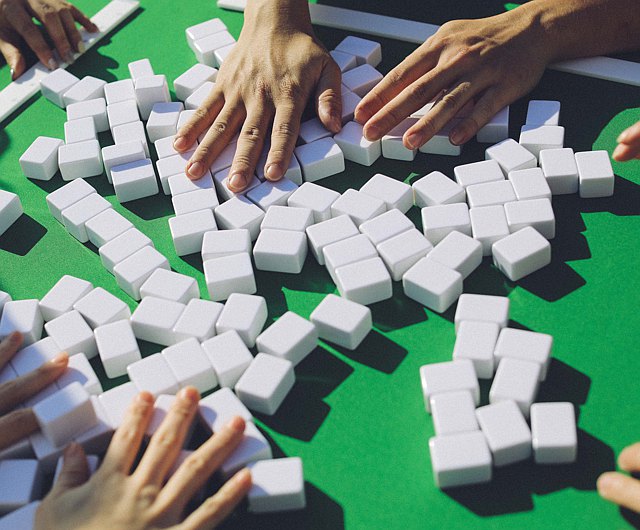
Traditional dosek tiles can be made from any material, as long as they're hard enough to not be bent, uniform in size and appearance, and large enough to be picked up by drake claws. Modern sets are painted ceramic, and are thick enough to stand on their sides such that a player can hide their hand without the need for a rack.
Each tile is numbered from 1 to 8 in an equal distribution. The numbers are shown using sets of (purely cosmetic) icons: 1 and 2 have bundles of wood, 3 and 4 have stone blocks, 5 and 6 have copper rods, and 7 and 8 have polished rubies.
A game of dosek typically has two to three players. More can play if multiple tile sets are used at once, but this is uncommon. Each player is dealt a hand they keep secret from the others. The remaining tiles are set to the side face-down to form the "store."
Once everyone has seen their hand, a round of initial betting begins, starting with the dealer. They may add any amount to the pot, though some dosek circles have a required minimum. From there, each player may either "match" (bet the same amount), "raise" (bet that amount plus something extra), or "break" (forfeit the game and anything they already added to the pot, without making further bets). If someone raises, that becomes the new minimum for matching, and anyone who has already bet must add in the extra. Betting continues in this manner until everyone has matched.
From there, whoever was last to add something to the pot takes the first turn.
On their turn, a player has two primary options: play a tile, or buy one from the store.
Playing Tiles
The player may add one tile to one of the "works" in play. There can be up to four active works at a time. If there are fewer (such as at the start of the game, when there are none), the player may start a new one.
A work can be added to as long as its total value (which just adds up all the values of its tiles) is not brought above 17. The goal is to bring it to 17 exactly. If a player does this, they take the work. Another work may then later be started in its place.
Buying From the Store
If a player can't play any tiles – for example, if they don't have any left, or all the works' values are too high – or they simply don't want to play anything in their current hand, they may add a small, flat amount to the pot to buy a random tile from the store. The amount is usually decided on ahead of time, often by the dealer.
If the bought tile would allow the player to complete a work, they may play it immediately and claim the work. Otherwise, the next player takes their turn.
If You Can't Play
If the player can't play any tiles and doesn't want to pay for one from the store (or is out of money to bet with), they may break instead, forfeiting the game.
The game is over when either (1) someone takes a certain amount of works, decided on beforehand, or (2) every player but one breaks. In either case, that player is the winner, and takes the pot.
History
Dosek was originally invented as a way for drakes to earn treasure and goods without the skills to make something themselves, and to pass the time with strangers while still getting something out of the interaction. While humans typically play with money, drakes are more likely to offer assorted treasures that everyone must agree on the relative value of before proceeding.
Dosek spread to Terrata by way of an earth Dragon family, which learned the game from stolen scrolls and was stranded by the Aida Spacetime Incident long ago. Its descendants still live to this day, though by now the game has spread far enough for its origins to be difficult to trace.
Regardless of player species, dosek is typically played on the street in informal contexts, though some have taken to starting "dosek dens" where people come from far and wide to play against the best of the best.
Overview
Details about this sport's overview
Playing
Details about this sport's playing
Traditional dosek tiles can be made from any material, as long as they're hard enough to not be bent, uniform in size and appearance, and large enough to be picked up by drake claws. Modern sets are painted ceramic, and are thick enough to stand on their sides such that a player can hide their hand without the need for a rack.
Each tile is numbered from 1 to 8 in an equal distribution. The numbers are shown using sets of (purely cosmetic) icons: 1 and 2 have bundles of wood, 3 and 4 have stone blocks, 5 and 6 have copper rods, and 7 and 8 have polished rubies.
A game of dosek typically has two to three players. More can play if multiple tile sets are used at once, but this is uncommon. Each player is dealt a hand they keep secret from the others. The remaining tiles are set to the side face-down to form the "store."
Once everyone has seen their hand, a round of initial betting begins, starting with the dealer. They may add any amount to the pot, though some dosek circles have a required minimum. From there, each player may either "match" (bet the same amount), "raise" (bet that amount plus something extra), or "break" (forfeit the game and anything they already added to the pot, without making further bets). If someone raises, that becomes the new minimum for matching, and anyone who has already bet must add in the extra. Betting continues in this manner until everyone has matched.
From there, whoever was last to add something to the pot takes the first turn.
On their turn, a player has two primary options: play a tile, or buy one from the store.
Playing Tiles
The player may add one tile to one of the "works" in play. There can be up to four active works at a time. If there are fewer (such as at the start of the game, when there are none), the player may start a new one.
A work can be added to as long as its total value (which just adds up all the values of its tiles) is not brought above 17. The goal is to bring it to 17 exactly. If a player does this, they take the work. Another work may then later be started in its place.
Buying From the Store
If a player can't play any tiles – for example, if they don't have any left, or all the works' values are too high – or they simply don't want to play anything in their current hand, they may add a small, flat amount to the pot to buy a random tile from the store. The amount is usually decided on ahead of time, often by the dealer.
If the bought tile would allow the player to complete a work, they may play it immediately and claim the work. Otherwise, the next player takes their turn.
If You Can't Play
If the player can't play any tiles and doesn't want to pay for one from the store (or is out of money to bet with), they may break instead, forfeiting the game.
The game is over when either (1) someone takes a certain amount of works, decided on beforehand, or (2) every player but one breaks. In either case, that player is the winner, and takes the pot.
History
Details about this sport's history
Dosek was originally invented as a way for drakes to earn treasure and goods without the skills to make something themselves, and to pass the time with strangers while still getting something out of the interaction. While humans typically play with money, drakes are more likely to offer assorted treasures that everyone must agree on the relative value of before proceeding.
Dosek spread to Terrata by way of an earth Dragon family, which learned the game from stolen scrolls and was stranded by the Aida Spacetime Incident long ago. Its descendants still live to this day, though by now the game has spread far enough for its origins to be difficult to trace.
Regardless of player species, dosek is typically played on the street in informal contexts, though some have taken to starting "dosek dens" where people come from far and wide to play against the best of the best.
Notes
Details about this sport's notes
No notes information yet
This section doesn't have any information filled in yet.
Gallery
Images and visual content for this sport
Associations
Other pages that reference or connect to this sport
Collections
Published collections that feature this sport
Not in any collections yet
This sport hasn't been published in any collections yet. Collections are curated groups of related content that help organize and showcase your world.
Tip: Collections are a great way to group related content together and share themed stories or worldbuilding elements with others.
Timelines
Timelines that reference or include this sport
No timeline connections yet
This sport isn't connected to any timelines yet. Timelines help organize events chronologically and show how your content fits into the broader history of your world.
Tip: Create timelines to organize important events in your world's history. Link characters, locations, and other content to specific events to build rich, interconnected narratives.
Shares
Discussion about this sport
No shares yet
Be the first to start a discussion about this sport by sharing it to the community stream.
Privacy & Sharing
Manage who can see and access this sport
Current Status
refresh
This sport is currently
Privacy Settings
Choose who can see and access this sport
language Universe Privacy
This page belongs to a universe with its own privacy settings