
Categories
Dive Deeper
Page Stats
Navigation
Categories
Dive Deeper
Page Stats
Complete Details
All information about this character
Overview
Penance Queen
Colony matriarch and developmental source
Leader , Queen , Reproducer
Female
Estimated age range: 40–70 years (adult onset by ~4–6 years, reproductive peak 8–30 years, senescence after ~50–80 years).
Looks
Estimated mass: 3,000–4,500 kg.
Estimated height (standing, to dorsal carapace top): 2.8–3.6 meters.
Details
Shoulder/leg height: 1.6–2.2 m (spiked short feet support a low, stable stance).
Dorsal carapace apex: additional 1.2–1.4 m above the legs when fully extended.
Overall length (head to tail): 4.5–6.0 m, depending on abdominal distension.
Variation: non‑gravid individuals toward the lower bound; gravid/brooding queens toward the upper bound.
Red
Penance
Sand
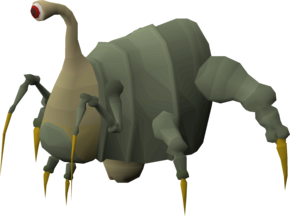
Size & build: extremely large, heavily sclerotized exoskeleton with overlapping dorsal plates forming a robust green carapace; massive abdomen with extensive brood musculature and nutrient stores; enlarged cranial tusks used for excavation and intraspecific signaling; short, spiked, weight‑bearing feet adapted for stability on uneven chamber floors.
Nature
Vulnerabilities & mortality: extreme armor reduces susceptibility to conventional weapons; lethal approaches exploit:
Sustained thermal collapse (fire): prolonged high heat denatures connective proteins and causes systemic failure in brood tissues.
Focused barbed penetrations into the ventral soft tissues or between dorsal plates: barbed implements that lodge and tear internal organs cause slow, fatal hemorrhage.
Disruption of chemical signaling: targeted sterilization or neutralization of pheromones and symbionts can fragment colony cohesion and reduce maternal investment.
Family
Notes
Size & build: extremely large, heavily sclerotized exoskeleton with overlapping dorsal plates forming a robust green carapace; massive abdomen with extensive brood musculature and nutrient stores; enlarged cranial tusks used for excavation and intraspecific signaling; short, spiked, weight‑bearing feet adapted for stability on uneven chamber floors.
Neural control: possesses an advanced distributed nervous architecture integrating dense sensory ganglia and a volatile neurochemical suite that coordinates colony behavior; signals propagate via low‑frequency substrate vibrations and chemical emitters, producing a functional telepathic‑like effect among conspecifics (see Mechanism below).
Reproduction: viviparous or matrotrophic ovovivipary — eggs/larvae develop within the queen, nourished by stored reserves and specialized glands; she births relatively advanced “queen spawn” that undergo direct development into other caste morphologies depending on local cues and nutrition.
Armor & defense: dorsal carapace resists cutting and piercing; tusks used to clear obstructions and to fend off large intruders; spiked feet anchor the queen against tipping and are effective against grappling predators.
Central role: functions as reproductive core, colony coordinator, and long‑term nutrient sink; her health directly governs colony cohesion and growth rates.
Communication & coordination: transmits colony directives using multimodal signals:
Substrate vibration pulses encoded by amplitude/frequency patterns (detected by mechanoreceptors in conspecifics).
Volatile pheromones and glandular aerosols that modulate aggression, foraging, and brood care.
Symbiotic microbes in secretions help broadcast chemical cues more persistently across cave surfaces. These channels create the appearance of instantaneous, telepathic control within the limited spatial scale of the colony.
Vulnerabilities & mortality: extreme armor reduces susceptibility to conventional weapons; lethal approaches exploit:
Sustained thermal collapse (fire): prolonged high heat denatures connective proteins and causes systemic failure in brood tissues.
Focused barbed penetrations into the ventral soft tissues or between dorsal plates: barbed implements that lodge and tear internal organs cause slow, fatal hemorrhage.
Disruption of chemical signaling: targeted sterilization or neutralization of pheromones and symbionts can fragment colony cohesion and reduce maternal investment.
Life history & colony dynamics: Queens are long‑lived relative to workers; colony growth is episodic and closely tied to resource influx. Removal of a queen triggers short‑term social instability and competition among large juveniles for queen succession sites.
“Telepathy” explained: not psychic transmission but rapid, redundant signaling via substrate seismic codes, volatile pheromone waves, and microbial mediators that preserve and amplify chemical messages on cave surfaces; because caves are acoustically and chemically closed systems, signals propagate reliably and produce the impression of direct mental control.
Queen brooding physiology: matrotrophy and extended parental investment occur in many invertebrates and provide a plausible analogue for producing advanced offspring in constrained, nutrient‑patchy environments.
Overview
Details about this character's overview
Penance Queen
Colony matriarch and developmental source
Leader , Queen , Reproducer
Female
Estimated age range: 40–70 years (adult onset by ~4–6 years, reproductive peak 8–30 years, senescence after ~50–80 years).
Looks
Details about this character's looks
Estimated mass: 3,000–4,500 kg.
Estimated height (standing, to dorsal carapace top): 2.8–3.6 meters.
Details
Shoulder/leg height: 1.6–2.2 m (spiked short feet support a low, stable stance).
Dorsal carapace apex: additional 1.2–1.4 m above the legs when fully extended.
Overall length (head to tail): 4.5–6.0 m, depending on abdominal distension.
Variation: non‑gravid individuals toward the lower bound; gravid/brooding queens toward the upper bound.
Red
Penance
Sand
Size & build: extremely large, heavily sclerotized exoskeleton with overlapping dorsal plates forming a robust green carapace; massive abdomen with extensive brood musculature and nutrient stores; enlarged cranial tusks used for excavation and intraspecific signaling; short, spiked, weight‑bearing feet adapted for stability on uneven chamber floors.
Nature
Details about this character's nature
Vulnerabilities & mortality: extreme armor reduces susceptibility to conventional weapons; lethal approaches exploit:
Sustained thermal collapse (fire): prolonged high heat denatures connective proteins and causes systemic failure in brood tissues.
Focused barbed penetrations into the ventral soft tissues or between dorsal plates: barbed implements that lodge and tear internal organs cause slow, fatal hemorrhage.
Disruption of chemical signaling: targeted sterilization or neutralization of pheromones and symbionts can fragment colony cohesion and reduce maternal investment.
Social
Details about this character's social
No social information yet
This section doesn't have any information filled in yet.
History
Details about this character's history
No history information yet
This section doesn't have any information filled in yet.
Family
Details about this character's family
Inventory
Details about this character's inventory
No inventory information yet
This section doesn't have any information filled in yet.
Notes
Details about this character's notes
Size & build: extremely large, heavily sclerotized exoskeleton with overlapping dorsal plates forming a robust green carapace; massive abdomen with extensive brood musculature and nutrient stores; enlarged cranial tusks used for excavation and intraspecific signaling; short, spiked, weight‑bearing feet adapted for stability on uneven chamber floors.
Neural control: possesses an advanced distributed nervous architecture integrating dense sensory ganglia and a volatile neurochemical suite that coordinates colony behavior; signals propagate via low‑frequency substrate vibrations and chemical emitters, producing a functional telepathic‑like effect among conspecifics (see Mechanism below).
Reproduction: viviparous or matrotrophic ovovivipary — eggs/larvae develop within the queen, nourished by stored reserves and specialized glands; she births relatively advanced “queen spawn” that undergo direct development into other caste morphologies depending on local cues and nutrition.
Armor & defense: dorsal carapace resists cutting and piercing; tusks used to clear obstructions and to fend off large intruders; spiked feet anchor the queen against tipping and are effective against grappling predators.
Central role: functions as reproductive core, colony coordinator, and long‑term nutrient sink; her health directly governs colony cohesion and growth rates.
Communication & coordination: transmits colony directives using multimodal signals:
Substrate vibration pulses encoded by amplitude/frequency patterns (detected by mechanoreceptors in conspecifics).
Volatile pheromones and glandular aerosols that modulate aggression, foraging, and brood care.
Symbiotic microbes in secretions help broadcast chemical cues more persistently across cave surfaces. These channels create the appearance of instantaneous, telepathic control within the limited spatial scale of the colony.
Vulnerabilities & mortality: extreme armor reduces susceptibility to conventional weapons; lethal approaches exploit:
Sustained thermal collapse (fire): prolonged high heat denatures connective proteins and causes systemic failure in brood tissues.
Focused barbed penetrations into the ventral soft tissues or between dorsal plates: barbed implements that lodge and tear internal organs cause slow, fatal hemorrhage.
Disruption of chemical signaling: targeted sterilization or neutralization of pheromones and symbionts can fragment colony cohesion and reduce maternal investment.
Life history & colony dynamics: Queens are long‑lived relative to workers; colony growth is episodic and closely tied to resource influx. Removal of a queen triggers short‑term social instability and competition among large juveniles for queen succession sites.
“Telepathy” explained: not psychic transmission but rapid, redundant signaling via substrate seismic codes, volatile pheromone waves, and microbial mediators that preserve and amplify chemical messages on cave surfaces; because caves are acoustically and chemically closed systems, signals propagate reliably and produce the impression of direct mental control.
Queen brooding physiology: matrotrophy and extended parental investment occur in many invertebrates and provide a plausible analogue for producing advanced offspring in constrained, nutrient‑patchy environments.
Gallery
Images and visual content for this character
Associations
Other pages that reference or connect to this character
Referenced By
5Collections
Published collections that feature this character
Not in any collections yet
This character hasn't been published in any collections yet. Collections are curated groups of related content that help organize and showcase your world.
Tip: Collections are a great way to group related content together and share themed stories or worldbuilding elements with others.
Timelines
Timelines that reference or include this character
No timeline connections yet
This character isn't connected to any timelines yet. Timelines help organize events chronologically and show how your content fits into the broader history of your world.
Tip: Create timelines to organize important events in your world's history. Link characters, locations, and other content to specific events to build rich, interconnected narratives.
Shares
Discussion about this character
No shares yet
Be the first to start a discussion about this character by sharing it to the community stream.
Privacy & Sharing
Manage who can see and access this character
Current Status
refresh
This character is currently
Privacy Settings
Choose who can see and access this character
language Universe Privacy
This page belongs to a universe with its own privacy settings