
Categories
Dive Deeper
Page Stats
Navigation
Categories
Dive Deeper
Page Stats
Complete Details
All information about this planet
Overview
Azafát
Geography
Earth-like: mostly water, with large islands jutting up over the area along tectonic platelines
Climate
- Not common, but [explanation of The Strange Storm]
Inhabitants
Vagapariña:
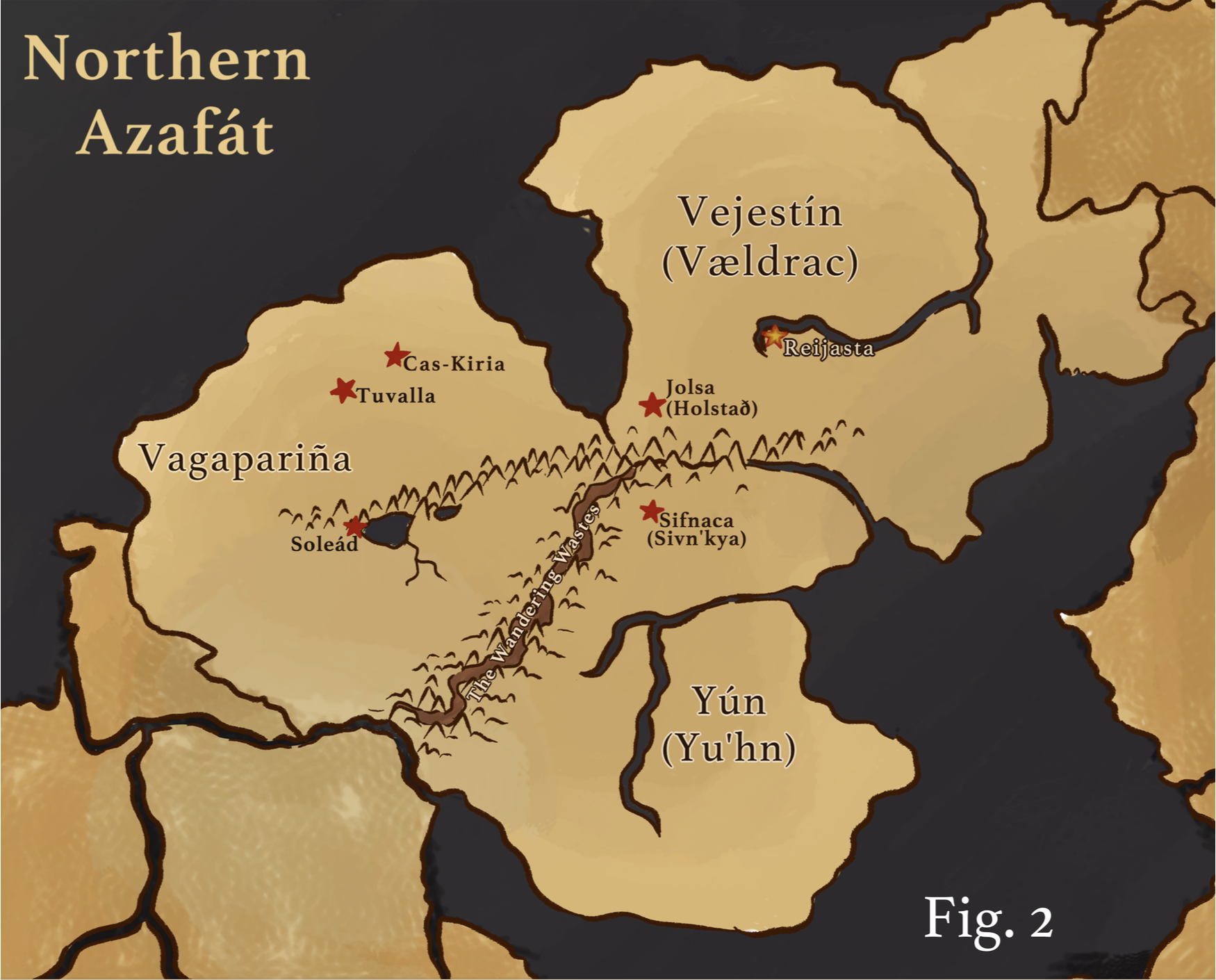
A relatively newer country (established roughly two centuries previously), Vagapariña was founded by the new cultists of Yan-Reigaste, fleeting Vældrac after an upsurge of infighting lent the new religion an unstable partner for Ischvinðar. By the time of the story, Vagapariña has established its own vibrant culture, quite distinct from the increasingly traditionalistic Vældic cultures. Vagapariñe noble families, as a reflection of the three spheres at the mercy of Yan-Reigaste, tend to be comprised of the Mayadón (Head of House), their three spouses, those spouses’ children (with or not with the Mayadón, though this varies depending on the family and region), and the Mayadón’s extended family. The Mayadón’s spouses typically become their advisors, leaders at court, treasurers, and religious authorities, though again this varies with each case.
Vagapariña works as a theocratic oligarchy, the Mayadones standing as metaphorical stewards to the king, their god. Therefore, there can be no living monarch, and so a council of powerful Mayadones and priests meet bi-yearly in Soleád (a major religious and cultural center) to tend to national and clerical matters. Otherwise, the politics of the country are rather decentralized, the largest unifier being their religion and historical unity against the Vældic Kingdom.
Vældrac:
An ancient kingdom, Vældrac is largely a culture of warriors. Their society, built around the instilled with conflict and long battles, has shaped itself around the dynamics of fighting to accommodate the vast amount of its population that take the soldier’s occupation early in life, only settling into trades or practices later in life. Though monarchical and, in name, monogamous, there is one important caveat— warpartners. Historically, on the eve of a war, it was custom for two soldiers who had trained together to symbolically marry, becoming one as two, and in that vein strengthening their prowess on the battlefield as Ischvind’s multiplicity in one strengthens their might over the world. Nowadays, the monarchy has re-instilled the idea of warpartners into the social consciousness to boost nationalism through celebration of tradition. Warpartners, importantly, cannot procreate with each other, instead forming “Quadrants” with another pair and procreating between each other. In peacetime, the Quadrant raises the children, but in wartime the task falls to local elders.
Yu’hn:
South of Vagapariña and Vældrac, Yu’hn is geographically separated from them by a
mountain range to the north and the Wandering Wastes (a desolate wasteland with a great gulch ripping apart an older mountain chain) to the west. The Yu’hnsk government is made up of the Prime-masters from each recognized guild, the country being largely concerned with its trade and material production, and thus willing to let the leaders of these facilitators govern their affairs.
Astral
Esole
History
Vagapariña:
A relatively newer country (established roughly two centuries previously), Vagapariña was founded by the new cultists of Yan-Reigaste, fleeting Vældrac after an upsurge of infighting lent the new religion an unstable partner for Ischvinðar.
Overview
Details about this planet's overview
Azafát
Geography
Details about this planet's geography
Earth-like: mostly water, with large islands jutting up over the area along tectonic platelines
Climate
Details about this planet's climate
- Not common, but [explanation of The Strange Storm]
Time
Details about this planet's time
No time information yet
This section doesn't have any information filled in yet.
Inhabitants
Details about this planet's inhabitants
Vagapariña:
A relatively newer country (established roughly two centuries previously), Vagapariña was founded by the new cultists of Yan-Reigaste, fleeting Vældrac after an upsurge of infighting lent the new religion an unstable partner for Ischvinðar. By the time of the story, Vagapariña has established its own vibrant culture, quite distinct from the increasingly traditionalistic Vældic cultures. Vagapariñe noble families, as a reflection of the three spheres at the mercy of Yan-Reigaste, tend to be comprised of the Mayadón (Head of House), their three spouses, those spouses’ children (with or not with the Mayadón, though this varies depending on the family and region), and the Mayadón’s extended family. The Mayadón’s spouses typically become their advisors, leaders at court, treasurers, and religious authorities, though again this varies with each case.
Vagapariña works as a theocratic oligarchy, the Mayadones standing as metaphorical stewards to the king, their god. Therefore, there can be no living monarch, and so a council of powerful Mayadones and priests meet bi-yearly in Soleád (a major religious and cultural center) to tend to national and clerical matters. Otherwise, the politics of the country are rather decentralized, the largest unifier being their religion and historical unity against the Vældic Kingdom.
Vældrac:
An ancient kingdom, Vældrac is largely a culture of warriors. Their society, built around the instilled with conflict and long battles, has shaped itself around the dynamics of fighting to accommodate the vast amount of its population that take the soldier’s occupation early in life, only settling into trades or practices later in life. Though monarchical and, in name, monogamous, there is one important caveat— warpartners. Historically, on the eve of a war, it was custom for two soldiers who had trained together to symbolically marry, becoming one as two, and in that vein strengthening their prowess on the battlefield as Ischvind’s multiplicity in one strengthens their might over the world. Nowadays, the monarchy has re-instilled the idea of warpartners into the social consciousness to boost nationalism through celebration of tradition. Warpartners, importantly, cannot procreate with each other, instead forming “Quadrants” with another pair and procreating between each other. In peacetime, the Quadrant raises the children, but in wartime the task falls to local elders.
Yu’hn:
South of Vagapariña and Vældrac, Yu’hn is geographically separated from them by a
mountain range to the north and the Wandering Wastes (a desolate wasteland with a great gulch ripping apart an older mountain chain) to the west. The Yu’hnsk government is made up of the Prime-masters from each recognized guild, the country being largely concerned with its trade and material production, and thus willing to let the leaders of these facilitators govern their affairs.
Astral
Details about this planet's astral
Esole
History
Details about this planet's history
Vagapariña:
A relatively newer country (established roughly two centuries previously), Vagapariña was founded by the new cultists of Yan-Reigaste, fleeting Vældrac after an upsurge of infighting lent the new religion an unstable partner for Ischvinðar.
Notes
Details about this planet's notes
No notes information yet
This section doesn't have any information filled in yet.
Gallery
Images and visual content for this planet
Associations
Other pages that reference or connect to this planet
Referenced By
9Reigín
Surface
Reigín
Nearby planets
The Middle Moon
Size
Reigín
Suns
Auris' Tribute
Planets
Vamah [The Humble Warrior]
Planets
Esole
Nearby planets
the Select
Weaknesses
Various Tales of Pale Snatchers
Planets
Collections
Published collections that feature this planet
Not in any collections yet
This planet hasn't been published in any collections yet. Collections are curated groups of related content that help organize and showcase your world.
Tip: Collections are a great way to group related content together and share themed stories or worldbuilding elements with others.
Timelines
Timelines that reference or include this planet
No timeline connections yet
This planet isn't connected to any timelines yet. Timelines help organize events chronologically and show how your content fits into the broader history of your world.
Tip: Create timelines to organize important events in your world's history. Link characters, locations, and other content to specific events to build rich, interconnected narratives.
Shares
Discussion about this planet
No shares yet
Be the first to start a discussion about this planet by sharing it to the community stream.
Privacy & Sharing
Manage who can see and access this planet
Current Status
refresh
This planet is currently
Privacy Settings
Choose who can see and access this planet
language Universe Privacy
This page belongs to a universe with its own privacy settings