Categories
Dive Deeper
Page Stats
Navigation
Categories
Dive Deeper
Page Stats
Complete Details
All information about this creature
Overview
Meer (Palm) Civet
Smaller and more friendly cousin of Lunar Civet
Mammal
Looks
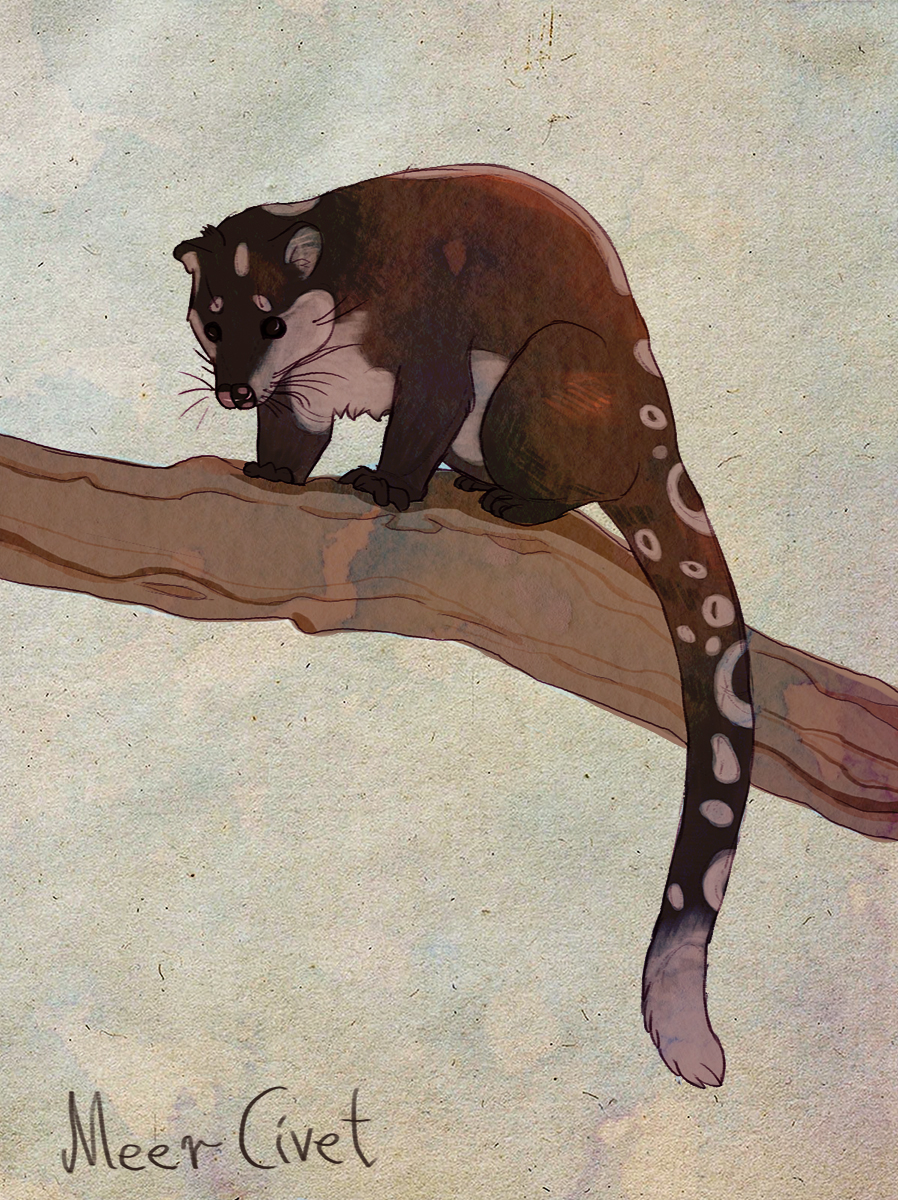
Meer Civets have dark brown fur, with reddish tones. Lips, chin, throat and belly are grey to white, depending on the individual. The end of Meer civet's tails is also lighter then the majority of it's coat. Light spot patterns appear throughout the tail- and, since no other civet has the same pattern, spots seem to be good identification method.
Cat-shape, similar to that of Lunar Civet, with longer tail and smaller ears.
The main body varies from 51 to 76 cm (20 to 28 in) in length, to which is added a tail of 51 to 63 cm (20 to 25 in).
"cat sized", if not smaller.
It weighs between 4 and 7 kg (8.8 and 15.4 lb).
It has three mammary glands.
Females and males own scend glands resembling testicles under the tail, which lead some Scholars to believe that this spieces are intersex.
unknown
Fur
Traits
Meer civets are quite shy and reserved animals that, if threatened, prefers to flee instead of attack. They are not known to attack humanoids, unless cornered- in that case, they'll use their sharp teeth and claws.
When alarmed, the animal sprays a secretion from its anal gland against the predator. The spray is similar in function to that of a skunk, and its conspicuousness serves to deter other predators.
(They also use the same mechanism to mark their territory and communicate with other members of their species. )
Unknown
Speed, agility; ability to climb on trees.
Their small size makes them vunerable to larger predators.
Meer civets are usually silent, as they prefer to use scent as a main way of communication, but they can produce sounds really simmilar to meows. When threatened by other species, it will hiss and growl.
Fur and anal glands that, if properly taken care of, can be turned into ingredient of perfume.
Smell
unknown
Habitat
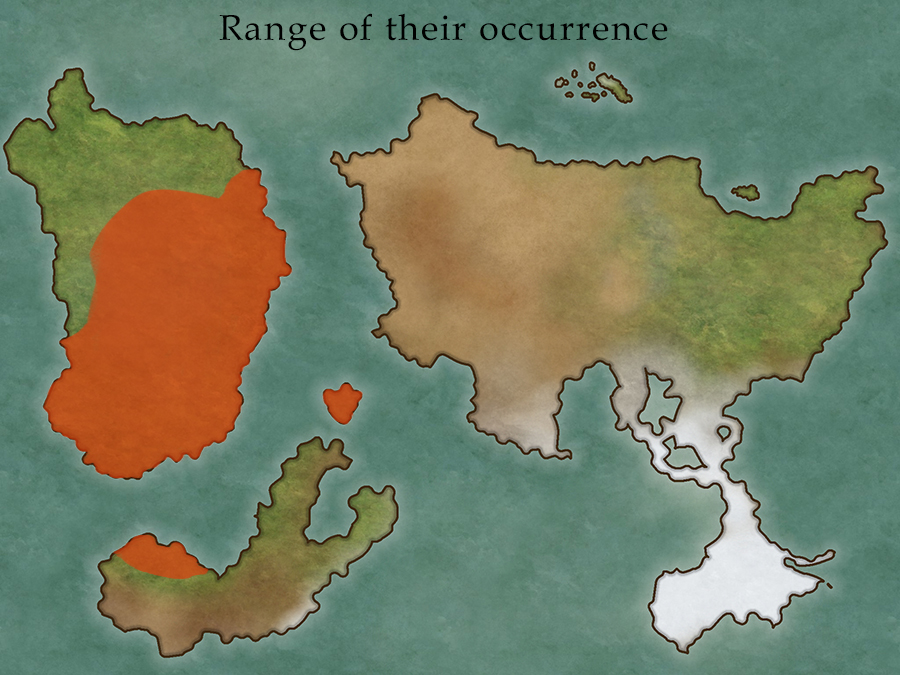
Warmer places, with high procentage of humidity. Since they are partly arboreal, they prefer living in dense forrests.
Meer civets are solitary creatures, with the exception of breeding season.
Big birds, snakes,
Meer civets are omnivorous, which means they eat both meat and plant based foods. Prey includes rodents, frogs, and snakes, while plant based favorites include coffee, mango, bananas and flower nectar.
Although they are not as domesticated as cats and dogs, they can become a very good pet, if taken care of by humans since it's first days of life.
Civets are a very popular companion to Syrinx , because they are very good tree climbers, and can be trained to investigate unreachable (for humans) spaces and signal upcoming danger. They also don't need to be fed, as they can search for food on their own.
In last 20 years Meer Civets has gotten more recognition on other continents for eating unwanted insects therefore fixing the crops- and as they aren't predators like cats, they aren't a danger to local species of birds and rodents.
You need to be careful though, because too dry enviorment might lead to civet developing lung and throat diseases.
Comparisons
Although they look a lot like cats, they are unrelated to felines. They are mostly related to creatures like ferrets, mongeese and and weasels.
Reproduction
Copulation in Meer can last for more than 30 minutes. Upon completion of copulation, males leave a copulation plug in the female's vaginal tract. After it's done, both male and female separate and go back to their own territories.
Civets are polyestrous and their mating behavior is promiscuous.
There are two breeding seasons per year. Pregnancy lasts two months.
Females take care of their offspring up until they are independent. Pups are weaned by three to four months, reaching reproductive age at a year old.
unknown
Notes
References i used to create and describe Meer Civets;
http://animalia.bio/asian-palm-civet
https://en.wikipedia.org/wiki/Masked_palm_civet
https://a-z-animals.com/animals/asian-palm-civet/
Overview
Details about this creature's overview
Meer (Palm) Civet
Smaller and more friendly cousin of Lunar Civet
Mammal
Looks
Details about this creature's looks
Meer Civets have dark brown fur, with reddish tones. Lips, chin, throat and belly are grey to white, depending on the individual. The end of Meer civet's tails is also lighter then the majority of it's coat. Light spot patterns appear throughout the tail- and, since no other civet has the same pattern, spots seem to be good identification method.
Cat-shape, similar to that of Lunar Civet, with longer tail and smaller ears.
The main body varies from 51 to 76 cm (20 to 28 in) in length, to which is added a tail of 51 to 63 cm (20 to 25 in).
"cat sized", if not smaller.
It weighs between 4 and 7 kg (8.8 and 15.4 lb).
It has three mammary glands.
Females and males own scend glands resembling testicles under the tail, which lead some Scholars to believe that this spieces are intersex.
unknown
Fur
Traits
Details about this creature's traits
Meer civets are quite shy and reserved animals that, if threatened, prefers to flee instead of attack. They are not known to attack humanoids, unless cornered- in that case, they'll use their sharp teeth and claws.
When alarmed, the animal sprays a secretion from its anal gland against the predator. The spray is similar in function to that of a skunk, and its conspicuousness serves to deter other predators.
(They also use the same mechanism to mark their territory and communicate with other members of their species. )
Unknown
Speed, agility; ability to climb on trees.
Their small size makes them vunerable to larger predators.
Meer civets are usually silent, as they prefer to use scent as a main way of communication, but they can produce sounds really simmilar to meows. When threatened by other species, it will hiss and growl.
Fur and anal glands that, if properly taken care of, can be turned into ingredient of perfume.
Smell
unknown
Habitat
Details about this creature's habitat
Warmer places, with high procentage of humidity. Since they are partly arboreal, they prefer living in dense forrests.
Meer civets are solitary creatures, with the exception of breeding season.
Big birds, snakes,
Meer civets are omnivorous, which means they eat both meat and plant based foods. Prey includes rodents, frogs, and snakes, while plant based favorites include coffee, mango, bananas and flower nectar.
Although they are not as domesticated as cats and dogs, they can become a very good pet, if taken care of by humans since it's first days of life.
Civets are a very popular companion to Syrinx , because they are very good tree climbers, and can be trained to investigate unreachable (for humans) spaces and signal upcoming danger. They also don't need to be fed, as they can search for food on their own.
In last 20 years Meer Civets has gotten more recognition on other continents for eating unwanted insects therefore fixing the crops- and as they aren't predators like cats, they aren't a danger to local species of birds and rodents.
You need to be careful though, because too dry enviorment might lead to civet developing lung and throat diseases.
Comparisons
Details about this creature's comparisons
Although they look a lot like cats, they are unrelated to felines. They are mostly related to creatures like ferrets, mongeese and and weasels.
Evolution
Details about this creature's evolution
No evolution information yet
This section doesn't have any information filled in yet.
Reproduction
Details about this creature's reproduction
Copulation in Meer can last for more than 30 minutes. Upon completion of copulation, males leave a copulation plug in the female's vaginal tract. After it's done, both male and female separate and go back to their own territories.
Civets are polyestrous and their mating behavior is promiscuous.
There are two breeding seasons per year. Pregnancy lasts two months.
Females take care of their offspring up until they are independent. Pups are weaned by three to four months, reaching reproductive age at a year old.
unknown
Classification
Details about this creature's classification
No classification information yet
This section doesn't have any information filled in yet.
Notes
Details about this creature's notes
References i used to create and describe Meer Civets;
http://animalia.bio/asian-palm-civet
https://en.wikipedia.org/wiki/Masked_palm_civet
https://a-z-animals.com/animals/asian-palm-civet/
Gallery
Images and visual content for this creature
Associations
Other pages that reference or connect to this creature
Referenced By
2Collections
Published collections that feature this creature
Not in any collections yet
This creature hasn't been published in any collections yet. Collections are curated groups of related content that help organize and showcase your world.
Tip: Collections are a great way to group related content together and share themed stories or worldbuilding elements with others.
Timelines
Timelines that reference or include this creature
No timeline connections yet
This creature isn't connected to any timelines yet. Timelines help organize events chronologically and show how your content fits into the broader history of your world.
Tip: Create timelines to organize important events in your world's history. Link characters, locations, and other content to specific events to build rich, interconnected narratives.
Shares
Discussion about this creature
No shares yet
Be the first to start a discussion about this creature by sharing it to the community stream.
Privacy & Sharing
Manage who can see and access this creature
Current Status
refresh
This creature is currently
Privacy Settings
Choose who can see and access this creature
language Universe Privacy
This page belongs to a universe with its own privacy settings