Categories
Dive Deeper
Page Stats
Navigation
Categories
Dive Deeper
Page Stats
Complete Details
All information about this creature
Overview
Lunar Civet
Rare, nocturnal mammal associated with Godess Vileyi
Mammal
Looks
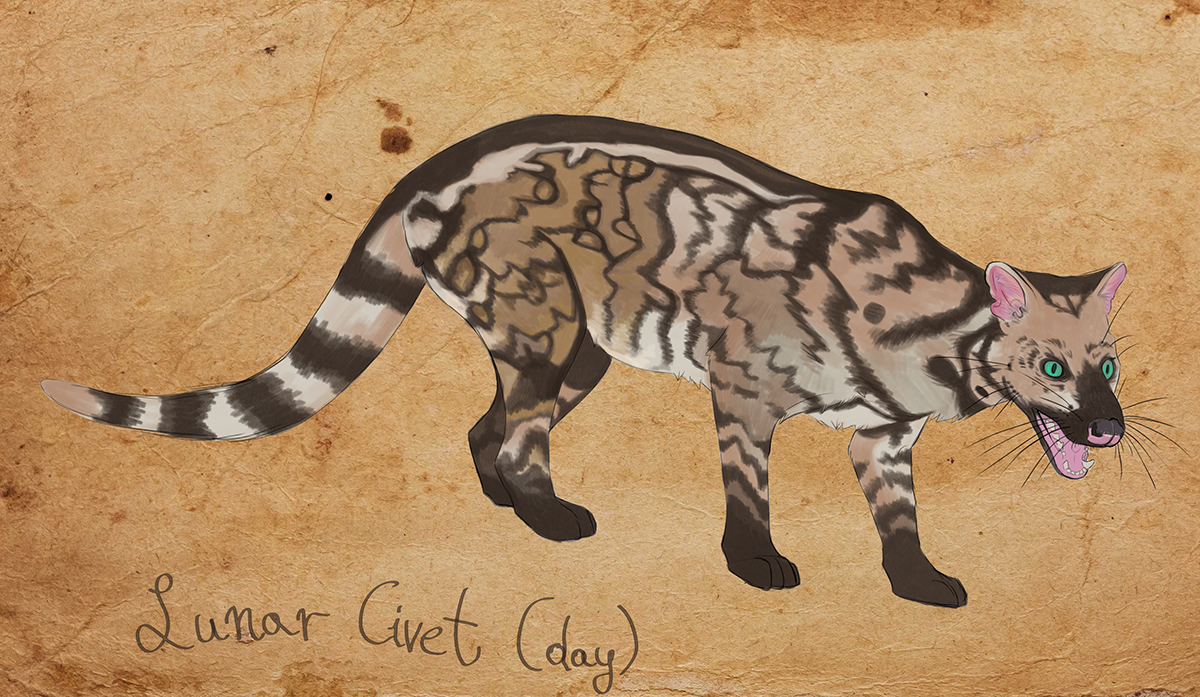
The Lunar Civet is grey or tawny and has a black spinal stripe running from behind the shoulders to the root of the tail. The front of the muzzle has a whitish patch emphasized by blackish behind on each side. The chin and fore throat are blackish. The sides and lower surface of the neck are banded with black stripes and white spaces in between. The tail has a variable number of complete black and white rings.
Civets have a broadly cat-like general appearance, though the muzzle is extended and often pointed, rather like that of an otter, mongoose or even possibly a ferret.
Compared to other spieces of civets, Lunar Civets are rather large, with their length ranging from about 50cm to 100cm (excluding their long tails, which often can be as 3/4 of their body length) and in weight from about 4 to 11kg.
In daylight, Lunar Civets aren't that much different from their cousins- with the exception of their light coloured eyes.
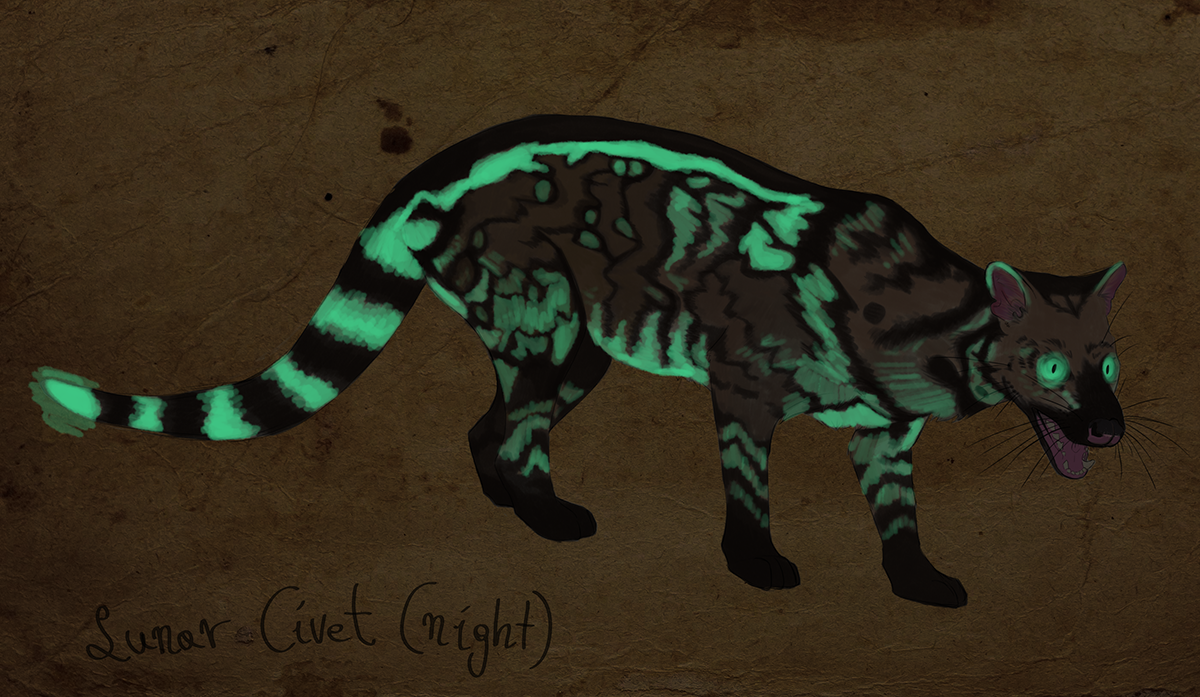
Difference is more visible during night time, when their fur starts to "glow".
It happens because Lunar Civets produce protein, that exhibits bright green fluorescence when exposed to light in the blue to ultraviolet range.
Traits
Although they are carnivorous, they aren't known for attacking animals bigger then themselves. Lunar Civets do not enjoy company of any humanoid spieces and tend to change their territories if they smell a human, with the exception of individuals living in oases ( fertile areas in a desert or semi-desert environments) - which cannot migrate often. In that case Civets keep their distance and attack only to protect their young.
There is a lot that is unknown about the animals. In their daily life, they may not move fast. Monks, who are most familiar with Lunar Civets, noted that three of marked individuals "moved at an average speed of 500 m/h (metres/hour) and traveled between 1.33 and 4.24 km each night". I've never seen a reliable statement about the maximum speed of the species.
The civets make few types of sounds -- a growl, a cough-spit, and a scream -- but the most commonly heard is the "ha ha ha" used in making contact. When threatened by humanoid species, they hiss.
Hearing and smelling
Taste
Habitat
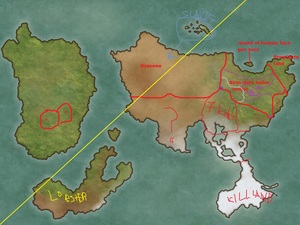
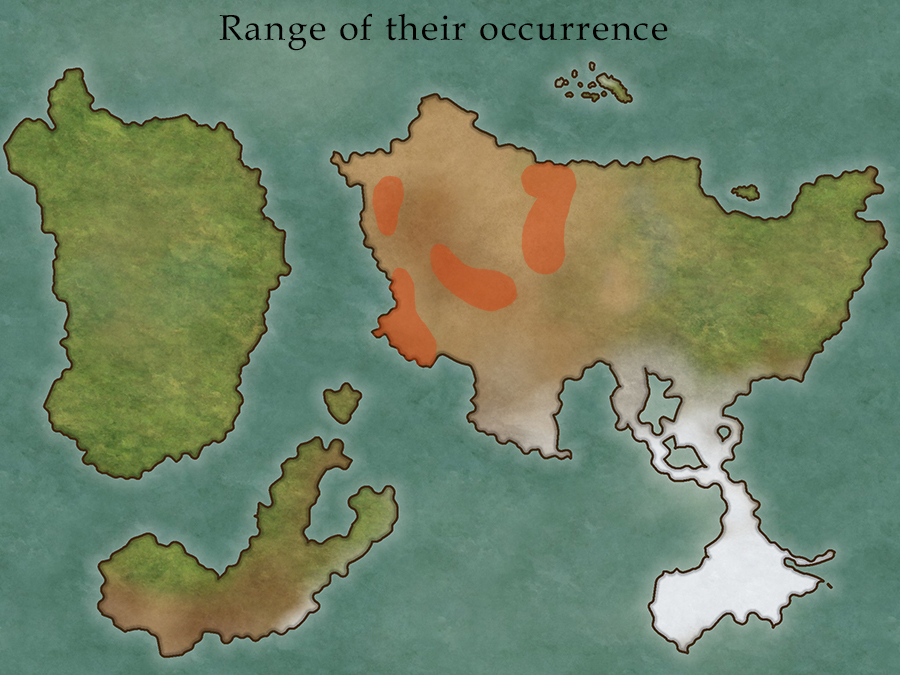
Lunar Civets seem to thrive in warmer climates, with dense vegetation and close to water sources. They are mostly common for oases, spread across Graenne's teritory.
Unknown
They seem to compete over territory and food with few species of desert viverns.
Most likely bigger, carnivorous creatures.
Lunar Civets are mostly known for their symbiosis relationship with Glowing Luna Moths, which resulted in them both becoming the symbol of Godess of Night and Destiny.
In natural habitat, Lunar Civets spend most of their nights walking around, carrying mentioned moths on their back. While Glowing Moths are keeping civet's healthy by feasting on flees and other parasites living in their fur, what moths are getting in return is protection from predators, easier way to migrate and find each other. They are also the ones that benefit from civet's death, as they are first to devour it's flesh, getting all the sodium they need to survive.
Religious humans believe that a sight of Lunar civet (no matter if alive or dead) accompanied by Glowing Moths is a sign of holy presence and making of a good decision.
Comparisons
It seems like Lunar Civets, although living on different continents and having different lifestyle, are mostly related to Meer Palm Civets.
Sign of Gods approving on your decision or life choice; sign of holy presence and being protected by spirits;
In literature and poems, especially in works of Graennian and Sirinian authors, they are a symbol of being in peace with your destiny and death, "carrying what gods planned for you on your shoulders without it weighting you down".
Reproduction
Unknown
Little is known about the mating and reproductive behavior of Lunar Civets. Breeding takes place at any time of the year. Females bear one litter each year of up to four young in each. Litters are born in very dense vegetation or in a hole in the ground. Young are able to open their eyes within ten days. Weaning starts at one month of age. Mothers raise their young on their own. Young can stay around their mother or at their mother's territory for next six months, until she becomes hostile and forces them to migrate.
Unknown
Classification
Chordata
Mammalia
Carnivora
Viverridae
Viverra
Viverra Candentis
Overview
Details about this creature's overview
Lunar Civet
Rare, nocturnal mammal associated with Godess Vileyi
Mammal
Looks
Details about this creature's looks
The Lunar Civet is grey or tawny and has a black spinal stripe running from behind the shoulders to the root of the tail. The front of the muzzle has a whitish patch emphasized by blackish behind on each side. The chin and fore throat are blackish. The sides and lower surface of the neck are banded with black stripes and white spaces in between. The tail has a variable number of complete black and white rings.
Civets have a broadly cat-like general appearance, though the muzzle is extended and often pointed, rather like that of an otter, mongoose or even possibly a ferret.
Compared to other spieces of civets, Lunar Civets are rather large, with their length ranging from about 50cm to 100cm (excluding their long tails, which often can be as 3/4 of their body length) and in weight from about 4 to 11kg.
In daylight, Lunar Civets aren't that much different from their cousins- with the exception of their light coloured eyes.
Difference is more visible during night time, when their fur starts to "glow".
It happens because Lunar Civets produce protein, that exhibits bright green fluorescence when exposed to light in the blue to ultraviolet range.
Traits
Details about this creature's traits
Although they are carnivorous, they aren't known for attacking animals bigger then themselves. Lunar Civets do not enjoy company of any humanoid spieces and tend to change their territories if they smell a human, with the exception of individuals living in oases ( fertile areas in a desert or semi-desert environments) - which cannot migrate often. In that case Civets keep their distance and attack only to protect their young.
There is a lot that is unknown about the animals. In their daily life, they may not move fast. Monks, who are most familiar with Lunar Civets, noted that three of marked individuals "moved at an average speed of 500 m/h (metres/hour) and traveled between 1.33 and 4.24 km each night". I've never seen a reliable statement about the maximum speed of the species.
The civets make few types of sounds -- a growl, a cough-spit, and a scream -- but the most commonly heard is the "ha ha ha" used in making contact. When threatened by humanoid species, they hiss.
Hearing and smelling
Taste
Habitat
Details about this creature's habitat
Lunar Civets seem to thrive in warmer climates, with dense vegetation and close to water sources. They are mostly common for oases, spread across Graenne's teritory.
Unknown
They seem to compete over territory and food with few species of desert viverns.
Most likely bigger, carnivorous creatures.
Lunar Civets are mostly known for their symbiosis relationship with Glowing Luna Moths, which resulted in them both becoming the symbol of Godess of Night and Destiny.
In natural habitat, Lunar Civets spend most of their nights walking around, carrying mentioned moths on their back. While Glowing Moths are keeping civet's healthy by feasting on flees and other parasites living in their fur, what moths are getting in return is protection from predators, easier way to migrate and find each other. They are also the ones that benefit from civet's death, as they are first to devour it's flesh, getting all the sodium they need to survive.
Religious humans believe that a sight of Lunar civet (no matter if alive or dead) accompanied by Glowing Moths is a sign of holy presence and making of a good decision.
Comparisons
Details about this creature's comparisons
It seems like Lunar Civets, although living on different continents and having different lifestyle, are mostly related to Meer Palm Civets.
Sign of Gods approving on your decision or life choice; sign of holy presence and being protected by spirits;
In literature and poems, especially in works of Graennian and Sirinian authors, they are a symbol of being in peace with your destiny and death, "carrying what gods planned for you on your shoulders without it weighting you down".
Evolution
Details about this creature's evolution
No evolution information yet
This section doesn't have any information filled in yet.
Reproduction
Details about this creature's reproduction
Unknown
Little is known about the mating and reproductive behavior of Lunar Civets. Breeding takes place at any time of the year. Females bear one litter each year of up to four young in each. Litters are born in very dense vegetation or in a hole in the ground. Young are able to open their eyes within ten days. Weaning starts at one month of age. Mothers raise their young on their own. Young can stay around their mother or at their mother's territory for next six months, until she becomes hostile and forces them to migrate.
Unknown
Classification
Details about this creature's classification
Chordata
Mammalia
Carnivora
Viverridae
Viverra
Viverra Candentis
Notes
Details about this creature's notes
No notes information yet
This section doesn't have any information filled in yet.
Gallery
Images and visual content for this creature
Associations
Other pages that reference or connect to this creature
Referenced By
4Collections
Published collections that feature this creature
Not in any collections yet
This creature hasn't been published in any collections yet. Collections are curated groups of related content that help organize and showcase your world.
Tip: Collections are a great way to group related content together and share themed stories or worldbuilding elements with others.
Timelines
Timelines that reference or include this creature
No timeline connections yet
This creature isn't connected to any timelines yet. Timelines help organize events chronologically and show how your content fits into the broader history of your world.
Tip: Create timelines to organize important events in your world's history. Link characters, locations, and other content to specific events to build rich, interconnected narratives.
Shares
Discussion about this creature
No shares yet
Be the first to start a discussion about this creature by sharing it to the community stream.
Privacy & Sharing
Manage who can see and access this creature
Current Status
refresh
This creature is currently
Privacy Settings
Choose who can see and access this creature
language Universe Privacy
This page belongs to a universe with its own privacy settings