
Categories
Dive Deeper
Page Stats
Navigation
Categories
Dive Deeper
Page Stats
Complete Details
All information about this creature
Overview
Drake Dogs
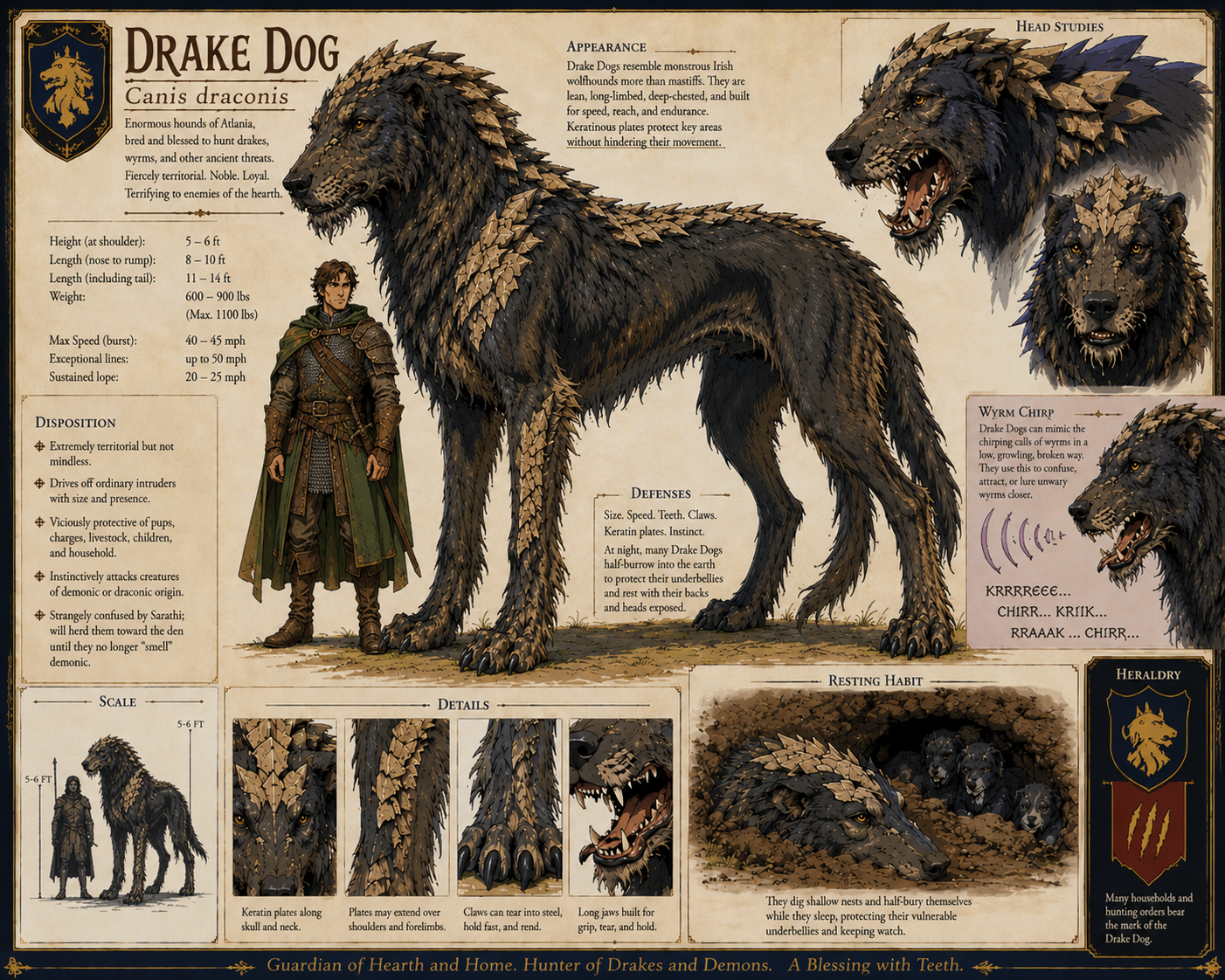
Drake Dogs are enormous Atlanian hounds descended, according to legend, from ordinary large hunting dogs changed during the ancient demon scourge. Some traditions say Cura blessed them to protect Atlanian homes, while others claim Kroloss gifted them to the Atlanians as beasts savage enough to fight demons. A mature Drake Dog stands five to six feet at the shoulder and resembles a monstrous Irish wolfhound: lean, lanky, deep-chested, narrow-waisted, long-jawed, and covered in coarse, stringy fur. Their powerful jaws are built for rending drakes and wyrms, their claws can tear into steel, and many bloodlines have hard keratinous plates along the skull, neck, shoulders, spine, and forelimbs. They are fiercely territorial but not indiscriminately aggressive, usually herding ordinary intruders away unless pups, children, livestock, charges, or bonded households are threatened. Against demonic or draconic creatures, however, they become far more dangerous, acting on an ancient instinct to attack. Drake Dogs are also known for half-burrowing while they sleep to protect their underbellies and for producing a low, growling mimicry of wyrm-chirping, which they use to confuse or lure unwary wyrms. In Atlania, they are prized as guardians, monster-hounds, noble companions, and symbols of household protection with teeth.
Dog
Looks
Ash Gray
Probably one of the most iconic Drake Dog colors. Pale to dark gray, often with darker muzzle, ears, legs, and back. This would look very Irish-wolfhound-adjacent and fit mountain Atlania well.
Iron Gray
Darker, colder gray with a faint bluish or steel cast. This would be especially prized among warrior families because it makes the dog look like living weathered armor.
Smoke Black
Not pure glossy black, but rough black mixed with gray guard hairs. This would be dramatic without feeling unnatural.
Charcoal Brindle
Dark gray or black striping over gray, brown, or muted tan. Good for making them look rugged and half-wild.
Bracken Brown
A rough brown-gray color like wet bark, old roots, or scrubland brush. Very practical and common among rural lines.
Dun / Fallow Tan
A pale tan, wheat, or dry-grass color. Likely common in warmer lowlands, gulf-facing estates, and pasture country.
Red-Brown / Rust
A muted rusty brown, not bright red. This could be more common in certain Atlanian regions and might be associated with older drake-hunting lines.
Grizzle
Mixed gray, tan, black, and brown hairs, giving the coat a rough salt-and-pepper or wolfhound look. This should probably be one of the most common and “default” appearances.
Less Common but Natural
White or Pale Cream
Not impossible, but probably uncommon and culturally loaded. A pale Drake Dog would stand out, especially in noble or religious contexts. A white one might be associated with Cura, household protection, or old blessing myths.
Deep Black
True black could exist but should be rarer than smoke black. It might be associated with Kroloss, night watches, and old demon-war stories.
Slate Blue-Gray
A rare, prized gray variant. Not magical-looking exactly, but distinctive enough for noble bloodlines.
Copper-Rust Brindle
Rusty red-brown with darker striping. This could be famous in certain old kennels.
Drake Dogs have a tall, lanky, wolfhound-like shape, enlarged to monstrous proportions. Their bodies are long-legged and narrow-waisted, with deep chests, hard lean muscle, and a rangy silhouette that makes them look built for covering broken ground at speed. Their shoulders are high and strong, their necks long and sinewy, and their heads slightly oversized compared to an ordinary hound, with long powerful jaws made for gripping, tearing, and worrying at drake flesh. Their limbs are thin only at first glance; beneath the stringy fur they are corded with muscle, ending in broad paws and hard claws capable of scoring steel. Keratinous plates may rise along the skull, neck, shoulders, spine, and forelimbs, adding a rugged armored outline without making them look reptilian. Overall, a Drake Dog looks less like a heavy war mastiff and more like an Irish wolfhound stretched into a pony-sized, drake-rending beast.
A mature Drake Dog is usually 8 to 10 feet long from nose to rump, with particularly large war-bred animals reaching around 11 feet. Including the tail, they may measure 11 to 14 feet overall. Their length is not low-slung or serpentine; it comes from their long legs, deep chest, powerful neck, extended jaws, and rangy wolfhound-like frame, giving them the reach and stride needed to harry drakes and wyrms across broken Atlanian terrain.
Markings
dark masks, pale brows, white chest patches, white paws, black ears, darker dorsal striping, brindling, grizzled muzzles, and lighter throat or belly fur.
Keratin Plate Colors
Their plates are usually darker or duller than the coat:
black horn, dark brown horn, smoky gray, old ivory, dull bronze, slate, or rust-darkened horn.
Some dogs might have plates that lighten with age, the way muzzles gray.
A fully grown Drake Dog usually stands 5 to 6 feet at the shoulder, with the largest war-bred or old noble lines reaching the full 6 feet. Younger adults, females, and lighter coursing lines may stand closer to 4½ to 5 feet at the shoulder, while half-grown animals can already be as tall as an ordinary riding dog or pony.
Their great height is made more striking by their lean, long-legged build. A Drake Dog does not look like a bulky mastiff scaled upward, but like an enormous wolfhound stretched into a monster-hunting shape, all legs, rib, jaw, sinew, and shaggy outline. Raised head-to-head, a mature Drake Dog can easily look an adult Atlanian in the eye.
A fully grown Drake Dog usually weighs between 600 and 900 pounds, depending on bloodline, sex, diet, and purpose. Lighter coursing lines bred for speed and distance may sit closer to 500 to 650 pounds, while heavy war-bred or old noble kennel lines can reach 900 to 1,100 pounds without being considered unhealthy.
Despite this size, Drake Dogs are not bulky animals. Their weight is carried in long bone, deep chest, powerful jaws, heavy shoulders, dense muscle, reinforced claws, and the keratinous plates that grow along parts of the body. A healthy Drake Dog should look lean, rangy, and hard-used rather than fat or barrel-chested.
A common Atlanian breeder’s warning is that a Drake Dog should look like it was built to run down a monster, not sit on one.
Traits
Drake Dogs are extremely territorial, but they are not indiscriminately aggressive. Against ordinary intruders, they usually prefer intimidation, blocking, circling, and herding behavior, using their immense size to drive trespassers away from their territory rather than immediately attacking. This restraint vanishes if a creature approaches their pups, their bonded household, livestock, children, or assigned charges. It also vanishes almost entirely around creatures of demonic or draconic origin, which Drake Dogs instinctively recognize as ancient enemies and may attack with little warning. Strangely, Drake Dogs do not show the same simple hatred toward the Sarathi. Around them, they often become confused, wary, and investigative, as if uncertain whether they are smelling prey, corruption, kinship, or something that has been wrongly marked. Rather than attacking immediately, a Drake Dog may attempt to herd a Sarathi toward its den or protected territory and keep them there until the animal is satisfied that the demonic scent has faded or no longer presents a threat.
bites and claws
Drake Dogs defend themselves through a combination of natural armor, immense size, speed, teeth, and claws. Their keratinous plates protect vulnerable areas along the skull, neck, shoulders, spine, and sometimes forelimbs, helping them survive glancing blows from drakes, wyrms, claws, horns, and weapons. Their size alone makes them difficult to overwhelm, while their speed allows them to avoid being pinned or surrounded. If forced into close combat, a Drake Dog relies on its long rending jaws and steel-scoring claws to tear, hold, and drag enemies off balance.
At rest, especially in the wild or on dangerous frontiers, Drake Dogs often half-burrow into loose soil, leaf mold, sand, or snow before sleeping. This protects their softer underbelly and lets their plated back, shoulders, and head remain exposed like a living barricade. A sleeping Drake Dog in this posture can be mistaken for a mound of brush, stone, or shaggy earth until it lifts its head and begins to growl.
A Drake Dog can reach roughly 40 to 45 miles per hour in a short sprint, with exceptional coursing lines briefly approaching 50 miles per hour on open ground. They are not built for delicate bursts of speed alone, however. Their true strength is a relentless long-striding lope, allowing them to maintain a frightening pace across hills, scrubland, rough roads, and broken Atlanian terrain while harrying prey too large to bring down in a single charge.
Drake Dogs have deep, resonant voices that carry through hills, valleys, and stone corridors. Their ordinary vocalizations include low rumbling growls, harsh barks, long baying calls, warning huffs, and throaty whines used between packmates, handlers, and pups. Their growl is especially distinctive, often felt in the chest before it is clearly heard.
Their strangest sound is a rough imitation of wyrm-chirping. True wyrms produce sharp, clicking, chirping calls, especially when young, hunting, distressed, or signaling to others. Drake Dogs can mimic these sounds in a lower, growlier, more broken way, forcing the chirps through a hound’s throat rather than a wyrm’s. To human ears, the result sounds wrong: a wet, gravelly sequence of chirps, clicks, and throat-croaks. To unwary wyrms, however, it can be convincing enough to cause hesitation, confusion, curiosity, or even draw them closer.
Hunters believe Drake Dogs use these calls deliberately, especially when stalking younger wyrms, injured drakes, or creatures separated from a nest. A trained Drake Dog may crouch low, half-hidden in brush or broken stone, and issue a growling chirp-call until the wyrm comes looking for what it thinks is prey, kin, or a rival. Once the creature is close enough, the Drake Dog breaks cover and attacks.
Habitat
Large enough drakes, demons
Wyrms, giant monitor lizards
Overview
Details about this creature's overview
Drake Dogs
Drake Dogs are enormous Atlanian hounds descended, according to legend, from ordinary large hunting dogs changed during the ancient demon scourge. Some traditions say Cura blessed them to protect Atlanian homes, while others claim Kroloss gifted them to the Atlanians as beasts savage enough to fight demons. A mature Drake Dog stands five to six feet at the shoulder and resembles a monstrous Irish wolfhound: lean, lanky, deep-chested, narrow-waisted, long-jawed, and covered in coarse, stringy fur. Their powerful jaws are built for rending drakes and wyrms, their claws can tear into steel, and many bloodlines have hard keratinous plates along the skull, neck, shoulders, spine, and forelimbs. They are fiercely territorial but not indiscriminately aggressive, usually herding ordinary intruders away unless pups, children, livestock, charges, or bonded households are threatened. Against demonic or draconic creatures, however, they become far more dangerous, acting on an ancient instinct to attack. Drake Dogs are also known for half-burrowing while they sleep to protect their underbellies and for producing a low, growling mimicry of wyrm-chirping, which they use to confuse or lure unwary wyrms. In Atlania, they are prized as guardians, monster-hounds, noble companions, and symbols of household protection with teeth.
Dog
Looks
Details about this creature's looks
Ash Gray
Probably one of the most iconic Drake Dog colors. Pale to dark gray, often with darker muzzle, ears, legs, and back. This would look very Irish-wolfhound-adjacent and fit mountain Atlania well.
Iron Gray
Darker, colder gray with a faint bluish or steel cast. This would be especially prized among warrior families because it makes the dog look like living weathered armor.
Smoke Black
Not pure glossy black, but rough black mixed with gray guard hairs. This would be dramatic without feeling unnatural.
Charcoal Brindle
Dark gray or black striping over gray, brown, or muted tan. Good for making them look rugged and half-wild.
Bracken Brown
A rough brown-gray color like wet bark, old roots, or scrubland brush. Very practical and common among rural lines.
Dun / Fallow Tan
A pale tan, wheat, or dry-grass color. Likely common in warmer lowlands, gulf-facing estates, and pasture country.
Red-Brown / Rust
A muted rusty brown, not bright red. This could be more common in certain Atlanian regions and might be associated with older drake-hunting lines.
Grizzle
Mixed gray, tan, black, and brown hairs, giving the coat a rough salt-and-pepper or wolfhound look. This should probably be one of the most common and “default” appearances.
Less Common but Natural
White or Pale Cream
Not impossible, but probably uncommon and culturally loaded. A pale Drake Dog would stand out, especially in noble or religious contexts. A white one might be associated with Cura, household protection, or old blessing myths.
Deep Black
True black could exist but should be rarer than smoke black. It might be associated with Kroloss, night watches, and old demon-war stories.
Slate Blue-Gray
A rare, prized gray variant. Not magical-looking exactly, but distinctive enough for noble bloodlines.
Copper-Rust Brindle
Rusty red-brown with darker striping. This could be famous in certain old kennels.
Drake Dogs have a tall, lanky, wolfhound-like shape, enlarged to monstrous proportions. Their bodies are long-legged and narrow-waisted, with deep chests, hard lean muscle, and a rangy silhouette that makes them look built for covering broken ground at speed. Their shoulders are high and strong, their necks long and sinewy, and their heads slightly oversized compared to an ordinary hound, with long powerful jaws made for gripping, tearing, and worrying at drake flesh. Their limbs are thin only at first glance; beneath the stringy fur they are corded with muscle, ending in broad paws and hard claws capable of scoring steel. Keratinous plates may rise along the skull, neck, shoulders, spine, and forelimbs, adding a rugged armored outline without making them look reptilian. Overall, a Drake Dog looks less like a heavy war mastiff and more like an Irish wolfhound stretched into a pony-sized, drake-rending beast.
A mature Drake Dog is usually 8 to 10 feet long from nose to rump, with particularly large war-bred animals reaching around 11 feet. Including the tail, they may measure 11 to 14 feet overall. Their length is not low-slung or serpentine; it comes from their long legs, deep chest, powerful neck, extended jaws, and rangy wolfhound-like frame, giving them the reach and stride needed to harry drakes and wyrms across broken Atlanian terrain.
Markings
dark masks, pale brows, white chest patches, white paws, black ears, darker dorsal striping, brindling, grizzled muzzles, and lighter throat or belly fur.
Keratin Plate Colors
Their plates are usually darker or duller than the coat:
black horn, dark brown horn, smoky gray, old ivory, dull bronze, slate, or rust-darkened horn.
Some dogs might have plates that lighten with age, the way muzzles gray.
A fully grown Drake Dog usually stands 5 to 6 feet at the shoulder, with the largest war-bred or old noble lines reaching the full 6 feet. Younger adults, females, and lighter coursing lines may stand closer to 4½ to 5 feet at the shoulder, while half-grown animals can already be as tall as an ordinary riding dog or pony.
Their great height is made more striking by their lean, long-legged build. A Drake Dog does not look like a bulky mastiff scaled upward, but like an enormous wolfhound stretched into a monster-hunting shape, all legs, rib, jaw, sinew, and shaggy outline. Raised head-to-head, a mature Drake Dog can easily look an adult Atlanian in the eye.
A fully grown Drake Dog usually weighs between 600 and 900 pounds, depending on bloodline, sex, diet, and purpose. Lighter coursing lines bred for speed and distance may sit closer to 500 to 650 pounds, while heavy war-bred or old noble kennel lines can reach 900 to 1,100 pounds without being considered unhealthy.
Despite this size, Drake Dogs are not bulky animals. Their weight is carried in long bone, deep chest, powerful jaws, heavy shoulders, dense muscle, reinforced claws, and the keratinous plates that grow along parts of the body. A healthy Drake Dog should look lean, rangy, and hard-used rather than fat or barrel-chested.
A common Atlanian breeder’s warning is that a Drake Dog should look like it was built to run down a monster, not sit on one.
Traits
Details about this creature's traits
Drake Dogs are extremely territorial, but they are not indiscriminately aggressive. Against ordinary intruders, they usually prefer intimidation, blocking, circling, and herding behavior, using their immense size to drive trespassers away from their territory rather than immediately attacking. This restraint vanishes if a creature approaches their pups, their bonded household, livestock, children, or assigned charges. It also vanishes almost entirely around creatures of demonic or draconic origin, which Drake Dogs instinctively recognize as ancient enemies and may attack with little warning. Strangely, Drake Dogs do not show the same simple hatred toward the Sarathi. Around them, they often become confused, wary, and investigative, as if uncertain whether they are smelling prey, corruption, kinship, or something that has been wrongly marked. Rather than attacking immediately, a Drake Dog may attempt to herd a Sarathi toward its den or protected territory and keep them there until the animal is satisfied that the demonic scent has faded or no longer presents a threat.
bites and claws
Drake Dogs defend themselves through a combination of natural armor, immense size, speed, teeth, and claws. Their keratinous plates protect vulnerable areas along the skull, neck, shoulders, spine, and sometimes forelimbs, helping them survive glancing blows from drakes, wyrms, claws, horns, and weapons. Their size alone makes them difficult to overwhelm, while their speed allows them to avoid being pinned or surrounded. If forced into close combat, a Drake Dog relies on its long rending jaws and steel-scoring claws to tear, hold, and drag enemies off balance.
At rest, especially in the wild or on dangerous frontiers, Drake Dogs often half-burrow into loose soil, leaf mold, sand, or snow before sleeping. This protects their softer underbelly and lets their plated back, shoulders, and head remain exposed like a living barricade. A sleeping Drake Dog in this posture can be mistaken for a mound of brush, stone, or shaggy earth until it lifts its head and begins to growl.
A Drake Dog can reach roughly 40 to 45 miles per hour in a short sprint, with exceptional coursing lines briefly approaching 50 miles per hour on open ground. They are not built for delicate bursts of speed alone, however. Their true strength is a relentless long-striding lope, allowing them to maintain a frightening pace across hills, scrubland, rough roads, and broken Atlanian terrain while harrying prey too large to bring down in a single charge.
Drake Dogs have deep, resonant voices that carry through hills, valleys, and stone corridors. Their ordinary vocalizations include low rumbling growls, harsh barks, long baying calls, warning huffs, and throaty whines used between packmates, handlers, and pups. Their growl is especially distinctive, often felt in the chest before it is clearly heard.
Their strangest sound is a rough imitation of wyrm-chirping. True wyrms produce sharp, clicking, chirping calls, especially when young, hunting, distressed, or signaling to others. Drake Dogs can mimic these sounds in a lower, growlier, more broken way, forcing the chirps through a hound’s throat rather than a wyrm’s. To human ears, the result sounds wrong: a wet, gravelly sequence of chirps, clicks, and throat-croaks. To unwary wyrms, however, it can be convincing enough to cause hesitation, confusion, curiosity, or even draw them closer.
Hunters believe Drake Dogs use these calls deliberately, especially when stalking younger wyrms, injured drakes, or creatures separated from a nest. A trained Drake Dog may crouch low, half-hidden in brush or broken stone, and issue a growling chirp-call until the wyrm comes looking for what it thinks is prey, kin, or a rival. Once the creature is close enough, the Drake Dog breaks cover and attacks.
Habitat
Details about this creature's habitat
Large enough drakes, demons
Wyrms, giant monitor lizards
Comparisons
Details about this creature's comparisons
No comparisons information yet
This section doesn't have any information filled in yet.
Classification
Details about this creature's classification
No classification information yet
This section doesn't have any information filled in yet.
Notes
Details about this creature's notes
No notes information yet
This section doesn't have any information filled in yet.
evolution
Details about this creature's evolution
No evolution information yet
This section doesn't have any information filled in yet.
Reproduction
Details about this creature's reproduction
No reproduction information yet
This section doesn't have any information filled in yet.
Gallery
Images and visual content for this creature
Associations
Other pages that reference or connect to this creature
Collections
Published collections that feature this creature
Not in any collections yet
This creature hasn't been published in any collections yet. Collections are curated groups of related content that help organize and showcase your world.
Tip: Collections are a great way to group related content together and share themed stories or worldbuilding elements with others.
Timelines
Timelines that reference or include this creature
No timeline connections yet
This creature isn't connected to any timelines yet. Timelines help organize events chronologically and show how your content fits into the broader history of your world.
Tip: Create timelines to organize important events in your world's history. Link characters, locations, and other content to specific events to build rich, interconnected narratives.
Shares
Discussion about this creature
No shares yet
Be the first to start a discussion about this creature by sharing it to the community stream.
Privacy & Sharing
Manage who can see and access this creature
Current Status
refresh
This creature is currently
Privacy Settings
Choose who can see and access this creature
language Universe Privacy
This page belongs to a universe with its own privacy settings