
Categories
Dive Deeper
Page Stats
Navigation
Categories
Dive Deeper
Page Stats
Complete Details
All information about this language
Overview
Info
Hesperi has been spoken for ages as the official tongue of the Selene people. It is said that early Selenes listened to the ways the earth whispered its own names and so copied it.
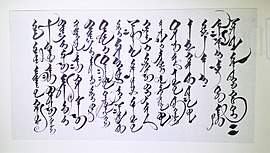
Hesperi's typology consists of long lines and intricate bars and swirls. Written up-down, read left to right. Inspiration: Mongolic script.
There are only a few dialects in Hesperi, mainly differing on slang and words for water sources.
Hesperi is spoken in almost a whisper, so there aren't many varying registers.
Hesperi speakers tend to engage their fingertips in the way they talk. Sharp hand movements aren't normally seen, whereas a speaker may use gestures close to the lips with waggling fingertips. If the speaker is angry, the fingers will most likely be used in a more curled fashion.
Seen as sacred words borrowed from nature itself, Hesperi has not evolved much throughout its history. Words may change as sounds surrounding them might. For example, a river that is beginning to dry may sound different than it did in the past, and the word may evolve to better reflect the river.
Phonology
Hesperi is pronounced mainly in head voice against the teeth and lips. Guttural sounds are not commonly used, with the K sound being an exemption.
CONSONANTS: H, S, P, K, L, T, D, R, L, N, F
VOWELS: A, E, I, O, U, W (soft U, small O sound)
Hesperi also has a nasal stop consonant, typed as 'tt'. The speaker clicks tongue against the roof of their mouth and allows the sound to stop quickly and redirect the sound towards the nose.
In American English, the nasal stop is heard in the middle of words like 'button' or 'kitten'.
vocabulary
"Lina-do u." (lit. come well.) formal
"Ame!" (lit. Welcome!) casual
"Ana-do u." (lit. leave well.)
"Ira!" (peace!)
"Mnoi tana e?" (for my satisfaction?)
"Hota-toba mnoi e" (I am satisfied)
"Mnoi" (satisfaction)
ALWAYS SAY THIS AFTER THEY SAY THANK YOU
Hota tana u (for the finish) *it kinda just means 'Is everything all good?'
If they say yes, then you say:
uali mnoi-ua tana! (lit. All for your satisfaction!) basically 'my pleasure'
Nala-ma ira-ua. "I hurt your peace."
Ra. informal
Lua. formal
Oe.
Muni.
Tisa - father
Kani - mother
Uami - older sister
Podi - older brother
Uaket - younger sister
Poket - younger brother
Mikit - youngest in the family
Kem-u poua-kisa-pur-talma? - How much is this? (lit. you tell, is this small or large amount?)
Ssisum, mnoi! - Not today, thanks!
Palpua! - That's too much! (lit. 'an insane amount!')
Kem-e pie-muni sum. - That's not for sale. (lit. I tell, not selling that)
Kem-e pie-lua sum. - That's for sale. (lit. I tell, yes selling that)
Entities
Hesperi's numerical system is based on the number 5.
Ta - one
Li - two
Ko - three
Ket - four
Pit - five
Putta - six (five-one)
Pisi - seven (five-two)
Piko - eight (five three)
Piket - nine (five four)
Lipit - ten (two five)
Lipitta - eleven (two five one)
etc.
Kisa - a few/small amount
Ssuma - more than five (only used when talking about quantifiable things)
Talma - many/much
Luora - very many/much
Palpua - an inordinate amount
u - you
e - me
olo - third person (highly contextual)
ua - your
ea - my
loa - third person personal (highly contextual)
^ add the suffix 'le' to the pronoun if referring to plural people possessing something (i.e. The Smiths' cat), or 'li' if referring to plural things in possession of one person (i.e. John's cats). If plural people in possession of plural things (i.e. The Smiths' cats), you would say 'lei'.
pite - that (over there)
pie - that (closer)
puta - this (in hand)
poua - this (close, but not in hand)
pire - abstract determiner, default if unsure which to use
Overview
Details about this language's overview
Info
Details about this language's info
Hesperi has been spoken for ages as the official tongue of the Selene people. It is said that early Selenes listened to the ways the earth whispered its own names and so copied it.
Hesperi's typology consists of long lines and intricate bars and swirls. Written up-down, read left to right. Inspiration: Mongolic script.
There are only a few dialects in Hesperi, mainly differing on slang and words for water sources.
Hesperi is spoken in almost a whisper, so there aren't many varying registers.
Hesperi speakers tend to engage their fingertips in the way they talk. Sharp hand movements aren't normally seen, whereas a speaker may use gestures close to the lips with waggling fingertips. If the speaker is angry, the fingers will most likely be used in a more curled fashion.
Seen as sacred words borrowed from nature itself, Hesperi has not evolved much throughout its history. Words may change as sounds surrounding them might. For example, a river that is beginning to dry may sound different than it did in the past, and the word may evolve to better reflect the river.
Phonology
Details about this language's phonology
Hesperi is pronounced mainly in head voice against the teeth and lips. Guttural sounds are not commonly used, with the K sound being an exemption.
CONSONANTS: H, S, P, K, L, T, D, R, L, N, F
VOWELS: A, E, I, O, U, W (soft U, small O sound)
Hesperi also has a nasal stop consonant, typed as 'tt'. The speaker clicks tongue against the roof of their mouth and allows the sound to stop quickly and redirect the sound towards the nose.
In American English, the nasal stop is heard in the middle of words like 'button' or 'kitten'.
Grammar
Details about this language's grammar
No grammar information yet
This section doesn't have any information filled in yet.
vocabulary
Details about this language's vocabulary
"Lina-do u." (lit. come well.) formal
"Ame!" (lit. Welcome!) casual
"Ana-do u." (lit. leave well.)
"Ira!" (peace!)
"Mnoi tana e?" (for my satisfaction?)
"Hota-toba mnoi e" (I am satisfied)
"Mnoi" (satisfaction)
ALWAYS SAY THIS AFTER THEY SAY THANK YOU
Hota tana u (for the finish) *it kinda just means 'Is everything all good?'
If they say yes, then you say:
uali mnoi-ua tana! (lit. All for your satisfaction!) basically 'my pleasure'
Nala-ma ira-ua. "I hurt your peace."
Ra. informal
Lua. formal
Oe.
Muni.
Tisa - father
Kani - mother
Uami - older sister
Podi - older brother
Uaket - younger sister
Poket - younger brother
Mikit - youngest in the family
Kem-u poua-kisa-pur-talma? - How much is this? (lit. you tell, is this small or large amount?)
Ssisum, mnoi! - Not today, thanks!
Palpua! - That's too much! (lit. 'an insane amount!')
Kem-e pie-muni sum. - That's not for sale. (lit. I tell, not selling that)
Kem-e pie-lua sum. - That's for sale. (lit. I tell, yes selling that)
Entities
Details about this language's entities
Hesperi's numerical system is based on the number 5.
Ta - one
Li - two
Ko - three
Ket - four
Pit - five
Putta - six (five-one)
Pisi - seven (five-two)
Piko - eight (five three)
Piket - nine (five four)
Lipit - ten (two five)
Lipitta - eleven (two five one)
etc.
Kisa - a few/small amount
Ssuma - more than five (only used when talking about quantifiable things)
Talma - many/much
Luora - very many/much
Palpua - an inordinate amount
u - you
e - me
olo - third person (highly contextual)
ua - your
ea - my
loa - third person personal (highly contextual)
^ add the suffix 'le' to the pronoun if referring to plural people possessing something (i.e. The Smiths' cat), or 'li' if referring to plural things in possession of one person (i.e. John's cats). If plural people in possession of plural things (i.e. The Smiths' cats), you would say 'lei'.
pite - that (over there)
pie - that (closer)
puta - this (in hand)
poua - this (close, but not in hand)
pire - abstract determiner, default if unsure which to use
Notes
Details about this language's notes
No notes information yet
This section doesn't have any information filled in yet.
Gallery
Images and visual content for this language
Associations
Other pages that reference or connect to this language
Referenced By
6Alate Sondra-Hespera
Languages spoken
Arun Pyrrha'Im
Languages spoken
Kephael Doma Parantta
Languages spoken
Io Sondra Mitkara
Languages spoken
Bulla Monasan
Spoken Languages
Halea
Languages
Collections
Published collections that feature this language
Not in any collections yet
This language hasn't been published in any collections yet. Collections are curated groups of related content that help organize and showcase your world.
Tip: Collections are a great way to group related content together and share themed stories or worldbuilding elements with others.
Timelines
Timelines that reference or include this language
No timeline connections yet
This language isn't connected to any timelines yet. Timelines help organize events chronologically and show how your content fits into the broader history of your world.
Tip: Create timelines to organize important events in your world's history. Link characters, locations, and other content to specific events to build rich, interconnected narratives.
Shares
Discussion about this language
No shares yet
Be the first to start a discussion about this language by sharing it to the community stream.
Privacy & Sharing
Manage who can see and access this language
Current Status
refresh
This language is currently
Privacy Settings
Choose who can see and access this language
language Universe Privacy
This page belongs to a universe with its own privacy settings