
Categories
Dive Deeper
Page Stats
Navigation
Categories
Dive Deeper
Page Stats
Complete Details
All information about this race
Overview
Okose
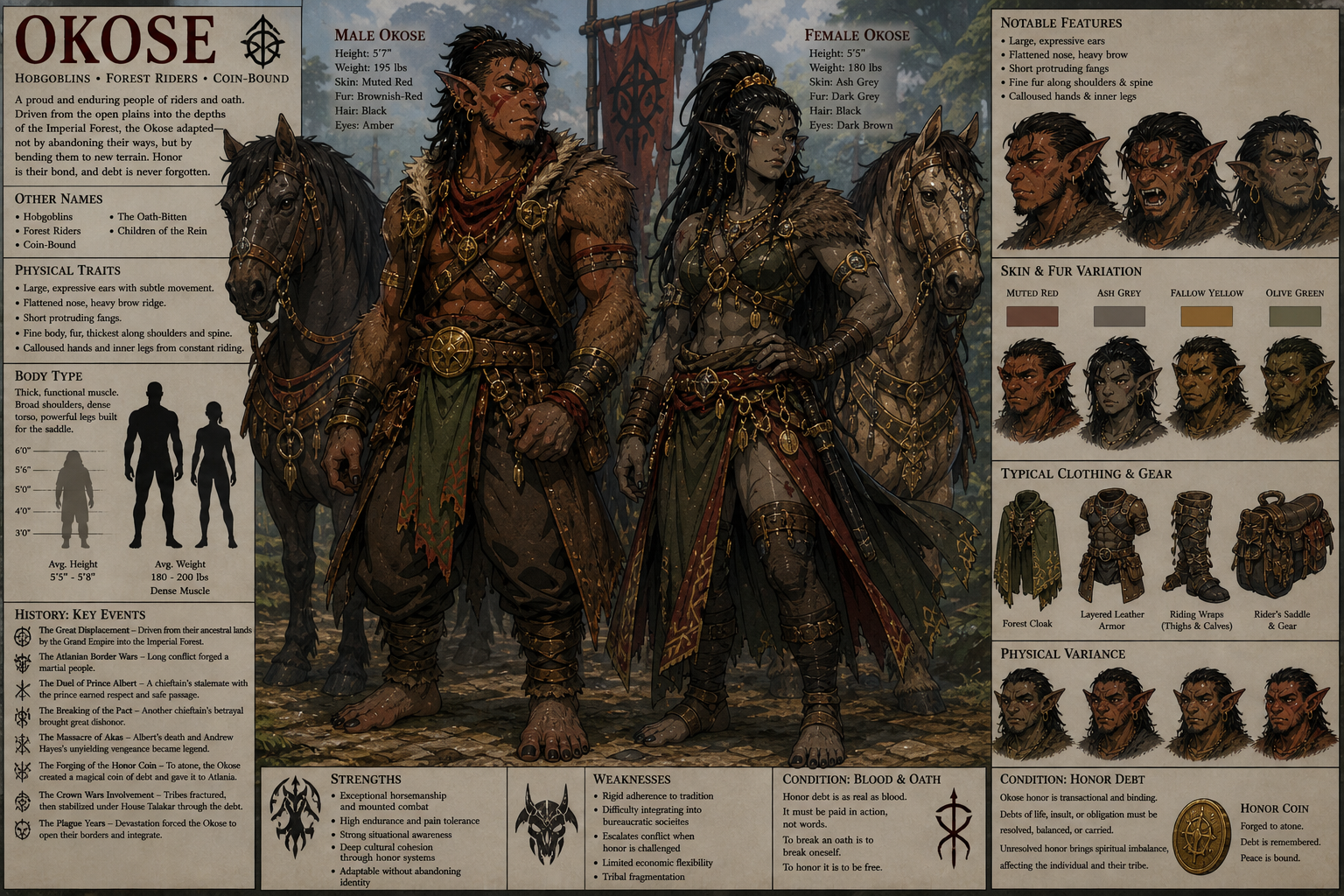
The Okose are a physically imposing but compact people, their strength immediately apparent in the density of their frames rather than their height. Rarely towering, they instead carry a grounded, forward-weighted presence—built for momentum, impact, and endurance in the saddle. Their flattened facial structure, wide noses, and small protruding fangs give them a harsh, almost sculpted appearance, further emphasized by their heavy brows and alert, expressive eyes.
A fine layer of short fur covers much of their bodies, most visible along the forearms, shoulders, and back, blending into skin tones that range across muted reds, ash greys, and fallow yellows. This fur often shifts in hue depending on lineage and environment, with forest-dwelling groups tending toward dull greens and browns that break up their silhouette in dense terrain.
They move with a rider’s posture even on foot—balanced, low, and ready to surge forward—giving the impression that they are never entirely at rest.
Hobgoblins
Forest Riders
Coin-Bound
The Oath-Bitten
Children of the Rein
Looks
Okose bodies are thick with functional muscle—broad shoulders, dense torsos, and powerful legs built for gripping and stabilizing during high-speed riding. Their strength is not exaggerated bulk, but compressed power, giving them a deceptively heavy presence for their height.
Muted Red
Ash Grey
Fallow Yellow
Olive-tinged Green (more common in forest-adapted tribes)
5'5"-5‘8"
180–200 lbs, primarily dense muscle
Large, expressive ears capable of subtle directional movement
Flattened nose and heavy brow ridge
Short, visible fangs (especially when speaking or emoting)
Fine body fur that thickens along the shoulders and spine
Calloused hands and inner legs from constant riding
While height variation can reach up to a foot in extreme cases, most Okose remain within a tight physical range. Greater variance is seen in:
Fur density and coloration
Ear size and shape
Facial flattening (some lineages more pronounced than others)
Forest-adapted Okose tend to be slightly leaner and more flexible, while plains-descended lineages retain heavier builds.
Okose clothing reflects a transitional identity—born of open plains but adapted to the dense Imperial Forest.
They favor:
Layered leathers and flexible hides
Reinforced riding wraps for thighs and calves
Cloaks and mantles designed to break up silhouette in forest terrain
Minimal loose fabric to avoid snagging during mounted movement
Armor, when worn, is practical and partial—focused on vital areas without restricting mobility in the saddle.
Traits
Exceptional horsemanship and mounted combat
High endurance and pain tolerance
Strong situational awareness (especially in motion)
Deep cultural cohesion through honor systems
Ability to adapt traditional practices to new environments without abandoning identity
Rigid adherence to tradition and honor structures
Difficulty integrating into hierarchical or bureaucratic societies
Tendency toward escalation when honor is challenged
Limited economic flexibility due to low reliance on currency
Fragmentation between tribes despite shared culture
The Okose are profoundly honor-driven, but unlike simple codes of conduct, their honor is transactional and binding.
Debts—whether of life, insult, or obligation—are not metaphorical. They are treated as real forces that must be resolved, balanced, or carried.
Unresolved honor is considered a form of spiritual imbalance that affects not just the الفرد, but the tribe.
Culture
Honor Debts – Every meaningful act creates obligation
Honor Coins – Physical tokens representing binding oaths or debts between parties
Trial by Combat – Used not for dominance, but resolution
“The Strong Survive” – Not cruelty, but expectation that strength carries responsibility
Mounted Rituals – Many ceremonies are performed on horseback, even in forest clearings
Despite outside perception, these traditions are not chaotic—they are structured, remembered, and enforced socially.
The Okose follow a deeply animistic belief system centered on the idea that the world is watched, remembered, and shaped by spirits. Rather than worshiping distant gods, they recognize and interact with forces embedded in the land itself—forests that remember those who pass through them, rivers that carry memory, and winds that spread truth or falsehood. To the Okose, every meaningful action is witnessed, and nothing of consequence is ever truly unseen.
They understand spirits in three broad forms: Bound Spirits, which are tied to places like trees, rivers, and valleys; Watching Spirits, which observe acts of honor, oathmaking, and betrayal; and Unbound Spirits, which wander without attachment and are often drawn to imbalance. Among these, the Watching Spirits are the most important, as they are believed to record the actions of individuals and determine whether a person stands in balance with the world.
Honor, therefore, is not simply cultural—it is spiritual law. Every oath, debt, or promise carries weight because it is witnessed, and unresolved obligations create imbalance that can draw misfortune or unwanted attention from the spirit world. This is why traditions such as Honor Debts and the forging of Honor Coins are treated as necessary acts of restoration rather than symbolism. To fail an oath is not just to lose face, but to become marked in a way that spirits can perceive.
The Okose also believe that horses occupy a unique place within this system, existing as spirit-aligned beings that share will with their riders. A mounted Okose is not seen as a person on an animal, but as a unified force, and many rituals—especially those involving oaths—are performed on horseback to reflect this bond. Mistreating a horse is considered both a cultural failing and a spiritual offense.
In death, the Okose do not believe in a single afterlife. Instead, a spirit’s fate depends on its balance: those with unresolved honor may linger, those who are balanced dissolve into the world, and those deeply bound to duty or place may persist as something closer to the Watching Spirits themselves. Because of this, memory is sacred—what is remembered, and how, shapes what remains.
Where others seek belonging or divine favor, the Okose seek balance within a world that is always observing. They do not build temples or pray often; instead, they speak before acting, acknowledge the unseen, and carry their obligations openly. To live well is to remain in balance—but to fail is to be remembered, not just by people, but by the world itself.
Okose society is divided into small, semi-independent tribes led by chieftains whose authority is based on:
Proven strength
Fulfilled honor debts
Ability to maintain balance within the tribe
Leadership is constantly tested—not through rebellion, but through expectation.
Traditionally focused on:
Horse breeding and riding equipment
Composite bows and mobile warfare tools
In later periods, they begin incorporating:
Atlanian engineering (particularly metalwork and infrastructure concepts)
Stanzgarian military tools
However, adoption is slow and filtered through cultural acceptance.
Warriors
Mercenaries
Scouts and outriders
Stable masters and breeders
Caravan guards
Trackers and forest riders
The Okose operate primarily on a system of trade and obligation rather than currency.
Value is determined by:
Utility
Rarity
Honor attached to the exchange
Currency exists when interacting with outsiders, but internally, debt and reputation function as the true economy.
Okose cuisine is built around practicality, preservation, and movement, reflecting their origins as nomadic riders and their later adaptation to life within the Imperial Forest. Their diet favors foods that can be carried, shared, and consumed without interrupting travel, with a strong emphasis on meat, hardy plants, and preserved goods.
Meat forms the core of their diet, particularly horse-adjacent herd animals, forest game, and anything that can be hunted efficiently from horseback or in coordinated group hunts. Cuts are rarely wasted, with drying, smoking, and curing being the most common methods of preparation. Tough, heavily seasoned jerked meats are especially favored, often carried in quantity during long rides.
They supplement this with gathered foods such as roots, bitter greens, nuts, and forest fruits. While they do not traditionally cultivate crops, many tribes have adopted limited foraging routes and seasonal gathering practices, especially after settling deeper into the forest. Mushrooms and ground tubers have become increasingly important in forest-dwelling groups.
Dairy plays a consistent role, particularly in the form of fermented milk, hard cheeses, and thick cultured drinks that travel well and provide long-lasting energy. These are often considered staple provisions rather than luxuries.
Meals are typically simple in structure but rich in meaning. Large, elaborate dishes are uncommon outside of major gatherings, but shared meals carry cultural weight. Eating together reinforces bonds, settles tensions, and in some cases, accompanies the acknowledgment or repayment of honor debts.
Flavor profiles tend toward:
heavy salting and preservation
smoky, fire-cooked meats
bitter and earthy plant flavors
fermented and sour dairy notes
While they have historically had little use for currency-based trade, increased contact with Atlania and Stanzgar has introduced new elements into their diet, including grains, spices, and stronger alcohols. These are still considered secondary to traditional foods but are increasingly present in larger or more settled tribes.
At its core, Okose food is not about indulgence—it is about sustaining strength, honoring tradition, and sharing in a way that reinforces the bonds that define them.
History
The Great Displacement
Driven from their ancestral lands by the Grand Empire, the Okose were forced into the Imperial Forest—an event that reshaped their entire culture from open plains riders to adaptive forest cavalry.
The Atlanian Border Wars
Long-standing conflict with Atlania hardened Okose martial identity, turning skirmishes into sustained campaigns.
The Duel of Prince Albert
Prince Albert’s stand and single combat against a chieftain resulted in a rare stalemate, earning him safe passage—a moment that reinforced Okose respect for strength and personal courage.
The Breaking of the Pact
A separate chieftain, unaware or unwilling to honor the duel’s outcome, attacked Albert’s retreating forces—creating one of the greatest dishonors in Okose history.
The Massacre of Akas
Albert’s death and Andrew Hayes’s relentless retaliation marked a turning point. Hayes’ refusal to fall—fighting through death itself—became legend among the Okose.
The Forging of the Honor Coin
To atone, the Okose created a magical honor-debt coin and presented it to Atlania, binding themselves to a future peace.
The Crown Wars Involvement
Despite peace, various tribes sided with different Atlanian houses, fracturing their unity until Hayes returned and invoked the debt to stabilize the realm under House Talakar.
The Plague Years
Widespread devastation forced the Okose to abandon isolation, integrating more fully into broader society and trade networks.
Notes
An average Okose stands just under the height of an Atlanian, but feels heavier in presence than many taller beings. Their body is compact and powerful, every movement efficient and grounded, shaped by a life spent in the saddle. Their flattened features and small fangs give them a stern, almost permanent intensity, though their expressions are far more nuanced than outsiders expect.
Their clothing is practical and worn, adapted for riding through dense forest rather than open plains, and their gear is maintained with meticulous care. Even at rest, they carry themselves as if ready to move at a moment’s notice.
More than anything, what defines them is not their strength—but the weight they carry unseen: every promise made, every debt owed, every act remembered.
To meet an Okose is not simply to meet a warrior—
it is to meet a living ledger of honor.
Overview
Details about this race's overview
Okose
The Okose are a physically imposing but compact people, their strength immediately apparent in the density of their frames rather than their height. Rarely towering, they instead carry a grounded, forward-weighted presence—built for momentum, impact, and endurance in the saddle. Their flattened facial structure, wide noses, and small protruding fangs give them a harsh, almost sculpted appearance, further emphasized by their heavy brows and alert, expressive eyes.
A fine layer of short fur covers much of their bodies, most visible along the forearms, shoulders, and back, blending into skin tones that range across muted reds, ash greys, and fallow yellows. This fur often shifts in hue depending on lineage and environment, with forest-dwelling groups tending toward dull greens and browns that break up their silhouette in dense terrain.
They move with a rider’s posture even on foot—balanced, low, and ready to surge forward—giving the impression that they are never entirely at rest.
Hobgoblins
Forest Riders
Coin-Bound
The Oath-Bitten
Children of the Rein
Looks
Details about this race's looks
Okose bodies are thick with functional muscle—broad shoulders, dense torsos, and powerful legs built for gripping and stabilizing during high-speed riding. Their strength is not exaggerated bulk, but compressed power, giving them a deceptively heavy presence for their height.
Muted Red
Ash Grey
Fallow Yellow
Olive-tinged Green (more common in forest-adapted tribes)
5'5"-5‘8"
180–200 lbs, primarily dense muscle
Large, expressive ears capable of subtle directional movement
Flattened nose and heavy brow ridge
Short, visible fangs (especially when speaking or emoting)
Fine body fur that thickens along the shoulders and spine
Calloused hands and inner legs from constant riding
While height variation can reach up to a foot in extreme cases, most Okose remain within a tight physical range. Greater variance is seen in:
Fur density and coloration
Ear size and shape
Facial flattening (some lineages more pronounced than others)
Forest-adapted Okose tend to be slightly leaner and more flexible, while plains-descended lineages retain heavier builds.
Okose clothing reflects a transitional identity—born of open plains but adapted to the dense Imperial Forest.
They favor:
Layered leathers and flexible hides
Reinforced riding wraps for thighs and calves
Cloaks and mantles designed to break up silhouette in forest terrain
Minimal loose fabric to avoid snagging during mounted movement
Armor, when worn, is practical and partial—focused on vital areas without restricting mobility in the saddle.
Traits
Details about this race's traits
Exceptional horsemanship and mounted combat
High endurance and pain tolerance
Strong situational awareness (especially in motion)
Deep cultural cohesion through honor systems
Ability to adapt traditional practices to new environments without abandoning identity
Rigid adherence to tradition and honor structures
Difficulty integrating into hierarchical or bureaucratic societies
Tendency toward escalation when honor is challenged
Limited economic flexibility due to low reliance on currency
Fragmentation between tribes despite shared culture
The Okose are profoundly honor-driven, but unlike simple codes of conduct, their honor is transactional and binding.
Debts—whether of life, insult, or obligation—are not metaphorical. They are treated as real forces that must be resolved, balanced, or carried.
Unresolved honor is considered a form of spiritual imbalance that affects not just the الفرد, but the tribe.
Culture
Details about this race's culture
Honor Debts – Every meaningful act creates obligation
Honor Coins – Physical tokens representing binding oaths or debts between parties
Trial by Combat – Used not for dominance, but resolution
“The Strong Survive” – Not cruelty, but expectation that strength carries responsibility
Mounted Rituals – Many ceremonies are performed on horseback, even in forest clearings
Despite outside perception, these traditions are not chaotic—they are structured, remembered, and enforced socially.
The Okose follow a deeply animistic belief system centered on the idea that the world is watched, remembered, and shaped by spirits. Rather than worshiping distant gods, they recognize and interact with forces embedded in the land itself—forests that remember those who pass through them, rivers that carry memory, and winds that spread truth or falsehood. To the Okose, every meaningful action is witnessed, and nothing of consequence is ever truly unseen.
They understand spirits in three broad forms: Bound Spirits, which are tied to places like trees, rivers, and valleys; Watching Spirits, which observe acts of honor, oathmaking, and betrayal; and Unbound Spirits, which wander without attachment and are often drawn to imbalance. Among these, the Watching Spirits are the most important, as they are believed to record the actions of individuals and determine whether a person stands in balance with the world.
Honor, therefore, is not simply cultural—it is spiritual law. Every oath, debt, or promise carries weight because it is witnessed, and unresolved obligations create imbalance that can draw misfortune or unwanted attention from the spirit world. This is why traditions such as Honor Debts and the forging of Honor Coins are treated as necessary acts of restoration rather than symbolism. To fail an oath is not just to lose face, but to become marked in a way that spirits can perceive.
The Okose also believe that horses occupy a unique place within this system, existing as spirit-aligned beings that share will with their riders. A mounted Okose is not seen as a person on an animal, but as a unified force, and many rituals—especially those involving oaths—are performed on horseback to reflect this bond. Mistreating a horse is considered both a cultural failing and a spiritual offense.
In death, the Okose do not believe in a single afterlife. Instead, a spirit’s fate depends on its balance: those with unresolved honor may linger, those who are balanced dissolve into the world, and those deeply bound to duty or place may persist as something closer to the Watching Spirits themselves. Because of this, memory is sacred—what is remembered, and how, shapes what remains.
Where others seek belonging or divine favor, the Okose seek balance within a world that is always observing. They do not build temples or pray often; instead, they speak before acting, acknowledge the unseen, and carry their obligations openly. To live well is to remain in balance—but to fail is to be remembered, not just by people, but by the world itself.
Okose society is divided into small, semi-independent tribes led by chieftains whose authority is based on:
Proven strength
Fulfilled honor debts
Ability to maintain balance within the tribe
Leadership is constantly tested—not through rebellion, but through expectation.
Traditionally focused on:
Horse breeding and riding equipment
Composite bows and mobile warfare tools
In later periods, they begin incorporating:
Atlanian engineering (particularly metalwork and infrastructure concepts)
Stanzgarian military tools
However, adoption is slow and filtered through cultural acceptance.
Warriors
Mercenaries
Scouts and outriders
Stable masters and breeders
Caravan guards
Trackers and forest riders
The Okose operate primarily on a system of trade and obligation rather than currency.
Value is determined by:
Utility
Rarity
Honor attached to the exchange
Currency exists when interacting with outsiders, but internally, debt and reputation function as the true economy.
Okose cuisine is built around practicality, preservation, and movement, reflecting their origins as nomadic riders and their later adaptation to life within the Imperial Forest. Their diet favors foods that can be carried, shared, and consumed without interrupting travel, with a strong emphasis on meat, hardy plants, and preserved goods.
Meat forms the core of their diet, particularly horse-adjacent herd animals, forest game, and anything that can be hunted efficiently from horseback or in coordinated group hunts. Cuts are rarely wasted, with drying, smoking, and curing being the most common methods of preparation. Tough, heavily seasoned jerked meats are especially favored, often carried in quantity during long rides.
They supplement this with gathered foods such as roots, bitter greens, nuts, and forest fruits. While they do not traditionally cultivate crops, many tribes have adopted limited foraging routes and seasonal gathering practices, especially after settling deeper into the forest. Mushrooms and ground tubers have become increasingly important in forest-dwelling groups.
Dairy plays a consistent role, particularly in the form of fermented milk, hard cheeses, and thick cultured drinks that travel well and provide long-lasting energy. These are often considered staple provisions rather than luxuries.
Meals are typically simple in structure but rich in meaning. Large, elaborate dishes are uncommon outside of major gatherings, but shared meals carry cultural weight. Eating together reinforces bonds, settles tensions, and in some cases, accompanies the acknowledgment or repayment of honor debts.
Flavor profiles tend toward:
heavy salting and preservation
smoky, fire-cooked meats
bitter and earthy plant flavors
fermented and sour dairy notes
While they have historically had little use for currency-based trade, increased contact with Atlania and Stanzgar has introduced new elements into their diet, including grains, spices, and stronger alcohols. These are still considered secondary to traditional foods but are increasingly present in larger or more settled tribes.
At its core, Okose food is not about indulgence—it is about sustaining strength, honoring tradition, and sharing in a way that reinforces the bonds that define them.
History
Details about this race's history
The Great Displacement
Driven from their ancestral lands by the Grand Empire, the Okose were forced into the Imperial Forest—an event that reshaped their entire culture from open plains riders to adaptive forest cavalry.
The Atlanian Border Wars
Long-standing conflict with Atlania hardened Okose martial identity, turning skirmishes into sustained campaigns.
The Duel of Prince Albert
Prince Albert’s stand and single combat against a chieftain resulted in a rare stalemate, earning him safe passage—a moment that reinforced Okose respect for strength and personal courage.
The Breaking of the Pact
A separate chieftain, unaware or unwilling to honor the duel’s outcome, attacked Albert’s retreating forces—creating one of the greatest dishonors in Okose history.
The Massacre of Akas
Albert’s death and Andrew Hayes’s relentless retaliation marked a turning point. Hayes’ refusal to fall—fighting through death itself—became legend among the Okose.
The Forging of the Honor Coin
To atone, the Okose created a magical honor-debt coin and presented it to Atlania, binding themselves to a future peace.
The Crown Wars Involvement
Despite peace, various tribes sided with different Atlanian houses, fracturing their unity until Hayes returned and invoked the debt to stabilize the realm under House Talakar.
The Plague Years
Widespread devastation forced the Okose to abandon isolation, integrating more fully into broader society and trade networks.
Notes
Details about this race's notes
An average Okose stands just under the height of an Atlanian, but feels heavier in presence than many taller beings. Their body is compact and powerful, every movement efficient and grounded, shaped by a life spent in the saddle. Their flattened features and small fangs give them a stern, almost permanent intensity, though their expressions are far more nuanced than outsiders expect.
Their clothing is practical and worn, adapted for riding through dense forest rather than open plains, and their gear is maintained with meticulous care. Even at rest, they carry themselves as if ready to move at a moment’s notice.
More than anything, what defines them is not their strength—but the weight they carry unseen: every promise made, every debt owed, every act remembered.
To meet an Okose is not simply to meet a warrior—
it is to meet a living ledger of honor.
Gallery
Images and visual content for this race
Associations
Other pages that reference or connect to this race
Referenced By
4Collections
Published collections that feature this race
Not in any collections yet
This race hasn't been published in any collections yet. Collections are curated groups of related content that help organize and showcase your world.
Tip: Collections are a great way to group related content together and share themed stories or worldbuilding elements with others.
Timelines
Timelines that reference or include this race
No timeline connections yet
This race isn't connected to any timelines yet. Timelines help organize events chronologically and show how your content fits into the broader history of your world.
Tip: Create timelines to organize important events in your world's history. Link characters, locations, and other content to specific events to build rich, interconnected narratives.
Shares
Discussion about this race
No shares yet
Be the first to start a discussion about this race by sharing it to the community stream.
Privacy & Sharing
Manage who can see and access this race
Current Status
refresh
This race is currently
Privacy Settings
Choose who can see and access this race
language Universe Privacy
This page belongs to a universe with its own privacy settings