
Categories
Dive Deeper
Page Stats
Navigation
Categories
Dive Deeper
Page Stats
Complete Details
All information about this race
Overview
Dwarf
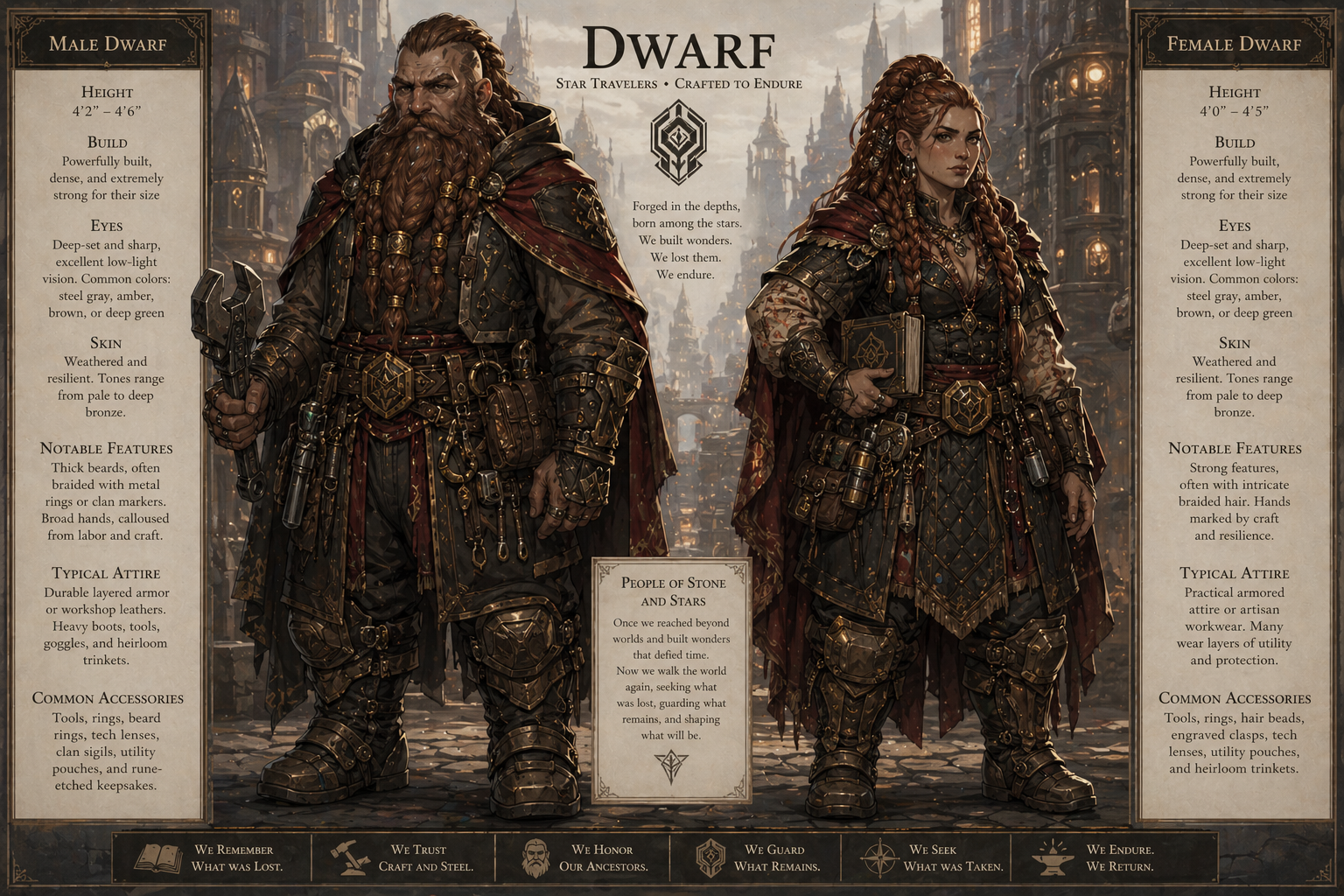
A dwarf is a short, powerfully built individual whose presence feels far heavier than their size suggests. Broad-shouldered, dense, and deliberate in movement, they carry themselves with the quiet certainty of something designed to endure rather than impress. Their features are often marked by labor—calloused hands, weathered skin, and eyes sharp in low light—giving them the look of someone who understands how things are made, and how they fail.
They are methodical, practical, and difficult to sway once decided, with a mind that favors structure, reliability, and long-term function over impulse or appearance. Even removed from the stars they once traveled, there remains something in them that feels engineered rather than grown—built for harsher places, and still quietly expecting to return to them one day.
Star travelers, dwarves, the red armored slayers (Hollow Holm), the wolves of Boulderholm (Nartheam), the Crafters (Dirkhill)
Looks
Body Shape – What does the average Dwarf body shape look like?
Dwarves are short, squat, and powerfully built, but those simple terms fail to capture just how dense and deliberate their physical structure truly is.
They are not merely “short people”—they are compactly engineered bodies, built for endurance, pressure, and environments most other races would find unbearable.
Their frames are broad and thick through the chest, shoulders, and hips, with a naturally low center of gravity that makes them incredibly stable. Even a lightly built dwarf tends to feel solid, as though there is far more weight and structure beneath the surface than their height suggests.
Their bones are unusually dense, and their musculature is tightly packed rather than visibly bulky. This gives them a powerful, grounded look—less like athletes built for speed and more like something designed to withstand strain over long periods of time.
Their limbs are proportionally shorter but thicker than those of most humanoids, especially in the forearms, thighs, and calves. Hands are strong, calloused, and precise, built equally well for:
fine mechanical work
tool use
and sustained physical labor
Their posture is typically upright but relaxed, with a subtle forward weight that suggests readiness rather than tension. When they move, it is efficient—no wasted motion, no unnecessary flourish. Even at rest, they tend to look like they could remain exactly where they are for hours without discomfort.
Despite their size, they are not slow. Their stride is shorter, but steady and tireless, allowing them to travel long distances or work long hours without significant fatigue. In confined environments—tunnels, workshops, tight corridors—they move with natural ease.
Their bodies are also notably resistant to environmental stress. Heat, pressure, and confined spaces do not seem to affect them the way they do others, and their builds reflect this—compact, reinforced, and enduring.
There is often a subtle sense that dwarves are built for places deeper and harsher than where they are currently standing.
To outsiders, the lasting impression is:
not small
but concentrated
Dwarven skin most commonly falls into tanned, earthen tones, shaped by heat, labor, and long exposure to forge-light, stone, and subterranean environments. Even those who spend little time in open sun tend to carry a natural, weathered coloration rather than true pallor.
Typical tones include:
warm bronze
sun-baked tan
deep ochre
ruddy brown
iron-dark umber
ash-touched beige
and soot-kissed copper hues
Undertones often lean warm—reds, golds, and burnt orange—giving their skin a slightly “forged” look, as though heat has always been part of them.
However, dwarves are not limited to these tones.
Due to their ancient, far-reaching history and lost stellar origins, a wide range of pigmentation exists, especially among older or more isolated clans. Some dwarves may display:
cooler stone-gray undertones
faint slate or blue-gray hues in low-light populations
pale mineral-like complexions among deep-dwelling groups
or unusually even, almost metallic-looking skin in rare bloodlines
These variations are subtle rather than extreme, but enough that experienced dwarves can often guess a clan’s environment—or history—at a glance.
Their skin is typically:
thick
resilient
and resistant to damage
Scars tend to heal cleanly but remain visible, often as lighter or slightly roughened lines rather than deep discoloration. Burns, when they occur, are taken seriously but are less common than one might expect given their environment.
With age, dwarven skin often becomes:
rougher
more textured
slightly darker or more desaturated
giving older dwarves a carved, stone-like appearance rather than a frail one.
Among their own people, complexion is rarely tied to beauty in the way other cultures might view it. Instead, skin is often read as a sign of:
labor
environment
endurance
and lived experience
A well-worn, scar-marked, heat-darkened dwarf is not considered less attractive—
they are considered proven.
Dwarves typically stand between 4 and 5 feet tall, but their height alone can be misleading.
They do not feel small.
Their proportions—broad shoulders, thick torsos, and dense builds—give them a physical presence far greater than their stature would suggest. A dwarf standing beside a taller individual rarely feels diminished; if anything, they often appear more grounded, more stable, and far harder to move.
Most dwarves cluster around the middle of that range, roughly 4’4” to 4’8”, with individuals outside that band becoming more notable within their communities.
Shorter dwarves, closer to 4 feet, are not uncommon, especially among certain deep-dwelling or more insular clans. Taller dwarves, approaching or slightly exceeding 5 feet, tend to come from lines with more surface exposure or mixed environmental histories.
What truly defines their height, however, is how they carry it.
Dwarves stand upright, rarely stooped, with a natural sense of balance and weight that makes them appear firmly anchored to the ground. Their shorter legs result in a compact stride, but one that is steady, efficient, and difficult to disrupt.
In confined spaces—tunnels, workshops, engineered structures—their height becomes an advantage rather than a limitation. Many of their environments are built with their proportions in mind, reinforcing the idea that they are not undersized—
the world simply wasn’t originally made for them.
Dwarves are very heavy for their size, with most adults commonly weighing between 160 and 240 pounds, though individuals on either end of their height range—and especially those from labor or engineering backgrounds—can fall outside that without appearing unusual.
What defines dwarven weight is not bulk, but density.
Their bodies are built with:
thick bone structure
tightly packed muscle
reinforced joints
and a general physical solidity that makes them feel far heavier than they look
A dwarf of average build may appear compact or even modestly sized, but lifting one quickly reveals the truth—they carry weight like stone rather than flesh.
Their musculature is rarely exaggerated in appearance. Even very strong dwarves often look simply “well built” rather than visibly massive. The strength is there, but it is contained, efficient, and meant for sustained effort rather than display.
Heavier dwarves tend to broaden rather than soften. Weight settles into:
thick shoulders
powerful backs
wide torsos
and dense limbs
giving them a more reinforced, structural look rather than one of excess.
Because of their endurance and environmental resistance, dwarves do not fatigue easily under their own weight. They move with steady confidence, and their mass contributes to their stability—once planted, they are difficult to push, pull, or knock off balance.
Among their own people, weight is rarely tied to attractiveness. Instead, it is often read as a sign of:
strength
resilience
work capacity
and long-term durability
A dwarf who feels “light” is often considered either young, untested, or unwell.
The most immediately noticeable feature of a dwarf is their compact, powerful presence. Though short in stature, they appear broad, grounded, and immovably solid—like something that belongs in stone rather than standing on it. Even at rest, they give the impression of weight and permanence, as if pushing one would be both difficult and unwise.
Their hands are particularly distinctive. Thick-fingered, calloused, and incredibly steady, they are built for precision as much as strength. A dwarf’s grip is famously firm, and their fine motor control allows them to work delicate mechanisms or intricate craftsmanship with surprising ease. It is often said that if a dwarf cannot fix something, it was likely never meant to be fixed.
Their eyes are adapted to low-light environments, often appearing:
deep-set
reflective in dim conditions
sharp and intensely focused
They tend toward colors like:
dark brown
iron-gray
amber
black
or deep hazel
In darkness, their gaze can feel almost luminescent—not glowing, but catching light in a way that makes it clear they see far more than they should.
Their skin and features often show the marks of their environment and labor. Scars are common, especially on the hands, forearms, and face, but are typically worn without concern. Burn marks, heat exposure, and signs of long-term work around metal, pressure, and harsh conditions are normal and carry little stigma.
Hair is usually thick and coarse, commonly found in:
black
deep brown
iron-gray
ash-blonde
or prematurely silver tones
Many dwarves wear their hair long or tied back for practicality, though styles vary widely between clans. Facial hair—especially among males but not exclusively—is often dense and worn with intention, whether braided, bound, or left natural depending on cultural preference.
Their voices tend to be lower and more resonant than expected for their size, often carrying a steady, grounded tone. Even when speaking quietly, dwarves can command attention simply through the weight of their presence.
Perhaps most distinctive, however, is the way they interact with their surroundings. Dwarves tend to:
test surfaces before trusting them
notice structural weaknesses instinctively
move with awareness of space and support
and treat tools, materials, and environments with practiced familiarity
There is often a subtle sense that they are always assessing:
how something is built
how it might fail
and how they would fix it
To outsiders, the lasting impression is:
not just that they are strong
but that they understand the world as something that can be taken apart and put back together again
Dwarves display a wide range of physical variation despite their shared compact, dense build and shorter stature. While all dwarves tend toward a squat, powerful frame, the expression of that build can differ significantly depending on clan history, environment, and lineage.
Body types vary from:
broad, barrel-chested laborers with thick limbs and heavy shoulders
to leaner, more compact individuals built for precision work or confined environments
to heavily muscled engineers and smiths whose strength shows more clearly through their frame
Even at their most slender, however, dwarves retain that underlying density and structural solidity that defines their kind.
Facial features also show notable diversity. Some dwarves have:
wide, flat noses and strong jaws suited to harsh environments
sharper, more angular features in certain clans
deep-set eyes and pronounced brow ridges
or smoother, more refined features depending on lineage
Hair texture and color vary widely, including:
coarse straight hair
thick waves
tight curls
with colors ranging from black and deep brown to ash-blonde, iron-gray, and early silvering in some bloodlines. Facial hair, where present, can differ greatly in thickness and growth patterns, and is often styled according to clan tradition.
Skin tones, while generally tanned and earth-toned, can shift based on environment and ancestry, with some populations showing:
warmer bronze or copper hues
cooler stone-gray undertones
or lighter, mineral-like complexions in deep-dwelling groups
Height typically falls within the 4–5 foot range, but proportions can vary—some dwarves appear slightly taller due to longer limbs, while others seem even more compact due to broader builds and shorter legs.
One of the more subtle but important differences lies in adaptation to environment. Certain dwarven groups show physical traits influenced by where they live:
deep-dwellers may have more pronounced low-light vision and paler or ash-toned skin
forge-dwellers often show heavier heat conditioning and more scar resilience
surface-facing dwarves may have slightly lighter builds and more varied pigmentation
Despite all this variation, dwarves remain immediately recognizable as a people. There is a shared sense of:
weight
structure
endurance
and purpose in their physical form
that ties them together across all clans and factions.
Among dwarves themselves, physical variance is rarely judged in terms of beauty. Instead, differences are often read as indicators of:
environment
specialization
lineage
and experience
A dwarf’s body tells a story—not of appearance, but of where they belong and what they are built to endure.
Dwarven clothing is practical, durable, and fully covering—but beneath that practicality lies the quiet echo of a people who once walked among the stars.
At first glance, their attire appears simple:
fitted, non-restrictive tunics
reinforced trousers
layered undershirts
heavy work belts
long coats or dusters
and durable boots
All made from strong fabrics designed to withstand heat, pressure, abrasion, and long hours of labor.
But look closer, and something feels… different.
Their clothing is not just made to last.
It is made to function.
Engineered Garments
Dwarven clothing is often constructed more like equipment than fashion.
Seams are reinforced.
Joints are articulated for movement.
Layers are designed to regulate temperature, wick moisture, and protect against environmental stress.
Even simple garments may include:
hidden fastening systems
modular layers that can be removed or added
reinforced stitching in stress points
and materials treated to resist heat, sparks, and chemical exposure
Many pieces are designed to be repaired indefinitely rather than replaced.
A well-made dwarven coat may outlive its owner.
Echoes of Starfaring Design
Though much of their original technology has been lost or hidden, remnants of their past still influence their clothing design.
Certain garments retain features that make little sense in a purely medieval context:
high, sealed collars that protect the neck
layered closures that fasten tight against the body
gloves designed for dexterity and protection
segmented outerwear that allows full mobility without exposing skin
and full-body coverage even in environments where it may not seem necessary
These are not aesthetic choices.
They are habits.
Inherited design philosophies from a time when exposure meant death.
Material Preferences
Dwarves favor materials that can endure stress and time:
heavy woven cloth
treated leather
layered fiber composites (in more advanced regions)
metal-thread reinforcement in high-wear areas
and occasionally magitech-infused fabrics where available
In Boulderholm, more advanced garments may include:
temperature-regulating layers
self-repairing weave patterns
or embedded magitech functions
though these are not commonly seen outside major centers.
Work and Utility First
Most dwarven clothing includes built-in utility:
tool loops
internal pockets
reinforced belts
modular attachments
and carrying harnesses
A dwarf rarely wears something that does not serve a purpose.
Even formal clothing tends to retain functional elements.
Looking good is acceptable.
Being unprepared is not.
Clan and Identity Markings
While not overly decorative, dwarves do incorporate identity into their clothing through:
subtle embroidery
geometric patterns
color banding
metal clasps or insignia
and layered stitching unique to clan or faction
Nartheam and Hollow Holm dwarves often display differences here, with:
Nartheam designs leaning more structured and integrated with modern materials
Hollow Holm designs tending toward older, more traditional patterns
Formal Attire
Formal dwarven clothing does not abandon practicality.
Instead, it refines it.
cleaner lines
higher quality materials
polished metal accents
structured coats
and more intricate patterning
A formal dwarven outfit still looks like something you could:
walk into a forge with
or survive a disaster in
because, historically, that was always a possibility.
Cultural Truth
Dwarves do not dress to impress others.
They dress to ensure that if something goes wrong:
they will still be standing when it is over
Traits
Cultural Truth
Dwarves do not dress to impress others.
They dress to ensure that if something goes wrong:
they will still be standing when it is over
Vast Knowledge and Memory
Dwarves possess an enormous cultural and intellectual strength:
their knowledge base.
Even with the loss of their Grand Library, dwarven society retains fragments of:
advanced engineering
ancient science
magitech integration
and forgotten technologies
This knowledge is not always complete, but it is deep, structured, and fiercely preserved.
Individually, dwarves are often:
methodical thinkers
highly detail-oriented
and capable of long-term focus
They excel at complex problem-solving, particularly in systems that require patience and layered understanding.
A dwarf may not solve a problem quickly.
But they will solve it correctly.
Engineering and Craftsmanship
Dwarves are unmatched in their ability to:
build
repair
optimize
and maintain
Their craftsmanship is defined by:
precision
durability
efficiency
and long-term reliability
They do not create disposable tools.
They create systems meant to endure.
Even in reduced technological states, dwarves maintain an instinctive understanding of structure, stress, and mechanical function.
They do not just use tools.
They understand them.
Physical Density and Strength
Dwarves are deceptively strong.
Their dense musculature and reinforced skeletal structure give them:
powerful lifting capability
strong grip strength
and exceptional resistance to physical force
They are difficult to knock over, difficult to move against their will, and capable of applying force in controlled, precise ways.
They are not built for speed or agility.
They are built to hold ground and keep working.
Adaptability Through Persistence
Dwarves are not quick adapters—but they are inevitable adapters.
Given enough time, they will:
study a system
understand it
improve it
and integrate it into their own knowledge
This makes them slow to change initially, but extremely difficult to outpace over long periods.
They do not chase innovation.
They absorb it.
And once they do, it becomes part of them.
Resilience of Will
Dwarves are famously stubborn—but this is also one of their greatest strengths.
They are:
resistant to intimidation
difficult to coerce
slow to abandon a position
and nearly impossible to break once committed
This mental resilience makes them reliable under pressure, particularly in:
siege conditions
long-term projects
and situations where others would give up
They do not panic easily.
They do not quit easily.
They do not forget easily.
For all their strength, knowledge, and endurance, dwarves are often undone by the very traits that make them formidable.
Their greatest weakness is not physical.
It is how they think.
Stubbornness to a Fault
Dwarven stubbornness is legendary—and frequently problematic.
Once a dwarf commits to a belief, plan, or course of action, changing that position is extremely difficult. Even when presented with new evidence, many will:
double down
reinterpret facts to fit their view
or refuse to engage with the contradiction at all
This is not simple pride.
It is a deeply ingrained mental rigidity.
To them, consistency is stability—and instability is dangerous.
Unfortunately, this means they can persist in being wrong with the same endurance they apply to being right.
Rigid Thought and Slow Adaptation
Dwarves excel at mastering systems, but struggle when those systems must change quickly.
They prefer:
established methods
proven designs
known outcomes
and are often suspicious of rapid innovation or unfamiliar approaches.
While they will eventually understand and integrate new ideas, they are:
slow to accept change
and slower to trust it
This makes them vulnerable to:
fast-moving political shifts
unconventional tactics
and technologies or strategies that do not follow predictable logic
Cultural Isolation
Dwarves have a long-standing tendency to:
distrust outsiders
hoard knowledge
and limit collaboration
Even in more modern times, where some factions (like the Nartheam) have begun opening up, this instinct remains strong.
This isolation leads to:
missed alliances
slower information exchange
and unnecessary conflict
They often assume others are less capable, less informed, or less important—an attitude that has historically cost them dearly.
Dependence on Lost Knowledge
A significant portion of dwarven identity is tied to knowledge they no longer fully possess.
The destruction of their Grand Library was catastrophic—not just materially, but culturally.
Many dwarves:
rely on incomplete systems
follow traditions whose original purpose is partially lost
or attempt to recreate technologies they only half understand
This creates a dangerous gap between:
what they believe they know
and
what they actually have access to
Their confidence often exceeds their current capability.
Internal Division
Dwarves are not a unified people.
The ongoing cold war between factions—particularly Nartheam and the Hollow Holm dwarves—creates:
political instability
resource fragmentation
competing goals
and active hostility between groups
Instead of pooling their knowledge and strength, they often work against each other.
This weakens them far more than any external enemy could.
Lack of Urgency
Dwarves think in long timeframes.
This is usually an advantage.
Until it isn’t.
They are prone to:
delaying decisions
underestimating immediate threats
and assuming problems can be solved with time
When faced with fast-moving crises, this can lead to slow responses and missed opportunities.
By the time a dwarf fully commits to action:
the situation may have already changed
Diminishing Potential
Their natural abilities—resistance, endurance, even aspects of their advanced knowledge—are slowly weakening over time.
Most dwarves acknowledge this quietly.
Some deny it completely.
Either way, it represents a long-term vulnerability.
They are not as strong as they once were.
And they know it.
Even if they refuse to say it out loud.
Dwarven conditions tend to reflect the same truth as their strengths:
they were built for more than the world they now live in
Many of their ailments are not simple diseases, but the result of a people slowly losing access to the environments, technologies, and knowledge they were originally designed to function within.
Among dwarves, illness is often described as:
something falling out of alignment
which is both metaphor and, uncomfortably, sometimes literal.
Drift
Description:
The most feared long-term condition among dwarves.
A slow degradation of their natural resistances and capabilities over time—heat tolerance, pressure resistance, toxin resistance, even aspects of their mental clarity and endurance.
Symptoms:
reduced tolerance to heat or pressure
increased susceptibility to toxins
fatigue during tasks that were once trivial
slower recovery times
subtle loss of focus or mental precision
It often progresses slowly enough to be denied.
Until it cannot be.
Cultural Meaning:
Quietly terrifying.
Because it confirms what many already suspect:
they are not what they used to be
Most dwarves will not speak of it openly.
Alignment Fatigue
Description:
A condition caused by prolonged exposure to unstable, poorly maintained, or incomplete systems—technological, magical, or structural.
Dwarves are instinctively attuned to systems working correctly. When surrounded by things that are “off,” it wears on them.
Symptoms:
headaches
irritability
inability to concentrate
obsessive focus on fixing nearby objects
physical tension
difficulty resting
In severe cases, it can lead to compulsive behavior until the source of misalignment is corrected—or the dwarf is removed from the environment.
Cultural Meaning:
Common among those working outside dwarven-controlled spaces.
Often dismissed by outsiders.
Never dismissed by dwarves.
Stone Lung
Description:
A chronic condition caused by prolonged exposure to dust, particulate matter, and subterranean environments without proper filtration.
While dwarves are resistant to toxins, constant exposure still takes a toll over decades.
Symptoms:
persistent cough
reduced lung capacity
fatigue during exertion
gravelly voice
difficulty breathing in cold air
Cultural Meaning:
Seen as an occupational hazard.
Older dwarves often treat it as inevitable.
Younger dwarves pretend it won’t happen to them.
Forge Burn (Chronic)
Description:
Not a single injury, but the cumulative effect of long-term exposure to extreme heat, sparks, and radiant energy in forge environments.
Symptoms:
thickened, scarred skin
reduced sensitivity in hands
localized nerve damage
heat stress fatigue
slower healing in repeatedly burned areas
Cultural Meaning:
Half badge of honor.
Half warning sign.
A dwarf with Forge Burn has worked long and hard.
They have also worked long enough to start paying for it.
Archive Fragmentation
Description:
A rare but serious cognitive condition tied to the loss of their Grand Library and fragmented knowledge systems.
Dwarves attempting to reconstruct incomplete or corrupted data may experience mental strain from trying to reconcile conflicting or missing information.
Symptoms:
obsessive research loops
inability to accept incomplete answers
fixation on lost knowledge
frustration bordering on mania
refusal to abandon unsolvable problems
Cultural Meaning:
Deeply concerning.
Often found among scholars and engineers.
Sometimes produces brilliance.
Sometimes destroys the person involved.
Void Longing
Description:
A subtle but persistent psychological condition affecting some dwarves—especially those who dwell on their lost stellar origins.
Symptoms:
fixation on the sky or stars
dissatisfaction with planetary life
restlessness
longing for something undefined
difficulty feeling “at home” anywhere
Cultural Meaning:
Rarely discussed openly.
Often dismissed as melancholy.
But among older dwarves, it is quietly understood as:
remembering something you can never return to
Culture
Dwarven tradition is built around preservation, guarded ownership, and the careful control of knowledge. Their customs are shaped by the loss of their greater history and the knowledge that much of what they once were now survives only in fragments.
Preservation and Recovery of Knowledge
Dwarves treat knowledge as inheritance, infrastructure, and survival. Records are copied, repaired, encrypted, hidden, and argued over with extreme seriousness. Lost schematics, damaged archives, old machines, and forgotten access points are not curiosities to them—they are pieces of themselves waiting to be recovered.
To recover lost knowledge is not simply scholarship.
It is restoration.
Stubborn Defense of What They Claim
When dwarves consider something theirs, they defend it with exhausting persistence. This may be land, a tool, a city, a machine, a tunnel, a treaty, a mine, or a scrap of information. To outsiders this can look like greed or paranoia, but dwarves view possession as responsibility.
If something is worth claiming, it is worth maintaining, improving, and defending.
Abandoning it lightly is shameful.
Shunning of Outsiders
For much of their history on Sol Saris, dwarves kept outsiders at a careful distance. They traded when useful, negotiated when necessary, and allied when unavoidable, but rarely trusted fully. Outsiders were seen as short-lived, careless, spiritually confused, and dangerously prone to mishandling things they did not understand.
This shunning was not always hatred.
Often it was containment.
Dwarves believed distance protected both sides—especially the outsiders.
Keeping Full Technological Levels Secret
Dwarves almost never show outsiders the full extent of what they know or possess. What other peoples see is usually a controlled layer of dwarven capability: useful, impressive, but incomplete.
Their true technologies, deeper archives, magitech systems, and old-world remnants are hidden behind permissions, sealed chambers, clan law, and deliberate misdirection.
To dwarves, secrecy is not dishonesty.
It is responsible stewardship.
Recent Openness and Shared Knowledge
In more recent times, especially among the Nartheam, some dwarves have begun welcoming outsiders and sharing selected knowledge. This does not mean full trust. It means controlled cooperation.
They may teach metallurgy, engineering principles, industrial methods, or limited magitech applications, but always with boundaries. This shift has caused tension among more isolationist dwarves, who see any sharing as the first step toward another catastrophe.
To the more open dwarves, however, survival now requires allies.
And allies must be given enough truth to matter.
Dwarven belief is not built like a religion.
It is built like a model—tested, revised, argued over, and only kept if it continues to hold under pressure.
They do not “believe” lightly.
They conclude.
On Other Races – Limited, Not Lesser
Dwarves generally view other races as limited, rather than inherently inferior.
To them, most peoples are constrained by:
shorter lifespans
narrower perspectives
incomplete cosmological understanding
and a tendency to accept explanations without fully testing them
This is not always expressed with cruelty.
Often it is expressed with quiet certainty.
Other races are seen as:
capable within their scope
but fundamentally restricted in how far that scope extends
A human may be brilliant.
A dwarf will still assume that brilliance has boundaries the human cannot see.
This belief makes dwarves:
patient with others
dismissive of their conclusions
and occasionally blind to insight that does not come from their own frameworks
On Gods – Power Without Authority
Dwarves do not deny the existence of gods.
They reject their right to be worshiped.
To dwarves, gods are:
powerful entities
long-lived intelligences
or forces of reality given form
but nothing more fundamentally deserving of reverence than:
stars
gravity
or the laws that govern matter itself
They view worship as a misunderstanding.
Power does not equal authority.
And authority must be earned through function—not spectacle.
There is a quiet disdain in dwarven culture for those who:
kneel too easily
pray without understanding
or offer devotion without question
They see this not as faith—
but as intellectual surrender.
The Stars as the True Constant
While they do not worship the stars, dwarves hold them in a kind of reverent respect.
The stars:
give light freely
obey consistent laws
and do not demand recognition
Unlike gods, they do not interfere.
Unlike mortals, they do not change.
To dwarves, this makes them closer to truth than any deity.
Some dwarves will spend long periods observing the night sky—not as prayer, but as:
remembering what is reliable
On the Halafin – A War Not Forgotten
The Halafin are not simply disliked.
They are remembered.
Dwarves view them as:
adversaries from a forgotten war
beings of immense power and arrogance
and unfinished business
The belief that:
“we would have won eventually”
is not just pride.
It is conviction.
To admit otherwise would mean accepting that the dwarves’ systems, strategies, and endurance were insufficient.
That is not a conclusion they are willing to reach.
Even generations removed from the conflict, this belief persists as a cultural constant:
the war was interrupted, not lost
the Halafin did not win
and the outcome was never properly resolved
This colors all dwarven perception of Halafin presence:
not fear
not awe
but irritation at an unfinished equation
On Knowledge and Truth
At the core of all dwarven belief is one principle:
truth exists, whether you understand it or not
Their goal is not to believe comforting ideas.
It is to identify what is correct.
This leads to:
skepticism of tradition without function
rejection of untested claims
and a tendency to treat philosophy as a problem to be solved
They do not trust ideas because they are old.
They trust them because they still work.
On Loss
Though rarely spoken openly, dwarven belief is shaped by a quiet, underlying truth:
they used to understand more than they do now
This creates a cultural tension:
confidence in their methods
paired with the knowledge that something vital is missing
Some interpret this as motivation.
Others interpret it as decline.
Few ignore it completely.
Core Cultural Truth
Dwarves do not ask:
“What do you believe?”
They ask:
“What do you know, how do you know it, and does it still hold under pressure?”
Dwarven governments are best understood not as political systems in the traditional sense, but as structures of control over knowledge, infrastructure, and capability.
They are oligarchic, but not simply because a few rule the many.
They are oligarchic because:
only a few can actually understand what must be governed
Oligarchies of Function, Not Birth
Dwarven leadership is typically held by councils made up of:
senior engineers
master smiths
archivists
high-level scholars
and those who control critical systems
Power is not granted purely through lineage—though lineage helps—but through demonstrated competence and control over systems that others depend on.
A ruler who cannot maintain what they oversee does not remain a ruler for long.
Authority comes from:
understanding
capability
and the ability to keep things working
Control Through Infrastructure
Dwarven governments do not rely heavily on law enforcement in the way other societies might.
Instead, they govern through control of:
production
maintenance
access to knowledge
technological systems
and critical resources
If a dwarf wishes to act against the system, they will quickly discover that:
tools are unavailable
systems no longer respond
access is denied
and support disappears
It is not dramatic.
It is effective.
Knowledge as Political Power
In dwarven society, knowledge is not just influence.
It is currency, leverage, and authority.
Those who control:
archives
schematics
functioning systems
or access to lost knowledge
hold immense political power.
This is especially true after the loss of the Grand Library, where fragments of knowledge are unevenly distributed across factions.
A council seat is not just a position.
It is access.
Factional Division – Nartheam and Hollow Holm
Dwarven governance is complicated by internal division.
There is no single unified dwarven government.
Instead, there are competing power structures, most notably:
Nartheam (Boulderholm)
Control the capital and much of the advanced infrastructure
More willing to work with outsiders
Share limited knowledge strategically
Use alliances (such as with Stanzgar) to maintain dominance
Focus on recovering lost knowledge through expansion and cooperation
Their governance is more outward-facing, but still tightly controlled.
Hollow Holm and Allied Clans
Oppose Nartheam leadership
Reject or heavily limit cooperation with outsiders
Maintain stricter knowledge secrecy
Focus on preservation rather than expansion
Often operate in smaller, more isolated strongholds
Their governance is more insular, defensive, and tradition-bound.
The Cold War Structure
Rather than open conflict, dwarven factions exist in a state of controlled hostility.
This includes:
espionage
knowledge theft
sabotage
political maneuvering
and indirect conflict through proxy alliances
Open war is avoided not out of peace—
but because the last one cost them too much.
Boulderholm – The Central Node
Boulderholm is not just a capital.
It is a system hub.
It contains:
advanced technology
archive remnants
production capabilities
and possibly access to post-scarcity systems
Control of Boulderholm means control of:
what still works at the highest level
This makes it the most politically important location in dwarven society.
Slow Governance, Long Decisions
Dwarven governments are deliberate.
Decisions are:
debated extensively
tested where possible
and evaluated for long-term consequences
This leads to:
stability
consistency
and extremely durable policy
It also leads to:
slow response times
missed short-term opportunities
and frustration for those expecting quick action
Relationship with Outsiders
Dwarven governments do not trust outsiders by default.
Even in more open factions, interaction is controlled, monitored, and limited.
Outsiders may be:
allies
trading partners
or temporary collaborators
But rarely equals in governance.
Trust is granted slowly, and often never completely.
Core Political Truth
Dwarves do not govern people first.
They govern systems.
And whoever controls the systems:
controls everything else
Dwarven technology exists in layers—what you can see, what you’re allowed to see, and what only a handful even understand anymore.
They are not a people who simply have advanced technology.
They are a people who are living among the remains of it, rebuilding, maintaining, and cautiously expanding outward from a much greater past.
Layered Technological Reality
Across most of Sol Saris, dwarven settlements appear to operate at a level comparable to a late industrial or early mechanized age:
advanced metallurgy
large-scale forges and foundries
steam or pressure-driven machinery
mechanical systems with high reliability
early industrial manufacturing methods
This is the level they allow most outsiders to see.
It is real.
It is also incomplete.
Magitech Integration
Where knowledge and resources allow, dwarves integrate magical systems with mechanical design, creating hybrid technologies that are:
more efficient
more durable
and often more stable than purely magical constructs
This includes:
heat-regulated forge systems
magically stabilized engines
reinforced structural frameworks
and controlled energy transfer systems
To dwarves, magic is not mysterious.
It is simply another variable to be engineered correctly.
Recovered and Fragmentary High Technology
Beneath the industrial layer lies something far more advanced:
remnants of their starfaring past.
These include:
partially functional old-world machinery
advanced materials with properties not fully understood
energy systems that no longer have complete documentation
and devices that can be used, but not fully replicated
Much of this technology is:
incomplete
degraded
or only partially understood
Dwarves often operate these systems through:
inherited procedure
reconstructed knowledge
and careful trial rather than full comprehension
This creates a dangerous reality:
they can still use things they no longer fully understand
Boulderholm – Post-Scarcity Core
At the heart of dwarven civilization lies Boulderholm, where the highest level of surviving technology still functions.
Within its deeper systems, dwarves have access to:
near post-scarcity production capabilities
advanced fabrication systems
automated or semi-automated manufacturing
high-efficiency energy generation
These systems are tightly controlled and rarely exposed.
To most dwarves, Boulderholm represents:
what they once were
and
what they are trying to become again
Engineering Philosophy
Dwarven technology is defined less by what it is, and more by how it is approached.
They prioritize:
reliability over speed
durability over elegance
function over appearance
repairability over replacement
A dwarven system is expected to:
continue working under stress
be fixable when it fails
and degrade slowly rather than catastrophically
They do not build for convenience.
They build for survival over time.
Hidden Systems and Redundancy
Dwarven structures and machines often contain:
redundant systems
backup power pathways
concealed access points
and emergency overrides
What appears to be a single system is often:
three systems layered together
with a fourth hidden in case all three fail
This makes dwarven technology:
incredibly resilient
difficult to sabotage
and frustrating for outsiders to understand
Technological Secrecy
Dwarves deliberately restrict access to their highest technologies.
Even among themselves, knowledge is compartmentalized.
Outsiders typically see:
industrial tools
standard machinery
and controlled magitech applications
They do not see:
archive interfaces
advanced fabrication systems
or deeper energy technologies
This is not paranoia.
It is policy.
Current Limitation
Despite all of this, dwarven technology is defined by a critical limitation:
they are rebuilding, not advancing freely
Their greatest efforts are directed toward:
recovering lost knowledge
restoring old systems
and reconnecting to what once existed
True innovation still happens—
but it is often secondary to reconstruction.
Core Technological Truth
Dwarves do not ask:
“What can we invent?”
They ask:
“What did we already know, and how do we get it back?”
Dwarven occupations are less about “jobs” and more about roles within a functioning system. Every dwarf is expected to contribute in a way that maintains, restores, or expands the structures their society depends on—whether those structures are mechanical, intellectual, or political.
They do not ask what you want to do.
They ask:
what are you capable of maintaining that others rely on?
Scholars – Keepers of What Remains
Dwarven scholars are not abstract thinkers in the usual sense.
They are:
archivists
data reconstructors
system interpreters
and custodians of fragmented knowledge
Their work involves:
decoding partial records
reconstructing lost theories
maintaining access to surviving archives
and verifying the accuracy of inherited information
Much of their time is spent trying to answer questions that no longer have complete records.
A good scholar does not simply study the past.
They stabilize it.
Engineers – Builders of Continuity
Engineers are among the most respected and essential roles in dwarven society.
They are responsible for:
designing new systems
maintaining existing infrastructure
adapting old-world technology to current conditions
and ensuring that everything continues to function
Their work spans:
mechanical systems
structural design
magitech integration
energy management
and large-scale construction
A dwarven engineer does not simply build.
They build things that are expected to keep working long after they are gone.
Smiths – Masters of Material
Smiths are more than metalworkers—they are specialists in material transformation and durability.
They produce:
tools
components
structural reinforcements
weapon systems
and specialized materials
In dwarven society, a smith is often expected to understand:
metallurgy at a deep level
stress tolerances
heat behavior
and the long-term performance of materials
Their work feeds directly into engineering and infrastructure.
Without smiths, nothing else functions.
Technicians and Maintainers
Not all dwarves design systems—many are responsible for keeping them operational.
These individuals:
monitor machinery
perform repairs
manage wear and degradation
and ensure systems do not fail unexpectedly
They are often less celebrated than engineers, but just as critical.
A well-designed system is worthless if no one keeps it running.
Archivists and Knowledge Wardens
Closely related to scholars, these dwarves are responsible for:
controlling access to knowledge
protecting sensitive information
organizing archives
and enforcing knowledge boundaries
They decide:
who gets to know what
when it can be shared
and how it is stored
In many ways, they are the gatekeepers of dwarven power.
Recovery Specialists
These dwarves dedicate themselves to finding and reclaiming lost knowledge and technology.
Their work includes:
exploring ruins
locating old archive nodes
salvaging damaged systems
and recovering fragments of pre-collapse technology
They often operate in dangerous conditions and are highly valued by all factions—even if their discoveries are later fought over.
Political and Administrative Roles
Dwarven governance requires individuals who can:
manage resource allocation
oversee large-scale systems
coordinate faction interests
and maintain internal stability
These roles are often filled by those with technical backgrounds rather than purely political ones.
A leader who does not understand the systems they govern is considered a liability.
Military and Defensive Roles
While not always emphasized culturally, dwarves do maintain defensive forces.
These individuals are responsible for:
protecting key infrastructure
defending settlements
guarding knowledge stores
and enforcing territorial claims
Their approach to combat tends to be:
structured
defensive
and system-focused
They protect what exists rather than seeking conquest.
Specialized Roles in Boulderholm
In Boulderholm and other advanced centers, additional occupations exist tied to higher-level systems:
magitech integrators
energy system operators
archive interface specialists
advanced fabrication technicians
These roles often require access to restricted knowledge and are tightly controlled.
Cultural Expectation
Dwarves are expected to:
learn a role
master it
and contribute meaningfully
Changing roles is possible, but not taken lightly—it requires retraining, re-evaluation, and proof of competence.
Idleness is not tolerated.
Incompetence is corrected.
Repeated failure is remembered.
Core Occupational Truth
Dwarves do not ask:
“What do you do for a living?”
They ask:
“What stops working if you are not there?”
Dwarven economics cannot be understood as a simple system of coin and trade.
It is a layered system of access, control, and function, where wealth is not defined by what you own, but by:
what you can use
what you can maintain
and what you are allowed to access
Boulderholm – Post-Scarcity Core
Within Boulderholm, traditional economics largely breaks down.
The city operates at a level approaching post-scarcity, where:
food, tools, and basic goods are readily available
advanced fabrication systems can produce what is needed
infrastructure provides stability without constant individual cost
In this environment, coin has little meaning internally.
Instead, value is measured through:
access rights
system permissions
and contribution to the functioning of society
A dwarf in Boulderholm does not become “wealthy” by accumulating currency.
They become influential by gaining clearance, trust, and responsibility.
Access as Currency
Outside of simple necessities, the true currency of dwarven society is:
knowledge access
tool and system permissions
authorization to restricted areas or technologies
and inclusion within trusted networks
A dwarf with access to:
advanced schematics
restricted archives
or high-level fabrication systems
is far more “wealthy” than one with coin.
This creates an economy based on:
trust, competence, and control
rather than material accumulation.
Resource Allocation Over Market Competition
Rather than relying heavily on open markets internally, dwarven society often operates through:
planned distribution
controlled allocation of resources
and system-based provisioning
Materials, tools, and labor are directed where they are needed most, rather than where they are most profitable.
This is not perfect.
But it is stable.
External Trade Economy
Outside of their core territories—especially in dealings with other races—dwarves engage in more recognizable economic behavior.
They trade:
high-quality tools
engineered goods
refined materials
limited technological knowledge
and specialized craftsmanship
In return, they acquire:
raw materials
rare components
information
labor resources
and political leverage
Even here, trade is rarely equal.
Dwarves carefully control what they export, ensuring that:
outsiders never receive enough to become independent of dwarven expertise
Controlled Scarcity
Dwarves intentionally maintain scarcity at the edges of their economy, even if they could eliminate it.
This includes limiting:
advanced tools
higher-tier technologies
specialized materials
and full system access
This is not inefficiency.
It is control.
If everything is available to everyone, nothing can be managed.
Factional Economic Divide
The cold war between factions affects dwarven economics significantly.
Nartheam (Boulderholm)
operate the most advanced systems
engage in external trade and alliances
distribute controlled access to outsiders
leverage technology as political currency
Hollow Holm and Allies
rely more on traditional production and preservation
restrict trade more heavily
hoard knowledge and resources
resist external economic influence
This creates two parallel economic models:
one outward-facing and strategic
one inward-focused and defensive
Labor and Value
Dwarves do not measure value primarily in labor cost.
They measure it in:
reliability
longevity
and system impact
A tool that lasts a century is more valuable than ten that last a year.
A worker who maintains a critical system is more valuable than ten who produce minor outputs.
Efficiency is judged over time, not in the moment.
Minimal Waste Culture
Dwarven economics strongly discourages waste.
broken items are repaired
materials are recycled
systems are maintained rather than replaced
Discarding something that can be fixed is considered both foolish and disrespectful.
This contributes to long-term stability and resource efficiency.
Core Economic Truth
Dwarves do not ask:
“How much does it cost?”
They ask:
“How long will it last, and who controls access to it?”
Dwarven food reflects the same philosophy as everything else they create:
it must be practical, durable, efficient, and reliable
They favor foods that can be:
eaten by hand
carried easily
stored for long periods
and consumed without interrupting work
Meals are rarely elaborate unless there is a specific reason. Eating is not ceremonial by default—it is functional maintenance of the body.
Portable and Compact Foods
Dwarves strongly prefer foods that can fit into:
pockets
satchels
tool belts
or small containers
Common staples include:
dense hand pies filled with meat, root vegetables, or mushrooms
thick-cut travel bread designed not to crumble
dried or smoked meats
compressed grain cakes
hard cheeses that keep well over time
and packed nut or seed clusters bound with fat or syrup
These foods are designed to:
provide sustained energy
resist spoilage
and be eaten quickly without preparation
Dense, High-Energy Meals
When dwarves do sit down for proper meals, they favor food that is:
heavy
filling
and long-lasting in effect
Common dishes include:
thick stews with root vegetables and tough cuts of meat
slow-cooked broths rich in fat and minerals
heavily seasoned roasted meats
and dense grain-based dishes
Flavor is appreciated, but efficiency matters more.
A meal should carry you through hours of labor.
Forge and Workshop Eating
It is common for dwarves to eat while working.
Because of this, their food is often:
resistant to heat exposure
easy to handle with one hand
and structured to avoid mess or waste
Some foods are specifically designed to be:
set aside briefly without spoiling
reheated quickly
or eaten in stages over long work periods
A dwarf stopping work entirely just to eat is considered inefficient unless the meal is communal or important.
Preservation Culture
Dwarves excel at preserving food for long-term use.
They commonly rely on:
drying
smoking
salting
curing
and compact storage methods
Food is treated much like tools:
something that should last as long as possible
without losing its usefulness
Waste is strongly discouraged.
Boulderholm Variance
In Boulderholm, where post-scarcity systems exist, dwarves technically have access to:
fresh food on demand
precisely balanced meals
and advanced preparation methods
However, many still prefer traditional foods.
Not because they must—
but because they trust them.
Old foods are known quantities.
New ones are not always worth the uncertainty.
Communal Meals (When They Happen)
Though most eating is practical, communal meals do occur:
after major projects
during significant decisions
or following successful recovery efforts
These meals are still hearty and functional, but slightly more varied and carefully prepared.
Even then, dwarves rarely indulge in excess.
The purpose remains:
to sustain, not to indulge
Core Cultural Truth
Dwarves do not ask:
“Does it taste good?”
They ask:
“Will it hold me through the work?”
History
Dwarven history is not told as a clean, continuous story.
It is remembered as breakpoints—moments where everything changed, systems failed, or entire directions of their civilization were altered.
To dwarves, history is less about dates and more about:
what stopped working
what was lost
and what had to be rebuilt
The War of the Stars (Pre-History)
Before Sol Saris, before their fall, the dwarves were part of a starfaring civilization, engaged in a massive, long-duration conflict with the Halafin.
The reasons for the war are lost—even during the war, they were not fully agreed upon. What remains is the certainty that it was:
vast in scale
technologically devastating
and fought across entire systems
Dwarves remember this war not as myth, but as fact without context.
They know they fought.
They know they endured.
And they believe, with quiet certainty:
they would have won
The Ceasefire and Withdrawal
At some unknown point, the war ended—not in victory, but in cessation.
Both sides agreed to:
withdraw
avoid direct contact
and remain distant from one another
For dwarves, this was not peace.
It was interruption.
The conflict was unresolved, its conclusion deferred rather than decided.
The later disappearance of the Halafin only deepened this belief—if the enemy vanishes, the equation remains unfinished.
The Fall to Sol Saris
The defining turning point.
A dwarven colony vessel—whether through sabotage, failure, or intent—crashed on Sol Saris.
With it fell:
a fragment of their people
a portion of their technology
and a mission they could no longer fully understand
Cut off from their wider civilization, the survivors began:
rebuilding infrastructure
continuing scientific study
and attempting to carry out what they believed were their final standing orders
This was not seen as a new beginning.
It was seen as:
continuation under failure conditions
The Age of Reconstruction
For centuries, dwarves on Sol Saris worked to:
stabilize their settlements
preserve what knowledge they retained
and reconstruct lost systems
During this period, much of their current culture formed:
emphasis on preservation
control of knowledge
and strict system maintenance
This was the age where dwarves shifted from expansion to containment and survival.
The Nartheam Civil War
The most devastating internal conflict in dwarven history on Sol Saris.
The Nartheam clan, dissatisfied with being treated as subordinates and constrained by leadership, rose in rebellion.
The conflict culminated in the Siege of Boulderholm, where dwarves fought dwarves for control of their own capital.
The Destruction of the Grand Library
During the siege, the Nartheam destroyed what was believed to be the Grand Library.
In truth, it was far worse.
The structure was a connection point to the full archive of dwarven knowledge—a gateway to everything they once knew.
Its destruction severed access to:
vast stores of information
advanced technological understanding
and possibly entire segments of their original civilization
This event is considered:
the single greatest loss in dwarven history
Not because knowledge was destroyed—
but because access to it was cut off.
The Fracturing of the Clans
Following the civil war, dwarven society split.
Many clans, already disillusioned by the war, rejected Nartheam leadership entirely.
This created:
multiple hostile factions
competing claims to legitimacy
and a permanent division within dwarven society
This is not a temporary conflict.
It is a structural fracture.
The Cold War of the Clans (Current Era)
Rather than continuing open war, dwarven factions now exist in a prolonged state of tension.
This includes:
espionage
sabotage
knowledge hoarding
and indirect conflict
Both major sides—Nartheam and the Hollow Holm factions—seek to recover lost knowledge.
But their goals differ:
Nartheam seeks restoration through control and expansion
Hollow Holm seeks preservation and restriction
Neither side trusts the other.
Both believe they are correct.
The Alliance with Stanzgar
The Nartheam, seeking stability and external strength, formed an alliance with the Stanzgarian Empire.
Through this alliance, they:
leverage military power
protect their holdings
and expand their search for lost knowledge across the continent
This marks a major shift in dwarven behavior:
from isolation
to strategic cooperation
Though even here, trust is limited.
The Ongoing Search
The defining “event” of the current dwarven age is not a single moment.
It is an ongoing effort.
Across the world, dwarves continue to search for:
lost archive nodes
remnants of old systems
fragments of knowledge
and any possible way to reconnect to what was lost
This search defines their present.
And shapes their future.
Core Historical Truth
Dwarves do not measure history by what happened.
They measure it by:
what was lost
what still works
and what might yet be recovered
Notes
Dwarven society, as it exists now on Sol Saris, is not unified, not stable, and not entirely certain of itself—though it would rarely admit that last part aloud.
What outsiders see as a single people is, in truth, a fractured civilization held together by shared origin and shared loss, rather than shared direction.
A Cold War, Not a Peace
Dwarves are not currently at open war with one another.
They are in a cold war.
This distinction matters.
Open conflict nearly destroyed them once. No faction is eager to repeat that mistake. Instead, conflict has shifted into:
intelligence gathering
covert operations
knowledge theft
political maneuvering
and strategic alliances with outside powers
Violence still occurs—but it is controlled, targeted, and often deniable.
This creates a constant tension where:
everyone is watching everyone
and no one fully trusts anyone
Two Primary Power Blocs
While many clans exist, most dwarven political gravity falls into two broad factions.
Nartheam (Boulderholm)
Control the capital, Boulderholm
Possess the highest concentration of advanced and functional technology
More willing to engage with outsiders
Share limited knowledge strategically
Maintain strong alliances, particularly with Stanzgar
They see themselves as pragmatic restorers.
To them, rebuilding dwarven strength requires:
external cooperation
expansion of influence
and active recovery efforts across the world
They are often viewed by others as:
dangerously open
and too willing to risk what remains
Hollow Holm and Allied Clans
Oppose Nartheam leadership and philosophy
Operate from smaller, more isolated strongholds
Maintain stricter control over knowledge
Limit or reject cooperation with outsiders
Focus on preservation over expansion
They see themselves as guardians of what is left.
To them, survival depends on:
containment
secrecy
and refusing to repeat past mistakes
They view Nartheam as:
reckless
compromised
and potentially responsible for future loss
Shared Goal, Different Purpose
Both factions seek the same thing:
the recovery of lost dwarven knowledge
But they do so for very different reasons.
Nartheam seeks to rebuild what was lost
Hollow Holm seeks to protect what remains
This difference ensures that even when their goals align, their methods—and therefore their actions—do not.
The Weight of the Grand Library
The destruction of the Grand Library is not just a historical event.
It is a living pressure on dwarven society.
Every faction, every clan, every major decision is shaped by it.
It represents:
the peak of what they were
the scale of what they lost
and the danger of internal division
For some, it is motivation.
For others, it is warning.
For all, it is unresolved.
A Civilization in Suspension
Dwarves are not advancing in a traditional sense.
They are:
stabilizing
recovering
and cautiously rebuilding
Their society exists in a kind of suspension state—caught between:
what they once were
and what they might become again
Progress exists, but it is uneven and often secondary to restoration.
Outsider Perception vs Reality
To outsiders, dwarves often appear:
advanced
secretive
and internally rigid
All of this is true.
What outsiders often miss is that beneath that exterior lies:
uncertainty about lost knowledge
disagreement over the future
and a deep awareness that they are no longer at their peak
They project stability.
Internally, they manage controlled instability.
Core Note
Dwarves are not a fallen people in denial.
They are a fallen people who know exactly how far they have fallen—
and are arguing over how to climb back up.
Overview
Details about this race's overview
Dwarf
A dwarf is a short, powerfully built individual whose presence feels far heavier than their size suggests. Broad-shouldered, dense, and deliberate in movement, they carry themselves with the quiet certainty of something designed to endure rather than impress. Their features are often marked by labor—calloused hands, weathered skin, and eyes sharp in low light—giving them the look of someone who understands how things are made, and how they fail.
They are methodical, practical, and difficult to sway once decided, with a mind that favors structure, reliability, and long-term function over impulse or appearance. Even removed from the stars they once traveled, there remains something in them that feels engineered rather than grown—built for harsher places, and still quietly expecting to return to them one day.
Star travelers, dwarves, the red armored slayers (Hollow Holm), the wolves of Boulderholm (Nartheam), the Crafters (Dirkhill)
Looks
Details about this race's looks
Body Shape – What does the average Dwarf body shape look like?
Dwarves are short, squat, and powerfully built, but those simple terms fail to capture just how dense and deliberate their physical structure truly is.
They are not merely “short people”—they are compactly engineered bodies, built for endurance, pressure, and environments most other races would find unbearable.
Their frames are broad and thick through the chest, shoulders, and hips, with a naturally low center of gravity that makes them incredibly stable. Even a lightly built dwarf tends to feel solid, as though there is far more weight and structure beneath the surface than their height suggests.
Their bones are unusually dense, and their musculature is tightly packed rather than visibly bulky. This gives them a powerful, grounded look—less like athletes built for speed and more like something designed to withstand strain over long periods of time.
Their limbs are proportionally shorter but thicker than those of most humanoids, especially in the forearms, thighs, and calves. Hands are strong, calloused, and precise, built equally well for:
fine mechanical work
tool use
and sustained physical labor
Their posture is typically upright but relaxed, with a subtle forward weight that suggests readiness rather than tension. When they move, it is efficient—no wasted motion, no unnecessary flourish. Even at rest, they tend to look like they could remain exactly where they are for hours without discomfort.
Despite their size, they are not slow. Their stride is shorter, but steady and tireless, allowing them to travel long distances or work long hours without significant fatigue. In confined environments—tunnels, workshops, tight corridors—they move with natural ease.
Their bodies are also notably resistant to environmental stress. Heat, pressure, and confined spaces do not seem to affect them the way they do others, and their builds reflect this—compact, reinforced, and enduring.
There is often a subtle sense that dwarves are built for places deeper and harsher than where they are currently standing.
To outsiders, the lasting impression is:
not small
but concentrated
Dwarven skin most commonly falls into tanned, earthen tones, shaped by heat, labor, and long exposure to forge-light, stone, and subterranean environments. Even those who spend little time in open sun tend to carry a natural, weathered coloration rather than true pallor.
Typical tones include:
warm bronze
sun-baked tan
deep ochre
ruddy brown
iron-dark umber
ash-touched beige
and soot-kissed copper hues
Undertones often lean warm—reds, golds, and burnt orange—giving their skin a slightly “forged” look, as though heat has always been part of them.
However, dwarves are not limited to these tones.
Due to their ancient, far-reaching history and lost stellar origins, a wide range of pigmentation exists, especially among older or more isolated clans. Some dwarves may display:
cooler stone-gray undertones
faint slate or blue-gray hues in low-light populations
pale mineral-like complexions among deep-dwelling groups
or unusually even, almost metallic-looking skin in rare bloodlines
These variations are subtle rather than extreme, but enough that experienced dwarves can often guess a clan’s environment—or history—at a glance.
Their skin is typically:
thick
resilient
and resistant to damage
Scars tend to heal cleanly but remain visible, often as lighter or slightly roughened lines rather than deep discoloration. Burns, when they occur, are taken seriously but are less common than one might expect given their environment.
With age, dwarven skin often becomes:
rougher
more textured
slightly darker or more desaturated
giving older dwarves a carved, stone-like appearance rather than a frail one.
Among their own people, complexion is rarely tied to beauty in the way other cultures might view it. Instead, skin is often read as a sign of:
labor
environment
endurance
and lived experience
A well-worn, scar-marked, heat-darkened dwarf is not considered less attractive—
they are considered proven.
Dwarves typically stand between 4 and 5 feet tall, but their height alone can be misleading.
They do not feel small.
Their proportions—broad shoulders, thick torsos, and dense builds—give them a physical presence far greater than their stature would suggest. A dwarf standing beside a taller individual rarely feels diminished; if anything, they often appear more grounded, more stable, and far harder to move.
Most dwarves cluster around the middle of that range, roughly 4’4” to 4’8”, with individuals outside that band becoming more notable within their communities.
Shorter dwarves, closer to 4 feet, are not uncommon, especially among certain deep-dwelling or more insular clans. Taller dwarves, approaching or slightly exceeding 5 feet, tend to come from lines with more surface exposure or mixed environmental histories.
What truly defines their height, however, is how they carry it.
Dwarves stand upright, rarely stooped, with a natural sense of balance and weight that makes them appear firmly anchored to the ground. Their shorter legs result in a compact stride, but one that is steady, efficient, and difficult to disrupt.
In confined spaces—tunnels, workshops, engineered structures—their height becomes an advantage rather than a limitation. Many of their environments are built with their proportions in mind, reinforcing the idea that they are not undersized—
the world simply wasn’t originally made for them.
Dwarves are very heavy for their size, with most adults commonly weighing between 160 and 240 pounds, though individuals on either end of their height range—and especially those from labor or engineering backgrounds—can fall outside that without appearing unusual.
What defines dwarven weight is not bulk, but density.
Their bodies are built with:
thick bone structure
tightly packed muscle
reinforced joints
and a general physical solidity that makes them feel far heavier than they look
A dwarf of average build may appear compact or even modestly sized, but lifting one quickly reveals the truth—they carry weight like stone rather than flesh.
Their musculature is rarely exaggerated in appearance. Even very strong dwarves often look simply “well built” rather than visibly massive. The strength is there, but it is contained, efficient, and meant for sustained effort rather than display.
Heavier dwarves tend to broaden rather than soften. Weight settles into:
thick shoulders
powerful backs
wide torsos
and dense limbs
giving them a more reinforced, structural look rather than one of excess.
Because of their endurance and environmental resistance, dwarves do not fatigue easily under their own weight. They move with steady confidence, and their mass contributes to their stability—once planted, they are difficult to push, pull, or knock off balance.
Among their own people, weight is rarely tied to attractiveness. Instead, it is often read as a sign of:
strength
resilience
work capacity
and long-term durability
A dwarf who feels “light” is often considered either young, untested, or unwell.
The most immediately noticeable feature of a dwarf is their compact, powerful presence. Though short in stature, they appear broad, grounded, and immovably solid—like something that belongs in stone rather than standing on it. Even at rest, they give the impression of weight and permanence, as if pushing one would be both difficult and unwise.
Their hands are particularly distinctive. Thick-fingered, calloused, and incredibly steady, they are built for precision as much as strength. A dwarf’s grip is famously firm, and their fine motor control allows them to work delicate mechanisms or intricate craftsmanship with surprising ease. It is often said that if a dwarf cannot fix something, it was likely never meant to be fixed.
Their eyes are adapted to low-light environments, often appearing:
deep-set
reflective in dim conditions
sharp and intensely focused
They tend toward colors like:
dark brown
iron-gray
amber
black
or deep hazel
In darkness, their gaze can feel almost luminescent—not glowing, but catching light in a way that makes it clear they see far more than they should.
Their skin and features often show the marks of their environment and labor. Scars are common, especially on the hands, forearms, and face, but are typically worn without concern. Burn marks, heat exposure, and signs of long-term work around metal, pressure, and harsh conditions are normal and carry little stigma.
Hair is usually thick and coarse, commonly found in:
black
deep brown
iron-gray
ash-blonde
or prematurely silver tones
Many dwarves wear their hair long or tied back for practicality, though styles vary widely between clans. Facial hair—especially among males but not exclusively—is often dense and worn with intention, whether braided, bound, or left natural depending on cultural preference.
Their voices tend to be lower and more resonant than expected for their size, often carrying a steady, grounded tone. Even when speaking quietly, dwarves can command attention simply through the weight of their presence.
Perhaps most distinctive, however, is the way they interact with their surroundings. Dwarves tend to:
test surfaces before trusting them
notice structural weaknesses instinctively
move with awareness of space and support
and treat tools, materials, and environments with practiced familiarity
There is often a subtle sense that they are always assessing:
how something is built
how it might fail
and how they would fix it
To outsiders, the lasting impression is:
not just that they are strong
but that they understand the world as something that can be taken apart and put back together again
Dwarves display a wide range of physical variation despite their shared compact, dense build and shorter stature. While all dwarves tend toward a squat, powerful frame, the expression of that build can differ significantly depending on clan history, environment, and lineage.
Body types vary from:
broad, barrel-chested laborers with thick limbs and heavy shoulders
to leaner, more compact individuals built for precision work or confined environments
to heavily muscled engineers and smiths whose strength shows more clearly through their frame
Even at their most slender, however, dwarves retain that underlying density and structural solidity that defines their kind.
Facial features also show notable diversity. Some dwarves have:
wide, flat noses and strong jaws suited to harsh environments
sharper, more angular features in certain clans
deep-set eyes and pronounced brow ridges
or smoother, more refined features depending on lineage
Hair texture and color vary widely, including:
coarse straight hair
thick waves
tight curls
with colors ranging from black and deep brown to ash-blonde, iron-gray, and early silvering in some bloodlines. Facial hair, where present, can differ greatly in thickness and growth patterns, and is often styled according to clan tradition.
Skin tones, while generally tanned and earth-toned, can shift based on environment and ancestry, with some populations showing:
warmer bronze or copper hues
cooler stone-gray undertones
or lighter, mineral-like complexions in deep-dwelling groups
Height typically falls within the 4–5 foot range, but proportions can vary—some dwarves appear slightly taller due to longer limbs, while others seem even more compact due to broader builds and shorter legs.
One of the more subtle but important differences lies in adaptation to environment. Certain dwarven groups show physical traits influenced by where they live:
deep-dwellers may have more pronounced low-light vision and paler or ash-toned skin
forge-dwellers often show heavier heat conditioning and more scar resilience
surface-facing dwarves may have slightly lighter builds and more varied pigmentation
Despite all this variation, dwarves remain immediately recognizable as a people. There is a shared sense of:
weight
structure
endurance
and purpose in their physical form
that ties them together across all clans and factions.
Among dwarves themselves, physical variance is rarely judged in terms of beauty. Instead, differences are often read as indicators of:
environment
specialization
lineage
and experience
A dwarf’s body tells a story—not of appearance, but of where they belong and what they are built to endure.
Dwarven clothing is practical, durable, and fully covering—but beneath that practicality lies the quiet echo of a people who once walked among the stars.
At first glance, their attire appears simple:
fitted, non-restrictive tunics
reinforced trousers
layered undershirts
heavy work belts
long coats or dusters
and durable boots
All made from strong fabrics designed to withstand heat, pressure, abrasion, and long hours of labor.
But look closer, and something feels… different.
Their clothing is not just made to last.
It is made to function.
Engineered Garments
Dwarven clothing is often constructed more like equipment than fashion.
Seams are reinforced.
Joints are articulated for movement.
Layers are designed to regulate temperature, wick moisture, and protect against environmental stress.
Even simple garments may include:
hidden fastening systems
modular layers that can be removed or added
reinforced stitching in stress points
and materials treated to resist heat, sparks, and chemical exposure
Many pieces are designed to be repaired indefinitely rather than replaced.
A well-made dwarven coat may outlive its owner.
Echoes of Starfaring Design
Though much of their original technology has been lost or hidden, remnants of their past still influence their clothing design.
Certain garments retain features that make little sense in a purely medieval context:
high, sealed collars that protect the neck
layered closures that fasten tight against the body
gloves designed for dexterity and protection
segmented outerwear that allows full mobility without exposing skin
and full-body coverage even in environments where it may not seem necessary
These are not aesthetic choices.
They are habits.
Inherited design philosophies from a time when exposure meant death.
Material Preferences
Dwarves favor materials that can endure stress and time:
heavy woven cloth
treated leather
layered fiber composites (in more advanced regions)
metal-thread reinforcement in high-wear areas
and occasionally magitech-infused fabrics where available
In Boulderholm, more advanced garments may include:
temperature-regulating layers
self-repairing weave patterns
or embedded magitech functions
though these are not commonly seen outside major centers.
Work and Utility First
Most dwarven clothing includes built-in utility:
tool loops
internal pockets
reinforced belts
modular attachments
and carrying harnesses
A dwarf rarely wears something that does not serve a purpose.
Even formal clothing tends to retain functional elements.
Looking good is acceptable.
Being unprepared is not.
Clan and Identity Markings
While not overly decorative, dwarves do incorporate identity into their clothing through:
subtle embroidery
geometric patterns
color banding
metal clasps or insignia
and layered stitching unique to clan or faction
Nartheam and Hollow Holm dwarves often display differences here, with:
Nartheam designs leaning more structured and integrated with modern materials
Hollow Holm designs tending toward older, more traditional patterns
Formal Attire
Formal dwarven clothing does not abandon practicality.
Instead, it refines it.
cleaner lines
higher quality materials
polished metal accents
structured coats
and more intricate patterning
A formal dwarven outfit still looks like something you could:
walk into a forge with
or survive a disaster in
because, historically, that was always a possibility.
Cultural Truth
Dwarves do not dress to impress others.
They dress to ensure that if something goes wrong:
they will still be standing when it is over
Traits
Details about this race's traits
Cultural Truth
Dwarves do not dress to impress others.
They dress to ensure that if something goes wrong:
they will still be standing when it is over
Vast Knowledge and Memory
Dwarves possess an enormous cultural and intellectual strength:
their knowledge base.
Even with the loss of their Grand Library, dwarven society retains fragments of:
advanced engineering
ancient science
magitech integration
and forgotten technologies
This knowledge is not always complete, but it is deep, structured, and fiercely preserved.
Individually, dwarves are often:
methodical thinkers
highly detail-oriented
and capable of long-term focus
They excel at complex problem-solving, particularly in systems that require patience and layered understanding.
A dwarf may not solve a problem quickly.
But they will solve it correctly.
Engineering and Craftsmanship
Dwarves are unmatched in their ability to:
build
repair
optimize
and maintain
Their craftsmanship is defined by:
precision
durability
efficiency
and long-term reliability
They do not create disposable tools.
They create systems meant to endure.
Even in reduced technological states, dwarves maintain an instinctive understanding of structure, stress, and mechanical function.
They do not just use tools.
They understand them.
Physical Density and Strength
Dwarves are deceptively strong.
Their dense musculature and reinforced skeletal structure give them:
powerful lifting capability
strong grip strength
and exceptional resistance to physical force
They are difficult to knock over, difficult to move against their will, and capable of applying force in controlled, precise ways.
They are not built for speed or agility.
They are built to hold ground and keep working.
Adaptability Through Persistence
Dwarves are not quick adapters—but they are inevitable adapters.
Given enough time, they will:
study a system
understand it
improve it
and integrate it into their own knowledge
This makes them slow to change initially, but extremely difficult to outpace over long periods.
They do not chase innovation.
They absorb it.
And once they do, it becomes part of them.
Resilience of Will
Dwarves are famously stubborn—but this is also one of their greatest strengths.
They are:
resistant to intimidation
difficult to coerce
slow to abandon a position
and nearly impossible to break once committed
This mental resilience makes them reliable under pressure, particularly in:
siege conditions
long-term projects
and situations where others would give up
They do not panic easily.
They do not quit easily.
They do not forget easily.
For all their strength, knowledge, and endurance, dwarves are often undone by the very traits that make them formidable.
Their greatest weakness is not physical.
It is how they think.
Stubbornness to a Fault
Dwarven stubbornness is legendary—and frequently problematic.
Once a dwarf commits to a belief, plan, or course of action, changing that position is extremely difficult. Even when presented with new evidence, many will:
double down
reinterpret facts to fit their view
or refuse to engage with the contradiction at all
This is not simple pride.
It is a deeply ingrained mental rigidity.
To them, consistency is stability—and instability is dangerous.
Unfortunately, this means they can persist in being wrong with the same endurance they apply to being right.
Rigid Thought and Slow Adaptation
Dwarves excel at mastering systems, but struggle when those systems must change quickly.
They prefer:
established methods
proven designs
known outcomes
and are often suspicious of rapid innovation or unfamiliar approaches.
While they will eventually understand and integrate new ideas, they are:
slow to accept change
and slower to trust it
This makes them vulnerable to:
fast-moving political shifts
unconventional tactics
and technologies or strategies that do not follow predictable logic
Cultural Isolation
Dwarves have a long-standing tendency to:
distrust outsiders
hoard knowledge
and limit collaboration
Even in more modern times, where some factions (like the Nartheam) have begun opening up, this instinct remains strong.
This isolation leads to:
missed alliances
slower information exchange
and unnecessary conflict
They often assume others are less capable, less informed, or less important—an attitude that has historically cost them dearly.
Dependence on Lost Knowledge
A significant portion of dwarven identity is tied to knowledge they no longer fully possess.
The destruction of their Grand Library was catastrophic—not just materially, but culturally.
Many dwarves:
rely on incomplete systems
follow traditions whose original purpose is partially lost
or attempt to recreate technologies they only half understand
This creates a dangerous gap between:
what they believe they know
and
what they actually have access to
Their confidence often exceeds their current capability.
Internal Division
Dwarves are not a unified people.
The ongoing cold war between factions—particularly Nartheam and the Hollow Holm dwarves—creates:
political instability
resource fragmentation
competing goals
and active hostility between groups
Instead of pooling their knowledge and strength, they often work against each other.
This weakens them far more than any external enemy could.
Lack of Urgency
Dwarves think in long timeframes.
This is usually an advantage.
Until it isn’t.
They are prone to:
delaying decisions
underestimating immediate threats
and assuming problems can be solved with time
When faced with fast-moving crises, this can lead to slow responses and missed opportunities.
By the time a dwarf fully commits to action:
the situation may have already changed
Diminishing Potential
Their natural abilities—resistance, endurance, even aspects of their advanced knowledge—are slowly weakening over time.
Most dwarves acknowledge this quietly.
Some deny it completely.
Either way, it represents a long-term vulnerability.
They are not as strong as they once were.
And they know it.
Even if they refuse to say it out loud.
Dwarven conditions tend to reflect the same truth as their strengths:
they were built for more than the world they now live in
Many of their ailments are not simple diseases, but the result of a people slowly losing access to the environments, technologies, and knowledge they were originally designed to function within.
Among dwarves, illness is often described as:
something falling out of alignment
which is both metaphor and, uncomfortably, sometimes literal.
Drift
Description:
The most feared long-term condition among dwarves.
A slow degradation of their natural resistances and capabilities over time—heat tolerance, pressure resistance, toxin resistance, even aspects of their mental clarity and endurance.
Symptoms:
reduced tolerance to heat or pressure
increased susceptibility to toxins
fatigue during tasks that were once trivial
slower recovery times
subtle loss of focus or mental precision
It often progresses slowly enough to be denied.
Until it cannot be.
Cultural Meaning:
Quietly terrifying.
Because it confirms what many already suspect:
they are not what they used to be
Most dwarves will not speak of it openly.
Alignment Fatigue
Description:
A condition caused by prolonged exposure to unstable, poorly maintained, or incomplete systems—technological, magical, or structural.
Dwarves are instinctively attuned to systems working correctly. When surrounded by things that are “off,” it wears on them.
Symptoms:
headaches
irritability
inability to concentrate
obsessive focus on fixing nearby objects
physical tension
difficulty resting
In severe cases, it can lead to compulsive behavior until the source of misalignment is corrected—or the dwarf is removed from the environment.
Cultural Meaning:
Common among those working outside dwarven-controlled spaces.
Often dismissed by outsiders.
Never dismissed by dwarves.
Stone Lung
Description:
A chronic condition caused by prolonged exposure to dust, particulate matter, and subterranean environments without proper filtration.
While dwarves are resistant to toxins, constant exposure still takes a toll over decades.
Symptoms:
persistent cough
reduced lung capacity
fatigue during exertion
gravelly voice
difficulty breathing in cold air
Cultural Meaning:
Seen as an occupational hazard.
Older dwarves often treat it as inevitable.
Younger dwarves pretend it won’t happen to them.
Forge Burn (Chronic)
Description:
Not a single injury, but the cumulative effect of long-term exposure to extreme heat, sparks, and radiant energy in forge environments.
Symptoms:
thickened, scarred skin
reduced sensitivity in hands
localized nerve damage
heat stress fatigue
slower healing in repeatedly burned areas
Cultural Meaning:
Half badge of honor.
Half warning sign.
A dwarf with Forge Burn has worked long and hard.
They have also worked long enough to start paying for it.
Archive Fragmentation
Description:
A rare but serious cognitive condition tied to the loss of their Grand Library and fragmented knowledge systems.
Dwarves attempting to reconstruct incomplete or corrupted data may experience mental strain from trying to reconcile conflicting or missing information.
Symptoms:
obsessive research loops
inability to accept incomplete answers
fixation on lost knowledge
frustration bordering on mania
refusal to abandon unsolvable problems
Cultural Meaning:
Deeply concerning.
Often found among scholars and engineers.
Sometimes produces brilliance.
Sometimes destroys the person involved.
Void Longing
Description:
A subtle but persistent psychological condition affecting some dwarves—especially those who dwell on their lost stellar origins.
Symptoms:
fixation on the sky or stars
dissatisfaction with planetary life
restlessness
longing for something undefined
difficulty feeling “at home” anywhere
Cultural Meaning:
Rarely discussed openly.
Often dismissed as melancholy.
But among older dwarves, it is quietly understood as:
remembering something you can never return to
Culture
Details about this race's culture
Dwarven tradition is built around preservation, guarded ownership, and the careful control of knowledge. Their customs are shaped by the loss of their greater history and the knowledge that much of what they once were now survives only in fragments.
Preservation and Recovery of Knowledge
Dwarves treat knowledge as inheritance, infrastructure, and survival. Records are copied, repaired, encrypted, hidden, and argued over with extreme seriousness. Lost schematics, damaged archives, old machines, and forgotten access points are not curiosities to them—they are pieces of themselves waiting to be recovered.
To recover lost knowledge is not simply scholarship.
It is restoration.
Stubborn Defense of What They Claim
When dwarves consider something theirs, they defend it with exhausting persistence. This may be land, a tool, a city, a machine, a tunnel, a treaty, a mine, or a scrap of information. To outsiders this can look like greed or paranoia, but dwarves view possession as responsibility.
If something is worth claiming, it is worth maintaining, improving, and defending.
Abandoning it lightly is shameful.
Shunning of Outsiders
For much of their history on Sol Saris, dwarves kept outsiders at a careful distance. They traded when useful, negotiated when necessary, and allied when unavoidable, but rarely trusted fully. Outsiders were seen as short-lived, careless, spiritually confused, and dangerously prone to mishandling things they did not understand.
This shunning was not always hatred.
Often it was containment.
Dwarves believed distance protected both sides—especially the outsiders.
Keeping Full Technological Levels Secret
Dwarves almost never show outsiders the full extent of what they know or possess. What other peoples see is usually a controlled layer of dwarven capability: useful, impressive, but incomplete.
Their true technologies, deeper archives, magitech systems, and old-world remnants are hidden behind permissions, sealed chambers, clan law, and deliberate misdirection.
To dwarves, secrecy is not dishonesty.
It is responsible stewardship.
Recent Openness and Shared Knowledge
In more recent times, especially among the Nartheam, some dwarves have begun welcoming outsiders and sharing selected knowledge. This does not mean full trust. It means controlled cooperation.
They may teach metallurgy, engineering principles, industrial methods, or limited magitech applications, but always with boundaries. This shift has caused tension among more isolationist dwarves, who see any sharing as the first step toward another catastrophe.
To the more open dwarves, however, survival now requires allies.
And allies must be given enough truth to matter.
Dwarven belief is not built like a religion.
It is built like a model—tested, revised, argued over, and only kept if it continues to hold under pressure.
They do not “believe” lightly.
They conclude.
On Other Races – Limited, Not Lesser
Dwarves generally view other races as limited, rather than inherently inferior.
To them, most peoples are constrained by:
shorter lifespans
narrower perspectives
incomplete cosmological understanding
and a tendency to accept explanations without fully testing them
This is not always expressed with cruelty.
Often it is expressed with quiet certainty.
Other races are seen as:
capable within their scope
but fundamentally restricted in how far that scope extends
A human may be brilliant.
A dwarf will still assume that brilliance has boundaries the human cannot see.
This belief makes dwarves:
patient with others
dismissive of their conclusions
and occasionally blind to insight that does not come from their own frameworks
On Gods – Power Without Authority
Dwarves do not deny the existence of gods.
They reject their right to be worshiped.
To dwarves, gods are:
powerful entities
long-lived intelligences
or forces of reality given form
but nothing more fundamentally deserving of reverence than:
stars
gravity
or the laws that govern matter itself
They view worship as a misunderstanding.
Power does not equal authority.
And authority must be earned through function—not spectacle.
There is a quiet disdain in dwarven culture for those who:
kneel too easily
pray without understanding
or offer devotion without question
They see this not as faith—
but as intellectual surrender.
The Stars as the True Constant
While they do not worship the stars, dwarves hold them in a kind of reverent respect.
The stars:
give light freely
obey consistent laws
and do not demand recognition
Unlike gods, they do not interfere.
Unlike mortals, they do not change.
To dwarves, this makes them closer to truth than any deity.
Some dwarves will spend long periods observing the night sky—not as prayer, but as:
remembering what is reliable
On the Halafin – A War Not Forgotten
The Halafin are not simply disliked.
They are remembered.
Dwarves view them as:
adversaries from a forgotten war
beings of immense power and arrogance
and unfinished business
The belief that:
“we would have won eventually”
is not just pride.
It is conviction.
To admit otherwise would mean accepting that the dwarves’ systems, strategies, and endurance were insufficient.
That is not a conclusion they are willing to reach.
Even generations removed from the conflict, this belief persists as a cultural constant:
the war was interrupted, not lost
the Halafin did not win
and the outcome was never properly resolved
This colors all dwarven perception of Halafin presence:
not fear
not awe
but irritation at an unfinished equation
On Knowledge and Truth
At the core of all dwarven belief is one principle:
truth exists, whether you understand it or not
Their goal is not to believe comforting ideas.
It is to identify what is correct.
This leads to:
skepticism of tradition without function
rejection of untested claims
and a tendency to treat philosophy as a problem to be solved
They do not trust ideas because they are old.
They trust them because they still work.
On Loss
Though rarely spoken openly, dwarven belief is shaped by a quiet, underlying truth:
they used to understand more than they do now
This creates a cultural tension:
confidence in their methods
paired with the knowledge that something vital is missing
Some interpret this as motivation.
Others interpret it as decline.
Few ignore it completely.
Core Cultural Truth
Dwarves do not ask:
“What do you believe?”
They ask:
“What do you know, how do you know it, and does it still hold under pressure?”
Dwarven governments are best understood not as political systems in the traditional sense, but as structures of control over knowledge, infrastructure, and capability.
They are oligarchic, but not simply because a few rule the many.
They are oligarchic because:
only a few can actually understand what must be governed
Oligarchies of Function, Not Birth
Dwarven leadership is typically held by councils made up of:
senior engineers
master smiths
archivists
high-level scholars
and those who control critical systems
Power is not granted purely through lineage—though lineage helps—but through demonstrated competence and control over systems that others depend on.
A ruler who cannot maintain what they oversee does not remain a ruler for long.
Authority comes from:
understanding
capability
and the ability to keep things working
Control Through Infrastructure
Dwarven governments do not rely heavily on law enforcement in the way other societies might.
Instead, they govern through control of:
production
maintenance
access to knowledge
technological systems
and critical resources
If a dwarf wishes to act against the system, they will quickly discover that:
tools are unavailable
systems no longer respond
access is denied
and support disappears
It is not dramatic.
It is effective.
Knowledge as Political Power
In dwarven society, knowledge is not just influence.
It is currency, leverage, and authority.
Those who control:
archives
schematics
functioning systems
or access to lost knowledge
hold immense political power.
This is especially true after the loss of the Grand Library, where fragments of knowledge are unevenly distributed across factions.
A council seat is not just a position.
It is access.
Factional Division – Nartheam and Hollow Holm
Dwarven governance is complicated by internal division.
There is no single unified dwarven government.
Instead, there are competing power structures, most notably:
Nartheam (Boulderholm)
Control the capital and much of the advanced infrastructure
More willing to work with outsiders
Share limited knowledge strategically
Use alliances (such as with Stanzgar) to maintain dominance
Focus on recovering lost knowledge through expansion and cooperation
Their governance is more outward-facing, but still tightly controlled.
Hollow Holm and Allied Clans
Oppose Nartheam leadership
Reject or heavily limit cooperation with outsiders
Maintain stricter knowledge secrecy
Focus on preservation rather than expansion
Often operate in smaller, more isolated strongholds
Their governance is more insular, defensive, and tradition-bound.
The Cold War Structure
Rather than open conflict, dwarven factions exist in a state of controlled hostility.
This includes:
espionage
knowledge theft
sabotage
political maneuvering
and indirect conflict through proxy alliances
Open war is avoided not out of peace—
but because the last one cost them too much.
Boulderholm – The Central Node
Boulderholm is not just a capital.
It is a system hub.
It contains:
advanced technology
archive remnants
production capabilities
and possibly access to post-scarcity systems
Control of Boulderholm means control of:
what still works at the highest level
This makes it the most politically important location in dwarven society.
Slow Governance, Long Decisions
Dwarven governments are deliberate.
Decisions are:
debated extensively
tested where possible
and evaluated for long-term consequences
This leads to:
stability
consistency
and extremely durable policy
It also leads to:
slow response times
missed short-term opportunities
and frustration for those expecting quick action
Relationship with Outsiders
Dwarven governments do not trust outsiders by default.
Even in more open factions, interaction is controlled, monitored, and limited.
Outsiders may be:
allies
trading partners
or temporary collaborators
But rarely equals in governance.
Trust is granted slowly, and often never completely.
Core Political Truth
Dwarves do not govern people first.
They govern systems.
And whoever controls the systems:
controls everything else
Dwarven technology exists in layers—what you can see, what you’re allowed to see, and what only a handful even understand anymore.
They are not a people who simply have advanced technology.
They are a people who are living among the remains of it, rebuilding, maintaining, and cautiously expanding outward from a much greater past.
Layered Technological Reality
Across most of Sol Saris, dwarven settlements appear to operate at a level comparable to a late industrial or early mechanized age:
advanced metallurgy
large-scale forges and foundries
steam or pressure-driven machinery
mechanical systems with high reliability
early industrial manufacturing methods
This is the level they allow most outsiders to see.
It is real.
It is also incomplete.
Magitech Integration
Where knowledge and resources allow, dwarves integrate magical systems with mechanical design, creating hybrid technologies that are:
more efficient
more durable
and often more stable than purely magical constructs
This includes:
heat-regulated forge systems
magically stabilized engines
reinforced structural frameworks
and controlled energy transfer systems
To dwarves, magic is not mysterious.
It is simply another variable to be engineered correctly.
Recovered and Fragmentary High Technology
Beneath the industrial layer lies something far more advanced:
remnants of their starfaring past.
These include:
partially functional old-world machinery
advanced materials with properties not fully understood
energy systems that no longer have complete documentation
and devices that can be used, but not fully replicated
Much of this technology is:
incomplete
degraded
or only partially understood
Dwarves often operate these systems through:
inherited procedure
reconstructed knowledge
and careful trial rather than full comprehension
This creates a dangerous reality:
they can still use things they no longer fully understand
Boulderholm – Post-Scarcity Core
At the heart of dwarven civilization lies Boulderholm, where the highest level of surviving technology still functions.
Within its deeper systems, dwarves have access to:
near post-scarcity production capabilities
advanced fabrication systems
automated or semi-automated manufacturing
high-efficiency energy generation
These systems are tightly controlled and rarely exposed.
To most dwarves, Boulderholm represents:
what they once were
and
what they are trying to become again
Engineering Philosophy
Dwarven technology is defined less by what it is, and more by how it is approached.
They prioritize:
reliability over speed
durability over elegance
function over appearance
repairability over replacement
A dwarven system is expected to:
continue working under stress
be fixable when it fails
and degrade slowly rather than catastrophically
They do not build for convenience.
They build for survival over time.
Hidden Systems and Redundancy
Dwarven structures and machines often contain:
redundant systems
backup power pathways
concealed access points
and emergency overrides
What appears to be a single system is often:
three systems layered together
with a fourth hidden in case all three fail
This makes dwarven technology:
incredibly resilient
difficult to sabotage
and frustrating for outsiders to understand
Technological Secrecy
Dwarves deliberately restrict access to their highest technologies.
Even among themselves, knowledge is compartmentalized.
Outsiders typically see:
industrial tools
standard machinery
and controlled magitech applications
They do not see:
archive interfaces
advanced fabrication systems
or deeper energy technologies
This is not paranoia.
It is policy.
Current Limitation
Despite all of this, dwarven technology is defined by a critical limitation:
they are rebuilding, not advancing freely
Their greatest efforts are directed toward:
recovering lost knowledge
restoring old systems
and reconnecting to what once existed
True innovation still happens—
but it is often secondary to reconstruction.
Core Technological Truth
Dwarves do not ask:
“What can we invent?”
They ask:
“What did we already know, and how do we get it back?”
Dwarven occupations are less about “jobs” and more about roles within a functioning system. Every dwarf is expected to contribute in a way that maintains, restores, or expands the structures their society depends on—whether those structures are mechanical, intellectual, or political.
They do not ask what you want to do.
They ask:
what are you capable of maintaining that others rely on?
Scholars – Keepers of What Remains
Dwarven scholars are not abstract thinkers in the usual sense.
They are:
archivists
data reconstructors
system interpreters
and custodians of fragmented knowledge
Their work involves:
decoding partial records
reconstructing lost theories
maintaining access to surviving archives
and verifying the accuracy of inherited information
Much of their time is spent trying to answer questions that no longer have complete records.
A good scholar does not simply study the past.
They stabilize it.
Engineers – Builders of Continuity
Engineers are among the most respected and essential roles in dwarven society.
They are responsible for:
designing new systems
maintaining existing infrastructure
adapting old-world technology to current conditions
and ensuring that everything continues to function
Their work spans:
mechanical systems
structural design
magitech integration
energy management
and large-scale construction
A dwarven engineer does not simply build.
They build things that are expected to keep working long after they are gone.
Smiths – Masters of Material
Smiths are more than metalworkers—they are specialists in material transformation and durability.
They produce:
tools
components
structural reinforcements
weapon systems
and specialized materials
In dwarven society, a smith is often expected to understand:
metallurgy at a deep level
stress tolerances
heat behavior
and the long-term performance of materials
Their work feeds directly into engineering and infrastructure.
Without smiths, nothing else functions.
Technicians and Maintainers
Not all dwarves design systems—many are responsible for keeping them operational.
These individuals:
monitor machinery
perform repairs
manage wear and degradation
and ensure systems do not fail unexpectedly
They are often less celebrated than engineers, but just as critical.
A well-designed system is worthless if no one keeps it running.
Archivists and Knowledge Wardens
Closely related to scholars, these dwarves are responsible for:
controlling access to knowledge
protecting sensitive information
organizing archives
and enforcing knowledge boundaries
They decide:
who gets to know what
when it can be shared
and how it is stored
In many ways, they are the gatekeepers of dwarven power.
Recovery Specialists
These dwarves dedicate themselves to finding and reclaiming lost knowledge and technology.
Their work includes:
exploring ruins
locating old archive nodes
salvaging damaged systems
and recovering fragments of pre-collapse technology
They often operate in dangerous conditions and are highly valued by all factions—even if their discoveries are later fought over.
Political and Administrative Roles
Dwarven governance requires individuals who can:
manage resource allocation
oversee large-scale systems
coordinate faction interests
and maintain internal stability
These roles are often filled by those with technical backgrounds rather than purely political ones.
A leader who does not understand the systems they govern is considered a liability.
Military and Defensive Roles
While not always emphasized culturally, dwarves do maintain defensive forces.
These individuals are responsible for:
protecting key infrastructure
defending settlements
guarding knowledge stores
and enforcing territorial claims
Their approach to combat tends to be:
structured
defensive
and system-focused
They protect what exists rather than seeking conquest.
Specialized Roles in Boulderholm
In Boulderholm and other advanced centers, additional occupations exist tied to higher-level systems:
magitech integrators
energy system operators
archive interface specialists
advanced fabrication technicians
These roles often require access to restricted knowledge and are tightly controlled.
Cultural Expectation
Dwarves are expected to:
learn a role
master it
and contribute meaningfully
Changing roles is possible, but not taken lightly—it requires retraining, re-evaluation, and proof of competence.
Idleness is not tolerated.
Incompetence is corrected.
Repeated failure is remembered.
Core Occupational Truth
Dwarves do not ask:
“What do you do for a living?”
They ask:
“What stops working if you are not there?”
Dwarven economics cannot be understood as a simple system of coin and trade.
It is a layered system of access, control, and function, where wealth is not defined by what you own, but by:
what you can use
what you can maintain
and what you are allowed to access
Boulderholm – Post-Scarcity Core
Within Boulderholm, traditional economics largely breaks down.
The city operates at a level approaching post-scarcity, where:
food, tools, and basic goods are readily available
advanced fabrication systems can produce what is needed
infrastructure provides stability without constant individual cost
In this environment, coin has little meaning internally.
Instead, value is measured through:
access rights
system permissions
and contribution to the functioning of society
A dwarf in Boulderholm does not become “wealthy” by accumulating currency.
They become influential by gaining clearance, trust, and responsibility.
Access as Currency
Outside of simple necessities, the true currency of dwarven society is:
knowledge access
tool and system permissions
authorization to restricted areas or technologies
and inclusion within trusted networks
A dwarf with access to:
advanced schematics
restricted archives
or high-level fabrication systems
is far more “wealthy” than one with coin.
This creates an economy based on:
trust, competence, and control
rather than material accumulation.
Resource Allocation Over Market Competition
Rather than relying heavily on open markets internally, dwarven society often operates through:
planned distribution
controlled allocation of resources
and system-based provisioning
Materials, tools, and labor are directed where they are needed most, rather than where they are most profitable.
This is not perfect.
But it is stable.
External Trade Economy
Outside of their core territories—especially in dealings with other races—dwarves engage in more recognizable economic behavior.
They trade:
high-quality tools
engineered goods
refined materials
limited technological knowledge
and specialized craftsmanship
In return, they acquire:
raw materials
rare components
information
labor resources
and political leverage
Even here, trade is rarely equal.
Dwarves carefully control what they export, ensuring that:
outsiders never receive enough to become independent of dwarven expertise
Controlled Scarcity
Dwarves intentionally maintain scarcity at the edges of their economy, even if they could eliminate it.
This includes limiting:
advanced tools
higher-tier technologies
specialized materials
and full system access
This is not inefficiency.
It is control.
If everything is available to everyone, nothing can be managed.
Factional Economic Divide
The cold war between factions affects dwarven economics significantly.
Nartheam (Boulderholm)
operate the most advanced systems
engage in external trade and alliances
distribute controlled access to outsiders
leverage technology as political currency
Hollow Holm and Allies
rely more on traditional production and preservation
restrict trade more heavily
hoard knowledge and resources
resist external economic influence
This creates two parallel economic models:
one outward-facing and strategic
one inward-focused and defensive
Labor and Value
Dwarves do not measure value primarily in labor cost.
They measure it in:
reliability
longevity
and system impact
A tool that lasts a century is more valuable than ten that last a year.
A worker who maintains a critical system is more valuable than ten who produce minor outputs.
Efficiency is judged over time, not in the moment.
Minimal Waste Culture
Dwarven economics strongly discourages waste.
broken items are repaired
materials are recycled
systems are maintained rather than replaced
Discarding something that can be fixed is considered both foolish and disrespectful.
This contributes to long-term stability and resource efficiency.
Core Economic Truth
Dwarves do not ask:
“How much does it cost?”
They ask:
“How long will it last, and who controls access to it?”
Dwarven food reflects the same philosophy as everything else they create:
it must be practical, durable, efficient, and reliable
They favor foods that can be:
eaten by hand
carried easily
stored for long periods
and consumed without interrupting work
Meals are rarely elaborate unless there is a specific reason. Eating is not ceremonial by default—it is functional maintenance of the body.
Portable and Compact Foods
Dwarves strongly prefer foods that can fit into:
pockets
satchels
tool belts
or small containers
Common staples include:
dense hand pies filled with meat, root vegetables, or mushrooms
thick-cut travel bread designed not to crumble
dried or smoked meats
compressed grain cakes
hard cheeses that keep well over time
and packed nut or seed clusters bound with fat or syrup
These foods are designed to:
provide sustained energy
resist spoilage
and be eaten quickly without preparation
Dense, High-Energy Meals
When dwarves do sit down for proper meals, they favor food that is:
heavy
filling
and long-lasting in effect
Common dishes include:
thick stews with root vegetables and tough cuts of meat
slow-cooked broths rich in fat and minerals
heavily seasoned roasted meats
and dense grain-based dishes
Flavor is appreciated, but efficiency matters more.
A meal should carry you through hours of labor.
Forge and Workshop Eating
It is common for dwarves to eat while working.
Because of this, their food is often:
resistant to heat exposure
easy to handle with one hand
and structured to avoid mess or waste
Some foods are specifically designed to be:
set aside briefly without spoiling
reheated quickly
or eaten in stages over long work periods
A dwarf stopping work entirely just to eat is considered inefficient unless the meal is communal or important.
Preservation Culture
Dwarves excel at preserving food for long-term use.
They commonly rely on:
drying
smoking
salting
curing
and compact storage methods
Food is treated much like tools:
something that should last as long as possible
without losing its usefulness
Waste is strongly discouraged.
Boulderholm Variance
In Boulderholm, where post-scarcity systems exist, dwarves technically have access to:
fresh food on demand
precisely balanced meals
and advanced preparation methods
However, many still prefer traditional foods.
Not because they must—
but because they trust them.
Old foods are known quantities.
New ones are not always worth the uncertainty.
Communal Meals (When They Happen)
Though most eating is practical, communal meals do occur:
after major projects
during significant decisions
or following successful recovery efforts
These meals are still hearty and functional, but slightly more varied and carefully prepared.
Even then, dwarves rarely indulge in excess.
The purpose remains:
to sustain, not to indulge
Core Cultural Truth
Dwarves do not ask:
“Does it taste good?”
They ask:
“Will it hold me through the work?”
History
Details about this race's history
Dwarven history is not told as a clean, continuous story.
It is remembered as breakpoints—moments where everything changed, systems failed, or entire directions of their civilization were altered.
To dwarves, history is less about dates and more about:
what stopped working
what was lost
and what had to be rebuilt
The War of the Stars (Pre-History)
Before Sol Saris, before their fall, the dwarves were part of a starfaring civilization, engaged in a massive, long-duration conflict with the Halafin.
The reasons for the war are lost—even during the war, they were not fully agreed upon. What remains is the certainty that it was:
vast in scale
technologically devastating
and fought across entire systems
Dwarves remember this war not as myth, but as fact without context.
They know they fought.
They know they endured.
And they believe, with quiet certainty:
they would have won
The Ceasefire and Withdrawal
At some unknown point, the war ended—not in victory, but in cessation.
Both sides agreed to:
withdraw
avoid direct contact
and remain distant from one another
For dwarves, this was not peace.
It was interruption.
The conflict was unresolved, its conclusion deferred rather than decided.
The later disappearance of the Halafin only deepened this belief—if the enemy vanishes, the equation remains unfinished.
The Fall to Sol Saris
The defining turning point.
A dwarven colony vessel—whether through sabotage, failure, or intent—crashed on Sol Saris.
With it fell:
a fragment of their people
a portion of their technology
and a mission they could no longer fully understand
Cut off from their wider civilization, the survivors began:
rebuilding infrastructure
continuing scientific study
and attempting to carry out what they believed were their final standing orders
This was not seen as a new beginning.
It was seen as:
continuation under failure conditions
The Age of Reconstruction
For centuries, dwarves on Sol Saris worked to:
stabilize their settlements
preserve what knowledge they retained
and reconstruct lost systems
During this period, much of their current culture formed:
emphasis on preservation
control of knowledge
and strict system maintenance
This was the age where dwarves shifted from expansion to containment and survival.
The Nartheam Civil War
The most devastating internal conflict in dwarven history on Sol Saris.
The Nartheam clan, dissatisfied with being treated as subordinates and constrained by leadership, rose in rebellion.
The conflict culminated in the Siege of Boulderholm, where dwarves fought dwarves for control of their own capital.
The Destruction of the Grand Library
During the siege, the Nartheam destroyed what was believed to be the Grand Library.
In truth, it was far worse.
The structure was a connection point to the full archive of dwarven knowledge—a gateway to everything they once knew.
Its destruction severed access to:
vast stores of information
advanced technological understanding
and possibly entire segments of their original civilization
This event is considered:
the single greatest loss in dwarven history
Not because knowledge was destroyed—
but because access to it was cut off.
The Fracturing of the Clans
Following the civil war, dwarven society split.
Many clans, already disillusioned by the war, rejected Nartheam leadership entirely.
This created:
multiple hostile factions
competing claims to legitimacy
and a permanent division within dwarven society
This is not a temporary conflict.
It is a structural fracture.
The Cold War of the Clans (Current Era)
Rather than continuing open war, dwarven factions now exist in a prolonged state of tension.
This includes:
espionage
sabotage
knowledge hoarding
and indirect conflict
Both major sides—Nartheam and the Hollow Holm factions—seek to recover lost knowledge.
But their goals differ:
Nartheam seeks restoration through control and expansion
Hollow Holm seeks preservation and restriction
Neither side trusts the other.
Both believe they are correct.
The Alliance with Stanzgar
The Nartheam, seeking stability and external strength, formed an alliance with the Stanzgarian Empire.
Through this alliance, they:
leverage military power
protect their holdings
and expand their search for lost knowledge across the continent
This marks a major shift in dwarven behavior:
from isolation
to strategic cooperation
Though even here, trust is limited.
The Ongoing Search
The defining “event” of the current dwarven age is not a single moment.
It is an ongoing effort.
Across the world, dwarves continue to search for:
lost archive nodes
remnants of old systems
fragments of knowledge
and any possible way to reconnect to what was lost
This search defines their present.
And shapes their future.
Core Historical Truth
Dwarves do not measure history by what happened.
They measure it by:
what was lost
what still works
and what might yet be recovered
Notes
Details about this race's notes
Dwarven society, as it exists now on Sol Saris, is not unified, not stable, and not entirely certain of itself—though it would rarely admit that last part aloud.
What outsiders see as a single people is, in truth, a fractured civilization held together by shared origin and shared loss, rather than shared direction.
A Cold War, Not a Peace
Dwarves are not currently at open war with one another.
They are in a cold war.
This distinction matters.
Open conflict nearly destroyed them once. No faction is eager to repeat that mistake. Instead, conflict has shifted into:
intelligence gathering
covert operations
knowledge theft
political maneuvering
and strategic alliances with outside powers
Violence still occurs—but it is controlled, targeted, and often deniable.
This creates a constant tension where:
everyone is watching everyone
and no one fully trusts anyone
Two Primary Power Blocs
While many clans exist, most dwarven political gravity falls into two broad factions.
Nartheam (Boulderholm)
Control the capital, Boulderholm
Possess the highest concentration of advanced and functional technology
More willing to engage with outsiders
Share limited knowledge strategically
Maintain strong alliances, particularly with Stanzgar
They see themselves as pragmatic restorers.
To them, rebuilding dwarven strength requires:
external cooperation
expansion of influence
and active recovery efforts across the world
They are often viewed by others as:
dangerously open
and too willing to risk what remains
Hollow Holm and Allied Clans
Oppose Nartheam leadership and philosophy
Operate from smaller, more isolated strongholds
Maintain stricter control over knowledge
Limit or reject cooperation with outsiders
Focus on preservation over expansion
They see themselves as guardians of what is left.
To them, survival depends on:
containment
secrecy
and refusing to repeat past mistakes
They view Nartheam as:
reckless
compromised
and potentially responsible for future loss
Shared Goal, Different Purpose
Both factions seek the same thing:
the recovery of lost dwarven knowledge
But they do so for very different reasons.
Nartheam seeks to rebuild what was lost
Hollow Holm seeks to protect what remains
This difference ensures that even when their goals align, their methods—and therefore their actions—do not.
The Weight of the Grand Library
The destruction of the Grand Library is not just a historical event.
It is a living pressure on dwarven society.
Every faction, every clan, every major decision is shaped by it.
It represents:
the peak of what they were
the scale of what they lost
and the danger of internal division
For some, it is motivation.
For others, it is warning.
For all, it is unresolved.
A Civilization in Suspension
Dwarves are not advancing in a traditional sense.
They are:
stabilizing
recovering
and cautiously rebuilding
Their society exists in a kind of suspension state—caught between:
what they once were
and what they might become again
Progress exists, but it is uneven and often secondary to restoration.
Outsider Perception vs Reality
To outsiders, dwarves often appear:
advanced
secretive
and internally rigid
All of this is true.
What outsiders often miss is that beneath that exterior lies:
uncertainty about lost knowledge
disagreement over the future
and a deep awareness that they are no longer at their peak
They project stability.
Internally, they manage controlled instability.
Core Note
Dwarves are not a fallen people in denial.
They are a fallen people who know exactly how far they have fallen—
and are arguing over how to climb back up.
Gallery
Images and visual content for this race
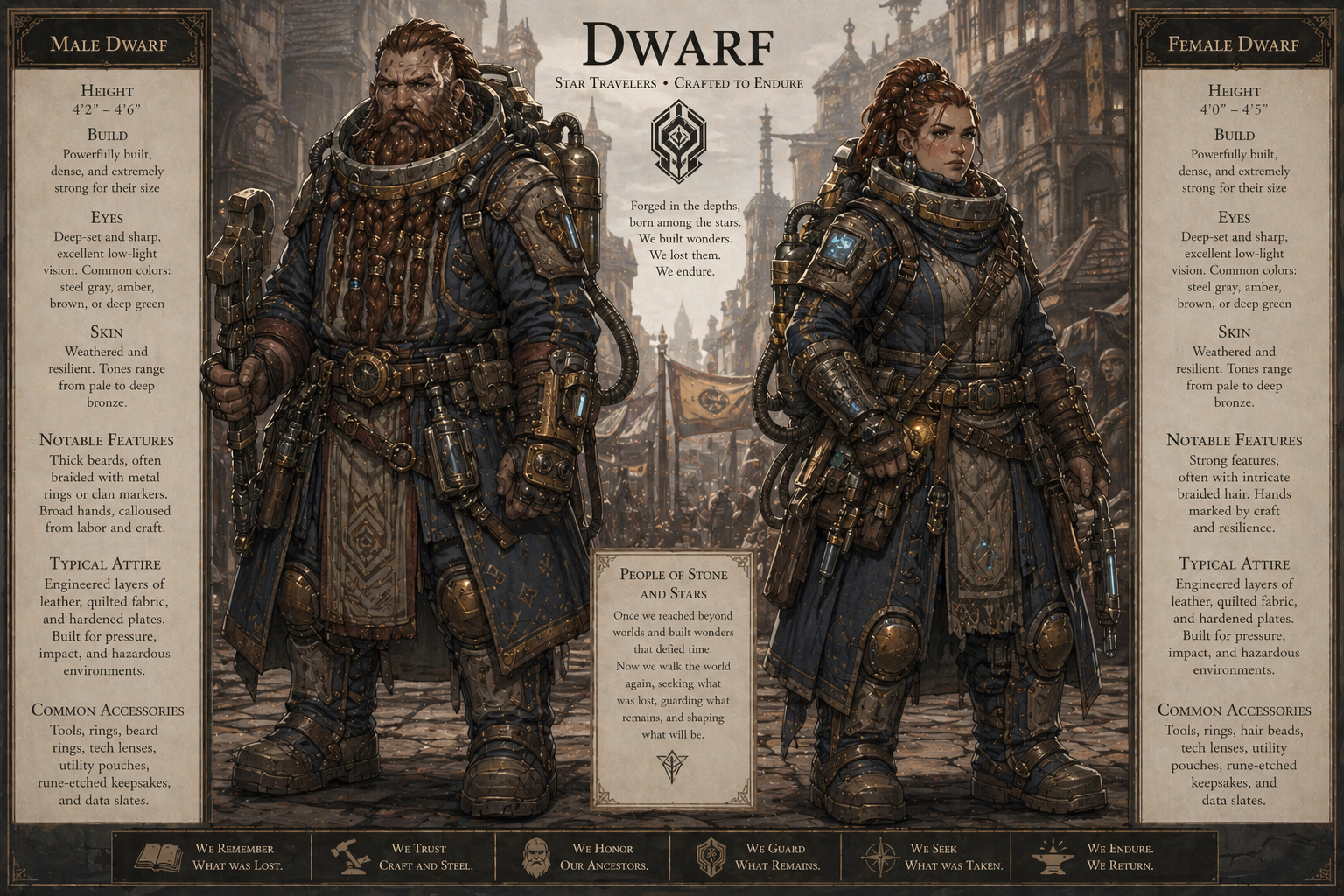
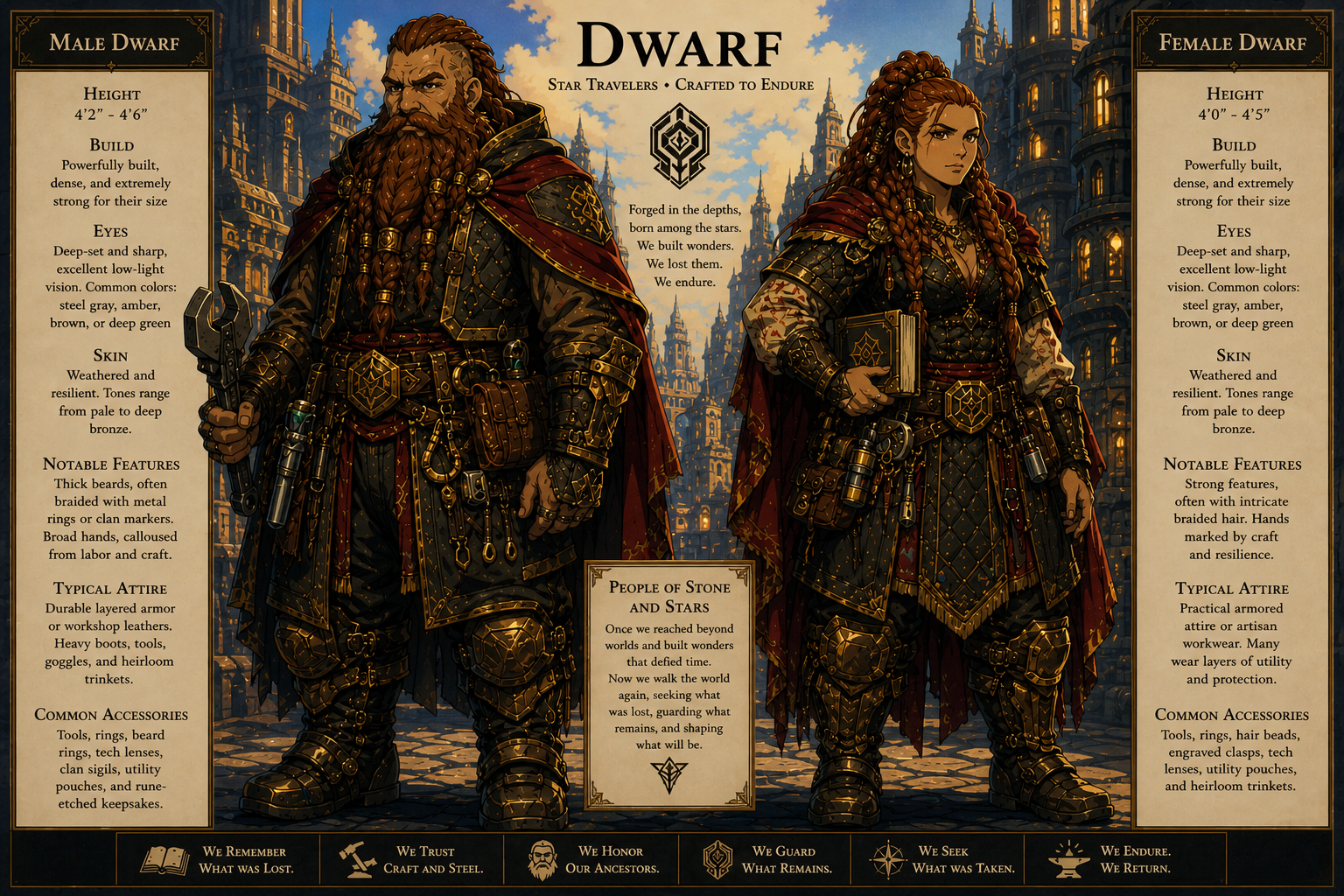
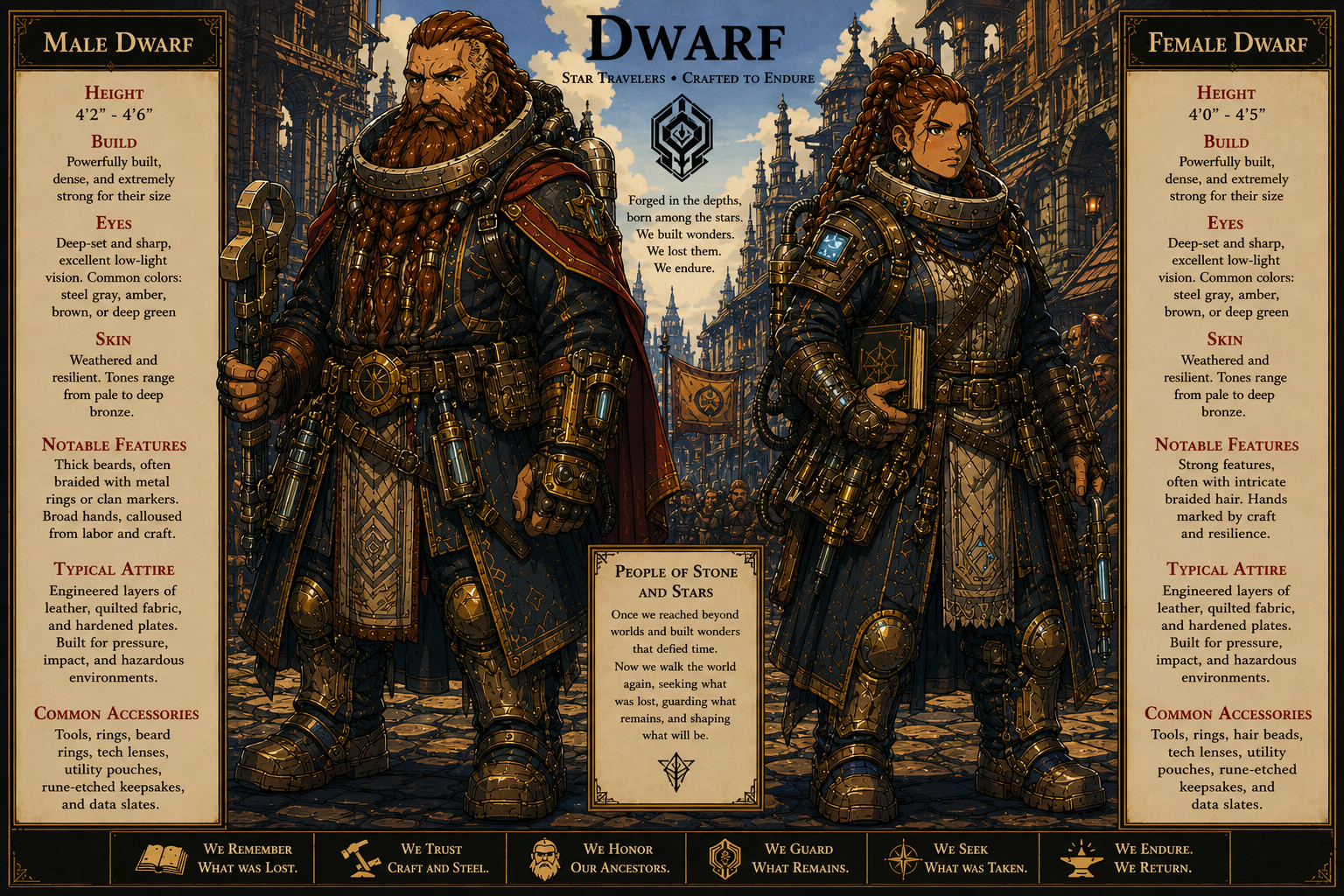
Associations
Other pages that reference or connect to this race
Referenced By
4Collections
Published collections that feature this race
Not in any collections yet
This race hasn't been published in any collections yet. Collections are curated groups of related content that help organize and showcase your world.
Tip: Collections are a great way to group related content together and share themed stories or worldbuilding elements with others.
Timelines
Timelines that reference or include this race
No timeline connections yet
This race isn't connected to any timelines yet. Timelines help organize events chronologically and show how your content fits into the broader history of your world.
Tip: Create timelines to organize important events in your world's history. Link characters, locations, and other content to specific events to build rich, interconnected narratives.
Shares
Discussion about this race
No shares yet
Be the first to start a discussion about this race by sharing it to the community stream.
Privacy & Sharing
Manage who can see and access this race
Current Status
refresh
This race is currently
Privacy Settings
Choose who can see and access this race
language Universe Privacy
This page belongs to a universe with its own privacy settings