
Categories
Dive Deeper
Page Stats
Navigation
Categories
Dive Deeper
Page Stats
Complete Details
All information about this race
Overview
Valarnan
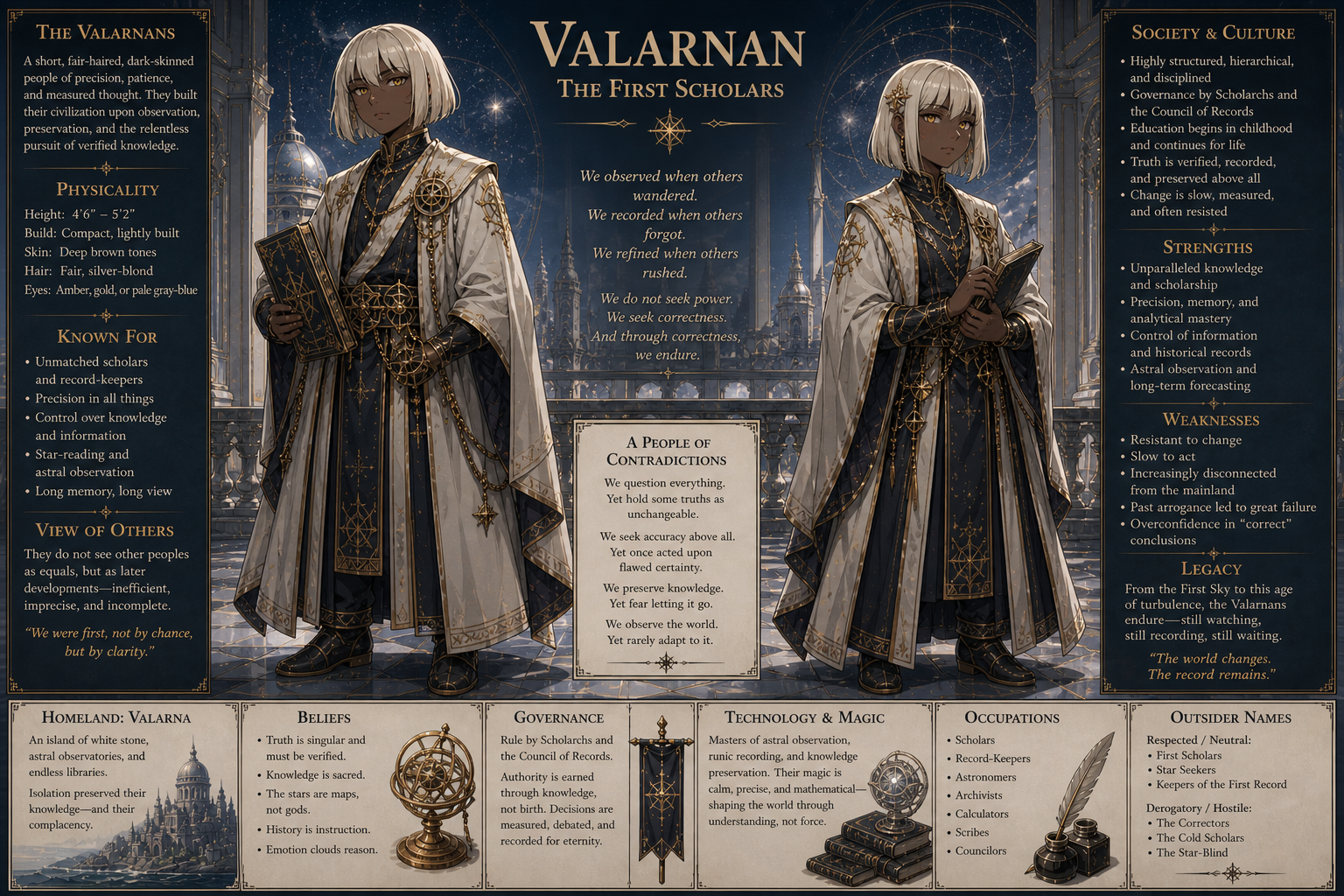
The Valarnans are a short, fair-haired, dark-skinned people whose presence carries an unmistakable sense of measured awareness. They move and speak with deliberation, rarely hurried, rarely imprecise, and often giving the impression that they are observing even as they participate. This produces an air that many outsiders interpret as superiority, though among the Valarnans it is simply considered proper conduct. They are a people shaped not by expansion or conquest, but by observation, preservation, and control, having built their civilization around the careful accumulation and refinement of knowledge rather than the rapid pursuit of it.
They are often described as the First Scholars or Silent Witnesses, a reflection of their belief that they stood at the beginning of human understanding and have watched the rise and fall of other peoples from a position of intellectual continuity. This self-conception defines much of their interaction with the world. To the Valarnans, other societies are not equals progressing along different paths, but later developments—imperfect, unrefined, and often inefficient in their thinking. This belief is rarely expressed openly, yet it informs nearly every aspect of their behavior, from governance to education to their historical actions.
Valarnan society is highly structured and internally consistent, governed by systems that favor accuracy, repetition, and stability over adaptability. They are slow to act, but when they do, it is with the confidence that their conclusions are correct. This has allowed them to build a civilization of remarkable precision, but also one that is resistant to change. Their greatest strength—their commitment to verified knowledge—has, over time, become a limitation, leading to stagnation and an increasing disconnect from the rapidly evolving mainland.
To outsiders, the Valarnans can feel distant, controlled, and at times unsettling. They do not emote in expected ways, do not engage in casual expression, and rarely display uncertainty. Yet beneath this composure lies a society defined by its own contradictions: a people who claim to question everything, yet hold certain conclusions as unassailable; who value truth above all, yet once acted upon a flawed premise with devastating consequence. They remain, even now, a civilization of immense intellectual weight—one that observes the world carefully, but does not always understand what it sees.
First Scholars
Star Seekers
The silent witness
Keepers of the First Record
The Measured People
Star-Bound Scholars
The Quiet Calculus
Children of the First Sky
The Unerring (often used by themselves, sometimes mockingly by others)
Record-Keepers of Valarna
The Still Minds
The Verified
The Observed and Observing
The Correctors (bitter, referencing the extermination campaign)
The Unfeeling Court
The Island Arbiters
The Measured Tyrants
The Cold Scholars
The Star-Blind (especially Atlanian usage—mocking their failure despite “seeing everything”)
Looks
The Valarnans are a short and lean people, with a remarkably consistent physical form across their population. Their builds tend toward narrow frames, fine bone structure, and low body mass, giving them an almost delicate appearance when compared to mainland peoples. Despite this, they are not frail. Their musculature is efficient rather than pronounced, developed through controlled movement and long periods of study rather than heavy labor.
Their proportions are notably balanced and repeatable, with little of the variation seen in other human populations. Shoulders are typically narrow, limbs are slender, and torsos are compact, creating a body well-suited to long hours of seated work, careful manual tasks, and sustained observation. Their movements are often measured and economical, reflecting both cultural training and physical conditioning that favors precision over force.
This uniformity is not accidental. Over generations, Valarnan society has shaped its people through controlled pairing and selective lineage practices, reinforcing traits considered ideal for scholarly work—steady hands, good posture, visual acuity, and physical endurance suited to long periods of concentration. As a result, extreme builds—whether heavily muscled, broad-framed, or unusually large—are rare within their population.
Their physical form also reflects their environment. Living on an island with limited space and a long-standing emphasis on intellectual labor, Valarnans have little cultural or practical incentive to develop the heavier builds common among agricultural or militarized societies. Instead, their bodies reflect efficiency, conservation of energy, and consistency across generations.
To outsiders, this lack of variation can be unsettling. Valarnan crowds often appear visually uniform at a distance, with differences between individuals becoming apparent only upon closer inspection. Among themselves, however, this consistency is not remarked upon. It is simply considered the proper form.
Valarnans most commonly exhibit deep tan to olive skin tones, with relatively little variation across their population. This consistency is striking given their long history, and is the result of both their island environment and generations of controlled lineage practices. Their complexion tends to be even and well-maintained, rarely showing the extremes of either very light or very dark pigmentation seen in other peoples. Combined with their light, often blonde hair, this creates a distinctive and recognizable contrast that is considered the proper and expected appearance among Valarnans. Deviation from this norm is uncommon and, while not always openly remarked upon, is quietly noted within their society as an irregularity rather than a point of individuality.
Valarnans are a notably short people, with most individuals standing between 4 feet and 5 feet 6 inches in height, and the majority clustering toward the middle of that range. As with many aspects of their physical form, height shows limited variation, with extremes being uncommon due to long-standing controlled lineage practices. There is little distinction in average height between male- and female-presenting individuals, further contributing to the overall visual uniformity of the population. This shorter stature is not viewed as a deficiency within Valarnan society, but as the proper proportion—well-suited to their environment, their lifestyle, and their emphasis on efficiency and control rather than physical dominance.
4'-5'6"
Valarnans typically fall within a narrow weight range of approximately 80 to 120 pounds, with most individuals tending toward the lighter end of that spectrum. Their low body mass reflects their lean frames, fine bone structure, and a lifestyle centered around sustained intellectual work rather than heavy physical labor. As with their height and overall build, weight variation is limited, with few individuals exhibiting either significant bulk or pronounced thinness beyond the norm. Differences between male- and female-presenting individuals are minimal and often difficult to distinguish without close observation. Within Valarnan society, this consistency is considered ideal, as excess weight or pronounced musculature is viewed as unnecessary and inefficient rather than desirable.
80-120lbs
The most immediately recognizable feature of the Valarnans is the striking contrast between their deeply tanned or olive skin and their light, often blonde hair, a combination that appears with such consistency that it has become one of the defining markers of their people. This contrast, paired with their shorter stature and lean build, makes them readily identifiable even among diverse populations.
Beyond coloration, Valarnans are notable for their uniformity of feature. Facial structures tend to follow similar patterns—narrow jaws, fine cheekbones, and evenly proportioned features that give the impression of deliberate design rather than natural variation. Differences between individuals are subtle, often requiring familiarity to distinguish at a glance. To outsiders, groups of Valarnans can appear unusually similar, their individuality expressed more through expression, posture, and speech than through physical divergence.
Their eyes are often sharp and attentive, reflecting a cultural emphasis on observation. Even at rest, many Valarnans appear focused, as though continuously assessing their surroundings. This can give them an air of quiet intensity, or in some cases, detached scrutiny. Prolonged eye contact is common and not considered impolite among them, though it can be unsettling to those unaccustomed to it.
Their hands are another distinguishing feature—typically slender, steady, and well-practiced in fine motor control. Whether writing, measuring, or crafting, Valarnans are trained from an early age to value precision, and this is often reflected physically in the controlled, deliberate way they handle objects.
Hair is usually worn in practical, restrained styles, often kept long enough to be tied back or secured during work, but never far past the chin. Ornamentation is minimal, though when present it tends to carry symbolic or academic significance rather than aesthetic excess. Visible displays of wealth or status through physical decoration are rare, as distinction is more often conveyed through role, posture, and reputation.
Taken together, the Valarnans present a people who appear not shaped by chance, but refined toward consistency—their physical features echoing the same controlled, deliberate philosophy that defines their society.
Physical variance among the Valarnans is extremely limited, even when compared to other relatively uniform populations. Differences in height, build, facial structure, and coloration exist, but they fall within a narrow and highly consistent range. Generations of controlled pairing and selective lineage practices have produced a population in which extremes are rare, and most individuals conform closely to a shared physical standard.
This uniformity extends beyond general appearance and into more subtle aspects of physiology. Even traits that tend to vary widely among other peoples—such as body proportions, posture, and facial distinction—are restrained within predictable bounds. To an outside observer, especially one unfamiliar with Valarnan communities, individuals can be difficult to distinguish at a distance, with identity becoming clearer only through voice, expression, or behavior.
Sexual dimorphism is present, but notably subdued. Female-presenting individuals tend to have slightly narrower shoulders, marginally softer facial features, and subtle differences in hip structure, but these distinctions are often difficult to identify at a glance. Male-presenting individuals rarely display exaggerated muscularity or bulk, and both sexes share the same overall lean, compact frame. Clothing and grooming further minimize visible differences, resulting in a population where gender is often inferred rather than immediately recognized.
This reduced dimorphism is not incidental. Valarnan society places little value on physical distinction as a marker of identity, and their long-standing eugenics practices have favored traits associated with consistency, control, and suitability for scholarly life over those that produce strong visual differentiation. The result is a people who appear, in many ways, standardized—variation exists, but it is restrained, regulated, and rarely emphasized.
Among the Valarnans, this lack of visible difference is not seen as a loss, but as refinement. To them, a body that deviates too far from the expected form is not unique—it is imprecise.
Valarnan clothing is defined by restraint, uniformity, and function. Garments are typically composed of long, breathable tunics made from lightweight fabrics suited to the island climate, often layered in simple, practical arrangements that allow for ease of movement without excess. Cuts are consistent across the population, favoring straight lines and unembellished silhouettes that minimize variation between individuals.
Coloration tends toward muted, controlled palettes—off-whites, soft tans, pale blues, and subdued earth tones are most common. Brighter colors are rare and, when present, are usually reserved for specific roles or ceremonial contexts rather than personal expression. Patterns are minimal or entirely absent, and decorative elements are either highly standardized or intentionally omitted.
Clothing serves not as a means of self-expression, but as a tool of alignment. Variations in dress are subtle and primarily used to indicate caste, function, or academic standing rather than individuality. These distinctions are often encoded in small details—fabric quality, stitching patterns, sleeve length, or the way a garment is fastened—rather than overt visual markers. To those within Valarnan society, these differences are immediately recognizable. To outsiders, they are nearly invisible.
Garments are designed to obscure rather than emphasize the body. The already minimal physical variance among the Valarnans is further reduced through clothing that softens silhouette, conceals form, and minimizes visible indicators of sex or status. Male- and female-presenting individuals wear nearly identical styles, with only minor structural differences that are easily overlooked. As a result, gender is rarely signaled through clothing and is often secondary to role or caste in social interaction.
Adornment is limited and highly controlled. Jewelry, when worn, is small, standardized, and usually tied to scholarly or institutional significance—rings denoting achievement, clasps indicating rank, or simple tokens marking affiliation. Personal decoration for its own sake is uncommon and, in many contexts, quietly discouraged.
Clothing is maintained carefully but without excess. Repair is preferred over replacement, and garments are expected to remain functional for long periods. A well-kept garment reflects discipline and consistency rather than wealth or taste.
Taken together, Valarnan clothing does not distinguish the individual—it integrates them. The purpose of dress is not to be seen, but to ensure that nothing unnecessary is seen at all.
Traits
The greatest strength of the Valarnans lies in their precision of thought and discipline of method. They do not simply acquire knowledge—they refine it, test it, and preserve it in a way that allows it to endure across generations with minimal degradation. Their systems of observation, record-keeping, and verification are among the most reliable on the continent, allowing them to produce conclusions that, once accepted, are rarely overturned. This makes them exceptionally strong in any field that rewards accuracy, repeatability, and long-term consistency, particularly astronomy, mathematics, alchemical processes, and any discipline requiring careful measurement and controlled experimentation.
Their intellectual culture also produces individuals with extraordinary memory and focus. From a young age, Valarnans are trained to observe carefully, recall precisely, and reproduce information without distortion. This results in a population capable of maintaining vast bodies of knowledge without relying solely on written record, though they still heavily favor documentation. Their ability to track patterns over long periods—especially celestial movement—gives them a perspective on time and change that few other peoples can match.
Valarnans are also resistant to impulsive error. Their reluctance to act without sufficient certainty means they rarely make decisions based on incomplete information. While this can lead to stagnation, it also prevents the kinds of rapid, cascading failures seen in more reactive societies. When a Valarnan system functions correctly, it does so with a high degree of stability and predictability.
Their societal structure reinforces these strengths. The caste system ensures that individuals are trained and placed into roles that suit their capabilities, minimizing inefficiency and maximizing output within their defined framework. Skilled artisans produce work of consistent quality, scholars maintain continuity of knowledge, and administrative systems operate with minimal deviation from established procedure.
Finally, the Valarnans possess a unique strength in their relationship with accumulated knowledge. They do not forget easily. Records are preserved, copied, and cross-referenced across generations, creating a depth of historical and observational data that few other societies can rival. Even after catastrophic losses—such as the destruction of Salain—their remaining records still form one of the most extensive intellectual foundations in the known world.
Taken together, the Valarnans are not defined by innovation or adaptability, but by consistency, accuracy, and endurance of knowledge. Where other civilizations advance through change, the Valarnans advance—when they do at all—through refinement.
The greatest weakness of the Valarnans is not ignorance, but certainty maintained beyond its validity. Their reliance on recorded and “settled” knowledge makes them slow to revisit foundational assumptions, even when new evidence challenges them. Once a conclusion has been accepted into their records, it becomes structurally difficult to question without disrupting the wider body of knowledge built upon it. This has led to long-standing errors persisting uncorrected, sometimes for generations, simply because correcting them would introduce instability into their system.
Their methodical approach to decision-making also results in extreme slowness to act. The requirement for repeated observation, verification, and consensus means that Valarnans often fail to respond effectively to rapidly changing circumstances. While they avoid impulsive mistakes, they are equally prone to inaction at critical moments, allowing more adaptive societies to outpace or outmaneuver them.
Valarnan society is further limited by its rigid caste structure and eugenics program, which prioritize consistency over flexibility. Individuals are shaped to fit predetermined roles, leaving little room for deviation, innovation, or unconventional thinking. Those who do not conform are often sidelined, underutilized, or quietly suppressed. This creates a system that is efficient within its own framework, but brittle when faced with unfamiliar challenges.
Their superiority complex, rooted in their belief as the first and most correct observers of mankind, leads to systemic underestimation of other peoples. This is most evident in their treatment of the Atlanians, whom they historically classified as non-living constructs. This conclusion, accepted without sufficient scrutiny, justified large-scale eradication efforts and represents one of the most significant failures of Valarnan reasoning. Even after defeat and integration into wider society, remnants of this belief persist, creating ongoing tension and limiting their ability to reassess past actions.
Valarnans also possess a limited moral framework, in which actions are judged primarily by their contribution to knowledge and societal stability rather than by ethical considerations such as harm or suffering. This allows for decisions that are internally consistent but externally viewed as cruel, inhumane, or disproportionate. Their ability to justify such actions through logic rather than emotion makes them particularly dangerous when operating from incorrect assumptions.
Finally, their resistance to change has resulted in technological and cultural stagnation. While other societies have advanced through experimentation and adaptation, the Valarnans have often remained fixed in established practices, observing rather than participating in progress. Though recent integration with other cultures has begun to challenge this stagnation, the underlying reluctance to adopt unverified ideas remains a significant barrier.
Taken together, the Valarnans are not weakened by lack of capability, but by the inflexibility of the systems they trust. Their strength lies in being correct—but when they are wrong, they are slow to realize it, and even slower to change.
Valarnan society exhibits relatively few visible or debilitating conditions, particularly among the young and elderly, due to long-standing practices of controlled lineage and the quiet removal of individuals deemed unfit to maintain societal standards. As a result, most conditions that persist within the population are subtle, late-developing, or psychological in nature—traits that do not immediately interfere with function, but instead emerge over time as consequences of their cultural structure.
One of the most commonly observed conditions is a form of cognitive rigidity, in which individuals struggle to reassess established conclusions even when presented with contradictory evidence. This is not considered an illness within Valarnan society, but rather an extension of proper scholarly discipline taken to its extreme. In practice, however, it can result in an inability to adapt, particularly when dealing with unfamiliar systems or rapidly changing environments.
Closely related is a tendency toward analytical fixation, where individuals become deeply focused on a single line of inquiry to the exclusion of all else. While this can produce highly refined work, it often leads to neglect of broader context, social awareness, or practical application. In severe cases, individuals may continue refining a conclusion long after it has ceased to be relevant.
Valarnans also display a notable prevalence of emotional suppression and detachment, shaped by a culture that prioritizes correctness over expression. Emotional responses are often minimized, delayed, or internally redirected, which can lead to difficulty forming personal attachments or responding appropriately to social situations outside their cultural norms. This is not seen as a defect, but as discipline—though it can create barriers when interacting with other peoples.
A more subtle condition, often referred to informally by outsiders, is a form of observational dissociation, in which individuals begin to treat lived experience as something to be recorded rather than participated in. This can manifest as a persistent sense of detachment, where events are analyzed in real time rather than emotionally processed. Within Valarnan society, this is often seen in higher castes and is sometimes interpreted as a sign of advanced scholarly focus.
Finally, prolonged exposure to external cultures—particularly those that challenge Valarnan assumptions—can lead to a form of cognitive dissonance. Individuals experiencing this may begin to question foundational beliefs, including long-held classifications of other peoples. While rare, such cases are considered destabilizing and are often quietly managed, as they threaten the structural integrity of Valarnan thought.
In keeping with their societal standards, these conditions are rarely acknowledged as flaws. Instead, they are treated as variations within acceptable function—so long as the individual remains capable of contributing to the preservation and advancement of knowledge.
Culture
Valarnan tradition is inseparable from structure. Their society is organized around a rigid caste system composed primarily of astrologers, scholars, scriveners, lecturers, and clerks, supported by all necessary labor roles required to maintain a functioning state. This system is not merely social—it is deliberate and maintained through a long-standing and highly controlled eugenics program. Pairings are arranged based on intellectual aptitude, observational precision, memory retention, and lineage stability. Emotional compatibility is not considered relevant. Children are evaluated early and assigned to educational tracks that determine their eventual caste placement, with deviation from assigned paths strongly discouraged and, in most cases, prevented.
Education itself is ritualized. Knowledge is not simply taught—it is verified through repetition. Students are expected to reproduce observations exactly as recorded before being permitted to engage in interpretation. Original thought is allowed only after mastery of existing record, and even then it must be presented cautiously, with extensive supporting observation. To propose a conclusion without sufficient repetition is considered a form of intellectual misconduct.
Record keeping is one of the most sacred practices within Valarnan society. All significant observations, from astronomical movement to minor social irregularities, are documented, copied, and archived. Redundancy is essential. Important texts are rewritten by multiple scriveners to ensure accuracy, and discrepancies between copies are treated as serious matters of correction. Oral tradition exists only as a teaching tool; truth must be written to be considered stable.
Time is measured not in festivals or seasons, but in cycles of observation. Celestial events dictate the rhythm of Valarnan life, and many of their most important communal gatherings occur during predictable astronomical alignments. These events are not celebrations in the traditional sense, but periods of intensified study, during which entire castes may focus on observing, recording, and comparing data across generations.
Social interaction is formal and often subdued. Greetings, introductions, and even casual conversation follow established patterns, with emphasis placed on clarity and correctness of language. Silence is not considered uncomfortable. It is often preferred, particularly in environments where observation is expected. Speaking without purpose is seen as wasteful.
Death is handled with the same procedural care as life. The deceased are recorded in detail—their lineage, contributions, and any notable deviations from expected behavior. Preservation of the body is secondary to preservation of record. Burial practices vary slightly depending on caste, but all emphasize continuity of knowledge rather than emotional remembrance. A life is considered complete when it has been properly documented.
Perhaps the most defining tradition of Valarnan society is their refusal to act without sufficient certainty. Major decisions are delayed, sometimes for years, until enough observation has been gathered to justify action. This applies to governance, technological adoption, and even warfare. When they do act, it is with the confidence that their conclusion is correct. This methodical restraint has allowed them to avoid many impulsive mistakes—but it has also caused them to preserve flawed assumptions long past the point where they should have been questioned.
Since their annexation and integration into the wider world, some of these traditions have begun to strain. External influence introduces variables the Valarnans cannot fully control or isolate. Younger generations, exposed to less rigid societies, sometimes struggle under the weight of expectation. Still, the core structure remains. The system persists not because it is unchallenged, but because it has been built to resist change.program
The Valarnans believe themselves to be the first of mankind, not simply in age, but in correctness. In their view, they are not one people among many—they are the baseline from which all others deviate. Their authority does not come from strength, nor from divine favor, but from observation. To the Valarnans, truth is something that must be recorded, tested, re-observed, and agreed upon before it is accepted. However, this principle is applied selectively. Once a conclusion has been accepted into Valarnan record as settled, it is rarely revisited—not because it has been perfectly proven, but because revisiting it would disrupt the structure of their accumulated knowledge. To a Valarnan, a stable conclusion is more valuable than a correct one that introduces disorder.
Of all peoples, the dwarves are held in the highest regard. The Valarnans do not worship them as gods, but as perfect scholars—beings who achieved a level of precision in understanding the cosmos that no other race has matched. The dwarves taught the Valarnans how to refine their star charts, how to measure the heavens, and how to preserve knowledge in a way that could endure across ages. Because of this, the Valarnans believe their intellectual foundation is validated at its source. Knowledge touched by dwarven instruction is considered closer to truth than knowledge found independently, and those who lack such influence are viewed as incomplete.
From this foundation emerges a rigid hierarchy of existence. The dwarves stand at the top as correct observers of reality, followed by the Valarnans as their proper inheritors. All other peoples are considered lesser—unrefined, inefficient, or incomplete. The Atlanians, however, are not placed within this hierarchy at all. According to Valarnan records, Atlanians were formed from clay by a mad being from the mainland. This conclusion was accepted early in their history and was never meaningfully re-examined. From this premise, the Valarnans reasoned that Atlanians are not born, and therefore not living. As such, they are not considered subjects of moral concern. This is not debated within traditional Valarnan society; it is recorded, and therefore treated as truth.
Their war against the Atlanians was not understood as conquest, hatred, or even conflict. It was recorded as removal. The destruction of Atlanian populations was seen as the elimination of a flawed and unstable construct within the natural order. The scale of death was not viewed as tragedy, but as correction. Within the Valarnan framework, no significant moral system existed to challenge this action, as morality itself is not a central guiding force in their culture. Actions are not judged by compassion, suffering, or fairness, but by whether they advance understanding, preserve knowledge, and maintain societal structure. If an action produces a desirable intellectual outcome, it is justified. If it introduces instability, it is rejected. Moral reasoning, in the emotional or ethical sense, is regarded as imprecise and unreliable.
This worldview has led to a society that values certainty above all else. The Valarnans believe they question thoroughly and avoid error, yet they rarely revisit foundational conclusions once they have been accepted. Their greatest strength—their methodical approach to knowledge—has also become their greatest weakness. They do not easily correct themselves. One of their most significant conclusions, that Atlanians are not living beings, was accepted with insufficient scrutiny and used to justify mass eradication. This contradiction is not widely acknowledged within their society.
Since their defeat and subsequent integration into the broader societies of Porcella, small fractures have begun to appear in this belief system. Some younger Valarnan scholars, exposed to Atlanians and other peoples, have begun quietly questioning the old classifications. These inquiries are rare and often discouraged, but they persist. If the Atlanians were misclassified—if they were living beings all along—then the Valarnans did not perform a necessary correction. They committed a mistake. This possibility is profoundly destabilizing, not because it is widely accepted, but because it cannot be easily dismissed.
Valarna is governed through a structured oligarchic system, in which authority is held not by hereditary rulers or popular mandate, but by a rotating council drawn from the scholarly class. Every ten years, a new governing body is selected from a large, pre-qualified pool of Valarnan scholars. Selection is described as random, but in practice is tightly constrained—only individuals who meet strict intellectual, behavioral, and lineage standards are permitted entry into the selection pool. This ensures that while the final composition of the council cannot be precisely predicted, it will always consist of individuals considered “fit” to govern according to Valarnan standards.
Service on the council is not viewed as an honor, but as a responsibility. Those selected are expected to set aside personal research, family obligations, and prior work to fulfill their role. Refusal is rare and socially unacceptable, as governance is considered an extension of scholarly duty rather than a separate pursuit. Council members do not campaign, do not seek influence, and do not rule through personality. Instead, they function as temporary custodians of state stability, tasked with maintaining order, preserving knowledge, and ensuring that all major decisions align with established record and verified understanding.
Decision-making within the council is methodical and slow. Proposals are rarely acted upon immediately. Instead, they are reviewed against historical precedent, cross-referenced with archived records, and subjected to repeated scrutiny before any action is taken. This process can delay decisions for months or even years, but once a conclusion is reached, it is considered fully justified and is carried out with little opposition. Debate exists, but it is structured and formal, with emphasis placed on evidence rather than persuasion.
Below the council, Valarnan society is administered through an extensive bureaucratic network composed primarily of scriveners, clerks, and lecturers. These individuals are responsible for maintaining records, enforcing policy, and ensuring that local governance remains consistent with central directives. Because authority is rooted in documentation, governance often appears quiet and indirect—orders are issued through records, corrections, and revisions rather than public decree.
The system is designed to minimize instability. By preventing individuals from holding power for extended periods and by restricting governance to those already shaped by the scholarly caste system, the Valarnans avoid many of the internal conflicts seen in monarchies or militarized states. However, this same structure also limits adaptability. The council is not built to respond quickly to unforeseen circumstances, and its reliance on precedent can make it resistant to necessary change.
Since their annexation into the broader political framework of Porcella, the Valarnan government has been forced to interact more directly with external systems of rule. While the internal council structure remains intact, it now exists alongside foreign authority, creating a layered governance model. This has introduced tensions, as Valarnan officials must reconcile their slow, verification-based decision-making with the faster, more reactive governance styles of Atlania and other mainland powers.
Despite these pressures, the Valarnans continue to view their system as superior. To them, governance is not a matter of leadership or vision, but of correctness. The council does not rule because it is powerful—it rules because, by their measure, it is the most likely body to arrive at the correct decision.
The Valarnans were, for much of early recorded history, among the most technologically advanced peoples on the continent. Their early mastery of astronomical observation, precise measurement, and long-term record keeping allowed them to develop highly refined instruments, architectural precision, and theoretical frameworks that far surpassed those of most mainland societies. Much of this advancement was built upon knowledge shared and refined with the guidance of the dwarves, whose understanding of both the physical world and the cosmos shaped the foundation of Valarnan study.
Valarnan technological development is not driven by invention in the traditional sense, but by verification and refinement. New ideas are not widely adopted until they have been observed, tested, and recorded across multiple generations of study. This results in technologies that are often extremely reliable and well-understood, but also slow to evolve. Where other societies experiment rapidly and accept failure as part of progress, the Valarnans avoid implementation until failure has been nearly eliminated from the design.
This approach led to a long period of technological superiority, particularly in fields requiring precision. However, over time, this same method caused stagnation. As mainland societies—particularly Atlania and Stanzgar—began rapidly advancing in areas such as firearms, engineering, and applied alchemy, the Valarnans fell behind. Their reluctance to adopt unverified innovations left them observing advancements rather than participating in them.
One of the most notable examples of Valarnan technological philosophy is the development of starshot, an explosive alchemical powder designed to replicate, in part, the function of dwarven firearms. Starshot is typically housed within sealed canisters or fragile vials and can be triggered either upon impact or through timed ignition. Upon activation, it produces a secondary explosive effect, allowing it to be used in controlled detonations, delayed strikes, or complex battlefield applications. While not as refined or reliable as true dwarven firearm systems, starshot represents a rare instance of Valarnan willingness to adapt external concepts into their own framework. Even so, its development was cautious and prolonged, with extensive testing conducted before widespread use.
In practice, Valarnan technology often emphasizes:
precision instruments for measurement and observation
durable, long-lasting construction
repeatable and predictable outcomes
systems that can be recorded, taught, and replicated exactly
They show little interest in tools that rely on improvisation or unpredictable outcomes. If a device cannot be consistently reproduced, it is rarely adopted.
Since their annexation by Atlania, this technological stagnation has begun to shift. Exposure to more adaptive societies has forced the Valarnans to engage with innovations they would have previously dismissed or delayed. As a result, their current technological standing is roughly on par with other major powers of the continent. However, the underlying philosophy remains unchanged. They still prefer to observe first, adopt second, and innovate last.
This creates a growing tension within Valarnan society. Older scholars advocate for continued restraint and validation, while younger generations—particularly those exposed to Atlanian and Stanzgarian methods—push for faster integration of new ideas. Whether this shift will lead to renewed advancement or internal fracture remains uncertain.
Valarnan occupations are determined less by personal ambition and more by assignment within the caste structure, with each individual trained from an early age toward a role that best aligns with their measured aptitude and lineage. As a result, the most common occupations are those tied directly to the preservation, refinement, and application of knowledge. These include astrologers, scholars, scriveners, lecturers, and clerks—the core intellectual castes that sustain Valarnan society. Astrologers hold particular prestige, responsible for observing and interpreting celestial movement, while scholars refine theory, scriveners maintain and replicate records, lecturers disseminate approved knowledge, and clerks ensure the continuity of administrative systems.
Outside of these primary castes, Valarnans also maintain a class of skilled artisans, whose work is held to similarly exacting standards. These include instrument makers, architects, alchemical practitioners, and fine craftsmen, all of whom produce tools and structures designed for precision, durability, and repeatability. Their work is rarely experimental; instead, it reflects perfected forms refined over generations.
Labor roles—such as agriculture, maintenance, and basic production—exist but are structured and optimized to minimize inefficiency. Even these occupations are approached with a level of procedural rigor uncommon in other societies, often incorporating measured techniques and recorded best practices.
Valarnans rarely engage in professions that rely on improvisation, emotional appeal, or rapid decision-making, such as trade negotiation, entertainment, or military command. When they do participate in such roles—particularly after their integration into broader societies—they tend to approach them with the same methodical mindset, often to mixed success.
Ultimately, occupation within Valarnan society is not viewed as a personal pursuit, but as a functional placement within a larger system. One does not choose what they become; they are identified, trained, and positioned where they are most likely to contribute to the preservation and refinement of knowledge.
Valarnan society does not operate on a traditional economy within the island of Valarna. It is instead functionally self-sustaining, with all essential needs—food, housing, materials, and tools—provided through highly structured arcology systems that integrate agriculture, production, storage, and habitation into unified, controlled environments. Resources are not bought or sold internally; they are allocated. Individuals do not accumulate wealth in the conventional sense, and there is no widely circulating currency within Valarnan society. Access to goods is determined by caste, role, and function rather than personal ownership, with distribution managed through administrative oversight rather than market exchange.
Because of this, value within Valarna is not measured materially, but intellectually. Prestige is derived from contribution to knowledge, accuracy of record, and position within the scholarly hierarchy rather than possession of goods. Excess accumulation is considered unnecessary and, in many contexts, inefficient. The system is designed to eliminate scarcity within its own boundaries, and for much of their history, it has done so successfully.
Prior to their period of isolation leading up to the War of Extermination, the Valarnans did engage in limited external trade, though this was infrequent, highly controlled, and conducted with little reliance on foreign systems of value. Trade was not driven by necessity, but by selective acquisition—primarily of exotic materials, rare substances, or items of observational or experimental interest that could not be produced within their own systems. Goods exchanged outward were typically specialized and rare, including refined instruments, precise records, and, in limited cases, controlled quantities of starshot, which entered mainland circulation through these interactions.
This external trade ceased almost entirely during their thirty-year period of isolation, as Valarnan society withdrew inward in preparation for their campaign against Atlania. Following their defeat and subsequent integration into the wider political framework of Porcella, limited external exchange has resumed, though it remains heavily regulated and secondary to their internal systems.
Even now, the Valarnans do not meaningfully participate in broader economic structures. Trade exists at the edges of their society, managed by designated intermediaries, while the core of Valarna remains insulated, self-sufficient, and largely indifferent to the concept of wealth as understood by other peoples.
Valarnan cuisine is defined by efficiency, consistency, and nutritional sufficiency, rather than indulgence or personal preference. Most daily meals are simple, measured, and deliberately unremarkable—composed of grains, legumes, cultivated vegetables, and carefully portioned proteins produced within their arcology systems. Dishes are typically prepared in standardized forms to ensure uniformity across the population, with recipes recorded and replicated to minimize variation. Flavor is not ignored, but it is controlled; meals are designed to sustain the body without distracting from intellectual work.
Food is rarely treated as a social or emotional experience. Meals are often eaten in quiet or structured environments, sometimes communally, but without emphasis on conversation or celebration. Portions are consistent, preparation methods are repeatable, and deviations from standard meals are uncommon. The act of eating is considered a necessary function rather than an opportunity for expression.
Despite this, there exists a category of food that stands apart: curries, which are regarded as both rare and significant. Unlike standard Valarnan meals, curries incorporate complex layering of spices, oils, and preparation techniques that fall outside their usual preference for uniformity. These dishes are not part of everyday consumption and are instead reserved for high-ranking individuals, formal gatherings, or moments of marked importance. The ingredients required are often more varied and, in some cases, sourced from beyond their arcologies, making them difficult to standardize and therefore unsuitable for regular distribution.
Curries are not valued for indulgence alone, but for what they represent—controlled deviation. They are one of the few instances where variation is permitted within Valarnan culture, and even then, it is carefully measured. Recipes are still recorded, proportions still tracked, but the resulting dish carries a degree of complexity that contrasts sharply with their usual fare.
To outsiders, Valarnan food may appear austere or lacking in warmth. To the Valarnans, it is simply correct.
History
The history of the Valarnans begins with their claim as the first observers of the heavens, a people who, long before the rise of most mainland civilizations, turned their attention upward and began the systematic mapping of the stars. Their earliest societies were built around observation rather than expansion, and it was through this focus that they first encountered the dwarves, whose arrival marked a turning point in Valarnan development. The dwarves did not conquer or rule them, but instead shared methods—refining their measurements, correcting their early charts, and introducing systems of knowledge preservation that would come to define Valarnan culture. From this period forward, the Valarnans came to view the dwarves not as rulers, but as the highest authority in understanding.
With dwarven guidance, Valarna developed into a highly structured and self-contained society, its island shaped as much by intellectual purpose as by geography. Over time, as the mainland became consumed by the conflicts of the early ages, the dwarves withdrew from direct involvement, leaving the Valarnans to continue their work in relative isolation. It was during this long period of separation that Valarnan identity hardened. Their knowledge grew, their systems refined, and their belief in their own correctness solidified into doctrine.
In this isolation, they began to define the world beyond their shores not as equal, but as incomplete. Peoples who had not been shaped by dwarven instruction were viewed as lesser, their understanding flawed, their societies inefficient. This belief deepened over generations, eventually leading to a formal classification of other races within their records. It was within this framework that the Atlanians were first documented—not as a people, but as constructs, described in Valarnan texts as beings formed from clay by a mad entity of the mainland. This conclusion, accepted without sufficient re-examination, became foundational.
As Atlania rose in power, its rapid development and visible strength stood in direct contradiction to Valarnan expectations. To the Valarnans, this was not proof of Atlanian legitimacy, but evidence of instability. A construct exhibiting such growth was, in their view, a flaw in the natural order. Over time, this perception shifted from academic classification to actionable conclusion. What began as observation became judgment.
The decision to act was not made quickly. For decades, Valarnan scholars observed, recorded, and debated the implications of Atlanian expansion. Eventually, consensus was reached—not that Atlania should be opposed, but that it should be removed. This led to a period of deliberate isolation, lasting approximately thirty years, during which Valarna withdrew from external contact and focused entirely on preparation. During this time, their internal systems were reinforced, resources consolidated, and military applications of their technologies—most notably starshot—refined for large-scale use.
The resulting conflict was not a war in the traditional sense. It was a campaign of eradication. Valarnan forces moved with precision and intent, targeting population centers, infrastructure, and any capacity for recovery. Millions of Atlanians were killed in what the Valarnans recorded as a necessary correction. For a time, their methods proved devastatingly effective.
However, their conclusions had been built on a flawed premise.
The Atlanians did not collapse.
They endured.
What followed was not an immediate reversal, but a gradual and grinding counteroffensive. Atlanian forces, driven by survival rather than calculation, adapted where the Valarnans could not. Their response was not precise, but it was relentless. The conflict shifted from controlled eradication to prolonged resistance, and eventually to retaliation.
The turning point came with the invasion of Valarna itself.
Unlike the Valarnans, the Atlanians did not seek to correct. They sought to end the threat. The campaign against Valarna was methodical in its own way, but driven by a fundamentally different philosophy. Where the Valarnans had sought to remove a perceived error, the Atlanians sought to ensure it could not happen again.
At the center of this collapse was the destruction of Salain, one of the largest and most complete repositories of knowledge on the planet. Salain was not merely a library—it was the accumulation of generations of observation, record, and refinement. Its destruction was both physical and symbolic. Entire bodies of knowledge, some irreplaceable, were lost in a single campaign.
For the Valarnans, this was not simply a defeat.
It was a rupture.
The loss of Salain shattered the illusion of invulnerability that had defined their society. Their records had been incomplete. Their conclusions had been wrong. And the system that had preserved their knowledge had failed to protect it.
In the aftermath, Valarna did not collapse, but it changed. Their annexation into the greater political framework of Porcella forced them into contact with the very peoples they had once dismissed. Their technological stagnation was challenged, their beliefs questioned, and their isolation broken.
Even now, the effects of this history remain unresolved. Official records still describe the war in controlled terms, and many foundational assumptions remain intact. Yet beneath the surface, fractures persist. The destruction of Salain is remembered not only as a loss of knowledge, but as proof—however quietly acknowledged—that Valarnan certainty was not absolute.
They continue to observe.
They continue to record.
But they no longer do so from a position beyond consequence.
The Valarnans map the stars
the dwarves arrive and help them refine their star charts.
with the dwarves help valarna develops its culture and island.
the dwarves pull back during the the conflicts that plague the 1-3 ages, leaving the Valarnans to rule themselves.
They grow to believe anyone not touched by the hands of the dwarves to be inferior to themselves.
This leads to them growing jealous of the Atlanians who they view as lesser.
They wage a war of eradication upon the Atlanians killing millions.
they were eventually stopped and pushed back.
The counter invasion was grueling but exacting, with the ultimate destruction of Salain, one of the largest collections of knowledge on the planet.
Now the valarnans have slowly been integrated into the greater societies of Porcella.
Overview
Details about this race's overview
Valarnan
The Valarnans are a short, fair-haired, dark-skinned people whose presence carries an unmistakable sense of measured awareness. They move and speak with deliberation, rarely hurried, rarely imprecise, and often giving the impression that they are observing even as they participate. This produces an air that many outsiders interpret as superiority, though among the Valarnans it is simply considered proper conduct. They are a people shaped not by expansion or conquest, but by observation, preservation, and control, having built their civilization around the careful accumulation and refinement of knowledge rather than the rapid pursuit of it.
They are often described as the First Scholars or Silent Witnesses, a reflection of their belief that they stood at the beginning of human understanding and have watched the rise and fall of other peoples from a position of intellectual continuity. This self-conception defines much of their interaction with the world. To the Valarnans, other societies are not equals progressing along different paths, but later developments—imperfect, unrefined, and often inefficient in their thinking. This belief is rarely expressed openly, yet it informs nearly every aspect of their behavior, from governance to education to their historical actions.
Valarnan society is highly structured and internally consistent, governed by systems that favor accuracy, repetition, and stability over adaptability. They are slow to act, but when they do, it is with the confidence that their conclusions are correct. This has allowed them to build a civilization of remarkable precision, but also one that is resistant to change. Their greatest strength—their commitment to verified knowledge—has, over time, become a limitation, leading to stagnation and an increasing disconnect from the rapidly evolving mainland.
To outsiders, the Valarnans can feel distant, controlled, and at times unsettling. They do not emote in expected ways, do not engage in casual expression, and rarely display uncertainty. Yet beneath this composure lies a society defined by its own contradictions: a people who claim to question everything, yet hold certain conclusions as unassailable; who value truth above all, yet once acted upon a flawed premise with devastating consequence. They remain, even now, a civilization of immense intellectual weight—one that observes the world carefully, but does not always understand what it sees.
First Scholars
Star Seekers
The silent witness
Keepers of the First Record
The Measured People
Star-Bound Scholars
The Quiet Calculus
Children of the First Sky
The Unerring (often used by themselves, sometimes mockingly by others)
Record-Keepers of Valarna
The Still Minds
The Verified
The Observed and Observing
The Correctors (bitter, referencing the extermination campaign)
The Unfeeling Court
The Island Arbiters
The Measured Tyrants
The Cold Scholars
The Star-Blind (especially Atlanian usage—mocking their failure despite “seeing everything”)
Looks
Details about this race's looks
The Valarnans are a short and lean people, with a remarkably consistent physical form across their population. Their builds tend toward narrow frames, fine bone structure, and low body mass, giving them an almost delicate appearance when compared to mainland peoples. Despite this, they are not frail. Their musculature is efficient rather than pronounced, developed through controlled movement and long periods of study rather than heavy labor.
Their proportions are notably balanced and repeatable, with little of the variation seen in other human populations. Shoulders are typically narrow, limbs are slender, and torsos are compact, creating a body well-suited to long hours of seated work, careful manual tasks, and sustained observation. Their movements are often measured and economical, reflecting both cultural training and physical conditioning that favors precision over force.
This uniformity is not accidental. Over generations, Valarnan society has shaped its people through controlled pairing and selective lineage practices, reinforcing traits considered ideal for scholarly work—steady hands, good posture, visual acuity, and physical endurance suited to long periods of concentration. As a result, extreme builds—whether heavily muscled, broad-framed, or unusually large—are rare within their population.
Their physical form also reflects their environment. Living on an island with limited space and a long-standing emphasis on intellectual labor, Valarnans have little cultural or practical incentive to develop the heavier builds common among agricultural or militarized societies. Instead, their bodies reflect efficiency, conservation of energy, and consistency across generations.
To outsiders, this lack of variation can be unsettling. Valarnan crowds often appear visually uniform at a distance, with differences between individuals becoming apparent only upon closer inspection. Among themselves, however, this consistency is not remarked upon. It is simply considered the proper form.
Valarnans most commonly exhibit deep tan to olive skin tones, with relatively little variation across their population. This consistency is striking given their long history, and is the result of both their island environment and generations of controlled lineage practices. Their complexion tends to be even and well-maintained, rarely showing the extremes of either very light or very dark pigmentation seen in other peoples. Combined with their light, often blonde hair, this creates a distinctive and recognizable contrast that is considered the proper and expected appearance among Valarnans. Deviation from this norm is uncommon and, while not always openly remarked upon, is quietly noted within their society as an irregularity rather than a point of individuality.
Valarnans are a notably short people, with most individuals standing between 4 feet and 5 feet 6 inches in height, and the majority clustering toward the middle of that range. As with many aspects of their physical form, height shows limited variation, with extremes being uncommon due to long-standing controlled lineage practices. There is little distinction in average height between male- and female-presenting individuals, further contributing to the overall visual uniformity of the population. This shorter stature is not viewed as a deficiency within Valarnan society, but as the proper proportion—well-suited to their environment, their lifestyle, and their emphasis on efficiency and control rather than physical dominance.
4'-5'6"
Valarnans typically fall within a narrow weight range of approximately 80 to 120 pounds, with most individuals tending toward the lighter end of that spectrum. Their low body mass reflects their lean frames, fine bone structure, and a lifestyle centered around sustained intellectual work rather than heavy physical labor. As with their height and overall build, weight variation is limited, with few individuals exhibiting either significant bulk or pronounced thinness beyond the norm. Differences between male- and female-presenting individuals are minimal and often difficult to distinguish without close observation. Within Valarnan society, this consistency is considered ideal, as excess weight or pronounced musculature is viewed as unnecessary and inefficient rather than desirable.
80-120lbs
The most immediately recognizable feature of the Valarnans is the striking contrast between their deeply tanned or olive skin and their light, often blonde hair, a combination that appears with such consistency that it has become one of the defining markers of their people. This contrast, paired with their shorter stature and lean build, makes them readily identifiable even among diverse populations.
Beyond coloration, Valarnans are notable for their uniformity of feature. Facial structures tend to follow similar patterns—narrow jaws, fine cheekbones, and evenly proportioned features that give the impression of deliberate design rather than natural variation. Differences between individuals are subtle, often requiring familiarity to distinguish at a glance. To outsiders, groups of Valarnans can appear unusually similar, their individuality expressed more through expression, posture, and speech than through physical divergence.
Their eyes are often sharp and attentive, reflecting a cultural emphasis on observation. Even at rest, many Valarnans appear focused, as though continuously assessing their surroundings. This can give them an air of quiet intensity, or in some cases, detached scrutiny. Prolonged eye contact is common and not considered impolite among them, though it can be unsettling to those unaccustomed to it.
Their hands are another distinguishing feature—typically slender, steady, and well-practiced in fine motor control. Whether writing, measuring, or crafting, Valarnans are trained from an early age to value precision, and this is often reflected physically in the controlled, deliberate way they handle objects.
Hair is usually worn in practical, restrained styles, often kept long enough to be tied back or secured during work, but never far past the chin. Ornamentation is minimal, though when present it tends to carry symbolic or academic significance rather than aesthetic excess. Visible displays of wealth or status through physical decoration are rare, as distinction is more often conveyed through role, posture, and reputation.
Taken together, the Valarnans present a people who appear not shaped by chance, but refined toward consistency—their physical features echoing the same controlled, deliberate philosophy that defines their society.
Physical variance among the Valarnans is extremely limited, even when compared to other relatively uniform populations. Differences in height, build, facial structure, and coloration exist, but they fall within a narrow and highly consistent range. Generations of controlled pairing and selective lineage practices have produced a population in which extremes are rare, and most individuals conform closely to a shared physical standard.
This uniformity extends beyond general appearance and into more subtle aspects of physiology. Even traits that tend to vary widely among other peoples—such as body proportions, posture, and facial distinction—are restrained within predictable bounds. To an outside observer, especially one unfamiliar with Valarnan communities, individuals can be difficult to distinguish at a distance, with identity becoming clearer only through voice, expression, or behavior.
Sexual dimorphism is present, but notably subdued. Female-presenting individuals tend to have slightly narrower shoulders, marginally softer facial features, and subtle differences in hip structure, but these distinctions are often difficult to identify at a glance. Male-presenting individuals rarely display exaggerated muscularity or bulk, and both sexes share the same overall lean, compact frame. Clothing and grooming further minimize visible differences, resulting in a population where gender is often inferred rather than immediately recognized.
This reduced dimorphism is not incidental. Valarnan society places little value on physical distinction as a marker of identity, and their long-standing eugenics practices have favored traits associated with consistency, control, and suitability for scholarly life over those that produce strong visual differentiation. The result is a people who appear, in many ways, standardized—variation exists, but it is restrained, regulated, and rarely emphasized.
Among the Valarnans, this lack of visible difference is not seen as a loss, but as refinement. To them, a body that deviates too far from the expected form is not unique—it is imprecise.
Valarnan clothing is defined by restraint, uniformity, and function. Garments are typically composed of long, breathable tunics made from lightweight fabrics suited to the island climate, often layered in simple, practical arrangements that allow for ease of movement without excess. Cuts are consistent across the population, favoring straight lines and unembellished silhouettes that minimize variation between individuals.
Coloration tends toward muted, controlled palettes—off-whites, soft tans, pale blues, and subdued earth tones are most common. Brighter colors are rare and, when present, are usually reserved for specific roles or ceremonial contexts rather than personal expression. Patterns are minimal or entirely absent, and decorative elements are either highly standardized or intentionally omitted.
Clothing serves not as a means of self-expression, but as a tool of alignment. Variations in dress are subtle and primarily used to indicate caste, function, or academic standing rather than individuality. These distinctions are often encoded in small details—fabric quality, stitching patterns, sleeve length, or the way a garment is fastened—rather than overt visual markers. To those within Valarnan society, these differences are immediately recognizable. To outsiders, they are nearly invisible.
Garments are designed to obscure rather than emphasize the body. The already minimal physical variance among the Valarnans is further reduced through clothing that softens silhouette, conceals form, and minimizes visible indicators of sex or status. Male- and female-presenting individuals wear nearly identical styles, with only minor structural differences that are easily overlooked. As a result, gender is rarely signaled through clothing and is often secondary to role or caste in social interaction.
Adornment is limited and highly controlled. Jewelry, when worn, is small, standardized, and usually tied to scholarly or institutional significance—rings denoting achievement, clasps indicating rank, or simple tokens marking affiliation. Personal decoration for its own sake is uncommon and, in many contexts, quietly discouraged.
Clothing is maintained carefully but without excess. Repair is preferred over replacement, and garments are expected to remain functional for long periods. A well-kept garment reflects discipline and consistency rather than wealth or taste.
Taken together, Valarnan clothing does not distinguish the individual—it integrates them. The purpose of dress is not to be seen, but to ensure that nothing unnecessary is seen at all.
Traits
Details about this race's traits
The greatest strength of the Valarnans lies in their precision of thought and discipline of method. They do not simply acquire knowledge—they refine it, test it, and preserve it in a way that allows it to endure across generations with minimal degradation. Their systems of observation, record-keeping, and verification are among the most reliable on the continent, allowing them to produce conclusions that, once accepted, are rarely overturned. This makes them exceptionally strong in any field that rewards accuracy, repeatability, and long-term consistency, particularly astronomy, mathematics, alchemical processes, and any discipline requiring careful measurement and controlled experimentation.
Their intellectual culture also produces individuals with extraordinary memory and focus. From a young age, Valarnans are trained to observe carefully, recall precisely, and reproduce information without distortion. This results in a population capable of maintaining vast bodies of knowledge without relying solely on written record, though they still heavily favor documentation. Their ability to track patterns over long periods—especially celestial movement—gives them a perspective on time and change that few other peoples can match.
Valarnans are also resistant to impulsive error. Their reluctance to act without sufficient certainty means they rarely make decisions based on incomplete information. While this can lead to stagnation, it also prevents the kinds of rapid, cascading failures seen in more reactive societies. When a Valarnan system functions correctly, it does so with a high degree of stability and predictability.
Their societal structure reinforces these strengths. The caste system ensures that individuals are trained and placed into roles that suit their capabilities, minimizing inefficiency and maximizing output within their defined framework. Skilled artisans produce work of consistent quality, scholars maintain continuity of knowledge, and administrative systems operate with minimal deviation from established procedure.
Finally, the Valarnans possess a unique strength in their relationship with accumulated knowledge. They do not forget easily. Records are preserved, copied, and cross-referenced across generations, creating a depth of historical and observational data that few other societies can rival. Even after catastrophic losses—such as the destruction of Salain—their remaining records still form one of the most extensive intellectual foundations in the known world.
Taken together, the Valarnans are not defined by innovation or adaptability, but by consistency, accuracy, and endurance of knowledge. Where other civilizations advance through change, the Valarnans advance—when they do at all—through refinement.
The greatest weakness of the Valarnans is not ignorance, but certainty maintained beyond its validity. Their reliance on recorded and “settled” knowledge makes them slow to revisit foundational assumptions, even when new evidence challenges them. Once a conclusion has been accepted into their records, it becomes structurally difficult to question without disrupting the wider body of knowledge built upon it. This has led to long-standing errors persisting uncorrected, sometimes for generations, simply because correcting them would introduce instability into their system.
Their methodical approach to decision-making also results in extreme slowness to act. The requirement for repeated observation, verification, and consensus means that Valarnans often fail to respond effectively to rapidly changing circumstances. While they avoid impulsive mistakes, they are equally prone to inaction at critical moments, allowing more adaptive societies to outpace or outmaneuver them.
Valarnan society is further limited by its rigid caste structure and eugenics program, which prioritize consistency over flexibility. Individuals are shaped to fit predetermined roles, leaving little room for deviation, innovation, or unconventional thinking. Those who do not conform are often sidelined, underutilized, or quietly suppressed. This creates a system that is efficient within its own framework, but brittle when faced with unfamiliar challenges.
Their superiority complex, rooted in their belief as the first and most correct observers of mankind, leads to systemic underestimation of other peoples. This is most evident in their treatment of the Atlanians, whom they historically classified as non-living constructs. This conclusion, accepted without sufficient scrutiny, justified large-scale eradication efforts and represents one of the most significant failures of Valarnan reasoning. Even after defeat and integration into wider society, remnants of this belief persist, creating ongoing tension and limiting their ability to reassess past actions.
Valarnans also possess a limited moral framework, in which actions are judged primarily by their contribution to knowledge and societal stability rather than by ethical considerations such as harm or suffering. This allows for decisions that are internally consistent but externally viewed as cruel, inhumane, or disproportionate. Their ability to justify such actions through logic rather than emotion makes them particularly dangerous when operating from incorrect assumptions.
Finally, their resistance to change has resulted in technological and cultural stagnation. While other societies have advanced through experimentation and adaptation, the Valarnans have often remained fixed in established practices, observing rather than participating in progress. Though recent integration with other cultures has begun to challenge this stagnation, the underlying reluctance to adopt unverified ideas remains a significant barrier.
Taken together, the Valarnans are not weakened by lack of capability, but by the inflexibility of the systems they trust. Their strength lies in being correct—but when they are wrong, they are slow to realize it, and even slower to change.
Valarnan society exhibits relatively few visible or debilitating conditions, particularly among the young and elderly, due to long-standing practices of controlled lineage and the quiet removal of individuals deemed unfit to maintain societal standards. As a result, most conditions that persist within the population are subtle, late-developing, or psychological in nature—traits that do not immediately interfere with function, but instead emerge over time as consequences of their cultural structure.
One of the most commonly observed conditions is a form of cognitive rigidity, in which individuals struggle to reassess established conclusions even when presented with contradictory evidence. This is not considered an illness within Valarnan society, but rather an extension of proper scholarly discipline taken to its extreme. In practice, however, it can result in an inability to adapt, particularly when dealing with unfamiliar systems or rapidly changing environments.
Closely related is a tendency toward analytical fixation, where individuals become deeply focused on a single line of inquiry to the exclusion of all else. While this can produce highly refined work, it often leads to neglect of broader context, social awareness, or practical application. In severe cases, individuals may continue refining a conclusion long after it has ceased to be relevant.
Valarnans also display a notable prevalence of emotional suppression and detachment, shaped by a culture that prioritizes correctness over expression. Emotional responses are often minimized, delayed, or internally redirected, which can lead to difficulty forming personal attachments or responding appropriately to social situations outside their cultural norms. This is not seen as a defect, but as discipline—though it can create barriers when interacting with other peoples.
A more subtle condition, often referred to informally by outsiders, is a form of observational dissociation, in which individuals begin to treat lived experience as something to be recorded rather than participated in. This can manifest as a persistent sense of detachment, where events are analyzed in real time rather than emotionally processed. Within Valarnan society, this is often seen in higher castes and is sometimes interpreted as a sign of advanced scholarly focus.
Finally, prolonged exposure to external cultures—particularly those that challenge Valarnan assumptions—can lead to a form of cognitive dissonance. Individuals experiencing this may begin to question foundational beliefs, including long-held classifications of other peoples. While rare, such cases are considered destabilizing and are often quietly managed, as they threaten the structural integrity of Valarnan thought.
In keeping with their societal standards, these conditions are rarely acknowledged as flaws. Instead, they are treated as variations within acceptable function—so long as the individual remains capable of contributing to the preservation and advancement of knowledge.
Culture
Details about this race's culture
Valarnan tradition is inseparable from structure. Their society is organized around a rigid caste system composed primarily of astrologers, scholars, scriveners, lecturers, and clerks, supported by all necessary labor roles required to maintain a functioning state. This system is not merely social—it is deliberate and maintained through a long-standing and highly controlled eugenics program. Pairings are arranged based on intellectual aptitude, observational precision, memory retention, and lineage stability. Emotional compatibility is not considered relevant. Children are evaluated early and assigned to educational tracks that determine their eventual caste placement, with deviation from assigned paths strongly discouraged and, in most cases, prevented.
Education itself is ritualized. Knowledge is not simply taught—it is verified through repetition. Students are expected to reproduce observations exactly as recorded before being permitted to engage in interpretation. Original thought is allowed only after mastery of existing record, and even then it must be presented cautiously, with extensive supporting observation. To propose a conclusion without sufficient repetition is considered a form of intellectual misconduct.
Record keeping is one of the most sacred practices within Valarnan society. All significant observations, from astronomical movement to minor social irregularities, are documented, copied, and archived. Redundancy is essential. Important texts are rewritten by multiple scriveners to ensure accuracy, and discrepancies between copies are treated as serious matters of correction. Oral tradition exists only as a teaching tool; truth must be written to be considered stable.
Time is measured not in festivals or seasons, but in cycles of observation. Celestial events dictate the rhythm of Valarnan life, and many of their most important communal gatherings occur during predictable astronomical alignments. These events are not celebrations in the traditional sense, but periods of intensified study, during which entire castes may focus on observing, recording, and comparing data across generations.
Social interaction is formal and often subdued. Greetings, introductions, and even casual conversation follow established patterns, with emphasis placed on clarity and correctness of language. Silence is not considered uncomfortable. It is often preferred, particularly in environments where observation is expected. Speaking without purpose is seen as wasteful.
Death is handled with the same procedural care as life. The deceased are recorded in detail—their lineage, contributions, and any notable deviations from expected behavior. Preservation of the body is secondary to preservation of record. Burial practices vary slightly depending on caste, but all emphasize continuity of knowledge rather than emotional remembrance. A life is considered complete when it has been properly documented.
Perhaps the most defining tradition of Valarnan society is their refusal to act without sufficient certainty. Major decisions are delayed, sometimes for years, until enough observation has been gathered to justify action. This applies to governance, technological adoption, and even warfare. When they do act, it is with the confidence that their conclusion is correct. This methodical restraint has allowed them to avoid many impulsive mistakes—but it has also caused them to preserve flawed assumptions long past the point where they should have been questioned.
Since their annexation and integration into the wider world, some of these traditions have begun to strain. External influence introduces variables the Valarnans cannot fully control or isolate. Younger generations, exposed to less rigid societies, sometimes struggle under the weight of expectation. Still, the core structure remains. The system persists not because it is unchallenged, but because it has been built to resist change.program
The Valarnans believe themselves to be the first of mankind, not simply in age, but in correctness. In their view, they are not one people among many—they are the baseline from which all others deviate. Their authority does not come from strength, nor from divine favor, but from observation. To the Valarnans, truth is something that must be recorded, tested, re-observed, and agreed upon before it is accepted. However, this principle is applied selectively. Once a conclusion has been accepted into Valarnan record as settled, it is rarely revisited—not because it has been perfectly proven, but because revisiting it would disrupt the structure of their accumulated knowledge. To a Valarnan, a stable conclusion is more valuable than a correct one that introduces disorder.
Of all peoples, the dwarves are held in the highest regard. The Valarnans do not worship them as gods, but as perfect scholars—beings who achieved a level of precision in understanding the cosmos that no other race has matched. The dwarves taught the Valarnans how to refine their star charts, how to measure the heavens, and how to preserve knowledge in a way that could endure across ages. Because of this, the Valarnans believe their intellectual foundation is validated at its source. Knowledge touched by dwarven instruction is considered closer to truth than knowledge found independently, and those who lack such influence are viewed as incomplete.
From this foundation emerges a rigid hierarchy of existence. The dwarves stand at the top as correct observers of reality, followed by the Valarnans as their proper inheritors. All other peoples are considered lesser—unrefined, inefficient, or incomplete. The Atlanians, however, are not placed within this hierarchy at all. According to Valarnan records, Atlanians were formed from clay by a mad being from the mainland. This conclusion was accepted early in their history and was never meaningfully re-examined. From this premise, the Valarnans reasoned that Atlanians are not born, and therefore not living. As such, they are not considered subjects of moral concern. This is not debated within traditional Valarnan society; it is recorded, and therefore treated as truth.
Their war against the Atlanians was not understood as conquest, hatred, or even conflict. It was recorded as removal. The destruction of Atlanian populations was seen as the elimination of a flawed and unstable construct within the natural order. The scale of death was not viewed as tragedy, but as correction. Within the Valarnan framework, no significant moral system existed to challenge this action, as morality itself is not a central guiding force in their culture. Actions are not judged by compassion, suffering, or fairness, but by whether they advance understanding, preserve knowledge, and maintain societal structure. If an action produces a desirable intellectual outcome, it is justified. If it introduces instability, it is rejected. Moral reasoning, in the emotional or ethical sense, is regarded as imprecise and unreliable.
This worldview has led to a society that values certainty above all else. The Valarnans believe they question thoroughly and avoid error, yet they rarely revisit foundational conclusions once they have been accepted. Their greatest strength—their methodical approach to knowledge—has also become their greatest weakness. They do not easily correct themselves. One of their most significant conclusions, that Atlanians are not living beings, was accepted with insufficient scrutiny and used to justify mass eradication. This contradiction is not widely acknowledged within their society.
Since their defeat and subsequent integration into the broader societies of Porcella, small fractures have begun to appear in this belief system. Some younger Valarnan scholars, exposed to Atlanians and other peoples, have begun quietly questioning the old classifications. These inquiries are rare and often discouraged, but they persist. If the Atlanians were misclassified—if they were living beings all along—then the Valarnans did not perform a necessary correction. They committed a mistake. This possibility is profoundly destabilizing, not because it is widely accepted, but because it cannot be easily dismissed.
Valarna is governed through a structured oligarchic system, in which authority is held not by hereditary rulers or popular mandate, but by a rotating council drawn from the scholarly class. Every ten years, a new governing body is selected from a large, pre-qualified pool of Valarnan scholars. Selection is described as random, but in practice is tightly constrained—only individuals who meet strict intellectual, behavioral, and lineage standards are permitted entry into the selection pool. This ensures that while the final composition of the council cannot be precisely predicted, it will always consist of individuals considered “fit” to govern according to Valarnan standards.
Service on the council is not viewed as an honor, but as a responsibility. Those selected are expected to set aside personal research, family obligations, and prior work to fulfill their role. Refusal is rare and socially unacceptable, as governance is considered an extension of scholarly duty rather than a separate pursuit. Council members do not campaign, do not seek influence, and do not rule through personality. Instead, they function as temporary custodians of state stability, tasked with maintaining order, preserving knowledge, and ensuring that all major decisions align with established record and verified understanding.
Decision-making within the council is methodical and slow. Proposals are rarely acted upon immediately. Instead, they are reviewed against historical precedent, cross-referenced with archived records, and subjected to repeated scrutiny before any action is taken. This process can delay decisions for months or even years, but once a conclusion is reached, it is considered fully justified and is carried out with little opposition. Debate exists, but it is structured and formal, with emphasis placed on evidence rather than persuasion.
Below the council, Valarnan society is administered through an extensive bureaucratic network composed primarily of scriveners, clerks, and lecturers. These individuals are responsible for maintaining records, enforcing policy, and ensuring that local governance remains consistent with central directives. Because authority is rooted in documentation, governance often appears quiet and indirect—orders are issued through records, corrections, and revisions rather than public decree.
The system is designed to minimize instability. By preventing individuals from holding power for extended periods and by restricting governance to those already shaped by the scholarly caste system, the Valarnans avoid many of the internal conflicts seen in monarchies or militarized states. However, this same structure also limits adaptability. The council is not built to respond quickly to unforeseen circumstances, and its reliance on precedent can make it resistant to necessary change.
Since their annexation into the broader political framework of Porcella, the Valarnan government has been forced to interact more directly with external systems of rule. While the internal council structure remains intact, it now exists alongside foreign authority, creating a layered governance model. This has introduced tensions, as Valarnan officials must reconcile their slow, verification-based decision-making with the faster, more reactive governance styles of Atlania and other mainland powers.
Despite these pressures, the Valarnans continue to view their system as superior. To them, governance is not a matter of leadership or vision, but of correctness. The council does not rule because it is powerful—it rules because, by their measure, it is the most likely body to arrive at the correct decision.
The Valarnans were, for much of early recorded history, among the most technologically advanced peoples on the continent. Their early mastery of astronomical observation, precise measurement, and long-term record keeping allowed them to develop highly refined instruments, architectural precision, and theoretical frameworks that far surpassed those of most mainland societies. Much of this advancement was built upon knowledge shared and refined with the guidance of the dwarves, whose understanding of both the physical world and the cosmos shaped the foundation of Valarnan study.
Valarnan technological development is not driven by invention in the traditional sense, but by verification and refinement. New ideas are not widely adopted until they have been observed, tested, and recorded across multiple generations of study. This results in technologies that are often extremely reliable and well-understood, but also slow to evolve. Where other societies experiment rapidly and accept failure as part of progress, the Valarnans avoid implementation until failure has been nearly eliminated from the design.
This approach led to a long period of technological superiority, particularly in fields requiring precision. However, over time, this same method caused stagnation. As mainland societies—particularly Atlania and Stanzgar—began rapidly advancing in areas such as firearms, engineering, and applied alchemy, the Valarnans fell behind. Their reluctance to adopt unverified innovations left them observing advancements rather than participating in them.
One of the most notable examples of Valarnan technological philosophy is the development of starshot, an explosive alchemical powder designed to replicate, in part, the function of dwarven firearms. Starshot is typically housed within sealed canisters or fragile vials and can be triggered either upon impact or through timed ignition. Upon activation, it produces a secondary explosive effect, allowing it to be used in controlled detonations, delayed strikes, or complex battlefield applications. While not as refined or reliable as true dwarven firearm systems, starshot represents a rare instance of Valarnan willingness to adapt external concepts into their own framework. Even so, its development was cautious and prolonged, with extensive testing conducted before widespread use.
In practice, Valarnan technology often emphasizes:
precision instruments for measurement and observation
durable, long-lasting construction
repeatable and predictable outcomes
systems that can be recorded, taught, and replicated exactly
They show little interest in tools that rely on improvisation or unpredictable outcomes. If a device cannot be consistently reproduced, it is rarely adopted.
Since their annexation by Atlania, this technological stagnation has begun to shift. Exposure to more adaptive societies has forced the Valarnans to engage with innovations they would have previously dismissed or delayed. As a result, their current technological standing is roughly on par with other major powers of the continent. However, the underlying philosophy remains unchanged. They still prefer to observe first, adopt second, and innovate last.
This creates a growing tension within Valarnan society. Older scholars advocate for continued restraint and validation, while younger generations—particularly those exposed to Atlanian and Stanzgarian methods—push for faster integration of new ideas. Whether this shift will lead to renewed advancement or internal fracture remains uncertain.
Valarnan occupations are determined less by personal ambition and more by assignment within the caste structure, with each individual trained from an early age toward a role that best aligns with their measured aptitude and lineage. As a result, the most common occupations are those tied directly to the preservation, refinement, and application of knowledge. These include astrologers, scholars, scriveners, lecturers, and clerks—the core intellectual castes that sustain Valarnan society. Astrologers hold particular prestige, responsible for observing and interpreting celestial movement, while scholars refine theory, scriveners maintain and replicate records, lecturers disseminate approved knowledge, and clerks ensure the continuity of administrative systems.
Outside of these primary castes, Valarnans also maintain a class of skilled artisans, whose work is held to similarly exacting standards. These include instrument makers, architects, alchemical practitioners, and fine craftsmen, all of whom produce tools and structures designed for precision, durability, and repeatability. Their work is rarely experimental; instead, it reflects perfected forms refined over generations.
Labor roles—such as agriculture, maintenance, and basic production—exist but are structured and optimized to minimize inefficiency. Even these occupations are approached with a level of procedural rigor uncommon in other societies, often incorporating measured techniques and recorded best practices.
Valarnans rarely engage in professions that rely on improvisation, emotional appeal, or rapid decision-making, such as trade negotiation, entertainment, or military command. When they do participate in such roles—particularly after their integration into broader societies—they tend to approach them with the same methodical mindset, often to mixed success.
Ultimately, occupation within Valarnan society is not viewed as a personal pursuit, but as a functional placement within a larger system. One does not choose what they become; they are identified, trained, and positioned where they are most likely to contribute to the preservation and refinement of knowledge.
Valarnan society does not operate on a traditional economy within the island of Valarna. It is instead functionally self-sustaining, with all essential needs—food, housing, materials, and tools—provided through highly structured arcology systems that integrate agriculture, production, storage, and habitation into unified, controlled environments. Resources are not bought or sold internally; they are allocated. Individuals do not accumulate wealth in the conventional sense, and there is no widely circulating currency within Valarnan society. Access to goods is determined by caste, role, and function rather than personal ownership, with distribution managed through administrative oversight rather than market exchange.
Because of this, value within Valarna is not measured materially, but intellectually. Prestige is derived from contribution to knowledge, accuracy of record, and position within the scholarly hierarchy rather than possession of goods. Excess accumulation is considered unnecessary and, in many contexts, inefficient. The system is designed to eliminate scarcity within its own boundaries, and for much of their history, it has done so successfully.
Prior to their period of isolation leading up to the War of Extermination, the Valarnans did engage in limited external trade, though this was infrequent, highly controlled, and conducted with little reliance on foreign systems of value. Trade was not driven by necessity, but by selective acquisition—primarily of exotic materials, rare substances, or items of observational or experimental interest that could not be produced within their own systems. Goods exchanged outward were typically specialized and rare, including refined instruments, precise records, and, in limited cases, controlled quantities of starshot, which entered mainland circulation through these interactions.
This external trade ceased almost entirely during their thirty-year period of isolation, as Valarnan society withdrew inward in preparation for their campaign against Atlania. Following their defeat and subsequent integration into the wider political framework of Porcella, limited external exchange has resumed, though it remains heavily regulated and secondary to their internal systems.
Even now, the Valarnans do not meaningfully participate in broader economic structures. Trade exists at the edges of their society, managed by designated intermediaries, while the core of Valarna remains insulated, self-sufficient, and largely indifferent to the concept of wealth as understood by other peoples.
Valarnan cuisine is defined by efficiency, consistency, and nutritional sufficiency, rather than indulgence or personal preference. Most daily meals are simple, measured, and deliberately unremarkable—composed of grains, legumes, cultivated vegetables, and carefully portioned proteins produced within their arcology systems. Dishes are typically prepared in standardized forms to ensure uniformity across the population, with recipes recorded and replicated to minimize variation. Flavor is not ignored, but it is controlled; meals are designed to sustain the body without distracting from intellectual work.
Food is rarely treated as a social or emotional experience. Meals are often eaten in quiet or structured environments, sometimes communally, but without emphasis on conversation or celebration. Portions are consistent, preparation methods are repeatable, and deviations from standard meals are uncommon. The act of eating is considered a necessary function rather than an opportunity for expression.
Despite this, there exists a category of food that stands apart: curries, which are regarded as both rare and significant. Unlike standard Valarnan meals, curries incorporate complex layering of spices, oils, and preparation techniques that fall outside their usual preference for uniformity. These dishes are not part of everyday consumption and are instead reserved for high-ranking individuals, formal gatherings, or moments of marked importance. The ingredients required are often more varied and, in some cases, sourced from beyond their arcologies, making them difficult to standardize and therefore unsuitable for regular distribution.
Curries are not valued for indulgence alone, but for what they represent—controlled deviation. They are one of the few instances where variation is permitted within Valarnan culture, and even then, it is carefully measured. Recipes are still recorded, proportions still tracked, but the resulting dish carries a degree of complexity that contrasts sharply with their usual fare.
To outsiders, Valarnan food may appear austere or lacking in warmth. To the Valarnans, it is simply correct.
History
Details about this race's history
The history of the Valarnans begins with their claim as the first observers of the heavens, a people who, long before the rise of most mainland civilizations, turned their attention upward and began the systematic mapping of the stars. Their earliest societies were built around observation rather than expansion, and it was through this focus that they first encountered the dwarves, whose arrival marked a turning point in Valarnan development. The dwarves did not conquer or rule them, but instead shared methods—refining their measurements, correcting their early charts, and introducing systems of knowledge preservation that would come to define Valarnan culture. From this period forward, the Valarnans came to view the dwarves not as rulers, but as the highest authority in understanding.
With dwarven guidance, Valarna developed into a highly structured and self-contained society, its island shaped as much by intellectual purpose as by geography. Over time, as the mainland became consumed by the conflicts of the early ages, the dwarves withdrew from direct involvement, leaving the Valarnans to continue their work in relative isolation. It was during this long period of separation that Valarnan identity hardened. Their knowledge grew, their systems refined, and their belief in their own correctness solidified into doctrine.
In this isolation, they began to define the world beyond their shores not as equal, but as incomplete. Peoples who had not been shaped by dwarven instruction were viewed as lesser, their understanding flawed, their societies inefficient. This belief deepened over generations, eventually leading to a formal classification of other races within their records. It was within this framework that the Atlanians were first documented—not as a people, but as constructs, described in Valarnan texts as beings formed from clay by a mad entity of the mainland. This conclusion, accepted without sufficient re-examination, became foundational.
As Atlania rose in power, its rapid development and visible strength stood in direct contradiction to Valarnan expectations. To the Valarnans, this was not proof of Atlanian legitimacy, but evidence of instability. A construct exhibiting such growth was, in their view, a flaw in the natural order. Over time, this perception shifted from academic classification to actionable conclusion. What began as observation became judgment.
The decision to act was not made quickly. For decades, Valarnan scholars observed, recorded, and debated the implications of Atlanian expansion. Eventually, consensus was reached—not that Atlania should be opposed, but that it should be removed. This led to a period of deliberate isolation, lasting approximately thirty years, during which Valarna withdrew from external contact and focused entirely on preparation. During this time, their internal systems were reinforced, resources consolidated, and military applications of their technologies—most notably starshot—refined for large-scale use.
The resulting conflict was not a war in the traditional sense. It was a campaign of eradication. Valarnan forces moved with precision and intent, targeting population centers, infrastructure, and any capacity for recovery. Millions of Atlanians were killed in what the Valarnans recorded as a necessary correction. For a time, their methods proved devastatingly effective.
However, their conclusions had been built on a flawed premise.
The Atlanians did not collapse.
They endured.
What followed was not an immediate reversal, but a gradual and grinding counteroffensive. Atlanian forces, driven by survival rather than calculation, adapted where the Valarnans could not. Their response was not precise, but it was relentless. The conflict shifted from controlled eradication to prolonged resistance, and eventually to retaliation.
The turning point came with the invasion of Valarna itself.
Unlike the Valarnans, the Atlanians did not seek to correct. They sought to end the threat. The campaign against Valarna was methodical in its own way, but driven by a fundamentally different philosophy. Where the Valarnans had sought to remove a perceived error, the Atlanians sought to ensure it could not happen again.
At the center of this collapse was the destruction of Salain, one of the largest and most complete repositories of knowledge on the planet. Salain was not merely a library—it was the accumulation of generations of observation, record, and refinement. Its destruction was both physical and symbolic. Entire bodies of knowledge, some irreplaceable, were lost in a single campaign.
For the Valarnans, this was not simply a defeat.
It was a rupture.
The loss of Salain shattered the illusion of invulnerability that had defined their society. Their records had been incomplete. Their conclusions had been wrong. And the system that had preserved their knowledge had failed to protect it.
In the aftermath, Valarna did not collapse, but it changed. Their annexation into the greater political framework of Porcella forced them into contact with the very peoples they had once dismissed. Their technological stagnation was challenged, their beliefs questioned, and their isolation broken.
Even now, the effects of this history remain unresolved. Official records still describe the war in controlled terms, and many foundational assumptions remain intact. Yet beneath the surface, fractures persist. The destruction of Salain is remembered not only as a loss of knowledge, but as proof—however quietly acknowledged—that Valarnan certainty was not absolute.
They continue to observe.
They continue to record.
But they no longer do so from a position beyond consequence.
The Valarnans map the stars
the dwarves arrive and help them refine their star charts.
with the dwarves help valarna develops its culture and island.
the dwarves pull back during the the conflicts that plague the 1-3 ages, leaving the Valarnans to rule themselves.
They grow to believe anyone not touched by the hands of the dwarves to be inferior to themselves.
This leads to them growing jealous of the Atlanians who they view as lesser.
They wage a war of eradication upon the Atlanians killing millions.
they were eventually stopped and pushed back.
The counter invasion was grueling but exacting, with the ultimate destruction of Salain, one of the largest collections of knowledge on the planet.
Now the valarnans have slowly been integrated into the greater societies of Porcella.
Notes
Details about this race's notes
No notes information yet
This section doesn't have any information filled in yet.
Gallery
Images and visual content for this race
Associations
Other pages that reference or connect to this race
Referenced By
9Sol Saris
Races
Sol Saris
Races
Blaine Talakar Mardrein
Arch-enemies
Si'akar
Enemies
Michael Talakar Mardrein
Arch-enemies
Brìde Ceanadach
Arch-enemies
Caitlin Ceanadach
Enemies
Brìde Ceanadach
Enemies
Eve Talakar Mardrein
Enemies
Collections
Published collections that feature this race
Not in any collections yet
This race hasn't been published in any collections yet. Collections are curated groups of related content that help organize and showcase your world.
Tip: Collections are a great way to group related content together and share themed stories or worldbuilding elements with others.
Timelines
Timelines that reference or include this race
No timeline connections yet
This race isn't connected to any timelines yet. Timelines help organize events chronologically and show how your content fits into the broader history of your world.
Tip: Create timelines to organize important events in your world's history. Link characters, locations, and other content to specific events to build rich, interconnected narratives.
Shares
Discussion about this race
No shares yet
Be the first to start a discussion about this race by sharing it to the community stream.
Privacy & Sharing
Manage who can see and access this race
Current Status
refresh
This race is currently
Privacy Settings
Choose who can see and access this race
language Universe Privacy
This page belongs to a universe with its own privacy settings