
Categories
Dive Deeper
Page Stats
Navigation
Categories
Dive Deeper
Page Stats
Complete Details
All information about this race
Overview
Movian
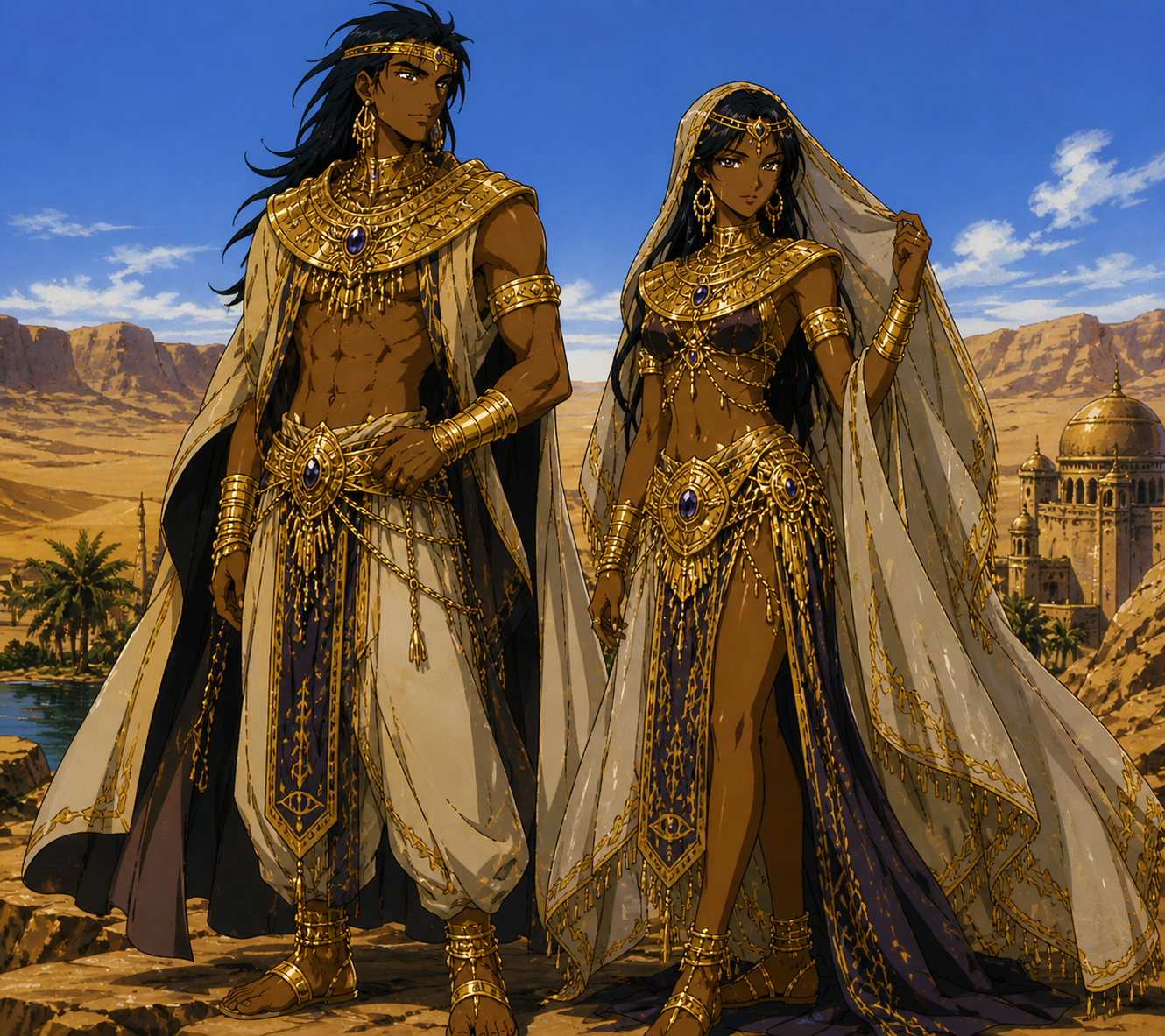
An average Movian is a tall, lean desert-dweller with dark, sun-shaped skin and a lithe, balanced frame built for endurance rather than strength. They move with a natural, fluid grace—each step controlled, efficient, and almost dance-like, as if shaped by years of crossing shifting sands under an unforgiving sun.
Their presence is often marked as much by what they wear as by what they are: layers of light fabric for the heat and the constant glint of gold jewelry, catching the light with every motion. Though not physically imposing, they carry themselves with quiet confidence and patience, giving the impression of someone who does not need to rush—because they can outlast whatever stands in their way.
the golden people, moister farmers, the oasis born
Looks
Movian bodies are shaped by a single uncompromising truth: the desert does not forgive excess. As a result, they are built for endurance, efficiency, and survival under relentless heat. They possess slender, elongated frames with low body fat and defined but controlled musculature—strength that favors repetition and stamina over brute force. Their physiques minimize heat retention and support efficient cooling, allowing them to remain active long after others would falter. Slightly longer limbs, narrow waists, and balanced proportions grant them extended stride and fluid, energy-efficient movement, with a smooth, rhythmic gait well-suited to traversing shifting sands. Their strength lies subtly in the legs, core, and shoulders, developed for stability, travel, and sustained effort rather than explosive power. Movians carry themselves with relaxed, upright posture and an ease of motion often described as effortless or dance-like, even at rest. Movement is not performance but adaptation—over generations, necessity has shaped them into a people who seem to flow rather than walk, built not to overpower their environment, but to outlast it.
Movian skin is shaped by constant exposure to an unforgiving sun, reflecting not just environment but adaptation. Their tones range from deep bronze and rich brown to dark sienna and near-ebony, always carrying a warm, sun-shaped depth even at the lighter end. This pigmentation serves a functional purpose, providing resistance to burning and durability under intense, reflective desert conditions. Their undertones tend toward gold, copper, or red-brown, often giving their skin a subtle natural radiance that appears almost luminous, as though it holds light rather than simply reflecting it. Over time, desert life leaves visible signs—fine lines, slight texturing, and weathering from wind and sand—marks that are not seen as flaws but as evidence of endurance. Scars and healed injuries often stand out against their skin, further reinforcing the reality of survival in a harsh environment. Movians commonly adorn themselves with gold and layered jewelry—necklaces, bangles, rings, and chains worn openly and in abundance—enhancing their natural warmth and giving rise to their name, “the golden people.” The combined effect is striking: a people whose skin and adornment together create the impression of figures moving through the desert wrapped in light, their bodies not just shaped by the sun, but strengthened to endure beneath it.
Movians average around 5’10”, typically ranging between 5’7” and 6’1”, creating a population that is relatively consistent in height without extreme outliers. While not towering, they are also not small, and their stature is defined less by raw measurement and more by how it is carried. Their slightly longer limbs, narrow frames, and balanced proportions give them extended stride length and highly efficient movement across open terrain, often making them appear taller than they truly are, especially in motion. This effect is reinforced by their upright posture, relaxed shoulders, and fluid, controlled movements, which create a presence that feels open, deliberate, and balanced rather than tense or compressed. In the desert, height is not a marker of dominance but of function—allowing for visibility across distances, awareness of surroundings, and efficient navigation through shifting landscapes. Movians use their height to scan horizons, track movement, and move with purpose, resulting in a perceptual effect where they seem more physically present and striking than their weight or stature alone would suggest. Ultimately, their height is not about standing above others, but about moving through the world with efficiency, balance, and intent.
Movians average around 150 pounds, though this reflects efficiency rather than mass. They are not built to be heavy, but to carry only what they need. Despite their relatively low weight, they are not fragile; their bodies are lean, well-conditioned, and structurally efficient, with minimal fat, tightly distributed muscle, and little excess mass. This creates a physique that feels light, balanced, and sustainable over long distances. In the desert, excess weight is a liability, increasing strain in extreme heat, water consumption, and energy expenditure, so Movians naturally avoid it. Their musculature is long and controlled rather than bulky, most developed in the legs for travel, the core for balance, and the shoulders and arms for light labor and climbing. They are not built to overpower, but to endure. While individuals may range from around 130 to 170 pounds, even at the higher end they rarely appear dense or heavy, as their environment limits excess. Their low weight contributes to their fluid, efficient movement, placing less strain on the body and allowing them to remain active for extended periods. Ultimately, Movians do not carry weight they cannot justify—every ounce must serve a purpose in survival.
Movians are immediately recognizable by the combination of deep, sun-shaped skin tones and a lean, elongated build, their bodies narrow, lightly muscled, and designed for efficiency rather than mass. This creates a silhouette that appears refined and balanced, never overtly imposing yet rarely out of place. They are often described as moving like dancers, their motion fluid, rhythmic, and highly controlled, with even the simplest actions carrying intention and economy—an adaptation born from traversing unstable sands, conserving energy, and avoiding wasted movement in extreme heat. They do not rush unless necessary and rarely stumble, instead seeming to flow through space rather than force their way through it. Movians are also known for their extensive use of gold adornment, wearing layered jewelry such as necklaces, bangles, rings, and draped body chains openly and in abundance. In sunlight, these ornaments reflect and amplify their natural movement, giving rise to their reputation as “the golden people.” Years of desert living shape their presence further, with relaxed but upright posture, controlled breathing, and an absence of unnecessary tension, making them appear at ease in conditions that would strain others. Their eyes are sharp and steady, adapted for scanning distant horizons and tracking subtle shifts in light and motion, lending their gaze a patient, observant quality. Across all aspects of their appearance, Movians carry little physical excess—no unnecessary bulk, no exaggerated features—resulting in a form that appears refined by environment rather than preference. They are not defined by any single trait, but by the way their entire body reflects efficiency, endurance, and controlled movement under a relentless sun.
the same as any humanoid
Movian clothing is shaped by a simple reality: the sun is a greater threat than modesty, and everything they wear is designed to manage heat, light, and exposure while preserving freedom of movement. Indoors, within shaded spaces, they favor light silks and loose, breathable fabrics with minimal layering, often leaving arms, shoulders, or portions of the torso uncovered for practical comfort. Outdoors, however, their approach shifts dramatically to layered desert wear—multiple light garments, flowing robes, wraps, and veils that provide full coverage when needed. These layers are not for insulation but for control, blocking direct sunlight, trapping cooler air, and reducing moisture loss. Their clothing is typically made from fine woven cloth and desert-suited fibers that breathe well, dry quickly, and avoid clinging under heat, with heavier materials used only when necessary. Adaptability is key; garments are modular and easily adjusted throughout the day, allowing a single outfit to transition from minimal indoor wear to full desert protection depending on conditions. Movians maintain a relaxed view of modesty, prioritizing comfort and efficiency over concealment, which outsiders sometimes misinterpret as boldness. Gold adornment is a constant feature—necklaces, bangles, rings, and layered body jewelry worn openly in daily life—catching the sun and reinforcing their reputation as “the golden people.” Head wraps, veils, and face coverings are commonly used for protection against sun, sand, and wind, while footwear remains light, flexible, and heat-resistant, typically in the form of sandals or soft boots suited for travel. Ultimately, Movian clothing is not about covering the body, but about controlling how much of the desert is allowed to touch it.
Traits
Movians are defined by their ability to endure and function in extreme heat, continuing where others would slow, exhaust, or collapse. Their bodies are adapted for prolonged exposure to high temperatures, limited water, and constant sun, allowing them to travel long distances, maintain steady output, and recover more effectively from heat stress. This is not merely resistance, but a kind of comfort within conditions that punish others. They are highly efficient in their use of energy, moving with controlled, deliberate motion and avoiding unnecessary exertion, which enables them to outlast opponents and operate effectively with limited resources. Their fluid, dancer-like movement grants them exceptional balance and adaptability, making them adept at navigating shifting sands and difficult terrain while remaining difficult to disrupt or predict. Combined with deep environmental knowledge—understanding wind, heat, and hidden resources—they can find paths, water, and safety where others cannot. Their physiology supports this further, allowing better heat tolerance and slower dehydration, while their culture fosters adaptability through trade, negotiation, and interaction with diverse groups. Mentally, they are patient, composed, and resistant to panic, accustomed to waiting, enduring discomfort, and making careful decisions. Able to function with minimal food, water, and comfort, Movians are not defined by overwhelming strength, but by a singular advantage: they continue when others cannot.
Movians are highly specialized for desert life, and this comes with significant weaknesses outside that environment. Their bodies, built for heat, are particularly vulnerable to cold, where they lose warmth quickly, struggle to maintain core temperature, and tire faster even with proper clothing. In low temperatures or damp climates, they often slow down, lose coordination, and become physically compromised, making cold not just an inconvenience but a direct threat to their function. While efficient with water, they remain dependent on it, and prolonged scarcity leads to rapid declines in performance, cognition, and endurance. Their lean frames also limit raw strength, impact resistance, and durability in direct physical confrontation, especially against larger or heavily armored opponents. Movians rely heavily on controlled movement and energy conservation, so chaotic environments, forced exertion, or unpredictable terrain can disrupt their effectiveness, as they perform best when able to control pace and conditions. Their clothing, optimized for airflow and heat management, leaves them more exposed to non-desert hazards such as cold, abrasive terrain, or sudden weather shifts. Additionally, their adaptation to extreme heat can foster a degree of overconfidence, leading them to underestimate environmental risks for others or misjudge group capabilities. Culturally, their complex legal traditions—built on layering rather than removal—can slow decision-making and create contradictions in moments requiring swift action. Ultimately, Movian weaknesses stem from specialization: they are exceptionally suited to one environment, and pay the cost everywhere else.
Movian conditions are not rare occurrences but expected consequences of life in a harsh desert environment, constantly managed rather than avoided. Dehydration is the most ever-present, as heat, exertion, and dry air steadily draw moisture from the body, leading to symptoms such as dizziness, weakness, and slowed reactions, with severe cases risking collapse or death; culturally, it is taken extremely seriously, reflected in the saying, “If you feel thirsty, you are already late.” Heat fatigue arises from prolonged exposure without rest, causing exhaustion, irritability, and reduced awareness, and is seen not as a lack of strength but as a failure of pacing. Though naturally resistant, Movians can still suffer sun damage under extreme conditions, typically viewed as a sign of poor preparation. Sand lung, caused by inhaling fine dust over time, leads to persistent coughing and reduced breath capacity, often regarded as an occupational mark of seasoned travelers. In contrast, cold shock is particularly feared, as sudden exposure to low temperatures can rapidly impair coordination, cognition, and endurance, with effects more severe due to their heat-adapted physiology. Salt depletion is another common risk during extended exertion, leading to cramps and disorientation, but is actively managed through diet and specialized drinks. Finally, mirage strain reflects the mental and visual fatigue caused by constant glare and distortion, resulting in eye strain and misjudgment of distance, teaching experienced Movians to rely on learned patterns rather than sight alone. Together, these conditions define a people whose daily lives are shaped by constant environmental pressure, where survival depends not on avoiding hardship, but on recognizing and managing it.
Culture
Movian traditions are defined by continuity, endurance, and the refusal to discard what has come before. Nowhere is this more evident than in their system of layered law, where rulings cannot simply be erased or ignored by new authority, but must instead be amended, redirected, or formally countered. Over generations, this has created a complex, interwoven legal structure that outsiders often find difficult to navigate, while Movians see it as a reflection of respect for authority and the belief that power should not erase the past. This philosophy extends into their cultural practices. Desert dance, a highly controlled and fluid form of expression performed during gatherings and celebrations, emphasizes precision, balance, and continuous motion, often enhanced by layered gold adornments that reflect light and movement, turning the body itself into a form of storytelling. Gold holds further importance through the carrying of wealth, where jewelry is worn openly as both decoration and portable value, representing personal achievement, trade success, or lineage. Socially, oasis gatherings serve as vital points of connection, where resources are shared, news exchanged, and even rival groups set aside conflict, reflecting the belief that where water is shared, survival takes precedence over dispute. On a more personal level, endurance walks test an individual’s discipline and resilience, with success measured not by speed but by the ability to complete the journey efficiently and without succumbing to the desert. Together, these traditions reflect a people shaped by harsh conditions and long memory, where law, movement, wealth, and survival all follow the same principle: nothing is wasted, nothing is forgotten, and everything must endure.
Movian belief centers on a singular principle: justice is not an abstract concept, but a real and active force that must be maintained. It is not worship of a deity, but of justice itself, seen as the foundation of order, legitimacy, and authority. Laws are not valid simply because they exist, but because they align with this force, and over time, each law is understood to contain a fragment of truth that contributes to a greater, evolving system. At the heart of this structure stands the Sultan, not merely as a ruler, but as the primary interpreter of justice, from whom law and direction flow outward through tribal and local leadership. However, their authority is not absolute; rulings must be discussed, supported, and agreed upon, as Movians believe justice cannot be arbitrary and must be refined through debate and consensus. This has created a culture where law is layered and enduring, reinterpreted rather than discarded, and constantly shaped through argument and application. At the same time, Movians recognize the necessity of balance—justice must serve survival, and survival must not abandon justice, as either extreme leads to instability. The desert reinforces this worldview, instilling the belief that endurance is a form of correctness, proof that one can exist within reality as it is. This extends into their social values, where wealth is worn openly, reflecting the idea that truth and status should be visible rather than concealed. Ultimately, Movian belief rejects blind authority in favor of a system where justice is continuously examined, debated, and carried forward, not as a fixed rule, but as something that must be actively upheld.
Movian governance is built on a balance between central authority and distributed autonomy, forming a unified system held together by agreement, law, and active participation rather than strict centralization. At its center stands the Sultan, who serves as the primary lawmaker, political leader, and symbolic voice of justice, responsible for proposing laws, guiding policy, and maintaining cohesion across the desert peoples. However, the Sultan’s authority is influential rather than absolute, as governance depends heavily on the Council of Leaders, composed of tribal and regional representatives who gather regularly in the capital to debate, interpret, and vote on proposed laws. For a law to be broadly valid, it must receive majority support from this body; otherwise, it remains limited in scope. Beyond the capital, Movian groups retain significant local autonomy, managing their own affairs, resources, and enforcement through regional leadership, allowing for flexibility and adaptation across varied desert conditions. Governance is further shaped by their layered legal tradition, where existing laws cannot simply be discarded but must be interpreted and worked around, creating a system that is stable but complex. Decision-making relies on debate and scrutiny, with authority strengthened through argument rather than silence, and unity maintained through consistent participation and communication among leaders. While this structure can slow responses and create legal overlap, it is accepted as a necessary trade-off to prevent unchecked power. Ultimately, Movian governance is not about top-down control, but about sustaining a shared system where authority exists only through collective agreement.
Movian technology reflects a people shaped by isolation, necessity, and opportunity—less advanced than powers like Stanzgar or Atlania, but steadily closing the gap through adaptation rather than pure innovation. Their approach is pragmatic: they take what works and reshape it to survive the desert. Technological growth has accelerated through trade, espionage, and conflict, exposing them to advanced metallurgy, weapon design, and engineering practices, which they study, replicate, and modify until functional under extreme heat, sand, and wind. This results in designs that prioritize durability, simplicity, and reliability, often featuring sealed components, sand-resistant construction, and materials suited to harsh climates, while fragile or overly complex systems are simplified or discarded. Water management remains central, with underground cisterns, covered reservoirs, and efficient transport and irrigation systems forming critical infrastructure that is constantly maintained and protected. The desert’s mineral wealth has also driven practical extraction methods, providing trade goods that allow access to foreign technologies and tools. Movians are highly effective at repurposing what they acquire, dismantling devices and rebuilding them into hybrid systems suited to their needs, even without fully understanding their original design. Historical conflicts, such as the Iron Wars, have further contributed knowledge in logistics, warfare, and coordination, while vast distances have led to the development of efficient courier networks and relay communication systems where speed is as valuable as the message itself. Though they still lack large-scale industry and mass production, these limitations are recognized and steadily addressed. Ultimately, Movian technology is not defined by invention, but by adaptation, resilience, and a refusal to let useful knowledge go to waste.
Movian occupations are shaped by three forces: the desert environment, their culture of trade and law, and their role as regional connectors. Work is flexible rather than fixed, shifting with season, location, and need, with individuals taking on whatever roles are necessary or available. They are widely known as couriers and desert messengers, valued for endurance, navigation, and reliability across dangerous terrain. Trade is central to their economy, with many serving as caravan handlers, negotiators, and transport coordinators, moving minerals, goods, and information across routes. Within the desert, others work in mineral extraction, a demanding but essential industry, or as water keepers, managing storage, distribution, and oasis agriculture—roles critical to survival. Their complex legal system also supports interpreters and advisors, who navigate layered laws and resolve disputes. Additionally, Movians are found as artisans and jewel workers, crafting gold adornments, as well as performers, where dance serves as both art and cultural expression. In more dangerous contexts, they act as guards and caravan protectors, relying on awareness and endurance over brute strength. Ultimately, Movian work is defined not by rigid specialization, but by adaptability and usefulness, with individuals shifting roles as needed to survive and thrive.
Movian economics are built on resource control, trade, and mobility, turning the harsh desert from a barrier into an advantage. Beneath the Movai sands lie vast mineral deposits—difficult to access but highly valuable—allowing Movians to trade raw metals and rare materials for food, tools, and technology despite limited industrial development. Trade is the lifeblood of their economy, supported by active and competitive routes, while their mobility enables key roles in transport, courier work, and logistics that others cannot easily replicate. Gold plays a central role as both currency and visible wealth, worn openly as a symbol of status and practicality. Internally, constant localized trade ensures survival, with exchanges of water, resources, and services emphasizing fairness and sustainability. Historically shaped by isolation and internal conflict, their economy developed as decentralized and resilient, but increased contact with outside powers—especially after events like the Iron Wars—has expanded their reach while introducing new risks. As they advance technologically, Movians are gradually processing more of their own materials and reducing reliance on external refinement. Ultimately, their economy is not built on abundance, but on controlling scarce resources and moving them efficiently where they are needed.
Movian food is shaped by survival in extreme heat, emphasizing hydration, efficiency, and bold flavor over indulgence. They favor juice-rich fruits that can be eaten fresh, dried, or pressed into liquids, using them as a primary source of both nourishment and water. A defining element of their cuisine is spiced fruit drinks, blending sweet juices with peppers and minerals to create refreshing, stimulating mixtures that aid circulation and heat management. To balance this, Movians rely on dried and preserved meats for portable protein, along with spiced grain dishes near oasis regions where agriculture is possible. Due to constant sweating, they also consume salted and mineral-rich foods to maintain bodily balance. Meals often prioritize cooling effects, featuring high-moisture and lightly prepared dishes that provide relief from the heat. At oasis settlements, food becomes communal, with shared meals of fruits, meats, and spiced preparations tied to trade and social interaction. Overall, Movian cuisine is bold, direct, and functional, centered on a single purpose: keeping the body hydrated, sustained, and able to endure the desert.
History
Movian history is not a single continuous empire but a layered accumulation of conflict, law, and survival, shaped by internal struggle, trade, and outside intrusion, all revolving around the question of who controls the desert and by what rules. In their earliest period, the Movai desert was divided among independent tribes and oasis communities that fought constantly over water, mineral-rich land, and trade routes, establishing a culture of conflict, negotiation, and adaptability. These endless desert wars were frequent and cyclical, with no permanent victories, fostering a society where alliances were temporary and survival required flexibility. Over time, a dominant शक्ति emerged, forming the Sultanate, which unified the desert not by eliminating local autonomy but by binding it through shared law and participation. This gave rise to their defining system of layered law, where rulings could not be erased but had to be reinterpreted or built upon, creating a complex and enduring legal structure. As trade routes expanded, Movians transitioned from isolated fighters to vital traders and intermediaries, leveraging mineral wealth and geography to connect distant regions. During the late Fifth Age, the Atlania campaign into the desert—known as the Iron Wars—ended in failure for the invaders, as Movians used endurance, mobility, and environmental mastery to outlast them, reinforcing their reputation as defenders of an unforgiving land. In the aftermath, they gained exposure to foreign technologies and a stronger awareness of external threats, accelerating their development. In the modern era, Movians continue to expand trade, adopt outside innovations, and refine their governance, evolving from an isolated desert power into a recognized force in continental affairs. Ultimately, their history is defined not by conquest or empire, but by endurance, adaptation, and the steady accumulation of strength through survival.
Overview
Details about this race's overview
Movian
An average Movian is a tall, lean desert-dweller with dark, sun-shaped skin and a lithe, balanced frame built for endurance rather than strength. They move with a natural, fluid grace—each step controlled, efficient, and almost dance-like, as if shaped by years of crossing shifting sands under an unforgiving sun.
Their presence is often marked as much by what they wear as by what they are: layers of light fabric for the heat and the constant glint of gold jewelry, catching the light with every motion. Though not physically imposing, they carry themselves with quiet confidence and patience, giving the impression of someone who does not need to rush—because they can outlast whatever stands in their way.
the golden people, moister farmers, the oasis born
Looks
Details about this race's looks
Movian bodies are shaped by a single uncompromising truth: the desert does not forgive excess. As a result, they are built for endurance, efficiency, and survival under relentless heat. They possess slender, elongated frames with low body fat and defined but controlled musculature—strength that favors repetition and stamina over brute force. Their physiques minimize heat retention and support efficient cooling, allowing them to remain active long after others would falter. Slightly longer limbs, narrow waists, and balanced proportions grant them extended stride and fluid, energy-efficient movement, with a smooth, rhythmic gait well-suited to traversing shifting sands. Their strength lies subtly in the legs, core, and shoulders, developed for stability, travel, and sustained effort rather than explosive power. Movians carry themselves with relaxed, upright posture and an ease of motion often described as effortless or dance-like, even at rest. Movement is not performance but adaptation—over generations, necessity has shaped them into a people who seem to flow rather than walk, built not to overpower their environment, but to outlast it.
Movian skin is shaped by constant exposure to an unforgiving sun, reflecting not just environment but adaptation. Their tones range from deep bronze and rich brown to dark sienna and near-ebony, always carrying a warm, sun-shaped depth even at the lighter end. This pigmentation serves a functional purpose, providing resistance to burning and durability under intense, reflective desert conditions. Their undertones tend toward gold, copper, or red-brown, often giving their skin a subtle natural radiance that appears almost luminous, as though it holds light rather than simply reflecting it. Over time, desert life leaves visible signs—fine lines, slight texturing, and weathering from wind and sand—marks that are not seen as flaws but as evidence of endurance. Scars and healed injuries often stand out against their skin, further reinforcing the reality of survival in a harsh environment. Movians commonly adorn themselves with gold and layered jewelry—necklaces, bangles, rings, and chains worn openly and in abundance—enhancing their natural warmth and giving rise to their name, “the golden people.” The combined effect is striking: a people whose skin and adornment together create the impression of figures moving through the desert wrapped in light, their bodies not just shaped by the sun, but strengthened to endure beneath it.
Movians average around 5’10”, typically ranging between 5’7” and 6’1”, creating a population that is relatively consistent in height without extreme outliers. While not towering, they are also not small, and their stature is defined less by raw measurement and more by how it is carried. Their slightly longer limbs, narrow frames, and balanced proportions give them extended stride length and highly efficient movement across open terrain, often making them appear taller than they truly are, especially in motion. This effect is reinforced by their upright posture, relaxed shoulders, and fluid, controlled movements, which create a presence that feels open, deliberate, and balanced rather than tense or compressed. In the desert, height is not a marker of dominance but of function—allowing for visibility across distances, awareness of surroundings, and efficient navigation through shifting landscapes. Movians use their height to scan horizons, track movement, and move with purpose, resulting in a perceptual effect where they seem more physically present and striking than their weight or stature alone would suggest. Ultimately, their height is not about standing above others, but about moving through the world with efficiency, balance, and intent.
Movians average around 150 pounds, though this reflects efficiency rather than mass. They are not built to be heavy, but to carry only what they need. Despite their relatively low weight, they are not fragile; their bodies are lean, well-conditioned, and structurally efficient, with minimal fat, tightly distributed muscle, and little excess mass. This creates a physique that feels light, balanced, and sustainable over long distances. In the desert, excess weight is a liability, increasing strain in extreme heat, water consumption, and energy expenditure, so Movians naturally avoid it. Their musculature is long and controlled rather than bulky, most developed in the legs for travel, the core for balance, and the shoulders and arms for light labor and climbing. They are not built to overpower, but to endure. While individuals may range from around 130 to 170 pounds, even at the higher end they rarely appear dense or heavy, as their environment limits excess. Their low weight contributes to their fluid, efficient movement, placing less strain on the body and allowing them to remain active for extended periods. Ultimately, Movians do not carry weight they cannot justify—every ounce must serve a purpose in survival.
Movians are immediately recognizable by the combination of deep, sun-shaped skin tones and a lean, elongated build, their bodies narrow, lightly muscled, and designed for efficiency rather than mass. This creates a silhouette that appears refined and balanced, never overtly imposing yet rarely out of place. They are often described as moving like dancers, their motion fluid, rhythmic, and highly controlled, with even the simplest actions carrying intention and economy—an adaptation born from traversing unstable sands, conserving energy, and avoiding wasted movement in extreme heat. They do not rush unless necessary and rarely stumble, instead seeming to flow through space rather than force their way through it. Movians are also known for their extensive use of gold adornment, wearing layered jewelry such as necklaces, bangles, rings, and draped body chains openly and in abundance. In sunlight, these ornaments reflect and amplify their natural movement, giving rise to their reputation as “the golden people.” Years of desert living shape their presence further, with relaxed but upright posture, controlled breathing, and an absence of unnecessary tension, making them appear at ease in conditions that would strain others. Their eyes are sharp and steady, adapted for scanning distant horizons and tracking subtle shifts in light and motion, lending their gaze a patient, observant quality. Across all aspects of their appearance, Movians carry little physical excess—no unnecessary bulk, no exaggerated features—resulting in a form that appears refined by environment rather than preference. They are not defined by any single trait, but by the way their entire body reflects efficiency, endurance, and controlled movement under a relentless sun.
the same as any humanoid
Movian clothing is shaped by a simple reality: the sun is a greater threat than modesty, and everything they wear is designed to manage heat, light, and exposure while preserving freedom of movement. Indoors, within shaded spaces, they favor light silks and loose, breathable fabrics with minimal layering, often leaving arms, shoulders, or portions of the torso uncovered for practical comfort. Outdoors, however, their approach shifts dramatically to layered desert wear—multiple light garments, flowing robes, wraps, and veils that provide full coverage when needed. These layers are not for insulation but for control, blocking direct sunlight, trapping cooler air, and reducing moisture loss. Their clothing is typically made from fine woven cloth and desert-suited fibers that breathe well, dry quickly, and avoid clinging under heat, with heavier materials used only when necessary. Adaptability is key; garments are modular and easily adjusted throughout the day, allowing a single outfit to transition from minimal indoor wear to full desert protection depending on conditions. Movians maintain a relaxed view of modesty, prioritizing comfort and efficiency over concealment, which outsiders sometimes misinterpret as boldness. Gold adornment is a constant feature—necklaces, bangles, rings, and layered body jewelry worn openly in daily life—catching the sun and reinforcing their reputation as “the golden people.” Head wraps, veils, and face coverings are commonly used for protection against sun, sand, and wind, while footwear remains light, flexible, and heat-resistant, typically in the form of sandals or soft boots suited for travel. Ultimately, Movian clothing is not about covering the body, but about controlling how much of the desert is allowed to touch it.
Traits
Details about this race's traits
Movians are defined by their ability to endure and function in extreme heat, continuing where others would slow, exhaust, or collapse. Their bodies are adapted for prolonged exposure to high temperatures, limited water, and constant sun, allowing them to travel long distances, maintain steady output, and recover more effectively from heat stress. This is not merely resistance, but a kind of comfort within conditions that punish others. They are highly efficient in their use of energy, moving with controlled, deliberate motion and avoiding unnecessary exertion, which enables them to outlast opponents and operate effectively with limited resources. Their fluid, dancer-like movement grants them exceptional balance and adaptability, making them adept at navigating shifting sands and difficult terrain while remaining difficult to disrupt or predict. Combined with deep environmental knowledge—understanding wind, heat, and hidden resources—they can find paths, water, and safety where others cannot. Their physiology supports this further, allowing better heat tolerance and slower dehydration, while their culture fosters adaptability through trade, negotiation, and interaction with diverse groups. Mentally, they are patient, composed, and resistant to panic, accustomed to waiting, enduring discomfort, and making careful decisions. Able to function with minimal food, water, and comfort, Movians are not defined by overwhelming strength, but by a singular advantage: they continue when others cannot.
Movians are highly specialized for desert life, and this comes with significant weaknesses outside that environment. Their bodies, built for heat, are particularly vulnerable to cold, where they lose warmth quickly, struggle to maintain core temperature, and tire faster even with proper clothing. In low temperatures or damp climates, they often slow down, lose coordination, and become physically compromised, making cold not just an inconvenience but a direct threat to their function. While efficient with water, they remain dependent on it, and prolonged scarcity leads to rapid declines in performance, cognition, and endurance. Their lean frames also limit raw strength, impact resistance, and durability in direct physical confrontation, especially against larger or heavily armored opponents. Movians rely heavily on controlled movement and energy conservation, so chaotic environments, forced exertion, or unpredictable terrain can disrupt their effectiveness, as they perform best when able to control pace and conditions. Their clothing, optimized for airflow and heat management, leaves them more exposed to non-desert hazards such as cold, abrasive terrain, or sudden weather shifts. Additionally, their adaptation to extreme heat can foster a degree of overconfidence, leading them to underestimate environmental risks for others or misjudge group capabilities. Culturally, their complex legal traditions—built on layering rather than removal—can slow decision-making and create contradictions in moments requiring swift action. Ultimately, Movian weaknesses stem from specialization: they are exceptionally suited to one environment, and pay the cost everywhere else.
Movian conditions are not rare occurrences but expected consequences of life in a harsh desert environment, constantly managed rather than avoided. Dehydration is the most ever-present, as heat, exertion, and dry air steadily draw moisture from the body, leading to symptoms such as dizziness, weakness, and slowed reactions, with severe cases risking collapse or death; culturally, it is taken extremely seriously, reflected in the saying, “If you feel thirsty, you are already late.” Heat fatigue arises from prolonged exposure without rest, causing exhaustion, irritability, and reduced awareness, and is seen not as a lack of strength but as a failure of pacing. Though naturally resistant, Movians can still suffer sun damage under extreme conditions, typically viewed as a sign of poor preparation. Sand lung, caused by inhaling fine dust over time, leads to persistent coughing and reduced breath capacity, often regarded as an occupational mark of seasoned travelers. In contrast, cold shock is particularly feared, as sudden exposure to low temperatures can rapidly impair coordination, cognition, and endurance, with effects more severe due to their heat-adapted physiology. Salt depletion is another common risk during extended exertion, leading to cramps and disorientation, but is actively managed through diet and specialized drinks. Finally, mirage strain reflects the mental and visual fatigue caused by constant glare and distortion, resulting in eye strain and misjudgment of distance, teaching experienced Movians to rely on learned patterns rather than sight alone. Together, these conditions define a people whose daily lives are shaped by constant environmental pressure, where survival depends not on avoiding hardship, but on recognizing and managing it.
Culture
Details about this race's culture
Movian traditions are defined by continuity, endurance, and the refusal to discard what has come before. Nowhere is this more evident than in their system of layered law, where rulings cannot simply be erased or ignored by new authority, but must instead be amended, redirected, or formally countered. Over generations, this has created a complex, interwoven legal structure that outsiders often find difficult to navigate, while Movians see it as a reflection of respect for authority and the belief that power should not erase the past. This philosophy extends into their cultural practices. Desert dance, a highly controlled and fluid form of expression performed during gatherings and celebrations, emphasizes precision, balance, and continuous motion, often enhanced by layered gold adornments that reflect light and movement, turning the body itself into a form of storytelling. Gold holds further importance through the carrying of wealth, where jewelry is worn openly as both decoration and portable value, representing personal achievement, trade success, or lineage. Socially, oasis gatherings serve as vital points of connection, where resources are shared, news exchanged, and even rival groups set aside conflict, reflecting the belief that where water is shared, survival takes precedence over dispute. On a more personal level, endurance walks test an individual’s discipline and resilience, with success measured not by speed but by the ability to complete the journey efficiently and without succumbing to the desert. Together, these traditions reflect a people shaped by harsh conditions and long memory, where law, movement, wealth, and survival all follow the same principle: nothing is wasted, nothing is forgotten, and everything must endure.
Movian belief centers on a singular principle: justice is not an abstract concept, but a real and active force that must be maintained. It is not worship of a deity, but of justice itself, seen as the foundation of order, legitimacy, and authority. Laws are not valid simply because they exist, but because they align with this force, and over time, each law is understood to contain a fragment of truth that contributes to a greater, evolving system. At the heart of this structure stands the Sultan, not merely as a ruler, but as the primary interpreter of justice, from whom law and direction flow outward through tribal and local leadership. However, their authority is not absolute; rulings must be discussed, supported, and agreed upon, as Movians believe justice cannot be arbitrary and must be refined through debate and consensus. This has created a culture where law is layered and enduring, reinterpreted rather than discarded, and constantly shaped through argument and application. At the same time, Movians recognize the necessity of balance—justice must serve survival, and survival must not abandon justice, as either extreme leads to instability. The desert reinforces this worldview, instilling the belief that endurance is a form of correctness, proof that one can exist within reality as it is. This extends into their social values, where wealth is worn openly, reflecting the idea that truth and status should be visible rather than concealed. Ultimately, Movian belief rejects blind authority in favor of a system where justice is continuously examined, debated, and carried forward, not as a fixed rule, but as something that must be actively upheld.
Movian governance is built on a balance between central authority and distributed autonomy, forming a unified system held together by agreement, law, and active participation rather than strict centralization. At its center stands the Sultan, who serves as the primary lawmaker, political leader, and symbolic voice of justice, responsible for proposing laws, guiding policy, and maintaining cohesion across the desert peoples. However, the Sultan’s authority is influential rather than absolute, as governance depends heavily on the Council of Leaders, composed of tribal and regional representatives who gather regularly in the capital to debate, interpret, and vote on proposed laws. For a law to be broadly valid, it must receive majority support from this body; otherwise, it remains limited in scope. Beyond the capital, Movian groups retain significant local autonomy, managing their own affairs, resources, and enforcement through regional leadership, allowing for flexibility and adaptation across varied desert conditions. Governance is further shaped by their layered legal tradition, where existing laws cannot simply be discarded but must be interpreted and worked around, creating a system that is stable but complex. Decision-making relies on debate and scrutiny, with authority strengthened through argument rather than silence, and unity maintained through consistent participation and communication among leaders. While this structure can slow responses and create legal overlap, it is accepted as a necessary trade-off to prevent unchecked power. Ultimately, Movian governance is not about top-down control, but about sustaining a shared system where authority exists only through collective agreement.
Movian technology reflects a people shaped by isolation, necessity, and opportunity—less advanced than powers like Stanzgar or Atlania, but steadily closing the gap through adaptation rather than pure innovation. Their approach is pragmatic: they take what works and reshape it to survive the desert. Technological growth has accelerated through trade, espionage, and conflict, exposing them to advanced metallurgy, weapon design, and engineering practices, which they study, replicate, and modify until functional under extreme heat, sand, and wind. This results in designs that prioritize durability, simplicity, and reliability, often featuring sealed components, sand-resistant construction, and materials suited to harsh climates, while fragile or overly complex systems are simplified or discarded. Water management remains central, with underground cisterns, covered reservoirs, and efficient transport and irrigation systems forming critical infrastructure that is constantly maintained and protected. The desert’s mineral wealth has also driven practical extraction methods, providing trade goods that allow access to foreign technologies and tools. Movians are highly effective at repurposing what they acquire, dismantling devices and rebuilding them into hybrid systems suited to their needs, even without fully understanding their original design. Historical conflicts, such as the Iron Wars, have further contributed knowledge in logistics, warfare, and coordination, while vast distances have led to the development of efficient courier networks and relay communication systems where speed is as valuable as the message itself. Though they still lack large-scale industry and mass production, these limitations are recognized and steadily addressed. Ultimately, Movian technology is not defined by invention, but by adaptation, resilience, and a refusal to let useful knowledge go to waste.
Movian occupations are shaped by three forces: the desert environment, their culture of trade and law, and their role as regional connectors. Work is flexible rather than fixed, shifting with season, location, and need, with individuals taking on whatever roles are necessary or available. They are widely known as couriers and desert messengers, valued for endurance, navigation, and reliability across dangerous terrain. Trade is central to their economy, with many serving as caravan handlers, negotiators, and transport coordinators, moving minerals, goods, and information across routes. Within the desert, others work in mineral extraction, a demanding but essential industry, or as water keepers, managing storage, distribution, and oasis agriculture—roles critical to survival. Their complex legal system also supports interpreters and advisors, who navigate layered laws and resolve disputes. Additionally, Movians are found as artisans and jewel workers, crafting gold adornments, as well as performers, where dance serves as both art and cultural expression. In more dangerous contexts, they act as guards and caravan protectors, relying on awareness and endurance over brute strength. Ultimately, Movian work is defined not by rigid specialization, but by adaptability and usefulness, with individuals shifting roles as needed to survive and thrive.
Movian economics are built on resource control, trade, and mobility, turning the harsh desert from a barrier into an advantage. Beneath the Movai sands lie vast mineral deposits—difficult to access but highly valuable—allowing Movians to trade raw metals and rare materials for food, tools, and technology despite limited industrial development. Trade is the lifeblood of their economy, supported by active and competitive routes, while their mobility enables key roles in transport, courier work, and logistics that others cannot easily replicate. Gold plays a central role as both currency and visible wealth, worn openly as a symbol of status and practicality. Internally, constant localized trade ensures survival, with exchanges of water, resources, and services emphasizing fairness and sustainability. Historically shaped by isolation and internal conflict, their economy developed as decentralized and resilient, but increased contact with outside powers—especially after events like the Iron Wars—has expanded their reach while introducing new risks. As they advance technologically, Movians are gradually processing more of their own materials and reducing reliance on external refinement. Ultimately, their economy is not built on abundance, but on controlling scarce resources and moving them efficiently where they are needed.
Movian food is shaped by survival in extreme heat, emphasizing hydration, efficiency, and bold flavor over indulgence. They favor juice-rich fruits that can be eaten fresh, dried, or pressed into liquids, using them as a primary source of both nourishment and water. A defining element of their cuisine is spiced fruit drinks, blending sweet juices with peppers and minerals to create refreshing, stimulating mixtures that aid circulation and heat management. To balance this, Movians rely on dried and preserved meats for portable protein, along with spiced grain dishes near oasis regions where agriculture is possible. Due to constant sweating, they also consume salted and mineral-rich foods to maintain bodily balance. Meals often prioritize cooling effects, featuring high-moisture and lightly prepared dishes that provide relief from the heat. At oasis settlements, food becomes communal, with shared meals of fruits, meats, and spiced preparations tied to trade and social interaction. Overall, Movian cuisine is bold, direct, and functional, centered on a single purpose: keeping the body hydrated, sustained, and able to endure the desert.
History
Details about this race's history
Movian history is not a single continuous empire but a layered accumulation of conflict, law, and survival, shaped by internal struggle, trade, and outside intrusion, all revolving around the question of who controls the desert and by what rules. In their earliest period, the Movai desert was divided among independent tribes and oasis communities that fought constantly over water, mineral-rich land, and trade routes, establishing a culture of conflict, negotiation, and adaptability. These endless desert wars were frequent and cyclical, with no permanent victories, fostering a society where alliances were temporary and survival required flexibility. Over time, a dominant शक्ति emerged, forming the Sultanate, which unified the desert not by eliminating local autonomy but by binding it through shared law and participation. This gave rise to their defining system of layered law, where rulings could not be erased but had to be reinterpreted or built upon, creating a complex and enduring legal structure. As trade routes expanded, Movians transitioned from isolated fighters to vital traders and intermediaries, leveraging mineral wealth and geography to connect distant regions. During the late Fifth Age, the Atlania campaign into the desert—known as the Iron Wars—ended in failure for the invaders, as Movians used endurance, mobility, and environmental mastery to outlast them, reinforcing their reputation as defenders of an unforgiving land. In the aftermath, they gained exposure to foreign technologies and a stronger awareness of external threats, accelerating their development. In the modern era, Movians continue to expand trade, adopt outside innovations, and refine their governance, evolving from an isolated desert power into a recognized force in continental affairs. Ultimately, their history is defined not by conquest or empire, but by endurance, adaptation, and the steady accumulation of strength through survival.
Notes
Details about this race's notes
No notes information yet
This section doesn't have any information filled in yet.
Gallery
Images and visual content for this race
Associations
Other pages that reference or connect to this race
Referenced By
4Collections
Published collections that feature this race
Not in any collections yet
This race hasn't been published in any collections yet. Collections are curated groups of related content that help organize and showcase your world.
Tip: Collections are a great way to group related content together and share themed stories or worldbuilding elements with others.
Timelines
Timelines that reference or include this race
No timeline connections yet
This race isn't connected to any timelines yet. Timelines help organize events chronologically and show how your content fits into the broader history of your world.
Tip: Create timelines to organize important events in your world's history. Link characters, locations, and other content to specific events to build rich, interconnected narratives.
Shares
Discussion about this race
No shares yet
Be the first to start a discussion about this race by sharing it to the community stream.
Privacy & Sharing
Manage who can see and access this race
Current Status
refresh
This race is currently
Privacy Settings
Choose who can see and access this race
language Universe Privacy
This page belongs to a universe with its own privacy settings