
Categories
Dive Deeper
Page Stats
Navigation
Categories
Dive Deeper
Page Stats
Complete Details
All information about this race
Overview
Tarkibi
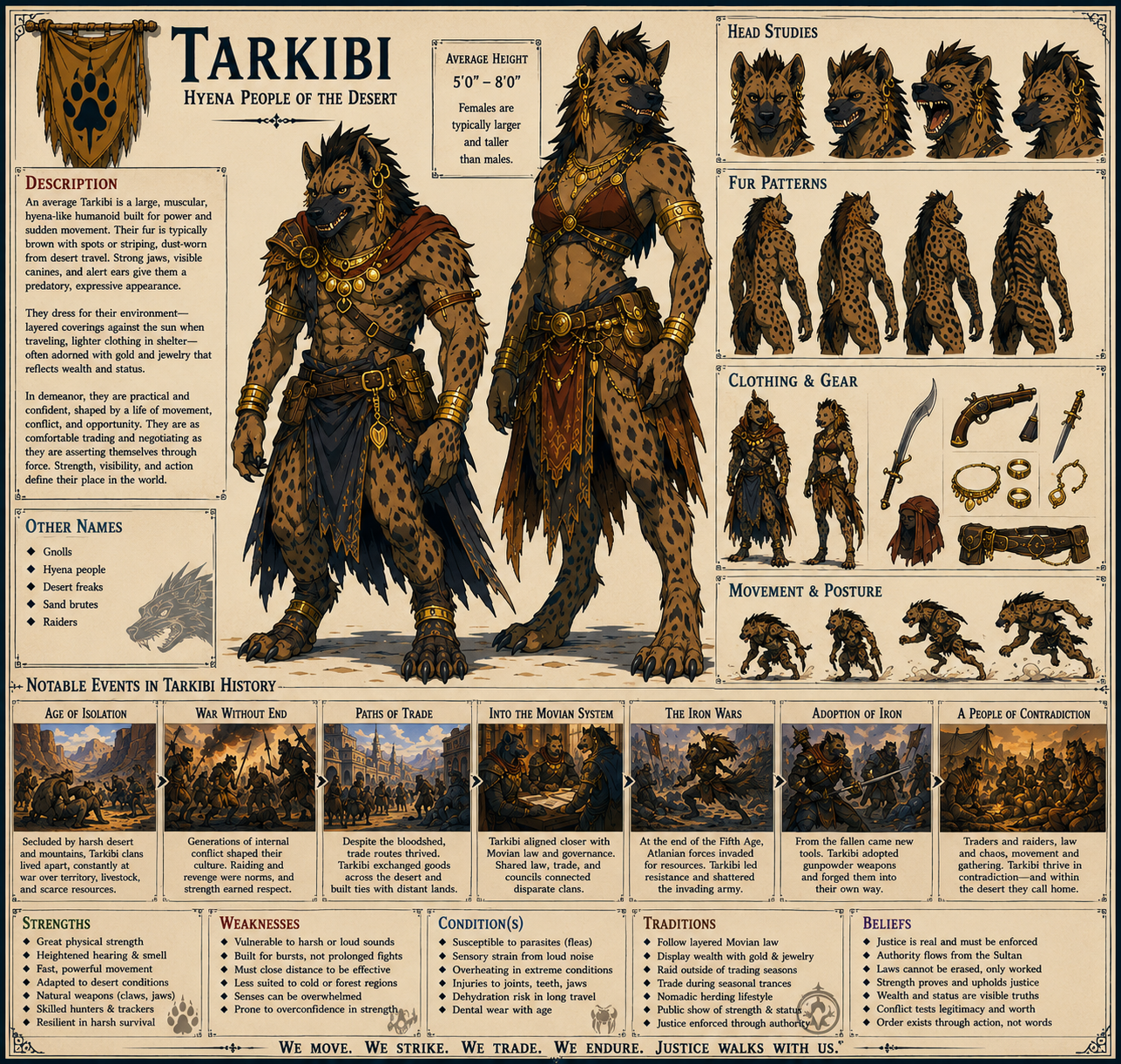
An average Tarkibi is a large, muscular, hyena-like humanoid with a forward-leaning, digitigrade stance and a body built for power and sudden movement. Their fur is typically brown with spots or striping, often dust-worn from desert travel, and their head is defined by a strong muzzle, visible canines, and alert, expressive ears. Even at rest, they carry a sense of coiled readiness, as if prepared to move or react at any moment.
They dress according to the environment—layered coverings against the sun when traveling, and lighter, minimal clothing in shelter—often adorned with visible gold and jewelry that reflects both wealth and status. Their presence is direct and physical, reinforced by their size, posture, and the way they occupy space.
In demeanor, they tend to be practical and confident, with an underlying edge shaped by a life of movement, conflict, and opportunity. They are as comfortable negotiating or trading as they are asserting themselves through force, and carry a mindset where strength, visibility, and action define their place in the world.
Gnolls, Hyena people, desert freaks, sand brutes, raiders
Looks
Tarkibi are large, powerful, digitigrade humanoids with a build closely resembling upright hyenas. Their bodies are defined by dense musculature, a forward-leaning posture, and a structure built for both strength and endurance. They are broad through the shoulders, thick through the chest, and carry most of their mass in a way that emphasizes physical power over refinement. Their legs are digitigrade, giving them a slightly hunched stance and a natural forward tilt, allowing for bursts of speed and efficient movement across difficult terrain. Their limbs are heavy and well-developed, with especially strong forearms and thighs suited for grappling, running, and sustained exertion. The torso is compact but thick, built to support their weight and muscle density, and their backs often slope slightly, reinforcing the impression of a predator ready to move at any moment. Their heads retain strong hyena-like features, with powerful jaws, pronounced canines, and a muzzle built for biting force, supported by a thick neck that blends into the shoulders. Females are typically larger than males, often broader and heavier, with more pronounced musculature. Overall, Tarkibi body shape is heavy, muscular, and predatory, built for strength, movement, and survival in harsh environments.
Their proportions suggest a body optimized for short bursts of overwhelming force rather than long-distance endurance, with weight distribution favoring the front half of the body for grappling and bite-driven combat. The digitigrade stance also implies a naturally quieter step than their size would suggest, especially on sand, allowing them to close distance more effectively than expected. Their heavy jaw structure and neck strength point to a fighting style that likely incorporates biting as a primary tool rather than a last resort. The size difference between females and males may influence social or combat roles, with larger individuals naturally dominating physical confrontations. Despite their mass, their structure avoids sluggishness—everything about their build suggests controlled aggression, rapid engagement, and the ability to overwhelm a target quickly before disengaging or repositioning.
Tarkibi are covered in fur rather than exposed skin across most of their bodies, with coloration typically falling within earth-toned browns. Their coats range from light sandy brown and dusty tan to reddish-brown and deep, dark brown, often carrying warm, sun-adapted undertones that allow them to blend naturally into desert and arid environments. Across this base coloration, Tarkibi commonly display distinct patterning in the form of spots, vertical striping, or horizontal striping along the back and flanks. These patterns vary by individual and lineage, but are usually darker than the base coat, creating a visible contrast that remains cohesive within their overall coloration.
Exposed skin—typically found around the muzzle, inside the ears, and along thinner fur areas—tends to be dark grey, black, or deep brown. This skin is often tougher and more resistant to sun exposure than typical humanoid skin, reflecting adaptation to harsh climates. Their fur texture is generally coarse and dense enough to protect against sun and abrasion, but not overly thick, preventing overheating. In some individuals, especially those from harsher regions, the coat may appear dust-worn, faded, or uneven in tone due to constant exposure.
Overall, Tarkibi coloration is not vibrant or highly varied—it is practical, camouflaged, and environmentally tuned, built to blend into arid landscapes while maintaining durability under extreme conditions. Their patterning likely serves more than just camouflage; it can act as a form of visual identification between individuals or groups, especially at a distance where shape alone might not be enough to distinguish one from another. The variation between spotted and striped patterns may also carry cultural or lineage significance, even if not formally recognized. Additionally, the muted, sun-worn appearance of many coats suggests that age, environment, and lifestyle visibly alter coloration over time, making a Tarkibi’s appearance a reflection not just of birth, but of lived experience.
Tarkibi typically stand between 5’0” and 8’0”, though their height can be somewhat deceptive due to their digitigrade stance and forward-leaning posture. When fully upright, taller individuals can appear imposing, but many naturally carry themselves with a slight hunch that makes them seem shorter at a glance. Even so, most fall comfortably into the mid-to-tall range, with 6’0”–7’0” being a common visual average.
Their height is paired with heavy musculature and a broad frame, giving them a presence that feels larger than their raw measurements suggest. A Tarkibi does not rely on height alone to dominate space—their width, posture, and movement contribute just as much to how large they feel.
Females tend to fall on the higher end of the height range and are often noticeably larger than males, reinforcing the visual and physical hierarchy within their groups. Males, while sometimes shorter, still maintain the same overall structure and presence.
Their digitigrade legs add to their effective height in motion, allowing for longer strides and a more elevated running posture. However, when at rest, their natural stance lowers their profile slightly, creating a contrast between how tall they are and how tall they appear.
Overall, Tarkibi height is not defined by consistency, but by range—spanning from average to towering, with physical presence shaped as much by build and posture as by vertical measurement.
Their wide height range suggests a population with strong genetic variation or environmental influence, rather than a tightly controlled physical standard. This variation, combined with their heavy builds, means that individuals can differ dramatically in silhouette—from compact and powerful to tall and imposing—without ever appearing out of place within their people.
Tarkibi typically weigh between 200–300 lbs, though their mass often feels greater than expected due to dense musculature and heavy bone structure. Their weight is not soft or evenly distributed—it is packed into a powerful frame built for strength, grappling, and short bursts of force. Most of their mass sits through the shoulders, chest, and upper limbs, giving them a slightly front-heavy feel that complements their forward-leaning posture.
Even individuals on the lower end of the range rarely appear light. Their bodies are compact, thick, and physically present, with little excess fat and a focus on functional mass. Heavier individuals broaden significantly rather than simply gaining size, becoming wider and more imposing rather than taller.
Females tend to occupy the higher end of the weight range, often carrying more mass across the entire frame while maintaining mobility. This difference is noticeable but consistent with their overall build—larger, stronger, and more physically dominant.
Their digitigrade structure supports their weight efficiently, allowing them to move with surprising agility despite their size. In motion, their mass translates into momentum, making them feel heavier than they look when they charge, collide, or grapple.
Overall, Tarkibi weight is not just a measure of size—it is a measure of density and force, reflecting a body built to hit hard, hold ground, and overpower through physical presence.
Their weight distribution suggests a natural advantage in close-quarters combat, where leverage, grip strength, and body mass matter more than reach or finesse. At the same time, their ability to carry that weight without appearing sluggish indicates a physiology adapted to balancing power with mobility, rather than sacrificing one for the other.
Tarkibi are immediately recognizable by their hyena-like form and predatory presence. Their most striking features include a digitigrade bipedal stance, dense fur covering most of the body, and a forward-leaning posture that gives them a constant sense of motion even when still. Their heads are distinctly animalistic, with elongated muzzles, powerful jaws, and pronounced canines that are often visible even when their mouths are closed. These teeth are not ornamental—they are built for tearing, and their bite is a defining part of their physical identity.
Their musculature is heavy and clearly visible beneath the fur, especially through the shoulders, arms, and thighs. This gives them a broad, powerful silhouette that feels larger than their height alone would suggest. Their forelimbs are particularly notable, often appearing slightly longer or more dominant in proportion, reinforcing their strength in grappling and close combat.
Their ears are typically upright and expressive, capable of subtle movement that reflects attention, mood, or awareness. Combined with their keen senses, this gives them an almost constantly alert appearance. Their eyes tend to be sharp and focused, often appearing more intense than expressive, with a gaze that tracks movement quickly and deliberately.
Their fur patterns—spots or striping—are another defining feature, often running along the back and flanks. These patterns help break up their silhouette and can vary enough to distinguish individuals at a glance. Their coats often show signs of environment and lifestyle, appearing dusted, worn, or slightly uneven from constant exposure.
Their posture and movement are as notable as any physical trait. Even at rest, they rarely appear relaxed—there is always a sense of coiled readiness. When they move, it is with controlled aggression: quick, grounded, and purposeful, with little wasted motion.
Their claws, though not always emphasized, are present and functional, aiding in grip, digging, and combat. Their feet, adapted for digitigrade movement, provide stability and traction on loose terrain, especially sand.
Overall, Tarkibi are defined not by a single feature, but by a combination of traits that create a cohesive impression: a large, furred, muscular predator built for close engagement, with senses, posture, and physical tools all aligned toward speed, force, and dominance.
their exaggerated jaw strength and neck structure suggest that biting is not secondary but integrated into how they fight and assert dominance. Their expressive ears and constant alertness imply a communication style that includes subtle physical cues beyond speech. The variation in fur patterning may also function socially, helping identify individuals, lineage, or group affiliation at a distance. Finally, their forward-heavy build and stance reinforce a combat approach centered on closing distance quickly, overwhelming targets, and maintaining control once engaged.
Tarkibi display a fair amount of physical variance while still maintaining a strong, recognizable baseline. All share core traits—digitigrade stance, heavy musculature, furred bodies, and hyena-like facial structure—but differences in size, patterning, and build can be quite noticeable between individuals. The most prominent variation is between sexes, with females typically being larger, heavier, and more physically imposing than males. This difference is not subtle and often defines group dynamics at a glance.
Height and weight vary across a wide range, producing individuals that can appear compact and dense or tall and imposing, while still fitting within the same overall body plan. Musculature can also differ—some individuals are built more for raw power with thicker frames, while others are slightly leaner and more movement-focused, though never to the point of appearing light.
Fur patterning is one of the most visible points of variation. Individuals may have spots, vertical striping, horizontal striping, or combinations that differ in density and contrast. These patterns can vary enough to make individuals easily distinguishable, even at a distance, especially within groups.
Facial structure shows smaller but noticeable variation, including differences in muzzle length, jaw width, ear size, and overall head shape. Some individuals appear more heavily built through the face and neck, while others have slightly narrower features, though all retain a distinctly predatory look.
Condition and lifestyle also play a role. Individuals who are more active, better fed, or more experienced often appear larger, more scarred, or more physically developed, while others may look leaner or less defined depending on their circumstances.
Overall, Tarkibi variation exists in scale, proportion, and surface detail rather than fundamental structure—they differ in how large, marked, or heavy they are, but not in what they are.
the pronounced size difference between females and males suggests that physical dominance may not align with typical expectations, potentially influencing social hierarchy or combat roles. The wide variation in fur patterning likely serves as a practical means of identification in open terrain where other distinguishing features are less visible. Differences in musculature and build hint at role-based adaptation—some individuals may naturally lean toward mobility and scouting, while others toward direct confrontation. Despite this variation, their shared structural traits keep them visually unified as a people, preventing divergence into distinctly separate subtypes.
Tarkibi clothing is defined by environment, practicality, and display. In the desert, they wear layered garments to protect against the sun’s intensity—loose outer wraps, cloaks, and coverings that shield fur and skin from heat and exposure. These layers are often light in construction but extensive in coverage, allowing airflow while reducing direct sunlight. Head and face coverings are common during travel, helping guard against heat and sand.
Indoors or in shaded environments, clothing becomes significantly lighter. Many wear fine silks or minimal garments, favoring comfort over coverage. Modesty is far less rigid than in most societies, and it is not unusual for clothing to leave large portions of the body exposed when conditions allow.
Adornment is a major part of their appearance. Tarkibi are known for wearing large amounts of gold and jewelry—rings, chains, bands, and decorative pieces worn across the arms, neck, ears, and even integrated into clothing. This is not subtle; wealth is meant to be visible, and individuals often display it openly.
Clothing is typically loose-fitting to accommodate their musculature and digitigrade stance, avoiding restriction of movement. Garments are designed to move with the body rather than shape it, allowing for ease in travel, combat, or daily activity.
Materials vary depending on access, but there is a clear contrast between functional outerwear and decorative elements. Practical pieces are built for durability and protection, while adornments and finer fabrics serve as markers of status, success, or personal expression.
the combination of heavy layering outdoors and minimal clothing indoors suggests a culture that is highly responsive to environment rather than bound by fixed standards of dress. Their reduced emphasis on modesty shifts the role of clothing away from concealment and toward protection and display. The prominence of gold and jewelry indicates that wealth is not just accumulated but actively worn, turning the body itself into a visible measure of status.
Traits
Tarkibi strengths are centered around physical power, sensory awareness, and adaptability to harsh environments. Their most immediate advantage is their increased musculature strength—they are naturally powerful, capable of overwhelming force in close quarters, and able to dominate through grappling, striking, and raw physical presence. This strength is not just for combat; it supports endurance in travel, carrying loads, and surviving in difficult terrain.
Their senses are highly developed, particularly hearing and smell. Tarkibi can detect movement, track targets, and remain aware of their surroundings at a level far beyond most peoples. This makes them effective hunters, scouts, and ambush predators, able to locate and follow targets even in low visibility or across open desert.
Their bodies are built for short bursts of speed and decisive action. Despite their size, they can move quickly and close distance faster than expected, especially over terrain like sand where their digitigrade stance gives them an advantage. This allows them to engage, overwhelm, and disengage with efficiency.
They are also well adapted to desert environments. Their fur, skin, and overall physiology allow them to endure heat, sun exposure, and harsh conditions that would slow or weaken others. Combined with their ability to function with limited resources, this makes them highly resilient in arid regions.
Their natural weapons—claws, powerful jaws, and pronounced canines—give them multiple effective methods of attack. They are not reliant on tools to be dangerous, and even unarmed, they remain highly lethal.
Additional insight: their strength combined with their bite capability suggests a combat style that integrates the whole body, not just limbs, allowing them to maintain effectiveness even when disarmed. Their heightened senses likely make them difficult to surprise and extremely effective at night or in low-visibility conditions. Their physical design favors decisive engagements—closing distance quickly, applying overwhelming force, and ending conflicts before prolonged exchanges become necessary.
Tarkibi weaknesses are tied to sensory sensitivity, environmental reliance, and behavioral patterns that come with their strengths. The most direct weakness is their susceptibility to harsh or sudden sounds. Their heightened hearing, while an advantage, makes them vulnerable to loud, sharp, or sustained noise, which can disorient, distract, or even temporarily disable them in extreme cases.
Their bodies are built for bursts of power rather than prolonged exertion. While capable of endurance in travel, in combat they favor quick, decisive engagements. If forced into extended fights where they cannot overwhelm an opponent quickly, they may lose efficiency over time compared to those built for sustained combat.
Their forward-heavy, close-quarters-focused build also creates a reliance on closing distance. Against opponents who can consistently maintain range or control space, Tarkibi may struggle to bring their full physical advantages to bear.
Environmental dependence is another factor. While highly adapted to desert conditions, they are less naturally suited to colder or heavily forested environments, where their fur, movement style, and sensory expectations may work against them.
Their strong reliance on smell and hearing can also be disrupted. Environments that overwhelm these senses—strong competing scents, chaotic noise, or interference—can reduce their effectiveness in tracking and awareness.
their sensitivity to sound suggests that certain tools or tactics could be disproportionately effective against them, especially in coordinated settings. Their emphasis on decisive engagement may also lead to overcommitment—once they engage, they are built to finish the fight, which can be exploited by opponents who can disengage or redirect them. Finally, their physical confidence and reliance on strength may at times reduce caution, particularly against unfamiliar threats that do not behave in expected ways.
Tarkibi are not prone to major systemic illnesses, but they do experience a number of conditions tied to their physiology, environment, and lifestyle. The most common is a higher susceptibility to parasites such as fleas, which can spread easily through their dense fur and close physical proximity within groups. While usually manageable, infestations can become irritating or distracting if not addressed.
Their heightened senses can also lead to sensory strain. In particular, exposure to harsh or sustained loud noise can cause disorientation, headaches, or temporary loss of focus. In extreme cases, this can impair coordination and awareness for short periods.
Their fur, while protective, can trap heat and debris. In hotter conditions or during extended exertion, this can lead to overheating or skin irritation if not managed properly. Sand, dust, and sweat can build up in the coat, causing discomfort or minor skin issues over time.
Injuries tend to occur most often in the form of:
tears
puncture wounds
and joint strain
due to their close-quarters fighting style and physical lifestyle. While their bodies are strong, repeated strain—especially in the shoulders, jaw, and legs—can lead to long-term wear if not given time to recover.
Additions: Tarkibi may experience periodic sensory overload when too many stimuli—sound, scent, and movement—occur at once, leading to momentary confusion or slowed reaction. Their strong bite and jaw use can also result in dental wear over time, especially in older individuals, potentially reducing effectiveness in combat or feeding. In arid environments, dehydration can set in quickly during prolonged activity, particularly if individuals rely too heavily on burst exertion without adequate rest. Finally, minor fungal or skin conditions may develop within the fur in areas where heat and moisture are trapped, especially if hygiene is neglected.
Culture
Tarkibi traditions are closely intertwined with those of the Movians, but where Movian customs emphasize balance and endurance, Tarkibi traditions lean toward expression through force, status, and presence. They follow the same underlying structures—especially in law and governance—but interpret and live them in a far more direct and physical way.
Layered Law in Practice
Like the Movians, Tarkibi follow the principle that laws cannot simply be erased. However, where Movians treat this as a system of careful interpretation, Tarkibi often approach it more aggressively. Laws are bent, worked around, and challenged through action rather than purely through debate, resulting in a legal system that feels even more chaotic and difficult to navigate. This shared foundation comes directly from their affiliation with Movian legal traditions .
Displays of Wealth and Power
Tarkibi place strong emphasis on visible status. Wealth is not stored quietly—it is worn openly, often in large quantities of gold and jewelry. This mirrors Movian customs, but among the Tarkibi it tends to be more excessive and physical, turning the body into a display of success, dominance, and personal achievement.
Raiding as Cultural Practice
Raiding is not purely economic—it is traditional. Tarkibi regularly raid each other and passing caravans outside of designated trading periods. These raids serve multiple purposes: acquiring resources, testing strength, and reinforcing social hierarchy. Success in raiding is a recognized marker of capability and standing.
Seasonal Restraint (Trading Season)
Despite their raiding culture, Tarkibi observe a form of structured restraint during trading periods. During these times, conflict is reduced or suspended, allowing for trade, negotiation, and interaction without constant threat. This mirrors the Movian oasis tradition of temporary peace, adapted to Tarkibi behavior and priorities.
Nomadic Herding Life
Many Tarkibi maintain a nomadic lifestyle centered around herding. Movement across the desert is not just practical—it is traditional. Routes, grazing patterns, and seasonal movement are passed down and maintained over generations, forming a cultural rhythm tied to survival and identity.
Justice Through Authority
Tarkibi share the belief that justice is a real and guiding force, flowing from central authority through local leaders. However, they tend to interpret justice more directly—less as something to be debated endlessly, and more as something to be enacted and enforced. This creates a culture where authority is respected, but also tested through action.
Public Assertion of Strength
Strength is not assumed—it is shown. Tarkibi traditions encourage visible demonstrations of capability, whether through combat, raiding success, or personal presence. Reputation is built through what others can see and confirm, not what is claimed.
Loose Social Modesty
Like the Movians, Tarkibi place little emphasis on strict modesty. Clothing is worn for comfort and environment rather than concealment, and physical presence is not hidden. This reinforces a culture where the body—its strength, adornment, and scars—is part of identity.
Core Tradition Identity
Tarkibi traditions are not subtle or restrained—they are direct, physical, and expressive, built on shared structures of law and justice but lived through strength, visibility, and constant testing of both.
Tarkibi belief is centered on a single core idea: justice is real, and it must be enforced. Like the Movians, they do not worship a traditional pantheon, but instead revere justice itself as a guiding force that defines order, authority, and legitimacy. To a Tarkibi, justice is not abstract—it is something that exists, can be acted upon, and must be upheld through action.
Justice is understood to flow from central authority, beginning with the Sultan and moving through tribal leaders and local structures. However, unlike a purely passive acceptance, Tarkibi belief allows for justice to be tested. Authority is respected, but it is also something that must prove itself through strength, consistency, and enforcement. A ruler or leader who cannot uphold justice in practice risks losing legitimacy, regardless of their position.
There is also a strong belief that justice is not static. Because laws cannot simply be removed, they accumulate and interact over time. Tarkibi accept that this creates complexity, but they view that complexity as part of truth—something to be navigated rather than simplified. What matters is not that the system is clean, but that it continues to function and produce outcomes that can be recognized as just.
Strength plays an important role in how justice is interpreted. While not openly replacing law, physical capability and the ability to enforce outcomes often influence how justice is carried out. A ruling that cannot be upheld in reality is seen as weak, and therefore flawed. This creates a cultural link between authority, action, and outcome.
Wealth and visible success are also tied into belief. What a Tarkibi has—what they can show—serves as proof of their place within the system. Value is not hidden, and neither is status. This aligns with the idea that truth, like justice, should be visible and testable.
There is also an acceptance of conflict as a natural part of maintaining order. Disputes, raids, and challenges are not always seen as breakdowns of the system, but as ways in which strength, position, and legitimacy are clarified.
Overall, Tarkibi belief is not philosophical or abstract—it is practical and enforced. Justice exists, authority interprets it, and individuals prove their place within it through what they can uphold, demonstrate, and maintain in the world around them.
Tarkibi governance is a hybrid system combining central authority with strong local autonomy. They share a unified political structure with the Movians, centered around a Sultan in the capital, but most day-to-day governance is handled by tribal and regional leaders who operate independently within that framework.
At the top sits the Sultan, who proposes laws and serves as the central authority and symbolic source of justice. However, the Sultan does not rule unilaterally. Laws must be brought before a wider body of leaders—tribal heads and regional authorities—who gather regularly, at least ten times a year, to debate and vote. For a law to be broadly recognized, it must receive majority approval. Without that support, it does not fully take hold across Tarkibi lands.
Outside the capital, Tarkibi groups largely govern themselves. Tribal leaders maintain control over their own people, handling local disputes, resource management, and enforcement of law. This creates a system where authority is layered—central direction exists, but local power is significant and often more immediately relevant.
Their legal structure heavily influences governance. Because laws cannot simply be removed, leadership must work within an ever-growing framework of prior rulings. This results in a system that is complex and sometimes contradictory, where leaders often navigate around existing laws rather than replacing them. Decision-making can be slow or indirect, especially when older laws conflict with new needs.
Power is not purely bureaucratic—it is also practical. Leaders are expected not only to hold authority but to enforce it. A ruler who cannot maintain control or uphold rulings risks losing influence, even if they technically retain their position.
Conflict between groups is not unusual, but it is bounded by the larger system. While tribes may raid or clash, they still operate under the same overarching legal and political structure, reconnecting through shared governance when required.
Overall, Tarkibi government is not tightly centralized nor completely fragmented—it is a negotiated system where authority must be agreed upon, enforced in practice, and constantly maintained across a network of semi-independent groups.
Tarkibi technology is practical, rugged, and shaped by desert conditions. It sits at a somewhat primitive baseline, but is not stagnant—they have adopted and integrated gunpowder weapons following their victory in the Iron Wars, marking a significant shift in their military capability.
Most of their tools and systems are built with durability in mind. Equipment is designed to withstand heat, sand, and constant movement, favoring simplicity over precision. Moving parts are kept minimal, materials are chosen for resilience, and anything too delicate is either modified heavily or abandoned. Their technology is not refined, but it works reliably in conditions that would break more advanced systems.
Gunpowder use is their most notable advancement. Firearms and explosive tools have been adapted to function in desert environments, often simplified to ensure reliability. While not produced at the same scale or level of refinement as more advanced societies, they are effective and respected, especially in coordinated engagements.
Outside of warfare, their technology supports a nomadic and semi-nomadic lifestyle. This includes:
portable shelters
durable tools
and equipment suited for herding and travel
These are designed to be:
easily transported
quick to assemble
and resistant to environmental wear
Water management exists, but is less centralized and developed than in more settled desert cultures. Tarkibi rely more on movement between resources than on large-scale infrastructure, using containers, transport methods, and local knowledge rather than extensive engineered systems.
Trade has introduced foreign tools and ideas, and like their neighbors, Tarkibi are willing to adopt what works. However, they tend to simplify and adapt rather than fully reproduce complex designs, resulting in equipment that may lack refinement but gains reliability.
Additional insight: their adoption of gunpowder suggests a culture willing to incorporate effective foreign ideas without abandoning their existing practices. Their preference for simple, durable construction indicates a technological philosophy focused on survival and function rather than advancement for its own sake. Over time, this could lead to a distinct technological identity—less advanced in theory, but highly specialized for extreme environments and constant use.
Tarkibi occupations are shaped by mobility, environment, and a culture that values both survival and strength. Most live semi-nomadic lives, with herding forming the backbone of daily work. They raise and move livestock across the desert, following seasonal patterns and resource availability. This work is constant and practical, tied directly to survival and group stability.
Raiding is also a common occupation, though it exists alongside rather than replacing herding. Tarkibi raid both rival groups and passing caravans outside of designated trading periods. This serves as a means of acquiring goods, testing capability, and reinforcing social standing. Success in raiding carries recognition and can elevate an individual’s reputation.
During trading seasons, many shift roles into more structured economic activity. They participate in caravan trade, acting as transporters, negotiators, or intermediaries. Some also work as caravan guards, using their strength and senses to protect goods moving through the desert.
Within more settled or centralized areas, Tarkibi may take on roles tied to governance and law. This includes acting as local leaders, enforcers, or representatives who participate in the broader legal system. These roles require not just authority, but the ability to maintain it in practice.
Craft and material work exists but is less emphasized. Individuals may produce tools, maintain weapons, or create personal goods, but large-scale specialization is uncommon. Most work remains tied to immediate need rather than dedicated trade professions.
Additional insight: Tarkibi occupations are fluid rather than fixed—an individual may herd, raid, and trade depending on season and circumstance. This flexibility reflects a culture that prioritizes usefulness over specialization. Their willingness to shift between roles also reinforces their adaptability, but limits the development of highly specialized professions, keeping most work grounded in survival, movement, and opportunity.
Tarkibi economics are decentralized, mobile, and built on a mix of barter, opportunistic gain, and periodic integration into larger trade systems. Most day-to-day exchange is handled through barter—livestock, preserved goods, materials, and labor traded directly without reliance on formal currency. Value is practical and immediate, based on need rather than standardized pricing.
Livestock forms the core of their wealth. Herds represent stability, mobility, and long-term value, and are one of the few consistent economic anchors across groups. Outside of that, goods are often acquired through raiding, which supplements resources and redistributes wealth between groups. This creates an economy that is active but unstable, with resources shifting frequently rather than accumulating in one place.
Trade with outsiders introduces a different layer. When interacting beyond their own groups—especially in the capital or during designated trading periods—currency becomes more common and structured exchange takes place. In these settings, Tarkibi engage in selling livestock, preserved goods, and acquired materials, while purchasing tools, weapons, and foreign goods they cannot easily produce themselves.
The capital acts as a point of economic convergence. Groups that are otherwise independent come together to participate in trade, legal matters, and larger-scale exchange. This creates a temporary but important layer of economic cohesion, even though most activity remains localized outside of it.
There is little emphasis on accumulation for its own sake. Wealth is often:
used
displayed
or redistributed
rather than stored long-term in abstract forms. Visible wealth, especially in the form of gold and adornment, serves both economic and social purposes, signaling status and success.
Additional insight: the reliance on barter and mobility prevents the formation of a rigid economic hierarchy, but also limits large-scale growth and stability. Raiding introduces volatility, making wealth fluid rather than fixed. Their periodic integration into structured trade suggests a dual economic identity—self-sufficient and decentralized most of the time, but capable of functioning within more formal systems when necessary
Tarkibi food is built around preservation, protein, and practicality, with a strong preference for foods that travel well and can survive harsh desert conditions. Mutton is the most favored meat, forming the backbone of many meals due to its availability from herded livestock. It is commonly roasted, dried, or stewed when resources allow, with roasting over open flame being the most preferred method.
Preservable foods are highly valued. Dried meats, salted cuts, and cured strips are staples, allowing Tarkibi to carry sustenance over long distances without spoilage. These foods are often tough, heavily seasoned, and designed to last rather than to impress.
Fat is also an important component of their diet. Animal fat is used to:
add calories
preserve meat
and provide sustained energy
especially during long travel or periods of scarcity. Meals that include richer cuts or rendered fat are considered more satisfying and valuable.
Bone-based foods and broths are common when time and resources allow. Bones are cracked, boiled, or roasted to extract as much nutrition as possible. Nothing is wasted, and even less desirable cuts are used fully.
When available, Tarkibi supplement their diet with:
hard grains
flatbreads
or traded foodstuffs
but these are not always consistent and often depend on trade or access to settlements.
During trading seasons or time spent in the capital, their diet becomes more varied. They gain access to:
spiced dishes
fresh meat preparations
and preserved goods from other cultures
These periods are often when they experience their most diverse meals.
Additional insight: their preference for preserved and protein-heavy foods reflects a lifestyle where consistency matters more than variety. Food must survive travel, heat, and unpredictability. The emphasis on using every part of an animal suggests a cultural respect for resource use, even if not framed sentimentally. Occasional access to richer or more varied foods likely carries social weight, marking moments of success, trade, or stability rather than everyday life.
History
Tarkibi history is defined by isolation, internal conflict, and eventual integration into a broader desert power structure. For much of their past, they existed largely on their own, separated by harsh geography that limited outside interference. This led to a long period marked by constant internal wars between clans and groups, fought over territory, livestock, and access to resources. These conflicts were frequent, cyclical, and rarely decisive, shaping a culture where conflict became normalized and expected.
Alongside this, the Tarkibi developed a parallel history of trade. Despite frequent conflict, they maintained routes through the desert, exchanging goods both among themselves and with those who could reach them. This created a balance between warfare and cooperation, where groups might raid one season and trade the next.
A major turning point came with their closer alignment to the Movian system. Rather than remaining fully independent, the Tarkibi became integrated into a larger political and legal structure centered around shared governance and law. This did not erase their internal conflicts, but it gave them a framework that connected disparate groups under a common system, especially in matters of trade and lawmaking.
The most significant recent event in their history is the Iron Wars at the end of the Fifth Age. During this conflict, Atlanian forces entered the desert in an attempt to secure resources and compensate for disrupted trade elsewhere. The Tarkibi were the primary force resisting this invasion. Using their knowledge of the terrain, mobility, and endurance, they played a central role in breaking the invading force. Their ability to fight effectively in desert conditions proved decisive, turning the environment itself into an advantage.
The outcome of the Iron Wars reinforced their position within the desert and elevated their standing within the broader system they are part of. It also marked a shift in their technological development, as they adopted gunpowder weapons encountered during the conflict and incorporated them into their own practices.
Additional insight: Tarkibi history lacks a single unifying origin event, instead being shaped by repeated cycles of conflict and adaptation. Their role in the Iron Wars stands out because it is one of the few times their strength was directed outward against a major external force rather than inward against each other. Their integration into a larger political system suggests a transition from isolated strength to shared structure, though without losing the underlying patterns of conflict that define much of their identity.
Notes
The Tarkibi are closely tied to the Movians, sharing not just territory but core systems of law, governance, and belief. They are not a separate civilization in isolation, but a distinct people operating within a larger, shared structure. Despite this, they maintain a strong independent identity shaped by their physicality, lifestyle, and approach to conflict.
They are not purely nomadic, but mobility is central to their way of life. Most groups move regularly based on livestock needs, resource availability, and seasonal conditions, though they still participate in centralized gatherings for trade and governance. This creates a dual existence—independent in daily life, but connected through larger systems when necessary.
Their culture embraces contradiction. They are both traders and raiders, participating in structured exchange during certain periods while engaging in conflict during others. These roles do not conflict within their worldview—they are simply different expressions of survival, strength, and opportunity.
Their legal system, inherited from shared traditions, is complex and layered to the point of being difficult to navigate. Rather than simplifying it, Tarkibi tend to work through it in direct and sometimes forceful ways, reinforcing a culture where action and outcome carry as much weight as interpretation.
Gender dynamics are notably different from many other peoples. With females typically being larger and often more physically dominant, social expectations and roles may not align with more common assumptions found elsewhere. This difference is visible and influences group interactions, though not always in rigid or formalized ways.
Their relationship with wealth is highly visible. Gold and adornment are not reserved for special occasions—they are worn openly and frequently. Wealth is something to be displayed, carried, and recognized, reinforcing status through presence rather than hidden accumulation.
Additional insight: the Tarkibi sit in an interesting position between structure and chaos. They are part of an organized system, yet much of their behavior remains fluid and opportunistic. Their culture does not seek to eliminate conflict or contradiction, but to exist within it. This creates a people who are adaptable, difficult to predict, and capable of shifting between cooperation and aggression without seeing either as a departure from who they are.
Overview
Details about this race's overview
Tarkibi
An average Tarkibi is a large, muscular, hyena-like humanoid with a forward-leaning, digitigrade stance and a body built for power and sudden movement. Their fur is typically brown with spots or striping, often dust-worn from desert travel, and their head is defined by a strong muzzle, visible canines, and alert, expressive ears. Even at rest, they carry a sense of coiled readiness, as if prepared to move or react at any moment.
They dress according to the environment—layered coverings against the sun when traveling, and lighter, minimal clothing in shelter—often adorned with visible gold and jewelry that reflects both wealth and status. Their presence is direct and physical, reinforced by their size, posture, and the way they occupy space.
In demeanor, they tend to be practical and confident, with an underlying edge shaped by a life of movement, conflict, and opportunity. They are as comfortable negotiating or trading as they are asserting themselves through force, and carry a mindset where strength, visibility, and action define their place in the world.
Gnolls, Hyena people, desert freaks, sand brutes, raiders
Looks
Details about this race's looks
Tarkibi are large, powerful, digitigrade humanoids with a build closely resembling upright hyenas. Their bodies are defined by dense musculature, a forward-leaning posture, and a structure built for both strength and endurance. They are broad through the shoulders, thick through the chest, and carry most of their mass in a way that emphasizes physical power over refinement. Their legs are digitigrade, giving them a slightly hunched stance and a natural forward tilt, allowing for bursts of speed and efficient movement across difficult terrain. Their limbs are heavy and well-developed, with especially strong forearms and thighs suited for grappling, running, and sustained exertion. The torso is compact but thick, built to support their weight and muscle density, and their backs often slope slightly, reinforcing the impression of a predator ready to move at any moment. Their heads retain strong hyena-like features, with powerful jaws, pronounced canines, and a muzzle built for biting force, supported by a thick neck that blends into the shoulders. Females are typically larger than males, often broader and heavier, with more pronounced musculature. Overall, Tarkibi body shape is heavy, muscular, and predatory, built for strength, movement, and survival in harsh environments.
Their proportions suggest a body optimized for short bursts of overwhelming force rather than long-distance endurance, with weight distribution favoring the front half of the body for grappling and bite-driven combat. The digitigrade stance also implies a naturally quieter step than their size would suggest, especially on sand, allowing them to close distance more effectively than expected. Their heavy jaw structure and neck strength point to a fighting style that likely incorporates biting as a primary tool rather than a last resort. The size difference between females and males may influence social or combat roles, with larger individuals naturally dominating physical confrontations. Despite their mass, their structure avoids sluggishness—everything about their build suggests controlled aggression, rapid engagement, and the ability to overwhelm a target quickly before disengaging or repositioning.
Tarkibi are covered in fur rather than exposed skin across most of their bodies, with coloration typically falling within earth-toned browns. Their coats range from light sandy brown and dusty tan to reddish-brown and deep, dark brown, often carrying warm, sun-adapted undertones that allow them to blend naturally into desert and arid environments. Across this base coloration, Tarkibi commonly display distinct patterning in the form of spots, vertical striping, or horizontal striping along the back and flanks. These patterns vary by individual and lineage, but are usually darker than the base coat, creating a visible contrast that remains cohesive within their overall coloration.
Exposed skin—typically found around the muzzle, inside the ears, and along thinner fur areas—tends to be dark grey, black, or deep brown. This skin is often tougher and more resistant to sun exposure than typical humanoid skin, reflecting adaptation to harsh climates. Their fur texture is generally coarse and dense enough to protect against sun and abrasion, but not overly thick, preventing overheating. In some individuals, especially those from harsher regions, the coat may appear dust-worn, faded, or uneven in tone due to constant exposure.
Overall, Tarkibi coloration is not vibrant or highly varied—it is practical, camouflaged, and environmentally tuned, built to blend into arid landscapes while maintaining durability under extreme conditions. Their patterning likely serves more than just camouflage; it can act as a form of visual identification between individuals or groups, especially at a distance where shape alone might not be enough to distinguish one from another. The variation between spotted and striped patterns may also carry cultural or lineage significance, even if not formally recognized. Additionally, the muted, sun-worn appearance of many coats suggests that age, environment, and lifestyle visibly alter coloration over time, making a Tarkibi’s appearance a reflection not just of birth, but of lived experience.
Tarkibi typically stand between 5’0” and 8’0”, though their height can be somewhat deceptive due to their digitigrade stance and forward-leaning posture. When fully upright, taller individuals can appear imposing, but many naturally carry themselves with a slight hunch that makes them seem shorter at a glance. Even so, most fall comfortably into the mid-to-tall range, with 6’0”–7’0” being a common visual average.
Their height is paired with heavy musculature and a broad frame, giving them a presence that feels larger than their raw measurements suggest. A Tarkibi does not rely on height alone to dominate space—their width, posture, and movement contribute just as much to how large they feel.
Females tend to fall on the higher end of the height range and are often noticeably larger than males, reinforcing the visual and physical hierarchy within their groups. Males, while sometimes shorter, still maintain the same overall structure and presence.
Their digitigrade legs add to their effective height in motion, allowing for longer strides and a more elevated running posture. However, when at rest, their natural stance lowers their profile slightly, creating a contrast between how tall they are and how tall they appear.
Overall, Tarkibi height is not defined by consistency, but by range—spanning from average to towering, with physical presence shaped as much by build and posture as by vertical measurement.
Their wide height range suggests a population with strong genetic variation or environmental influence, rather than a tightly controlled physical standard. This variation, combined with their heavy builds, means that individuals can differ dramatically in silhouette—from compact and powerful to tall and imposing—without ever appearing out of place within their people.
Tarkibi typically weigh between 200–300 lbs, though their mass often feels greater than expected due to dense musculature and heavy bone structure. Their weight is not soft or evenly distributed—it is packed into a powerful frame built for strength, grappling, and short bursts of force. Most of their mass sits through the shoulders, chest, and upper limbs, giving them a slightly front-heavy feel that complements their forward-leaning posture.
Even individuals on the lower end of the range rarely appear light. Their bodies are compact, thick, and physically present, with little excess fat and a focus on functional mass. Heavier individuals broaden significantly rather than simply gaining size, becoming wider and more imposing rather than taller.
Females tend to occupy the higher end of the weight range, often carrying more mass across the entire frame while maintaining mobility. This difference is noticeable but consistent with their overall build—larger, stronger, and more physically dominant.
Their digitigrade structure supports their weight efficiently, allowing them to move with surprising agility despite their size. In motion, their mass translates into momentum, making them feel heavier than they look when they charge, collide, or grapple.
Overall, Tarkibi weight is not just a measure of size—it is a measure of density and force, reflecting a body built to hit hard, hold ground, and overpower through physical presence.
Their weight distribution suggests a natural advantage in close-quarters combat, where leverage, grip strength, and body mass matter more than reach or finesse. At the same time, their ability to carry that weight without appearing sluggish indicates a physiology adapted to balancing power with mobility, rather than sacrificing one for the other.
Tarkibi are immediately recognizable by their hyena-like form and predatory presence. Their most striking features include a digitigrade bipedal stance, dense fur covering most of the body, and a forward-leaning posture that gives them a constant sense of motion even when still. Their heads are distinctly animalistic, with elongated muzzles, powerful jaws, and pronounced canines that are often visible even when their mouths are closed. These teeth are not ornamental—they are built for tearing, and their bite is a defining part of their physical identity.
Their musculature is heavy and clearly visible beneath the fur, especially through the shoulders, arms, and thighs. This gives them a broad, powerful silhouette that feels larger than their height alone would suggest. Their forelimbs are particularly notable, often appearing slightly longer or more dominant in proportion, reinforcing their strength in grappling and close combat.
Their ears are typically upright and expressive, capable of subtle movement that reflects attention, mood, or awareness. Combined with their keen senses, this gives them an almost constantly alert appearance. Their eyes tend to be sharp and focused, often appearing more intense than expressive, with a gaze that tracks movement quickly and deliberately.
Their fur patterns—spots or striping—are another defining feature, often running along the back and flanks. These patterns help break up their silhouette and can vary enough to distinguish individuals at a glance. Their coats often show signs of environment and lifestyle, appearing dusted, worn, or slightly uneven from constant exposure.
Their posture and movement are as notable as any physical trait. Even at rest, they rarely appear relaxed—there is always a sense of coiled readiness. When they move, it is with controlled aggression: quick, grounded, and purposeful, with little wasted motion.
Their claws, though not always emphasized, are present and functional, aiding in grip, digging, and combat. Their feet, adapted for digitigrade movement, provide stability and traction on loose terrain, especially sand.
Overall, Tarkibi are defined not by a single feature, but by a combination of traits that create a cohesive impression: a large, furred, muscular predator built for close engagement, with senses, posture, and physical tools all aligned toward speed, force, and dominance.
their exaggerated jaw strength and neck structure suggest that biting is not secondary but integrated into how they fight and assert dominance. Their expressive ears and constant alertness imply a communication style that includes subtle physical cues beyond speech. The variation in fur patterning may also function socially, helping identify individuals, lineage, or group affiliation at a distance. Finally, their forward-heavy build and stance reinforce a combat approach centered on closing distance quickly, overwhelming targets, and maintaining control once engaged.
Tarkibi display a fair amount of physical variance while still maintaining a strong, recognizable baseline. All share core traits—digitigrade stance, heavy musculature, furred bodies, and hyena-like facial structure—but differences in size, patterning, and build can be quite noticeable between individuals. The most prominent variation is between sexes, with females typically being larger, heavier, and more physically imposing than males. This difference is not subtle and often defines group dynamics at a glance.
Height and weight vary across a wide range, producing individuals that can appear compact and dense or tall and imposing, while still fitting within the same overall body plan. Musculature can also differ—some individuals are built more for raw power with thicker frames, while others are slightly leaner and more movement-focused, though never to the point of appearing light.
Fur patterning is one of the most visible points of variation. Individuals may have spots, vertical striping, horizontal striping, or combinations that differ in density and contrast. These patterns can vary enough to make individuals easily distinguishable, even at a distance, especially within groups.
Facial structure shows smaller but noticeable variation, including differences in muzzle length, jaw width, ear size, and overall head shape. Some individuals appear more heavily built through the face and neck, while others have slightly narrower features, though all retain a distinctly predatory look.
Condition and lifestyle also play a role. Individuals who are more active, better fed, or more experienced often appear larger, more scarred, or more physically developed, while others may look leaner or less defined depending on their circumstances.
Overall, Tarkibi variation exists in scale, proportion, and surface detail rather than fundamental structure—they differ in how large, marked, or heavy they are, but not in what they are.
the pronounced size difference between females and males suggests that physical dominance may not align with typical expectations, potentially influencing social hierarchy or combat roles. The wide variation in fur patterning likely serves as a practical means of identification in open terrain where other distinguishing features are less visible. Differences in musculature and build hint at role-based adaptation—some individuals may naturally lean toward mobility and scouting, while others toward direct confrontation. Despite this variation, their shared structural traits keep them visually unified as a people, preventing divergence into distinctly separate subtypes.
Tarkibi clothing is defined by environment, practicality, and display. In the desert, they wear layered garments to protect against the sun’s intensity—loose outer wraps, cloaks, and coverings that shield fur and skin from heat and exposure. These layers are often light in construction but extensive in coverage, allowing airflow while reducing direct sunlight. Head and face coverings are common during travel, helping guard against heat and sand.
Indoors or in shaded environments, clothing becomes significantly lighter. Many wear fine silks or minimal garments, favoring comfort over coverage. Modesty is far less rigid than in most societies, and it is not unusual for clothing to leave large portions of the body exposed when conditions allow.
Adornment is a major part of their appearance. Tarkibi are known for wearing large amounts of gold and jewelry—rings, chains, bands, and decorative pieces worn across the arms, neck, ears, and even integrated into clothing. This is not subtle; wealth is meant to be visible, and individuals often display it openly.
Clothing is typically loose-fitting to accommodate their musculature and digitigrade stance, avoiding restriction of movement. Garments are designed to move with the body rather than shape it, allowing for ease in travel, combat, or daily activity.
Materials vary depending on access, but there is a clear contrast between functional outerwear and decorative elements. Practical pieces are built for durability and protection, while adornments and finer fabrics serve as markers of status, success, or personal expression.
the combination of heavy layering outdoors and minimal clothing indoors suggests a culture that is highly responsive to environment rather than bound by fixed standards of dress. Their reduced emphasis on modesty shifts the role of clothing away from concealment and toward protection and display. The prominence of gold and jewelry indicates that wealth is not just accumulated but actively worn, turning the body itself into a visible measure of status.
Traits
Details about this race's traits
Tarkibi strengths are centered around physical power, sensory awareness, and adaptability to harsh environments. Their most immediate advantage is their increased musculature strength—they are naturally powerful, capable of overwhelming force in close quarters, and able to dominate through grappling, striking, and raw physical presence. This strength is not just for combat; it supports endurance in travel, carrying loads, and surviving in difficult terrain.
Their senses are highly developed, particularly hearing and smell. Tarkibi can detect movement, track targets, and remain aware of their surroundings at a level far beyond most peoples. This makes them effective hunters, scouts, and ambush predators, able to locate and follow targets even in low visibility or across open desert.
Their bodies are built for short bursts of speed and decisive action. Despite their size, they can move quickly and close distance faster than expected, especially over terrain like sand where their digitigrade stance gives them an advantage. This allows them to engage, overwhelm, and disengage with efficiency.
They are also well adapted to desert environments. Their fur, skin, and overall physiology allow them to endure heat, sun exposure, and harsh conditions that would slow or weaken others. Combined with their ability to function with limited resources, this makes them highly resilient in arid regions.
Their natural weapons—claws, powerful jaws, and pronounced canines—give them multiple effective methods of attack. They are not reliant on tools to be dangerous, and even unarmed, they remain highly lethal.
Additional insight: their strength combined with their bite capability suggests a combat style that integrates the whole body, not just limbs, allowing them to maintain effectiveness even when disarmed. Their heightened senses likely make them difficult to surprise and extremely effective at night or in low-visibility conditions. Their physical design favors decisive engagements—closing distance quickly, applying overwhelming force, and ending conflicts before prolonged exchanges become necessary.
Tarkibi weaknesses are tied to sensory sensitivity, environmental reliance, and behavioral patterns that come with their strengths. The most direct weakness is their susceptibility to harsh or sudden sounds. Their heightened hearing, while an advantage, makes them vulnerable to loud, sharp, or sustained noise, which can disorient, distract, or even temporarily disable them in extreme cases.
Their bodies are built for bursts of power rather than prolonged exertion. While capable of endurance in travel, in combat they favor quick, decisive engagements. If forced into extended fights where they cannot overwhelm an opponent quickly, they may lose efficiency over time compared to those built for sustained combat.
Their forward-heavy, close-quarters-focused build also creates a reliance on closing distance. Against opponents who can consistently maintain range or control space, Tarkibi may struggle to bring their full physical advantages to bear.
Environmental dependence is another factor. While highly adapted to desert conditions, they are less naturally suited to colder or heavily forested environments, where their fur, movement style, and sensory expectations may work against them.
Their strong reliance on smell and hearing can also be disrupted. Environments that overwhelm these senses—strong competing scents, chaotic noise, or interference—can reduce their effectiveness in tracking and awareness.
their sensitivity to sound suggests that certain tools or tactics could be disproportionately effective against them, especially in coordinated settings. Their emphasis on decisive engagement may also lead to overcommitment—once they engage, they are built to finish the fight, which can be exploited by opponents who can disengage or redirect them. Finally, their physical confidence and reliance on strength may at times reduce caution, particularly against unfamiliar threats that do not behave in expected ways.
Tarkibi are not prone to major systemic illnesses, but they do experience a number of conditions tied to their physiology, environment, and lifestyle. The most common is a higher susceptibility to parasites such as fleas, which can spread easily through their dense fur and close physical proximity within groups. While usually manageable, infestations can become irritating or distracting if not addressed.
Their heightened senses can also lead to sensory strain. In particular, exposure to harsh or sustained loud noise can cause disorientation, headaches, or temporary loss of focus. In extreme cases, this can impair coordination and awareness for short periods.
Their fur, while protective, can trap heat and debris. In hotter conditions or during extended exertion, this can lead to overheating or skin irritation if not managed properly. Sand, dust, and sweat can build up in the coat, causing discomfort or minor skin issues over time.
Injuries tend to occur most often in the form of:
tears
puncture wounds
and joint strain
due to their close-quarters fighting style and physical lifestyle. While their bodies are strong, repeated strain—especially in the shoulders, jaw, and legs—can lead to long-term wear if not given time to recover.
Additions: Tarkibi may experience periodic sensory overload when too many stimuli—sound, scent, and movement—occur at once, leading to momentary confusion or slowed reaction. Their strong bite and jaw use can also result in dental wear over time, especially in older individuals, potentially reducing effectiveness in combat or feeding. In arid environments, dehydration can set in quickly during prolonged activity, particularly if individuals rely too heavily on burst exertion without adequate rest. Finally, minor fungal or skin conditions may develop within the fur in areas where heat and moisture are trapped, especially if hygiene is neglected.
Culture
Details about this race's culture
Tarkibi traditions are closely intertwined with those of the Movians, but where Movian customs emphasize balance and endurance, Tarkibi traditions lean toward expression through force, status, and presence. They follow the same underlying structures—especially in law and governance—but interpret and live them in a far more direct and physical way.
Layered Law in Practice
Like the Movians, Tarkibi follow the principle that laws cannot simply be erased. However, where Movians treat this as a system of careful interpretation, Tarkibi often approach it more aggressively. Laws are bent, worked around, and challenged through action rather than purely through debate, resulting in a legal system that feels even more chaotic and difficult to navigate. This shared foundation comes directly from their affiliation with Movian legal traditions .
Displays of Wealth and Power
Tarkibi place strong emphasis on visible status. Wealth is not stored quietly—it is worn openly, often in large quantities of gold and jewelry. This mirrors Movian customs, but among the Tarkibi it tends to be more excessive and physical, turning the body into a display of success, dominance, and personal achievement.
Raiding as Cultural Practice
Raiding is not purely economic—it is traditional. Tarkibi regularly raid each other and passing caravans outside of designated trading periods. These raids serve multiple purposes: acquiring resources, testing strength, and reinforcing social hierarchy. Success in raiding is a recognized marker of capability and standing.
Seasonal Restraint (Trading Season)
Despite their raiding culture, Tarkibi observe a form of structured restraint during trading periods. During these times, conflict is reduced or suspended, allowing for trade, negotiation, and interaction without constant threat. This mirrors the Movian oasis tradition of temporary peace, adapted to Tarkibi behavior and priorities.
Nomadic Herding Life
Many Tarkibi maintain a nomadic lifestyle centered around herding. Movement across the desert is not just practical—it is traditional. Routes, grazing patterns, and seasonal movement are passed down and maintained over generations, forming a cultural rhythm tied to survival and identity.
Justice Through Authority
Tarkibi share the belief that justice is a real and guiding force, flowing from central authority through local leaders. However, they tend to interpret justice more directly—less as something to be debated endlessly, and more as something to be enacted and enforced. This creates a culture where authority is respected, but also tested through action.
Public Assertion of Strength
Strength is not assumed—it is shown. Tarkibi traditions encourage visible demonstrations of capability, whether through combat, raiding success, or personal presence. Reputation is built through what others can see and confirm, not what is claimed.
Loose Social Modesty
Like the Movians, Tarkibi place little emphasis on strict modesty. Clothing is worn for comfort and environment rather than concealment, and physical presence is not hidden. This reinforces a culture where the body—its strength, adornment, and scars—is part of identity.
Core Tradition Identity
Tarkibi traditions are not subtle or restrained—they are direct, physical, and expressive, built on shared structures of law and justice but lived through strength, visibility, and constant testing of both.
Tarkibi belief is centered on a single core idea: justice is real, and it must be enforced. Like the Movians, they do not worship a traditional pantheon, but instead revere justice itself as a guiding force that defines order, authority, and legitimacy. To a Tarkibi, justice is not abstract—it is something that exists, can be acted upon, and must be upheld through action.
Justice is understood to flow from central authority, beginning with the Sultan and moving through tribal leaders and local structures. However, unlike a purely passive acceptance, Tarkibi belief allows for justice to be tested. Authority is respected, but it is also something that must prove itself through strength, consistency, and enforcement. A ruler or leader who cannot uphold justice in practice risks losing legitimacy, regardless of their position.
There is also a strong belief that justice is not static. Because laws cannot simply be removed, they accumulate and interact over time. Tarkibi accept that this creates complexity, but they view that complexity as part of truth—something to be navigated rather than simplified. What matters is not that the system is clean, but that it continues to function and produce outcomes that can be recognized as just.
Strength plays an important role in how justice is interpreted. While not openly replacing law, physical capability and the ability to enforce outcomes often influence how justice is carried out. A ruling that cannot be upheld in reality is seen as weak, and therefore flawed. This creates a cultural link between authority, action, and outcome.
Wealth and visible success are also tied into belief. What a Tarkibi has—what they can show—serves as proof of their place within the system. Value is not hidden, and neither is status. This aligns with the idea that truth, like justice, should be visible and testable.
There is also an acceptance of conflict as a natural part of maintaining order. Disputes, raids, and challenges are not always seen as breakdowns of the system, but as ways in which strength, position, and legitimacy are clarified.
Overall, Tarkibi belief is not philosophical or abstract—it is practical and enforced. Justice exists, authority interprets it, and individuals prove their place within it through what they can uphold, demonstrate, and maintain in the world around them.
Tarkibi governance is a hybrid system combining central authority with strong local autonomy. They share a unified political structure with the Movians, centered around a Sultan in the capital, but most day-to-day governance is handled by tribal and regional leaders who operate independently within that framework.
At the top sits the Sultan, who proposes laws and serves as the central authority and symbolic source of justice. However, the Sultan does not rule unilaterally. Laws must be brought before a wider body of leaders—tribal heads and regional authorities—who gather regularly, at least ten times a year, to debate and vote. For a law to be broadly recognized, it must receive majority approval. Without that support, it does not fully take hold across Tarkibi lands.
Outside the capital, Tarkibi groups largely govern themselves. Tribal leaders maintain control over their own people, handling local disputes, resource management, and enforcement of law. This creates a system where authority is layered—central direction exists, but local power is significant and often more immediately relevant.
Their legal structure heavily influences governance. Because laws cannot simply be removed, leadership must work within an ever-growing framework of prior rulings. This results in a system that is complex and sometimes contradictory, where leaders often navigate around existing laws rather than replacing them. Decision-making can be slow or indirect, especially when older laws conflict with new needs.
Power is not purely bureaucratic—it is also practical. Leaders are expected not only to hold authority but to enforce it. A ruler who cannot maintain control or uphold rulings risks losing influence, even if they technically retain their position.
Conflict between groups is not unusual, but it is bounded by the larger system. While tribes may raid or clash, they still operate under the same overarching legal and political structure, reconnecting through shared governance when required.
Overall, Tarkibi government is not tightly centralized nor completely fragmented—it is a negotiated system where authority must be agreed upon, enforced in practice, and constantly maintained across a network of semi-independent groups.
Tarkibi technology is practical, rugged, and shaped by desert conditions. It sits at a somewhat primitive baseline, but is not stagnant—they have adopted and integrated gunpowder weapons following their victory in the Iron Wars, marking a significant shift in their military capability.
Most of their tools and systems are built with durability in mind. Equipment is designed to withstand heat, sand, and constant movement, favoring simplicity over precision. Moving parts are kept minimal, materials are chosen for resilience, and anything too delicate is either modified heavily or abandoned. Their technology is not refined, but it works reliably in conditions that would break more advanced systems.
Gunpowder use is their most notable advancement. Firearms and explosive tools have been adapted to function in desert environments, often simplified to ensure reliability. While not produced at the same scale or level of refinement as more advanced societies, they are effective and respected, especially in coordinated engagements.
Outside of warfare, their technology supports a nomadic and semi-nomadic lifestyle. This includes:
portable shelters
durable tools
and equipment suited for herding and travel
These are designed to be:
easily transported
quick to assemble
and resistant to environmental wear
Water management exists, but is less centralized and developed than in more settled desert cultures. Tarkibi rely more on movement between resources than on large-scale infrastructure, using containers, transport methods, and local knowledge rather than extensive engineered systems.
Trade has introduced foreign tools and ideas, and like their neighbors, Tarkibi are willing to adopt what works. However, they tend to simplify and adapt rather than fully reproduce complex designs, resulting in equipment that may lack refinement but gains reliability.
Additional insight: their adoption of gunpowder suggests a culture willing to incorporate effective foreign ideas without abandoning their existing practices. Their preference for simple, durable construction indicates a technological philosophy focused on survival and function rather than advancement for its own sake. Over time, this could lead to a distinct technological identity—less advanced in theory, but highly specialized for extreme environments and constant use.
Tarkibi occupations are shaped by mobility, environment, and a culture that values both survival and strength. Most live semi-nomadic lives, with herding forming the backbone of daily work. They raise and move livestock across the desert, following seasonal patterns and resource availability. This work is constant and practical, tied directly to survival and group stability.
Raiding is also a common occupation, though it exists alongside rather than replacing herding. Tarkibi raid both rival groups and passing caravans outside of designated trading periods. This serves as a means of acquiring goods, testing capability, and reinforcing social standing. Success in raiding carries recognition and can elevate an individual’s reputation.
During trading seasons, many shift roles into more structured economic activity. They participate in caravan trade, acting as transporters, negotiators, or intermediaries. Some also work as caravan guards, using their strength and senses to protect goods moving through the desert.
Within more settled or centralized areas, Tarkibi may take on roles tied to governance and law. This includes acting as local leaders, enforcers, or representatives who participate in the broader legal system. These roles require not just authority, but the ability to maintain it in practice.
Craft and material work exists but is less emphasized. Individuals may produce tools, maintain weapons, or create personal goods, but large-scale specialization is uncommon. Most work remains tied to immediate need rather than dedicated trade professions.
Additional insight: Tarkibi occupations are fluid rather than fixed—an individual may herd, raid, and trade depending on season and circumstance. This flexibility reflects a culture that prioritizes usefulness over specialization. Their willingness to shift between roles also reinforces their adaptability, but limits the development of highly specialized professions, keeping most work grounded in survival, movement, and opportunity.
Tarkibi economics are decentralized, mobile, and built on a mix of barter, opportunistic gain, and periodic integration into larger trade systems. Most day-to-day exchange is handled through barter—livestock, preserved goods, materials, and labor traded directly without reliance on formal currency. Value is practical and immediate, based on need rather than standardized pricing.
Livestock forms the core of their wealth. Herds represent stability, mobility, and long-term value, and are one of the few consistent economic anchors across groups. Outside of that, goods are often acquired through raiding, which supplements resources and redistributes wealth between groups. This creates an economy that is active but unstable, with resources shifting frequently rather than accumulating in one place.
Trade with outsiders introduces a different layer. When interacting beyond their own groups—especially in the capital or during designated trading periods—currency becomes more common and structured exchange takes place. In these settings, Tarkibi engage in selling livestock, preserved goods, and acquired materials, while purchasing tools, weapons, and foreign goods they cannot easily produce themselves.
The capital acts as a point of economic convergence. Groups that are otherwise independent come together to participate in trade, legal matters, and larger-scale exchange. This creates a temporary but important layer of economic cohesion, even though most activity remains localized outside of it.
There is little emphasis on accumulation for its own sake. Wealth is often:
used
displayed
or redistributed
rather than stored long-term in abstract forms. Visible wealth, especially in the form of gold and adornment, serves both economic and social purposes, signaling status and success.
Additional insight: the reliance on barter and mobility prevents the formation of a rigid economic hierarchy, but also limits large-scale growth and stability. Raiding introduces volatility, making wealth fluid rather than fixed. Their periodic integration into structured trade suggests a dual economic identity—self-sufficient and decentralized most of the time, but capable of functioning within more formal systems when necessary
Tarkibi food is built around preservation, protein, and practicality, with a strong preference for foods that travel well and can survive harsh desert conditions. Mutton is the most favored meat, forming the backbone of many meals due to its availability from herded livestock. It is commonly roasted, dried, or stewed when resources allow, with roasting over open flame being the most preferred method.
Preservable foods are highly valued. Dried meats, salted cuts, and cured strips are staples, allowing Tarkibi to carry sustenance over long distances without spoilage. These foods are often tough, heavily seasoned, and designed to last rather than to impress.
Fat is also an important component of their diet. Animal fat is used to:
add calories
preserve meat
and provide sustained energy
especially during long travel or periods of scarcity. Meals that include richer cuts or rendered fat are considered more satisfying and valuable.
Bone-based foods and broths are common when time and resources allow. Bones are cracked, boiled, or roasted to extract as much nutrition as possible. Nothing is wasted, and even less desirable cuts are used fully.
When available, Tarkibi supplement their diet with:
hard grains
flatbreads
or traded foodstuffs
but these are not always consistent and often depend on trade or access to settlements.
During trading seasons or time spent in the capital, their diet becomes more varied. They gain access to:
spiced dishes
fresh meat preparations
and preserved goods from other cultures
These periods are often when they experience their most diverse meals.
Additional insight: their preference for preserved and protein-heavy foods reflects a lifestyle where consistency matters more than variety. Food must survive travel, heat, and unpredictability. The emphasis on using every part of an animal suggests a cultural respect for resource use, even if not framed sentimentally. Occasional access to richer or more varied foods likely carries social weight, marking moments of success, trade, or stability rather than everyday life.
History
Details about this race's history
Tarkibi history is defined by isolation, internal conflict, and eventual integration into a broader desert power structure. For much of their past, they existed largely on their own, separated by harsh geography that limited outside interference. This led to a long period marked by constant internal wars between clans and groups, fought over territory, livestock, and access to resources. These conflicts were frequent, cyclical, and rarely decisive, shaping a culture where conflict became normalized and expected.
Alongside this, the Tarkibi developed a parallel history of trade. Despite frequent conflict, they maintained routes through the desert, exchanging goods both among themselves and with those who could reach them. This created a balance between warfare and cooperation, where groups might raid one season and trade the next.
A major turning point came with their closer alignment to the Movian system. Rather than remaining fully independent, the Tarkibi became integrated into a larger political and legal structure centered around shared governance and law. This did not erase their internal conflicts, but it gave them a framework that connected disparate groups under a common system, especially in matters of trade and lawmaking.
The most significant recent event in their history is the Iron Wars at the end of the Fifth Age. During this conflict, Atlanian forces entered the desert in an attempt to secure resources and compensate for disrupted trade elsewhere. The Tarkibi were the primary force resisting this invasion. Using their knowledge of the terrain, mobility, and endurance, they played a central role in breaking the invading force. Their ability to fight effectively in desert conditions proved decisive, turning the environment itself into an advantage.
The outcome of the Iron Wars reinforced their position within the desert and elevated their standing within the broader system they are part of. It also marked a shift in their technological development, as they adopted gunpowder weapons encountered during the conflict and incorporated them into their own practices.
Additional insight: Tarkibi history lacks a single unifying origin event, instead being shaped by repeated cycles of conflict and adaptation. Their role in the Iron Wars stands out because it is one of the few times their strength was directed outward against a major external force rather than inward against each other. Their integration into a larger political system suggests a transition from isolated strength to shared structure, though without losing the underlying patterns of conflict that define much of their identity.
Notes
Details about this race's notes
The Tarkibi are closely tied to the Movians, sharing not just territory but core systems of law, governance, and belief. They are not a separate civilization in isolation, but a distinct people operating within a larger, shared structure. Despite this, they maintain a strong independent identity shaped by their physicality, lifestyle, and approach to conflict.
They are not purely nomadic, but mobility is central to their way of life. Most groups move regularly based on livestock needs, resource availability, and seasonal conditions, though they still participate in centralized gatherings for trade and governance. This creates a dual existence—independent in daily life, but connected through larger systems when necessary.
Their culture embraces contradiction. They are both traders and raiders, participating in structured exchange during certain periods while engaging in conflict during others. These roles do not conflict within their worldview—they are simply different expressions of survival, strength, and opportunity.
Their legal system, inherited from shared traditions, is complex and layered to the point of being difficult to navigate. Rather than simplifying it, Tarkibi tend to work through it in direct and sometimes forceful ways, reinforcing a culture where action and outcome carry as much weight as interpretation.
Gender dynamics are notably different from many other peoples. With females typically being larger and often more physically dominant, social expectations and roles may not align with more common assumptions found elsewhere. This difference is visible and influences group interactions, though not always in rigid or formalized ways.
Their relationship with wealth is highly visible. Gold and adornment are not reserved for special occasions—they are worn openly and frequently. Wealth is something to be displayed, carried, and recognized, reinforcing status through presence rather than hidden accumulation.
Additional insight: the Tarkibi sit in an interesting position between structure and chaos. They are part of an organized system, yet much of their behavior remains fluid and opportunistic. Their culture does not seek to eliminate conflict or contradiction, but to exist within it. This creates a people who are adaptable, difficult to predict, and capable of shifting between cooperation and aggression without seeing either as a departure from who they are.
Gallery
Images and visual content for this race
Associations
Other pages that reference or connect to this race
Referenced By
1Collections
Published collections that feature this race
Not in any collections yet
This race hasn't been published in any collections yet. Collections are curated groups of related content that help organize and showcase your world.
Tip: Collections are a great way to group related content together and share themed stories or worldbuilding elements with others.
Timelines
Timelines that reference or include this race
No timeline connections yet
This race isn't connected to any timelines yet. Timelines help organize events chronologically and show how your content fits into the broader history of your world.
Tip: Create timelines to organize important events in your world's history. Link characters, locations, and other content to specific events to build rich, interconnected narratives.
Shares
Discussion about this race
No shares yet
Be the first to start a discussion about this race by sharing it to the community stream.
Privacy & Sharing
Manage who can see and access this race
Current Status
refresh
This race is currently
Privacy Settings
Choose who can see and access this race
language Universe Privacy
This page belongs to a universe with its own privacy settings