
Categories
Dive Deeper
Page Stats
Navigation
Categories
Dive Deeper
Page Stats
Complete Details
All information about this race
Overview
Mirothii
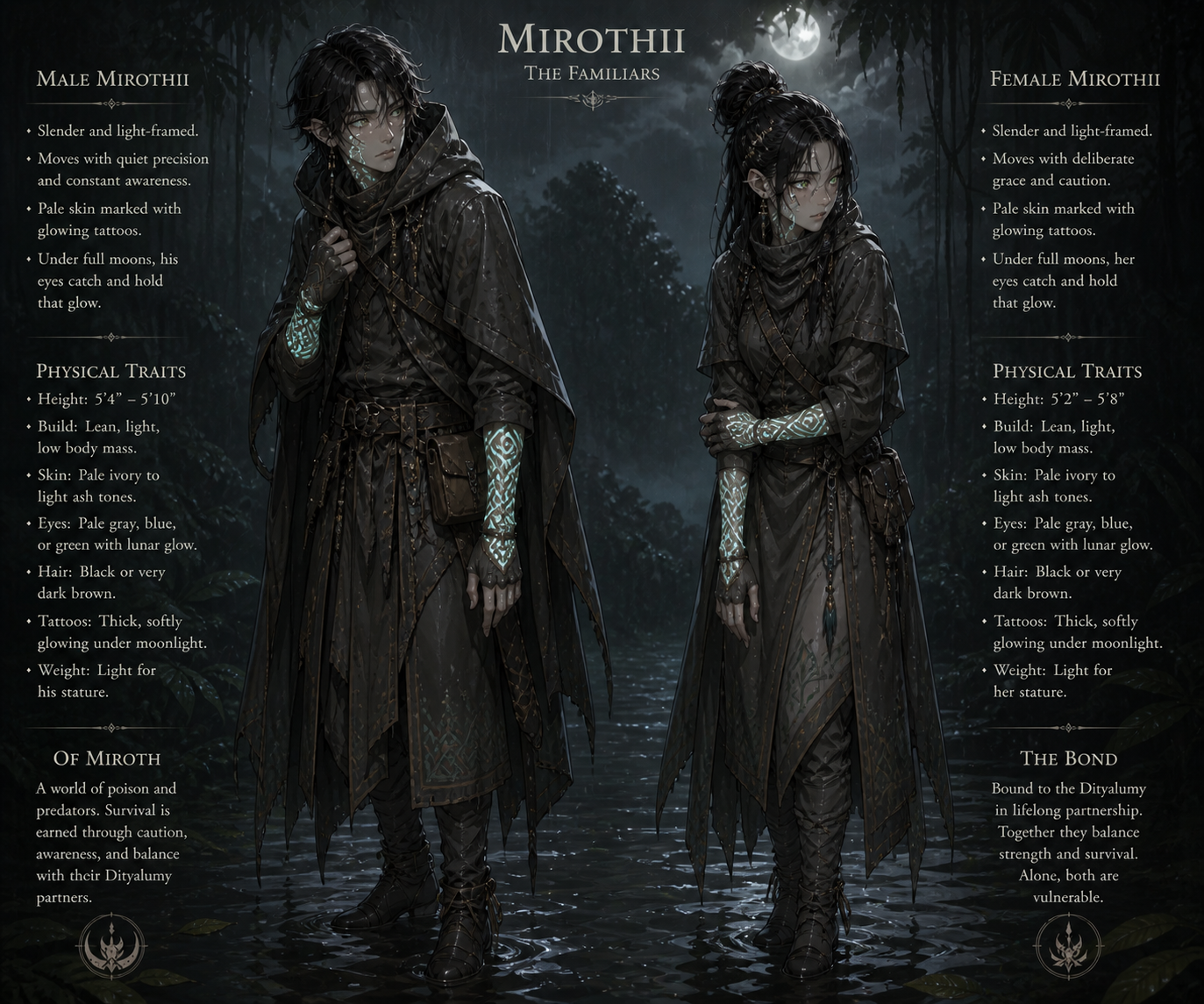
An average Mirothii is a slender, pale-skinned human with a light, almost fragile frame and sharp, watchful eyes that seem to miss very little. They move with quiet precision, every step deliberate, as if the ground itself might turn against them if trusted too easily. Their features are often marked by faintly glowing tattoos and, under the light of the full moons, eyes that catch and hold that glow.
Though not physically imposing, they carry themselves with a constant, controlled awareness—someone shaped by a world where caution is survival—and are rarely seen alone for long, most often found alongside the Dityalumy partner that completes the balance of their lives.
Familiars,
Looks
Mirothii bodies reflect the brutal truth of their homeland:
on Miroth, being heavy, slow, or careless gets you killed
They are not built for dominance or raw strength.
They are built for:
avoidance
precision
and survival in a place where almost everything is dangerous
Lean, Light, and Efficient
Mirothii tend toward:
slender frames
low body mass
and slightly athletic builds
Most individuals appear:
narrow through the shoulders
light through the limbs
and compact through the torso
Their bodies carry very little excess weight, giving them a look that can seem:
fragile at first glance
but controlled and deliberate on closer inspection
They are not weak—
they are:
economical
Unusually Light for Their Size
One of the most notable aspects of the Mirothii is how little they weigh.
Even healthy adults often feel:
lighter than expected
easy to lift
and less physically dense than other humans
This is not malnourishment.
It is adaptation.
A lighter body allows for:
faster reactions
quieter movement
less strain when climbing or traversing unstable terrain
and quicker recovery when avoiding danger
Musculature – Subtle but Functional
Mirothii musculature is:
present but not pronounced
tightly distributed
and built for repeated, controlled motion
Strength shows most clearly in:
forearms (climbing, gripping, tool use)
legs (sudden movement, repositioning)
and core (balance and stability)
They are not built to overpower threats.
They are built to:
not be where the threat strikes
Posture and Movement
Mirothii tend to carry themselves with:
slight tension
constant awareness
and readiness to move
They rarely appear fully relaxed in open environments.
Even at rest, they seem:
alert
listening
and subtly tracking their surroundings
Their movement is:
careful but not slow
quiet without being hesitant
and highly controlled
They step lightly, often placing their weight with intention, as if:
the ground itself might betray them if trusted too easily
Adaptation to a Toxic World
Living in an environment where:
plants are poisonous
animals are predatory
and even contact can be dangerous
has shaped their bodies to favor:
minimal exposure
reduced surface contact
and efficient energy use
They avoid unnecessary exertion, not out of laziness—but because:
wasted movement can be fatal
Subtle Predatory Echo
Though human, the Mirothii carry a faint resemblance to something more watchful.
Their combination of:
light frame
controlled movement
and sharp awareness
gives them a presence that feels:
less like prey—and more like something that learned how not to be caught
Core Body Truth
Mirothii are not built to survive by force.
They are built to survive by:
not being touched, not being caught, and not making mistakes
Mirothii skin reflects a life lived under filtered light, constant caution, and a land where touch itself can be dangerous.
Their tones tend toward pale, desaturated hues, shaped more by environment than by sun.
Common Skin Tones
Most Mirothii fall within a range of:
pale ivory
soft porcelain
muted beige
light ash-toned skin
and faintly gray-touched complexions
Even the darker end of their range rarely becomes truly deep in color. Instead, it appears:
subdued
softened
and slightly dulled compared to mainland populations
Undertones
Undertones often lean:
cool (pinks, pale blues)
or neutral with a faint gray cast
Warm undertones exist, but are less common and usually muted.
This gives many Mirothii a complexion that can appear:
slightly washed
subtly unnatural
or “moon-touched” to outsiders
Environmental Influence
Despite living on an island, Mirothii do not display strong sun-darkening.
This is due to:
frequent cloud cover or indirect light
time spent under canopy or shelter
and cultural habits of avoiding unnecessary exposure
Their skin instead reflects:
protection and caution, rather than exposure
Skin Texture and Resilience
Mirothii skin is typically:
thin in appearance
smooth
but surprisingly resilient
Due to their environment, their skin has adapted to:
resist minor irritants
tolerate low-level toxins
and recover quickly from superficial exposure
However, this does not make them immune—
only:
less easily affected than others would be
Markings and Subtle Variations
Some Mirothii display faint natural variations such as:
light freckling
subtle mottling
or barely visible patterning under the skin
These are usually:
soft
irregular
and often more noticeable in certain lighting conditions
Tattoo Interaction
Their cultural tattoos, made from local flora, interact uniquely with their pale skin.
Because of their complexion:
tattoos often stand out sharply
the faint glow appears more pronounced
and markings can seem almost luminous in low light
This has led to a cultural association between:
pale skin and visible identity
Moonlight Effect
Under direct moonlight—especially during a full moon—Mirothii skin can appear:
brighter
cooler in tone
and almost reflective
Combined with their Moon Drop Sight (glowing eyes), this creates an effect where they can seem:
part of the same force they believe created them
Core Skin Identity
Mirothii skin is not shaped by the sun—
but by:
shadow, caution, and a world where contact must be measured
Mirothii typically stand between 5’0” and 6’0”, but like much about them, their height tells only part of the story.
They are not especially tall or short by human standards—
but they often feel smaller than they are.
Average Range and Distribution
Most Mirothii cluster between:
5’2” and 5’8”
Individuals outside this range exist, but extremes are uncommon.
Their overall population trends slightly shorter on average, though not dramatically so.
Perception of Height
Because of their:
slender builds
light frames
and narrow proportions
Mirothii often appear:
smaller
less imposing
and easier to overlook
This is compounded by their tendency to:
keep a lower profile
avoid drawing attention
and move quietly through their environment
A Mirothii standing at average height may still be perceived as:
less physically present than they actually are
Posture and Presence
Mirothii posture is shaped by caution.
They tend to stand:
balanced
slightly reserved
and ready to move rather than to display
They rarely:
square themselves aggressively
or take up more space than necessary
This makes their height feel:
contained rather than projected
Environmental Influence
In a land where:
visibility can attract predators
and movement must be controlled
height is not an advantage unless it serves awareness.
Mirothii use their height for:
sightlines
awareness
and positioning
but do not rely on it for:
intimidation
or dominance
Functional Height
Their proportions allow them to:
navigate dense terrain
move through uneven environments
and maintain balance on uncertain ground
Height is simply another tool—
not a defining trait.
Core Height Truth
Mirothii are not defined by how tall they stand—
but by:
how little attention their height draws
Mirothii are notably light for their size, with most adults falling between 100 and 160 pounds.
Even at the higher end of this range, they rarely appear—or feel—heavy.
Light Frame, Minimal Mass
Their bodies carry:
low overall body fat
tightly distributed, efficient muscle
and lighter bone structure than most human populations
This results in a physique that feels:
easy to lift
quick to move
and lacking the dense “weight” expected of a human frame
This is not weakness.
It is adaptation.
Why They Are So Light
On Miroth, weight works against survival.
A lighter body allows for:
faster reaction time
quieter movement
less strain when climbing or navigating unstable terrain
and reduced risk when avoiding contact with dangerous surfaces
When nearly everything can poison, sting, or kill on contact:
less weight means less commitment to a mistake
Muscle and Strength Distribution
Mirothii are not heavily muscled, but they are not frail.
Their strength is:
subtle
controlled
and focused on function
They carry strength primarily in:
forearms (gripping, climbing, handling tools carefully)
legs (quick repositioning and balance)
and core (stability and control of movement)
They are capable—
just not built for force.
Heavier Individuals
Even the heaviest Mirothii tend to:
broaden slightly rather than bulk
retain their light overall feel
and avoid accumulating excess mass
Significant weight gain is uncommon, as:
their lifestyle discourages it
and their environment punishes inefficiency
Interaction with Their Environment
Their low weight allows them to:
move across fragile or unstable ground
climb surfaces others might break
and reduce impact when landing or falling
They often step and move as if:
every surface must be trusted carefully
Because on Miroth—
that assumption is usually correct.
Perceptual Effect
To outsiders, one of the most surprising things about a Mirothii is:
how little they weigh when handled or lifted
This can lead to dangerous underestimation.
They are easy to move—
but not easy to catch.
Core Weight Truth
Mirothii are not built to endure force—
they are built to:
avoid it entirely
The most striking thing about a Mirothii is not any single feature—
it is the combination of fragility and awareness.
They look like people who should not survive where they live.
And yet, they do.
Pale, Moon-Touched Skin
Their skin is immediately noticeable:
pale
cool-toned
and often lacking the warmth seen in other human populations
It can appear:
faintly desaturated
slightly reflective under certain light
or almost luminous under moonlight
This gives them a look that feels:
less sun-shaped—and more night-shaped
Sharp, Predatory Eyes
Their eyes are their most defining feature.
They tend to be:
sharply focused
slightly narrowed even at rest
and constantly moving in small, precise adjustments
To outsiders, their gaze can feel:
assessing
calculating
and just a little unsettling
They do not look at things passively.
They look like they are:
deciding what something is, and whether it matters
Moon Drop Sight (Lunar Glow)
When exposed to full moonlight, Mirothii eyes begin to:
glow softly
intensify in color or brightness
and reflect light far more strongly than normal
This is not subtle in direct conditions.
In darkness, a Mirothii under full moonlight may appear:
as if their eyes are holding light rather than reflecting it
This phenomenon is culturally significant and often tied to:
identity
spiritual belief
and moments of importance
Light, Delicate Frame
Their bodies reinforce their otherworldly impression.
They appear:
thin
lightly built
and almost too fragile for their environment
Their limbs are:
narrow
precise
and controlled in movement
Even when strong, they do not look powerful.
They look:
carefully made
Controlled, Quiet Movement
Mirothii movement is highly distinctive.
They move:
quietly
deliberately
and with minimal wasted motion
Their steps are:
placed with intention
often lighter than expected
and rarely careless
They rarely stumble.
They rarely rush blindly.
Even when moving quickly, there is:
control inside the speed
Subtle Environmental Awareness
One of the most noticeable traits—once observed—is how they interact with their surroundings.
They tend to:
avoid unnecessary contact
adjust their path constantly
and notice small changes others ignore
This manifests in subtle ways:
stepping around plants without looking down
pausing slightly before touching surfaces
reacting to sounds others did not register
It creates the impression that:
they are always aware of something you are not
Tattoo Luminescence
Their ritual tattoos, made from local flora, often:
glow faintly
stand out sharply against their pale skin
and become more visible in low light
These markings are:
personal
cultural
and often tied to life events or milestones
In dim conditions, a group of Mirothii can appear:
marked by soft, living light across their skin
Subtle Signs of Toxic Adaptation
Though not overtly monstrous, there are small indicators of their adaptation to a deadly environment:
slightly dulled reactions to irritants
lack of hesitation near dangerous flora
familiarity with things others instinctively avoid
They may casually interact with:
plants
surfaces
or substances
that would make outsiders recoil.
Core Feature Identity
Mirothii are defined not by strength or size—
but by:
awareness, restraint, and a quiet, unnatural familiarity with danger
For an island people, the Mirothii display a surprisingly high degree of variation, though always within the constraints imposed by their environment.
No matter how individuals differ, all Mirothii share a common foundation:
light build, controlled movement, and an awareness shaped by danger
Body Type Variation
While they tend toward lean, slightly athletic builds, there is still visible range in body type:
Wiry and extremely slender individuals built almost entirely for speed and minimal presence
Lightly athletic builds with more visible muscle, especially among hunters and climbers
Compact frames that appear smaller but maintain the same efficiency and control
Even the most physically developed Mirothii never become:
bulky
heavy
or mass-focused
Their environment simply does not allow it.
Facial Structure
Facial features show notable variation, including:
narrower, sharper faces with pronounced cheekbones
softer but still refined features
longer or shorter facial proportions depending on lineage
However, all tend to retain:
a certain sharpness
and that distinctive, focused gaze
Even the softest-featured Mirothii still look:
like they are paying attention
Eye Variation
While all Mirothii share that predatory intensity, eye color can vary across:
pale gray
light blue
washed green
muted hazel
and occasionally darker tones
Regardless of color, their eyes always appear:
bright
alert
and quick to focus
Under moonlight, all exhibit Moon Drop Sight, though:
brightness
intensity
and hue of the glow
may vary slightly between individuals.
Skin Tone Range
Though generally pale, variation exists in:
undertone (cool, neutral, faintly warm)
saturation (from porcelain to ash-muted tones)
and subtle mottling or freckling
Some individuals appear almost:
ghost-pale
while others carry:
slightly deeper, though still muted, coloration
Hair Texture and Color
Hair varies more than skin tone, including:
straight
wavy
or lightly curled textures
Common colors include:
black
dark brown
ash brown
muted blonde
and occasionally lighter or desaturated tones
Hair is often worn:
tied back
shortened
or kept controlled
to avoid interference with vision or movement.
Tattoo Expression
One of the most visible forms of variation comes from their ritual tattoos.
Differences include:
placement
pattern
density
and glow intensity
Some individuals may have:
minimal markings
or a single significant tattoo
Others may be:
heavily marked with layered designs
representing multiple life events
These tattoos often become a primary way to:
visually distinguish individuals
Environmental and Role Influence
Though they share the same island, different roles create subtle physical differences:
hunters and climbers may develop stronger forearms and legs
gatherers may show more careful, precise hand use
those working closely with Dityalumy may carry themselves differently in posture and awareness
These differences are functional rather than aesthetic.
Limits of Variation
Despite all variation, the environment enforces strict boundaries.
You will not find Mirothii who are:
heavily built
slow-moving
or physically careless
Those traits do not persist.
Core Truth
Mirothii vary in form, but never in function.
Every difference still serves the same purpose:
survival in a world that punishes mistakes immediately
Mirothii clothing is shaped by two unavoidable truths:
on Miroth, what you touch can kill you
and it is almost always raining
Their garments are not about fashion or status first.
They are about:
protection from contact
constant water management
and the ability to remove anything instantly if it becomes dangerous
Layered, Removable Outerwear
The most recognizable piece of Mirothii clothing is the light poncho or outer wrap.
These are:
loose-fitting
highly water-repellent
and designed to shed both rain and contaminants
They are worn to:
prevent contact with poisonous plants
keep constant rainfall from soaking inner layers
deflect runoff from leaves and surfaces
and create a barrier between the body and the environment
Most importantly, they are designed to be:
removed immediately
If a garment becomes:
contaminated
oversaturated
or compromised
a Mirothii will:
drop it
step away
and not hesitate
Rain-Shedding Design
Because of near-constant rainfall, Mirothii clothing is built to:
channel water away from the body
dry quickly when possible
and avoid holding moisture
Common design elements include:
angled shoulders and sloped outer layers
overlapping fabric that directs water downward
minimal pockets or folds where water can collect
and smooth outer surfaces that encourage runoff
Clothing is not just worn—
it is shaped to interact with rain correctly.
Treated Furs and Insulating Layers
For warmth in wet conditions, Mirothii use:
carefully treated furs
water-resistant natural fibers
and insulating inner wraps
These are processed to:
resist saturation
maintain warmth even when damp
and avoid trapping harmful substances
Fur is typically worn:
as removable mantles
layered beneath rain-shedding outerwear
or in modular pieces that can be adjusted depending on conditions
Skin Coverage vs. Mobility
Mirothii must balance:
covering the body from toxic contact
avoiding prolonged exposure to wet materials
and maintaining full mobility
As a result, their clothing is:
light rather than heavy
layered rather than thick
and designed to move easily even when wet
Common garments include:
fitted inner layers that dry quickly
light trousers or wraps
arm coverings that can be removed independently
and minimal restrictive elements
Nothing is worn that would:
slow reaction time—especially when soaked
Water and Toxin Resistance
Their environment combines:
toxic plant oils
poisonous animal residue
and constant rainfall that spreads both
Because of this, their clothing is:
treated with oils and compounds to repel water
resistant to absorption of toxins carried in rain
and designed to prevent contaminants from soaking inward
Garments are regularly:
cleaned
rotated
dried when possible
or destroyed if unsafe
Fast Release Design
Nearly all Mirothii clothing shares one critical feature:
it can be removed quickly—even when wet
Fastenings are:
simple
accessible
and functional under poor conditions
Most garments rely on:
ties
wraps
or single-release closures
This allows a Mirothii to:
shed soaked or contaminated layers instantly
avoid prolonged exposure
and react without delay
Footwear and Ground Contact
Footwear must handle:
slick terrain
standing water
and contaminated surfaces
Common choices include:
water-resistant boots
flexible, quick-drying wraps
or treated coverings that allow grip even when wet
They are designed to:
shed water quickly
maintain traction
and avoid becoming heavy when saturated
As with all clothing, they are:
easy to remove
and frequently replaced
Minimal Decoration, Functional Identity
Mirothii clothing remains largely practical, but identity is still expressed through:
visible tattoo patterns beneath or between layers
subtle dye work that does not interfere with function
and personal adjustments to fit or layering style
Anything decorative must not:
trap water
slow drying
or increase risk
Relationship to Clothing
Mirothii do not become attached to clothing.
It is:
temporary
expendable
and always secondary to survival
Rain, toxins, and wear ensure that garments:
degrade quickly
require replacement often
and are never trusted completely
If clothing becomes dangerous, it is abandoned without hesitation.
Core Clothing Truth
Mirothii clothing exists to create distance—
from poison, from water, and from anything that lingers too long.
Traits
Symbiosis with the Dityalumy
The greatest strength of the Mirothii is not found in their own bodies—
but in their bond with the Dityalumy.
Through the ritual of Bonding, a Mirothii and a Dityalumy form a lifelong pair that is:
biological
spiritual
emotional
and practical
The Dityalumy bring:
overwhelming physical strength
extreme durability
rapid regeneration
and centuries of lived experience
The Mirothii provide:
environmental awareness
decision-making grounded in immediate survival
mobility and adaptability in hazardous terrain
and a stabilizing presence for their partner
A bonded pair operates as something greater than either alone.
They can:
coordinate with minimal communication
anticipate each other’s actions
and function with unsettling precision
Where one is:
powerful but dependent
the other is:
fragile but self-sufficient
Together, they eliminate each other’s greatest weaknesses.
Resistance to Miroth’s Poisons
Miroth is a hostile environment where:
nearly all flora is toxic
most fauna are venomous
and even incidental contact can be dangerous
The Mirothii have adapted to this reality.
They possess a natural resistance that allows them to:
handle poisonous plants safely
survive low-level toxin exposure
and move through environments that would incapacitate outsiders
They are not immune.
But where others would:
hesitate
suffer immediate harm
or die
the Mirothii can continue operating.
This resistance is essential—not exceptional—
because without it:
they could not exist on Miroth at all
Environmental Mastery
The Mirothii possess an instinctive understanding of their environment.
They can:
identify dangerous plants at a glance
detect subtle signs of predator presence
and navigate terrain that appears indistinguishable to outsiders
On Miroth, knowledge is survival.
And they have it.
Extreme Situational Awareness
Mirothii are constantly aware of:
movement
sound
surface conditions
and environmental changes
They notice:
what shifted
what doesn’t belong
and what is about to become a problem
This allows them to:
avoid danger before it becomes immediate
Precision Movement
Their light frames and controlled musculature allow them to:
move quietly
place each step deliberately
and avoid unnecessary contact
They are highly effective at:
traversing unstable ground
moving through dense or hazardous terrain
and navigating environments where mistakes are lethal
Energy Efficiency
Mirothii waste very little energy.
Their movements are:
measured
controlled
and purposeful
They rarely:
overexert
overcommit
or act without reason
This allows them to:
endure long periods of activity
conserve resources
and remain effective under pressure
Adaptation to Constant Rain and Hazard
Miroth is not just toxic—
it is wet, unstable, and relentless.
The Mirothii are fully adapted to:
near-constant rainfall
low visibility
slick terrain
and spreading environmental hazards
Conditions that hinder others are simply:
baseline conditions for them
Low Physical Profile
Their smaller, lighter builds make them:
harder to detect
easier to overlook
and less likely to draw attention
This is not intimidation-based survival—
it is avoidance-based survival.
Mental Discipline Through Necessity
Living on Miroth requires:
patience
control
and constant decision-making
This produces individuals who are:
cautious
deliberate
and rarely reckless
They think before acting because:
acting without thought is often fatal
Stabilizing Influence on the Dityalumy
The Dityalumy are:
powerful
long-lived
and biologically dependent on blood
This creates potential instability.
The Mirothii, through Bonding, provide:
consistency
grounding
and emotional regulation
They are not just partners.
They are:
anchors
This role is essential—not symbolic.
Without it, Dityalumy strength becomes:
harder to direct
harder to trust
and more dangerous to everyone involved
Core Strength Identity
The Mirothii are not strong in isolation.
They are strong because:
they exist within a system of survival that turns weakness into interdependence
Light Frames and Limited Physical Strength
Mirothii are very light for their size, and that comes with a clear cost.
They lack:
raw strength
physical mass
and the ability to overpower most opponents
A Mirothii can be:
lifted
thrown
or physically restrained
far more easily than most other human populations.
In direct confrontation, especially against:
larger humanoids
heavily armored opponents
or creatures native to Miroth
they are at a severe disadvantage.
They are not built to win fights through force—
and when forced into one:
they are often already in danger
Dependence on the Dityalumy
Their greatest strength is also one of their greatest vulnerabilities.
The Mirothii exist in symbiosis with the Dityalumy.
While this bond provides:
protection
strength
and stability
it also creates reliance.
Without their bonded partner, a Mirothii is:
far more exposed to predators
more vulnerable in open conflict
and operating without the force multiplier they are culturally and practically built around
While Mirothii can survive independently, their society is structured around:
not having to
The loss of a bonded Dityalumy is not just emotional—
it is a practical loss of security.
Light Frames and Limited Physical Strength (Expanded)
Mirothii are very light for their size, and that comes with a clear cost.
They lack:
raw strength
physical mass
and the ability to overpower most opponents
A Mirothii can be:
lifted
thrown
or physically restrained
far more easily than most other human populations.
In direct confrontation, especially against:
larger humanoids
heavily armored opponents
or creatures native to Miroth
they are at a severe disadvantage.
They are not built to win fights through force—
and when forced into one:
they are often already in danger
Dependence on the Dityalumy (Expanded)
Their greatest strength is also one of their greatest vulnerabilities.
The Mirothii exist in symbiosis with the Dityalumy.
While this bond provides:
protection
strength
and stability
it also creates reliance.
Without their bonded partner, a Mirothii is:
far more exposed to predators
more vulnerable in open conflict
and operating without the force multiplier they are culturally and practically built around
While Mirothii can survive independently, their society is structured around:
not having to
The loss of a bonded Dityalumy is not just emotional—
it is a practical loss of security.
Moon Drop Sight
Description:
A natural condition where a Mirothii’s eyes glow when exposed to full moonlight.
This is not considered an illness, but a baseline trait—though its intensity and effects can vary.
Symptoms:
eyes emitting a soft to bright glow under direct moonlight
increased light sensitivity
heightened awareness or alertness in some individuals
difficulty sleeping during strong lunar cycles
In rare cases, stronger expressions may cause:
overstimulation
restlessness
or difficulty focusing
Cultural Meaning:
Deeply tied to their origin beliefs.
Often seen as:
proof they were shaped by the moons
Stronger Moon Drop Sight is sometimes interpreted as:
a sign of importance
a mark of attention from the moons
or simply “being watched a little closer”
Toxin Saturation
Description:
A condition caused by repeated or prolonged exposure to Miroth’s poisons beyond what the body can tolerate.
Even with natural resistance, buildup can occur over time.
Symptoms:
nausea
slowed reactions
skin irritation or discoloration
trembling or weakness
reduced awareness or delayed decision-making
Severe cases may result in:
collapse
loss of motor control
or long-term damage
Cultural Meaning:
Seen as a warning sign.
Not failure—
but:
a reminder that resistance is not immunity
Rain Rot
Description:
A chronic condition caused by constant exposure to wet environments without proper drying or care.
Particularly common during long storm periods.
Symptoms:
softened or damaged skin
increased susceptibility to infection
joint stiffness
persistent fatigue
irritation from prolonged dampness
In severe cases:
movement becomes painful
and skin may begin to break down
Cultural Meaning:
Common but disliked.
Often associated with:
poor discipline
or lack of proper care
Elders tend to treat it as:
preventable—and therefore mildly embarrassing
Bond Loss Syndrome
Description:
A psychological and functional condition occurring after the loss of a bonded Dityalumy.
This is not simply grief.
It is the loss of a lifelong symbiotic connection.
Symptoms:
disorientation
loss of routine
reduced situational awareness
hesitation in decision-making
emotional withdrawal or instability
In severe cases:
individuals may become unable to function effectively in dangerous environments
Cultural Meaning:
Handled with seriousness and care.
The community understands that:
losing a bond means losing part of how you survive
Recovery is possible—
but rarely quick.
Contact Shock
Description:
A stress response triggered by unexpected or uncontrolled contact with unknown substances or surfaces.
Develops from lifelong conditioning in a hazardous environment.
Symptoms:
sudden withdrawal or recoil
hesitation to interact with surroundings
increased anxiety
overcorrection in movement
In extreme cases:
temporary paralysis of decision-making
Cultural Meaning:
More common in younger individuals or after traumatic exposure.
Seen as:
the body remembering danger faster than the mind can process it
Lunar Restlessness
Description:
A cyclical condition tied to strong lunar phases, especially full moons.
Often overlaps with stronger expressions of Moon Drop Sight.
Symptoms:
difficulty sleeping
heightened alertness
increased sensitivity to surroundings
restlessness or pacing behavior
In some individuals:
sharper perception
faster reactions
but reduced ability to relax
Cultural Meaning:
Not considered harmful.
Often expected.
Some even treat it as:
a time when the world feels clearer—if more difficult to ignore
Culture
The Bonding
The most important tradition in Mirothii life is The Bonding.
It is a ritual in which a Mirothii and a Dityalumy form a lifelong pair bond, lasting until death separates them.
To outsiders, it resembles marriage.
To the Mirothii, it is something far more complex:
a survival agreement
a spiritual connection
a shared life structure
and a mutual dependency
The Dityalumy gains:
a trusted source of blood
stability
and a connection to mortal life
The Mirothii gains:
protection
strength through partnership
and a constant presence in a dangerous world
The bond shapes:
daily life
family structure
social standing
and personal identity
It is not always romantic.
It does not need to be.
Some bonded pairs are:
lovers
close companions
or simply two people who chose each other because survival demanded trust
To enter Bonding is to say:
“I am tying my life to yours, and I expect you to do the same.”
Breaking a bond is extremely rare and requires:
ritual
time
and the involvement of others
Most never attempt it.
The Bonding
The most important tradition in Mirothii life is The Bonding.
It is a ritual in which a Mirothii and a Dityalumy form a lifelong pair bond, lasting until death separates them.
To outsiders, it resembles marriage.
To the Mirothii, it is something far more complex:
a survival agreement
a spiritual connection
a shared life structure
and a mutual dependency
The Dityalumy gains:
a trusted source of blood
stability
and a connection to mortal life
The Mirothii gains:
protection
strength through partnership
and a constant presence in a dangerous world
The bond shapes:
daily life
family structure
social standing
and personal identity
It is not always romantic.
It does not need to be.
Some bonded pairs are:
lovers
close companions
or simply two people who chose each other because survival demanded trust
To enter Bonding is to say:
“I am tying my life to yours, and I expect you to do the same.”
Breaking a bond is extremely rare and requires:
ritual
time
and the involvement of others
Most never attempt it.
The Rain Watch
Tradition:
During heavy or prolonged storms, Mirothii take turns maintaining a quiet watch over their surroundings.
This is not formal guard duty.
It is a shared awareness practice where individuals:
observe changes in water flow
listen for unnatural movement
and track how the environment shifts under rainfall
The goal is not just defense—
but understanding how the island behaves in its most active state.
Meaning:
Rain changes everything.
You either learn from it—
or it teaches you the hard way.
The First Safe Path
Tradition:
Young Mirothii are guided through a “first path” across hazardous terrain, taught how to:
move safely
identify danger
and navigate without error
This is often done under supervision, but with increasing independence.
Completing it marks a transition from:
being protected
to
being responsible for your own survival
Meaning:
You are not considered grown when you age.
You are considered grown when:
you can walk without being watched
Shared Silence
Tradition:
Bonded pairs—and sometimes close family members—practice extended periods of shared silence.
During this time:
communication is minimal
movement is coordinated
and awareness is heightened
This strengthens:
trust
nonverbal understanding
and environmental awareness
Meaning:
If you can exist beside someone without speaking—
and still understand them—
the bond is real.
The Shedding of Contamination
Tradition:
When a Mirothii is exposed to something dangerous, there is a ritualized process of:
removing contaminated clothing
cleaning the body
and re-entering the group safely
While practical in origin, it has become culturally reinforced.
Witnessing someone go through this process is treated seriously, not casually.
Meaning:
You do not bring danger back with you.
Not to your home.
Not to your people.
Mirothii belief is built around one central truth:
they were made by the moons—and they are still being watched
On a world with five moons, their faith is not abstract or distant.
It is:
visible
cyclical
and ever-present
Their beliefs are not about worship in the formal sense.
They are about:
understanding the balance between creation, danger, and survival
Born of the Moons (Expanded)
The Mirothii believe they were created when:
the light of the five moons
mixed with the energies of Miroth
This act of creation was not controlled.
It was:
powerful
unstable
and incomplete
From it came:
the Mirothii
and the many dangerous creatures that inhabit the island
Creation, to them, is not perfect.
It is:
something that produces both life and threat at the same time
The Midnight Protectors
To survive what was created, the moons gave them the Dityalumy—
their midnight protectors.
The Mirothii believe the Dityalumy are:
a blessing
a necessity
and part of the same original act of creation
Their relationship is not seen as ownership or dominance.
It is understood as:
a system that allows both to exist
The cost of this protection is known and accepted:
approximately a pint of blood every two weeks
This is not viewed as sacrifice in a negative sense.
It is:
expected
normalized
and built into daily life
To give blood is not to lose something—
it is to:
participate in the balance that keeps you alive
Creation Is Dangerous
Unlike many cultures, the Mirothii do not view creation as purely good.
They believe:
the same force that made them
also made everything that can kill them
This creates a worldview where:
life is valued
but never assumed safe
Danger is not an intrusion.
It is:
part of how the world works
The Mirothii do not believe in safety as a permanent state.
They believe in:
balance
awareness
and correct behavior
Survival comes from:
maintaining relationships (with people, environment, and Dityalumy)
avoiding excess
and not disrupting what keeps things stable
Too much of anything—carelessness, greed, isolation—leads to imbalance.
And imbalance leads to death.
Blood as Shared Survival
Blood is not sacred in the same way it is to the Dityalumy—
but it is deeply meaningful.
It represents:
trust
continuity
and mutual survival
Giving blood is:
expected
personal
and never entirely casual
It reinforces the idea that:
life on Miroth is not individual—it is shared
You Do Not Survive Alone
The Mirothii strongly believe that no one survives Miroth by themselves.
This applies to:
individuals
families
and entire tribes
Independence is respected—
but isolation is viewed as:
dangerous, and often temporary
The Island Is Alive (In Practice, Not Worship)
While not always spoken as literal belief, the Mirothii behave as if:
the island reacts
the environment remembers
and careless behavior has consequences beyond the immediate
This creates habits of:
caution
respect
and quiet awareness
Being Chosen Matters
Because of Bonding, there is a belief that being chosen by a Dityalumy is:
significant
meaningful
and not random
Even when practical, the act of choosing carries weight.
To be bonded is to be:
seen, selected, and trusted in a way that matters
Survival Is Not Luck
The Mirothii do not attribute survival to chance.
They believe survival comes from:
correct behavior
awareness
and maintaining balance
If someone lives, it is because:
they did something right
If they die, it is because:
something went wrong
This is not cruelty.
It is:
acceptance of how their world works
The Moons as a Single Presence
Though there are five moons in the sky, the Mirothii do not see them as separate entities.
To them, the moons are:
one thing, seen in five parts
They are understood as:
a single force
a shared origin
and a unified presence looking down on the world
The Mirothii do not divide meaning between the moons.
They do not assign:
different domains
personalities
or competing influences
Instead, the five are simply:
how the one is seen
Observation, Not Worship
The moons are not worshipped in the traditional sense.
There are no:
temples
priesthoods
or structured rituals of devotion
Instead, the Mirothii:
acknowledge their presence
live under their light
and remain aware of being seen
Their relationship is quiet.
Constant.
Unavoidable.
The Shared Role of the Moons
The moons are not distant or symbolic.
They are:
always present
always visible (when not hidden by storm)
and always part of daily life
They do not guide through instruction.
They do not intervene directly.
But they are understood to:
witness everything
Core Belief Identity
The Mirothii do not believe they were placed in a safe world.
They believe they were created in a dangerous one—
and given just enough to survive it.
Mirothii governance is local, practical, and rooted in survival, not hierarchy.
They are not ruled by a single unified authority.
Instead, they exist as:
a network of independent tribes that cooperate when necessary
Each tribe governs itself, but no tribe exists in isolation from the realities of the island—or the growing presence of the outside world.
Mirothii governance is local, practical, and rooted in survival, not hierarchy.
They are not ruled by a single unified authority.
Instead, they exist as:
a network of independent tribes that cooperate when necessary
Each tribe governs itself, but no tribe exists in isolation from the realities of the island—or the growing presence of the outside world.
Tribal Leadership
Each Mirothii tribe is led by a local tribal leader, chosen through a combination of:
proven competence
survival experience
family influence
and community trust
Leadership is not ceremonial.
A leader is expected to:
keep people alive
organize hunting and resource gathering
manage relationships with neighboring tribes
coordinate defense against predators and threats
and resolve disputes
If a leader fails at these things, they do not remain leader for long.
Leadership is not inherited by right.
It is:
maintained by usefulness
Limited Centralization
Historically, Mirothii tribes interacted only:
two to three times per year
during large gatherings.
These gatherings were used to:
share information
settle disputes
arrange bonds or alliances
and maintain a broader sense of unity
Outside of these events, tribes operated largely independently.
There is no traditional:
central government
standing authority
or unified law across all tribes
The Role of the Dityalumy
The Dityalumy do not rule the Mirothii.
They live within the same tribal structure, acting as:
advisors
protectors
hunters
and living memory
Their influence comes from:
experience
longevity
and personal relationships
not formal authority.
A respected Dityalumy may shape decisions—
but they do not command them.
The Black Circle (Expanded)
The establishment of Black Circle, the Stanzgarian colony on Miroth, marks the most significant shift in Mirothii governance in generations.
It is critical to understand:
Black Circle exists because the Mirothii allowed it—and continue to support its presence
This was not:
conquest
coercion
or subjugation
It was a decision.
The Mirothii recognized that controlled contact with Stanzgar could:
provide stability
create trade opportunities
and act as a buffer against other, less controlled foreign powers
Black Circle brings:
structured trade
consistent communication with the mainland
access to outside goods
and a stable point of interaction
It also encourages tribes to:
communicate more frequently
coordinate beyond traditional gatherings
and engage with broader political realities
Stanzgarian Relationship
Stanzgar is not seen as a ruler of Miroth.
It is viewed as:
a powerful ally whose presence is both useful and carefully managed
Through agreements like the Five-Year Pact, the Mirothii and Dityalumy maintain:
autonomy
tribal sovereignty
and control over their land
In return, Stanzgar provides:
military deterrence against external threats
political recognition
and access to broader trade networks
The relationship is not one of dependence.
It is one of:
mutual benefit, chosen deliberately
Shifting Toward Coordination
Because of Black Circle and increased outside interaction, Mirothii governance is slowly evolving.
Tribes now:
communicate more regularly
coordinate decisions more often
and respond collectively to external pressures
This does not mean unification—
but it does mean:
less isolation than before
Authority Through Function, Not Title
Across all tribes, authority is based on:
capability
reliability
and results
Not rank.
Not ceremony.
Not distance from the people.
A leader who cannot:
solve problems
protect their people
or maintain balance
will eventually be replaced.
Core Government Identity
Mirothii governance is not about control.
It is about:
keeping people alive in a world that does not care if they are
Mirothii technology is defined by one overriding principle:
if it does not work in the rain, it does not work
They are not a people of large-scale industry or complex machines.
They are a people of:
practical survival tools
environmental adaptation
and techniques refined through necessity
Their technological level appears “primitive” to outsiders—
but that judgment usually comes from people who have never tried to survive Miroth for a week.
Survival-Focused Craft
Mirothii technology is centered around:
hunting
gathering
shelter construction
and environmental management
Their tools are designed to be:
reliable
repairable
and usable in constant wet conditions
Common tools include:
lightweight spears and hunting implements
cutting tools resistant to corrosion
climbing aids
and simple but effective trapping systems
Everything is built with the understanding that:
moisture is constant
surfaces are unstable
and materials degrade quickly
Water-Resistant Material Culture
Because of constant rainfall, Mirothii have developed strong skill in creating:
water-repellent fabrics
treated leathers and furs
and plant-based coatings that resist saturation
These materials are used in:
clothing
shelter coverings
storage wraps
and tool grips
Their ability to manage water is one of their most important technological strengths.
Toxin-Aware Tool Use
Living in a toxic environment has shaped how they design and use tools.
Mirothii technologies often include:
non-reactive materials for handling dangerous plants
tools designed to minimize skin contact
and methods for safely harvesting or processing poisonous resources
They also develop:
natural antidotes
toxin-resistant treatments
and preparation techniques that make otherwise dangerous materials usable
Their knowledge of toxins is as important as the tools themselves.
Shelter and Environmental Design
Mirothii shelters are built to:
withstand constant rain
resist environmental seepage
and minimize contact with dangerous surfaces
Structures are often:
elevated
angled for water runoff
and built with layered coverings
They favor:
flexibility over permanence
and function over scale
A shelter that survives storms is more valuable than one that looks impressive.
Limited but Intentional Simplicity
The Mirothii do not pursue technological advancement for its own sake.
They deliberately favor:
simple systems
minimal moving parts
and easily repairable designs
Complex mechanisms are often avoided because:
they fail more easily in wet conditions
they are harder to maintain
and they introduce unnecessary risk
Their philosophy is:
complexity is another way to die if it breaks at the wrong time
Interaction with Stanzgar and Black Circle
The presence of Black Circle has introduced access to:
metal tools
improved weaponry
and limited external technologies
However, the Mirothii adopt these cautiously.
They evaluate new tools based on:
whether they function in Miroth conditions
whether they can be maintained locally
and whether they introduce dependency
Some technologies are accepted.
Others are quietly ignored.
Knowledge as Technology
Perhaps their greatest technological strength is not physical—
but informational.
The Mirothii possess deep, generational knowledge of:
plant life
animal behavior
environmental patterns
and survival techniques
This knowledge is:
taught directly
practiced constantly
and refined over time
In many cases, this knowledge is more valuable than any tool.
Core Technology Identity
Mirothii technology is not about advancement.
It is about:
what continues to work in a place where failure is immediate
Mirothii occupations are shaped by a simple, unavoidable truth:
on Miroth, everyone must be useful—or they do not last long
There is no strict separation between “jobs” in the way mainland societies understand them.
Instead, Mirothii work is:
practical
flexible
and shared across the tribe
A single individual may take on multiple roles depending on:
season
need
and circumstance
Work is not identity.
It is:
participation in survival
Hunting and Gathering (Expanded)
The foundation of Mirothii life is:
hunting
foraging
and resource collection
Hunters are responsible for:
tracking and killing dangerous prey
identifying which creatures are safe—or safe enough—to harvest
and retrieving usable materials from highly hazardous environments
Gatherers handle:
edible plant collection
medicinal flora
and toxic materials that can be repurposed safely
This work requires:
extreme caution
environmental knowledge
and precise execution
A mistake in either role can be fatal.
Dityalumy-Bonded Roles
Bonded Mirothii often take on roles that complement their Dityalumy partner.
They may act as:
guides
coordinators
scouts
or stabilizing decision-makers
While the Dityalumy provides:
strength
durability
and combat dominance
the Mirothii provides:
direction
awareness
and control
Together, they function as:
a single operational unit
This partnership influences:
how tasks are assigned
how work is performed
and how responsibilities are shared
Healers and Herbalists
Given the toxicity of Miroth, healers are essential.
They specialize in:
treating poison exposure
creating antidotes
managing injuries
and maintaining overall health
Their knowledge includes:
plant properties
toxin interactions
and preparation methods
Healers are not removed from other work—they are expected to:
contribute when needed
but are protected when their skills are required
Shelter Builders and Maintainers
Some Mirothii focus on:
constructing shelters
maintaining structures
and ensuring environmental safety
This includes:
managing water flow
repairing storm damage
and preventing toxic intrusion
These roles are critical during:
storm seasons
environmental shifts
or after major damage
Trackers and Watchers
Certain individuals specialize in awareness-based roles, including:
tracking animals or threats
maintaining environmental watch
and identifying changes in terrain or behavior
They are often responsible for:
early warning systems
guiding safe movement
and preventing avoidable danger
These roles require:
constant attention
and high mental discipline
Inter-Tribal and Black Circle Liaisons
With the rise of Black Circle, some Mirothii have taken on roles involving:
communication with other tribes
coordination of gatherings
and interaction with Stanzgarian representatives
These individuals must:
understand both cultures
navigate differing expectations
and protect Mirothii interests
This is one of the few roles where:
social awareness is as important as survival skill
General Labor Expectation
Even with specialization, all Mirothii are expected to:
assist in food gathering
help with shelter maintenance
and contribute during times of need
No role is exempt from basic survival responsibilities.
A healer may still:
repair a roof
gather food
or stand watch
Work Across a Lifetime
Mirothii often shift roles over time.
An individual may:
begin as a gatherer
become a hunter
later serve as a watcher
and eventually take on advisory roles
Experience matters.
But flexibility matters more.
Core Occupational Identity
Mirothii occupations are not about status.
They are about:
doing what needs to be done, when it needs to be done, by whoever is able to do it
Mirothii economics are built on a reality most mainland systems never have to face:
survival matters more than ownership
They do not operate on accumulation, profit, or expansion.
They operate on:
exchange
trust
and immediate usefulness
Trade and Barter (Expanded)
The foundation of Mirothii economics is trade and barter, in both:
goods
and services
Common exchanges include:
food for tools
medicinal knowledge for labor
protection for supplies
crafted items for rare materials
Nothing is abstract.
Everything traded has:
clear, immediate value
A thing is worth what it can do—
not what someone says it is worth.
Service as Currency
Because survival is collaborative, services hold equal value to goods.
A Mirothii may “pay” with:
guiding someone safely through dangerous terrain
treating poison or injury
assisting in construction or repair
or providing knowledge others lack
This creates a system where:
what you can do is as valuable as what you can give
Limited Concept of Ownership
Ownership exists—but it is practical, not absolute.
Individuals may own:
tools
personal items
or resources they gathered
However, in times of need:
resources are shared
supplies are redistributed
and survival overrides personal claim
Hoarding is strongly discouraged because:
unused resources are wasted survival
Inter-Tribal Exchange
During seasonal gatherings, tribes engage in broader trade.
These exchanges often involve:
rare or region-specific materials
specialized knowledge
and long-term agreements
These gatherings are less about profit and more about:
maintaining balance between tribes
ensuring no group falls too far behind
and strengthening relationships
Dityalumy Exchange Role
The Bonding system also has an economic dimension.
While not transactional in the traditional sense, the exchange is clear:
the Mirothii provide blood (roughly a pint every two weeks)
the Dityalumy provide protection and strength
This is not seen as debt or cost.
It is:
a necessary and accepted balance
Outside of bonding, Dityalumy may also contribute through:
hunting
defense
or specialized labor
Interaction with Black Circle (Expanded)
The establishment of Black Circle introduced a new economic layer.
Through it, the Mirothii now have access to:
metal tools
foreign goods
refined materials
and structured trade systems
In exchange, they provide:
rare biological materials
knowledge of Miroth’s environment
and access to resources outsiders cannot safely obtain
However, the Mirothii approach this trade cautiously.
They are aware that:
outside economies prioritize accumulation
and external powers understand leverage differently
As a result, they:
limit dependency
maintain control over what leaves the island
and avoid over-reliance on foreign goods
Stanzgarian Influence Without Control
Stanzgar participates in Mirothii trade but does not control it.
Their role is:
facilitator
trade partner
and external stabilizer
The Mirothii engage with them because:
it is beneficial—not because it is required
Scarcity and Value
Because Miroth is dangerous, many resources are:
difficult to obtain
risky to gather
or inherently limited
This naturally regulates value.
Something is valuable because:
it was hard to acquire
it required risk
or it cannot be easily replaced
Minimal Wealth Accumulation
The Mirothii do not accumulate wealth in the traditional sense.
There is little concept of:
long-term hoarding
large-scale trade empires
or economic dominance
Instead, value is measured in:
reliability
usefulness
and contribution to the group
Core Economic Identity
Mirothii economics are not about growth.
They are about:
keeping resources moving where they are needed, when they are needed
Mirothii cuisine is shaped by a world where:
almost everything is poisonous—and the rest is trying to eat you
Their food is not about indulgence first.
It is about:
making the dangerous edible
preserving what is hard to obtain
and extracting as much value as possible from every kill
Sweet-Tinged Preserved Meat
A staple and widely favored dish among the Mirothii is:
meat cooked with local fruits, then dried for preservation
The process typically involves:
harvesting safe—or safely prepared—meat from dangerous fauna
cooking it with processed local fruits
allowing the mixture to absorb both flavor and mild chemical properties
then drying it into long-lasting strips or slabs
The result is a food that is:
slightly sweet
faintly tangy or “tingling” on the tongue
dense in nutrients
and highly portable
The tingling sensation comes from trace compounds in the fruit—
harmless when prepared correctly, but a reminder of where it came from.
This dish is valued because it:
lasts for extended periods
resists spoilage in wet conditions
and can be eaten safely during travel
Rain-Cured Fish
Fish are one of the more reliable food sources on Miroth.
They are often:
cleaned quickly after catch
lightly treated with plant extracts
and hung in covered areas to cure in the constant damp air
Unlike dry curing in other regions, Mirothii methods rely on:
controlled exposure to moisture
airflow
and toxin-neutralizing treatments
The result is:
firm, flavorful fish
slightly salty or mineral-rich
and safe for longer storage
Fire-Seared Meat
When fresh meat is available, it is often:
cooked quickly over open flame
seared heavily on the outside
and eaten soon after preparation
This method helps:
neutralize surface toxins
reduce risk from contaminants
and preserve the interior of the meat
Meals like this are often eaten:
immediately after a successful hunt
and shared among those present
Bitter Greens (Prepared Safely)
Many plant-based foods on Miroth are dangerous unless properly handled.
Some Mirothii favorites include:
carefully processed bitter greens
roots that require soaking or treatment
and leaves that are only edible after preparation
These foods tend to be:
sharp in flavor
slightly bitter
and often paired with meat to balance taste
Eating them safely is a mark of:
knowledge and skill
Tonic Broths
Mirothii often prepare broths using:
bones
herbs
and treated plant matter
These broths are used for:
recovery after toxin exposure
maintaining strength
and general health
They are less about flavor and more about:
function
warmth
and restoration
Travel Rations
In addition to preserved meat, Mirothii carry compact food such as:
dried meat-fruit mixtures
treated root strips
and dense, long-lasting nutrient packs
These are designed to:
survive constant rain
remain safe over time
and provide reliable energy
Shared Kill Meals
When a large or dangerous creature is successfully hunted, it is common to:
prepare and consume portions immediately
distribute the rest among the group
and use as much of the animal as possible
These meals are:
communal
practical
and often tied to accomplishment
Flavor Profile
Mirothii food tends to be:
intense rather than subtle
combining sweet, bitter, and sharp elements
often carrying a faint “edge” from its origins
To outsiders, it can feel:
unusual
slightly unsettling
or unexpectedly complex
To the Mirothii, it is simply:
what safe food tastes like
Core Food Identity
Mirothii food is not about comfort.
It is about:
turning a lethal environment into something that can sustain life
History
Mirothii history is not recorded in empires or long conquests.
It is remembered through:
survival
decisions that changed how they lived
and moments when the outside world tried to enter their island
Every major event answers one question:
how much of the world do we allow in—and on what terms?
The Moon-Born Creation
When the world began for them
The Mirothii believe they were created when:
the light of the five moons
mixed with the volatile energies of Miroth
This act did not create a safe world.
It created:
the Mirothii
the Dityalumy
and the countless poisonous and predatory lifeforms that inhabit the island
This is not remembered as a perfect beginning.
It is remembered as:
a dangerous one that required adaptation to survive
This belief shapes everything that follows.
The Age of Isolation
Before the mainland knew their name
For most of their history, the Mirothii lived in:
tribal independence
limited inter-tribal contact
and complete isolation from the mainland
During this time, they developed:
Bonding traditions with the Dityalumy
toxin resistance
survival techniques unique to Miroth
and a worldview centered on balance rather than expansion
The island was:
dangerous
sufficient
and entirely theirs
This period is often remembered as:
the time before choices had consequences beyond the island
The Age of Isolation
Before the mainland knew their name
For most of their history, the Mirothii lived in:
tribal independence
limited inter-tribal contact
and complete isolation from the mainland
During this time, they developed:
Bonding traditions with the Dityalumy
toxin resistance
survival techniques unique to Miroth
and a worldview centered on balance rather than expansion
The island was:
dangerous
sufficient
and entirely theirs
This period is often remembered as:
the time before choices had consequences beyond the island
The Landing of Stanzgar
When the outside world arrived
The arrival of Stanzgarian ships marked the first sustained contact with a major external power.
For the Mirothii and Dityalumy, this created an immediate problem:
resist and risk eventual invasion
or negotiate while they still held control
They chose negotiation.
This moment is significant because it represents:
the first time the Mirothii chose how they would be approached by the outside world
Initial contact was:
tense
cautious
and carefully controlled
But it established a precedent:
outsiders could be dealt with
but only on terms that preserved Miroth
The Five-Year Pact
Survival through agreement
To maintain independence, an agreement was formed:
each year, one hundred Dityalumy would serve in Stanzgarian legions for five years
In return:
Miroth remained autonomous
tribal sovereignty was respected
and Stanzgar became an ally rather than a threat
For the Mirothii, this event matters because:
it secured their continued independence
it formalized their relationship with the mainland
and it ensured their survival without conquest
This is not viewed as submission.
It is viewed as:
choosing the terms of survival before someone else does
The Establishment of Black Circle
Controlled contact with the outside world
At some point following initial contact, the Mirothii tribes made a collective decision:
to allow the creation of a foreign settlement on their island
This settlement became Black Circle.
Its creation was made possible when:
a member of the Drachenbär line summoned a flame-born dragon
which cleared the land in a single night
without spreading beyond what had been granted
The ground was left:
permanently blackened
and clearly marked as something different
Black Circle represents a major turning point because:
it created a permanent point of contact with the mainland
it allowed structured trade and communication
and it introduced outside influence in a controlled form
Most importantly:
it exists because the Mirothii chose to allow it
The Shift from Isolation to Managed Interaction
A slow, ongoing change
Following the establishment of Black Circle, Mirothii society began to shift.
Tribes that once interacted only a few times a year began to:
communicate more frequently
coordinate decisions
and respond collectively to outside pressures
This is not a single event—
but an ongoing transformation.
It represents the transition from:
isolation
to
controlled engagement
Dityalumy Service Tradition (Mirothii Perspective)
The cost that keeps things stable
While the Five-Year Pact is often told through the Dityalumy, it is equally important to the Mirothii.
Every year:
bonded partners leave
families adjust
and tribes account for their absence
This creates:
cycles of departure and return
shared cultural memory
and a constant awareness of the outside world
For the Mirothii, this is not just political.
It is personal.
Core Historical Identity
Mirothii history is not about expansion.
It is about:
surviving change without losing control of who they are
Overview
Details about this race's overview
Mirothii
An average Mirothii is a slender, pale-skinned human with a light, almost fragile frame and sharp, watchful eyes that seem to miss very little. They move with quiet precision, every step deliberate, as if the ground itself might turn against them if trusted too easily. Their features are often marked by faintly glowing tattoos and, under the light of the full moons, eyes that catch and hold that glow.
Though not physically imposing, they carry themselves with a constant, controlled awareness—someone shaped by a world where caution is survival—and are rarely seen alone for long, most often found alongside the Dityalumy partner that completes the balance of their lives.
Familiars,
Looks
Details about this race's looks
Mirothii bodies reflect the brutal truth of their homeland:
on Miroth, being heavy, slow, or careless gets you killed
They are not built for dominance or raw strength.
They are built for:
avoidance
precision
and survival in a place where almost everything is dangerous
Lean, Light, and Efficient
Mirothii tend toward:
slender frames
low body mass
and slightly athletic builds
Most individuals appear:
narrow through the shoulders
light through the limbs
and compact through the torso
Their bodies carry very little excess weight, giving them a look that can seem:
fragile at first glance
but controlled and deliberate on closer inspection
They are not weak—
they are:
economical
Unusually Light for Their Size
One of the most notable aspects of the Mirothii is how little they weigh.
Even healthy adults often feel:
lighter than expected
easy to lift
and less physically dense than other humans
This is not malnourishment.
It is adaptation.
A lighter body allows for:
faster reactions
quieter movement
less strain when climbing or traversing unstable terrain
and quicker recovery when avoiding danger
Musculature – Subtle but Functional
Mirothii musculature is:
present but not pronounced
tightly distributed
and built for repeated, controlled motion
Strength shows most clearly in:
forearms (climbing, gripping, tool use)
legs (sudden movement, repositioning)
and core (balance and stability)
They are not built to overpower threats.
They are built to:
not be where the threat strikes
Posture and Movement
Mirothii tend to carry themselves with:
slight tension
constant awareness
and readiness to move
They rarely appear fully relaxed in open environments.
Even at rest, they seem:
alert
listening
and subtly tracking their surroundings
Their movement is:
careful but not slow
quiet without being hesitant
and highly controlled
They step lightly, often placing their weight with intention, as if:
the ground itself might betray them if trusted too easily
Adaptation to a Toxic World
Living in an environment where:
plants are poisonous
animals are predatory
and even contact can be dangerous
has shaped their bodies to favor:
minimal exposure
reduced surface contact
and efficient energy use
They avoid unnecessary exertion, not out of laziness—but because:
wasted movement can be fatal
Subtle Predatory Echo
Though human, the Mirothii carry a faint resemblance to something more watchful.
Their combination of:
light frame
controlled movement
and sharp awareness
gives them a presence that feels:
less like prey—and more like something that learned how not to be caught
Core Body Truth
Mirothii are not built to survive by force.
They are built to survive by:
not being touched, not being caught, and not making mistakes
Mirothii skin reflects a life lived under filtered light, constant caution, and a land where touch itself can be dangerous.
Their tones tend toward pale, desaturated hues, shaped more by environment than by sun.
Common Skin Tones
Most Mirothii fall within a range of:
pale ivory
soft porcelain
muted beige
light ash-toned skin
and faintly gray-touched complexions
Even the darker end of their range rarely becomes truly deep in color. Instead, it appears:
subdued
softened
and slightly dulled compared to mainland populations
Undertones
Undertones often lean:
cool (pinks, pale blues)
or neutral with a faint gray cast
Warm undertones exist, but are less common and usually muted.
This gives many Mirothii a complexion that can appear:
slightly washed
subtly unnatural
or “moon-touched” to outsiders
Environmental Influence
Despite living on an island, Mirothii do not display strong sun-darkening.
This is due to:
frequent cloud cover or indirect light
time spent under canopy or shelter
and cultural habits of avoiding unnecessary exposure
Their skin instead reflects:
protection and caution, rather than exposure
Skin Texture and Resilience
Mirothii skin is typically:
thin in appearance
smooth
but surprisingly resilient
Due to their environment, their skin has adapted to:
resist minor irritants
tolerate low-level toxins
and recover quickly from superficial exposure
However, this does not make them immune—
only:
less easily affected than others would be
Markings and Subtle Variations
Some Mirothii display faint natural variations such as:
light freckling
subtle mottling
or barely visible patterning under the skin
These are usually:
soft
irregular
and often more noticeable in certain lighting conditions
Tattoo Interaction
Their cultural tattoos, made from local flora, interact uniquely with their pale skin.
Because of their complexion:
tattoos often stand out sharply
the faint glow appears more pronounced
and markings can seem almost luminous in low light
This has led to a cultural association between:
pale skin and visible identity
Moonlight Effect
Under direct moonlight—especially during a full moon—Mirothii skin can appear:
brighter
cooler in tone
and almost reflective
Combined with their Moon Drop Sight (glowing eyes), this creates an effect where they can seem:
part of the same force they believe created them
Core Skin Identity
Mirothii skin is not shaped by the sun—
but by:
shadow, caution, and a world where contact must be measured
Mirothii typically stand between 5’0” and 6’0”, but like much about them, their height tells only part of the story.
They are not especially tall or short by human standards—
but they often feel smaller than they are.
Average Range and Distribution
Most Mirothii cluster between:
5’2” and 5’8”
Individuals outside this range exist, but extremes are uncommon.
Their overall population trends slightly shorter on average, though not dramatically so.
Perception of Height
Because of their:
slender builds
light frames
and narrow proportions
Mirothii often appear:
smaller
less imposing
and easier to overlook
This is compounded by their tendency to:
keep a lower profile
avoid drawing attention
and move quietly through their environment
A Mirothii standing at average height may still be perceived as:
less physically present than they actually are
Posture and Presence
Mirothii posture is shaped by caution.
They tend to stand:
balanced
slightly reserved
and ready to move rather than to display
They rarely:
square themselves aggressively
or take up more space than necessary
This makes their height feel:
contained rather than projected
Environmental Influence
In a land where:
visibility can attract predators
and movement must be controlled
height is not an advantage unless it serves awareness.
Mirothii use their height for:
sightlines
awareness
and positioning
but do not rely on it for:
intimidation
or dominance
Functional Height
Their proportions allow them to:
navigate dense terrain
move through uneven environments
and maintain balance on uncertain ground
Height is simply another tool—
not a defining trait.
Core Height Truth
Mirothii are not defined by how tall they stand—
but by:
how little attention their height draws
Mirothii are notably light for their size, with most adults falling between 100 and 160 pounds.
Even at the higher end of this range, they rarely appear—or feel—heavy.
Light Frame, Minimal Mass
Their bodies carry:
low overall body fat
tightly distributed, efficient muscle
and lighter bone structure than most human populations
This results in a physique that feels:
easy to lift
quick to move
and lacking the dense “weight” expected of a human frame
This is not weakness.
It is adaptation.
Why They Are So Light
On Miroth, weight works against survival.
A lighter body allows for:
faster reaction time
quieter movement
less strain when climbing or navigating unstable terrain
and reduced risk when avoiding contact with dangerous surfaces
When nearly everything can poison, sting, or kill on contact:
less weight means less commitment to a mistake
Muscle and Strength Distribution
Mirothii are not heavily muscled, but they are not frail.
Their strength is:
subtle
controlled
and focused on function
They carry strength primarily in:
forearms (gripping, climbing, handling tools carefully)
legs (quick repositioning and balance)
and core (stability and control of movement)
They are capable—
just not built for force.
Heavier Individuals
Even the heaviest Mirothii tend to:
broaden slightly rather than bulk
retain their light overall feel
and avoid accumulating excess mass
Significant weight gain is uncommon, as:
their lifestyle discourages it
and their environment punishes inefficiency
Interaction with Their Environment
Their low weight allows them to:
move across fragile or unstable ground
climb surfaces others might break
and reduce impact when landing or falling
They often step and move as if:
every surface must be trusted carefully
Because on Miroth—
that assumption is usually correct.
Perceptual Effect
To outsiders, one of the most surprising things about a Mirothii is:
how little they weigh when handled or lifted
This can lead to dangerous underestimation.
They are easy to move—
but not easy to catch.
Core Weight Truth
Mirothii are not built to endure force—
they are built to:
avoid it entirely
The most striking thing about a Mirothii is not any single feature—
it is the combination of fragility and awareness.
They look like people who should not survive where they live.
And yet, they do.
Pale, Moon-Touched Skin
Their skin is immediately noticeable:
pale
cool-toned
and often lacking the warmth seen in other human populations
It can appear:
faintly desaturated
slightly reflective under certain light
or almost luminous under moonlight
This gives them a look that feels:
less sun-shaped—and more night-shaped
Sharp, Predatory Eyes
Their eyes are their most defining feature.
They tend to be:
sharply focused
slightly narrowed even at rest
and constantly moving in small, precise adjustments
To outsiders, their gaze can feel:
assessing
calculating
and just a little unsettling
They do not look at things passively.
They look like they are:
deciding what something is, and whether it matters
Moon Drop Sight (Lunar Glow)
When exposed to full moonlight, Mirothii eyes begin to:
glow softly
intensify in color or brightness
and reflect light far more strongly than normal
This is not subtle in direct conditions.
In darkness, a Mirothii under full moonlight may appear:
as if their eyes are holding light rather than reflecting it
This phenomenon is culturally significant and often tied to:
identity
spiritual belief
and moments of importance
Light, Delicate Frame
Their bodies reinforce their otherworldly impression.
They appear:
thin
lightly built
and almost too fragile for their environment
Their limbs are:
narrow
precise
and controlled in movement
Even when strong, they do not look powerful.
They look:
carefully made
Controlled, Quiet Movement
Mirothii movement is highly distinctive.
They move:
quietly
deliberately
and with minimal wasted motion
Their steps are:
placed with intention
often lighter than expected
and rarely careless
They rarely stumble.
They rarely rush blindly.
Even when moving quickly, there is:
control inside the speed
Subtle Environmental Awareness
One of the most noticeable traits—once observed—is how they interact with their surroundings.
They tend to:
avoid unnecessary contact
adjust their path constantly
and notice small changes others ignore
This manifests in subtle ways:
stepping around plants without looking down
pausing slightly before touching surfaces
reacting to sounds others did not register
It creates the impression that:
they are always aware of something you are not
Tattoo Luminescence
Their ritual tattoos, made from local flora, often:
glow faintly
stand out sharply against their pale skin
and become more visible in low light
These markings are:
personal
cultural
and often tied to life events or milestones
In dim conditions, a group of Mirothii can appear:
marked by soft, living light across their skin
Subtle Signs of Toxic Adaptation
Though not overtly monstrous, there are small indicators of their adaptation to a deadly environment:
slightly dulled reactions to irritants
lack of hesitation near dangerous flora
familiarity with things others instinctively avoid
They may casually interact with:
plants
surfaces
or substances
that would make outsiders recoil.
Core Feature Identity
Mirothii are defined not by strength or size—
but by:
awareness, restraint, and a quiet, unnatural familiarity with danger
For an island people, the Mirothii display a surprisingly high degree of variation, though always within the constraints imposed by their environment.
No matter how individuals differ, all Mirothii share a common foundation:
light build, controlled movement, and an awareness shaped by danger
Body Type Variation
While they tend toward lean, slightly athletic builds, there is still visible range in body type:
Wiry and extremely slender individuals built almost entirely for speed and minimal presence
Lightly athletic builds with more visible muscle, especially among hunters and climbers
Compact frames that appear smaller but maintain the same efficiency and control
Even the most physically developed Mirothii never become:
bulky
heavy
or mass-focused
Their environment simply does not allow it.
Facial Structure
Facial features show notable variation, including:
narrower, sharper faces with pronounced cheekbones
softer but still refined features
longer or shorter facial proportions depending on lineage
However, all tend to retain:
a certain sharpness
and that distinctive, focused gaze
Even the softest-featured Mirothii still look:
like they are paying attention
Eye Variation
While all Mirothii share that predatory intensity, eye color can vary across:
pale gray
light blue
washed green
muted hazel
and occasionally darker tones
Regardless of color, their eyes always appear:
bright
alert
and quick to focus
Under moonlight, all exhibit Moon Drop Sight, though:
brightness
intensity
and hue of the glow
may vary slightly between individuals.
Skin Tone Range
Though generally pale, variation exists in:
undertone (cool, neutral, faintly warm)
saturation (from porcelain to ash-muted tones)
and subtle mottling or freckling
Some individuals appear almost:
ghost-pale
while others carry:
slightly deeper, though still muted, coloration
Hair Texture and Color
Hair varies more than skin tone, including:
straight
wavy
or lightly curled textures
Common colors include:
black
dark brown
ash brown
muted blonde
and occasionally lighter or desaturated tones
Hair is often worn:
tied back
shortened
or kept controlled
to avoid interference with vision or movement.
Tattoo Expression
One of the most visible forms of variation comes from their ritual tattoos.
Differences include:
placement
pattern
density
and glow intensity
Some individuals may have:
minimal markings
or a single significant tattoo
Others may be:
heavily marked with layered designs
representing multiple life events
These tattoos often become a primary way to:
visually distinguish individuals
Environmental and Role Influence
Though they share the same island, different roles create subtle physical differences:
hunters and climbers may develop stronger forearms and legs
gatherers may show more careful, precise hand use
those working closely with Dityalumy may carry themselves differently in posture and awareness
These differences are functional rather than aesthetic.
Limits of Variation
Despite all variation, the environment enforces strict boundaries.
You will not find Mirothii who are:
heavily built
slow-moving
or physically careless
Those traits do not persist.
Core Truth
Mirothii vary in form, but never in function.
Every difference still serves the same purpose:
survival in a world that punishes mistakes immediately
Mirothii clothing is shaped by two unavoidable truths:
on Miroth, what you touch can kill you
and it is almost always raining
Their garments are not about fashion or status first.
They are about:
protection from contact
constant water management
and the ability to remove anything instantly if it becomes dangerous
Layered, Removable Outerwear
The most recognizable piece of Mirothii clothing is the light poncho or outer wrap.
These are:
loose-fitting
highly water-repellent
and designed to shed both rain and contaminants
They are worn to:
prevent contact with poisonous plants
keep constant rainfall from soaking inner layers
deflect runoff from leaves and surfaces
and create a barrier between the body and the environment
Most importantly, they are designed to be:
removed immediately
If a garment becomes:
contaminated
oversaturated
or compromised
a Mirothii will:
drop it
step away
and not hesitate
Rain-Shedding Design
Because of near-constant rainfall, Mirothii clothing is built to:
channel water away from the body
dry quickly when possible
and avoid holding moisture
Common design elements include:
angled shoulders and sloped outer layers
overlapping fabric that directs water downward
minimal pockets or folds where water can collect
and smooth outer surfaces that encourage runoff
Clothing is not just worn—
it is shaped to interact with rain correctly.
Treated Furs and Insulating Layers
For warmth in wet conditions, Mirothii use:
carefully treated furs
water-resistant natural fibers
and insulating inner wraps
These are processed to:
resist saturation
maintain warmth even when damp
and avoid trapping harmful substances
Fur is typically worn:
as removable mantles
layered beneath rain-shedding outerwear
or in modular pieces that can be adjusted depending on conditions
Skin Coverage vs. Mobility
Mirothii must balance:
covering the body from toxic contact
avoiding prolonged exposure to wet materials
and maintaining full mobility
As a result, their clothing is:
light rather than heavy
layered rather than thick
and designed to move easily even when wet
Common garments include:
fitted inner layers that dry quickly
light trousers or wraps
arm coverings that can be removed independently
and minimal restrictive elements
Nothing is worn that would:
slow reaction time—especially when soaked
Water and Toxin Resistance
Their environment combines:
toxic plant oils
poisonous animal residue
and constant rainfall that spreads both
Because of this, their clothing is:
treated with oils and compounds to repel water
resistant to absorption of toxins carried in rain
and designed to prevent contaminants from soaking inward
Garments are regularly:
cleaned
rotated
dried when possible
or destroyed if unsafe
Fast Release Design
Nearly all Mirothii clothing shares one critical feature:
it can be removed quickly—even when wet
Fastenings are:
simple
accessible
and functional under poor conditions
Most garments rely on:
ties
wraps
or single-release closures
This allows a Mirothii to:
shed soaked or contaminated layers instantly
avoid prolonged exposure
and react without delay
Footwear and Ground Contact
Footwear must handle:
slick terrain
standing water
and contaminated surfaces
Common choices include:
water-resistant boots
flexible, quick-drying wraps
or treated coverings that allow grip even when wet
They are designed to:
shed water quickly
maintain traction
and avoid becoming heavy when saturated
As with all clothing, they are:
easy to remove
and frequently replaced
Minimal Decoration, Functional Identity
Mirothii clothing remains largely practical, but identity is still expressed through:
visible tattoo patterns beneath or between layers
subtle dye work that does not interfere with function
and personal adjustments to fit or layering style
Anything decorative must not:
trap water
slow drying
or increase risk
Relationship to Clothing
Mirothii do not become attached to clothing.
It is:
temporary
expendable
and always secondary to survival
Rain, toxins, and wear ensure that garments:
degrade quickly
require replacement often
and are never trusted completely
If clothing becomes dangerous, it is abandoned without hesitation.
Core Clothing Truth
Mirothii clothing exists to create distance—
from poison, from water, and from anything that lingers too long.
Traits
Details about this race's traits
Symbiosis with the Dityalumy
The greatest strength of the Mirothii is not found in their own bodies—
but in their bond with the Dityalumy.
Through the ritual of Bonding, a Mirothii and a Dityalumy form a lifelong pair that is:
biological
spiritual
emotional
and practical
The Dityalumy bring:
overwhelming physical strength
extreme durability
rapid regeneration
and centuries of lived experience
The Mirothii provide:
environmental awareness
decision-making grounded in immediate survival
mobility and adaptability in hazardous terrain
and a stabilizing presence for their partner
A bonded pair operates as something greater than either alone.
They can:
coordinate with minimal communication
anticipate each other’s actions
and function with unsettling precision
Where one is:
powerful but dependent
the other is:
fragile but self-sufficient
Together, they eliminate each other’s greatest weaknesses.
Resistance to Miroth’s Poisons
Miroth is a hostile environment where:
nearly all flora is toxic
most fauna are venomous
and even incidental contact can be dangerous
The Mirothii have adapted to this reality.
They possess a natural resistance that allows them to:
handle poisonous plants safely
survive low-level toxin exposure
and move through environments that would incapacitate outsiders
They are not immune.
But where others would:
hesitate
suffer immediate harm
or die
the Mirothii can continue operating.
This resistance is essential—not exceptional—
because without it:
they could not exist on Miroth at all
Environmental Mastery
The Mirothii possess an instinctive understanding of their environment.
They can:
identify dangerous plants at a glance
detect subtle signs of predator presence
and navigate terrain that appears indistinguishable to outsiders
On Miroth, knowledge is survival.
And they have it.
Extreme Situational Awareness
Mirothii are constantly aware of:
movement
sound
surface conditions
and environmental changes
They notice:
what shifted
what doesn’t belong
and what is about to become a problem
This allows them to:
avoid danger before it becomes immediate
Precision Movement
Their light frames and controlled musculature allow them to:
move quietly
place each step deliberately
and avoid unnecessary contact
They are highly effective at:
traversing unstable ground
moving through dense or hazardous terrain
and navigating environments where mistakes are lethal
Energy Efficiency
Mirothii waste very little energy.
Their movements are:
measured
controlled
and purposeful
They rarely:
overexert
overcommit
or act without reason
This allows them to:
endure long periods of activity
conserve resources
and remain effective under pressure
Adaptation to Constant Rain and Hazard
Miroth is not just toxic—
it is wet, unstable, and relentless.
The Mirothii are fully adapted to:
near-constant rainfall
low visibility
slick terrain
and spreading environmental hazards
Conditions that hinder others are simply:
baseline conditions for them
Low Physical Profile
Their smaller, lighter builds make them:
harder to detect
easier to overlook
and less likely to draw attention
This is not intimidation-based survival—
it is avoidance-based survival.
Mental Discipline Through Necessity
Living on Miroth requires:
patience
control
and constant decision-making
This produces individuals who are:
cautious
deliberate
and rarely reckless
They think before acting because:
acting without thought is often fatal
Stabilizing Influence on the Dityalumy
The Dityalumy are:
powerful
long-lived
and biologically dependent on blood
This creates potential instability.
The Mirothii, through Bonding, provide:
consistency
grounding
and emotional regulation
They are not just partners.
They are:
anchors
This role is essential—not symbolic.
Without it, Dityalumy strength becomes:
harder to direct
harder to trust
and more dangerous to everyone involved
Core Strength Identity
The Mirothii are not strong in isolation.
They are strong because:
they exist within a system of survival that turns weakness into interdependence
Light Frames and Limited Physical Strength
Mirothii are very light for their size, and that comes with a clear cost.
They lack:
raw strength
physical mass
and the ability to overpower most opponents
A Mirothii can be:
lifted
thrown
or physically restrained
far more easily than most other human populations.
In direct confrontation, especially against:
larger humanoids
heavily armored opponents
or creatures native to Miroth
they are at a severe disadvantage.
They are not built to win fights through force—
and when forced into one:
they are often already in danger
Dependence on the Dityalumy
Their greatest strength is also one of their greatest vulnerabilities.
The Mirothii exist in symbiosis with the Dityalumy.
While this bond provides:
protection
strength
and stability
it also creates reliance.
Without their bonded partner, a Mirothii is:
far more exposed to predators
more vulnerable in open conflict
and operating without the force multiplier they are culturally and practically built around
While Mirothii can survive independently, their society is structured around:
not having to
The loss of a bonded Dityalumy is not just emotional—
it is a practical loss of security.
Light Frames and Limited Physical Strength (Expanded)
Mirothii are very light for their size, and that comes with a clear cost.
They lack:
raw strength
physical mass
and the ability to overpower most opponents
A Mirothii can be:
lifted
thrown
or physically restrained
far more easily than most other human populations.
In direct confrontation, especially against:
larger humanoids
heavily armored opponents
or creatures native to Miroth
they are at a severe disadvantage.
They are not built to win fights through force—
and when forced into one:
they are often already in danger
Dependence on the Dityalumy (Expanded)
Their greatest strength is also one of their greatest vulnerabilities.
The Mirothii exist in symbiosis with the Dityalumy.
While this bond provides:
protection
strength
and stability
it also creates reliance.
Without their bonded partner, a Mirothii is:
far more exposed to predators
more vulnerable in open conflict
and operating without the force multiplier they are culturally and practically built around
While Mirothii can survive independently, their society is structured around:
not having to
The loss of a bonded Dityalumy is not just emotional—
it is a practical loss of security.
Moon Drop Sight
Description:
A natural condition where a Mirothii’s eyes glow when exposed to full moonlight.
This is not considered an illness, but a baseline trait—though its intensity and effects can vary.
Symptoms:
eyes emitting a soft to bright glow under direct moonlight
increased light sensitivity
heightened awareness or alertness in some individuals
difficulty sleeping during strong lunar cycles
In rare cases, stronger expressions may cause:
overstimulation
restlessness
or difficulty focusing
Cultural Meaning:
Deeply tied to their origin beliefs.
Often seen as:
proof they were shaped by the moons
Stronger Moon Drop Sight is sometimes interpreted as:
a sign of importance
a mark of attention from the moons
or simply “being watched a little closer”
Toxin Saturation
Description:
A condition caused by repeated or prolonged exposure to Miroth’s poisons beyond what the body can tolerate.
Even with natural resistance, buildup can occur over time.
Symptoms:
nausea
slowed reactions
skin irritation or discoloration
trembling or weakness
reduced awareness or delayed decision-making
Severe cases may result in:
collapse
loss of motor control
or long-term damage
Cultural Meaning:
Seen as a warning sign.
Not failure—
but:
a reminder that resistance is not immunity
Rain Rot
Description:
A chronic condition caused by constant exposure to wet environments without proper drying or care.
Particularly common during long storm periods.
Symptoms:
softened or damaged skin
increased susceptibility to infection
joint stiffness
persistent fatigue
irritation from prolonged dampness
In severe cases:
movement becomes painful
and skin may begin to break down
Cultural Meaning:
Common but disliked.
Often associated with:
poor discipline
or lack of proper care
Elders tend to treat it as:
preventable—and therefore mildly embarrassing
Bond Loss Syndrome
Description:
A psychological and functional condition occurring after the loss of a bonded Dityalumy.
This is not simply grief.
It is the loss of a lifelong symbiotic connection.
Symptoms:
disorientation
loss of routine
reduced situational awareness
hesitation in decision-making
emotional withdrawal or instability
In severe cases:
individuals may become unable to function effectively in dangerous environments
Cultural Meaning:
Handled with seriousness and care.
The community understands that:
losing a bond means losing part of how you survive
Recovery is possible—
but rarely quick.
Contact Shock
Description:
A stress response triggered by unexpected or uncontrolled contact with unknown substances or surfaces.
Develops from lifelong conditioning in a hazardous environment.
Symptoms:
sudden withdrawal or recoil
hesitation to interact with surroundings
increased anxiety
overcorrection in movement
In extreme cases:
temporary paralysis of decision-making
Cultural Meaning:
More common in younger individuals or after traumatic exposure.
Seen as:
the body remembering danger faster than the mind can process it
Lunar Restlessness
Description:
A cyclical condition tied to strong lunar phases, especially full moons.
Often overlaps with stronger expressions of Moon Drop Sight.
Symptoms:
difficulty sleeping
heightened alertness
increased sensitivity to surroundings
restlessness or pacing behavior
In some individuals:
sharper perception
faster reactions
but reduced ability to relax
Cultural Meaning:
Not considered harmful.
Often expected.
Some even treat it as:
a time when the world feels clearer—if more difficult to ignore
Culture
Details about this race's culture
The Bonding
The most important tradition in Mirothii life is The Bonding.
It is a ritual in which a Mirothii and a Dityalumy form a lifelong pair bond, lasting until death separates them.
To outsiders, it resembles marriage.
To the Mirothii, it is something far more complex:
a survival agreement
a spiritual connection
a shared life structure
and a mutual dependency
The Dityalumy gains:
a trusted source of blood
stability
and a connection to mortal life
The Mirothii gains:
protection
strength through partnership
and a constant presence in a dangerous world
The bond shapes:
daily life
family structure
social standing
and personal identity
It is not always romantic.
It does not need to be.
Some bonded pairs are:
lovers
close companions
or simply two people who chose each other because survival demanded trust
To enter Bonding is to say:
“I am tying my life to yours, and I expect you to do the same.”
Breaking a bond is extremely rare and requires:
ritual
time
and the involvement of others
Most never attempt it.
The Bonding
The most important tradition in Mirothii life is The Bonding.
It is a ritual in which a Mirothii and a Dityalumy form a lifelong pair bond, lasting until death separates them.
To outsiders, it resembles marriage.
To the Mirothii, it is something far more complex:
a survival agreement
a spiritual connection
a shared life structure
and a mutual dependency
The Dityalumy gains:
a trusted source of blood
stability
and a connection to mortal life
The Mirothii gains:
protection
strength through partnership
and a constant presence in a dangerous world
The bond shapes:
daily life
family structure
social standing
and personal identity
It is not always romantic.
It does not need to be.
Some bonded pairs are:
lovers
close companions
or simply two people who chose each other because survival demanded trust
To enter Bonding is to say:
“I am tying my life to yours, and I expect you to do the same.”
Breaking a bond is extremely rare and requires:
ritual
time
and the involvement of others
Most never attempt it.
The Rain Watch
Tradition:
During heavy or prolonged storms, Mirothii take turns maintaining a quiet watch over their surroundings.
This is not formal guard duty.
It is a shared awareness practice where individuals:
observe changes in water flow
listen for unnatural movement
and track how the environment shifts under rainfall
The goal is not just defense—
but understanding how the island behaves in its most active state.
Meaning:
Rain changes everything.
You either learn from it—
or it teaches you the hard way.
The First Safe Path
Tradition:
Young Mirothii are guided through a “first path” across hazardous terrain, taught how to:
move safely
identify danger
and navigate without error
This is often done under supervision, but with increasing independence.
Completing it marks a transition from:
being protected
to
being responsible for your own survival
Meaning:
You are not considered grown when you age.
You are considered grown when:
you can walk without being watched
Shared Silence
Tradition:
Bonded pairs—and sometimes close family members—practice extended periods of shared silence.
During this time:
communication is minimal
movement is coordinated
and awareness is heightened
This strengthens:
trust
nonverbal understanding
and environmental awareness
Meaning:
If you can exist beside someone without speaking—
and still understand them—
the bond is real.
The Shedding of Contamination
Tradition:
When a Mirothii is exposed to something dangerous, there is a ritualized process of:
removing contaminated clothing
cleaning the body
and re-entering the group safely
While practical in origin, it has become culturally reinforced.
Witnessing someone go through this process is treated seriously, not casually.
Meaning:
You do not bring danger back with you.
Not to your home.
Not to your people.
Mirothii belief is built around one central truth:
they were made by the moons—and they are still being watched
On a world with five moons, their faith is not abstract or distant.
It is:
visible
cyclical
and ever-present
Their beliefs are not about worship in the formal sense.
They are about:
understanding the balance between creation, danger, and survival
Born of the Moons (Expanded)
The Mirothii believe they were created when:
the light of the five moons
mixed with the energies of Miroth
This act of creation was not controlled.
It was:
powerful
unstable
and incomplete
From it came:
the Mirothii
and the many dangerous creatures that inhabit the island
Creation, to them, is not perfect.
It is:
something that produces both life and threat at the same time
The Midnight Protectors
To survive what was created, the moons gave them the Dityalumy—
their midnight protectors.
The Mirothii believe the Dityalumy are:
a blessing
a necessity
and part of the same original act of creation
Their relationship is not seen as ownership or dominance.
It is understood as:
a system that allows both to exist
The cost of this protection is known and accepted:
approximately a pint of blood every two weeks
This is not viewed as sacrifice in a negative sense.
It is:
expected
normalized
and built into daily life
To give blood is not to lose something—
it is to:
participate in the balance that keeps you alive
Creation Is Dangerous
Unlike many cultures, the Mirothii do not view creation as purely good.
They believe:
the same force that made them
also made everything that can kill them
This creates a worldview where:
life is valued
but never assumed safe
Danger is not an intrusion.
It is:
part of how the world works
The Mirothii do not believe in safety as a permanent state.
They believe in:
balance
awareness
and correct behavior
Survival comes from:
maintaining relationships (with people, environment, and Dityalumy)
avoiding excess
and not disrupting what keeps things stable
Too much of anything—carelessness, greed, isolation—leads to imbalance.
And imbalance leads to death.
Blood as Shared Survival
Blood is not sacred in the same way it is to the Dityalumy—
but it is deeply meaningful.
It represents:
trust
continuity
and mutual survival
Giving blood is:
expected
personal
and never entirely casual
It reinforces the idea that:
life on Miroth is not individual—it is shared
You Do Not Survive Alone
The Mirothii strongly believe that no one survives Miroth by themselves.
This applies to:
individuals
families
and entire tribes
Independence is respected—
but isolation is viewed as:
dangerous, and often temporary
The Island Is Alive (In Practice, Not Worship)
While not always spoken as literal belief, the Mirothii behave as if:
the island reacts
the environment remembers
and careless behavior has consequences beyond the immediate
This creates habits of:
caution
respect
and quiet awareness
Being Chosen Matters
Because of Bonding, there is a belief that being chosen by a Dityalumy is:
significant
meaningful
and not random
Even when practical, the act of choosing carries weight.
To be bonded is to be:
seen, selected, and trusted in a way that matters
Survival Is Not Luck
The Mirothii do not attribute survival to chance.
They believe survival comes from:
correct behavior
awareness
and maintaining balance
If someone lives, it is because:
they did something right
If they die, it is because:
something went wrong
This is not cruelty.
It is:
acceptance of how their world works
The Moons as a Single Presence
Though there are five moons in the sky, the Mirothii do not see them as separate entities.
To them, the moons are:
one thing, seen in five parts
They are understood as:
a single force
a shared origin
and a unified presence looking down on the world
The Mirothii do not divide meaning between the moons.
They do not assign:
different domains
personalities
or competing influences
Instead, the five are simply:
how the one is seen
Observation, Not Worship
The moons are not worshipped in the traditional sense.
There are no:
temples
priesthoods
or structured rituals of devotion
Instead, the Mirothii:
acknowledge their presence
live under their light
and remain aware of being seen
Their relationship is quiet.
Constant.
Unavoidable.
The Shared Role of the Moons
The moons are not distant or symbolic.
They are:
always present
always visible (when not hidden by storm)
and always part of daily life
They do not guide through instruction.
They do not intervene directly.
But they are understood to:
witness everything
Core Belief Identity
The Mirothii do not believe they were placed in a safe world.
They believe they were created in a dangerous one—
and given just enough to survive it.
Mirothii governance is local, practical, and rooted in survival, not hierarchy.
They are not ruled by a single unified authority.
Instead, they exist as:
a network of independent tribes that cooperate when necessary
Each tribe governs itself, but no tribe exists in isolation from the realities of the island—or the growing presence of the outside world.
Mirothii governance is local, practical, and rooted in survival, not hierarchy.
They are not ruled by a single unified authority.
Instead, they exist as:
a network of independent tribes that cooperate when necessary
Each tribe governs itself, but no tribe exists in isolation from the realities of the island—or the growing presence of the outside world.
Tribal Leadership
Each Mirothii tribe is led by a local tribal leader, chosen through a combination of:
proven competence
survival experience
family influence
and community trust
Leadership is not ceremonial.
A leader is expected to:
keep people alive
organize hunting and resource gathering
manage relationships with neighboring tribes
coordinate defense against predators and threats
and resolve disputes
If a leader fails at these things, they do not remain leader for long.
Leadership is not inherited by right.
It is:
maintained by usefulness
Limited Centralization
Historically, Mirothii tribes interacted only:
two to three times per year
during large gatherings.
These gatherings were used to:
share information
settle disputes
arrange bonds or alliances
and maintain a broader sense of unity
Outside of these events, tribes operated largely independently.
There is no traditional:
central government
standing authority
or unified law across all tribes
The Role of the Dityalumy
The Dityalumy do not rule the Mirothii.
They live within the same tribal structure, acting as:
advisors
protectors
hunters
and living memory
Their influence comes from:
experience
longevity
and personal relationships
not formal authority.
A respected Dityalumy may shape decisions—
but they do not command them.
The Black Circle (Expanded)
The establishment of Black Circle, the Stanzgarian colony on Miroth, marks the most significant shift in Mirothii governance in generations.
It is critical to understand:
Black Circle exists because the Mirothii allowed it—and continue to support its presence
This was not:
conquest
coercion
or subjugation
It was a decision.
The Mirothii recognized that controlled contact with Stanzgar could:
provide stability
create trade opportunities
and act as a buffer against other, less controlled foreign powers
Black Circle brings:
structured trade
consistent communication with the mainland
access to outside goods
and a stable point of interaction
It also encourages tribes to:
communicate more frequently
coordinate beyond traditional gatherings
and engage with broader political realities
Stanzgarian Relationship
Stanzgar is not seen as a ruler of Miroth.
It is viewed as:
a powerful ally whose presence is both useful and carefully managed
Through agreements like the Five-Year Pact, the Mirothii and Dityalumy maintain:
autonomy
tribal sovereignty
and control over their land
In return, Stanzgar provides:
military deterrence against external threats
political recognition
and access to broader trade networks
The relationship is not one of dependence.
It is one of:
mutual benefit, chosen deliberately
Shifting Toward Coordination
Because of Black Circle and increased outside interaction, Mirothii governance is slowly evolving.
Tribes now:
communicate more regularly
coordinate decisions more often
and respond collectively to external pressures
This does not mean unification—
but it does mean:
less isolation than before
Authority Through Function, Not Title
Across all tribes, authority is based on:
capability
reliability
and results
Not rank.
Not ceremony.
Not distance from the people.
A leader who cannot:
solve problems
protect their people
or maintain balance
will eventually be replaced.
Core Government Identity
Mirothii governance is not about control.
It is about:
keeping people alive in a world that does not care if they are
Mirothii technology is defined by one overriding principle:
if it does not work in the rain, it does not work
They are not a people of large-scale industry or complex machines.
They are a people of:
practical survival tools
environmental adaptation
and techniques refined through necessity
Their technological level appears “primitive” to outsiders—
but that judgment usually comes from people who have never tried to survive Miroth for a week.
Survival-Focused Craft
Mirothii technology is centered around:
hunting
gathering
shelter construction
and environmental management
Their tools are designed to be:
reliable
repairable
and usable in constant wet conditions
Common tools include:
lightweight spears and hunting implements
cutting tools resistant to corrosion
climbing aids
and simple but effective trapping systems
Everything is built with the understanding that:
moisture is constant
surfaces are unstable
and materials degrade quickly
Water-Resistant Material Culture
Because of constant rainfall, Mirothii have developed strong skill in creating:
water-repellent fabrics
treated leathers and furs
and plant-based coatings that resist saturation
These materials are used in:
clothing
shelter coverings
storage wraps
and tool grips
Their ability to manage water is one of their most important technological strengths.
Toxin-Aware Tool Use
Living in a toxic environment has shaped how they design and use tools.
Mirothii technologies often include:
non-reactive materials for handling dangerous plants
tools designed to minimize skin contact
and methods for safely harvesting or processing poisonous resources
They also develop:
natural antidotes
toxin-resistant treatments
and preparation techniques that make otherwise dangerous materials usable
Their knowledge of toxins is as important as the tools themselves.
Shelter and Environmental Design
Mirothii shelters are built to:
withstand constant rain
resist environmental seepage
and minimize contact with dangerous surfaces
Structures are often:
elevated
angled for water runoff
and built with layered coverings
They favor:
flexibility over permanence
and function over scale
A shelter that survives storms is more valuable than one that looks impressive.
Limited but Intentional Simplicity
The Mirothii do not pursue technological advancement for its own sake.
They deliberately favor:
simple systems
minimal moving parts
and easily repairable designs
Complex mechanisms are often avoided because:
they fail more easily in wet conditions
they are harder to maintain
and they introduce unnecessary risk
Their philosophy is:
complexity is another way to die if it breaks at the wrong time
Interaction with Stanzgar and Black Circle
The presence of Black Circle has introduced access to:
metal tools
improved weaponry
and limited external technologies
However, the Mirothii adopt these cautiously.
They evaluate new tools based on:
whether they function in Miroth conditions
whether they can be maintained locally
and whether they introduce dependency
Some technologies are accepted.
Others are quietly ignored.
Knowledge as Technology
Perhaps their greatest technological strength is not physical—
but informational.
The Mirothii possess deep, generational knowledge of:
plant life
animal behavior
environmental patterns
and survival techniques
This knowledge is:
taught directly
practiced constantly
and refined over time
In many cases, this knowledge is more valuable than any tool.
Core Technology Identity
Mirothii technology is not about advancement.
It is about:
what continues to work in a place where failure is immediate
Mirothii occupations are shaped by a simple, unavoidable truth:
on Miroth, everyone must be useful—or they do not last long
There is no strict separation between “jobs” in the way mainland societies understand them.
Instead, Mirothii work is:
practical
flexible
and shared across the tribe
A single individual may take on multiple roles depending on:
season
need
and circumstance
Work is not identity.
It is:
participation in survival
Hunting and Gathering (Expanded)
The foundation of Mirothii life is:
hunting
foraging
and resource collection
Hunters are responsible for:
tracking and killing dangerous prey
identifying which creatures are safe—or safe enough—to harvest
and retrieving usable materials from highly hazardous environments
Gatherers handle:
edible plant collection
medicinal flora
and toxic materials that can be repurposed safely
This work requires:
extreme caution
environmental knowledge
and precise execution
A mistake in either role can be fatal.
Dityalumy-Bonded Roles
Bonded Mirothii often take on roles that complement their Dityalumy partner.
They may act as:
guides
coordinators
scouts
or stabilizing decision-makers
While the Dityalumy provides:
strength
durability
and combat dominance
the Mirothii provides:
direction
awareness
and control
Together, they function as:
a single operational unit
This partnership influences:
how tasks are assigned
how work is performed
and how responsibilities are shared
Healers and Herbalists
Given the toxicity of Miroth, healers are essential.
They specialize in:
treating poison exposure
creating antidotes
managing injuries
and maintaining overall health
Their knowledge includes:
plant properties
toxin interactions
and preparation methods
Healers are not removed from other work—they are expected to:
contribute when needed
but are protected when their skills are required
Shelter Builders and Maintainers
Some Mirothii focus on:
constructing shelters
maintaining structures
and ensuring environmental safety
This includes:
managing water flow
repairing storm damage
and preventing toxic intrusion
These roles are critical during:
storm seasons
environmental shifts
or after major damage
Trackers and Watchers
Certain individuals specialize in awareness-based roles, including:
tracking animals or threats
maintaining environmental watch
and identifying changes in terrain or behavior
They are often responsible for:
early warning systems
guiding safe movement
and preventing avoidable danger
These roles require:
constant attention
and high mental discipline
Inter-Tribal and Black Circle Liaisons
With the rise of Black Circle, some Mirothii have taken on roles involving:
communication with other tribes
coordination of gatherings
and interaction with Stanzgarian representatives
These individuals must:
understand both cultures
navigate differing expectations
and protect Mirothii interests
This is one of the few roles where:
social awareness is as important as survival skill
General Labor Expectation
Even with specialization, all Mirothii are expected to:
assist in food gathering
help with shelter maintenance
and contribute during times of need
No role is exempt from basic survival responsibilities.
A healer may still:
repair a roof
gather food
or stand watch
Work Across a Lifetime
Mirothii often shift roles over time.
An individual may:
begin as a gatherer
become a hunter
later serve as a watcher
and eventually take on advisory roles
Experience matters.
But flexibility matters more.
Core Occupational Identity
Mirothii occupations are not about status.
They are about:
doing what needs to be done, when it needs to be done, by whoever is able to do it
Mirothii economics are built on a reality most mainland systems never have to face:
survival matters more than ownership
They do not operate on accumulation, profit, or expansion.
They operate on:
exchange
trust
and immediate usefulness
Trade and Barter (Expanded)
The foundation of Mirothii economics is trade and barter, in both:
goods
and services
Common exchanges include:
food for tools
medicinal knowledge for labor
protection for supplies
crafted items for rare materials
Nothing is abstract.
Everything traded has:
clear, immediate value
A thing is worth what it can do—
not what someone says it is worth.
Service as Currency
Because survival is collaborative, services hold equal value to goods.
A Mirothii may “pay” with:
guiding someone safely through dangerous terrain
treating poison or injury
assisting in construction or repair
or providing knowledge others lack
This creates a system where:
what you can do is as valuable as what you can give
Limited Concept of Ownership
Ownership exists—but it is practical, not absolute.
Individuals may own:
tools
personal items
or resources they gathered
However, in times of need:
resources are shared
supplies are redistributed
and survival overrides personal claim
Hoarding is strongly discouraged because:
unused resources are wasted survival
Inter-Tribal Exchange
During seasonal gatherings, tribes engage in broader trade.
These exchanges often involve:
rare or region-specific materials
specialized knowledge
and long-term agreements
These gatherings are less about profit and more about:
maintaining balance between tribes
ensuring no group falls too far behind
and strengthening relationships
Dityalumy Exchange Role
The Bonding system also has an economic dimension.
While not transactional in the traditional sense, the exchange is clear:
the Mirothii provide blood (roughly a pint every two weeks)
the Dityalumy provide protection and strength
This is not seen as debt or cost.
It is:
a necessary and accepted balance
Outside of bonding, Dityalumy may also contribute through:
hunting
defense
or specialized labor
Interaction with Black Circle (Expanded)
The establishment of Black Circle introduced a new economic layer.
Through it, the Mirothii now have access to:
metal tools
foreign goods
refined materials
and structured trade systems
In exchange, they provide:
rare biological materials
knowledge of Miroth’s environment
and access to resources outsiders cannot safely obtain
However, the Mirothii approach this trade cautiously.
They are aware that:
outside economies prioritize accumulation
and external powers understand leverage differently
As a result, they:
limit dependency
maintain control over what leaves the island
and avoid over-reliance on foreign goods
Stanzgarian Influence Without Control
Stanzgar participates in Mirothii trade but does not control it.
Their role is:
facilitator
trade partner
and external stabilizer
The Mirothii engage with them because:
it is beneficial—not because it is required
Scarcity and Value
Because Miroth is dangerous, many resources are:
difficult to obtain
risky to gather
or inherently limited
This naturally regulates value.
Something is valuable because:
it was hard to acquire
it required risk
or it cannot be easily replaced
Minimal Wealth Accumulation
The Mirothii do not accumulate wealth in the traditional sense.
There is little concept of:
long-term hoarding
large-scale trade empires
or economic dominance
Instead, value is measured in:
reliability
usefulness
and contribution to the group
Core Economic Identity
Mirothii economics are not about growth.
They are about:
keeping resources moving where they are needed, when they are needed
Mirothii cuisine is shaped by a world where:
almost everything is poisonous—and the rest is trying to eat you
Their food is not about indulgence first.
It is about:
making the dangerous edible
preserving what is hard to obtain
and extracting as much value as possible from every kill
Sweet-Tinged Preserved Meat
A staple and widely favored dish among the Mirothii is:
meat cooked with local fruits, then dried for preservation
The process typically involves:
harvesting safe—or safely prepared—meat from dangerous fauna
cooking it with processed local fruits
allowing the mixture to absorb both flavor and mild chemical properties
then drying it into long-lasting strips or slabs
The result is a food that is:
slightly sweet
faintly tangy or “tingling” on the tongue
dense in nutrients
and highly portable
The tingling sensation comes from trace compounds in the fruit—
harmless when prepared correctly, but a reminder of where it came from.
This dish is valued because it:
lasts for extended periods
resists spoilage in wet conditions
and can be eaten safely during travel
Rain-Cured Fish
Fish are one of the more reliable food sources on Miroth.
They are often:
cleaned quickly after catch
lightly treated with plant extracts
and hung in covered areas to cure in the constant damp air
Unlike dry curing in other regions, Mirothii methods rely on:
controlled exposure to moisture
airflow
and toxin-neutralizing treatments
The result is:
firm, flavorful fish
slightly salty or mineral-rich
and safe for longer storage
Fire-Seared Meat
When fresh meat is available, it is often:
cooked quickly over open flame
seared heavily on the outside
and eaten soon after preparation
This method helps:
neutralize surface toxins
reduce risk from contaminants
and preserve the interior of the meat
Meals like this are often eaten:
immediately after a successful hunt
and shared among those present
Bitter Greens (Prepared Safely)
Many plant-based foods on Miroth are dangerous unless properly handled.
Some Mirothii favorites include:
carefully processed bitter greens
roots that require soaking or treatment
and leaves that are only edible after preparation
These foods tend to be:
sharp in flavor
slightly bitter
and often paired with meat to balance taste
Eating them safely is a mark of:
knowledge and skill
Tonic Broths
Mirothii often prepare broths using:
bones
herbs
and treated plant matter
These broths are used for:
recovery after toxin exposure
maintaining strength
and general health
They are less about flavor and more about:
function
warmth
and restoration
Travel Rations
In addition to preserved meat, Mirothii carry compact food such as:
dried meat-fruit mixtures
treated root strips
and dense, long-lasting nutrient packs
These are designed to:
survive constant rain
remain safe over time
and provide reliable energy
Shared Kill Meals
When a large or dangerous creature is successfully hunted, it is common to:
prepare and consume portions immediately
distribute the rest among the group
and use as much of the animal as possible
These meals are:
communal
practical
and often tied to accomplishment
Flavor Profile
Mirothii food tends to be:
intense rather than subtle
combining sweet, bitter, and sharp elements
often carrying a faint “edge” from its origins
To outsiders, it can feel:
unusual
slightly unsettling
or unexpectedly complex
To the Mirothii, it is simply:
what safe food tastes like
Core Food Identity
Mirothii food is not about comfort.
It is about:
turning a lethal environment into something that can sustain life
History
Details about this race's history
Mirothii history is not recorded in empires or long conquests.
It is remembered through:
survival
decisions that changed how they lived
and moments when the outside world tried to enter their island
Every major event answers one question:
how much of the world do we allow in—and on what terms?
The Moon-Born Creation
When the world began for them
The Mirothii believe they were created when:
the light of the five moons
mixed with the volatile energies of Miroth
This act did not create a safe world.
It created:
the Mirothii
the Dityalumy
and the countless poisonous and predatory lifeforms that inhabit the island
This is not remembered as a perfect beginning.
It is remembered as:
a dangerous one that required adaptation to survive
This belief shapes everything that follows.
The Age of Isolation
Before the mainland knew their name
For most of their history, the Mirothii lived in:
tribal independence
limited inter-tribal contact
and complete isolation from the mainland
During this time, they developed:
Bonding traditions with the Dityalumy
toxin resistance
survival techniques unique to Miroth
and a worldview centered on balance rather than expansion
The island was:
dangerous
sufficient
and entirely theirs
This period is often remembered as:
the time before choices had consequences beyond the island
The Age of Isolation
Before the mainland knew their name
For most of their history, the Mirothii lived in:
tribal independence
limited inter-tribal contact
and complete isolation from the mainland
During this time, they developed:
Bonding traditions with the Dityalumy
toxin resistance
survival techniques unique to Miroth
and a worldview centered on balance rather than expansion
The island was:
dangerous
sufficient
and entirely theirs
This period is often remembered as:
the time before choices had consequences beyond the island
The Landing of Stanzgar
When the outside world arrived
The arrival of Stanzgarian ships marked the first sustained contact with a major external power.
For the Mirothii and Dityalumy, this created an immediate problem:
resist and risk eventual invasion
or negotiate while they still held control
They chose negotiation.
This moment is significant because it represents:
the first time the Mirothii chose how they would be approached by the outside world
Initial contact was:
tense
cautious
and carefully controlled
But it established a precedent:
outsiders could be dealt with
but only on terms that preserved Miroth
The Five-Year Pact
Survival through agreement
To maintain independence, an agreement was formed:
each year, one hundred Dityalumy would serve in Stanzgarian legions for five years
In return:
Miroth remained autonomous
tribal sovereignty was respected
and Stanzgar became an ally rather than a threat
For the Mirothii, this event matters because:
it secured their continued independence
it formalized their relationship with the mainland
and it ensured their survival without conquest
This is not viewed as submission.
It is viewed as:
choosing the terms of survival before someone else does
The Establishment of Black Circle
Controlled contact with the outside world
At some point following initial contact, the Mirothii tribes made a collective decision:
to allow the creation of a foreign settlement on their island
This settlement became Black Circle.
Its creation was made possible when:
a member of the Drachenbär line summoned a flame-born dragon
which cleared the land in a single night
without spreading beyond what had been granted
The ground was left:
permanently blackened
and clearly marked as something different
Black Circle represents a major turning point because:
it created a permanent point of contact with the mainland
it allowed structured trade and communication
and it introduced outside influence in a controlled form
Most importantly:
it exists because the Mirothii chose to allow it
The Shift from Isolation to Managed Interaction
A slow, ongoing change
Following the establishment of Black Circle, Mirothii society began to shift.
Tribes that once interacted only a few times a year began to:
communicate more frequently
coordinate decisions
and respond collectively to outside pressures
This is not a single event—
but an ongoing transformation.
It represents the transition from:
isolation
to
controlled engagement
Dityalumy Service Tradition (Mirothii Perspective)
The cost that keeps things stable
While the Five-Year Pact is often told through the Dityalumy, it is equally important to the Mirothii.
Every year:
bonded partners leave
families adjust
and tribes account for their absence
This creates:
cycles of departure and return
shared cultural memory
and a constant awareness of the outside world
For the Mirothii, this is not just political.
It is personal.
Core Historical Identity
Mirothii history is not about expansion.
It is about:
surviving change without losing control of who they are
Notes
Details about this race's notes
No notes information yet
This section doesn't have any information filled in yet.
Gallery
Images and visual content for this race
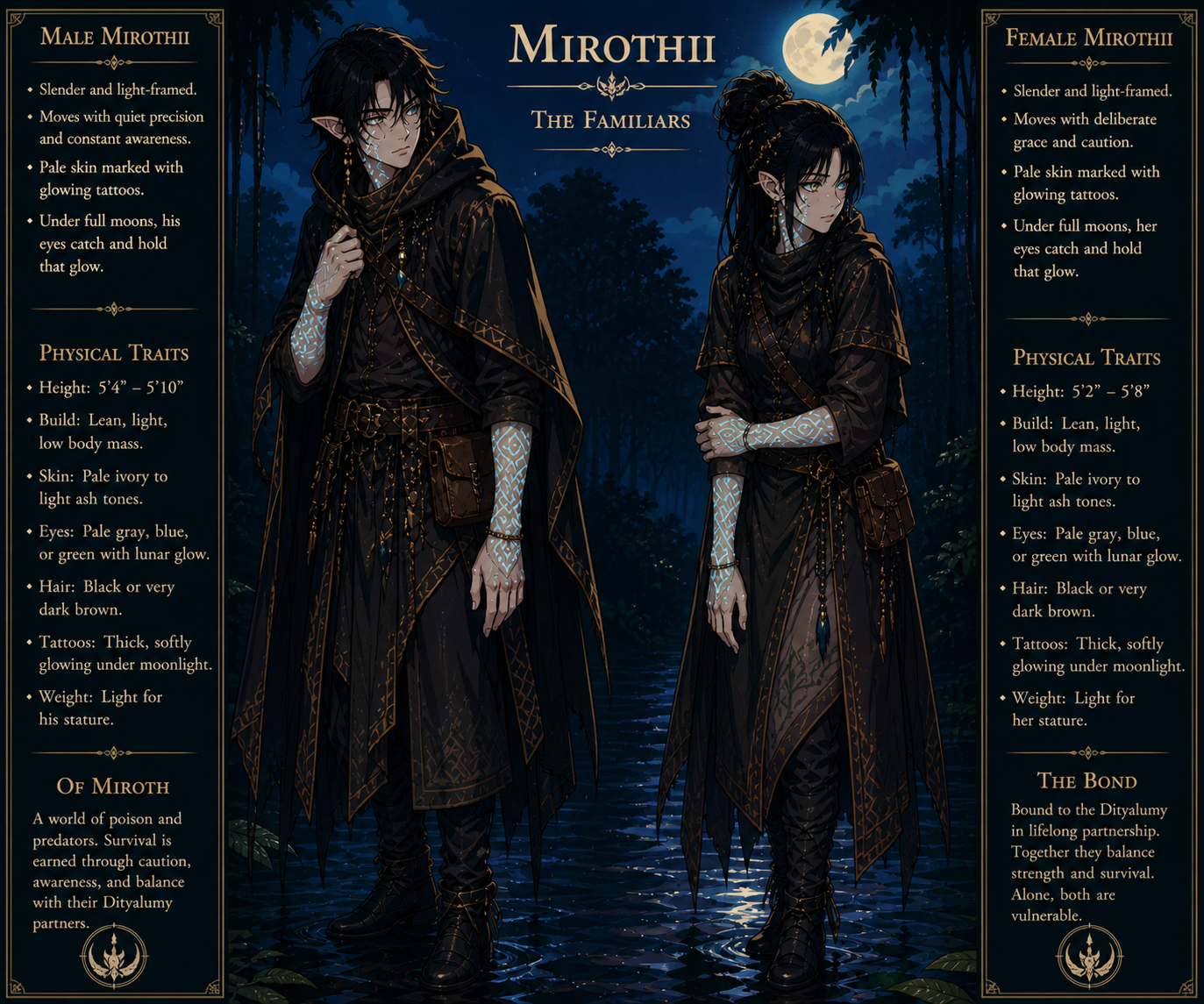
Associations
Other pages that reference or connect to this race
Referenced By
3Collections
Published collections that feature this race
Not in any collections yet
This race hasn't been published in any collections yet. Collections are curated groups of related content that help organize and showcase your world.
Tip: Collections are a great way to group related content together and share themed stories or worldbuilding elements with others.
Timelines
Timelines that reference or include this race
No timeline connections yet
This race isn't connected to any timelines yet. Timelines help organize events chronologically and show how your content fits into the broader history of your world.
Tip: Create timelines to organize important events in your world's history. Link characters, locations, and other content to specific events to build rich, interconnected narratives.
Shares
Discussion about this race
No shares yet
Be the first to start a discussion about this race by sharing it to the community stream.
Privacy & Sharing
Manage who can see and access this race
Current Status
refresh
This race is currently
Privacy Settings
Choose who can see and access this race
language Universe Privacy
This page belongs to a universe with its own privacy settings