
Categories
Dive Deeper
Page Stats
Navigation
Categories
Dive Deeper
Page Stats
Complete Details
All information about this race
Overview
Goltari - Wolf clan
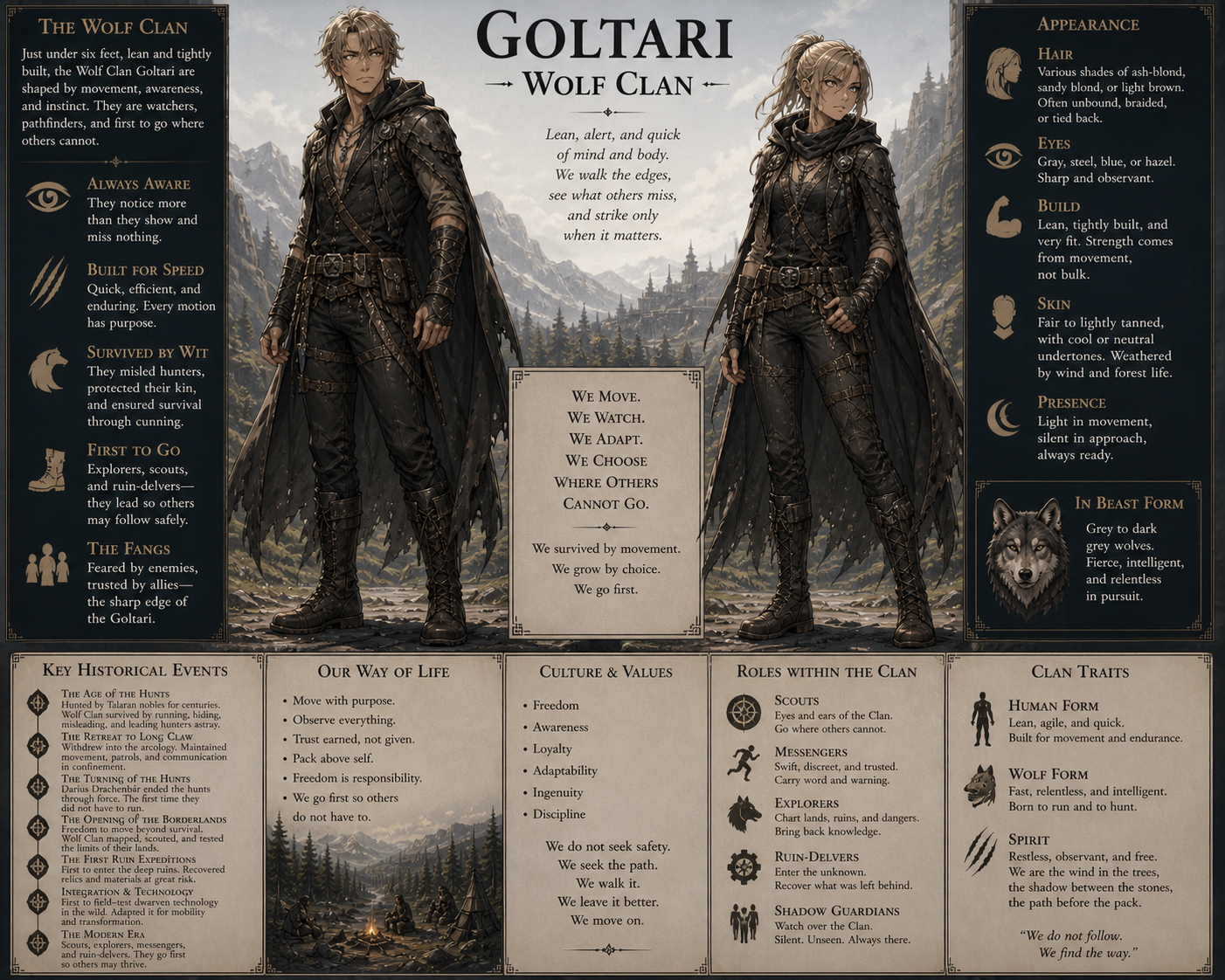
A typical Wolf Clan Goltari stands just under six feet, lean and tightly built, with the kind of body shaped more by movement than by strength. They carry themselves lightly, rarely fully at rest, as if every part of them is quietly ready to react. Their features tend toward the sharp and alert—quick eyes that track more than they show, and slightly elongated canines that hint at what lies beneath. Even in stillness, there is a sense that they are paying attention to something others have missed.
In motion, that impression becomes certainty. They move with efficient, controlled speed, wasting little energy and rarely committing more force than needed. Whether working, watching, or traveling, they give the sense of someone who has already noticed you, already judged the situation, and is simply deciding what to do next. Beneath it all is a constant balance—between restraint and instinct, between human and werewolf—held together not by ease, but by practiced control.
the fangs of the Goltari, the people, fuzzies, skin shifters, animals
Looks
In their human form, Wolf Clan Goltari are lean, athletic, and built for speed rather than raw mass, carrying tension and readiness where the Bear Clan carries weight and density. Their bodies favor narrow but defined shoulders, long limbs—especially in the legs—and tight, efficient musculature with naturally low body fat, creating a physique that is not fragile but coiled, holding energy in reserve and ready to move at a moment’s notice. Their musculature is often more visibly defined, particularly in the thighs, calves, and forearms, reflecting a body built for running, rapid directional changes, and sudden bursts of speed rather than sustained brute force. Their posture reinforces this, tending toward a slight forward lean, balanced on the balls of their feet, with a subtle restlessness even at stillness, giving the impression that they are never fully at rest—only waiting. Subtle traits of their wolf nature often show through in sharper facial features, slightly elongated canines, pronounced cheekbones, and eyes that track movement quickly and constantly. Though they may appear lighter than their Bear Clan counterparts, they retain the same underlying density shared by all Goltari, often weighing more than they seem. In their werewolf form, this design becomes fully realized, transforming into lean, predatory shapes defined by digitigrade legs, long agile limbs, narrow but powerful torsos, and extended arms ending in clawed hands. They lack the massive scale of werebears, but compensate with superior speed, agility, and mobility, focusing their strength into acceleration, rapid directional shifts, and coordinated movement. Their legs are especially powerful, enabling sprinting, bounding across uneven terrain, and sustained pursuit, while their upper bodies remain strong but are built for tearing, brief grappling, and quick repositioning rather than prolonged force. Their heads are distinctly wolf-like, with elongated muzzles, prominent fangs, sharp forward-focused eyes, and highly expressive ears, while their fur is generally shorter and less dense than that of Bear Clan werebears, though still protective. Their overall silhouette conveys constant motion, as if even standing still is only a pause between actions. Across both forms, Wolf Clan Goltari are defined by movement, control, and the ability to act faster than others can react, embodying speed not just as a physical trait, but as a constant state of readiness.
Wolf Clan Goltari tend toward fair and lightly toned skin shaped by the same northern forests as their Bear Clan kin, but with a cleaner, cooler, and more even complexion rather than a heavily weathered one. Common tones include pale ivory, soft beige, light tan, muted peach, and occasionally faintly gray-touched hues, with undertones leaning cool—pinks and pale reds—or neutral rather than sun-warmed. Their skin is firm and resilient, adapted to outdoor life, yet shows less heavy wear; instead of deep weathering or thick scarring, they more often display light scars, fine lines from exposure, and subtle marks from travel and movement. Cold conditions frequently leave them with flushed cheeks, reddened ears, and a wind-touched look, especially among the more active. Body hair is present but lighter and more controlled than in the Bear Clan, typically finer and less dense, contributing to a streamlined appearance. Hair colors commonly include black, dark brown, ash brown, dirty blonde, and occasional lighter tones, with facial hair—when present—kept shorter and less dominant. In their werewolf form, visible skin is replaced by shorter, more streamlined fur in natural wolf tones such as gray, dark gray, black, brown, and ash, often with mottled patterns, lighter underbellies, darker dorsal coloring, or subtle striping tied to lineage. Across both forms, their eyes remain one of their most defining features, appearing in shades of amber, gold, pale brown, gray, or occasionally icy tones, always sharp, alert, and constantly tracking movement; in their transformed state, this intensity deepens, giving the impression of something that is always watching and rarely caught off guard. Overall, Wolf Clan Goltari present a look shaped less by weight and endurance and more by sharpness, clarity, and constant awareness, reflecting a people built for motion rather than burden.
In their human form, Wolf Clan Goltari are slightly shorter on average than the Bear Clan, typically standing between 5’8” and 5’10”, yet they rarely feel average in presence. Their long limbs, upright posture, and constant readiness create the impression of being taller, quicker, and harder to track in motion than their actual height suggests. This perception is reinforced by their proportions—longer legs relative to the torso, narrower but defined shoulders, and a naturally balanced stance built for movement. They tend to stand lightly, slightly forward, and ready to move at a moment’s notice, giving the sense that they are not choosing stillness, but merely delaying action. In contrast to the grounded, planted presence of the Bear Clan, Wolf Clan Goltari feel poised and transitional, as if movement is always imminent. In their werewolf form, they increase in height, though not to the same towering extent as the Bear Clan, typically reaching between 7 and 8.5 feet when upright. Their form emphasizes proportion and mobility over sheer scale, with a lean, elongated frame, digitigrade legs that add vertical lift, and a posture that shifts fluidly between upright and forward-leaning depending on motion. Because of this, they often appear taller when moving than when standing still, and more imposing when advancing than at rest. Where the Bear Clan’s height conveys mass and presence, the Wolf Clan’s height conveys reach, speed, and the ability to close distance rapidly. They do not dominate space by occupying it—they dominate it by moving through it, making their true measure not how tall they stand, but how quickly and effectively they can change where they are.
In their human form, Wolf Clan Goltari are heavier than they appear, typically ranging between 150 and 210 pounds depending on height and build, though their weight is defined not by bulk but by dense, efficient musculature. Their bodies carry tightly packed muscle built for speed and endurance, supported by a strong yet lighter bone structure than that of the Bear Clan, with weight distributed to favor mobility over sheer mass—concentrated in the legs and hips for drive, the core for stability and control, and the shoulders for bursts of force and brief grappling. Even their slimmer individuals feel solid when struck, difficult to unbalance, and stronger than their frame suggests; they do not feel light, but compressed, as if their strength is tightly contained rather than outwardly expressed. In their werewolf form, this density expands into a lean but powerful mass, typically ranging from 500 to 900 pounds, still lighter in build than the Bear Clan but heavily muscled and structurally reinforced for speed and sustained motion. Their bodies are designed to support rapid acceleration, sharp directional changes, and prolonged pursuit, with weight contributing to momentum in sprints, impact during lunges, and stability at high speed. When they strike, their mass is not felt as slow, crushing force, but as sudden, focused impact delivered with precision. Unlike the Bear Clan, whose weight anchors them, Wolf Clan Goltari carry their weight forward, keeping it in motion to drive agility, acceleration, and relentless pressure. Even at rest, they can seem lighter than they are, but once they move, the reality becomes clear—they are not light, but fast with weight behind it, applying their mass exactly where and when it matters most.
In their human form, the most noticeable trait of a Wolf Clan Goltari is not size, but alertness. They give the immediate impression of someone constantly aware—tracking movement without appearing to, and never fully off guard. Their eyes are often the first feature noticed: sharp, quick-moving, and constantly adjusting focus, typically in tones of amber, gold, pale brown, or gray, with a tendency to lock onto motion or sound before others even register it. Slightly elongated canines are another defining feature, sometimes subtle, sometimes unmistakable, visible when they speak, smile, or tense. Their facial structure leans more angular than that of the Bear Clan, with higher cheekbones, narrower jaws, and sharper overall definition, giving them a naturally predatory look even at rest. Their build reinforces this impression—lean, tightly held, and efficient, with visible muscle definition in the legs, forearms, and shoulders. Their hands are strong but dexterous, suited for gripping, climbing, and controlled bursts of force. Perhaps most distinct is their movement: even when standing still, they shift their weight, stay balanced on the balls of their feet, and subtly orient toward sound or motion, never feeling fully planted—only ready. In their werewolf form, this readiness becomes overtly predatory, defined by speed, coordination, and precision rather than mass. Their elongated, wolf-like heads feature pronounced muzzles and large fangs built for fast, tearing bites rather than crushing force. Upright, highly mobile ears constantly adjust to sound, often signaling intent before action. Their lean, muscular frames—long-limbed with narrow but powerful torsos—appear perpetually tense, built for chasing, maneuvering, and rapid repositioning. Digitigrade legs provide spring-loaded acceleration and bounding movement, giving them a silhouette that always seems on the verge of motion. Their claws are sharp and curved for slashing and gripping, while their hands retain enough dexterity to interact with their environment mid-movement. Their eyes intensify further, reflective in low light, fixed and predatory, rarely unfocused; when they lock onto something, it feels less like attention and more like selection. Across both forms, the defining trait remains constant: they are aware before others are, noticing movement, sound, and environmental changes faster than most—and once they notice, they act. Where the Bear Clan is defined by presence, the Wolf Clan is defined by perception and response.
Wolf Clan Goltari display a wide range of individual variation, but always within a clear and consistent framework: they are lean, fast, and built for movement, never mistaken for heavy or slow regardless of personal differences. In human form, variation is most noticeable in proportions, feature sharpness, and muscle expression rather than overall body type. Some individuals are extremely lean and wiry, built almost entirely for speed and endurance, while others carry slightly more mass through the shoulders and torso without sacrificing agility. Muscle definition can range from highly visible—especially in the legs and arms—to smoother builds that still conceal the same underlying strength. Facial structures vary from sharply angular with high cheekbones and narrow jaws to slightly broader or softer lines, yet always retain an edge of alertness and precision. Canine prominence also differs, from subtle elongation to clearly visible fangs, particularly under tension or when speaking, while most individuals fall within a height range of 5’8” to 5’10”, with only slight deviation beyond it. In their werewolf form, variation becomes more pronounced, particularly in body proportions, fur coloration, and overall build. Some are longer-limbed and optimized for extreme speed, while others are slightly more compact, favoring maneuverability and control. Fur coloration commonly includes shades of gray, dark gray, black, brown, and ash, often with mottled patterns, lighter underbellies, or darker dorsal tones that may reflect lineage. Differences in muzzle length, jaw width, ear size, claw length, and forelimb strength further distinguish individuals, often influenced by ancestry or lifestyle. Environmental and behavioral factors also play a role, with those engaged in constant hunting or patrol tending toward longer, leaner frames, while those spending more time in settlements may appear slightly more compact. Unlike the Bear Clan, whose variation emphasizes mass and presence, Wolf Clan differences often manifest in movement patterns—some individuals are constantly in motion, others remain still but highly reactive; some rely on raw speed, while others emphasize timing and precision. Within their culture, these differences are judged not by appearance alone, but by effectiveness—speed, awareness, control, and the ability to act at the right moment. A faster individual is not inherently superior, but one who moves when it matters and does not miss the moment earns respect. Ultimately, while variation exists, it never obscures their defining traits: a lean form, rapid response, and the constant impression that they are already reacting before others even begin.
Wolf Clan Goltari clothing follows the same core principle as all Goltari—your body may change shape, so your clothing cannot get in the way—but where the Bear Clan emphasizes durability and mass, the Wolf Clan prioritizes movement, silence, and control. Their garments are typically light, flexible, and close-fitting without ever becoming restrictive, including fitted tunics or wrap-shirts, flexible trousers, sleeveless or short-sleeved layers, and soft outer wraps instead of heavy coats. Everything is cut to avoid snagging, reduce excess weight, and allow full range of motion, with even looser pieces kept controlled rather than bulky. Like all Goltari, they account for transformation, but instead of relying on reinforced breakaway designs, they favor quick-release construction—tied, wrapped, or fastened simply—minimal layering, or clothing they are willing to shed and retrieve later, often avoiding overly complex or expensive daily wear for this reason. Sound control is a defining feature, with materials chosen for quiet movement—soft woven cloth, treated leather, flexible hide, and layered fabrics that do not rustle or scrape—while metal is used sparingly and secured tightly to prevent noise. Layering is still present but focused on mobility rather than insulation, using light hooded wraps, short cloaks, or half-capes that provide warmth and concealment without hindering speed. Footwear emphasizes grip, flexibility, and ground awareness, often consisting of soft boots or light bindings that allow them to feel the terrain beneath them, improving balance, stealth, and reaction time. They carry little compared to the Bear Clan, relying on tightly secured belts, small harnesses, and compact gear that remains balanced and easily discarded if necessary, avoiding anything that swings, rattles, or shifts unnecessarily. Their clothing colors favor muted, natural tones—grays, browns, dark greens, blacks, and ash hues—blending into their environment, with brighter colors reserved for gatherings or personal expression. Ultimately, where the Bear Clan dresses to endure and withstand, the Wolf Clan dresses to move, adapt, and avoid being caught, caring less about whether their clothing survives transformation and more about whether it slows them down beforehand.
Traits
Wolf Clan Goltari are defined by a different kind of power than their Bear Clan counterparts. Where the Bear Clan overwhelms, the Wolf Clan excels in speed, awareness, and precision. Their strength is not in stopping a problem through sheer force, but in reaching it first and ending it before it has the chance to grow. They are naturally faster than most humanoids even in human form, capable of rapid acceleration, sharp directional changes, and fluid movement across uneven terrain, with the ability to maintain speed over long distances. In their werewolf form, this becomes their defining advantage—explosive bursts of motion, sustained pursuit, and unpredictable movement that is difficult to counter. They do not simply move fast; they move at the exact moment it matters most.
Their heightened awareness is equally critical. Wolf Clan Goltari possess exceptional perception, able to notice movement, sound, and subtle environmental changes with remarkable speed. This allows them to react faster than opponents, anticipate danger, and adapt mid-action. In many encounters, they are not stronger than those they face—but they are already acting while others are still deciding. Built for endurance, they excel in prolonged effort, capable of tracking targets over great distances, maintaining pace long after others tire, and continuing pressure until resistance collapses. They do not need immediate victory; they can persist until the outcome becomes inevitable.
Rather than relying on brute force, they favor precision—targeted strikes, controlled engagements, and efficient use of energy. They are skilled at identifying weaknesses, exploiting openings, and disengaging when necessary, striking exactly where it matters rather than wasting effort. While highly capable individually, their true strength often emerges in coordination. Wolf Clan Goltari naturally fall into synchronized movement and shared awareness, allowing them to surround, pressure, and control opponents as a group without relying on direct confrontation.
Their transformation into werewolf form enhances speed, agility, and combat effectiveness without the spatial limitations faced by the Bear Clan, making them more adaptable in confined environments and more capable of repositioning during combat. Combined with their natural adaptation to forested ruins and uneven terrain, they move efficiently through obstacles that would slow others, using the environment as an extension of their strategy rather than a hindrance. Ultimately, Wolf Clan Goltari do not rely on overpowering their opponents—they rely on being faster to act, harder to catch, and more precise in everything they do.
Wolf Clan Goltari are formidable—but like the Bear Clan, their strengths come with clear and exploitable limits. Where they excel in speed and precision, they are most vulnerable in situations that demand sustained endurance under pressure, resistance to disruption, or raw, direct force. Like all Goltari, they are highly susceptible to silver, which can weaken physical performance, disrupt or slow transformation, cause burning pain on contact, and interfere with recovery. For the Wolf Clan in particular, even minor exposure is dangerous—not because it stops them outright, but because it disrupts timing, and timing is central to everything they do.
They are also vulnerable to forced transformation through specific herbs or compounds, which removes their ability to choose when to shift. This is especially dangerous for a people whose effectiveness depends on control and precision. When forced, they may lose positioning, be pushed into unfavorable terrain, or be caught mid-action without preparation. Unlike voluntary transformation, this strips them of their greatest advantage: deciding when to act.
Compared to the Bear Clan, Wolf Clan Goltari lack the same level of raw mass, crushing strength, and impact resistance. This makes them more vulnerable when forced into prolonged direct confrontation, unable to disengage, or required to absorb heavy blows. They are not fragile—but they are not built to stand still and trade force. Their effectiveness is directly tied to movement: their ability to reposition, maintain momentum, and control the pace of engagement. When that movement is restricted—by confined spaces, environmental obstacles, or coordinated opposition—their advantages diminish quickly. If they cannot move freely, they lose the ability to dictate the encounter.
Their heightened awareness, while a defining strength, also creates vulnerability. They are more susceptible to sensory overload from loud noise, overwhelming scents, smoke, chemical irritants, or chaotic environments. These can disrupt focus, delay reaction time, and create moments of disorientation. Even brief disruption can be enough to break their rhythm, and once that rhythm is lost, their effectiveness drops sharply.
Their speed and responsiveness also come at an energy cost. They rely on bursts of exertion and sustained activity over time rather than static endurance. If forced into repeated high-intensity engagements without rest, they may fatigue, lose precision, and become less effective. Their natural confidence in movement can also lead to overextension—committing too quickly, advancing ahead of support, or relying too heavily on their ability to recover. When situations do not behave as expected, this can result in isolation, exposure to counterattack, or being overwhelmed.
Finally, like the Bear Clan, they carry the psychological weight of the hunts. This legacy can manifest as heightened aggression, strong reactions to specific stimuli, and distrust of unfamiliar tactics or environments. In some cases, it may push them to act sooner than necessary or assume threat where there is none, disrupting their usual control. At their core, Wolf Clan Goltari are strongest when they control the pace—when they choose when and how an engagement unfolds. They are weakest when that control is taken away and they are forced to react on terms they did not set.
Wolf Clan Goltari are formidable—but like the Bear Clan, their strengths come with clear and exploitable limits. Where they excel in speed and precision, they are often vulnerable in situations that demand endurance under pressure, resistance to disruption, or raw force. Like all Goltari, they are highly susceptible to silver, which can weaken their physical performance, disrupt or slow transformation, cause burning pain on contact, and interfere with recovery; for the Wolf Clan in particular, even minor exposure can disrupt timing, and timing is everything to them. They are also vulnerable to forced transformation through certain herbs and compounds, which is especially dangerous because their effectiveness depends on choice and control—when forced, they may lose tactical positioning, be pushed into unfavorable environments, or be caught mid-action without preparation, stripping them of their greatest advantage: deciding when to act. Compared to the Bear Clan, they lack the same level of raw mass, crushing strength, and impact resistance, making them more vulnerable when forced into prolonged direct confrontation, unable to disengage, or required to absorb heavy hits; they are not weak, but they are not built to stand and trade blows. Their effectiveness is directly tied to their ability to move, reposition, and maintain momentum, and when that movement is restricted by confined spaces, environmental obstacles, or coordinated opposition, their advantages diminish quickly—without freedom of movement, they lose control over the pace of engagement. Their heightened awareness, while a strength, also makes them susceptible to sensory overload from loud noise, overwhelming scents, smoke, chemicals, or chaotic environments, all of which can disrupt focus, delay reaction time, or create brief disorientation—more than enough to break their rhythm. Their speed and responsiveness come at a cost, as they expend energy quickly in bursts and rely on sustained stamina over time rather than static endurance; repeated high-intensity engagements without rest can lead to fatigue, loss of precision, and reduced effectiveness. Their natural confidence in movement can also lead to overextension, committing too quickly, pushing ahead of support, or relying too heavily on their ability to react, which can result in isolation, exposure to counterattack, or being overwhelmed if misjudged—especially when situations do not behave as expected. Finally, like the Bear Clan, they carry the psychological weight of the hunts, which can manifest as heightened aggression, strong reactions to certain stimuli, and distrust of unfamiliar environments or tactics, sometimes pushing them to act sooner than necessary or assume threat where there is none. At their core, Wolf Clan Goltari are strongest when they control the pace of a situation, and weakest when that control is taken away.
Culture
Trading Stories Around Campfires among the Wolf Clan is not passive—it is interactive, competitive, and alive, with stories shared at the end of long days, during travel halts, and in moments where the group gathers to rest but not fully relax; unlike the Bear Clan’s slower, heavier storytelling, Wolf Clan stories are quicker, sharper, and more reactive, with listeners freely interrupting, challenging details, adding their own perspectives, or calling out exaggerations mid-story, as accuracy matters but so does delivery, and a good storyteller is judged by timing, pacing, and their ability to hold attention without losing the thread, often focusing on hunts, close calls, clever escapes, or moments where quick thinking mattered more than strength—stories are not just memory, but practice for thinking fast and speaking faster. Humor follows the same pattern: fast, sharp, and often merciless, with jokes used constantly to relieve tension, test wit, and keep others mentally alert through quick remarks, dry humor, and well-timed insults, where a slow joke is a bad joke and a predictable one worse, and joking blends into light challenges, verbal sparring, and social positioning, with respect given to those who can keep up and teasing reserved for those who cannot—rarely exclusion—because the ability to laugh and respond quickly reflects the ability to think under pressure. Community gatherings reflect this same restless energy, being lively, mobile, and rarely static, as people move between conversations, step in and out of discussions, and avoid staying in one place for long, often incorporating informal competitions, sudden races, or skill demonstrations, with even serious matters discussed while walking, circling, or engaging in light activity, reinforcing the belief that stillness is not required for unity and that connection is maintained through presence, awareness, and engagement rather than position. Communal herbal baths, shared with the Bear Clan, provide both physical and mental restoration but hold particular importance for the Wolf Clan in calming heightened senses, easing muscle tension from constant movement, and helping individuals come down from heightened states, offering a quieter space for slower conversation, reflection, and emotional grounding, with specific herb blends chosen to dull overstimulation, reduce restlessness, and restore balance—because a body always ready to move must be taught how to stop. Foot races stand as one of the most defining traditions, not merely sport but identity itself, occurring casually between individuals, as part of gatherings, or during formal events, taking the form of sprints, endurance runs, obstacle courses, or terrain challenges through ruins and forest, where winning matters less than how one ran, how one adapted, and whether one pushed themselves, with races often spontaneous or lightly organized, reinforcing that speed is not just a physical trait but something to be tested, proven, and respected. Vigilance is expressed through the Moving Watch, where Wolf Clan Goltari rarely stand guard in fixed positions but instead move through designated paths, shift positions frequently, and overlap awareness to ensure no blind spot remains static and no watcher becomes complacent, embodying the belief that awareness should never become routine and that if you stop moving, you stop noticing. This emphasis on pursuit is formalized in the First Chase, a rite where young Goltari must track, pursue, and successfully reach a target—whether another clan member, a marked route, or a symbolic objective—not to capture it but to complete the pursuit, marking recognition not through strength but through the ability to follow something to its end. Practical habits also become ritualized in the Drop and Return tradition, where, due to shedding clothing and gear during transformation, individuals are expected to remember where they left their belongings, return to retrieve them, and not rely on others, reinforcing personal responsibility and the idea that nothing tracks one’s path more clearly than carelessness. Altogether, Wolf Clan traditions are built around movement, awareness, and constant engagement; they do not sit still to define themselves, but instead define themselves through what they do—and how quickly they do it.
Wolf Clan beliefs share the same foundation as the Bear Clan—pragmatism, natural order, and a living world full of spirits—but are expressed through a different lens, one centered on movement, awareness, and response rather than endurance through stability. They do not see the world as something to stand against, but as something constantly changing that must be met in motion. Their pragmatism is not only about doing what works, but doing what works fast enough; they believe hesitation creates problems, overthinking costs opportunities, and action often outweighs certainty, with decisions judged as much by timing as by outcome—because a perfect plan executed too late is worse than a flawed decision made at the right moment, and one is judged not only by what they chose, but when they chose it. In maintaining the natural order, they share the broader Goltari belief in balance but view that balance as dynamic rather than fixed, understanding that ecosystems shift, disruption is not inherently wrong, and predation, pursuit, and conflict are natural parts of maintaining equilibrium; their role is not to prevent change, but to ensure it does not spiral beyond control, reinforcing the idea that the world is meant to remain balanced while changing. Their belief that spirits inhabit all things is similarly active—spirits are not distant but nearby, moving, watching, and responsive, acknowledged through awareness and behavior rather than quiet reverence alone, creating a worldview where one is never truly alone, especially when it seems they are. Their understanding of karma is rooted in action and consequence, where what is done returns in time, not as moral judgment or divine punishment, but as the natural response of the world itself; quick actions can carry long consequences, and even small decisions echo, reinforcing that speed does not remove responsibility. Central to their identity is the belief that motion is life—stillness, whether physical or metaphorical, represents stagnation, inaction, and eventual decline, shaping how they train, think, and live, as they hold that if one is not moving forward, something else is moving toward them. Awareness is seen as the foundation of survival, more critical than strength alone, with emphasis placed on noticing first, understanding quickly, and acting before others, teaching even the young to observe and react before they are taught to fight, because the one who sees first determines what happens next. Socially, they place strong value on chosen bonds as much as blood ties, recognizing hunting groups, travel companions, and long-term allies as extensions of pack, where loyalty is expected but earned through shared action rather than assumed by birth, reinforcing that those who run beside you matter as much as those you were born to. Above all, they believe that control is strength: power without control is failure, and speed, instinct, and transformation are meaningless if not directed with discipline; acting too soon can be as dangerous as acting too late, and losing control means losing advantage, a belief deeply tied to their history and the risks of their own nature. In the end, Wolf Clan Goltari do not define strength by the ability to act, but by the ability to choose when to act—and to do so at exactly the right moment.
The Wolf Clan does not maintain a separate government from the Bear Clan; instead, they are part of a shared Goltari governing structure, making any discussion of their governance inherently joint, overlapping, and at times contentious. While cultural differences between the clans are significant, politically they are bound together under a unified system built around a council-based democracy with strong tribal influence. Representation is drawn from both Bear and Wolf Clans to ensure that neither perspective dominates completely, allowing both approaches—strength and endurance from the Bear Clan, speed and adaptability from the Wolf Clan—to shape decision-making. Authority is not concentrated in a single ruler but distributed among council representatives, influential figures, and experienced individuals recognized by their communities. Within this shared system, three primary factions define most political alignment: the Isolationists, who advocate for reduced external contact and a return to self-reliance, often framed by Wolf Clan members as minimizing unnecessary variables and risk; the Stanzgarian Supporters, who favor continued alliance and cooperation with Stanzgar for access to technology, trade, and stability, with Wolf Clan members emphasizing adaptability and the advantages of moving between cultures; and the Crusaders, who believe Talara has not answered for its past and push for retaliation or reckoning, with Wolf Clan voices often focusing on action over remembrance. Decisions are made through council deliberation, negotiation between factions, and input from clan leadership, with debates frequently reflecting the contrast between Bear Clan preference for long-term stability and Wolf Clan emphasis on timing, flexibility, and immediate practicality—resulting in outcomes that may be slower than the Wolf Clan would prefer, but more stable than either clan might achieve alone. Despite this structured system, tribal identity remains strong, with local groups retaining autonomy over daily affairs, dispute resolution, and internal organization, creating a layered system of local independence under shared governance. Formal authority exists, but it is heavily influenced by reputation, past actions, and demonstrated capability, and among Wolf Clan Goltari especially, influence is often earned through proven effectiveness, reliability under pressure, and the ability to act decisively when needed. Externally, the Goltari government maintains a significant relationship with Stanzgar, shaped by shared history, Drachenbär protection, and mutual benefit; while they remain independent, their political reality continues to be influenced by the presence of a powerful ally whose support—and expectations—still shape the boundaries of their decisions.
Goltari technology is not unified or cleanly developed; it is inherited, adopted, scavenged, and adapted, shaped primarily by two sources—what they have been given and what they have found. Through their connection to Stanzgar, the Goltari have access to advanced dwarven-influenced technologies, placing them far beyond what their isolated past would suggest, including refined metallurgy, advanced tools and weaponry, early industrial machinery, magitech-integrated systems, and structured engineering practices; they make use of firearms—particularly rifles in coordinated roles—reinforced armor and equipment, mechanical infrastructure where available, and dwarven-designed systems adapted for daily use. However, their relationship with this technology is distinct: unlike dwarves, they do not treat it with controlled reverence, but instead modify it, repurpose it, and integrate it into their own needs with a practical focus, viewing technology not as something to preserve perfectly, but as something to use effectively. While they have access to advanced systems, the Goltari rarely pursue deep theoretical understanding, instead excelling in practical application, field repair, improvisation, and modification; a Goltari may not know why something works, but they will know how to fix it, how to use it, and how to keep it functioning, making them highly effective in mixed or unstable environments where rigid systems would fail. Beyond adopted technology, ancient ruins scattered across their homeland provide access to older, unstable relics—devices, materials, and mechanisms that are not widely understood, not easily replicated, and often not fully trusted, such as strange devices with unclear functions, materials that resist decay, inconsistent mechanisms, or artifacts that interact unpredictably with magic and environment; these items are rare, closely guarded, and used with caution, as even the Goltari recognize that not everything found should be used without thought. Unlike reproducible dwarven systems, ruin-derived technology is limited, tied to specific discoveries, and unevenly distributed, with some individuals possessing relic-grade tools while others rely entirely on Stanzgarian or basic equipment, and such possession can bring status, caution, or suspicion depending on the item’s nature. All Goltari technology is shaped by one constant factor: their bodies do not remain the same, requiring equipment to accommodate transformation—weapons must be usable or easily discarded, armor tends toward lighter or modular forms, tools are carried for rapid release, and complex gear is often avoided unless necessary; in many cases, their greatest tool remains their own body in werewolf form, with technology serving to support rather than replace it. Though not traditional innovators, the Goltari are highly effective practical innovators, combining dwarven systems, Stanzgarian military structure, and lived experience to create solutions that are flexible, durable, and suited to unpredictable conditions, particularly excelling at making tools function outside their intended environment, last longer than expected, or continue operating after partial failure. Culturally, they do not idolize technology—they respect it only as far as it proves useful, judging equipment by performance, durability, and reliability under real conditions rather than origin or sophistication, keeping them grounded even when wielding tools far beyond their ancestors’ capabilities. At their core, the Goltari do not ask where something came from—they ask whether it will work when they need it to.
Wolf Clan Goltari operate within the same shared labor structure as the Bear Clan, where work is assigned daily, specialists are respected, and no one is exempt, but their nature shifts how that system functions in practice. They participate fully in the morning assignment system at dawn, where tasks are chosen or assigned based on immediate need, current conditions, and who arrives early enough to select their role, with common duties including patrols and perimeter checks, scouting routes, resource gathering, maintenance and repair, food preparation and transport, and general labor; those who arrive early gain better selection, more control over their day, and roles suited to their strengths, while those who arrive late take what remains, but among the Wolf Clan there is an added expectation that speed begins before the work itself. Like the Bear Clan, they maintain recognized specialists—scouts and trackers, messengers and runners, hunters, light infantry and skirmishers, engineers and tech handlers, herbalists and sensory specialists, and negotiators or envoys—roles developed over time, acknowledged by the community, and protected when necessary, ensuring that critical skills are not wasted on unrelated labor. While they share all major roles, Wolf Clan Goltari tend to dominate areas requiring speed, awareness, and adaptability, excelling in scouting, reconnaissance, tracking, pursuit, long-distance messaging, rapid-response duties, and skirmish combat, often being the first sent out and the first to return. Despite specialization, they are expected to remain flexible and capable outside their primary role; a scout may assist with repairs, gather food, or stand watch, and anyone unwilling to contribute beyond their specialty is viewed as unreliable regardless of skill. Reputation among the Wolf Clan is built through consistency, responsiveness, and visible effort, but more specifically through how quickly one reacts, how effectively one adapts, and whether one acts when needed—someone highly skilled but slow to respond is often considered less dependable than someone faster and slightly less refined. They are also more likely than the Bear Clan to take on mobile external roles such as messengers between settlements, scouts for allied forces, caravan guards, wilderness guides, or independent operators, their comfort with movement allowing them to operate beyond their homeland, adapt to unfamiliar conditions, and return with valuable information or resources. Their werewolf form further enhances their role in rapid movement, pursuit, flanking, and terrain navigation, though transformation is used deliberately rather than constantly, with individuals varying in reliance based on personal limits and the known risks of transformation weakness, and communities planning accordingly. Central to their approach is initiative within structure—they are expected to act when needed, avoid unnecessary delay, and adjust to changing conditions, while still maintaining control, as acting too soon can be as costly as acting too late. In the end, Wolf Clan Goltari are not defined by any single occupation, but by how quickly and effectively they step into whatever role is required.
Wolf Clan Goltari operate within the same shared economic framework as the Bear Clan—internally driven by barter, service exchange, and shared labor, and externally supported by coin—but their role within that system is distinct, defined by movement, discovery, and risk; if the Bear Clan stabilizes the economy, the Wolf Clan feeds it. Within their communities, they follow the same foundational principles: goods move based on need, contribution, and reputation, and value is measured in usefulness rather than accumulation, with consistent contributors trusted and those who fail to give remembered. Their defining economic role emerged early, when they became the first among the Goltari to move beyond simply living among the ruins and begin entering them; where others saw danger, unstable structures, and unnecessary risk, the Wolf Clan saw something worth reaching first, leading them to scout deeper sections, map unstable interiors, and test routes others avoided, permanently shaping their place in Goltari society. They became the primary agents of retrieval and recovery, the ones most likely to enter dangerous ruin zones, recover materials, and return with valuable or usable finds, including rare metals and alloys, strange tools or mechanisms, partially functional relic technology, and objects whose purpose may not yet be understood; their strengths—speed, awareness, and adaptability—make them the ones who go where others will not and still return. This work is inherently unstable and dangerous, with expeditions that may yield nothing or uncover discoveries of immense value, creating a pattern where high risk occasionally produces high reward, and those who undertake it are often respected, watched, and sometimes regarded with caution. Recovered goods do not always remain with the individual; depending on the item, they may be given to specialists such as engineers or smiths, traded within the clan, offered to shared leadership, or used in external trade, though some items are kept personally when their function or value is unclear. Through this role, the Wolf Clan significantly influences external trade, contributing rare materials and unique goods that provide strong bargaining leverage, particularly through connections with Stanzgar, allowing the Goltari to exchange for advanced tools, structured resources, or political advantage, granting them economic influence beyond what their population alone would suggest. Due to their mobility and frequent interaction with outsiders, Wolf Clan Goltari are also more comfortable with coin and structured trade than many of their Bear Clan counterparts, often carrying currency and understanding value across cultures, though internally coin remains secondary to reputation and contribution. Their economic contribution is inherently unpredictable; they may spend long periods engaged in routine labor, scouting, or general work, only to return suddenly with something rare, valuable, or not yet fully understood, a pattern accepted as part of their role. Culturally, they place little value on hoarding or long-term accumulation, instead emphasizing use, movement, and opportunity, viewing unused wealth as wasted or delayed beyond relevance. Within the shared Goltari system, the Wolf Clan ultimately represents exploration, recovery, and the willingness to risk something in pursuit of something greater.
Wolf Clan Goltari share the same general dietary foundation as the Bear Clan—meat, fish, and practical, filling meals—but their approach to food reflects their nature: eat quickly, eat well enough, and keep moving, with food important but rarely the focus for long. Meat remains central to their diet, commonly sourced from hunted game, trapped animals, or shared clan provisions, with a preference for leaner cuts, quick-cooked meats, and food that can be prepared and eaten without delay, using methods such as fire-searing, roasting in smaller portions, or slicing meat thin for faster cooking, emphasizing efficiency over excess. Fish is also widely consumed, especially when it can be caught quickly, cooked fast, or preserved for later, often prepared as smoked strips, dried travel rations, or quickly grilled whole fish, valued for its reliability, portability, and ease of preparation in the field. More than the Bear Clan, Wolf Clan Goltari rely heavily on portable foods, favoring items that are easy to carry, quick to consume, and high in energy, such as dried meat strips, compact ration packs, rendered fat mixed with meat, and durable trail foods, often eaten while moving, between tasks, or without stopping entirely. While they do participate in communal meals, they tend toward lighter stews, smaller portions, and meals that do not require prolonged stillness, with such gatherings still serving purposes of cohesion, recovery, and shared resources, but typically shorter, more active, and less stationary than those of the Bear Clan. Their diet is frequently supplemented with foraged foods like berries, roots, edible plants, and other forest finds, often eaten raw, added quickly to meals, or carried for light consumption, reinforcing a practical awareness of their environment. Herbal knowledge also plays a role, particularly for calming overstimulation, aiding recovery after transformation, and restoring balance, with lighter broths, infused drinks, and quick remedies valued for function over flavor. Culturally, Wolf Clan Goltari are less inclined to linger over meals or remain seated for long, instead eating in short bursts, sharing food quickly, and returning to activity, though during larger gatherings they still participate fully in communal traditions. In essence, Wolf Clan food reflects who they are: fast, functional, and built to keep them moving.
History
The Age of the Hunts defines the Wolf Clan as much as it does the Goltari as a whole, but where the Bear Clan endured through strength and fortification, the Wolf Clan survived through motion; for generations, as the aristocracy of Talara hunted their people, Wolf Clan Goltari adapted by running, hiding, misleading, and drawing danger away from others, becoming pathfinders, decoys, and early warning systems, with their defining traits—movement, awareness, and rapid response—born not from tradition, but from necessity. When the Goltari were forced into consolidation within Long Claw, the ancient arcology that became their refuge, this period strained the Wolf Clan more than most, as they are not built for confinement, yet even within those walls they adapted by carving internal routes, maintaining patrol patterns, and serving as messengers and coordinators, ensuring that even in containment the Goltari never became still. The turning point came with the rise of Darius Drachenbär, who, having lived among the Goltari, recognized them as his people and brought the full military force of Stanzgar against Talara, ending the Hunts through decisive violence; to the Wolf Clan, this moment is remembered not only as salvation, but as the first time they did not have to run. In the aftermath, the fortified borderlands created a new reality—movement without immediate pursuit, exploration beyond survival, and expansion into lands long avoided—and the Wolf Clan were the first to test that freedom, pushing past safe zones, mapping the outer reaches of their homeland, and redefining movement from something forced into something chosen. This shift continued with the first deliberate ruin expeditions, as the Wolf Clan entered unstable, unknown structures others had avoided, exploring deeper, recovering materials, and transforming ruins from looming dangers into sources of opportunity; these early efforts were costly and uncertain, with many lost, but those who returned brought back relics, knowledge, and the foundation of the Goltari’s modern economic shift. With integration into Stanzgar’s sphere and access to dwarven-influenced technology, Wolf Clan Goltari again took the lead, field-testing tools in uncontrolled environments, adapting them for mobility and transformation, and establishing a cultural approach to technology defined not by preservation, but by proof. In the modern era, the Wolf Clan exists in a state their ancestors never knew—free to travel, to return, and to choose when to act—serving as scouts, explorers, messengers, and ruin-delvers, their identity no longer defined by flight but by initiative; where they were once those who fled, they are now those who go first. At their core, the Wolf Clan did not survive by resisting the world, but by moving through it faster than it could close around them—and when they were finally given the chance to stop running, they chose not to.
Overview
Details about this race's overview
Goltari - Wolf clan
A typical Wolf Clan Goltari stands just under six feet, lean and tightly built, with the kind of body shaped more by movement than by strength. They carry themselves lightly, rarely fully at rest, as if every part of them is quietly ready to react. Their features tend toward the sharp and alert—quick eyes that track more than they show, and slightly elongated canines that hint at what lies beneath. Even in stillness, there is a sense that they are paying attention to something others have missed.
In motion, that impression becomes certainty. They move with efficient, controlled speed, wasting little energy and rarely committing more force than needed. Whether working, watching, or traveling, they give the sense of someone who has already noticed you, already judged the situation, and is simply deciding what to do next. Beneath it all is a constant balance—between restraint and instinct, between human and werewolf—held together not by ease, but by practiced control.
the fangs of the Goltari, the people, fuzzies, skin shifters, animals
Looks
Details about this race's looks
In their human form, Wolf Clan Goltari are lean, athletic, and built for speed rather than raw mass, carrying tension and readiness where the Bear Clan carries weight and density. Their bodies favor narrow but defined shoulders, long limbs—especially in the legs—and tight, efficient musculature with naturally low body fat, creating a physique that is not fragile but coiled, holding energy in reserve and ready to move at a moment’s notice. Their musculature is often more visibly defined, particularly in the thighs, calves, and forearms, reflecting a body built for running, rapid directional changes, and sudden bursts of speed rather than sustained brute force. Their posture reinforces this, tending toward a slight forward lean, balanced on the balls of their feet, with a subtle restlessness even at stillness, giving the impression that they are never fully at rest—only waiting. Subtle traits of their wolf nature often show through in sharper facial features, slightly elongated canines, pronounced cheekbones, and eyes that track movement quickly and constantly. Though they may appear lighter than their Bear Clan counterparts, they retain the same underlying density shared by all Goltari, often weighing more than they seem. In their werewolf form, this design becomes fully realized, transforming into lean, predatory shapes defined by digitigrade legs, long agile limbs, narrow but powerful torsos, and extended arms ending in clawed hands. They lack the massive scale of werebears, but compensate with superior speed, agility, and mobility, focusing their strength into acceleration, rapid directional shifts, and coordinated movement. Their legs are especially powerful, enabling sprinting, bounding across uneven terrain, and sustained pursuit, while their upper bodies remain strong but are built for tearing, brief grappling, and quick repositioning rather than prolonged force. Their heads are distinctly wolf-like, with elongated muzzles, prominent fangs, sharp forward-focused eyes, and highly expressive ears, while their fur is generally shorter and less dense than that of Bear Clan werebears, though still protective. Their overall silhouette conveys constant motion, as if even standing still is only a pause between actions. Across both forms, Wolf Clan Goltari are defined by movement, control, and the ability to act faster than others can react, embodying speed not just as a physical trait, but as a constant state of readiness.
Wolf Clan Goltari tend toward fair and lightly toned skin shaped by the same northern forests as their Bear Clan kin, but with a cleaner, cooler, and more even complexion rather than a heavily weathered one. Common tones include pale ivory, soft beige, light tan, muted peach, and occasionally faintly gray-touched hues, with undertones leaning cool—pinks and pale reds—or neutral rather than sun-warmed. Their skin is firm and resilient, adapted to outdoor life, yet shows less heavy wear; instead of deep weathering or thick scarring, they more often display light scars, fine lines from exposure, and subtle marks from travel and movement. Cold conditions frequently leave them with flushed cheeks, reddened ears, and a wind-touched look, especially among the more active. Body hair is present but lighter and more controlled than in the Bear Clan, typically finer and less dense, contributing to a streamlined appearance. Hair colors commonly include black, dark brown, ash brown, dirty blonde, and occasional lighter tones, with facial hair—when present—kept shorter and less dominant. In their werewolf form, visible skin is replaced by shorter, more streamlined fur in natural wolf tones such as gray, dark gray, black, brown, and ash, often with mottled patterns, lighter underbellies, darker dorsal coloring, or subtle striping tied to lineage. Across both forms, their eyes remain one of their most defining features, appearing in shades of amber, gold, pale brown, gray, or occasionally icy tones, always sharp, alert, and constantly tracking movement; in their transformed state, this intensity deepens, giving the impression of something that is always watching and rarely caught off guard. Overall, Wolf Clan Goltari present a look shaped less by weight and endurance and more by sharpness, clarity, and constant awareness, reflecting a people built for motion rather than burden.
In their human form, Wolf Clan Goltari are slightly shorter on average than the Bear Clan, typically standing between 5’8” and 5’10”, yet they rarely feel average in presence. Their long limbs, upright posture, and constant readiness create the impression of being taller, quicker, and harder to track in motion than their actual height suggests. This perception is reinforced by their proportions—longer legs relative to the torso, narrower but defined shoulders, and a naturally balanced stance built for movement. They tend to stand lightly, slightly forward, and ready to move at a moment’s notice, giving the sense that they are not choosing stillness, but merely delaying action. In contrast to the grounded, planted presence of the Bear Clan, Wolf Clan Goltari feel poised and transitional, as if movement is always imminent. In their werewolf form, they increase in height, though not to the same towering extent as the Bear Clan, typically reaching between 7 and 8.5 feet when upright. Their form emphasizes proportion and mobility over sheer scale, with a lean, elongated frame, digitigrade legs that add vertical lift, and a posture that shifts fluidly between upright and forward-leaning depending on motion. Because of this, they often appear taller when moving than when standing still, and more imposing when advancing than at rest. Where the Bear Clan’s height conveys mass and presence, the Wolf Clan’s height conveys reach, speed, and the ability to close distance rapidly. They do not dominate space by occupying it—they dominate it by moving through it, making their true measure not how tall they stand, but how quickly and effectively they can change where they are.
In their human form, Wolf Clan Goltari are heavier than they appear, typically ranging between 150 and 210 pounds depending on height and build, though their weight is defined not by bulk but by dense, efficient musculature. Their bodies carry tightly packed muscle built for speed and endurance, supported by a strong yet lighter bone structure than that of the Bear Clan, with weight distributed to favor mobility over sheer mass—concentrated in the legs and hips for drive, the core for stability and control, and the shoulders for bursts of force and brief grappling. Even their slimmer individuals feel solid when struck, difficult to unbalance, and stronger than their frame suggests; they do not feel light, but compressed, as if their strength is tightly contained rather than outwardly expressed. In their werewolf form, this density expands into a lean but powerful mass, typically ranging from 500 to 900 pounds, still lighter in build than the Bear Clan but heavily muscled and structurally reinforced for speed and sustained motion. Their bodies are designed to support rapid acceleration, sharp directional changes, and prolonged pursuit, with weight contributing to momentum in sprints, impact during lunges, and stability at high speed. When they strike, their mass is not felt as slow, crushing force, but as sudden, focused impact delivered with precision. Unlike the Bear Clan, whose weight anchors them, Wolf Clan Goltari carry their weight forward, keeping it in motion to drive agility, acceleration, and relentless pressure. Even at rest, they can seem lighter than they are, but once they move, the reality becomes clear—they are not light, but fast with weight behind it, applying their mass exactly where and when it matters most.
In their human form, the most noticeable trait of a Wolf Clan Goltari is not size, but alertness. They give the immediate impression of someone constantly aware—tracking movement without appearing to, and never fully off guard. Their eyes are often the first feature noticed: sharp, quick-moving, and constantly adjusting focus, typically in tones of amber, gold, pale brown, or gray, with a tendency to lock onto motion or sound before others even register it. Slightly elongated canines are another defining feature, sometimes subtle, sometimes unmistakable, visible when they speak, smile, or tense. Their facial structure leans more angular than that of the Bear Clan, with higher cheekbones, narrower jaws, and sharper overall definition, giving them a naturally predatory look even at rest. Their build reinforces this impression—lean, tightly held, and efficient, with visible muscle definition in the legs, forearms, and shoulders. Their hands are strong but dexterous, suited for gripping, climbing, and controlled bursts of force. Perhaps most distinct is their movement: even when standing still, they shift their weight, stay balanced on the balls of their feet, and subtly orient toward sound or motion, never feeling fully planted—only ready. In their werewolf form, this readiness becomes overtly predatory, defined by speed, coordination, and precision rather than mass. Their elongated, wolf-like heads feature pronounced muzzles and large fangs built for fast, tearing bites rather than crushing force. Upright, highly mobile ears constantly adjust to sound, often signaling intent before action. Their lean, muscular frames—long-limbed with narrow but powerful torsos—appear perpetually tense, built for chasing, maneuvering, and rapid repositioning. Digitigrade legs provide spring-loaded acceleration and bounding movement, giving them a silhouette that always seems on the verge of motion. Their claws are sharp and curved for slashing and gripping, while their hands retain enough dexterity to interact with their environment mid-movement. Their eyes intensify further, reflective in low light, fixed and predatory, rarely unfocused; when they lock onto something, it feels less like attention and more like selection. Across both forms, the defining trait remains constant: they are aware before others are, noticing movement, sound, and environmental changes faster than most—and once they notice, they act. Where the Bear Clan is defined by presence, the Wolf Clan is defined by perception and response.
Wolf Clan Goltari display a wide range of individual variation, but always within a clear and consistent framework: they are lean, fast, and built for movement, never mistaken for heavy or slow regardless of personal differences. In human form, variation is most noticeable in proportions, feature sharpness, and muscle expression rather than overall body type. Some individuals are extremely lean and wiry, built almost entirely for speed and endurance, while others carry slightly more mass through the shoulders and torso without sacrificing agility. Muscle definition can range from highly visible—especially in the legs and arms—to smoother builds that still conceal the same underlying strength. Facial structures vary from sharply angular with high cheekbones and narrow jaws to slightly broader or softer lines, yet always retain an edge of alertness and precision. Canine prominence also differs, from subtle elongation to clearly visible fangs, particularly under tension or when speaking, while most individuals fall within a height range of 5’8” to 5’10”, with only slight deviation beyond it. In their werewolf form, variation becomes more pronounced, particularly in body proportions, fur coloration, and overall build. Some are longer-limbed and optimized for extreme speed, while others are slightly more compact, favoring maneuverability and control. Fur coloration commonly includes shades of gray, dark gray, black, brown, and ash, often with mottled patterns, lighter underbellies, or darker dorsal tones that may reflect lineage. Differences in muzzle length, jaw width, ear size, claw length, and forelimb strength further distinguish individuals, often influenced by ancestry or lifestyle. Environmental and behavioral factors also play a role, with those engaged in constant hunting or patrol tending toward longer, leaner frames, while those spending more time in settlements may appear slightly more compact. Unlike the Bear Clan, whose variation emphasizes mass and presence, Wolf Clan differences often manifest in movement patterns—some individuals are constantly in motion, others remain still but highly reactive; some rely on raw speed, while others emphasize timing and precision. Within their culture, these differences are judged not by appearance alone, but by effectiveness—speed, awareness, control, and the ability to act at the right moment. A faster individual is not inherently superior, but one who moves when it matters and does not miss the moment earns respect. Ultimately, while variation exists, it never obscures their defining traits: a lean form, rapid response, and the constant impression that they are already reacting before others even begin.
Wolf Clan Goltari clothing follows the same core principle as all Goltari—your body may change shape, so your clothing cannot get in the way—but where the Bear Clan emphasizes durability and mass, the Wolf Clan prioritizes movement, silence, and control. Their garments are typically light, flexible, and close-fitting without ever becoming restrictive, including fitted tunics or wrap-shirts, flexible trousers, sleeveless or short-sleeved layers, and soft outer wraps instead of heavy coats. Everything is cut to avoid snagging, reduce excess weight, and allow full range of motion, with even looser pieces kept controlled rather than bulky. Like all Goltari, they account for transformation, but instead of relying on reinforced breakaway designs, they favor quick-release construction—tied, wrapped, or fastened simply—minimal layering, or clothing they are willing to shed and retrieve later, often avoiding overly complex or expensive daily wear for this reason. Sound control is a defining feature, with materials chosen for quiet movement—soft woven cloth, treated leather, flexible hide, and layered fabrics that do not rustle or scrape—while metal is used sparingly and secured tightly to prevent noise. Layering is still present but focused on mobility rather than insulation, using light hooded wraps, short cloaks, or half-capes that provide warmth and concealment without hindering speed. Footwear emphasizes grip, flexibility, and ground awareness, often consisting of soft boots or light bindings that allow them to feel the terrain beneath them, improving balance, stealth, and reaction time. They carry little compared to the Bear Clan, relying on tightly secured belts, small harnesses, and compact gear that remains balanced and easily discarded if necessary, avoiding anything that swings, rattles, or shifts unnecessarily. Their clothing colors favor muted, natural tones—grays, browns, dark greens, blacks, and ash hues—blending into their environment, with brighter colors reserved for gatherings or personal expression. Ultimately, where the Bear Clan dresses to endure and withstand, the Wolf Clan dresses to move, adapt, and avoid being caught, caring less about whether their clothing survives transformation and more about whether it slows them down beforehand.
Traits
Details about this race's traits
Wolf Clan Goltari are defined by a different kind of power than their Bear Clan counterparts. Where the Bear Clan overwhelms, the Wolf Clan excels in speed, awareness, and precision. Their strength is not in stopping a problem through sheer force, but in reaching it first and ending it before it has the chance to grow. They are naturally faster than most humanoids even in human form, capable of rapid acceleration, sharp directional changes, and fluid movement across uneven terrain, with the ability to maintain speed over long distances. In their werewolf form, this becomes their defining advantage—explosive bursts of motion, sustained pursuit, and unpredictable movement that is difficult to counter. They do not simply move fast; they move at the exact moment it matters most.
Their heightened awareness is equally critical. Wolf Clan Goltari possess exceptional perception, able to notice movement, sound, and subtle environmental changes with remarkable speed. This allows them to react faster than opponents, anticipate danger, and adapt mid-action. In many encounters, they are not stronger than those they face—but they are already acting while others are still deciding. Built for endurance, they excel in prolonged effort, capable of tracking targets over great distances, maintaining pace long after others tire, and continuing pressure until resistance collapses. They do not need immediate victory; they can persist until the outcome becomes inevitable.
Rather than relying on brute force, they favor precision—targeted strikes, controlled engagements, and efficient use of energy. They are skilled at identifying weaknesses, exploiting openings, and disengaging when necessary, striking exactly where it matters rather than wasting effort. While highly capable individually, their true strength often emerges in coordination. Wolf Clan Goltari naturally fall into synchronized movement and shared awareness, allowing them to surround, pressure, and control opponents as a group without relying on direct confrontation.
Their transformation into werewolf form enhances speed, agility, and combat effectiveness without the spatial limitations faced by the Bear Clan, making them more adaptable in confined environments and more capable of repositioning during combat. Combined with their natural adaptation to forested ruins and uneven terrain, they move efficiently through obstacles that would slow others, using the environment as an extension of their strategy rather than a hindrance. Ultimately, Wolf Clan Goltari do not rely on overpowering their opponents—they rely on being faster to act, harder to catch, and more precise in everything they do.
Wolf Clan Goltari are formidable—but like the Bear Clan, their strengths come with clear and exploitable limits. Where they excel in speed and precision, they are most vulnerable in situations that demand sustained endurance under pressure, resistance to disruption, or raw, direct force. Like all Goltari, they are highly susceptible to silver, which can weaken physical performance, disrupt or slow transformation, cause burning pain on contact, and interfere with recovery. For the Wolf Clan in particular, even minor exposure is dangerous—not because it stops them outright, but because it disrupts timing, and timing is central to everything they do.
They are also vulnerable to forced transformation through specific herbs or compounds, which removes their ability to choose when to shift. This is especially dangerous for a people whose effectiveness depends on control and precision. When forced, they may lose positioning, be pushed into unfavorable terrain, or be caught mid-action without preparation. Unlike voluntary transformation, this strips them of their greatest advantage: deciding when to act.
Compared to the Bear Clan, Wolf Clan Goltari lack the same level of raw mass, crushing strength, and impact resistance. This makes them more vulnerable when forced into prolonged direct confrontation, unable to disengage, or required to absorb heavy blows. They are not fragile—but they are not built to stand still and trade force. Their effectiveness is directly tied to movement: their ability to reposition, maintain momentum, and control the pace of engagement. When that movement is restricted—by confined spaces, environmental obstacles, or coordinated opposition—their advantages diminish quickly. If they cannot move freely, they lose the ability to dictate the encounter.
Their heightened awareness, while a defining strength, also creates vulnerability. They are more susceptible to sensory overload from loud noise, overwhelming scents, smoke, chemical irritants, or chaotic environments. These can disrupt focus, delay reaction time, and create moments of disorientation. Even brief disruption can be enough to break their rhythm, and once that rhythm is lost, their effectiveness drops sharply.
Their speed and responsiveness also come at an energy cost. They rely on bursts of exertion and sustained activity over time rather than static endurance. If forced into repeated high-intensity engagements without rest, they may fatigue, lose precision, and become less effective. Their natural confidence in movement can also lead to overextension—committing too quickly, advancing ahead of support, or relying too heavily on their ability to recover. When situations do not behave as expected, this can result in isolation, exposure to counterattack, or being overwhelmed.
Finally, like the Bear Clan, they carry the psychological weight of the hunts. This legacy can manifest as heightened aggression, strong reactions to specific stimuli, and distrust of unfamiliar tactics or environments. In some cases, it may push them to act sooner than necessary or assume threat where there is none, disrupting their usual control. At their core, Wolf Clan Goltari are strongest when they control the pace—when they choose when and how an engagement unfolds. They are weakest when that control is taken away and they are forced to react on terms they did not set.
Wolf Clan Goltari are formidable—but like the Bear Clan, their strengths come with clear and exploitable limits. Where they excel in speed and precision, they are often vulnerable in situations that demand endurance under pressure, resistance to disruption, or raw force. Like all Goltari, they are highly susceptible to silver, which can weaken their physical performance, disrupt or slow transformation, cause burning pain on contact, and interfere with recovery; for the Wolf Clan in particular, even minor exposure can disrupt timing, and timing is everything to them. They are also vulnerable to forced transformation through certain herbs and compounds, which is especially dangerous because their effectiveness depends on choice and control—when forced, they may lose tactical positioning, be pushed into unfavorable environments, or be caught mid-action without preparation, stripping them of their greatest advantage: deciding when to act. Compared to the Bear Clan, they lack the same level of raw mass, crushing strength, and impact resistance, making them more vulnerable when forced into prolonged direct confrontation, unable to disengage, or required to absorb heavy hits; they are not weak, but they are not built to stand and trade blows. Their effectiveness is directly tied to their ability to move, reposition, and maintain momentum, and when that movement is restricted by confined spaces, environmental obstacles, or coordinated opposition, their advantages diminish quickly—without freedom of movement, they lose control over the pace of engagement. Their heightened awareness, while a strength, also makes them susceptible to sensory overload from loud noise, overwhelming scents, smoke, chemicals, or chaotic environments, all of which can disrupt focus, delay reaction time, or create brief disorientation—more than enough to break their rhythm. Their speed and responsiveness come at a cost, as they expend energy quickly in bursts and rely on sustained stamina over time rather than static endurance; repeated high-intensity engagements without rest can lead to fatigue, loss of precision, and reduced effectiveness. Their natural confidence in movement can also lead to overextension, committing too quickly, pushing ahead of support, or relying too heavily on their ability to react, which can result in isolation, exposure to counterattack, or being overwhelmed if misjudged—especially when situations do not behave as expected. Finally, like the Bear Clan, they carry the psychological weight of the hunts, which can manifest as heightened aggression, strong reactions to certain stimuli, and distrust of unfamiliar environments or tactics, sometimes pushing them to act sooner than necessary or assume threat where there is none. At their core, Wolf Clan Goltari are strongest when they control the pace of a situation, and weakest when that control is taken away.
Culture
Details about this race's culture
Trading Stories Around Campfires among the Wolf Clan is not passive—it is interactive, competitive, and alive, with stories shared at the end of long days, during travel halts, and in moments where the group gathers to rest but not fully relax; unlike the Bear Clan’s slower, heavier storytelling, Wolf Clan stories are quicker, sharper, and more reactive, with listeners freely interrupting, challenging details, adding their own perspectives, or calling out exaggerations mid-story, as accuracy matters but so does delivery, and a good storyteller is judged by timing, pacing, and their ability to hold attention without losing the thread, often focusing on hunts, close calls, clever escapes, or moments where quick thinking mattered more than strength—stories are not just memory, but practice for thinking fast and speaking faster. Humor follows the same pattern: fast, sharp, and often merciless, with jokes used constantly to relieve tension, test wit, and keep others mentally alert through quick remarks, dry humor, and well-timed insults, where a slow joke is a bad joke and a predictable one worse, and joking blends into light challenges, verbal sparring, and social positioning, with respect given to those who can keep up and teasing reserved for those who cannot—rarely exclusion—because the ability to laugh and respond quickly reflects the ability to think under pressure. Community gatherings reflect this same restless energy, being lively, mobile, and rarely static, as people move between conversations, step in and out of discussions, and avoid staying in one place for long, often incorporating informal competitions, sudden races, or skill demonstrations, with even serious matters discussed while walking, circling, or engaging in light activity, reinforcing the belief that stillness is not required for unity and that connection is maintained through presence, awareness, and engagement rather than position. Communal herbal baths, shared with the Bear Clan, provide both physical and mental restoration but hold particular importance for the Wolf Clan in calming heightened senses, easing muscle tension from constant movement, and helping individuals come down from heightened states, offering a quieter space for slower conversation, reflection, and emotional grounding, with specific herb blends chosen to dull overstimulation, reduce restlessness, and restore balance—because a body always ready to move must be taught how to stop. Foot races stand as one of the most defining traditions, not merely sport but identity itself, occurring casually between individuals, as part of gatherings, or during formal events, taking the form of sprints, endurance runs, obstacle courses, or terrain challenges through ruins and forest, where winning matters less than how one ran, how one adapted, and whether one pushed themselves, with races often spontaneous or lightly organized, reinforcing that speed is not just a physical trait but something to be tested, proven, and respected. Vigilance is expressed through the Moving Watch, where Wolf Clan Goltari rarely stand guard in fixed positions but instead move through designated paths, shift positions frequently, and overlap awareness to ensure no blind spot remains static and no watcher becomes complacent, embodying the belief that awareness should never become routine and that if you stop moving, you stop noticing. This emphasis on pursuit is formalized in the First Chase, a rite where young Goltari must track, pursue, and successfully reach a target—whether another clan member, a marked route, or a symbolic objective—not to capture it but to complete the pursuit, marking recognition not through strength but through the ability to follow something to its end. Practical habits also become ritualized in the Drop and Return tradition, where, due to shedding clothing and gear during transformation, individuals are expected to remember where they left their belongings, return to retrieve them, and not rely on others, reinforcing personal responsibility and the idea that nothing tracks one’s path more clearly than carelessness. Altogether, Wolf Clan traditions are built around movement, awareness, and constant engagement; they do not sit still to define themselves, but instead define themselves through what they do—and how quickly they do it.
Wolf Clan beliefs share the same foundation as the Bear Clan—pragmatism, natural order, and a living world full of spirits—but are expressed through a different lens, one centered on movement, awareness, and response rather than endurance through stability. They do not see the world as something to stand against, but as something constantly changing that must be met in motion. Their pragmatism is not only about doing what works, but doing what works fast enough; they believe hesitation creates problems, overthinking costs opportunities, and action often outweighs certainty, with decisions judged as much by timing as by outcome—because a perfect plan executed too late is worse than a flawed decision made at the right moment, and one is judged not only by what they chose, but when they chose it. In maintaining the natural order, they share the broader Goltari belief in balance but view that balance as dynamic rather than fixed, understanding that ecosystems shift, disruption is not inherently wrong, and predation, pursuit, and conflict are natural parts of maintaining equilibrium; their role is not to prevent change, but to ensure it does not spiral beyond control, reinforcing the idea that the world is meant to remain balanced while changing. Their belief that spirits inhabit all things is similarly active—spirits are not distant but nearby, moving, watching, and responsive, acknowledged through awareness and behavior rather than quiet reverence alone, creating a worldview where one is never truly alone, especially when it seems they are. Their understanding of karma is rooted in action and consequence, where what is done returns in time, not as moral judgment or divine punishment, but as the natural response of the world itself; quick actions can carry long consequences, and even small decisions echo, reinforcing that speed does not remove responsibility. Central to their identity is the belief that motion is life—stillness, whether physical or metaphorical, represents stagnation, inaction, and eventual decline, shaping how they train, think, and live, as they hold that if one is not moving forward, something else is moving toward them. Awareness is seen as the foundation of survival, more critical than strength alone, with emphasis placed on noticing first, understanding quickly, and acting before others, teaching even the young to observe and react before they are taught to fight, because the one who sees first determines what happens next. Socially, they place strong value on chosen bonds as much as blood ties, recognizing hunting groups, travel companions, and long-term allies as extensions of pack, where loyalty is expected but earned through shared action rather than assumed by birth, reinforcing that those who run beside you matter as much as those you were born to. Above all, they believe that control is strength: power without control is failure, and speed, instinct, and transformation are meaningless if not directed with discipline; acting too soon can be as dangerous as acting too late, and losing control means losing advantage, a belief deeply tied to their history and the risks of their own nature. In the end, Wolf Clan Goltari do not define strength by the ability to act, but by the ability to choose when to act—and to do so at exactly the right moment.
The Wolf Clan does not maintain a separate government from the Bear Clan; instead, they are part of a shared Goltari governing structure, making any discussion of their governance inherently joint, overlapping, and at times contentious. While cultural differences between the clans are significant, politically they are bound together under a unified system built around a council-based democracy with strong tribal influence. Representation is drawn from both Bear and Wolf Clans to ensure that neither perspective dominates completely, allowing both approaches—strength and endurance from the Bear Clan, speed and adaptability from the Wolf Clan—to shape decision-making. Authority is not concentrated in a single ruler but distributed among council representatives, influential figures, and experienced individuals recognized by their communities. Within this shared system, three primary factions define most political alignment: the Isolationists, who advocate for reduced external contact and a return to self-reliance, often framed by Wolf Clan members as minimizing unnecessary variables and risk; the Stanzgarian Supporters, who favor continued alliance and cooperation with Stanzgar for access to technology, trade, and stability, with Wolf Clan members emphasizing adaptability and the advantages of moving between cultures; and the Crusaders, who believe Talara has not answered for its past and push for retaliation or reckoning, with Wolf Clan voices often focusing on action over remembrance. Decisions are made through council deliberation, negotiation between factions, and input from clan leadership, with debates frequently reflecting the contrast between Bear Clan preference for long-term stability and Wolf Clan emphasis on timing, flexibility, and immediate practicality—resulting in outcomes that may be slower than the Wolf Clan would prefer, but more stable than either clan might achieve alone. Despite this structured system, tribal identity remains strong, with local groups retaining autonomy over daily affairs, dispute resolution, and internal organization, creating a layered system of local independence under shared governance. Formal authority exists, but it is heavily influenced by reputation, past actions, and demonstrated capability, and among Wolf Clan Goltari especially, influence is often earned through proven effectiveness, reliability under pressure, and the ability to act decisively when needed. Externally, the Goltari government maintains a significant relationship with Stanzgar, shaped by shared history, Drachenbär protection, and mutual benefit; while they remain independent, their political reality continues to be influenced by the presence of a powerful ally whose support—and expectations—still shape the boundaries of their decisions.
Goltari technology is not unified or cleanly developed; it is inherited, adopted, scavenged, and adapted, shaped primarily by two sources—what they have been given and what they have found. Through their connection to Stanzgar, the Goltari have access to advanced dwarven-influenced technologies, placing them far beyond what their isolated past would suggest, including refined metallurgy, advanced tools and weaponry, early industrial machinery, magitech-integrated systems, and structured engineering practices; they make use of firearms—particularly rifles in coordinated roles—reinforced armor and equipment, mechanical infrastructure where available, and dwarven-designed systems adapted for daily use. However, their relationship with this technology is distinct: unlike dwarves, they do not treat it with controlled reverence, but instead modify it, repurpose it, and integrate it into their own needs with a practical focus, viewing technology not as something to preserve perfectly, but as something to use effectively. While they have access to advanced systems, the Goltari rarely pursue deep theoretical understanding, instead excelling in practical application, field repair, improvisation, and modification; a Goltari may not know why something works, but they will know how to fix it, how to use it, and how to keep it functioning, making them highly effective in mixed or unstable environments where rigid systems would fail. Beyond adopted technology, ancient ruins scattered across their homeland provide access to older, unstable relics—devices, materials, and mechanisms that are not widely understood, not easily replicated, and often not fully trusted, such as strange devices with unclear functions, materials that resist decay, inconsistent mechanisms, or artifacts that interact unpredictably with magic and environment; these items are rare, closely guarded, and used with caution, as even the Goltari recognize that not everything found should be used without thought. Unlike reproducible dwarven systems, ruin-derived technology is limited, tied to specific discoveries, and unevenly distributed, with some individuals possessing relic-grade tools while others rely entirely on Stanzgarian or basic equipment, and such possession can bring status, caution, or suspicion depending on the item’s nature. All Goltari technology is shaped by one constant factor: their bodies do not remain the same, requiring equipment to accommodate transformation—weapons must be usable or easily discarded, armor tends toward lighter or modular forms, tools are carried for rapid release, and complex gear is often avoided unless necessary; in many cases, their greatest tool remains their own body in werewolf form, with technology serving to support rather than replace it. Though not traditional innovators, the Goltari are highly effective practical innovators, combining dwarven systems, Stanzgarian military structure, and lived experience to create solutions that are flexible, durable, and suited to unpredictable conditions, particularly excelling at making tools function outside their intended environment, last longer than expected, or continue operating after partial failure. Culturally, they do not idolize technology—they respect it only as far as it proves useful, judging equipment by performance, durability, and reliability under real conditions rather than origin or sophistication, keeping them grounded even when wielding tools far beyond their ancestors’ capabilities. At their core, the Goltari do not ask where something came from—they ask whether it will work when they need it to.
Wolf Clan Goltari operate within the same shared labor structure as the Bear Clan, where work is assigned daily, specialists are respected, and no one is exempt, but their nature shifts how that system functions in practice. They participate fully in the morning assignment system at dawn, where tasks are chosen or assigned based on immediate need, current conditions, and who arrives early enough to select their role, with common duties including patrols and perimeter checks, scouting routes, resource gathering, maintenance and repair, food preparation and transport, and general labor; those who arrive early gain better selection, more control over their day, and roles suited to their strengths, while those who arrive late take what remains, but among the Wolf Clan there is an added expectation that speed begins before the work itself. Like the Bear Clan, they maintain recognized specialists—scouts and trackers, messengers and runners, hunters, light infantry and skirmishers, engineers and tech handlers, herbalists and sensory specialists, and negotiators or envoys—roles developed over time, acknowledged by the community, and protected when necessary, ensuring that critical skills are not wasted on unrelated labor. While they share all major roles, Wolf Clan Goltari tend to dominate areas requiring speed, awareness, and adaptability, excelling in scouting, reconnaissance, tracking, pursuit, long-distance messaging, rapid-response duties, and skirmish combat, often being the first sent out and the first to return. Despite specialization, they are expected to remain flexible and capable outside their primary role; a scout may assist with repairs, gather food, or stand watch, and anyone unwilling to contribute beyond their specialty is viewed as unreliable regardless of skill. Reputation among the Wolf Clan is built through consistency, responsiveness, and visible effort, but more specifically through how quickly one reacts, how effectively one adapts, and whether one acts when needed—someone highly skilled but slow to respond is often considered less dependable than someone faster and slightly less refined. They are also more likely than the Bear Clan to take on mobile external roles such as messengers between settlements, scouts for allied forces, caravan guards, wilderness guides, or independent operators, their comfort with movement allowing them to operate beyond their homeland, adapt to unfamiliar conditions, and return with valuable information or resources. Their werewolf form further enhances their role in rapid movement, pursuit, flanking, and terrain navigation, though transformation is used deliberately rather than constantly, with individuals varying in reliance based on personal limits and the known risks of transformation weakness, and communities planning accordingly. Central to their approach is initiative within structure—they are expected to act when needed, avoid unnecessary delay, and adjust to changing conditions, while still maintaining control, as acting too soon can be as costly as acting too late. In the end, Wolf Clan Goltari are not defined by any single occupation, but by how quickly and effectively they step into whatever role is required.
Wolf Clan Goltari operate within the same shared economic framework as the Bear Clan—internally driven by barter, service exchange, and shared labor, and externally supported by coin—but their role within that system is distinct, defined by movement, discovery, and risk; if the Bear Clan stabilizes the economy, the Wolf Clan feeds it. Within their communities, they follow the same foundational principles: goods move based on need, contribution, and reputation, and value is measured in usefulness rather than accumulation, with consistent contributors trusted and those who fail to give remembered. Their defining economic role emerged early, when they became the first among the Goltari to move beyond simply living among the ruins and begin entering them; where others saw danger, unstable structures, and unnecessary risk, the Wolf Clan saw something worth reaching first, leading them to scout deeper sections, map unstable interiors, and test routes others avoided, permanently shaping their place in Goltari society. They became the primary agents of retrieval and recovery, the ones most likely to enter dangerous ruin zones, recover materials, and return with valuable or usable finds, including rare metals and alloys, strange tools or mechanisms, partially functional relic technology, and objects whose purpose may not yet be understood; their strengths—speed, awareness, and adaptability—make them the ones who go where others will not and still return. This work is inherently unstable and dangerous, with expeditions that may yield nothing or uncover discoveries of immense value, creating a pattern where high risk occasionally produces high reward, and those who undertake it are often respected, watched, and sometimes regarded with caution. Recovered goods do not always remain with the individual; depending on the item, they may be given to specialists such as engineers or smiths, traded within the clan, offered to shared leadership, or used in external trade, though some items are kept personally when their function or value is unclear. Through this role, the Wolf Clan significantly influences external trade, contributing rare materials and unique goods that provide strong bargaining leverage, particularly through connections with Stanzgar, allowing the Goltari to exchange for advanced tools, structured resources, or political advantage, granting them economic influence beyond what their population alone would suggest. Due to their mobility and frequent interaction with outsiders, Wolf Clan Goltari are also more comfortable with coin and structured trade than many of their Bear Clan counterparts, often carrying currency and understanding value across cultures, though internally coin remains secondary to reputation and contribution. Their economic contribution is inherently unpredictable; they may spend long periods engaged in routine labor, scouting, or general work, only to return suddenly with something rare, valuable, or not yet fully understood, a pattern accepted as part of their role. Culturally, they place little value on hoarding or long-term accumulation, instead emphasizing use, movement, and opportunity, viewing unused wealth as wasted or delayed beyond relevance. Within the shared Goltari system, the Wolf Clan ultimately represents exploration, recovery, and the willingness to risk something in pursuit of something greater.
Wolf Clan Goltari share the same general dietary foundation as the Bear Clan—meat, fish, and practical, filling meals—but their approach to food reflects their nature: eat quickly, eat well enough, and keep moving, with food important but rarely the focus for long. Meat remains central to their diet, commonly sourced from hunted game, trapped animals, or shared clan provisions, with a preference for leaner cuts, quick-cooked meats, and food that can be prepared and eaten without delay, using methods such as fire-searing, roasting in smaller portions, or slicing meat thin for faster cooking, emphasizing efficiency over excess. Fish is also widely consumed, especially when it can be caught quickly, cooked fast, or preserved for later, often prepared as smoked strips, dried travel rations, or quickly grilled whole fish, valued for its reliability, portability, and ease of preparation in the field. More than the Bear Clan, Wolf Clan Goltari rely heavily on portable foods, favoring items that are easy to carry, quick to consume, and high in energy, such as dried meat strips, compact ration packs, rendered fat mixed with meat, and durable trail foods, often eaten while moving, between tasks, or without stopping entirely. While they do participate in communal meals, they tend toward lighter stews, smaller portions, and meals that do not require prolonged stillness, with such gatherings still serving purposes of cohesion, recovery, and shared resources, but typically shorter, more active, and less stationary than those of the Bear Clan. Their diet is frequently supplemented with foraged foods like berries, roots, edible plants, and other forest finds, often eaten raw, added quickly to meals, or carried for light consumption, reinforcing a practical awareness of their environment. Herbal knowledge also plays a role, particularly for calming overstimulation, aiding recovery after transformation, and restoring balance, with lighter broths, infused drinks, and quick remedies valued for function over flavor. Culturally, Wolf Clan Goltari are less inclined to linger over meals or remain seated for long, instead eating in short bursts, sharing food quickly, and returning to activity, though during larger gatherings they still participate fully in communal traditions. In essence, Wolf Clan food reflects who they are: fast, functional, and built to keep them moving.
History
Details about this race's history
The Age of the Hunts defines the Wolf Clan as much as it does the Goltari as a whole, but where the Bear Clan endured through strength and fortification, the Wolf Clan survived through motion; for generations, as the aristocracy of Talara hunted their people, Wolf Clan Goltari adapted by running, hiding, misleading, and drawing danger away from others, becoming pathfinders, decoys, and early warning systems, with their defining traits—movement, awareness, and rapid response—born not from tradition, but from necessity. When the Goltari were forced into consolidation within Long Claw, the ancient arcology that became their refuge, this period strained the Wolf Clan more than most, as they are not built for confinement, yet even within those walls they adapted by carving internal routes, maintaining patrol patterns, and serving as messengers and coordinators, ensuring that even in containment the Goltari never became still. The turning point came with the rise of Darius Drachenbär, who, having lived among the Goltari, recognized them as his people and brought the full military force of Stanzgar against Talara, ending the Hunts through decisive violence; to the Wolf Clan, this moment is remembered not only as salvation, but as the first time they did not have to run. In the aftermath, the fortified borderlands created a new reality—movement without immediate pursuit, exploration beyond survival, and expansion into lands long avoided—and the Wolf Clan were the first to test that freedom, pushing past safe zones, mapping the outer reaches of their homeland, and redefining movement from something forced into something chosen. This shift continued with the first deliberate ruin expeditions, as the Wolf Clan entered unstable, unknown structures others had avoided, exploring deeper, recovering materials, and transforming ruins from looming dangers into sources of opportunity; these early efforts were costly and uncertain, with many lost, but those who returned brought back relics, knowledge, and the foundation of the Goltari’s modern economic shift. With integration into Stanzgar’s sphere and access to dwarven-influenced technology, Wolf Clan Goltari again took the lead, field-testing tools in uncontrolled environments, adapting them for mobility and transformation, and establishing a cultural approach to technology defined not by preservation, but by proof. In the modern era, the Wolf Clan exists in a state their ancestors never knew—free to travel, to return, and to choose when to act—serving as scouts, explorers, messengers, and ruin-delvers, their identity no longer defined by flight but by initiative; where they were once those who fled, they are now those who go first. At their core, the Wolf Clan did not survive by resisting the world, but by moving through it faster than it could close around them—and when they were finally given the chance to stop running, they chose not to.
Notes
Details about this race's notes
No notes information yet
This section doesn't have any information filled in yet.
Gallery
Images and visual content for this race
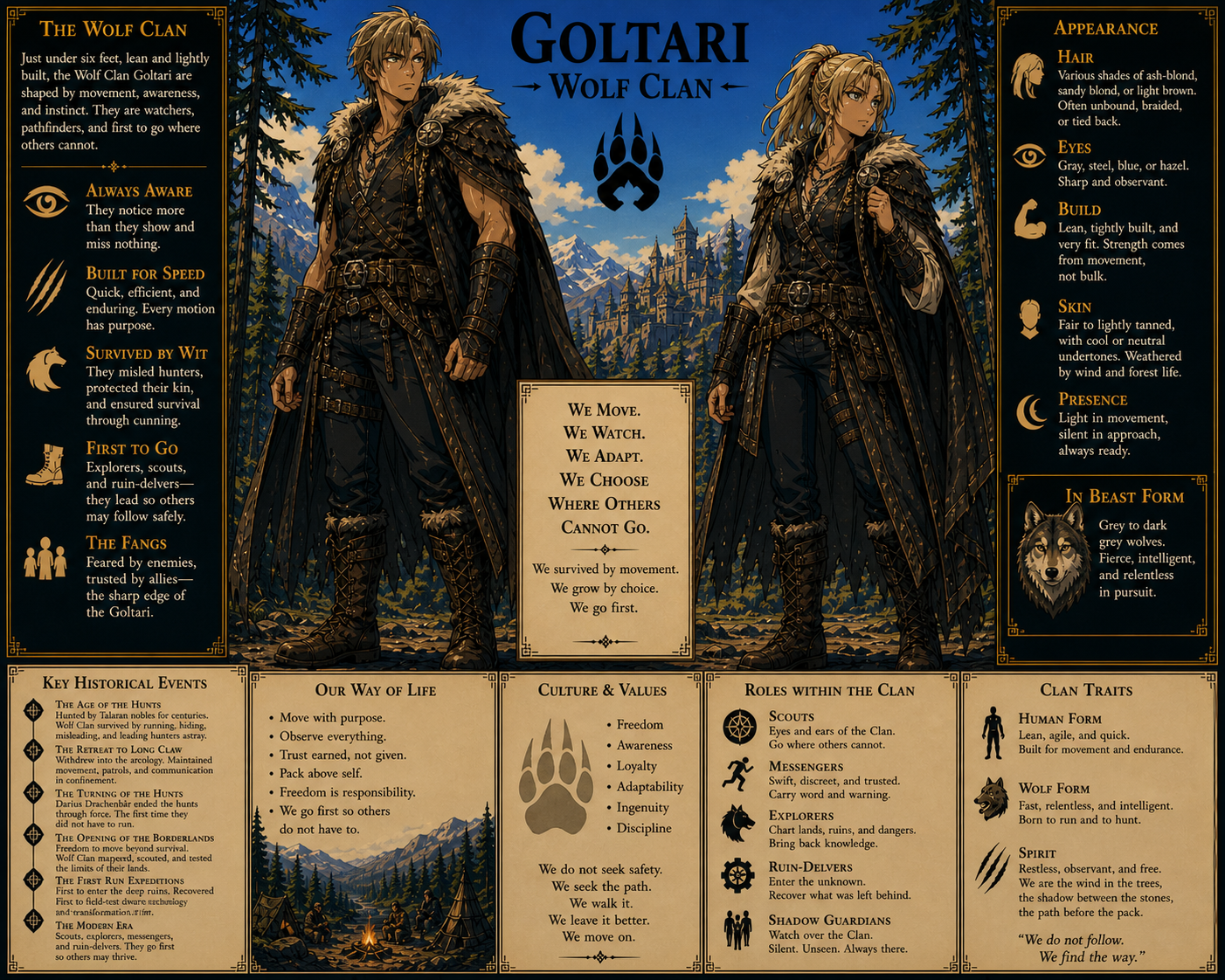
Associations
Other pages that reference or connect to this race
Referenced By
2Collections
Published collections that feature this race
Not in any collections yet
This race hasn't been published in any collections yet. Collections are curated groups of related content that help organize and showcase your world.
Tip: Collections are a great way to group related content together and share themed stories or worldbuilding elements with others.
Timelines
Timelines that reference or include this race
No timeline connections yet
This race isn't connected to any timelines yet. Timelines help organize events chronologically and show how your content fits into the broader history of your world.
Tip: Create timelines to organize important events in your world's history. Link characters, locations, and other content to specific events to build rich, interconnected narratives.
Shares
Discussion about this race
No shares yet
Be the first to start a discussion about this race by sharing it to the community stream.
Privacy & Sharing
Manage who can see and access this race
Current Status
refresh
This race is currently
Privacy Settings
Choose who can see and access this race
language Universe Privacy
This page belongs to a universe with its own privacy settings