
Categories
Dive Deeper
Page Stats
Navigation
Categories
Dive Deeper
Page Stats
Complete Details
All information about this race
Overview
Tokkiti
The rabbit folk of the far north, beyond the domain of the Legions of the North. They are a diminutive but spirited people who do not take well to being ruled over. They are semi nomadic grazing their herds of sheep and goats across the vast tundra grasslands in the summer and holing up in their fortress burrows come winter. There interactions with the other races of the north ranges from peaceful trading to active waring depending on season on going hostilities. Due to their tight knit family structures few have made it south beyond the north gate of the Legion remnant until the seventh age.
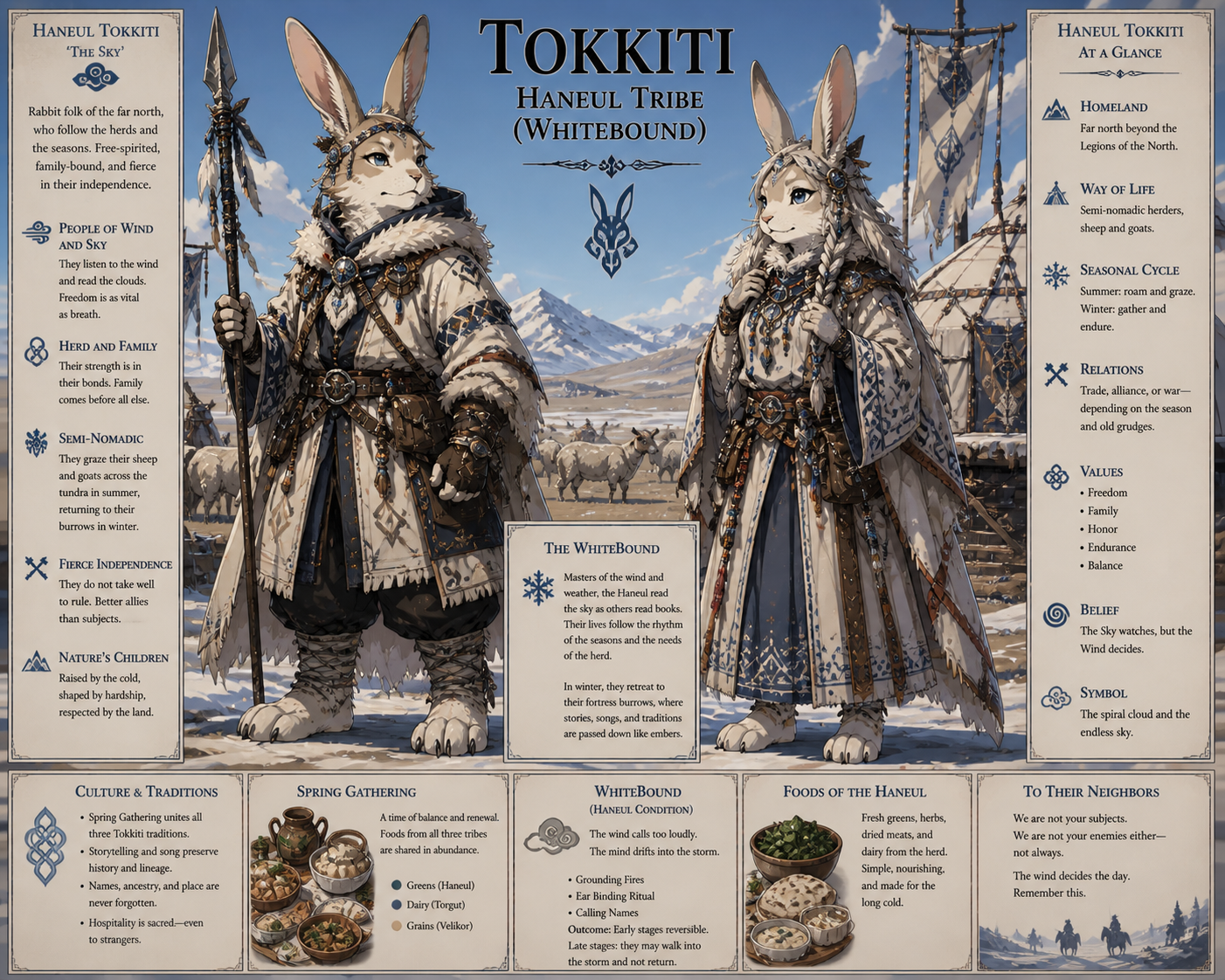
Haneul Tokkiti (Sky)
Torgut Tokkiti (Cliff-Born)
Velikor Tokkiti (Great)
Looks
The Tokkiti's body shape is split between the three major tribes, Haneul, Torgut, and Velikor.
The Haneul are small compared to their compatriots rarely breaking three feet, but with thick powerful legs and thighs for jumping extremely high. They have lovely pure white coats of fur in the winter that darken to a greyish tone by summer.
The Torgut are the largest in population of the three tribes, they vary in size from two and half to three and half feet in stature their lean frames giving them a sense of height compared to their shorter brethren. In winter their coats are white, moving to a brown in summer. In either season the tips of their ears are always black.
The Velikor are the smallest of the three tribes, but largest in stature, in both bulk and height. They regularly break three foot five inches topping the charts at three foot ten inches not including their ears. They have thick fur that goes from white in winter and brown and black in summer covering a layer of fat and pure muscle. One could be forgiven for assuming they are fat, but their strength is immense. With kicks and punches known to dent weaker plate armor.
Were you to shave a Tokkiti and not die in the process you would find their skin is very dark grey, but their fur is usually white during the long cold winter, shifting to browns and blacks by mid summer.
The Haneul range from two and a half to three feet tall
The Torgut range from two ten to three six in height
The Velikor are three six to three ten in height
none of these heights include their ears which can add up to an extra eighteen inches.
Weight ranges from forty five pounds at the lightest and one hundred and forty five pounds at the far end dependent on tribal ancestry
The Tokkiti are immediately recognizable by their powerful digitigrade legs, built for explosive movement. Even the smallest among them possess thick, spring-loaded thighs and calves, allowing for leaps far beyond what their stature would suggest. Their lower bodies are disproportionately strong compared to their upper frames, giving them a low, coiled posture when at rest and a startling, almost violent acceleration when in motion.
Their ears are their most defining and expressive feature, ranging from roughly 8 inches to over 18 inches in length, depending on lineage. These ears are highly mobile and serve not only for hearing but also for communication, emotional display, and social signaling. Variations in ear length, thickness, and markings (such as the permanent black tips common among Torgut lines) are one of the clearest indicators of mixed tribal heritage.
Tokkiti possess dense, seasonally shifting fur, typically white in winter for camouflage, transitioning to browns, greys, and blacks in summer. Beneath this coat lies dark grey skin, rarely seen and culturally taboo to expose. The fur itself is thick and insulating, particularly among the Velikor, whose coats conceal a layer of fat over heavily muscled bodies, giving them a deceptively soft appearance.
Their facial structure is compact but expressive, with large forward-facing eyes adapted for low-light conditions and wide fields of vision. Their noses are constantly in motion, and their whiskers are highly sensitive, aiding in navigation through tight spaces, burrows, and dense terrain.
Despite their size, Tokkiti are physically formidable. Their kicks are especially dangerous, capable of delivering enough force to break bone or dent weaker forms of armor, particularly among the Velikor. Their upper body strength is less pronounced but still sufficient for close combat, grappling, and tool use.
Finally, Tokkiti movement is distinct: a blend of short, grounded steps and sudden bounding motion, allowing them to traverse snow, rock, and uneven terrain with remarkable efficiency. Even when still, they carry a sense of coiled readiness, as if every individual is only a heartbeat away from motion.
Aside from the general variance between the tribes, the main physical variance is in their ears, with the intermingling of the tribes giving a wide spectrum, some Haneul can have long 18 inch ears with black tips, and a Velikor with short 8 inch ears with the white and brown winter/summer coloring of a Torgut
Tokkiti clothing is built around layering, mobility, and protection from extreme cold, adapted to their digitigrade form and powerful, spring-driven movement. In winter, they wear thick, fur-lined coats of hide and leather, wrapped and belted to seal in heat, paired with high insulating leg wraps and split-sole or tightly bound foot wraps instead of full boots, leaving the heel free for natural motion. Their garments are bulky but carefully structured, with overlapping closures, deep hoods, and ear accommodations: slits, wraps, or bindings that protect their long ears without restricting them. In summer, the silhouette shifts to loose, flowing tunics and robes of lighter leather or cloth, still belted but more open for airflow and movement, while decoration becomes more prominent through embroidery, fringe, and especially metalwork such as silver plates, charms, and pendants worn at the waist and chest for both status and spiritual protection. Across all seasons, their clothing favors function first, preserving warmth, maintaining agility, and supporting their powerful legs, while ornamentation reflects identity, lineage, and belief.
Traits
The Tokkiti are a physically specialized people whose strengths are rooted in explosive movement, environmental adaptation, and heightened senses. Their most defining trait is their powerful digitigrade legs, capable of generating immense force. This allows for rapid acceleration, extreme jumping ability, and sudden directional changes, making them exceptionally difficult to track, ambush, or pin down in close combat.
Their sensory perception is highly developed, particularly their hearing and sense of smell. Their long, mobile ears can detect subtle vibrations and distant movement, while their noses and whiskers provide acute environmental awareness, even in low visibility conditions such as snowfall or darkness. Combined, these senses give them a near-constant awareness of their surroundings.
Tokkiti are also well adapted to harsh northern climates. Their dense fur and physiology allow them to remain active in extreme cold with minimal loss of function. Snow, ice, and rugged terrain present far less of an obstacle to them than to most other peoples, granting them a natural advantage in their native environments.
Their movement is further enhanced by an innate sense of terrain and spatial awareness, allowing them to navigate uneven ground, narrow passages, and unstable surfaces with ease. This is especially evident in their ability to traverse steep inclines and snow-covered landscapes, often in tandem with their goat mounts.
Culturally and physically, the Tokkiti also excel at nonverbal communication. Subtle ear movements and posture shifts allow them to coordinate silently in groups, an ability that proves invaluable in hunting, travel, and warfare.
Each of the three major tribes carries an additional, distinct strength:
The Haneul Tokkiti possess an affinity with the north wind, allowing them to sense and exert limited control over it, particularly in open or elevated terrain.
The Torgut Tokkiti are able to communicate with herds of goats and sheep, forming unusually strong bonds with their mounts and livestock, and coordinating with them beyond normal animal handling.
The Velikor Tokkiti are gifted with immense physical strength, their heavily muscled frames capable of delivering devastating blows, with kicks and strikes powerful enough to damage armor and break bone.
Despite their many strengths, the Tokkiti possess several inherent weaknesses, most of which stem directly from their specialized physiology and environmental adaptation.
Foremost among these is their poor tolerance for heat. Their dense fur and cold-adapted bodies make them highly susceptible to overheating in warm climates or during prolonged exertion, limiting their effectiveness outside of colder regions and making endurance-based engagements particularly dangerous for them.
While their lower bodies are exceptionally powerful, their upper bodies are comparatively less robust. Their arms and torsos are not built for sustained grappling or heavy lifting, leaving them at a disadvantage in prolonged close-quarters combat against larger or more heavily built opponents.
Tokkiti are also not built for sustained endurance. Their strength lies in short bursts of speed and power rather than long-duration exertion. Extended chases, drawn-out battles, or situations requiring constant physical output will exhaust them more quickly than many other species.
Their ears, while a major strength, are also a vulnerability. Highly sensitive and essential for balance, awareness, and communication, damage to the ears can cause disorientation, reduced coordination, and impaired group cohesion. Such injuries also carry significant cultural and personal weight.
Due to their high metabolism and cold-environment lifestyle, Tokkiti require a consistent and substantial caloric intake. Disruptions to food supply can weaken them more rapidly than other peoples, particularly in winter conditions where energy demands are highest.
Culturally, the Tokkiti’s strong sense of independence presents its own challenges. They do not take well to centralized authority, which can lead to fractured leadership, difficulty maintaining large-scale coordination, and internal disagreement in times of crisis.
Finally, though they are formidable in their own right, the Tokkiti retain elements of their prey ancestry. Under extreme stress—such as sudden loud stimuli or overwhelming threats—they may experience instinctive reactions, including freezing or sudden flight, which can disrupt discipline in chaotic situations.
Whitebound (Haneul Predominant)
“The wind does not answer twice.”
Overview:
A condition affecting primarily the Haneul Tokkiti, tied to their affinity with the north wind. Whitebound occurs when an individual overextends their connection to the wind, especially during storms or prolonged exposure to extreme cold.
Symptoms:
Gradual loss of body heat regulation (even in cold conditions)
Paling of fur beyond natural winter coloration (almost luminous white)
Distant, unfocused gaze
Reduced physical responsiveness, as if “listening” to something far away
Eventually, near-total stillness
Effect:
The individual becomes increasingly detached from the physical world
Reaction times slow, movement becomes minimal
In severe cases, they may wander into storms or high ground and not return
Cultural Interpretation:
Seen as being “claimed by the wind”
Not always viewed as tragic—sometimes as a form of ascension or calling
Recovery is rare, but possible if intervention occurs early
Hornmadness (Torgut Predominant)
“When the herd runs, so too does the mind.”
Overview:
A condition linked to the Torgut Tokkiti’s bond with herd animals, particularly goats. It occurs when the connection becomes too strong or prolonged, blurring the line between Tokkiti and herd instinct.
Symptoms:
Heightened agitation or restlessness
Increased aggression or territorial behavior
Head and shoulder posturing mimicking goats
Compulsive need to remain within or return to a herd
Diminished verbal communication, replaced by body language
Effect:
The individual begins to think and react like a herd animal
Prioritizes:
Group movement
Dominance challenges
Immediate physical response over reason
Can become dangerous in confined or social environments
Cultural Interpretation:
Feared, but also respected as a loss of self to instinct
Some warriors intentionally flirt with early stages for combat advantage
Managed through isolation, ritual grounding, or herd separation
Deepburden (Velikor Predominant)
“Strength gathers weight.”
Overview:
A condition seen most often in Velikor Tokkiti, tied to their immense strength and dense, cold-adapted bodies. Deepburden is a slow-developing condition where the body’s mass and strength begin to outpace mobility and circulation.
Symptoms:
Gradual increase in body mass (muscle and fat)
Slowing movement and reduced agility
Shortness of breath during exertion
Joint strain, especially in hips and knees
Preference for stillness or grounded positions
Effect:
The Tokkiti becomes:
Less mobile
More difficult to move or displace
Strength remains high—or even increases—but:
Speed and reaction time degrade
In advanced cases, they become nearly immovable, but still conscious and aware
Cultural Interpretation:
Not always seen as illness—sometimes as a form of “settling”
Elders or defenders may be honored in this state
In extreme cases, individuals may choose to remain in one place permanently, becoming living anchors within a community
Culture
Tokkiti traditions are deeply tied to seasonal change, movement, and balance, reflecting their belief that life must be lived in harmony between Breath, Blood, and Root. Rather than fixed calendars, their traditions follow the turning of the world itself, with each transition between seasons marked by ritual, observation, and communal action.
The most important of these is the Spring Gathering, held at the end of winter when the great burrows open and the Tokkiti emerge once more into the wider world. Representatives from all twelve burrows and all three tribes come together to celebrate survival, renew bonds, and exchange goods, stories, and mates. It is a time of movement and reconnection, marked by competitions of speed, strength, and riding skill, as well as the beginning of adulthood for many young Tokkiti.
Other seasonal traditions mark the shifting balance of the world. The First Wind, observed at the edge of winter’s end, is a quiet ritual in which individuals stand in the open and listen for the changing of the air, offering small tokens to the wind as it begins to move again. Greenrise follows in early spring, when the first shoots of grain appear; on this day, fields are walked but not worked, honoring the awakening of the earth. In the height of summer, the High Sun Trials test physical strength and instinct through races, combat games, and herd-running, celebrating the peak of motion and vitality. As the seasons turn, the Last Cut marks the final harvest, with the last sheaf of grain bound and kept as a promise to the land. Finally, the Long Quiet signals the approach of winter, a period of slowing movement, storytelling, and preparation as the Tokkiti withdraw once more into their burrows.
Central to Tokkiti life is the rite of passage known as the First Bound, through which a young Tokkiti becomes an adult. At the end of winter, each leveret must leave the safety of the burrow alone, travel a set distance, and return by their own strength. This journey always includes a meaningful crossing—such as a leap over a marked gap or natural obstacle—symbolizing the transition from dependence to self-driven movement. Upon returning, they are recognized as full members of their community and take their place among their people.
Preceding this is the Winter Stilling, a quieter but equally important tradition. During the deep winter, those nearing adulthood reduce their movement and remain within the burrow, learning and assisting in a variety of roles—crafting, tending stores, observing herds, and listening to the teachings of shamans. This period is not used to assign a permanent role, but to help each individual understand where they best belong within the balance of Breath, Blood, and Root.
Across all traditions, the Tokkiti emphasize belonging over control, and movement over stagnation. Their rituals are not acts of worship, but acts of alignment—ensuring that they remain in right relationship with the world, their spirits, and one another.
The Tokkiti follow an animistic worldview in which the world is alive with spirit and intention. They believe that all things that endure or move possess a presence that must be respected and engaged with, not dominated. These spirits are understood through three interwoven domains: Breath, Blood, and Root. Breath governs the winds, sky, and turning seasons; Blood encompasses animals, instinct, and the shared will of living creatures; and Root binds the earth, grain, and the places Tokkiti call home. No single domain is considered superior—survival and harmony depend on maintaining balance between all three.
Each of the three major tribes is more closely aligned with one of these domains. The Haneul Tokkiti are keepers of Breath, interpreting the will of the north wind and the shifting of seasons, and producing the majority of shamans who serve as mediators between spirits and people. The Torgut Tokkiti are speakers of Blood, maintaining deep bonds with herd animals and honoring instinct as a guiding force, believing that animals are not lesser beings but parallel peoples with their own will and awareness. The Velikor Tokkiti are keepers of Root, responsible for tending burrows, fields, and hearths, and honoring the spirits of earth and grain that sustain Tokkiti life through endurance and stability.
Across all tribes, ritual and reciprocity are central. Offerings of food, crafted goods, or symbolic acts are made to maintain right relationships with the spirits, particularly before taking from the land or after surviving hardship. Movement itself is considered sacred, a sign of life and proper balance, while stagnation or excess in any one domain is seen as dangerous. The Tokkiti understand many of their afflictions as imbalances within this system: to be taken too far by wind, instinct, or rooted strength is to lose oneself. As such, their beliefs are not centered on worship, but on belonging—living in right measure between Breath, Blood, and Root.
Tokkiti governance is localized, communal, and seasonally grounded, centered around the great winter burrows that serve as both political and social anchors. Each burrow is governed by a Council of Six, composed of two representatives from each of the three tribes: Haneul, Torgut, and Velikor. This structure ensures that the domains of Breath, Blood, and Root are always held in balance, and that no single perspective dominates decision-making.
Council members are not absolute rulers, but recognized voices of experience and trust, chosen through a mixture of reputation, consensus, and demonstrated service to the burrow. Their responsibilities include coordinating winter survival, resolving disputes, organizing labor, managing food stores, and directing defense when needed. Decisions are typically made through deliberation and agreement, as Tokkiti culture resists rigid hierarchy and centralized authority.
During the winter months, when all Tokkiti withdraw into their burrows, governance is at its most active and structured. However, outside of winter, authority becomes far more diffuse. Families and groups operate independently across wide territories, tending herds, fields, and routes, with leadership becoming situational and practical rather than formal.
The twelve great burrows of the north form a loose coalition, bound not by law but by mutual need and long-standing agreement. This coalition exists primarily for mutual defense, particularly against the Corgyn, and for maintaining communication between distant regions. While the burrows will come to one another’s aid in times of crisis, there is no overarching ruler or unified state—only a network of interdependent but independent communities.
At the individual level, loyalty is strongest not to tribe alone, but to one’s burrow-clan—a multi-tribal community that shares labor, survival, and identity.
Tokkiti burrows are vast, communal structures occupied primarily during the winter months, when the surface world becomes too hostile for sustained life. Each burrow houses dozens of families from all three tribes, forming a single extended burrow-clan. These clans are not defined strictly by blood, but by shared residence, mutual obligation, and long-standing association.
Burrows themselves are carefully constructed and maintained, typically by Velikor builders, and are designed to balance warmth, airflow, structural stability, and spiritual harmony. They extend deep into the earth with multiple chambers, including:
Living quarters for families
Communal halls for gatherings and decision-making
Storage chambers for grain, preserved food, and supplies
Workshop spaces for crafting and repair
Ritual areas for offerings and spiritual practice
Life within the burrow is highly cooperative. Food, labor, and responsibility are shared, with individuals contributing according to need and ability. Farmers manage stores and prepare for spring planting, herders assist with indoor animal care or planning for migration, and craftsmen continue their work through the long winter. Shamans and wind-readers guide the spiritual life of the burrow, particularly during periods of stillness and uncertainty.
Despite the close quarters, Tokkiti burrow life is not rigidly stratified. Social structure is fluid, with respect earned through contribution, wisdom, and reliability rather than birth alone. However, tensions can arise, particularly between differing tribal perspectives:
Haneul may favor change and adaptability
Torgut may prioritize instinct and immediate response
Velikor may emphasize stability and long-term planning
The Council of Six exists in part to mediate these differences, ensuring that no single approach disrupts the balance necessary for survival.
Outside of winter, the burrow-clan disperses across a wide territory that functions as its fief or hold, encompassing grazing lands, fields, and travel routes. Families may spend most of the year apart, but they remain bound by their shared burrow identity, returning each winter to reform the whole.
In this way, the Tokkiti live two lives:
One of movement, independence, and open land
One of community, stillness, and shared survival
Both are necessary, and neither can exist without the other.
Tokkiti technology reflects a society shaped by mobility, seasonal survival, and practical craftsmanship, rather than large-scale industry or permanent urban development. Their tools and systems are designed to function across two distinct modes of life: the open, mobile seasons of herding and travel, and the enclosed, communal winters within the great burrows.
At their core, the Tokkiti possess the technological level of a semi-nomadic feudal society, with a strong emphasis on efficiency, repairability, and adaptation to extreme cold. Common materials include wood, bone, horn, leather, and worked metals, all chosen for durability and performance in harsh northern environments.
Tokkiti are highly skilled smiths and metalworkers, particularly known for forging their distinctive punch-daggers and compact weapons suited to their anatomy and fighting style. Their metalwork favors reinforced, compact designs, prioritizing strength and function over ornament, though ceremonial pieces may feature silver inlays and symbolic engravings tied to the domains of Breath, Blood, and Root. In addition to weapons, smiths produce agricultural tools, structural fittings for burrows, mount gear, and trade goods.
Complementing this are woodworkers, leatherworkers, and bone-carvers who create lightweight, durable equipment suited for constant movement. These include travel packs, insulated containers, flexible tools, and components for herd management and seasonal transport.
One of the Tokkiti’s most advanced technological achievements lies in their burrow construction and environmental engineering. These large, communal structures are carefully designed to retain heat, regulate airflow, and remain structurally stable in frozen or shifting ground. Burrows incorporate layered insulation, controlled ventilation systems, and modular expansion over generations. This knowledge is primarily maintained by Velikor builders and is regarded as both a technical discipline and a spiritual responsibility tied to the Root domain.
Mobility is supported by a range of adaptable, terrain-conscious technologies, including specialized saddles and harnesses for goat mounts, balanced pack systems, weather-integrated clothing, and simple sled or drag systems for winter transport. Among the Torgut, herd management techniques combine practical knowledge with deep cultural understanding, forming a system that borders on intuitive communication.
Tokkiti knowledge is preserved primarily through oral tradition, apprenticeship, and seasonal repetition, rather than reliance on written systems alone. Skills are learned through practice, particularly during the Winter Stilling, and reinforced across years of experience. Shamans and wind-readers maintain a parallel body of knowledge, interpreting environmental patterns as both practical information and spiritual communication.
By the Seventh Age, firearms have begun to reach the northern territories, introduced through trade, scavenging, and contact with southern powers beyond the remnants of the Legions. While still rare, their presence has already begun to challenge Tokkiti traditions and ways of life.
Firearms represent a fundamental shift in combat. They allow killing at a distance without movement or direct engagement, reducing the Tokkiti’s natural advantages in speed, terrain, and instinct. This has created a growing divide among the burrows. Some, particularly younger warriors and scouts, see firearms as a necessary adaptation, experimenting with their use alongside traditional tactics. Others view them with suspicion or outright rejection, believing they disrupt the balance between Breath, Blood, and Root, and sever the relationship between hunter and hunted.
Practical concerns reinforce this hesitation. Firearms are difficult to maintain in extreme cold, prone to failure, and dependent on ammunition supplies that do not align with Tokkiti self-sufficiency.
As a result, firearms remain limited, unevenly distributed, and widely debated. Some burrows cautiously adopt them, others forbid their use, and many remain divided. More than a new technology, firearms represent a philosophical challenge to Tokkiti identity—forcing them to confront whether a people defined by movement, closeness, and balance can endure the adoption of a weapon that requires none of these.
Tokkiti occupations are shaped by season, necessity, and personal alignment within the balance of Breath, Blood, and Root. While certain roles are more common within specific tribes, no occupation is barred to any Tokkiti, and individuals are encouraged to find their place through experience, particularly during the Winter Stilling and their transition into adulthood.
At the foundation of Tokkiti life are farmers and grain tenders, most often associated with the Velikor, who cultivate hardy crops such as wheat and rye in the brief growing seasons. These individuals also act as keepers of Root, maintaining the fields that sustain the burrows through winter. Alongside them are the burrow builders, also primarily Velikor, who design, expand, and maintain the vast communal burrows. Their work is both practical and spiritual, as each structure is believed to house and anchor protective spirits tied to the land and hearth.
The Torgut Tokkiti most commonly take on roles as nomadic herders and beast-speakers, forming deep bonds with goats and sheep. These individuals serve as herd wardens, guiding animal movement, protecting flocks, and maintaining the delicate relationship between Tokkiti and the Blood domain. Their work extends beyond simple animal care, often involving an intuitive understanding of herd behavior that borders on communication.
Among the Haneul Tokkiti, the most notable occupation is that of the wind-reader or shaman. These individuals interpret the movement of air and season, acting as mediators between the Tokkiti and the Breath domain. They guide ritual, advise burrow councils, and are often called upon during times of imbalance or uncertainty. While not all Haneul become shamans, their affinity for wind and perception makes them naturally suited to roles requiring awareness and interpretation.
Across all tribes, certain roles are shared and highly valued. Smiths and metalworkers are essential figures, responsible for crafting tools, agricultural implements, and the Tokkiti’s distinctive punch-daggers and weapons. Their work is often seen as a collaboration with both Root and Blood, shaping the materials of the earth into instruments of survival and defense.
Scouts and riders form the backbone of Tokkiti warfare and communication. Mounted on goats or traveling on foot, they act as messengers, hunters, and defenders of the burrows. Their role is closely tied to movement and awareness, embodying the Tokkiti ideal of striking swiftly and never remaining where danger lingers.
In practice, most Tokkiti do not hold a single occupation for life. Instead, roles may shift with season, need, and personal development, reflecting their belief that identity is not fixed, but discovered through movement and balance. A Tokkiti may herd in youth, build in adulthood, and guide as a shaman in later years, each role representing a different way of belonging within the world.
Tokkiti economics are rooted in self-sufficiency, reciprocity, and seasonal exchange, rather than centralized markets or large-scale currency systems. Each burrow-clan functions as a largely independent economic unit, producing most of what it requires through a combination of farming, herding, crafting, and stored surplus. This internal stability allows the Tokkiti to endure long winters without reliance on external supply, making resilience more important than accumulation.
The primary form of exchange among the Tokkiti is barter, supported by strong cultural expectations of mutual obligation. Goods and labor are traded fluidly both within and between burrow-clans, often without strict accounting. Debts are rarely formalized in numbers, but instead remembered as relationships of balance—to give is to create an obligation, and to take without return risks social and spiritual imbalance. This system is reinforced by their beliefs in Breath, Blood, and Root, where overaccumulation or hoarding is viewed as a disruption of natural order.
Each tribe contributes distinct economic strengths. The Velikor anchor production through farming, burrow construction, and storage, ensuring long-term survival and stability. The Torgut generate mobile wealth through herding, providing meat, hides, wool, and animal stock, and acting as key traders across wide territories. The Haneul contribute less materially but hold economic influence through guidance, foresight, and ritual knowledge, advising when to plant, move, harvest, or conserve resources.
Trade between burrows occurs most visibly during seasonal gatherings—especially the Spring Gathering—where goods, livestock, tools, and crafted items are exchanged. These events serve not only as markets, but as economic rebalancing points, redistributing surplus and addressing shortages across the wider Tokkiti network.
While barter dominates internally, the Tokkiti do engage in coin-based trade with neighboring human populations. The currency in circulation is typically minted by northern human kingdoms, often following traditions inherited from the old Empire, with regional variations. Tokkiti use coin primarily for:
Trade with outsiders
Acquisition of rare or non-local goods
Occasional inter-burrow exchanges where standardized value is useful
However, coin holds limited cultural significance among the Tokkiti themselves. Wealth is not measured in currency, but in:
Stored food and materials
Healthy herds
Strength of burrow infrastructure
Depth of social ties and obligations
As such, coin is treated as a tool of convenience, not a foundation of value.
The introduction of firearms has begun to introduce new economic pressures. Ammunition, maintenance tools, and replacement parts cannot be easily produced within traditional Tokkiti systems, creating a reliance on external trade. This has led to growing debate within and between burrows, as some see firearms as worth the economic shift, while others view them as a dangerous dependency that undermines Tokkiti self-sufficiency.
In all aspects, Tokkiti economics favor balance over accumulation, function over excess, and relationship over transaction. Their system is not designed to generate wealth in the conventional sense, but to ensure that no burrow, and no individual, is left without what is needed to endure.
Tokkiti diets reflect a balance between their natural herbivorous instincts and the realities of life in a harsh northern climate. At their core, they favor foods derived from grains, hardy vegetation, and preserved plant matter, supplemented by animal products obtained through herding. Their cuisine is shaped by seasonality, storage, and efficiency, with a strong preference for foods that can sustain them through long winters.
Staple foods include wheat and rye preparations, most commonly in the form of dense flatbreads, boiled grain porridges, and thick, fermented doughs. These are often eaten warm and are considered foundational to daily life, particularly within the burrows during winter. Grain is also used in simple fermented drinks, ranging from mildly sour beverages to stronger ceremonial brews consumed during gatherings.
The Tokkiti also consume a wide range of roots, grasses, and hardy greens, especially in the warmer months. Fresh shoots and wild forage are highly valued after winter scarcity, and the first edible growth of spring is often treated as both nourishment and ritual renewal. In colder months, these foods are preserved through drying or storage in burrow chambers, becoming softer, earthier components of winter meals.
From their herds, the Tokkiti derive milk and milk-based foods, which are among their most prized resources. These are processed into:
Soft cheeses
Thick yogurts
Fermented milk drinks
These foods are rich, sustaining, and often associated with strength and vitality, particularly among the Torgut.
While the Tokkiti are not natural hunters of large game, they do occasionally consume small amounts of meat, usually in the form of:
Broths
Stews
Preserved strips
Meat is typically reserved for times of need, ritual, or communal feasting, and is never treated as a primary dietary staple.
Preservation is essential to Tokkiti cuisine. Common methods include:
Drying grains and greens
Fermenting dairy and plant matter
Storing food in insulated burrow chambers
These techniques result in foods that are often:
Sour
Dense
Highly sustaining
Flavor preferences tend toward:
Earthy and grain-forward
Mildly sour or fermented
Warm and filling rather than sharp or spiced
Among their most favored foods are:
Thick rye porridge with fermented milk
Fresh spring greens eaten raw at first thaw
Soft cheeses paired with warm flatbread
Fermented grain drink shared during gatherings
Slow-cooked root and grain stews during winter
Food among the Tokkiti is rarely about indulgence and more about sustenance, balance, and shared survival. Meals are often communal, particularly in winter, reinforcing bonds within the burrow. To eat is not only to sustain the body, but to participate in the ongoing relationship between Breath, Blood, and Root—taking only what is needed, and ensuring that nothing essential is wasted.
Haneul signature dishes
Windbread – a thin, crisp flatbread dried to near brittleness, often carried on long journeys
Sky Broth – a light, clear soup made from herbs, greens, and trace grains, often consumed during rituals
First-Greens Plate – raw or lightly warmed spring shoots eaten at the first thaw
Breath Drink – a lightly fermented grain beverage, mild and slightly sour
Torgut signature dishes
Herdcheese Cakes – soft cheese pressed into dense cakes, often eaten with warm grain
Bloodmilk Stew – a thick mixture of fermented milk, grains, and occasional meat, rich and filling
Trail Curds – dried cheese pieces carried during long herding routes
Red Broth – a rare but valued meat-based broth, often shared communally
Velikor signature dishes
Root Porridge – thick rye or wheat porridge mixed with softened roots and preserved greens
Burrow Stew – slow-cooked grain and root stew, often shared in large communal pots
Stonebread – dense, heavy bread designed to last for long periods
Last Sheaf Cakes – ceremonial grain cakes made from the final harvest
History
The Age of Scattered Burrows (Early–Mid 4th Age)
“Before the Three walked together.”
In earlier ages, the Tokkiti were not a unified people, but a collection of loosely related groups divided along tribal lines. The Haneul roamed the open tundra and high winds, the Torgut followed migrating herds across vast distances, and the Velikor maintained smaller, more permanent burrow settlements.
Interaction between these groups ranged from cooperation to conflict, particularly during harsh winters or times of scarcity. Each tribe viewed the others as imbalanced—the Haneul too distant, the Torgut too driven by instinct, and the Velikor too rooted and slow to change.
This period was marked by frequent famine cycles, as no single group possessed the full balance of survival strategies needed to endure the worst northern winters.
The Grey Hunger (Late 4th Age)
“When even the wind carried nothing.”
One of the most devastating famines in Tokkiti memory, the Grey Hunger was caused by a convergence of failures:
Crops failed to take root
Herd migrations broke pattern
Winter arrived early and lingered
Entire groups vanished. Others were forced into desperate migration, leading to conflict over territory and resources.
It was during this time that the Tokkiti began to understand that no single tribe could survive alone. Haneul foresight, Torgut herd knowledge, and Velikor storage and structure were all necessary.
This famine is widely considered the first true turning point toward unity.
The War of Still Fields (Early 5th Age)
“They tried to make us stay.”
Following the famine, a northern human faction—often referred to in Tokkiti oral history as the Lords of the Still Fields—attempted to expand into Tokkiti territory.
These humans:
Sought to settle and control grazing lands
Built fixed fortifications and imposed territorial claims
Attempted to restrict Tokkiti movement
This directly clashed with Tokkiti identity, as:
Movement is sacred
Land is not owned, but belonged to
The resulting war was brutal. Tokkiti forces, though divided at first, quickly realized that only through combined tribal cooperation could they resist.
Key developments during this war:
First recorded joint warbands of all three tribes
Integration of:
Haneul scouting and wind-reading
Torgut mounted combat
Velikor defensive strongpoints
The Tokkiti ultimately drove the humans back or forced them into limited coexistence, but at great cost.
The Binding of the Three (Mid 5th Age)
“Breath, Blood, and Root must stand together.”
In the aftermath of the war, the Tokkiti formalized what had begun as necessity into culture.
This period saw:
The philosophical codification of Breath, Blood, and Root as interdependent domains
The establishment of shared traditions across tribes
The earliest forms of multi-tribal burrow cooperation
It is during this time that:
The Council of Six structure begins to emerge
Seasonal gatherings become more formalized
This was not a unification into a single nation, but a recognition of mutual dependence.
The Long Peace and the Corgyn Rise (Late 5th Age)
“When the south grew quiet, the west grew bold.”
During the 500-year peace that followed the fall of larger imperial conflicts, the Tokkiti stabilized and expanded their seasonal patterns.
However, this era also saw:
The formation of the Corgyn Republic
Increasing territorial pressure along shared borders
Unlike earlier human conflicts, the Corgyn:
Were more organized
More persistent
More willing to adapt to Tokkiti tactics
This period established the long-standing tension and recurring conflict between Tokkiti and Corgyn, though it remained largely seasonal and localized rather than total war.
The Burrow Fortification Era (Late 6th Age – Early 7th Age)
“We learned to endure together.”
Within the last 30–50 years, the Tokkiti undertook one of the most significant changes in their history: the construction of the Twelve Great Burrow Forts.
This development was driven by:
Increasing external pressure (particularly from the Corgyn)
The need for stronger winter defenses
The desire for more reliable food storage and coordination
These burrows represent:
A fusion of Velikor engineering, Torgut logistics, and Haneul planning
The physical manifestation of Breath, Blood, and Root in balance
They also solidified:
The Council of Six governance model
The burrow-clan identity as primary social unit
Despite this, the Tokkiti remain resistant to forming a centralized state.
The Age of Distant Thunder (Early 7th Age – Present)
“The world kills from afar now.”
The arrival of firearms in the north marks the beginning of a new and uncertain era.
Unlike previous threats, firearms:
Undermine Tokkiti advantages in movement and terrain
Introduce dependency on external supply chains
Challenge cultural beliefs about combat and balance
This has created:
Division among burrows
Debate within councils
A generational split in how the future should be faced
Some Tokkiti adapt, integrating firearms into their tactics. Others reject them entirely, seeing them as a break from the natural order.
Notes
❄️ Whitebound (Haneul)
“The wind does not answer twice.”
Treatment & Intervention:
1. Grounding Fires
The afflicted is brought into a low, enclosed space (burrow, tent, or snow shelter)
Surrounded by:
Warmth
Still air
Fires are kept low and steady—not roaring
👉 Purpose:
Break connection to open wind
Re-anchor the body to stillness and warmth
2. Ear Binding Ritual
Ears are:
Wrapped tightly in fur or cloth
Sometimes weighted slightly
👉 Purpose:
Reduce sensory input from wind
Symbolically “close the sky” to the individual
3. Calling Names
Family or kin repeat:
The individual’s name, lineage, and place
Spoken continuously over hours or days
👉 Purpose:
Reinforce identity
Pull the mind back from dissociation
Outcome:
Early stages: often reversible
Late stages: individual may leave voluntarily, walking into storms or high ground
⛰️ Hornmadness (Torgut)
“When the herd runs, so too does the mind.”
Treatment & Intervention:
1. Herd Separation
Immediate removal from:
Goats
Sheep
Large group movement
👉 Purpose:
Break feedback loop between Tokkiti and herd instinct
2. Isolation Circles
Individual is placed in:
A marked circle (stones, carved posts, or rope)
Must remain inside for a set period
👉 Purpose:
Reintroduce personal boundaries and self-awareness
3. Head Weighting / Horn Harness
A weighted band or harness is placed across shoulders/head
👉 Purpose:
Counteract instinct to:
Lower head
Charge
Forces upright posture (more “Tokkiti,” less “beast”)
4. Controlled Reintroduction
Gradual return to herd interaction:
One animal at a time
Under supervision
Outcome:
Most recover
Some retain:
Slight behavioral shifts (more aggressive, more territorial)
A few choose to remain with herds permanently
🌲 Deepburden (Velikor)
“Strength gathers weight.”
Treatment & Management:
1. Load Sharing
The afflicted is:
Given roles that require strength but minimal movement
Community redistributes physical labor
👉 Purpose:
Prevent worsening through overexertion
2. Heat Therapy
Unlike other Tokkiti, Velikor are exposed to:
Controlled warmth
Heated stones, enclosed spaces
👉 Purpose:
Improve circulation
Reduce stiffness
3. Guided Movement Rituals
Slow, deliberate movement patterns:
Almost meditative
Focus on:
Maintaining joint function
Preserving mobility as long as possible
4. Anchoring Role
Advanced individuals may become:
Gatekeepers
Settlement defenders
Ritual figures
👉 They are no longer expected to move far—
they become part of the place itself
Outcome:
Not curable
Managed, adapted, and often honored rather than feared
During the Spring Gathering, foods from all three traditions are combined:
Fresh greens (Haneul)
Dairy and rich dishes (Torgut)
Stored grains and breads (Velikor)
Meals are:
Communal
Abundant (relative to winter scarcity)
Symbolic of balance restored
Overview
Details about this race's overview
Tokkiti
The rabbit folk of the far north, beyond the domain of the Legions of the North. They are a diminutive but spirited people who do not take well to being ruled over. They are semi nomadic grazing their herds of sheep and goats across the vast tundra grasslands in the summer and holing up in their fortress burrows come winter. There interactions with the other races of the north ranges from peaceful trading to active waring depending on season on going hostilities. Due to their tight knit family structures few have made it south beyond the north gate of the Legion remnant until the seventh age.
Haneul Tokkiti (Sky)
Torgut Tokkiti (Cliff-Born)
Velikor Tokkiti (Great)
Looks
Details about this race's looks
The Tokkiti's body shape is split between the three major tribes, Haneul, Torgut, and Velikor.
The Haneul are small compared to their compatriots rarely breaking three feet, but with thick powerful legs and thighs for jumping extremely high. They have lovely pure white coats of fur in the winter that darken to a greyish tone by summer.
The Torgut are the largest in population of the three tribes, they vary in size from two and half to three and half feet in stature their lean frames giving them a sense of height compared to their shorter brethren. In winter their coats are white, moving to a brown in summer. In either season the tips of their ears are always black.
The Velikor are the smallest of the three tribes, but largest in stature, in both bulk and height. They regularly break three foot five inches topping the charts at three foot ten inches not including their ears. They have thick fur that goes from white in winter and brown and black in summer covering a layer of fat and pure muscle. One could be forgiven for assuming they are fat, but their strength is immense. With kicks and punches known to dent weaker plate armor.
Were you to shave a Tokkiti and not die in the process you would find their skin is very dark grey, but their fur is usually white during the long cold winter, shifting to browns and blacks by mid summer.
The Haneul range from two and a half to three feet tall
The Torgut range from two ten to three six in height
The Velikor are three six to three ten in height
none of these heights include their ears which can add up to an extra eighteen inches.
Weight ranges from forty five pounds at the lightest and one hundred and forty five pounds at the far end dependent on tribal ancestry
The Tokkiti are immediately recognizable by their powerful digitigrade legs, built for explosive movement. Even the smallest among them possess thick, spring-loaded thighs and calves, allowing for leaps far beyond what their stature would suggest. Their lower bodies are disproportionately strong compared to their upper frames, giving them a low, coiled posture when at rest and a startling, almost violent acceleration when in motion.
Their ears are their most defining and expressive feature, ranging from roughly 8 inches to over 18 inches in length, depending on lineage. These ears are highly mobile and serve not only for hearing but also for communication, emotional display, and social signaling. Variations in ear length, thickness, and markings (such as the permanent black tips common among Torgut lines) are one of the clearest indicators of mixed tribal heritage.
Tokkiti possess dense, seasonally shifting fur, typically white in winter for camouflage, transitioning to browns, greys, and blacks in summer. Beneath this coat lies dark grey skin, rarely seen and culturally taboo to expose. The fur itself is thick and insulating, particularly among the Velikor, whose coats conceal a layer of fat over heavily muscled bodies, giving them a deceptively soft appearance.
Their facial structure is compact but expressive, with large forward-facing eyes adapted for low-light conditions and wide fields of vision. Their noses are constantly in motion, and their whiskers are highly sensitive, aiding in navigation through tight spaces, burrows, and dense terrain.
Despite their size, Tokkiti are physically formidable. Their kicks are especially dangerous, capable of delivering enough force to break bone or dent weaker forms of armor, particularly among the Velikor. Their upper body strength is less pronounced but still sufficient for close combat, grappling, and tool use.
Finally, Tokkiti movement is distinct: a blend of short, grounded steps and sudden bounding motion, allowing them to traverse snow, rock, and uneven terrain with remarkable efficiency. Even when still, they carry a sense of coiled readiness, as if every individual is only a heartbeat away from motion.
Aside from the general variance between the tribes, the main physical variance is in their ears, with the intermingling of the tribes giving a wide spectrum, some Haneul can have long 18 inch ears with black tips, and a Velikor with short 8 inch ears with the white and brown winter/summer coloring of a Torgut
Tokkiti clothing is built around layering, mobility, and protection from extreme cold, adapted to their digitigrade form and powerful, spring-driven movement. In winter, they wear thick, fur-lined coats of hide and leather, wrapped and belted to seal in heat, paired with high insulating leg wraps and split-sole or tightly bound foot wraps instead of full boots, leaving the heel free for natural motion. Their garments are bulky but carefully structured, with overlapping closures, deep hoods, and ear accommodations: slits, wraps, or bindings that protect their long ears without restricting them. In summer, the silhouette shifts to loose, flowing tunics and robes of lighter leather or cloth, still belted but more open for airflow and movement, while decoration becomes more prominent through embroidery, fringe, and especially metalwork such as silver plates, charms, and pendants worn at the waist and chest for both status and spiritual protection. Across all seasons, their clothing favors function first, preserving warmth, maintaining agility, and supporting their powerful legs, while ornamentation reflects identity, lineage, and belief.
Traits
Details about this race's traits
The Tokkiti are a physically specialized people whose strengths are rooted in explosive movement, environmental adaptation, and heightened senses. Their most defining trait is their powerful digitigrade legs, capable of generating immense force. This allows for rapid acceleration, extreme jumping ability, and sudden directional changes, making them exceptionally difficult to track, ambush, or pin down in close combat.
Their sensory perception is highly developed, particularly their hearing and sense of smell. Their long, mobile ears can detect subtle vibrations and distant movement, while their noses and whiskers provide acute environmental awareness, even in low visibility conditions such as snowfall or darkness. Combined, these senses give them a near-constant awareness of their surroundings.
Tokkiti are also well adapted to harsh northern climates. Their dense fur and physiology allow them to remain active in extreme cold with minimal loss of function. Snow, ice, and rugged terrain present far less of an obstacle to them than to most other peoples, granting them a natural advantage in their native environments.
Their movement is further enhanced by an innate sense of terrain and spatial awareness, allowing them to navigate uneven ground, narrow passages, and unstable surfaces with ease. This is especially evident in their ability to traverse steep inclines and snow-covered landscapes, often in tandem with their goat mounts.
Culturally and physically, the Tokkiti also excel at nonverbal communication. Subtle ear movements and posture shifts allow them to coordinate silently in groups, an ability that proves invaluable in hunting, travel, and warfare.
Each of the three major tribes carries an additional, distinct strength:
The Haneul Tokkiti possess an affinity with the north wind, allowing them to sense and exert limited control over it, particularly in open or elevated terrain.
The Torgut Tokkiti are able to communicate with herds of goats and sheep, forming unusually strong bonds with their mounts and livestock, and coordinating with them beyond normal animal handling.
The Velikor Tokkiti are gifted with immense physical strength, their heavily muscled frames capable of delivering devastating blows, with kicks and strikes powerful enough to damage armor and break bone.
Despite their many strengths, the Tokkiti possess several inherent weaknesses, most of which stem directly from their specialized physiology and environmental adaptation.
Foremost among these is their poor tolerance for heat. Their dense fur and cold-adapted bodies make them highly susceptible to overheating in warm climates or during prolonged exertion, limiting their effectiveness outside of colder regions and making endurance-based engagements particularly dangerous for them.
While their lower bodies are exceptionally powerful, their upper bodies are comparatively less robust. Their arms and torsos are not built for sustained grappling or heavy lifting, leaving them at a disadvantage in prolonged close-quarters combat against larger or more heavily built opponents.
Tokkiti are also not built for sustained endurance. Their strength lies in short bursts of speed and power rather than long-duration exertion. Extended chases, drawn-out battles, or situations requiring constant physical output will exhaust them more quickly than many other species.
Their ears, while a major strength, are also a vulnerability. Highly sensitive and essential for balance, awareness, and communication, damage to the ears can cause disorientation, reduced coordination, and impaired group cohesion. Such injuries also carry significant cultural and personal weight.
Due to their high metabolism and cold-environment lifestyle, Tokkiti require a consistent and substantial caloric intake. Disruptions to food supply can weaken them more rapidly than other peoples, particularly in winter conditions where energy demands are highest.
Culturally, the Tokkiti’s strong sense of independence presents its own challenges. They do not take well to centralized authority, which can lead to fractured leadership, difficulty maintaining large-scale coordination, and internal disagreement in times of crisis.
Finally, though they are formidable in their own right, the Tokkiti retain elements of their prey ancestry. Under extreme stress—such as sudden loud stimuli or overwhelming threats—they may experience instinctive reactions, including freezing or sudden flight, which can disrupt discipline in chaotic situations.
Whitebound (Haneul Predominant)
“The wind does not answer twice.”
Overview:
A condition affecting primarily the Haneul Tokkiti, tied to their affinity with the north wind. Whitebound occurs when an individual overextends their connection to the wind, especially during storms or prolonged exposure to extreme cold.
Symptoms:
Gradual loss of body heat regulation (even in cold conditions)
Paling of fur beyond natural winter coloration (almost luminous white)
Distant, unfocused gaze
Reduced physical responsiveness, as if “listening” to something far away
Eventually, near-total stillness
Effect:
The individual becomes increasingly detached from the physical world
Reaction times slow, movement becomes minimal
In severe cases, they may wander into storms or high ground and not return
Cultural Interpretation:
Seen as being “claimed by the wind”
Not always viewed as tragic—sometimes as a form of ascension or calling
Recovery is rare, but possible if intervention occurs early
Hornmadness (Torgut Predominant)
“When the herd runs, so too does the mind.”
Overview:
A condition linked to the Torgut Tokkiti’s bond with herd animals, particularly goats. It occurs when the connection becomes too strong or prolonged, blurring the line between Tokkiti and herd instinct.
Symptoms:
Heightened agitation or restlessness
Increased aggression or territorial behavior
Head and shoulder posturing mimicking goats
Compulsive need to remain within or return to a herd
Diminished verbal communication, replaced by body language
Effect:
The individual begins to think and react like a herd animal
Prioritizes:
Group movement
Dominance challenges
Immediate physical response over reason
Can become dangerous in confined or social environments
Cultural Interpretation:
Feared, but also respected as a loss of self to instinct
Some warriors intentionally flirt with early stages for combat advantage
Managed through isolation, ritual grounding, or herd separation
Deepburden (Velikor Predominant)
“Strength gathers weight.”
Overview:
A condition seen most often in Velikor Tokkiti, tied to their immense strength and dense, cold-adapted bodies. Deepburden is a slow-developing condition where the body’s mass and strength begin to outpace mobility and circulation.
Symptoms:
Gradual increase in body mass (muscle and fat)
Slowing movement and reduced agility
Shortness of breath during exertion
Joint strain, especially in hips and knees
Preference for stillness or grounded positions
Effect:
The Tokkiti becomes:
Less mobile
More difficult to move or displace
Strength remains high—or even increases—but:
Speed and reaction time degrade
In advanced cases, they become nearly immovable, but still conscious and aware
Cultural Interpretation:
Not always seen as illness—sometimes as a form of “settling”
Elders or defenders may be honored in this state
In extreme cases, individuals may choose to remain in one place permanently, becoming living anchors within a community
Culture
Details about this race's culture
Tokkiti traditions are deeply tied to seasonal change, movement, and balance, reflecting their belief that life must be lived in harmony between Breath, Blood, and Root. Rather than fixed calendars, their traditions follow the turning of the world itself, with each transition between seasons marked by ritual, observation, and communal action.
The most important of these is the Spring Gathering, held at the end of winter when the great burrows open and the Tokkiti emerge once more into the wider world. Representatives from all twelve burrows and all three tribes come together to celebrate survival, renew bonds, and exchange goods, stories, and mates. It is a time of movement and reconnection, marked by competitions of speed, strength, and riding skill, as well as the beginning of adulthood for many young Tokkiti.
Other seasonal traditions mark the shifting balance of the world. The First Wind, observed at the edge of winter’s end, is a quiet ritual in which individuals stand in the open and listen for the changing of the air, offering small tokens to the wind as it begins to move again. Greenrise follows in early spring, when the first shoots of grain appear; on this day, fields are walked but not worked, honoring the awakening of the earth. In the height of summer, the High Sun Trials test physical strength and instinct through races, combat games, and herd-running, celebrating the peak of motion and vitality. As the seasons turn, the Last Cut marks the final harvest, with the last sheaf of grain bound and kept as a promise to the land. Finally, the Long Quiet signals the approach of winter, a period of slowing movement, storytelling, and preparation as the Tokkiti withdraw once more into their burrows.
Central to Tokkiti life is the rite of passage known as the First Bound, through which a young Tokkiti becomes an adult. At the end of winter, each leveret must leave the safety of the burrow alone, travel a set distance, and return by their own strength. This journey always includes a meaningful crossing—such as a leap over a marked gap or natural obstacle—symbolizing the transition from dependence to self-driven movement. Upon returning, they are recognized as full members of their community and take their place among their people.
Preceding this is the Winter Stilling, a quieter but equally important tradition. During the deep winter, those nearing adulthood reduce their movement and remain within the burrow, learning and assisting in a variety of roles—crafting, tending stores, observing herds, and listening to the teachings of shamans. This period is not used to assign a permanent role, but to help each individual understand where they best belong within the balance of Breath, Blood, and Root.
Across all traditions, the Tokkiti emphasize belonging over control, and movement over stagnation. Their rituals are not acts of worship, but acts of alignment—ensuring that they remain in right relationship with the world, their spirits, and one another.
The Tokkiti follow an animistic worldview in which the world is alive with spirit and intention. They believe that all things that endure or move possess a presence that must be respected and engaged with, not dominated. These spirits are understood through three interwoven domains: Breath, Blood, and Root. Breath governs the winds, sky, and turning seasons; Blood encompasses animals, instinct, and the shared will of living creatures; and Root binds the earth, grain, and the places Tokkiti call home. No single domain is considered superior—survival and harmony depend on maintaining balance between all three.
Each of the three major tribes is more closely aligned with one of these domains. The Haneul Tokkiti are keepers of Breath, interpreting the will of the north wind and the shifting of seasons, and producing the majority of shamans who serve as mediators between spirits and people. The Torgut Tokkiti are speakers of Blood, maintaining deep bonds with herd animals and honoring instinct as a guiding force, believing that animals are not lesser beings but parallel peoples with their own will and awareness. The Velikor Tokkiti are keepers of Root, responsible for tending burrows, fields, and hearths, and honoring the spirits of earth and grain that sustain Tokkiti life through endurance and stability.
Across all tribes, ritual and reciprocity are central. Offerings of food, crafted goods, or symbolic acts are made to maintain right relationships with the spirits, particularly before taking from the land or after surviving hardship. Movement itself is considered sacred, a sign of life and proper balance, while stagnation or excess in any one domain is seen as dangerous. The Tokkiti understand many of their afflictions as imbalances within this system: to be taken too far by wind, instinct, or rooted strength is to lose oneself. As such, their beliefs are not centered on worship, but on belonging—living in right measure between Breath, Blood, and Root.
Tokkiti governance is localized, communal, and seasonally grounded, centered around the great winter burrows that serve as both political and social anchors. Each burrow is governed by a Council of Six, composed of two representatives from each of the three tribes: Haneul, Torgut, and Velikor. This structure ensures that the domains of Breath, Blood, and Root are always held in balance, and that no single perspective dominates decision-making.
Council members are not absolute rulers, but recognized voices of experience and trust, chosen through a mixture of reputation, consensus, and demonstrated service to the burrow. Their responsibilities include coordinating winter survival, resolving disputes, organizing labor, managing food stores, and directing defense when needed. Decisions are typically made through deliberation and agreement, as Tokkiti culture resists rigid hierarchy and centralized authority.
During the winter months, when all Tokkiti withdraw into their burrows, governance is at its most active and structured. However, outside of winter, authority becomes far more diffuse. Families and groups operate independently across wide territories, tending herds, fields, and routes, with leadership becoming situational and practical rather than formal.
The twelve great burrows of the north form a loose coalition, bound not by law but by mutual need and long-standing agreement. This coalition exists primarily for mutual defense, particularly against the Corgyn, and for maintaining communication between distant regions. While the burrows will come to one another’s aid in times of crisis, there is no overarching ruler or unified state—only a network of interdependent but independent communities.
At the individual level, loyalty is strongest not to tribe alone, but to one’s burrow-clan—a multi-tribal community that shares labor, survival, and identity.
Tokkiti burrows are vast, communal structures occupied primarily during the winter months, when the surface world becomes too hostile for sustained life. Each burrow houses dozens of families from all three tribes, forming a single extended burrow-clan. These clans are not defined strictly by blood, but by shared residence, mutual obligation, and long-standing association.
Burrows themselves are carefully constructed and maintained, typically by Velikor builders, and are designed to balance warmth, airflow, structural stability, and spiritual harmony. They extend deep into the earth with multiple chambers, including:
Living quarters for families
Communal halls for gatherings and decision-making
Storage chambers for grain, preserved food, and supplies
Workshop spaces for crafting and repair
Ritual areas for offerings and spiritual practice
Life within the burrow is highly cooperative. Food, labor, and responsibility are shared, with individuals contributing according to need and ability. Farmers manage stores and prepare for spring planting, herders assist with indoor animal care or planning for migration, and craftsmen continue their work through the long winter. Shamans and wind-readers guide the spiritual life of the burrow, particularly during periods of stillness and uncertainty.
Despite the close quarters, Tokkiti burrow life is not rigidly stratified. Social structure is fluid, with respect earned through contribution, wisdom, and reliability rather than birth alone. However, tensions can arise, particularly between differing tribal perspectives:
Haneul may favor change and adaptability
Torgut may prioritize instinct and immediate response
Velikor may emphasize stability and long-term planning
The Council of Six exists in part to mediate these differences, ensuring that no single approach disrupts the balance necessary for survival.
Outside of winter, the burrow-clan disperses across a wide territory that functions as its fief or hold, encompassing grazing lands, fields, and travel routes. Families may spend most of the year apart, but they remain bound by their shared burrow identity, returning each winter to reform the whole.
In this way, the Tokkiti live two lives:
One of movement, independence, and open land
One of community, stillness, and shared survival
Both are necessary, and neither can exist without the other.
Tokkiti technology reflects a society shaped by mobility, seasonal survival, and practical craftsmanship, rather than large-scale industry or permanent urban development. Their tools and systems are designed to function across two distinct modes of life: the open, mobile seasons of herding and travel, and the enclosed, communal winters within the great burrows.
At their core, the Tokkiti possess the technological level of a semi-nomadic feudal society, with a strong emphasis on efficiency, repairability, and adaptation to extreme cold. Common materials include wood, bone, horn, leather, and worked metals, all chosen for durability and performance in harsh northern environments.
Tokkiti are highly skilled smiths and metalworkers, particularly known for forging their distinctive punch-daggers and compact weapons suited to their anatomy and fighting style. Their metalwork favors reinforced, compact designs, prioritizing strength and function over ornament, though ceremonial pieces may feature silver inlays and symbolic engravings tied to the domains of Breath, Blood, and Root. In addition to weapons, smiths produce agricultural tools, structural fittings for burrows, mount gear, and trade goods.
Complementing this are woodworkers, leatherworkers, and bone-carvers who create lightweight, durable equipment suited for constant movement. These include travel packs, insulated containers, flexible tools, and components for herd management and seasonal transport.
One of the Tokkiti’s most advanced technological achievements lies in their burrow construction and environmental engineering. These large, communal structures are carefully designed to retain heat, regulate airflow, and remain structurally stable in frozen or shifting ground. Burrows incorporate layered insulation, controlled ventilation systems, and modular expansion over generations. This knowledge is primarily maintained by Velikor builders and is regarded as both a technical discipline and a spiritual responsibility tied to the Root domain.
Mobility is supported by a range of adaptable, terrain-conscious technologies, including specialized saddles and harnesses for goat mounts, balanced pack systems, weather-integrated clothing, and simple sled or drag systems for winter transport. Among the Torgut, herd management techniques combine practical knowledge with deep cultural understanding, forming a system that borders on intuitive communication.
Tokkiti knowledge is preserved primarily through oral tradition, apprenticeship, and seasonal repetition, rather than reliance on written systems alone. Skills are learned through practice, particularly during the Winter Stilling, and reinforced across years of experience. Shamans and wind-readers maintain a parallel body of knowledge, interpreting environmental patterns as both practical information and spiritual communication.
By the Seventh Age, firearms have begun to reach the northern territories, introduced through trade, scavenging, and contact with southern powers beyond the remnants of the Legions. While still rare, their presence has already begun to challenge Tokkiti traditions and ways of life.
Firearms represent a fundamental shift in combat. They allow killing at a distance without movement or direct engagement, reducing the Tokkiti’s natural advantages in speed, terrain, and instinct. This has created a growing divide among the burrows. Some, particularly younger warriors and scouts, see firearms as a necessary adaptation, experimenting with their use alongside traditional tactics. Others view them with suspicion or outright rejection, believing they disrupt the balance between Breath, Blood, and Root, and sever the relationship between hunter and hunted.
Practical concerns reinforce this hesitation. Firearms are difficult to maintain in extreme cold, prone to failure, and dependent on ammunition supplies that do not align with Tokkiti self-sufficiency.
As a result, firearms remain limited, unevenly distributed, and widely debated. Some burrows cautiously adopt them, others forbid their use, and many remain divided. More than a new technology, firearms represent a philosophical challenge to Tokkiti identity—forcing them to confront whether a people defined by movement, closeness, and balance can endure the adoption of a weapon that requires none of these.
Tokkiti occupations are shaped by season, necessity, and personal alignment within the balance of Breath, Blood, and Root. While certain roles are more common within specific tribes, no occupation is barred to any Tokkiti, and individuals are encouraged to find their place through experience, particularly during the Winter Stilling and their transition into adulthood.
At the foundation of Tokkiti life are farmers and grain tenders, most often associated with the Velikor, who cultivate hardy crops such as wheat and rye in the brief growing seasons. These individuals also act as keepers of Root, maintaining the fields that sustain the burrows through winter. Alongside them are the burrow builders, also primarily Velikor, who design, expand, and maintain the vast communal burrows. Their work is both practical and spiritual, as each structure is believed to house and anchor protective spirits tied to the land and hearth.
The Torgut Tokkiti most commonly take on roles as nomadic herders and beast-speakers, forming deep bonds with goats and sheep. These individuals serve as herd wardens, guiding animal movement, protecting flocks, and maintaining the delicate relationship between Tokkiti and the Blood domain. Their work extends beyond simple animal care, often involving an intuitive understanding of herd behavior that borders on communication.
Among the Haneul Tokkiti, the most notable occupation is that of the wind-reader or shaman. These individuals interpret the movement of air and season, acting as mediators between the Tokkiti and the Breath domain. They guide ritual, advise burrow councils, and are often called upon during times of imbalance or uncertainty. While not all Haneul become shamans, their affinity for wind and perception makes them naturally suited to roles requiring awareness and interpretation.
Across all tribes, certain roles are shared and highly valued. Smiths and metalworkers are essential figures, responsible for crafting tools, agricultural implements, and the Tokkiti’s distinctive punch-daggers and weapons. Their work is often seen as a collaboration with both Root and Blood, shaping the materials of the earth into instruments of survival and defense.
Scouts and riders form the backbone of Tokkiti warfare and communication. Mounted on goats or traveling on foot, they act as messengers, hunters, and defenders of the burrows. Their role is closely tied to movement and awareness, embodying the Tokkiti ideal of striking swiftly and never remaining where danger lingers.
In practice, most Tokkiti do not hold a single occupation for life. Instead, roles may shift with season, need, and personal development, reflecting their belief that identity is not fixed, but discovered through movement and balance. A Tokkiti may herd in youth, build in adulthood, and guide as a shaman in later years, each role representing a different way of belonging within the world.
Tokkiti economics are rooted in self-sufficiency, reciprocity, and seasonal exchange, rather than centralized markets or large-scale currency systems. Each burrow-clan functions as a largely independent economic unit, producing most of what it requires through a combination of farming, herding, crafting, and stored surplus. This internal stability allows the Tokkiti to endure long winters without reliance on external supply, making resilience more important than accumulation.
The primary form of exchange among the Tokkiti is barter, supported by strong cultural expectations of mutual obligation. Goods and labor are traded fluidly both within and between burrow-clans, often without strict accounting. Debts are rarely formalized in numbers, but instead remembered as relationships of balance—to give is to create an obligation, and to take without return risks social and spiritual imbalance. This system is reinforced by their beliefs in Breath, Blood, and Root, where overaccumulation or hoarding is viewed as a disruption of natural order.
Each tribe contributes distinct economic strengths. The Velikor anchor production through farming, burrow construction, and storage, ensuring long-term survival and stability. The Torgut generate mobile wealth through herding, providing meat, hides, wool, and animal stock, and acting as key traders across wide territories. The Haneul contribute less materially but hold economic influence through guidance, foresight, and ritual knowledge, advising when to plant, move, harvest, or conserve resources.
Trade between burrows occurs most visibly during seasonal gatherings—especially the Spring Gathering—where goods, livestock, tools, and crafted items are exchanged. These events serve not only as markets, but as economic rebalancing points, redistributing surplus and addressing shortages across the wider Tokkiti network.
While barter dominates internally, the Tokkiti do engage in coin-based trade with neighboring human populations. The currency in circulation is typically minted by northern human kingdoms, often following traditions inherited from the old Empire, with regional variations. Tokkiti use coin primarily for:
Trade with outsiders
Acquisition of rare or non-local goods
Occasional inter-burrow exchanges where standardized value is useful
However, coin holds limited cultural significance among the Tokkiti themselves. Wealth is not measured in currency, but in:
Stored food and materials
Healthy herds
Strength of burrow infrastructure
Depth of social ties and obligations
As such, coin is treated as a tool of convenience, not a foundation of value.
The introduction of firearms has begun to introduce new economic pressures. Ammunition, maintenance tools, and replacement parts cannot be easily produced within traditional Tokkiti systems, creating a reliance on external trade. This has led to growing debate within and between burrows, as some see firearms as worth the economic shift, while others view them as a dangerous dependency that undermines Tokkiti self-sufficiency.
In all aspects, Tokkiti economics favor balance over accumulation, function over excess, and relationship over transaction. Their system is not designed to generate wealth in the conventional sense, but to ensure that no burrow, and no individual, is left without what is needed to endure.
Tokkiti diets reflect a balance between their natural herbivorous instincts and the realities of life in a harsh northern climate. At their core, they favor foods derived from grains, hardy vegetation, and preserved plant matter, supplemented by animal products obtained through herding. Their cuisine is shaped by seasonality, storage, and efficiency, with a strong preference for foods that can sustain them through long winters.
Staple foods include wheat and rye preparations, most commonly in the form of dense flatbreads, boiled grain porridges, and thick, fermented doughs. These are often eaten warm and are considered foundational to daily life, particularly within the burrows during winter. Grain is also used in simple fermented drinks, ranging from mildly sour beverages to stronger ceremonial brews consumed during gatherings.
The Tokkiti also consume a wide range of roots, grasses, and hardy greens, especially in the warmer months. Fresh shoots and wild forage are highly valued after winter scarcity, and the first edible growth of spring is often treated as both nourishment and ritual renewal. In colder months, these foods are preserved through drying or storage in burrow chambers, becoming softer, earthier components of winter meals.
From their herds, the Tokkiti derive milk and milk-based foods, which are among their most prized resources. These are processed into:
Soft cheeses
Thick yogurts
Fermented milk drinks
These foods are rich, sustaining, and often associated with strength and vitality, particularly among the Torgut.
While the Tokkiti are not natural hunters of large game, they do occasionally consume small amounts of meat, usually in the form of:
Broths
Stews
Preserved strips
Meat is typically reserved for times of need, ritual, or communal feasting, and is never treated as a primary dietary staple.
Preservation is essential to Tokkiti cuisine. Common methods include:
Drying grains and greens
Fermenting dairy and plant matter
Storing food in insulated burrow chambers
These techniques result in foods that are often:
Sour
Dense
Highly sustaining
Flavor preferences tend toward:
Earthy and grain-forward
Mildly sour or fermented
Warm and filling rather than sharp or spiced
Among their most favored foods are:
Thick rye porridge with fermented milk
Fresh spring greens eaten raw at first thaw
Soft cheeses paired with warm flatbread
Fermented grain drink shared during gatherings
Slow-cooked root and grain stews during winter
Food among the Tokkiti is rarely about indulgence and more about sustenance, balance, and shared survival. Meals are often communal, particularly in winter, reinforcing bonds within the burrow. To eat is not only to sustain the body, but to participate in the ongoing relationship between Breath, Blood, and Root—taking only what is needed, and ensuring that nothing essential is wasted.
Haneul signature dishes
Windbread – a thin, crisp flatbread dried to near brittleness, often carried on long journeys
Sky Broth – a light, clear soup made from herbs, greens, and trace grains, often consumed during rituals
First-Greens Plate – raw or lightly warmed spring shoots eaten at the first thaw
Breath Drink – a lightly fermented grain beverage, mild and slightly sour
Torgut signature dishes
Herdcheese Cakes – soft cheese pressed into dense cakes, often eaten with warm grain
Bloodmilk Stew – a thick mixture of fermented milk, grains, and occasional meat, rich and filling
Trail Curds – dried cheese pieces carried during long herding routes
Red Broth – a rare but valued meat-based broth, often shared communally
Velikor signature dishes
Root Porridge – thick rye or wheat porridge mixed with softened roots and preserved greens
Burrow Stew – slow-cooked grain and root stew, often shared in large communal pots
Stonebread – dense, heavy bread designed to last for long periods
Last Sheaf Cakes – ceremonial grain cakes made from the final harvest
History
Details about this race's history
The Age of Scattered Burrows (Early–Mid 4th Age)
“Before the Three walked together.”
In earlier ages, the Tokkiti were not a unified people, but a collection of loosely related groups divided along tribal lines. The Haneul roamed the open tundra and high winds, the Torgut followed migrating herds across vast distances, and the Velikor maintained smaller, more permanent burrow settlements.
Interaction between these groups ranged from cooperation to conflict, particularly during harsh winters or times of scarcity. Each tribe viewed the others as imbalanced—the Haneul too distant, the Torgut too driven by instinct, and the Velikor too rooted and slow to change.
This period was marked by frequent famine cycles, as no single group possessed the full balance of survival strategies needed to endure the worst northern winters.
The Grey Hunger (Late 4th Age)
“When even the wind carried nothing.”
One of the most devastating famines in Tokkiti memory, the Grey Hunger was caused by a convergence of failures:
Crops failed to take root
Herd migrations broke pattern
Winter arrived early and lingered
Entire groups vanished. Others were forced into desperate migration, leading to conflict over territory and resources.
It was during this time that the Tokkiti began to understand that no single tribe could survive alone. Haneul foresight, Torgut herd knowledge, and Velikor storage and structure were all necessary.
This famine is widely considered the first true turning point toward unity.
The War of Still Fields (Early 5th Age)
“They tried to make us stay.”
Following the famine, a northern human faction—often referred to in Tokkiti oral history as the Lords of the Still Fields—attempted to expand into Tokkiti territory.
These humans:
Sought to settle and control grazing lands
Built fixed fortifications and imposed territorial claims
Attempted to restrict Tokkiti movement
This directly clashed with Tokkiti identity, as:
Movement is sacred
Land is not owned, but belonged to
The resulting war was brutal. Tokkiti forces, though divided at first, quickly realized that only through combined tribal cooperation could they resist.
Key developments during this war:
First recorded joint warbands of all three tribes
Integration of:
Haneul scouting and wind-reading
Torgut mounted combat
Velikor defensive strongpoints
The Tokkiti ultimately drove the humans back or forced them into limited coexistence, but at great cost.
The Binding of the Three (Mid 5th Age)
“Breath, Blood, and Root must stand together.”
In the aftermath of the war, the Tokkiti formalized what had begun as necessity into culture.
This period saw:
The philosophical codification of Breath, Blood, and Root as interdependent domains
The establishment of shared traditions across tribes
The earliest forms of multi-tribal burrow cooperation
It is during this time that:
The Council of Six structure begins to emerge
Seasonal gatherings become more formalized
This was not a unification into a single nation, but a recognition of mutual dependence.
The Long Peace and the Corgyn Rise (Late 5th Age)
“When the south grew quiet, the west grew bold.”
During the 500-year peace that followed the fall of larger imperial conflicts, the Tokkiti stabilized and expanded their seasonal patterns.
However, this era also saw:
The formation of the Corgyn Republic
Increasing territorial pressure along shared borders
Unlike earlier human conflicts, the Corgyn:
Were more organized
More persistent
More willing to adapt to Tokkiti tactics
This period established the long-standing tension and recurring conflict between Tokkiti and Corgyn, though it remained largely seasonal and localized rather than total war.
The Burrow Fortification Era (Late 6th Age – Early 7th Age)
“We learned to endure together.”
Within the last 30–50 years, the Tokkiti undertook one of the most significant changes in their history: the construction of the Twelve Great Burrow Forts.
This development was driven by:
Increasing external pressure (particularly from the Corgyn)
The need for stronger winter defenses
The desire for more reliable food storage and coordination
These burrows represent:
A fusion of Velikor engineering, Torgut logistics, and Haneul planning
The physical manifestation of Breath, Blood, and Root in balance
They also solidified:
The Council of Six governance model
The burrow-clan identity as primary social unit
Despite this, the Tokkiti remain resistant to forming a centralized state.
The Age of Distant Thunder (Early 7th Age – Present)
“The world kills from afar now.”
The arrival of firearms in the north marks the beginning of a new and uncertain era.
Unlike previous threats, firearms:
Undermine Tokkiti advantages in movement and terrain
Introduce dependency on external supply chains
Challenge cultural beliefs about combat and balance
This has created:
Division among burrows
Debate within councils
A generational split in how the future should be faced
Some Tokkiti adapt, integrating firearms into their tactics. Others reject them entirely, seeing them as a break from the natural order.
Notes
Details about this race's notes
❄️ Whitebound (Haneul)
“The wind does not answer twice.”
Treatment & Intervention:
1. Grounding Fires
The afflicted is brought into a low, enclosed space (burrow, tent, or snow shelter)
Surrounded by:
Warmth
Still air
Fires are kept low and steady—not roaring
👉 Purpose:
Break connection to open wind
Re-anchor the body to stillness and warmth
2. Ear Binding Ritual
Ears are:
Wrapped tightly in fur or cloth
Sometimes weighted slightly
👉 Purpose:
Reduce sensory input from wind
Symbolically “close the sky” to the individual
3. Calling Names
Family or kin repeat:
The individual’s name, lineage, and place
Spoken continuously over hours or days
👉 Purpose:
Reinforce identity
Pull the mind back from dissociation
Outcome:
Early stages: often reversible
Late stages: individual may leave voluntarily, walking into storms or high ground
⛰️ Hornmadness (Torgut)
“When the herd runs, so too does the mind.”
Treatment & Intervention:
1. Herd Separation
Immediate removal from:
Goats
Sheep
Large group movement
👉 Purpose:
Break feedback loop between Tokkiti and herd instinct
2. Isolation Circles
Individual is placed in:
A marked circle (stones, carved posts, or rope)
Must remain inside for a set period
👉 Purpose:
Reintroduce personal boundaries and self-awareness
3. Head Weighting / Horn Harness
A weighted band or harness is placed across shoulders/head
👉 Purpose:
Counteract instinct to:
Lower head
Charge
Forces upright posture (more “Tokkiti,” less “beast”)
4. Controlled Reintroduction
Gradual return to herd interaction:
One animal at a time
Under supervision
Outcome:
Most recover
Some retain:
Slight behavioral shifts (more aggressive, more territorial)
A few choose to remain with herds permanently
🌲 Deepburden (Velikor)
“Strength gathers weight.”
Treatment & Management:
1. Load Sharing
The afflicted is:
Given roles that require strength but minimal movement
Community redistributes physical labor
👉 Purpose:
Prevent worsening through overexertion
2. Heat Therapy
Unlike other Tokkiti, Velikor are exposed to:
Controlled warmth
Heated stones, enclosed spaces
👉 Purpose:
Improve circulation
Reduce stiffness
3. Guided Movement Rituals
Slow, deliberate movement patterns:
Almost meditative
Focus on:
Maintaining joint function
Preserving mobility as long as possible
4. Anchoring Role
Advanced individuals may become:
Gatekeepers
Settlement defenders
Ritual figures
👉 They are no longer expected to move far—
they become part of the place itself
Outcome:
Not curable
Managed, adapted, and often honored rather than feared
During the Spring Gathering, foods from all three traditions are combined:
Fresh greens (Haneul)
Dairy and rich dishes (Torgut)
Stored grains and breads (Velikor)
Meals are:
Communal
Abundant (relative to winter scarcity)
Symbolic of balance restored
Gallery
Images and visual content for this race
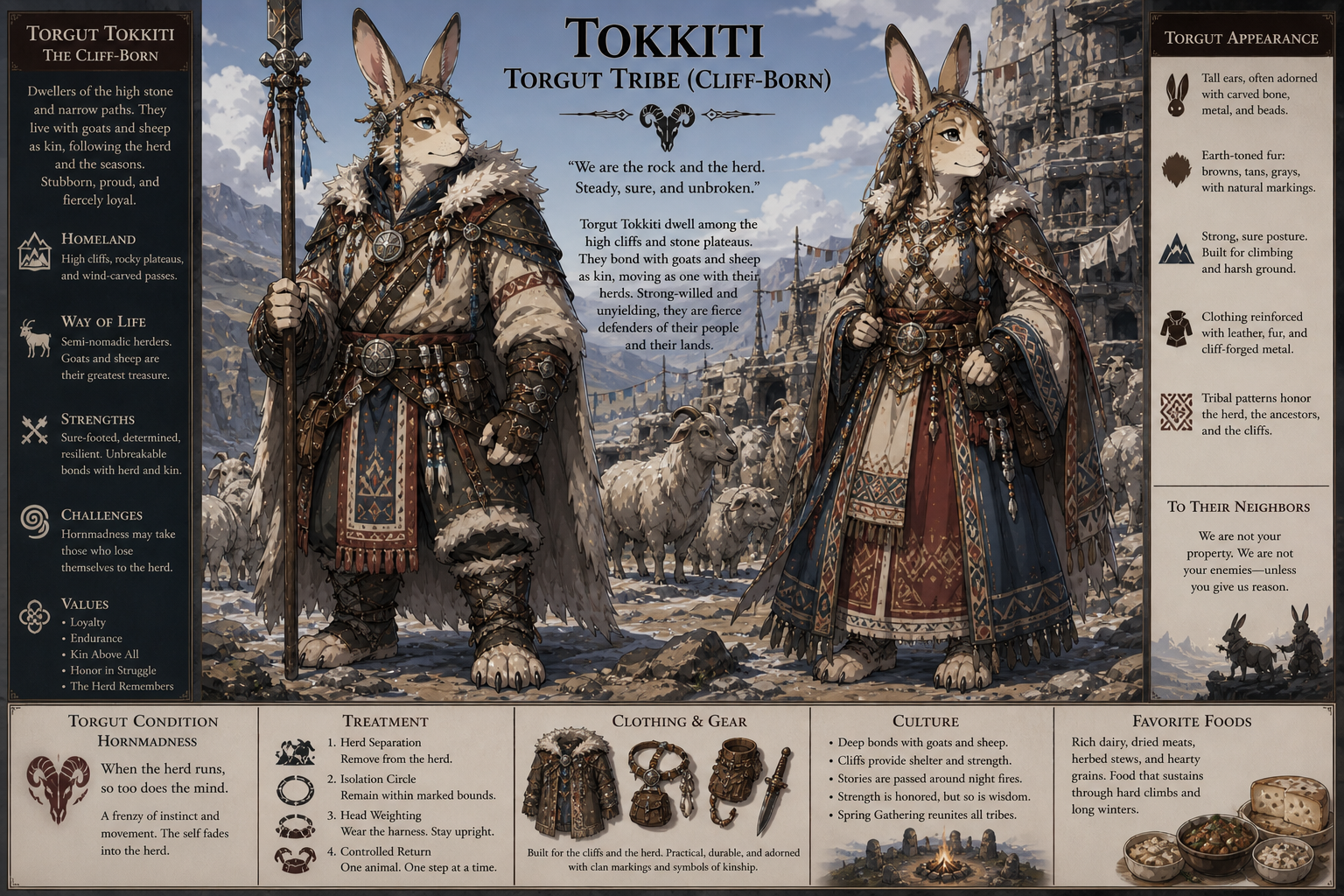
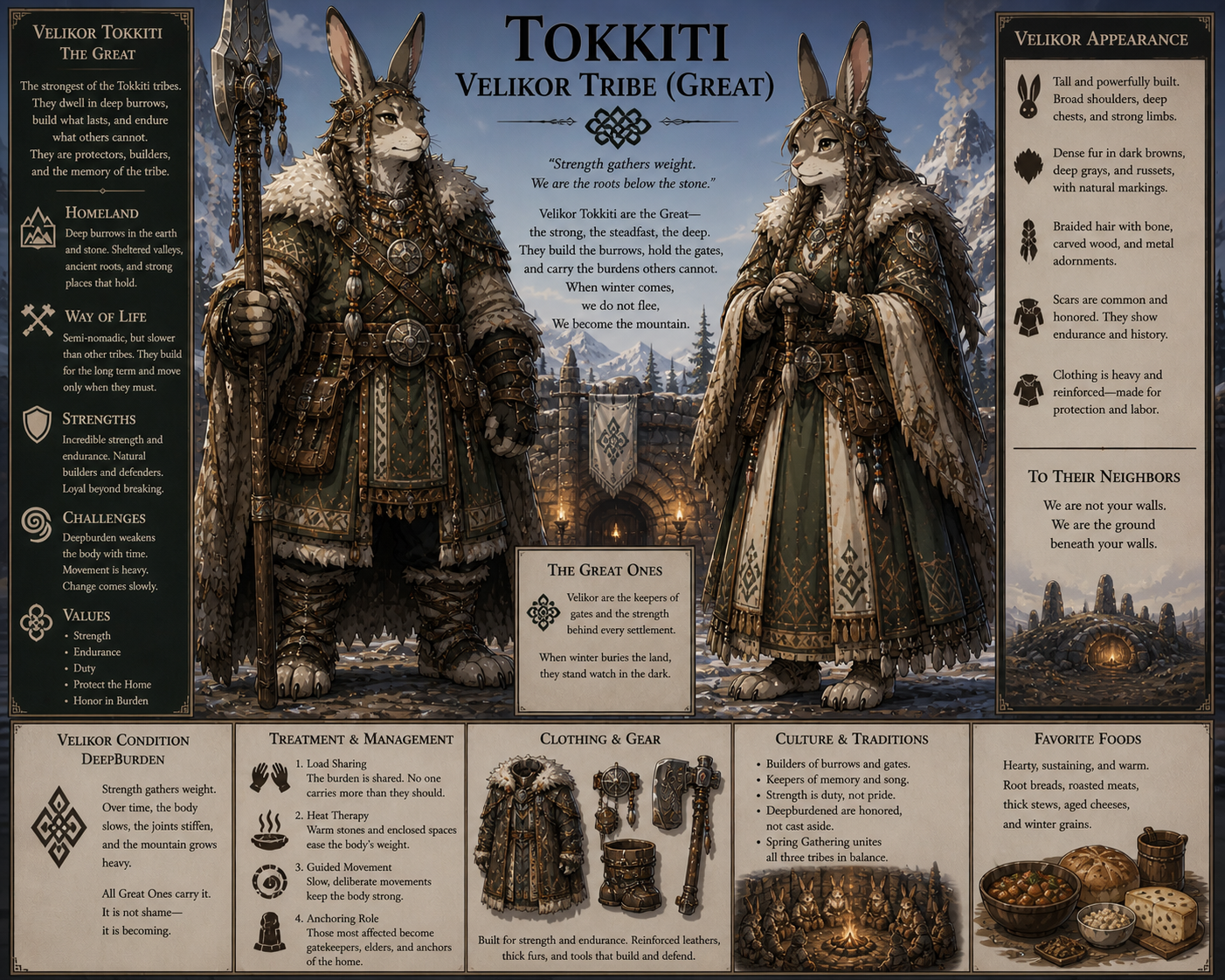
Associations
Other pages that reference or connect to this race
Referenced By
1Collections
Published collections that feature this race
Not in any collections yet
This race hasn't been published in any collections yet. Collections are curated groups of related content that help organize and showcase your world.
Tip: Collections are a great way to group related content together and share themed stories or worldbuilding elements with others.
Timelines
Timelines that reference or include this race
No timeline connections yet
This race isn't connected to any timelines yet. Timelines help organize events chronologically and show how your content fits into the broader history of your world.
Tip: Create timelines to organize important events in your world's history. Link characters, locations, and other content to specific events to build rich, interconnected narratives.
Shares
Discussion about this race
No shares yet
Be the first to start a discussion about this race by sharing it to the community stream.
Privacy & Sharing
Manage who can see and access this race
Current Status
refresh
This race is currently
Privacy Settings
Choose who can see and access this race
language Universe Privacy
This page belongs to a universe with its own privacy settings