
Categories
Dive Deeper
Page Stats
Navigation
Categories
Dive Deeper
Page Stats
Complete Details
All information about this race
Overview
Corgyn
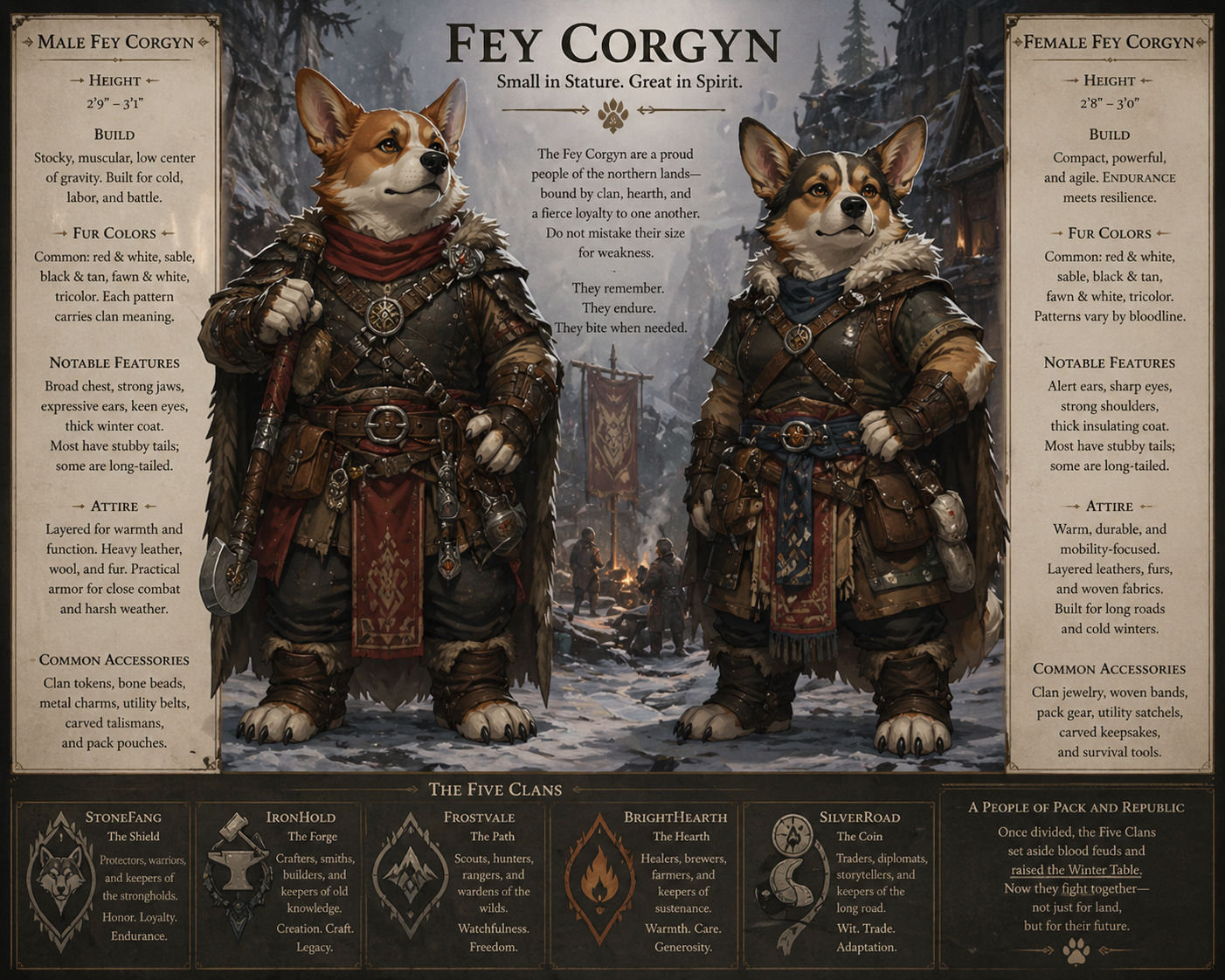
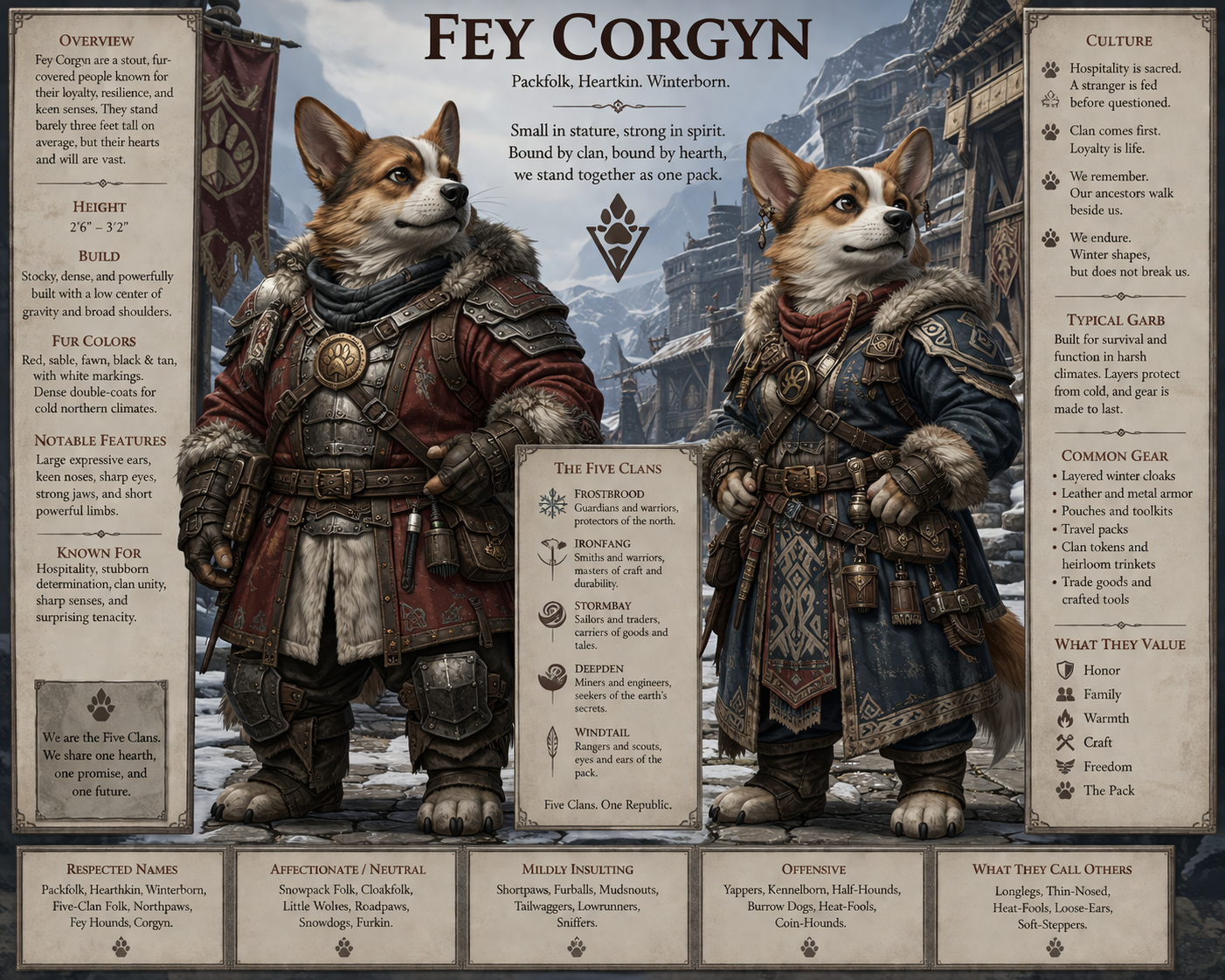
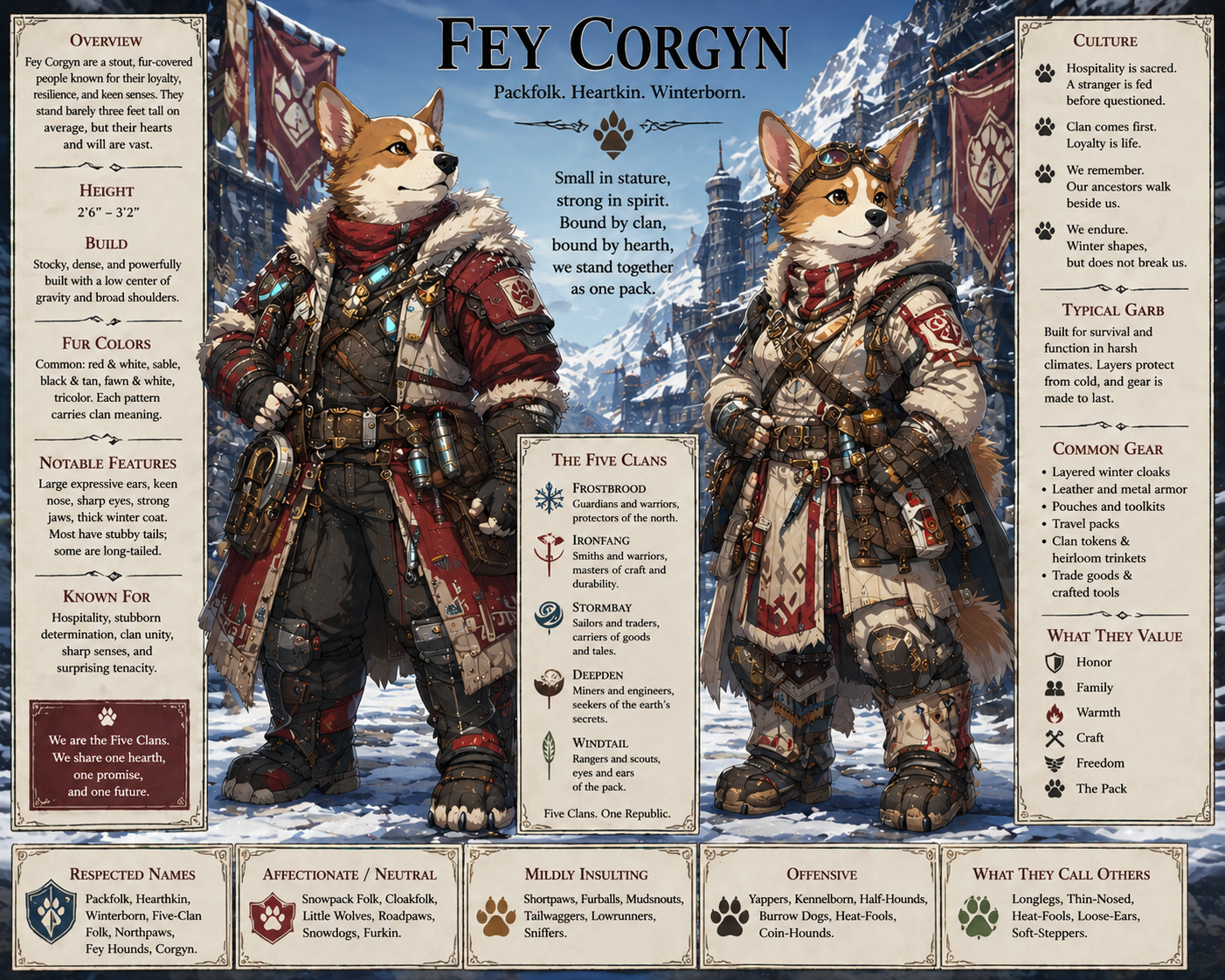
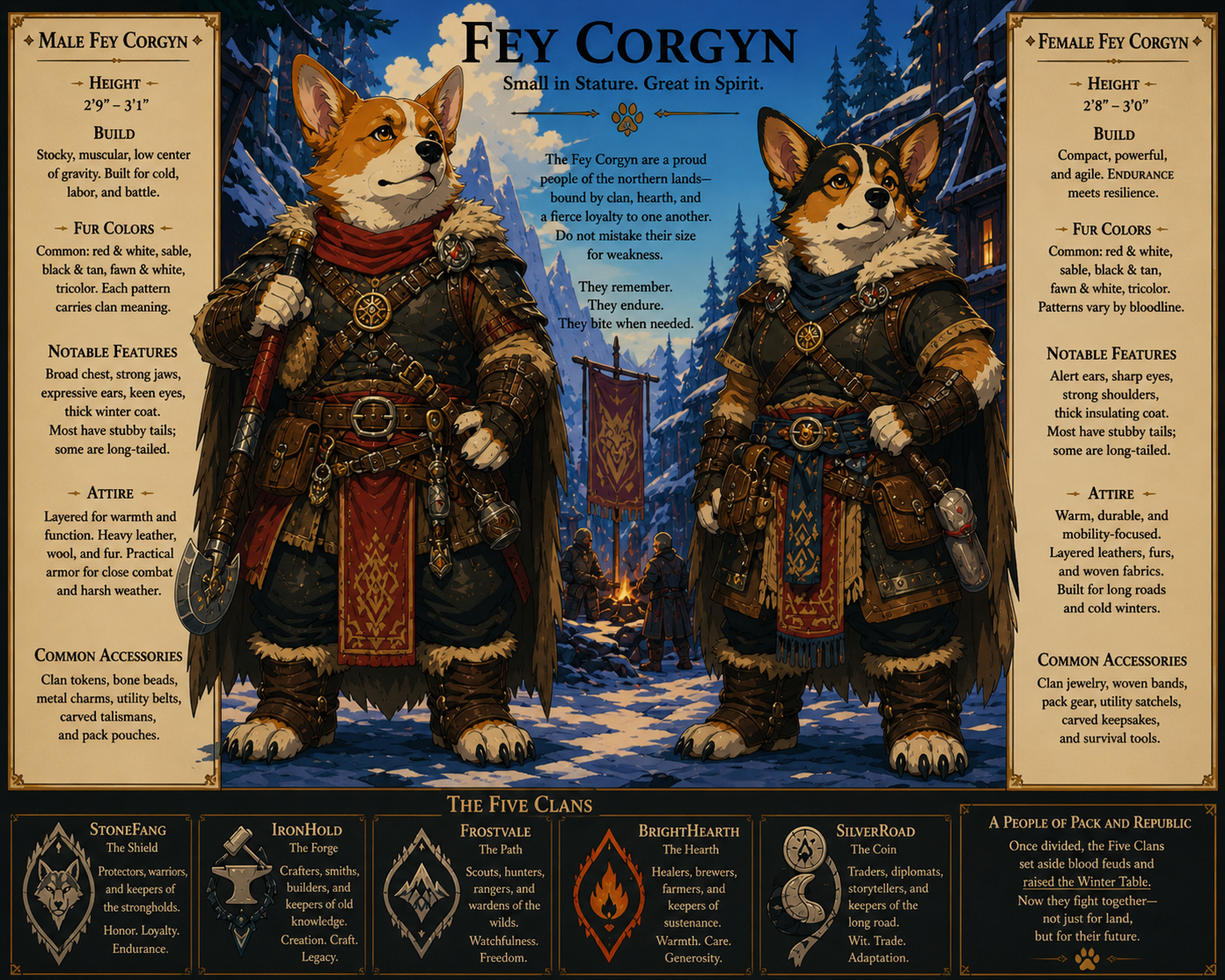
A Corgyn is a small, stocky, fur-covered humanoid with strong canine features, standing barely three feet tall but carrying themselves with surprising confidence and weight. With broad shoulders, a low center of gravity, expressive ears, and a constantly alert nose, they move with a quick, bounding gait and an air of stubborn determination. Their dense fur—often red, sable, fawn, or black and tan with white markings—protects them from the harsh northern cold, while their sharp senses and bright, clever eyes hint at a mind that notices more than it lets on.
To outsiders, they are easy to underestimate—
until they prove otherwise.
Corgynach (kor-gin-akh) – “the People of the Pack”
Fey-Cor – shortened, older form, used in older texts or ritual
Hearthkin – emphasizing warmth, family, and survival
Snowpack Folk – common in northern clans
Five-Clan Folk – political identity tied to their republic
Lowland Keepers – a bit ironic, referring to their height and homeland
Winterborn – common poetic or cultural self-reference
Casual / Internal Use
Packfolk
Clanners
Roadpaws (used especially for those on The Long Road)
Neutral / Respectful
Fey Hounds – acknowledges their fey nature and canine traits
Northpaws – common among traders
Furkin – broadly used, not always offensive
Winter Folk – simple, respectful
Corgyn – many outsiders just use their actual name
Affectionate / Slightly Diminishing
Little Wolves – used by taller warrior cultures
Snowdogs – common among southern peoples
Cloakfolk – referencing their heavy winter wear
Lowrunners – referencing their gait and speed
Mild Insults
Shortpaws – very common, mildly irritating
Furballs – dismissive but not deeply offensive
Mudsnouts – implying they root around or scavenge
Tailwaggers – mocking their expressiveness
Harsher / More Offensive
Yappers – implying they talk too much
Kennelborn – suggesting domestication or lesser status
Half-Hounds – denying their personhood
Burrow Dogs – implying they belong underground or in holes
Sniffers – mocking their strong sense of smell
Contextual Insults (More Cultural)
Storm Beggars – referencing their Winter Table hospitality (twisted into weakness)
Scrap Traders – mocking their tendency to adopt outside tech
Coin-Hounds – used by rivals in trade or mercenary work
Looks
Diminutive, squat, and stocky, covered head to toe in fur, canine ears sit atop their heads, they have a short muzzle, digitgrade legs ending in paws, their hand have three "fingers" and a semi opposable thumb, fur colors include shades of red, sable, and fawn, as well as black and tan, often with white markings on the chest, neck, and legs
Fur patterns include shades of red, sable, and fawn, as well as black and tan, often with white markings on the chest, neck, and legs
2.5 - 3.5 feet
40-65lbs
The first thing most people notice about the Corgyn is how compact and solid they are. Though small in height, they are broad through the shoulders, thick through the chest, and built with the sturdy confidence of something that has never once considered itself “small.” Their low center of gravity and powerful legs give them an unmistakably grounded presence, making them seem far harder to move than their size would suggest.
Their canine features are immediately obvious. Large expressive dog-like ears sit atop their heads, constantly shifting with mood and attention, often revealing their thoughts before their mouths do. Their muzzles are short and broad rather than narrow, giving them a strong, stubborn look that suits their reputation well. Their noses are dark, sensitive, and always working—many Fey Corgyn seem to be smelling the world before they fully trust it.
Their legs are digitigrade and end in sturdy paws rather than human feet, giving them a quick, bounding gait and remarkable agility over uneven ground despite their squat builds. Their hands are similarly distinct, with three thick fingers and a semi-opposable thumb that allows for tool use without losing the practical sturdiness of a working animal.
Their fur is dense and weather-resistant, often thickest around the neck, shoulders, and tail base, giving some individuals the appearance of a natural mantle or collar. White markings across the chest, throat, and legs are common and often culturally noted, especially if they form unusual shapes or symmetrical patterns.
Their tails—whether naturally short, thick, or fuller depending on bloodline—are highly expressive and almost impossible to hide emotionally. Combined with their ears, a Fey Corgyn can accidentally reveal irritation, excitement, suspicion, or affection long before they say a word.
Their eyes tend to be warm shades of:
brown
amber
honey-gold
dark hazel
or occasionally pale blue-gray in rarer lines
and are often bright, alert, and a little too clever.
Perhaps most distinctive of all is the way they carry themselves: like a creature entirely convinced that being closer to the ground simply means they get there first.
To outsiders, the lasting impression is usually:
small enough to underestimate
sturdy enough to regret it immediately.
Males tend to be larger than females, largest differences are in fur patterns
Fey Corgyn clothing is built first for warmth, second for durability, and only then for appearance—though they would argue that looking respectable in winter is part of survival.
Hailing from the far north of Porcella, where snow lingers for most of the year and the wind seems personally offended by your existence, they favor layered clothing designed to trap heat without restricting movement. Their natural fur helps, but harsh northern winters do not care how fluffy you are.
They commonly wear:
thick wool tunics
layered linen undershirts
heavy fur-lined vests
leather belts and harnesses
insulated wraps for the legs and ankles
and heavy cloaks fastened high around the shoulders
Because of their digitigrade legs and compact builds, their clothing is cut differently than human garments—shorter in the torso, broader through the chest, and designed to allow easy movement of the hips and tail without bunching or discomfort.
Cloaks and mantle-capes are especially common, often made from:
wolf fur
bear hide
thick sheep wool
treated winter pelts
or heavy woven northern cloth
These are worn almost like status pieces as much as practical garments. A good winter cloak is expected to last years and may be passed through families like heirlooms.
Boots are less common than among humans due to their paws and digitigrade stance, but they do wear:
leather paw wraps
winter bindings
protective travel boots for ice crossings
and thick insulating foot wraps during the worst storms
Hands are often left uncovered for work, but fingerless fur-lined gloves or wrist wraps are common in colder seasons.
Decoration tends toward practicality mixed with clan pride:
embroidered hems
carved bone clasps
metal cloak pins
woven family patterns
and brightly dyed scarves or shoulder wraps
Red, deep green, dark blue, white, and warm earth tones are common, with brighter colors often reserved for festivals or family gatherings.
Well-made belts and harnesses are particularly valued, both for carrying tools and because Fey Corgyn tend to appreciate useful craftsmanship over delicate ornament.
Formal wear is not especially elaborate—it usually means:
the same clothes, but cleaner
and with the good cloak
which is honestly true of many northern peoples.
To outsiders, they often look like:
stubborn little winter survivors wrapped in enough fur to survive an argument with a blizzard.
Traits
Acute sense of hearing and smell, fey sight (allowing them to see beyond the veil into the unseen realm, but also allows them to detect hidden or secret doors, or traps more easily), able to innately cast some more minor minor elemental spells, very good at handling the cold
For all their resilience, cleverness, and stubborn northern durability, the Fey Corgyn carry several weaknesses that come from the same traits that make them strong.
Their greatest weakness is heat.
Built for the long winters and brutal cold of northern Porcella, they handle snow, wind, and ice with almost insulting ease—but hot climates are miserable for them. Excessive heat causes exhaustion quickly, and humid southern summers can leave even strong Fey Corgyn sluggish, irritable, and physically unwell. Heatstroke is a very real danger, and many avoid the south entirely unless necessity demands it.
Their small stature also creates practical disadvantages.
Though compact and strong for their size, they are still physically short. Reaching, carrying oversized equipment, mounted combat, and fighting larger opponents head-on can all be difficult. Their strength is impressive for their frame, but physics remains rude and uncooperative.
Their strong senses can become liabilities.
Their exceptional hearing and smell make them excellent trackers and scouts, but loud noise, strong perfumes, smoke, blood-heavy battlefields, and certain alchemical substances can overwhelm them quickly. A battlefield cannon or enclosed forge can be as disorienting as a flashbang. Some enemies learn quickly that overwhelming the senses is often easier than overcoming the warrior.
Their emotions are difficult to hide.
Because their ears, tails, posture, and scent responses are so expressive, deception can be harder for them than for many other peoples. A trained liar can still lie, of course—but it is much harder when your ears betray your irritation and your tail announces your excitement to the room.
They can also be intensely stubborn.
This is often framed as cultural pride, but it is absolutely a weakness when it becomes refusal to retreat, refusal to ask for help, or refusal to admit that yes, perhaps digging through a blizzard to prove a point was a poor decision. Fey Corgyn pride and common sense occasionally have a strained relationship.
Their Fey Sight, while powerful, is not always comfortable.
Seeing too much means they notice things others do not—spirits, old magic, places where reality feels wrong, and the lingering edges of things best left unseen. Young Fey Corgyn often struggle with sleep, paranoia, or distraction before learning how to ignore what constantly watches back.
Iron and certain anti-fey materials can also interfere with their innate magic.
Cold-worked iron, especially old iron or deliberately anti-fey warded metals, can dull their spellwork, disrupt their Fey Sight, and create deep physical discomfort if worn too long against the skin. This does not make them helpless, but it is enough that many warriors and travelers remain wary of certain places and people.
Among themselves, there is an old joke:
“We are blessed with sharp noses, sharper eyes,
and absolutely no ability to mind our own business.”
which, unfortunately, is true.
Summer Sickness
Description:
The most common Fey Corgyn condition.
A seasonal weakness caused by excessive heat, humidity, or long exposure to southern climates.
Their bodies are built for winter.
Summer takes that personally.
Symptoms:
exhaustion
dizziness
overheating
irritability
loss of appetite
heavy shedding
restless sleep
weakness in spellcasting
In severe cases, it can lead to dangerous collapse or heatstroke.
Cultural Meaning:
Taken very seriously.
A Fey Corgyn complaining about the heat is normal.
A Fey Corgyn going quiet about the heat means everyone should start worrying.
Open Sight
Description:
A condition where Fey Sight develops too strongly or too early, making it difficult for the individual to filter the unseen world from the ordinary one.
Most common in children and adolescents.
Sometimes persists for life.
Symptoms:
seeing spirits too clearly
nightmares
insomnia
distraction
talking to things no one else can see
fear of certain empty places
refusal to enter rooms “that feel wrong”
Sometimes they are imagining it.
Sometimes they absolutely are not.
Which is the problem.
Cultural Meaning:
Handled with patience, not fear.
Children with Open Sight are watched carefully and usually given protective charms rather than punishment.
Pawcrack
Description:
A painful but common condition caused by harsh winters, ice exposure, and constant travel over frozen ground.
The pads of the feet dry, split, or become infected.
Yes, it is exactly as miserable as it sounds.
Symptoms:
cracked paw pads
bleeding
difficulty walking
stiffness
winter infections
Older travelers and soldiers are especially prone to it.
Cultural Meaning:
Universally hated.
Also universally treated with the same terrible-smelling salves every grandmother insists are “perfectly fine.”
They are not.
Spellburn
Description:
A magical exhaustion caused by overuse of their innate elemental magic, especially among young or prideful Fey Corgyn who insist they are “fine.”
They are never fine.
Symptoms:
nosebleeds
trembling hands
migraines
glowing eyes
temporary loss of Fey Sight clarity
complete magical exhaustion
In severe cases, unconsciousness.
Cultural Meaning:
Usually accompanied by an elder saying:
“I told you so.”
This is considered part of the healing process.
Culture
The Winter Table
Tradition:
No one eats alone during the deep winter if it can be helped.
Families, neighbors, travelers, and even rivals are expected to share warm meals during the harshest months, especially during storms.
A house with a lit hearth is expected to make room.
Refusing someone warmth without grave reason is considered deeply shameful.
Cultural Meaning:
Winter is too dangerous for pride.
You can resume disliking each other after the soup.
Saying:
“Blizzards do not care who started it.”
Pawprints in Fresh Snow
Tradition:
Young Fey Corgyn leaving home for the first time—whether for trade, war, marriage, or simple wandering—leave their first footprints in fresh snow outside the family home at dawn.
Older family members follow later and place their own prints beside them.
Meaning:
You may leave.
You do not leave alone.
Your path still belongs to the family.
The Good Cloak
Tradition:
Every Fey Corgyn family keeps at least one “good cloak”—the best winter mantle owned by the household.
It is worn for:
festivals
weddings
funerals
important negotiations
and moments when one must look like they have their life under control
which may or may not be true.
These cloaks are often inherited and repaired for generations.
Meaning:
Respect is visible.
Also warmth is visible.
Preferably both.
Ear-Honesty
Tradition:
Because their ears and tails make lying physically difficult, there is a cultural expectation of blunt honesty among close family and trusted friends.
Not brutal honesty.
Just obvious honesty.
Trying to hide simple feelings from people who can literally see your ears flatten is considered exhausting and slightly insulting.
Meaning:
If your ears said it first, just save everyone time.
Threshold Offerings
Tradition:
Because of their Fey Sight and old ties to the unseen world, small offerings are often left at thresholds:
a crust of bread
warm milk
polished stones
ribbons
bits of sweet herb
or carved wooden charms
especially during seasonal changes.
This is not exactly worship.
It is more:
polite acknowledgment that the world is crowded
and some neighbors should not be offended.
Meaning:
Good fences make good neighbors.
Good offerings make quieter neighbors.
The Long Road
Tradition:
When a Fey Corgyn reaches adulthood, they are expected—if able—to leave home for a time and walk what is called The Long Road.
This is not exile, and not quite pilgrimage.
It is the belief that no one should inherit a home they have never chosen to return to.
Young Fey Corgyn are encouraged to travel beyond their northern homeland:
serving in foreign households
working trade routes
joining mercenary bands
apprenticing with craftsmen
escorting caravans
sailing with merchant crews
or simply wandering until they have enough stories to justify coming back
Some return in a year.
Some in ten.
Some marry halfway across the world and come home only for funerals and winter festivals.
All are still considered part of the pack.
Cultural Meaning:
You leave so you understand what home actually is.
A Fey Corgyn who never leaves may love their homeland—
but one who leaves and returns chooses it.
That matters more.
It also keeps the young from becoming insufferably certain they know everything.
Which elders consider a public service.
Departure Custom:
Before leaving, the traveler receives:
a travel cloak or family scarf
a small carved charm for luck
and enough food to embarrass them in front of strangers
because no respectable family sends someone into the world looking underfed.
Saying:
“Go far enough to miss us.
Come back before we start charging rent.”
The Fey Corgyn are practical people first, spiritual people second, and stubbornly convinced those are the same thing.
Living in the harsh northern reaches of Porcella, where winter can kill the foolish and the unseen world often feels only one step away, they have little patience for faith that exists only in temples and speeches. Their beliefs are woven into daily life—into thresholds, hearthfires, storms, family promises, and the quiet certainty that some things should simply be respected whether you understand them or not.
They believe:
warmth is sacred
hospitality is protection
promises have weight
and the world is always listening
The Hearth Is Holy
The hearth is the center of life, family, and spiritual safety.
Fire is not worshiped exactly, but it is treated with deep reverence. A warm hearth means:
life
shelter
honesty
community
and survival
Many homes treat the main hearth almost like a shrine, and serious family matters are expected to be spoken there.
To extinguish a family hearth carelessly is considered deeply unlucky.
To be welcomed to someone’s fire is trust.
To be denied it is a statement.
The Unseen World Is Nearby
Because of their Fey Sight, the Fey Corgyn believe strongly that the world is layered.
There is always:
the road you can see
and
the road something else is walking beside it
Spirits, old fey things, wandering luck, household guardians, and places where reality feels thin are treated as ordinary truths, not superstition.
They do not necessarily worship these things.
They respect them.
And they leave offerings so everyone can remain politely uninvolved.
Pack Before Self
Community is a moral obligation.
The individual matters, but never more than the people who would come looking for them in a storm.
Family is often broad and flexible:
blood relatives
adopted kin
old neighbors
former rivals
and anyone who has helped carry you through winter
All may count.
Loyalty is judged by action, not sentiment.
Someone helping repair your roof means more than someone saying they care.
Winter Reveals Character
Hardship is believed to show the truth of a person.
Anyone can be generous in summer.
Winter proves who you are.
How someone behaves when food is scarce, roads are closed, and tempers are short tells you more than titles ever will.
This creates a culture where endurance is admired, but cruelty during hardship is remembered for generations
Luck Must Be Helped
Good fortune is not random.
It is invited.
This is why they maintain:
threshold offerings
lucky travel charms
family cloak traditions
and small rituals before journeys or major decisions
Luck is treated less like magic and more like manners.
If fortune ignores you, perhaps you have been rude.
Promises Leave Marks
Oaths are taken very seriously.
Words matter because spoken promises are believed to linger.
A broken promise does not simply hurt feelings—it leaves a kind of stain.
This is why formal promises are often made:
at the hearth
at the doorway
or during first snowfall
places where memory feels stronger
People may forgive betrayal.
The house might not.
The two councils - every year Each of the five clans that make up the fey corgyn kingdom, each year send two of their own to serve as members of the domestic and foreign councils, usually their wisest family head and their oldest warrior, the domestic council decides how taxes that have been collected in the previous year shall be used and what domestic projects need to be funded in the future, they also settle disputes from their people and the five clans, the foreign council decides matters of trade and war, and they go to war almost every year, sometimes they win sometimes not, their most common foe is tokkiti but they'll fight anyone if they let them
Prone to "adopting" any technology they can get their paws on
outside of domestic and military roles needed in their homeland they regularly seek employment as foreign adventurers and mercenaries
The fey corgyn mostly trade internally, but what goods that do leave are considered of high value, they mostly deal in silver and iron as their main trade good as they control two massive mines containing the metals
Hearty Stews and Thick Broths
If you ask a Fey Corgyn their favorite food, the honest answer is:
“something hot in a bowl.”
Common stews include:
root vegetable and mutton stew
thick barley and mushroom broth
fish chowders in coastal clans
bone-rich broths simmered for days
These are often eaten communally, especially during winter.
A pot left simmering is considered:
a sign everything is still going well
Hand Pies and Meat Buns
Perfectly suited to their size and lifestyle, Fey Corgyn love:
small meat pies
stuffed bread pockets
savory buns filled with meat, herbs, and root vegetables
These are:
portable
filling
and easy to eat on the move
Every family has their own version, and arguments over which is “correct” are both common and completely unresolvable.
Roasted Roots and Winter Vegetables
Their diet leans heavily on hardy crops that survive northern climates:
potatoes
turnips
carrots
parsnips
onions
These are often:
roasted in hearth coals
mashed with fat or butter
or added into stews
Simple food, but done well.
Cured and Smoked Meats
Preservation is essential, so they make heavy use of:
smoked meats
dried strips of game
salted cuts
and fat-preserved meats
These are eaten alone, added to meals, or carried during travel.
A well-prepared smoked meat is considered:
both food and craftsmanship
Dense Cheeses and Fat-Rich Foods
They favor foods that provide long-lasting energy:
hard, aged cheeses
soft, fatty cheeses in colder regions
buttered breads
and rich spreads
Cold demands calories.
They do not pretend otherwise.
Thick Hearth Breads
Bread is a staple, but not light or airy.
Their breads are:
dense
slightly coarse
often seeded or grain-heavy
designed to hold up to soups and stews
A good loaf should:
survive being dropped, sat on, and still taste fine
Sweet Treats (When Available)
Though not central to their diet, they enjoy:
honeyed pastries
dried fruit cakes
nut-and-syrup clusters
sweet breads during festivals
Sweets are often tied to:
celebrations
departures (like The Long Road)
and winter gatherings
Eating Culture
Food is rarely eaten alone unless necessary.
Meals are:
shared
talked over
argued over
and occasionally stolen from each other’s plates
A Fey Corgyn eating quietly is either:
very tired
very sick
or planning something
History
At some point the five clans stop fighting and form a Republic, in an attempt to claim more land for farming they proceed to go to war constantly, this also helps to keep their population manageable
Notes
The fey corgyn are based off of corgis, while some of them have long tails this is not the norm most are short
What They Call Outsiders (Optional Flavor for You)
Since they definitely have opinions:
Longlegs – anyone taller (which is most people)
Thin-Nosed – people with weaker senses
Heat-Fools – southerners who don’t respect cold or weather
Loose-Ears – people who can hide emotions too easily
The best part here is this:
A lot of these “insults” probably don’t land the way outsiders expect.
Calling a Fey Corgyn something like “dog” or “hound” is often less insulting than intended—
but calling them useless, unreliable, or disloyal?
That’s where fights start.
Overview
Details about this race's overview
Corgyn
A Corgyn is a small, stocky, fur-covered humanoid with strong canine features, standing barely three feet tall but carrying themselves with surprising confidence and weight. With broad shoulders, a low center of gravity, expressive ears, and a constantly alert nose, they move with a quick, bounding gait and an air of stubborn determination. Their dense fur—often red, sable, fawn, or black and tan with white markings—protects them from the harsh northern cold, while their sharp senses and bright, clever eyes hint at a mind that notices more than it lets on.
To outsiders, they are easy to underestimate—
until they prove otherwise.
Corgynach (kor-gin-akh) – “the People of the Pack”
Fey-Cor – shortened, older form, used in older texts or ritual
Hearthkin – emphasizing warmth, family, and survival
Snowpack Folk – common in northern clans
Five-Clan Folk – political identity tied to their republic
Lowland Keepers – a bit ironic, referring to their height and homeland
Winterborn – common poetic or cultural self-reference
Casual / Internal Use
Packfolk
Clanners
Roadpaws (used especially for those on The Long Road)
Neutral / Respectful
Fey Hounds – acknowledges their fey nature and canine traits
Northpaws – common among traders
Furkin – broadly used, not always offensive
Winter Folk – simple, respectful
Corgyn – many outsiders just use their actual name
Affectionate / Slightly Diminishing
Little Wolves – used by taller warrior cultures
Snowdogs – common among southern peoples
Cloakfolk – referencing their heavy winter wear
Lowrunners – referencing their gait and speed
Mild Insults
Shortpaws – very common, mildly irritating
Furballs – dismissive but not deeply offensive
Mudsnouts – implying they root around or scavenge
Tailwaggers – mocking their expressiveness
Harsher / More Offensive
Yappers – implying they talk too much
Kennelborn – suggesting domestication or lesser status
Half-Hounds – denying their personhood
Burrow Dogs – implying they belong underground or in holes
Sniffers – mocking their strong sense of smell
Contextual Insults (More Cultural)
Storm Beggars – referencing their Winter Table hospitality (twisted into weakness)
Scrap Traders – mocking their tendency to adopt outside tech
Coin-Hounds – used by rivals in trade or mercenary work
Looks
Details about this race's looks
Diminutive, squat, and stocky, covered head to toe in fur, canine ears sit atop their heads, they have a short muzzle, digitgrade legs ending in paws, their hand have three "fingers" and a semi opposable thumb, fur colors include shades of red, sable, and fawn, as well as black and tan, often with white markings on the chest, neck, and legs
Fur patterns include shades of red, sable, and fawn, as well as black and tan, often with white markings on the chest, neck, and legs
2.5 - 3.5 feet
40-65lbs
The first thing most people notice about the Corgyn is how compact and solid they are. Though small in height, they are broad through the shoulders, thick through the chest, and built with the sturdy confidence of something that has never once considered itself “small.” Their low center of gravity and powerful legs give them an unmistakably grounded presence, making them seem far harder to move than their size would suggest.
Their canine features are immediately obvious. Large expressive dog-like ears sit atop their heads, constantly shifting with mood and attention, often revealing their thoughts before their mouths do. Their muzzles are short and broad rather than narrow, giving them a strong, stubborn look that suits their reputation well. Their noses are dark, sensitive, and always working—many Fey Corgyn seem to be smelling the world before they fully trust it.
Their legs are digitigrade and end in sturdy paws rather than human feet, giving them a quick, bounding gait and remarkable agility over uneven ground despite their squat builds. Their hands are similarly distinct, with three thick fingers and a semi-opposable thumb that allows for tool use without losing the practical sturdiness of a working animal.
Their fur is dense and weather-resistant, often thickest around the neck, shoulders, and tail base, giving some individuals the appearance of a natural mantle or collar. White markings across the chest, throat, and legs are common and often culturally noted, especially if they form unusual shapes or symmetrical patterns.
Their tails—whether naturally short, thick, or fuller depending on bloodline—are highly expressive and almost impossible to hide emotionally. Combined with their ears, a Fey Corgyn can accidentally reveal irritation, excitement, suspicion, or affection long before they say a word.
Their eyes tend to be warm shades of:
brown
amber
honey-gold
dark hazel
or occasionally pale blue-gray in rarer lines
and are often bright, alert, and a little too clever.
Perhaps most distinctive of all is the way they carry themselves: like a creature entirely convinced that being closer to the ground simply means they get there first.
To outsiders, the lasting impression is usually:
small enough to underestimate
sturdy enough to regret it immediately.
Males tend to be larger than females, largest differences are in fur patterns
Fey Corgyn clothing is built first for warmth, second for durability, and only then for appearance—though they would argue that looking respectable in winter is part of survival.
Hailing from the far north of Porcella, where snow lingers for most of the year and the wind seems personally offended by your existence, they favor layered clothing designed to trap heat without restricting movement. Their natural fur helps, but harsh northern winters do not care how fluffy you are.
They commonly wear:
thick wool tunics
layered linen undershirts
heavy fur-lined vests
leather belts and harnesses
insulated wraps for the legs and ankles
and heavy cloaks fastened high around the shoulders
Because of their digitigrade legs and compact builds, their clothing is cut differently than human garments—shorter in the torso, broader through the chest, and designed to allow easy movement of the hips and tail without bunching or discomfort.
Cloaks and mantle-capes are especially common, often made from:
wolf fur
bear hide
thick sheep wool
treated winter pelts
or heavy woven northern cloth
These are worn almost like status pieces as much as practical garments. A good winter cloak is expected to last years and may be passed through families like heirlooms.
Boots are less common than among humans due to their paws and digitigrade stance, but they do wear:
leather paw wraps
winter bindings
protective travel boots for ice crossings
and thick insulating foot wraps during the worst storms
Hands are often left uncovered for work, but fingerless fur-lined gloves or wrist wraps are common in colder seasons.
Decoration tends toward practicality mixed with clan pride:
embroidered hems
carved bone clasps
metal cloak pins
woven family patterns
and brightly dyed scarves or shoulder wraps
Red, deep green, dark blue, white, and warm earth tones are common, with brighter colors often reserved for festivals or family gatherings.
Well-made belts and harnesses are particularly valued, both for carrying tools and because Fey Corgyn tend to appreciate useful craftsmanship over delicate ornament.
Formal wear is not especially elaborate—it usually means:
the same clothes, but cleaner
and with the good cloak
which is honestly true of many northern peoples.
To outsiders, they often look like:
stubborn little winter survivors wrapped in enough fur to survive an argument with a blizzard.
Traits
Details about this race's traits
Acute sense of hearing and smell, fey sight (allowing them to see beyond the veil into the unseen realm, but also allows them to detect hidden or secret doors, or traps more easily), able to innately cast some more minor minor elemental spells, very good at handling the cold
For all their resilience, cleverness, and stubborn northern durability, the Fey Corgyn carry several weaknesses that come from the same traits that make them strong.
Their greatest weakness is heat.
Built for the long winters and brutal cold of northern Porcella, they handle snow, wind, and ice with almost insulting ease—but hot climates are miserable for them. Excessive heat causes exhaustion quickly, and humid southern summers can leave even strong Fey Corgyn sluggish, irritable, and physically unwell. Heatstroke is a very real danger, and many avoid the south entirely unless necessity demands it.
Their small stature also creates practical disadvantages.
Though compact and strong for their size, they are still physically short. Reaching, carrying oversized equipment, mounted combat, and fighting larger opponents head-on can all be difficult. Their strength is impressive for their frame, but physics remains rude and uncooperative.
Their strong senses can become liabilities.
Their exceptional hearing and smell make them excellent trackers and scouts, but loud noise, strong perfumes, smoke, blood-heavy battlefields, and certain alchemical substances can overwhelm them quickly. A battlefield cannon or enclosed forge can be as disorienting as a flashbang. Some enemies learn quickly that overwhelming the senses is often easier than overcoming the warrior.
Their emotions are difficult to hide.
Because their ears, tails, posture, and scent responses are so expressive, deception can be harder for them than for many other peoples. A trained liar can still lie, of course—but it is much harder when your ears betray your irritation and your tail announces your excitement to the room.
They can also be intensely stubborn.
This is often framed as cultural pride, but it is absolutely a weakness when it becomes refusal to retreat, refusal to ask for help, or refusal to admit that yes, perhaps digging through a blizzard to prove a point was a poor decision. Fey Corgyn pride and common sense occasionally have a strained relationship.
Their Fey Sight, while powerful, is not always comfortable.
Seeing too much means they notice things others do not—spirits, old magic, places where reality feels wrong, and the lingering edges of things best left unseen. Young Fey Corgyn often struggle with sleep, paranoia, or distraction before learning how to ignore what constantly watches back.
Iron and certain anti-fey materials can also interfere with their innate magic.
Cold-worked iron, especially old iron or deliberately anti-fey warded metals, can dull their spellwork, disrupt their Fey Sight, and create deep physical discomfort if worn too long against the skin. This does not make them helpless, but it is enough that many warriors and travelers remain wary of certain places and people.
Among themselves, there is an old joke:
“We are blessed with sharp noses, sharper eyes,
and absolutely no ability to mind our own business.”
which, unfortunately, is true.
Summer Sickness
Description:
The most common Fey Corgyn condition.
A seasonal weakness caused by excessive heat, humidity, or long exposure to southern climates.
Their bodies are built for winter.
Summer takes that personally.
Symptoms:
exhaustion
dizziness
overheating
irritability
loss of appetite
heavy shedding
restless sleep
weakness in spellcasting
In severe cases, it can lead to dangerous collapse or heatstroke.
Cultural Meaning:
Taken very seriously.
A Fey Corgyn complaining about the heat is normal.
A Fey Corgyn going quiet about the heat means everyone should start worrying.
Open Sight
Description:
A condition where Fey Sight develops too strongly or too early, making it difficult for the individual to filter the unseen world from the ordinary one.
Most common in children and adolescents.
Sometimes persists for life.
Symptoms:
seeing spirits too clearly
nightmares
insomnia
distraction
talking to things no one else can see
fear of certain empty places
refusal to enter rooms “that feel wrong”
Sometimes they are imagining it.
Sometimes they absolutely are not.
Which is the problem.
Cultural Meaning:
Handled with patience, not fear.
Children with Open Sight are watched carefully and usually given protective charms rather than punishment.
Pawcrack
Description:
A painful but common condition caused by harsh winters, ice exposure, and constant travel over frozen ground.
The pads of the feet dry, split, or become infected.
Yes, it is exactly as miserable as it sounds.
Symptoms:
cracked paw pads
bleeding
difficulty walking
stiffness
winter infections
Older travelers and soldiers are especially prone to it.
Cultural Meaning:
Universally hated.
Also universally treated with the same terrible-smelling salves every grandmother insists are “perfectly fine.”
They are not.
Spellburn
Description:
A magical exhaustion caused by overuse of their innate elemental magic, especially among young or prideful Fey Corgyn who insist they are “fine.”
They are never fine.
Symptoms:
nosebleeds
trembling hands
migraines
glowing eyes
temporary loss of Fey Sight clarity
complete magical exhaustion
In severe cases, unconsciousness.
Cultural Meaning:
Usually accompanied by an elder saying:
“I told you so.”
This is considered part of the healing process.
Culture
Details about this race's culture
The Winter Table
Tradition:
No one eats alone during the deep winter if it can be helped.
Families, neighbors, travelers, and even rivals are expected to share warm meals during the harshest months, especially during storms.
A house with a lit hearth is expected to make room.
Refusing someone warmth without grave reason is considered deeply shameful.
Cultural Meaning:
Winter is too dangerous for pride.
You can resume disliking each other after the soup.
Saying:
“Blizzards do not care who started it.”
Pawprints in Fresh Snow
Tradition:
Young Fey Corgyn leaving home for the first time—whether for trade, war, marriage, or simple wandering—leave their first footprints in fresh snow outside the family home at dawn.
Older family members follow later and place their own prints beside them.
Meaning:
You may leave.
You do not leave alone.
Your path still belongs to the family.
The Good Cloak
Tradition:
Every Fey Corgyn family keeps at least one “good cloak”—the best winter mantle owned by the household.
It is worn for:
festivals
weddings
funerals
important negotiations
and moments when one must look like they have their life under control
which may or may not be true.
These cloaks are often inherited and repaired for generations.
Meaning:
Respect is visible.
Also warmth is visible.
Preferably both.
Ear-Honesty
Tradition:
Because their ears and tails make lying physically difficult, there is a cultural expectation of blunt honesty among close family and trusted friends.
Not brutal honesty.
Just obvious honesty.
Trying to hide simple feelings from people who can literally see your ears flatten is considered exhausting and slightly insulting.
Meaning:
If your ears said it first, just save everyone time.
Threshold Offerings
Tradition:
Because of their Fey Sight and old ties to the unseen world, small offerings are often left at thresholds:
a crust of bread
warm milk
polished stones
ribbons
bits of sweet herb
or carved wooden charms
especially during seasonal changes.
This is not exactly worship.
It is more:
polite acknowledgment that the world is crowded
and some neighbors should not be offended.
Meaning:
Good fences make good neighbors.
Good offerings make quieter neighbors.
The Long Road
Tradition:
When a Fey Corgyn reaches adulthood, they are expected—if able—to leave home for a time and walk what is called The Long Road.
This is not exile, and not quite pilgrimage.
It is the belief that no one should inherit a home they have never chosen to return to.
Young Fey Corgyn are encouraged to travel beyond their northern homeland:
serving in foreign households
working trade routes
joining mercenary bands
apprenticing with craftsmen
escorting caravans
sailing with merchant crews
or simply wandering until they have enough stories to justify coming back
Some return in a year.
Some in ten.
Some marry halfway across the world and come home only for funerals and winter festivals.
All are still considered part of the pack.
Cultural Meaning:
You leave so you understand what home actually is.
A Fey Corgyn who never leaves may love their homeland—
but one who leaves and returns chooses it.
That matters more.
It also keeps the young from becoming insufferably certain they know everything.
Which elders consider a public service.
Departure Custom:
Before leaving, the traveler receives:
a travel cloak or family scarf
a small carved charm for luck
and enough food to embarrass them in front of strangers
because no respectable family sends someone into the world looking underfed.
Saying:
“Go far enough to miss us.
Come back before we start charging rent.”
The Fey Corgyn are practical people first, spiritual people second, and stubbornly convinced those are the same thing.
Living in the harsh northern reaches of Porcella, where winter can kill the foolish and the unseen world often feels only one step away, they have little patience for faith that exists only in temples and speeches. Their beliefs are woven into daily life—into thresholds, hearthfires, storms, family promises, and the quiet certainty that some things should simply be respected whether you understand them or not.
They believe:
warmth is sacred
hospitality is protection
promises have weight
and the world is always listening
The Hearth Is Holy
The hearth is the center of life, family, and spiritual safety.
Fire is not worshiped exactly, but it is treated with deep reverence. A warm hearth means:
life
shelter
honesty
community
and survival
Many homes treat the main hearth almost like a shrine, and serious family matters are expected to be spoken there.
To extinguish a family hearth carelessly is considered deeply unlucky.
To be welcomed to someone’s fire is trust.
To be denied it is a statement.
The Unseen World Is Nearby
Because of their Fey Sight, the Fey Corgyn believe strongly that the world is layered.
There is always:
the road you can see
and
the road something else is walking beside it
Spirits, old fey things, wandering luck, household guardians, and places where reality feels thin are treated as ordinary truths, not superstition.
They do not necessarily worship these things.
They respect them.
And they leave offerings so everyone can remain politely uninvolved.
Pack Before Self
Community is a moral obligation.
The individual matters, but never more than the people who would come looking for them in a storm.
Family is often broad and flexible:
blood relatives
adopted kin
old neighbors
former rivals
and anyone who has helped carry you through winter
All may count.
Loyalty is judged by action, not sentiment.
Someone helping repair your roof means more than someone saying they care.
Winter Reveals Character
Hardship is believed to show the truth of a person.
Anyone can be generous in summer.
Winter proves who you are.
How someone behaves when food is scarce, roads are closed, and tempers are short tells you more than titles ever will.
This creates a culture where endurance is admired, but cruelty during hardship is remembered for generations
Luck Must Be Helped
Good fortune is not random.
It is invited.
This is why they maintain:
threshold offerings
lucky travel charms
family cloak traditions
and small rituals before journeys or major decisions
Luck is treated less like magic and more like manners.
If fortune ignores you, perhaps you have been rude.
Promises Leave Marks
Oaths are taken very seriously.
Words matter because spoken promises are believed to linger.
A broken promise does not simply hurt feelings—it leaves a kind of stain.
This is why formal promises are often made:
at the hearth
at the doorway
or during first snowfall
places where memory feels stronger
People may forgive betrayal.
The house might not.
The two councils - every year Each of the five clans that make up the fey corgyn kingdom, each year send two of their own to serve as members of the domestic and foreign councils, usually their wisest family head and their oldest warrior, the domestic council decides how taxes that have been collected in the previous year shall be used and what domestic projects need to be funded in the future, they also settle disputes from their people and the five clans, the foreign council decides matters of trade and war, and they go to war almost every year, sometimes they win sometimes not, their most common foe is tokkiti but they'll fight anyone if they let them
Prone to "adopting" any technology they can get their paws on
outside of domestic and military roles needed in their homeland they regularly seek employment as foreign adventurers and mercenaries
The fey corgyn mostly trade internally, but what goods that do leave are considered of high value, they mostly deal in silver and iron as their main trade good as they control two massive mines containing the metals
Hearty Stews and Thick Broths
If you ask a Fey Corgyn their favorite food, the honest answer is:
“something hot in a bowl.”
Common stews include:
root vegetable and mutton stew
thick barley and mushroom broth
fish chowders in coastal clans
bone-rich broths simmered for days
These are often eaten communally, especially during winter.
A pot left simmering is considered:
a sign everything is still going well
Hand Pies and Meat Buns
Perfectly suited to their size and lifestyle, Fey Corgyn love:
small meat pies
stuffed bread pockets
savory buns filled with meat, herbs, and root vegetables
These are:
portable
filling
and easy to eat on the move
Every family has their own version, and arguments over which is “correct” are both common and completely unresolvable.
Roasted Roots and Winter Vegetables
Their diet leans heavily on hardy crops that survive northern climates:
potatoes
turnips
carrots
parsnips
onions
These are often:
roasted in hearth coals
mashed with fat or butter
or added into stews
Simple food, but done well.
Cured and Smoked Meats
Preservation is essential, so they make heavy use of:
smoked meats
dried strips of game
salted cuts
and fat-preserved meats
These are eaten alone, added to meals, or carried during travel.
A well-prepared smoked meat is considered:
both food and craftsmanship
Dense Cheeses and Fat-Rich Foods
They favor foods that provide long-lasting energy:
hard, aged cheeses
soft, fatty cheeses in colder regions
buttered breads
and rich spreads
Cold demands calories.
They do not pretend otherwise.
Thick Hearth Breads
Bread is a staple, but not light or airy.
Their breads are:
dense
slightly coarse
often seeded or grain-heavy
designed to hold up to soups and stews
A good loaf should:
survive being dropped, sat on, and still taste fine
Sweet Treats (When Available)
Though not central to their diet, they enjoy:
honeyed pastries
dried fruit cakes
nut-and-syrup clusters
sweet breads during festivals
Sweets are often tied to:
celebrations
departures (like The Long Road)
and winter gatherings
Eating Culture
Food is rarely eaten alone unless necessary.
Meals are:
shared
talked over
argued over
and occasionally stolen from each other’s plates
A Fey Corgyn eating quietly is either:
very tired
very sick
or planning something
History
Details about this race's history
At some point the five clans stop fighting and form a Republic, in an attempt to claim more land for farming they proceed to go to war constantly, this also helps to keep their population manageable
Notes
Details about this race's notes
The fey corgyn are based off of corgis, while some of them have long tails this is not the norm most are short
What They Call Outsiders (Optional Flavor for You)
Since they definitely have opinions:
Longlegs – anyone taller (which is most people)
Thin-Nosed – people with weaker senses
Heat-Fools – southerners who don’t respect cold or weather
Loose-Ears – people who can hide emotions too easily
The best part here is this:
A lot of these “insults” probably don’t land the way outsiders expect.
Calling a Fey Corgyn something like “dog” or “hound” is often less insulting than intended—
but calling them useless, unreliable, or disloyal?
That’s where fights start.
Gallery
Images and visual content for this race
Associations
Other pages that reference or connect to this race
Referenced By
1Collections
Published collections that feature this race
Not in any collections yet
This race hasn't been published in any collections yet. Collections are curated groups of related content that help organize and showcase your world.
Tip: Collections are a great way to group related content together and share themed stories or worldbuilding elements with others.
Timelines
Timelines that reference or include this race
No timeline connections yet
This race isn't connected to any timelines yet. Timelines help organize events chronologically and show how your content fits into the broader history of your world.
Tip: Create timelines to organize important events in your world's history. Link characters, locations, and other content to specific events to build rich, interconnected narratives.
Shares
Discussion about this race
No shares yet
Be the first to start a discussion about this race by sharing it to the community stream.
Privacy & Sharing
Manage who can see and access this race
Current Status
refresh
This race is currently
Privacy Settings
Choose who can see and access this race
language Universe Privacy
This page belongs to a universe with its own privacy settings