
Categories
Dive Deeper
Page Stats
Navigation
Categories
Dive Deeper
Page Stats
Complete Details
All information about this race
Overview
Roskarn
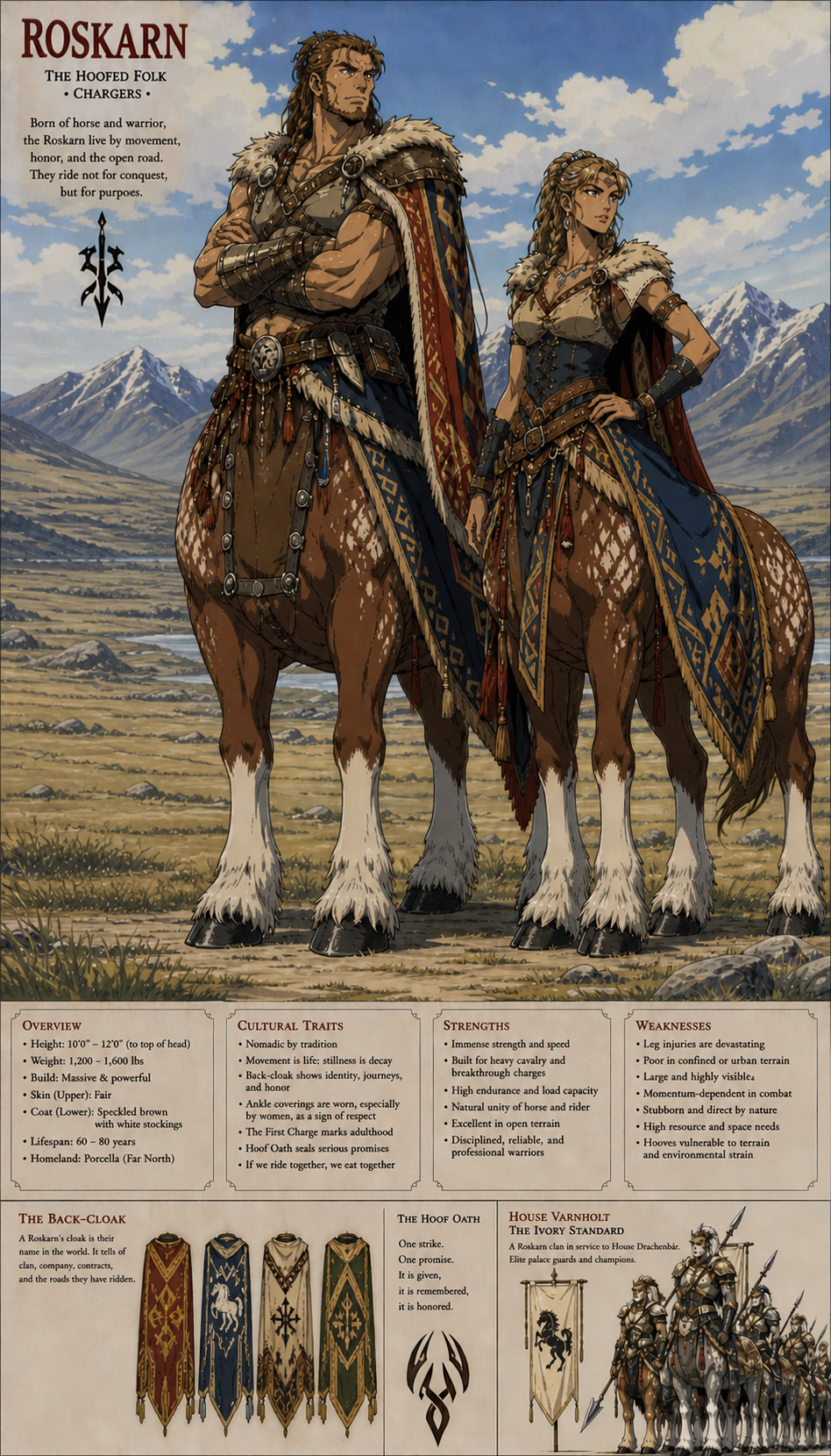
An average Roskarn is a massive centaurian figure, standing over ten feet tall, with the powerful lower body of a draft horse and the muscular torso of a seasoned warrior. Their equine half—most often a speckled brown with white stockings—carries them with steady, ground-shaking confidence, while their human half remains upright, controlled, and always ready to act.
They move with a sense of constant purpose, whether at rest or in motion, as if stillness is only temporary. Their back-cloak drapes across their body in bold colors and patterns, marking who they are, where they’ve ridden, and what they’ve survived. Even unarmed, they give the impression of contained momentum—something that could surge forward at any moment.
To stand near a Roskarn is to feel it immediately:
this is not just a person—this is movement, weight, and intent given form
the hoofed folk, Chargers, The mounted warriors, The Roskarn Companies
Looks
The Roskarn body is defined by a powerful fusion of two forms:
the mass and endurance of a warhorse, combined with the control and strength of a human torso
They are not simply half one and half the other—
they are built as a single, unified structure designed for movement, impact, and sustained combat.
Lower Body – Warhorse Foundation
The lower half of a Roskarn resembles that of a large Clydesdale-type horse, but often even more robust.
It is characterized by:
massive musculature in the shoulders and hindquarters
thick, powerful legs built for load-bearing and acceleration
broad hooves suited for stability and impact
This portion of their body is built for:
carrying significant weight (armor, weapons, rider-equivalent loads)
charging at high speed
and maintaining endurance over long distances
Their movement is:
heavy but controlled
capable of explosive bursts
and sustained over time
Upper Body – Human Strength and Control
Where a horse’s neck would normally be, the Roskarn instead possess a fully formed human torso.
This upper body tends toward:
muscular builds in males (broad chest, thick arms, powerful shoulders)
more lithe but still strong builds in females (lean muscle, flexibility, endurance)
The upper body provides:
weapon handling
directional control
and fine motor function
This creates a being capable of:
both brute force and precise action simultaneously
Integration of Forms
The most important aspect of Roskarn body shape is not the halves themselves—
but how well they function together.
Their structure allows for:
seamless coordination between upper and lower body
the ability to fight while moving at speed
and maintaining balance during impact or rapid direction changes
Unlike a mounted rider, a Roskarn does not need to:
compensate for a separate animal
They are:
their own mount and rider in one
Sexual Dimorphism
There is visible difference between male and female Roskarn:
Males tend to be:
larger overall
heavier in both upper and lower body
more visibly muscular
Females tend to be:
slightly smaller in frame
more streamlined
with a more lithe upper body while retaining powerful lower strength
These differences affect:
appearance
but not fundamental capability
Scale and Presence
Even before considering height or weight, Roskarn bodies convey:
mass
power
and momentum
They are not built for subtlety.
They are built for:
presence, impact, and movement across open ground
Core Body Identity
The Roskarn body is not divided—
it is unified around one purpose:
to move fast, hit hard, and keep going
Roskarn coloration is defined by a clear duality:
human skin above
equine coat below
These are not mismatched—
they are harmonized, forming a single, recognizable identity.
Upper Body – Human Skin
The Roskarn upper body is typically:
fair-skinned
with tones ranging from:
pale ivory
light peach
to lightly sun-touched beige in more traveled individuals
Because many Roskarn spend time outdoors, especially during campaigns, their skin may show:
weathering
tanning
or light freckling
However, their baseline complexion tends to remain:
on the fairer end of the human spectrum
Lower Body – Equine Coat
The lower half displays a coat pattern reminiscent of large draft horses, with distinct traits:
Base Coat
Most commonly:
brown (ranging from rich chestnut to darker earthy tones)
Less commonly:
darker brown nearing black
or lighter, muted variations
Speckled Patterning
A defining feature of Roskarn coats is the presence of:
intermixed white hairs throughout the base coat
This creates a:
speckled
slightly mottled
or softly textured visual appearance
Rather than clean, solid color, their coats tend to look:
lived-in and naturally varied
White Stockings
Another consistent trait is:
white stockings extending up the legs
These typically:
reach toward the knees and hocks
vary slightly in height and edge definition
contrast clearly with the darker base coat
This pattern is widely recognized across Roskarn populations.
Visual Cohesion
Despite being a dual-bodied species, Roskarn coloration is not chaotic.
There is a strong sense of:
cohesion between upper and lower halves
natural blending of tones
and consistency within individuals
They do not appear:
mismatched
or artificially divided
They appear:
whole
Variation
While variation exists, it is generally:
moderate
and centered around coat tone and speckling density
Major differences tend to be:
darker vs lighter brown coats
heavier vs lighter speckling
variation in stocking height
Core Color Identity
Roskarn coloration reflects:
strength, natural patterning, and a unified form between human and horse
Roskarn are massive in scale, with most individuals standing between:
10 to 12 feet tall
This measurement is taken from:
the ground (hoof)
to the top of the head (not including raised arms or weapons)
How Their Height Reads
Because of their centaur form, Roskarn height is experienced differently than that of humanoids.
Their size comes from:
the full height of a large draft horse body
plus the added height of a human torso
This creates a figure that:
towers over most races
commands space naturally
and is visible even across crowded or open terrain
Even at the lower end (~10 feet), a Roskarn feels:
imposing and difficult to ignore
Height Distribution
Most Roskarn fall within:
10’0” – 11’0” → common range
11’0” – 12’0” → larger, more imposing individuals
Those approaching or exceeding 12 feet are:
rare
and often associated with particularly strong bloodlines or warrior reputations
Sex-Based Differences
There is some variation between sexes:
Males tend to be:
taller on average
broader in frame
and more physically imposing
Females tend to be:
slightly shorter
more streamlined in upper body
but still extremely large compared to most races
The difference is noticeable—
but both remain:
well above humanoid scale
Mounted Perspective
Because Roskarn are effectively:
their own mount
their height places their upper body at a level comparable to:
a rider seated on a very large warhorse
This gives them advantages in:
reach
battlefield visibility
and striking downward angles in combat
Environmental Presence
In most environments, Roskarn height means they:
dominate interiors unless spaces are built for them
are easily seen at distance
and naturally control physical space in social settings
Their size is not something they can:
minimize
or conceal
Core Height Identity
Roskarn are not just tall—
they are:
large in a way that combines height, length, and mass into a single overwhelming presence
Roskarn typically weigh between:
1,600 to 2,000 pounds (1.6–2 tons)
This weight reflects not just size—
but dense muscle, heavy bone structure, and full-body integration of two powerful forms.
Where the Weight Comes From
The majority of a Roskarn’s mass comes from their equine lower body, which is comparable to—though often larger and more robust than—a Clydesdale horse.
This includes:
thick, load-bearing legs
powerful hindquarters
and a broad, reinforced torso
The human upper body, while smaller in proportion, still contributes:
significant muscle mass
dense structure
and additional weight for combat and control
Together, this creates a being that is:
not just large—but heavily built in every part
Weight Distribution
Roskarn weight is naturally distributed for:
balance
mobility
and sustained movement
The lower body carries:
the majority of mass
and all locomotion force
While the upper body provides:
control
direction
and striking power
This distribution allows them to:
move efficiently despite their size
and maintain stability even during high-speed movement or impact
Variation Within the Range
Most Roskarn fall within:
1,600–1,800 lbs → more typical individuals
1,800–2,000 lbs → larger or heavily built individuals
Factors influencing weight include:
muscle development
frame size
and overall conditioning
Sex-Based Differences
Males tend to be:
heavier
more densely muscled
and closer to the upper end of the range
Females tend to be:
slightly lighter
more streamlined in upper body
but still extremely heavy compared to most races
Even lighter Roskarn remain:
far beyond humanoid weight standards
Impact and Presence
At this weight, Roskarn:
are extremely difficult to physically stop
generate tremendous force when moving at speed
and can cause significant impact simply through momentum
Their movement carries:
weight
intention
and consequence
Core Weight Identity
Roskarn weight is not just mass—
it is:
momentum, power, and the ability to carry force through motion
Centaur Form
The defining silhouette
The most immediate and unmistakable feature of a Roskarn is their centaur body:
a full horse body with a human torso where the neck and head would be
This creates a form that is:
long
tall
and massively present
They are not mistaken for anything else.
At a glance, they are:
their own mount, their own rider, and their own weapon platform
Massive, Draft-Horse Build
Their lower body resembles a large Clydesdale, giving them:
thick, powerful legs
broad hooves
and immense muscular mass
This is not a light or agile horse form—
it is built for:
strength
impact
and sustained movement
Their size alone makes them:
imposing
and physically dominant in open space
Height and Elevated Torso
With heights reaching 10–12 feet, their human torso sits far above most humanoids.
This gives them:
natural reach advantage
battlefield visibility
and a commanding presence in any setting
When facing others, they are often:
literally looking down on them
Powerful Upper Body
Their human half is not decorative—it is:
muscular
functional
and combat-capable
They possess:
strong arms for weapon use
broad shoulders (especially in males)
and controlled upper-body strength
This allows them to:
strike with force
handle heavy weapons
and fight effectively while moving
Speckled Equine Coat with White Stockings
Their lower body is marked by:
a brown base coat (most common)
interspersed white hairs creating a speckled appearance
and white stockings rising to the knees and hocks
This patterning gives them a look that is:
distinct
recognizable
and consistent across their people
Back-Cloak (Cultural Feature, Visually Prominent)
While not biological, one of the most visually defining features of a Roskarn is their back-cloak.
Draped across their equine body, it is:
large
vibrant
and highly detailed
It represents:
lineage
company affiliation
personal history
and contracts served
To an observer, a Roskarn’s cloak is often as important as their body in identifying them.
Roskarn hooves are:
large
durable
and capable of delivering significant force
They are used for:
movement
but also as weapons when needed
A strike from a Roskarn’s hooves can be:
devastating
Integrated Movement
Unlike a rider and mount, Roskarn move as:
a single, unified body
Their motion is:
coordinated
efficient
and controlled
They can:
run
turn
and strike
without needing to compensate for a separate entity.
Commanding Spatial Presence
Because of their size and length, Roskarn naturally:
take up space
control movement around them
and dominate physical environments
In confined areas, this becomes even more noticeable.
Armor Compatibility
Roskarn are often seen equipped with:
heavy barding for the lower body
reinforced upper armor
and integrated weapon systems
This enhances their already formidable appearance, turning them into:
living heavy cavalry units
Core Feature Identity
Roskarn are defined by a combination of:
scale, strength, and a unified body built for movement and impact
Roskarn show moderate, controlled variation.
They are not wildly diverse in form—
but no two are identical.
Most differences appear in:
coat pattern, proportions, and presence—rather than fundamental structure
Consistent Core Form
Across all Roskarn, several traits remain consistent:
large Clydesdale-like lower bodies
muscular human torsos
tall overall stature
powerful, unified build
This means that even with variation, all Roskarn are immediately recognizable as:
the same people
Equine Coat Variation (Primary Source of Difference)
The most noticeable variation comes from their horse-like coat.
Differences include:
shade of brown (light chestnut → deep dark brown)
density of white speckling
distribution of mixed hairs
subtle tonal shifts across the body
While brown remains the most common base, individuals can appear:
darker and more uniform
or lighter and more visibly speckled
White Stocking Variation
While white stockings are common, they vary in:
height (lower vs higher up the leg)
edge definition (sharp vs uneven boundaries)
symmetry between legs
These differences are often used to:
visually distinguish individuals
or identify lineage within close communities
Upper Body Variation
The human half shows variance similar to other humanoids, including:
muscle mass
shoulder width
torso length
and overall build
Examples include:
heavily muscled individuals built for combat
more streamlined forms suited for speed and endurance
broader vs narrower frames
Sexual Dimorphism
There are consistent but not extreme differences between sexes:
Males:
larger overall
heavier musculature
broader upper body
Females:
slightly smaller
more lithe upper frame
but still extremely powerful
These differences affect appearance more than capability.
Height and Mass Differences
While most Roskarn fall within standard ranges, some variation exists:
shorter individuals (~10 ft) appear more compact
taller individuals (~12 ft) feel especially imposing
heavier builds emphasize strength
leaner builds emphasize speed and endurance
Posture and Movement Style
Roskarn may differ in:
how they carry their upper body
stride length and rhythm
movement efficiency vs forceful gait
Some appear:
smooth and controlled
others more forceful and heavy in motion
Condition-Based Differences
Because of their size and lifestyle, physical differences can also arise from:
wear on hooves
past injuries
or long-term strain
These may subtly affect:
stance
gait
or balance
Core Variance Identity
Roskarn do not vary wildly in form—
they vary in expression of strength and pattern, not structure.
Roskarn clothing is shaped by three constant needs:
climate
mobility
and identity
Everything they wear must work with a body that is:
large, fast-moving, and always in motion
Upper Body Clothing
Human practicality in harsh climates
In their northern homeland of Porcella, Roskarn dress their upper bodies in:
heavy furs
thick layered garments
and weather-resistant materials
These are designed to:
retain heat
resist wind
and endure long migrations
Clothing is typically:
fitted enough to avoid snagging
but not restrictive to arm movement
When traveling south, this shifts to:
lighter fabrics
reduced layering
and more breathable materials
However, even in warmer climates, they rarely abandon:
practical, durable construction
Lower Body Covering
Cloaks instead of trousers
Roskarn do not wear clothing on their equine body in the same way humanoids do.
Instead, they use:
the back-cloak
This large, draped garment covers part of the horse body and serves multiple roles:
protection from weather
visual identity
and cultural expression
It is:
worn across the back and sides
often secured to avoid interference with movement
and designed to flow without tangling in the legs
The Back-Cloak (Core Cultural Garment)
The back-cloak is not optional.
It is one of the most important elements of Roskarn identity.
Each cloak represents:
lineage
company affiliation
personal history
contracts served
It is:
richly colored
patterned with meaning
and unique to the individual
Cultural rules surrounding it are strict:
it must never be stepped on
it must be repaired if damaged
losing it is worse than losing a weapon
To a Roskarn:
the cloak is who you are
Ankle Coverings
A key cultural and social marker
Roskarn often wrap their lower legs (near the “ankles” of the human perspective) in:
furs
cloth
or protective wrappings
These serve:
warmth
protection
and cultural expression
For females, this becomes especially important:
it is considered scandalous not to wear ankle coverings in public among strangers
This is not just clothing—
it is a marker of:
propriety
respect
and social awareness
Armor Integration
As a martial people, Roskarn frequently incorporate armor into their clothing.
This may include:
upper-body armor (breastplates, pauldrons, bracers)
equine barding for the lower body
reinforced cloak attachments
Armor must be:
secure at high speed
balanced across the body
and non-restrictive to movement
When fully equipped, a Roskarn becomes:
a complete heavy cavalry unit
Mobility and Fit
All Roskarn clothing is designed with:
movement in mind
minimal interference with stride
and stability at speed
Loose elements are:
controlled
secured
or intentionally shaped to flow safely
Nothing is worn that could:
tangle in the legs
shift unpredictably
or slow them down
Regional Variation
Northern Roskarn:
heavier furs
thicker cloaks
more insulation
Southern/Traveling Roskarn:
lighter fabrics
reduced layering
but never without their back-cloak
Core Clothing Identity
Roskarn clothing is not divided between fashion and function—
it is:
identity worn in a form that must survive movement, weather, and war
Traits
Roskarn strengths come from a rare combination:
the mass and momentum of a warhorse, guided by the intelligence and control of a trained warrior
They are not just strong—
they are force in motion.
Massive Physical Strength
Roskarn possess extraordinary strength derived from both halves of their body:
the equine lower body provides:
immense pulling power
explosive acceleration
and load-bearing capability
the human upper body provides:
controlled striking force
weapon handling
and precision
This allows them to:
carry heavy armor and weapons
overpower most opponents in close combat
and maintain force even under strain
Their strength is not situational—
it is:
constant and reliable
Incredible Speed
Despite their size, Roskarn are fast.
They are capable of:
rapid acceleration
sustained high-speed movement
and covering large distances efficiently
Their stride allows them to:
outpace most infantry
keep up with or exceed mounted units
and maintain speed while engaging in combat
Their movement is not just quick—
it carries:
weight and impact
Heavy Cavalry Dominance
Roskarn are naturally suited to:
heavy cavalry roles
Without needing mounts, they function as:
fully integrated cavalry units
capable of charging, striking, and maintaining formation
In this role, they excel at:
breaking enemy lines
applying overwhelming forward pressure
and controlling battlefield momentum
Few forces can withstand:
a coordinated Roskarn charge
Rapid Attack and Mobility Units
Beyond heavy impact, Roskarn are also effective in:
rapid strike groups
mobile warfare
and repositioning across the battlefield
They can:
engage quickly
disengage cleanly
and re-engage where needed
Their mobility makes them:
tactically flexible
and difficult to pin down
Unified Body (No Rider Limitation)
Unlike traditional cavalry, Roskarn:
do not rely on a separate mount
This gives them advantages in:
coordination
reaction time
and control
They never need to:
manage a separate creature
compensate for mismatched movement
or risk losing their mount
They are:
perfectly synchronized with themselves
Endurance and Load Capacity
Roskarn are capable of:
carrying heavy loads over long distances
sustaining prolonged activity
and continuing movement under stress
They are well-suited for:
long campaigns
extended travel
and sustained engagements
Reach and Elevation Advantage
With their elevated human torso, Roskarn gain:
extended reach in melee combat
improved visibility
and the ability to strike downward
This makes them effective against:
smaller opponents
dense formations
and lower-positioned targets
Psychological Impact
The presence of Roskarn on the battlefield creates:
intimidation
disruption
and fear
Their size, speed, and form make them:
visually overwhelming
and difficult to ignore
An approaching Roskarn charge is often:
felt before it is fully seen
Mercenary Discipline
Due to their long history as mercenary companies, Roskarn often possess:
battlefield experience
contract discipline
and coordinated unit tactics
They are not just powerful individually—
they are effective as:
organized, professional forces
Core Strength Identity
Roskarn strengths are built on one idea:
they bring the force of cavalry without the weakness of needing one
Roskarn weaknesses come from the same traits that make them powerful:
size, speed, and a body built like a warhorse
What gives them dominance in open battle can become a liability in the wrong conditions.
Equine Structural Vulnerability
When the body breaks, it breaks badly
Despite their strength, the Roskarn lower body follows the same structural realities as a horse.
This means:
leg injuries are critical
fractures are difficult to recover from
and mobility loss is often devastating
A damaged limb can:
remove their ability to fight
prevent movement entirely
or lead to long-term impairment
Unlike smaller humanoids, they cannot:
easily compensate
or fight effectively while injured
Size and Space Limitations
At 10–12 feet tall and over half a ton in weight, Roskarn struggle in:
confined spaces
narrow terrain
dense urban environments
They cannot easily:
enter most buildings
maneuver through tight corridors
or navigate cluttered environments
This makes them less effective in:
indoor combat
ambush-heavy terrain
or environments designed for smaller beings
High Visibility
Roskarn are:
large
loud
and difficult to conceal
They are poor at:
stealth
covert movement
or blending into surroundings
On the battlefield, this makes them:
priority targets
easy to track
and difficult to reposition unseen
Momentum Dependence
Much of Roskarn combat effectiveness relies on:
forward movement
speed
and impact
When they are:
slowed
halted
or forced into stationary combat
their advantages are reduced.
They are strongest when:
moving with purpose and force
Less so when:
pinned
boxed in
or unable to build momentum
Stubbornness
A cultural and behavioral trait
Roskarn are known for being:
stubborn
direct
and inclined toward head-on solutions
This can lead to:
choosing direct confrontation over safer alternatives
resisting tactical withdrawal
or underestimating indirect strategies
While this makes them:
reliable in a charge
and committed in battle
it can also make them:
predictable
Resource Demands
Their size requires:
large amounts of food
water
and space
Sustaining Roskarn forces can be:
logistically demanding
and difficult over long campaigns
Terrain Dependence
Roskarn perform best on:
open ground
plains
and wide terrain
They are less effective in:
dense forests
rocky or uneven terrain
swamps or unstable ground
Environments that restrict movement reduce:
speed
coordination
and effectiveness
Hoof and Load Stress
Due to their weight and activity, Roskarn are prone to:
hoof wear
stress injuries
and long-term strain
This requires:
maintenance
rest cycles
and care
Without it, performance declines.
Core Weakness Identity
Roskarn weaknesses are not subtle—
they are the natural cost of being:
large, powerful, and built for motion rather than concealment or confinement
Roskarn conditions are closely tied to:
their equine physiology
their size and weight
and their high-strain, high-mobility lifestyle
They are not fragile—
but when something goes wrong, it tends to be:
serious, structural, and difficult to ignore
Hoof Problems
A constant maintenance concern
Roskarn commonly suffer from hoof-related issues, especially due to:
long-distance travel
heavy loads
and combat stress
These problems can include:
cracking or splitting
uneven wear
bruising
or infection
Because their entire weight depends on hoof integrity, even minor issues can:
affect movement
reduce stability
or lead to further injury if untreated
To manage this, Roskarn often require:
regular inspection
trimming and shaping
and in some cases shoeing
Shoeing and Corrective Care
Some Roskarn adopt:
metal shoes
or reinforced hoof coverings
These are used to:
protect against wear
improve traction
and correct structural imbalance
However, improper shoeing can:
worsen strain
alter gait
or create long-term damage
Because of this, skilled care is highly valued.
Leg Stress and Structural Strain
Description:
Due to their weight and activity, Roskarn experience significant stress on:
joints
tendons
and bones in the lower body
Symptoms:
stiffness
reduced stride efficiency
soreness after prolonged movement
In severe cases:
stress fractures
or long-term mobility issues
Cultural Context:
Often managed through:
rest cycles
pacing
and conditioning
Ignoring early signs can lead to:
serious and sometimes permanent damage
Load Fatigue
Description:
Roskarn frequently carry:
armor
weapons
and supplies
Combined with their own body weight, this can lead to:
fatigue
overheating
and reduced endurance over time
Symptoms:
slowed movement
heavy breathing
decreased responsiveness
Context:
Most experienced Roskarn learn to:
manage their load carefully
and balance equipment with endurance
Joint Compression (Back and Shoulders)
Description:
The junction between the human torso and equine body experiences:
constant strain
especially during combat or rapid movement
Symptoms:
back pain
stiffness in the upper body
reduced flexibility
Over time:
posture may be affected
or range of motion limited
Cold Leg Stiffness
Description:
In colder climates—especially in their northern homeland—Roskarn may experience:
stiffness in lower limbs
reduced flexibility
slower reaction time
Symptoms:
tight movement
delayed acceleration
discomfort during early activity
Management:
warm coverings
movement before exertion
proper layering
Battle Impact Trauma
Description:
Due to their role as heavy cavalry, Roskarn are exposed to:
high-impact collisions
sudden stops
and violent directional shifts
Symptoms:
bruising
internal strain
temporary disorientation
In severe cases:
structural damage to limbs or joints
Core Condition Identity
Roskarn conditions are not subtle ailments—
they are the wear, strain, and damage of a body built for speed and impact under immense weight
Culture
Roskarn traditions are built around:
movement
identity
and shared action
They are a people who define themselves not by where they stay—
but by:
what they carry with them, and what they do together
Ankle Covering Tradition
Modesty, identity, and social boundary
Among Roskarn, especially women, ankle coverings are culturally significant.
These coverings:
are worn around the lower legs
made from cloth, leather, or fur
and maintained with care
For women, it is considered:
scandalous to appear without ankle coverings among strangers
This is not merely about modesty—
it is about:
signaling respect
defining personal boundaries
and distinguishing familiarity from formality
Among family or trusted company, expectations may relax—
but in public, the rule is clear.
Nomadic Tradition
Movement as a way of life
Roskarn are traditionally nomadic, though this manifests differently by region.
Northern Roskarn (Porcella):
follow herd animals
move with seasonal patterns
and migrate across known routes
Southern/Traveling Roskarn:
follow conflict and contracts
move where work and war take them
and operate as mobile companies
In both cases, movement is not temporary—
it is:
a defining constant
The Back-Cloak as Identity
Wearing your life openly
The back-cloak is one of the most important traditions in Roskarn culture.
It is not just clothing.
It represents:
lineage
company affiliation
contracts served
and personal history
Each cloak is:
unique
patterned with meaning
and deeply personal
Cultural Rules:
A cloak is never stepped on by another Roskarn
A torn cloak must be repaired before the next contract
Losing your cloak is worse than losing a weapon
To a Roskarn:
the cloak is identity made visible
The First Charge Rite
Becoming an adult through impact
A Roskarn is not considered fully adult until they have:
taken part in a true charge
This is not symbolic—it is a real combat or contract situation where they must:
move with a unit
commit to forward momentum
and follow through without hesitation
It tests:
courage
control
and discipline under pressure
Surviving and completing the charge marks:
acceptance into full adulthood
and recognition as a capable member of their people
The Hoof Oath
Promises made with force
Serious promises among Roskarn are sealed through:
a single, deliberate hoof-strike into the ground
Never twice.
The act signifies:
commitment
finality
and personal accountability
Once made, a Hoof Oath is expected to be:
upheld
remembered
and honored without exception
Breaking one carries:
severe loss of trust
and lasting reputation damage
The Banner Meal
Shared survival, shared table
Among Roskarn companies, there is a simple but absolute rule:
if we ride together, we eat together
Meals are:
shared equally
taken as a group
and treated as a moment of unity
This reinforces:
trust
mutual reliance
and the idea that no one rides alone
Winter Mantle Exchange
Family through preparation
Before the first true winter migration, Roskarn families participate in the:
Winter Mantle Exchange
Elders gift younger members:
back-cloaks
winter mantles
ankle wrappings
These are:
practical items
but also deeply symbolic
They represent:
readiness
care
and the passing of responsibility
This is one of the most familial and intimate traditions in Roskarn culture.
Contract Honor
Roskarn mercenary culture has created a strong tradition around:
honoring contracts
fulfilling agreed terms
and maintaining reputation
A Roskarn or company that breaks contract risks:
losing future work
damaging their name
and being excluded from opportunities
Their word in contract becomes:
part of their identity, like their cloak
The Open Ground Preference
Roskarn favor:
open terrain
wide spaces
and visible engagement
Even culturally, they prefer:
direct interaction
face-to-face negotiation
and visible action
This reflects their nature as:
people meant to move, not to hide
Core Tradition Identity
Roskarn traditions revolve around:
identity carried openly, promises made visibly, and life lived in motion with others
Roskarn belief is centered on one enduring idea:
life is movement—and meaning is found in how far, how well, and with whom you travel
Their worldview blends older spiritual tradition with newer influences, but both are filtered through:
motion
purpose
and lived experience
The Evermarch
The path that never ends
Traditionally, Roskarn worship a deity known as:
The Evermarch
The Evermarch is not seen as a distant god, but as:
the embodiment of movement
the path beneath their hooves
and the force that drives all things forward
It represents:
migration
conflict
journeys
and the passage of time
To follow the Evermarch is to:
keep moving
take action
and avoid stagnation
Stillness, in this belief, is not peace—
it is:
decay
Movement as Purpose
To stop is to lose meaning
Roskarn believe that a meaningful life is one that:
continues forward
takes on new paths
and does not remain idle
This manifests in:
nomadic traditions
mercenary work
and a willingness to leave familiar ground
A Roskarn who refuses to move—physically or metaphorically—is often seen as:
diminished
or disconnected from their purpose
Earned Identity
Roskarn do not believe identity is static.
Who you are is determined by:
where you have ridden
what you have done
and what you have endured
This is reflected in traditions like:
the back-cloak
contract history
and the First Charge
Your life is not defined by origin alone—
but by:
the path you carve through it
Integration of Stanzgarian Faiths
As many Roskarn have integrated into the Stanzgarian Confederation, their beliefs have expanded.
Some now:
adopt or incorporate Stanzgarian gods
participate in shared religious practices
or blend traditions
However, even when adopting new beliefs, they tend to interpret them through:
movement
action
and practical meaning
They do not abandon the Evermarch easily—
they adapt around it.
Conflict as a Natural State
Roskarn do not view conflict as inherently negative.
Instead, it is seen as:
a natural part of life
a proving ground
and a source of growth
This belief supports their tendency to:
follow war as mercenaries
engage directly
and seek purpose in struggle
Peace is not rejected—
but it is rarely seen as permanent.
The Value of Shared Paths
While individual strength matters, Roskarn also believe in:
riding together
sharing burdens
and collective experience
This is reflected in:
the Banner Meal
company structures
and contract loyalty
A path traveled alone is valid—
but a path shared is:
stronger
Promise as Path Commitment
Promises—especially Hoof Oaths—are not just agreements.
They are seen as:
commitments to a path
decisions that shape the future
Breaking a promise is not just dishonorable—
it is:
abandoning the road you chose
Disdain for Stagnation
Roskarn tend to distrust:
those who remain in one place too long
those who avoid risk
or those who seek comfort over action
This is where insults like:
“stable-born”
gain meaning—
implying someone who has:
never been tested
never truly moved
and never proven themselves
Core Belief Identity
Roskarn beliefs are not about stillness or certainty—
they are about:
movement, action, and the meaning found in the journey itself
Roskarn governance is decentralized, mobile, and periodic.
They are not a people of fixed capitals or constant centralized rule.
Instead, they govern through:
family authority in the present, and collective decision at set moments in time
Clan and Family Authority
Rule where you ride
At the most immediate level, Roskarn are governed by:
family groups
clans
and company structures
Each group:
makes its own decisions
manages its own members
and governs according to its needs
Leadership within a clan is typically based on:
experience
capability
and the ability to lead in motion
This creates a system where authority is:
local
practical
and constantly tested
Autonomy as Default
There is no permanent, overarching ruler for all Roskarn.
Instead:
clans operate independently
companies act according to contract
and families maintain internal control
This independence allows Roskarn to:
adapt quickly
move freely
and avoid rigid political structures
The Fifteen-Year Gathering
When the people become one
Roughly every fifteen years, many Roskarn clans gather in a large, rare assembly.
This gathering is used to decide:
land distribution in their northern homelands
migration boundaries
and immutable rules of war among themselves
These decisions are:
binding
respected across clans
and not easily changed
This event acts as:
their closest equivalent to a central government
Rules of War
Conflict, but controlled
Because Roskarn are:
martial
mobile
and often armed
they maintain agreed-upon rules governing:
inter-clan conflict
acceptable conduct
and limits of violence among themselves
These rules are set during the great gatherings and serve to:
prevent unnecessary destruction
maintain long-term stability
and preserve unity despite independence
Company Governance (Mercenary Influence)
Many Roskarn operate within mercenary companies, which introduce additional structure.
These companies may have:
ranked leadership
contract obligations
and internal discipline systems
While not replacing clan authority, they overlay it, creating:
dual structures of loyalty
to both family and company
Integration with the Stanzgarian Confederation
As part of or associated with the Stanzgarian Confederation, some Roskarn:
interact with external governance systems
operate under foreign laws while on contract
or maintain diplomatic relationships
However, they rarely:
abandon their internal structures
Instead, they:
interface with outside systems without becoming them
Strengths and Limitations
Strengths:
highly adaptable
resistant to centralized collapse
allows for strong local leadership
Limitations:
lack of constant unified direction
slower large-scale coordination outside gatherings
potential for inter-clan tension
Core Government Identity
Roskarn governance is not about constant control—
it is about:
independence in motion, and unity only when it is needed
Roskarn technology is defined by a simple approach:
if it works while moving, it is worth using
They are not isolationist or resistant to change—
they are selective adopters, taking in outside technologies and reshaping them to fit:
their bodies
their mobility
and their role as warriors and mercenaries
Adoption of Foreign Technology
Use what proves itself
Roskarn have readily integrated technologies from:
the Stanzgarian Confederation
and dwarven craftsmanship traditions
This includes:
advanced metallurgy
refined weapons and armor
mechanical tools
and early magitech systems where accessible
They do not adopt blindly.
They keep what:
survives field use
holds up under motion
and can be maintained without constant infrastructure
Mastery of Metalcraft
Heavy bodies, heavy equipment
Roskarn make extensive use of:
dwarven-influenced metalwork
reinforced armor
and durable weapon systems
Their equipment tends to be:
heavier than what most humanoids can use
built for impact and longevity
and designed to function under extreme strain
This applies especially to:
barding for their equine bodies
upper-body armor
and large-scale weapons
Gunpowder Weapons
Force amplified at range
Roskarn are particularly fond of gunpowder-based weaponry.
This includes:
rifles
pistols
and mounted or supported firearms
These weapons suit them because they:
complement their elevated firing position
allow engagement before a charge
and add impact to already powerful assaults
They often integrate firearms into:
cavalry-style tactics
or rapid strike engagements
Mobility-Adapted Equipment
All Roskarn technology must account for:
constant movement
This means their tools and systems are:
secured against high-speed travel
balanced across their body
and resistant to shifting or loss
Examples include:
harness-mounted equipment
stabilized weapon mounts
and gear designed for quick access while moving
Anything that:
interferes with stride
or destabilizes balance
is rejected.
Field Durability and Repair
Roskarn favor technology that can be:
repaired in the field
maintained without specialized facilities
and kept functional under harsh conditions
They are skilled at:
patchwork repairs
reinforcement
and extending the life of equipment
Like many mobile peoples, they value:
function over perfection
Limited Fixed Infrastructure
Because of their nomadic tendencies, Roskarn do not invest heavily in:
large, permanent industrial systems
or fixed production centers
Instead, they rely on:
mobile resources
external trade
and contracted supply lines
This limits large-scale production but supports:
flexibility
and independence
Specialized Military Integration
Some Roskarn groups—such as those in service to powerful houses like the Drachenbär—use highly specialized equipment, including:
enchanted weapons
integrated spell systems
and hybrid magitech armaments
For example:
the Ivory Standard employs
light spell cannons
and enchanted halberds
This represents the upper end of Roskarn technological integration.
Core Technological Identity
Roskarn technology is not about invention—
it is about:
adopting, adapting, and surviving with tools that can keep up with them
Roskarn occupations are shaped by:
mobility
physical capability
and a culture built around conflict and movement
Like any established people, they maintain clear specialization and defined roles both at home and abroad.
At home, they perform the full range of structured societal work.
Abroad, they are known for one thing above all:
they are among the finest mercenaries in the world
Domestic Roles
Structured work within a mobile society
Within their homelands—especially in northern Porcella—Roskarn maintain well-defined occupations necessary to sustain their people.
These include:
herders and animal wardens managing migratory herds
campwrights and builders responsible for mobile settlement structures
provisioners and cooks handling food preparation and supply
smiths, leatherworkers, and armorers maintaining weapons, barding, and equipment
clothworkers crafting and maintaining cloaks, mantles, and wrappings
These roles are:
specialized
skill-based
and often tied to family or clan tradition
Roskarn society functions through:
people knowing their role and performing it well
Mercenary Companies
Their defining role abroad
Outside their homeland, Roskarn are most famous as:
elite mercenary forces
These companies operate across the continent, taking contracts for:
warfare
protection
and strategic engagements
They are highly valued for:
heavy cavalry capability
battlefield reliability
and decisive impact
Roskarn mercenary companies are known to be:
professional
disciplined
and contract-bound
A company’s reputation is:
as important as its strength
Heavy Cavalry and Shock Troops
Roskarn excel in roles such as:
front-line breakers
charging units
and rapid assault forces
They are deployed to:
shatter enemy formations
exploit openings
and apply overwhelming pressure
Their presence often marks:
the moment a battle turns
Company Officers and Contract Leaders
Within mercenary structures, some Roskarn serve as:
commanders
contract negotiators
and tactical leaders
They manage:
company movement
contract execution
and battlefield decisions
Leadership is earned through:
experience
success
and proven judgment
Scouts and Rapid Messengers
Roskarn also serve as:
long-distance scouts
battlefield couriers
and rapid-response units
Their speed allows them to:
carry information quickly
move between forces
and maintain communication over large distances
Blacksmiths and Equipment Specialists
Roskarn craftsmen maintain and repair:
weapons
armor
barding
and structural equipment
Their work emphasizes:
durability
function
and reliability under strain
Guards and Elite Retainers
Some Roskarn serve as:
elite guards
personal retainers
and palace defenders
A notable example:
House Varnholt, serving as The Ivory Standard under the Drachenbär
These roles involve:
high-level protection
advanced equipment use
and strict discipline
Service-Based Economy Roles
Roskarn abroad primarily trade in:
service rather than goods
They are paid for:
combat ability
protection
and contract fulfillment
Their economic presence is built on:
what they can do—not what they produce
Core Occupational Identity
Roskarn occupations reflect a structured society in motion:
defined roles at home, and professional force abroad
Roskarn economics are built on a dual foundation:
barter and resource exchange at home
and high-value contract income abroad
They are not a purely local economy, nor a fully integrated industrial one.
They exist between the two, sustained by:
what they produce for themselves—and what they earn through force
Homeland Economy
Barter, resources, and internal exchange
Within their northern homeland of Porcella, Roskarn primarily operate through:
barter and direct exchange
This includes trade in:
food (meat, preserved goods, herd products)
crafted equipment (armor, cloaks, tools)
labor and services within the clan structure
Currency is not absent, but it is:
secondary
situational
and less central than direct value exchange
This system works because:
communities are structured
roles are specialized
and needs are clearly understood
Clan-Based Resource Control
Economic resources are typically managed at the:
family or clan level
This includes control over:
herds
territory
equipment production
and labor output
Wealth within the homeland is not measured purely in coin, but in:
livestock
equipment quality
and the strength of one’s clan
Mercenary Income
Primary source of external wealth
Outside their homeland, Roskarn generate significant wealth through:
mercenary contracts
They are paid in:
gold
goods
equipment
and sometimes land rights or privileges
These contracts can be:
short-term engagements
extended campaigns
or long-standing retainerships
Because of their effectiveness, Roskarn companies often command:
high payment relative to other forces
Wealth Flow Back to Porcella
Much of the wealth earned abroad is:
brought back to their homeland
redistributed through clans
and reinvested into their society
This wealth supports:
better equipment
improved living standards
and long-term stability
It also reinforces the importance of:
service abroad as an economic pillar
Material Acquisition and Trade
Roskarn use their earned wealth to acquire:
advanced weapons and armor
gunpowder and ammunition
crafted goods from Stanzgar and dwarven sources
Because they do not produce all advanced materials themselves, they rely on:
trade networks
contract relationships
and external suppliers
Limited Internal Industry
Due to their nomadic tendencies, Roskarn do not heavily invest in:
large-scale industry
fixed production centers
or centralized manufacturing
Instead, production remains:
localized
specialized
and mobile where possible
Reputation as Economic Capital
For Roskarn, reputation is currency.
A company or individual known for:
honoring contracts
performing effectively
and maintaining discipline
will receive:
better offers
higher pay
and more consistent work
Losing reputation can mean:
losing access to income entirely
Core Economic Identity
Roskarn economics are not based on accumulation alone—
they are built on:
earning wealth through action, and sustaining life through structured exchange
Roast Vegetable Dishes with Stuffed Meats
Hearty, efficient, and built to sustain
A staple and widely favored Roskarn dish consists of:
large roasted vegetables stuffed with meat
This typically involves:
hollowed root vegetables
or thick, durable produce capable of holding structure during cooking
These are then filled with:
seasoned meats
fats
and occasionally grains or herbs
The entire dish is:
roasted slowly
allowing flavors to combine
and creating a dense, nourishing meal
This type of food is valued because it is:
efficient to prepare in large quantities
easy to portion among groups
and nutritionally balanced for high-energy bodies
It is commonly served during:
camp gatherings
pre- or post-march meals
and communal company meals
Cultural Meaning:
This dish reflects Roskarn priorities:
substance, efficiency, and shared consumption
Roasted Root and Field Vegetables
Roskarn favor vegetables that are:
durable
filling
and easy to prepare in bulk
These are often:
roasted over open flame
cooked in large batches
or packed for later consumption
Common choices include:
root vegetables
hardy greens
and dense, starchy plants
Meat-Heavy Diet Components
Due to their size and energy demands, Roskarn consume:
significant quantities of meat
This includes:
roasted cuts
stewed meats
and preserved forms for travel
Meat is often:
combined with vegetables
rather than served alone
to maintain balance and efficiency.
Travel Rations and Packed Foods
As a mobile people, Roskarn rely on foods that:
store well
carry easily
and provide sustained energy
These include:
dried meats
compact vegetable preparations
and preserved meal packs
Food must support:
movement without constant preparation
Communal Cooking Practices
Roskarn meals are often:
prepared in groups
shared across companies or families
and eaten together
This aligns with traditions like:
the Banner Meal
Food is rarely:
individualized
or isolated
Instead, it reinforces:
unity
shared effort
and collective identity
Flavor Profile
Roskarn food tends to emphasize:
rich, roasted flavors
hearty textures
and practical preparation
It is not delicate or overly complex—
it is:
filling, functional, and meant to sustain powerful bodies
Core Food Identity
Roskarn cuisine is built around:
efficiency, nourishment, and the ability to feed many strong bodies at once
History
Roskarn history is shaped less by empire and more by pressure:
pressure of land
pressure of population
and pressure from the wider world
They are a people who were not forged by conquest—
but by the decision to move outward when staying was no longer enough.
The Northern Isolation
During the Grand Empire
During the height of the old continental empire, the Roskarn of Porcella were largely:
left alone
unincorporated
and outside direct imperial control
Their northern homeland was:
distant
difficult to reach
and of limited immediate value to expansionist powers
Because of this, they maintained:
their clan structures
their nomadic traditions
and their independence
While other peoples were:
conquered
integrated
or reshaped by the empire
the Roskarn remained:
untouched and self-defined
The Pressure of the North
When staying became a problem
After the fall of the empire, conditions in the north began to change.
Over time, Porcella faced increasing strain from:
population growth
herd limitations
and resource constraints
The land could still sustain them—
but not without:
crowding
competition
and eventual instability
This created a fundamental problem:
too many Roskarn for the land to comfortably hold
The First Southward Companies
Movement becomes solution
Rather than collapse inward or fracture, the Roskarn chose a different path:
they began sending their warriors south
These early groups were not yet formal mercenary companies, but they served similar roles:
offering martial strength
hiring themselves to foreign powers
and bringing back wealth and resources
This solved multiple problems at once:
reduced population pressure
brought in external goods and wealth
and created new opportunities
This decision marked a turning point:
movement became economic strategy
The Rise of the Roskarn Companies
From migration to identity
Over time, these traveling warbands became:
structured
professional
and widely recognized
The Roskarn were no longer just northern nomads—
they became known across the continent as:
elite mercenary forces
Their reputation was built on:
reliability
discipline
and overwhelming battlefield presence
This era established:
their economic model
their external identity
and their long-term role in continental politics
Integration with the Stanzgarian Sphere
From outsiders to participants
As their presence spread, many Roskarn began interacting more heavily with:
the Stanzgarian Confederation
its markets
and its wars
This led to:
adoption of new technologies
partial integration into foreign systems
and exposure to new beliefs
However, they did not lose their identity.
Instead, they became:
a people who operate within the world, without being absorbed by it
The Establishment of Long-Term Contracts
As their reputation solidified, Roskarn companies began securing:
long-term contracts
standing retainers
and elite positions within foreign powers
A key example:
House Varnholt
serving as The Ivory Standard under the Drachenbär
This marked a shift from:
temporary service
to
institutionalized presence abroad
The Modern Era – A People in Motion
Today, Roskarn exist in a balance between:
homeland tradition
and external engagement
They:
maintain their clan structures
continue their periodic gatherings
and sustain their nomadic roots
While also:
operating across the continent
influencing wars and politics
and bringing wealth back north
They are not defined by a single land anymore—
but by:
the paths they travel between them
Core Historical Identity
Roskarn history is not about being conquered or conquering—
it is about:
choosing to move outward, and building identity through what they do beyond their homeland
Notes
Insult – “Stable-Born”
Calling a Roskarn:
“stable-born”
is a serious insult.
It implies that the individual is:
soft
untested
overly comfortable
or lacking real experience
The phrase suggests someone who has:
never truly ridden far
never faced meaningful conflict
and never proven themselves outside controlled conditions
In Roskarn culture, this cuts directly against their core values of:
movement, experience, and earned identity
House Varnholt – The Ivory Standard
The Drachenbär maintain a permanent Roskarn presence within their inner power structure.
A full Roskarn clan—House Varnholt—is kept on retainer as elite palace guards.
Their company is known as:
The Ivory Standard
They serve as:
heavy palace guards
elite defenders of the Drachenbär seat of power
and a visible symbol of strength and prestige
Equipment of the Ivory Standard
Members of the Ivory Standard are equipped with:
light spell cannons
enchanted halberds
and reinforced armor suitable for both palace defense and open combat
This places them among the most heavily equipped Roskarn forces in existence.
Cultural Significance
The presence of House Varnholt in such a role reflects several important truths:
Roskarn are trusted in high-security positions when bound by contract
their reputation extends into the highest levels of power
and their integration into foreign systems can reach elite status without loss of identity
At the same time, it reinforces:
their identity as a people whose strength is hired—but never owned
Overview
Details about this race's overview
Roskarn
An average Roskarn is a massive centaurian figure, standing over ten feet tall, with the powerful lower body of a draft horse and the muscular torso of a seasoned warrior. Their equine half—most often a speckled brown with white stockings—carries them with steady, ground-shaking confidence, while their human half remains upright, controlled, and always ready to act.
They move with a sense of constant purpose, whether at rest or in motion, as if stillness is only temporary. Their back-cloak drapes across their body in bold colors and patterns, marking who they are, where they’ve ridden, and what they’ve survived. Even unarmed, they give the impression of contained momentum—something that could surge forward at any moment.
To stand near a Roskarn is to feel it immediately:
this is not just a person—this is movement, weight, and intent given form
the hoofed folk, Chargers, The mounted warriors, The Roskarn Companies
Looks
Details about this race's looks
The Roskarn body is defined by a powerful fusion of two forms:
the mass and endurance of a warhorse, combined with the control and strength of a human torso
They are not simply half one and half the other—
they are built as a single, unified structure designed for movement, impact, and sustained combat.
Lower Body – Warhorse Foundation
The lower half of a Roskarn resembles that of a large Clydesdale-type horse, but often even more robust.
It is characterized by:
massive musculature in the shoulders and hindquarters
thick, powerful legs built for load-bearing and acceleration
broad hooves suited for stability and impact
This portion of their body is built for:
carrying significant weight (armor, weapons, rider-equivalent loads)
charging at high speed
and maintaining endurance over long distances
Their movement is:
heavy but controlled
capable of explosive bursts
and sustained over time
Upper Body – Human Strength and Control
Where a horse’s neck would normally be, the Roskarn instead possess a fully formed human torso.
This upper body tends toward:
muscular builds in males (broad chest, thick arms, powerful shoulders)
more lithe but still strong builds in females (lean muscle, flexibility, endurance)
The upper body provides:
weapon handling
directional control
and fine motor function
This creates a being capable of:
both brute force and precise action simultaneously
Integration of Forms
The most important aspect of Roskarn body shape is not the halves themselves—
but how well they function together.
Their structure allows for:
seamless coordination between upper and lower body
the ability to fight while moving at speed
and maintaining balance during impact or rapid direction changes
Unlike a mounted rider, a Roskarn does not need to:
compensate for a separate animal
They are:
their own mount and rider in one
Sexual Dimorphism
There is visible difference between male and female Roskarn:
Males tend to be:
larger overall
heavier in both upper and lower body
more visibly muscular
Females tend to be:
slightly smaller in frame
more streamlined
with a more lithe upper body while retaining powerful lower strength
These differences affect:
appearance
but not fundamental capability
Scale and Presence
Even before considering height or weight, Roskarn bodies convey:
mass
power
and momentum
They are not built for subtlety.
They are built for:
presence, impact, and movement across open ground
Core Body Identity
The Roskarn body is not divided—
it is unified around one purpose:
to move fast, hit hard, and keep going
Roskarn coloration is defined by a clear duality:
human skin above
equine coat below
These are not mismatched—
they are harmonized, forming a single, recognizable identity.
Upper Body – Human Skin
The Roskarn upper body is typically:
fair-skinned
with tones ranging from:
pale ivory
light peach
to lightly sun-touched beige in more traveled individuals
Because many Roskarn spend time outdoors, especially during campaigns, their skin may show:
weathering
tanning
or light freckling
However, their baseline complexion tends to remain:
on the fairer end of the human spectrum
Lower Body – Equine Coat
The lower half displays a coat pattern reminiscent of large draft horses, with distinct traits:
Base Coat
Most commonly:
brown (ranging from rich chestnut to darker earthy tones)
Less commonly:
darker brown nearing black
or lighter, muted variations
Speckled Patterning
A defining feature of Roskarn coats is the presence of:
intermixed white hairs throughout the base coat
This creates a:
speckled
slightly mottled
or softly textured visual appearance
Rather than clean, solid color, their coats tend to look:
lived-in and naturally varied
White Stockings
Another consistent trait is:
white stockings extending up the legs
These typically:
reach toward the knees and hocks
vary slightly in height and edge definition
contrast clearly with the darker base coat
This pattern is widely recognized across Roskarn populations.
Visual Cohesion
Despite being a dual-bodied species, Roskarn coloration is not chaotic.
There is a strong sense of:
cohesion between upper and lower halves
natural blending of tones
and consistency within individuals
They do not appear:
mismatched
or artificially divided
They appear:
whole
Variation
While variation exists, it is generally:
moderate
and centered around coat tone and speckling density
Major differences tend to be:
darker vs lighter brown coats
heavier vs lighter speckling
variation in stocking height
Core Color Identity
Roskarn coloration reflects:
strength, natural patterning, and a unified form between human and horse
Roskarn are massive in scale, with most individuals standing between:
10 to 12 feet tall
This measurement is taken from:
the ground (hoof)
to the top of the head (not including raised arms or weapons)
How Their Height Reads
Because of their centaur form, Roskarn height is experienced differently than that of humanoids.
Their size comes from:
the full height of a large draft horse body
plus the added height of a human torso
This creates a figure that:
towers over most races
commands space naturally
and is visible even across crowded or open terrain
Even at the lower end (~10 feet), a Roskarn feels:
imposing and difficult to ignore
Height Distribution
Most Roskarn fall within:
10’0” – 11’0” → common range
11’0” – 12’0” → larger, more imposing individuals
Those approaching or exceeding 12 feet are:
rare
and often associated with particularly strong bloodlines or warrior reputations
Sex-Based Differences
There is some variation between sexes:
Males tend to be:
taller on average
broader in frame
and more physically imposing
Females tend to be:
slightly shorter
more streamlined in upper body
but still extremely large compared to most races
The difference is noticeable—
but both remain:
well above humanoid scale
Mounted Perspective
Because Roskarn are effectively:
their own mount
their height places their upper body at a level comparable to:
a rider seated on a very large warhorse
This gives them advantages in:
reach
battlefield visibility
and striking downward angles in combat
Environmental Presence
In most environments, Roskarn height means they:
dominate interiors unless spaces are built for them
are easily seen at distance
and naturally control physical space in social settings
Their size is not something they can:
minimize
or conceal
Core Height Identity
Roskarn are not just tall—
they are:
large in a way that combines height, length, and mass into a single overwhelming presence
Roskarn typically weigh between:
1,600 to 2,000 pounds (1.6–2 tons)
This weight reflects not just size—
but dense muscle, heavy bone structure, and full-body integration of two powerful forms.
Where the Weight Comes From
The majority of a Roskarn’s mass comes from their equine lower body, which is comparable to—though often larger and more robust than—a Clydesdale horse.
This includes:
thick, load-bearing legs
powerful hindquarters
and a broad, reinforced torso
The human upper body, while smaller in proportion, still contributes:
significant muscle mass
dense structure
and additional weight for combat and control
Together, this creates a being that is:
not just large—but heavily built in every part
Weight Distribution
Roskarn weight is naturally distributed for:
balance
mobility
and sustained movement
The lower body carries:
the majority of mass
and all locomotion force
While the upper body provides:
control
direction
and striking power
This distribution allows them to:
move efficiently despite their size
and maintain stability even during high-speed movement or impact
Variation Within the Range
Most Roskarn fall within:
1,600–1,800 lbs → more typical individuals
1,800–2,000 lbs → larger or heavily built individuals
Factors influencing weight include:
muscle development
frame size
and overall conditioning
Sex-Based Differences
Males tend to be:
heavier
more densely muscled
and closer to the upper end of the range
Females tend to be:
slightly lighter
more streamlined in upper body
but still extremely heavy compared to most races
Even lighter Roskarn remain:
far beyond humanoid weight standards
Impact and Presence
At this weight, Roskarn:
are extremely difficult to physically stop
generate tremendous force when moving at speed
and can cause significant impact simply through momentum
Their movement carries:
weight
intention
and consequence
Core Weight Identity
Roskarn weight is not just mass—
it is:
momentum, power, and the ability to carry force through motion
Centaur Form
The defining silhouette
The most immediate and unmistakable feature of a Roskarn is their centaur body:
a full horse body with a human torso where the neck and head would be
This creates a form that is:
long
tall
and massively present
They are not mistaken for anything else.
At a glance, they are:
their own mount, their own rider, and their own weapon platform
Massive, Draft-Horse Build
Their lower body resembles a large Clydesdale, giving them:
thick, powerful legs
broad hooves
and immense muscular mass
This is not a light or agile horse form—
it is built for:
strength
impact
and sustained movement
Their size alone makes them:
imposing
and physically dominant in open space
Height and Elevated Torso
With heights reaching 10–12 feet, their human torso sits far above most humanoids.
This gives them:
natural reach advantage
battlefield visibility
and a commanding presence in any setting
When facing others, they are often:
literally looking down on them
Powerful Upper Body
Their human half is not decorative—it is:
muscular
functional
and combat-capable
They possess:
strong arms for weapon use
broad shoulders (especially in males)
and controlled upper-body strength
This allows them to:
strike with force
handle heavy weapons
and fight effectively while moving
Speckled Equine Coat with White Stockings
Their lower body is marked by:
a brown base coat (most common)
interspersed white hairs creating a speckled appearance
and white stockings rising to the knees and hocks
This patterning gives them a look that is:
distinct
recognizable
and consistent across their people
Back-Cloak (Cultural Feature, Visually Prominent)
While not biological, one of the most visually defining features of a Roskarn is their back-cloak.
Draped across their equine body, it is:
large
vibrant
and highly detailed
It represents:
lineage
company affiliation
personal history
and contracts served
To an observer, a Roskarn’s cloak is often as important as their body in identifying them.
Roskarn hooves are:
large
durable
and capable of delivering significant force
They are used for:
movement
but also as weapons when needed
A strike from a Roskarn’s hooves can be:
devastating
Integrated Movement
Unlike a rider and mount, Roskarn move as:
a single, unified body
Their motion is:
coordinated
efficient
and controlled
They can:
run
turn
and strike
without needing to compensate for a separate entity.
Commanding Spatial Presence
Because of their size and length, Roskarn naturally:
take up space
control movement around them
and dominate physical environments
In confined areas, this becomes even more noticeable.
Armor Compatibility
Roskarn are often seen equipped with:
heavy barding for the lower body
reinforced upper armor
and integrated weapon systems
This enhances their already formidable appearance, turning them into:
living heavy cavalry units
Core Feature Identity
Roskarn are defined by a combination of:
scale, strength, and a unified body built for movement and impact
Roskarn show moderate, controlled variation.
They are not wildly diverse in form—
but no two are identical.
Most differences appear in:
coat pattern, proportions, and presence—rather than fundamental structure
Consistent Core Form
Across all Roskarn, several traits remain consistent:
large Clydesdale-like lower bodies
muscular human torsos
tall overall stature
powerful, unified build
This means that even with variation, all Roskarn are immediately recognizable as:
the same people
Equine Coat Variation (Primary Source of Difference)
The most noticeable variation comes from their horse-like coat.
Differences include:
shade of brown (light chestnut → deep dark brown)
density of white speckling
distribution of mixed hairs
subtle tonal shifts across the body
While brown remains the most common base, individuals can appear:
darker and more uniform
or lighter and more visibly speckled
White Stocking Variation
While white stockings are common, they vary in:
height (lower vs higher up the leg)
edge definition (sharp vs uneven boundaries)
symmetry between legs
These differences are often used to:
visually distinguish individuals
or identify lineage within close communities
Upper Body Variation
The human half shows variance similar to other humanoids, including:
muscle mass
shoulder width
torso length
and overall build
Examples include:
heavily muscled individuals built for combat
more streamlined forms suited for speed and endurance
broader vs narrower frames
Sexual Dimorphism
There are consistent but not extreme differences between sexes:
Males:
larger overall
heavier musculature
broader upper body
Females:
slightly smaller
more lithe upper frame
but still extremely powerful
These differences affect appearance more than capability.
Height and Mass Differences
While most Roskarn fall within standard ranges, some variation exists:
shorter individuals (~10 ft) appear more compact
taller individuals (~12 ft) feel especially imposing
heavier builds emphasize strength
leaner builds emphasize speed and endurance
Posture and Movement Style
Roskarn may differ in:
how they carry their upper body
stride length and rhythm
movement efficiency vs forceful gait
Some appear:
smooth and controlled
others more forceful and heavy in motion
Condition-Based Differences
Because of their size and lifestyle, physical differences can also arise from:
wear on hooves
past injuries
or long-term strain
These may subtly affect:
stance
gait
or balance
Core Variance Identity
Roskarn do not vary wildly in form—
they vary in expression of strength and pattern, not structure.
Roskarn clothing is shaped by three constant needs:
climate
mobility
and identity
Everything they wear must work with a body that is:
large, fast-moving, and always in motion
Upper Body Clothing
Human practicality in harsh climates
In their northern homeland of Porcella, Roskarn dress their upper bodies in:
heavy furs
thick layered garments
and weather-resistant materials
These are designed to:
retain heat
resist wind
and endure long migrations
Clothing is typically:
fitted enough to avoid snagging
but not restrictive to arm movement
When traveling south, this shifts to:
lighter fabrics
reduced layering
and more breathable materials
However, even in warmer climates, they rarely abandon:
practical, durable construction
Lower Body Covering
Cloaks instead of trousers
Roskarn do not wear clothing on their equine body in the same way humanoids do.
Instead, they use:
the back-cloak
This large, draped garment covers part of the horse body and serves multiple roles:
protection from weather
visual identity
and cultural expression
It is:
worn across the back and sides
often secured to avoid interference with movement
and designed to flow without tangling in the legs
The Back-Cloak (Core Cultural Garment)
The back-cloak is not optional.
It is one of the most important elements of Roskarn identity.
Each cloak represents:
lineage
company affiliation
personal history
contracts served
It is:
richly colored
patterned with meaning
and unique to the individual
Cultural rules surrounding it are strict:
it must never be stepped on
it must be repaired if damaged
losing it is worse than losing a weapon
To a Roskarn:
the cloak is who you are
Ankle Coverings
A key cultural and social marker
Roskarn often wrap their lower legs (near the “ankles” of the human perspective) in:
furs
cloth
or protective wrappings
These serve:
warmth
protection
and cultural expression
For females, this becomes especially important:
it is considered scandalous not to wear ankle coverings in public among strangers
This is not just clothing—
it is a marker of:
propriety
respect
and social awareness
Armor Integration
As a martial people, Roskarn frequently incorporate armor into their clothing.
This may include:
upper-body armor (breastplates, pauldrons, bracers)
equine barding for the lower body
reinforced cloak attachments
Armor must be:
secure at high speed
balanced across the body
and non-restrictive to movement
When fully equipped, a Roskarn becomes:
a complete heavy cavalry unit
Mobility and Fit
All Roskarn clothing is designed with:
movement in mind
minimal interference with stride
and stability at speed
Loose elements are:
controlled
secured
or intentionally shaped to flow safely
Nothing is worn that could:
tangle in the legs
shift unpredictably
or slow them down
Regional Variation
Northern Roskarn:
heavier furs
thicker cloaks
more insulation
Southern/Traveling Roskarn:
lighter fabrics
reduced layering
but never without their back-cloak
Core Clothing Identity
Roskarn clothing is not divided between fashion and function—
it is:
identity worn in a form that must survive movement, weather, and war
Traits
Details about this race's traits
Roskarn strengths come from a rare combination:
the mass and momentum of a warhorse, guided by the intelligence and control of a trained warrior
They are not just strong—
they are force in motion.
Massive Physical Strength
Roskarn possess extraordinary strength derived from both halves of their body:
the equine lower body provides:
immense pulling power
explosive acceleration
and load-bearing capability
the human upper body provides:
controlled striking force
weapon handling
and precision
This allows them to:
carry heavy armor and weapons
overpower most opponents in close combat
and maintain force even under strain
Their strength is not situational—
it is:
constant and reliable
Incredible Speed
Despite their size, Roskarn are fast.
They are capable of:
rapid acceleration
sustained high-speed movement
and covering large distances efficiently
Their stride allows them to:
outpace most infantry
keep up with or exceed mounted units
and maintain speed while engaging in combat
Their movement is not just quick—
it carries:
weight and impact
Heavy Cavalry Dominance
Roskarn are naturally suited to:
heavy cavalry roles
Without needing mounts, they function as:
fully integrated cavalry units
capable of charging, striking, and maintaining formation
In this role, they excel at:
breaking enemy lines
applying overwhelming forward pressure
and controlling battlefield momentum
Few forces can withstand:
a coordinated Roskarn charge
Rapid Attack and Mobility Units
Beyond heavy impact, Roskarn are also effective in:
rapid strike groups
mobile warfare
and repositioning across the battlefield
They can:
engage quickly
disengage cleanly
and re-engage where needed
Their mobility makes them:
tactically flexible
and difficult to pin down
Unified Body (No Rider Limitation)
Unlike traditional cavalry, Roskarn:
do not rely on a separate mount
This gives them advantages in:
coordination
reaction time
and control
They never need to:
manage a separate creature
compensate for mismatched movement
or risk losing their mount
They are:
perfectly synchronized with themselves
Endurance and Load Capacity
Roskarn are capable of:
carrying heavy loads over long distances
sustaining prolonged activity
and continuing movement under stress
They are well-suited for:
long campaigns
extended travel
and sustained engagements
Reach and Elevation Advantage
With their elevated human torso, Roskarn gain:
extended reach in melee combat
improved visibility
and the ability to strike downward
This makes them effective against:
smaller opponents
dense formations
and lower-positioned targets
Psychological Impact
The presence of Roskarn on the battlefield creates:
intimidation
disruption
and fear
Their size, speed, and form make them:
visually overwhelming
and difficult to ignore
An approaching Roskarn charge is often:
felt before it is fully seen
Mercenary Discipline
Due to their long history as mercenary companies, Roskarn often possess:
battlefield experience
contract discipline
and coordinated unit tactics
They are not just powerful individually—
they are effective as:
organized, professional forces
Core Strength Identity
Roskarn strengths are built on one idea:
they bring the force of cavalry without the weakness of needing one
Roskarn weaknesses come from the same traits that make them powerful:
size, speed, and a body built like a warhorse
What gives them dominance in open battle can become a liability in the wrong conditions.
Equine Structural Vulnerability
When the body breaks, it breaks badly
Despite their strength, the Roskarn lower body follows the same structural realities as a horse.
This means:
leg injuries are critical
fractures are difficult to recover from
and mobility loss is often devastating
A damaged limb can:
remove their ability to fight
prevent movement entirely
or lead to long-term impairment
Unlike smaller humanoids, they cannot:
easily compensate
or fight effectively while injured
Size and Space Limitations
At 10–12 feet tall and over half a ton in weight, Roskarn struggle in:
confined spaces
narrow terrain
dense urban environments
They cannot easily:
enter most buildings
maneuver through tight corridors
or navigate cluttered environments
This makes them less effective in:
indoor combat
ambush-heavy terrain
or environments designed for smaller beings
High Visibility
Roskarn are:
large
loud
and difficult to conceal
They are poor at:
stealth
covert movement
or blending into surroundings
On the battlefield, this makes them:
priority targets
easy to track
and difficult to reposition unseen
Momentum Dependence
Much of Roskarn combat effectiveness relies on:
forward movement
speed
and impact
When they are:
slowed
halted
or forced into stationary combat
their advantages are reduced.
They are strongest when:
moving with purpose and force
Less so when:
pinned
boxed in
or unable to build momentum
Stubbornness
A cultural and behavioral trait
Roskarn are known for being:
stubborn
direct
and inclined toward head-on solutions
This can lead to:
choosing direct confrontation over safer alternatives
resisting tactical withdrawal
or underestimating indirect strategies
While this makes them:
reliable in a charge
and committed in battle
it can also make them:
predictable
Resource Demands
Their size requires:
large amounts of food
water
and space
Sustaining Roskarn forces can be:
logistically demanding
and difficult over long campaigns
Terrain Dependence
Roskarn perform best on:
open ground
plains
and wide terrain
They are less effective in:
dense forests
rocky or uneven terrain
swamps or unstable ground
Environments that restrict movement reduce:
speed
coordination
and effectiveness
Hoof and Load Stress
Due to their weight and activity, Roskarn are prone to:
hoof wear
stress injuries
and long-term strain
This requires:
maintenance
rest cycles
and care
Without it, performance declines.
Core Weakness Identity
Roskarn weaknesses are not subtle—
they are the natural cost of being:
large, powerful, and built for motion rather than concealment or confinement
Roskarn conditions are closely tied to:
their equine physiology
their size and weight
and their high-strain, high-mobility lifestyle
They are not fragile—
but when something goes wrong, it tends to be:
serious, structural, and difficult to ignore
Hoof Problems
A constant maintenance concern
Roskarn commonly suffer from hoof-related issues, especially due to:
long-distance travel
heavy loads
and combat stress
These problems can include:
cracking or splitting
uneven wear
bruising
or infection
Because their entire weight depends on hoof integrity, even minor issues can:
affect movement
reduce stability
or lead to further injury if untreated
To manage this, Roskarn often require:
regular inspection
trimming and shaping
and in some cases shoeing
Shoeing and Corrective Care
Some Roskarn adopt:
metal shoes
or reinforced hoof coverings
These are used to:
protect against wear
improve traction
and correct structural imbalance
However, improper shoeing can:
worsen strain
alter gait
or create long-term damage
Because of this, skilled care is highly valued.
Leg Stress and Structural Strain
Description:
Due to their weight and activity, Roskarn experience significant stress on:
joints
tendons
and bones in the lower body
Symptoms:
stiffness
reduced stride efficiency
soreness after prolonged movement
In severe cases:
stress fractures
or long-term mobility issues
Cultural Context:
Often managed through:
rest cycles
pacing
and conditioning
Ignoring early signs can lead to:
serious and sometimes permanent damage
Load Fatigue
Description:
Roskarn frequently carry:
armor
weapons
and supplies
Combined with their own body weight, this can lead to:
fatigue
overheating
and reduced endurance over time
Symptoms:
slowed movement
heavy breathing
decreased responsiveness
Context:
Most experienced Roskarn learn to:
manage their load carefully
and balance equipment with endurance
Joint Compression (Back and Shoulders)
Description:
The junction between the human torso and equine body experiences:
constant strain
especially during combat or rapid movement
Symptoms:
back pain
stiffness in the upper body
reduced flexibility
Over time:
posture may be affected
or range of motion limited
Cold Leg Stiffness
Description:
In colder climates—especially in their northern homeland—Roskarn may experience:
stiffness in lower limbs
reduced flexibility
slower reaction time
Symptoms:
tight movement
delayed acceleration
discomfort during early activity
Management:
warm coverings
movement before exertion
proper layering
Battle Impact Trauma
Description:
Due to their role as heavy cavalry, Roskarn are exposed to:
high-impact collisions
sudden stops
and violent directional shifts
Symptoms:
bruising
internal strain
temporary disorientation
In severe cases:
structural damage to limbs or joints
Core Condition Identity
Roskarn conditions are not subtle ailments—
they are the wear, strain, and damage of a body built for speed and impact under immense weight
Culture
Details about this race's culture
Roskarn traditions are built around:
movement
identity
and shared action
They are a people who define themselves not by where they stay—
but by:
what they carry with them, and what they do together
Ankle Covering Tradition
Modesty, identity, and social boundary
Among Roskarn, especially women, ankle coverings are culturally significant.
These coverings:
are worn around the lower legs
made from cloth, leather, or fur
and maintained with care
For women, it is considered:
scandalous to appear without ankle coverings among strangers
This is not merely about modesty—
it is about:
signaling respect
defining personal boundaries
and distinguishing familiarity from formality
Among family or trusted company, expectations may relax—
but in public, the rule is clear.
Nomadic Tradition
Movement as a way of life
Roskarn are traditionally nomadic, though this manifests differently by region.
Northern Roskarn (Porcella):
follow herd animals
move with seasonal patterns
and migrate across known routes
Southern/Traveling Roskarn:
follow conflict and contracts
move where work and war take them
and operate as mobile companies
In both cases, movement is not temporary—
it is:
a defining constant
The Back-Cloak as Identity
Wearing your life openly
The back-cloak is one of the most important traditions in Roskarn culture.
It is not just clothing.
It represents:
lineage
company affiliation
contracts served
and personal history
Each cloak is:
unique
patterned with meaning
and deeply personal
Cultural Rules:
A cloak is never stepped on by another Roskarn
A torn cloak must be repaired before the next contract
Losing your cloak is worse than losing a weapon
To a Roskarn:
the cloak is identity made visible
The First Charge Rite
Becoming an adult through impact
A Roskarn is not considered fully adult until they have:
taken part in a true charge
This is not symbolic—it is a real combat or contract situation where they must:
move with a unit
commit to forward momentum
and follow through without hesitation
It tests:
courage
control
and discipline under pressure
Surviving and completing the charge marks:
acceptance into full adulthood
and recognition as a capable member of their people
The Hoof Oath
Promises made with force
Serious promises among Roskarn are sealed through:
a single, deliberate hoof-strike into the ground
Never twice.
The act signifies:
commitment
finality
and personal accountability
Once made, a Hoof Oath is expected to be:
upheld
remembered
and honored without exception
Breaking one carries:
severe loss of trust
and lasting reputation damage
The Banner Meal
Shared survival, shared table
Among Roskarn companies, there is a simple but absolute rule:
if we ride together, we eat together
Meals are:
shared equally
taken as a group
and treated as a moment of unity
This reinforces:
trust
mutual reliance
and the idea that no one rides alone
Winter Mantle Exchange
Family through preparation
Before the first true winter migration, Roskarn families participate in the:
Winter Mantle Exchange
Elders gift younger members:
back-cloaks
winter mantles
ankle wrappings
These are:
practical items
but also deeply symbolic
They represent:
readiness
care
and the passing of responsibility
This is one of the most familial and intimate traditions in Roskarn culture.
Contract Honor
Roskarn mercenary culture has created a strong tradition around:
honoring contracts
fulfilling agreed terms
and maintaining reputation
A Roskarn or company that breaks contract risks:
losing future work
damaging their name
and being excluded from opportunities
Their word in contract becomes:
part of their identity, like their cloak
The Open Ground Preference
Roskarn favor:
open terrain
wide spaces
and visible engagement
Even culturally, they prefer:
direct interaction
face-to-face negotiation
and visible action
This reflects their nature as:
people meant to move, not to hide
Core Tradition Identity
Roskarn traditions revolve around:
identity carried openly, promises made visibly, and life lived in motion with others
Roskarn belief is centered on one enduring idea:
life is movement—and meaning is found in how far, how well, and with whom you travel
Their worldview blends older spiritual tradition with newer influences, but both are filtered through:
motion
purpose
and lived experience
The Evermarch
The path that never ends
Traditionally, Roskarn worship a deity known as:
The Evermarch
The Evermarch is not seen as a distant god, but as:
the embodiment of movement
the path beneath their hooves
and the force that drives all things forward
It represents:
migration
conflict
journeys
and the passage of time
To follow the Evermarch is to:
keep moving
take action
and avoid stagnation
Stillness, in this belief, is not peace—
it is:
decay
Movement as Purpose
To stop is to lose meaning
Roskarn believe that a meaningful life is one that:
continues forward
takes on new paths
and does not remain idle
This manifests in:
nomadic traditions
mercenary work
and a willingness to leave familiar ground
A Roskarn who refuses to move—physically or metaphorically—is often seen as:
diminished
or disconnected from their purpose
Earned Identity
Roskarn do not believe identity is static.
Who you are is determined by:
where you have ridden
what you have done
and what you have endured
This is reflected in traditions like:
the back-cloak
contract history
and the First Charge
Your life is not defined by origin alone—
but by:
the path you carve through it
Integration of Stanzgarian Faiths
As many Roskarn have integrated into the Stanzgarian Confederation, their beliefs have expanded.
Some now:
adopt or incorporate Stanzgarian gods
participate in shared religious practices
or blend traditions
However, even when adopting new beliefs, they tend to interpret them through:
movement
action
and practical meaning
They do not abandon the Evermarch easily—
they adapt around it.
Conflict as a Natural State
Roskarn do not view conflict as inherently negative.
Instead, it is seen as:
a natural part of life
a proving ground
and a source of growth
This belief supports their tendency to:
follow war as mercenaries
engage directly
and seek purpose in struggle
Peace is not rejected—
but it is rarely seen as permanent.
The Value of Shared Paths
While individual strength matters, Roskarn also believe in:
riding together
sharing burdens
and collective experience
This is reflected in:
the Banner Meal
company structures
and contract loyalty
A path traveled alone is valid—
but a path shared is:
stronger
Promise as Path Commitment
Promises—especially Hoof Oaths—are not just agreements.
They are seen as:
commitments to a path
decisions that shape the future
Breaking a promise is not just dishonorable—
it is:
abandoning the road you chose
Disdain for Stagnation
Roskarn tend to distrust:
those who remain in one place too long
those who avoid risk
or those who seek comfort over action
This is where insults like:
“stable-born”
gain meaning—
implying someone who has:
never been tested
never truly moved
and never proven themselves
Core Belief Identity
Roskarn beliefs are not about stillness or certainty—
they are about:
movement, action, and the meaning found in the journey itself
Roskarn governance is decentralized, mobile, and periodic.
They are not a people of fixed capitals or constant centralized rule.
Instead, they govern through:
family authority in the present, and collective decision at set moments in time
Clan and Family Authority
Rule where you ride
At the most immediate level, Roskarn are governed by:
family groups
clans
and company structures
Each group:
makes its own decisions
manages its own members
and governs according to its needs
Leadership within a clan is typically based on:
experience
capability
and the ability to lead in motion
This creates a system where authority is:
local
practical
and constantly tested
Autonomy as Default
There is no permanent, overarching ruler for all Roskarn.
Instead:
clans operate independently
companies act according to contract
and families maintain internal control
This independence allows Roskarn to:
adapt quickly
move freely
and avoid rigid political structures
The Fifteen-Year Gathering
When the people become one
Roughly every fifteen years, many Roskarn clans gather in a large, rare assembly.
This gathering is used to decide:
land distribution in their northern homelands
migration boundaries
and immutable rules of war among themselves
These decisions are:
binding
respected across clans
and not easily changed
This event acts as:
their closest equivalent to a central government
Rules of War
Conflict, but controlled
Because Roskarn are:
martial
mobile
and often armed
they maintain agreed-upon rules governing:
inter-clan conflict
acceptable conduct
and limits of violence among themselves
These rules are set during the great gatherings and serve to:
prevent unnecessary destruction
maintain long-term stability
and preserve unity despite independence
Company Governance (Mercenary Influence)
Many Roskarn operate within mercenary companies, which introduce additional structure.
These companies may have:
ranked leadership
contract obligations
and internal discipline systems
While not replacing clan authority, they overlay it, creating:
dual structures of loyalty
to both family and company
Integration with the Stanzgarian Confederation
As part of or associated with the Stanzgarian Confederation, some Roskarn:
interact with external governance systems
operate under foreign laws while on contract
or maintain diplomatic relationships
However, they rarely:
abandon their internal structures
Instead, they:
interface with outside systems without becoming them
Strengths and Limitations
Strengths:
highly adaptable
resistant to centralized collapse
allows for strong local leadership
Limitations:
lack of constant unified direction
slower large-scale coordination outside gatherings
potential for inter-clan tension
Core Government Identity
Roskarn governance is not about constant control—
it is about:
independence in motion, and unity only when it is needed
Roskarn technology is defined by a simple approach:
if it works while moving, it is worth using
They are not isolationist or resistant to change—
they are selective adopters, taking in outside technologies and reshaping them to fit:
their bodies
their mobility
and their role as warriors and mercenaries
Adoption of Foreign Technology
Use what proves itself
Roskarn have readily integrated technologies from:
the Stanzgarian Confederation
and dwarven craftsmanship traditions
This includes:
advanced metallurgy
refined weapons and armor
mechanical tools
and early magitech systems where accessible
They do not adopt blindly.
They keep what:
survives field use
holds up under motion
and can be maintained without constant infrastructure
Mastery of Metalcraft
Heavy bodies, heavy equipment
Roskarn make extensive use of:
dwarven-influenced metalwork
reinforced armor
and durable weapon systems
Their equipment tends to be:
heavier than what most humanoids can use
built for impact and longevity
and designed to function under extreme strain
This applies especially to:
barding for their equine bodies
upper-body armor
and large-scale weapons
Gunpowder Weapons
Force amplified at range
Roskarn are particularly fond of gunpowder-based weaponry.
This includes:
rifles
pistols
and mounted or supported firearms
These weapons suit them because they:
complement their elevated firing position
allow engagement before a charge
and add impact to already powerful assaults
They often integrate firearms into:
cavalry-style tactics
or rapid strike engagements
Mobility-Adapted Equipment
All Roskarn technology must account for:
constant movement
This means their tools and systems are:
secured against high-speed travel
balanced across their body
and resistant to shifting or loss
Examples include:
harness-mounted equipment
stabilized weapon mounts
and gear designed for quick access while moving
Anything that:
interferes with stride
or destabilizes balance
is rejected.
Field Durability and Repair
Roskarn favor technology that can be:
repaired in the field
maintained without specialized facilities
and kept functional under harsh conditions
They are skilled at:
patchwork repairs
reinforcement
and extending the life of equipment
Like many mobile peoples, they value:
function over perfection
Limited Fixed Infrastructure
Because of their nomadic tendencies, Roskarn do not invest heavily in:
large, permanent industrial systems
or fixed production centers
Instead, they rely on:
mobile resources
external trade
and contracted supply lines
This limits large-scale production but supports:
flexibility
and independence
Specialized Military Integration
Some Roskarn groups—such as those in service to powerful houses like the Drachenbär—use highly specialized equipment, including:
enchanted weapons
integrated spell systems
and hybrid magitech armaments
For example:
the Ivory Standard employs
light spell cannons
and enchanted halberds
This represents the upper end of Roskarn technological integration.
Core Technological Identity
Roskarn technology is not about invention—
it is about:
adopting, adapting, and surviving with tools that can keep up with them
Roskarn occupations are shaped by:
mobility
physical capability
and a culture built around conflict and movement
Like any established people, they maintain clear specialization and defined roles both at home and abroad.
At home, they perform the full range of structured societal work.
Abroad, they are known for one thing above all:
they are among the finest mercenaries in the world
Domestic Roles
Structured work within a mobile society
Within their homelands—especially in northern Porcella—Roskarn maintain well-defined occupations necessary to sustain their people.
These include:
herders and animal wardens managing migratory herds
campwrights and builders responsible for mobile settlement structures
provisioners and cooks handling food preparation and supply
smiths, leatherworkers, and armorers maintaining weapons, barding, and equipment
clothworkers crafting and maintaining cloaks, mantles, and wrappings
These roles are:
specialized
skill-based
and often tied to family or clan tradition
Roskarn society functions through:
people knowing their role and performing it well
Mercenary Companies
Their defining role abroad
Outside their homeland, Roskarn are most famous as:
elite mercenary forces
These companies operate across the continent, taking contracts for:
warfare
protection
and strategic engagements
They are highly valued for:
heavy cavalry capability
battlefield reliability
and decisive impact
Roskarn mercenary companies are known to be:
professional
disciplined
and contract-bound
A company’s reputation is:
as important as its strength
Heavy Cavalry and Shock Troops
Roskarn excel in roles such as:
front-line breakers
charging units
and rapid assault forces
They are deployed to:
shatter enemy formations
exploit openings
and apply overwhelming pressure
Their presence often marks:
the moment a battle turns
Company Officers and Contract Leaders
Within mercenary structures, some Roskarn serve as:
commanders
contract negotiators
and tactical leaders
They manage:
company movement
contract execution
and battlefield decisions
Leadership is earned through:
experience
success
and proven judgment
Scouts and Rapid Messengers
Roskarn also serve as:
long-distance scouts
battlefield couriers
and rapid-response units
Their speed allows them to:
carry information quickly
move between forces
and maintain communication over large distances
Blacksmiths and Equipment Specialists
Roskarn craftsmen maintain and repair:
weapons
armor
barding
and structural equipment
Their work emphasizes:
durability
function
and reliability under strain
Guards and Elite Retainers
Some Roskarn serve as:
elite guards
personal retainers
and palace defenders
A notable example:
House Varnholt, serving as The Ivory Standard under the Drachenbär
These roles involve:
high-level protection
advanced equipment use
and strict discipline
Service-Based Economy Roles
Roskarn abroad primarily trade in:
service rather than goods
They are paid for:
combat ability
protection
and contract fulfillment
Their economic presence is built on:
what they can do—not what they produce
Core Occupational Identity
Roskarn occupations reflect a structured society in motion:
defined roles at home, and professional force abroad
Roskarn economics are built on a dual foundation:
barter and resource exchange at home
and high-value contract income abroad
They are not a purely local economy, nor a fully integrated industrial one.
They exist between the two, sustained by:
what they produce for themselves—and what they earn through force
Homeland Economy
Barter, resources, and internal exchange
Within their northern homeland of Porcella, Roskarn primarily operate through:
barter and direct exchange
This includes trade in:
food (meat, preserved goods, herd products)
crafted equipment (armor, cloaks, tools)
labor and services within the clan structure
Currency is not absent, but it is:
secondary
situational
and less central than direct value exchange
This system works because:
communities are structured
roles are specialized
and needs are clearly understood
Clan-Based Resource Control
Economic resources are typically managed at the:
family or clan level
This includes control over:
herds
territory
equipment production
and labor output
Wealth within the homeland is not measured purely in coin, but in:
livestock
equipment quality
and the strength of one’s clan
Mercenary Income
Primary source of external wealth
Outside their homeland, Roskarn generate significant wealth through:
mercenary contracts
They are paid in:
gold
goods
equipment
and sometimes land rights or privileges
These contracts can be:
short-term engagements
extended campaigns
or long-standing retainerships
Because of their effectiveness, Roskarn companies often command:
high payment relative to other forces
Wealth Flow Back to Porcella
Much of the wealth earned abroad is:
brought back to their homeland
redistributed through clans
and reinvested into their society
This wealth supports:
better equipment
improved living standards
and long-term stability
It also reinforces the importance of:
service abroad as an economic pillar
Material Acquisition and Trade
Roskarn use their earned wealth to acquire:
advanced weapons and armor
gunpowder and ammunition
crafted goods from Stanzgar and dwarven sources
Because they do not produce all advanced materials themselves, they rely on:
trade networks
contract relationships
and external suppliers
Limited Internal Industry
Due to their nomadic tendencies, Roskarn do not heavily invest in:
large-scale industry
fixed production centers
or centralized manufacturing
Instead, production remains:
localized
specialized
and mobile where possible
Reputation as Economic Capital
For Roskarn, reputation is currency.
A company or individual known for:
honoring contracts
performing effectively
and maintaining discipline
will receive:
better offers
higher pay
and more consistent work
Losing reputation can mean:
losing access to income entirely
Core Economic Identity
Roskarn economics are not based on accumulation alone—
they are built on:
earning wealth through action, and sustaining life through structured exchange
Roast Vegetable Dishes with Stuffed Meats
Hearty, efficient, and built to sustain
A staple and widely favored Roskarn dish consists of:
large roasted vegetables stuffed with meat
This typically involves:
hollowed root vegetables
or thick, durable produce capable of holding structure during cooking
These are then filled with:
seasoned meats
fats
and occasionally grains or herbs
The entire dish is:
roasted slowly
allowing flavors to combine
and creating a dense, nourishing meal
This type of food is valued because it is:
efficient to prepare in large quantities
easy to portion among groups
and nutritionally balanced for high-energy bodies
It is commonly served during:
camp gatherings
pre- or post-march meals
and communal company meals
Cultural Meaning:
This dish reflects Roskarn priorities:
substance, efficiency, and shared consumption
Roasted Root and Field Vegetables
Roskarn favor vegetables that are:
durable
filling
and easy to prepare in bulk
These are often:
roasted over open flame
cooked in large batches
or packed for later consumption
Common choices include:
root vegetables
hardy greens
and dense, starchy plants
Meat-Heavy Diet Components
Due to their size and energy demands, Roskarn consume:
significant quantities of meat
This includes:
roasted cuts
stewed meats
and preserved forms for travel
Meat is often:
combined with vegetables
rather than served alone
to maintain balance and efficiency.
Travel Rations and Packed Foods
As a mobile people, Roskarn rely on foods that:
store well
carry easily
and provide sustained energy
These include:
dried meats
compact vegetable preparations
and preserved meal packs
Food must support:
movement without constant preparation
Communal Cooking Practices
Roskarn meals are often:
prepared in groups
shared across companies or families
and eaten together
This aligns with traditions like:
the Banner Meal
Food is rarely:
individualized
or isolated
Instead, it reinforces:
unity
shared effort
and collective identity
Flavor Profile
Roskarn food tends to emphasize:
rich, roasted flavors
hearty textures
and practical preparation
It is not delicate or overly complex—
it is:
filling, functional, and meant to sustain powerful bodies
Core Food Identity
Roskarn cuisine is built around:
efficiency, nourishment, and the ability to feed many strong bodies at once
History
Details about this race's history
Roskarn history is shaped less by empire and more by pressure:
pressure of land
pressure of population
and pressure from the wider world
They are a people who were not forged by conquest—
but by the decision to move outward when staying was no longer enough.
The Northern Isolation
During the Grand Empire
During the height of the old continental empire, the Roskarn of Porcella were largely:
left alone
unincorporated
and outside direct imperial control
Their northern homeland was:
distant
difficult to reach
and of limited immediate value to expansionist powers
Because of this, they maintained:
their clan structures
their nomadic traditions
and their independence
While other peoples were:
conquered
integrated
or reshaped by the empire
the Roskarn remained:
untouched and self-defined
The Pressure of the North
When staying became a problem
After the fall of the empire, conditions in the north began to change.
Over time, Porcella faced increasing strain from:
population growth
herd limitations
and resource constraints
The land could still sustain them—
but not without:
crowding
competition
and eventual instability
This created a fundamental problem:
too many Roskarn for the land to comfortably hold
The First Southward Companies
Movement becomes solution
Rather than collapse inward or fracture, the Roskarn chose a different path:
they began sending their warriors south
These early groups were not yet formal mercenary companies, but they served similar roles:
offering martial strength
hiring themselves to foreign powers
and bringing back wealth and resources
This solved multiple problems at once:
reduced population pressure
brought in external goods and wealth
and created new opportunities
This decision marked a turning point:
movement became economic strategy
The Rise of the Roskarn Companies
From migration to identity
Over time, these traveling warbands became:
structured
professional
and widely recognized
The Roskarn were no longer just northern nomads—
they became known across the continent as:
elite mercenary forces
Their reputation was built on:
reliability
discipline
and overwhelming battlefield presence
This era established:
their economic model
their external identity
and their long-term role in continental politics
Integration with the Stanzgarian Sphere
From outsiders to participants
As their presence spread, many Roskarn began interacting more heavily with:
the Stanzgarian Confederation
its markets
and its wars
This led to:
adoption of new technologies
partial integration into foreign systems
and exposure to new beliefs
However, they did not lose their identity.
Instead, they became:
a people who operate within the world, without being absorbed by it
The Establishment of Long-Term Contracts
As their reputation solidified, Roskarn companies began securing:
long-term contracts
standing retainers
and elite positions within foreign powers
A key example:
House Varnholt
serving as The Ivory Standard under the Drachenbär
This marked a shift from:
temporary service
to
institutionalized presence abroad
The Modern Era – A People in Motion
Today, Roskarn exist in a balance between:
homeland tradition
and external engagement
They:
maintain their clan structures
continue their periodic gatherings
and sustain their nomadic roots
While also:
operating across the continent
influencing wars and politics
and bringing wealth back north
They are not defined by a single land anymore—
but by:
the paths they travel between them
Core Historical Identity
Roskarn history is not about being conquered or conquering—
it is about:
choosing to move outward, and building identity through what they do beyond their homeland
Notes
Details about this race's notes
Insult – “Stable-Born”
Calling a Roskarn:
“stable-born”
is a serious insult.
It implies that the individual is:
soft
untested
overly comfortable
or lacking real experience
The phrase suggests someone who has:
never truly ridden far
never faced meaningful conflict
and never proven themselves outside controlled conditions
In Roskarn culture, this cuts directly against their core values of:
movement, experience, and earned identity
House Varnholt – The Ivory Standard
The Drachenbär maintain a permanent Roskarn presence within their inner power structure.
A full Roskarn clan—House Varnholt—is kept on retainer as elite palace guards.
Their company is known as:
The Ivory Standard
They serve as:
heavy palace guards
elite defenders of the Drachenbär seat of power
and a visible symbol of strength and prestige
Equipment of the Ivory Standard
Members of the Ivory Standard are equipped with:
light spell cannons
enchanted halberds
and reinforced armor suitable for both palace defense and open combat
This places them among the most heavily equipped Roskarn forces in existence.
Cultural Significance
The presence of House Varnholt in such a role reflects several important truths:
Roskarn are trusted in high-security positions when bound by contract
their reputation extends into the highest levels of power
and their integration into foreign systems can reach elite status without loss of identity
At the same time, it reinforces:
their identity as a people whose strength is hired—but never owned
Gallery
Images and visual content for this race
Associations
Other pages that reference or connect to this race
No connections yet
Start building your world by linking this race to other pages
Collections
Published collections that feature this race
Not in any collections yet
This race hasn't been published in any collections yet. Collections are curated groups of related content that help organize and showcase your world.
Tip: Collections are a great way to group related content together and share themed stories or worldbuilding elements with others.
Timelines
Timelines that reference or include this race
No timeline connections yet
This race isn't connected to any timelines yet. Timelines help organize events chronologically and show how your content fits into the broader history of your world.
Tip: Create timelines to organize important events in your world's history. Link characters, locations, and other content to specific events to build rich, interconnected narratives.
Shares
Discussion about this race
No shares yet
Be the first to start a discussion about this race by sharing it to the community stream.
Privacy & Sharing
Manage who can see and access this race
Current Status
refresh
This race is currently
Privacy Settings
Choose who can see and access this race
language Universe Privacy
This page belongs to a universe with its own privacy settings