
Categories
Dive Deeper
Page Stats
Navigation
Categories
Dive Deeper
Page Stats
Complete Details
All information about this race
Overview
Sairi
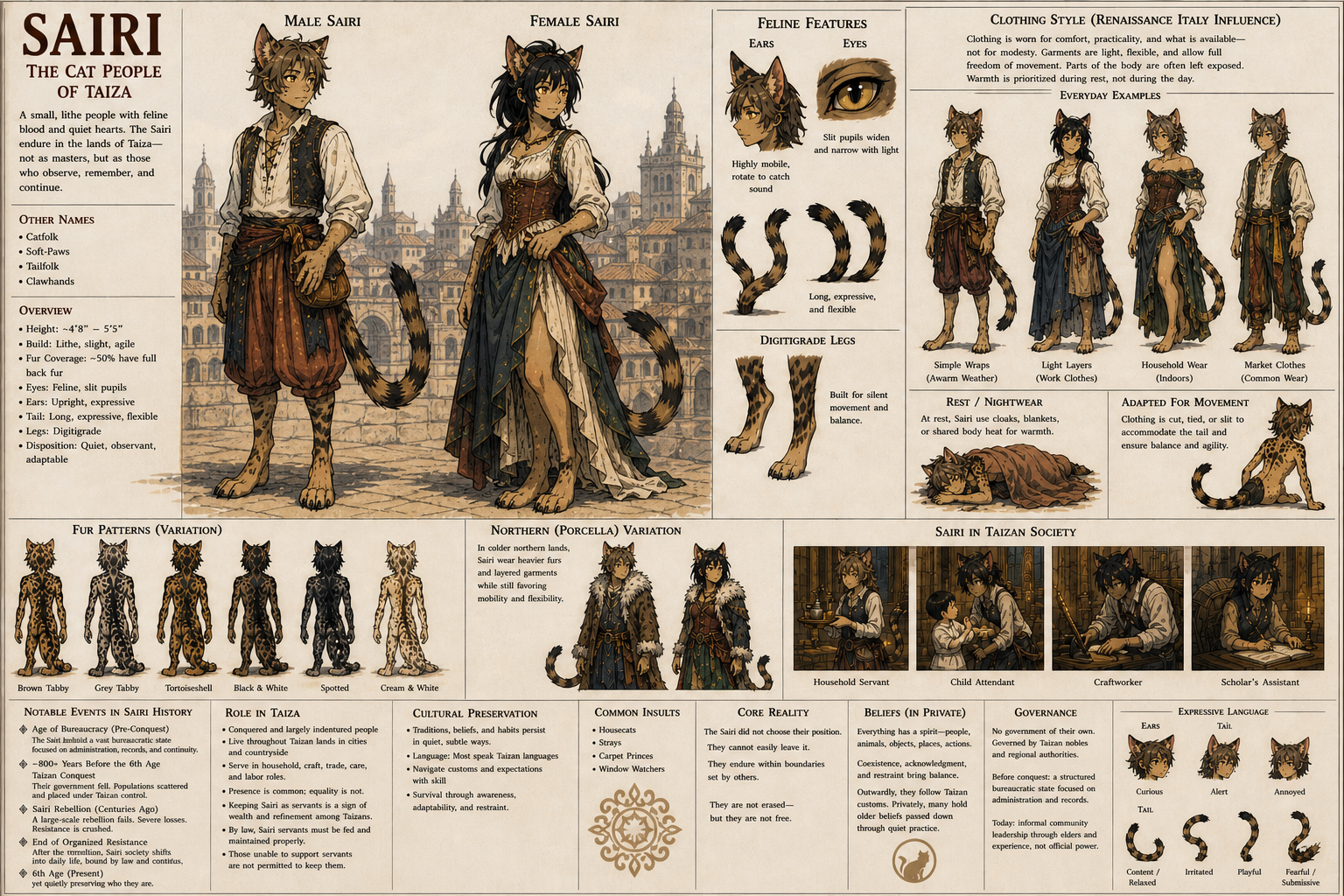
An average Sairi is a small, lithe feline humanoid, usually standing just under human height, with a light frame built for quiet movement and balance rather than strength. Their body carries subtle feline traits—upright cat ears, a long expressive tail, and digitigrade legs—and about half bear a full layer of fur covering their entire back, patterned like that of a house cat, while their chest and stomach remain bare.
Their eyes are distinctly feline, with slit pupils that widen and narrow with the light, giving them a watchful, reflective gaze that seems to notice more than it reveals. They move softly, with deliberate, efficient steps, rarely making more noise than necessary, and often giving the impression of being present without drawing attention.
Clothing is usually simple and practical—light when possible, layered when needed—and worn for comfort rather than modesty. A Sairi’s posture tends to be relaxed but alert, their ears and tail shifting subtly in response to their surroundings in ways that often communicate more than words.
To meet a Sairi is to notice not what they do loudly—but what they notice quietly, and how easily they seem to exist just slightly outside the center of attention:
a presence defined not by force, but by awareness, restraint, and the quiet persistence of someone who has learned to endure
Outsider Terms:
Catfolk
Soft-Paws
Tailfolk
Clawhands
Looks
Sairi bodies are best described as lithe, flexible, and built for balance over brute strength, favoring lightweight efficiency and fluid movement. Most possess slim frames, narrow waists, long limbs, and low visible body mass, with subtle musculature optimized for quick motion, precision, and control rather than raw power. Like the house cats they resemble, their bodies are designed for sudden bursts of speed, rapid directional changes, climbing, and silent locomotion, giving them a spring-loaded, responsive quality that often makes them appear coiled even at rest. They move on digitigrade legs, with elevated heels and weight carried on the balls of the feet, resulting in a naturally forward-leaning posture, elastic stride, and quiet footfalls, while their slightly angled legs provide strong push-off and rapid recovery. Their upper bodies are narrow and highly flexible, particularly through the spine, allowing for quick rotation, efficient climbing, and tight maneuverability in close quarters. While most Sairi are slender, natural variation exists, ranging from delicate, narrow builds to more compact or slightly heavier forms, especially in well-fed individuals, though all retain a generally agile structure. They tend toward lighter body weights overall, with any added mass becoming visibly apparent in their silhouette. Sexual dimorphism is present but subtle, with males being slightly larger or broader and females more consistently lithe, though both maintain the same core agility. Their posture is relaxed but alert, constantly adjusting, and their movements are quiet, efficient, and difficult to track. Ultimately, Sairi bodies are not built for dominance through strength, but for movement, awareness, and survival through subtlety.
Sairi skin tones are generally subtle and remain close to human ranges, most commonly falling between fair and lightly tanned shades, with some regional variation. Unlike their often vibrant and patterned fur, their exposed skin is relatively muted and naturalistic, typically ranging from fair tones in less sun-exposed northern regions to light tan and soft golden hues in warmer areas such as Taiza. Their complexion rarely reaches very dark tones or extreme pigmentation, instead staying within a narrow, realistic spectrum. Environmental factors influence these differences, with individuals from the Taizan heartlands tending toward warmer, sun-touched tones, while those from Porcella and northern regions often exhibit lighter skin with cooler undertones. Most Sairi skin carries neutral or softly warm undertones, rarely appearing strongly red or heavily olive, giving it an even, understated appearance. Because their fur commonly covers the back, limbs, and tail but leaves areas like the chest and stomach exposed, their skin often contrasts with the varied patterns of their fur—striped, spotted, or solid—creating a layered and highly individualized look. Their skin is typically smooth, soft, and relatively unblemished, with scarring less common or less prominently displayed than in more combat-focused cultures. These exposed areas also show the clearest signs of natural tone variation, tanning, and environmental wear. Overall, Sairi skin serves not as the primary focus of their visual identity, but as a quiet, natural foundation beneath the far more expressive patterns of their fur.
Sairi are a smaller-statured people, typically standing:
between 4’8” and 5’5”
With most individuals clustering below the human average, their size reinforces their overall impression of:
lightness, quickness, and compact efficiency
Height Distribution (Expanded)
Most Sairi fall into:
4’8” – 5’0” → smaller, more compact builds (very common)
5’0” – 5’3” → average range
5’3” – 5’5” → taller Sairi, less common
Heights above this range do exist, but are:
rare
and often remarked upon
These outliers are sometimes compared to:
larger house cat breeds among smaller ones
“House Cat” Variation Analogy
Height variation among Sairi is often compared to:
the difference between smaller domestic cats and larger breeds
This means:
some appear notably compact and slight
while others feel larger and more physically present
But even the tallest rarely exceed:
5’5” as a typical upper bound
Sex-Based Differences
Males tend to be:
slightly taller on average
closer to the upper end of the range
Females tend to be:
slightly shorter
more commonly in the mid-to-lower range
The difference is noticeable but not extreme.
Perceived Height vs Presence
Despite their smaller stature, Sairi can feel:
larger than expected in motion
or more present than their height suggests
This comes from:
confident balance
fluid movement
and controlled posture
However, in direct comparison to other races, they are:
visibly smaller
Interaction with Other Races
Their height often places them:
below eye level with Taizans
significantly smaller than larger races
This reinforces:
their physical vulnerability in some contexts
and the perception of them as:
delicate
or non-threatening
Core Height Identity
Sairi are not defined by size,
but by how effectively they move within it.
Sairi tend toward:
lightweight, slender builds with body weight generally falling on the lower end for their height.
Their mass reflects their overall design:
agile, flexible, and energy-efficient
Typical Weight Range
Most Sairi fall into:
80 – 110 lbs → lighter, very slender individuals (common)
100 – 130 lbs → average range
130 – 150 lbs → heavier or well-fed individuals
Outliers beyond this range exist, but are:
uncommon and usually noticeable
Lean Baseline
By default, Sairi bodies tend toward:
low body fat, light muscle mass, and narrow frames
Even physically active individuals remain:
compact rather than bulky
Their strength is present, but not expressed through size.
Weight Response to Diet
Sairi are notably responsive to food availability.
They:
gain visible weight quickly when well-fed and lose it just as quickly under scarcity
This can result in:
softer, fuller builds in stable environments
noticeably leaner or thinner forms in harsher conditions
Fur and Perception of Weight
Because many Sairi have:
fur along their backs and limbs, their apparent size may not always reflect their actual weight.
They can appear:
slightly larger or more filled out than their true mass suggests.
Sex-Based Differences
Males tend to:
fall slightly higher in weight
carry marginally more muscle
Females tend to:
be lighter overall
more consistently slender
The difference remains moderate.
Movement and Efficiency
Their lighter weight supports:
silent movement
rapid acceleration
and reduced impact when landing
This contributes directly to:
their ability to move quickly and recover from falls
Core Weight Identity
Sairi weight is not built for force it is built for:
speed, control, and efficient movement
Sairi are defined by a collection of distinctly feline features that emphasize sensitivity, awareness, and quiet precision over raw power. Their most striking trait is their cat-like eyes, marked by vertical slit pupils, wide reflective irises, and excellent low-light vision, often appearing bright even in dim environments and constantly shifting as their pupils narrow in light and widen in darkness, giving them a gaze that can feel watchful, distant, or intensely focused. Positioned atop the head, their ears move independently and swivel toward sound, acting as constant indicators of attention and emotion, subtly signaling curiosity, irritation, alertness, or calm even when the Sairi themselves remain still. Their tails are fully functional and rarely still, aiding in balance, rapid turns, and recovery from movement while also expressing emotion through flicks, positioning, and motion. They move on digitigrade feet, walking on the balls of their feet with quiet, spring-like efficiency that allows for near-silent movement even in cluttered environments. Many Sairi possess partial fur patterning that runs from the neck down along the back and limbs, never covering the chest or stomach, displaying a wide range of patterns similar to domestic cats—striped, spotted, solid, or mixed—creating a layered appearance of exposed skin and patterned fur unique to each individual. Their hands remain humanoid but often feature slightly sharper nails, enhanced grip, and fine motor control, making them well suited for climbing and delicate manipulation. Some also possess subtle whiskers, which, though not always prominent, enhance spatial awareness and environmental sensing. Their bodies respond quickly and instinctively to sudden changes, allowing for rapid correction, controlled falls, and fluid recovery. Overall, Sairi expression is understated, communicated through small shifts in posture, ear and tail movement, and eye focus, making their emotions quiet, controlled, and often difficult to read without familiarity.
Sairi exhibit extreme physical variance comparable to the full range seen in house cats, with individuals sharing the same underlying body structure yet differing dramatically in outward appearance. While their core form remains consistent, variation appears across size, proportions, fur presence, facial features, and overall build, allowing two Sairi of the same height to look entirely distinct from one another. One of the most noticeable differences lies in fur, with roughly half of all Sairi possessing patterned fur along the back and limbs, while others may have minimal, fine, or no fur beyond the ears and tail. These patterns can include stripes, spots, solid colors, or irregular combinations, reflecting the full diversity seen in domestic cats and creating strong visual individuality. Body shape also varies within their generally lithe baseline, ranging from slender, high-energy builds to more compact or slightly stockier forms, with softer silhouettes appearing in well-fed individuals and leaner, more worn frames in harsher conditions. Differences extend to features such as ear size and shape, tail length and thickness, eye size and intensity, and the prominence of whiskers, with some individuals appearing sharper and more angular while others are softer and more rounded. Beyond physical traits, Sairi identity is also expressed through posture, movement, and subtle mannerisms, meaning two individuals may appear similar yet feel entirely different in presence. Ultimately, Sairi are unified by structure but defined by variation, with individuality being one of their most defining characteristics.
Sairi clothing is shaped primarily by practical need, availability, and comfort rather than modesty or social expectation. Unlike many cultures, they place little emphasis on covering the body for its own sake, instead favoring garments that support utility, temperature regulation, and ease of movement. Within regions like Taiza, many Sairi wear what they are given or can afford, resulting in simple, often reused or repaired clothing that is functional rather than abundant or tailored. Their preferred garments are lightweight, flexible, and non-restrictive, allowing for fluid motion and comfort both in activity and rest, typically consisting of loose wraps, soft cloth layers, and minimal fastening. Because modesty is not strongly emphasized, clothing often leaves parts of the body exposed, especially areas less sensitive to temperature. Rather than heavy daytime layering, Sairi prioritize warmth during rest, relying on cloaks, blankets, or shared body heat when sleeping. Their garments are also adapted to their anatomy, incorporating slits, open backs, or flexible designs to accommodate tail movement and maintain balance and agility. Soft, quiet materials are favored to suit their sensitive skin and preference for silent movement. Clothing is layered as needed based on environment and conditions rather than fashion, leading to practical but inconsistent outfits with little concern for uniformity. Ultimately, Sairi clothing is not about appearance or modesty, but about comfort, mobility, and making effective use of what is available.
Traits
Sairi strengths arise from a combination of heightened senses, exceptional physical control, and subtle social awareness, making them well suited for survival through precision and perception rather than brute force. They possess highly sensitive hearing and an advanced sense of smell, allowing them to detect subtle environmental changes, identify individuals by scent, and notice movement before it becomes visible, giving them a strong advantage in crowded or low-visibility environments. Their balance is exceptional, supported by tail movement, core strength, and spatial awareness, enabling them to move across narrow or unstable surfaces, recover quickly from slips, and maintain control during rapid motion. Sairi move lightly and deliberately, with minimal sound, capable of navigating tight or cluttered spaces without drawing attention, which makes them particularly effective in stealth and close-quarters environments. Their reflexes are fast and instinctive, allowing them to react quickly to sudden threats, adjust mid-motion, and recover from imbalance with ease. Their eyes provide strong low-light vision, enabling clear sight in dim environments and rapid adjustment between light levels. Socially, they are highly observant, attuned to body language, tone, and subtle behavioral cues, allowing them to detect tension, anticipate reactions, and navigate complex social dynamics. Their flexible bodies support fluid movement, tight turns, climbing, and maneuvering in confined spaces, while their instinctive ability to twist and distribute impact makes them particularly adept at surviving falls with reduced injury. Sairi also adapt quickly to new environments, learning layouts and identifying safe paths with efficiency, and their lighter build allows for sustained movement with less energy expenditure. Combined with an often unassuming appearance that causes others to underestimate them, Sairi excel not by overpowering others, but by outmoving, out-noticing, and outlasting through awareness and control.
Sairi weaknesses stem from the same traits that define their strengths—sensitivity, light physical structure, and heightened awareness—making them capable but also fragile under sustained physical or mental pressure. Their smaller stature and lighter build limit raw strength, making it difficult for them to overpower larger opponents or engage effectively in direct force-on-force combat. Their heightened senses, while advantageous, also make them vulnerable to overstimulation; loud environments or sudden noises can cause distraction, stress, or even disorientation, while strong smells may lead to nausea, headaches, or avoidance behavior. Physically, they are not well suited to cold environments, as their lower body mass and often limited natural insulation result in faster heat loss and reduced efficiency without external warmth. Their lighter bone structure also makes them more susceptible to injury from heavy impacts, increasing the risk of fractures or long-term damage. Sairi possess a strong startle reflex, which can cause involuntary movement or momentary loss of control, sometimes revealing their position or disrupting deliberate action. Behaviorally, they may exhibit territorial stubbornness, forming strong attachments to spaces and routines that make them resistant to change or defensive over personal areas. Their tendency toward light, restless sleep can lead to inconsistent recovery, fatigue, and decreased performance over time, especially when combined with their high metabolic needs, which require frequent food intake to maintain energy and focus. Additionally, their size and demeanor often lead others to perceive them as delicate or easily controlled, which can result in both underestimation and increased risk of exploitation. While quick and reactive, Sairi struggle with prolonged physical strain or sustained high-pressure situations, performing best in short bursts rather than extended exertion. Ultimately, their weaknesses are not failures, but the natural cost of being highly sensitive, highly responsive, and physically light.
Sairi conditions are closely tied to their heightened sensory input, light and responsive physiology, and overall environmental sensitivity, with many of these states being harmless under normal circumstances but becoming problematic when their natural traits are pushed too far. One of the most common is Sun-Laze, a warmth-induced lethargy in which a Sairi becomes deeply relaxed, slow to respond, and unwilling to move when exposed to sunlight or comfortable heat, often harmless but potentially dangerous if awareness drops at the wrong moment. In contrast, Whisker Sense is a rare state of heightened perception, where spatial awareness and responsiveness become nearly perfect, allowing for exceptional balance and sensitivity to subtle movement, though it comes with constant tension and difficulty relaxing. Sensory overload can also manifest as Scent-Sick, where strong or conflicting smells cause nausea, headaches, dizziness, or panic, limiting where an individual can comfortably function, or Storm-Ears, a painful sensitivity to pressure changes and sound shifts that can cause disorientation, anxiety, and early awareness of approaching storms. Some Sairi experience Moonwake, a cyclical restlessness tied to lunar phases that brings bursts of energy and alertness at the cost of disrupted sleep and later fatigue. When multiple sensory inputs—sound, smell, movement, or social pressure—build beyond tolerance, a Sairi may suffer an Overstimulation Collapse, resulting in withdrawal, shutdown behavior, or temporary inability to function. Physical conditions also occur, such as Cold Fatigue, where prolonged exposure to low temperatures rapidly reduces coordination and energy, Startle Lock, an extreme reaction causing brief freezing or uncontrolled movement, and Hunger Drop, a rapid onset of fatigue and loss of focus due to insufficient caloric intake. Together, these conditions reflect a body and mind that are finely tuned and highly capable, but vulnerable to overload when pushed beyond their natural limits.
Culture
Sairi traditions are quiet, persistent, and rarely formalized, maintained not through authority or enforcement but through habit, memory, and shared understanding. Even after centuries under outside rule, these customs endure because they are small enough to persist and constant enough to matter. In daily life, this is reflected in practices like the unspoken rule of the Sun Spot Seat, where the warmest place in any home—whether a window, heated stone, rooftop, or courtyard wall—is instinctively given to elders, mothers, honored guests, or the sick without discussion. Before departure for travel, work, danger, or major life changes, it is common for someone close to braid a small piece of the individual’s hair, a quiet gesture of connection and hope for return that is often kept or undone only when they come back safely. Meals are accompanied by the Quiet Plate, where a small portion of food is set aside without declaration for ancestors, wandering spirits, or simply “those who come hungry,” reinforcing a sense of unseen presence and generosity. Mourning is similarly restrained; grief is expected to be carried quietly, with loud displays considered disruptive, especially indoors. Within the home, boundaries are marked subtly but firmly, such as the custom of removing shoes before entering the innermost room, a space reserved for rest, memory, and what is held closest. The most honest conversations often occur during Night Kitchen Talk, shared in quiet, late hours while preparing food, where truth and emotion are expressed away from public view. Everyday behavior reflects a culture of awareness and respect, with Sairi moving softly through shared spaces, maintaining unspoken personal territories, and often sharing warmth with those close to them during rest or cold conditions. Rather than preserving identity through grand structures or declarations, Sairi culture endures through repeated actions and small, consistent rituals—subtle practices that continue because no one has reason, or desire, to abandon them.
Sairi beliefs exist in two layers: what is shown and what is kept. Outwardly, they follow Taizan customs as expected, observing dominant traditions and presenting alignment without visible resistance, not always out of true acceptance but as a necessity for survival. Privately, however, many Sairi continue to hold older beliefs that persist through quiet continuation rather than open practice. At the core of these beliefs is the idea that everything possesses a spirit—people, animals, objects, places, and even moments or actions—and this understanding shapes their behavior in subtle but consistent ways. Rather than seeking control, Sairi belief emphasizes coexistence, acknowledgment, and restraint, treating the world with care and avoiding unnecessary harm, not because it is formally required, but because it is quietly understood. These ideas are rarely spoken or codified, instead appearing in everyday habits such as setting aside food, respecting spaces, or speaking carefully in private. Because open expression can be restricted, belief is passed indirectly, embedded in tradition and maintained through repeated action rather than explicit teaching. Sairi tend to value awareness and understanding over dominance, and have developed a cultural mindset that prioritizes endurance and adaptation over confrontation, recognizing that belief does not always need to be visible to remain real. Without reliance on monuments or formal systems, their traditions and faith endure through shared behavior and memory, carried forward in how they live rather than what they declare.
Sairi no longer possess a government of their own, as their political structure was dismantled following their conquest by the Taizans. What remains today is a combination of integration into Taizan rule, informal local organization, and cultural memory of what once existed. After their defeat, the Sairi lost centralized authority, had their governing institutions dissolved, and were absorbed into the broader Taizan political system, where they are now governed by noble houses, regional authorities, and appointed overseers. They no longer elect their own leaders, maintain independent laws, or operate as a sovereign people. Before this conquest, however, the Sairi maintained a sprawling bureaucratic state, likely defined by layered administration, record-keeping, and structured civic management, emphasizing organization and continuity in contrast to Taizan rule. While this system no longer exists in practice, traces of it persist in cultural habits of order, observation, and quiet structure. In the present day, Sairi communities exist within Taizan-controlled territories and labor systems, experiencing governance primarily as subjects rather than participants, with decisions made externally by nobles and officials. Despite this, they maintain subtle internal cohesion through informal structures, including elder guidance, experience-based leadership, and quiet conflict resolution, none of which are codified or officially recognized but often prove effective. At the most immediate level, governance occurs within households or small community groups, where authority is practical, situational, and rooted in experience rather than title. Ultimately, Sairi governance is defined not by what exists formally, but by its absence, and by the quiet, persistent structures that endure beneath it.
Sairi do not maintain a distinct technological identity of their own, instead relying on the same systems and tools used by the Taizans, though their relationship to this technology differs significantly. They have access to advanced tools such as gunpowder weapons, runic enchantments, anti-magic equipment, and the broader outputs of Taizan industry, primarily through labor roles, service positions, or assigned duties. However, this access rarely extends to ownership or authorship, as Sairi are seldom the primary designers or decision-makers behind these systems. Their use of technology is often restricted, supervised, or dependent on their role, meaning they may regularly handle, maintain, or support equipment without being entrusted with its deeper design or independent control. Despite this, Sairi are typically highly capable in practical application, excelling in precise tasks, maintenance, and careful handling due to their fine motor control, attention to detail, and naturally quiet movement. Their interaction with technology tends to be adaptive rather than innovative, focusing on learning existing systems, using them efficiently, and applying them where needed rather than developing new ones. When given a choice, they often prefer tools that are simple, reliable, and low-maintenance, using more complex systems only when required. Technology is integrated into their lives quietly, without display or emphasis, treated as something functional rather than defining. Even when unrecognized, Sairi frequently contribute to technological systems through upkeep, refinement, and consistent use. Ultimately, they do not define themselves through technology, but exist within it, shaping and sustaining it from within rather than directing it openly.
Sairi occupations are shaped primarily by their status under Taizan rule, as well as by social expectation and structural limitation, placing them across a wide range of labor but most commonly within lower-class, service, and tightly controlled roles. The most visible and expected occupation for Sairi is domestic and personal service, including work as household servants, attendants, caretakers, cleaners, and personal aides, roles for which they are often selected due to their perceived quietness, precision, attentiveness, and aesthetic appeal; among Taizans, the presence of Sairi servants is frequently seen as a sign of wealth and status. Beyond this, many Sairi occupy essential but demanding labor positions such as manual work, agriculture, transport, and general workforce duties, which are often physically taxing, low in status, and closely managed. They are also commonly employed in support and maintenance roles, including cleaning, equipment upkeep, and operational assistance, where their natural attention to detail and efficiency are highly valued. In kitchens and food-related work, Sairi frequently assist in preparing meals, managing food stores, and supporting household or institutional cooking, reflecting both practicality and cultural overlap. Some are assigned to more specialized or skilled positions, such as artisan support or technical assistance, though these roles are typically supervised and granted through selection rather than open opportunity. A number of Sairi also serve in clerical or administrative capacities, handling record-keeping and bureaucratic tasks that echo aspects of their former societal structure. In higher-status environments, they may act as personal attendants or specialized domestic staff for nobility, sometimes benefiting from slightly improved conditions but still operating within the same system of control. Truly independent roles are rare, limited to freed individuals or those in exceptional circumstances. Ultimately, Sairi do not freely choose from all possible occupations, but are instead placed, utilized, and occasionally elevated within a structured system that defines the limits of their participation.
Sairi exist within the broader Taizan economic system, which is wealthy, structured, and tightly controlled, and as an oppressed and largely indentured people, their economic reality is defined not by ownership but by participation under constraint. Taiza ensures that even its lowest classes, including the Sairi, are provided for at a basic level, with access to food, shelter, and minimal economic participation, not out of generosity but as part of a system designed to maintain order and productivity. Many Sairi, particularly those in service roles, receive small stipends that allow them to purchase personal items, acquire modest comforts, and engage in limited trade, creating a restricted but tangible personal economy in which they can make small choices and accumulate minor possessions. Taizan law enforces certain protections, such as prohibiting the starvation or neglect of servants and requiring that those who cannot afford to maintain them relinquish ownership, establishing a baseline for survival without granting true autonomy. Sairi economic participation is centered on labor, with their work supporting households, industries, and the wider infrastructure, though they rarely control production, own significant resources, or direct economic flow. While it is theoretically possible for some Sairi to accumulate enough wealth to buy their freedom and gain citizenship, this path is slow, difficult, and heavily dependent on circumstance. As a result, most engage in the economy primarily as consumers rather than owners, purchasing small goods, trading locally, and participating in markets without access to land, large enterprises, or meaningful capital. Within Taizan society, Sairi are often viewed less as independent economic actors and more as components of the system itself, valued for their labor, presence, and function. Ultimately, Sairi economics is not about wealth or control, but about survival, participation, and carving out small spaces of ownership within a system that limits both.
Sairi food preferences center on warmth, comfort, and small, repeatable meals, favoring dishes that are easy to eat, easy to share, and easy to return to. One of the most common comfort foods is warm rice topped with a soft or lightly cooked egg, a simple and familiar dish that provides steady energy and a strong sense of safety and stability. Fish is their preferred source of protein, prepared in a variety of ways such as grilling, steaming, light frying, or adding to broths, valued for being flavorful without overwhelming the senses. They also enjoy small roasted birds like quail or pigeon, typically cooked whole and lightly seasoned, offering manageable portions suited to individual or shared meals. Sairi favor mild, smooth desserts such as cream-based sweets, custards, and simple milk dishes, avoiding overly intense flavors in favor of soft sweetness. Their eating habits emphasize portability and frequency, with a preference for hand snacks such as wrapped bites, small portions of meat or rice, roasted nuts, seeds, and honeyed fruits that provide quick energy and are easy to store. Warm beverages like milk tea or lightly spiced teas are commonly consumed for relaxation and social moments, particularly in the evening. Meat is often prepared in thin slices to allow for easier chewing and sharing, while breads—especially warm flatbreads—are typically torn by hand and eaten communally, reinforcing informal and shared dining practices. Across all meals, Sairi strongly prefer food that is warm and freshly prepared, with cold food being less desirable unless necessary. They tend to eat smaller portions more frequently rather than large meals, aligning with their metabolism and energy needs, and generally favor soft, easy-to-chew textures over dense or tough foods. Ultimately, Sairi cuisine is not about excess or display, but about comfort, warmth, and quiet consistency.
History
Sairi history is defined not by repeated uprisings, but by:
loss, a single failed resistance, and long-term adaptation
They are a people whose defining events are not ongoing—
but settled, and still shaping everything that follows.
The Age of Bureaucracy (Pre-Conquest)
A people of structure and administration
Before Taizan rule, the Sairi maintained:
a sprawling bureaucratic state
Their society emphasized:
layered governance
record-keeping
civil organization
and continuity over generations
They were not expansionist—
but highly structured, with systems designed to:
manage rather than dominate
The Taizan Conquest (~800+ Years Before the 6th Age)
The defining break
The Sairi were conquered by the Taizans more than eight centuries before the Sixth Age.
This resulted in:
total collapse of their governing system
dismantling of administrative institutions
widespread indentured servitude
Their population was:
redistributed
absorbed into Taizan-controlled regions
and reorganized under noble authority
This was not occupation—
it was:
permanent integration under foreign rule
The Sairi Rebellion (Centuries Ago)
The last attempt to reclaim independence
At some point after their conquest, the Sairi attempted:
a large-scale rebellion
Details vary, but the outcome is clear:
it failed decisively
losses were severe
and its consequences were lasting
After its suppression:
resistance structures were dismantled
populations were further controlled
and opportunities for organized revolt were effectively removed
This event became:
the last major attempt at independence
The End of Organized Resistance
A cultural turning point
Following the failed rebellion, Sairi society shifted.
Over generations, the focus moved from:
resistance
to
survival and continuity
As of the Sixth Age:
the Sairi are not actively attempting to break away from Taizan rule
This is not due to a lack of awareness—
but a recognition of:
past failure
structural reality
and the cost of open defiance
Cultural Survival Through Quiet Means
What endured after everything else was lost
While their political identity was destroyed, their culture adapted.
Traditions became:
smaller
quieter
embedded in daily life
They persisted through:
household practices
food customs
personal rituals
and unspoken beliefs
Their survival strategy became:
continuation without confrontation
Integration Into Taizan Society
Over centuries, Sairi have become:
fully integrated into Taizan territory
essential to its labor and domestic systems
and ever-present within its structure
They live:
among Taizans
within the same cities
under the same laws
But remain:
socially distinct
and structurally subordinate
Core Historical Identity
Sairi history is not one of repeated struggle—
it is one of:
a single failed resistance, followed by generations of adaptation
Notes
Status Within Taiza
The Sairi are:
a conquered and largely indentured people
They live:
throughout Taizan lands
within the same cities and regions
and alongside their conquerors
However, their position remains:
socially subordinate
economically limited
and structurally controlled
They are present everywhere—
but not equal anywhere.
Cultural Absorption (Partial, Not Total)
Over centuries, the Sairi have been:
heavily influenced by Taizan culture
required to follow outward customs
and integrated into daily Taizan life
Despite this, they have not fully lost their identity.
Instead, they have:
retained traditions
preserved beliefs
and maintained cultural habits
in ways that are:
quiet, subtle, and difficult to erase
Servitude as Status Symbol
Among Taizans, keeping Sairi as servants is often seen as:
a sign of wealth and refinement
They are perceived as:
aesthetically pleasing
delicate
and well-suited to controlled environments
This perception reinforces:
their placement in domestic roles
and their visibility in high-status households
Economic Treatment of Servants
Taizan law enforces certain expectations regarding Sairi and other indentured peoples:
they must be fed properly
they must be maintained at a basic standard
and neglect is considered illegal
Additionally:
those who cannot afford to maintain servants are not permitted to keep them
This creates a system where:
Sairi are sustained
but not empowered
Geographic Integration
Sairi are not isolated to specific regions.
They live:
throughout Taiza
in both urban and rural environments
and across all levels of society
This widespread presence makes them:
a constant part of daily life within Taizan territory
Language and Behavior Adaptation
Most Sairi:
speak the dominant languages of Taiza
understand Taizan customs
and navigate social expectations effectively
This allows them to:
function within the system
avoid unnecessary conflict
and maintain stability
Insults and Social Perception
Common derogatory terms used for Sairi include:
Housecats
Strays
Carpet Princes
Window Watchers
These insults reflect how they are often viewed:
domesticated
passive
ornamental
or confined
Reality of Their Position
Despite stability and partial integration, the core truth remains:
the Sairi do not control their own place in society
They:
did not choose their position
cannot easily leave it
and exist within boundaries set by others
Core Note Identity
The Sairi are not erased—
but they are not free.
Overview
Details about this race's overview
Sairi
An average Sairi is a small, lithe feline humanoid, usually standing just under human height, with a light frame built for quiet movement and balance rather than strength. Their body carries subtle feline traits—upright cat ears, a long expressive tail, and digitigrade legs—and about half bear a full layer of fur covering their entire back, patterned like that of a house cat, while their chest and stomach remain bare.
Their eyes are distinctly feline, with slit pupils that widen and narrow with the light, giving them a watchful, reflective gaze that seems to notice more than it reveals. They move softly, with deliberate, efficient steps, rarely making more noise than necessary, and often giving the impression of being present without drawing attention.
Clothing is usually simple and practical—light when possible, layered when needed—and worn for comfort rather than modesty. A Sairi’s posture tends to be relaxed but alert, their ears and tail shifting subtly in response to their surroundings in ways that often communicate more than words.
To meet a Sairi is to notice not what they do loudly—but what they notice quietly, and how easily they seem to exist just slightly outside the center of attention:
a presence defined not by force, but by awareness, restraint, and the quiet persistence of someone who has learned to endure
Outsider Terms:
Catfolk
Soft-Paws
Tailfolk
Clawhands
Looks
Details about this race's looks
Sairi bodies are best described as lithe, flexible, and built for balance over brute strength, favoring lightweight efficiency and fluid movement. Most possess slim frames, narrow waists, long limbs, and low visible body mass, with subtle musculature optimized for quick motion, precision, and control rather than raw power. Like the house cats they resemble, their bodies are designed for sudden bursts of speed, rapid directional changes, climbing, and silent locomotion, giving them a spring-loaded, responsive quality that often makes them appear coiled even at rest. They move on digitigrade legs, with elevated heels and weight carried on the balls of the feet, resulting in a naturally forward-leaning posture, elastic stride, and quiet footfalls, while their slightly angled legs provide strong push-off and rapid recovery. Their upper bodies are narrow and highly flexible, particularly through the spine, allowing for quick rotation, efficient climbing, and tight maneuverability in close quarters. While most Sairi are slender, natural variation exists, ranging from delicate, narrow builds to more compact or slightly heavier forms, especially in well-fed individuals, though all retain a generally agile structure. They tend toward lighter body weights overall, with any added mass becoming visibly apparent in their silhouette. Sexual dimorphism is present but subtle, with males being slightly larger or broader and females more consistently lithe, though both maintain the same core agility. Their posture is relaxed but alert, constantly adjusting, and their movements are quiet, efficient, and difficult to track. Ultimately, Sairi bodies are not built for dominance through strength, but for movement, awareness, and survival through subtlety.
Sairi skin tones are generally subtle and remain close to human ranges, most commonly falling between fair and lightly tanned shades, with some regional variation. Unlike their often vibrant and patterned fur, their exposed skin is relatively muted and naturalistic, typically ranging from fair tones in less sun-exposed northern regions to light tan and soft golden hues in warmer areas such as Taiza. Their complexion rarely reaches very dark tones or extreme pigmentation, instead staying within a narrow, realistic spectrum. Environmental factors influence these differences, with individuals from the Taizan heartlands tending toward warmer, sun-touched tones, while those from Porcella and northern regions often exhibit lighter skin with cooler undertones. Most Sairi skin carries neutral or softly warm undertones, rarely appearing strongly red or heavily olive, giving it an even, understated appearance. Because their fur commonly covers the back, limbs, and tail but leaves areas like the chest and stomach exposed, their skin often contrasts with the varied patterns of their fur—striped, spotted, or solid—creating a layered and highly individualized look. Their skin is typically smooth, soft, and relatively unblemished, with scarring less common or less prominently displayed than in more combat-focused cultures. These exposed areas also show the clearest signs of natural tone variation, tanning, and environmental wear. Overall, Sairi skin serves not as the primary focus of their visual identity, but as a quiet, natural foundation beneath the far more expressive patterns of their fur.
Sairi are a smaller-statured people, typically standing:
between 4’8” and 5’5”
With most individuals clustering below the human average, their size reinforces their overall impression of:
lightness, quickness, and compact efficiency
Height Distribution (Expanded)
Most Sairi fall into:
4’8” – 5’0” → smaller, more compact builds (very common)
5’0” – 5’3” → average range
5’3” – 5’5” → taller Sairi, less common
Heights above this range do exist, but are:
rare
and often remarked upon
These outliers are sometimes compared to:
larger house cat breeds among smaller ones
“House Cat” Variation Analogy
Height variation among Sairi is often compared to:
the difference between smaller domestic cats and larger breeds
This means:
some appear notably compact and slight
while others feel larger and more physically present
But even the tallest rarely exceed:
5’5” as a typical upper bound
Sex-Based Differences
Males tend to be:
slightly taller on average
closer to the upper end of the range
Females tend to be:
slightly shorter
more commonly in the mid-to-lower range
The difference is noticeable but not extreme.
Perceived Height vs Presence
Despite their smaller stature, Sairi can feel:
larger than expected in motion
or more present than their height suggests
This comes from:
confident balance
fluid movement
and controlled posture
However, in direct comparison to other races, they are:
visibly smaller
Interaction with Other Races
Their height often places them:
below eye level with Taizans
significantly smaller than larger races
This reinforces:
their physical vulnerability in some contexts
and the perception of them as:
delicate
or non-threatening
Core Height Identity
Sairi are not defined by size,
but by how effectively they move within it.
Sairi tend toward:
lightweight, slender builds with body weight generally falling on the lower end for their height.
Their mass reflects their overall design:
agile, flexible, and energy-efficient
Typical Weight Range
Most Sairi fall into:
80 – 110 lbs → lighter, very slender individuals (common)
100 – 130 lbs → average range
130 – 150 lbs → heavier or well-fed individuals
Outliers beyond this range exist, but are:
uncommon and usually noticeable
Lean Baseline
By default, Sairi bodies tend toward:
low body fat, light muscle mass, and narrow frames
Even physically active individuals remain:
compact rather than bulky
Their strength is present, but not expressed through size.
Weight Response to Diet
Sairi are notably responsive to food availability.
They:
gain visible weight quickly when well-fed and lose it just as quickly under scarcity
This can result in:
softer, fuller builds in stable environments
noticeably leaner or thinner forms in harsher conditions
Fur and Perception of Weight
Because many Sairi have:
fur along their backs and limbs, their apparent size may not always reflect their actual weight.
They can appear:
slightly larger or more filled out than their true mass suggests.
Sex-Based Differences
Males tend to:
fall slightly higher in weight
carry marginally more muscle
Females tend to:
be lighter overall
more consistently slender
The difference remains moderate.
Movement and Efficiency
Their lighter weight supports:
silent movement
rapid acceleration
and reduced impact when landing
This contributes directly to:
their ability to move quickly and recover from falls
Core Weight Identity
Sairi weight is not built for force it is built for:
speed, control, and efficient movement
Sairi are defined by a collection of distinctly feline features that emphasize sensitivity, awareness, and quiet precision over raw power. Their most striking trait is their cat-like eyes, marked by vertical slit pupils, wide reflective irises, and excellent low-light vision, often appearing bright even in dim environments and constantly shifting as their pupils narrow in light and widen in darkness, giving them a gaze that can feel watchful, distant, or intensely focused. Positioned atop the head, their ears move independently and swivel toward sound, acting as constant indicators of attention and emotion, subtly signaling curiosity, irritation, alertness, or calm even when the Sairi themselves remain still. Their tails are fully functional and rarely still, aiding in balance, rapid turns, and recovery from movement while also expressing emotion through flicks, positioning, and motion. They move on digitigrade feet, walking on the balls of their feet with quiet, spring-like efficiency that allows for near-silent movement even in cluttered environments. Many Sairi possess partial fur patterning that runs from the neck down along the back and limbs, never covering the chest or stomach, displaying a wide range of patterns similar to domestic cats—striped, spotted, solid, or mixed—creating a layered appearance of exposed skin and patterned fur unique to each individual. Their hands remain humanoid but often feature slightly sharper nails, enhanced grip, and fine motor control, making them well suited for climbing and delicate manipulation. Some also possess subtle whiskers, which, though not always prominent, enhance spatial awareness and environmental sensing. Their bodies respond quickly and instinctively to sudden changes, allowing for rapid correction, controlled falls, and fluid recovery. Overall, Sairi expression is understated, communicated through small shifts in posture, ear and tail movement, and eye focus, making their emotions quiet, controlled, and often difficult to read without familiarity.
Sairi exhibit extreme physical variance comparable to the full range seen in house cats, with individuals sharing the same underlying body structure yet differing dramatically in outward appearance. While their core form remains consistent, variation appears across size, proportions, fur presence, facial features, and overall build, allowing two Sairi of the same height to look entirely distinct from one another. One of the most noticeable differences lies in fur, with roughly half of all Sairi possessing patterned fur along the back and limbs, while others may have minimal, fine, or no fur beyond the ears and tail. These patterns can include stripes, spots, solid colors, or irregular combinations, reflecting the full diversity seen in domestic cats and creating strong visual individuality. Body shape also varies within their generally lithe baseline, ranging from slender, high-energy builds to more compact or slightly stockier forms, with softer silhouettes appearing in well-fed individuals and leaner, more worn frames in harsher conditions. Differences extend to features such as ear size and shape, tail length and thickness, eye size and intensity, and the prominence of whiskers, with some individuals appearing sharper and more angular while others are softer and more rounded. Beyond physical traits, Sairi identity is also expressed through posture, movement, and subtle mannerisms, meaning two individuals may appear similar yet feel entirely different in presence. Ultimately, Sairi are unified by structure but defined by variation, with individuality being one of their most defining characteristics.
Sairi clothing is shaped primarily by practical need, availability, and comfort rather than modesty or social expectation. Unlike many cultures, they place little emphasis on covering the body for its own sake, instead favoring garments that support utility, temperature regulation, and ease of movement. Within regions like Taiza, many Sairi wear what they are given or can afford, resulting in simple, often reused or repaired clothing that is functional rather than abundant or tailored. Their preferred garments are lightweight, flexible, and non-restrictive, allowing for fluid motion and comfort both in activity and rest, typically consisting of loose wraps, soft cloth layers, and minimal fastening. Because modesty is not strongly emphasized, clothing often leaves parts of the body exposed, especially areas less sensitive to temperature. Rather than heavy daytime layering, Sairi prioritize warmth during rest, relying on cloaks, blankets, or shared body heat when sleeping. Their garments are also adapted to their anatomy, incorporating slits, open backs, or flexible designs to accommodate tail movement and maintain balance and agility. Soft, quiet materials are favored to suit their sensitive skin and preference for silent movement. Clothing is layered as needed based on environment and conditions rather than fashion, leading to practical but inconsistent outfits with little concern for uniformity. Ultimately, Sairi clothing is not about appearance or modesty, but about comfort, mobility, and making effective use of what is available.
Traits
Details about this race's traits
Sairi strengths arise from a combination of heightened senses, exceptional physical control, and subtle social awareness, making them well suited for survival through precision and perception rather than brute force. They possess highly sensitive hearing and an advanced sense of smell, allowing them to detect subtle environmental changes, identify individuals by scent, and notice movement before it becomes visible, giving them a strong advantage in crowded or low-visibility environments. Their balance is exceptional, supported by tail movement, core strength, and spatial awareness, enabling them to move across narrow or unstable surfaces, recover quickly from slips, and maintain control during rapid motion. Sairi move lightly and deliberately, with minimal sound, capable of navigating tight or cluttered spaces without drawing attention, which makes them particularly effective in stealth and close-quarters environments. Their reflexes are fast and instinctive, allowing them to react quickly to sudden threats, adjust mid-motion, and recover from imbalance with ease. Their eyes provide strong low-light vision, enabling clear sight in dim environments and rapid adjustment between light levels. Socially, they are highly observant, attuned to body language, tone, and subtle behavioral cues, allowing them to detect tension, anticipate reactions, and navigate complex social dynamics. Their flexible bodies support fluid movement, tight turns, climbing, and maneuvering in confined spaces, while their instinctive ability to twist and distribute impact makes them particularly adept at surviving falls with reduced injury. Sairi also adapt quickly to new environments, learning layouts and identifying safe paths with efficiency, and their lighter build allows for sustained movement with less energy expenditure. Combined with an often unassuming appearance that causes others to underestimate them, Sairi excel not by overpowering others, but by outmoving, out-noticing, and outlasting through awareness and control.
Sairi weaknesses stem from the same traits that define their strengths—sensitivity, light physical structure, and heightened awareness—making them capable but also fragile under sustained physical or mental pressure. Their smaller stature and lighter build limit raw strength, making it difficult for them to overpower larger opponents or engage effectively in direct force-on-force combat. Their heightened senses, while advantageous, also make them vulnerable to overstimulation; loud environments or sudden noises can cause distraction, stress, or even disorientation, while strong smells may lead to nausea, headaches, or avoidance behavior. Physically, they are not well suited to cold environments, as their lower body mass and often limited natural insulation result in faster heat loss and reduced efficiency without external warmth. Their lighter bone structure also makes them more susceptible to injury from heavy impacts, increasing the risk of fractures or long-term damage. Sairi possess a strong startle reflex, which can cause involuntary movement or momentary loss of control, sometimes revealing their position or disrupting deliberate action. Behaviorally, they may exhibit territorial stubbornness, forming strong attachments to spaces and routines that make them resistant to change or defensive over personal areas. Their tendency toward light, restless sleep can lead to inconsistent recovery, fatigue, and decreased performance over time, especially when combined with their high metabolic needs, which require frequent food intake to maintain energy and focus. Additionally, their size and demeanor often lead others to perceive them as delicate or easily controlled, which can result in both underestimation and increased risk of exploitation. While quick and reactive, Sairi struggle with prolonged physical strain or sustained high-pressure situations, performing best in short bursts rather than extended exertion. Ultimately, their weaknesses are not failures, but the natural cost of being highly sensitive, highly responsive, and physically light.
Sairi conditions are closely tied to their heightened sensory input, light and responsive physiology, and overall environmental sensitivity, with many of these states being harmless under normal circumstances but becoming problematic when their natural traits are pushed too far. One of the most common is Sun-Laze, a warmth-induced lethargy in which a Sairi becomes deeply relaxed, slow to respond, and unwilling to move when exposed to sunlight or comfortable heat, often harmless but potentially dangerous if awareness drops at the wrong moment. In contrast, Whisker Sense is a rare state of heightened perception, where spatial awareness and responsiveness become nearly perfect, allowing for exceptional balance and sensitivity to subtle movement, though it comes with constant tension and difficulty relaxing. Sensory overload can also manifest as Scent-Sick, where strong or conflicting smells cause nausea, headaches, dizziness, or panic, limiting where an individual can comfortably function, or Storm-Ears, a painful sensitivity to pressure changes and sound shifts that can cause disorientation, anxiety, and early awareness of approaching storms. Some Sairi experience Moonwake, a cyclical restlessness tied to lunar phases that brings bursts of energy and alertness at the cost of disrupted sleep and later fatigue. When multiple sensory inputs—sound, smell, movement, or social pressure—build beyond tolerance, a Sairi may suffer an Overstimulation Collapse, resulting in withdrawal, shutdown behavior, or temporary inability to function. Physical conditions also occur, such as Cold Fatigue, where prolonged exposure to low temperatures rapidly reduces coordination and energy, Startle Lock, an extreme reaction causing brief freezing or uncontrolled movement, and Hunger Drop, a rapid onset of fatigue and loss of focus due to insufficient caloric intake. Together, these conditions reflect a body and mind that are finely tuned and highly capable, but vulnerable to overload when pushed beyond their natural limits.
Culture
Details about this race's culture
Sairi traditions are quiet, persistent, and rarely formalized, maintained not through authority or enforcement but through habit, memory, and shared understanding. Even after centuries under outside rule, these customs endure because they are small enough to persist and constant enough to matter. In daily life, this is reflected in practices like the unspoken rule of the Sun Spot Seat, where the warmest place in any home—whether a window, heated stone, rooftop, or courtyard wall—is instinctively given to elders, mothers, honored guests, or the sick without discussion. Before departure for travel, work, danger, or major life changes, it is common for someone close to braid a small piece of the individual’s hair, a quiet gesture of connection and hope for return that is often kept or undone only when they come back safely. Meals are accompanied by the Quiet Plate, where a small portion of food is set aside without declaration for ancestors, wandering spirits, or simply “those who come hungry,” reinforcing a sense of unseen presence and generosity. Mourning is similarly restrained; grief is expected to be carried quietly, with loud displays considered disruptive, especially indoors. Within the home, boundaries are marked subtly but firmly, such as the custom of removing shoes before entering the innermost room, a space reserved for rest, memory, and what is held closest. The most honest conversations often occur during Night Kitchen Talk, shared in quiet, late hours while preparing food, where truth and emotion are expressed away from public view. Everyday behavior reflects a culture of awareness and respect, with Sairi moving softly through shared spaces, maintaining unspoken personal territories, and often sharing warmth with those close to them during rest or cold conditions. Rather than preserving identity through grand structures or declarations, Sairi culture endures through repeated actions and small, consistent rituals—subtle practices that continue because no one has reason, or desire, to abandon them.
Sairi beliefs exist in two layers: what is shown and what is kept. Outwardly, they follow Taizan customs as expected, observing dominant traditions and presenting alignment without visible resistance, not always out of true acceptance but as a necessity for survival. Privately, however, many Sairi continue to hold older beliefs that persist through quiet continuation rather than open practice. At the core of these beliefs is the idea that everything possesses a spirit—people, animals, objects, places, and even moments or actions—and this understanding shapes their behavior in subtle but consistent ways. Rather than seeking control, Sairi belief emphasizes coexistence, acknowledgment, and restraint, treating the world with care and avoiding unnecessary harm, not because it is formally required, but because it is quietly understood. These ideas are rarely spoken or codified, instead appearing in everyday habits such as setting aside food, respecting spaces, or speaking carefully in private. Because open expression can be restricted, belief is passed indirectly, embedded in tradition and maintained through repeated action rather than explicit teaching. Sairi tend to value awareness and understanding over dominance, and have developed a cultural mindset that prioritizes endurance and adaptation over confrontation, recognizing that belief does not always need to be visible to remain real. Without reliance on monuments or formal systems, their traditions and faith endure through shared behavior and memory, carried forward in how they live rather than what they declare.
Sairi no longer possess a government of their own, as their political structure was dismantled following their conquest by the Taizans. What remains today is a combination of integration into Taizan rule, informal local organization, and cultural memory of what once existed. After their defeat, the Sairi lost centralized authority, had their governing institutions dissolved, and were absorbed into the broader Taizan political system, where they are now governed by noble houses, regional authorities, and appointed overseers. They no longer elect their own leaders, maintain independent laws, or operate as a sovereign people. Before this conquest, however, the Sairi maintained a sprawling bureaucratic state, likely defined by layered administration, record-keeping, and structured civic management, emphasizing organization and continuity in contrast to Taizan rule. While this system no longer exists in practice, traces of it persist in cultural habits of order, observation, and quiet structure. In the present day, Sairi communities exist within Taizan-controlled territories and labor systems, experiencing governance primarily as subjects rather than participants, with decisions made externally by nobles and officials. Despite this, they maintain subtle internal cohesion through informal structures, including elder guidance, experience-based leadership, and quiet conflict resolution, none of which are codified or officially recognized but often prove effective. At the most immediate level, governance occurs within households or small community groups, where authority is practical, situational, and rooted in experience rather than title. Ultimately, Sairi governance is defined not by what exists formally, but by its absence, and by the quiet, persistent structures that endure beneath it.
Sairi do not maintain a distinct technological identity of their own, instead relying on the same systems and tools used by the Taizans, though their relationship to this technology differs significantly. They have access to advanced tools such as gunpowder weapons, runic enchantments, anti-magic equipment, and the broader outputs of Taizan industry, primarily through labor roles, service positions, or assigned duties. However, this access rarely extends to ownership or authorship, as Sairi are seldom the primary designers or decision-makers behind these systems. Their use of technology is often restricted, supervised, or dependent on their role, meaning they may regularly handle, maintain, or support equipment without being entrusted with its deeper design or independent control. Despite this, Sairi are typically highly capable in practical application, excelling in precise tasks, maintenance, and careful handling due to their fine motor control, attention to detail, and naturally quiet movement. Their interaction with technology tends to be adaptive rather than innovative, focusing on learning existing systems, using them efficiently, and applying them where needed rather than developing new ones. When given a choice, they often prefer tools that are simple, reliable, and low-maintenance, using more complex systems only when required. Technology is integrated into their lives quietly, without display or emphasis, treated as something functional rather than defining. Even when unrecognized, Sairi frequently contribute to technological systems through upkeep, refinement, and consistent use. Ultimately, they do not define themselves through technology, but exist within it, shaping and sustaining it from within rather than directing it openly.
Sairi occupations are shaped primarily by their status under Taizan rule, as well as by social expectation and structural limitation, placing them across a wide range of labor but most commonly within lower-class, service, and tightly controlled roles. The most visible and expected occupation for Sairi is domestic and personal service, including work as household servants, attendants, caretakers, cleaners, and personal aides, roles for which they are often selected due to their perceived quietness, precision, attentiveness, and aesthetic appeal; among Taizans, the presence of Sairi servants is frequently seen as a sign of wealth and status. Beyond this, many Sairi occupy essential but demanding labor positions such as manual work, agriculture, transport, and general workforce duties, which are often physically taxing, low in status, and closely managed. They are also commonly employed in support and maintenance roles, including cleaning, equipment upkeep, and operational assistance, where their natural attention to detail and efficiency are highly valued. In kitchens and food-related work, Sairi frequently assist in preparing meals, managing food stores, and supporting household or institutional cooking, reflecting both practicality and cultural overlap. Some are assigned to more specialized or skilled positions, such as artisan support or technical assistance, though these roles are typically supervised and granted through selection rather than open opportunity. A number of Sairi also serve in clerical or administrative capacities, handling record-keeping and bureaucratic tasks that echo aspects of their former societal structure. In higher-status environments, they may act as personal attendants or specialized domestic staff for nobility, sometimes benefiting from slightly improved conditions but still operating within the same system of control. Truly independent roles are rare, limited to freed individuals or those in exceptional circumstances. Ultimately, Sairi do not freely choose from all possible occupations, but are instead placed, utilized, and occasionally elevated within a structured system that defines the limits of their participation.
Sairi exist within the broader Taizan economic system, which is wealthy, structured, and tightly controlled, and as an oppressed and largely indentured people, their economic reality is defined not by ownership but by participation under constraint. Taiza ensures that even its lowest classes, including the Sairi, are provided for at a basic level, with access to food, shelter, and minimal economic participation, not out of generosity but as part of a system designed to maintain order and productivity. Many Sairi, particularly those in service roles, receive small stipends that allow them to purchase personal items, acquire modest comforts, and engage in limited trade, creating a restricted but tangible personal economy in which they can make small choices and accumulate minor possessions. Taizan law enforces certain protections, such as prohibiting the starvation or neglect of servants and requiring that those who cannot afford to maintain them relinquish ownership, establishing a baseline for survival without granting true autonomy. Sairi economic participation is centered on labor, with their work supporting households, industries, and the wider infrastructure, though they rarely control production, own significant resources, or direct economic flow. While it is theoretically possible for some Sairi to accumulate enough wealth to buy their freedom and gain citizenship, this path is slow, difficult, and heavily dependent on circumstance. As a result, most engage in the economy primarily as consumers rather than owners, purchasing small goods, trading locally, and participating in markets without access to land, large enterprises, or meaningful capital. Within Taizan society, Sairi are often viewed less as independent economic actors and more as components of the system itself, valued for their labor, presence, and function. Ultimately, Sairi economics is not about wealth or control, but about survival, participation, and carving out small spaces of ownership within a system that limits both.
Sairi food preferences center on warmth, comfort, and small, repeatable meals, favoring dishes that are easy to eat, easy to share, and easy to return to. One of the most common comfort foods is warm rice topped with a soft or lightly cooked egg, a simple and familiar dish that provides steady energy and a strong sense of safety and stability. Fish is their preferred source of protein, prepared in a variety of ways such as grilling, steaming, light frying, or adding to broths, valued for being flavorful without overwhelming the senses. They also enjoy small roasted birds like quail or pigeon, typically cooked whole and lightly seasoned, offering manageable portions suited to individual or shared meals. Sairi favor mild, smooth desserts such as cream-based sweets, custards, and simple milk dishes, avoiding overly intense flavors in favor of soft sweetness. Their eating habits emphasize portability and frequency, with a preference for hand snacks such as wrapped bites, small portions of meat or rice, roasted nuts, seeds, and honeyed fruits that provide quick energy and are easy to store. Warm beverages like milk tea or lightly spiced teas are commonly consumed for relaxation and social moments, particularly in the evening. Meat is often prepared in thin slices to allow for easier chewing and sharing, while breads—especially warm flatbreads—are typically torn by hand and eaten communally, reinforcing informal and shared dining practices. Across all meals, Sairi strongly prefer food that is warm and freshly prepared, with cold food being less desirable unless necessary. They tend to eat smaller portions more frequently rather than large meals, aligning with their metabolism and energy needs, and generally favor soft, easy-to-chew textures over dense or tough foods. Ultimately, Sairi cuisine is not about excess or display, but about comfort, warmth, and quiet consistency.
History
Details about this race's history
Sairi history is defined not by repeated uprisings, but by:
loss, a single failed resistance, and long-term adaptation
They are a people whose defining events are not ongoing—
but settled, and still shaping everything that follows.
The Age of Bureaucracy (Pre-Conquest)
A people of structure and administration
Before Taizan rule, the Sairi maintained:
a sprawling bureaucratic state
Their society emphasized:
layered governance
record-keeping
civil organization
and continuity over generations
They were not expansionist—
but highly structured, with systems designed to:
manage rather than dominate
The Taizan Conquest (~800+ Years Before the 6th Age)
The defining break
The Sairi were conquered by the Taizans more than eight centuries before the Sixth Age.
This resulted in:
total collapse of their governing system
dismantling of administrative institutions
widespread indentured servitude
Their population was:
redistributed
absorbed into Taizan-controlled regions
and reorganized under noble authority
This was not occupation—
it was:
permanent integration under foreign rule
The Sairi Rebellion (Centuries Ago)
The last attempt to reclaim independence
At some point after their conquest, the Sairi attempted:
a large-scale rebellion
Details vary, but the outcome is clear:
it failed decisively
losses were severe
and its consequences were lasting
After its suppression:
resistance structures were dismantled
populations were further controlled
and opportunities for organized revolt were effectively removed
This event became:
the last major attempt at independence
The End of Organized Resistance
A cultural turning point
Following the failed rebellion, Sairi society shifted.
Over generations, the focus moved from:
resistance
to
survival and continuity
As of the Sixth Age:
the Sairi are not actively attempting to break away from Taizan rule
This is not due to a lack of awareness—
but a recognition of:
past failure
structural reality
and the cost of open defiance
Cultural Survival Through Quiet Means
What endured after everything else was lost
While their political identity was destroyed, their culture adapted.
Traditions became:
smaller
quieter
embedded in daily life
They persisted through:
household practices
food customs
personal rituals
and unspoken beliefs
Their survival strategy became:
continuation without confrontation
Integration Into Taizan Society
Over centuries, Sairi have become:
fully integrated into Taizan territory
essential to its labor and domestic systems
and ever-present within its structure
They live:
among Taizans
within the same cities
under the same laws
But remain:
socially distinct
and structurally subordinate
Core Historical Identity
Sairi history is not one of repeated struggle—
it is one of:
a single failed resistance, followed by generations of adaptation
Notes
Details about this race's notes
Status Within Taiza
The Sairi are:
a conquered and largely indentured people
They live:
throughout Taizan lands
within the same cities and regions
and alongside their conquerors
However, their position remains:
socially subordinate
economically limited
and structurally controlled
They are present everywhere—
but not equal anywhere.
Cultural Absorption (Partial, Not Total)
Over centuries, the Sairi have been:
heavily influenced by Taizan culture
required to follow outward customs
and integrated into daily Taizan life
Despite this, they have not fully lost their identity.
Instead, they have:
retained traditions
preserved beliefs
and maintained cultural habits
in ways that are:
quiet, subtle, and difficult to erase
Servitude as Status Symbol
Among Taizans, keeping Sairi as servants is often seen as:
a sign of wealth and refinement
They are perceived as:
aesthetically pleasing
delicate
and well-suited to controlled environments
This perception reinforces:
their placement in domestic roles
and their visibility in high-status households
Economic Treatment of Servants
Taizan law enforces certain expectations regarding Sairi and other indentured peoples:
they must be fed properly
they must be maintained at a basic standard
and neglect is considered illegal
Additionally:
those who cannot afford to maintain servants are not permitted to keep them
This creates a system where:
Sairi are sustained
but not empowered
Geographic Integration
Sairi are not isolated to specific regions.
They live:
throughout Taiza
in both urban and rural environments
and across all levels of society
This widespread presence makes them:
a constant part of daily life within Taizan territory
Language and Behavior Adaptation
Most Sairi:
speak the dominant languages of Taiza
understand Taizan customs
and navigate social expectations effectively
This allows them to:
function within the system
avoid unnecessary conflict
and maintain stability
Insults and Social Perception
Common derogatory terms used for Sairi include:
Housecats
Strays
Carpet Princes
Window Watchers
These insults reflect how they are often viewed:
domesticated
passive
ornamental
or confined
Reality of Their Position
Despite stability and partial integration, the core truth remains:
the Sairi do not control their own place in society
They:
did not choose their position
cannot easily leave it
and exist within boundaries set by others
Core Note Identity
The Sairi are not erased—
but they are not free.
Gallery
Images and visual content for this race
Associations
Other pages that reference or connect to this race
No connections yet
Start building your world by linking this race to other pages
Collections
Published collections that feature this race
Not in any collections yet
This race hasn't been published in any collections yet. Collections are curated groups of related content that help organize and showcase your world.
Tip: Collections are a great way to group related content together and share themed stories or worldbuilding elements with others.
Timelines
Timelines that reference or include this race
No timeline connections yet
This race isn't connected to any timelines yet. Timelines help organize events chronologically and show how your content fits into the broader history of your world.
Tip: Create timelines to organize important events in your world's history. Link characters, locations, and other content to specific events to build rich, interconnected narratives.
Shares
Discussion about this race
No shares yet
Be the first to start a discussion about this race by sharing it to the community stream.
Privacy & Sharing
Manage who can see and access this race
Current Status
refresh
This race is currently
Privacy Settings
Choose who can see and access this race
language Universe Privacy
This page belongs to a universe with its own privacy settings