
Categories
Dive Deeper
Page Stats
Navigation
Categories
Dive Deeper
Page Stats
Complete Details
All information about this race
Overview
Karushi
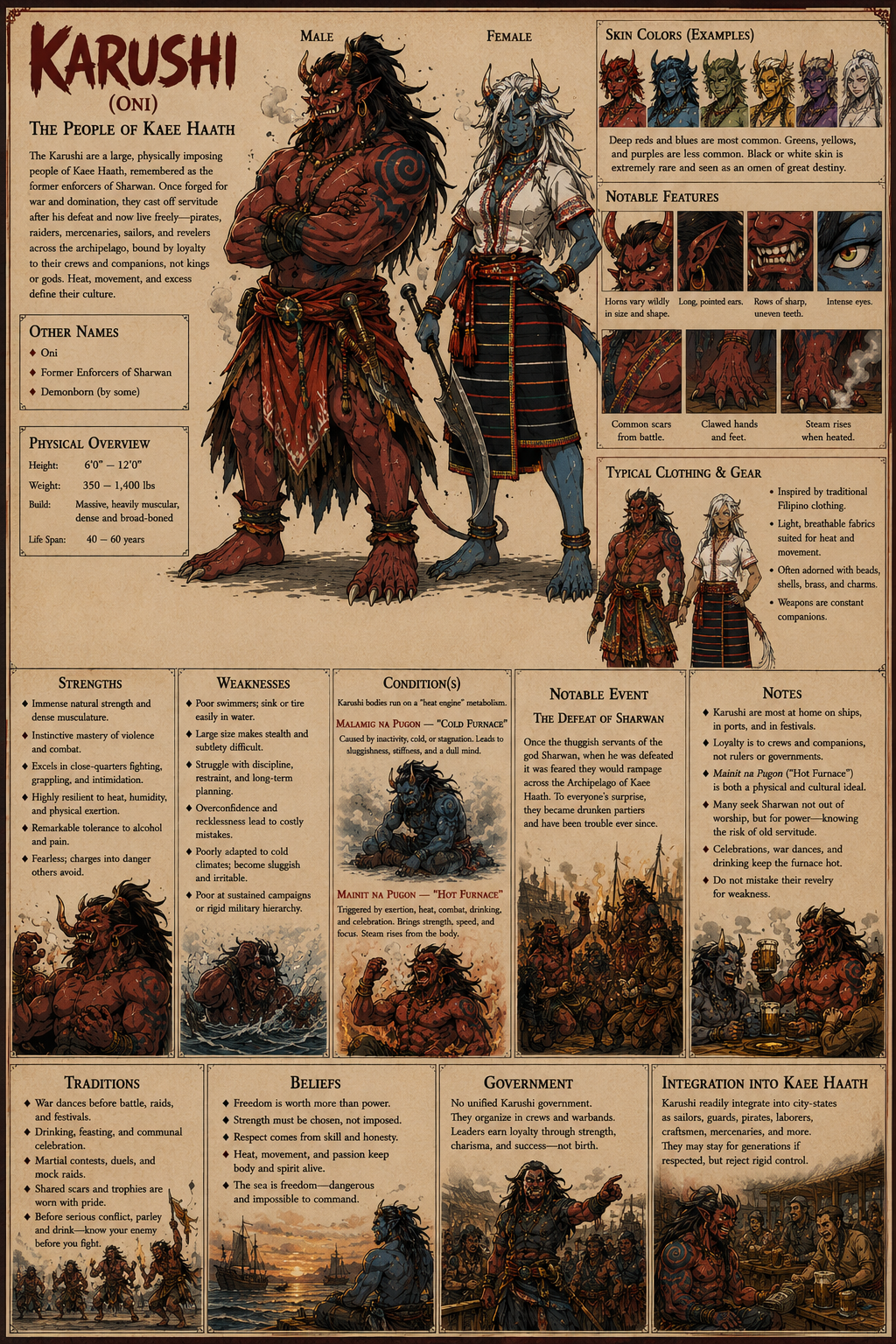
The Karushi are a large, physically imposing people of Kaee Haath, remembered throughout the archipelago as the former enforcers of Sharwan during the age before his defeat. Towering over most other peoples and naturally gifted in the arts of violence and warfare, the Karushi possess immense physical strength, predatory features, and an instinctive understanding of combat that has made them feared across the islands for generations. Yet despite this reputation, modern Karushi culture is defined less by conquest and discipline than by freedom, excess, celebration, and personal loyalty.
Following Sharwan’s defeat at the hands of Tal’Zanithal, the Karushi cast aside the rigid role forced upon them and embraced a far less restrained way of life. Many turned toward piracy, mercenary work, raiding, trade, drinking, festivals, and maritime life, organizing themselves into crews, warbands, and shifting personal alliances rather than centralized states or standing armies. Though often dismissed as lazy, reckless, or hedonistic, this perception hides a dangerous truth: the martial skill of the Karushi never disappeared. Even the most drunken or unmotivated among them may possess combat instincts and physical capability far beyond that of ordinary warriors, capable of erupting into sudden violence once driven into a state the Karushi call Mainit na Pugon—“Hot Furnace.”
Karushi culture revolves around heat, movement, and communal experience, expressed through loud celebrations, war dances, drinking, martial contests, and strong social bonds. Unlike the more detached Lutan, the Karushi readily integrate themselves into the societies of Kaee Haath, becoming sailors, guards, pirates, laborers, craftsmen, mercenaries, tavern owners, or local troublemakers depending on circumstance, whether they are welcomed or not. Their loyalty lies first and foremost with their crews and companions rather than governments or institutions, and attempts to control them too rigidly often end in unrest or violence.
Though they reject servitude and deeply distrust centralized authority, the legacy of Sharwan still lingers heavily over the Karushi. They remain one of the peoples most willing to seek him out directly, not out of worship, but because they understand his nature more intimately than most and recognize the temptation of the power he offers. Among many Karushi, accepting Sharwan’s gifts is viewed with a mixture of respect, pity, and unease—an acknowledgment that great strength may still carry the weight of an old yoke.
Oni
Looks
The Karrushi possess a large, physically imposing humanoid build shaped around strength, momentum, and raw physical presence. Their bodies are broad and powerfully structured, with heavy shoulders, thick limbs, and dense musculature that gives even relaxed individuals an intimidating appearance. Unlike the lighter, constantly shifting posture of the Lutan, the Karrushi carry themselves with a grounded, weighty stance that makes them appear firmly planted even when in motion. Their proportions favor force over agility, with long arms built for powerful swings, grappling, and lifting, while their legs are thick and stable, capable of explosive bursts of speed despite their size.
Male Karrushi tend to develop especially bulky upper bodies, with massive chests, backs, and shoulders that can make them appear almost oversized compared to other peoples of Kaee Haath. Female Karrushi, while generally leaner and slightly less bulky, remain visibly muscular and physically formidable, favoring athletic power over narrow or delicate proportions. Across both sexes, the Karrushi maintain a naturally predatory silhouette, with subtle forward posture, clawed hands and feet, and movements that feel deliberate and forceful rather than fluid.
Their heads are marked by prominent horns that vary widely in size, angle, and shape between individuals, serving as one of their most recognizable traits. Facial features often blend humanoid structure with more beast-like elements, including pronounced teeth, sharp eyes, and heavily defined brow lines that contribute to their intense expressions. Overall, the Karrushi are built less like creatures adapted for constant motion and more like living shock forces: large, resilient, and naturally suited for violence even before training or experience are considered.
The Karrushi display a wide range of vivid skin tones uncommon among most peoples of Sol Saris, with deep reds and blues being by far the most prevalent throughout the archipelago. These colors can range from muted earthy shades to more saturated tones depending on lineage, environment, and individual variation, often accompanied by darker freckling, mottling, or subtle patterning across the shoulders, back, and limbs. Greens and yellows are also present among the Karrushi, though noticeably less common, typically appearing in more subdued or weathered tones rather than bright coloration. Regardless of hue, Karrushi skin tends to possess a rugged, slightly textured appearance, contributing to their naturally imposing look.
Horns, claws, and thicker patches of skin around the joints commonly darken with age, use, or exposure, and many Karrushi bear visible scars from fighting, raiding, or reckless living, often wearing them proudly rather than concealing them. Hair coloration varies widely but frequently contrasts strongly against the skin, with pale pinks, whites, blacks, and fiery reds all appearing among different individuals and regions.
Among the rarest Karrushi are those born with black or white skin, occurrences uncommon enough to carry heavy cultural significance across much of Kaee Haath. Such individuals are widely viewed as omens of exceptional prowess, destiny, or upheaval, and are often burdened with expectations of greatness from an early age. Leadership roles, command positions, or symbolic authority are frequently pushed upon them regardless of personal desire or actual suitability. Some rise to meet these expectations and become legendary figures among the Karrushi, while others spend their lives attempting to escape reputations forced upon them simply because of the color of their skin.
The Karrushi are an exceptionally large people, typically standing between 6 and 12 feet tall, with considerable variation occurring between individuals and bloodlines. Even the smallest among them are physically imposing compared to most other peoples of Kaee Haath, while the largest can tower over crowds and dominate a space through sheer presence alone. Their size is matched by dense musculature and heavy frames, giving the Karrushi a naturally intimidating appearance long before armor or weapons are considered. Despite this immense stature, they are far from slow, capable of sudden bursts of speed and force that make their size all the more dangerous.
The Karrushi are an immensely heavy people, with most individuals weighing between 350 and 1,400 pounds depending on height, build, and lifestyle. Even the leanest among them possess dense musculature, thick bone structure, and heavy frames that give them a substantial physical presence far beyond that of most other peoples of Kaee Haath. Average adults commonly fall within the middle of this range, while especially large individuals such as veteran raiders, renowned warriors, or those from particularly imposing bloodlines can grow far heavier still. Male Karrushi generally trend toward greater upper-body bulk and overall mass, developing massive shoulders, chests, and arms, while females tend to carry slightly leaner and more athletic builds without losing the immense strength characteristic of the people as a whole. Despite their tendency toward indulgence and excess, the Karrushi rarely appear soft or fragile, instead giving the impression of immense physical weight and restrained force even in moments of relaxation.
The Karrushi are marked by a number of striking physical traits that reinforce their naturally imposing presence and long association with warfare. Most prominent among these are their horns, which vary dramatically in size, shape, and orientation between individuals, ranging from heavy curling forms to sharp forward-pointing growths or asymmetrical jagged structures. Horns are often treated as points of personal pride and are commonly decorated with metal bands, carvings, paint, or trophies gathered throughout a Karrushi’s life. Their faces are further distinguished by pronounced teeth and enlarged canines, often visible even while speaking, contributing to their predatory appearance alongside heavily defined brows and intense eyes.
Their bodies display dense, rugged skin that naturally thickens around the joints, knuckles, shoulders, and other high-impact areas, giving many Karrushi the appearance of carrying natural armor formed through generations of violence and hard living. Scars are extremely common and rarely hidden, instead worn openly as reminders of fights survived, raids endured, or reckless decisions lived through. Many Karrushi also possess natural marbling, mottling, or darker patterning across the skin, particularly around the shoulders, spine, and limbs, creating appearances reminiscent of storm clouds, bruising, or smoke-like streaks depending on coloration.
Physically, the Karrushi tend to run unusually warm, with body heat that becomes especially noticeable in rain or colder air where steam may visibly rise from their skin. Their voices are deep and powerful, easily carrying across crowded halls, stormy docks, or battlefields alike, lending itself naturally to loud celebrations, arguments, songs, and pirate chants. Combined with their immense tolerance for alcohol and equally immense appetites for food, drink, excitement, and conflict, the Karrushi project an overwhelming sense of life and presence even at rest. Among them, individuals born with black or white skin remain extraordinarily rare and are widely regarded as omens of exceptional prowess or destiny, often having leadership and expectation forced upon them regardless of personal desire or temperament.
The Karushi display an exceptionally broad range of physical variation, shaped by bloodline, environment, lifestyle, and the decentralized nature of their society. While all Karushi share a naturally imposing build and predatory presence, the specific expression of these traits can differ dramatically between individuals and groups. Some develop massive, heavily muscled bodies with thick limbs and broad frames resembling living siege weapons, while others possess leaner, more athletic builds built around speed, aggression, and rapid movement. Regardless of shape, even the leanest Karushi retain a sense of dense physical power that distinguishes them from most other peoples of Kaee Haath.
Horn shape and size vary enormously, serving as one of the most visually distinctive forms of individuality among the Karushi. Horns may curl, sweep backward, jut forward like spears, spread outward like crowns, or grow in uneven asymmetrical forms, with broken or damaged horns being especially common among older warriors and pirates. Facial structure also varies widely, with some individuals appearing closer to heavily built humanoids while others possess more beast-like features such as broader jaws, more prominent fangs, or stronger brow ridges. Skin patterning frequently differs between individuals as well, including marbling, mottling, darker extremities, or storm-like markings across the shoulders and spine.
Lifestyle further influences appearance, particularly among older Karushi. Some become visibly thickened by years of drink, feasting, and indulgence while still retaining immense underlying strength, while others remain hardened through constant raiding, warfare, or travel. Regional differences between islands also shape the people subtly, with coastal Karushi often appearing leaner and weathered, volcanic populations tending toward heavier builds and darker tones, and jungle-dwelling groups developing more agile, predatory physiques. Despite this wide variance, all Karushi remain unmistakably recognizable through their immense presence, powerful frames, and the lingering sense that violence comes naturally to them even at rest.
Karushi clothing is shaped primarily by the tropical climate of Kaee Haath, maritime life, and a cultural preference for comfort, movement, and physical expression over rigid formality. Most favor wrapped lower garments, layered waist cloths, loose trousers, open jackets, sleeveless vests, and asymmetrical draping that allow freedom of movement in heat and humidity while remaining practical aboard ships or during sudden violence. Clothing often leaves portions of the chest, arms, shoulders, or legs exposed, with the Karushi placing little importance on concealing musculature, scars, tattoos, or skin markings. Rope belts, layered sashes, woven fabrics, decorative knots, jewelry, and patterned textiles are common throughout the archipelago, with regional weaving styles and dyes serving as visible signs of local identity, crew affiliation, or personal taste.
While the Karushi possess a long martial history, heavy armor is uncommon outside warfare, raiding, ceremonial events, or individuals of particular status. Instead, many wear selective armor pieces such as shoulder guards, bracers, plated skirts, or reinforced sandals combined with otherwise lightweight tropical clothing. Weapons are frequently carried openly and treated as both practical tools and personal statements, ranging from massive clubs and cleavers to swords, spears, and older inherited weapons dating back to the age of Sharwan’s rule. Overall, Karushi fashion combines maritime practicality, martial confidence, and flamboyant individuality into a style that appears simultaneously relaxed, dangerous, and deeply rooted in the storm-wracked island cultures of Kaee Haath.
Traits
The Karushi possess immense natural physical strength, dense musculature, and heavy frames that make them formidable even without formal training. Their size, combined with a deeply ingrained instinct for violence and combat, grants them an unusually intuitive understanding of weapons, momentum, and close-quarters fighting. Even inexperienced Karushi often display a natural grasp of striking, grappling, intimidation, and battlefield movement that other peoples must learn through years of practice. This inherited martial aptitude, believed by many to be a lingering remnant of their ancient role beneath Sharwan, has made the Karushi feared as warriors, pirates, mercenaries, and raiders throughout Kaee Haath.
Karushi are also exceptionally grounded physically, difficult to stagger, knock aside, or unbalance even in rough terrain, storms, or shipboard combat. Their bodies naturally tolerate heat, humidity, and physical exertion at levels uncommon among most peoples, often radiating visible warmth or steam during heavy activity or rain. Combined with remarkable resilience to alcohol and a cultural fearlessness toward danger, the Karushi are known for charging into situations others would avoid entirely, relying on overwhelming force, instinct, and confidence to carry them through. Though many spend their lives in indulgence, celebration, or piracy rather than organized warfare, the underlying martial capability of the Karushi remains ever-present beneath their relaxed and excessive culture.
Despite their immense strength and natural combat aptitude, the Karushi possess several significant weaknesses tied directly to their physical nature and cultural tendencies. Their dense musculature, heavy frames, and grounded bodies make them surprisingly poor swimmers despite their close relationship with the sea, causing many to sink quickly or tire rapidly in open water. As a result, Karushi pirates and sailors place enormous importance on ships, ropes, boarding tactics, and staying above the waves rather than within them. Their size and weight can also become disadvantages in confined spaces, during long marches, or in situations requiring stealth, subtlety, or careful resource management.
Culturally, the Karushi struggle with restraint, discipline, and centralized organization. Their society encourages indulgence, excess, impulsiveness, and personal freedom, often at the expense of long-term planning or stability. While capable of terrifying effectiveness in raids, duels, and short bursts of violence, they are poorly suited for prolonged campaigns, rigid military hierarchy, or sustained large-scale governance. Many Karushi rely heavily on instinctive talent and physical superiority rather than refinement or patience, leading to overconfidence and reckless decision-making. Additionally, their bodies are poorly adapted to colder climates, with many becoming sluggish, irritable, or physically uncomfortable in prolonged cold environments far removed from the humid heat of Kaee Haath.
The Karushi possess a unique physiological trait often described by outsiders as a “heat engine” metabolism, causing their bodies and minds to function best when active, stimulated, and physically warm. Periods of prolonged inactivity, cold exposure, or stillness can leave many Karushi sluggish, stiff, lethargic, and mentally unfocused in a condition commonly referred to among their people as Malamig na Pugon—“Cold Furnace.” While not debilitating, this state causes the Karushi to feel physically heavy and emotionally dulled, often leading to irritability, laziness, or restless dissatisfaction if maintained for too long. Among the Karushi, becoming a “cold furnace” is viewed as both an unpleasant physical condition and a symbolic loss of drive, passion, or momentum.
In contrast, physical exertion, combat, celebration, alcohol, heat, and social activity rapidly “wake” the Karushi body, bringing them into a state known as Mainit na Pugon—“Hot Furnace.” In this condition, circulation, responsiveness, and overall physical capability increase dramatically, with many Karushi visibly radiating heat or venting steam from their skin in cooler air or rain. This phenomenon has contributed to long-standing beliefs that Karushi blood burns hotter than that of other peoples. The cycle between Malamig na Pugon and Mainit na Pugon has profoundly shaped Karushi culture, reinforcing their love of fighting, drinking, dancing, feasting, and loud communal gatherings, all of which help keep both body and spirit “heated.” Older Karushi often struggle more heavily with periods of cooling, leading many to remain constantly active, surround themselves with warmth, or rely heavily on alcohol and stimulation well into old age.
Culture
Karushi traditions are deeply rooted in movement, celebration, and communal physical expression, with war dances serving as one of the most recognizable and culturally significant practices across Kaee Haath. These dances range from short, explosive displays performed before fights, raids, arguments, or acts of intimidation to extended communal performances held during festivals, funerals, victories, and seasonal gatherings. Combining rhythmic stomping, weapon flourishes, shouted chants, drumming, and synchronized movement, war dances serve both practical and symbolic purposes, helping participants physically “heat” themselves into a state of Mainit na Pugon while reinforcing bonds between crews, warbands, and local communities.
The changing of the dry season holds particular importance throughout the archipelago, as calmer seas allow travel, trade, celebration, and piracy to flourish between the islands. During these periods, city-states and settlements often erupt into festivals marked by feasting, drinking, martial competitions, music, and public performance. Wherever such celebrations occur, Karushi are almost certain to appear, whether invited or not. Unlike the more detached Lutan, the Karushi readily integrate themselves into the societies around them, becoming laborers, mercenaries, guards, pirates, entertainers, or local troublemakers depending on circumstance. Their immense appetites for food, drink, excitement, and social activity make them highly visible presences within the communities they inhabit, and even settlements that resent or fear them often find it difficult to imagine local festivals, docks, or fighting pits without Karushi participation.
Communal combat games, drinking contests, mock raids, wrestling matches, and weapon performances are all common elements of Karushi social life, blurring the line between celebration and martial practice. Through these traditions, the Karushi maintain not only their cultural identity, but also the physical and emotional heat they believe necessary to avoid falling into Malamig na Pugon, reinforcing a way of life centered around momentum, excess, and shared experience.
Karushi beliefs center around freedom, directness, shared experience, and the conviction that strength must be chosen rather than imposed. Though they remain deeply aware of Sharwan and the power he can bestow upon those capable of reaching and defeating him, most Karushi view accepting his gifts with discomfort or outright suspicion. To many, willingly taking power from Sharwan is seen as placing the old yoke of servitude back upon oneself, exchanging freedom for strength no matter how valuable that strength may be. Those who seek him out are not universally condemned, but they are often regarded with a mixture of pity, caution, and reluctant understanding.
Central to Karushi philosophy is the belief that conflict should be honest and personal rather than cold or detached. Before serious fights, raids, duels, or acts of vengeance, it is common for Karushi to engage in some form of parlay, introduction, or verbal exchange, believing that opponents should understand one another before violence begins. Shared drinks before battle, declarations of grievance, challenges, and final conversations are all culturally significant practices, reinforcing the idea that struggle carries meaning beyond simple victory or defeat. Skill is respected regardless of origin, and even enemies may earn admiration if they fight well or carry themselves with confidence and sincerity.
The concepts of Mainit na Pugon and Malamig na Pugon also shape Karushi beliefs beyond simple physiology. Heat, activity, passion, and communal experience are associated with life and vitality, while isolation, stagnation, and emotional coldness are viewed as deeply unhealthy states of being. As a result, Karushi place great value on celebration, drinking, dancing, storytelling, combat, and companionship, seeing them not merely as pleasures but as necessary parts of a meaningful life. They tend to trust crews, companions, and personal bonds far more than institutions or rulers, and many view the sea itself as the ultimate reflection of freedom: dangerous, ever-changing, and impossible to fully control.
The Karushi possess no unified government of their own and rarely attempt to establish large, stable states despite their immense martial capability. Instead, their primary social and political structure is the crew, a flexible unit that may function as a pirate band, mercenary company, labor group, extended family, raiding party, or simple collection of companions bound together through shared loyalty and mutual interest. Leadership within a crew is typically informal but highly personal, favoring individuals who demonstrate strength, charisma, success, generosity, and the ability to maintain the crew’s momentum and cohesion rather than any hereditary claim or rigid authority structure.
While the Karushi are not natural nation-builders, they readily integrate themselves into the societies of Kaee Haath, particularly the city-states largely established and maintained by the Kaevari. Individual Karushi and entire crews may attach themselves to a settlement, ruler, harbor, or island for years or even generations if they feel respected, valued, and personally connected to the community. In these situations, they commonly serve as guards, sailors, mercenaries, laborers, pirates, enforcers, or local champions, often becoming deeply woven into the daily life of the places they inhabit regardless of whether they were originally welcomed there. However, their loyalty remains fundamentally personal rather than institutional, and attempts to impose excessive control, cold bureaucracy, or exploitative authority upon them frequently lead to unrest, abandonment, or outright violence.
Karushi are also known to attach themselves to groups outside their own culture, including wandering Lutan troops, a dynamic that is often both highly effective and deeply disruptive. Such arrangements frequently result in clashes between Karushi excess and Lutan discipline, though mutual respect for skill and personal capability often allows these unlikely partnerships to endure. Across Kaee Haath, the Karushi remain a people who participate heavily in society without ever fully surrendering themselves to it, carrying their loyalty first and foremost to the companions and crews they personally choose to stand beside.
Karushi technology is shaped heavily by maritime life, opportunistic adaptation, and their frequent interaction with foreign traders arriving in Kaee Haath. Because they are often among the first peoples to encounter Nmerian merchants and imported goods, the Karushi are quick to adopt useful or impressive technologies despite lacking the centralized structures necessary for widespread standardization or industrial production. Firearms remain relatively rare throughout the archipelago, but the Karushi readily make use of them whenever they can acquire or steal them, favoring hand cannons, matchlocks, pistols, and ship-mounted bombards for their destructive force, noise, and intimidation value. Rather than disciplined battlefield formations, Karushi tend to employ such weapons in aggressive close-range fighting, piracy, boarding actions, and raids.
Beyond warfare, the Karushi possess considerable practical knowledge related to ships, harbors, rope systems, repair work, and improvised engineering, largely due to their deep involvement in maritime culture. Their tools and weapons are frequently personalized, modified, reinforced, or decorated, reflecting both individual pride and a preference for adaptation over uniformity. Though many Karushi favor wandering, piracy, or mercenary work, those who dedicate themselves to long-term trade or craftsmanship are often highly respected, as maintaining such rooted professions is viewed as requiring exceptional discipline and patience. Their physiology also makes them naturally suited to work involving heat and heavy labor, allowing many Karushi to excel in smithing, furnace work, shipbuilding, and other physically demanding crafts when they choose to pursue them.
Despite their strengths, Karushi technology remains decentralized and inconsistent. They excel at improvisation and rapid adoption of new ideas, but struggle with large-scale organization, standardized production, and the bureaucratic systems necessary to sustain advanced industry. As a result, Karushi technological culture tends to spread through crews, ports, and personal connections rather than formal institutions, helping make the peoples of Kaee Haath highly adaptive despite the fragmented nature of the archipelago itself.
Karushi occupations are heavily influenced by their immense physical capability, maritime culture, and preference for active, socially engaging lifestyles. Many naturally gravitate toward professions involving combat, heavy labor, sailing, or physical risk, resulting in large numbers of Karushi working as mercenaries, pirates, guards, raiders, sailors, dockworkers, shipboard fighters, monster hunters, and enforcers throughout Kaee Haath. Their instinctive understanding of violence and weaponry makes them highly sought after in dangerous professions, while their size and resilience also allow them to excel in physically demanding labor such as smithing, foundry work, shipbuilding, quarrying, logging, and large-scale construction.
Due to their close relationship with maritime life, Karushi are especially common in ports, aboard ships, and around harbors, where they serve as riggers, salvagers, harbor workers, navigators, smugglers, and ship captains. Despite their rough reputation, they are also deeply involved in the social and celebratory aspects of island life, frequently working as tavern owners, brewers, performers, musicians, war dancers, gambling organizers, and festival figures. Many Karushi naturally insert themselves into the communities around them regardless of whether they were formally welcomed, becoming familiar and often unavoidable presences within local society.
While most Karushi prefer flexible or high-energy professions, those who commit themselves to stable long-term trades such as merchant work, permanent craftsmanship, or organized shipping are often highly respected by their peers, as maintaining such rooted responsibilities is viewed as requiring unusual discipline and self-control. Across the archipelago, Karushi occupations tend to reflect lives built around momentum, danger, companionship, and constant activity, reinforcing both their cultural identity and their need to remain in a state of Mainit na Pugon rather than falling into Malamig na Pugon.
The Karushi are deeply integrated into the broader economic systems of Kaee Haath, particularly within ports, city-states, trade hubs, and maritime industries where their presence is both common and highly influential. Unlike the more communal internal systems of the Lutan, Karushi economic life is largely centered around personal wealth, wages, trade, and direct exchange. Coin is treated as an individual matter, earned and spent freely according to personal desire, though crews and close companions often pool resources informally to maintain ships, purchase supplies, support injured members, or fund large ventures. These arrangements are typically based on trust, loyalty, and shared expectation rather than formal contracts or structured taxation.
Karushi are known for keeping wealth in constant circulation, spending heavily on food, drink, weapons, festivals, gambling, ship maintenance, and personal adornment rather than quietly accumulating riches over long periods. As a result, areas with strong Karushi populations often develop lively and economically active dock districts, taverns, fighting pits, shipyards, and marketplaces. Violence and trade are also closely intertwined within Karushi society, with piracy, mercenary work, smuggling, escorting, and protection services existing comfortably alongside legitimate labor and commerce. Gambling and competitive wagering are especially common, further reinforcing their tendency toward impulsive spending and risk-taking.
Despite their reputation for excess and instability, the Karushi hold genuine respect for successful merchants, captains, innkeepers, and long-term traders, viewing the discipline required to maintain stable economic ventures as a skill worthy of admiration. While their economic behavior can lead to cycles of debt, reckless spending, or sudden fortune, it also makes the Karushi one of the most economically dynamic peoples within the archipelago, helping drive the movement of goods, coin, labor, and opportunity throughout Kaee Haath.
Karushi food culture centers around heat, strong flavor, communal eating, and excess, reflecting both their physiology and their highly social way of life. Their immense size and heat-driven bodies require substantial amounts of food, leading many Karushi to favor large portions of roasted meat, grilled seafood, rich broths, and heavily seasoned dishes designed to keep the body active and “heated.” Freshly cooked food is strongly preferred, particularly meals served directly from flame, coals, or boiling pots, with many Karushi associating hot food with vitality, energy, and emotional well-being. Spices, smoke, fermented sauces, garlic, peppers, and strong marinades are common throughout their cuisine, influenced heavily by the tropical and maritime environment of Kaee Haath.
Seafood forms a major part of the Karushi diet, especially among coastal crews and pirate bands, with grilled fish, giant crabs, shellfish, squid, and smoked sea meats appearing frequently at both everyday meals and large gatherings. Communal hot pots and shared platters are especially popular during festivals or drinking sessions, where meals become loud social events centered around companionship, storytelling, gambling, and alcohol consumption. Drinking itself is deeply integrated into Karushi food culture, with rice liquors, fermented fruit alcohols, strong spirits, and spiced drinks accompanying nearly every major gathering.
Portable foods for raids and long voyages often include smoked meats, dried seafood, preserved fruits, fermented foods, and heavily seasoned travel rations designed to remain flavorful even after long periods aboard ships. Many Karushi also enjoy challenge foods or excessive eating contests, treating spice tolerance, dangerous ingredients, or sheer quantity as forms of entertainment and personal pride. Across Kaee Haath, Karushi cuisine is widely recognized as bold, filling, messy, and intensely communal, much like the people themselves.
History
Long before the modern peoples of Kaee Haath understood themselves as separate cultures or races, the archipelago appears to have belonged to a far older civilization whose identity has been almost completely erased by time, disaster, and fragmentation. Across the islands surrounding the Shattered Palm, immense ruins, resonant temple complexes, elevated courtyards, collapsed observatories, drowned causeways, and impossible stone structures remain scattered through jungles, cliffsides, reefs, and volcanic valleys. No surviving people fully agrees on who built them. The Lutan claim they are remnants of the Monkey King’s ancient domains, the Kaevari believe they are fragments of a forgotten maritime civilization, some Karushi traditions whisper that Sharwan once ruled much of the archipelago directly, while many Mayurai seem instinctively drawn to the ruins without fully understanding why they feel sacred at all.
Whatever this ancient civilization truly was, it eventually collapsed. Some believe the destruction of the great volcanic center now known as the Shattered Palm marked the beginning of the end, shattering trade routes, flooding islands, destroying cities, and isolating surviving populations across the archipelago. Others believe the collapse was slower, caused by war, internal decay, unnatural forces, or struggles involving Sharwan and powers no longer remembered clearly. Much of Kaee Haath’s surviving history exists only as contradictory oral traditions, fragmented rituals, ruined architecture, and inherited instincts preserved unevenly between the races.
The Lutan are believed to be among the oldest surviving organized peoples of the archipelago. Their traditions speak of ancient troop kingdoms, sacred mountain monasteries, disciplined wandering societies, and the lost rule of the Monkey King, though how much of this survives as literal history is unclear. Even in the modern age, the Lutan remain deeply tied to ruins, ancestral memory, and sacred preservation, often treating the remnants of the ancient world with reverence and caution.
The Mayurai appear to have once served some ceremonial or guardian function within the forgotten civilization. Though their masters vanished long ago, the species continues to reenact fragments of inherited purpose through territorial courts, ritualized combat, sacred performances, and instinctive attraction toward temple complexes and resonant ruins. Over centuries, they developed unstable but vibrant communal societies centered around musters, sacred display grounds, and ritual authority, frequently coming into conflict with the Lutan over possession of ancient ceremonial sites.
The Karushi emerged in later eras as powerful warriors, raiders, enforcers, and mercenaries closely tied to the influence of Sharwan. Whether created, shaped, uplifted, or merely empowered by him remains uncertain, but the connection between the Karushi and Sharwan is deeply embedded within both their biology and cultural memory. For long periods, they served as feared martial powers throughout Kaee Haath before eventually throwing off the rigid structures imposed upon them after Sharwan’s defeat at the hands of Tal'Zanithal. In the centuries afterward, the Karushi fragmented into crews, pirate bands, mercenary groups, harbor communities, and wandering martial cultures defined more by celebration, violence, and personal freedom than centralized rule.
The Kaevari rose to prominence comparatively late, gradually building the first truly stable maritime city-states of the modern era across the islands surrounding the Shattered Palm. Drawing together fragments of surviving knowledge, trade traditions, navigation systems, engineering practices, and scholarly traditions preserved unevenly across the archipelago, the Kaevari established temple-schools that became centers of administration, learning, trade, and civic life. Though less ancient than many of the structures surrounding them, the Kaevari became the primary organizers and sustainers of modern civilization within Kaee Haath, integrating both Lutan and Mayurai populations into their growing urban centers while maintaining complicated relationships with the fiercely independent Karushi.
In the modern age, Kaee Haath exists as a fractured but interconnected archipelago where no people fully understands the world that came before them, yet all continue to live among its ruins. The Kaevari maintain the closest thing to stable civilization, the Lutan preserve memory and sacred continuity, the Karushi embody freedom and inherited violence, and the Mayurai continue to perform echoes of ancient ceremonial purpose beneath the shadow of forgotten ruins. Around them all, the storms surrounding the Shattered Palm continue to rage, and somewhere beneath the fractured history of the archipelago lies the unanswered question that haunts every people of Kaee Haath alike: who built the first civilization, and what destroyed it?
Once the thuggish servants of the god Sharwan, when he was defeated it was feared they would rampage across the Archipelago of Kaee Haath, to everyone's surprise, they became drunken partiers and have been trouble ever since.
Notes
- Nagbabagang Alimango
(“Blazing Crab”)
A massive communal dish built around giant archipelago crabs split open and roasted directly over volcanic stone or open coals. The meat is coated in a thick mixture of chili paste, garlic, fermented fish sauce, citrus, and palm sugar before cooking, creating a heavily caramelized shell with intensely spicy flesh beneath. The claws are often cracked apart publicly with hammers or bare hands, and the dish is traditionally eaten in loud groups where conversation, gambling, and drinking are expected parts of the meal. Particularly spicy preparations are commonly used during festivals or before raids to help push participants into Mainit na Pugon.
Paired Beverage — Apoy Rum
A dark sugarcane liquor infused with peppers, smoked citrus peel, and volcanic spices. Served warm or at room temperature in heavy ceramic cups, it burns intensely going down and is infamous for causing even experienced drinkers to begin visibly steaming in cooler weather.
- Pugon Stew
Named after the Karushi concept of the “furnace,” this enormous communal hot pot is built from thick cuts of slow-cooked meat, marrow bones, sea eel, root vegetables, fermented greens, and black pepper broth left simmering for hours over constant heat. Every crew, tavern, or harbor district claims their own variation, and ingredients are often added continuously throughout the night as people gather around it to drink, argue, gamble, and tell stories. A properly maintained Pugon Stew is considered a point of pride, and some taverns are rumored to keep the same stew base active for years at a time.
Paired Beverage — Mainit Rice Wine
A cloudy fermented rice alcohol served heated with ginger, cloves, and bitter tropical herbs. Less explosive than stronger Karushi liquors, it is commonly consumed during long nights of storytelling or war dancing to slowly “heat the furnace” without overwhelming the drinker too quickly.
- Bagyo Skewers
(“Storm Skewers”)
A favorite among pirates and sailors, Bagyo Skewers consist of aggressively seasoned chunks of shark, reef boar, squid, or giant insect meat threaded onto thick iron or hardwood skewers and cooked quickly over roaring flame. The meat is coated in salt, crushed spices, fermented vinegar glaze, and charred herbs, resulting in a smoky, salty, intensely savory flavor designed to pair well with alcohol and sea air. Crews often prepare them directly aboard ships during calm seas or immediately after successful raids, with competitions forming around who can tolerate the hottest spice mixtures.
Paired Beverage — Blackwake Palm Spirit
A brutally strong distilled palm liquor with a smoky aftertaste and slight bitterness from burned sugar and charred wood infusion. Favored heavily by pirate crews, it is notorious for causing fights, singing, confessions, and terrible decisions in roughly equal measure.
Overview
Details about this race's overview
Karushi
The Karushi are a large, physically imposing people of Kaee Haath, remembered throughout the archipelago as the former enforcers of Sharwan during the age before his defeat. Towering over most other peoples and naturally gifted in the arts of violence and warfare, the Karushi possess immense physical strength, predatory features, and an instinctive understanding of combat that has made them feared across the islands for generations. Yet despite this reputation, modern Karushi culture is defined less by conquest and discipline than by freedom, excess, celebration, and personal loyalty.
Following Sharwan’s defeat at the hands of Tal’Zanithal, the Karushi cast aside the rigid role forced upon them and embraced a far less restrained way of life. Many turned toward piracy, mercenary work, raiding, trade, drinking, festivals, and maritime life, organizing themselves into crews, warbands, and shifting personal alliances rather than centralized states or standing armies. Though often dismissed as lazy, reckless, or hedonistic, this perception hides a dangerous truth: the martial skill of the Karushi never disappeared. Even the most drunken or unmotivated among them may possess combat instincts and physical capability far beyond that of ordinary warriors, capable of erupting into sudden violence once driven into a state the Karushi call Mainit na Pugon—“Hot Furnace.”
Karushi culture revolves around heat, movement, and communal experience, expressed through loud celebrations, war dances, drinking, martial contests, and strong social bonds. Unlike the more detached Lutan, the Karushi readily integrate themselves into the societies of Kaee Haath, becoming sailors, guards, pirates, laborers, craftsmen, mercenaries, tavern owners, or local troublemakers depending on circumstance, whether they are welcomed or not. Their loyalty lies first and foremost with their crews and companions rather than governments or institutions, and attempts to control them too rigidly often end in unrest or violence.
Though they reject servitude and deeply distrust centralized authority, the legacy of Sharwan still lingers heavily over the Karushi. They remain one of the peoples most willing to seek him out directly, not out of worship, but because they understand his nature more intimately than most and recognize the temptation of the power he offers. Among many Karushi, accepting Sharwan’s gifts is viewed with a mixture of respect, pity, and unease—an acknowledgment that great strength may still carry the weight of an old yoke.
Oni
Looks
Details about this race's looks
The Karrushi possess a large, physically imposing humanoid build shaped around strength, momentum, and raw physical presence. Their bodies are broad and powerfully structured, with heavy shoulders, thick limbs, and dense musculature that gives even relaxed individuals an intimidating appearance. Unlike the lighter, constantly shifting posture of the Lutan, the Karrushi carry themselves with a grounded, weighty stance that makes them appear firmly planted even when in motion. Their proportions favor force over agility, with long arms built for powerful swings, grappling, and lifting, while their legs are thick and stable, capable of explosive bursts of speed despite their size.
Male Karrushi tend to develop especially bulky upper bodies, with massive chests, backs, and shoulders that can make them appear almost oversized compared to other peoples of Kaee Haath. Female Karrushi, while generally leaner and slightly less bulky, remain visibly muscular and physically formidable, favoring athletic power over narrow or delicate proportions. Across both sexes, the Karrushi maintain a naturally predatory silhouette, with subtle forward posture, clawed hands and feet, and movements that feel deliberate and forceful rather than fluid.
Their heads are marked by prominent horns that vary widely in size, angle, and shape between individuals, serving as one of their most recognizable traits. Facial features often blend humanoid structure with more beast-like elements, including pronounced teeth, sharp eyes, and heavily defined brow lines that contribute to their intense expressions. Overall, the Karrushi are built less like creatures adapted for constant motion and more like living shock forces: large, resilient, and naturally suited for violence even before training or experience are considered.
The Karrushi display a wide range of vivid skin tones uncommon among most peoples of Sol Saris, with deep reds and blues being by far the most prevalent throughout the archipelago. These colors can range from muted earthy shades to more saturated tones depending on lineage, environment, and individual variation, often accompanied by darker freckling, mottling, or subtle patterning across the shoulders, back, and limbs. Greens and yellows are also present among the Karrushi, though noticeably less common, typically appearing in more subdued or weathered tones rather than bright coloration. Regardless of hue, Karrushi skin tends to possess a rugged, slightly textured appearance, contributing to their naturally imposing look.
Horns, claws, and thicker patches of skin around the joints commonly darken with age, use, or exposure, and many Karrushi bear visible scars from fighting, raiding, or reckless living, often wearing them proudly rather than concealing them. Hair coloration varies widely but frequently contrasts strongly against the skin, with pale pinks, whites, blacks, and fiery reds all appearing among different individuals and regions.
Among the rarest Karrushi are those born with black or white skin, occurrences uncommon enough to carry heavy cultural significance across much of Kaee Haath. Such individuals are widely viewed as omens of exceptional prowess, destiny, or upheaval, and are often burdened with expectations of greatness from an early age. Leadership roles, command positions, or symbolic authority are frequently pushed upon them regardless of personal desire or actual suitability. Some rise to meet these expectations and become legendary figures among the Karrushi, while others spend their lives attempting to escape reputations forced upon them simply because of the color of their skin.
The Karrushi are an exceptionally large people, typically standing between 6 and 12 feet tall, with considerable variation occurring between individuals and bloodlines. Even the smallest among them are physically imposing compared to most other peoples of Kaee Haath, while the largest can tower over crowds and dominate a space through sheer presence alone. Their size is matched by dense musculature and heavy frames, giving the Karrushi a naturally intimidating appearance long before armor or weapons are considered. Despite this immense stature, they are far from slow, capable of sudden bursts of speed and force that make their size all the more dangerous.
The Karrushi are an immensely heavy people, with most individuals weighing between 350 and 1,400 pounds depending on height, build, and lifestyle. Even the leanest among them possess dense musculature, thick bone structure, and heavy frames that give them a substantial physical presence far beyond that of most other peoples of Kaee Haath. Average adults commonly fall within the middle of this range, while especially large individuals such as veteran raiders, renowned warriors, or those from particularly imposing bloodlines can grow far heavier still. Male Karrushi generally trend toward greater upper-body bulk and overall mass, developing massive shoulders, chests, and arms, while females tend to carry slightly leaner and more athletic builds without losing the immense strength characteristic of the people as a whole. Despite their tendency toward indulgence and excess, the Karrushi rarely appear soft or fragile, instead giving the impression of immense physical weight and restrained force even in moments of relaxation.
The Karrushi are marked by a number of striking physical traits that reinforce their naturally imposing presence and long association with warfare. Most prominent among these are their horns, which vary dramatically in size, shape, and orientation between individuals, ranging from heavy curling forms to sharp forward-pointing growths or asymmetrical jagged structures. Horns are often treated as points of personal pride and are commonly decorated with metal bands, carvings, paint, or trophies gathered throughout a Karrushi’s life. Their faces are further distinguished by pronounced teeth and enlarged canines, often visible even while speaking, contributing to their predatory appearance alongside heavily defined brows and intense eyes.
Their bodies display dense, rugged skin that naturally thickens around the joints, knuckles, shoulders, and other high-impact areas, giving many Karrushi the appearance of carrying natural armor formed through generations of violence and hard living. Scars are extremely common and rarely hidden, instead worn openly as reminders of fights survived, raids endured, or reckless decisions lived through. Many Karrushi also possess natural marbling, mottling, or darker patterning across the skin, particularly around the shoulders, spine, and limbs, creating appearances reminiscent of storm clouds, bruising, or smoke-like streaks depending on coloration.
Physically, the Karrushi tend to run unusually warm, with body heat that becomes especially noticeable in rain or colder air where steam may visibly rise from their skin. Their voices are deep and powerful, easily carrying across crowded halls, stormy docks, or battlefields alike, lending itself naturally to loud celebrations, arguments, songs, and pirate chants. Combined with their immense tolerance for alcohol and equally immense appetites for food, drink, excitement, and conflict, the Karrushi project an overwhelming sense of life and presence even at rest. Among them, individuals born with black or white skin remain extraordinarily rare and are widely regarded as omens of exceptional prowess or destiny, often having leadership and expectation forced upon them regardless of personal desire or temperament.
The Karushi display an exceptionally broad range of physical variation, shaped by bloodline, environment, lifestyle, and the decentralized nature of their society. While all Karushi share a naturally imposing build and predatory presence, the specific expression of these traits can differ dramatically between individuals and groups. Some develop massive, heavily muscled bodies with thick limbs and broad frames resembling living siege weapons, while others possess leaner, more athletic builds built around speed, aggression, and rapid movement. Regardless of shape, even the leanest Karushi retain a sense of dense physical power that distinguishes them from most other peoples of Kaee Haath.
Horn shape and size vary enormously, serving as one of the most visually distinctive forms of individuality among the Karushi. Horns may curl, sweep backward, jut forward like spears, spread outward like crowns, or grow in uneven asymmetrical forms, with broken or damaged horns being especially common among older warriors and pirates. Facial structure also varies widely, with some individuals appearing closer to heavily built humanoids while others possess more beast-like features such as broader jaws, more prominent fangs, or stronger brow ridges. Skin patterning frequently differs between individuals as well, including marbling, mottling, darker extremities, or storm-like markings across the shoulders and spine.
Lifestyle further influences appearance, particularly among older Karushi. Some become visibly thickened by years of drink, feasting, and indulgence while still retaining immense underlying strength, while others remain hardened through constant raiding, warfare, or travel. Regional differences between islands also shape the people subtly, with coastal Karushi often appearing leaner and weathered, volcanic populations tending toward heavier builds and darker tones, and jungle-dwelling groups developing more agile, predatory physiques. Despite this wide variance, all Karushi remain unmistakably recognizable through their immense presence, powerful frames, and the lingering sense that violence comes naturally to them even at rest.
Karushi clothing is shaped primarily by the tropical climate of Kaee Haath, maritime life, and a cultural preference for comfort, movement, and physical expression over rigid formality. Most favor wrapped lower garments, layered waist cloths, loose trousers, open jackets, sleeveless vests, and asymmetrical draping that allow freedom of movement in heat and humidity while remaining practical aboard ships or during sudden violence. Clothing often leaves portions of the chest, arms, shoulders, or legs exposed, with the Karushi placing little importance on concealing musculature, scars, tattoos, or skin markings. Rope belts, layered sashes, woven fabrics, decorative knots, jewelry, and patterned textiles are common throughout the archipelago, with regional weaving styles and dyes serving as visible signs of local identity, crew affiliation, or personal taste.
While the Karushi possess a long martial history, heavy armor is uncommon outside warfare, raiding, ceremonial events, or individuals of particular status. Instead, many wear selective armor pieces such as shoulder guards, bracers, plated skirts, or reinforced sandals combined with otherwise lightweight tropical clothing. Weapons are frequently carried openly and treated as both practical tools and personal statements, ranging from massive clubs and cleavers to swords, spears, and older inherited weapons dating back to the age of Sharwan’s rule. Overall, Karushi fashion combines maritime practicality, martial confidence, and flamboyant individuality into a style that appears simultaneously relaxed, dangerous, and deeply rooted in the storm-wracked island cultures of Kaee Haath.
Traits
Details about this race's traits
The Karushi possess immense natural physical strength, dense musculature, and heavy frames that make them formidable even without formal training. Their size, combined with a deeply ingrained instinct for violence and combat, grants them an unusually intuitive understanding of weapons, momentum, and close-quarters fighting. Even inexperienced Karushi often display a natural grasp of striking, grappling, intimidation, and battlefield movement that other peoples must learn through years of practice. This inherited martial aptitude, believed by many to be a lingering remnant of their ancient role beneath Sharwan, has made the Karushi feared as warriors, pirates, mercenaries, and raiders throughout Kaee Haath.
Karushi are also exceptionally grounded physically, difficult to stagger, knock aside, or unbalance even in rough terrain, storms, or shipboard combat. Their bodies naturally tolerate heat, humidity, and physical exertion at levels uncommon among most peoples, often radiating visible warmth or steam during heavy activity or rain. Combined with remarkable resilience to alcohol and a cultural fearlessness toward danger, the Karushi are known for charging into situations others would avoid entirely, relying on overwhelming force, instinct, and confidence to carry them through. Though many spend their lives in indulgence, celebration, or piracy rather than organized warfare, the underlying martial capability of the Karushi remains ever-present beneath their relaxed and excessive culture.
Despite their immense strength and natural combat aptitude, the Karushi possess several significant weaknesses tied directly to their physical nature and cultural tendencies. Their dense musculature, heavy frames, and grounded bodies make them surprisingly poor swimmers despite their close relationship with the sea, causing many to sink quickly or tire rapidly in open water. As a result, Karushi pirates and sailors place enormous importance on ships, ropes, boarding tactics, and staying above the waves rather than within them. Their size and weight can also become disadvantages in confined spaces, during long marches, or in situations requiring stealth, subtlety, or careful resource management.
Culturally, the Karushi struggle with restraint, discipline, and centralized organization. Their society encourages indulgence, excess, impulsiveness, and personal freedom, often at the expense of long-term planning or stability. While capable of terrifying effectiveness in raids, duels, and short bursts of violence, they are poorly suited for prolonged campaigns, rigid military hierarchy, or sustained large-scale governance. Many Karushi rely heavily on instinctive talent and physical superiority rather than refinement or patience, leading to overconfidence and reckless decision-making. Additionally, their bodies are poorly adapted to colder climates, with many becoming sluggish, irritable, or physically uncomfortable in prolonged cold environments far removed from the humid heat of Kaee Haath.
The Karushi possess a unique physiological trait often described by outsiders as a “heat engine” metabolism, causing their bodies and minds to function best when active, stimulated, and physically warm. Periods of prolonged inactivity, cold exposure, or stillness can leave many Karushi sluggish, stiff, lethargic, and mentally unfocused in a condition commonly referred to among their people as Malamig na Pugon—“Cold Furnace.” While not debilitating, this state causes the Karushi to feel physically heavy and emotionally dulled, often leading to irritability, laziness, or restless dissatisfaction if maintained for too long. Among the Karushi, becoming a “cold furnace” is viewed as both an unpleasant physical condition and a symbolic loss of drive, passion, or momentum.
In contrast, physical exertion, combat, celebration, alcohol, heat, and social activity rapidly “wake” the Karushi body, bringing them into a state known as Mainit na Pugon—“Hot Furnace.” In this condition, circulation, responsiveness, and overall physical capability increase dramatically, with many Karushi visibly radiating heat or venting steam from their skin in cooler air or rain. This phenomenon has contributed to long-standing beliefs that Karushi blood burns hotter than that of other peoples. The cycle between Malamig na Pugon and Mainit na Pugon has profoundly shaped Karushi culture, reinforcing their love of fighting, drinking, dancing, feasting, and loud communal gatherings, all of which help keep both body and spirit “heated.” Older Karushi often struggle more heavily with periods of cooling, leading many to remain constantly active, surround themselves with warmth, or rely heavily on alcohol and stimulation well into old age.
Culture
Details about this race's culture
Karushi traditions are deeply rooted in movement, celebration, and communal physical expression, with war dances serving as one of the most recognizable and culturally significant practices across Kaee Haath. These dances range from short, explosive displays performed before fights, raids, arguments, or acts of intimidation to extended communal performances held during festivals, funerals, victories, and seasonal gatherings. Combining rhythmic stomping, weapon flourishes, shouted chants, drumming, and synchronized movement, war dances serve both practical and symbolic purposes, helping participants physically “heat” themselves into a state of Mainit na Pugon while reinforcing bonds between crews, warbands, and local communities.
The changing of the dry season holds particular importance throughout the archipelago, as calmer seas allow travel, trade, celebration, and piracy to flourish between the islands. During these periods, city-states and settlements often erupt into festivals marked by feasting, drinking, martial competitions, music, and public performance. Wherever such celebrations occur, Karushi are almost certain to appear, whether invited or not. Unlike the more detached Lutan, the Karushi readily integrate themselves into the societies around them, becoming laborers, mercenaries, guards, pirates, entertainers, or local troublemakers depending on circumstance. Their immense appetites for food, drink, excitement, and social activity make them highly visible presences within the communities they inhabit, and even settlements that resent or fear them often find it difficult to imagine local festivals, docks, or fighting pits without Karushi participation.
Communal combat games, drinking contests, mock raids, wrestling matches, and weapon performances are all common elements of Karushi social life, blurring the line between celebration and martial practice. Through these traditions, the Karushi maintain not only their cultural identity, but also the physical and emotional heat they believe necessary to avoid falling into Malamig na Pugon, reinforcing a way of life centered around momentum, excess, and shared experience.
Karushi beliefs center around freedom, directness, shared experience, and the conviction that strength must be chosen rather than imposed. Though they remain deeply aware of Sharwan and the power he can bestow upon those capable of reaching and defeating him, most Karushi view accepting his gifts with discomfort or outright suspicion. To many, willingly taking power from Sharwan is seen as placing the old yoke of servitude back upon oneself, exchanging freedom for strength no matter how valuable that strength may be. Those who seek him out are not universally condemned, but they are often regarded with a mixture of pity, caution, and reluctant understanding.
Central to Karushi philosophy is the belief that conflict should be honest and personal rather than cold or detached. Before serious fights, raids, duels, or acts of vengeance, it is common for Karushi to engage in some form of parlay, introduction, or verbal exchange, believing that opponents should understand one another before violence begins. Shared drinks before battle, declarations of grievance, challenges, and final conversations are all culturally significant practices, reinforcing the idea that struggle carries meaning beyond simple victory or defeat. Skill is respected regardless of origin, and even enemies may earn admiration if they fight well or carry themselves with confidence and sincerity.
The concepts of Mainit na Pugon and Malamig na Pugon also shape Karushi beliefs beyond simple physiology. Heat, activity, passion, and communal experience are associated with life and vitality, while isolation, stagnation, and emotional coldness are viewed as deeply unhealthy states of being. As a result, Karushi place great value on celebration, drinking, dancing, storytelling, combat, and companionship, seeing them not merely as pleasures but as necessary parts of a meaningful life. They tend to trust crews, companions, and personal bonds far more than institutions or rulers, and many view the sea itself as the ultimate reflection of freedom: dangerous, ever-changing, and impossible to fully control.
The Karushi possess no unified government of their own and rarely attempt to establish large, stable states despite their immense martial capability. Instead, their primary social and political structure is the crew, a flexible unit that may function as a pirate band, mercenary company, labor group, extended family, raiding party, or simple collection of companions bound together through shared loyalty and mutual interest. Leadership within a crew is typically informal but highly personal, favoring individuals who demonstrate strength, charisma, success, generosity, and the ability to maintain the crew’s momentum and cohesion rather than any hereditary claim or rigid authority structure.
While the Karushi are not natural nation-builders, they readily integrate themselves into the societies of Kaee Haath, particularly the city-states largely established and maintained by the Kaevari. Individual Karushi and entire crews may attach themselves to a settlement, ruler, harbor, or island for years or even generations if they feel respected, valued, and personally connected to the community. In these situations, they commonly serve as guards, sailors, mercenaries, laborers, pirates, enforcers, or local champions, often becoming deeply woven into the daily life of the places they inhabit regardless of whether they were originally welcomed there. However, their loyalty remains fundamentally personal rather than institutional, and attempts to impose excessive control, cold bureaucracy, or exploitative authority upon them frequently lead to unrest, abandonment, or outright violence.
Karushi are also known to attach themselves to groups outside their own culture, including wandering Lutan troops, a dynamic that is often both highly effective and deeply disruptive. Such arrangements frequently result in clashes between Karushi excess and Lutan discipline, though mutual respect for skill and personal capability often allows these unlikely partnerships to endure. Across Kaee Haath, the Karushi remain a people who participate heavily in society without ever fully surrendering themselves to it, carrying their loyalty first and foremost to the companions and crews they personally choose to stand beside.
Karushi technology is shaped heavily by maritime life, opportunistic adaptation, and their frequent interaction with foreign traders arriving in Kaee Haath. Because they are often among the first peoples to encounter Nmerian merchants and imported goods, the Karushi are quick to adopt useful or impressive technologies despite lacking the centralized structures necessary for widespread standardization or industrial production. Firearms remain relatively rare throughout the archipelago, but the Karushi readily make use of them whenever they can acquire or steal them, favoring hand cannons, matchlocks, pistols, and ship-mounted bombards for their destructive force, noise, and intimidation value. Rather than disciplined battlefield formations, Karushi tend to employ such weapons in aggressive close-range fighting, piracy, boarding actions, and raids.
Beyond warfare, the Karushi possess considerable practical knowledge related to ships, harbors, rope systems, repair work, and improvised engineering, largely due to their deep involvement in maritime culture. Their tools and weapons are frequently personalized, modified, reinforced, or decorated, reflecting both individual pride and a preference for adaptation over uniformity. Though many Karushi favor wandering, piracy, or mercenary work, those who dedicate themselves to long-term trade or craftsmanship are often highly respected, as maintaining such rooted professions is viewed as requiring exceptional discipline and patience. Their physiology also makes them naturally suited to work involving heat and heavy labor, allowing many Karushi to excel in smithing, furnace work, shipbuilding, and other physically demanding crafts when they choose to pursue them.
Despite their strengths, Karushi technology remains decentralized and inconsistent. They excel at improvisation and rapid adoption of new ideas, but struggle with large-scale organization, standardized production, and the bureaucratic systems necessary to sustain advanced industry. As a result, Karushi technological culture tends to spread through crews, ports, and personal connections rather than formal institutions, helping make the peoples of Kaee Haath highly adaptive despite the fragmented nature of the archipelago itself.
Karushi occupations are heavily influenced by their immense physical capability, maritime culture, and preference for active, socially engaging lifestyles. Many naturally gravitate toward professions involving combat, heavy labor, sailing, or physical risk, resulting in large numbers of Karushi working as mercenaries, pirates, guards, raiders, sailors, dockworkers, shipboard fighters, monster hunters, and enforcers throughout Kaee Haath. Their instinctive understanding of violence and weaponry makes them highly sought after in dangerous professions, while their size and resilience also allow them to excel in physically demanding labor such as smithing, foundry work, shipbuilding, quarrying, logging, and large-scale construction.
Due to their close relationship with maritime life, Karushi are especially common in ports, aboard ships, and around harbors, where they serve as riggers, salvagers, harbor workers, navigators, smugglers, and ship captains. Despite their rough reputation, they are also deeply involved in the social and celebratory aspects of island life, frequently working as tavern owners, brewers, performers, musicians, war dancers, gambling organizers, and festival figures. Many Karushi naturally insert themselves into the communities around them regardless of whether they were formally welcomed, becoming familiar and often unavoidable presences within local society.
While most Karushi prefer flexible or high-energy professions, those who commit themselves to stable long-term trades such as merchant work, permanent craftsmanship, or organized shipping are often highly respected by their peers, as maintaining such rooted responsibilities is viewed as requiring unusual discipline and self-control. Across the archipelago, Karushi occupations tend to reflect lives built around momentum, danger, companionship, and constant activity, reinforcing both their cultural identity and their need to remain in a state of Mainit na Pugon rather than falling into Malamig na Pugon.
The Karushi are deeply integrated into the broader economic systems of Kaee Haath, particularly within ports, city-states, trade hubs, and maritime industries where their presence is both common and highly influential. Unlike the more communal internal systems of the Lutan, Karushi economic life is largely centered around personal wealth, wages, trade, and direct exchange. Coin is treated as an individual matter, earned and spent freely according to personal desire, though crews and close companions often pool resources informally to maintain ships, purchase supplies, support injured members, or fund large ventures. These arrangements are typically based on trust, loyalty, and shared expectation rather than formal contracts or structured taxation.
Karushi are known for keeping wealth in constant circulation, spending heavily on food, drink, weapons, festivals, gambling, ship maintenance, and personal adornment rather than quietly accumulating riches over long periods. As a result, areas with strong Karushi populations often develop lively and economically active dock districts, taverns, fighting pits, shipyards, and marketplaces. Violence and trade are also closely intertwined within Karushi society, with piracy, mercenary work, smuggling, escorting, and protection services existing comfortably alongside legitimate labor and commerce. Gambling and competitive wagering are especially common, further reinforcing their tendency toward impulsive spending and risk-taking.
Despite their reputation for excess and instability, the Karushi hold genuine respect for successful merchants, captains, innkeepers, and long-term traders, viewing the discipline required to maintain stable economic ventures as a skill worthy of admiration. While their economic behavior can lead to cycles of debt, reckless spending, or sudden fortune, it also makes the Karushi one of the most economically dynamic peoples within the archipelago, helping drive the movement of goods, coin, labor, and opportunity throughout Kaee Haath.
Karushi food culture centers around heat, strong flavor, communal eating, and excess, reflecting both their physiology and their highly social way of life. Their immense size and heat-driven bodies require substantial amounts of food, leading many Karushi to favor large portions of roasted meat, grilled seafood, rich broths, and heavily seasoned dishes designed to keep the body active and “heated.” Freshly cooked food is strongly preferred, particularly meals served directly from flame, coals, or boiling pots, with many Karushi associating hot food with vitality, energy, and emotional well-being. Spices, smoke, fermented sauces, garlic, peppers, and strong marinades are common throughout their cuisine, influenced heavily by the tropical and maritime environment of Kaee Haath.
Seafood forms a major part of the Karushi diet, especially among coastal crews and pirate bands, with grilled fish, giant crabs, shellfish, squid, and smoked sea meats appearing frequently at both everyday meals and large gatherings. Communal hot pots and shared platters are especially popular during festivals or drinking sessions, where meals become loud social events centered around companionship, storytelling, gambling, and alcohol consumption. Drinking itself is deeply integrated into Karushi food culture, with rice liquors, fermented fruit alcohols, strong spirits, and spiced drinks accompanying nearly every major gathering.
Portable foods for raids and long voyages often include smoked meats, dried seafood, preserved fruits, fermented foods, and heavily seasoned travel rations designed to remain flavorful even after long periods aboard ships. Many Karushi also enjoy challenge foods or excessive eating contests, treating spice tolerance, dangerous ingredients, or sheer quantity as forms of entertainment and personal pride. Across Kaee Haath, Karushi cuisine is widely recognized as bold, filling, messy, and intensely communal, much like the people themselves.
History
Details about this race's history
Long before the modern peoples of Kaee Haath understood themselves as separate cultures or races, the archipelago appears to have belonged to a far older civilization whose identity has been almost completely erased by time, disaster, and fragmentation. Across the islands surrounding the Shattered Palm, immense ruins, resonant temple complexes, elevated courtyards, collapsed observatories, drowned causeways, and impossible stone structures remain scattered through jungles, cliffsides, reefs, and volcanic valleys. No surviving people fully agrees on who built them. The Lutan claim they are remnants of the Monkey King’s ancient domains, the Kaevari believe they are fragments of a forgotten maritime civilization, some Karushi traditions whisper that Sharwan once ruled much of the archipelago directly, while many Mayurai seem instinctively drawn to the ruins without fully understanding why they feel sacred at all.
Whatever this ancient civilization truly was, it eventually collapsed. Some believe the destruction of the great volcanic center now known as the Shattered Palm marked the beginning of the end, shattering trade routes, flooding islands, destroying cities, and isolating surviving populations across the archipelago. Others believe the collapse was slower, caused by war, internal decay, unnatural forces, or struggles involving Sharwan and powers no longer remembered clearly. Much of Kaee Haath’s surviving history exists only as contradictory oral traditions, fragmented rituals, ruined architecture, and inherited instincts preserved unevenly between the races.
The Lutan are believed to be among the oldest surviving organized peoples of the archipelago. Their traditions speak of ancient troop kingdoms, sacred mountain monasteries, disciplined wandering societies, and the lost rule of the Monkey King, though how much of this survives as literal history is unclear. Even in the modern age, the Lutan remain deeply tied to ruins, ancestral memory, and sacred preservation, often treating the remnants of the ancient world with reverence and caution.
The Mayurai appear to have once served some ceremonial or guardian function within the forgotten civilization. Though their masters vanished long ago, the species continues to reenact fragments of inherited purpose through territorial courts, ritualized combat, sacred performances, and instinctive attraction toward temple complexes and resonant ruins. Over centuries, they developed unstable but vibrant communal societies centered around musters, sacred display grounds, and ritual authority, frequently coming into conflict with the Lutan over possession of ancient ceremonial sites.
The Karushi emerged in later eras as powerful warriors, raiders, enforcers, and mercenaries closely tied to the influence of Sharwan. Whether created, shaped, uplifted, or merely empowered by him remains uncertain, but the connection between the Karushi and Sharwan is deeply embedded within both their biology and cultural memory. For long periods, they served as feared martial powers throughout Kaee Haath before eventually throwing off the rigid structures imposed upon them after Sharwan’s defeat at the hands of Tal'Zanithal. In the centuries afterward, the Karushi fragmented into crews, pirate bands, mercenary groups, harbor communities, and wandering martial cultures defined more by celebration, violence, and personal freedom than centralized rule.
The Kaevari rose to prominence comparatively late, gradually building the first truly stable maritime city-states of the modern era across the islands surrounding the Shattered Palm. Drawing together fragments of surviving knowledge, trade traditions, navigation systems, engineering practices, and scholarly traditions preserved unevenly across the archipelago, the Kaevari established temple-schools that became centers of administration, learning, trade, and civic life. Though less ancient than many of the structures surrounding them, the Kaevari became the primary organizers and sustainers of modern civilization within Kaee Haath, integrating both Lutan and Mayurai populations into their growing urban centers while maintaining complicated relationships with the fiercely independent Karushi.
In the modern age, Kaee Haath exists as a fractured but interconnected archipelago where no people fully understands the world that came before them, yet all continue to live among its ruins. The Kaevari maintain the closest thing to stable civilization, the Lutan preserve memory and sacred continuity, the Karushi embody freedom and inherited violence, and the Mayurai continue to perform echoes of ancient ceremonial purpose beneath the shadow of forgotten ruins. Around them all, the storms surrounding the Shattered Palm continue to rage, and somewhere beneath the fractured history of the archipelago lies the unanswered question that haunts every people of Kaee Haath alike: who built the first civilization, and what destroyed it?
Once the thuggish servants of the god Sharwan, when he was defeated it was feared they would rampage across the Archipelago of Kaee Haath, to everyone's surprise, they became drunken partiers and have been trouble ever since.
Notes
Details about this race's notes
- Nagbabagang Alimango
(“Blazing Crab”)
A massive communal dish built around giant archipelago crabs split open and roasted directly over volcanic stone or open coals. The meat is coated in a thick mixture of chili paste, garlic, fermented fish sauce, citrus, and palm sugar before cooking, creating a heavily caramelized shell with intensely spicy flesh beneath. The claws are often cracked apart publicly with hammers or bare hands, and the dish is traditionally eaten in loud groups where conversation, gambling, and drinking are expected parts of the meal. Particularly spicy preparations are commonly used during festivals or before raids to help push participants into Mainit na Pugon.
Paired Beverage — Apoy Rum
A dark sugarcane liquor infused with peppers, smoked citrus peel, and volcanic spices. Served warm or at room temperature in heavy ceramic cups, it burns intensely going down and is infamous for causing even experienced drinkers to begin visibly steaming in cooler weather.
- Pugon Stew
Named after the Karushi concept of the “furnace,” this enormous communal hot pot is built from thick cuts of slow-cooked meat, marrow bones, sea eel, root vegetables, fermented greens, and black pepper broth left simmering for hours over constant heat. Every crew, tavern, or harbor district claims their own variation, and ingredients are often added continuously throughout the night as people gather around it to drink, argue, gamble, and tell stories. A properly maintained Pugon Stew is considered a point of pride, and some taverns are rumored to keep the same stew base active for years at a time.
Paired Beverage — Mainit Rice Wine
A cloudy fermented rice alcohol served heated with ginger, cloves, and bitter tropical herbs. Less explosive than stronger Karushi liquors, it is commonly consumed during long nights of storytelling or war dancing to slowly “heat the furnace” without overwhelming the drinker too quickly.
- Bagyo Skewers
(“Storm Skewers”)
A favorite among pirates and sailors, Bagyo Skewers consist of aggressively seasoned chunks of shark, reef boar, squid, or giant insect meat threaded onto thick iron or hardwood skewers and cooked quickly over roaring flame. The meat is coated in salt, crushed spices, fermented vinegar glaze, and charred herbs, resulting in a smoky, salty, intensely savory flavor designed to pair well with alcohol and sea air. Crews often prepare them directly aboard ships during calm seas or immediately after successful raids, with competitions forming around who can tolerate the hottest spice mixtures.
Paired Beverage — Blackwake Palm Spirit
A brutally strong distilled palm liquor with a smoky aftertaste and slight bitterness from burned sugar and charred wood infusion. Favored heavily by pirate crews, it is notorious for causing fights, singing, confessions, and terrible decisions in roughly equal measure.
Gallery
Images and visual content for this race
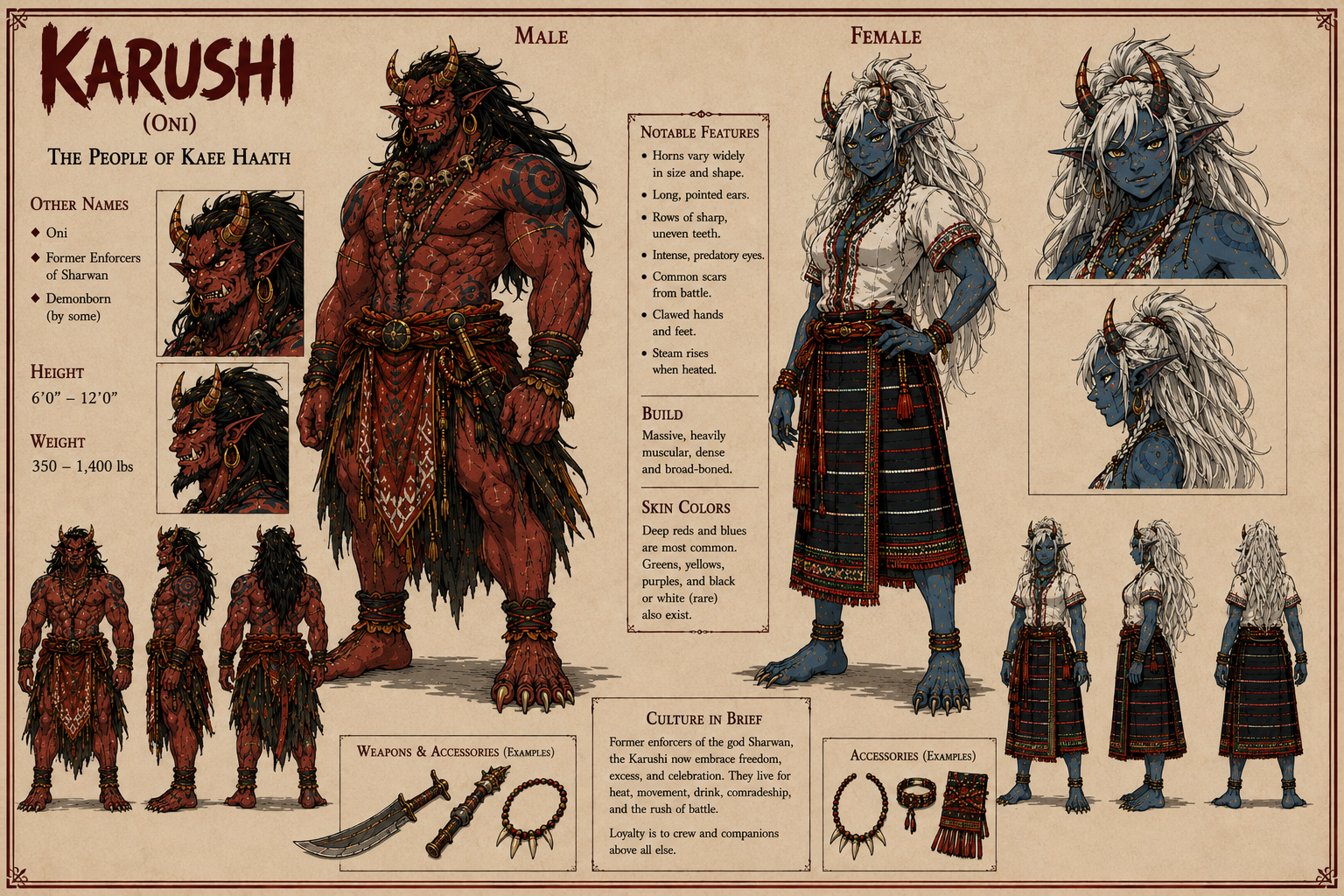
Associations
Other pages that reference or connect to this race
Collections
Published collections that feature this race
Not in any collections yet
This race hasn't been published in any collections yet. Collections are curated groups of related content that help organize and showcase your world.
Tip: Collections are a great way to group related content together and share themed stories or worldbuilding elements with others.
Timelines
Timelines that reference or include this race
No timeline connections yet
This race isn't connected to any timelines yet. Timelines help organize events chronologically and show how your content fits into the broader history of your world.
Tip: Create timelines to organize important events in your world's history. Link characters, locations, and other content to specific events to build rich, interconnected narratives.
Shares
Discussion about this race
No shares yet
Be the first to start a discussion about this race by sharing it to the community stream.
Privacy & Sharing
Manage who can see and access this race
Current Status
refresh
This race is currently
Privacy Settings
Choose who can see and access this race
language Universe Privacy
This page belongs to a universe with its own privacy settings