
Categories
Dive Deeper
Page Stats
Navigation
Categories
Dive Deeper
Page Stats
Complete Details
All information about this race
Overview
Lutan
The Lutan are a mobile and highly adaptive people of Kaee Haath, known for their agility, independence, and deeply ingrained emphasis on personal mastery. Organizing themselves into small, self-sufficient groups known as troops, they move across the archipelago rather than settling permanently, navigating jungles, ruins, coastlines, and city edges with equal familiarity. Though capable of integrating into other societies when needed, the Lutan rarely remain in one place for long, preferring a way of life that allows them to act, adapt, and define themselves on their own terms.
Unlike many of the peoples of Kaee Haath, the Lutan do not center their identity around Sharwan, instead carrying forward fragmented oral traditions of a long-lost figure known as the Monkey King—remembered as a being who once stood against Sharwan and was ultimately struck down. The details of this story vary widely between troops, and its meaning is constantly debated, reinterpreted, and performed, forming a cultural backbone that values inquiry and expression over fixed truth. This has resulted in a society that resists centralized authority, where belief is shaped through experience and disagreement is seen not as division, but as a necessary process for understanding.
Lutan culture places strong emphasis on demonstration over declaration. Skill, whether martial, practical, or expressive, is the primary measure of an individual, and it is expected to be shown rather than claimed. This manifests in their traditions, where tournaments, movement displays, and performative recitations are used to test ability, share knowledge, and resolve disputes. Among the most distinctive of these practices are contested recitations, in which differing interpretations of history or philosophy are enacted simultaneously, with observers determining which version carries greater weight through its execution and coherence.
Despite their independence, the Lutan are not disconnected from one another. Periodic gatherings bring multiple troops together to exchange ideas, test themselves, and reaffirm their shared cultural identity without imposing structure or authority. These events, along with their shared traditions and overlapping histories, allow the Lutan to remain a cohesive people even in the absence of centralized governance.
In the broader context of Kaee Haath, the Lutan are often viewed as both valuable and disruptive. They are skilled, capable, and adaptable, frequently acting as scouts, fighters, or problem-solvers, but their tendency to involve themselves according to their own judgment rather than invitation can create tension with more settled populations. To the Lutan, however, this is simply a reflection of their worldview: that action, skill, and understanding must be earned directly, and that no structure—whether societal or divine—should go unquestioned.
The Troop-Born, The Moving Kin, The Unbound Hands, Children of the Broken Crown, Those Who Walk the Ruins, The Path-Walkers, Ruin Runners, Tree-Walkers, Storm Climbers, Free Troops, Island Apes, Rope-Dancers, Cliff Ghosts, Quickhands, Echoes of the First King, The Scattered Crown, Voices of the Ruins, The Many Paths, Keepers of the Unfinished Story, Those Who Disagree, Branch Dancers, Tree Rats, Ruin Chatterers, Tail Preachers, Jumping Philosophers, Cliff-Runners, Little Blades, Grip-Freaks, Hard-to-Hit Bastards
Looks
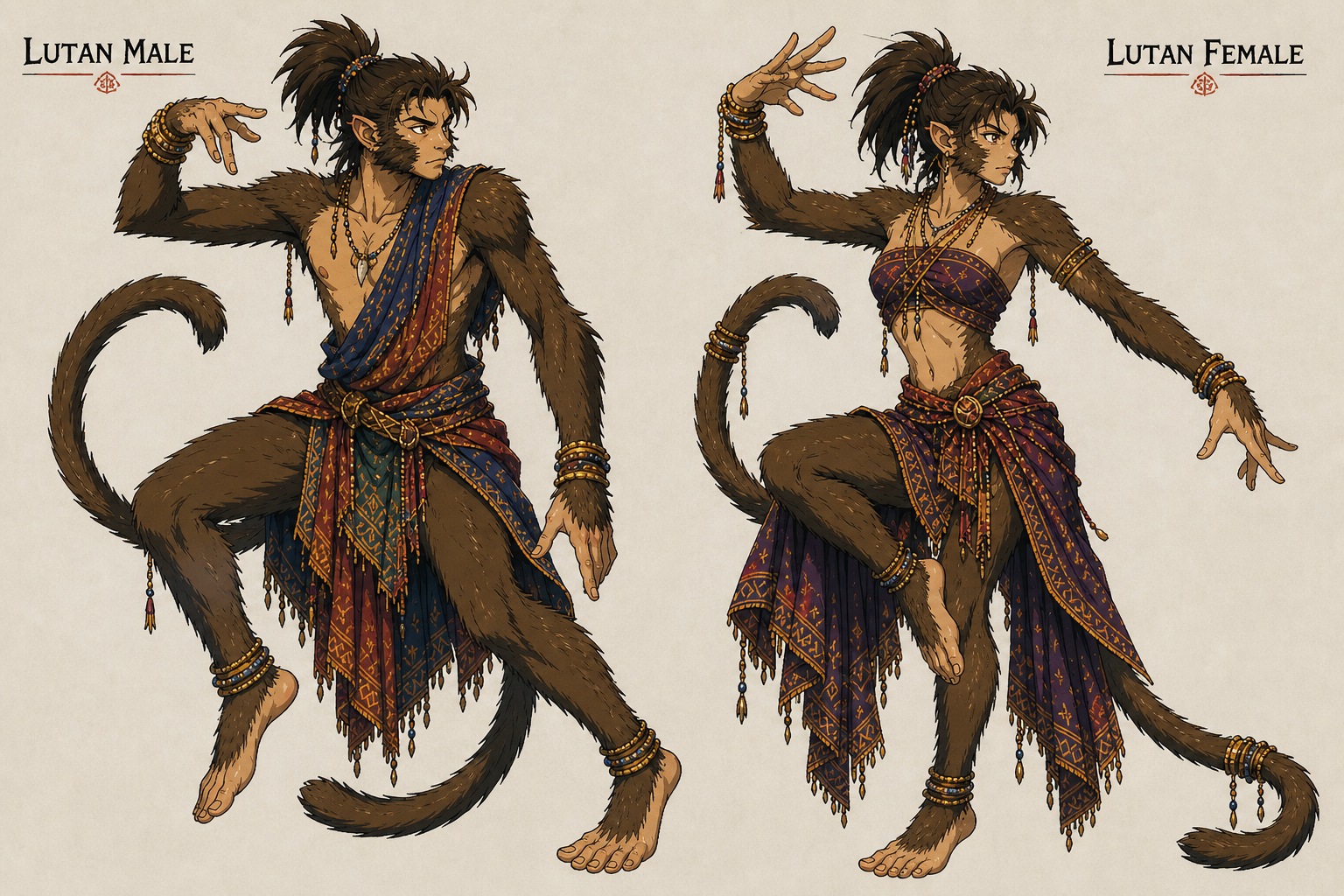
The Lutan possess a lean, semi-humanoid body built around agility and balance. They stand fully upright, though their posture carries a slight forward lean, giving them a ready, reactive stance rather than a rigid one. Their proportions favor movement and control: arms are slightly longer than those of a human, while their legs are compact but powerful, built for springing motion. The torso is narrow and flexible, allowing for a high degree of twisting and compression without appearing bulky. Overall, their silhouette is light and streamlined, with a subtle coiled quality that suggests constant readiness for motion.
The Lutan display a range of natural, earth-toned coloration that blends skin and fur into a unified, organic appearance rather than a sharply separated coat. Their exposed skin most commonly falls within warm, muted tones—ranging from soft tan and dusty beige to deeper, sun-browned hues—often carrying a slightly desaturated quality that helps them blend into stone, wood, and jungle environments alike. This skin is typically most visible along the chest, abdomen, inner limbs, and parts of the face.
Their fur grows in uneven but intentional patterns across the body, most prominently along the forearms, shoulders, upper back, and outer legs. This fur tends toward shades of brown, ranging from light sandy tones to rich reddish-browns and deeper umber, with occasional grey or near-black variants appearing in some individuals. Rather than being uniform, the coloration often shifts subtly across the body, creating a natural gradient—darker along the spine and outer limbs, and lighter toward the underside.
Facial markings are common and serve as one of the most distinctive visual traits among the Lutan. Many individuals display darker fur around the eyes, cheeks, or brow, sometimes forming mask-like patterns that accentuate expression. Others may have lighter fur outlining the eyes or muzzle, giving contrast and clarity to their features. These markings vary widely between individuals and troops, but remain within a consistent natural palette.
The tail typically follows the same coloration as the outer limbs, often slightly darker than the torso, with occasional subtle banding or tonal variation rather than stark stripes. Overall, Lutan coloration is not flamboyant, but layered and nuanced—designed by nature and environment rather than ornamentation—resulting in a people who appear visually cohesive at a distance, yet individually distinct upon closer inspection.
The Lutan are a relatively small-statured people, typically standing between 4’8” and 5’6”, with most individuals clustering toward the middle of that range. Their height rarely draws immediate attention on its own, as it is balanced by their upright posture and confident, poised bearing. While they are shorter than most human populations, they do not appear diminished; instead, their proportions and presence give them a sense of compact capability.
Variation in height is influenced more by environment and upbringing than by any strict division within the people. Lutan raised in dense canopies or more vertical terrain tend to be slightly shorter and lighter, favoring maneuverability and ease of movement through tight spaces, while those accustomed to ruins, open ground, or more physically demanding martial traditions may grow somewhat taller and broader within the natural limits of their build. Despite these differences, extreme height is uncommon, and even the tallest Lutan remain within a relatively narrow range, reinforcing the sense that they are a cohesive people shaped by shared physical constraints.
The Lutan are a light but solidly built people, typically weighing between 90 and 150 pounds, with most individuals falling near the middle of that range. Their weight is distributed in a way that prioritizes efficiency over mass, giving them a compact, balanced feel rather than a heavy or imposing one. Despite their relatively low weight, they do not appear fragile; their bodies carry a quiet density, the result of lean, well-conditioned musculature rather than bulk.
Variation in weight follows similar lines to their environment and lifestyle. Lutan who spend most of their time in the canopy or navigating tight, vertical spaces tend to be lighter and more slender, while those who operate on the ground, in ruins, or in more physically demanding roles often develop slightly heavier, more muscular builds. Even at their heaviest, however, Lutan remain streamlined and agile, never crossing into true bulk, maintaining a consistent emphasis on movement, balance, and control across the entire people.
The Lutan are marked by a collection of distinct physical features that reinforce their identity as a people built for movement, precision, and environmental adaptability. Most immediately noticeable is their long, fully prehensile tail, typically equal to or slightly longer than their body. It moves with constant, subtle awareness, aiding in balance, anchoring, and stabilization during motion. While not suited for fine manipulation, it is an extension of their physical control, and its use often reflects an individual’s level of discipline and coordination.
Their hands are another defining trait, with long, flexible fingers and fully opposable thumbs capable of both delicate manipulation and powerful grip. This dexterity is mirrored in their feet, which are semi-prehensile, featuring elongated toes and a partially opposable big toe. This allows them to grip surfaces, maintain balance on uneven terrain, and assist in climbing without compromising their ability to walk upright.
Facially, the Lutan strike a balance between human and simian features. Their muzzles are shortened, allowing for a wide range of expressive movement, supported by a well-defined brow that enhances nonverbal communication. Their eyes are forward-facing and slightly larger than human average, giving them a keen, attentive look, while their ears are rounded, slightly protruding, and set higher on the head.
Their bodies are covered in partial fur rather than a full coat, with thicker growth along the forearms, shoulders, upper back, and outer legs, while the chest, abdomen, and face show more exposed skin. This uneven distribution creates a natural visual layering that reflects both their environment and their movement patterns.
Taken together, these features give the Lutan an appearance that is immediately recognizable: a people defined not by exaggeration of any single trait, but by the seamless integration of balance, dexterity, and expressive physicality.
The Lutan exhibit a wide range of physical variation, though all differences exist within a shared and recognizable form rather than diverging into distinct subtypes. These variations are shaped primarily by environment, lifestyle, and the traditions of the troop in which an individual is raised, resulting in subtle but meaningful differences in build, proportion, and movement.
Lutan raised in dense canopy environments tend toward longer limbs and lighter frames, with slightly elongated tails and a more refined, balanced posture. Their movements are quieter and more controlled, favoring precision and efficiency over force. In contrast, those who dwell among ruins or settled areas often develop more adaptable builds, maintaining a balance between agility and strength. These individuals typically display more varied movement patterns, shifting easily between climbing, running, and navigating constructed spaces.
Coastal Lutan often show broader shoulders and stronger lower bodies, reflecting a life spent navigating uneven terrain, rocky shorelines, and water. They are generally more comfortable in and around water than others of their kind, with movement that remains fluid even in unstable footing. Meanwhile, Lutan from more martial or ground-focused traditions tend to develop slightly stockier builds, with denser musculature and a more grounded stance. Their movements are more direct and explosive, favoring bursts of speed and controlled force.
Differences can also be seen in fur density, coloration, and facial markings, often influenced by climate and regional ancestry, though always remaining within a natural, cohesive range. Despite these variations, no Lutan appears wholly out of place among another group. Each individual reflects their environment and upbringing, but all remain unmistakably part of the same people, unified by their shared balance of agility, control, and adaptability.
The typical clothing of the Lutan is built around movement, adaptability, and personal modification rather than uniform design. Their garments are primarily wrap-based, favoring layered cloth secured through knots, tucks, and tension rather than stitching, allowing for quick adjustment and a full range of motion. The lower body is most often covered by a wrapped garment similar in function to a chong kraben or sampot, tightly secured and frequently split or tucked to allow for climbing, leaping, and rapid shifts in footing. The upper body is commonly left bare or only partially covered, sometimes with a diagonal sash or shoulder wrap that can be tightened or removed as needed. Around the waist, additional cloth layers or belts are often used to secure the primary garment and provide a place to carry small tools or personal items.
All Lutan clothing is designed with their physiology in mind, particularly the presence of a fully prehensile tail, which is always left free and unobstructed. Garments are arranged to avoid interference with its movement, and in some cases subtly frame or emphasize its position. Materials are chosen for their lightness and ability to dry quickly, reflecting the humid, storm-heavy environment of Kaee Haath, and heavy layering or rigid construction is avoided. Bare skin is common, especially across the chest, shoulders, and portions of the legs, both for comfort in the heat and to reduce the burden of waterlogged fabric.
Variation between individuals is significant, as clothing is shaped more by environment, troop tradition, and personal habit than by any centralized standard. A single Lutan’s attire may reflect influences from multiple island cultures, incorporating different wrapping styles, patterns, and materials, all adapted for practical use. Additional elements such as forearm wraps, wrist bindings, light belts, and small pouches are common, serving functional roles rather than purely decorative ones. Footwear is minimal when present at all, with many Lutan preferring to go barefoot for improved grip and control. The result is a style of dress that appears simple at a glance, but on closer inspection reveals a highly refined system tailored to movement, environment, and individual expression.
Traits
The Lutan excel in movement, control, and adaptability, possessing a physical and cultural skill set that allows them to navigate the world in ways few others can match. Their greatest strength lies in their exceptional mobility, as they move fluidly through complex environments—climbing, leaping, and balancing with equal ease across trees, ruins, cliffs, and constructed spaces. This is supported by remarkable grip strength in both their hands and semi-prehensile feet, allowing them to maintain positions and control their surroundings even in unstable or vertical terrain. Their balance and spatial awareness are highly refined, granting them precise control over their bodies and making them difficult to displace or overwhelm.
Rather than relying on sustained brute force, Lutan favor explosive bursts of movement, engaging and disengaging rapidly while maintaining full control of their positioning. Their dexterity further enhances this, enabling fine manipulation of tools, weapons, and their environment with a level of precision that complements their mobility. Beyond their physical traits, the Lutan are highly adaptable, capable of adjusting to a wide range of environments and situations, supported by a strong cultural emphasis on independence and problem-solving. This mindset, combined with the natural variation between individuals and troops, makes their behavior and tactics difficult to predict. When operating together, Lutan display an intuitive sense of coordination, moving in loose but effective harmony without the need for rigid command structures. Taken together, their strengths lie not in overwhelming power, but in their ability to control themselves, their movement, and the space around them with exceptional precision.
The Lutan’s strengths are closely tied to a number of inherent limitations, many of which stem from their reliance on mobility, control, and independence. While they possess impressive strength for their size, they lack the raw physical power to consistently contend with larger or more heavily built opponents, and can struggle when forced into direct contests of force. Their lean, efficient bodies are not built to absorb heavy impacts, leaving them more vulnerable to crushing blows or sustained damage. This is compounded by their reliance on movement; when confined, restricted, or placed in environments that limit their ability to climb, leap, or reposition, their effectiveness is significantly reduced. Similarly, they excel in short bursts of activity rather than prolonged exertion, and extended engagements or forced endurance can wear them down more quickly than sturdier peoples.
Beyond the physical, the Lutan’s cultural traits present their own challenges. Their organization into small, independent troops makes large-scale coordination difficult, and their strong emphasis on self-reliance often leads them to resist external authority or intervention. This can create tension with more structured societies, particularly when Lutan involve themselves in situations where their presence is not requested. Differences in tradition and belief between troops can also lead to internal disagreements, preventing a unified cultural direction. Additionally, their reluctance to seek aid—particularly in the form of approaching Sharwan—can cause individuals to delay or avoid solutions that others might pursue more readily. Taken together, the Lutan are most vulnerable when their control over themselves, their environment, or the flow of a situation is disrupted, forcing them into conditions where their natural advantages can no longer be fully brought to bear.
The Lutan are prone to a number of conditions that arise naturally from their physiology, environment, and way of life. Their reliance on constant movement, climbing, and gripping places significant strain on their joints and tendons, particularly in the shoulders, wrists, knees, and ankles, often leading to chronic wear as they age. Injuries to the tail are also relatively common, as it is in near-constant use for balance and stabilization; such injuries can have a noticeable impact not only on mobility but also on an individual’s perceived control and discipline. Repeated strain on the hands and feet can result in grip fatigue or reduced sensitivity over time, affecting both strength and precision.
The storm-heavy environment of Kaee Haath exposes the Lutan to frequent dampness, wind, and shifting conditions, contributing to respiratory discomfort, joint stiffness, and lingering fatigue. Falls, while less common among experienced individuals, remain an ever-present risk due to the vertical nature of their movement, sometimes resulting in lasting injuries. Their mobile, troop-based lifestyle can also lead to periods of inconsistent nutrition, particularly for those who struggle to secure stable resources, impacting growth, endurance, and recovery.
Culturally, the Lutan’s strong emphasis on independence often results in delayed care, as individuals push through injury or illness rather than seeking assistance, allowing minor issues to develop into chronic conditions. Additionally, their way of life can create a form of social strain, particularly for those who spend extended time away from their troop, leading to restlessness or difficulty settling within more structured communities. Together, these conditions reflect not weakness, but the long-term cost of a life defined by movement, self-reliance, and constant adaptation.
Culture
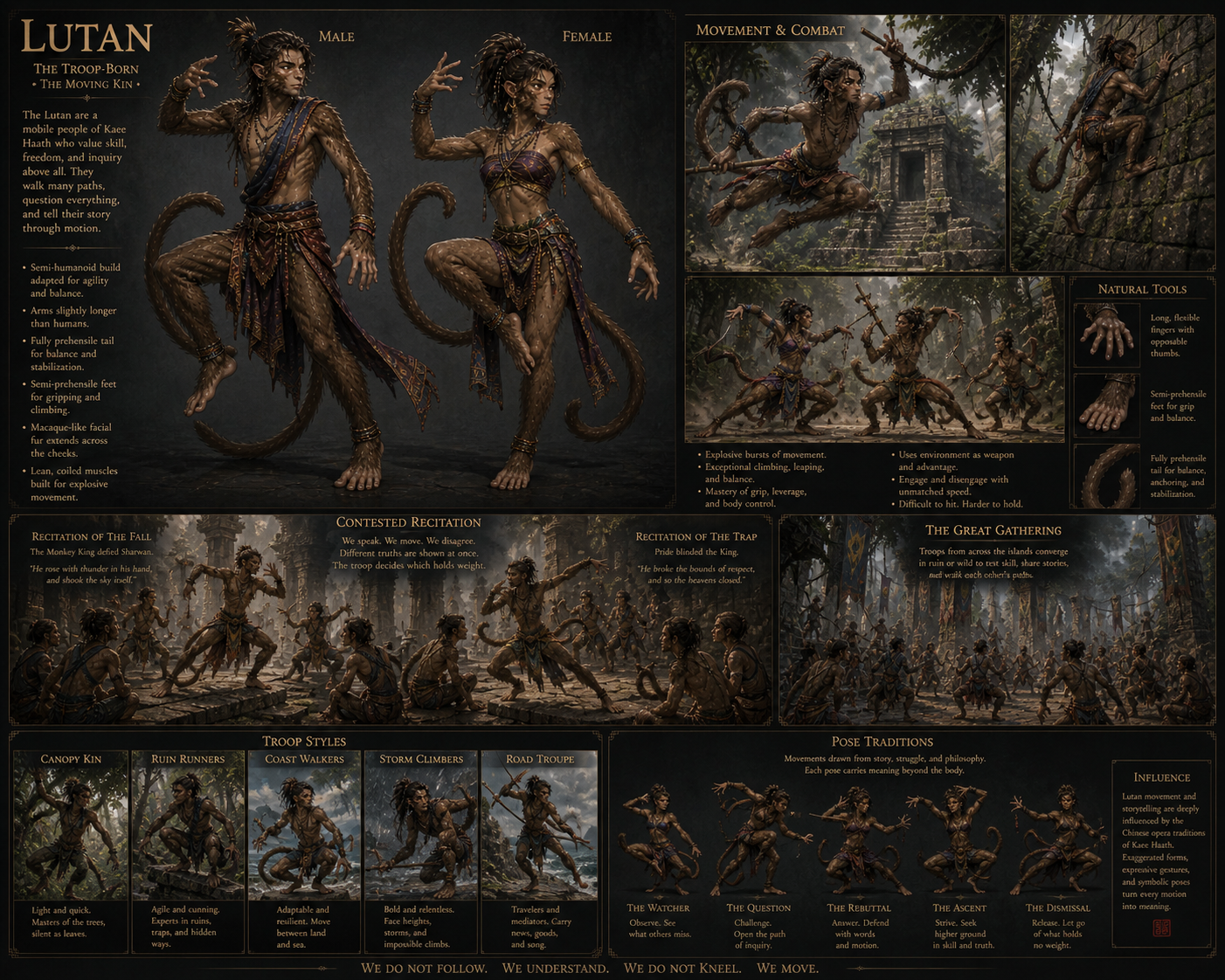
Lutan traditions are centered around gathering, expression, and the continual demonstration of skill, rather than formalized or enforced practices. The most significant of these is the Great Gathering, a recurring convergence of multiple troops that takes place periodically across the islands. While not governed by a strict schedule or authority, these gatherings are widely recognized as important cultural events where Lutan come together to exchange techniques, test themselves against one another, and reaffirm their shared identity. Central to these gatherings are tournaments and skill displays, which extend beyond simple competition to become expressions of mastery. These may include martial combat, movement trials, and demonstrations of precision or adaptability, where the manner of performance often carries as much weight as the outcome itself.
Balancing this outward expression is a quieter tradition of meditative contemplation, where individuals refine control through stillness, breath, and deliberate movement. These practices serve not only to improve physical discipline, but also to deepen personal understanding and interpretation of one’s own path. Equally important is the Lutan tradition of performative storytelling, through which history, philosophy, and memory are preserved. Rather than written records, the Lutan recount their past through stylized reenactments, blending physical performance with spoken narrative to depict battles, notable figures, and especially the many interpretations of the Monkey King. No single version of these stories is considered definitive, and variation between performances is expected, even encouraged.
Among the most distinctive of Lutan traditions is the practice of contested recitation, a performative form of storytelling, debate, and conflict resolution that most often takes place within the ruins of their ancient past. These recitations frequently arise during periods of rest or meditation, when one individual begins to recount a historical event, philosophical idea, or interpretation of the Monkey King. As the recitation unfolds, other members of the troop physically embody the narrative through movement, reenacting the described actions with precision and intent. When disagreement arises, it is not expressed through interruption, but through the initiation of a competing recitation. A second Lutan may begin their own telling, offering a different interpretation, sequence of events, or meaning, resulting in multiple performances occurring simultaneously within the same space.
Those not directly involved in the performance take on the role of observers, evaluating each interpretation based on its execution, internal consistency, and the clarity with which it conveys its perspective. No formal judgment is declared, but over time one interpretation may gain broader acceptance, while others persist, evolve, or fade. In this way, disagreement becomes a structured and essential part of Lutan culture, allowing conflicts to be explored and resolved without resorting to direct confrontation. The practice reinforces their belief that truth is not fixed or given, but must be continually examined, expressed, and refined through both action and interpretation, ensuring that their history and philosophy remain active and alive rather than static.
This results in a culture with a distinctly performative streak, where skill is not only practiced but presented, and where movement itself becomes a form of communication. Even in practical contexts, Lutan often express themselves through controlled, intentional motion, reflecting their belief that mastery is something to be seen as well as achieved. None of these traditions are enforced by any authority, but they are widely observed and carried forward through participation, ensuring that Lutan culture remains active, adaptive, and continually reinterpreted across generations.
The beliefs of the Lutan are not organized into a unified religion, but instead exist as a collection of shared stories, personal philosophies, and lived practices passed down through their scattered troops. At the center of these beliefs lies the enduring figure of the Monkey King, a being remembered as powerful enough to stand against Sharwan, yet ultimately struck down by him. The details of this story are inconsistent and often contradictory, varying between troops and generations, and as a result the Monkey King is not a fixed symbol but a subject of ongoing interpretation. Some view him as the pinnacle of strength and defiance, others as a cautionary figure, and still others as something greater that was lost or misunderstood.
Rather than expressing belief through worship or ritual, the Lutan define it through action. Skill, discipline, and personal mastery are seen as the clearest reflections of truth, and individuals are expected to pursue their own understanding through experience rather than doctrine. This fosters a culture that is inherently skeptical of authority, particularly divine authority, where power alone is not seen as justification. While Sharwan is acknowledged as a real and formidable presence, he is not followed or revered in a traditional sense, and seeking him out is viewed as a matter of necessity or personal decision rather than faith.
Because their society is divided into independent troops, Lutan beliefs are naturally fragmented, with each group preserving and interpreting different aspects of their shared history. Debate and disagreement are common, and no single perspective is considered absolute. Across these differences, however, there remains a consistent emphasis on self-determination and earned understanding. Truth is not given, but discovered, and each Lutan is expected to find their own path through the balance of memory, experience, and personal refinement.
The Lutan do not possess a centralized government, nor do they recognize any overarching authority across their people. Instead, they are organized into small, independent groups known as troops, each of which functions as a self-governing unit. Leadership within a troop is typically held by the most capable individual, often referred to as the First Hand or an equivalent title, though this position is not fixed or hereditary. Authority must be continually justified through demonstrated skill, judgment, and the ability to maintain cohesion, and may be challenged or replaced if another proves more capable. Decisions within a troop are often resolved through a combination of discussion, demonstration, and, when necessary, direct challenge, with outcomes favoring those who can best support their position through action.
Despite this fragmentation, the Lutan are not entirely disconnected from one another. Periodic gatherings bring multiple troops together in a shared space, not as a governing body, but as a cultural convergence. These gatherings serve as opportunities to exchange techniques, test skill, settle disputes, and share interpretations of their history, particularly the stories surrounding the Monkey King. While individuals may earn recognition, reputation, or informal titles through these events, no decisions made there are binding beyond those who choose to uphold them. In this way, the Lutan maintain a sense of shared identity without surrendering their independence, relying on reputation, personal conduct, and demonstrated ability rather than formal structures of governance.
The Lutan approach technology through a lens of practicality and personal utility rather than structured development or large-scale production. Lacking centralized industry and rarely engaging in mining or metallurgy themselves, they rely heavily on trade, salvage, and adaptation to acquire tools and materials, often modifying what they obtain to better suit their needs. As a result, their equipment is rarely standardized, instead reflecting a mixture of origins and individual adjustments. While the broader region of Kaee Haath remains less developed in the art of large-scale warfare than places such as Porcella or Taiza, the Lutan themselves show little interest in closing that gap. Technologies such as gunpowder are rare and largely confined to a handful of more developed coastal city-states, and even where they are available, the Lutan make minimal use of them, favoring tools that reward control, precision, and adaptability over those that rely on force or scale.
In domestic life, the Lutan have access to a range of technologies through limited foreign trade, primarily facilitated by Nmerian merchants who operate on fast, profit-driven routes. These goods tend to enter the archipelago through a small number of outer islands before gradually spreading inward, resulting in uneven availability across regions. The Lutan adopt such tools selectively, integrating only those that complement their mobile, physically demanding lifestyle, while discarding or ignoring those that require permanence or rigid structure. Though they may lack the means for widespread production, they are not without understanding; Lutan frequently study, repurpose, and adapt the technologies they encounter, reshaping them into forms that align with their emphasis on movement, efficiency, and personal mastery.
While the Lutan are capable of performing a wide range of occupations, their preference for independence and mobility means they rarely adopt the structured roles commonly found in settled societies. Instead, each troop maintains a set of essential functions necessary for its continued survival, with individuals taking on responsibilities based on skill, need, and circumstance rather than fixed titles. These typically include those who gather and manage food resources, individuals capable of treating injuries and maintaining physical health, and experienced pathfinders who guide the troop safely through the varied and often dangerous environments of Kaee Haath. Others focus on maintaining and adapting equipment, repairing tools, and ensuring that what the troop carries remains functional and suited to their needs.
Combat specialists are present within most troops, not as a formal military class, but as individuals who dedicate themselves to refining martial skill and responding to external threats. Scouts and climbers often operate at the edges of the group, providing awareness and access to otherwise unreachable terrain. Equally important are those who serve as voices within the troop, leading recitations and preserving knowledge through performance, as well as individuals who guide meditative practices and help maintain internal balance. In situations involving interaction with outsiders, some Lutan take on the role of interpreters, navigating the cultural and social expectations of other peoples. These roles are fluid and frequently overlap, ensuring that no single function is entirely dependent on one individual. In this way, Lutan occupations are less about defined professions and more about maintaining a flexible, self-sufficient system of shared competence within each troop.
The Lutan do not operate on a formal monetary system within their own troops, instead relying on a shared, need-based approach to resources and goods. Coin and trade value hold little meaning internally, where usefulness, contribution, and reliability carry far greater weight than accumulated wealth. Items are distributed based on circumstance rather than ownership, and individuals are expected to take what they require while contributing what they are able. Despite this, Lutan are not unfamiliar with currency, and many individuals carry personal coin for use in external settings such as towns, city-states, or when dealing with traveling merchants, particularly those from Nmeria.
Among larger troops, it is not uncommon for a communal reserve of wealth to be maintained, though this functions less as a formal treasury and more as a shared fund used for significant or collective needs. Such resources are typically entrusted to specific individuals who act as carriers rather than controllers, responsible for safeguarding and transporting valuables when necessary. These treasure bearers, while trusted, also present an obvious point of vulnerability, making them potential targets for bandits or opportunistic groups. Lutan attitudes toward wealth discourage excessive hoarding, favoring practical use over accumulation, and trade is often approached in a flexible, situational manner, with value placed on goods, services, and skill rather than strict equivalence. While this system allows for a high degree of independence and adaptability, it also limits large-scale economic development, leaving the Lutan reliant on trade and exchange for materials and technologies they do not produce themselves.
The Lutan diet is built around fresh, gathered foods and supplemented by skill-based hunting, reflecting both their environment and their emphasis on practical refinement. Fruit forms the core of their diet, with experienced foragers selecting from a wide variety of tropical sources such as figs, vine-grown fruits, and canopy harvests, guided by deep knowledge of seasonal patterns and terrain. This is complemented by plant foods including tender shoots, greens, roots, and tubers, which are often lightly prepared through drying or roasting rather than consumed raw. Nuts and seeds provide a reliable source of energy and are frequently carried or processed into simple mixtures for travel.
Protein is obtained through a combination of fishing, small game hunting, and the deliberate harvesting of insects. While smaller insects are consumed as a common and accessible resource, larger varieties are often treated as a more substantial and intentional food source, sometimes requiring coordinated effort to capture. Fishing and coastal foraging are also widely practiced, with Lutan making use of simple tools and techniques to gather fish, shellfish, and crustaceans. Cooking, when employed, is minimal and efficient, typically involving roasting over open flame or drying for preservation, avoiding methods that require prolonged time or fixed location. The result is a diet that is adaptable, portable, and closely tied to skill and environment, where the quality and variety of food reflect the capability of the troop rather than access to complex preparation or infrastructure.
History
Long before the modern peoples of Kaee Haath understood themselves as separate cultures or races, the archipelago appears to have belonged to a far older civilization whose identity has been almost completely erased by time, disaster, and fragmentation. Across the islands surrounding the Shattered Palm, immense ruins, resonant temple complexes, elevated courtyards, collapsed observatories, drowned causeways, and impossible stone structures remain scattered through jungles, cliffsides, reefs, and volcanic valleys. No surviving people fully agrees on who built them. The Lutan claim they are remnants of the Monkey King’s ancient domains, the Kaevari believe they are fragments of a forgotten maritime civilization, some Karushi traditions whisper that Sharwan once ruled much of the archipelago directly, while many Mayurai seem instinctively drawn to the ruins without fully understanding why they feel sacred at all.
Whatever this ancient civilization truly was, it eventually collapsed. Some believe the destruction of the great volcanic center now known as the Shattered Palm marked the beginning of the end, shattering trade routes, flooding islands, destroying cities, and isolating surviving populations across the archipelago. Others believe the collapse was slower, caused by war, internal decay, unnatural forces, or struggles involving Sharwan and powers no longer remembered clearly. Much of Kaee Haath’s surviving history exists only as contradictory oral traditions, fragmented rituals, ruined architecture, and inherited instincts preserved unevenly between the races.
The Lutan are believed to be among the oldest surviving organized peoples of the archipelago. Their traditions speak of ancient troop kingdoms, sacred mountain monasteries, disciplined wandering societies, and the lost rule of the Monkey King, though how much of this survives as literal history is unclear. Even in the modern age, the Lutan remain deeply tied to ruins, ancestral memory, and sacred preservation, often treating the remnants of the ancient world with reverence and caution.
The Mayurai appear to have once served some ceremonial or guardian function within the forgotten civilization. Though their masters vanished long ago, the species continues to reenact fragments of inherited purpose through territorial courts, ritualized combat, sacred performances, and instinctive attraction toward temple complexes and resonant ruins. Over centuries, they developed unstable but vibrant communal societies centered around musters, sacred display grounds, and ritual authority, frequently coming into conflict with the Lutan over possession of ancient ceremonial sites.
The Karushi emerged in later eras as powerful warriors, raiders, enforcers, and mercenaries closely tied to the influence of Sharwan. Whether created, shaped, uplifted, or merely empowered by him remains uncertain, but the connection between the Karushi and Sharwan is deeply embedded within both their biology and cultural memory. For long periods, they served as feared martial powers throughout Kaee Haath before eventually throwing off the rigid structures imposed upon them after Sharwan’s defeat at the hands of Tal'Zanithal. In the centuries afterward, the Karushi fragmented into crews, pirate bands, mercenary groups, harbor communities, and wandering martial cultures defined more by celebration, violence, and personal freedom than centralized rule.
The Kaevari rose to prominence comparatively late, gradually building the first truly stable maritime city-states of the modern era across the islands surrounding the Shattered Palm. Drawing together fragments of surviving knowledge, trade traditions, navigation systems, engineering practices, and scholarly traditions preserved unevenly across the archipelago, the Kaevari established temple-schools that became centers of administration, learning, trade, and civic life. Though less ancient than many of the structures surrounding them, the Kaevari became the primary organizers and sustainers of modern civilization within Kaee Haath, integrating both Lutan and Mayurai populations into their growing urban centers while maintaining complicated relationships with the fiercely independent Karushi.
In the modern age, Kaee Haath exists as a fractured but interconnected archipelago where no people fully understands the world that came before them, yet all continue to live among its ruins. The Kaevari maintain the closest thing to stable civilization, the Lutan preserve memory and sacred continuity, the Karushi embody freedom and inherited violence, and the Mayurai continue to perform echoes of ancient ceremonial purpose beneath the shadow of forgotten ruins. Around them all, the storms surrounding the Shattered Palm continue to rage, and somewhere beneath the fractured history of the archipelago lies the unanswered question that haunts every people of Kaee Haath alike: who built the first civilization, and what destroyed it?
At some point in the distant past, their great leader, the Monkey King, fought Sharwan and lost.
Overview
Details about this race's overview
Lutan
The Lutan are a mobile and highly adaptive people of Kaee Haath, known for their agility, independence, and deeply ingrained emphasis on personal mastery. Organizing themselves into small, self-sufficient groups known as troops, they move across the archipelago rather than settling permanently, navigating jungles, ruins, coastlines, and city edges with equal familiarity. Though capable of integrating into other societies when needed, the Lutan rarely remain in one place for long, preferring a way of life that allows them to act, adapt, and define themselves on their own terms.
Unlike many of the peoples of Kaee Haath, the Lutan do not center their identity around Sharwan, instead carrying forward fragmented oral traditions of a long-lost figure known as the Monkey King—remembered as a being who once stood against Sharwan and was ultimately struck down. The details of this story vary widely between troops, and its meaning is constantly debated, reinterpreted, and performed, forming a cultural backbone that values inquiry and expression over fixed truth. This has resulted in a society that resists centralized authority, where belief is shaped through experience and disagreement is seen not as division, but as a necessary process for understanding.
Lutan culture places strong emphasis on demonstration over declaration. Skill, whether martial, practical, or expressive, is the primary measure of an individual, and it is expected to be shown rather than claimed. This manifests in their traditions, where tournaments, movement displays, and performative recitations are used to test ability, share knowledge, and resolve disputes. Among the most distinctive of these practices are contested recitations, in which differing interpretations of history or philosophy are enacted simultaneously, with observers determining which version carries greater weight through its execution and coherence.
Despite their independence, the Lutan are not disconnected from one another. Periodic gatherings bring multiple troops together to exchange ideas, test themselves, and reaffirm their shared cultural identity without imposing structure or authority. These events, along with their shared traditions and overlapping histories, allow the Lutan to remain a cohesive people even in the absence of centralized governance.
In the broader context of Kaee Haath, the Lutan are often viewed as both valuable and disruptive. They are skilled, capable, and adaptable, frequently acting as scouts, fighters, or problem-solvers, but their tendency to involve themselves according to their own judgment rather than invitation can create tension with more settled populations. To the Lutan, however, this is simply a reflection of their worldview: that action, skill, and understanding must be earned directly, and that no structure—whether societal or divine—should go unquestioned.
The Troop-Born, The Moving Kin, The Unbound Hands, Children of the Broken Crown, Those Who Walk the Ruins, The Path-Walkers, Ruin Runners, Tree-Walkers, Storm Climbers, Free Troops, Island Apes, Rope-Dancers, Cliff Ghosts, Quickhands, Echoes of the First King, The Scattered Crown, Voices of the Ruins, The Many Paths, Keepers of the Unfinished Story, Those Who Disagree, Branch Dancers, Tree Rats, Ruin Chatterers, Tail Preachers, Jumping Philosophers, Cliff-Runners, Little Blades, Grip-Freaks, Hard-to-Hit Bastards
Looks
Details about this race's looks
The Lutan possess a lean, semi-humanoid body built around agility and balance. They stand fully upright, though their posture carries a slight forward lean, giving them a ready, reactive stance rather than a rigid one. Their proportions favor movement and control: arms are slightly longer than those of a human, while their legs are compact but powerful, built for springing motion. The torso is narrow and flexible, allowing for a high degree of twisting and compression without appearing bulky. Overall, their silhouette is light and streamlined, with a subtle coiled quality that suggests constant readiness for motion.
The Lutan display a range of natural, earth-toned coloration that blends skin and fur into a unified, organic appearance rather than a sharply separated coat. Their exposed skin most commonly falls within warm, muted tones—ranging from soft tan and dusty beige to deeper, sun-browned hues—often carrying a slightly desaturated quality that helps them blend into stone, wood, and jungle environments alike. This skin is typically most visible along the chest, abdomen, inner limbs, and parts of the face.
Their fur grows in uneven but intentional patterns across the body, most prominently along the forearms, shoulders, upper back, and outer legs. This fur tends toward shades of brown, ranging from light sandy tones to rich reddish-browns and deeper umber, with occasional grey or near-black variants appearing in some individuals. Rather than being uniform, the coloration often shifts subtly across the body, creating a natural gradient—darker along the spine and outer limbs, and lighter toward the underside.
Facial markings are common and serve as one of the most distinctive visual traits among the Lutan. Many individuals display darker fur around the eyes, cheeks, or brow, sometimes forming mask-like patterns that accentuate expression. Others may have lighter fur outlining the eyes or muzzle, giving contrast and clarity to their features. These markings vary widely between individuals and troops, but remain within a consistent natural palette.
The tail typically follows the same coloration as the outer limbs, often slightly darker than the torso, with occasional subtle banding or tonal variation rather than stark stripes. Overall, Lutan coloration is not flamboyant, but layered and nuanced—designed by nature and environment rather than ornamentation—resulting in a people who appear visually cohesive at a distance, yet individually distinct upon closer inspection.
The Lutan are a relatively small-statured people, typically standing between 4’8” and 5’6”, with most individuals clustering toward the middle of that range. Their height rarely draws immediate attention on its own, as it is balanced by their upright posture and confident, poised bearing. While they are shorter than most human populations, they do not appear diminished; instead, their proportions and presence give them a sense of compact capability.
Variation in height is influenced more by environment and upbringing than by any strict division within the people. Lutan raised in dense canopies or more vertical terrain tend to be slightly shorter and lighter, favoring maneuverability and ease of movement through tight spaces, while those accustomed to ruins, open ground, or more physically demanding martial traditions may grow somewhat taller and broader within the natural limits of their build. Despite these differences, extreme height is uncommon, and even the tallest Lutan remain within a relatively narrow range, reinforcing the sense that they are a cohesive people shaped by shared physical constraints.
The Lutan are a light but solidly built people, typically weighing between 90 and 150 pounds, with most individuals falling near the middle of that range. Their weight is distributed in a way that prioritizes efficiency over mass, giving them a compact, balanced feel rather than a heavy or imposing one. Despite their relatively low weight, they do not appear fragile; their bodies carry a quiet density, the result of lean, well-conditioned musculature rather than bulk.
Variation in weight follows similar lines to their environment and lifestyle. Lutan who spend most of their time in the canopy or navigating tight, vertical spaces tend to be lighter and more slender, while those who operate on the ground, in ruins, or in more physically demanding roles often develop slightly heavier, more muscular builds. Even at their heaviest, however, Lutan remain streamlined and agile, never crossing into true bulk, maintaining a consistent emphasis on movement, balance, and control across the entire people.
The Lutan are marked by a collection of distinct physical features that reinforce their identity as a people built for movement, precision, and environmental adaptability. Most immediately noticeable is their long, fully prehensile tail, typically equal to or slightly longer than their body. It moves with constant, subtle awareness, aiding in balance, anchoring, and stabilization during motion. While not suited for fine manipulation, it is an extension of their physical control, and its use often reflects an individual’s level of discipline and coordination.
Their hands are another defining trait, with long, flexible fingers and fully opposable thumbs capable of both delicate manipulation and powerful grip. This dexterity is mirrored in their feet, which are semi-prehensile, featuring elongated toes and a partially opposable big toe. This allows them to grip surfaces, maintain balance on uneven terrain, and assist in climbing without compromising their ability to walk upright.
Facially, the Lutan strike a balance between human and simian features. Their muzzles are shortened, allowing for a wide range of expressive movement, supported by a well-defined brow that enhances nonverbal communication. Their eyes are forward-facing and slightly larger than human average, giving them a keen, attentive look, while their ears are rounded, slightly protruding, and set higher on the head.
Their bodies are covered in partial fur rather than a full coat, with thicker growth along the forearms, shoulders, upper back, and outer legs, while the chest, abdomen, and face show more exposed skin. This uneven distribution creates a natural visual layering that reflects both their environment and their movement patterns.
Taken together, these features give the Lutan an appearance that is immediately recognizable: a people defined not by exaggeration of any single trait, but by the seamless integration of balance, dexterity, and expressive physicality.
The Lutan exhibit a wide range of physical variation, though all differences exist within a shared and recognizable form rather than diverging into distinct subtypes. These variations are shaped primarily by environment, lifestyle, and the traditions of the troop in which an individual is raised, resulting in subtle but meaningful differences in build, proportion, and movement.
Lutan raised in dense canopy environments tend toward longer limbs and lighter frames, with slightly elongated tails and a more refined, balanced posture. Their movements are quieter and more controlled, favoring precision and efficiency over force. In contrast, those who dwell among ruins or settled areas often develop more adaptable builds, maintaining a balance between agility and strength. These individuals typically display more varied movement patterns, shifting easily between climbing, running, and navigating constructed spaces.
Coastal Lutan often show broader shoulders and stronger lower bodies, reflecting a life spent navigating uneven terrain, rocky shorelines, and water. They are generally more comfortable in and around water than others of their kind, with movement that remains fluid even in unstable footing. Meanwhile, Lutan from more martial or ground-focused traditions tend to develop slightly stockier builds, with denser musculature and a more grounded stance. Their movements are more direct and explosive, favoring bursts of speed and controlled force.
Differences can also be seen in fur density, coloration, and facial markings, often influenced by climate and regional ancestry, though always remaining within a natural, cohesive range. Despite these variations, no Lutan appears wholly out of place among another group. Each individual reflects their environment and upbringing, but all remain unmistakably part of the same people, unified by their shared balance of agility, control, and adaptability.
The typical clothing of the Lutan is built around movement, adaptability, and personal modification rather than uniform design. Their garments are primarily wrap-based, favoring layered cloth secured through knots, tucks, and tension rather than stitching, allowing for quick adjustment and a full range of motion. The lower body is most often covered by a wrapped garment similar in function to a chong kraben or sampot, tightly secured and frequently split or tucked to allow for climbing, leaping, and rapid shifts in footing. The upper body is commonly left bare or only partially covered, sometimes with a diagonal sash or shoulder wrap that can be tightened or removed as needed. Around the waist, additional cloth layers or belts are often used to secure the primary garment and provide a place to carry small tools or personal items.
All Lutan clothing is designed with their physiology in mind, particularly the presence of a fully prehensile tail, which is always left free and unobstructed. Garments are arranged to avoid interference with its movement, and in some cases subtly frame or emphasize its position. Materials are chosen for their lightness and ability to dry quickly, reflecting the humid, storm-heavy environment of Kaee Haath, and heavy layering or rigid construction is avoided. Bare skin is common, especially across the chest, shoulders, and portions of the legs, both for comfort in the heat and to reduce the burden of waterlogged fabric.
Variation between individuals is significant, as clothing is shaped more by environment, troop tradition, and personal habit than by any centralized standard. A single Lutan’s attire may reflect influences from multiple island cultures, incorporating different wrapping styles, patterns, and materials, all adapted for practical use. Additional elements such as forearm wraps, wrist bindings, light belts, and small pouches are common, serving functional roles rather than purely decorative ones. Footwear is minimal when present at all, with many Lutan preferring to go barefoot for improved grip and control. The result is a style of dress that appears simple at a glance, but on closer inspection reveals a highly refined system tailored to movement, environment, and individual expression.
Traits
Details about this race's traits
The Lutan excel in movement, control, and adaptability, possessing a physical and cultural skill set that allows them to navigate the world in ways few others can match. Their greatest strength lies in their exceptional mobility, as they move fluidly through complex environments—climbing, leaping, and balancing with equal ease across trees, ruins, cliffs, and constructed spaces. This is supported by remarkable grip strength in both their hands and semi-prehensile feet, allowing them to maintain positions and control their surroundings even in unstable or vertical terrain. Their balance and spatial awareness are highly refined, granting them precise control over their bodies and making them difficult to displace or overwhelm.
Rather than relying on sustained brute force, Lutan favor explosive bursts of movement, engaging and disengaging rapidly while maintaining full control of their positioning. Their dexterity further enhances this, enabling fine manipulation of tools, weapons, and their environment with a level of precision that complements their mobility. Beyond their physical traits, the Lutan are highly adaptable, capable of adjusting to a wide range of environments and situations, supported by a strong cultural emphasis on independence and problem-solving. This mindset, combined with the natural variation between individuals and troops, makes their behavior and tactics difficult to predict. When operating together, Lutan display an intuitive sense of coordination, moving in loose but effective harmony without the need for rigid command structures. Taken together, their strengths lie not in overwhelming power, but in their ability to control themselves, their movement, and the space around them with exceptional precision.
The Lutan’s strengths are closely tied to a number of inherent limitations, many of which stem from their reliance on mobility, control, and independence. While they possess impressive strength for their size, they lack the raw physical power to consistently contend with larger or more heavily built opponents, and can struggle when forced into direct contests of force. Their lean, efficient bodies are not built to absorb heavy impacts, leaving them more vulnerable to crushing blows or sustained damage. This is compounded by their reliance on movement; when confined, restricted, or placed in environments that limit their ability to climb, leap, or reposition, their effectiveness is significantly reduced. Similarly, they excel in short bursts of activity rather than prolonged exertion, and extended engagements or forced endurance can wear them down more quickly than sturdier peoples.
Beyond the physical, the Lutan’s cultural traits present their own challenges. Their organization into small, independent troops makes large-scale coordination difficult, and their strong emphasis on self-reliance often leads them to resist external authority or intervention. This can create tension with more structured societies, particularly when Lutan involve themselves in situations where their presence is not requested. Differences in tradition and belief between troops can also lead to internal disagreements, preventing a unified cultural direction. Additionally, their reluctance to seek aid—particularly in the form of approaching Sharwan—can cause individuals to delay or avoid solutions that others might pursue more readily. Taken together, the Lutan are most vulnerable when their control over themselves, their environment, or the flow of a situation is disrupted, forcing them into conditions where their natural advantages can no longer be fully brought to bear.
The Lutan are prone to a number of conditions that arise naturally from their physiology, environment, and way of life. Their reliance on constant movement, climbing, and gripping places significant strain on their joints and tendons, particularly in the shoulders, wrists, knees, and ankles, often leading to chronic wear as they age. Injuries to the tail are also relatively common, as it is in near-constant use for balance and stabilization; such injuries can have a noticeable impact not only on mobility but also on an individual’s perceived control and discipline. Repeated strain on the hands and feet can result in grip fatigue or reduced sensitivity over time, affecting both strength and precision.
The storm-heavy environment of Kaee Haath exposes the Lutan to frequent dampness, wind, and shifting conditions, contributing to respiratory discomfort, joint stiffness, and lingering fatigue. Falls, while less common among experienced individuals, remain an ever-present risk due to the vertical nature of their movement, sometimes resulting in lasting injuries. Their mobile, troop-based lifestyle can also lead to periods of inconsistent nutrition, particularly for those who struggle to secure stable resources, impacting growth, endurance, and recovery.
Culturally, the Lutan’s strong emphasis on independence often results in delayed care, as individuals push through injury or illness rather than seeking assistance, allowing minor issues to develop into chronic conditions. Additionally, their way of life can create a form of social strain, particularly for those who spend extended time away from their troop, leading to restlessness or difficulty settling within more structured communities. Together, these conditions reflect not weakness, but the long-term cost of a life defined by movement, self-reliance, and constant adaptation.
Culture
Details about this race's culture
Lutan traditions are centered around gathering, expression, and the continual demonstration of skill, rather than formalized or enforced practices. The most significant of these is the Great Gathering, a recurring convergence of multiple troops that takes place periodically across the islands. While not governed by a strict schedule or authority, these gatherings are widely recognized as important cultural events where Lutan come together to exchange techniques, test themselves against one another, and reaffirm their shared identity. Central to these gatherings are tournaments and skill displays, which extend beyond simple competition to become expressions of mastery. These may include martial combat, movement trials, and demonstrations of precision or adaptability, where the manner of performance often carries as much weight as the outcome itself.
Balancing this outward expression is a quieter tradition of meditative contemplation, where individuals refine control through stillness, breath, and deliberate movement. These practices serve not only to improve physical discipline, but also to deepen personal understanding and interpretation of one’s own path. Equally important is the Lutan tradition of performative storytelling, through which history, philosophy, and memory are preserved. Rather than written records, the Lutan recount their past through stylized reenactments, blending physical performance with spoken narrative to depict battles, notable figures, and especially the many interpretations of the Monkey King. No single version of these stories is considered definitive, and variation between performances is expected, even encouraged.
Among the most distinctive of Lutan traditions is the practice of contested recitation, a performative form of storytelling, debate, and conflict resolution that most often takes place within the ruins of their ancient past. These recitations frequently arise during periods of rest or meditation, when one individual begins to recount a historical event, philosophical idea, or interpretation of the Monkey King. As the recitation unfolds, other members of the troop physically embody the narrative through movement, reenacting the described actions with precision and intent. When disagreement arises, it is not expressed through interruption, but through the initiation of a competing recitation. A second Lutan may begin their own telling, offering a different interpretation, sequence of events, or meaning, resulting in multiple performances occurring simultaneously within the same space.
Those not directly involved in the performance take on the role of observers, evaluating each interpretation based on its execution, internal consistency, and the clarity with which it conveys its perspective. No formal judgment is declared, but over time one interpretation may gain broader acceptance, while others persist, evolve, or fade. In this way, disagreement becomes a structured and essential part of Lutan culture, allowing conflicts to be explored and resolved without resorting to direct confrontation. The practice reinforces their belief that truth is not fixed or given, but must be continually examined, expressed, and refined through both action and interpretation, ensuring that their history and philosophy remain active and alive rather than static.
This results in a culture with a distinctly performative streak, where skill is not only practiced but presented, and where movement itself becomes a form of communication. Even in practical contexts, Lutan often express themselves through controlled, intentional motion, reflecting their belief that mastery is something to be seen as well as achieved. None of these traditions are enforced by any authority, but they are widely observed and carried forward through participation, ensuring that Lutan culture remains active, adaptive, and continually reinterpreted across generations.
The beliefs of the Lutan are not organized into a unified religion, but instead exist as a collection of shared stories, personal philosophies, and lived practices passed down through their scattered troops. At the center of these beliefs lies the enduring figure of the Monkey King, a being remembered as powerful enough to stand against Sharwan, yet ultimately struck down by him. The details of this story are inconsistent and often contradictory, varying between troops and generations, and as a result the Monkey King is not a fixed symbol but a subject of ongoing interpretation. Some view him as the pinnacle of strength and defiance, others as a cautionary figure, and still others as something greater that was lost or misunderstood.
Rather than expressing belief through worship or ritual, the Lutan define it through action. Skill, discipline, and personal mastery are seen as the clearest reflections of truth, and individuals are expected to pursue their own understanding through experience rather than doctrine. This fosters a culture that is inherently skeptical of authority, particularly divine authority, where power alone is not seen as justification. While Sharwan is acknowledged as a real and formidable presence, he is not followed or revered in a traditional sense, and seeking him out is viewed as a matter of necessity or personal decision rather than faith.
Because their society is divided into independent troops, Lutan beliefs are naturally fragmented, with each group preserving and interpreting different aspects of their shared history. Debate and disagreement are common, and no single perspective is considered absolute. Across these differences, however, there remains a consistent emphasis on self-determination and earned understanding. Truth is not given, but discovered, and each Lutan is expected to find their own path through the balance of memory, experience, and personal refinement.
The Lutan do not possess a centralized government, nor do they recognize any overarching authority across their people. Instead, they are organized into small, independent groups known as troops, each of which functions as a self-governing unit. Leadership within a troop is typically held by the most capable individual, often referred to as the First Hand or an equivalent title, though this position is not fixed or hereditary. Authority must be continually justified through demonstrated skill, judgment, and the ability to maintain cohesion, and may be challenged or replaced if another proves more capable. Decisions within a troop are often resolved through a combination of discussion, demonstration, and, when necessary, direct challenge, with outcomes favoring those who can best support their position through action.
Despite this fragmentation, the Lutan are not entirely disconnected from one another. Periodic gatherings bring multiple troops together in a shared space, not as a governing body, but as a cultural convergence. These gatherings serve as opportunities to exchange techniques, test skill, settle disputes, and share interpretations of their history, particularly the stories surrounding the Monkey King. While individuals may earn recognition, reputation, or informal titles through these events, no decisions made there are binding beyond those who choose to uphold them. In this way, the Lutan maintain a sense of shared identity without surrendering their independence, relying on reputation, personal conduct, and demonstrated ability rather than formal structures of governance.
The Lutan approach technology through a lens of practicality and personal utility rather than structured development or large-scale production. Lacking centralized industry and rarely engaging in mining or metallurgy themselves, they rely heavily on trade, salvage, and adaptation to acquire tools and materials, often modifying what they obtain to better suit their needs. As a result, their equipment is rarely standardized, instead reflecting a mixture of origins and individual adjustments. While the broader region of Kaee Haath remains less developed in the art of large-scale warfare than places such as Porcella or Taiza, the Lutan themselves show little interest in closing that gap. Technologies such as gunpowder are rare and largely confined to a handful of more developed coastal city-states, and even where they are available, the Lutan make minimal use of them, favoring tools that reward control, precision, and adaptability over those that rely on force or scale.
In domestic life, the Lutan have access to a range of technologies through limited foreign trade, primarily facilitated by Nmerian merchants who operate on fast, profit-driven routes. These goods tend to enter the archipelago through a small number of outer islands before gradually spreading inward, resulting in uneven availability across regions. The Lutan adopt such tools selectively, integrating only those that complement their mobile, physically demanding lifestyle, while discarding or ignoring those that require permanence or rigid structure. Though they may lack the means for widespread production, they are not without understanding; Lutan frequently study, repurpose, and adapt the technologies they encounter, reshaping them into forms that align with their emphasis on movement, efficiency, and personal mastery.
While the Lutan are capable of performing a wide range of occupations, their preference for independence and mobility means they rarely adopt the structured roles commonly found in settled societies. Instead, each troop maintains a set of essential functions necessary for its continued survival, with individuals taking on responsibilities based on skill, need, and circumstance rather than fixed titles. These typically include those who gather and manage food resources, individuals capable of treating injuries and maintaining physical health, and experienced pathfinders who guide the troop safely through the varied and often dangerous environments of Kaee Haath. Others focus on maintaining and adapting equipment, repairing tools, and ensuring that what the troop carries remains functional and suited to their needs.
Combat specialists are present within most troops, not as a formal military class, but as individuals who dedicate themselves to refining martial skill and responding to external threats. Scouts and climbers often operate at the edges of the group, providing awareness and access to otherwise unreachable terrain. Equally important are those who serve as voices within the troop, leading recitations and preserving knowledge through performance, as well as individuals who guide meditative practices and help maintain internal balance. In situations involving interaction with outsiders, some Lutan take on the role of interpreters, navigating the cultural and social expectations of other peoples. These roles are fluid and frequently overlap, ensuring that no single function is entirely dependent on one individual. In this way, Lutan occupations are less about defined professions and more about maintaining a flexible, self-sufficient system of shared competence within each troop.
The Lutan do not operate on a formal monetary system within their own troops, instead relying on a shared, need-based approach to resources and goods. Coin and trade value hold little meaning internally, where usefulness, contribution, and reliability carry far greater weight than accumulated wealth. Items are distributed based on circumstance rather than ownership, and individuals are expected to take what they require while contributing what they are able. Despite this, Lutan are not unfamiliar with currency, and many individuals carry personal coin for use in external settings such as towns, city-states, or when dealing with traveling merchants, particularly those from Nmeria.
Among larger troops, it is not uncommon for a communal reserve of wealth to be maintained, though this functions less as a formal treasury and more as a shared fund used for significant or collective needs. Such resources are typically entrusted to specific individuals who act as carriers rather than controllers, responsible for safeguarding and transporting valuables when necessary. These treasure bearers, while trusted, also present an obvious point of vulnerability, making them potential targets for bandits or opportunistic groups. Lutan attitudes toward wealth discourage excessive hoarding, favoring practical use over accumulation, and trade is often approached in a flexible, situational manner, with value placed on goods, services, and skill rather than strict equivalence. While this system allows for a high degree of independence and adaptability, it also limits large-scale economic development, leaving the Lutan reliant on trade and exchange for materials and technologies they do not produce themselves.
The Lutan diet is built around fresh, gathered foods and supplemented by skill-based hunting, reflecting both their environment and their emphasis on practical refinement. Fruit forms the core of their diet, with experienced foragers selecting from a wide variety of tropical sources such as figs, vine-grown fruits, and canopy harvests, guided by deep knowledge of seasonal patterns and terrain. This is complemented by plant foods including tender shoots, greens, roots, and tubers, which are often lightly prepared through drying or roasting rather than consumed raw. Nuts and seeds provide a reliable source of energy and are frequently carried or processed into simple mixtures for travel.
Protein is obtained through a combination of fishing, small game hunting, and the deliberate harvesting of insects. While smaller insects are consumed as a common and accessible resource, larger varieties are often treated as a more substantial and intentional food source, sometimes requiring coordinated effort to capture. Fishing and coastal foraging are also widely practiced, with Lutan making use of simple tools and techniques to gather fish, shellfish, and crustaceans. Cooking, when employed, is minimal and efficient, typically involving roasting over open flame or drying for preservation, avoiding methods that require prolonged time or fixed location. The result is a diet that is adaptable, portable, and closely tied to skill and environment, where the quality and variety of food reflect the capability of the troop rather than access to complex preparation or infrastructure.
History
Details about this race's history
Long before the modern peoples of Kaee Haath understood themselves as separate cultures or races, the archipelago appears to have belonged to a far older civilization whose identity has been almost completely erased by time, disaster, and fragmentation. Across the islands surrounding the Shattered Palm, immense ruins, resonant temple complexes, elevated courtyards, collapsed observatories, drowned causeways, and impossible stone structures remain scattered through jungles, cliffsides, reefs, and volcanic valleys. No surviving people fully agrees on who built them. The Lutan claim they are remnants of the Monkey King’s ancient domains, the Kaevari believe they are fragments of a forgotten maritime civilization, some Karushi traditions whisper that Sharwan once ruled much of the archipelago directly, while many Mayurai seem instinctively drawn to the ruins without fully understanding why they feel sacred at all.
Whatever this ancient civilization truly was, it eventually collapsed. Some believe the destruction of the great volcanic center now known as the Shattered Palm marked the beginning of the end, shattering trade routes, flooding islands, destroying cities, and isolating surviving populations across the archipelago. Others believe the collapse was slower, caused by war, internal decay, unnatural forces, or struggles involving Sharwan and powers no longer remembered clearly. Much of Kaee Haath’s surviving history exists only as contradictory oral traditions, fragmented rituals, ruined architecture, and inherited instincts preserved unevenly between the races.
The Lutan are believed to be among the oldest surviving organized peoples of the archipelago. Their traditions speak of ancient troop kingdoms, sacred mountain monasteries, disciplined wandering societies, and the lost rule of the Monkey King, though how much of this survives as literal history is unclear. Even in the modern age, the Lutan remain deeply tied to ruins, ancestral memory, and sacred preservation, often treating the remnants of the ancient world with reverence and caution.
The Mayurai appear to have once served some ceremonial or guardian function within the forgotten civilization. Though their masters vanished long ago, the species continues to reenact fragments of inherited purpose through territorial courts, ritualized combat, sacred performances, and instinctive attraction toward temple complexes and resonant ruins. Over centuries, they developed unstable but vibrant communal societies centered around musters, sacred display grounds, and ritual authority, frequently coming into conflict with the Lutan over possession of ancient ceremonial sites.
The Karushi emerged in later eras as powerful warriors, raiders, enforcers, and mercenaries closely tied to the influence of Sharwan. Whether created, shaped, uplifted, or merely empowered by him remains uncertain, but the connection between the Karushi and Sharwan is deeply embedded within both their biology and cultural memory. For long periods, they served as feared martial powers throughout Kaee Haath before eventually throwing off the rigid structures imposed upon them after Sharwan’s defeat at the hands of Tal'Zanithal. In the centuries afterward, the Karushi fragmented into crews, pirate bands, mercenary groups, harbor communities, and wandering martial cultures defined more by celebration, violence, and personal freedom than centralized rule.
The Kaevari rose to prominence comparatively late, gradually building the first truly stable maritime city-states of the modern era across the islands surrounding the Shattered Palm. Drawing together fragments of surviving knowledge, trade traditions, navigation systems, engineering practices, and scholarly traditions preserved unevenly across the archipelago, the Kaevari established temple-schools that became centers of administration, learning, trade, and civic life. Though less ancient than many of the structures surrounding them, the Kaevari became the primary organizers and sustainers of modern civilization within Kaee Haath, integrating both Lutan and Mayurai populations into their growing urban centers while maintaining complicated relationships with the fiercely independent Karushi.
In the modern age, Kaee Haath exists as a fractured but interconnected archipelago where no people fully understands the world that came before them, yet all continue to live among its ruins. The Kaevari maintain the closest thing to stable civilization, the Lutan preserve memory and sacred continuity, the Karushi embody freedom and inherited violence, and the Mayurai continue to perform echoes of ancient ceremonial purpose beneath the shadow of forgotten ruins. Around them all, the storms surrounding the Shattered Palm continue to rage, and somewhere beneath the fractured history of the archipelago lies the unanswered question that haunts every people of Kaee Haath alike: who built the first civilization, and what destroyed it?
At some point in the distant past, their great leader, the Monkey King, fought Sharwan and lost.
Notes
Details about this race's notes
No notes information yet
This section doesn't have any information filled in yet.
Gallery
Images and visual content for this race
Associations
Other pages that reference or connect to this race
Collections
Published collections that feature this race
Not in any collections yet
This race hasn't been published in any collections yet. Collections are curated groups of related content that help organize and showcase your world.
Tip: Collections are a great way to group related content together and share themed stories or worldbuilding elements with others.
Timelines
Timelines that reference or include this race
No timeline connections yet
This race isn't connected to any timelines yet. Timelines help organize events chronologically and show how your content fits into the broader history of your world.
Tip: Create timelines to organize important events in your world's history. Link characters, locations, and other content to specific events to build rich, interconnected narratives.
Shares
Discussion about this race
No shares yet
Be the first to start a discussion about this race by sharing it to the community stream.
Privacy & Sharing
Manage who can see and access this race
Current Status
refresh
This race is currently
Privacy Settings
Choose who can see and access this race
language Universe Privacy
This page belongs to a universe with its own privacy settings