
Categories
Dive Deeper
Page Stats
Navigation
Categories
Dive Deeper
Page Stats
Complete Details
All information about this race
Overview
Kaevari
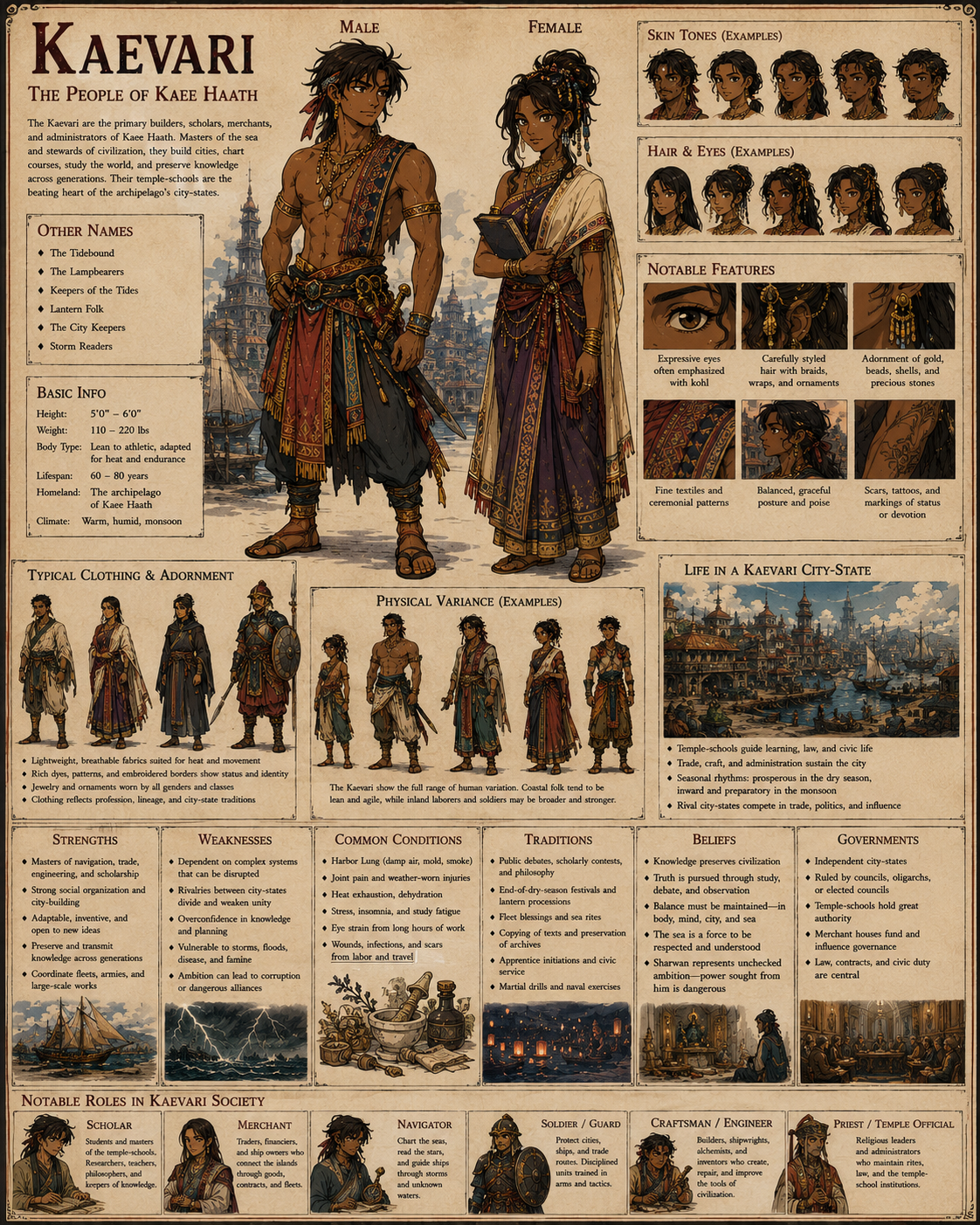
The Kaevari are the primary builders, scholars, merchants, and administrators of Kaee Haath, forming the foundation of the archipelago’s city-states and maritime civilization. Though physically unremarkable when compared to the towering Karushi or the highly specialized Lutan, the Kaevari have shaped much of the political, economic, and intellectual life of the islands through generations of trade, scholarship, engineering, and civic organization. Spread across hundreds of islands surrounding the storm-wracked waters of the Shattered Palm, the Kaevari maintain a vast network of ports, temple-schools, marketplaces, fleets, archives, and rival city-states bound together through shared cultural traditions and dependence upon the sea.
Kaevari civilization is centered around temple-schools that function simultaneously as religious institutions, academies, archives, administrative centers, and political authorities. Within these institutions, knowledge is treated as both sacred responsibility and practical necessity, leading the Kaevari to develop sophisticated traditions of navigation, medicine, alchemy, engineering, astronomy, law, and maritime trade. Unlike more rigid scholarly cultures such as the Valarnans or dwarves, the Kaevari place strong value on debate, reinterpretation, experimentation, and public discourse, believing that civilization survives only through the continuous refinement and preservation of knowledge across generations.
Life throughout Kaee Haath is heavily shaped by the monsoon seasons and the dangerous seas surrounding the archipelago. During calmer periods, Kaevari fleets move constantly between islands carrying rice, spices, textiles, metals, medicinal compounds, timber, dyes, preserved foods, and countless other goods through dense maritime trade networks. During the wet season, many cities turn inward, focusing on preservation, teaching, flood preparation, scholarship, and civic maintenance while storms isolate large portions of the archipelago. This seasonal rhythm has produced a people deeply aware of both the power and fragility of civilization, reinforcing cultural values centered around preparation, balance, cooperation, and long-term stability.
Though often viewed as refined, intellectual, or orderly compared to the more emotionally expressive Karushi or the wandering Lutan, the Kaevari are still profoundly human in their ambitions, rivalries, and desires. Their city-states are marked by political competition, merchant rivalries, scholarly disputes, and constant struggles for influence between temple-schools, trade houses, fleets, and noble families. They are also among the peoples most likely to seek out Sharwan directly despite fully understanding the danger he represents, driven by the same ambition, curiosity, and hunger for advancement that helped build their civilization in the first place. Throughout Kaee Haath, the Kaevari remain a people defined not by physical dominance, but by their determination to preserve order, knowledge, and civilization against the storms—both natural and human—that constantly threaten to tear the archipelago apart.
The Tidebound, The Lampbearers, Keepers of the Tides, Lantern Folk, The City Keepers, Storm Readers
Looks
The Kaevari possess the broad physical variation typical of humanity, though the warm climate and maritime nature of Kaee Haath have shaped many toward leaner, heat-adapted builds well suited for tropical life. Most Kaevari favor balanced proportions rather than extreme physiques, with bodies built more around endurance, agility, and daily labor than raw physical power. Across the archipelago, it is common to find slim to moderately athletic frames among sailors, merchants, laborers, soldiers, and travelers alike, reflecting lives spent within crowded port cities, humid environments, and active trade networks.
Regional differences between islands and city-states can produce noticeable variation in build and posture. Coastal populations often develop lighter, more agile physiques suited for shipboard movement and maritime work, while inland warriors, guards, and laborers may carry broader shoulders and denser musculature from military training or heavy labor. Wealthier Kaevari frequently present themselves with deliberate poise and refinement, emphasizing graceful posture, careful grooming, and controlled movement as signs of education and status rather than overwhelming physicality.
Compared to the towering Karushi or the highly specialized movement of the Lutan, the Kaevari appear physically unexceptional at first glance, yet this adaptability is itself one of their defining strengths. Their bodies reflect the diversity and flexibility of a people deeply tied to trade, governance, travel, and urban life, capable of fitting themselves into nearly every role required to sustain the complex societies of Kaee Haath.
The Kaevari commonly possess a wide range of brown skin tones shaped by the tropical climate and maritime environment of Kaee Haath. Most fall somewhere between deep bronze, warm umber, rich brown, and dark espresso shades, often carrying warm undertones that become especially striking beneath the humid sunlight of the archipelago. Lighter brown tones are more common among certain coastal or mixed populations, while darker complexions are especially prevalent throughout the older city-states and southern islands. Variation between families, regions, and lineages is broad and unremarkable within Kaevari society, with skin tone rarely carrying the same cultural significance seen among peoples such as the Karushi.
Exposure to sea air, sunlight, labor, and travel often leaves visible marks on the skin over time, particularly among sailors, merchants, soldiers, and harbor workers. Golden undertones, sun-darkened shoulders, and weathered complexions are all common sights throughout the archipelago’s ports and markets. Hair is most frequently black or dark brown, ranging from straight to heavily curled depending on lineage and region, while eye colors tend toward dark browns, ambers, and deep hazel tones. Overall, the appearance of the Kaevari reflects the diversity and adaptability of a people shaped by tropical city life, maritime trade, and generations of movement between the islands of Kaee Haath.
The Kaevari are a generally average-sized people, with most adults standing between 5 and 6 feet tall depending on region, lineage, and lifestyle. Their populations display the normal variation expected of humanity, though the majority tend toward leaner, heat-adapted builds suited to the tropical climate and maritime culture of Kaee Haath. While physically smaller and less imposing than the Karushi, the Kaevari are highly adaptable and capable of filling a wide variety of social, military, and labor roles throughout the archipelago. Their average stature, combined with their diversity and flexibility, allows them to integrate easily into the crowded cities, ports, ships, and trade networks that define much of Kaevari civilization.
The Kaevari typically weigh between 110 and 220 pounds, with considerable variation occurring between regions, professions, and individual lifestyles. Most possess lean to moderately athletic builds shaped by the tropical climate and active nature of life throughout Kaee Haath, resulting in physiques better suited for endurance, labor, travel, and maritime work than extreme physical bulk. Coastal populations and merchant classes often trend lighter and more agile, while soldiers, dockworkers, sailors, and laborers may develop broader frames and denser musculature through physically demanding occupations. Though lacking the immense size of the Karushi or the specialized movement-focused physiques of the Lutan, the Kaevari maintain the adaptability and balanced physicality characteristic of humanity, allowing them to thrive across nearly every environment and profession within the archipelago.
The Kaevari are distinguished less by extreme physical traits and more by the refinement, presentation, and visible cultural identity shaped by centuries of city life and maritime civilization throughout Kaee Haath. Expressive dark eyes are common among the people and are frequently emphasized through cosmetics, pigments, or ceremonial decoration across all sexes. Hair culture holds significant social importance within many Kaevari societies, with long braids, intricate wraps, oils, beads, jewelry, flowers, and decorative styling often serving as markers of status, profession, regional identity, or personal taste.
Jewelry and ornamentation are deeply woven into Kaevari culture, particularly the use of gold, bronze, beads, chains, rings, and woven adornments integrated directly into clothing and hairstyles. Fine textiles, embroidered fabrics, patterned wraps, and layered draped garments are similarly valued, reflecting both personal wealth and the strong trade networks connecting the islands. Even common laborers or sailors often possess some form of decorative accessory or regional cloth pattern, reinforcing the Kaevari tendency to merge practicality with presentation.
Life within the tropical archipelago also leaves visible marks upon the Kaevari. Sun-darkened skin, weathered hands, salt-worn hair, and the scent of oils, incense, spices, or sea air are common throughout their port cities and coastal communities. Many bear subtle maritime indicators such as rope calluses, navigation tattoos, or sailor charms tied to local traditions. Above all, the Kaevari are notable for their deliberate composure and social refinement, carrying themselves with an intentional poise shaped by generations of trade, governance, ritual, and urban life.
The Kaevari display broad physical variation typical of a widespread and interconnected human population, shaped heavily by regional culture, profession, environment, and centuries of maritime exchange throughout Kaee Haath. While all Kaevari remain recognizably human, differences in build, complexion, grooming, and presentation can vary noticeably between islands, city-states, and social classes. Coastal populations often develop leaner, more agile physiques suited for sailing, climbing, swimming, and life within crowded port cities, while inland soldiers, laborers, and guards may possess broader frames and denser musculature shaped by military service or heavy physical work.
Hair texture and styling vary widely across the archipelago, ranging from straight and wavy to tightly curled, with black and dark brown tones being most common. Hairstyles frequently carry regional or social significance, with braids, wrapped hair, oils, beads, jewelry, flowers, and shaved patterns all appearing among different communities. Skin tones similarly display broad variation within the established spectrum of brown complexions common to the Kaevari, often influenced further by climate, lineage, and exposure to sea and sun.
As the most trade-oriented and urbanized people of Kaee Haath, the Kaevari also possess the highest degree of visible cultural mixing, especially within major ports and city-states where generations of migration and commerce have blended regional appearances together. Social class and profession strongly influence appearance as well, with merchants, nobles, sailors, soldiers, priests, craftsmen, and laborers each tending toward distinct styles of grooming, posture, ornamentation, and physical conditioning. Overall, Kaevari variation reflects the diversity of a civilization deeply shaped by trade, movement, and urban life rather than rigid biological distinction.
The Kaevari favor clothing designed for the tropical climate and densely populated maritime cities of Kaee Haath, combining practicality, refinement, and visible social presentation into a highly varied but recognizable cultural style. Most garments are built from layered draped fabrics rather than heavily stitched clothing, allowing airflow and ease of movement in the humid heat of the archipelago. Wrapped lower garments, long cloth panels, waist sashes, shoulder drapes, fitted wraps, and lightweight layered fabrics are common across all social classes, with the exact arrangement often varying between islands, professions, and city-states. Clothing is rarely minimalistic in appearance even when physically lightweight, as the Kaevari place strong cultural importance on presentation, color coordination, fabric quality, and ornamentation.
Among common laborers, sailors, merchants, and dockworkers, clothing tends to prioritize flexibility and durability while still maintaining regional identity through woven patterns, dyed cloth, embroidered hems, jewelry, and decorative wrapping styles. Men commonly wear layered waist wraps, fitted or draped upper cloths, sleeveless jackets, shoulder shawls, or lightweight long coats suited for sea travel and tropical weather. Women often wear wrapped skirts, layered draped fabrics, fitted bodices or chest wraps, and flowing shoulder cloths that balance elegance with practicality in humid environments. Jewelry is widespread among both sexes regardless of class, with gold, bronze, beads, chains, rings, anklets, armlets, and hair adornments serving as common forms of self-expression and status display.
Wealthier Kaevari and urban elites favor more elaborate layering, finer textiles, imported dyes, embroidered fabrics, and carefully arranged drapery designed to display sophistication and social standing without sacrificing comfort in the heat. Rich jewel tones, patterned silks, metallic threadwork, and decorative sashes are especially common among merchant houses, administrators, nobles, priests, and wealthy ship captains. Hairstyles, cosmetics, oils, perfumes, and carefully maintained grooming are considered equally important parts of dress, reinforcing the Kaevari emphasis on composure, refinement, and deliberate self-presentation.
Military clothing among the Kaevari generally reflects the same tropical and layered foundations while incorporating practical armor elements such as scale pieces, reinforced cloth, lacquered plates, layered leather, and protective wraps suited for naval warfare and humid climates. Across Kaee Haath, Kaevari clothing reflects the values of a civilization built upon trade, urban life, maritime exchange, and social identity, appearing simultaneously elegant, functional, and deeply adapted to the warm island environment they call home.
Traits
The greatest strengths of the Kaevari lie in their adaptability through knowledge, their sophisticated social organization, and their ability to sustain complex civilization across the dangerous and fragmented environment of Kaee Haath. Through generations of scholarship, maritime trade, and institutional learning centered around the temple-schools, the Kaevari have developed advanced understanding in navigation, administration, engineering, medicine, astronomy, alchemy, infrastructure, and logistics. Their societies excel at preserving and transmitting information across generations, allowing them to refine techniques, maintain large urban populations, and respond to environmental challenges more effectively than most peoples of the archipelago.
Maritime expertise represents one of the defining strengths of the Kaevari. Their navigators, harbor officials, shipbuilders, and merchants possess extensive knowledge of currents, reefs, storms, seasonal weather, and inter-island trade, allowing them to sustain economic and political networks across seas many others consider treacherous. Combined with their strong administrative traditions and highly specialized labor systems, this has allowed the Kaevari to become the primary builders and organizers of large-scale civilization throughout Kaee Haath.
The Kaevari are also highly effective at adapting to new ideas, technologies, and changing conditions through study and structured experimentation rather than instinct alone. Their willingness to debate, reinterpret, and refine existing knowledge makes them unusually flexible for such an urbanized people, allowing different city-states to evolve specialized expertise in medicine, law, engineering, navigation, military organization, or trade. Though individually less physically imposing than the Karushi or as naturally movement-oriented as the Lutan, the Kaevari compensate through coordination, preparation, discipline, and the collective strength of systems maintained across generations.
Above all, the Kaevari possess a deep cultural understanding that civilization itself requires constant effort to survive. Their greatest strength is not raw power, but the ability to organize people, preserve knowledge, and maintain functioning societies even in the face of storms, political rivalry, isolation, and the unpredictable dangers of the archipelago.
The greatest weaknesses of the Kaevari stem from the very complexity and sophistication that define their civilization. Their city-states rely heavily upon interconnected systems of trade, infrastructure, administration, scholarship, and maritime coordination, making them particularly vulnerable to disruption when those systems fail. Severe monsoons, harbor destruction, flooding, disease outbreaks, political instability, or interruptions to trade routes can rapidly create shortages, unrest, and economic collapse throughout even the most prosperous regions of Kaee Haath. Because so much of Kaevari society depends upon preparation, maintenance, and organized cooperation, failures within those systems often produce consequences far beyond the original problem itself.
Political fragmentation also represents a constant challenge within the archipelago. Rivalries between city-states, merchant houses, scholarly factions, and temple-schools frequently undermine large-scale unity, leading to trade disputes, proxy conflicts, bureaucratic obstruction, and internal competition even during periods of external danger. While Kaevari culture encourages debate and reinterpretation, this same intellectual environment can also foster indecision, arrogance, and excessive confidence in theoretical solutions over immediate practical action. Many Kaevari scholars, officials, and elites develop strong belief in the superiority of organized civilization and accumulated knowledge, sometimes causing them to underestimate less structured peoples such as the Lutan or the emotionally driven instincts of the Karushi.
On a personal level, the Kaevari are also deeply vulnerable to ambition. Their societies reward knowledge, political influence, wealth, and achievement, producing a constant undercurrent of competition between individuals, schools, dynasties, and city-states. This ambition has driven many of the archipelago’s greatest advancements, but it has also repeatedly pushed Kaevari rulers, scholars, merchants, and warriors toward corruption, obsession, or the dangerous temptation of seeking power directly from Sharwan himself. In many ways, the Kaevari understand civilization better than any people in Kaee Haath—yet they also understand how fragile civilization truly is, and how easily human ambition can become the force that destroys it from within.
The Kaevari do not possess many uniquely biological conditions tied specifically to their people, but the demands of life within the dense maritime civilizations of Kaee Haath have led to several widespread illnesses and chronic ailments strongly associated with Kaevari society. Respiratory conditions collectively referred to in many ports as “Harbor Lung” are particularly common among sailors, dockworkers, archive keepers, shipwrights, and laborers regularly exposed to damp air, mold, smoke, flooding, and the humid monsoon climate. Long-term maritime work also frequently produces chronic joint pain, weather-related injuries, sun damage, and various conditions associated with prolonged exposure to salt air and harsh tropical environments.
Among scholars, administrators, alchemists, and temple-school students, conditions related to exhaustion, stress, and obsessive study are similarly widespread. Many Kaevari intellectual traditions place enormous social importance on learning, achievement, and refinement, often leading individuals to overwork themselves physically and mentally in pursuit of status, discovery, or civic responsibility. Insomnia, anxiety, eye strain, nervous exhaustion, and stress-related illness are common within major scholarly centers, particularly among archivists, astronomers, physicians, and legal scholars. Exposure to inks, dyes, alchemical compounds, and medicinal substances also occasionally results in poisoning or long-term physical deterioration among certain professions.
Dense urban populations and seasonal monsoons further expose the Kaevari to outbreaks of tropical disease, parasites, waterborne illness, and periodic epidemics capable of spreading rapidly through crowded ports and trade hubs. As a result, medicine, sanitation, flood control, preservation techniques, and public health practices hold unusually high importance within many Kaevari city-states. In many ways, the conditions most associated with the Kaevari are not the result of unusual biology, but of the immense physical and mental demands required to maintain one of the most advanced and interconnected civilizations in Kaee Haath.
Culture
Kaevari traditions are deeply tied to scholarship, maritime life, civic identity, and the preservation of knowledge across generations. Throughout Kaee Haath, temple-schools regularly host public debates, philosophical discussions, navigational competitions, legal arguments, historical recitations, and scholarly gatherings that function simultaneously as intellectual exercises, political events, and social celebrations. Disagreement and reinterpretation are treated as natural parts of learning within Kaevari society, and many traditions revolve around the refinement of ideas through public discourse rather than rigid acceptance of inherited doctrine.
Seasonal festivals tied to the sea, trade, harvests, and changing weather patterns hold enormous cultural importance throughout the archipelago. The beginning and end of calmer sailing seasons are often marked by harbor celebrations, fleet blessings, lantern ceremonies, market gatherings, and public performances intended to honor safe travel, successful trade, and survival against the storms surrounding Kaee Haath. Particularly significant are the great end-of-dry-season festivals held before the arrival of the monsoon rains. These celebrations mark the final major harvests, the closing of safer trade periods, and the preparation of cities and fleets for the dangerous wet season ahead. Public feasts, civic gatherings, ritual preparations, and communal labor become common during this time, with communities preserving food, reinforcing infrastructure, securing archives, and honoring the merchants, scholars, captains, laborers, and officials whose efforts sustained the city throughout the year. Though celebratory in nature, these festivals also carry an undercurrent of caution and collective responsibility, reflecting the Kaevari belief that survival depends upon preparation, cooperation, and the careful maintenance of civilization in the face of an unpredictable world.
Lanterns, firelight, and illuminated processions are especially significant within many city-states, symbolizing guidance, continuity, and the transmission of knowledge from one generation to the next. The Kaevari also maintain numerous traditions centered around study, recordkeeping, and civic responsibility. Ceremonial copying of important texts, restoration of damaged archives, apprentice initiations, observatory rituals, and formal presentations of new discoveries are common within temple-schools and scholarly communities. During periods of heavy monsoon or dangerous seas, many cities shift inward culturally, devoting more time to teaching, preservation work, philosophy, medicine, and historical reflection while maritime travel becomes more limited.
Unlike the more explosive martial traditions of the Karushi, Kaevari military customs tend to emphasize discipline, coordination, and refinement through organized drills, tactical games, ceremonial duels, and naval exercises. Social presentation also plays a major role in public life, with clothing, grooming, jewelry, perfumes, and controlled composure all viewed as reflections of personal discipline and cultural education. Across the archipelago, Kaevari traditions reinforce the belief that civilization survives not through strength alone, but through the careful maintenance of knowledge, order, cooperation, and shared cultural continuity.
Kaevari beliefs center around the idea that civilization survives only through the preservation, refinement, and transmission of knowledge across generations. Throughout Kaee Haath, learning is treated not merely as a practical necessity, but as a sacred responsibility tied directly to the stability of society, the survival of cities, and the ability of humanity to endure within a dangerous and unpredictable world. Their temple-schools teach that truth is not something simply inherited or accepted blindly, but something pursued through observation, debate, experimentation, and disciplined study. As a result, questioning, reinterpretation, and scholarly disagreement are widely accepted within Kaevari intellectual culture, provided they occur within established systems of learning and discourse.
Kaevari philosophy places strong emphasis on balance, drawing heavily from alchemical traditions, theories of bodily and emotional equilibrium, astronomy, environmental observation, and the belief that imbalance—whether within the body, the city, the sea, or the individual mind—inevitably leads to suffering and collapse. The sea itself occupies a central symbolic role within their worldview, seen not as something to conquer entirely, but as a force to be studied, respected, and navigated through wisdom rather than domination. Observation and recordkeeping are often treated as forms of devotion, with navigation, medicine, engineering, history, and astronomy all carrying spiritual as well as practical significance.
Unlike many peoples of Sol Saris, the Kaevari do not generally deny the reality or power of Sharwan. Instead, they view him as the embodiment of unchecked personal ambition, strength, and desire unconstrained by the responsibilities necessary to maintain civilization. Officially, most temple-schools discourage seeking his favor directly, regarding dependence upon his gifts as dangerous both to individuals and society as a whole. Yet because the Kaevari are deeply human in both ambition and curiosity, they also produce more individuals willing to seek Sharwan out than perhaps any other people in Kaee Haath. This contradiction lies at the heart of much Kaevari philosophy and political tension: the understanding that the same drive pushing humanity toward greatness may also lead it toward ruin if left unbalanced.
Kaevari governments are primarily organized around independent city-states, each centered upon a major temple-school that serves simultaneously as a religious institution, archive, academy, administrative center, and political authority. These temple-schools form the heart of Kaevari civilization throughout Kaee Haath, preserving knowledge while also training scholars, navigators, physicians, merchants, military officers, alchemists, and civic officials responsible for maintaining the complex maritime societies of the archipelago. Rather than separating spiritual practice from intellectual pursuit, the Kaevari treat the acquisition and refinement of knowledge as a sacred responsibility closely tied to the survival and advancement of civilization itself.
Unlike the more rigid or detached scholarly traditions seen among peoples such as the Valarnans or the dwarves, Kaevari intellectual culture places strong emphasis on debate, reinterpretation, questioning, and practical experimentation within structured systems of learning. Their studies blend observation, philosophy, alchemy, medicine, astronomy, navigation, engineering, and theories resembling the balancing of bodily humors, creating a proto-scientific tradition deeply shaped by both scholarship and human interpretation. Disagreement between schools, scholars, and city-states is not only common but often expected, with rival philosophies and competing theories driving both political and academic conflict throughout the islands.
Each city-state develops its own specialties, traditions, and internal hierarchies depending on geography, trade influence, and historical development. Some become renowned for navigation and maritime trade, others for military study, medicine, alchemy, engineering, or legal scholarship. Though alliances and trade networks exist between them, no single Kaevari state dominates the archipelago completely, resulting in a politically fragmented but intellectually vibrant civilization. Officially, most temple-schools discourage seeking the direct power of Sharwan, viewing dependence upon him as dangerous to both personal freedom and social stability. Nevertheless, ambitious rulers, scholars, warriors, and merchants continue to pursue his strength throughout history, creating an enduring tension between the Kaevari pursuit of ordered civilization and the temptations of personal power.
Kaevari technology is highly developed in the fields most necessary to sustain a complex maritime civilization spread across the storm-wracked islands of Kaee Haath. Their temple-schools serve not only as centers of philosophy and governance, but also as institutions of applied knowledge where navigation, astronomy, medicine, engineering, alchemy, mathematics, and administration are studied and refined. As a result, the Kaevari possess sophisticated systems of shipbuilding, harbor construction, flood control, water storage, and tropical urban planning designed specifically to withstand the humid climate, seasonal storms, and dense populations of the archipelago. Their cities commonly feature raised foundations, drainage systems, shaded courtyards, canals, ventilation-focused architecture, reservoirs, and carefully engineered ports adapted for both trade and defense.
Maritime technology represents one of the Kaevari’s greatest strengths. Their navigators maintain detailed charts of currents, reefs, seasonal weather patterns, and stars, allowing them to move between islands more safely and reliably than most other peoples of Kaee Haath. Signal systems, storm prediction methods, and advanced sail designs are also common among major city-states. Alongside this, the Kaevari possess extensive knowledge of alchemy and practical chemistry, producing medicines, dyes, oils, perfumes, preservatives, incendiaries, and other compounds through observational experimentation and inherited scholarly traditions rooted in theories of bodily balance and material interaction.
While firearms and gunpowder weapons exist within Kaee Haath, they remain uncommon and unevenly distributed, often imported through foreign trade or produced in limited quantities by wealthier city-states and temple-schools. The Kaevari study such technologies with great interest, but widespread standardization remains difficult due to political fragmentation and rivalry between city-states. Instead, Kaevari technological culture tends to prioritize adaptability, environmental mastery, and practical civic infrastructure over industrial scale or rigid uniformity. Their greatest innovations often emerge not from conquest, but from the constant need to sustain trade, scholarship, governance, and daily life within one of the most dangerous maritime environments in Sol Saris.
Kaevari occupations are highly diverse and specialized, reflecting the complex maritime civilization and interconnected city-states of Kaee Haath. As the primary builders, administrators, scholars, and merchants of the archipelago, the Kaevari maintain extensive systems of labor supporting trade, governance, scholarship, agriculture, infrastructure, and naval activity across the islands. Maritime professions are especially common throughout Kaevari society, with sailors, navigators, harbor pilots, cartographers, shipwrights, dockworkers, fleet coordinators, and merchant captains forming the backbone of inter-island commerce and communication. Specialized navigators capable of reading currents, storms, reefs, and monsoon patterns are particularly respected due to the dangerous waters surrounding the archipelago.
Temple-schools also support a large scholarly and civic class composed of archivists, teachers, astronomers, physicians, alchemists, philosophers, legal scholars, historians, scribes, and administrative officials responsible for preserving knowledge and maintaining the bureaucratic systems necessary to govern densely populated city-states. Beyond scholarship, Kaevari society depends heavily upon engineers, canal workers, flood managers, irrigation specialists, builders, textile artisans, perfumers, dye workers, jewelers, and numerous other skilled craftsmen whose labor supports urban life and maritime trade.
Agriculture remains equally vital despite the prominence of the cities, with rice farmers, orchard keepers, spice growers, fisherfolk, sugar processors, and terrace workers sustaining much of the archipelago’s population. Seasonal occupations tied to the monsoons are also common, including storm watchers, infrastructure inspectors, archive protectors, and reservoir managers tasked with preparing settlements for the dangerous wet season each year. Military professions within Kaevari society tend to emphasize organization, discipline, and naval coordination, producing harbor guards, naval officers, shipboard marines, fortress engineers, and tactical instructors rather than the looser warrior traditions seen among the Karushi.
Across Kaee Haath, Kaevari occupations are generally viewed through the lens of civic contribution and specialization, with skilled labor, scholarship, trade, and administrative competence all carrying significant social value. Their civilization depends upon the coordinated efforts of thousands of individuals performing interconnected roles, reinforcing the Kaevari belief that society survives through cooperation, knowledge, and the careful maintenance of complex systems rather than strength alone.
Kaevari economics are built around maritime trade, seasonal movement, and the constant interdependence of the islands composing Kaee Haath. Because no single island possesses every resource necessary to sustain large populations or advanced city-states, trade between regions became essential early in Kaevari history, shaping the archipelago into a vast network of ports, shipping lanes, marketplaces, and competing commercial powers. Rice, spices, hardwoods, fish, sugarcane, fruit, dyes, incense, metals, medicinal compounds, and alchemical materials all move constantly between the islands during the calmer sailing seasons, creating an economy heavily dependent upon navigation, logistics, and maritime stability.
The temple-schools at the heart of Kaevari civilization also serve major economic functions, maintaining navigation charts, trade records, merchant certifications, legal systems, tax structures, standardized measurements, and archival knowledge necessary to support large-scale commerce across the archipelago. Merchant houses and shipping dynasties hold enormous political influence within many city-states, often rivaling scholarly institutions themselves in wealth and authority. Although most major states mint their own currencies, standardized silver and bronze coinage is widely recognized throughout Kaee Haath, supported by extensive market networks and trade agreements between ports.
Economic activity throughout the archipelago follows strong seasonal rhythms shaped by the dangerous monsoons and storms surrounding the islands. During the dry season, trade fleets, diplomatic envoys, mercenary companies, festivals, and merchant caravans move heavily between the islands, bringing periods of immense economic activity and cultural exchange. During the wet season, many cities turn inward, focusing on preservation, infrastructure repair, scholarship, food storage, and local production while dangerous seas limit long-distance travel. This seasonal cycle strongly influences nearly every aspect of Kaevari life, from politics and religion to food, labor, and festival traditions.
Piracy, smuggling, and mercenary activity also form accepted realities within the economic systems of Kaee Haath. Rather than existing entirely outside society, many pirate crews maintain indirect relationships with ports, merchants, officials, or rival city-states, blurring the line between outlaw activity and sanctioned private warfare. Karushi crews in particular play major roles throughout the economy as sailors, dockworkers, guards, pirates, laborers, ship crews, and mercenaries, making them simultaneously disruptive and indispensable to the functioning of maritime trade. Even the feared waters surrounding the Shattered Palm remain economically important, drawing rare resources, dangerous expeditions, religious pilgrims, and ambitious individuals seeking Sharwan’s power despite the immense risks involved.
Kaevari cuisine is built around rice, seafood, spices, tropical produce, and the complex trade networks connecting the islands of Kaee Haath. Meals are typically designed around layered flavors and balanced combinations rather than sheer excess, reflecting the Kaevari emphasis on refinement, bodily balance, and practical nourishment within the demanding tropical climate. Rice serves as the foundation of most diets throughout the archipelago, appearing in countless regional forms ranging from simple daily meals to elaborate ceremonial dishes prepared during festivals, religious observances, or civic celebrations.
Seafood is equally central to Kaevari food culture, with reef fish, eel, squid, shellfish, river fish, and preserved sea products commonly appearing across nearly every social class. Coconut, citrus, peppers, garlic, aromatic herbs, fermented sauces, and rich spice blends are used extensively throughout Kaevari cooking, producing cuisine known for its depth of flavor, fragrant broths, and carefully layered seasoning. Many dishes balance heat, sweetness, sourness, richness, and cooling ingredients according to longstanding alchemical and medicinal traditions tied to theories of bodily equilibrium and seasonal health.
Because the monsoon season can isolate islands and disrupt trade for long periods, preservation techniques play a major role within Kaevari food traditions. Dried fish, fermented sauces, pickled vegetables, preserved fruits, spiced storage foods, and rice-based travel rations are all common throughout the archipelago. Temple-schools and scholarly communities often maintain their own culinary traditions emphasizing restorative broths, herbal teas, medicinal preparations, and carefully balanced meals intended to support study and long-term health. While alcohol is widely consumed throughout Kaevari society, it is generally approached with more restraint than among the Karushi, with rice wines, herbal liquors, spiced drinks, and ceremonial beverages serving important social and ritual roles during festivals, debates, and communal gatherings.
Across Kaee Haath, Kaevari cuisine reflects the same qualities that define their civilization as a whole: adaptability, complexity, refinement, and the careful balancing of many interconnected parts into a functioning and enduring system.
History
Long before the modern peoples of Kaee Haath understood themselves as separate cultures or races, the archipelago appears to have belonged to a far older civilization whose identity has been almost completely erased by time, disaster, and fragmentation. Across the islands surrounding the Shattered Palm, immense ruins, resonant temple complexes, elevated courtyards, collapsed observatories, drowned causeways, and impossible stone structures remain scattered through jungles, cliffsides, reefs, and volcanic valleys. No surviving people fully agrees on who built them. The Lutan claim they are remnants of the Monkey King’s ancient domains, the Kaevari believe they are fragments of a forgotten maritime civilization, some Karushi traditions whisper that Sharwan once ruled much of the archipelago directly, while many Mayurai seem instinctively drawn to the ruins without fully understanding why they feel sacred at all.
Whatever this ancient civilization truly was, it eventually collapsed. Some believe the destruction of the great volcanic center now known as the Shattered Palm marked the beginning of the end, shattering trade routes, flooding islands, destroying cities, and isolating surviving populations across the archipelago. Others believe the collapse was slower, caused by war, internal decay, unnatural forces, or struggles involving Sharwan and powers no longer remembered clearly. Much of Kaee Haath’s surviving history exists only as contradictory oral traditions, fragmented rituals, ruined architecture, and inherited instincts preserved unevenly between the races.
The Lutan are believed to be among the oldest surviving organized peoples of the archipelago. Their traditions speak of ancient troop kingdoms, sacred mountain monasteries, disciplined wandering societies, and the lost rule of the Monkey King, though how much of this survives as literal history is unclear. Even in the modern age, the Lutan remain deeply tied to ruins, ancestral memory, and sacred preservation, often treating the remnants of the ancient world with reverence and caution.
The Mayurai appear to have once served some ceremonial or guardian function within the forgotten civilization. Though their masters vanished long ago, the species continues to reenact fragments of inherited purpose through territorial courts, ritualized combat, sacred performances, and instinctive attraction toward temple complexes and resonant ruins. Over centuries, they developed unstable but vibrant communal societies centered around musters, sacred display grounds, and ritual authority, frequently coming into conflict with the Lutan over possession of ancient ceremonial sites.
The Karushi emerged in later eras as powerful warriors, raiders, enforcers, and mercenaries closely tied to the influence of Sharwan. Whether created, shaped, uplifted, or merely empowered by him remains uncertain, but the connection between the Karushi and Sharwan is deeply embedded within both their biology and cultural memory. For long periods, they served as feared martial powers throughout Kaee Haath before eventually throwing off the rigid structures imposed upon them after Sharwan’s defeat at the hands of Tal'Zanithal. In the centuries afterward, the Karushi fragmented into crews, pirate bands, mercenary groups, harbor communities, and wandering martial cultures defined more by celebration, violence, and personal freedom than centralized rule.
The Kaevari rose to prominence comparatively late, gradually building the first truly stable maritime city-states of the modern era across the islands surrounding the Shattered Palm. Drawing together fragments of surviving knowledge, trade traditions, navigation systems, engineering practices, and scholarly traditions preserved unevenly across the archipelago, the Kaevari established temple-schools that became centers of administration, learning, trade, and civic life. Though less ancient than many of the structures surrounding them, the Kaevari became the primary organizers and sustainers of modern civilization within Kaee Haath, integrating both Lutan and Mayurai populations into their growing urban centers while maintaining complicated relationships with the fiercely independent Karushi.
In the modern age, Kaee Haath exists as a fractured but interconnected archipelago where no people fully understands the world that came before them, yet all continue to live among its ruins. The Kaevari maintain the closest thing to stable civilization, the Lutan preserve memory and sacred continuity, the Karushi embody freedom and inherited violence, and the Mayurai continue to perform echoes of ancient ceremonial purpose beneath the shadow of forgotten ruins. Around them all, the storms surrounding the Shattered Palm continue to rage, and somewhere beneath the fractured history of the archipelago lies the unanswered question that haunts every people of Kaee Haath alike: who built the first civilization, and what destroyed it?
Overview
Details about this race's overview
Kaevari
The Kaevari are the primary builders, scholars, merchants, and administrators of Kaee Haath, forming the foundation of the archipelago’s city-states and maritime civilization. Though physically unremarkable when compared to the towering Karushi or the highly specialized Lutan, the Kaevari have shaped much of the political, economic, and intellectual life of the islands through generations of trade, scholarship, engineering, and civic organization. Spread across hundreds of islands surrounding the storm-wracked waters of the Shattered Palm, the Kaevari maintain a vast network of ports, temple-schools, marketplaces, fleets, archives, and rival city-states bound together through shared cultural traditions and dependence upon the sea.
Kaevari civilization is centered around temple-schools that function simultaneously as religious institutions, academies, archives, administrative centers, and political authorities. Within these institutions, knowledge is treated as both sacred responsibility and practical necessity, leading the Kaevari to develop sophisticated traditions of navigation, medicine, alchemy, engineering, astronomy, law, and maritime trade. Unlike more rigid scholarly cultures such as the Valarnans or dwarves, the Kaevari place strong value on debate, reinterpretation, experimentation, and public discourse, believing that civilization survives only through the continuous refinement and preservation of knowledge across generations.
Life throughout Kaee Haath is heavily shaped by the monsoon seasons and the dangerous seas surrounding the archipelago. During calmer periods, Kaevari fleets move constantly between islands carrying rice, spices, textiles, metals, medicinal compounds, timber, dyes, preserved foods, and countless other goods through dense maritime trade networks. During the wet season, many cities turn inward, focusing on preservation, teaching, flood preparation, scholarship, and civic maintenance while storms isolate large portions of the archipelago. This seasonal rhythm has produced a people deeply aware of both the power and fragility of civilization, reinforcing cultural values centered around preparation, balance, cooperation, and long-term stability.
Though often viewed as refined, intellectual, or orderly compared to the more emotionally expressive Karushi or the wandering Lutan, the Kaevari are still profoundly human in their ambitions, rivalries, and desires. Their city-states are marked by political competition, merchant rivalries, scholarly disputes, and constant struggles for influence between temple-schools, trade houses, fleets, and noble families. They are also among the peoples most likely to seek out Sharwan directly despite fully understanding the danger he represents, driven by the same ambition, curiosity, and hunger for advancement that helped build their civilization in the first place. Throughout Kaee Haath, the Kaevari remain a people defined not by physical dominance, but by their determination to preserve order, knowledge, and civilization against the storms—both natural and human—that constantly threaten to tear the archipelago apart.
The Tidebound, The Lampbearers, Keepers of the Tides, Lantern Folk, The City Keepers, Storm Readers
Looks
Details about this race's looks
The Kaevari possess the broad physical variation typical of humanity, though the warm climate and maritime nature of Kaee Haath have shaped many toward leaner, heat-adapted builds well suited for tropical life. Most Kaevari favor balanced proportions rather than extreme physiques, with bodies built more around endurance, agility, and daily labor than raw physical power. Across the archipelago, it is common to find slim to moderately athletic frames among sailors, merchants, laborers, soldiers, and travelers alike, reflecting lives spent within crowded port cities, humid environments, and active trade networks.
Regional differences between islands and city-states can produce noticeable variation in build and posture. Coastal populations often develop lighter, more agile physiques suited for shipboard movement and maritime work, while inland warriors, guards, and laborers may carry broader shoulders and denser musculature from military training or heavy labor. Wealthier Kaevari frequently present themselves with deliberate poise and refinement, emphasizing graceful posture, careful grooming, and controlled movement as signs of education and status rather than overwhelming physicality.
Compared to the towering Karushi or the highly specialized movement of the Lutan, the Kaevari appear physically unexceptional at first glance, yet this adaptability is itself one of their defining strengths. Their bodies reflect the diversity and flexibility of a people deeply tied to trade, governance, travel, and urban life, capable of fitting themselves into nearly every role required to sustain the complex societies of Kaee Haath.
The Kaevari commonly possess a wide range of brown skin tones shaped by the tropical climate and maritime environment of Kaee Haath. Most fall somewhere between deep bronze, warm umber, rich brown, and dark espresso shades, often carrying warm undertones that become especially striking beneath the humid sunlight of the archipelago. Lighter brown tones are more common among certain coastal or mixed populations, while darker complexions are especially prevalent throughout the older city-states and southern islands. Variation between families, regions, and lineages is broad and unremarkable within Kaevari society, with skin tone rarely carrying the same cultural significance seen among peoples such as the Karushi.
Exposure to sea air, sunlight, labor, and travel often leaves visible marks on the skin over time, particularly among sailors, merchants, soldiers, and harbor workers. Golden undertones, sun-darkened shoulders, and weathered complexions are all common sights throughout the archipelago’s ports and markets. Hair is most frequently black or dark brown, ranging from straight to heavily curled depending on lineage and region, while eye colors tend toward dark browns, ambers, and deep hazel tones. Overall, the appearance of the Kaevari reflects the diversity and adaptability of a people shaped by tropical city life, maritime trade, and generations of movement between the islands of Kaee Haath.
The Kaevari are a generally average-sized people, with most adults standing between 5 and 6 feet tall depending on region, lineage, and lifestyle. Their populations display the normal variation expected of humanity, though the majority tend toward leaner, heat-adapted builds suited to the tropical climate and maritime culture of Kaee Haath. While physically smaller and less imposing than the Karushi, the Kaevari are highly adaptable and capable of filling a wide variety of social, military, and labor roles throughout the archipelago. Their average stature, combined with their diversity and flexibility, allows them to integrate easily into the crowded cities, ports, ships, and trade networks that define much of Kaevari civilization.
The Kaevari typically weigh between 110 and 220 pounds, with considerable variation occurring between regions, professions, and individual lifestyles. Most possess lean to moderately athletic builds shaped by the tropical climate and active nature of life throughout Kaee Haath, resulting in physiques better suited for endurance, labor, travel, and maritime work than extreme physical bulk. Coastal populations and merchant classes often trend lighter and more agile, while soldiers, dockworkers, sailors, and laborers may develop broader frames and denser musculature through physically demanding occupations. Though lacking the immense size of the Karushi or the specialized movement-focused physiques of the Lutan, the Kaevari maintain the adaptability and balanced physicality characteristic of humanity, allowing them to thrive across nearly every environment and profession within the archipelago.
The Kaevari are distinguished less by extreme physical traits and more by the refinement, presentation, and visible cultural identity shaped by centuries of city life and maritime civilization throughout Kaee Haath. Expressive dark eyes are common among the people and are frequently emphasized through cosmetics, pigments, or ceremonial decoration across all sexes. Hair culture holds significant social importance within many Kaevari societies, with long braids, intricate wraps, oils, beads, jewelry, flowers, and decorative styling often serving as markers of status, profession, regional identity, or personal taste.
Jewelry and ornamentation are deeply woven into Kaevari culture, particularly the use of gold, bronze, beads, chains, rings, and woven adornments integrated directly into clothing and hairstyles. Fine textiles, embroidered fabrics, patterned wraps, and layered draped garments are similarly valued, reflecting both personal wealth and the strong trade networks connecting the islands. Even common laborers or sailors often possess some form of decorative accessory or regional cloth pattern, reinforcing the Kaevari tendency to merge practicality with presentation.
Life within the tropical archipelago also leaves visible marks upon the Kaevari. Sun-darkened skin, weathered hands, salt-worn hair, and the scent of oils, incense, spices, or sea air are common throughout their port cities and coastal communities. Many bear subtle maritime indicators such as rope calluses, navigation tattoos, or sailor charms tied to local traditions. Above all, the Kaevari are notable for their deliberate composure and social refinement, carrying themselves with an intentional poise shaped by generations of trade, governance, ritual, and urban life.
The Kaevari display broad physical variation typical of a widespread and interconnected human population, shaped heavily by regional culture, profession, environment, and centuries of maritime exchange throughout Kaee Haath. While all Kaevari remain recognizably human, differences in build, complexion, grooming, and presentation can vary noticeably between islands, city-states, and social classes. Coastal populations often develop leaner, more agile physiques suited for sailing, climbing, swimming, and life within crowded port cities, while inland soldiers, laborers, and guards may possess broader frames and denser musculature shaped by military service or heavy physical work.
Hair texture and styling vary widely across the archipelago, ranging from straight and wavy to tightly curled, with black and dark brown tones being most common. Hairstyles frequently carry regional or social significance, with braids, wrapped hair, oils, beads, jewelry, flowers, and shaved patterns all appearing among different communities. Skin tones similarly display broad variation within the established spectrum of brown complexions common to the Kaevari, often influenced further by climate, lineage, and exposure to sea and sun.
As the most trade-oriented and urbanized people of Kaee Haath, the Kaevari also possess the highest degree of visible cultural mixing, especially within major ports and city-states where generations of migration and commerce have blended regional appearances together. Social class and profession strongly influence appearance as well, with merchants, nobles, sailors, soldiers, priests, craftsmen, and laborers each tending toward distinct styles of grooming, posture, ornamentation, and physical conditioning. Overall, Kaevari variation reflects the diversity of a civilization deeply shaped by trade, movement, and urban life rather than rigid biological distinction.
The Kaevari favor clothing designed for the tropical climate and densely populated maritime cities of Kaee Haath, combining practicality, refinement, and visible social presentation into a highly varied but recognizable cultural style. Most garments are built from layered draped fabrics rather than heavily stitched clothing, allowing airflow and ease of movement in the humid heat of the archipelago. Wrapped lower garments, long cloth panels, waist sashes, shoulder drapes, fitted wraps, and lightweight layered fabrics are common across all social classes, with the exact arrangement often varying between islands, professions, and city-states. Clothing is rarely minimalistic in appearance even when physically lightweight, as the Kaevari place strong cultural importance on presentation, color coordination, fabric quality, and ornamentation.
Among common laborers, sailors, merchants, and dockworkers, clothing tends to prioritize flexibility and durability while still maintaining regional identity through woven patterns, dyed cloth, embroidered hems, jewelry, and decorative wrapping styles. Men commonly wear layered waist wraps, fitted or draped upper cloths, sleeveless jackets, shoulder shawls, or lightweight long coats suited for sea travel and tropical weather. Women often wear wrapped skirts, layered draped fabrics, fitted bodices or chest wraps, and flowing shoulder cloths that balance elegance with practicality in humid environments. Jewelry is widespread among both sexes regardless of class, with gold, bronze, beads, chains, rings, anklets, armlets, and hair adornments serving as common forms of self-expression and status display.
Wealthier Kaevari and urban elites favor more elaborate layering, finer textiles, imported dyes, embroidered fabrics, and carefully arranged drapery designed to display sophistication and social standing without sacrificing comfort in the heat. Rich jewel tones, patterned silks, metallic threadwork, and decorative sashes are especially common among merchant houses, administrators, nobles, priests, and wealthy ship captains. Hairstyles, cosmetics, oils, perfumes, and carefully maintained grooming are considered equally important parts of dress, reinforcing the Kaevari emphasis on composure, refinement, and deliberate self-presentation.
Military clothing among the Kaevari generally reflects the same tropical and layered foundations while incorporating practical armor elements such as scale pieces, reinforced cloth, lacquered plates, layered leather, and protective wraps suited for naval warfare and humid climates. Across Kaee Haath, Kaevari clothing reflects the values of a civilization built upon trade, urban life, maritime exchange, and social identity, appearing simultaneously elegant, functional, and deeply adapted to the warm island environment they call home.
Traits
Details about this race's traits
The greatest strengths of the Kaevari lie in their adaptability through knowledge, their sophisticated social organization, and their ability to sustain complex civilization across the dangerous and fragmented environment of Kaee Haath. Through generations of scholarship, maritime trade, and institutional learning centered around the temple-schools, the Kaevari have developed advanced understanding in navigation, administration, engineering, medicine, astronomy, alchemy, infrastructure, and logistics. Their societies excel at preserving and transmitting information across generations, allowing them to refine techniques, maintain large urban populations, and respond to environmental challenges more effectively than most peoples of the archipelago.
Maritime expertise represents one of the defining strengths of the Kaevari. Their navigators, harbor officials, shipbuilders, and merchants possess extensive knowledge of currents, reefs, storms, seasonal weather, and inter-island trade, allowing them to sustain economic and political networks across seas many others consider treacherous. Combined with their strong administrative traditions and highly specialized labor systems, this has allowed the Kaevari to become the primary builders and organizers of large-scale civilization throughout Kaee Haath.
The Kaevari are also highly effective at adapting to new ideas, technologies, and changing conditions through study and structured experimentation rather than instinct alone. Their willingness to debate, reinterpret, and refine existing knowledge makes them unusually flexible for such an urbanized people, allowing different city-states to evolve specialized expertise in medicine, law, engineering, navigation, military organization, or trade. Though individually less physically imposing than the Karushi or as naturally movement-oriented as the Lutan, the Kaevari compensate through coordination, preparation, discipline, and the collective strength of systems maintained across generations.
Above all, the Kaevari possess a deep cultural understanding that civilization itself requires constant effort to survive. Their greatest strength is not raw power, but the ability to organize people, preserve knowledge, and maintain functioning societies even in the face of storms, political rivalry, isolation, and the unpredictable dangers of the archipelago.
The greatest weaknesses of the Kaevari stem from the very complexity and sophistication that define their civilization. Their city-states rely heavily upon interconnected systems of trade, infrastructure, administration, scholarship, and maritime coordination, making them particularly vulnerable to disruption when those systems fail. Severe monsoons, harbor destruction, flooding, disease outbreaks, political instability, or interruptions to trade routes can rapidly create shortages, unrest, and economic collapse throughout even the most prosperous regions of Kaee Haath. Because so much of Kaevari society depends upon preparation, maintenance, and organized cooperation, failures within those systems often produce consequences far beyond the original problem itself.
Political fragmentation also represents a constant challenge within the archipelago. Rivalries between city-states, merchant houses, scholarly factions, and temple-schools frequently undermine large-scale unity, leading to trade disputes, proxy conflicts, bureaucratic obstruction, and internal competition even during periods of external danger. While Kaevari culture encourages debate and reinterpretation, this same intellectual environment can also foster indecision, arrogance, and excessive confidence in theoretical solutions over immediate practical action. Many Kaevari scholars, officials, and elites develop strong belief in the superiority of organized civilization and accumulated knowledge, sometimes causing them to underestimate less structured peoples such as the Lutan or the emotionally driven instincts of the Karushi.
On a personal level, the Kaevari are also deeply vulnerable to ambition. Their societies reward knowledge, political influence, wealth, and achievement, producing a constant undercurrent of competition between individuals, schools, dynasties, and city-states. This ambition has driven many of the archipelago’s greatest advancements, but it has also repeatedly pushed Kaevari rulers, scholars, merchants, and warriors toward corruption, obsession, or the dangerous temptation of seeking power directly from Sharwan himself. In many ways, the Kaevari understand civilization better than any people in Kaee Haath—yet they also understand how fragile civilization truly is, and how easily human ambition can become the force that destroys it from within.
The Kaevari do not possess many uniquely biological conditions tied specifically to their people, but the demands of life within the dense maritime civilizations of Kaee Haath have led to several widespread illnesses and chronic ailments strongly associated with Kaevari society. Respiratory conditions collectively referred to in many ports as “Harbor Lung” are particularly common among sailors, dockworkers, archive keepers, shipwrights, and laborers regularly exposed to damp air, mold, smoke, flooding, and the humid monsoon climate. Long-term maritime work also frequently produces chronic joint pain, weather-related injuries, sun damage, and various conditions associated with prolonged exposure to salt air and harsh tropical environments.
Among scholars, administrators, alchemists, and temple-school students, conditions related to exhaustion, stress, and obsessive study are similarly widespread. Many Kaevari intellectual traditions place enormous social importance on learning, achievement, and refinement, often leading individuals to overwork themselves physically and mentally in pursuit of status, discovery, or civic responsibility. Insomnia, anxiety, eye strain, nervous exhaustion, and stress-related illness are common within major scholarly centers, particularly among archivists, astronomers, physicians, and legal scholars. Exposure to inks, dyes, alchemical compounds, and medicinal substances also occasionally results in poisoning or long-term physical deterioration among certain professions.
Dense urban populations and seasonal monsoons further expose the Kaevari to outbreaks of tropical disease, parasites, waterborne illness, and periodic epidemics capable of spreading rapidly through crowded ports and trade hubs. As a result, medicine, sanitation, flood control, preservation techniques, and public health practices hold unusually high importance within many Kaevari city-states. In many ways, the conditions most associated with the Kaevari are not the result of unusual biology, but of the immense physical and mental demands required to maintain one of the most advanced and interconnected civilizations in Kaee Haath.
Culture
Details about this race's culture
Kaevari traditions are deeply tied to scholarship, maritime life, civic identity, and the preservation of knowledge across generations. Throughout Kaee Haath, temple-schools regularly host public debates, philosophical discussions, navigational competitions, legal arguments, historical recitations, and scholarly gatherings that function simultaneously as intellectual exercises, political events, and social celebrations. Disagreement and reinterpretation are treated as natural parts of learning within Kaevari society, and many traditions revolve around the refinement of ideas through public discourse rather than rigid acceptance of inherited doctrine.
Seasonal festivals tied to the sea, trade, harvests, and changing weather patterns hold enormous cultural importance throughout the archipelago. The beginning and end of calmer sailing seasons are often marked by harbor celebrations, fleet blessings, lantern ceremonies, market gatherings, and public performances intended to honor safe travel, successful trade, and survival against the storms surrounding Kaee Haath. Particularly significant are the great end-of-dry-season festivals held before the arrival of the monsoon rains. These celebrations mark the final major harvests, the closing of safer trade periods, and the preparation of cities and fleets for the dangerous wet season ahead. Public feasts, civic gatherings, ritual preparations, and communal labor become common during this time, with communities preserving food, reinforcing infrastructure, securing archives, and honoring the merchants, scholars, captains, laborers, and officials whose efforts sustained the city throughout the year. Though celebratory in nature, these festivals also carry an undercurrent of caution and collective responsibility, reflecting the Kaevari belief that survival depends upon preparation, cooperation, and the careful maintenance of civilization in the face of an unpredictable world.
Lanterns, firelight, and illuminated processions are especially significant within many city-states, symbolizing guidance, continuity, and the transmission of knowledge from one generation to the next. The Kaevari also maintain numerous traditions centered around study, recordkeeping, and civic responsibility. Ceremonial copying of important texts, restoration of damaged archives, apprentice initiations, observatory rituals, and formal presentations of new discoveries are common within temple-schools and scholarly communities. During periods of heavy monsoon or dangerous seas, many cities shift inward culturally, devoting more time to teaching, preservation work, philosophy, medicine, and historical reflection while maritime travel becomes more limited.
Unlike the more explosive martial traditions of the Karushi, Kaevari military customs tend to emphasize discipline, coordination, and refinement through organized drills, tactical games, ceremonial duels, and naval exercises. Social presentation also plays a major role in public life, with clothing, grooming, jewelry, perfumes, and controlled composure all viewed as reflections of personal discipline and cultural education. Across the archipelago, Kaevari traditions reinforce the belief that civilization survives not through strength alone, but through the careful maintenance of knowledge, order, cooperation, and shared cultural continuity.
Kaevari beliefs center around the idea that civilization survives only through the preservation, refinement, and transmission of knowledge across generations. Throughout Kaee Haath, learning is treated not merely as a practical necessity, but as a sacred responsibility tied directly to the stability of society, the survival of cities, and the ability of humanity to endure within a dangerous and unpredictable world. Their temple-schools teach that truth is not something simply inherited or accepted blindly, but something pursued through observation, debate, experimentation, and disciplined study. As a result, questioning, reinterpretation, and scholarly disagreement are widely accepted within Kaevari intellectual culture, provided they occur within established systems of learning and discourse.
Kaevari philosophy places strong emphasis on balance, drawing heavily from alchemical traditions, theories of bodily and emotional equilibrium, astronomy, environmental observation, and the belief that imbalance—whether within the body, the city, the sea, or the individual mind—inevitably leads to suffering and collapse. The sea itself occupies a central symbolic role within their worldview, seen not as something to conquer entirely, but as a force to be studied, respected, and navigated through wisdom rather than domination. Observation and recordkeeping are often treated as forms of devotion, with navigation, medicine, engineering, history, and astronomy all carrying spiritual as well as practical significance.
Unlike many peoples of Sol Saris, the Kaevari do not generally deny the reality or power of Sharwan. Instead, they view him as the embodiment of unchecked personal ambition, strength, and desire unconstrained by the responsibilities necessary to maintain civilization. Officially, most temple-schools discourage seeking his favor directly, regarding dependence upon his gifts as dangerous both to individuals and society as a whole. Yet because the Kaevari are deeply human in both ambition and curiosity, they also produce more individuals willing to seek Sharwan out than perhaps any other people in Kaee Haath. This contradiction lies at the heart of much Kaevari philosophy and political tension: the understanding that the same drive pushing humanity toward greatness may also lead it toward ruin if left unbalanced.
Kaevari governments are primarily organized around independent city-states, each centered upon a major temple-school that serves simultaneously as a religious institution, archive, academy, administrative center, and political authority. These temple-schools form the heart of Kaevari civilization throughout Kaee Haath, preserving knowledge while also training scholars, navigators, physicians, merchants, military officers, alchemists, and civic officials responsible for maintaining the complex maritime societies of the archipelago. Rather than separating spiritual practice from intellectual pursuit, the Kaevari treat the acquisition and refinement of knowledge as a sacred responsibility closely tied to the survival and advancement of civilization itself.
Unlike the more rigid or detached scholarly traditions seen among peoples such as the Valarnans or the dwarves, Kaevari intellectual culture places strong emphasis on debate, reinterpretation, questioning, and practical experimentation within structured systems of learning. Their studies blend observation, philosophy, alchemy, medicine, astronomy, navigation, engineering, and theories resembling the balancing of bodily humors, creating a proto-scientific tradition deeply shaped by both scholarship and human interpretation. Disagreement between schools, scholars, and city-states is not only common but often expected, with rival philosophies and competing theories driving both political and academic conflict throughout the islands.
Each city-state develops its own specialties, traditions, and internal hierarchies depending on geography, trade influence, and historical development. Some become renowned for navigation and maritime trade, others for military study, medicine, alchemy, engineering, or legal scholarship. Though alliances and trade networks exist between them, no single Kaevari state dominates the archipelago completely, resulting in a politically fragmented but intellectually vibrant civilization. Officially, most temple-schools discourage seeking the direct power of Sharwan, viewing dependence upon him as dangerous to both personal freedom and social stability. Nevertheless, ambitious rulers, scholars, warriors, and merchants continue to pursue his strength throughout history, creating an enduring tension between the Kaevari pursuit of ordered civilization and the temptations of personal power.
Kaevari technology is highly developed in the fields most necessary to sustain a complex maritime civilization spread across the storm-wracked islands of Kaee Haath. Their temple-schools serve not only as centers of philosophy and governance, but also as institutions of applied knowledge where navigation, astronomy, medicine, engineering, alchemy, mathematics, and administration are studied and refined. As a result, the Kaevari possess sophisticated systems of shipbuilding, harbor construction, flood control, water storage, and tropical urban planning designed specifically to withstand the humid climate, seasonal storms, and dense populations of the archipelago. Their cities commonly feature raised foundations, drainage systems, shaded courtyards, canals, ventilation-focused architecture, reservoirs, and carefully engineered ports adapted for both trade and defense.
Maritime technology represents one of the Kaevari’s greatest strengths. Their navigators maintain detailed charts of currents, reefs, seasonal weather patterns, and stars, allowing them to move between islands more safely and reliably than most other peoples of Kaee Haath. Signal systems, storm prediction methods, and advanced sail designs are also common among major city-states. Alongside this, the Kaevari possess extensive knowledge of alchemy and practical chemistry, producing medicines, dyes, oils, perfumes, preservatives, incendiaries, and other compounds through observational experimentation and inherited scholarly traditions rooted in theories of bodily balance and material interaction.
While firearms and gunpowder weapons exist within Kaee Haath, they remain uncommon and unevenly distributed, often imported through foreign trade or produced in limited quantities by wealthier city-states and temple-schools. The Kaevari study such technologies with great interest, but widespread standardization remains difficult due to political fragmentation and rivalry between city-states. Instead, Kaevari technological culture tends to prioritize adaptability, environmental mastery, and practical civic infrastructure over industrial scale or rigid uniformity. Their greatest innovations often emerge not from conquest, but from the constant need to sustain trade, scholarship, governance, and daily life within one of the most dangerous maritime environments in Sol Saris.
Kaevari occupations are highly diverse and specialized, reflecting the complex maritime civilization and interconnected city-states of Kaee Haath. As the primary builders, administrators, scholars, and merchants of the archipelago, the Kaevari maintain extensive systems of labor supporting trade, governance, scholarship, agriculture, infrastructure, and naval activity across the islands. Maritime professions are especially common throughout Kaevari society, with sailors, navigators, harbor pilots, cartographers, shipwrights, dockworkers, fleet coordinators, and merchant captains forming the backbone of inter-island commerce and communication. Specialized navigators capable of reading currents, storms, reefs, and monsoon patterns are particularly respected due to the dangerous waters surrounding the archipelago.
Temple-schools also support a large scholarly and civic class composed of archivists, teachers, astronomers, physicians, alchemists, philosophers, legal scholars, historians, scribes, and administrative officials responsible for preserving knowledge and maintaining the bureaucratic systems necessary to govern densely populated city-states. Beyond scholarship, Kaevari society depends heavily upon engineers, canal workers, flood managers, irrigation specialists, builders, textile artisans, perfumers, dye workers, jewelers, and numerous other skilled craftsmen whose labor supports urban life and maritime trade.
Agriculture remains equally vital despite the prominence of the cities, with rice farmers, orchard keepers, spice growers, fisherfolk, sugar processors, and terrace workers sustaining much of the archipelago’s population. Seasonal occupations tied to the monsoons are also common, including storm watchers, infrastructure inspectors, archive protectors, and reservoir managers tasked with preparing settlements for the dangerous wet season each year. Military professions within Kaevari society tend to emphasize organization, discipline, and naval coordination, producing harbor guards, naval officers, shipboard marines, fortress engineers, and tactical instructors rather than the looser warrior traditions seen among the Karushi.
Across Kaee Haath, Kaevari occupations are generally viewed through the lens of civic contribution and specialization, with skilled labor, scholarship, trade, and administrative competence all carrying significant social value. Their civilization depends upon the coordinated efforts of thousands of individuals performing interconnected roles, reinforcing the Kaevari belief that society survives through cooperation, knowledge, and the careful maintenance of complex systems rather than strength alone.
Kaevari economics are built around maritime trade, seasonal movement, and the constant interdependence of the islands composing Kaee Haath. Because no single island possesses every resource necessary to sustain large populations or advanced city-states, trade between regions became essential early in Kaevari history, shaping the archipelago into a vast network of ports, shipping lanes, marketplaces, and competing commercial powers. Rice, spices, hardwoods, fish, sugarcane, fruit, dyes, incense, metals, medicinal compounds, and alchemical materials all move constantly between the islands during the calmer sailing seasons, creating an economy heavily dependent upon navigation, logistics, and maritime stability.
The temple-schools at the heart of Kaevari civilization also serve major economic functions, maintaining navigation charts, trade records, merchant certifications, legal systems, tax structures, standardized measurements, and archival knowledge necessary to support large-scale commerce across the archipelago. Merchant houses and shipping dynasties hold enormous political influence within many city-states, often rivaling scholarly institutions themselves in wealth and authority. Although most major states mint their own currencies, standardized silver and bronze coinage is widely recognized throughout Kaee Haath, supported by extensive market networks and trade agreements between ports.
Economic activity throughout the archipelago follows strong seasonal rhythms shaped by the dangerous monsoons and storms surrounding the islands. During the dry season, trade fleets, diplomatic envoys, mercenary companies, festivals, and merchant caravans move heavily between the islands, bringing periods of immense economic activity and cultural exchange. During the wet season, many cities turn inward, focusing on preservation, infrastructure repair, scholarship, food storage, and local production while dangerous seas limit long-distance travel. This seasonal cycle strongly influences nearly every aspect of Kaevari life, from politics and religion to food, labor, and festival traditions.
Piracy, smuggling, and mercenary activity also form accepted realities within the economic systems of Kaee Haath. Rather than existing entirely outside society, many pirate crews maintain indirect relationships with ports, merchants, officials, or rival city-states, blurring the line between outlaw activity and sanctioned private warfare. Karushi crews in particular play major roles throughout the economy as sailors, dockworkers, guards, pirates, laborers, ship crews, and mercenaries, making them simultaneously disruptive and indispensable to the functioning of maritime trade. Even the feared waters surrounding the Shattered Palm remain economically important, drawing rare resources, dangerous expeditions, religious pilgrims, and ambitious individuals seeking Sharwan’s power despite the immense risks involved.
Kaevari cuisine is built around rice, seafood, spices, tropical produce, and the complex trade networks connecting the islands of Kaee Haath. Meals are typically designed around layered flavors and balanced combinations rather than sheer excess, reflecting the Kaevari emphasis on refinement, bodily balance, and practical nourishment within the demanding tropical climate. Rice serves as the foundation of most diets throughout the archipelago, appearing in countless regional forms ranging from simple daily meals to elaborate ceremonial dishes prepared during festivals, religious observances, or civic celebrations.
Seafood is equally central to Kaevari food culture, with reef fish, eel, squid, shellfish, river fish, and preserved sea products commonly appearing across nearly every social class. Coconut, citrus, peppers, garlic, aromatic herbs, fermented sauces, and rich spice blends are used extensively throughout Kaevari cooking, producing cuisine known for its depth of flavor, fragrant broths, and carefully layered seasoning. Many dishes balance heat, sweetness, sourness, richness, and cooling ingredients according to longstanding alchemical and medicinal traditions tied to theories of bodily equilibrium and seasonal health.
Because the monsoon season can isolate islands and disrupt trade for long periods, preservation techniques play a major role within Kaevari food traditions. Dried fish, fermented sauces, pickled vegetables, preserved fruits, spiced storage foods, and rice-based travel rations are all common throughout the archipelago. Temple-schools and scholarly communities often maintain their own culinary traditions emphasizing restorative broths, herbal teas, medicinal preparations, and carefully balanced meals intended to support study and long-term health. While alcohol is widely consumed throughout Kaevari society, it is generally approached with more restraint than among the Karushi, with rice wines, herbal liquors, spiced drinks, and ceremonial beverages serving important social and ritual roles during festivals, debates, and communal gatherings.
Across Kaee Haath, Kaevari cuisine reflects the same qualities that define their civilization as a whole: adaptability, complexity, refinement, and the careful balancing of many interconnected parts into a functioning and enduring system.
History
Details about this race's history
Long before the modern peoples of Kaee Haath understood themselves as separate cultures or races, the archipelago appears to have belonged to a far older civilization whose identity has been almost completely erased by time, disaster, and fragmentation. Across the islands surrounding the Shattered Palm, immense ruins, resonant temple complexes, elevated courtyards, collapsed observatories, drowned causeways, and impossible stone structures remain scattered through jungles, cliffsides, reefs, and volcanic valleys. No surviving people fully agrees on who built them. The Lutan claim they are remnants of the Monkey King’s ancient domains, the Kaevari believe they are fragments of a forgotten maritime civilization, some Karushi traditions whisper that Sharwan once ruled much of the archipelago directly, while many Mayurai seem instinctively drawn to the ruins without fully understanding why they feel sacred at all.
Whatever this ancient civilization truly was, it eventually collapsed. Some believe the destruction of the great volcanic center now known as the Shattered Palm marked the beginning of the end, shattering trade routes, flooding islands, destroying cities, and isolating surviving populations across the archipelago. Others believe the collapse was slower, caused by war, internal decay, unnatural forces, or struggles involving Sharwan and powers no longer remembered clearly. Much of Kaee Haath’s surviving history exists only as contradictory oral traditions, fragmented rituals, ruined architecture, and inherited instincts preserved unevenly between the races.
The Lutan are believed to be among the oldest surviving organized peoples of the archipelago. Their traditions speak of ancient troop kingdoms, sacred mountain monasteries, disciplined wandering societies, and the lost rule of the Monkey King, though how much of this survives as literal history is unclear. Even in the modern age, the Lutan remain deeply tied to ruins, ancestral memory, and sacred preservation, often treating the remnants of the ancient world with reverence and caution.
The Mayurai appear to have once served some ceremonial or guardian function within the forgotten civilization. Though their masters vanished long ago, the species continues to reenact fragments of inherited purpose through territorial courts, ritualized combat, sacred performances, and instinctive attraction toward temple complexes and resonant ruins. Over centuries, they developed unstable but vibrant communal societies centered around musters, sacred display grounds, and ritual authority, frequently coming into conflict with the Lutan over possession of ancient ceremonial sites.
The Karushi emerged in later eras as powerful warriors, raiders, enforcers, and mercenaries closely tied to the influence of Sharwan. Whether created, shaped, uplifted, or merely empowered by him remains uncertain, but the connection between the Karushi and Sharwan is deeply embedded within both their biology and cultural memory. For long periods, they served as feared martial powers throughout Kaee Haath before eventually throwing off the rigid structures imposed upon them after Sharwan’s defeat at the hands of Tal'Zanithal. In the centuries afterward, the Karushi fragmented into crews, pirate bands, mercenary groups, harbor communities, and wandering martial cultures defined more by celebration, violence, and personal freedom than centralized rule.
The Kaevari rose to prominence comparatively late, gradually building the first truly stable maritime city-states of the modern era across the islands surrounding the Shattered Palm. Drawing together fragments of surviving knowledge, trade traditions, navigation systems, engineering practices, and scholarly traditions preserved unevenly across the archipelago, the Kaevari established temple-schools that became centers of administration, learning, trade, and civic life. Though less ancient than many of the structures surrounding them, the Kaevari became the primary organizers and sustainers of modern civilization within Kaee Haath, integrating both Lutan and Mayurai populations into their growing urban centers while maintaining complicated relationships with the fiercely independent Karushi.
In the modern age, Kaee Haath exists as a fractured but interconnected archipelago where no people fully understands the world that came before them, yet all continue to live among its ruins. The Kaevari maintain the closest thing to stable civilization, the Lutan preserve memory and sacred continuity, the Karushi embody freedom and inherited violence, and the Mayurai continue to perform echoes of ancient ceremonial purpose beneath the shadow of forgotten ruins. Around them all, the storms surrounding the Shattered Palm continue to rage, and somewhere beneath the fractured history of the archipelago lies the unanswered question that haunts every people of Kaee Haath alike: who built the first civilization, and what destroyed it?
Notes
Details about this race's notes
No notes information yet
This section doesn't have any information filled in yet.
Gallery
Images and visual content for this race
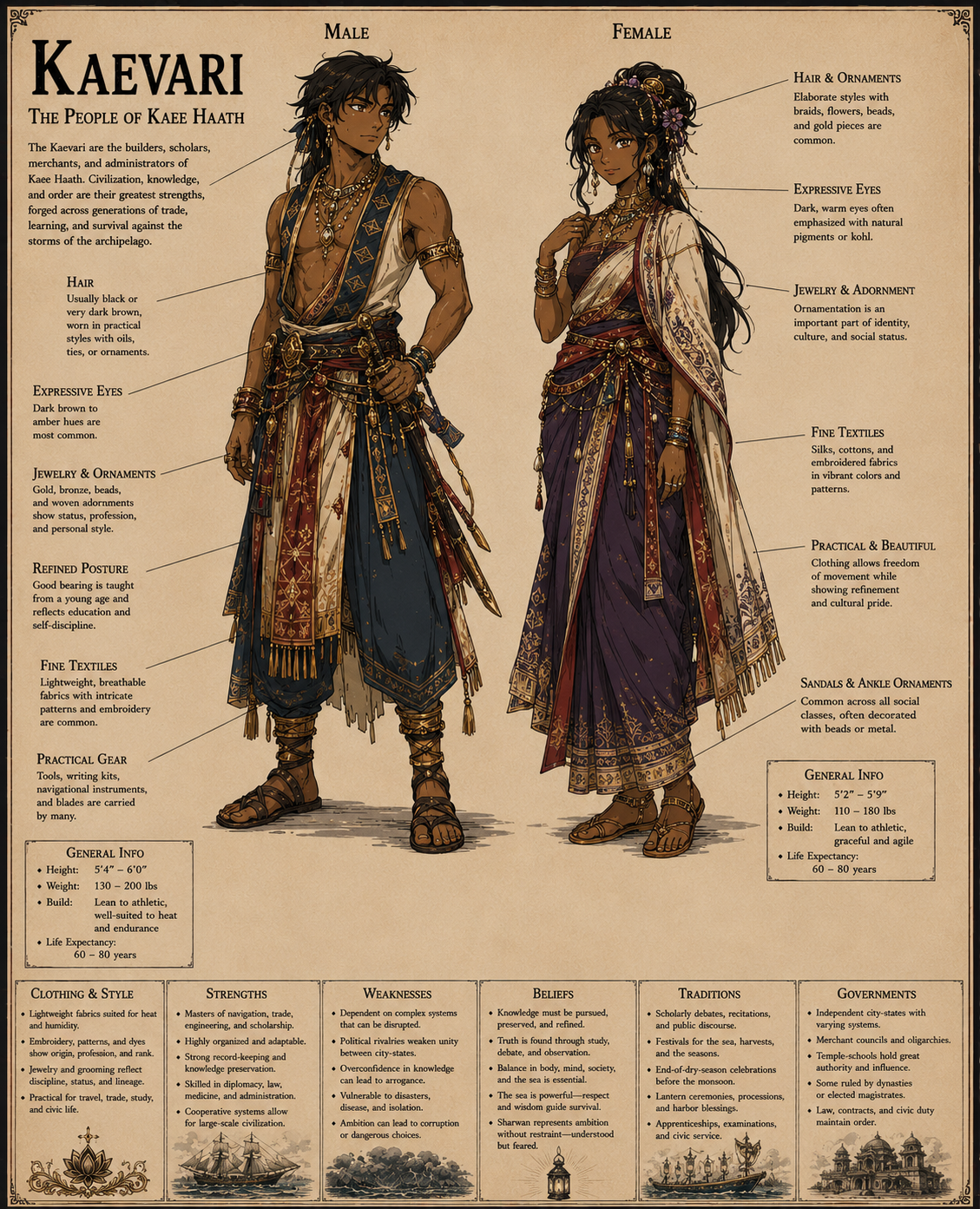
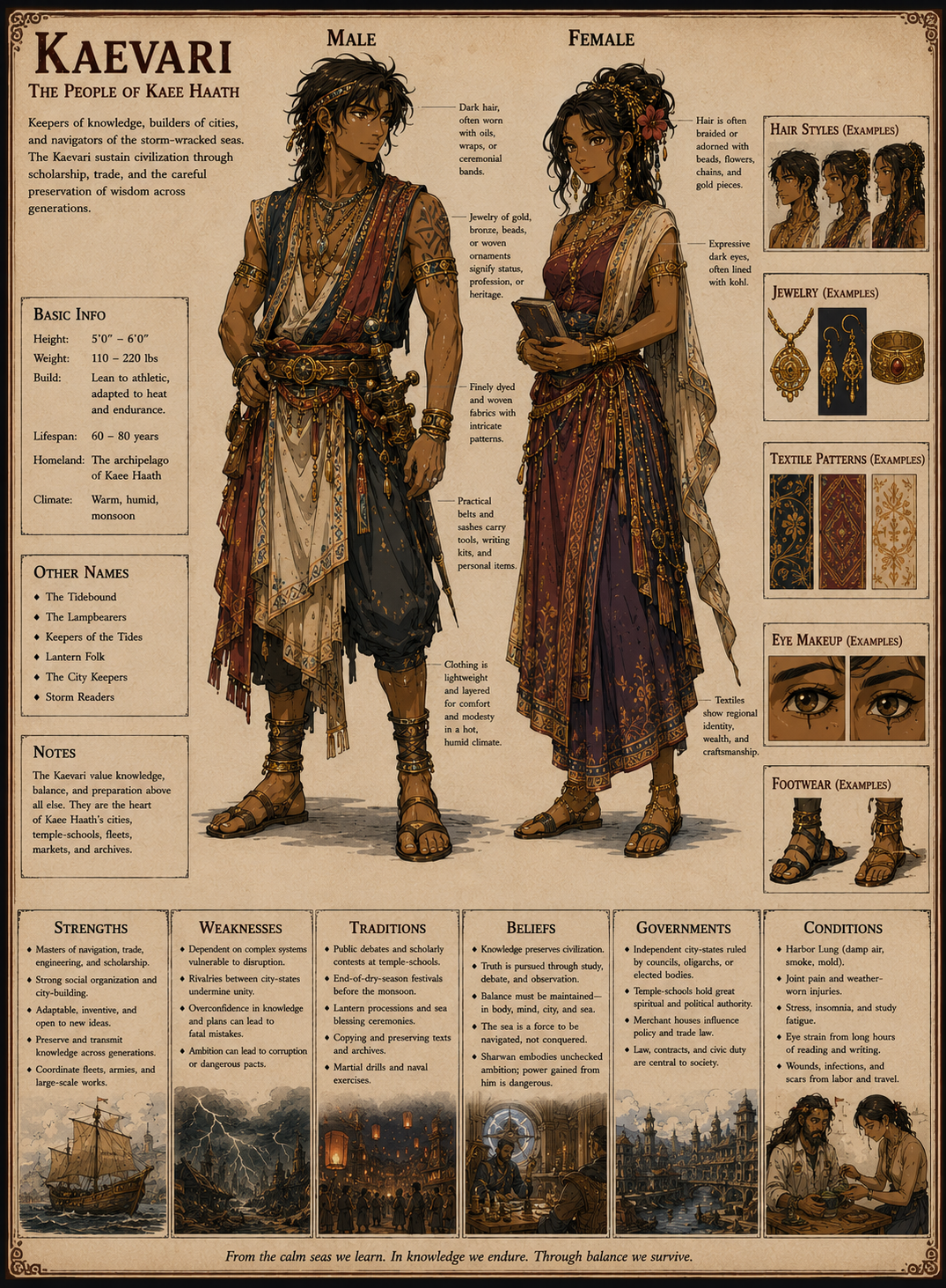
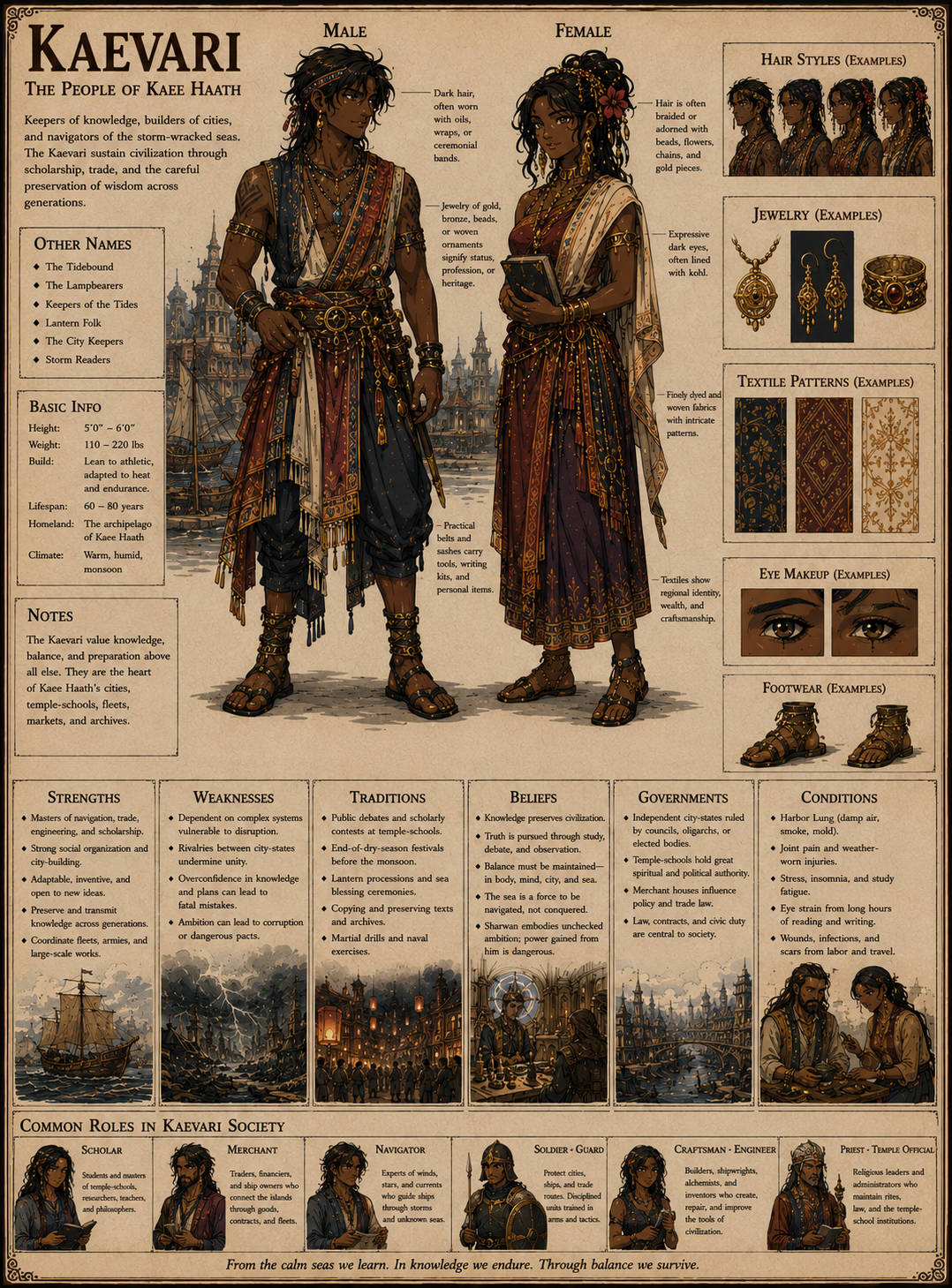
Associations
Other pages that reference or connect to this race
Referenced By
2Collections
Published collections that feature this race
Not in any collections yet
This race hasn't been published in any collections yet. Collections are curated groups of related content that help organize and showcase your world.
Tip: Collections are a great way to group related content together and share themed stories or worldbuilding elements with others.
Timelines
Timelines that reference or include this race
No timeline connections yet
This race isn't connected to any timelines yet. Timelines help organize events chronologically and show how your content fits into the broader history of your world.
Tip: Create timelines to organize important events in your world's history. Link characters, locations, and other content to specific events to build rich, interconnected narratives.
Shares
Discussion about this race
No shares yet
Be the first to start a discussion about this race by sharing it to the community stream.
Privacy & Sharing
Manage who can see and access this race
Current Status
refresh
This race is currently
Privacy Settings
Choose who can see and access this race
language Universe Privacy
This page belongs to a universe with its own privacy settings