
Categories
Dive Deeper
Page Stats
Navigation
Categories
Dive Deeper
Page Stats
Complete Details
All information about this race
Overview
Sarathi
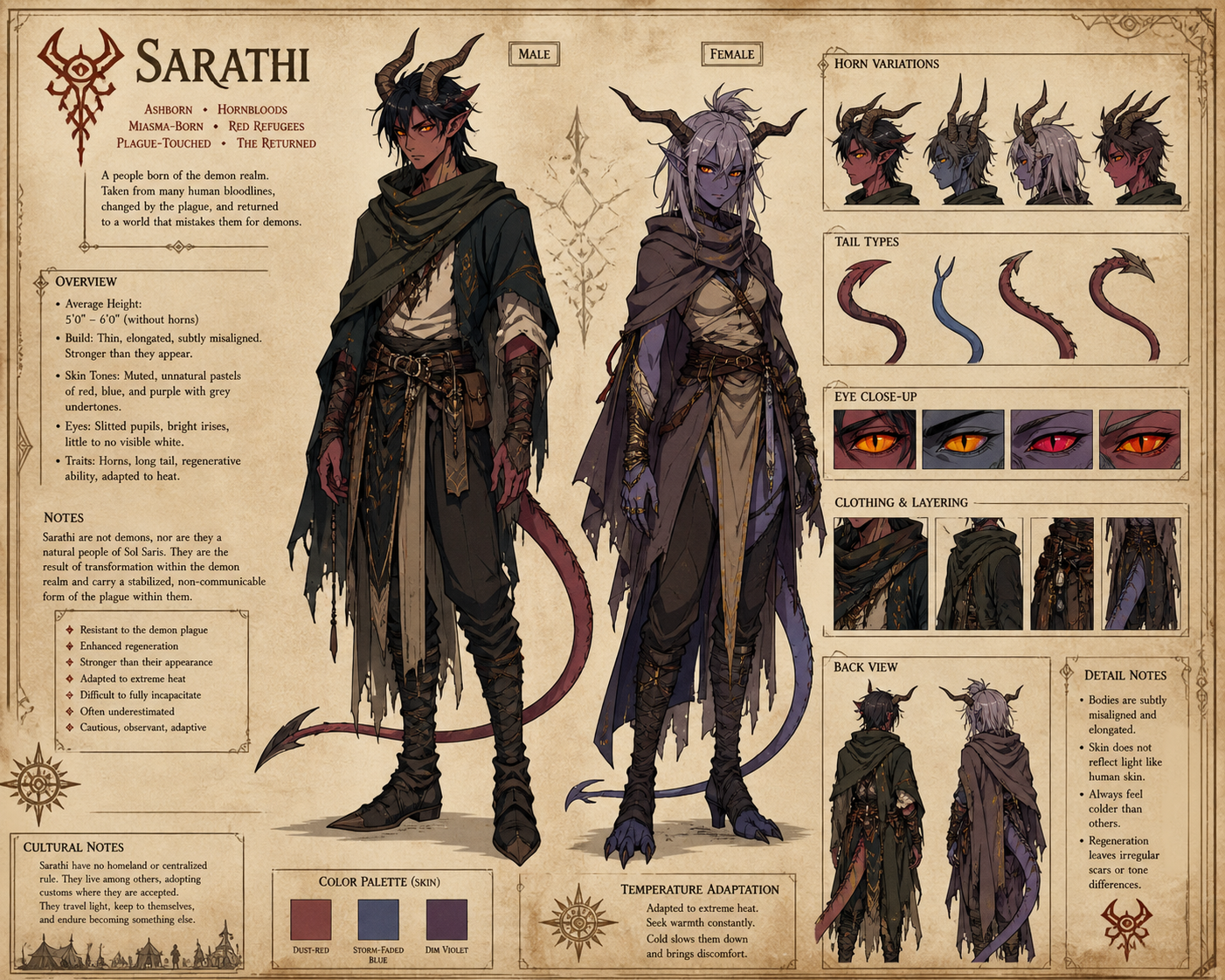
An average Sarathi stands within human height, thin to the point of discomfort, their body appearing subtly misaligned—as if shaped by rules that no longer apply in this world. Their skin carries a muted, unnatural tone—dust-red, dim violet, or storm-faded blue—matte and cold to the eye. From their head rise horns of unpredictable shape, and behind them a long, controlled tail moves with quiet intention.
Their eyes are the most arresting feature: slitted pupils set in bright irises, often with little true white visible, giving their gaze a constant, unsettling focus.
Despite their fragile appearance, they move with deliberate control and carry more strength than expected. They favor layered, practical clothing, always seeking warmth, and often hold themselves in stillness longer than feels natural.
Socially, an average Sarathi is cautious, observant, and adaptive. They speak and act in ways that match their surroundings, rarely drawing attention unless forced to. Their habits reflect displacement—portable possessions, flexible routines, and a readiness to move if needed.
They are not fully trusted, rarely fully comfortable, and almost never fully understood.
At their core, an average Sarathi is not defined by what they were—but by the fact that they endured becoming something else.
Ashborn, Hornbloods, Miasma-Born, Red Refugees, Plague-Touched, The Returned
Looks
Sarathi bodies are best described as humanoid, but visibly wrong in proportion and presence. At a glance they resemble thin humans, but the longer one looks, the more their form feels misplaced, imbalanced, or subtly unnatural. They tend to be skinny, but not in a healthy or symmetrical way—their bodies often appear too narrow in some areas and too elongated in others, with proportions that don’t quite align with human expectation. This can manifest as slightly too-long limbs, narrow torsos paired with uneven musculature, or joints that seem just a bit off in placement or movement. They are not frail, but they often look like they should be. The “wrongness” in their form is not extreme, but consistent, creating the impression that their bodies were shaped under different rules. This may show as asymmetry that shouldn’t quite work—but does, movement that feels slightly delayed or too smooth, or posture that never fully settles into something natural, resulting in a constant low-level discomfort when observed.
All Sarathi possess horns, which may grow from the forehead, the top of the skull, or the sides of the head. These horns vary widely in shape, size, and direction, but are always present and serve as one of the clearest indicators that they are not fully of this world. They also have long, strong, pointed or forked tails that are muscular, flexible, and partially prehensile. These tails are used for balance, subtle manipulation, and sometimes expression, feeling active and deliberate rather than decorative. Despite their thin appearance, Sarathi possess noticeable underlying strength—their muscles are not bulky, but dense and efficient, creating a disconnect where they appear weaker than they actually are. They grow hair similarly to humans, both on the head and across the body in typical patterns, reinforcing their partially human origin while contrasting with their more alien traits.
Their movement often feels slightly too fluid or subtly unnatural in timing. They may hold still longer than expected, move in ways that seem overly controlled, or shift posture without the usual human transitions. Altogether, this contributes to the sense that their bodies are operating correctly—but not familiarly. Sarathi are not monstrous, but they are unmistakably altered, their form reflecting something human that has been reshaped by another plane and then forced back into this one.
Sarathi skin tones are immediately striking, falling into dark, desaturated pastel shades of red, blue, and purple. Their coloration feels muted, unnatural, and distinctly non-human, as if it belongs somewhere else. Common tones include dusty reds reminiscent of dried blood or ash-muted crimson, faded blues with storm-worn, slate-like qualities, and dim purples that evoke bruised or twilight-violet hues. These colors are not bright or saturated—instead, they appear softened, dulled, or drained of intensity. This creates a strange contradiction: the softness of pastel tones combined with the depth of darker shades, giving their skin a slightly muted, almost powdery or matte appearance that lacks the warmth typical of human skin.
Their skin often carries faint grey undertones, ashen qualities, or subtle mottling in low light. In some cases, it can appear flatter than human skin or less responsive to light, reinforcing the sense that their bodies do not interact with the world in quite the same way. While the main hues remain consistent, individuals may vary in depth of tone, saturation, or blending between colors—for example, red shifting toward purple at the extremities, blue carrying faint violet undertones, or uneven coloration along the limbs and torso. Due to their regenerative traits, Sarathi skin may also show irregular healing patterns, faint discoloration where wounds once were, or patchy differences in texture, creating subtle visual inconsistencies across the body.
In most regions of Sol Saris, their skin stands out sharply against human populations, natural tones, and common environments. Even brief glimpses are enough to immediately mark them as different. Sarathi skin is not meant to blend in—it reflects a body shaped by another world, carrying its color back with it.
Sarathi typically stand:
between 5’0” and 6’0” in height (excluding horns)
At a glance, this places them well within human norms—but their overall presence makes them feel:
taller, stranger, or slightly “off” in scale
Height Distribution (Expanded)
Most Sarathi fall into:
5’0” – 5’4” → shorter, more compact builds
5’4” – 5’8” → average range
5’8” – 6’0” → taller individuals
Outliers beyond this range exist, but are:
uncommon
and often visually striking due to their already unusual proportions
Horns and Perceived Height
Although horns are not included in their official height, they significantly affect how tall a Sarathi appears.
Depending on their shape and orientation, horns can:
add several inches to their silhouette
draw the eye upward
and exaggerate their vertical presence
This often leads to Sarathi being perceived as:
taller than they actually are
Proportion vs Measurement
Because of their:
elongated features
narrow frames
and unusual proportions
Sarathi can feel:
stretched
or slightly mis-scaled
Even when standing next to someone of equal height, they may appear:
longer rather than taller
Sex-Based Differences
Males tend to:
fall slightly higher in the height range
and appear more elongated
Females tend to:
cluster toward the middle
and present slightly more compact proportions
The difference exists, but is not extreme.
Presence and Posture
Sarathi posture often enhances their perceived height through:
stillness
upright positioning
and minimal wasted movement
They rarely:
slouch heavily
or collapse their frame inward
Instead, they tend to hold themselves in a way that feels:
intentional, even when at rest
Core Height Identity
Sarathi height is not remarkable on its own—
but combined with their form, it becomes:
something that feels subtly wrong to measure
Sarathi tend to be:
light for their height
with body weight that often feels lower than it should be given their size.
Typical Weight Range (Expanded)
Most Sarathi fall into:
100 – 130 lbs → very lean individuals (common)
120 – 150 lbs → average range
150 – 170 lbs → heavier or more physically developed individuals
Outliers exist, but even larger Sarathi rarely carry weight in a way that appears:
bulky
or dense in the traditional sense
Unsettling Lightness
Sarathi bodies often seem:
too light for their frame
or lacking expected mass in key areas
When compared directly to humans of similar height, they may feel:
underweight without appearing frail
This contributes to the sense that:
something about their physical makeup is different at a fundamental level
Distribution of Mass
Their weight is not evenly expressed.
They may appear:
narrow through the torso
slightly heavier in limbs or joints
or uneven in how mass is carried
This creates a silhouette that feels:
inconsistent rather than balanced
Muscle vs Appearance
Despite their low weight, Sarathi possess:
noticeable strength beyond what their build suggests
Their musculature is:
compact
efficient
and not visibly pronounced
This leads to a disconnect where:
they can exert more force than their size implies
Regenerative Influence
Their regenerative nature affects how their bodies maintain mass:
they recover from injury rather than degrade
but this does not necessarily increase bulk or density
In some cases, this may result in:
subtle irregularities in tissue
or areas that do not fully match the rest of the body
Weight Stability
Sarathi tend to:
maintain a relatively stable weight
and do not fluctuate as dramatically as some other races
Their bodies resist:
both extreme gain
and extreme loss
Core Weight Identity
Sarathi weight does not match expectation—
it reinforces the idea that:
their bodies are functioning correctly, but not according to familiar rules
Sarathi are immediately recognizable by a combination of traits that feel cohesive—but fundamentally unnatural. Each feature alone is striking, but together they create a presence that is impossible to mistake for human. All Sarathi possess horns, which may emerge from the forehead, the top of the skull, or the sides of the head. These horns vary widely in length, curvature, thickness, and orientation—some sweep backward, curl outward, or jut forward at sharp angles—but they are always present, prominent, and culturally significant. They also have long, muscular tails, often ending in a point or fork, which are strong, flexible, and partially prehensile. These tails are used for balance, subtle manipulation, and controlled movement, feeling active and intentional rather than decorative.
Their eyes are among their most unsettling features. Sarathi possess slitted, cat-like pupils and bright irises in shades of orange or yellow, paired with colored sclera that range from yellow to deep red. This removes the typical white of the eye, creating a vivid, intense gaze that can appear luminous in low light—focused, predatory, and difficult to ignore. Their skin further reinforces their alien nature, appearing in dark, desaturated pastel tones of red, blue, and purple. These matte, muted colors are unlike natural human coloration and contribute heavily to the sense that Sarathi do not belong to this world.
Beyond individual features, their bodies carry a persistent sense of proportional “wrongness.” Limbs may feel slightly too long or too thin, joints move just a bit differently, and posture never fully settles into something familiar. Nothing is exaggerated, but everything is just off enough to feel incorrect. Due to their regenerative nature, their skin may also show faint mismatches in tone, irregular healed areas, or subtle differences in texture, becoming more noticeable on closer inspection.
Sarathi often display a preference for warmth, gravitating toward heated surfaces and insulated clothing, hinting at an origin in a far hotter environment. They are also capable of remaining unusually still for extended periods, and when they do move, it is deliberate, efficient, and slightly too smooth. This creates a presence that feels measured rather than reactive. Ultimately, Sarathi are defined not just by what they have—but by how all of it comes together into something that is complete, functional, and undeniably unnatural.
Sarathi exhibit extreme, almost exaggerated physical variance. While they share a consistent set of core traits—horns, a tail, slitted pupils, and unnatural skin tones of red, blue, or purple—the way those traits manifest differs so widely that no two Sarathi look quite alike. These core features are non-negotiable; every Sarathi has them, and everything else is subject to change. The most visually diverse trait is their horns, which can vary wildly in length (from short nubs to long sweeping structures), shape (straight, curved, spiraled, jagged), placement (forehead, crown, or sides), and orientation (forward, outward, backward, or even asymmetrical). Some individuals have perfectly mirrored horns, while others display uneven or mismatched growth.
Their tails, though always long, strong, and partially prehensile, also vary in thickness, length, tapering, and tip shape, ranging from whip-like and thin to thicker, more muscular forms, sometimes ending in a point or fork. Body proportions shift the sense of “wrongness” in different ways—some Sarathi have longer limbs, others narrower torsos, and some appear compact but uneven. The distortion is consistent in presence, but not in placement. Skin coloration, while limited to reds, blues, and purples, varies in shade depth, blending, and distribution; some individuals appear nearly monochrome, while others show subtle transitions or uneven coloration across the body.
Facial structure can range from relatively human-adjacent to distinctly alien, differing in sharpness, eye size and intensity, jaw structure, and overall silhouette. Hair grows similarly to humans but varies in thickness, length, and density, with some individuals having full, thick hair and others showing sparse or uneven growth. Their regenerative nature can also introduce irregularities over time, such as subtle tissue mismatches, uneven healing, or faint asymmetry, adding to each individual’s uniqueness. Overall, Sarathi variance is not random—it is consistent in concept but chaotic in execution. They are unified by what they are, but defined by how differently they express it.
Sarathi clothing is shaped by two constant pressures: the environment they now live in and the environment they came from. The result is a style that prioritizes warmth, comfort, and adaptability over identity or tradition. Across nearly all regions of Sol Saris, Sarathi tend to feel uncomfortably cold, leading them to favor heavier fabrics, layered clothing, and insulated garments. Even in climates others consider mild or warm, they often dress as if the air is never quite warm enough. Layering is their default approach—multiple overlapping garments that can be adjusted throughout the day to regulate temperature and maintain comfort. These layers are practical rather than styled, added or removed as needed rather than for appearance.
Because of their unusual proportions, horns, and tail, Sarathi clothing tends to be loose, flexible, and forgiving in fit. This prevents restriction of movement, avoids pressure on their horns, and ensures their tail can move freely without interference. Garments are often modified with open backs, slits, or adjusted fastenings to accommodate this, prioritizing function over uniformity. Headwear is rare, as standard hats are impractical due to horn placement and variation, though specialized designs may be created to fit around rather than over them.
Sarathi do not maintain a strong independent clothing tradition and instead adopt the styles of the cultures around them. This results in wide regional variation, with individuals often reflecting local fashion in a practical, adapted form. Materials are chosen for warmth, softness, and durability, with rough or abrasive fabrics generally avoided due to comfort and skin sensitivity. Clothing is selected primarily for function, durability, and ease of use rather than fashion or symbolic meaning.
Many Sarathi also favor clothing that is easy to move in, carry, and adapt, reflecting their history of displacement. Personalization exists but is subtle—small modifications, layering choices, or practical additions that reflect individual preference rather than cultural identity. Overall, Sarathi clothing reflects displacement more than tradition, shaped by necessity, environment, and the need to remain comfortable in a world that is always just a little too cold.
Traits
Sarathi strengths stem from a single defining factor: their partial adaptation to the demon plague. This has left them altered, resilient in specific ways, and physically more capable than they appear. One of their most important traits is a semi-immunity to the demon plague itself. While not completely immune, Sarathi can survive exposure that would affect or kill others, resisting rapid or uncontrolled mutation and maintaining stability under conditions that would be lethal to most. This makes them uniquely suited to contaminated or unstable environments and difficult to corrupt in the same ways as others.
They also possess enhanced physical strength relative to their appearance. Sarathi are noticeably stronger than their thin, uneven builds suggest—not to an extreme or superhuman degree, but enough to overpower individuals of similar size, lift more than expected, and apply force efficiently. This often catches others off guard, as their fragile-looking forms do not match their actual capability. Their regenerative qualities are another defining strength. Sarathi can recover from injuries that would kill most humans, including major trauma and significant tissue damage. Their bodies are capable of rebuilding and stabilizing themselves, allowing them to continue functioning even after severe harm, though this process is neither painless nor always immediate.
Because of this regenerative nature, they are difficult to fully incapacitate. They can continue operating after serious injury and recover over time, giving them a form of endurance based not on stamina, but on survival through damage. Their altered physiology also grants them resistance to environmental degradation, allowing them to tolerate harsher conditions, resist certain forms of physical decline, and maintain function in diseased, corrupted, or otherwise hostile environments.
As a scattered people without a unified structure, Sarathi are highly adaptable. They can integrate into new environments, learn unfamiliar systems, and function within different cultures with relative ease. Their history has also shaped a survival-oriented mindset—practical, resilient, and focused on continuation rather than ideal conditions. They make use of what is available rather than waiting for something better.
Finally, their deceptive physical presence works in their favor. Because they appear thin, uneven, or fragile, they are often underestimated. This can provide an advantage in confrontation, negotiation, or survival situations. Sarathi strengths are not clean or elegant—they are the result of surviving something that should have destroyed them, and continuing anyway.
Sarathi weaknesses stem directly from the same source as their strengths: their incomplete adaptation to the demon plague. What grants them resilience also leaves them inconsistent, unstable in edge cases, and physically uncomfortable in ways others are not. Their regeneration, while powerful, is imperfect—recovery is not precise, not painless, and not always fast. They can survive catastrophic damage, but rebuilt tissue may not match perfectly, function can return unevenly, and recovery may take significant time. This means a Sarathi might endure injuries that would kill others, yet still suffer lingering weakness, impaired movement, or prolonged periods of reduced capability.
They also experience pain fully, if not more intensely. Their regenerative nature does not dull sensation; instead, they remain conscious through trauma others would not survive and must endure the entire recovery process. This creates a harsh reality where they can survive more, but must also feel more. Cold intolerance is another constant issue. Their bodies are adapted to a far hotter environment, leaving them perpetually uncomfortable in most climates of Sol Saris. This leads to stiffness, slowed movement, reduced efficiency, and a reliance on external warmth to function at their best.
Their physical presence creates social challenges. Horns, tails, unnatural skin tones, and subtly “wrong” proportions often cause distrust, fear, or discomfort in others. Even when accepted, they are rarely fully at ease in the eyes of those around them, leading to social distance or suspicion. Physically, they can also be inconsistent. Their bodies are capable, but not always predictable—strength output, recovery time, and performance can vary due to their altered nature.
Though their condition is non-communicable, residual effects of the demon plague remain within them. These can manifest as irregular healing, subtle physical instability, or long-term strain on the body. Beyond the physical, their scattered existence creates structural weaknesses. Without a unified culture, centralized support, or strong communal systems, Sarathi often face isolation and lack collective protection. They are also dependent on the societies they integrate into for resources, stability, and acceptance, limiting their ability to operate independently or build lasting power structures.
Finally, they are often perceived as something adjacent to the very threat they survived—remnants of the demon plague rather than survivors of it. This perception lingers even in regions that tolerate or accept them, shaping long-term trust and interaction. Sarathi weaknesses are not separate from their strengths—they are the cost of surviving something that was never meant to be survived.
Sarathi conditions all stem from a single root: a non-communicable form of the demon plague carried within their bodies. This condition does not spread, but it shapes their physiology, drives their regeneration, and introduces instability over time. Every Sarathi carries a stabilized version of the plague, granting them regenerative ability, resistance to mutation, and survival under extreme conditions. However, it also means their bodies are never fully “normal,” always under internal strain and subtly unstable.
This instability manifests in several ways. Overgrowth episodes occur when regeneration overcompensates, producing excess tissue, uneven healing, or temporary physical distortion, which can cause swelling, reduced mobility, and the need for time or correction to settle. Delayed reconstruction reflects the body prioritizing survival over immediate repair, leaving injuries visible for longer before sudden, sometimes rapid recovery occurs. Pain echo is also common, where the body “remembers” trauma even after healing, resulting in phantom pain, lingering sensitivity, or discomfort without active injury.
Sarathi are also dependent on heat for optimal function. Their bodies perform better in warmer environments, with improved regeneration and efficiency, while cold conditions slow recovery, increase fatigue, and reduce overall performance. Over time, they may experience plague fatigue—sudden exhaustion and reduced regenerative effectiveness caused by the constant internal strain of their condition, often requiring extended rest to recover.
More subtle effects include stability drift, where the body undergoes gradual, minor changes over time. This can appear as slight shifts in proportion, small changes in skin tone or texture, or other irregular internal adjustments that accumulate slowly. Sensory displacement may also occur, causing brief disconnects between perception and movement—delayed reactions, misjudged distances, or momentary disorientation. In cases of severe trauma, regenerative shock can set in, where the body enters an intensive recovery state, leading to temporary immobility, reduced awareness, and vulnerability while healing progresses.
Sarathi conditions are not separate afflictions—they are the ongoing consequences of a body that should not function, but does anyway.
Culture
Sarathi traditions are fragmented, borrowed, and quietly preserved. Unlike older peoples of Sol Saris, they do not possess a strong, unified cultural body. What survived did so by accident, by usefulness, or by being small enough not to be taken from them. Most Sarathi traditions are either adopted from the cultures they live within or reduced remnants of something older, carried forward unevenly.
The majority of Sarathi practice the customs of those around them—local traditions, religious practices, social norms, and daily habits. Because they are scattered, few in number, and dependent on acceptance, they tend to integrate rather than assert. As a result, a Sarathi raised in one region may share more in common culturally with their neighbors than with another Sarathi elsewhere. This reflects a long history of displacement, beginning with their escape from the demon plane and continuing through periods of persecution, during which much of their original culture was lost, suppressed, or abandoned for survival.
One of the few widely preserved traditions is the care and maintenance of horns and hair. This includes cleaning, polishing, trimming, shaping, and careful grooming. Horns are treated as personal and sensitive, requiring consistent attention, and these routines often serve as grounding practices—one of the only consistent cultural behaviors shared across Sarathi individuals. In many cases, this is the closest thing they have to a common tradition.
Sarathi also display recurring heat-seeking behaviors that function like informal traditions. They gather in warm spaces, seek out heat sources, and rest in shared warmth whenever possible. While born from necessity, these habits create patterns of behavior that are repeated and shared across individuals.
Recognition between Sarathi tends to be quiet and understated. They identify one another through subtle observation and shared physical traits, often acknowledging each other without overt display. This creates a low-visibility form of cultural connection—present, but rarely expressed openly.
Many Sarathi also maintain travel-ready habits shaped by their history as refugees. They keep possessions minimal, favor portable items, and remain ready to relocate if necessary. This is less a formal tradition and more a learned survival behavior that continues to be passed between individuals.
More than any single ritual, what unites Sarathi is their approach: they adopt what works. Customs, beliefs, and behaviors are kept if they allow them to survive, integrate, or remain stable. Sarathi traditions are not unified or inherited in full—they are assembled, preserved in fragments, and carried forward where possible.
Sarathi beliefs are defined less by doctrine and more by absence, adaptation, and personal reconstruction. They are a people who lost much of what they once believed, abandoned what became dangerous to keep, and now build belief around what allows them to live. When they fled the demon plane, their original belief systems were largely abandoned, fragmented, or intentionally discarded—driven by necessity, persecution, and the need to distance themselves from anything associated with demons. What remains is not a preserved system, but scattered remnants with little cohesion.
Most Sarathi adopt the beliefs of the people they live among, taking on local religions, spiritual practices, and cultural worldviews. This is often not a matter of deep devotion, but of practical alignment—integrating socially, avoiding suspicion, and ensuring survival. As a result, Sarathi beliefs vary widely depending on where they are; two individuals from different regions may follow entirely different systems, and even those in the same place may differ internally.
They tend to approach belief pragmatically, treating it as something to work within rather than something to defend. They are less likely to argue doctrine or assert religious authority, and more likely to observe, participate, and adapt as needed. At the same time, they maintain a clear distance from anything that ties them back to their origin. Most actively avoid beliefs that connect them to demons, both out of personal rejection and social necessity, careful not to reinforce the fears others may already have about them.
Their worldview is shaped by survival. Stability is valued more than certainty, and practicality outweighs ideology. This creates a mindset that is flexible, grounded, and focused on continuation rather than conviction. Many Sarathi are also skeptical of permanence; having lost so much, they tend to distrust systems that claim to be unchanging or absolute, assuming instead that anything can be taken, altered, or disappear.
Without a unified structure, belief becomes personal, situational, and self-defined. Each Sarathi reconstructs meaning in their own way, influenced by environment, experience, and need. Sarathi belief is not unified, inherited, or enforced—it is rebuilt, adapted, and shaped by the need to belong without being consumed.
The Sarathi have no government of their own. They are a scattered people with no centralized authority, no shared political structure, and no unified leadership. They possess no homeland to govern, no council to organize them, and no collective body that represents them. This is a direct result of their recent arrival to Sol Saris—within roughly the last ninety years—their escape under extreme conditions, and their relatively small population. They are not a nation, nor even a loosely organized polity, but individuals and small clusters living within the boundaries of other societies.
As a result, Sarathi exist entirely under the governance of the regions they inhabit. Their legal status, rights, and protections are determined by the states that control those lands, most commonly in places like the Stanzgar River Valley, Vallis Pinguium, and surrounding regions. There is no unified Sarathi law or authority—only the laws of others applied to them.
Unlike some displaced peoples, the Sarathi have not formed shadow councils, hidden leadership structures, or coordinated political organizations. There is no widespread movement to unify, reclaim authority, or establish a governing body of their own. This absence is driven by their small numbers, lack of shared cultural structure, and a consistent focus on survival and integration rather than political consolidation.
In rare cases, individual Sarathi may gain influence within a community through reputation, skill, or long-term presence. However, this influence is always local and personal—it does not extend beyond the immediate environment or represent Sarathi as a whole. There is no mechanism by which individual influence becomes collective power.
Sarathi governance is therefore entirely external. They depend on host nations, local laws, and existing authority structures for order and protection. This creates a situation where their experience can vary widely depending on where they live, as different regions treat them differently.
The Sarathi are not governed as a people—they are governed wherever they happen to be.
Sarathi do not possess a distinct technological tradition of their own. They use whatever technologies they can access, learn, or carry with them, and their relationship with technology is defined by availability, adaptability, and necessity. Rather than being tied to a specific technological identity, they rely on the tools and systems present in the societies they inhabit. This commonly includes regional crafts and industry, gunpowder weapons when permitted or trained, basic enchantments, and everyday utility equipment. Their tools change depending on where they are, not who they are.
They tend to develop strong practical familiarity with what they use. Sarathi are often fast learners, observant, and willing to experiment within safe limits, allowing them to become functional with new tools quickly even without formal training. This adaptability makes them competent across a wide range of systems, though not necessarily specialized in any single one.
Access, however, is a limiting factor. Sarathi frequently face restrictions when it comes to advanced technologies, with limited opportunities to engage in high-level production, innovation, or specialization. This is influenced by their social position, trust barriers, and lack of centralized support or infrastructure of their own.
Because of their history as refugees, they tend to favor tools that are portable, reliable, and easy to maintain. Lightweight equipment, multi-use items, and durable tools are preferred over complex or stationary systems. They prioritize independence from large infrastructure, choosing what can be carried, repaired, and relied upon in uncertain conditions.
Their approach to technology is also improvisational. Rather than inventing entirely new systems, Sarathi are more likely to modify existing tools, repurpose items, or combine different techniques to suit their needs. Their focus is practical rather than innovative, driven by immediate function rather than long-term development.
They also form little attachment to specific tools or methods. Moving between regions and cultures, they are comfortable switching systems, learning new approaches, and abandoning old ones when necessary. This flexibility reinforces their ability to adapt, but also prevents the formation of a unified technological identity.
Sarathi tend to use technology quietly and efficiently. Their competence often goes unnoticed because they do not draw attention to how they use tools—they simply make them work. Sarathi do not define themselves through technology; they survive through it.
Sarathi occupations are defined by a single reality: they work where they are allowed and survive where they can. With no unified structure, no homeland, and only a recent arrival to Sol Saris, they fill roles based on opportunity, necessity, and the tolerance of others. Most commonly, Sarathi find work in general labor—manual work, transport, construction, and other physically demanding roles. These positions are widely available, require minimal trust, and suit their resilience and understated strength, even if they are not always the preferred choice.
Many also take on travel-based work. Caravan labor, port handling, courier roles, and trade support align well with their mobile lifestyle and familiarity with shifting environments. Movement becomes both a necessity and a livelihood, allowing them to operate between regions where long-term stability may not be possible.
Their partial resistance to the demon plague and overall durability make them suited for hazard-tolerant roles. In some regions, they are employed in contaminated areas, unstable environments, or dangerous cleanup and exploration work—positions others avoid. In these cases, their condition becomes an advantage, and sometimes one of the few reasons they are actively sought out.
Sarathi also work in service and support roles such as inns, kitchens, and maintenance, though access to these positions depends heavily on local acceptance. Some develop technical skills, craftsmanship, or specialized knowledge, but are often uncredited, underpaid, or working under others, with their contributions going unrecognized despite their capability.
A smaller number operate independently as traders, freelancers, or contract workers. These individuals rely on reputation, adaptability, and mobility, often avoiding long-term attachment in favor of flexibility. In more accepting communities, Sarathi may become trusted workers or stable members of local systems, though these situations are dependent on circumstance rather than the norm.
Among themselves, Sarathi sometimes exchange work through favors, mutual aid, and informal agreements, forming a small, quiet internal support network alongside formal systems. Ultimately, Sarathi occupations are not freely chosen—they are taken, adapted to, and survived through.
Sarathi economics are defined by dispersion, instability, and adaptability. They are not a unified economic force and do not control significant resources; instead, their situation shifts depending on where they live, who they live among, and what opportunities they can access. There is no single Sarathi economy. In stable regions they may find steady work and modest security, in hostile regions they may struggle for basic survival, and in more accepting communities they may integrate and build a degree of stability. This creates a wide spectrum ranging from near destitution to functional, if modest, independence.
They lack central wealth and infrastructure. Sarathi do not possess shared economic institutions, trade networks of their own, or collective control of resources. They do not operate large guilds, national industries, or unified markets, instead existing entirely within the economies of others. Among themselves, they often rely on favor-based exchange rather than formal trade. Labor, assistance, and obligations are exchanged through trust, forming a small, decentralized support network that operates alongside formal systems.
Within broader societies, Sarathi participate as laborers, service workers, or independent operators. They earn wages, purchase goods, and trade when possible, but rarely accumulate significant wealth or hold positions of financial power. Due to instability, mobility, and lack of structural support, they often struggle to retain wealth long-term, build lasting security, or pass resources across generations. Money is typically used for immediate needs, portability, and short-term stability rather than long-term investment.
Their economic behavior reflects their history. Sarathi favor goods that can be carried, wealth that can be moved, and assets that do not tie them to a single place. This leads to low attachment to property or fixed holdings. They are also opportunistic earners, quick to take available work, adapt to changing markets, and shift roles as needed. While this flexibility allows them to function in unstable conditions, it also prevents consistent long-term growth.
Access to opportunity is heavily influenced by perception. Trust from employers and communities, along with lingering fear of their origins, can open doors in some regions and close them entirely in others. Ultimately, Sarathi economics are not centralized, stable, or inherited—they are improvised, situational, and built moment to moment.
Sarathi food preferences are shaped by:
their history as refugees
their need for mobility
and their internal heat-driven physiology
They favor foods that are:
portable, durable, and capable of sustaining them over time
Travel-Friendly Foods (Expanded)
Food that moves with them
The most defining trait of Sarathi cuisine is:
portability
Common choices include:
dried meats
hard breads
preserved grains
and compact rations
These foods are:
easy to carry
resistant to spoilage
and reliable across long periods
This reflects a mindset where:
food must be ready to move at a moment’s notice
Preserved Meats
Sarathi commonly favor:
jerky
smoked meats
salted cuts
These provide:
high energy
long shelf life
and ease of storage
Dense Breads and Hard Rations
Staples often include:
hard loaves
flatbreads
or compact grain cakes
These are:
filling
durable
and easily portioned
Heat-Retaining Foods (Expanded)
Warmth from within
Because Sarathi are constantly cold, they strongly prefer foods that are:
warm
or capable of holding heat
When available, they favor:
stews
broths
and heavily cooked meals
These provide not just sustenance—but:
a sense of physical relief
Spiced and Intense Flavors
Sarathi often gravitate toward:
strong spices
heat-forward dishes
and bold flavor profiles
This may be tied to:
their origin in a harsher, hotter environment
Mild foods are often seen as:
less satisfying
or lacking substance
Quick-Preparation Meals
Foods that can be:
prepared quickly
eaten without ceremony
or consumed on the move
are highly valued
This includes:
simple cooked meats
reheated grains
or assembled meals
Frequent, Small Consumption
Rather than large meals, Sarathi often:
eat when they can
in smaller portions
This reflects:
inconsistent access
and a habit of maintaining energy rather than indulging
Low Attachment to Specific Cuisine
Because they move between cultures, Sarathi:
do not strongly cling to specific food traditions
and adapt easily to local diets
They are more concerned with:
function over identity in food
Shared Food Among Sarathi
When Sarathi gather, food may be:
shared
divided evenly
or distributed based on need
This reflects their favor-based internal systems.
Core Food Identity
Sarathi food is not about tradition or comfort alone—
it is about:
survival, warmth, and readiness to move
History
Sarathi history is extremely short—and extremely intense. It is defined by abduction, transformation, escape, persecution, and reluctant acceptance. Unlike most peoples of Sol Saris, their entire known history spans less than a century. Their origins trace back to the time of the first Atlanians, when humans were taken into the demon realm. There, over generations, they were altered, exposed to the demon plague, and reshaped into something new. From these conditions, the Sarathi emerged—no longer fully human, but not fully demonic. This period is poorly recorded, not fully understood, and foundational to everything they are.
For generations, they existed within the demon realm in a hostile, unstable, and mutative environment. It was not a civilization in the traditional sense, but survival under constant pressure. During this time, they developed resistance to the demon plague, regenerative abilities, and the distinct physical traits that define them. Less than a century before the 6th Age, a number of Sarathi escaped and reached Sol Saris. This was not a mass migration, but a scattered emergence, marking their first true presence in the world and the beginning of all modern Sarathi existence.
Upon arrival, they were widely mistaken for demons. During the height of the demon plague crisis, Sarathi were hunted, killed, and driven out of settlements, with little distinction made between them and actual demonic entities. This period of witch hunts resulted in heavy loss of life, further scattering of survivors, and deep-rooted mistrust that still lingers. The turning point came when the Stanzgarian Medical Inquisition studied them and determined that their condition was non-communicable and that they were not active carriers of the plague. This led to a reduction in organized persecution, limited legal tolerance, and the beginning of broader acceptance—an event that is largely the reason the Sarathi still exist as a people.
Following this recognition, Sarathi began to integrate into existing societies, settling where they were permitted and adopting local customs and systems. They are now most commonly found in regions such as the Stanzgar River Valley, Vallis Pinguium, and surrounding areas. Their presence varies by location—accepted in some places, tolerated in others, and still distrusted in a few. Sarathi history is not ancient or layered; it is recent, violent, and still unfolding.
Notes
Sarathi origin is often misunderstood, but they are not Atlanians. While they trace their beginnings to humans taken during the time of the first Atlanians, those taken came from various populations, likely diverse in origin and not tied to a single culture or lineage. Their transformation occurred after their abduction into the demon realm, meaning Sarathi identity is not a continuation of Atlanian blood, but a divergence formed from multiple human roots shaped by exposure and survival.
Their presence on Sol Saris is extremely recent. The Sarathi have existed on the continent for less than ninety years, having lived almost entirely within the demon realm prior to their escape. This makes them one of the newest peoples in the world, with no deep historical ties to existing nations or long-standing cultural foundations. All Sarathi are descendants of those who were taken and changed—they are not born of demons, nor are they a naturally occurring people of Sol Saris. Their existence is the result of transformation, endurance, and adaptation.
Despite their appearance and origin, their condition is non-communicable. They do not spread the demon plague; what they carry is internal, stabilized, and non-infectious. This distinction was critical in their eventual acceptance, though it has not fully erased suspicion. Sarathi are still often perceived as demonic, corrupted, or dangerous, and even in regions where they are accepted, this perception can linger, influencing trust and behavior toward them.
They are few in number and widely dispersed, rarely forming large groups or unified communities. They do not build cities or large enclaves, instead existing as scattered individuals or small clusters within other societies. This has contributed to deep cultural fragmentation. Due to displacement, persecution, and the short span of their history, they lack a strong shared culture or preserved traditions beyond fragments. Their identity is largely individual and situational rather than collective.
Sarathi tend toward integration rather than separation. They do not commonly attempt to isolate themselves or form independent societies, instead adopting the systems, customs, and structures of the communities they live within. This further reinforces their fragmented identity while allowing them to survive within established frameworks.
They also maintain a consistent relationship with heat. Sarathi feel colder than others in the same environment, suggesting their bodies are adapted to a significantly hotter climate—likely a remnant of their time in the demon realm. This affects their behavior, clothing, and comfort in nearly all regions of Sol Saris.
The Sarathi are not a continuation of what was taken—they are what survived being changed.
Overview
Details about this race's overview
Sarathi
An average Sarathi stands within human height, thin to the point of discomfort, their body appearing subtly misaligned—as if shaped by rules that no longer apply in this world. Their skin carries a muted, unnatural tone—dust-red, dim violet, or storm-faded blue—matte and cold to the eye. From their head rise horns of unpredictable shape, and behind them a long, controlled tail moves with quiet intention.
Their eyes are the most arresting feature: slitted pupils set in bright irises, often with little true white visible, giving their gaze a constant, unsettling focus.
Despite their fragile appearance, they move with deliberate control and carry more strength than expected. They favor layered, practical clothing, always seeking warmth, and often hold themselves in stillness longer than feels natural.
Socially, an average Sarathi is cautious, observant, and adaptive. They speak and act in ways that match their surroundings, rarely drawing attention unless forced to. Their habits reflect displacement—portable possessions, flexible routines, and a readiness to move if needed.
They are not fully trusted, rarely fully comfortable, and almost never fully understood.
At their core, an average Sarathi is not defined by what they were—but by the fact that they endured becoming something else.
Ashborn, Hornbloods, Miasma-Born, Red Refugees, Plague-Touched, The Returned
Looks
Details about this race's looks
Sarathi bodies are best described as humanoid, but visibly wrong in proportion and presence. At a glance they resemble thin humans, but the longer one looks, the more their form feels misplaced, imbalanced, or subtly unnatural. They tend to be skinny, but not in a healthy or symmetrical way—their bodies often appear too narrow in some areas and too elongated in others, with proportions that don’t quite align with human expectation. This can manifest as slightly too-long limbs, narrow torsos paired with uneven musculature, or joints that seem just a bit off in placement or movement. They are not frail, but they often look like they should be. The “wrongness” in their form is not extreme, but consistent, creating the impression that their bodies were shaped under different rules. This may show as asymmetry that shouldn’t quite work—but does, movement that feels slightly delayed or too smooth, or posture that never fully settles into something natural, resulting in a constant low-level discomfort when observed.
All Sarathi possess horns, which may grow from the forehead, the top of the skull, or the sides of the head. These horns vary widely in shape, size, and direction, but are always present and serve as one of the clearest indicators that they are not fully of this world. They also have long, strong, pointed or forked tails that are muscular, flexible, and partially prehensile. These tails are used for balance, subtle manipulation, and sometimes expression, feeling active and deliberate rather than decorative. Despite their thin appearance, Sarathi possess noticeable underlying strength—their muscles are not bulky, but dense and efficient, creating a disconnect where they appear weaker than they actually are. They grow hair similarly to humans, both on the head and across the body in typical patterns, reinforcing their partially human origin while contrasting with their more alien traits.
Their movement often feels slightly too fluid or subtly unnatural in timing. They may hold still longer than expected, move in ways that seem overly controlled, or shift posture without the usual human transitions. Altogether, this contributes to the sense that their bodies are operating correctly—but not familiarly. Sarathi are not monstrous, but they are unmistakably altered, their form reflecting something human that has been reshaped by another plane and then forced back into this one.
Sarathi skin tones are immediately striking, falling into dark, desaturated pastel shades of red, blue, and purple. Their coloration feels muted, unnatural, and distinctly non-human, as if it belongs somewhere else. Common tones include dusty reds reminiscent of dried blood or ash-muted crimson, faded blues with storm-worn, slate-like qualities, and dim purples that evoke bruised or twilight-violet hues. These colors are not bright or saturated—instead, they appear softened, dulled, or drained of intensity. This creates a strange contradiction: the softness of pastel tones combined with the depth of darker shades, giving their skin a slightly muted, almost powdery or matte appearance that lacks the warmth typical of human skin.
Their skin often carries faint grey undertones, ashen qualities, or subtle mottling in low light. In some cases, it can appear flatter than human skin or less responsive to light, reinforcing the sense that their bodies do not interact with the world in quite the same way. While the main hues remain consistent, individuals may vary in depth of tone, saturation, or blending between colors—for example, red shifting toward purple at the extremities, blue carrying faint violet undertones, or uneven coloration along the limbs and torso. Due to their regenerative traits, Sarathi skin may also show irregular healing patterns, faint discoloration where wounds once were, or patchy differences in texture, creating subtle visual inconsistencies across the body.
In most regions of Sol Saris, their skin stands out sharply against human populations, natural tones, and common environments. Even brief glimpses are enough to immediately mark them as different. Sarathi skin is not meant to blend in—it reflects a body shaped by another world, carrying its color back with it.
Sarathi typically stand:
between 5’0” and 6’0” in height (excluding horns)
At a glance, this places them well within human norms—but their overall presence makes them feel:
taller, stranger, or slightly “off” in scale
Height Distribution (Expanded)
Most Sarathi fall into:
5’0” – 5’4” → shorter, more compact builds
5’4” – 5’8” → average range
5’8” – 6’0” → taller individuals
Outliers beyond this range exist, but are:
uncommon
and often visually striking due to their already unusual proportions
Horns and Perceived Height
Although horns are not included in their official height, they significantly affect how tall a Sarathi appears.
Depending on their shape and orientation, horns can:
add several inches to their silhouette
draw the eye upward
and exaggerate their vertical presence
This often leads to Sarathi being perceived as:
taller than they actually are
Proportion vs Measurement
Because of their:
elongated features
narrow frames
and unusual proportions
Sarathi can feel:
stretched
or slightly mis-scaled
Even when standing next to someone of equal height, they may appear:
longer rather than taller
Sex-Based Differences
Males tend to:
fall slightly higher in the height range
and appear more elongated
Females tend to:
cluster toward the middle
and present slightly more compact proportions
The difference exists, but is not extreme.
Presence and Posture
Sarathi posture often enhances their perceived height through:
stillness
upright positioning
and minimal wasted movement
They rarely:
slouch heavily
or collapse their frame inward
Instead, they tend to hold themselves in a way that feels:
intentional, even when at rest
Core Height Identity
Sarathi height is not remarkable on its own—
but combined with their form, it becomes:
something that feels subtly wrong to measure
Sarathi tend to be:
light for their height
with body weight that often feels lower than it should be given their size.
Typical Weight Range (Expanded)
Most Sarathi fall into:
100 – 130 lbs → very lean individuals (common)
120 – 150 lbs → average range
150 – 170 lbs → heavier or more physically developed individuals
Outliers exist, but even larger Sarathi rarely carry weight in a way that appears:
bulky
or dense in the traditional sense
Unsettling Lightness
Sarathi bodies often seem:
too light for their frame
or lacking expected mass in key areas
When compared directly to humans of similar height, they may feel:
underweight without appearing frail
This contributes to the sense that:
something about their physical makeup is different at a fundamental level
Distribution of Mass
Their weight is not evenly expressed.
They may appear:
narrow through the torso
slightly heavier in limbs or joints
or uneven in how mass is carried
This creates a silhouette that feels:
inconsistent rather than balanced
Muscle vs Appearance
Despite their low weight, Sarathi possess:
noticeable strength beyond what their build suggests
Their musculature is:
compact
efficient
and not visibly pronounced
This leads to a disconnect where:
they can exert more force than their size implies
Regenerative Influence
Their regenerative nature affects how their bodies maintain mass:
they recover from injury rather than degrade
but this does not necessarily increase bulk or density
In some cases, this may result in:
subtle irregularities in tissue
or areas that do not fully match the rest of the body
Weight Stability
Sarathi tend to:
maintain a relatively stable weight
and do not fluctuate as dramatically as some other races
Their bodies resist:
both extreme gain
and extreme loss
Core Weight Identity
Sarathi weight does not match expectation—
it reinforces the idea that:
their bodies are functioning correctly, but not according to familiar rules
Sarathi are immediately recognizable by a combination of traits that feel cohesive—but fundamentally unnatural. Each feature alone is striking, but together they create a presence that is impossible to mistake for human. All Sarathi possess horns, which may emerge from the forehead, the top of the skull, or the sides of the head. These horns vary widely in length, curvature, thickness, and orientation—some sweep backward, curl outward, or jut forward at sharp angles—but they are always present, prominent, and culturally significant. They also have long, muscular tails, often ending in a point or fork, which are strong, flexible, and partially prehensile. These tails are used for balance, subtle manipulation, and controlled movement, feeling active and intentional rather than decorative.
Their eyes are among their most unsettling features. Sarathi possess slitted, cat-like pupils and bright irises in shades of orange or yellow, paired with colored sclera that range from yellow to deep red. This removes the typical white of the eye, creating a vivid, intense gaze that can appear luminous in low light—focused, predatory, and difficult to ignore. Their skin further reinforces their alien nature, appearing in dark, desaturated pastel tones of red, blue, and purple. These matte, muted colors are unlike natural human coloration and contribute heavily to the sense that Sarathi do not belong to this world.
Beyond individual features, their bodies carry a persistent sense of proportional “wrongness.” Limbs may feel slightly too long or too thin, joints move just a bit differently, and posture never fully settles into something familiar. Nothing is exaggerated, but everything is just off enough to feel incorrect. Due to their regenerative nature, their skin may also show faint mismatches in tone, irregular healed areas, or subtle differences in texture, becoming more noticeable on closer inspection.
Sarathi often display a preference for warmth, gravitating toward heated surfaces and insulated clothing, hinting at an origin in a far hotter environment. They are also capable of remaining unusually still for extended periods, and when they do move, it is deliberate, efficient, and slightly too smooth. This creates a presence that feels measured rather than reactive. Ultimately, Sarathi are defined not just by what they have—but by how all of it comes together into something that is complete, functional, and undeniably unnatural.
Sarathi exhibit extreme, almost exaggerated physical variance. While they share a consistent set of core traits—horns, a tail, slitted pupils, and unnatural skin tones of red, blue, or purple—the way those traits manifest differs so widely that no two Sarathi look quite alike. These core features are non-negotiable; every Sarathi has them, and everything else is subject to change. The most visually diverse trait is their horns, which can vary wildly in length (from short nubs to long sweeping structures), shape (straight, curved, spiraled, jagged), placement (forehead, crown, or sides), and orientation (forward, outward, backward, or even asymmetrical). Some individuals have perfectly mirrored horns, while others display uneven or mismatched growth.
Their tails, though always long, strong, and partially prehensile, also vary in thickness, length, tapering, and tip shape, ranging from whip-like and thin to thicker, more muscular forms, sometimes ending in a point or fork. Body proportions shift the sense of “wrongness” in different ways—some Sarathi have longer limbs, others narrower torsos, and some appear compact but uneven. The distortion is consistent in presence, but not in placement. Skin coloration, while limited to reds, blues, and purples, varies in shade depth, blending, and distribution; some individuals appear nearly monochrome, while others show subtle transitions or uneven coloration across the body.
Facial structure can range from relatively human-adjacent to distinctly alien, differing in sharpness, eye size and intensity, jaw structure, and overall silhouette. Hair grows similarly to humans but varies in thickness, length, and density, with some individuals having full, thick hair and others showing sparse or uneven growth. Their regenerative nature can also introduce irregularities over time, such as subtle tissue mismatches, uneven healing, or faint asymmetry, adding to each individual’s uniqueness. Overall, Sarathi variance is not random—it is consistent in concept but chaotic in execution. They are unified by what they are, but defined by how differently they express it.
Sarathi clothing is shaped by two constant pressures: the environment they now live in and the environment they came from. The result is a style that prioritizes warmth, comfort, and adaptability over identity or tradition. Across nearly all regions of Sol Saris, Sarathi tend to feel uncomfortably cold, leading them to favor heavier fabrics, layered clothing, and insulated garments. Even in climates others consider mild or warm, they often dress as if the air is never quite warm enough. Layering is their default approach—multiple overlapping garments that can be adjusted throughout the day to regulate temperature and maintain comfort. These layers are practical rather than styled, added or removed as needed rather than for appearance.
Because of their unusual proportions, horns, and tail, Sarathi clothing tends to be loose, flexible, and forgiving in fit. This prevents restriction of movement, avoids pressure on their horns, and ensures their tail can move freely without interference. Garments are often modified with open backs, slits, or adjusted fastenings to accommodate this, prioritizing function over uniformity. Headwear is rare, as standard hats are impractical due to horn placement and variation, though specialized designs may be created to fit around rather than over them.
Sarathi do not maintain a strong independent clothing tradition and instead adopt the styles of the cultures around them. This results in wide regional variation, with individuals often reflecting local fashion in a practical, adapted form. Materials are chosen for warmth, softness, and durability, with rough or abrasive fabrics generally avoided due to comfort and skin sensitivity. Clothing is selected primarily for function, durability, and ease of use rather than fashion or symbolic meaning.
Many Sarathi also favor clothing that is easy to move in, carry, and adapt, reflecting their history of displacement. Personalization exists but is subtle—small modifications, layering choices, or practical additions that reflect individual preference rather than cultural identity. Overall, Sarathi clothing reflects displacement more than tradition, shaped by necessity, environment, and the need to remain comfortable in a world that is always just a little too cold.
Traits
Details about this race's traits
Sarathi strengths stem from a single defining factor: their partial adaptation to the demon plague. This has left them altered, resilient in specific ways, and physically more capable than they appear. One of their most important traits is a semi-immunity to the demon plague itself. While not completely immune, Sarathi can survive exposure that would affect or kill others, resisting rapid or uncontrolled mutation and maintaining stability under conditions that would be lethal to most. This makes them uniquely suited to contaminated or unstable environments and difficult to corrupt in the same ways as others.
They also possess enhanced physical strength relative to their appearance. Sarathi are noticeably stronger than their thin, uneven builds suggest—not to an extreme or superhuman degree, but enough to overpower individuals of similar size, lift more than expected, and apply force efficiently. This often catches others off guard, as their fragile-looking forms do not match their actual capability. Their regenerative qualities are another defining strength. Sarathi can recover from injuries that would kill most humans, including major trauma and significant tissue damage. Their bodies are capable of rebuilding and stabilizing themselves, allowing them to continue functioning even after severe harm, though this process is neither painless nor always immediate.
Because of this regenerative nature, they are difficult to fully incapacitate. They can continue operating after serious injury and recover over time, giving them a form of endurance based not on stamina, but on survival through damage. Their altered physiology also grants them resistance to environmental degradation, allowing them to tolerate harsher conditions, resist certain forms of physical decline, and maintain function in diseased, corrupted, or otherwise hostile environments.
As a scattered people without a unified structure, Sarathi are highly adaptable. They can integrate into new environments, learn unfamiliar systems, and function within different cultures with relative ease. Their history has also shaped a survival-oriented mindset—practical, resilient, and focused on continuation rather than ideal conditions. They make use of what is available rather than waiting for something better.
Finally, their deceptive physical presence works in their favor. Because they appear thin, uneven, or fragile, they are often underestimated. This can provide an advantage in confrontation, negotiation, or survival situations. Sarathi strengths are not clean or elegant—they are the result of surviving something that should have destroyed them, and continuing anyway.
Sarathi weaknesses stem directly from the same source as their strengths: their incomplete adaptation to the demon plague. What grants them resilience also leaves them inconsistent, unstable in edge cases, and physically uncomfortable in ways others are not. Their regeneration, while powerful, is imperfect—recovery is not precise, not painless, and not always fast. They can survive catastrophic damage, but rebuilt tissue may not match perfectly, function can return unevenly, and recovery may take significant time. This means a Sarathi might endure injuries that would kill others, yet still suffer lingering weakness, impaired movement, or prolonged periods of reduced capability.
They also experience pain fully, if not more intensely. Their regenerative nature does not dull sensation; instead, they remain conscious through trauma others would not survive and must endure the entire recovery process. This creates a harsh reality where they can survive more, but must also feel more. Cold intolerance is another constant issue. Their bodies are adapted to a far hotter environment, leaving them perpetually uncomfortable in most climates of Sol Saris. This leads to stiffness, slowed movement, reduced efficiency, and a reliance on external warmth to function at their best.
Their physical presence creates social challenges. Horns, tails, unnatural skin tones, and subtly “wrong” proportions often cause distrust, fear, or discomfort in others. Even when accepted, they are rarely fully at ease in the eyes of those around them, leading to social distance or suspicion. Physically, they can also be inconsistent. Their bodies are capable, but not always predictable—strength output, recovery time, and performance can vary due to their altered nature.
Though their condition is non-communicable, residual effects of the demon plague remain within them. These can manifest as irregular healing, subtle physical instability, or long-term strain on the body. Beyond the physical, their scattered existence creates structural weaknesses. Without a unified culture, centralized support, or strong communal systems, Sarathi often face isolation and lack collective protection. They are also dependent on the societies they integrate into for resources, stability, and acceptance, limiting their ability to operate independently or build lasting power structures.
Finally, they are often perceived as something adjacent to the very threat they survived—remnants of the demon plague rather than survivors of it. This perception lingers even in regions that tolerate or accept them, shaping long-term trust and interaction. Sarathi weaknesses are not separate from their strengths—they are the cost of surviving something that was never meant to be survived.
Sarathi conditions all stem from a single root: a non-communicable form of the demon plague carried within their bodies. This condition does not spread, but it shapes their physiology, drives their regeneration, and introduces instability over time. Every Sarathi carries a stabilized version of the plague, granting them regenerative ability, resistance to mutation, and survival under extreme conditions. However, it also means their bodies are never fully “normal,” always under internal strain and subtly unstable.
This instability manifests in several ways. Overgrowth episodes occur when regeneration overcompensates, producing excess tissue, uneven healing, or temporary physical distortion, which can cause swelling, reduced mobility, and the need for time or correction to settle. Delayed reconstruction reflects the body prioritizing survival over immediate repair, leaving injuries visible for longer before sudden, sometimes rapid recovery occurs. Pain echo is also common, where the body “remembers” trauma even after healing, resulting in phantom pain, lingering sensitivity, or discomfort without active injury.
Sarathi are also dependent on heat for optimal function. Their bodies perform better in warmer environments, with improved regeneration and efficiency, while cold conditions slow recovery, increase fatigue, and reduce overall performance. Over time, they may experience plague fatigue—sudden exhaustion and reduced regenerative effectiveness caused by the constant internal strain of their condition, often requiring extended rest to recover.
More subtle effects include stability drift, where the body undergoes gradual, minor changes over time. This can appear as slight shifts in proportion, small changes in skin tone or texture, or other irregular internal adjustments that accumulate slowly. Sensory displacement may also occur, causing brief disconnects between perception and movement—delayed reactions, misjudged distances, or momentary disorientation. In cases of severe trauma, regenerative shock can set in, where the body enters an intensive recovery state, leading to temporary immobility, reduced awareness, and vulnerability while healing progresses.
Sarathi conditions are not separate afflictions—they are the ongoing consequences of a body that should not function, but does anyway.
Culture
Details about this race's culture
Sarathi traditions are fragmented, borrowed, and quietly preserved. Unlike older peoples of Sol Saris, they do not possess a strong, unified cultural body. What survived did so by accident, by usefulness, or by being small enough not to be taken from them. Most Sarathi traditions are either adopted from the cultures they live within or reduced remnants of something older, carried forward unevenly.
The majority of Sarathi practice the customs of those around them—local traditions, religious practices, social norms, and daily habits. Because they are scattered, few in number, and dependent on acceptance, they tend to integrate rather than assert. As a result, a Sarathi raised in one region may share more in common culturally with their neighbors than with another Sarathi elsewhere. This reflects a long history of displacement, beginning with their escape from the demon plane and continuing through periods of persecution, during which much of their original culture was lost, suppressed, or abandoned for survival.
One of the few widely preserved traditions is the care and maintenance of horns and hair. This includes cleaning, polishing, trimming, shaping, and careful grooming. Horns are treated as personal and sensitive, requiring consistent attention, and these routines often serve as grounding practices—one of the only consistent cultural behaviors shared across Sarathi individuals. In many cases, this is the closest thing they have to a common tradition.
Sarathi also display recurring heat-seeking behaviors that function like informal traditions. They gather in warm spaces, seek out heat sources, and rest in shared warmth whenever possible. While born from necessity, these habits create patterns of behavior that are repeated and shared across individuals.
Recognition between Sarathi tends to be quiet and understated. They identify one another through subtle observation and shared physical traits, often acknowledging each other without overt display. This creates a low-visibility form of cultural connection—present, but rarely expressed openly.
Many Sarathi also maintain travel-ready habits shaped by their history as refugees. They keep possessions minimal, favor portable items, and remain ready to relocate if necessary. This is less a formal tradition and more a learned survival behavior that continues to be passed between individuals.
More than any single ritual, what unites Sarathi is their approach: they adopt what works. Customs, beliefs, and behaviors are kept if they allow them to survive, integrate, or remain stable. Sarathi traditions are not unified or inherited in full—they are assembled, preserved in fragments, and carried forward where possible.
Sarathi beliefs are defined less by doctrine and more by absence, adaptation, and personal reconstruction. They are a people who lost much of what they once believed, abandoned what became dangerous to keep, and now build belief around what allows them to live. When they fled the demon plane, their original belief systems were largely abandoned, fragmented, or intentionally discarded—driven by necessity, persecution, and the need to distance themselves from anything associated with demons. What remains is not a preserved system, but scattered remnants with little cohesion.
Most Sarathi adopt the beliefs of the people they live among, taking on local religions, spiritual practices, and cultural worldviews. This is often not a matter of deep devotion, but of practical alignment—integrating socially, avoiding suspicion, and ensuring survival. As a result, Sarathi beliefs vary widely depending on where they are; two individuals from different regions may follow entirely different systems, and even those in the same place may differ internally.
They tend to approach belief pragmatically, treating it as something to work within rather than something to defend. They are less likely to argue doctrine or assert religious authority, and more likely to observe, participate, and adapt as needed. At the same time, they maintain a clear distance from anything that ties them back to their origin. Most actively avoid beliefs that connect them to demons, both out of personal rejection and social necessity, careful not to reinforce the fears others may already have about them.
Their worldview is shaped by survival. Stability is valued more than certainty, and practicality outweighs ideology. This creates a mindset that is flexible, grounded, and focused on continuation rather than conviction. Many Sarathi are also skeptical of permanence; having lost so much, they tend to distrust systems that claim to be unchanging or absolute, assuming instead that anything can be taken, altered, or disappear.
Without a unified structure, belief becomes personal, situational, and self-defined. Each Sarathi reconstructs meaning in their own way, influenced by environment, experience, and need. Sarathi belief is not unified, inherited, or enforced—it is rebuilt, adapted, and shaped by the need to belong without being consumed.
The Sarathi have no government of their own. They are a scattered people with no centralized authority, no shared political structure, and no unified leadership. They possess no homeland to govern, no council to organize them, and no collective body that represents them. This is a direct result of their recent arrival to Sol Saris—within roughly the last ninety years—their escape under extreme conditions, and their relatively small population. They are not a nation, nor even a loosely organized polity, but individuals and small clusters living within the boundaries of other societies.
As a result, Sarathi exist entirely under the governance of the regions they inhabit. Their legal status, rights, and protections are determined by the states that control those lands, most commonly in places like the Stanzgar River Valley, Vallis Pinguium, and surrounding regions. There is no unified Sarathi law or authority—only the laws of others applied to them.
Unlike some displaced peoples, the Sarathi have not formed shadow councils, hidden leadership structures, or coordinated political organizations. There is no widespread movement to unify, reclaim authority, or establish a governing body of their own. This absence is driven by their small numbers, lack of shared cultural structure, and a consistent focus on survival and integration rather than political consolidation.
In rare cases, individual Sarathi may gain influence within a community through reputation, skill, or long-term presence. However, this influence is always local and personal—it does not extend beyond the immediate environment or represent Sarathi as a whole. There is no mechanism by which individual influence becomes collective power.
Sarathi governance is therefore entirely external. They depend on host nations, local laws, and existing authority structures for order and protection. This creates a situation where their experience can vary widely depending on where they live, as different regions treat them differently.
The Sarathi are not governed as a people—they are governed wherever they happen to be.
Sarathi do not possess a distinct technological tradition of their own. They use whatever technologies they can access, learn, or carry with them, and their relationship with technology is defined by availability, adaptability, and necessity. Rather than being tied to a specific technological identity, they rely on the tools and systems present in the societies they inhabit. This commonly includes regional crafts and industry, gunpowder weapons when permitted or trained, basic enchantments, and everyday utility equipment. Their tools change depending on where they are, not who they are.
They tend to develop strong practical familiarity with what they use. Sarathi are often fast learners, observant, and willing to experiment within safe limits, allowing them to become functional with new tools quickly even without formal training. This adaptability makes them competent across a wide range of systems, though not necessarily specialized in any single one.
Access, however, is a limiting factor. Sarathi frequently face restrictions when it comes to advanced technologies, with limited opportunities to engage in high-level production, innovation, or specialization. This is influenced by their social position, trust barriers, and lack of centralized support or infrastructure of their own.
Because of their history as refugees, they tend to favor tools that are portable, reliable, and easy to maintain. Lightweight equipment, multi-use items, and durable tools are preferred over complex or stationary systems. They prioritize independence from large infrastructure, choosing what can be carried, repaired, and relied upon in uncertain conditions.
Their approach to technology is also improvisational. Rather than inventing entirely new systems, Sarathi are more likely to modify existing tools, repurpose items, or combine different techniques to suit their needs. Their focus is practical rather than innovative, driven by immediate function rather than long-term development.
They also form little attachment to specific tools or methods. Moving between regions and cultures, they are comfortable switching systems, learning new approaches, and abandoning old ones when necessary. This flexibility reinforces their ability to adapt, but also prevents the formation of a unified technological identity.
Sarathi tend to use technology quietly and efficiently. Their competence often goes unnoticed because they do not draw attention to how they use tools—they simply make them work. Sarathi do not define themselves through technology; they survive through it.
Sarathi occupations are defined by a single reality: they work where they are allowed and survive where they can. With no unified structure, no homeland, and only a recent arrival to Sol Saris, they fill roles based on opportunity, necessity, and the tolerance of others. Most commonly, Sarathi find work in general labor—manual work, transport, construction, and other physically demanding roles. These positions are widely available, require minimal trust, and suit their resilience and understated strength, even if they are not always the preferred choice.
Many also take on travel-based work. Caravan labor, port handling, courier roles, and trade support align well with their mobile lifestyle and familiarity with shifting environments. Movement becomes both a necessity and a livelihood, allowing them to operate between regions where long-term stability may not be possible.
Their partial resistance to the demon plague and overall durability make them suited for hazard-tolerant roles. In some regions, they are employed in contaminated areas, unstable environments, or dangerous cleanup and exploration work—positions others avoid. In these cases, their condition becomes an advantage, and sometimes one of the few reasons they are actively sought out.
Sarathi also work in service and support roles such as inns, kitchens, and maintenance, though access to these positions depends heavily on local acceptance. Some develop technical skills, craftsmanship, or specialized knowledge, but are often uncredited, underpaid, or working under others, with their contributions going unrecognized despite their capability.
A smaller number operate independently as traders, freelancers, or contract workers. These individuals rely on reputation, adaptability, and mobility, often avoiding long-term attachment in favor of flexibility. In more accepting communities, Sarathi may become trusted workers or stable members of local systems, though these situations are dependent on circumstance rather than the norm.
Among themselves, Sarathi sometimes exchange work through favors, mutual aid, and informal agreements, forming a small, quiet internal support network alongside formal systems. Ultimately, Sarathi occupations are not freely chosen—they are taken, adapted to, and survived through.
Sarathi economics are defined by dispersion, instability, and adaptability. They are not a unified economic force and do not control significant resources; instead, their situation shifts depending on where they live, who they live among, and what opportunities they can access. There is no single Sarathi economy. In stable regions they may find steady work and modest security, in hostile regions they may struggle for basic survival, and in more accepting communities they may integrate and build a degree of stability. This creates a wide spectrum ranging from near destitution to functional, if modest, independence.
They lack central wealth and infrastructure. Sarathi do not possess shared economic institutions, trade networks of their own, or collective control of resources. They do not operate large guilds, national industries, or unified markets, instead existing entirely within the economies of others. Among themselves, they often rely on favor-based exchange rather than formal trade. Labor, assistance, and obligations are exchanged through trust, forming a small, decentralized support network that operates alongside formal systems.
Within broader societies, Sarathi participate as laborers, service workers, or independent operators. They earn wages, purchase goods, and trade when possible, but rarely accumulate significant wealth or hold positions of financial power. Due to instability, mobility, and lack of structural support, they often struggle to retain wealth long-term, build lasting security, or pass resources across generations. Money is typically used for immediate needs, portability, and short-term stability rather than long-term investment.
Their economic behavior reflects their history. Sarathi favor goods that can be carried, wealth that can be moved, and assets that do not tie them to a single place. This leads to low attachment to property or fixed holdings. They are also opportunistic earners, quick to take available work, adapt to changing markets, and shift roles as needed. While this flexibility allows them to function in unstable conditions, it also prevents consistent long-term growth.
Access to opportunity is heavily influenced by perception. Trust from employers and communities, along with lingering fear of their origins, can open doors in some regions and close them entirely in others. Ultimately, Sarathi economics are not centralized, stable, or inherited—they are improvised, situational, and built moment to moment.
Sarathi food preferences are shaped by:
their history as refugees
their need for mobility
and their internal heat-driven physiology
They favor foods that are:
portable, durable, and capable of sustaining them over time
Travel-Friendly Foods (Expanded)
Food that moves with them
The most defining trait of Sarathi cuisine is:
portability
Common choices include:
dried meats
hard breads
preserved grains
and compact rations
These foods are:
easy to carry
resistant to spoilage
and reliable across long periods
This reflects a mindset where:
food must be ready to move at a moment’s notice
Preserved Meats
Sarathi commonly favor:
jerky
smoked meats
salted cuts
These provide:
high energy
long shelf life
and ease of storage
Dense Breads and Hard Rations
Staples often include:
hard loaves
flatbreads
or compact grain cakes
These are:
filling
durable
and easily portioned
Heat-Retaining Foods (Expanded)
Warmth from within
Because Sarathi are constantly cold, they strongly prefer foods that are:
warm
or capable of holding heat
When available, they favor:
stews
broths
and heavily cooked meals
These provide not just sustenance—but:
a sense of physical relief
Spiced and Intense Flavors
Sarathi often gravitate toward:
strong spices
heat-forward dishes
and bold flavor profiles
This may be tied to:
their origin in a harsher, hotter environment
Mild foods are often seen as:
less satisfying
or lacking substance
Quick-Preparation Meals
Foods that can be:
prepared quickly
eaten without ceremony
or consumed on the move
are highly valued
This includes:
simple cooked meats
reheated grains
or assembled meals
Frequent, Small Consumption
Rather than large meals, Sarathi often:
eat when they can
in smaller portions
This reflects:
inconsistent access
and a habit of maintaining energy rather than indulging
Low Attachment to Specific Cuisine
Because they move between cultures, Sarathi:
do not strongly cling to specific food traditions
and adapt easily to local diets
They are more concerned with:
function over identity in food
Shared Food Among Sarathi
When Sarathi gather, food may be:
shared
divided evenly
or distributed based on need
This reflects their favor-based internal systems.
Core Food Identity
Sarathi food is not about tradition or comfort alone—
it is about:
survival, warmth, and readiness to move
History
Details about this race's history
Sarathi history is extremely short—and extremely intense. It is defined by abduction, transformation, escape, persecution, and reluctant acceptance. Unlike most peoples of Sol Saris, their entire known history spans less than a century. Their origins trace back to the time of the first Atlanians, when humans were taken into the demon realm. There, over generations, they were altered, exposed to the demon plague, and reshaped into something new. From these conditions, the Sarathi emerged—no longer fully human, but not fully demonic. This period is poorly recorded, not fully understood, and foundational to everything they are.
For generations, they existed within the demon realm in a hostile, unstable, and mutative environment. It was not a civilization in the traditional sense, but survival under constant pressure. During this time, they developed resistance to the demon plague, regenerative abilities, and the distinct physical traits that define them. Less than a century before the 6th Age, a number of Sarathi escaped and reached Sol Saris. This was not a mass migration, but a scattered emergence, marking their first true presence in the world and the beginning of all modern Sarathi existence.
Upon arrival, they were widely mistaken for demons. During the height of the demon plague crisis, Sarathi were hunted, killed, and driven out of settlements, with little distinction made between them and actual demonic entities. This period of witch hunts resulted in heavy loss of life, further scattering of survivors, and deep-rooted mistrust that still lingers. The turning point came when the Stanzgarian Medical Inquisition studied them and determined that their condition was non-communicable and that they were not active carriers of the plague. This led to a reduction in organized persecution, limited legal tolerance, and the beginning of broader acceptance—an event that is largely the reason the Sarathi still exist as a people.
Following this recognition, Sarathi began to integrate into existing societies, settling where they were permitted and adopting local customs and systems. They are now most commonly found in regions such as the Stanzgar River Valley, Vallis Pinguium, and surrounding areas. Their presence varies by location—accepted in some places, tolerated in others, and still distrusted in a few. Sarathi history is not ancient or layered; it is recent, violent, and still unfolding.
Notes
Details about this race's notes
Sarathi origin is often misunderstood, but they are not Atlanians. While they trace their beginnings to humans taken during the time of the first Atlanians, those taken came from various populations, likely diverse in origin and not tied to a single culture or lineage. Their transformation occurred after their abduction into the demon realm, meaning Sarathi identity is not a continuation of Atlanian blood, but a divergence formed from multiple human roots shaped by exposure and survival.
Their presence on Sol Saris is extremely recent. The Sarathi have existed on the continent for less than ninety years, having lived almost entirely within the demon realm prior to their escape. This makes them one of the newest peoples in the world, with no deep historical ties to existing nations or long-standing cultural foundations. All Sarathi are descendants of those who were taken and changed—they are not born of demons, nor are they a naturally occurring people of Sol Saris. Their existence is the result of transformation, endurance, and adaptation.
Despite their appearance and origin, their condition is non-communicable. They do not spread the demon plague; what they carry is internal, stabilized, and non-infectious. This distinction was critical in their eventual acceptance, though it has not fully erased suspicion. Sarathi are still often perceived as demonic, corrupted, or dangerous, and even in regions where they are accepted, this perception can linger, influencing trust and behavior toward them.
They are few in number and widely dispersed, rarely forming large groups or unified communities. They do not build cities or large enclaves, instead existing as scattered individuals or small clusters within other societies. This has contributed to deep cultural fragmentation. Due to displacement, persecution, and the short span of their history, they lack a strong shared culture or preserved traditions beyond fragments. Their identity is largely individual and situational rather than collective.
Sarathi tend toward integration rather than separation. They do not commonly attempt to isolate themselves or form independent societies, instead adopting the systems, customs, and structures of the communities they live within. This further reinforces their fragmented identity while allowing them to survive within established frameworks.
They also maintain a consistent relationship with heat. Sarathi feel colder than others in the same environment, suggesting their bodies are adapted to a significantly hotter climate—likely a remnant of their time in the demon realm. This affects their behavior, clothing, and comfort in nearly all regions of Sol Saris.
The Sarathi are not a continuation of what was taken—they are what survived being changed.
Gallery
Images and visual content for this race
Associations
Other pages that reference or connect to this race
No connections yet
Start building your world by linking this race to other pages
Collections
Published collections that feature this race
Not in any collections yet
This race hasn't been published in any collections yet. Collections are curated groups of related content that help organize and showcase your world.
Tip: Collections are a great way to group related content together and share themed stories or worldbuilding elements with others.
Timelines
Timelines that reference or include this race
No timeline connections yet
This race isn't connected to any timelines yet. Timelines help organize events chronologically and show how your content fits into the broader history of your world.
Tip: Create timelines to organize important events in your world's history. Link characters, locations, and other content to specific events to build rich, interconnected narratives.
Shares
Discussion about this race
No shares yet
Be the first to start a discussion about this race by sharing it to the community stream.
Privacy & Sharing
Manage who can see and access this race
Current Status
refresh
This race is currently
Privacy Settings
Choose who can see and access this race
language Universe Privacy
This page belongs to a universe with its own privacy settings