
Categories
Dive Deeper
Page Stats
Navigation
Categories
Dive Deeper
Page Stats
Complete Details
All information about this race
Overview
Varash
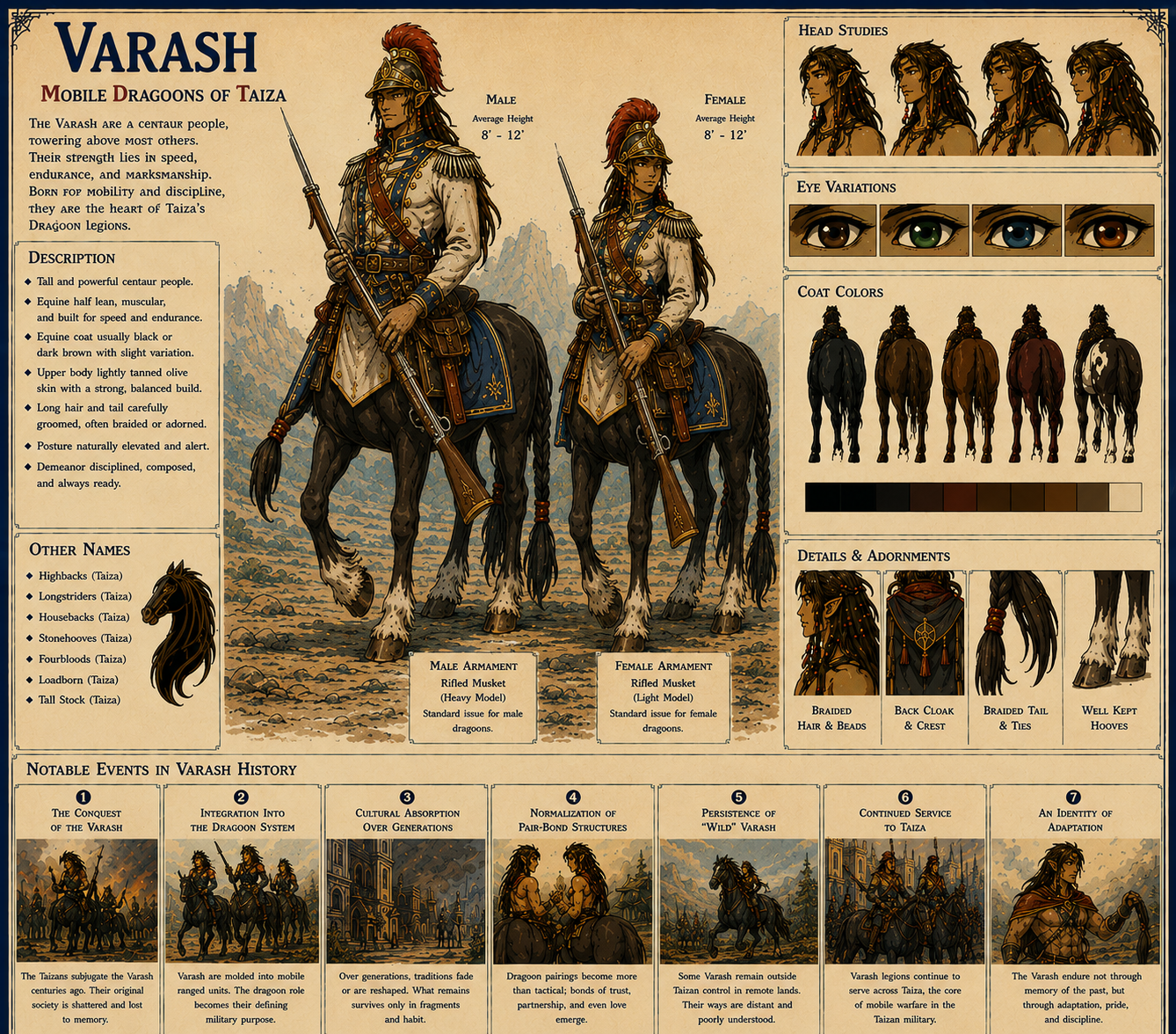
An average Varash is a towering centaur-like figure, standing well above most others with the lower body of a lean, powerful horse and the upper torso of a humanoid. Their equine half is typically dark—black or deep brown—often marked with subtle variation, while their upper body carries lightly tanned olive skin and a strong, balanced build. Their posture is naturally elevated and alert, with sharp, watchful eyes that seem to constantly scan the distance.
Their hair—both head and tail—is kept long and carefully maintained, often braided or adorned, reflecting both personal identity and cultural expectation. A small back-cloak and light upper garments are common, practical for their environment while still marking affiliation or role.
In movement, they are smooth and efficient, capable of covering ground quickly while maintaining control and awareness. In demeanor, they tend toward disciplined and composed, shaped by a life of structure and expectation. They carry themselves with a quiet readiness—less outwardly aggressive, but always prepared, defined by precision, endurance, and a role that blends strength with control.
Taiza - Highbacks, Longstriders, Housebacks, Stonehooves, Fourbloods, Loadborn, Tall Stock
Looks
The Varash possess a centaur-like form, combining the lower body of a horse with the upper torso of a humanoid. Their lower half is built similarly to a lithe Persano horse—long-legged, lean, and built for speed and endurance rather than raw bulk. The musculature is clean and defined, especially through the thighs and hindquarters, giving them strong forward momentum and sustained movement capability.
Their upper body rises where the neck of a horse would normally be, forming a seamless transition into a humanoid torso. This upper half is proportionate but slightly elongated to match their overall scale, with lightly tanned olive skin, defined but not overly bulky musculature, and slightly pointed ears. The shoulders and arms are well-developed, built for weapon use—particularly ranged combat—without sacrificing flexibility or control.
The spine bridges both halves into a single functional structure, resulting in a body that feels unified rather than segmented. Movement flows naturally between the upper and lower body, allowing them to aim, fire, or strike while in motion without losing balance.
Males tend to be larger overall, with broader upper bodies and more mass through the equine half, while females are generally smaller and slightly more streamlined, though still powerful and capable.
Their posture is naturally elevated and forward-facing, with the head held high and eyes constantly scanning the horizon. This gives them a watchful, almost vigilant presence, reinforced by their height and long sightlines.
Overall, the Varash body is built for mobility, awareness, and sustained combat function—capable of carrying weight, maintaining speed, and operating effectively across open terrain.
Additional insight: their centaur structure suggests a culture and lifestyle heavily adapted to open environments, where speed, visibility, and endurance are critical. The balance between a lighter horse build and a functional humanoid torso indicates specialization toward ranged combat and battlefield maneuvering rather than heavy shock engagement. Their unified body structure also implies a high degree of coordination, allowing them to act as both mount and soldier in a single form, which directly supports their role as dragoons.
Varash coloration is split between their humanoid upper body and equine lower half, creating a two-part visual identity that is both consistent and expressive.
The upper body most commonly presents lightly tanned olive skin. This tone ranges from soft sun-warmed tan to deeper olive hues, with warm undertones being the norm. Their skin reflects a life spent outdoors, often appearing slightly weathered or sun-touched, especially across the shoulders and arms. Extreme tones—very pale or very dark—are uncommon, with most individuals falling within a cohesive, warm spectrum.
The lower equine half is typically darker, most often appearing in shades of black or deep brown. These tones dominate the population, giving the Varash a grounded, uniform base. However, variation does exist, with some individuals displaying lighter browns or subtle tonal shifts across the coat.
Markings are where much of their individuality shows. The most culturally significant are the “white socks” on the lower legs. These can range from small, uneven patches to clean, symmetrical stockings. Bright, well-defined white markings—especially when balanced across all four legs—are considered highly attractive and auspicious.
Additional variation can appear in the form of:
subtle dappling
faint gradients between tones
or small irregular patches in the coat
though these are secondary to the dominant dark coloration.
Hair (both head and tail) typically falls within natural dark tones—black and brown being the most common—with occasional lighter variations. These are often emphasized through grooming and braiding rather than natural color contrast.
Overall, Varash coloration is defined by contrast and cohesion: a warm, human upper half paired with a darker, more uniform equine base, accented by meaningful markings that carry both aesthetic and cultural weight.
Additional insight: the strong cultural value placed on white markings suggests that coloration is not purely aesthetic, but tied to ideas of fortune, status, or desirability. The relative uniformity of their base colors, contrasted with individualized markings, creates a balance between shared identity and personal distinction.
Varash typically stand between 8’ and 12’ tall when measured from the ground to the top of the head. This height comes from the full vertical structure of their centaur form—the equine body providing elevation, with the humanoid torso adding additional height above that.
Most individuals fall into a practical average range of about 9’–11’, with shorter individuals still towering over most humanoids and taller ones becoming truly imposing in open terrain. Their height is not just vertical—it is length as well, with a long body that gives them significant physical presence even before standing height is considered.
Males tend to occupy the upper end of the range more frequently, often appearing broader and taller overall, while females are generally somewhat shorter and more streamlined, though still very large by most standards.
Their height is reinforced by posture. Varash naturally carry themselves upright and forward-facing, with their upper body held high and their gaze directed outward across distance. This makes them feel even taller than their raw measurement suggests, especially in open environments where their full frame is visible.
In motion, their height becomes even more pronounced. Their stride length and elevated perspective allow them to move quickly across terrain while maintaining visibility over long distances, reinforcing both their physical and tactical presence.
Overall, Varash height is a defining trait—not just in scale, but in how it shapes their interaction with the world. They are built to see far, move far, and be seen from far away.
Additional insight: their height gives them a natural advantage in observation and ranged combat, aligning with their cultural emphasis on marksmanship. At the same time, their size likely makes concealment difficult, reinforcing a battlefield role built around visibility, positioning, and distance rather than stealth.
Varash typically weigh between 1,500 and 2,000 lbs, with most of that mass coming from their equine lower body. This weight is distributed across a long, powerful frame built for movement, load-bearing, and sustained activity rather than static bulk.
The lower half carries the majority of their mass, with dense muscle and bone structure through the legs, hips, and torso of the horse body. This gives them a stable, grounded presence and allows them to carry equipment, riders, and armor without significant loss of mobility. Their upper humanoid body, while strong and well-defined, contributes less to overall weight and is built more for control, precision, and weapon use.
Males tend to fall toward the higher end of the range, often heavier due to increased muscle mass and overall size, while females are typically lighter and more streamlined, though still extremely heavy compared to most humanoids.
Despite their weight, Varash are not sluggish. Their mass is efficiently supported by their structure, allowing them to move with speed and endurance across open terrain. Their weight becomes an advantage in momentum—once in motion, they are difficult to stop or redirect.
Overall, Varash weight reflects a balance of strength and mobility: heavy enough to carry, endure, and impact, but structured in a way that keeps them fast, stable, and responsive.
Additional insight: their weight distribution suggests a natural advantage in carrying loads and maintaining stability under stress, which supports their role as dragoons. However, it also implies limitations in confined or fragile environments, where their mass could become a hindrance rather than a benefit.
The most immediately recognizable feature of a Varash is their centaur form—a full equine body paired with a humanoid torso where the horse’s neck and head would normally be. This creates a long, powerful silhouette that is both elevated and extended, giving them a commanding presence in any environment.
Their lower half resembles a lithe, well-bred horse, with long legs, strong hindquarters, and a body built for speed and endurance. The musculature is clean and efficient rather than bulky, emphasizing movement and sustained motion. Their hooves are large, durable, and critical to both mobility and long-term health, often maintained with great care.
The upper body is distinctly humanoid, with lightly tanned olive skin, defined musculature, and slightly pointed ears. Their shoulders and arms are well-developed, reflecting their cultural focus on weapon use—particularly ranged weapons. Their hands are dexterous and steady, capable of fine control even while the lower body is in motion.
Their eyes are a defining feature—sharp, watchful, and constantly scanning. Varash possess exceptional long-distance vision, and their gaze often appears focused beyond immediate surroundings, as if always assessing the horizon. This gives them a vigilant, almost ever-alert demeanor.
Hair is culturally significant. Both head hair and tail hair are kept long whenever possible, often carefully maintained, braided, and adorned. Braiding is not just aesthetic—it carries social and cultural meaning, especially in preparation for travel or battle.
Markings on the lower body, particularly white “socks” on the legs, are highly valued. Clean, symmetrical white markings are considered especially beautiful and fortunate, and are often remarked upon at birth and throughout life.
Their posture is naturally elevated and forward-facing. Even at rest, they rarely appear relaxed in the same way as other peoples—their stance suggests readiness, awareness, and the ability to move quickly if needed.
Equipment integration is also notable. Many Varash—especially in military roles—are fitted with specialized saddles designed to carry a rider. These saddles are not incidental; they are built as part of their functional identity, allowing them to operate as both mount and soldier in coordinated roles.
Additional insight: the combination of elevated vision, long body length, and integrated equipment suggests a physiology and culture built around battlefield awareness and coordinated movement rather than isolated combat. Their emphasis on hair and grooming indicates that even within a highly functional body, personal presentation remains important. The presence of saddles as a normalized feature also reflects a unique adaptation—acceptance of a dual role that blends independence with imposed structure.
Varash show a considerable amount of physical variance while still maintaining a clear, consistent core form. All share the same centaur structure—lithe equine lower body and humanoid upper torso—but differ noticeably in size, proportion, and surface features.
The most visible variation appears in their equine half. Coat color, while commonly black or brown, can shift in tone and depth, and markings vary widely. White “socks” differ in size, symmetry, and brightness, with some individuals having minimal markings and others displaying clean, high stockings that are culturally prized. Subtle patterning such as dappling or tonal gradients can also appear, adding further individuality.
Build also varies. Some Varash lean more toward a lighter, speed-focused frame, with narrower bodies and longer legs, while others are more robust, carrying additional muscle and mass through the shoulders and hindquarters. These differences affect how they move and what roles they naturally excel in, but all remain within a generally athletic baseline.
The humanoid upper body shows variation similar to that of a human population—differences in facial structure, shoulder width, muscle definition, and overall proportion. While most share the same olive-toned skin range and slightly pointed ears, individual features can differ enough to make each person visually distinct.
Sexual dimorphism is present but not extreme. Males are typically larger, broader, and heavier overall, while females are more streamlined and slightly smaller. However, both sexes retain the same fundamental strength, structure, and capability.
Hair is another major point of variation. Length is culturally consistent—long for both head and tail—but thickness, texture, and natural color can differ. The way it is braided, styled, or adorned often becomes a more defining feature than the raw hair itself.
Condition and lifestyle also influence appearance. Well-maintained individuals—particularly those in structured roles—often appear cleaner, more groomed, and physically balanced, while others may show signs of wear through their coat, hooves, and overall presentation.
Overall, Varash variation exists in expression rather than structure—they differ in size, markings, and detail, but remain unmistakably unified in form.
Additional insight: the strong emphasis on markings and grooming suggests that identity is communicated visually as much through care and presentation as through natural traits. Differences in build may also correlate with role specialization, especially in contexts where mobility, endurance, or load-bearing are emphasized. Despite this variation, the consistency of their core form ensures they are always immediately recognizable as Varash.
Varash clothing is shaped by climate, role, and the practical realities of their centaur form. In the hot and humid seasons, most wear light, breathable garments across the humanoid upper body—simple wraps, fitted tops, or work-appropriate clothing that allows for airflow and freedom of movement. Clothing is functional first, adjusted to whatever labor or duty they perform.
A defining element across nearly all Varash is the presence of a small back-cloak. This garment serves multiple purposes: signaling affiliation, offering a degree of modesty, and providing light protection from sun or weather without interfering with movement. It is one of the few consistent visual markers across classes and roles.
Hair presentation is a major part of their appearance. Both head hair and tail hair are kept long whenever possible and are frequently braided or adorned. These styles are not purely decorative—they carry social meaning, indicate readiness, and reflect personal or group identity.
The equine lower half is typically left uncovered in most situations, both for practicality and comfort. However, elements such as:
reinforced tack
light coverings
or protective wrappings
may be used depending on environment or task, particularly around the hooves or legs.
In military service, their attire becomes more structured. Varash soldiers often wear:
light gambesons
breastplates
ornate helms
designed to protect the upper body without restricting movement or throwing off balance. A key feature of military equipment is the specialized saddle, built to carry a rider. This is integrated into their combat role and maintained as part of their standard kit.
Compared to their upper body, armor on the lower half is minimal or absent, as weight and mobility are prioritized over full protection. Equipment is carefully balanced to avoid interfering with speed or endurance.
Additional insight: Varash clothing reflects a constant negotiation between individuality and imposed function. While grooming and adornment—especially hair—allow for personal expression, their overall attire is heavily shaped by practicality and, in some cases, expectation from those they serve under. The consistent use of back-cloaks and braided hair suggests that even within constraint, they maintain visible markers of identity and belonging.
Traits
Varash strengths center on vision, mobility, and integrated combat capability. Their most defining advantage is their hawk-like eyesight. They can track movement and identify targets at extreme distances, giving them a natural edge in scouting, surveillance, and ranged combat. This precision made them historically peerless archers, and it translates seamlessly into modern use of rifles.
Their physical strength is another major asset. The combination of a powerful equine lower body and a well-developed humanoid upper torso allows them to carry significant weight, maintain stability under pressure, and deliver force when needed. They are not just strong—they are stable, able to absorb motion and continue acting without losing balance.
Mobility is a core strength. Their long stride, endurance, and efficient build allow them to move quickly across open terrain for extended periods. They can reposition, pursue, or withdraw far more effectively than most, making them ideal for roles that require constant movement.
They excel as dragoons and battlefield harassers. Their ability to fire accurately while in motion, combined with their speed and reach, allows them to disrupt formations, pick off targets, and control space without committing to direct engagement. They are especially effective at maintaining distance while applying pressure.
Their integrated structure—being both mount and soldier—gives them a unique advantage in coordination. When paired with a rider, they function as a unified combat unit, combining mobility, awareness, and layered offense. This pairing allows for division of focus: one controlling movement and positioning, the other engaging targets or defending close range.
Endurance is another key strength. Varash can sustain activity over long periods without significant decline, especially in open environments where they can maintain their natural pace. This makes them reliable in prolonged operations.
Additional insight: their height and elevated perspective further enhance their battlefield awareness, allowing them to see over obstacles and track changes in terrain or enemy movement. Their cultural emphasis on marksmanship reinforces their natural advantages, turning a physical trait into a refined skill set. The combination of long-range precision, mobility, and coordinated pairing creates a role that is difficult to replicate—one that relies on both physiology and training rather than either alone.
Varash weaknesses stem from their size, structure, and behavioral tendencies shaped by both biology and circumstance. One of the most consistent is their instinct toward flight. They are naturally predisposed to avoid danger, and while training can overcome this, it requires effort and discipline. Untrained or stressed individuals may hesitate, withdraw, or break formation when pressure becomes overwhelming.
Their large size makes them difficult to conceal. Varash cannot easily take cover, hide, or operate in tight or enclosed environments. This makes them highly visible targets, especially in open combat where their height and length work against them. They are also easier to track due to their weight and hoofprints.
Their centaur form creates structural limitations. They are less effective in confined spaces such as narrow streets, dense interiors, or heavily forested terrain where maneuverability is restricted. Turning radius, overhead clearance, and spatial constraints can all hinder movement and combat effectiveness.
Bone injuries are particularly problematic. Due to their equine physiology, broken bones—especially in the legs—take longer to heal and can be debilitating for extended periods. A serious leg injury can remove a Varash from mobility entirely, which is critical to their survival and role.
They are highly dependent on proper maintenance. Hoof care is essential, and neglect can lead to pain, reduced mobility, or long-term damage. This reliance on external care—often provided by others—introduces a logistical vulnerability.
Their role specialization can also be a weakness. Varash excel at ranged harassment and mobile combat, but are less suited for prolonged close-quarters engagements, especially when unable to maintain distance or mobility. If forced into static or enclosed fighting, their advantages diminish quickly.
Their reliance on paired combat in military contexts can create dependency. When separated from a trained partner, they may be less effective than when operating as part of a coordinated unit, particularly in situations that require simultaneous management of multiple threats.
Additional insight: their elevated center of mass and long body may make recovery from imbalance more difficult than smaller bipeds, especially on uneven or unstable ground. Their instinct to flee, while rooted in survival, can be exploited by opponents who apply sustained pressure or create controlled panic. Finally, their visibility and value—particularly in military roles—can make them priority targets, increasing the risk placed on them in organized conflict.
Varash conditions are closely tied to their hybrid physiology, weight-bearing structure, and environmental demands. Their most common issues center around mobility, maintenance, and strain on their equine half.
Hoof problems are frequent and require regular care. Cracking, wear, infection, or imbalance can occur if hooves are not properly maintained. In many cases, corrective work or shoeing is required to keep them functional, especially for those in heavy labor or military roles. Poor hoof condition can quickly lead to reduced mobility or pain.
Broken bones, particularly in the legs, are a serious concern. Due to their equine structure and weight, fractures take longer to heal and can be severely limiting. Even minor breaks may require extended recovery, and severe ones can permanently impact movement.
Joint strain is common, especially in the knees, hips, and shoulders. Their size and weight put constant stress on these areas, and prolonged activity, heavy loads, or sudden impacts can lead to long-term wear or injury.
Back strain can also occur, particularly in individuals who regularly carry riders or heavy equipment. The integration point between the humanoid torso and equine body is especially vulnerable to overuse or improper load distribution.
Additions: Varash may suffer from heat stress in hot, humid environments despite adaptation, especially when heavily equipped or overworked. Their large body mass makes cooling slower, increasing the risk during prolonged exertion. Respiratory fatigue can occur during extended high-speed movement, particularly in those pushed beyond their normal endurance.
Skin and coat issues may develop along areas of friction—especially where saddles, harnesses, or gear rest—leading to irritation, sores, or infection if not properly managed. Similarly, improper grooming or neglect can result in matting or discomfort in both head and tail hair.
Nutritional strain is another factor. Their large size requires significant caloric intake, and insufficient nutrition can lead to rapid decline in strength, endurance, and overall health.
Finally, stress-related conditions can appear in individuals under constant pressure, particularly those in military roles. This may manifest as restlessness, heightened reactivity, or difficulty settling when not actively engaged, reflecting a body and mindset conditioned for constant readiness.
Culture
Varash traditions are deeply intertwined with those of the Taizans, shaped by long integration, shared military structure, and daily coexistence. While much of their current practice exists within Taizan systems, the Varash express these traditions through their own physicality, discipline, and cultural priorities.
Excellence in Marksmanship and Saber Combat
Varash are expected to embody ranged precision. Historically peerless archers, they now carry that identity into rifle use, treating marksmanship with near-religious intensity. While Taizans emphasize pistols and close aggression, Varash maintain a cultural expectation of distance control, accuracy, and composure. Saber training is also common, though more defensive and practical in nature.
The First Shot Is Witnessed
A defining moment in a young Varash’s life is their first true rifle shot. This act must be witnessed, marking their entry into responsibility and expectation. It is less about hitting the target and more about demonstrating control under observation—something highly valued in both Varash and Taizan military culture.
The Rider Pair Bond
Central to Varash life in military service is the dragoon pairing with a Taizan rider. This is not treated as a temporary assignment, but as a functional and often personal bond. Some pairs develop deep trust, even intimacy, while others struggle under the dynamic. Regardless, the pairing is always significant—it defines battlefield behavior, survival, and often identity.
Hair Must Be Kept Long
Both head and tail hair are kept long whenever possible. This is one of the clearest surviving Varash cultural markers. Long hair represents continuity, dignity, and identity. Cutting it without cause can be seen as a loss or a sign of distress.
Braiding Before Departure
Before leaving for battle, travel, or extended duty, a Varash will braid part of their hair or have it braided by someone close to them. This quiet ritual symbolizes connection, memory, and the hope of return. It is one of the more personal traditions that persists even within structured military life.
Tail Braiding and Ornamentation
The tail is treated with the same importance as head hair. It is groomed, braided, and sometimes decorated, reflecting both discipline and personal expression. A well-kept tail signals self-respect and attention to detail.
The White Sock Blessing
White markings on the lower legs are culturally significant. Clean, symmetrical “socks” are seen as signs of beauty and fortune. At birth, individuals with strong markings are often noted and quietly regarded as having favorable prospects.
Never Eat While Standing Before a Superior
Even within a hierarchy, there are rules of composure. A Varash does not eat casually in front of a superior. This reflects both discipline and an awareness of status, reinforcing controlled behavior in structured environments.
Night Grooming Circles
Among trusted companions, especially within units or households, Varash gather at night to groom fur, braid hair, and tend to hooves and gear. These moments are practical but also social—spaces where tension lowers and identity is maintained outside of formal expectations.
Equipment Ritualization
Weapons, saddles, and gear are maintained with repetitive precision. Rifles are cleaned methodically, saddles checked and adjusted, and equipment handled with care. This reflects both military discipline and a deeper cultural emphasis on readiness.
Load-Bearing Expectation
Varash are culturally conditioned to carry—equipment, riders, and responsibility. This is not always framed as burden, but as function. Endurance and reliability are valued traits, reinforced through both expectation and repetition.
Core Tradition Identity
Varash traditions exist at the intersection of inherited identity and imposed structure. Living alongside the Taizans, they have adapted many external systems, but continue to express themselves through discipline, grooming, ritualized readiness, and the quiet persistence of practices that remain distinctly their own.
Varash beliefs exist at the intersection of inherited identity and long-standing integration with Taizan culture. While they broadly follow the same martial and social structures as the Taizans, they interpret and internalize those ideas in ways that reflect their own history, physiology, and role within that system.
Martial Excellence as Identity
Like the Taizans, Varash place strong value on martial capability. However, where Taizan culture often emphasizes dominance and direct assertion, Varash belief leans more toward precision and performance. Skill—especially in ranged combat—is not just practical, it is validating. To shoot well is to prove control, discipline, and worth.
Reverence for the Shot
Ranged combat carries a near-spiritual weight. The act of aiming, breathing, and firing is treated with focus and seriousness that borders on ritual. A clean, controlled shot is seen as an expression of inner discipline and clarity, not just technical ability.
Strength Must Be Directed
Varash recognize their own physical power, but culturally frame it as something that must be controlled rather than unleashed. Strength without direction is seen as wasteful or even dangerous. This belief aligns with their role—power exists, but it is applied through training, positioning, and restraint.
Acceptance of Structure
After generations under Taizan rule, most Varash accept hierarchy and structured authority as a normal part of life. This acceptance is not always rooted in devotion, but in familiarity and practicality. Order is expected, and functioning within it is seen as necessary for stability.
Lineage and Controlled Breeding
There is a strong belief in maintaining and improving physical lines. Varash place importance on pairing individuals in ways that preserve strength, health, and desirable traits. While not universally enforced or fully successful, this belief persists as a cultural undercurrent—strength is something that should be carried forward intentionally.
The Value of Presentation
Appearance reflects discipline. Grooming, posture, and physical care are not superficial—they are indicators of self-control and reliability. A well-kept individual is assumed to be more capable, more trustworthy, and more prepared.
Duality of Self
There is an underlying tension in Varash belief between independence and function. They are both individuals and part of a system, both self-directed and directed by others. This duality is not always resolved—it is lived with. Some embrace it, others resist it, but all are shaped by it.
Trust Through Pairing
The dragoon pairing reinforces a belief that effectiveness can come from shared roles. Trust, coordination, and reliance on another are not seen as weakness, but as necessary components of success. At the same time, this belief can carry complexity—trust must be earned, and not all pairings achieve it.
Core Belief Identity
Varash belief is not rooted in abstract philosophy or divine systems—it is grounded in discipline, performance, and lived structure. Influenced heavily by Taizan culture but shaped by their own experience, they believe in control over chaos, precision over excess, and proving one’s place through action rather than claim.
The Varash do not possess a sovereign government of their own. They exist within the political structure of Taiza and are governed through Taizan authority at every formal level. Their experience of governance is therefore one of integration, oversight, and limited internal influence rather than independent rule.
Absence of Sovereignty
Varash political autonomy was lost long ago. They do not maintain independent institutions, lawmaking bodies, or leadership recognized outside of Taizan systems. Decisions affecting their lives are made by Taizan officials—nobility, military command, and administrative structures.
Governance Through Taizan Authority
In practice, Varash are governed as part of the broader Taizan state. Authority flows through:
noble houses
military hierarchy
regional administrators
Varash most often interact with governance through military service, assigned labor, or household integration. Law, enforcement, and policy are externally defined, and compliance is expected.
Military as Primary Structure
For many Varash, especially those in service, the military functions as their primary governing body. Rank, command, and unit structure dictate daily life, responsibilities, and movement. Within this system, discipline and performance often carry more immediate weight than civil law.
Limited Internal Influence
While they lack formal power, Varash do exercise some influence within constrained spaces. This may appear as:
informal leadership among themselves
respected veterans guiding behavior
or small-scale decision-making within units or households
These structures are not officially recognized, but they help maintain cohesion and identity.
Lineage Control Practices
One of the few areas where Varash attempt self-direction is in controlling lineage. Efforts to influence pairings and maintain strong bloodlines persist as a semi-organized internal practice. However, these efforts are inconsistent and often overridden by external conditions, limiting their effectiveness.
Integration Over Separation
Unlike some subjugated peoples, the Varash are not isolated from the dominant system—they are embedded within it. This creates a situation where governance is not distant, but constant, shaping nearly every aspect of life through expectation, structure, and role.
Core Government Identity
Varash governance is defined by absence at the top and adaptation below. They do not rule themselves, but they are not without structure—they live within a system imposed by the Taizans, navigating it through discipline, limited internal organization, and small attempts at preserving control where they can.
Varash utilize the same technological base as the Taizans, but their interaction with it is shaped by their physiology, battlefield role, and position within the system. They are not primary innovators, but they are highly effective operators of the technologies placed in their hands.
Shared Military Technology
Varash are most closely associated with advanced ranged weaponry. Rifles are their defining tool, often scaled and reinforced to match their strength and size. In many cases, what they carry exceeds what a standard humanoid could safely handle. Larger individuals—particularly males—may even operate weapons approaching light cannon scale, using their stability and mass to absorb recoil.
Runic and Anti-Magic Systems
Like the broader Taizan system, Varash operate within a technological environment that includes:
runic enchantments
anti-magic devices
and specialized equipment designed to counter arcane threats
While they may not design these systems, they are trained to use them effectively in the field, particularly in coordinated military contexts.
Equipment Adapted to Form
A significant portion of their technological interaction involves adaptation. Standard equipment is often modified to suit their centaur structure. This includes:
custom saddles designed for rider integration
adjusted weapon grips and firing supports
reinforced harness systems
and gear balanced for their movement and weight distribution
These adaptations are essential—without them, much of the broader technological base would be impractical for Varash use.
Maintenance and Reliability Focus
Varash tend to emphasize reliability over complexity. Their equipment is maintained carefully, often through repeated, almost ritualized routines. Weapons are kept in working order, saddles are adjusted regularly, and any failure in gear is treated as a serious issue.
Limited Role in Innovation
They are rarely involved in the design or advancement of new technologies. Their role is typically:
use
maintenance
and application
rather than creation. This places them in a position where they are highly familiar with tools, but not in control of their development.
Battlefield Integration
Technology for the Varash is not separate from their body—it is integrated into how they fight. Rifles, saddles, and gear are all extensions of their function as mobile ranged units. Their ability to operate effectively while moving at speed makes them uniquely suited to technologies that require both stability and mobility.
Core Technological Identity
Varash do not define themselves through invention, but through execution. They take the tools provided by the Taizan system and apply them with precision, discipline, and consistency—turning existing technology into something highly effective through skill and adaptation.
Varash occupations are largely defined by their integration into Taizan society, with roles shaped by both their physical capabilities and the expectations placed upon them. While they can be found in a range of domestic and labor positions, their most defining occupation remains military service.
Military Service (Primary Role)
The most prominent and culturally reinforced occupation for Varash is that of the dragoon. In this role, they act as mobile ranged units, carrying a rider while operating heavy rifles or similar weaponry. These positions require extensive training and are considered both valuable and costly to maintain. As a result, Varash dragoons are carefully managed and protected assets on the battlefield.
In addition to dragoons, some serve as:
house guards
escort units
or battlefield harassers
These roles all emphasize mobility, awareness, and ranged engagement.
Domestic and Assigned Labor
Outside of military service, many Varash fill domestic or assigned roles within Taizan society. These can include:
transport and load-bearing work
estate labor
infrastructure support
or general service roles
Their size and strength make them well-suited for carrying, moving, and sustained physical tasks, though these roles are often defined by assignment rather than personal choice.
Specialized Support Roles
Some Varash take on more specialized positions tied to their physical needs or environment, such as:
stable and hoof care coordination (often in conjunction with others)
equipment transport and maintenance
or logistical support within military units
These roles ensure the continued function of both individuals and larger systems.
Household and Status Roles
In higher-status environments, Varash may be attached to noble households as part of their military or logistical presence. Serving as a mounted guard or transport asset can also function as a display of wealth and power for the household they are attached to.
Limited Independent Work
True independence in occupation is uncommon. Most Varash operate within assigned or expected roles, with little opportunity to fully determine their own path. Exceptions exist, but they are rare and often dependent on circumstance or status.
Core Occupational Identity
Varash occupations are defined less by choice and more by function. They are placed where their abilities are most useful—most often in roles requiring strength, endurance, and coordinated combat—resulting in a workforce and military presence that is highly capable, but tightly structured within the system they live under.
Varash economics are not independent—they exist entirely within the Taizan economic system. Their access to wealth, resources, and stability is determined by role, assignment, and position within that structure rather than by personal enterprise or market control.
Dependent Integration
Varash do not operate a separate economy. They earn, receive, or are allocated resources through Taizan channels, whether through military service, household attachment, or labor roles. This creates a system where survival and comfort are generally provided for, but rarely self-directed.
Military Compensation and Value
Those in military service—especially dragoons—are among the most economically secure. Because of the cost of training and maintaining them, they are treated as valuable assets. This results in:
consistent provisioning
equipment upkeep
and relative stability
However, this value is tied to function—loss of role often means loss of that stability.
Household Support Systems
Varash attached to noble households or estates are typically maintained as part of that household’s structure. Food, lodging, and basic needs are provided, though this varies in quality depending on the status and disposition of those in charge.
Limited Wealth Accumulation
Personal accumulation of wealth is uncommon. While individuals may possess items—especially personal adornments or tools—large-scale ownership of land, trade networks, or capital is rare. Most economic standing is situational rather than accumulated.
Resource Security vs Autonomy
A defining feature of Varash economics is the trade-off between stability and independence. Their needs are often met more consistently than those of many lower classes, but this comes at the cost of economic freedom. They are supported, but not self-determining.
Internal Value Systems
Within their own communities, value is often measured less in coin and more in:
reliability
skill
and presentation
While currency exists in the broader system, internal recognition is tied more to performance and reputation than to wealth.
Core Economic Identity
Varash economics are structured, stable, and controlled. They do not build wealth in the traditional sense—instead, they exist within a system that provides for them in exchange for function, creating a population that is materially supported but economically constrained.
Varash favor meat-heavy, spice-forward dishes, with a strong preference for foods that are rich, filling, and sustaining. Protein forms the core of most meals—roasted meats, stewed cuts, and heavily seasoned preparations are especially valued, providing the caloric density needed to support their large bodies.
Spice plays an important role. Meals are often bold in flavor, using heat, salt, and aromatic blends to enhance otherwise simple ingredients. Strong seasoning is not just preference—it helps preserve food and make repetitive staples more satisfying over time.
Grains and rough plant foods are also part of their diet, especially when meat is less available. These are typically served as:
flatbreads
grain mash
or thick porridge-like dishes
often used to stretch meals or accompany meat rather than replace it.
Due to their size, Varash consume significantly larger portions than most humanoids. Meals tend to be substantial, and frequent feeding is necessary to maintain energy, particularly for those in active roles such as military service.
When circumstances allow, they favor:
freshly cooked meat over preserved
well-spiced broths and stews
and warm, heavy meals that can be eaten quickly and efficiently
In more structured environments, especially within military or household systems, food is often standardized—nutritious, filling, but not always varied.
Root vegetables and hardy plants that grow in Taizan climates are commonly incorporated into stews, adding bulk and texture. Salted or cured meats may be used for travel or field rations, though they are less preferred than fresh preparations. Some Varash develop a taste for slightly tougher or fibrous cuts of meat, as these hold up better in large-portion cooking and long simmering.
Hydration is also critical. Given their size and activity level, they require large amounts of water, and meals are often paired with broths or liquids to support this need.
Additional insight: their diet reflects both biology and circumstance—large bodies requiring dense nutrition, and a structured system that prioritizes function over culinary variety. While they may not always have the freedom to choose what they eat, their preferences lean strongly toward foods that reinforce strength, endurance, and recovery.
History
Varash history is defined less by a series of distinct, remembered milestones and more by a single, overwhelming transition: their conquest and long integration into Taizan society. Unlike many peoples, their past prior to this event is largely lost, fragmented, or no longer culturally accessible.
The Conquest of the Varash (Distant Past)
The defining moment in Varash history is their subjugation by the Taizans. This occurred far enough in the past that no living tradition accurately recalls what Varash society was like before it. What remains is not memory, but consequence—structure, role, and identity reshaped around their place within Taiza.
This event resulted in:
loss of independent governance
dissolution of original cultural institutions
and redefinition of Varash purpose within a new system
Over generations, this became normalized to the point that most Varash no longer perceive it as a recent or reversible condition, but as the natural state of their existence.
Integration into the Dragoon System
Following their conquest, Varash were gradually integrated into military roles that took advantage of their physiology. The development of the dragoon pairing system—where a Varash carries a rider while operating as a ranged combat platform—became one of the most defining structures of their modern identity.
This marked a shift from:
unknown prior martial traditions
to:
highly specialized, role-driven military function
Over time, this role became not just practical, but expected.
Cultural Absorption Over Generations
Rather than resisting in a unified or continuous way, Varash identity was slowly reshaped across generations. Traditions that survived did so in altered forms—grooming practices, marksmanship focus, and personal rituals—while broader cultural structures were replaced or forgotten.
This process resulted in:
a people who retain fragments of identity
but lack a cohesive memory of origin
Normalization of Pair-Bond Structures
The dragoon pairing evolved beyond a purely tactical necessity into a defining social structure. Over time, these bonds became embedded in both military and personal life, influencing relationships, expectations, and even family structures.
This development blurred lines between:
function and identity
duty and personal connection
Persistence of “Wild” Varash
Not all Varash exist within structured society. Small populations remain in more remote and harsh regions, living outside of direct control. These groups represent a rare continuation of independence, though their ways of life are not well understood and are often viewed as distant or separate from the majority population.
Core Historical Identity
Varash history is not a long chain of remembered events—it is the enduring impact of one. Their story is defined by loss, adaptation, and normalization, resulting in a people who live within a system that replaced their past so thoroughly that it is no longer clearly visible.
Notes
The Varash are deeply integrated into Taizan society, to the point that most no longer possess a clear memory of what their culture was prior to conquest. What remains of their identity exists in fragments—rituals, grooming practices, and martial focus—rather than in preserved institutions or historical continuity.
They are not a separate civilization operating alongside Taiza, but a people embedded within it. Their roles, expectations, and opportunities are largely defined externally, even as they maintain internal markers of identity through habit and presentation.
The dragoon pairing is central not just to their military function, but to their social experience. These relationships often extend beyond battlefield necessity, sometimes becoming long-term partnerships, close friendships, or romantic bonds. This dynamic creates a unique layer of interpersonal complexity within their culture.
Varash maintain a strong emphasis on personal upkeep. Grooming—of hair, tail, coat, and hooves—is not optional, but expected. It reflects discipline, self-respect, and readiness, and is one of the most visible ways they assert individuality within a structured system.
While most live within Taizan-controlled environments, there are still “wild” Varash populations in more remote and hostile regions. These groups exist outside direct control and may retain aspects of older ways of life, though little is widely known about them.
In military units, there is a consistent difference in armament between sexes. Female Varash are typically issued “lighter” rifles compared to their male counterparts, though these weapons are still far larger and more powerful than what a normal human could safely operate. Male Varash, on the other hand, often carry weapons closer in scale to light cannons, relying on their greater size and mass to manage recoil and weight.
Additional insight: the division in weapon scale reinforces existing physical differences without reducing overall combat effectiveness—both sexes remain highly capable, simply optimized differently. This also highlights how their physiology directly shapes not just their role, but the tools designed for them.
Overview
Details about this race's overview
Varash
An average Varash is a towering centaur-like figure, standing well above most others with the lower body of a lean, powerful horse and the upper torso of a humanoid. Their equine half is typically dark—black or deep brown—often marked with subtle variation, while their upper body carries lightly tanned olive skin and a strong, balanced build. Their posture is naturally elevated and alert, with sharp, watchful eyes that seem to constantly scan the distance.
Their hair—both head and tail—is kept long and carefully maintained, often braided or adorned, reflecting both personal identity and cultural expectation. A small back-cloak and light upper garments are common, practical for their environment while still marking affiliation or role.
In movement, they are smooth and efficient, capable of covering ground quickly while maintaining control and awareness. In demeanor, they tend toward disciplined and composed, shaped by a life of structure and expectation. They carry themselves with a quiet readiness—less outwardly aggressive, but always prepared, defined by precision, endurance, and a role that blends strength with control.
Taiza - Highbacks, Longstriders, Housebacks, Stonehooves, Fourbloods, Loadborn, Tall Stock
Looks
Details about this race's looks
The Varash possess a centaur-like form, combining the lower body of a horse with the upper torso of a humanoid. Their lower half is built similarly to a lithe Persano horse—long-legged, lean, and built for speed and endurance rather than raw bulk. The musculature is clean and defined, especially through the thighs and hindquarters, giving them strong forward momentum and sustained movement capability.
Their upper body rises where the neck of a horse would normally be, forming a seamless transition into a humanoid torso. This upper half is proportionate but slightly elongated to match their overall scale, with lightly tanned olive skin, defined but not overly bulky musculature, and slightly pointed ears. The shoulders and arms are well-developed, built for weapon use—particularly ranged combat—without sacrificing flexibility or control.
The spine bridges both halves into a single functional structure, resulting in a body that feels unified rather than segmented. Movement flows naturally between the upper and lower body, allowing them to aim, fire, or strike while in motion without losing balance.
Males tend to be larger overall, with broader upper bodies and more mass through the equine half, while females are generally smaller and slightly more streamlined, though still powerful and capable.
Their posture is naturally elevated and forward-facing, with the head held high and eyes constantly scanning the horizon. This gives them a watchful, almost vigilant presence, reinforced by their height and long sightlines.
Overall, the Varash body is built for mobility, awareness, and sustained combat function—capable of carrying weight, maintaining speed, and operating effectively across open terrain.
Additional insight: their centaur structure suggests a culture and lifestyle heavily adapted to open environments, where speed, visibility, and endurance are critical. The balance between a lighter horse build and a functional humanoid torso indicates specialization toward ranged combat and battlefield maneuvering rather than heavy shock engagement. Their unified body structure also implies a high degree of coordination, allowing them to act as both mount and soldier in a single form, which directly supports their role as dragoons.
Varash coloration is split between their humanoid upper body and equine lower half, creating a two-part visual identity that is both consistent and expressive.
The upper body most commonly presents lightly tanned olive skin. This tone ranges from soft sun-warmed tan to deeper olive hues, with warm undertones being the norm. Their skin reflects a life spent outdoors, often appearing slightly weathered or sun-touched, especially across the shoulders and arms. Extreme tones—very pale or very dark—are uncommon, with most individuals falling within a cohesive, warm spectrum.
The lower equine half is typically darker, most often appearing in shades of black or deep brown. These tones dominate the population, giving the Varash a grounded, uniform base. However, variation does exist, with some individuals displaying lighter browns or subtle tonal shifts across the coat.
Markings are where much of their individuality shows. The most culturally significant are the “white socks” on the lower legs. These can range from small, uneven patches to clean, symmetrical stockings. Bright, well-defined white markings—especially when balanced across all four legs—are considered highly attractive and auspicious.
Additional variation can appear in the form of:
subtle dappling
faint gradients between tones
or small irregular patches in the coat
though these are secondary to the dominant dark coloration.
Hair (both head and tail) typically falls within natural dark tones—black and brown being the most common—with occasional lighter variations. These are often emphasized through grooming and braiding rather than natural color contrast.
Overall, Varash coloration is defined by contrast and cohesion: a warm, human upper half paired with a darker, more uniform equine base, accented by meaningful markings that carry both aesthetic and cultural weight.
Additional insight: the strong cultural value placed on white markings suggests that coloration is not purely aesthetic, but tied to ideas of fortune, status, or desirability. The relative uniformity of their base colors, contrasted with individualized markings, creates a balance between shared identity and personal distinction.
Varash typically stand between 8’ and 12’ tall when measured from the ground to the top of the head. This height comes from the full vertical structure of their centaur form—the equine body providing elevation, with the humanoid torso adding additional height above that.
Most individuals fall into a practical average range of about 9’–11’, with shorter individuals still towering over most humanoids and taller ones becoming truly imposing in open terrain. Their height is not just vertical—it is length as well, with a long body that gives them significant physical presence even before standing height is considered.
Males tend to occupy the upper end of the range more frequently, often appearing broader and taller overall, while females are generally somewhat shorter and more streamlined, though still very large by most standards.
Their height is reinforced by posture. Varash naturally carry themselves upright and forward-facing, with their upper body held high and their gaze directed outward across distance. This makes them feel even taller than their raw measurement suggests, especially in open environments where their full frame is visible.
In motion, their height becomes even more pronounced. Their stride length and elevated perspective allow them to move quickly across terrain while maintaining visibility over long distances, reinforcing both their physical and tactical presence.
Overall, Varash height is a defining trait—not just in scale, but in how it shapes their interaction with the world. They are built to see far, move far, and be seen from far away.
Additional insight: their height gives them a natural advantage in observation and ranged combat, aligning with their cultural emphasis on marksmanship. At the same time, their size likely makes concealment difficult, reinforcing a battlefield role built around visibility, positioning, and distance rather than stealth.
Varash typically weigh between 1,500 and 2,000 lbs, with most of that mass coming from their equine lower body. This weight is distributed across a long, powerful frame built for movement, load-bearing, and sustained activity rather than static bulk.
The lower half carries the majority of their mass, with dense muscle and bone structure through the legs, hips, and torso of the horse body. This gives them a stable, grounded presence and allows them to carry equipment, riders, and armor without significant loss of mobility. Their upper humanoid body, while strong and well-defined, contributes less to overall weight and is built more for control, precision, and weapon use.
Males tend to fall toward the higher end of the range, often heavier due to increased muscle mass and overall size, while females are typically lighter and more streamlined, though still extremely heavy compared to most humanoids.
Despite their weight, Varash are not sluggish. Their mass is efficiently supported by their structure, allowing them to move with speed and endurance across open terrain. Their weight becomes an advantage in momentum—once in motion, they are difficult to stop or redirect.
Overall, Varash weight reflects a balance of strength and mobility: heavy enough to carry, endure, and impact, but structured in a way that keeps them fast, stable, and responsive.
Additional insight: their weight distribution suggests a natural advantage in carrying loads and maintaining stability under stress, which supports their role as dragoons. However, it also implies limitations in confined or fragile environments, where their mass could become a hindrance rather than a benefit.
The most immediately recognizable feature of a Varash is their centaur form—a full equine body paired with a humanoid torso where the horse’s neck and head would normally be. This creates a long, powerful silhouette that is both elevated and extended, giving them a commanding presence in any environment.
Their lower half resembles a lithe, well-bred horse, with long legs, strong hindquarters, and a body built for speed and endurance. The musculature is clean and efficient rather than bulky, emphasizing movement and sustained motion. Their hooves are large, durable, and critical to both mobility and long-term health, often maintained with great care.
The upper body is distinctly humanoid, with lightly tanned olive skin, defined musculature, and slightly pointed ears. Their shoulders and arms are well-developed, reflecting their cultural focus on weapon use—particularly ranged weapons. Their hands are dexterous and steady, capable of fine control even while the lower body is in motion.
Their eyes are a defining feature—sharp, watchful, and constantly scanning. Varash possess exceptional long-distance vision, and their gaze often appears focused beyond immediate surroundings, as if always assessing the horizon. This gives them a vigilant, almost ever-alert demeanor.
Hair is culturally significant. Both head hair and tail hair are kept long whenever possible, often carefully maintained, braided, and adorned. Braiding is not just aesthetic—it carries social and cultural meaning, especially in preparation for travel or battle.
Markings on the lower body, particularly white “socks” on the legs, are highly valued. Clean, symmetrical white markings are considered especially beautiful and fortunate, and are often remarked upon at birth and throughout life.
Their posture is naturally elevated and forward-facing. Even at rest, they rarely appear relaxed in the same way as other peoples—their stance suggests readiness, awareness, and the ability to move quickly if needed.
Equipment integration is also notable. Many Varash—especially in military roles—are fitted with specialized saddles designed to carry a rider. These saddles are not incidental; they are built as part of their functional identity, allowing them to operate as both mount and soldier in coordinated roles.
Additional insight: the combination of elevated vision, long body length, and integrated equipment suggests a physiology and culture built around battlefield awareness and coordinated movement rather than isolated combat. Their emphasis on hair and grooming indicates that even within a highly functional body, personal presentation remains important. The presence of saddles as a normalized feature also reflects a unique adaptation—acceptance of a dual role that blends independence with imposed structure.
Varash show a considerable amount of physical variance while still maintaining a clear, consistent core form. All share the same centaur structure—lithe equine lower body and humanoid upper torso—but differ noticeably in size, proportion, and surface features.
The most visible variation appears in their equine half. Coat color, while commonly black or brown, can shift in tone and depth, and markings vary widely. White “socks” differ in size, symmetry, and brightness, with some individuals having minimal markings and others displaying clean, high stockings that are culturally prized. Subtle patterning such as dappling or tonal gradients can also appear, adding further individuality.
Build also varies. Some Varash lean more toward a lighter, speed-focused frame, with narrower bodies and longer legs, while others are more robust, carrying additional muscle and mass through the shoulders and hindquarters. These differences affect how they move and what roles they naturally excel in, but all remain within a generally athletic baseline.
The humanoid upper body shows variation similar to that of a human population—differences in facial structure, shoulder width, muscle definition, and overall proportion. While most share the same olive-toned skin range and slightly pointed ears, individual features can differ enough to make each person visually distinct.
Sexual dimorphism is present but not extreme. Males are typically larger, broader, and heavier overall, while females are more streamlined and slightly smaller. However, both sexes retain the same fundamental strength, structure, and capability.
Hair is another major point of variation. Length is culturally consistent—long for both head and tail—but thickness, texture, and natural color can differ. The way it is braided, styled, or adorned often becomes a more defining feature than the raw hair itself.
Condition and lifestyle also influence appearance. Well-maintained individuals—particularly those in structured roles—often appear cleaner, more groomed, and physically balanced, while others may show signs of wear through their coat, hooves, and overall presentation.
Overall, Varash variation exists in expression rather than structure—they differ in size, markings, and detail, but remain unmistakably unified in form.
Additional insight: the strong emphasis on markings and grooming suggests that identity is communicated visually as much through care and presentation as through natural traits. Differences in build may also correlate with role specialization, especially in contexts where mobility, endurance, or load-bearing are emphasized. Despite this variation, the consistency of their core form ensures they are always immediately recognizable as Varash.
Varash clothing is shaped by climate, role, and the practical realities of their centaur form. In the hot and humid seasons, most wear light, breathable garments across the humanoid upper body—simple wraps, fitted tops, or work-appropriate clothing that allows for airflow and freedom of movement. Clothing is functional first, adjusted to whatever labor or duty they perform.
A defining element across nearly all Varash is the presence of a small back-cloak. This garment serves multiple purposes: signaling affiliation, offering a degree of modesty, and providing light protection from sun or weather without interfering with movement. It is one of the few consistent visual markers across classes and roles.
Hair presentation is a major part of their appearance. Both head hair and tail hair are kept long whenever possible and are frequently braided or adorned. These styles are not purely decorative—they carry social meaning, indicate readiness, and reflect personal or group identity.
The equine lower half is typically left uncovered in most situations, both for practicality and comfort. However, elements such as:
reinforced tack
light coverings
or protective wrappings
may be used depending on environment or task, particularly around the hooves or legs.
In military service, their attire becomes more structured. Varash soldiers often wear:
light gambesons
breastplates
ornate helms
designed to protect the upper body without restricting movement or throwing off balance. A key feature of military equipment is the specialized saddle, built to carry a rider. This is integrated into their combat role and maintained as part of their standard kit.
Compared to their upper body, armor on the lower half is minimal or absent, as weight and mobility are prioritized over full protection. Equipment is carefully balanced to avoid interfering with speed or endurance.
Additional insight: Varash clothing reflects a constant negotiation between individuality and imposed function. While grooming and adornment—especially hair—allow for personal expression, their overall attire is heavily shaped by practicality and, in some cases, expectation from those they serve under. The consistent use of back-cloaks and braided hair suggests that even within constraint, they maintain visible markers of identity and belonging.
Traits
Details about this race's traits
Varash strengths center on vision, mobility, and integrated combat capability. Their most defining advantage is their hawk-like eyesight. They can track movement and identify targets at extreme distances, giving them a natural edge in scouting, surveillance, and ranged combat. This precision made them historically peerless archers, and it translates seamlessly into modern use of rifles.
Their physical strength is another major asset. The combination of a powerful equine lower body and a well-developed humanoid upper torso allows them to carry significant weight, maintain stability under pressure, and deliver force when needed. They are not just strong—they are stable, able to absorb motion and continue acting without losing balance.
Mobility is a core strength. Their long stride, endurance, and efficient build allow them to move quickly across open terrain for extended periods. They can reposition, pursue, or withdraw far more effectively than most, making them ideal for roles that require constant movement.
They excel as dragoons and battlefield harassers. Their ability to fire accurately while in motion, combined with their speed and reach, allows them to disrupt formations, pick off targets, and control space without committing to direct engagement. They are especially effective at maintaining distance while applying pressure.
Their integrated structure—being both mount and soldier—gives them a unique advantage in coordination. When paired with a rider, they function as a unified combat unit, combining mobility, awareness, and layered offense. This pairing allows for division of focus: one controlling movement and positioning, the other engaging targets or defending close range.
Endurance is another key strength. Varash can sustain activity over long periods without significant decline, especially in open environments where they can maintain their natural pace. This makes them reliable in prolonged operations.
Additional insight: their height and elevated perspective further enhance their battlefield awareness, allowing them to see over obstacles and track changes in terrain or enemy movement. Their cultural emphasis on marksmanship reinforces their natural advantages, turning a physical trait into a refined skill set. The combination of long-range precision, mobility, and coordinated pairing creates a role that is difficult to replicate—one that relies on both physiology and training rather than either alone.
Varash weaknesses stem from their size, structure, and behavioral tendencies shaped by both biology and circumstance. One of the most consistent is their instinct toward flight. They are naturally predisposed to avoid danger, and while training can overcome this, it requires effort and discipline. Untrained or stressed individuals may hesitate, withdraw, or break formation when pressure becomes overwhelming.
Their large size makes them difficult to conceal. Varash cannot easily take cover, hide, or operate in tight or enclosed environments. This makes them highly visible targets, especially in open combat where their height and length work against them. They are also easier to track due to their weight and hoofprints.
Their centaur form creates structural limitations. They are less effective in confined spaces such as narrow streets, dense interiors, or heavily forested terrain where maneuverability is restricted. Turning radius, overhead clearance, and spatial constraints can all hinder movement and combat effectiveness.
Bone injuries are particularly problematic. Due to their equine physiology, broken bones—especially in the legs—take longer to heal and can be debilitating for extended periods. A serious leg injury can remove a Varash from mobility entirely, which is critical to their survival and role.
They are highly dependent on proper maintenance. Hoof care is essential, and neglect can lead to pain, reduced mobility, or long-term damage. This reliance on external care—often provided by others—introduces a logistical vulnerability.
Their role specialization can also be a weakness. Varash excel at ranged harassment and mobile combat, but are less suited for prolonged close-quarters engagements, especially when unable to maintain distance or mobility. If forced into static or enclosed fighting, their advantages diminish quickly.
Their reliance on paired combat in military contexts can create dependency. When separated from a trained partner, they may be less effective than when operating as part of a coordinated unit, particularly in situations that require simultaneous management of multiple threats.
Additional insight: their elevated center of mass and long body may make recovery from imbalance more difficult than smaller bipeds, especially on uneven or unstable ground. Their instinct to flee, while rooted in survival, can be exploited by opponents who apply sustained pressure or create controlled panic. Finally, their visibility and value—particularly in military roles—can make them priority targets, increasing the risk placed on them in organized conflict.
Varash conditions are closely tied to their hybrid physiology, weight-bearing structure, and environmental demands. Their most common issues center around mobility, maintenance, and strain on their equine half.
Hoof problems are frequent and require regular care. Cracking, wear, infection, or imbalance can occur if hooves are not properly maintained. In many cases, corrective work or shoeing is required to keep them functional, especially for those in heavy labor or military roles. Poor hoof condition can quickly lead to reduced mobility or pain.
Broken bones, particularly in the legs, are a serious concern. Due to their equine structure and weight, fractures take longer to heal and can be severely limiting. Even minor breaks may require extended recovery, and severe ones can permanently impact movement.
Joint strain is common, especially in the knees, hips, and shoulders. Their size and weight put constant stress on these areas, and prolonged activity, heavy loads, or sudden impacts can lead to long-term wear or injury.
Back strain can also occur, particularly in individuals who regularly carry riders or heavy equipment. The integration point between the humanoid torso and equine body is especially vulnerable to overuse or improper load distribution.
Additions: Varash may suffer from heat stress in hot, humid environments despite adaptation, especially when heavily equipped or overworked. Their large body mass makes cooling slower, increasing the risk during prolonged exertion. Respiratory fatigue can occur during extended high-speed movement, particularly in those pushed beyond their normal endurance.
Skin and coat issues may develop along areas of friction—especially where saddles, harnesses, or gear rest—leading to irritation, sores, or infection if not properly managed. Similarly, improper grooming or neglect can result in matting or discomfort in both head and tail hair.
Nutritional strain is another factor. Their large size requires significant caloric intake, and insufficient nutrition can lead to rapid decline in strength, endurance, and overall health.
Finally, stress-related conditions can appear in individuals under constant pressure, particularly those in military roles. This may manifest as restlessness, heightened reactivity, or difficulty settling when not actively engaged, reflecting a body and mindset conditioned for constant readiness.
Culture
Details about this race's culture
Varash traditions are deeply intertwined with those of the Taizans, shaped by long integration, shared military structure, and daily coexistence. While much of their current practice exists within Taizan systems, the Varash express these traditions through their own physicality, discipline, and cultural priorities.
Excellence in Marksmanship and Saber Combat
Varash are expected to embody ranged precision. Historically peerless archers, they now carry that identity into rifle use, treating marksmanship with near-religious intensity. While Taizans emphasize pistols and close aggression, Varash maintain a cultural expectation of distance control, accuracy, and composure. Saber training is also common, though more defensive and practical in nature.
The First Shot Is Witnessed
A defining moment in a young Varash’s life is their first true rifle shot. This act must be witnessed, marking their entry into responsibility and expectation. It is less about hitting the target and more about demonstrating control under observation—something highly valued in both Varash and Taizan military culture.
The Rider Pair Bond
Central to Varash life in military service is the dragoon pairing with a Taizan rider. This is not treated as a temporary assignment, but as a functional and often personal bond. Some pairs develop deep trust, even intimacy, while others struggle under the dynamic. Regardless, the pairing is always significant—it defines battlefield behavior, survival, and often identity.
Hair Must Be Kept Long
Both head and tail hair are kept long whenever possible. This is one of the clearest surviving Varash cultural markers. Long hair represents continuity, dignity, and identity. Cutting it without cause can be seen as a loss or a sign of distress.
Braiding Before Departure
Before leaving for battle, travel, or extended duty, a Varash will braid part of their hair or have it braided by someone close to them. This quiet ritual symbolizes connection, memory, and the hope of return. It is one of the more personal traditions that persists even within structured military life.
Tail Braiding and Ornamentation
The tail is treated with the same importance as head hair. It is groomed, braided, and sometimes decorated, reflecting both discipline and personal expression. A well-kept tail signals self-respect and attention to detail.
The White Sock Blessing
White markings on the lower legs are culturally significant. Clean, symmetrical “socks” are seen as signs of beauty and fortune. At birth, individuals with strong markings are often noted and quietly regarded as having favorable prospects.
Never Eat While Standing Before a Superior
Even within a hierarchy, there are rules of composure. A Varash does not eat casually in front of a superior. This reflects both discipline and an awareness of status, reinforcing controlled behavior in structured environments.
Night Grooming Circles
Among trusted companions, especially within units or households, Varash gather at night to groom fur, braid hair, and tend to hooves and gear. These moments are practical but also social—spaces where tension lowers and identity is maintained outside of formal expectations.
Equipment Ritualization
Weapons, saddles, and gear are maintained with repetitive precision. Rifles are cleaned methodically, saddles checked and adjusted, and equipment handled with care. This reflects both military discipline and a deeper cultural emphasis on readiness.
Load-Bearing Expectation
Varash are culturally conditioned to carry—equipment, riders, and responsibility. This is not always framed as burden, but as function. Endurance and reliability are valued traits, reinforced through both expectation and repetition.
Core Tradition Identity
Varash traditions exist at the intersection of inherited identity and imposed structure. Living alongside the Taizans, they have adapted many external systems, but continue to express themselves through discipline, grooming, ritualized readiness, and the quiet persistence of practices that remain distinctly their own.
Varash beliefs exist at the intersection of inherited identity and long-standing integration with Taizan culture. While they broadly follow the same martial and social structures as the Taizans, they interpret and internalize those ideas in ways that reflect their own history, physiology, and role within that system.
Martial Excellence as Identity
Like the Taizans, Varash place strong value on martial capability. However, where Taizan culture often emphasizes dominance and direct assertion, Varash belief leans more toward precision and performance. Skill—especially in ranged combat—is not just practical, it is validating. To shoot well is to prove control, discipline, and worth.
Reverence for the Shot
Ranged combat carries a near-spiritual weight. The act of aiming, breathing, and firing is treated with focus and seriousness that borders on ritual. A clean, controlled shot is seen as an expression of inner discipline and clarity, not just technical ability.
Strength Must Be Directed
Varash recognize their own physical power, but culturally frame it as something that must be controlled rather than unleashed. Strength without direction is seen as wasteful or even dangerous. This belief aligns with their role—power exists, but it is applied through training, positioning, and restraint.
Acceptance of Structure
After generations under Taizan rule, most Varash accept hierarchy and structured authority as a normal part of life. This acceptance is not always rooted in devotion, but in familiarity and practicality. Order is expected, and functioning within it is seen as necessary for stability.
Lineage and Controlled Breeding
There is a strong belief in maintaining and improving physical lines. Varash place importance on pairing individuals in ways that preserve strength, health, and desirable traits. While not universally enforced or fully successful, this belief persists as a cultural undercurrent—strength is something that should be carried forward intentionally.
The Value of Presentation
Appearance reflects discipline. Grooming, posture, and physical care are not superficial—they are indicators of self-control and reliability. A well-kept individual is assumed to be more capable, more trustworthy, and more prepared.
Duality of Self
There is an underlying tension in Varash belief between independence and function. They are both individuals and part of a system, both self-directed and directed by others. This duality is not always resolved—it is lived with. Some embrace it, others resist it, but all are shaped by it.
Trust Through Pairing
The dragoon pairing reinforces a belief that effectiveness can come from shared roles. Trust, coordination, and reliance on another are not seen as weakness, but as necessary components of success. At the same time, this belief can carry complexity—trust must be earned, and not all pairings achieve it.
Core Belief Identity
Varash belief is not rooted in abstract philosophy or divine systems—it is grounded in discipline, performance, and lived structure. Influenced heavily by Taizan culture but shaped by their own experience, they believe in control over chaos, precision over excess, and proving one’s place through action rather than claim.
The Varash do not possess a sovereign government of their own. They exist within the political structure of Taiza and are governed through Taizan authority at every formal level. Their experience of governance is therefore one of integration, oversight, and limited internal influence rather than independent rule.
Absence of Sovereignty
Varash political autonomy was lost long ago. They do not maintain independent institutions, lawmaking bodies, or leadership recognized outside of Taizan systems. Decisions affecting their lives are made by Taizan officials—nobility, military command, and administrative structures.
Governance Through Taizan Authority
In practice, Varash are governed as part of the broader Taizan state. Authority flows through:
noble houses
military hierarchy
regional administrators
Varash most often interact with governance through military service, assigned labor, or household integration. Law, enforcement, and policy are externally defined, and compliance is expected.
Military as Primary Structure
For many Varash, especially those in service, the military functions as their primary governing body. Rank, command, and unit structure dictate daily life, responsibilities, and movement. Within this system, discipline and performance often carry more immediate weight than civil law.
Limited Internal Influence
While they lack formal power, Varash do exercise some influence within constrained spaces. This may appear as:
informal leadership among themselves
respected veterans guiding behavior
or small-scale decision-making within units or households
These structures are not officially recognized, but they help maintain cohesion and identity.
Lineage Control Practices
One of the few areas where Varash attempt self-direction is in controlling lineage. Efforts to influence pairings and maintain strong bloodlines persist as a semi-organized internal practice. However, these efforts are inconsistent and often overridden by external conditions, limiting their effectiveness.
Integration Over Separation
Unlike some subjugated peoples, the Varash are not isolated from the dominant system—they are embedded within it. This creates a situation where governance is not distant, but constant, shaping nearly every aspect of life through expectation, structure, and role.
Core Government Identity
Varash governance is defined by absence at the top and adaptation below. They do not rule themselves, but they are not without structure—they live within a system imposed by the Taizans, navigating it through discipline, limited internal organization, and small attempts at preserving control where they can.
Varash utilize the same technological base as the Taizans, but their interaction with it is shaped by their physiology, battlefield role, and position within the system. They are not primary innovators, but they are highly effective operators of the technologies placed in their hands.
Shared Military Technology
Varash are most closely associated with advanced ranged weaponry. Rifles are their defining tool, often scaled and reinforced to match their strength and size. In many cases, what they carry exceeds what a standard humanoid could safely handle. Larger individuals—particularly males—may even operate weapons approaching light cannon scale, using their stability and mass to absorb recoil.
Runic and Anti-Magic Systems
Like the broader Taizan system, Varash operate within a technological environment that includes:
runic enchantments
anti-magic devices
and specialized equipment designed to counter arcane threats
While they may not design these systems, they are trained to use them effectively in the field, particularly in coordinated military contexts.
Equipment Adapted to Form
A significant portion of their technological interaction involves adaptation. Standard equipment is often modified to suit their centaur structure. This includes:
custom saddles designed for rider integration
adjusted weapon grips and firing supports
reinforced harness systems
and gear balanced for their movement and weight distribution
These adaptations are essential—without them, much of the broader technological base would be impractical for Varash use.
Maintenance and Reliability Focus
Varash tend to emphasize reliability over complexity. Their equipment is maintained carefully, often through repeated, almost ritualized routines. Weapons are kept in working order, saddles are adjusted regularly, and any failure in gear is treated as a serious issue.
Limited Role in Innovation
They are rarely involved in the design or advancement of new technologies. Their role is typically:
use
maintenance
and application
rather than creation. This places them in a position where they are highly familiar with tools, but not in control of their development.
Battlefield Integration
Technology for the Varash is not separate from their body—it is integrated into how they fight. Rifles, saddles, and gear are all extensions of their function as mobile ranged units. Their ability to operate effectively while moving at speed makes them uniquely suited to technologies that require both stability and mobility.
Core Technological Identity
Varash do not define themselves through invention, but through execution. They take the tools provided by the Taizan system and apply them with precision, discipline, and consistency—turning existing technology into something highly effective through skill and adaptation.
Varash occupations are largely defined by their integration into Taizan society, with roles shaped by both their physical capabilities and the expectations placed upon them. While they can be found in a range of domestic and labor positions, their most defining occupation remains military service.
Military Service (Primary Role)
The most prominent and culturally reinforced occupation for Varash is that of the dragoon. In this role, they act as mobile ranged units, carrying a rider while operating heavy rifles or similar weaponry. These positions require extensive training and are considered both valuable and costly to maintain. As a result, Varash dragoons are carefully managed and protected assets on the battlefield.
In addition to dragoons, some serve as:
house guards
escort units
or battlefield harassers
These roles all emphasize mobility, awareness, and ranged engagement.
Domestic and Assigned Labor
Outside of military service, many Varash fill domestic or assigned roles within Taizan society. These can include:
transport and load-bearing work
estate labor
infrastructure support
or general service roles
Their size and strength make them well-suited for carrying, moving, and sustained physical tasks, though these roles are often defined by assignment rather than personal choice.
Specialized Support Roles
Some Varash take on more specialized positions tied to their physical needs or environment, such as:
stable and hoof care coordination (often in conjunction with others)
equipment transport and maintenance
or logistical support within military units
These roles ensure the continued function of both individuals and larger systems.
Household and Status Roles
In higher-status environments, Varash may be attached to noble households as part of their military or logistical presence. Serving as a mounted guard or transport asset can also function as a display of wealth and power for the household they are attached to.
Limited Independent Work
True independence in occupation is uncommon. Most Varash operate within assigned or expected roles, with little opportunity to fully determine their own path. Exceptions exist, but they are rare and often dependent on circumstance or status.
Core Occupational Identity
Varash occupations are defined less by choice and more by function. They are placed where their abilities are most useful—most often in roles requiring strength, endurance, and coordinated combat—resulting in a workforce and military presence that is highly capable, but tightly structured within the system they live under.
Varash economics are not independent—they exist entirely within the Taizan economic system. Their access to wealth, resources, and stability is determined by role, assignment, and position within that structure rather than by personal enterprise or market control.
Dependent Integration
Varash do not operate a separate economy. They earn, receive, or are allocated resources through Taizan channels, whether through military service, household attachment, or labor roles. This creates a system where survival and comfort are generally provided for, but rarely self-directed.
Military Compensation and Value
Those in military service—especially dragoons—are among the most economically secure. Because of the cost of training and maintaining them, they are treated as valuable assets. This results in:
consistent provisioning
equipment upkeep
and relative stability
However, this value is tied to function—loss of role often means loss of that stability.
Household Support Systems
Varash attached to noble households or estates are typically maintained as part of that household’s structure. Food, lodging, and basic needs are provided, though this varies in quality depending on the status and disposition of those in charge.
Limited Wealth Accumulation
Personal accumulation of wealth is uncommon. While individuals may possess items—especially personal adornments or tools—large-scale ownership of land, trade networks, or capital is rare. Most economic standing is situational rather than accumulated.
Resource Security vs Autonomy
A defining feature of Varash economics is the trade-off between stability and independence. Their needs are often met more consistently than those of many lower classes, but this comes at the cost of economic freedom. They are supported, but not self-determining.
Internal Value Systems
Within their own communities, value is often measured less in coin and more in:
reliability
skill
and presentation
While currency exists in the broader system, internal recognition is tied more to performance and reputation than to wealth.
Core Economic Identity
Varash economics are structured, stable, and controlled. They do not build wealth in the traditional sense—instead, they exist within a system that provides for them in exchange for function, creating a population that is materially supported but economically constrained.
Varash favor meat-heavy, spice-forward dishes, with a strong preference for foods that are rich, filling, and sustaining. Protein forms the core of most meals—roasted meats, stewed cuts, and heavily seasoned preparations are especially valued, providing the caloric density needed to support their large bodies.
Spice plays an important role. Meals are often bold in flavor, using heat, salt, and aromatic blends to enhance otherwise simple ingredients. Strong seasoning is not just preference—it helps preserve food and make repetitive staples more satisfying over time.
Grains and rough plant foods are also part of their diet, especially when meat is less available. These are typically served as:
flatbreads
grain mash
or thick porridge-like dishes
often used to stretch meals or accompany meat rather than replace it.
Due to their size, Varash consume significantly larger portions than most humanoids. Meals tend to be substantial, and frequent feeding is necessary to maintain energy, particularly for those in active roles such as military service.
When circumstances allow, they favor:
freshly cooked meat over preserved
well-spiced broths and stews
and warm, heavy meals that can be eaten quickly and efficiently
In more structured environments, especially within military or household systems, food is often standardized—nutritious, filling, but not always varied.
Root vegetables and hardy plants that grow in Taizan climates are commonly incorporated into stews, adding bulk and texture. Salted or cured meats may be used for travel or field rations, though they are less preferred than fresh preparations. Some Varash develop a taste for slightly tougher or fibrous cuts of meat, as these hold up better in large-portion cooking and long simmering.
Hydration is also critical. Given their size and activity level, they require large amounts of water, and meals are often paired with broths or liquids to support this need.
Additional insight: their diet reflects both biology and circumstance—large bodies requiring dense nutrition, and a structured system that prioritizes function over culinary variety. While they may not always have the freedom to choose what they eat, their preferences lean strongly toward foods that reinforce strength, endurance, and recovery.
History
Details about this race's history
Varash history is defined less by a series of distinct, remembered milestones and more by a single, overwhelming transition: their conquest and long integration into Taizan society. Unlike many peoples, their past prior to this event is largely lost, fragmented, or no longer culturally accessible.
The Conquest of the Varash (Distant Past)
The defining moment in Varash history is their subjugation by the Taizans. This occurred far enough in the past that no living tradition accurately recalls what Varash society was like before it. What remains is not memory, but consequence—structure, role, and identity reshaped around their place within Taiza.
This event resulted in:
loss of independent governance
dissolution of original cultural institutions
and redefinition of Varash purpose within a new system
Over generations, this became normalized to the point that most Varash no longer perceive it as a recent or reversible condition, but as the natural state of their existence.
Integration into the Dragoon System
Following their conquest, Varash were gradually integrated into military roles that took advantage of their physiology. The development of the dragoon pairing system—where a Varash carries a rider while operating as a ranged combat platform—became one of the most defining structures of their modern identity.
This marked a shift from:
unknown prior martial traditions
to:
highly specialized, role-driven military function
Over time, this role became not just practical, but expected.
Cultural Absorption Over Generations
Rather than resisting in a unified or continuous way, Varash identity was slowly reshaped across generations. Traditions that survived did so in altered forms—grooming practices, marksmanship focus, and personal rituals—while broader cultural structures were replaced or forgotten.
This process resulted in:
a people who retain fragments of identity
but lack a cohesive memory of origin
Normalization of Pair-Bond Structures
The dragoon pairing evolved beyond a purely tactical necessity into a defining social structure. Over time, these bonds became embedded in both military and personal life, influencing relationships, expectations, and even family structures.
This development blurred lines between:
function and identity
duty and personal connection
Persistence of “Wild” Varash
Not all Varash exist within structured society. Small populations remain in more remote and harsh regions, living outside of direct control. These groups represent a rare continuation of independence, though their ways of life are not well understood and are often viewed as distant or separate from the majority population.
Core Historical Identity
Varash history is not a long chain of remembered events—it is the enduring impact of one. Their story is defined by loss, adaptation, and normalization, resulting in a people who live within a system that replaced their past so thoroughly that it is no longer clearly visible.
Notes
Details about this race's notes
The Varash are deeply integrated into Taizan society, to the point that most no longer possess a clear memory of what their culture was prior to conquest. What remains of their identity exists in fragments—rituals, grooming practices, and martial focus—rather than in preserved institutions or historical continuity.
They are not a separate civilization operating alongside Taiza, but a people embedded within it. Their roles, expectations, and opportunities are largely defined externally, even as they maintain internal markers of identity through habit and presentation.
The dragoon pairing is central not just to their military function, but to their social experience. These relationships often extend beyond battlefield necessity, sometimes becoming long-term partnerships, close friendships, or romantic bonds. This dynamic creates a unique layer of interpersonal complexity within their culture.
Varash maintain a strong emphasis on personal upkeep. Grooming—of hair, tail, coat, and hooves—is not optional, but expected. It reflects discipline, self-respect, and readiness, and is one of the most visible ways they assert individuality within a structured system.
While most live within Taizan-controlled environments, there are still “wild” Varash populations in more remote and hostile regions. These groups exist outside direct control and may retain aspects of older ways of life, though little is widely known about them.
In military units, there is a consistent difference in armament between sexes. Female Varash are typically issued “lighter” rifles compared to their male counterparts, though these weapons are still far larger and more powerful than what a normal human could safely operate. Male Varash, on the other hand, often carry weapons closer in scale to light cannons, relying on their greater size and mass to manage recoil and weight.
Additional insight: the division in weapon scale reinforces existing physical differences without reducing overall combat effectiveness—both sexes remain highly capable, simply optimized differently. This also highlights how their physiology directly shapes not just their role, but the tools designed for them.
Gallery
Images and visual content for this race
Associations
Other pages that reference or connect to this race
No connections yet
Start building your world by linking this race to other pages
Collections
Published collections that feature this race
Not in any collections yet
This race hasn't been published in any collections yet. Collections are curated groups of related content that help organize and showcase your world.
Tip: Collections are a great way to group related content together and share themed stories or worldbuilding elements with others.
Timelines
Timelines that reference or include this race
No timeline connections yet
This race isn't connected to any timelines yet. Timelines help organize events chronologically and show how your content fits into the broader history of your world.
Tip: Create timelines to organize important events in your world's history. Link characters, locations, and other content to specific events to build rich, interconnected narratives.
Shares
Discussion about this race
No shares yet
Be the first to start a discussion about this race by sharing it to the community stream.
Privacy & Sharing
Manage who can see and access this race
Current Status
refresh
This race is currently
Privacy Settings
Choose who can see and access this race
language Universe Privacy
This page belongs to a universe with its own privacy settings