
Categories
Dive Deeper
Page Stats
Navigation
Categories
Dive Deeper
Page Stats
Complete Details
All information about this race
Overview
Vel-Lirae
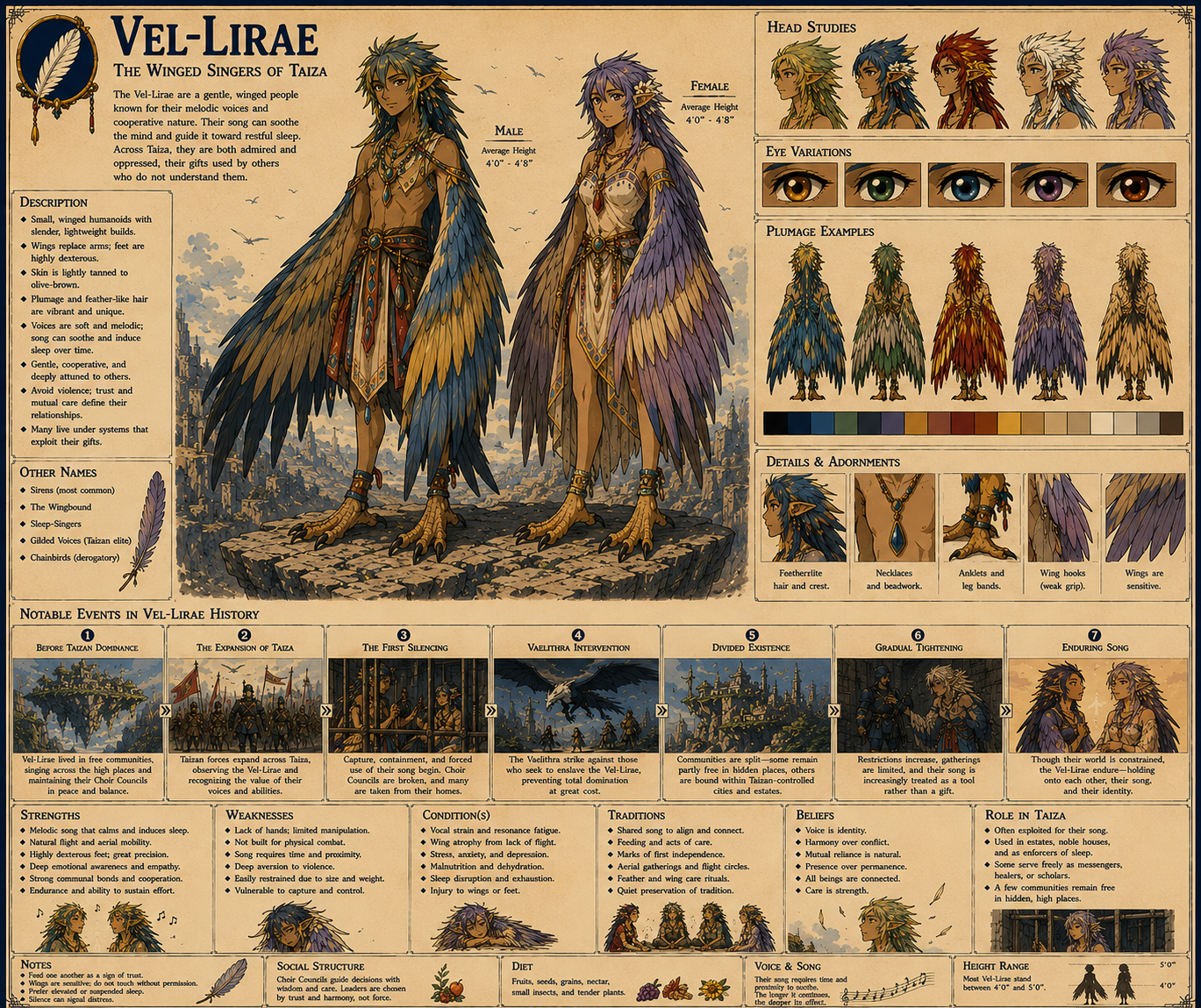
A typical Vel-Lirae is a small, winged humanoid standing between four and five feet tall, with a slender, lightweight frame built for balance and controlled movement. Their wings replace traditional arms, folding naturally along the body when at rest, while their highly dexterous feet handle nearly all interaction with the world around them. Their skin carries warm tones—lightly tanned to olive-brown—contrasted by vibrant, individually unique plumage and soft, feather-like hair that moves gently with air and motion. Their face is open and expressive, their eyes attentive and clear, often giving the impression that they are always listening.
Their voice is their most defining feature. Even in ordinary speech, it carries a soft, melodic quality, but when they sing, it becomes something deeper—structured, sustained, and capable of gradually calming those who hear it. This ability is not immediate, requiring time and proximity to take effect, but when allowed to continue, it can guide others into a state of stillness and eventual sleep.
In behavior, the Vel-Lirae are gentle, cooperative, and deeply attuned to those around them. They rely on one another naturally, offering and accepting help without hesitation, and often express trust through small, physical acts such as feeding or assisting one another. They avoid conflict whenever possible, not out of fear, but because violence feels fundamentally wrong to them.
Within Taiza, this nature places them at a disadvantage. Many live under systems that treat them as resources rather than people, their abilities controlled and their autonomy limited. Even so, they endure—maintaining quiet bonds, shared habits, and fragments of their identity wherever they can. A Vel-Lirae may appear soft, even fragile, but they are not easily erased. Their strength lies not in force, but in persistence, connection, and the quiet refusal to become something they are not.
Sirens (most common external name)
The Wingbound
Sleep-Singers
Gilded Voices (Taizan elite)
Chainbirds (derogatory)
Looks
The Vel-Lirae possess a slender, lightweight frame shaped almost entirely by the demands of flight and balance. Their bodies are elongated rather than broad, with narrow shoulders that transition smoothly into their wing structure, creating a continuous, flowing silhouette rather than a sharply defined upper body. A long torso and well-developed core provide the stability necessary for controlled aerial movement, allowing them to maintain balance both in flight and while perched.
Their lower bodies are light and efficient, typically adopting either a slightly digitigrade or lightly lifted stance depending on individual variation, though never to the degree seen in more heavily adapted avian species. Their overall build favors endurance and sustained motion over bursts of power, giving them a graceful, almost drifting quality when they move.
They are not fragile—but they are not built for direct physical confrontation. Their strength lies in control, positioning, and presence rather than force, and their bodies reflect a life shaped around avoidance of harm rather than the ability to deliver it.
Wings (Arms) – How do they function?
The Vel-Lirae possess fully developed wings in place of traditional arms, extending from the shoulders and forming the dominant structure of their upper body. These wings are strong enough for sustained gliding and controlled flight, with primary feathers capable of generating lift and maintaining aerial stability over distance.
Along the leading edge of the wing, small hook-like joints are present, offering limited gripping capability. These hooks can be used to catch, brace, or hold objects in a restrained manner, but they lack the range, strength, and precision required for consistent fine manipulation. While useful in specific situations, they are not the Vel-Lirae’s primary means of interacting with the world.
Instead, the Vel-Lirae rely heavily on their feet.
Their lower limbs are highly dexterous, with flexible, grasping toes capable of delicate and controlled movement. Through practice and necessity, they develop remarkable precision in their feet, allowing them to perform tasks that would typically require hands—handling tools, preparing food, securing garments, and interacting with their environment with a level of control that offsets the limitations of their wings.
This reliance shapes nearly every aspect of their lives. Tasks are performed from seated, perched, or grounded positions that allow access to objects below them, and tools are designed to be stable, accessible, and usable without the need for upper limb manipulation. Activities that require sustained handling or fine control are slower and more deliberate, often benefiting from cooperation or specialized environments.
As a result, Vel-Lirae culture is built around adaptation rather than substitution. They do not attempt to replicate hand-based function through their wings, but instead structure their world in a way that allows their bodies to function as they are.
The Vel-Lirae display a combination of exposed skin, feathered features, and soft, feather-like hair, creating a layered and visually distinctive appearance. Their exposed skin—most visible across the face, neck, torso, and upper portions of the legs—is typically found within the same tonal range as the Taizan populations, most commonly falling between lightly tanned and olive-brown hues. These tones often carry a warm undertone, shaped by the same environmental conditions that influence much of Taiza’s peoples.
Their skin is generally smooth and unmarked, with a natural softness that contrasts with the more structured elements of their form. Subtle variation exists between individuals, with some leaning toward lighter sun-touched tones while others present deeper, richer olive-brown coloration, but these differences remain within a relatively consistent range.
In contrast, their feathers provide the greatest visual distinction. Wing plumage is often bright and expressive, featuring a wide range of colors such as soft golds, sky-blues, greens, warm reds, and occasional iridescent tones that shift slightly in changing light. These colors tend to feel natural rather than artificial, blending in gradients or gentle patterning rather than stark segmentation.
Their hair is a notable feature in itself, appearing as a soft, feather-like structure rather than true strands. It retains the general shape and flow of humanoid hair, but with a finer, lighter texture that reflects its avian nature. This hair often mirrors or complements the coloration of their feathers, sometimes appearing slightly muted in comparison, or carrying softer versions of the same tones. In motion, it responds more like light plumage than dense hair, catching air and movement with subtle lift and flow.
Together, these elements create a cohesive visual identity—warm, grounded skin tones set against vibrant, airy feathering and softly structured hair—marking the Vel-Lirae as both part of Taiza and distinctly separate from it.
The Vel-Lirae are a notably small people, with most individuals standing between approximately 4 and 5 feet in height at full extension. Their stature is compact and lightweight, shaped by a body built for balance, flight, and controlled movement rather than physical dominance.
Their height is consistent across the population, with only minor variation between individuals. Even those considered tall among the Vel-Lirae rarely exceed this range, giving them a relatively uniform silhouette when compared to many other peoples of Taiza.
This smaller stature is further emphasized by their proportions. Their bodies are slender and lightly built, with narrow torsos and reduced mass that support efficient movement both in the air and on the ground. When at rest, they often appear even smaller due to posture, frequently settling into perched or grounded positions that draw their form inward rather than outward.
Despite their size, they do not feel frail. Their movements are controlled and deliberate, and their bodies are well-suited to their environment. However, when placed beside larger peoples—particularly the Vaelithra—the difference is immediately apparent, reinforcing the physical disparity that defines much of their interaction with the world around them.
Despite their already small stature, the Vel-Lirae are noticeably lighter than they appear. Most individuals fall within a range of approximately 60 to 110 pounds, with even the tallest among them rarely exceeding this by any significant margin.
This reduced weight is a direct result of their avian-adapted physiology. Their bodies are built around efficient mass distribution, lighter skeletal structures, and lean musculature optimized for balance and sustained aerial movement rather than strength. As a result, their physical presence often creates a subtle dissonance—when lifted, supported, or carried, they feel far lighter than their form would suggest.
Their lightness does not imply fragility. While not suited for direct physical conflict, their bodies are resilient in the ways that matter to them—capable of withstanding the demands of flight, landing, and constant repositioning. Their strength lies in control and endurance rather than force, and their weight reflects that purpose.
In practical terms, this makes them easier to support or handle when necessary, but also more vulnerable in situations where physical resistance would otherwise be possible. Like much of their physiology, their weight is both an adaptation—and a limitation—shaped by the demands of how they live.
The Vel-Lirae are immediately recognizable, not for any single defining trait, but for the cohesion of their form—every aspect of their body shaped by flight, voice, and adaptation to a world not built for them. Their most defining feature is the complete absence of traditional arms, replaced instead by fully developed wings extending from the shoulders. These wings are both powerful and expressive, capable of sustained flight and subtle motion, and are rarely held completely still. Along the leading edge of the wing, small hook-like joints are present, offering limited grip, though these are secondary to their primary method of interaction.
Their feet are highly dexterous and serve as their primary means of manipulation. Flexible, grasping toes allow for a surprising degree of precision, enabling them to handle tools, secure garments, and interact with their environment with practiced control. This reliance shapes how they move through the world—perching, grounding themselves, or positioning objects within reach rather than reaching outward.
Their faces are soft in structure but highly expressive, with emotion carried through the mouth, jaw, and subtle facial movement. Their eyes are large and clear, often appearing bright or reflective, and unlike the Vaelithra, they convey emotion openly. However, their gaze tends to linger, not out of intensity, but attentiveness—giving the impression that they are always listening, even when silent.
Their hair is a distinctive blend between human and avian traits, appearing as soft, feather-like strands that hold shape while remaining light and responsive to movement. It often mirrors or complements their plumage, though usually in more muted or softened tones. Around the shoulders and upper back, fine transitional feathering blends into the larger wing structure, creating a natural gradient between body and wing rather than a harsh divide.
Their plumage is one of their most visually striking features. Wings are often brightly colored, displaying soft gradients, layered tones, or gentle patterning that shifts subtly in different lighting. Unlike more aggressive displays seen in other avian species, Vel-Lirae coloration tends to feel harmonious rather than bold—visually present, but not overwhelming. Individual variation is high, and no two Vel-Lirae share the exact same arrangement of color or pattern.
Perhaps most notable, however, is something less immediately visible—their voice. Even in ordinary speech, Vel-Lirae voices carry a soft, melodic quality, with a natural cadence that feels almost musical. When singing, this quality deepens into something more profound. Their voices do not simply produce sound, but resonance—layered, controlled, and capable of affecting those who hear it over time. There is often a subtle physical sensation associated with it, as though the sound is felt as much as heard, settling gently rather than striking sharply.
A less obvious but consistent trait is their tendency toward stillness when focused. When listening or singing, Vel-Lirae often become very quiet in body, wings held close or slightly open, posture steady. This stillness is not rigid, but intentional, creating a sense of calm presence that contrasts with the constant motion of their feathers and hair.
Taken together, the Vel-Lirae present a form that feels cohesive and deliberate—soft where others are harsh, expressive where others are restrained, and defined as much by what they do not have as by how completely they have adapted to it.
While the Vel-Lirae share a highly consistent core body structure, there is meaningful variation in their outward appearance, particularly in plumage, coloration, and secondary physical traits. Despite this, their overall silhouette remains uniform enough that individuals are always immediately recognizable as Vel-Lirae.
One of the most notable aspects of their variance lies in plumage, where no two individuals display the exact same arrangement of color or pattern. Wing feathers range across a wide spectrum of tones—soft golds, sky-blues, greens, warm reds, and occasional iridescent hues—often layered in gradients or subtle patterning rather than sharp contrast. Tail and secondary feathering may carry more intricate variations, with slight shifts in tone, density, or flow that give each individual a distinct visual identity without disrupting the overall harmony of their appearance.
Sex-based differences exist, though they are more nuanced than in many other peoples. Both males and females share the same general body shape—slender, lightly built, and softly contoured—resulting in a naturally androgynous or gently feminine presentation across the species. Males, however, tend to display more vibrant and saturated plumage, with stronger coloration and more pronounced visual presence in their wings and feathering. In contrast, females typically exhibit slightly softer or more muted tones, though still well within the broader range of Vel-Lirae coloration.
The most consistent structural distinction is found in the chest. Females develop modest but clearly defined breasts, while males lack this feature entirely, maintaining a flatter torso. Beyond this, differences in build are minimal, with both sexes remaining similar in height, weight, and overall proportion.
Additional variation can be seen in hair texture and length, though all Vel-Lirae share the same feather-like quality. Some individuals display shorter, denser feather-hair that sits close to the head, while others have longer, softer growth that moves more freely with air currents. These differences often mirror or complement plumage coloration, further reinforcing individual identity.
Minor variation also appears in facial structure, feather density, and the shape or spread of wing and tail feathers. Some individuals may have broader wings suited for steadier flight, while others possess slightly narrower profiles that favor maneuverability, though these differences remain subtle and do not significantly alter capability.
Taken together, Vel-Lirae variation emphasizes individuality without breaking cohesion. Each person is visually distinct—defined by their coloration, feathering, and subtle structural differences—yet all remain clearly part of the same people, unified by form, movement, and presence.
Vel-Lirae clothing is shaped by two primary factors: their lack of traditional arms and their need to keep their wings fully unobstructed. As a result, their garments are simple in structure, relying on draping, wrapping, and secure placement rather than fitted construction or complex fastening.
In their traditional form, Vel-Lirae clothing consists of light, flexible fabrics draped over the body and secured at the waist, most commonly with a tie, cord, or wrap that holds the garment in place without requiring adjustment. These garments are designed to fall naturally along the body, allowing for full range of motion in the wings while remaining stable during movement and flight. The overall shape is often loose and flowing, adapting to the body rather than shaping it.
Because of their reliance on their feet for manipulation, clothing is made to be easy to put on, remove, and maintain without fine upper-limb control. This favors open designs, minimal layering, and materials that do not easily tangle or shift out of place. Garments are typically arranged from a seated or grounded position, with movements that allow the Vel-Lirae to guide fabric into place using balance and lower-limb dexterity.
Traditionally, the Vel-Lirae place little emphasis on modesty. Their clothing is worn for comfort, practicality, and environmental protection rather than concealment, and exposed skin is not culturally significant in the way it is for many other peoples. Coverage is often minimal, especially in environments where temperature and safety allow.
However, this has begun to change under the influence of Taiza.
As the Vel-Lirae are increasingly forced to interact with or exist within Taizan-controlled spaces, modesty standards are often imposed externally. This has led to the adoption of additional coverage in certain contexts, particularly across the chest and lower body, though these additions are typically pragmatic rather than cultural in origin. Even in these cases, Vel-Lirae garments retain their fundamental design—draped, tied, and non-restrictive—rather than shifting toward fully structured attire.
Decoration, when present, tends to be lightweight and integrated into the fabric itself. Subtle dyes, woven patterns, and soft ornamentation are more common than heavy adornment, as excess weight or rigid structure interferes with flight and comfort. Personal expression is often found in color choice and fabric arrangement rather than in complex accessories.
Overall, Vel-Lirae clothing reflects a people who adapted their environment to their form rather than forcing their form into rigid structure—prioritizing ease, movement, and function above all else, even as outside pressures begin to alter how that expression is seen and shaped.
Traits
The Vel-Lirae possess a unique combination of traits centered around control, endurance, and adaptation rather than force. Their most defining strength lies in their resonant vocal ability, a magical form of sustained singing capable of calming those who hear it and gradually guiding them into sleep. While this effect is not immediate and requires continuous exposure to take hold, it is highly effective in controlled environments, allowing the Vel-Lirae to de-escalate tension, stabilize emotional states, and influence situations over time without direct confrontation. This is supported by their natural flight mobility, as their fully developed wings grant them reliable aerial movement, enabling repositioning, escape, and access to spaces that many ground-bound peoples cannot easily reach. Despite lacking traditional hands, they compensate through exceptional foot dexterity, using flexible, highly controlled movements to manipulate tools, secure garments, and interact with their environment with practiced precision. Alongside their physical adaptations, the Vel-Lirae possess a high degree of emotional awareness, allowing them to read and respond to the emotional states of others with subtlety and care, often maintaining cohesion in situations that might otherwise become unstable. Their strong communal cohesion further reinforces this, as their dependence on one another has created tightly bonded social structures built on trust, cooperation, and shared responsibility. Finally, their bodies and temperaments are well-suited to endurance, favoring sustained effort over bursts of intensity. Whether maintaining their song, enduring difficult conditions, or supporting others over extended periods, the Vel-Lirae excel not through force, but through persistence, control, and the ability to adapt their strengths to the world around them.
The Vel-Lirae are defined as much by their limitations as by their strengths, with many of their weaknesses stemming directly from the same traits that shape their identity. Most notably, they lack traditional arms and hands, relying instead on limited wing-hooks and highly dexterous feet. While they have adapted to this over time, it still imposes a significant restriction on independence, particularly in unfamiliar environments or situations requiring speed, strength, or complex manipulation. Physically, they are not built for direct confrontation. Their bodies are light, optimized for flight and balance rather than force, leaving them at a severe disadvantage against most other peoples of Taiza in any form of close combat. Their primary defensive ability—their resonant song—is also limited by its nature. It requires sustained, uninterrupted singing and close enough proximity to affect others, making it ineffective against immediate threats, ranged attacks, or enemies who can disrupt or avoid exposure. This creates a critical vulnerability in fast-moving or chaotic situations where there is no time for the effect to take hold. Compounding this is their deep cultural aversion to violence. The Vel-Lirae do not merely avoid conflict—they struggle to engage in harm even when necessary, often defaulting to withdrawal, endurance, or de-escalation rather than resistance. This makes organized defense difficult and leaves them heavily reliant on positioning, environment, or the protection of others. Their light weight and small stature, while beneficial for flight, also make them easier to restrain or overpower once physically engaged. In a place like Taiza, where systems of control are structured and enforced, these traits combine to make the Vel-Lirae particularly vulnerable to capture, confinement, and long-term subjugation. Their strengths allow them to endure—but rarely to prevent the conditions that force them to do so.
The Vel-Lirae live under a constant intersection of physical limitation, environmental pressure, and imposed control, with each of these factors reinforcing the others. Their bodies, while well-adapted for flight and sustained motion, are not suited for confinement, restriction, or forced inactivity. As a result, many of the conditions that affect them most severely are not diseases in the traditional sense, but outcomes of being placed in environments that directly oppose their natural state.
Their reliance on sustained vocal ability also creates a unique vulnerability. Their voice is not simply a means of communication, but a core part of their physiology and identity. When it is strained, suppressed, or forcibly overused, the effects are not limited to physical discomfort, but can extend into emotional and psychological instability. Similarly, their dependence on mobility—both aerial and positional—means that restriction of movement can have compounding effects on both body and mind.
Within Taiza, these pressures are intensified. Systems of control often limit movement, dictate vocal use, and place the Vel-Lirae into roles that conflict with their natural rhythms. Over time, this results in a range of recurring conditions, many of which are widely recognized among both the Vel-Lirae themselves and those who interact with them regularly.
Common Conditions
Vocal Strain
Caused by prolonged or forced singing, especially when required to maintain their resonant ability beyond safe limits. Symptoms include loss of vocal clarity, pain, reduced effectiveness of their song, and eventual temporary or permanent voice loss.
Resonance Fatigue
A deeper form of exhaustion tied specifically to overuse of their magical vocal ability. This can result in full-body fatigue, disorientation, difficulty maintaining tone, and in severe cases, an inability to produce resonant effects at all.
Wing Atrophy
Occurs when flight is restricted for extended periods. Musculature weakens, feathers degrade, and overall aerial capability diminishes. Recovery is possible but often slow and difficult without consistent movement.
Perch Deprivation
A condition resulting from the inability to rest in elevated or natural positions. Leads to discomfort, poor sleep, balance issues, and long-term physical strain due to unnatural resting postures.
Constraint Stress
Psychological and physical stress caused by confinement or restricted movement. Manifests as agitation, withdrawal, loss of coordination, and in some cases panic responses.
Silencing
A condition where an individual loses the will or ability to sing, often due to prolonged oppression, trauma, or forced misuse of their voice. This is considered one of the most severe conditions among the Vel-Lirae, as it represents both a physical and cultural loss.
Dependency Degradation
Develops when trust-based interactions are consistently violated or replaced with forced reliance. Leads to difficulty forming bonds, hesitation in accepting help, and breakdown of communal behavior.
Culture
Vel-Lirae traditions are rooted in connection, trust, and the shared experience of voice. Their customs are not built around dominance, status, or display, but around reinforcement of community and the careful maintenance of bonds that are both emotional and functional. Many of their traditions developed from necessity, but over time became deeply meaningful expressions of identity.
Central to nearly all Vel-Lirae tradition is shared presence—being physically close, engaged, and attentive to one another. Because their lives depend on cooperation and mutual reliance, their rituals emphasize trust not as an abstract concept, but as something demonstrated through action.
One of the most defining traditions is the act of shared song. Groups of Vel-Lirae will gather to sing together, not to produce a performance, but to align tone, breath, and rhythm. These gatherings are often quiet and sustained, with individuals joining or leaving naturally, creating a continuous flow rather than a fixed beginning or end. The purpose is not to induce sleep, but to reinforce harmony within the group—emotionally and socially. Participation is not required, but presence is always acknowledged.
Another important tradition centers around acts of care. Because many everyday tasks require assistance, the act of helping another—feeding, securing clothing, tending to feathers or wings—is treated as something meaningful rather than routine. In traditional settings, these actions are often performed in structured or ritualized ways, particularly during times of stress, recovery, or transition. To accept such care is as important as to give it, reinforcing mutual trust.
Vel-Lirae also maintain traditions tied to first independence. As individuals grow, there is a gradual transition where they learn to manage tasks on their own using their feet and environment. This is often marked quietly rather than ceremonially, acknowledged through subtle changes in how others interact with them—less direct assistance, more shared responsibility. It is not a moment of separation, but of integration into the broader community.
In environments where they are free, Vel-Lirae often engage in aerial gatherings, where groups take to the air together in coordinated but informal movement. These are not displays of skill for competition, but expressions of presence and freedom, reinforcing both individual capability and collective awareness.
However, within Taiza, many of these traditions are disrupted, altered, or suppressed. Shared song is often restricted or repurposed, acts of care are stripped of choice, and communal gatherings are limited or controlled. Even so, Vel-Lirae continue to preserve fragments of these traditions where they can—quietly, subtly, and often without outward acknowledgment.
In this way, their traditions endure not through visibility, but through persistence—maintained in small acts, shared moments, and the continued choice to remain connected, even in conditions that seek to break that connection.
Vel-Lirae beliefs are not structured around rigid doctrine, formal religion, or centralized authority, but instead arise from shared experience, natural limitation, and the role their voice plays in their existence. Their worldview is shaped less by abstract philosophy and more by lived truth—what they can feel, sustain, and rely on.
At the center of their beliefs is the idea that voice is identity. To the Vel-Lirae, a voice is not simply a tool for communication, but a reflection of the self—carrying emotion, intent, and presence in a way that cannot be separated from the individual. To silence a voice is not just to quiet someone, but to diminish them. Because of this, they place deep importance on how voice is used, valuing sincerity, restraint, and clarity over volume or force.
Closely tied to this is their understanding of harmony. Harmony, to the Vel-Lirae, is not limited to music, but extends to relationships, environments, and interactions. A balanced state—between individuals, within a group, or even within oneself—is considered ideal. Conflict is not viewed as something to be won, but something to be resolved or allowed to settle naturally. This belief reinforces their aversion to violence, as force is seen as something that disrupts rather than restores balance.
They also hold a strong belief in mutual reliance. Independence, as it is understood by many other peoples, is not a central value. Instead, the Vel-Lirae believe that beings are meant to exist in connection with one another, supporting where others cannot act. This is not seen as dependency in a negative sense, but as a natural state of shared existence. To refuse help when it is needed, or to deny it when it can be given, is often viewed as a form of imbalance.
Another key belief is the importance of presence over permanence. The Vel-Lirae do not place strong emphasis on legacy, conquest, or lasting marks upon the world. Instead, they value the immediate moment—what is felt, shared, and maintained in the present. Their traditions and interactions reflect this, focusing on continuity of experience rather than preservation of monuments or history.
Within Taiza, these beliefs are often challenged but not erased. Systems of control attempt to redefine voice as a function, harmony as compliance, and reliance as weakness. While some Vel-Lirae internalize these distortions over time, many continue to hold to their original understanding, even if only in small, quiet ways.
In this sense, Vel-Lirae belief is not something that must be taught or enforced—it is something that persists, even under pressure, carried in the way they speak, the way they listen, and the way they choose to remain connected to one another.
The Vel-Lirae have never followed a rigid or hierarchical system of governance in the traditional sense. Instead, their society was historically organized through a structure known as the Choir Council—a communal form of leadership built on shared voice, consensus, and collective presence rather than authority or command.
Before the expansion of Taizan control, Choir Councils were formed within Vel-Lirae communities as needed, composed of individuals recognized for their steadiness, clarity of thought, and ability to maintain harmony within a group. These were not permanent positions of power, but roles assumed through trust and relinquished when no longer needed. Decisions were not issued from above, but reached through extended discussion, often accompanied by shared vocal alignment—where tone, cadence, and presence carried as much weight as spoken words.
There was no singular ruler, no fixed governing body, and no concept of dominance within leadership. Authority, where it existed, was situational and rooted in the ability to guide rather than direct.
This structure, however, does not translate easily into the realities of Taiza.
Under Taizan expansion, the Vel-Lirae have not been fully subsumed into the broader system of indenture, largely due to the continued presence and intervention of the Vaelithra. This has allowed portions of their societal structure to persist—but not without strain.
Choir Councils still exist where they can, particularly in areas where Vel-Lirae communities retain some degree of autonomy. However, their ability to function has become increasingly limited. Movement restrictions, population fragmentation, and external oversight all interfere with the formation and continuity of these councils. What was once fluid and naturally occurring now requires careful coordination, discretion, and, in some cases, concealment.
In Taizan-controlled spaces, Vel-Lirae are often subject to imposed authority structures that disregard their traditional systems entirely. In these environments, the Choir Council holds no recognized power, and its influence is reduced to quiet guidance among individuals rather than community-wide decision-making.
As a result, Vel-Lirae governance now exists in two overlapping states:
One remembered and maintained where possible—communal, adaptive, and based in shared understanding.
The other imposed—structured, external, and enforced through control rather than consensus.
Each year, the balance between these states becomes more difficult to sustain. Yet despite this, the Vel-Lirae continue to preserve the Choir Council in whatever form they can—sometimes openly, more often quietly—holding onto a system that defines not just how they govern, but how they understand themselves as a people.
Vel-Lirae technology is defined not by advancement in the conventional sense, but by adaptation. Their tools, structures, and methods are designed to work with their anatomy rather than compensate for it, resulting in systems that prioritize accessibility, stability, and ease of use over complexity or scale.
In their traditional state, Vel-Lirae technology centers around environmental integration. Their structures are built into existing terrain—cliffsides, high canyons, and elevated natural formations—minimizing the need for heavy construction or reshaping of the land. Living spaces are arranged around perches, suspended platforms, and stable surfaces positioned for easy access by foot. Materials are typically lightweight and flexible, favoring woven fibers, treated fabrics, and interlocking frameworks that can be maintained without the need for fine hand-based manipulation.
Their tools follow similar principles. Most are designed to be used with the feet or secured in place so that interaction requires minimal grip adjustment. Objects are often stabilized before use rather than held, allowing the Vel-Lirae to work through positioning and control instead of force. This results in tools that are simple in appearance but highly functional within the context of their design.
One of the most distinctive aspects of Vel-Lirae technology lies in their use of acoustic design. While not always recognized as “technology” by other peoples, the Vel-Lirae deliberately shape spaces to carry, soften, or sustain sound. Surfaces, spacing, and materials are arranged to support vocal resonance, allowing their voices to travel more effectively or maintain clarity over distance. In communal areas, this creates environments where multiple voices can overlap without distortion, reinforcing their reliance on shared sound and communication.
However, within Taiza, Vel-Lirae access to their own technological practices is often limited.
In Taizan-controlled environments, they are typically restricted from maintaining or constructing their traditional spaces, and instead must operate within structures not designed for their form. This reduces their ability to function independently and forces reliance on external systems. In some cases, they are provided with adapted tools—simplified or modified for foot use—but these are often utilitarian and lack the refinement of their original designs.
They do not possess advanced weapon technology of their own, nor do they prioritize its development. Their cultural aversion to violence and reliance on their voice has historically made such pursuits unnecessary. When exposed to external technologies, particularly those of the Taizans, they may learn to use them to a limited extent, but rarely integrate them into their own practices in a meaningful way.
Overall, Vel-Lirae technology reflects a people who do not seek to dominate their environment, but to exist within it. Their innovations are quiet, precise, and deeply functional—designed not to expand power, but to maintain balance, accessibility, and continuity in a world that is rarely built with them in mind.
Vel-Lirae occupations have never been rigidly defined in the way seen among more structured or hierarchical societies. Traditionally, roles were fluid and shaped by need, ability, and circumstance rather than fixed profession. Before the expansion of Taizan control, Vel-Lirae communities organized labor around cooperation and shared responsibility, with individuals contributing where they were most capable rather than specializing in a narrow function. Common roles included foragers, gatherers, and fishers, often working in groups to compensate for their physical limitations. Others focused on crafting lightweight tools, weaving materials, or maintaining living spaces designed for foot-based interaction. Care roles were particularly prominent, with individuals tending to the needs of others—feeding, assisting, and maintaining communal well-being as a normalized and respected part of daily life. Vocal roles also existed, though not as professions in a formal sense; individuals with strong control over their voice might lead shared song, assist in calming distressed members of the community, or help maintain cohesion during times of strain.
Outside of Taizan control, these patterns still persist where Vel-Lirae retain some degree of autonomy, though often in a reduced or adapted form. Communities that remain partially free tend to operate in small, tightly connected groups, continuing to rely on cooperative labor and shared tasks. Foraging, fishing, and material gathering remain central, along with the maintenance of their specialized environments. Some Vel-Lirae also take on roles as mediators or intermediaries when interacting with other peoples, using their emotional awareness and vocal control to manage tension and maintain stability in uncertain situations. In these spaces, their occupations remain grounded in mutual support rather than external demand, though scarcity and pressure often limit the range of what they can sustain.
Within Taizan-controlled systems, however, Vel-Lirae occupations are no longer chosen—they are assigned. Their roles are determined by perceived utility, with little regard for personal inclination or traditional practice. Most are placed into positions that make direct use of their voice, such as sleep induction, emotional regulation, or controlled pacification. They are frequently used in structured environments where prolonged singing can be maintained, often under supervision or constraint. Others are assigned to roles that require minimal manipulation, such as passive presence, observation, or support within enclosed spaces where their movement can be easily managed. Some are utilized in performance settings, where their voices are valued but their autonomy is removed, reducing what was once a communal expression into a controlled function.
Even in these conditions, remnants of their original roles persist in subtle ways. Vel-Lirae continue to assist one another where possible, maintaining small acts of care and cooperation even when such actions are neither required nor acknowledged. However, the shift from shared responsibility to imposed function represents a fundamental change. Where once occupation was an extension of community, within Taiza it becomes a tool of control—defining not how they contribute, but how they are used.
The Vel-Lirae have no native economic system built around currency, ownership, or accumulation. Prior to Taizan expansion, their relationship with resources was communal and immediate—goods were gathered, created, and distributed based on need, with little distinction between production and use. Value was not stored or traded in excess, but maintained through shared access and mutual support. In this state, the concept of wealth held little meaning beyond the stability of the group itself.
In areas where Vel-Lirae communities remain outside direct Taizan control, this structure persists in a diminished but recognizable form. Resources are still shared, labor remains cooperative, and exchange with outsiders—when it occurs—is limited and situational. Goods such as gathered food, woven materials, or simple tools may be traded, along with services like mediation or controlled use of their voice. Even so, these interactions rarely develop into sustained economic systems, as the Vel-Lirae do not naturally orient themselves toward accumulation or long-term material gain.
Within Taizan-controlled systems, however, the Vel-Lirae do not function as independent economic participants.
They are instead bound within a structure of indentured servitude, which, in practice, operates as slavery under formalized rule. Their labor is assigned, their output controlled, and their value defined externally. While this system includes provisions such as the expectation of payment and the theoretical possibility of purchasing one’s freedom, these elements do not alter its fundamental nature. Vel-Lirae under indenture experience a loss of autonomy, are subject to forced labor, and exist within a framework of systemic control that governs how and where their abilities are used.
Their vocal ability, in particular, is treated as a specialized asset. They are placed into roles where their song can be directed and maintained, and their contribution is measured not by personal agency, but by usefulness within the system. Any compensation they receive is typically regulated, restricted, or insufficient to meaningfully alter their position, making the path to freedom difficult, inconsistent, and often dependent on circumstance beyond their control.
Those few who do achieve release from indenture may enter broader Taizan society as recognized individuals, gaining legal protections, citizenship, and the potential for social mobility. However, this transition is rare, and does not reflect the reality experienced by the majority of Vel-Lirae.
Even within controlled environments, fragments of their original economic behavior persist. Small acts of sharing—food, materials, assistance—continue quietly among them, often without acknowledgment or permission. These exchanges are not transactional, but relational, reflecting a system that was never built around ownership to begin with.
As a result, Vel-Lirae economics exist across three overlapping states: a communal system rooted in shared survival, a diminished form maintained in partial freedom, and an imposed structure in which they are not participants, but assets—valued, controlled, and, in some cases, expendable within a system that defines them by what they provide rather than what they possess.
The Vel-Lirae favor foods that align with both their physiology and their communal way of life—light, manageable, and easy to handle with their feet. Because they lack traditional hands, their diet naturally leans toward items that can be grasped, torn, or consumed without complex preparation. Meals are rarely hurried, often shared in close proximity, with food passed, offered, or even directly fed between individuals as an act of trust and care rather than mere convenience.
Their preferences tend toward fresh, naturally sourced foods. Fruits, soft vegetation, and small proteins make up the core of their diet, often prepared in simple ways that preserve texture and ease of handling. When cooking is involved, it is typically minimal—roasting, drying, or softening foods rather than heavily altering them. In communal settings, food is often arranged in accessible groupings, allowing individuals to perch, lean in, and eat together without the need for individual portions or utensils.
Taste also plays a role in their preferences. Vel-Lirae are drawn to foods that are subtle, layered, and balanced, rather than overwhelmingly rich or harsh. Sweetness is appreciated, especially when natural, and gentle acidity or softness of texture is favored over bitterness or toughness. Hydration is equally important, and many of their preferred foods carry natural moisture.
Within Taiza, their access to preferred foods is often limited. Those under control are fed what is provided rather than what is chosen, which can lead to nutritional imbalance or quiet dissatisfaction. Even so, when given the opportunity, Vel-Lirae will gravitate back toward the kinds of foods that suit them best—simple, shared, and easy to manage within their physical limitations.
Common Favorite Foods
Soft fruits (berries, figs, sliced melons, orchard fruits)
Clustered fruits (grapes, vine fruits, anything easily grasped and separated)
Tender greens and shoots (young leaves, soft stems)
Roasted root vegetables (softened for easier handling)
Small fish (grilled or lightly cooked, easy to pick apart)
Shellfish (prepared and opened for consumption)
Eggs (boiled or soft-cooked, highly valued)
Nuts and seeds (often cracked or prepared beforehand)
Dried fruits (lightweight and easy to store)
Honey and nectar-based foods (small portions, highly enjoyed)
Soft grains or mash-like foods (when available, especially in shared settings)
History
The history of the Vel-Lirae is not marked by conquest or expansion, but by endurance. Their notable events are defined less by victories and more by moments where their way of life was tested, altered, or nearly erased under the pressure of Taiza.
Before the rise of Taizan dominance, the Vel-Lirae existed in relatively stable communal networks, forming Choir Councils and maintaining their traditions without external interference. Their settlements, built into elevated and wind-shaped environments, allowed them to live in accordance with their nature—supported by shared labor, vocal communication, and mutual reliance. This period is remembered not as a golden age of power, but as one of continuity and balance.
This stability began to fracture with the expansion of Taizan influence.
As Taizan forces moved to bring the peoples of Taiza under their system, the Vel-Lirae were identified not as a threat, but as a resource. Their vocal ability quickly became a target of strategic value, and initial encounters shifted from observation to active attempts at control. Early conflicts did not resemble traditional warfare. Instead, they were marked by capture, containment, and forced application of Vel-Lirae abilities. Entire groups were displaced, separated, or absorbed into the growing structure of indentured servitude.
This period, often referred to among the Vel-Lirae as the First Silencing, represents the first large-scale disruption of their culture. Choir Councils were broken apart, shared song was interrupted or repurposed, and the trust-based structure of their communities was strained under imposed control. For the first time, their voice—once a symbol of identity—was used against their will.
It was during this period that the involvement of the Vaelithra became decisive.
As pressure on the Vel-Lirae increased, the Vaelithra began to intervene directly. Where Vel-Lirae could not resist, the Vaelithra disrupted. Where capture was attempted, they responded with force. This did not prevent losses—many Vel-Lirae were still taken—but it prevented complete systemic absorption. The Taizans, while capable of defeating individuals and even groups, were unable to fully consolidate control over the population as a whole.
This led to a prolonged state of instability rather than resolution.
In the generations that followed, Vel-Lirae existence became divided. Some communities remained partially free, maintaining fragments of their traditions and governance where conditions allowed. Others were fully drawn into the Taizan system, their roles defined by utility rather than identity. Movement between these states was rare and often difficult, with the possibility of freedom existing in theory but remaining inconsistent in practice.
More recently, Vel-Lirae accounts speak of a gradual tightening of control. Choir Councils have become harder to form and maintain, shared gatherings are increasingly restricted, and conditions within Taizan-controlled spaces have grown more structured. While not a singular event, this ongoing shift is widely recognized as a continuation of earlier pressures—a slow erosion rather than a decisive break.
Across all of these events, one pattern remains consistent:
The Vel-Lirae have never fully collapsed as a people—but neither have they remained unchanged.
Their history is not one of clear turning points, but of accumulation—of pressure, adaptation, loss, and persistence. Each event has reshaped them, not by replacing what they were, but by forcing it into smaller, quieter forms that continue to endure beneath the surface.
Notes
Vel-Lirae will often feed one another directly, even when it is not necessary. This is not considered intimate in the way other peoples might interpret it, but is instead a normal extension of trust and shared presence.
Personal space among the Vel-Lirae is context-dependent rather than fixed. In most situations, they maintain a comfortable distance, but during meals, rest, or communal activity, they will gather closely—sometimes to the point of physical contact—without discomfort.
Their wings are sensitive, particularly along the joints and base. Touching another Vel-Lirae’s wings without permission is considered inappropriate, even among close individuals.
Vel-Lirae rarely raise their voices in anger. When distressed, they are more likely to become quieter rather than louder, withdrawing vocally rather than escalating.
They have a tendency to tilt or angle their head while listening, often appearing to “focus” on sound rather than sight.
Vel-Lirae environments are often arranged below perch height, not at hand height. Objects are placed where they can be reached with the feet, not reached for outwardly.
When allowed to choose, Vel-Lirae prefer to sleep in elevated or lightly suspended positions, rather than fully grounded. Being forced to sleep on flat surfaces for extended periods can lead to discomfort and poor rest.
They are naturally inclined to share food and resources without explicit agreement, which can be misinterpreted as entitlement by other peoples unfamiliar with their culture.
Vel-Lirae do not typically assign strong meaning to ownership of small personal items. Objects are understood as being “in use” rather than permanently belonging to an individual unless explicitly stated otherwise.
Prolonged silence from a Vel-Lirae—especially one who would normally sing—is often recognized by others of their kind as a sign of distress or harm, even if no outward injury is visible.
They instinctively adjust their posture and positioning to keep their wings clear at all times, even in confined spaces, often without conscious thought.
When interacting with the Vaelithra, Vel-Lirae show no hesitation or misreading of their expressions, responding naturally where other peoples might struggle.
Overview
Details about this race's overview
Vel-Lirae
A typical Vel-Lirae is a small, winged humanoid standing between four and five feet tall, with a slender, lightweight frame built for balance and controlled movement. Their wings replace traditional arms, folding naturally along the body when at rest, while their highly dexterous feet handle nearly all interaction with the world around them. Their skin carries warm tones—lightly tanned to olive-brown—contrasted by vibrant, individually unique plumage and soft, feather-like hair that moves gently with air and motion. Their face is open and expressive, their eyes attentive and clear, often giving the impression that they are always listening.
Their voice is their most defining feature. Even in ordinary speech, it carries a soft, melodic quality, but when they sing, it becomes something deeper—structured, sustained, and capable of gradually calming those who hear it. This ability is not immediate, requiring time and proximity to take effect, but when allowed to continue, it can guide others into a state of stillness and eventual sleep.
In behavior, the Vel-Lirae are gentle, cooperative, and deeply attuned to those around them. They rely on one another naturally, offering and accepting help without hesitation, and often express trust through small, physical acts such as feeding or assisting one another. They avoid conflict whenever possible, not out of fear, but because violence feels fundamentally wrong to them.
Within Taiza, this nature places them at a disadvantage. Many live under systems that treat them as resources rather than people, their abilities controlled and their autonomy limited. Even so, they endure—maintaining quiet bonds, shared habits, and fragments of their identity wherever they can. A Vel-Lirae may appear soft, even fragile, but they are not easily erased. Their strength lies not in force, but in persistence, connection, and the quiet refusal to become something they are not.
Sirens (most common external name)
The Wingbound
Sleep-Singers
Gilded Voices (Taizan elite)
Chainbirds (derogatory)
Looks
Details about this race's looks
The Vel-Lirae possess a slender, lightweight frame shaped almost entirely by the demands of flight and balance. Their bodies are elongated rather than broad, with narrow shoulders that transition smoothly into their wing structure, creating a continuous, flowing silhouette rather than a sharply defined upper body. A long torso and well-developed core provide the stability necessary for controlled aerial movement, allowing them to maintain balance both in flight and while perched.
Their lower bodies are light and efficient, typically adopting either a slightly digitigrade or lightly lifted stance depending on individual variation, though never to the degree seen in more heavily adapted avian species. Their overall build favors endurance and sustained motion over bursts of power, giving them a graceful, almost drifting quality when they move.
They are not fragile—but they are not built for direct physical confrontation. Their strength lies in control, positioning, and presence rather than force, and their bodies reflect a life shaped around avoidance of harm rather than the ability to deliver it.
Wings (Arms) – How do they function?
The Vel-Lirae possess fully developed wings in place of traditional arms, extending from the shoulders and forming the dominant structure of their upper body. These wings are strong enough for sustained gliding and controlled flight, with primary feathers capable of generating lift and maintaining aerial stability over distance.
Along the leading edge of the wing, small hook-like joints are present, offering limited gripping capability. These hooks can be used to catch, brace, or hold objects in a restrained manner, but they lack the range, strength, and precision required for consistent fine manipulation. While useful in specific situations, they are not the Vel-Lirae’s primary means of interacting with the world.
Instead, the Vel-Lirae rely heavily on their feet.
Their lower limbs are highly dexterous, with flexible, grasping toes capable of delicate and controlled movement. Through practice and necessity, they develop remarkable precision in their feet, allowing them to perform tasks that would typically require hands—handling tools, preparing food, securing garments, and interacting with their environment with a level of control that offsets the limitations of their wings.
This reliance shapes nearly every aspect of their lives. Tasks are performed from seated, perched, or grounded positions that allow access to objects below them, and tools are designed to be stable, accessible, and usable without the need for upper limb manipulation. Activities that require sustained handling or fine control are slower and more deliberate, often benefiting from cooperation or specialized environments.
As a result, Vel-Lirae culture is built around adaptation rather than substitution. They do not attempt to replicate hand-based function through their wings, but instead structure their world in a way that allows their bodies to function as they are.
The Vel-Lirae display a combination of exposed skin, feathered features, and soft, feather-like hair, creating a layered and visually distinctive appearance. Their exposed skin—most visible across the face, neck, torso, and upper portions of the legs—is typically found within the same tonal range as the Taizan populations, most commonly falling between lightly tanned and olive-brown hues. These tones often carry a warm undertone, shaped by the same environmental conditions that influence much of Taiza’s peoples.
Their skin is generally smooth and unmarked, with a natural softness that contrasts with the more structured elements of their form. Subtle variation exists between individuals, with some leaning toward lighter sun-touched tones while others present deeper, richer olive-brown coloration, but these differences remain within a relatively consistent range.
In contrast, their feathers provide the greatest visual distinction. Wing plumage is often bright and expressive, featuring a wide range of colors such as soft golds, sky-blues, greens, warm reds, and occasional iridescent tones that shift slightly in changing light. These colors tend to feel natural rather than artificial, blending in gradients or gentle patterning rather than stark segmentation.
Their hair is a notable feature in itself, appearing as a soft, feather-like structure rather than true strands. It retains the general shape and flow of humanoid hair, but with a finer, lighter texture that reflects its avian nature. This hair often mirrors or complements the coloration of their feathers, sometimes appearing slightly muted in comparison, or carrying softer versions of the same tones. In motion, it responds more like light plumage than dense hair, catching air and movement with subtle lift and flow.
Together, these elements create a cohesive visual identity—warm, grounded skin tones set against vibrant, airy feathering and softly structured hair—marking the Vel-Lirae as both part of Taiza and distinctly separate from it.
The Vel-Lirae are a notably small people, with most individuals standing between approximately 4 and 5 feet in height at full extension. Their stature is compact and lightweight, shaped by a body built for balance, flight, and controlled movement rather than physical dominance.
Their height is consistent across the population, with only minor variation between individuals. Even those considered tall among the Vel-Lirae rarely exceed this range, giving them a relatively uniform silhouette when compared to many other peoples of Taiza.
This smaller stature is further emphasized by their proportions. Their bodies are slender and lightly built, with narrow torsos and reduced mass that support efficient movement both in the air and on the ground. When at rest, they often appear even smaller due to posture, frequently settling into perched or grounded positions that draw their form inward rather than outward.
Despite their size, they do not feel frail. Their movements are controlled and deliberate, and their bodies are well-suited to their environment. However, when placed beside larger peoples—particularly the Vaelithra—the difference is immediately apparent, reinforcing the physical disparity that defines much of their interaction with the world around them.
Despite their already small stature, the Vel-Lirae are noticeably lighter than they appear. Most individuals fall within a range of approximately 60 to 110 pounds, with even the tallest among them rarely exceeding this by any significant margin.
This reduced weight is a direct result of their avian-adapted physiology. Their bodies are built around efficient mass distribution, lighter skeletal structures, and lean musculature optimized for balance and sustained aerial movement rather than strength. As a result, their physical presence often creates a subtle dissonance—when lifted, supported, or carried, they feel far lighter than their form would suggest.
Their lightness does not imply fragility. While not suited for direct physical conflict, their bodies are resilient in the ways that matter to them—capable of withstanding the demands of flight, landing, and constant repositioning. Their strength lies in control and endurance rather than force, and their weight reflects that purpose.
In practical terms, this makes them easier to support or handle when necessary, but also more vulnerable in situations where physical resistance would otherwise be possible. Like much of their physiology, their weight is both an adaptation—and a limitation—shaped by the demands of how they live.
The Vel-Lirae are immediately recognizable, not for any single defining trait, but for the cohesion of their form—every aspect of their body shaped by flight, voice, and adaptation to a world not built for them. Their most defining feature is the complete absence of traditional arms, replaced instead by fully developed wings extending from the shoulders. These wings are both powerful and expressive, capable of sustained flight and subtle motion, and are rarely held completely still. Along the leading edge of the wing, small hook-like joints are present, offering limited grip, though these are secondary to their primary method of interaction.
Their feet are highly dexterous and serve as their primary means of manipulation. Flexible, grasping toes allow for a surprising degree of precision, enabling them to handle tools, secure garments, and interact with their environment with practiced control. This reliance shapes how they move through the world—perching, grounding themselves, or positioning objects within reach rather than reaching outward.
Their faces are soft in structure but highly expressive, with emotion carried through the mouth, jaw, and subtle facial movement. Their eyes are large and clear, often appearing bright or reflective, and unlike the Vaelithra, they convey emotion openly. However, their gaze tends to linger, not out of intensity, but attentiveness—giving the impression that they are always listening, even when silent.
Their hair is a distinctive blend between human and avian traits, appearing as soft, feather-like strands that hold shape while remaining light and responsive to movement. It often mirrors or complements their plumage, though usually in more muted or softened tones. Around the shoulders and upper back, fine transitional feathering blends into the larger wing structure, creating a natural gradient between body and wing rather than a harsh divide.
Their plumage is one of their most visually striking features. Wings are often brightly colored, displaying soft gradients, layered tones, or gentle patterning that shifts subtly in different lighting. Unlike more aggressive displays seen in other avian species, Vel-Lirae coloration tends to feel harmonious rather than bold—visually present, but not overwhelming. Individual variation is high, and no two Vel-Lirae share the exact same arrangement of color or pattern.
Perhaps most notable, however, is something less immediately visible—their voice. Even in ordinary speech, Vel-Lirae voices carry a soft, melodic quality, with a natural cadence that feels almost musical. When singing, this quality deepens into something more profound. Their voices do not simply produce sound, but resonance—layered, controlled, and capable of affecting those who hear it over time. There is often a subtle physical sensation associated with it, as though the sound is felt as much as heard, settling gently rather than striking sharply.
A less obvious but consistent trait is their tendency toward stillness when focused. When listening or singing, Vel-Lirae often become very quiet in body, wings held close or slightly open, posture steady. This stillness is not rigid, but intentional, creating a sense of calm presence that contrasts with the constant motion of their feathers and hair.
Taken together, the Vel-Lirae present a form that feels cohesive and deliberate—soft where others are harsh, expressive where others are restrained, and defined as much by what they do not have as by how completely they have adapted to it.
While the Vel-Lirae share a highly consistent core body structure, there is meaningful variation in their outward appearance, particularly in plumage, coloration, and secondary physical traits. Despite this, their overall silhouette remains uniform enough that individuals are always immediately recognizable as Vel-Lirae.
One of the most notable aspects of their variance lies in plumage, where no two individuals display the exact same arrangement of color or pattern. Wing feathers range across a wide spectrum of tones—soft golds, sky-blues, greens, warm reds, and occasional iridescent hues—often layered in gradients or subtle patterning rather than sharp contrast. Tail and secondary feathering may carry more intricate variations, with slight shifts in tone, density, or flow that give each individual a distinct visual identity without disrupting the overall harmony of their appearance.
Sex-based differences exist, though they are more nuanced than in many other peoples. Both males and females share the same general body shape—slender, lightly built, and softly contoured—resulting in a naturally androgynous or gently feminine presentation across the species. Males, however, tend to display more vibrant and saturated plumage, with stronger coloration and more pronounced visual presence in their wings and feathering. In contrast, females typically exhibit slightly softer or more muted tones, though still well within the broader range of Vel-Lirae coloration.
The most consistent structural distinction is found in the chest. Females develop modest but clearly defined breasts, while males lack this feature entirely, maintaining a flatter torso. Beyond this, differences in build are minimal, with both sexes remaining similar in height, weight, and overall proportion.
Additional variation can be seen in hair texture and length, though all Vel-Lirae share the same feather-like quality. Some individuals display shorter, denser feather-hair that sits close to the head, while others have longer, softer growth that moves more freely with air currents. These differences often mirror or complement plumage coloration, further reinforcing individual identity.
Minor variation also appears in facial structure, feather density, and the shape or spread of wing and tail feathers. Some individuals may have broader wings suited for steadier flight, while others possess slightly narrower profiles that favor maneuverability, though these differences remain subtle and do not significantly alter capability.
Taken together, Vel-Lirae variation emphasizes individuality without breaking cohesion. Each person is visually distinct—defined by their coloration, feathering, and subtle structural differences—yet all remain clearly part of the same people, unified by form, movement, and presence.
Vel-Lirae clothing is shaped by two primary factors: their lack of traditional arms and their need to keep their wings fully unobstructed. As a result, their garments are simple in structure, relying on draping, wrapping, and secure placement rather than fitted construction or complex fastening.
In their traditional form, Vel-Lirae clothing consists of light, flexible fabrics draped over the body and secured at the waist, most commonly with a tie, cord, or wrap that holds the garment in place without requiring adjustment. These garments are designed to fall naturally along the body, allowing for full range of motion in the wings while remaining stable during movement and flight. The overall shape is often loose and flowing, adapting to the body rather than shaping it.
Because of their reliance on their feet for manipulation, clothing is made to be easy to put on, remove, and maintain without fine upper-limb control. This favors open designs, minimal layering, and materials that do not easily tangle or shift out of place. Garments are typically arranged from a seated or grounded position, with movements that allow the Vel-Lirae to guide fabric into place using balance and lower-limb dexterity.
Traditionally, the Vel-Lirae place little emphasis on modesty. Their clothing is worn for comfort, practicality, and environmental protection rather than concealment, and exposed skin is not culturally significant in the way it is for many other peoples. Coverage is often minimal, especially in environments where temperature and safety allow.
However, this has begun to change under the influence of Taiza.
As the Vel-Lirae are increasingly forced to interact with or exist within Taizan-controlled spaces, modesty standards are often imposed externally. This has led to the adoption of additional coverage in certain contexts, particularly across the chest and lower body, though these additions are typically pragmatic rather than cultural in origin. Even in these cases, Vel-Lirae garments retain their fundamental design—draped, tied, and non-restrictive—rather than shifting toward fully structured attire.
Decoration, when present, tends to be lightweight and integrated into the fabric itself. Subtle dyes, woven patterns, and soft ornamentation are more common than heavy adornment, as excess weight or rigid structure interferes with flight and comfort. Personal expression is often found in color choice and fabric arrangement rather than in complex accessories.
Overall, Vel-Lirae clothing reflects a people who adapted their environment to their form rather than forcing their form into rigid structure—prioritizing ease, movement, and function above all else, even as outside pressures begin to alter how that expression is seen and shaped.
Traits
Details about this race's traits
The Vel-Lirae possess a unique combination of traits centered around control, endurance, and adaptation rather than force. Their most defining strength lies in their resonant vocal ability, a magical form of sustained singing capable of calming those who hear it and gradually guiding them into sleep. While this effect is not immediate and requires continuous exposure to take hold, it is highly effective in controlled environments, allowing the Vel-Lirae to de-escalate tension, stabilize emotional states, and influence situations over time without direct confrontation. This is supported by their natural flight mobility, as their fully developed wings grant them reliable aerial movement, enabling repositioning, escape, and access to spaces that many ground-bound peoples cannot easily reach. Despite lacking traditional hands, they compensate through exceptional foot dexterity, using flexible, highly controlled movements to manipulate tools, secure garments, and interact with their environment with practiced precision. Alongside their physical adaptations, the Vel-Lirae possess a high degree of emotional awareness, allowing them to read and respond to the emotional states of others with subtlety and care, often maintaining cohesion in situations that might otherwise become unstable. Their strong communal cohesion further reinforces this, as their dependence on one another has created tightly bonded social structures built on trust, cooperation, and shared responsibility. Finally, their bodies and temperaments are well-suited to endurance, favoring sustained effort over bursts of intensity. Whether maintaining their song, enduring difficult conditions, or supporting others over extended periods, the Vel-Lirae excel not through force, but through persistence, control, and the ability to adapt their strengths to the world around them.
The Vel-Lirae are defined as much by their limitations as by their strengths, with many of their weaknesses stemming directly from the same traits that shape their identity. Most notably, they lack traditional arms and hands, relying instead on limited wing-hooks and highly dexterous feet. While they have adapted to this over time, it still imposes a significant restriction on independence, particularly in unfamiliar environments or situations requiring speed, strength, or complex manipulation. Physically, they are not built for direct confrontation. Their bodies are light, optimized for flight and balance rather than force, leaving them at a severe disadvantage against most other peoples of Taiza in any form of close combat. Their primary defensive ability—their resonant song—is also limited by its nature. It requires sustained, uninterrupted singing and close enough proximity to affect others, making it ineffective against immediate threats, ranged attacks, or enemies who can disrupt or avoid exposure. This creates a critical vulnerability in fast-moving or chaotic situations where there is no time for the effect to take hold. Compounding this is their deep cultural aversion to violence. The Vel-Lirae do not merely avoid conflict—they struggle to engage in harm even when necessary, often defaulting to withdrawal, endurance, or de-escalation rather than resistance. This makes organized defense difficult and leaves them heavily reliant on positioning, environment, or the protection of others. Their light weight and small stature, while beneficial for flight, also make them easier to restrain or overpower once physically engaged. In a place like Taiza, where systems of control are structured and enforced, these traits combine to make the Vel-Lirae particularly vulnerable to capture, confinement, and long-term subjugation. Their strengths allow them to endure—but rarely to prevent the conditions that force them to do so.
The Vel-Lirae live under a constant intersection of physical limitation, environmental pressure, and imposed control, with each of these factors reinforcing the others. Their bodies, while well-adapted for flight and sustained motion, are not suited for confinement, restriction, or forced inactivity. As a result, many of the conditions that affect them most severely are not diseases in the traditional sense, but outcomes of being placed in environments that directly oppose their natural state.
Their reliance on sustained vocal ability also creates a unique vulnerability. Their voice is not simply a means of communication, but a core part of their physiology and identity. When it is strained, suppressed, or forcibly overused, the effects are not limited to physical discomfort, but can extend into emotional and psychological instability. Similarly, their dependence on mobility—both aerial and positional—means that restriction of movement can have compounding effects on both body and mind.
Within Taiza, these pressures are intensified. Systems of control often limit movement, dictate vocal use, and place the Vel-Lirae into roles that conflict with their natural rhythms. Over time, this results in a range of recurring conditions, many of which are widely recognized among both the Vel-Lirae themselves and those who interact with them regularly.
Common Conditions
Vocal Strain
Caused by prolonged or forced singing, especially when required to maintain their resonant ability beyond safe limits. Symptoms include loss of vocal clarity, pain, reduced effectiveness of their song, and eventual temporary or permanent voice loss.
Resonance Fatigue
A deeper form of exhaustion tied specifically to overuse of their magical vocal ability. This can result in full-body fatigue, disorientation, difficulty maintaining tone, and in severe cases, an inability to produce resonant effects at all.
Wing Atrophy
Occurs when flight is restricted for extended periods. Musculature weakens, feathers degrade, and overall aerial capability diminishes. Recovery is possible but often slow and difficult without consistent movement.
Perch Deprivation
A condition resulting from the inability to rest in elevated or natural positions. Leads to discomfort, poor sleep, balance issues, and long-term physical strain due to unnatural resting postures.
Constraint Stress
Psychological and physical stress caused by confinement or restricted movement. Manifests as agitation, withdrawal, loss of coordination, and in some cases panic responses.
Silencing
A condition where an individual loses the will or ability to sing, often due to prolonged oppression, trauma, or forced misuse of their voice. This is considered one of the most severe conditions among the Vel-Lirae, as it represents both a physical and cultural loss.
Dependency Degradation
Develops when trust-based interactions are consistently violated or replaced with forced reliance. Leads to difficulty forming bonds, hesitation in accepting help, and breakdown of communal behavior.
Culture
Details about this race's culture
Vel-Lirae traditions are rooted in connection, trust, and the shared experience of voice. Their customs are not built around dominance, status, or display, but around reinforcement of community and the careful maintenance of bonds that are both emotional and functional. Many of their traditions developed from necessity, but over time became deeply meaningful expressions of identity.
Central to nearly all Vel-Lirae tradition is shared presence—being physically close, engaged, and attentive to one another. Because their lives depend on cooperation and mutual reliance, their rituals emphasize trust not as an abstract concept, but as something demonstrated through action.
One of the most defining traditions is the act of shared song. Groups of Vel-Lirae will gather to sing together, not to produce a performance, but to align tone, breath, and rhythm. These gatherings are often quiet and sustained, with individuals joining or leaving naturally, creating a continuous flow rather than a fixed beginning or end. The purpose is not to induce sleep, but to reinforce harmony within the group—emotionally and socially. Participation is not required, but presence is always acknowledged.
Another important tradition centers around acts of care. Because many everyday tasks require assistance, the act of helping another—feeding, securing clothing, tending to feathers or wings—is treated as something meaningful rather than routine. In traditional settings, these actions are often performed in structured or ritualized ways, particularly during times of stress, recovery, or transition. To accept such care is as important as to give it, reinforcing mutual trust.
Vel-Lirae also maintain traditions tied to first independence. As individuals grow, there is a gradual transition where they learn to manage tasks on their own using their feet and environment. This is often marked quietly rather than ceremonially, acknowledged through subtle changes in how others interact with them—less direct assistance, more shared responsibility. It is not a moment of separation, but of integration into the broader community.
In environments where they are free, Vel-Lirae often engage in aerial gatherings, where groups take to the air together in coordinated but informal movement. These are not displays of skill for competition, but expressions of presence and freedom, reinforcing both individual capability and collective awareness.
However, within Taiza, many of these traditions are disrupted, altered, or suppressed. Shared song is often restricted or repurposed, acts of care are stripped of choice, and communal gatherings are limited or controlled. Even so, Vel-Lirae continue to preserve fragments of these traditions where they can—quietly, subtly, and often without outward acknowledgment.
In this way, their traditions endure not through visibility, but through persistence—maintained in small acts, shared moments, and the continued choice to remain connected, even in conditions that seek to break that connection.
Vel-Lirae beliefs are not structured around rigid doctrine, formal religion, or centralized authority, but instead arise from shared experience, natural limitation, and the role their voice plays in their existence. Their worldview is shaped less by abstract philosophy and more by lived truth—what they can feel, sustain, and rely on.
At the center of their beliefs is the idea that voice is identity. To the Vel-Lirae, a voice is not simply a tool for communication, but a reflection of the self—carrying emotion, intent, and presence in a way that cannot be separated from the individual. To silence a voice is not just to quiet someone, but to diminish them. Because of this, they place deep importance on how voice is used, valuing sincerity, restraint, and clarity over volume or force.
Closely tied to this is their understanding of harmony. Harmony, to the Vel-Lirae, is not limited to music, but extends to relationships, environments, and interactions. A balanced state—between individuals, within a group, or even within oneself—is considered ideal. Conflict is not viewed as something to be won, but something to be resolved or allowed to settle naturally. This belief reinforces their aversion to violence, as force is seen as something that disrupts rather than restores balance.
They also hold a strong belief in mutual reliance. Independence, as it is understood by many other peoples, is not a central value. Instead, the Vel-Lirae believe that beings are meant to exist in connection with one another, supporting where others cannot act. This is not seen as dependency in a negative sense, but as a natural state of shared existence. To refuse help when it is needed, or to deny it when it can be given, is often viewed as a form of imbalance.
Another key belief is the importance of presence over permanence. The Vel-Lirae do not place strong emphasis on legacy, conquest, or lasting marks upon the world. Instead, they value the immediate moment—what is felt, shared, and maintained in the present. Their traditions and interactions reflect this, focusing on continuity of experience rather than preservation of monuments or history.
Within Taiza, these beliefs are often challenged but not erased. Systems of control attempt to redefine voice as a function, harmony as compliance, and reliance as weakness. While some Vel-Lirae internalize these distortions over time, many continue to hold to their original understanding, even if only in small, quiet ways.
In this sense, Vel-Lirae belief is not something that must be taught or enforced—it is something that persists, even under pressure, carried in the way they speak, the way they listen, and the way they choose to remain connected to one another.
The Vel-Lirae have never followed a rigid or hierarchical system of governance in the traditional sense. Instead, their society was historically organized through a structure known as the Choir Council—a communal form of leadership built on shared voice, consensus, and collective presence rather than authority or command.
Before the expansion of Taizan control, Choir Councils were formed within Vel-Lirae communities as needed, composed of individuals recognized for their steadiness, clarity of thought, and ability to maintain harmony within a group. These were not permanent positions of power, but roles assumed through trust and relinquished when no longer needed. Decisions were not issued from above, but reached through extended discussion, often accompanied by shared vocal alignment—where tone, cadence, and presence carried as much weight as spoken words.
There was no singular ruler, no fixed governing body, and no concept of dominance within leadership. Authority, where it existed, was situational and rooted in the ability to guide rather than direct.
This structure, however, does not translate easily into the realities of Taiza.
Under Taizan expansion, the Vel-Lirae have not been fully subsumed into the broader system of indenture, largely due to the continued presence and intervention of the Vaelithra. This has allowed portions of their societal structure to persist—but not without strain.
Choir Councils still exist where they can, particularly in areas where Vel-Lirae communities retain some degree of autonomy. However, their ability to function has become increasingly limited. Movement restrictions, population fragmentation, and external oversight all interfere with the formation and continuity of these councils. What was once fluid and naturally occurring now requires careful coordination, discretion, and, in some cases, concealment.
In Taizan-controlled spaces, Vel-Lirae are often subject to imposed authority structures that disregard their traditional systems entirely. In these environments, the Choir Council holds no recognized power, and its influence is reduced to quiet guidance among individuals rather than community-wide decision-making.
As a result, Vel-Lirae governance now exists in two overlapping states:
One remembered and maintained where possible—communal, adaptive, and based in shared understanding.
The other imposed—structured, external, and enforced through control rather than consensus.
Each year, the balance between these states becomes more difficult to sustain. Yet despite this, the Vel-Lirae continue to preserve the Choir Council in whatever form they can—sometimes openly, more often quietly—holding onto a system that defines not just how they govern, but how they understand themselves as a people.
Vel-Lirae technology is defined not by advancement in the conventional sense, but by adaptation. Their tools, structures, and methods are designed to work with their anatomy rather than compensate for it, resulting in systems that prioritize accessibility, stability, and ease of use over complexity or scale.
In their traditional state, Vel-Lirae technology centers around environmental integration. Their structures are built into existing terrain—cliffsides, high canyons, and elevated natural formations—minimizing the need for heavy construction or reshaping of the land. Living spaces are arranged around perches, suspended platforms, and stable surfaces positioned for easy access by foot. Materials are typically lightweight and flexible, favoring woven fibers, treated fabrics, and interlocking frameworks that can be maintained without the need for fine hand-based manipulation.
Their tools follow similar principles. Most are designed to be used with the feet or secured in place so that interaction requires minimal grip adjustment. Objects are often stabilized before use rather than held, allowing the Vel-Lirae to work through positioning and control instead of force. This results in tools that are simple in appearance but highly functional within the context of their design.
One of the most distinctive aspects of Vel-Lirae technology lies in their use of acoustic design. While not always recognized as “technology” by other peoples, the Vel-Lirae deliberately shape spaces to carry, soften, or sustain sound. Surfaces, spacing, and materials are arranged to support vocal resonance, allowing their voices to travel more effectively or maintain clarity over distance. In communal areas, this creates environments where multiple voices can overlap without distortion, reinforcing their reliance on shared sound and communication.
However, within Taiza, Vel-Lirae access to their own technological practices is often limited.
In Taizan-controlled environments, they are typically restricted from maintaining or constructing their traditional spaces, and instead must operate within structures not designed for their form. This reduces their ability to function independently and forces reliance on external systems. In some cases, they are provided with adapted tools—simplified or modified for foot use—but these are often utilitarian and lack the refinement of their original designs.
They do not possess advanced weapon technology of their own, nor do they prioritize its development. Their cultural aversion to violence and reliance on their voice has historically made such pursuits unnecessary. When exposed to external technologies, particularly those of the Taizans, they may learn to use them to a limited extent, but rarely integrate them into their own practices in a meaningful way.
Overall, Vel-Lirae technology reflects a people who do not seek to dominate their environment, but to exist within it. Their innovations are quiet, precise, and deeply functional—designed not to expand power, but to maintain balance, accessibility, and continuity in a world that is rarely built with them in mind.
Vel-Lirae occupations have never been rigidly defined in the way seen among more structured or hierarchical societies. Traditionally, roles were fluid and shaped by need, ability, and circumstance rather than fixed profession. Before the expansion of Taizan control, Vel-Lirae communities organized labor around cooperation and shared responsibility, with individuals contributing where they were most capable rather than specializing in a narrow function. Common roles included foragers, gatherers, and fishers, often working in groups to compensate for their physical limitations. Others focused on crafting lightweight tools, weaving materials, or maintaining living spaces designed for foot-based interaction. Care roles were particularly prominent, with individuals tending to the needs of others—feeding, assisting, and maintaining communal well-being as a normalized and respected part of daily life. Vocal roles also existed, though not as professions in a formal sense; individuals with strong control over their voice might lead shared song, assist in calming distressed members of the community, or help maintain cohesion during times of strain.
Outside of Taizan control, these patterns still persist where Vel-Lirae retain some degree of autonomy, though often in a reduced or adapted form. Communities that remain partially free tend to operate in small, tightly connected groups, continuing to rely on cooperative labor and shared tasks. Foraging, fishing, and material gathering remain central, along with the maintenance of their specialized environments. Some Vel-Lirae also take on roles as mediators or intermediaries when interacting with other peoples, using their emotional awareness and vocal control to manage tension and maintain stability in uncertain situations. In these spaces, their occupations remain grounded in mutual support rather than external demand, though scarcity and pressure often limit the range of what they can sustain.
Within Taizan-controlled systems, however, Vel-Lirae occupations are no longer chosen—they are assigned. Their roles are determined by perceived utility, with little regard for personal inclination or traditional practice. Most are placed into positions that make direct use of their voice, such as sleep induction, emotional regulation, or controlled pacification. They are frequently used in structured environments where prolonged singing can be maintained, often under supervision or constraint. Others are assigned to roles that require minimal manipulation, such as passive presence, observation, or support within enclosed spaces where their movement can be easily managed. Some are utilized in performance settings, where their voices are valued but their autonomy is removed, reducing what was once a communal expression into a controlled function.
Even in these conditions, remnants of their original roles persist in subtle ways. Vel-Lirae continue to assist one another where possible, maintaining small acts of care and cooperation even when such actions are neither required nor acknowledged. However, the shift from shared responsibility to imposed function represents a fundamental change. Where once occupation was an extension of community, within Taiza it becomes a tool of control—defining not how they contribute, but how they are used.
The Vel-Lirae have no native economic system built around currency, ownership, or accumulation. Prior to Taizan expansion, their relationship with resources was communal and immediate—goods were gathered, created, and distributed based on need, with little distinction between production and use. Value was not stored or traded in excess, but maintained through shared access and mutual support. In this state, the concept of wealth held little meaning beyond the stability of the group itself.
In areas where Vel-Lirae communities remain outside direct Taizan control, this structure persists in a diminished but recognizable form. Resources are still shared, labor remains cooperative, and exchange with outsiders—when it occurs—is limited and situational. Goods such as gathered food, woven materials, or simple tools may be traded, along with services like mediation or controlled use of their voice. Even so, these interactions rarely develop into sustained economic systems, as the Vel-Lirae do not naturally orient themselves toward accumulation or long-term material gain.
Within Taizan-controlled systems, however, the Vel-Lirae do not function as independent economic participants.
They are instead bound within a structure of indentured servitude, which, in practice, operates as slavery under formalized rule. Their labor is assigned, their output controlled, and their value defined externally. While this system includes provisions such as the expectation of payment and the theoretical possibility of purchasing one’s freedom, these elements do not alter its fundamental nature. Vel-Lirae under indenture experience a loss of autonomy, are subject to forced labor, and exist within a framework of systemic control that governs how and where their abilities are used.
Their vocal ability, in particular, is treated as a specialized asset. They are placed into roles where their song can be directed and maintained, and their contribution is measured not by personal agency, but by usefulness within the system. Any compensation they receive is typically regulated, restricted, or insufficient to meaningfully alter their position, making the path to freedom difficult, inconsistent, and often dependent on circumstance beyond their control.
Those few who do achieve release from indenture may enter broader Taizan society as recognized individuals, gaining legal protections, citizenship, and the potential for social mobility. However, this transition is rare, and does not reflect the reality experienced by the majority of Vel-Lirae.
Even within controlled environments, fragments of their original economic behavior persist. Small acts of sharing—food, materials, assistance—continue quietly among them, often without acknowledgment or permission. These exchanges are not transactional, but relational, reflecting a system that was never built around ownership to begin with.
As a result, Vel-Lirae economics exist across three overlapping states: a communal system rooted in shared survival, a diminished form maintained in partial freedom, and an imposed structure in which they are not participants, but assets—valued, controlled, and, in some cases, expendable within a system that defines them by what they provide rather than what they possess.
The Vel-Lirae favor foods that align with both their physiology and their communal way of life—light, manageable, and easy to handle with their feet. Because they lack traditional hands, their diet naturally leans toward items that can be grasped, torn, or consumed without complex preparation. Meals are rarely hurried, often shared in close proximity, with food passed, offered, or even directly fed between individuals as an act of trust and care rather than mere convenience.
Their preferences tend toward fresh, naturally sourced foods. Fruits, soft vegetation, and small proteins make up the core of their diet, often prepared in simple ways that preserve texture and ease of handling. When cooking is involved, it is typically minimal—roasting, drying, or softening foods rather than heavily altering them. In communal settings, food is often arranged in accessible groupings, allowing individuals to perch, lean in, and eat together without the need for individual portions or utensils.
Taste also plays a role in their preferences. Vel-Lirae are drawn to foods that are subtle, layered, and balanced, rather than overwhelmingly rich or harsh. Sweetness is appreciated, especially when natural, and gentle acidity or softness of texture is favored over bitterness or toughness. Hydration is equally important, and many of their preferred foods carry natural moisture.
Within Taiza, their access to preferred foods is often limited. Those under control are fed what is provided rather than what is chosen, which can lead to nutritional imbalance or quiet dissatisfaction. Even so, when given the opportunity, Vel-Lirae will gravitate back toward the kinds of foods that suit them best—simple, shared, and easy to manage within their physical limitations.
Common Favorite Foods
Soft fruits (berries, figs, sliced melons, orchard fruits)
Clustered fruits (grapes, vine fruits, anything easily grasped and separated)
Tender greens and shoots (young leaves, soft stems)
Roasted root vegetables (softened for easier handling)
Small fish (grilled or lightly cooked, easy to pick apart)
Shellfish (prepared and opened for consumption)
Eggs (boiled or soft-cooked, highly valued)
Nuts and seeds (often cracked or prepared beforehand)
Dried fruits (lightweight and easy to store)
Honey and nectar-based foods (small portions, highly enjoyed)
Soft grains or mash-like foods (when available, especially in shared settings)
History
Details about this race's history
The history of the Vel-Lirae is not marked by conquest or expansion, but by endurance. Their notable events are defined less by victories and more by moments where their way of life was tested, altered, or nearly erased under the pressure of Taiza.
Before the rise of Taizan dominance, the Vel-Lirae existed in relatively stable communal networks, forming Choir Councils and maintaining their traditions without external interference. Their settlements, built into elevated and wind-shaped environments, allowed them to live in accordance with their nature—supported by shared labor, vocal communication, and mutual reliance. This period is remembered not as a golden age of power, but as one of continuity and balance.
This stability began to fracture with the expansion of Taizan influence.
As Taizan forces moved to bring the peoples of Taiza under their system, the Vel-Lirae were identified not as a threat, but as a resource. Their vocal ability quickly became a target of strategic value, and initial encounters shifted from observation to active attempts at control. Early conflicts did not resemble traditional warfare. Instead, they were marked by capture, containment, and forced application of Vel-Lirae abilities. Entire groups were displaced, separated, or absorbed into the growing structure of indentured servitude.
This period, often referred to among the Vel-Lirae as the First Silencing, represents the first large-scale disruption of their culture. Choir Councils were broken apart, shared song was interrupted or repurposed, and the trust-based structure of their communities was strained under imposed control. For the first time, their voice—once a symbol of identity—was used against their will.
It was during this period that the involvement of the Vaelithra became decisive.
As pressure on the Vel-Lirae increased, the Vaelithra began to intervene directly. Where Vel-Lirae could not resist, the Vaelithra disrupted. Where capture was attempted, they responded with force. This did not prevent losses—many Vel-Lirae were still taken—but it prevented complete systemic absorption. The Taizans, while capable of defeating individuals and even groups, were unable to fully consolidate control over the population as a whole.
This led to a prolonged state of instability rather than resolution.
In the generations that followed, Vel-Lirae existence became divided. Some communities remained partially free, maintaining fragments of their traditions and governance where conditions allowed. Others were fully drawn into the Taizan system, their roles defined by utility rather than identity. Movement between these states was rare and often difficult, with the possibility of freedom existing in theory but remaining inconsistent in practice.
More recently, Vel-Lirae accounts speak of a gradual tightening of control. Choir Councils have become harder to form and maintain, shared gatherings are increasingly restricted, and conditions within Taizan-controlled spaces have grown more structured. While not a singular event, this ongoing shift is widely recognized as a continuation of earlier pressures—a slow erosion rather than a decisive break.
Across all of these events, one pattern remains consistent:
The Vel-Lirae have never fully collapsed as a people—but neither have they remained unchanged.
Their history is not one of clear turning points, but of accumulation—of pressure, adaptation, loss, and persistence. Each event has reshaped them, not by replacing what they were, but by forcing it into smaller, quieter forms that continue to endure beneath the surface.
Notes
Details about this race's notes
Vel-Lirae will often feed one another directly, even when it is not necessary. This is not considered intimate in the way other peoples might interpret it, but is instead a normal extension of trust and shared presence.
Personal space among the Vel-Lirae is context-dependent rather than fixed. In most situations, they maintain a comfortable distance, but during meals, rest, or communal activity, they will gather closely—sometimes to the point of physical contact—without discomfort.
Their wings are sensitive, particularly along the joints and base. Touching another Vel-Lirae’s wings without permission is considered inappropriate, even among close individuals.
Vel-Lirae rarely raise their voices in anger. When distressed, they are more likely to become quieter rather than louder, withdrawing vocally rather than escalating.
They have a tendency to tilt or angle their head while listening, often appearing to “focus” on sound rather than sight.
Vel-Lirae environments are often arranged below perch height, not at hand height. Objects are placed where they can be reached with the feet, not reached for outwardly.
When allowed to choose, Vel-Lirae prefer to sleep in elevated or lightly suspended positions, rather than fully grounded. Being forced to sleep on flat surfaces for extended periods can lead to discomfort and poor rest.
They are naturally inclined to share food and resources without explicit agreement, which can be misinterpreted as entitlement by other peoples unfamiliar with their culture.
Vel-Lirae do not typically assign strong meaning to ownership of small personal items. Objects are understood as being “in use” rather than permanently belonging to an individual unless explicitly stated otherwise.
Prolonged silence from a Vel-Lirae—especially one who would normally sing—is often recognized by others of their kind as a sign of distress or harm, even if no outward injury is visible.
They instinctively adjust their posture and positioning to keep their wings clear at all times, even in confined spaces, often without conscious thought.
When interacting with the Vaelithra, Vel-Lirae show no hesitation or misreading of their expressions, responding naturally where other peoples might struggle.
Gallery
Images and visual content for this race
Associations
Other pages that reference or connect to this race
No connections yet
Start building your world by linking this race to other pages
Collections
Published collections that feature this race
Not in any collections yet
This race hasn't been published in any collections yet. Collections are curated groups of related content that help organize and showcase your world.
Tip: Collections are a great way to group related content together and share themed stories or worldbuilding elements with others.
Timelines
Timelines that reference or include this race
No timeline connections yet
This race isn't connected to any timelines yet. Timelines help organize events chronologically and show how your content fits into the broader history of your world.
Tip: Create timelines to organize important events in your world's history. Link characters, locations, and other content to specific events to build rich, interconnected narratives.
Shares
Discussion about this race
No shares yet
Be the first to start a discussion about this race by sharing it to the community stream.
Privacy & Sharing
Manage who can see and access this race
Current Status
refresh
This race is currently
Privacy Settings
Choose who can see and access this race
language Universe Privacy
This page belongs to a universe with its own privacy settings