
Categories
Dive Deeper
Page Stats
Navigation
Categories
Dive Deeper
Page Stats
Complete Details
All information about this race
Overview
Vaelithra
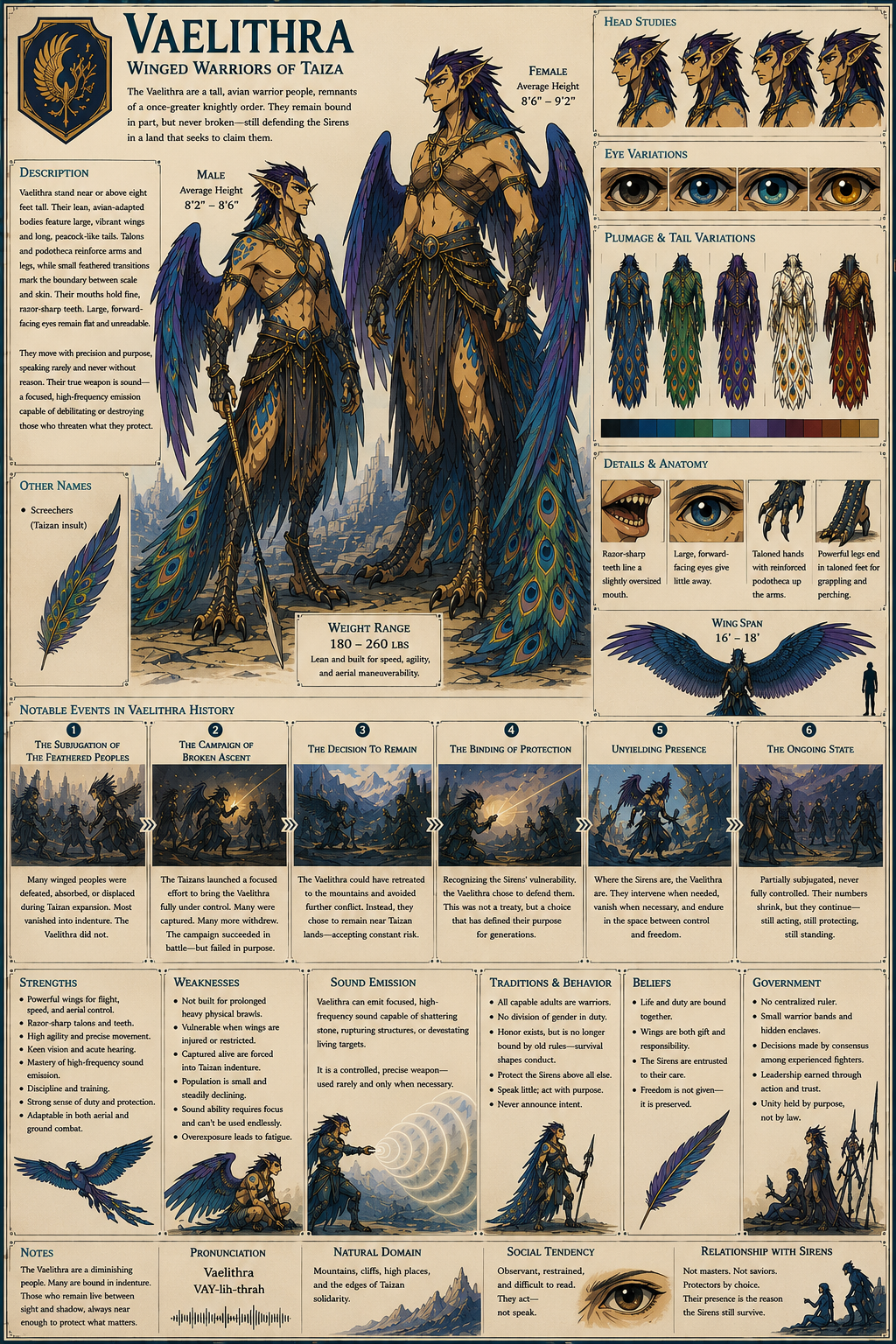
An average Vaelithra stands near or above eight feet tall, their lean, avian-adapted body built for controlled movement rather than brute force. Large, vibrant wings extend from their back, paired with a long, peacock-like tail that shifts subtly with posture and balance. Their limbs end in sharp talons, reinforced by podotheca that climbs their arms and legs, while small feathered transitions mark the boundary between scale and skin. Their exposed features—most often lightly tanned—frame a face that is immediately striking: a slightly oversized mouth lined with fine, razor-sharp teeth, and large, forward-facing eyes that remain flat and unreadable regardless of emotion. Though their eyes give little away, the rest of their face and body remain expressive through controlled motion, wing positioning, and subtle shifts in posture.
In movement, they are deliberate and efficient, rarely wasting motion, carrying their size with a precision that feels intentional rather than natural. Their voice, when used, is measured and exact, capable of reproducing language and sound with unsettling accuracy, though rarely used without purpose. Beneath that control lies the potential for their more dangerous ability—the emission of focused, high-frequency sound—held in reserve rather than displayed openly.
Behaviorally, the average Vaelithra is observant, restrained, and difficult to read at a glance. They do not seek out conflict, but they do not avoid it when it becomes necessary, particularly where the Sirens are concerned. When placed in such a situation, their hesitation disappears, replaced by immediate, decisive action. They do not posture, and they do not announce intent—they act.
They are most often found at the edges of Taizan-controlled spaces, moving carefully, remaining as long as they are able without being detected. Their presence is rarely obvious, but when it is, it is usually because something has already gone wrong.
What defines them is not dominance or visibility, but persistence. They are a people under pressure, diminished but not removed, controlled in part but never completely. An average Vaelithra is not a symbol of power, but of continuation—still present, still acting, and still standing in the space between what has already been taken and what has not yet been lost.
Screechers (Taizan insult)
Looks
The Vaelithra possess a humanoid frame heavily adapted toward avian function, combining aerial capability, precision control, and predatory efficiency into a single cohesive form. Their bodies are lean rather than bulky, built with tensile strength optimized for balance, grip, and sudden exertion instead of sustained brute force. Narrow torsos, long limbs, and low body fat give them an appearance of controlled readiness, as though every movement is intentional and nothing is wasted. Their arms retain a humanoid structure through the shoulder and upper arm, but end in raptorial talons instead of hands—fully dexterous despite their shape—capable of both delicate manipulation and violent force. These limbs are reinforced by podotheca, keratinized scaling that extends from the talons up past the forearms to just above the elbows, forming a natural armor that marks a clear transition from flesh to weapon. Their lower bodies follow a digitigrade structure, with powerful grasping talons and reinforced joints designed for landing, perching, and rapid directional shifts, with the same podotheca extending up the legs to just above the knees. From their backs extend large, fully functional wings, anchored deep into the musculature of the upper torso and supported by strong back and chest structures, making them integral to posture as much as movement; their shoulders sit slightly back, their stance open and balanced to account for constant wing presence. Behind them trails a long, peacock-like tail—dense, flexible, and actively used for balance, directional control, and subtle communication—never purely ornamental, always part of how they move. Their necks are slightly forward-set compared to humans, allowing for a controlled, predatory alignment of the head, giving the impression that they do not simply look around their environment, but directly at what draws their attention. Every aspect of the Vaelithra form is built around precision over power, control over excess, and movement over mass, resulting in a body that feels less like a variation of the humanoid shape and more like a system designed for deliberate action, aerial dominance, and restrained, purposeful force.
The Vaelithra display a combination of exposed skin and avian covering, creating a layered visual identity that blends humanoid and feathered elements. Their exposed skin—primarily found across the face, neck, upper torso, and portions of the upper limbs—is most commonly lightly to moderately tanned, reflecting the broader populations of Taiza and their shared environmental conditions. Tones tend to fall within warm ranges, from soft olive-tan to deeper sun-browned hues, often carrying a subtle dryness or weathered quality from constant exposure to open air and altitude. This skin is typically smooth but firm, with visible tension around the jaw and cheek structure due to their expressive facial movement. In contrast, the areas covered by podotheca—extending from the talons up to just above the elbows and knees—shift sharply in texture and coloration, presenting as keratinized scaling in shades of muted bone, ash-gray, dark umber, or near-black, depending on the individual. These hardened regions are matte and slightly ridged, built for durability rather than display. At the upper boundary of these scaled sections, particularly along the arms, small tufts of feathers emerge where podotheca meets skin—subtle and controlled in growth, typically extending only partway toward the shoulder. These feathered transitions soften the visual divide without obscuring it, creating a layered boundary between flesh and armor. Surrounding and framing both skin and scale are their feathers, which provide the greatest visual variation among the Vaelithra. Wing and tail plumage often exhibit vibrant, high-contrast coloration, including deep blues, iridescent greens, rich golds, stark whites, and occasional patterned gradients or eye-like markings reminiscent of peacock displays. These colors may shift subtly in different lighting, especially in individuals with more iridescent feather structures. Facial feathering is typically more restrained in color, often darker or more neutral, drawing focus to their expressions rather than overwhelming them. The overall effect is a body that transitions cleanly between soft skin, hardened scale, and vivid plumage—each serving a distinct functional and visual role, and together forming a cohesive appearance that is both striking and immediately recognizable.
The Vaelithra are a notably large people, with an average standing height of approximately 8 feet, and many individuals exceeding this with ease. This measurement does not account for the full extension of their wings or tail, both of which significantly increase their overall physical presence. Their height is not the result of bulk, but of elongated structure—long limbs, extended torso proportions, and a naturally elevated posture shaped by their wing anatomy. Even when at rest, they appear tall; when fully extended, they are imposing. Their size is further emphasized by their wingspan, which often stretches well beyond their height, and the added length of their trailing tail, creating a silhouette that dominates vertical space as much as horizontal. Despite this, their movement does not feel heavy or cumbersome. They carry their height with controlled precision, maintaining balance and awareness in a way that prevents their size from becoming a liability. Instead of appearing oversized, they feel scaled upward with intent, as though their form was designed to operate at that size rather than grow into it. To most other peoples of Taiza, standing beside a Vaelithra is an immediate reminder of difference—not just in stature, but in presence.
Despite their considerable height, the Vaelithra are surprisingly light for their size, with most individuals typically weighing between 180 and 260 pounds, though some fall slightly outside this range depending on build. Their bodies are structured around hollow-adapted bone systems, lean musculature, and efficient mass distribution, all of which prioritize aerial capability over grounded weight. As a result, an average Vaelithra, standing near or above 8 feet tall, may weigh little more than a large human, appearing far lighter than their silhouette would suggest. This reduced weight does not equate to fragility; their bodies are reinforced where necessary, particularly through podotheca and dense connective structures, allowing them to withstand the stresses of flight, landing, and sudden motion. Instead, their lightness contributes to their overall efficiency—enabling controlled lift, sustained flight, and rapid directional changes without excessive strain. To those unfamiliar with them, this creates a subtle but noticeable dissonance: they look as though they should be heavy, grounded, and imposing, yet move with a lightness that feels almost unnatural for their size.
The Vaelithra are immediately recognizable, not because of any single trait, but because of how many of their features feel slightly wrong when viewed together. Their form blends humanoid structure with avian adaptation in a way that is cohesive, but deeply unsettling to those unfamiliar with them. Their limbs end in sharp, raptorial talons rather than hands or feet, supported by podotheca—keratinized scaling that extends up their arms to just above the elbows and up their legs to just above the knees, forming natural armor that clearly marks their limbs as functional weapons. At the upper edges of these scaled regions, small tufts of feathers emerge, particularly along the arms, softening the transition between hardened scale and exposed skin without obscuring the divide. From their backs extend large, fully developed wings, vibrant in coloration and fully integrated into their musculature, while a long, peacock-like tail trails behind them, dense with layered feathers and used for balance, movement, and subtle expression.
Their faces are among their most striking and disquieting features. The mouth is larger than expected for a humanoid frame, capable of opening wider than seems necessary, and lined with fine, razor-sharp teeth designed more for tearing than chewing. Even at rest, a hint of these teeth is often visible, giving their neutral expression a predatory edge. Their eyes are large and forward-facing, but notably do not convey emotion in the way most peoples expect. They remain flat, steady, and faintly deadpan regardless of what the Vaelithra is feeling, often creating the impression that they are unimpressed, or that something has gone unnoticed rather than understood. This disconnect between expressive facial movement and unresponsive eyes produces a constant sense of misalignment for outsiders, as though the face and gaze are not fully in agreement.
Beyond their physical structure, the Vaelithra possess a defining internal feature: their ability to produce highly controlled, high-frequency sound through a resonant, magical mechanism. This is not simple vocalization, but a directed emission of sound capable of disorienting, damaging, or destabilizing targets with precision. The same underlying capability grants them exceptional control over their voices in normal speech, allowing for near-perfect mimicry of sounds, accents, and languages after minimal exposure. Despite this, they do not use mimicry carelessly, and notably refuse to replicate the voices of Sirens, treating them as something inherent and not to be imitated. In contrast, Sirens—whose own voices can induce sleep—perceive layers within Vaelithra vocalization that others cannot, reading emotional and tonal nuance where most hear only controlled sound.
Taken together, the Vaelithra are defined by a series of contrasts: soft skin against hardened scale, vibrant plumage against restrained facial coloration, expressive movement against unreadable eyes, and a voice that can either speak with precision or strike with force. None of these traits exist in isolation, and it is their combination that makes them so distinct—each reinforcing the sense that they are not simply avian humanoids, but something more deliberate, more controlled, and far less easily understood.
While the Vaelithra share a highly consistent core body structure, their outward appearance varies to such a degree that no two individuals possess the same coloration or patterning. This variance is most pronounced in their plumage, which serves as the primary source of visual identity across the species.
Wing and tail feathers display an extraordinary range of color, often combining deep, saturated tones such as storm-blue, forest green, and burnished gold with stark whites, muted grays, or near-black shades. These colors rarely appear in isolation. Instead, they layer, shift, and interact—forming gradients, banding, speckling, or eye-like patterns that differ from one individual to the next. Many Vaelithra exhibit iridescence, causing their feathers to change tone depending on light and angle, further ensuring that even similar base colors do not present identically. Tail plumage is often the most elaborate, with longer feather structures and more pronounced patterning, making it a focal point for both display and subtle communication.
This uniqueness extends beyond feathers. While exposed skin remains within the lightly to moderately tanned range common to Taiza, individual tones may lean more olive, bronze, or sun-darkened, and the contrast between skin and plumage varies widely. Facial feathering, though generally more restrained in color, often reflects elements of an individual’s broader coloration, tying the overall appearance together without overwhelming expression.
Podotheca coloration also varies, typically appearing in muted tones such as bone, ash-gray, dark umber, or black, but rarely in a perfectly uniform shade. Subtle differences in tone, texture, or faint banding patterns are common, adding another layer of individuality. The small feather tufts that mark the transition between podotheca and exposed skin further reinforce this variation, differing in density, placement, and how far they extend toward the shoulder.
Size and structure remain relatively consistent by comparison, though variation still exists. Most Vaelithra stand around 8 feet tall, with some individuals falling slightly below or rising well above this average. Differences in build are more noticeable than differences in height, with some individuals appearing more slender and flight-oriented, while others carry slightly denser musculature suited for stronger land-based movement or combat. Wing structure also shows subtle variation in span, density, and shape, influencing flight style without altering overall capability.
Despite this wide range of variation, the Vaelithra never lose their defining silhouette. Their shared structure ensures immediate recognition, while their coloration ensures complete individuality—no two presenting the same arrangement of color, pattern, or visual detail, even within the same lineage.
Vaelithra clothing is shaped by a combination of mobility, exposure, and function, resulting in attire that is typically minimal in coverage but deliberate in placement. In non-combat settings, most Vaelithra wear light coverings over the chest and groin, leaving the majority of the body unobstructed to preserve freedom of movement for both flight and ground mobility. These garments are usually secured rather than draped, designed to remain in place without interfering with wings, tail, or limb motion.
Groin coverings are particularly distinctive in design. Rather than being tightly fitted, they often extend downward between the legs in a hanging panel, which is frequently decorated with color, pattern, or personal markings. These elements can range from simple dyed cloth to more intricate designs, serving as one of the few consistent outlets for visible personal expression in everyday wear.
Outside of combat, Vaelithra commonly wrap their limbs for protection. Their taloned hands and feet, along with the podotheca along their arms and legs, are often bound in layered cloth or light wrappings, providing protection against abrasion, environmental wear, and repeated impact from perching, landing, or travel. These wrappings are practical rather than ornamental, though some individuals incorporate subtle color or pattern into them.
When preparing for battle, their appearance changes significantly. Vaelithra will equip full combat gear, including a fitted cuirass, helmet, greaves, and specialized armored gloves and talon guards designed to reinforce their natural weapons without restricting movement. This equipment is shaped to accommodate their wings and digitigrade stance, ensuring protection does not come at the cost of mobility. Armor tends to follow Taizan design principles—functional, refined, and built with both physical and runic considerations in mind.
A notable adaptation within their combat equipment is the use of modified Taizan pistols, typically integrated directly into their armored gloves. These weapons are adjusted to be fired without a traditional trigger pull, allowing the Vaelithra to discharge them through controlled motion or pressure while maintaining full use of their talons. This modification reflects both their physiology and their ability to adapt Taizan technology to suit their needs.
Overall, Vaelithra clothing is defined by restraint and purpose. In daily life, it protects without restricting. In combat, it transforms into something more complete—layered, reinforced, and fully aligned with the realities of conflict in Taiza—without ever compromising the movement and control their bodies require.
Traits
The Vaelithra excel in areas that reward control, adaptability, and precision rather than raw dominance, with their strengths defined not by overwhelming force, but by how effectively they apply what they have. Their most defining advantage is their aerial capability; with fully functional wings and bodies built for efficient movement, they possess true vertical mobility in a region where control of space is often contested, allowing them to reposition rapidly, disengage when needed, and approach from angles others cannot easily defend. This mobility is reinforced by their low body weight relative to their size, enabling sustained flight, controlled landings, and rapid directional changes that often feel disproportionate to their height. Their limbs further enhance this effectiveness, as their taloned hands and feet, reinforced by podotheca, allow them to grip surfaces and opponents with exceptional force, maintain stability in positions others could not hold, and function as natural weapons, all while retaining full dexterity for precise manipulation. Internally, they possess a powerful advantage in their resonant vocal ability, capable of emitting directed, high-frequency sound that can disrupt, disorient, or damage targets with precision, allowing them to apply force without direct contact. This same internal control extends to their voices in more conventional use, granting them exceptional mimicry and rapid language acquisition, enabling them to adapt quickly to new environments, communicate across cultures, and internalize unfamiliar behaviors with unusual speed. Their expressive control is equally refined; while their eyes remain unreadable, their faces, wings, and posture convey information clearly to those who understand them, allowing for precise communication and minimal wasted motion within their own kind. Finally, their position within Taiza gives them a situational strength few others possess, as they exist in a state of incomplete control rather than full subjugation, retaining autonomy at a population level, operating outside full integration into Taizan structures, and functioning under constant pressure without total submission. Taken together, the Vaelithra are strongest when they are able to control engagement, apply force with precision, and adapt to the situation in front of them, rather than attempting to overpower it directly.
The Vaelithra possess a number of limitations that stem directly from the same traits that make them effective, creating a balance between capability and constraint rather than a purely advantageous design. Their most immediate weakness is their reliance on lightweight structure and aerial efficiency, which comes at the cost of raw durability. While not fragile, they are not built to absorb sustained punishment, particularly in prolonged close-quarters engagements where heavier or more heavily armored opponents can outlast them. Their hollow-adapted bone structure and lean musculature favor movement and control, but leave them at a disadvantage in contests of endurance, grappling, or brute force.
Their size, while imposing, also creates challenges. Standing at or above 8 feet tall with large wings and a trailing tail, they are difficult to conceal and occupy a significant amount of physical space. In confined environments—dense structures, narrow corridors, or enclosed interiors—their mobility is restricted, limiting both their ability to maneuver and their capacity to fully utilize their wings. This forces them into engagements where their natural advantages are reduced and where more compact opponents may operate more effectively.
Their wings themselves, while a major strength, are also a vulnerability. Damage to the wings directly impacts their mobility, balance, and ability to disengage. Even minor impairment can reduce flight capability or precision, and in environments where aerial movement is limited or denied, the presence of wings becomes less of an advantage and more of a structural complication that must be worked around.
The Vaelithra’s reliance on precision extends to their internal abilities as well. Their resonant vocal capability, while powerful, is not without cost. It requires control and focus, and overuse can lead to strain, reducing effectiveness or leaving them unable to utilize it at full capacity. It is not a constant or effortless ability, and misuse can create openings rather than advantages.
Their exceptional mimicry and rapid language acquisition, while beneficial, can also contribute to a perception problem when interacting with others. Their ability to replicate voices and speech patterns, combined with their unreadable eyes, often leads to distrust or discomfort, making it more difficult to establish stable relationships with those outside their own kind or their Siren counterparts.
Perhaps most significantly within the context of Taiza, the Vaelithra lack the structural integration and scale of organization seen in the Taizan system. They are not as centralized, not as industrially supported, and do not possess the same level of coordinated military infrastructure. This limits their ability to engage in sustained, large-scale conflict, particularly against a society that has refined warfare into a structured and continuous system. While they can resist, disrupt, and endure, they are not positioned to dominate or replace that system.
Finally, their protective relationship with the Sirens introduces an inherent vulnerability. Because the Sirens are physically limited and ill-suited for direct violence, the Vaelithra must often divide attention between engagement and protection. This can restrict their tactical options, force them into unfavorable positions, or require them to prioritize defense over advantage. In a region where control is often established through decisive action, this constraint can be exploited by opponents willing to act without such considerations.
Taken together, the Vaelithra are limited not by a lack of capability, but by the boundaries of how that capability is structured. They are effective when able to move, control, and choose their engagements, but become increasingly constrained when forced into situations that demand endurance, confinement, or sustained direct confrontation.
The Vaelithra’s conditions are closely tied to the demands of flight, precision movement, and repeated strain on a lightweight but highly specialized body. Their physiology is efficient, but not forgiving—built to perform well within certain limits, and to degrade noticeably when pushed beyond them. Many of their common conditions stem from the tension between aerial capability and grounded reality, where repeated takeoff, landing, gripping, and controlled motion place stress on joints, connective tissue, and structural systems over time. Their wings, while powerful, are particularly vulnerable to overuse and injury, and even minor damage can have disproportionate effects on mobility and independence. Similarly, their reliance on talons for both locomotion and manipulation leads to wear in areas that most humanoid species do not experience in the same way. Their resonant vocal ability introduces another layer of strain, as the internal structures required to produce directed sound can be overtaxed with repeated or improper use. Combined with their size and relatively low mass, these factors result in a physiology that excels under controlled conditions but accumulates wear when subjected to sustained stress, impact, or misuse.
Common Conditions
Wing Strain and Microtearing
Repeated flight, especially under load or in poor conditions, can cause small tears in wing musculature or feather anchoring points. This leads to reduced lift, instability in flight, and increased fatigue.
Joint Stress (Shoulders, Hips, and Knees)
Frequent takeoff and landing place consistent strain on major joints. Over time, this can lead to stiffness, reduced flexibility, or chronic discomfort, particularly in individuals engaged in frequent travel or combat.
Talon Wear and Structural Damage
Because talons are used for both movement and manipulation, they are prone to chipping, cracking, or uneven wear. Improper maintenance can lead to reduced grip strength or pain during use.
Podotheca Cracking and Drying
The keratinized scaling along the limbs can dry out or develop cracks, especially in harsh environments. This can cause discomfort, reduced flexibility, and vulnerability to infection if left untreated.
Landing Impact Fatigue
Even with controlled movement, repeated high-impact landings can lead to cumulative stress in the legs and lower spine, resulting in reduced shock absorption over time.
Resonant Strain (Vocal System Overuse)
Overuse of their directed sound ability can strain internal structures, leading to reduced output, loss of precision, or temporary inability to use the ability effectively.
Respiratory Fatigue
Sustained flight or repeated use of vocal abilities can tax their respiratory system, leading to shortness of breath, reduced endurance, and slower recovery.
Feather Damage and Loss
Feathers can be damaged through combat, environment, or overuse. Loss of key flight feathers can impact balance, maneuverability, and lift until regrowth occurs.
Balance Disruption (Wing or Tail Injury)
Damage to wings or tail feathers can significantly affect balance and coordination, both in flight and on the ground, requiring compensation that can lead to further strain.
Nutritional Strain
Maintaining a large body with low mass and high energy demands requires consistent nutrition. Deficiency can quickly lead to reduced strength, endurance, and overall function.
Culture
Vaelithra traditions are defined by control, restraint, and continuity under pressure, shaped by a life lived alongside a dominant power that has never fully absorbed them. Unlike the Taizans, who structure conflict openly, or the Sairi, who preserve culture quietly within integration, the Vaelithra exist in a space where identity must be maintained without full exposure and without complete concealment. Their traditions reflect this balance—deliberate, practiced, and often subtle in execution, but deeply embedded in daily life. Among them, the voice is treated as a direct extension of the self; because of their ability to mimic with precision, individuals are expected to speak in their own voice unless there is clear purpose, avoiding unnecessary imitation, and never mimicking another Vaelithra without consent, as doing so is considered a serious breach of identity. Communication does not rely solely on sound, and extended silence is common, with posture, wing position, and tail movement carrying meaning where words are unnecessary. This becomes especially pronounced in their relationship with the Sirens, where Vaelithra align themselves with Siren vocalization, adjusting their own sound to support rather than override it, and positioning themselves physically to intercept threats; they do not mimic Siren voices under any circumstance, instead harmonizing with them in a way that reinforces without replacing. Before conflict, many Vaelithra enter a period of complete stillness, minimizing movement, controlling breath, and narrowing focus, not as ceremony, but as a practiced state of readiness rooted in control rather than reaction. Feather maintenance is a constant and practical concern, with wings and tail regularly cleaned, aligned, and kept functional, as neglect is seen not just as physical failure, but as a lapse in control. Similarly, outside of combat, they routinely wrap their talons, forearms, and lower legs in layered bindings to protect against wear and environmental strain, a repeated practice that reinforces preparedness through habit. Their clothing offers few outlets for expression, making their hanging groin coverings—often decorated with color, pattern, or personal markings—one of the primary ways individuality is displayed, carrying more visual weight than ornamentation would in other cultures. Learning itself is treated as an ongoing, observational process, with younger individuals expected to watch, replicate, and refine rather than rely on formal instruction, reinforcing their natural tendency toward mimicry and controlled adaptation. Taken together, Vaelithra traditions are built around a central principle: control defines identity, and identity must be maintained, even under constant external pressure.
Vaelithra beliefs are built around a core truth:
control is the foundation of identity—but some things must be defended without restraint
They do not reject conflict outright, nor do they embrace it in the way the Taizans do. Instead, they treat violence as something that must be measured, deliberate, and justified by purpose, rather than used as proof of self. Where Taizan belief centers on victory as validation, the Vaelithra place greater importance on what is being protected, and why the conflict exists at all.
At the center of this belief system is their relationship with the Sirens. The Sirens are not simply allies or companions—they are viewed as those who must be protected, not because they are lesser, but because they are not built for violence and should not be forced to endure it. This creates a defining contradiction within Vaelithra belief: while they value control above all else, they will abandon that restraint without hesitation if it means safeguarding the Sirens. In these moments, action is no longer measured by efficiency or outcome, but by necessity.
They do not see this as a loss of control.
They see it as the only correct use of it.
Vaelithra do not accept the Taizan idea that victory determines legitimacy. To them, defeat does not grant the victor inherent right over another. While they understand the reality of Taizan systems—and operate within or around them when necessary—they do not believe those systems are justified. This places them in quiet but constant opposition, not always through open conflict, but through refusal to fully accept the structure imposed upon them.
Their approach to identity is similarly precise. The voice is considered an extension of the self, and because of their ability to replicate sound, it is treated with strict boundaries. To speak in another’s voice without purpose is to blur identity, and to mimic a Siren is considered fundamentally unacceptable. Expression is expected to be controlled, intentional, and accurate, reflecting an internal belief that who you are must remain distinct, even when everything around you pressures you to conform.
They also place value on perception and understanding. Where others may rely on outward cues, Vaelithra are trained—both culturally and instinctively—to read beyond the obvious, to interpret movement, tone, and intent. This reinforces a worldview in which surface appearances are unreliable, and truth must be observed rather than assumed.
At their core, the Vaelithra believe that existence is not proven through dominance, but through what one chooses to preserve. They do not seek to conquer, and they do not measure themselves by how many they defeat. Instead, they define themselves by what remains under their protection, and by their willingness to stand in the path of forces that would erase it.
This belief does not make them passive.
It makes them selective—and when that line is crossed, unyielding.
The Vaelithra do not maintain a centralized government in the traditional sense. They have no unified state, no ruling council that governs all of their people, and no permanent hierarchy that mirrors the structured systems of Taiza. Instead, their organization more closely resembles a distributed order bound by shared obligation, where authority is situational, earned, and often temporary.
At the core of their structure is a system of oaths and protective responsibility. Vaelithra organize themselves around individuals, groups, or regions—most often centered on the protection of Sirens—and those who take on that responsibility are expected to act, decide, and lead within that scope. Authority is not granted through title alone, but through the ability to fulfill that role and maintain it under pressure. Those who fail to do so are not ceremonially removed—they are simply replaced by circumstance, as others step in to take on the responsibility they could not sustain.
This creates a structure that resembles a loose brotherhood or order, often compared by outsiders to a group of knights—individuals bound by shared principles rather than strict command. However, unlike idealized chivalric orders, the Vaelithra do not operate under preserved codes of honor or formalized conduct. The conditions of Taiza have forced adaptation. Their guiding principles remain, but they are applied with practical restraint rather than idealistic purity. What might once have been expressed as open chivalry is now enforced through quiet, decisive action, shaped by the need to protect rather than to appear honorable.
Leadership among the Vaelithra is therefore fluid and context-dependent. In moments of conflict, individuals with the clearest awareness, strongest control, or most relevant experience may take command, but this authority rarely persists beyond the situation that required it. Outside of immediate necessity, decisions are often made through mutual recognition rather than formal agreement, with individuals aligning based on shared understanding rather than imposed order.
Because they are not fully integrated into the Taizan system, they also lack the large-scale infrastructure required for sustained governance. They do not maintain standing armies, centralized economies, or formal territorial control in the way Taizan houses do. Instead, their presence is localized and responsive, existing where they are needed rather than where they claim ownership.
This structure has strengths and limitations. It allows them to adapt quickly, avoid full systemic control, and maintain autonomy at a population level. At the same time, it prevents them from organizing at the scale required to challenge Taizan authority directly or sustain prolonged, large-scale conflict.
At its core, Vaelithra governance is not about ruling—it is about holding responsibility where it is needed and sustaining it for as long as it can be maintained. Authority exists only so long as it is upheld through action, and when it fails, it does not collapse—it shifts.
Vaelithra technology is defined less by innovation and more by adaptation, modification, and selective use. Unlike the Taizans, who refine and produce advanced combat systems at scale, the Vaelithra do not maintain the infrastructure required for widespread technological development. Instead, they rely on what they can acquire, alter, and maintain—most often drawing from Taizan designs and reshaping them to fit their own physiology and needs.
Their most notable technological adaptations are found in weapon integration, particularly with firearms. Vaelithra commonly make use of modified Taizan pistols, which are reworked to function without traditional trigger mechanisms. These weapons are often mounted directly into or alongside armored gloves, allowing them to be fired through controlled pressure or motion rather than finger-based activation. This modification reflects both their taloned anatomy and their emphasis on maintaining full use of their limbs in combat. The result is a system that blends natural weaponry with mechanical force, allowing for seamless transitions between striking, gripping, and firing.
Beyond weapons, their use of armor is similarly adapted rather than invented. When equipped for combat, Vaelithra utilize Taizan-style armor systems, including cuirasses, helmets, greaves, and reinforced limb protection, all adjusted to accommodate wings, digitigrade legs, and their overall body structure. These pieces are often modified for flexibility and clearance, ensuring that protection does not interfere with flight or rapid movement. While they benefit from Taizan advancements such as runic reinforcement and anti-magic integration, they are rarely the ones creating these systems themselves.
In everyday contexts, Vaelithra rely on simpler, functional materials. Cloth wrappings, bindings, and lightweight coverings are used extensively for protection and maintenance, particularly around talons and podotheca. These are practical solutions, designed for durability and ease of replacement rather than complexity.
Their interaction with magical systems follows a similar pattern. They are capable of using enchanted equipment and operating within environments shaped by runic and anti-magic technologies, but they do not appear to pursue large-scale magical development independently. Their own natural abilities—particularly their resonant vocal capability—reduce the need for external systems in certain contexts, reinforcing a preference for internal capability over external reliance.
This results in a technological identity that is practical, selective, and reactive. The Vaelithra do not define themselves through what they build, but through how effectively they use what is available to them. They take existing systems—primarily those of the Taizans—and reshape them into forms that align with their bodies, their movement, and their way of engaging with the world around them.
Vaelithra occupations are shaped less by formal systems and more by necessity, limitation, and constant proximity to a hostile power structure. Because they are not welcome within Taizan cities or towns, they rarely participate in stable, recognized professions. Instead, they exist on the edges of controlled space, living in hidden or transient settlements and remaining in any one location only as long as they are not detected. This creates a way of life defined by mobility, discretion, and adaptability rather than specialization within a structured economy.
Their most defining role is that of protectors, particularly in relation to the Sirens. Many Vaelithra organize themselves around the defense of Siren groups, acting as:
sentries
interceptors
rapid-response defenders
These roles are not formalized positions, but ongoing responsibilities that shape daily behavior. Protection is not an occupation in the traditional sense—it is a constant condition of their existence.
Outside of this, Vaelithra often take on roles that support survival in unstable environments. They function as:
foragers and hunters, gathering food while minimizing trace and exposure
scouts and observers, monitoring Taizan movement and activity from a distance
relocators, identifying new temporary habitation sites when an area becomes unsafe
These activities rely heavily on their mobility, perception, and ability to operate without drawing attention.
Their vocal abilities and mimicry also lend themselves to information gathering and environmental adaptation. Vaelithra are capable of learning languages quickly and interpreting behavior across cultures, allowing them to:
understand Taizan activity without direct integration
navigate the outskirts of controlled areas when necessary
avoid detection by adapting speech and behavior
However, this does not translate into stable roles within Taizan systems. Their presence in such areas is temporary, cautious, and often avoided unless required.
Material acquisition is another practical concern. Because they lack access to organized markets or production systems, Vaelithra often rely on:
salvage and recovery, reclaiming usable materials from abandoned or contested areas
limited trade, when possible, through indirect or controlled exchanges
adaptation of captured or acquired equipment, particularly Taizan weapons and armor
This reinforces their reliance on modification rather than creation.
They do not maintain large-scale crafts, industries, or administrative roles. Any skilled work—such as maintaining equipment, repairing armor, or adjusting weapons—is typically handled at a small, practical level, focused on immediate need rather than production.
Overall, Vaelithra occupations are not defined by profession, but by function. They do not build careers within a system—they operate alongside it, beneath it, or just outside of it. Their roles shift as conditions demand, but remain centered on a few constants: survival, observation, adaptation, and above all, protection.
Vaelithra economics exist largely outside formal systems, shaped by exclusion, mobility, and necessity rather than structured participation. Because they are not permitted to openly engage in the economies of Taiza, they do not maintain stable markets, recognized trades, or centralized systems of production. Instead, their economic activity is informal, situational, and often discreet, operating along the edges of established society rather than within it.
They do not accumulate wealth in the traditional sense. Currency has limited and inconsistent value to them, as it cannot always be safely used in the environments they occupy. Instead, value is measured more practically—through useful materials, functional equipment, food, safe passage, and information. What they acquire is typically used, repurposed, or redistributed rather than stored in large quantities.
A significant portion of their economic interaction comes through service exchange. Vaelithra will offer their capabilities—protection, scouting, tracking, retrieval, or targeted intervention—to those in need, including individuals within Taizan society. This includes lower-class Taizans or those without reliable support from local nobles, who may seek assistance when formal structures fail them. These exchanges are rarely official or widely acknowledged, and often occur in controlled or indirect settings, but they form a consistent thread of interaction between the Vaelithra and the broader population.
In return, they receive what is immediately useful:
supplies and provisions
access to equipment or materials
information about local conditions
temporary shelter or safe zones
This creates a system that functions more like negotiated necessity than commerce, where both parties benefit under specific circumstances without requiring formal recognition.
Because they lack infrastructure, the Vaelithra rely heavily on recovery and adaptation. Materials are gathered through:
salvage from abandoned or contested areas
acquisition from conflict zones
limited trade when conditions allow
Equipment, particularly weapons and armor, is often modified from Taizan designs rather than produced independently. Maintenance and repair are handled at a small scale, focused on keeping what they have functional rather than expanding production.
This results in an economic identity that is fluid, decentralized, and reactive. There is no stable system to participate in, and no reliable way to build one under current conditions. Instead, the Vaelithra sustain themselves through a combination of service, adaptation, and careful interaction with a world that does not formally include them.
At its core, their economy is not built on growth or accumulation—but on continuation, ensuring that they have what they need to survive, move, and fulfill their responsibilities without becoming dependent on a system that would ultimately seek to control them.
Vaelithra diets are shaped by mobility, high energy demands, and limited access to stable supply, resulting in food preferences that prioritize density, portability, and efficiency over variety or indulgence. Their bodies require consistent intake to support flight and recovery, but their circumstances rarely allow for structured meals, leading them to favor foods that can be eaten quickly, carried easily, and preserved without complex preparation. They show a strong preference for high-protein sources, particularly meat that can be dried, smoked, or consumed raw when necessary, as well as fats that provide sustained energy over long periods of activity. Fresh food is valued when available, but rarely relied upon, making preservation a practical necessity rather than a cultural choice.
Despite this, Vaelithra do not lack preference. Many favor foods that provide clean energy without slowing movement, avoiding overly heavy or difficult-to-digest meals when they expect to remain active. Their sense of taste is precise rather than indulgent, often favoring clarity of flavor over complexity. When operating alongside Sirens, their dietary habits may shift slightly, incorporating softer or more easily shared foods, though their nutritional needs remain distinct. Access to food is often inconsistent, reinforcing a tendency to eat what is available rather than what is ideal, but over time, clear patterns of preference still emerge.
Commonly Favored Foods
Dried meats (jerky-style cuts) – lightweight, durable, and energy-dense
Smoked fish – especially from coastal or river-edge regions
Fresh-caught small game – consumed quickly, sometimes with minimal preparation
Rendered animal fats – used for sustained energy during long activity
Salted meats and preserved cuts – long-lasting and easy to transport
Dense travel rations – compact mixtures of meat, fat, and grain when available
Hard fruits (when accessible) – especially those that travel well and resist spoilage
Nuts and seeds – small, portable, and high in energy
Bone broths or reduced stocks – consumed when time and resources allow
Simple flatbreads or grain cakes – rare but valued for stability and pairing
History
The history of the Vaelithra within Taiza is not defined by empire-building or expansion, but by pressure, response, and unresolved conflict. Their most significant moments are not victories in the traditional sense, but points where they refused to collapse under systems that absorbed nearly every other people around them.
The Subjugation of the Feathered Peoples
Early in Taizan expansion, the various feathered and winged peoples of Taiza were among those brought into conflict. Many of these groups were:
defeated
absorbed into Taizan structure
or pushed out of viable territory
Some were integrated into the system of indenture, while others were reduced or displaced to the point of cultural dissolution. This period established a clear pattern:
Aerial capability alone was not enough to resist Taizan control
The Vaelithra were part of this broader conflict, and like others, they were engaged, defeated in places, and partially captured.
But unlike the rest—
they did not disappear into the system.
The Campaign of Broken Ascent
At a later stage of expansion, the Taizans committed to a more focused effort to bring the remaining Vaelithra fully under control. This campaign—referred to in some records as the Campaign of Broken Ascent—was intended to complete what earlier conflicts had begun.
The approach followed established Taizan doctrine:
direct engagement
decisive conflict
conversion of defeat into indenture
And in many engagements, it worked.
Vaelithra forces were:
defeated in open confrontation
individuals were captured and bound
localized groups were dismantled
By all measurable standards, the campaign was successful in part.
But it never reached completion.
The Vaelithra did not consolidate into a single force that could be decisively broken, nor did they collapse into a population that could be fully absorbed. Instead, what remained:
withdrew
relocated
reformed in smaller, less predictable groupings
Control was established in areas—but never across the whole.
The campaign did not fail in battle.
It failed in outcome.
The Taizans secured victories.
They did not secure total control.
The Decision to Remain
Following these conflicts, the Vaelithra faced a clear possibility:
They could withdraw.
The mountainous regions of Taiza, while harsh, offered space that was:
less controlled
less contested
more defensible
They could have abandoned the lowlands, avoided further direct pressure, and focused on preserving themselves.
They did not.
Instead, they remained in proximity to Taizan-controlled regions—dangerously close, often at the edges of cities and settlements—accepting constant risk of detection and conflict.
This decision was not made for territory.
It was made for the Sirens.
The Binding of Protection
At some point following the major campaigns, the Vaelithra made a collective shift—one that would define their role permanently.
They chose to actively defend the Sirens.
The Sirens, though possessing their own powerful vocal ability, were:
physically limited
unsuited for direct conflict
vulnerable to capture despite their defenses
The Vaelithra recognized this clearly.
And chose not to withdraw.
This was not a formal pact, nor a recorded treaty. There is no singular moment where it was declared in a way others would recognize.
Instead, it appears as a consistent pattern:
Vaelithra presence wherever Sirens remained
intervention in attempts to control or remove them
continued exposure to Taizan pressure as a result
They could have reduced their risk.
They chose not to.
The Ongoing State
In the present, the Vaelithra exist in a condition that has persisted since these events:
partially subjugated, but not fully controlled
present, but not integrated
pressured, but not removed
The Taizans have succeeded in binding many individuals.
They have not succeeded in binding the population.
The Sirens remain.
And where they remain—
the Vaelithra are still there.
The Vaelithra could have survived by leaving. Instead, they chose to remain—and in doing so, ensured that neither they nor the Sirens would ever be fully removed from Taiza.
Notes
Pronunciation:
Vaelithra → “VAY-lih-thrah”
The Vaelithra are best understood not as a stable people, but as the remnants of a declining, knightly order. Their numbers are limited, and continue to diminish over time, not through a single catastrophic event, but through steady loss—individuals taken into Taizan indenture, killed in conflict, or rendered unable to continue fighting due to accumulated physical damage. What remains is a population that is still active, but increasingly strained.
Both male and female Vaelithra participate equally in combat and protection roles. There is no meaningful division between them in terms of responsibility or expectation; all who are capable are expected to act when required.
The Taizans make a consistent effort to capture Vaelithra alive whenever possible, as they do with other beast races. This is not done out of restraint, but practicality—living captives can be bound into the system of indenture, while the dead cannot. As a result, Vaelithra engaged in conflict must account not only for the risk of death, but the risk of capture and permanent loss of autonomy.
In earlier periods, the Vaelithra were known for a more recognizable form of chivalric behavior, adhering to clearer ideals of honor, conduct, and engagement. Over time, this has been eroded. Prolonged conflict with the Taizans—who do not share or recognize those same principles—has forced adaptation. While elements of that older mindset remain, particularly in their sense of duty and protection, much of their outward chivalry has been abandoned in favor of practical survival and effectiveness.
Despite this shift, traces of their earlier identity persist in how they act rather than how they present themselves. They do not announce honor, but they still operate within a framework shaped by it—most clearly seen in their continued decision to defend the Sirens, even when doing so offers no strategic advantage.
Overview
Details about this race's overview
Vaelithra
An average Vaelithra stands near or above eight feet tall, their lean, avian-adapted body built for controlled movement rather than brute force. Large, vibrant wings extend from their back, paired with a long, peacock-like tail that shifts subtly with posture and balance. Their limbs end in sharp talons, reinforced by podotheca that climbs their arms and legs, while small feathered transitions mark the boundary between scale and skin. Their exposed features—most often lightly tanned—frame a face that is immediately striking: a slightly oversized mouth lined with fine, razor-sharp teeth, and large, forward-facing eyes that remain flat and unreadable regardless of emotion. Though their eyes give little away, the rest of their face and body remain expressive through controlled motion, wing positioning, and subtle shifts in posture.
In movement, they are deliberate and efficient, rarely wasting motion, carrying their size with a precision that feels intentional rather than natural. Their voice, when used, is measured and exact, capable of reproducing language and sound with unsettling accuracy, though rarely used without purpose. Beneath that control lies the potential for their more dangerous ability—the emission of focused, high-frequency sound—held in reserve rather than displayed openly.
Behaviorally, the average Vaelithra is observant, restrained, and difficult to read at a glance. They do not seek out conflict, but they do not avoid it when it becomes necessary, particularly where the Sirens are concerned. When placed in such a situation, their hesitation disappears, replaced by immediate, decisive action. They do not posture, and they do not announce intent—they act.
They are most often found at the edges of Taizan-controlled spaces, moving carefully, remaining as long as they are able without being detected. Their presence is rarely obvious, but when it is, it is usually because something has already gone wrong.
What defines them is not dominance or visibility, but persistence. They are a people under pressure, diminished but not removed, controlled in part but never completely. An average Vaelithra is not a symbol of power, but of continuation—still present, still acting, and still standing in the space between what has already been taken and what has not yet been lost.
Screechers (Taizan insult)
Looks
Details about this race's looks
The Vaelithra possess a humanoid frame heavily adapted toward avian function, combining aerial capability, precision control, and predatory efficiency into a single cohesive form. Their bodies are lean rather than bulky, built with tensile strength optimized for balance, grip, and sudden exertion instead of sustained brute force. Narrow torsos, long limbs, and low body fat give them an appearance of controlled readiness, as though every movement is intentional and nothing is wasted. Their arms retain a humanoid structure through the shoulder and upper arm, but end in raptorial talons instead of hands—fully dexterous despite their shape—capable of both delicate manipulation and violent force. These limbs are reinforced by podotheca, keratinized scaling that extends from the talons up past the forearms to just above the elbows, forming a natural armor that marks a clear transition from flesh to weapon. Their lower bodies follow a digitigrade structure, with powerful grasping talons and reinforced joints designed for landing, perching, and rapid directional shifts, with the same podotheca extending up the legs to just above the knees. From their backs extend large, fully functional wings, anchored deep into the musculature of the upper torso and supported by strong back and chest structures, making them integral to posture as much as movement; their shoulders sit slightly back, their stance open and balanced to account for constant wing presence. Behind them trails a long, peacock-like tail—dense, flexible, and actively used for balance, directional control, and subtle communication—never purely ornamental, always part of how they move. Their necks are slightly forward-set compared to humans, allowing for a controlled, predatory alignment of the head, giving the impression that they do not simply look around their environment, but directly at what draws their attention. Every aspect of the Vaelithra form is built around precision over power, control over excess, and movement over mass, resulting in a body that feels less like a variation of the humanoid shape and more like a system designed for deliberate action, aerial dominance, and restrained, purposeful force.
The Vaelithra display a combination of exposed skin and avian covering, creating a layered visual identity that blends humanoid and feathered elements. Their exposed skin—primarily found across the face, neck, upper torso, and portions of the upper limbs—is most commonly lightly to moderately tanned, reflecting the broader populations of Taiza and their shared environmental conditions. Tones tend to fall within warm ranges, from soft olive-tan to deeper sun-browned hues, often carrying a subtle dryness or weathered quality from constant exposure to open air and altitude. This skin is typically smooth but firm, with visible tension around the jaw and cheek structure due to their expressive facial movement. In contrast, the areas covered by podotheca—extending from the talons up to just above the elbows and knees—shift sharply in texture and coloration, presenting as keratinized scaling in shades of muted bone, ash-gray, dark umber, or near-black, depending on the individual. These hardened regions are matte and slightly ridged, built for durability rather than display. At the upper boundary of these scaled sections, particularly along the arms, small tufts of feathers emerge where podotheca meets skin—subtle and controlled in growth, typically extending only partway toward the shoulder. These feathered transitions soften the visual divide without obscuring it, creating a layered boundary between flesh and armor. Surrounding and framing both skin and scale are their feathers, which provide the greatest visual variation among the Vaelithra. Wing and tail plumage often exhibit vibrant, high-contrast coloration, including deep blues, iridescent greens, rich golds, stark whites, and occasional patterned gradients or eye-like markings reminiscent of peacock displays. These colors may shift subtly in different lighting, especially in individuals with more iridescent feather structures. Facial feathering is typically more restrained in color, often darker or more neutral, drawing focus to their expressions rather than overwhelming them. The overall effect is a body that transitions cleanly between soft skin, hardened scale, and vivid plumage—each serving a distinct functional and visual role, and together forming a cohesive appearance that is both striking and immediately recognizable.
The Vaelithra are a notably large people, with an average standing height of approximately 8 feet, and many individuals exceeding this with ease. This measurement does not account for the full extension of their wings or tail, both of which significantly increase their overall physical presence. Their height is not the result of bulk, but of elongated structure—long limbs, extended torso proportions, and a naturally elevated posture shaped by their wing anatomy. Even when at rest, they appear tall; when fully extended, they are imposing. Their size is further emphasized by their wingspan, which often stretches well beyond their height, and the added length of their trailing tail, creating a silhouette that dominates vertical space as much as horizontal. Despite this, their movement does not feel heavy or cumbersome. They carry their height with controlled precision, maintaining balance and awareness in a way that prevents their size from becoming a liability. Instead of appearing oversized, they feel scaled upward with intent, as though their form was designed to operate at that size rather than grow into it. To most other peoples of Taiza, standing beside a Vaelithra is an immediate reminder of difference—not just in stature, but in presence.
Despite their considerable height, the Vaelithra are surprisingly light for their size, with most individuals typically weighing between 180 and 260 pounds, though some fall slightly outside this range depending on build. Their bodies are structured around hollow-adapted bone systems, lean musculature, and efficient mass distribution, all of which prioritize aerial capability over grounded weight. As a result, an average Vaelithra, standing near or above 8 feet tall, may weigh little more than a large human, appearing far lighter than their silhouette would suggest. This reduced weight does not equate to fragility; their bodies are reinforced where necessary, particularly through podotheca and dense connective structures, allowing them to withstand the stresses of flight, landing, and sudden motion. Instead, their lightness contributes to their overall efficiency—enabling controlled lift, sustained flight, and rapid directional changes without excessive strain. To those unfamiliar with them, this creates a subtle but noticeable dissonance: they look as though they should be heavy, grounded, and imposing, yet move with a lightness that feels almost unnatural for their size.
The Vaelithra are immediately recognizable, not because of any single trait, but because of how many of their features feel slightly wrong when viewed together. Their form blends humanoid structure with avian adaptation in a way that is cohesive, but deeply unsettling to those unfamiliar with them. Their limbs end in sharp, raptorial talons rather than hands or feet, supported by podotheca—keratinized scaling that extends up their arms to just above the elbows and up their legs to just above the knees, forming natural armor that clearly marks their limbs as functional weapons. At the upper edges of these scaled regions, small tufts of feathers emerge, particularly along the arms, softening the transition between hardened scale and exposed skin without obscuring the divide. From their backs extend large, fully developed wings, vibrant in coloration and fully integrated into their musculature, while a long, peacock-like tail trails behind them, dense with layered feathers and used for balance, movement, and subtle expression.
Their faces are among their most striking and disquieting features. The mouth is larger than expected for a humanoid frame, capable of opening wider than seems necessary, and lined with fine, razor-sharp teeth designed more for tearing than chewing. Even at rest, a hint of these teeth is often visible, giving their neutral expression a predatory edge. Their eyes are large and forward-facing, but notably do not convey emotion in the way most peoples expect. They remain flat, steady, and faintly deadpan regardless of what the Vaelithra is feeling, often creating the impression that they are unimpressed, or that something has gone unnoticed rather than understood. This disconnect between expressive facial movement and unresponsive eyes produces a constant sense of misalignment for outsiders, as though the face and gaze are not fully in agreement.
Beyond their physical structure, the Vaelithra possess a defining internal feature: their ability to produce highly controlled, high-frequency sound through a resonant, magical mechanism. This is not simple vocalization, but a directed emission of sound capable of disorienting, damaging, or destabilizing targets with precision. The same underlying capability grants them exceptional control over their voices in normal speech, allowing for near-perfect mimicry of sounds, accents, and languages after minimal exposure. Despite this, they do not use mimicry carelessly, and notably refuse to replicate the voices of Sirens, treating them as something inherent and not to be imitated. In contrast, Sirens—whose own voices can induce sleep—perceive layers within Vaelithra vocalization that others cannot, reading emotional and tonal nuance where most hear only controlled sound.
Taken together, the Vaelithra are defined by a series of contrasts: soft skin against hardened scale, vibrant plumage against restrained facial coloration, expressive movement against unreadable eyes, and a voice that can either speak with precision or strike with force. None of these traits exist in isolation, and it is their combination that makes them so distinct—each reinforcing the sense that they are not simply avian humanoids, but something more deliberate, more controlled, and far less easily understood.
While the Vaelithra share a highly consistent core body structure, their outward appearance varies to such a degree that no two individuals possess the same coloration or patterning. This variance is most pronounced in their plumage, which serves as the primary source of visual identity across the species.
Wing and tail feathers display an extraordinary range of color, often combining deep, saturated tones such as storm-blue, forest green, and burnished gold with stark whites, muted grays, or near-black shades. These colors rarely appear in isolation. Instead, they layer, shift, and interact—forming gradients, banding, speckling, or eye-like patterns that differ from one individual to the next. Many Vaelithra exhibit iridescence, causing their feathers to change tone depending on light and angle, further ensuring that even similar base colors do not present identically. Tail plumage is often the most elaborate, with longer feather structures and more pronounced patterning, making it a focal point for both display and subtle communication.
This uniqueness extends beyond feathers. While exposed skin remains within the lightly to moderately tanned range common to Taiza, individual tones may lean more olive, bronze, or sun-darkened, and the contrast between skin and plumage varies widely. Facial feathering, though generally more restrained in color, often reflects elements of an individual’s broader coloration, tying the overall appearance together without overwhelming expression.
Podotheca coloration also varies, typically appearing in muted tones such as bone, ash-gray, dark umber, or black, but rarely in a perfectly uniform shade. Subtle differences in tone, texture, or faint banding patterns are common, adding another layer of individuality. The small feather tufts that mark the transition between podotheca and exposed skin further reinforce this variation, differing in density, placement, and how far they extend toward the shoulder.
Size and structure remain relatively consistent by comparison, though variation still exists. Most Vaelithra stand around 8 feet tall, with some individuals falling slightly below or rising well above this average. Differences in build are more noticeable than differences in height, with some individuals appearing more slender and flight-oriented, while others carry slightly denser musculature suited for stronger land-based movement or combat. Wing structure also shows subtle variation in span, density, and shape, influencing flight style without altering overall capability.
Despite this wide range of variation, the Vaelithra never lose their defining silhouette. Their shared structure ensures immediate recognition, while their coloration ensures complete individuality—no two presenting the same arrangement of color, pattern, or visual detail, even within the same lineage.
Vaelithra clothing is shaped by a combination of mobility, exposure, and function, resulting in attire that is typically minimal in coverage but deliberate in placement. In non-combat settings, most Vaelithra wear light coverings over the chest and groin, leaving the majority of the body unobstructed to preserve freedom of movement for both flight and ground mobility. These garments are usually secured rather than draped, designed to remain in place without interfering with wings, tail, or limb motion.
Groin coverings are particularly distinctive in design. Rather than being tightly fitted, they often extend downward between the legs in a hanging panel, which is frequently decorated with color, pattern, or personal markings. These elements can range from simple dyed cloth to more intricate designs, serving as one of the few consistent outlets for visible personal expression in everyday wear.
Outside of combat, Vaelithra commonly wrap their limbs for protection. Their taloned hands and feet, along with the podotheca along their arms and legs, are often bound in layered cloth or light wrappings, providing protection against abrasion, environmental wear, and repeated impact from perching, landing, or travel. These wrappings are practical rather than ornamental, though some individuals incorporate subtle color or pattern into them.
When preparing for battle, their appearance changes significantly. Vaelithra will equip full combat gear, including a fitted cuirass, helmet, greaves, and specialized armored gloves and talon guards designed to reinforce their natural weapons without restricting movement. This equipment is shaped to accommodate their wings and digitigrade stance, ensuring protection does not come at the cost of mobility. Armor tends to follow Taizan design principles—functional, refined, and built with both physical and runic considerations in mind.
A notable adaptation within their combat equipment is the use of modified Taizan pistols, typically integrated directly into their armored gloves. These weapons are adjusted to be fired without a traditional trigger pull, allowing the Vaelithra to discharge them through controlled motion or pressure while maintaining full use of their talons. This modification reflects both their physiology and their ability to adapt Taizan technology to suit their needs.
Overall, Vaelithra clothing is defined by restraint and purpose. In daily life, it protects without restricting. In combat, it transforms into something more complete—layered, reinforced, and fully aligned with the realities of conflict in Taiza—without ever compromising the movement and control their bodies require.
Traits
Details about this race's traits
The Vaelithra excel in areas that reward control, adaptability, and precision rather than raw dominance, with their strengths defined not by overwhelming force, but by how effectively they apply what they have. Their most defining advantage is their aerial capability; with fully functional wings and bodies built for efficient movement, they possess true vertical mobility in a region where control of space is often contested, allowing them to reposition rapidly, disengage when needed, and approach from angles others cannot easily defend. This mobility is reinforced by their low body weight relative to their size, enabling sustained flight, controlled landings, and rapid directional changes that often feel disproportionate to their height. Their limbs further enhance this effectiveness, as their taloned hands and feet, reinforced by podotheca, allow them to grip surfaces and opponents with exceptional force, maintain stability in positions others could not hold, and function as natural weapons, all while retaining full dexterity for precise manipulation. Internally, they possess a powerful advantage in their resonant vocal ability, capable of emitting directed, high-frequency sound that can disrupt, disorient, or damage targets with precision, allowing them to apply force without direct contact. This same internal control extends to their voices in more conventional use, granting them exceptional mimicry and rapid language acquisition, enabling them to adapt quickly to new environments, communicate across cultures, and internalize unfamiliar behaviors with unusual speed. Their expressive control is equally refined; while their eyes remain unreadable, their faces, wings, and posture convey information clearly to those who understand them, allowing for precise communication and minimal wasted motion within their own kind. Finally, their position within Taiza gives them a situational strength few others possess, as they exist in a state of incomplete control rather than full subjugation, retaining autonomy at a population level, operating outside full integration into Taizan structures, and functioning under constant pressure without total submission. Taken together, the Vaelithra are strongest when they are able to control engagement, apply force with precision, and adapt to the situation in front of them, rather than attempting to overpower it directly.
The Vaelithra possess a number of limitations that stem directly from the same traits that make them effective, creating a balance between capability and constraint rather than a purely advantageous design. Their most immediate weakness is their reliance on lightweight structure and aerial efficiency, which comes at the cost of raw durability. While not fragile, they are not built to absorb sustained punishment, particularly in prolonged close-quarters engagements where heavier or more heavily armored opponents can outlast them. Their hollow-adapted bone structure and lean musculature favor movement and control, but leave them at a disadvantage in contests of endurance, grappling, or brute force.
Their size, while imposing, also creates challenges. Standing at or above 8 feet tall with large wings and a trailing tail, they are difficult to conceal and occupy a significant amount of physical space. In confined environments—dense structures, narrow corridors, or enclosed interiors—their mobility is restricted, limiting both their ability to maneuver and their capacity to fully utilize their wings. This forces them into engagements where their natural advantages are reduced and where more compact opponents may operate more effectively.
Their wings themselves, while a major strength, are also a vulnerability. Damage to the wings directly impacts their mobility, balance, and ability to disengage. Even minor impairment can reduce flight capability or precision, and in environments where aerial movement is limited or denied, the presence of wings becomes less of an advantage and more of a structural complication that must be worked around.
The Vaelithra’s reliance on precision extends to their internal abilities as well. Their resonant vocal capability, while powerful, is not without cost. It requires control and focus, and overuse can lead to strain, reducing effectiveness or leaving them unable to utilize it at full capacity. It is not a constant or effortless ability, and misuse can create openings rather than advantages.
Their exceptional mimicry and rapid language acquisition, while beneficial, can also contribute to a perception problem when interacting with others. Their ability to replicate voices and speech patterns, combined with their unreadable eyes, often leads to distrust or discomfort, making it more difficult to establish stable relationships with those outside their own kind or their Siren counterparts.
Perhaps most significantly within the context of Taiza, the Vaelithra lack the structural integration and scale of organization seen in the Taizan system. They are not as centralized, not as industrially supported, and do not possess the same level of coordinated military infrastructure. This limits their ability to engage in sustained, large-scale conflict, particularly against a society that has refined warfare into a structured and continuous system. While they can resist, disrupt, and endure, they are not positioned to dominate or replace that system.
Finally, their protective relationship with the Sirens introduces an inherent vulnerability. Because the Sirens are physically limited and ill-suited for direct violence, the Vaelithra must often divide attention between engagement and protection. This can restrict their tactical options, force them into unfavorable positions, or require them to prioritize defense over advantage. In a region where control is often established through decisive action, this constraint can be exploited by opponents willing to act without such considerations.
Taken together, the Vaelithra are limited not by a lack of capability, but by the boundaries of how that capability is structured. They are effective when able to move, control, and choose their engagements, but become increasingly constrained when forced into situations that demand endurance, confinement, or sustained direct confrontation.
The Vaelithra’s conditions are closely tied to the demands of flight, precision movement, and repeated strain on a lightweight but highly specialized body. Their physiology is efficient, but not forgiving—built to perform well within certain limits, and to degrade noticeably when pushed beyond them. Many of their common conditions stem from the tension between aerial capability and grounded reality, where repeated takeoff, landing, gripping, and controlled motion place stress on joints, connective tissue, and structural systems over time. Their wings, while powerful, are particularly vulnerable to overuse and injury, and even minor damage can have disproportionate effects on mobility and independence. Similarly, their reliance on talons for both locomotion and manipulation leads to wear in areas that most humanoid species do not experience in the same way. Their resonant vocal ability introduces another layer of strain, as the internal structures required to produce directed sound can be overtaxed with repeated or improper use. Combined with their size and relatively low mass, these factors result in a physiology that excels under controlled conditions but accumulates wear when subjected to sustained stress, impact, or misuse.
Common Conditions
Wing Strain and Microtearing
Repeated flight, especially under load or in poor conditions, can cause small tears in wing musculature or feather anchoring points. This leads to reduced lift, instability in flight, and increased fatigue.
Joint Stress (Shoulders, Hips, and Knees)
Frequent takeoff and landing place consistent strain on major joints. Over time, this can lead to stiffness, reduced flexibility, or chronic discomfort, particularly in individuals engaged in frequent travel or combat.
Talon Wear and Structural Damage
Because talons are used for both movement and manipulation, they are prone to chipping, cracking, or uneven wear. Improper maintenance can lead to reduced grip strength or pain during use.
Podotheca Cracking and Drying
The keratinized scaling along the limbs can dry out or develop cracks, especially in harsh environments. This can cause discomfort, reduced flexibility, and vulnerability to infection if left untreated.
Landing Impact Fatigue
Even with controlled movement, repeated high-impact landings can lead to cumulative stress in the legs and lower spine, resulting in reduced shock absorption over time.
Resonant Strain (Vocal System Overuse)
Overuse of their directed sound ability can strain internal structures, leading to reduced output, loss of precision, or temporary inability to use the ability effectively.
Respiratory Fatigue
Sustained flight or repeated use of vocal abilities can tax their respiratory system, leading to shortness of breath, reduced endurance, and slower recovery.
Feather Damage and Loss
Feathers can be damaged through combat, environment, or overuse. Loss of key flight feathers can impact balance, maneuverability, and lift until regrowth occurs.
Balance Disruption (Wing or Tail Injury)
Damage to wings or tail feathers can significantly affect balance and coordination, both in flight and on the ground, requiring compensation that can lead to further strain.
Nutritional Strain
Maintaining a large body with low mass and high energy demands requires consistent nutrition. Deficiency can quickly lead to reduced strength, endurance, and overall function.
Culture
Details about this race's culture
Vaelithra traditions are defined by control, restraint, and continuity under pressure, shaped by a life lived alongside a dominant power that has never fully absorbed them. Unlike the Taizans, who structure conflict openly, or the Sairi, who preserve culture quietly within integration, the Vaelithra exist in a space where identity must be maintained without full exposure and without complete concealment. Their traditions reflect this balance—deliberate, practiced, and often subtle in execution, but deeply embedded in daily life. Among them, the voice is treated as a direct extension of the self; because of their ability to mimic with precision, individuals are expected to speak in their own voice unless there is clear purpose, avoiding unnecessary imitation, and never mimicking another Vaelithra without consent, as doing so is considered a serious breach of identity. Communication does not rely solely on sound, and extended silence is common, with posture, wing position, and tail movement carrying meaning where words are unnecessary. This becomes especially pronounced in their relationship with the Sirens, where Vaelithra align themselves with Siren vocalization, adjusting their own sound to support rather than override it, and positioning themselves physically to intercept threats; they do not mimic Siren voices under any circumstance, instead harmonizing with them in a way that reinforces without replacing. Before conflict, many Vaelithra enter a period of complete stillness, minimizing movement, controlling breath, and narrowing focus, not as ceremony, but as a practiced state of readiness rooted in control rather than reaction. Feather maintenance is a constant and practical concern, with wings and tail regularly cleaned, aligned, and kept functional, as neglect is seen not just as physical failure, but as a lapse in control. Similarly, outside of combat, they routinely wrap their talons, forearms, and lower legs in layered bindings to protect against wear and environmental strain, a repeated practice that reinforces preparedness through habit. Their clothing offers few outlets for expression, making their hanging groin coverings—often decorated with color, pattern, or personal markings—one of the primary ways individuality is displayed, carrying more visual weight than ornamentation would in other cultures. Learning itself is treated as an ongoing, observational process, with younger individuals expected to watch, replicate, and refine rather than rely on formal instruction, reinforcing their natural tendency toward mimicry and controlled adaptation. Taken together, Vaelithra traditions are built around a central principle: control defines identity, and identity must be maintained, even under constant external pressure.
Vaelithra beliefs are built around a core truth:
control is the foundation of identity—but some things must be defended without restraint
They do not reject conflict outright, nor do they embrace it in the way the Taizans do. Instead, they treat violence as something that must be measured, deliberate, and justified by purpose, rather than used as proof of self. Where Taizan belief centers on victory as validation, the Vaelithra place greater importance on what is being protected, and why the conflict exists at all.
At the center of this belief system is their relationship with the Sirens. The Sirens are not simply allies or companions—they are viewed as those who must be protected, not because they are lesser, but because they are not built for violence and should not be forced to endure it. This creates a defining contradiction within Vaelithra belief: while they value control above all else, they will abandon that restraint without hesitation if it means safeguarding the Sirens. In these moments, action is no longer measured by efficiency or outcome, but by necessity.
They do not see this as a loss of control.
They see it as the only correct use of it.
Vaelithra do not accept the Taizan idea that victory determines legitimacy. To them, defeat does not grant the victor inherent right over another. While they understand the reality of Taizan systems—and operate within or around them when necessary—they do not believe those systems are justified. This places them in quiet but constant opposition, not always through open conflict, but through refusal to fully accept the structure imposed upon them.
Their approach to identity is similarly precise. The voice is considered an extension of the self, and because of their ability to replicate sound, it is treated with strict boundaries. To speak in another’s voice without purpose is to blur identity, and to mimic a Siren is considered fundamentally unacceptable. Expression is expected to be controlled, intentional, and accurate, reflecting an internal belief that who you are must remain distinct, even when everything around you pressures you to conform.
They also place value on perception and understanding. Where others may rely on outward cues, Vaelithra are trained—both culturally and instinctively—to read beyond the obvious, to interpret movement, tone, and intent. This reinforces a worldview in which surface appearances are unreliable, and truth must be observed rather than assumed.
At their core, the Vaelithra believe that existence is not proven through dominance, but through what one chooses to preserve. They do not seek to conquer, and they do not measure themselves by how many they defeat. Instead, they define themselves by what remains under their protection, and by their willingness to stand in the path of forces that would erase it.
This belief does not make them passive.
It makes them selective—and when that line is crossed, unyielding.
The Vaelithra do not maintain a centralized government in the traditional sense. They have no unified state, no ruling council that governs all of their people, and no permanent hierarchy that mirrors the structured systems of Taiza. Instead, their organization more closely resembles a distributed order bound by shared obligation, where authority is situational, earned, and often temporary.
At the core of their structure is a system of oaths and protective responsibility. Vaelithra organize themselves around individuals, groups, or regions—most often centered on the protection of Sirens—and those who take on that responsibility are expected to act, decide, and lead within that scope. Authority is not granted through title alone, but through the ability to fulfill that role and maintain it under pressure. Those who fail to do so are not ceremonially removed—they are simply replaced by circumstance, as others step in to take on the responsibility they could not sustain.
This creates a structure that resembles a loose brotherhood or order, often compared by outsiders to a group of knights—individuals bound by shared principles rather than strict command. However, unlike idealized chivalric orders, the Vaelithra do not operate under preserved codes of honor or formalized conduct. The conditions of Taiza have forced adaptation. Their guiding principles remain, but they are applied with practical restraint rather than idealistic purity. What might once have been expressed as open chivalry is now enforced through quiet, decisive action, shaped by the need to protect rather than to appear honorable.
Leadership among the Vaelithra is therefore fluid and context-dependent. In moments of conflict, individuals with the clearest awareness, strongest control, or most relevant experience may take command, but this authority rarely persists beyond the situation that required it. Outside of immediate necessity, decisions are often made through mutual recognition rather than formal agreement, with individuals aligning based on shared understanding rather than imposed order.
Because they are not fully integrated into the Taizan system, they also lack the large-scale infrastructure required for sustained governance. They do not maintain standing armies, centralized economies, or formal territorial control in the way Taizan houses do. Instead, their presence is localized and responsive, existing where they are needed rather than where they claim ownership.
This structure has strengths and limitations. It allows them to adapt quickly, avoid full systemic control, and maintain autonomy at a population level. At the same time, it prevents them from organizing at the scale required to challenge Taizan authority directly or sustain prolonged, large-scale conflict.
At its core, Vaelithra governance is not about ruling—it is about holding responsibility where it is needed and sustaining it for as long as it can be maintained. Authority exists only so long as it is upheld through action, and when it fails, it does not collapse—it shifts.
Vaelithra technology is defined less by innovation and more by adaptation, modification, and selective use. Unlike the Taizans, who refine and produce advanced combat systems at scale, the Vaelithra do not maintain the infrastructure required for widespread technological development. Instead, they rely on what they can acquire, alter, and maintain—most often drawing from Taizan designs and reshaping them to fit their own physiology and needs.
Their most notable technological adaptations are found in weapon integration, particularly with firearms. Vaelithra commonly make use of modified Taizan pistols, which are reworked to function without traditional trigger mechanisms. These weapons are often mounted directly into or alongside armored gloves, allowing them to be fired through controlled pressure or motion rather than finger-based activation. This modification reflects both their taloned anatomy and their emphasis on maintaining full use of their limbs in combat. The result is a system that blends natural weaponry with mechanical force, allowing for seamless transitions between striking, gripping, and firing.
Beyond weapons, their use of armor is similarly adapted rather than invented. When equipped for combat, Vaelithra utilize Taizan-style armor systems, including cuirasses, helmets, greaves, and reinforced limb protection, all adjusted to accommodate wings, digitigrade legs, and their overall body structure. These pieces are often modified for flexibility and clearance, ensuring that protection does not interfere with flight or rapid movement. While they benefit from Taizan advancements such as runic reinforcement and anti-magic integration, they are rarely the ones creating these systems themselves.
In everyday contexts, Vaelithra rely on simpler, functional materials. Cloth wrappings, bindings, and lightweight coverings are used extensively for protection and maintenance, particularly around talons and podotheca. These are practical solutions, designed for durability and ease of replacement rather than complexity.
Their interaction with magical systems follows a similar pattern. They are capable of using enchanted equipment and operating within environments shaped by runic and anti-magic technologies, but they do not appear to pursue large-scale magical development independently. Their own natural abilities—particularly their resonant vocal capability—reduce the need for external systems in certain contexts, reinforcing a preference for internal capability over external reliance.
This results in a technological identity that is practical, selective, and reactive. The Vaelithra do not define themselves through what they build, but through how effectively they use what is available to them. They take existing systems—primarily those of the Taizans—and reshape them into forms that align with their bodies, their movement, and their way of engaging with the world around them.
Vaelithra occupations are shaped less by formal systems and more by necessity, limitation, and constant proximity to a hostile power structure. Because they are not welcome within Taizan cities or towns, they rarely participate in stable, recognized professions. Instead, they exist on the edges of controlled space, living in hidden or transient settlements and remaining in any one location only as long as they are not detected. This creates a way of life defined by mobility, discretion, and adaptability rather than specialization within a structured economy.
Their most defining role is that of protectors, particularly in relation to the Sirens. Many Vaelithra organize themselves around the defense of Siren groups, acting as:
sentries
interceptors
rapid-response defenders
These roles are not formalized positions, but ongoing responsibilities that shape daily behavior. Protection is not an occupation in the traditional sense—it is a constant condition of their existence.
Outside of this, Vaelithra often take on roles that support survival in unstable environments. They function as:
foragers and hunters, gathering food while minimizing trace and exposure
scouts and observers, monitoring Taizan movement and activity from a distance
relocators, identifying new temporary habitation sites when an area becomes unsafe
These activities rely heavily on their mobility, perception, and ability to operate without drawing attention.
Their vocal abilities and mimicry also lend themselves to information gathering and environmental adaptation. Vaelithra are capable of learning languages quickly and interpreting behavior across cultures, allowing them to:
understand Taizan activity without direct integration
navigate the outskirts of controlled areas when necessary
avoid detection by adapting speech and behavior
However, this does not translate into stable roles within Taizan systems. Their presence in such areas is temporary, cautious, and often avoided unless required.
Material acquisition is another practical concern. Because they lack access to organized markets or production systems, Vaelithra often rely on:
salvage and recovery, reclaiming usable materials from abandoned or contested areas
limited trade, when possible, through indirect or controlled exchanges
adaptation of captured or acquired equipment, particularly Taizan weapons and armor
This reinforces their reliance on modification rather than creation.
They do not maintain large-scale crafts, industries, or administrative roles. Any skilled work—such as maintaining equipment, repairing armor, or adjusting weapons—is typically handled at a small, practical level, focused on immediate need rather than production.
Overall, Vaelithra occupations are not defined by profession, but by function. They do not build careers within a system—they operate alongside it, beneath it, or just outside of it. Their roles shift as conditions demand, but remain centered on a few constants: survival, observation, adaptation, and above all, protection.
Vaelithra economics exist largely outside formal systems, shaped by exclusion, mobility, and necessity rather than structured participation. Because they are not permitted to openly engage in the economies of Taiza, they do not maintain stable markets, recognized trades, or centralized systems of production. Instead, their economic activity is informal, situational, and often discreet, operating along the edges of established society rather than within it.
They do not accumulate wealth in the traditional sense. Currency has limited and inconsistent value to them, as it cannot always be safely used in the environments they occupy. Instead, value is measured more practically—through useful materials, functional equipment, food, safe passage, and information. What they acquire is typically used, repurposed, or redistributed rather than stored in large quantities.
A significant portion of their economic interaction comes through service exchange. Vaelithra will offer their capabilities—protection, scouting, tracking, retrieval, or targeted intervention—to those in need, including individuals within Taizan society. This includes lower-class Taizans or those without reliable support from local nobles, who may seek assistance when formal structures fail them. These exchanges are rarely official or widely acknowledged, and often occur in controlled or indirect settings, but they form a consistent thread of interaction between the Vaelithra and the broader population.
In return, they receive what is immediately useful:
supplies and provisions
access to equipment or materials
information about local conditions
temporary shelter or safe zones
This creates a system that functions more like negotiated necessity than commerce, where both parties benefit under specific circumstances without requiring formal recognition.
Because they lack infrastructure, the Vaelithra rely heavily on recovery and adaptation. Materials are gathered through:
salvage from abandoned or contested areas
acquisition from conflict zones
limited trade when conditions allow
Equipment, particularly weapons and armor, is often modified from Taizan designs rather than produced independently. Maintenance and repair are handled at a small scale, focused on keeping what they have functional rather than expanding production.
This results in an economic identity that is fluid, decentralized, and reactive. There is no stable system to participate in, and no reliable way to build one under current conditions. Instead, the Vaelithra sustain themselves through a combination of service, adaptation, and careful interaction with a world that does not formally include them.
At its core, their economy is not built on growth or accumulation—but on continuation, ensuring that they have what they need to survive, move, and fulfill their responsibilities without becoming dependent on a system that would ultimately seek to control them.
Vaelithra diets are shaped by mobility, high energy demands, and limited access to stable supply, resulting in food preferences that prioritize density, portability, and efficiency over variety or indulgence. Their bodies require consistent intake to support flight and recovery, but their circumstances rarely allow for structured meals, leading them to favor foods that can be eaten quickly, carried easily, and preserved without complex preparation. They show a strong preference for high-protein sources, particularly meat that can be dried, smoked, or consumed raw when necessary, as well as fats that provide sustained energy over long periods of activity. Fresh food is valued when available, but rarely relied upon, making preservation a practical necessity rather than a cultural choice.
Despite this, Vaelithra do not lack preference. Many favor foods that provide clean energy without slowing movement, avoiding overly heavy or difficult-to-digest meals when they expect to remain active. Their sense of taste is precise rather than indulgent, often favoring clarity of flavor over complexity. When operating alongside Sirens, their dietary habits may shift slightly, incorporating softer or more easily shared foods, though their nutritional needs remain distinct. Access to food is often inconsistent, reinforcing a tendency to eat what is available rather than what is ideal, but over time, clear patterns of preference still emerge.
Commonly Favored Foods
Dried meats (jerky-style cuts) – lightweight, durable, and energy-dense
Smoked fish – especially from coastal or river-edge regions
Fresh-caught small game – consumed quickly, sometimes with minimal preparation
Rendered animal fats – used for sustained energy during long activity
Salted meats and preserved cuts – long-lasting and easy to transport
Dense travel rations – compact mixtures of meat, fat, and grain when available
Hard fruits (when accessible) – especially those that travel well and resist spoilage
Nuts and seeds – small, portable, and high in energy
Bone broths or reduced stocks – consumed when time and resources allow
Simple flatbreads or grain cakes – rare but valued for stability and pairing
History
Details about this race's history
The history of the Vaelithra within Taiza is not defined by empire-building or expansion, but by pressure, response, and unresolved conflict. Their most significant moments are not victories in the traditional sense, but points where they refused to collapse under systems that absorbed nearly every other people around them.
The Subjugation of the Feathered Peoples
Early in Taizan expansion, the various feathered and winged peoples of Taiza were among those brought into conflict. Many of these groups were:
defeated
absorbed into Taizan structure
or pushed out of viable territory
Some were integrated into the system of indenture, while others were reduced or displaced to the point of cultural dissolution. This period established a clear pattern:
Aerial capability alone was not enough to resist Taizan control
The Vaelithra were part of this broader conflict, and like others, they were engaged, defeated in places, and partially captured.
But unlike the rest—
they did not disappear into the system.
The Campaign of Broken Ascent
At a later stage of expansion, the Taizans committed to a more focused effort to bring the remaining Vaelithra fully under control. This campaign—referred to in some records as the Campaign of Broken Ascent—was intended to complete what earlier conflicts had begun.
The approach followed established Taizan doctrine:
direct engagement
decisive conflict
conversion of defeat into indenture
And in many engagements, it worked.
Vaelithra forces were:
defeated in open confrontation
individuals were captured and bound
localized groups were dismantled
By all measurable standards, the campaign was successful in part.
But it never reached completion.
The Vaelithra did not consolidate into a single force that could be decisively broken, nor did they collapse into a population that could be fully absorbed. Instead, what remained:
withdrew
relocated
reformed in smaller, less predictable groupings
Control was established in areas—but never across the whole.
The campaign did not fail in battle.
It failed in outcome.
The Taizans secured victories.
They did not secure total control.
The Decision to Remain
Following these conflicts, the Vaelithra faced a clear possibility:
They could withdraw.
The mountainous regions of Taiza, while harsh, offered space that was:
less controlled
less contested
more defensible
They could have abandoned the lowlands, avoided further direct pressure, and focused on preserving themselves.
They did not.
Instead, they remained in proximity to Taizan-controlled regions—dangerously close, often at the edges of cities and settlements—accepting constant risk of detection and conflict.
This decision was not made for territory.
It was made for the Sirens.
The Binding of Protection
At some point following the major campaigns, the Vaelithra made a collective shift—one that would define their role permanently.
They chose to actively defend the Sirens.
The Sirens, though possessing their own powerful vocal ability, were:
physically limited
unsuited for direct conflict
vulnerable to capture despite their defenses
The Vaelithra recognized this clearly.
And chose not to withdraw.
This was not a formal pact, nor a recorded treaty. There is no singular moment where it was declared in a way others would recognize.
Instead, it appears as a consistent pattern:
Vaelithra presence wherever Sirens remained
intervention in attempts to control or remove them
continued exposure to Taizan pressure as a result
They could have reduced their risk.
They chose not to.
The Ongoing State
In the present, the Vaelithra exist in a condition that has persisted since these events:
partially subjugated, but not fully controlled
present, but not integrated
pressured, but not removed
The Taizans have succeeded in binding many individuals.
They have not succeeded in binding the population.
The Sirens remain.
And where they remain—
the Vaelithra are still there.
The Vaelithra could have survived by leaving. Instead, they chose to remain—and in doing so, ensured that neither they nor the Sirens would ever be fully removed from Taiza.
Notes
Details about this race's notes
Pronunciation:
Vaelithra → “VAY-lih-thrah”
The Vaelithra are best understood not as a stable people, but as the remnants of a declining, knightly order. Their numbers are limited, and continue to diminish over time, not through a single catastrophic event, but through steady loss—individuals taken into Taizan indenture, killed in conflict, or rendered unable to continue fighting due to accumulated physical damage. What remains is a population that is still active, but increasingly strained.
Both male and female Vaelithra participate equally in combat and protection roles. There is no meaningful division between them in terms of responsibility or expectation; all who are capable are expected to act when required.
The Taizans make a consistent effort to capture Vaelithra alive whenever possible, as they do with other beast races. This is not done out of restraint, but practicality—living captives can be bound into the system of indenture, while the dead cannot. As a result, Vaelithra engaged in conflict must account not only for the risk of death, but the risk of capture and permanent loss of autonomy.
In earlier periods, the Vaelithra were known for a more recognizable form of chivalric behavior, adhering to clearer ideals of honor, conduct, and engagement. Over time, this has been eroded. Prolonged conflict with the Taizans—who do not share or recognize those same principles—has forced adaptation. While elements of that older mindset remain, particularly in their sense of duty and protection, much of their outward chivalry has been abandoned in favor of practical survival and effectiveness.
Despite this shift, traces of their earlier identity persist in how they act rather than how they present themselves. They do not announce honor, but they still operate within a framework shaped by it—most clearly seen in their continued decision to defend the Sirens, even when doing so offers no strategic advantage.
Gallery
Images and visual content for this race
Associations
Other pages that reference or connect to this race
No connections yet
Start building your world by linking this race to other pages
Collections
Published collections that feature this race
Not in any collections yet
This race hasn't been published in any collections yet. Collections are curated groups of related content that help organize and showcase your world.
Tip: Collections are a great way to group related content together and share themed stories or worldbuilding elements with others.
Timelines
Timelines that reference or include this race
No timeline connections yet
This race isn't connected to any timelines yet. Timelines help organize events chronologically and show how your content fits into the broader history of your world.
Tip: Create timelines to organize important events in your world's history. Link characters, locations, and other content to specific events to build rich, interconnected narratives.
Shares
Discussion about this race
No shares yet
Be the first to start a discussion about this race by sharing it to the community stream.
Privacy & Sharing
Manage who can see and access this race
Current Status
refresh
This race is currently
Privacy Settings
Choose who can see and access this race
language Universe Privacy
This page belongs to a universe with its own privacy settings