
Categories
Dive Deeper
Page Stats
Navigation
Categories
Dive Deeper
Page Stats
Complete Details
All information about this race
Overview
The Reef Clans
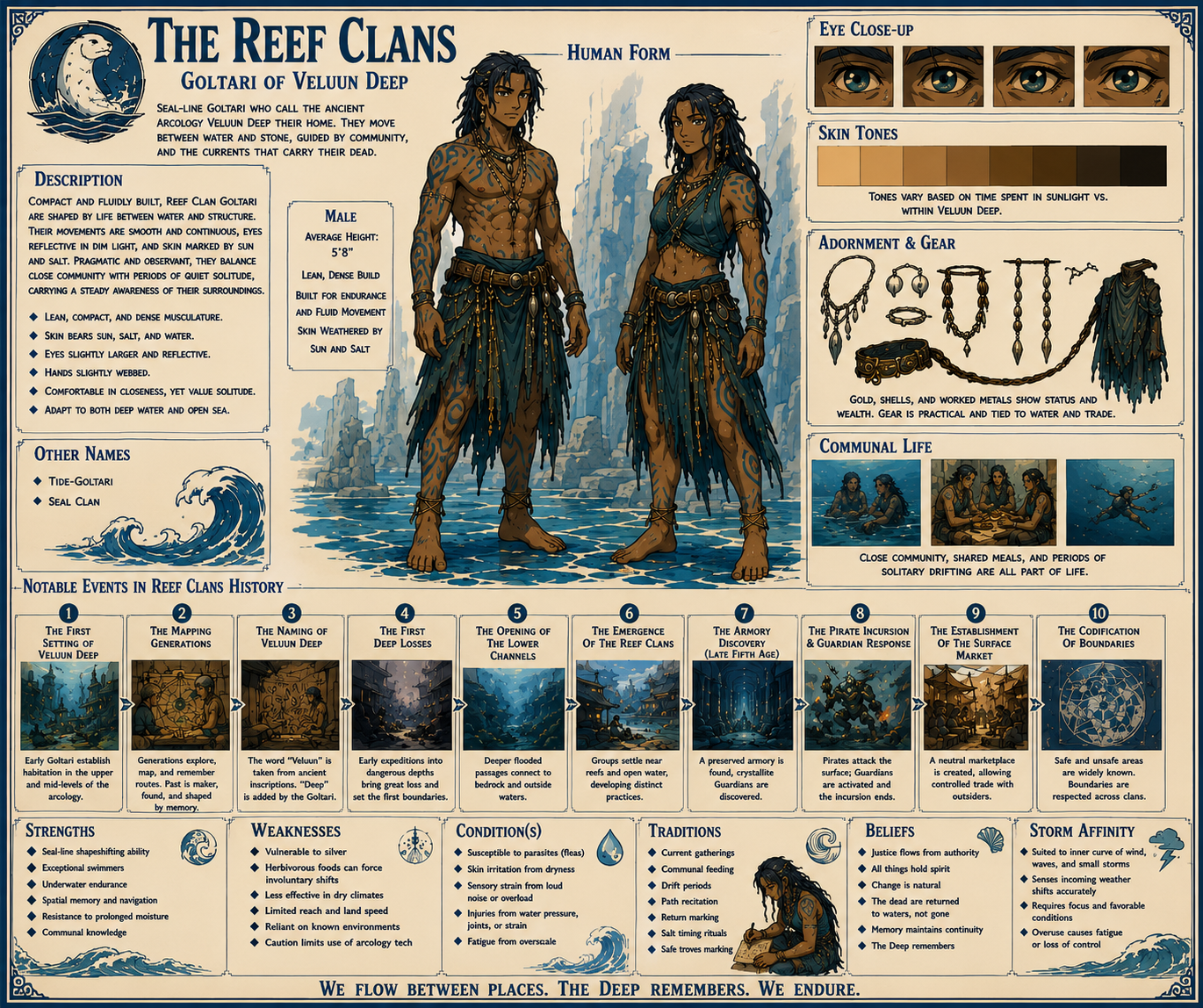
The average Kaee Haath Goltari presents as a compact, fluidly built individual, typically standing around 5’5” with a frame that appears lean but carries a surprising density beneath the surface. Their movements are smooth and continuous, with little wasted motion, giving the impression that they move through their environment rather than against it. Their skin often bears the effects of both sun and salt, ranging from lighter tones shaped by life within Veluun Deep to deeper, weathered complexions from time spent near the surface and in open water. Their eyes are slightly larger and more reflective than most, catching light in a way that gives them a faintly wet or glass-like appearance, particularly in dim conditions.
In their hybrid state, their seal-line lineage becomes more apparent. Their torso broadens, their limbs thicken and shorten slightly, and their hands widen with subtle webbing, all while retaining a clearly humanoid structure. Their features shift just enough to suggest adaptation rather than transformation, with a slightly flattened nose, compact jaw, and patches of short, dense fur along the shoulders, spine, and limbs. Even then, they remain recognizable as Goltari, never fully abandoning their human form.
Behaviorally, they are pragmatic, observant, and comfortable in close proximity to others, often favoring shared space and physical contact without hesitation. They balance this with periods of quiet isolation, drifting alone through water or structure before returning without explanation. Their presence is steady rather than imposing, shaped more by endurance than aggression, and grounded in an unspoken awareness of their surroundings. Whether navigating the layered corridors of Veluun Deep or moving through open water, they carry with them a sense of continuity—of belonging not to a single place, but to the ongoing movement between them.
Tide-Goltari, Seal clan,
Looks
The Goltari of Kaee Haath retain the broad physical variability characteristic of their people, but their environment has shaped a distinct tendency in both their human and hybrid forms. In their human state, they most often present with lean to moderately muscular builds, with strength concentrated in the shoulders, back, and core. Their posture carries a subtle forward balance, less grounded than their mainland kin and more fluid, reflecting a life spent moving between land and water. Though they may appear lighter in frame, they maintain the defining Goltari trait of dense musculature, weighing more than they seem and built for endurance rather than short bursts of force. Their overall presence suggests bodies adapted for sustained motion, particularly swimming and climbing along wet or uneven surfaces.
In their hybrid state, these traits become more pronounced and specialized without ever losing their humanoid structure. The torso broadens, with an expanded ribcage and thickened upper body, suggesting increased lung capacity and internal strength. Limbs shift toward shorter, denser proportions, sacrificing visual length for power and control. The shoulders and arms become especially developed, forming rounded, powerful musculature suited for propulsion through water and controlled movement in submerged environments. Hands widen slightly, with partial webbing between thickened fingers that enhance grip and efficiency in water. The legs remain fully functional for walking but take on a heavier, stabilizing role, aiding balance and maneuverability rather than speed. The neck and upper spine thicken subtly, allowing for smoother, more continuous movement of the head and body.
Surface features shift in tandem with these structural changes. The skin appears smoother and slightly tightened, often taking on a faintly slick or reflective quality when wet. Patches of short, dense fur may develop along the shoulders, spine, forearms, and outer thighs. Facial features adjust subtly, with a slightly flattened nose, a more compact jaw, and eyes that appear larger and more reflective, particularly in low light. These changes remain restrained, ensuring the individual is always clearly recognizable as humanoid.
The most defining aspect of their hybrid form, however, is not their shape but their movement. They exhibit a rolling, continuous flow between actions, with minimal wasted motion and a sense of momentum that carries through the entire body. Even on land, they move as though passing through their environment rather than pushing against it. Where other Goltari lineages may feel grounded or coiled with tension, those of Kaee Haath present as fluid, weighted, and unbroken in motion—bodies not built to dominate terrain, but to endure, adapt, and move seamlessly between land and water.
The skin tones of the Kaee Haath Goltari display a broad range shaped by both tropical exposure and life within the partially enclosed environments of Veluun Deep. Individuals who spend significant time near the surface or in open waters tend toward sun-darkened complexions, ranging from warm bronze and deep tan to rich brown tones, often carrying a slightly weathered quality from constant exposure to salt, wind, and reflected light off the water. In contrast, those who live primarily within the deeper or more sheltered levels of the arcology frequently exhibit lighter skin tones, including muted olive, pale tan, and occasionally very light complexions that lack strong sun coloration. This variation is not rigidly divided, and many individuals fall somewhere between these extremes depending on their habits and roles.
Regardless of tone, their skin often carries subtle environmental markers. It may appear slightly smoother or tighter than that of mainland Goltari, with a faint sheen when wet or in humid conditions. In some individuals, especially those frequently shifting or spending extended periods in hybrid states, the skin may show a softened texture reminiscent of well-conditioned leather, resistant to prolonged moisture exposure. Minor mottling or uneven coloration is not uncommon, particularly along the shoulders, arms, and upper back, where sun, salt, and water exposure are most consistent. These tonal variations, combined with the already wide natural diversity of Goltari skin color across the continent, result in a population where no single shade dominates, but where environmental influence is clearly visible in the lived-in quality of the skin rather than in any one defining color.
The Goltari of Kaee Haath tend to be slightly shorter on average than their mainland counterparts, with most individuals standing around 5’5” in height. While, like all Goltari, they exhibit a wide range of body shapes and physical variance, their environment has favored more compact builds that support efficiency in swimming, diving, and maneuvering through the confined and uneven spaces of Veluun Deep. Taller individuals do exist, but are less common, as excessive height can become a disadvantage in tight corridors, submerged passageways, and during prolonged time in the water. This results in a population where shorter to mid-range heights are more typical, contributing to an overall physical profile that emphasizes control, balance, and endurance over reach or imposing stature.
The Goltari of Kaee Haath tend to weigh noticeably more than their height and build would suggest, maintaining the dense musculature characteristic of all Goltari. Despite their generally compact frames, most individuals fall within a range that reflects this hidden mass, with an average weight commonly between 160–200 lbs, though this can vary widely depending on body composition and lifestyle. Their weight is not carried in bulk, but in tightly packed muscle and reinforced structure, particularly through the shoulders, back, and core, which are heavily developed for swimming, climbing, and sustained movement in water.
This density gives them a grounded, almost anchored presence when on land, and contributes to their efficiency in aquatic environments, allowing for controlled movement, strong propulsion, and improved stability beneath the surface. Even leaner individuals often feel unexpectedly heavy when lifted or braced against, a trait that can catch outsiders off guard. As with all Goltari, variance exists in all directions, but the underlying pattern remains consistent: their bodies are built to endure, and that endurance carries weight.
The Kaee Haath Goltari possess a number of subtle but immediately recognizable physical traits shaped by their environment and seal-line lineage, many of which become more pronounced during partial or hybrid transformation. Their eyes are often the most striking feature, appearing larger than average with a naturally reflective quality that catches light even in dim conditions, giving them a faintly wet or glass-like appearance. In darker environments, this can create a noticeable shine, particularly when viewed at an angle. Their gaze tends to feel steady and observant rather than sharp or predatory, reflecting a temperament shaped more by endurance and awareness than sudden aggression.
Their hands are broader than those of most mainland Goltari, with thickened fingers and subtle webbing that becomes more visible during transformation. Even in a relaxed state, their grip is unusually strong, adapted for maintaining control on slick surfaces and in moving water. The nails are typically thicker and more durable, often slightly flattened rather than sharply pointed, aiding in traction rather than tearing.
Facial structure shows mild but consistent adaptation, with slightly flattened noses and more compact jaws. Their teeth do not extend into the pronounced canines seen in wolf-line Goltari, instead tending toward a more uniform shape, though still strong and well-suited for a diet that includes fish and tougher meats. Some individuals may display faint whisker lines along the upper lip and cheeks, not as full whiskers, but as subtle sensory markings that become more noticeable in hybrid states.
Across the body, patches of short, dense fur may appear, particularly along the shoulders, spine, forearms, and outer thighs. This fur is typically close-set and fine, blending smoothly into the skin rather than standing out as a separate layer. In some individuals, especially those who spend extended time in water, the fur can take on a slightly darker or slickened appearance when wet.
A defining but less immediately visible feature is the overall texture and resilience of their skin. It is often smoother and more tightly set than that of mainland Goltari, with a faint elasticity that resists prolonged exposure to water. When wet, it may take on a slight sheen, giving the impression of a surface that sheds water rather than absorbing it. Minor mottling or tonal variation is common, particularly along areas most exposed to sun and salt.
Perhaps the most subtle but telling feature is how these traits come together in motion. Even at rest, there is a sense of contained movement in their posture, as though their bodies are always prepared to shift, turn, or flow into action. This gives them a presence that feels less rigid than other Goltari lineages—less rooted, and more attuned to continuous, adaptive movement shaped by both structure and environment.
Physical variance among the Kaee Haath Goltari remains as broad and unconstrained as that of their mainland kin, with individuals displaying a wide range of builds, proportions, and features. No single body type defines them, and variation runs in all directions, from lean and compact to broader and more heavily built forms. However, this variance is expressed within the context of their environment, meaning that even the most divergent individuals tend to show some degree of aquatic adaptation in posture, musculature, or movement.
Some individuals are noticeably streamlined, with narrow frames, longer limbs, and a lighter overall profile that favors speed and efficiency in the water. Others are more robust, with thicker torsos, shorter limbs, and a denser, more powerful build suited for diving, hauling, or operating in deeper or more turbulent waters. Between these extremes exists a full spectrum of intermediate forms, with many individuals blending traits in ways that reflect their personal habits, roles, and time spent in either open water or within the arcology itself.
Facial features also vary significantly, with differences in nose shape, jaw structure, and eye size creating a wide range of appearances. Some individuals display more pronounced aquatic traits, such as flatter noses, larger eyes, or more visible webbing, while others retain a more traditionally human presentation with only subtle markers of their lineage. The distribution and density of short body fur can differ greatly as well, from barely noticeable patches to more defined coverage along the shoulders, back, and limbs.
Even within hybrid states, this variability persists. While all share the same general structural shifts, the degree to which features express themselves can differ widely between individuals. Some undergo more dramatic physical changes, with heavier musculature and more visible adaptations, while others shift more subtly, retaining a closer resemblance to their human form.
Despite this wide range of variation, all Kaee Haath Goltari share an underlying cohesion in how their bodies function. Regardless of build or appearance, their forms are consistently adapted for endurance, control, and fluid movement, ensuring that even the most physically distinct individuals remain well-suited to the demands of their environment.
Typical clothing among the Kaee Haath Goltari is shaped primarily by constant exposure to water, humidity, and shifting between dry and submerged environments. As a result, their garments are designed for practicality, durability, and adaptability rather than decoration or strict formality. Most clothing is made from materials that resist water retention and dry quickly, such as tightly woven plant fibers, treated leathers, or flexible hides sourced from marine life. Fabrics are often layered lightly or worn in combinations that allow for easy adjustment, rather than heavy, multi-layered outfits that would become cumbersome when wet.
Clothing tends to be fitted enough to avoid snagging or dragging in water, but not restrictive, allowing for full range of motion during swimming, climbing, and transformation. Many garments are secured with wraps, ties, or simple fastenings rather than rigid structures, enabling them to be loosened or shifted quickly when entering a hybrid state. Sleeves are often short or absent, and lower garments are commonly cut to reduce weight and resistance, with hems designed to avoid tangling around the legs.
It is not uncommon for individuals to wear minimal clothing when within the deeper or more private sections of Veluun Deep, particularly in areas that remain fully submerged or constantly humid. In these spaces, clothing serves more as protection against abrasion than modesty. When more coverage is desired—such as during travel, interaction with outsiders, or time spent on the surface—additional layers may be added, including cloaks, wraps, or outer garments designed to shed water rather than absorb it.
Footwear is used situationally, often consisting of simple, flexible coverings that provide grip on wet stone but can be easily removed before entering the water. Jewelry and adornments are typically kept minimal and practical, though some individuals may wear items made from bone, shell, or worked metal, often tied to personal or clan significance. Overall, their clothing reflects a lifestyle in which being wet is the default state, and comfort, mobility, and function take precedence over appearance or permanence.
Traits
The Kaee Haath Goltari possess the core strengths common to all Goltari, most notably their ability to partially transform into hybrid states that enhance their physical capabilities. In their case, this transformation expresses through a seal-like hybrid form, adapting their bodies for aquatic movement while retaining a humanoid structure. Through this controlled shifting, they are able to increase strength, durability, and mobility as needed, allowing them to respond fluidly to changing conditions. Even without transformation, they are generally stronger and more resilient than an average human, with dense musculature that supports sustained physical effort rather than short bursts of power.
Their seal-line hybrid form provides significant advantages in water. They exhibit exceptional swimming ability, capable of both long-distance endurance and precise maneuvering in tight or complex underwater spaces. Their bodies are highly efficient in aquatic environments, allowing them to conserve energy while navigating currents, waves, and submerged terrain. This efficiency is further supported by enhanced breath control and underwater endurance, enabling them to remain submerged for extended periods compared to most surface-dwelling peoples.
They also possess strong spatial awareness and environmental memory, developed through generations of navigating the layered and partially functional structure of Veluun Deep. This allows them to move confidently through complex, uneven, or hazardous environments, including flooded corridors, collapsed sections, and narrow passageways. Their ability to recall routes, recognize structural patterns, and adapt to shifting conditions gives them a significant advantage in both exploration and defense within their home territory.
Their skin and overall physiology provide a degree of resistance to prolonged moisture exposure, reducing issues such as chafing, water damage, or fatigue that would affect others in similar conditions. Combined with their adaptable clothing and physical resilience, this allows them to operate continuously in environments that alternate between wet and dry without significant loss of performance.
In addition to their physical capabilities, they benefit from a strong communal structure and shared knowledge base. Information about safe paths, dangerous zones, and functional areas within Veluun Deep is passed down and reinforced collectively, allowing even younger or less experienced individuals to operate with a level of confidence and awareness that would otherwise take years to develop alone. This shared understanding, combined with their pragmatic worldview, makes them highly effective at surviving and adapting to both environmental challenges and external threats without relying on excessive force or unnecessary risk.
The Kaee Haath Goltari share the inherent weaknesses common to all Goltari, most notably their vulnerability to silver, which interferes with their ability to transform and can weaken or disrupt their hybrid state. In addition, certain herbs and compounds are capable of forcing involuntary transformation, potentially driving them into heightened or uncontrolled hybrid states that reduce precision and increase vulnerability in critical situations.
Their seal-line adaptation, while highly effective in aquatic environments, creates limitations when operating far inland or in dry conditions. Extended exposure to dry climates can lead to discomfort, reduced efficiency, and physical strain, as their bodies are better suited to humid or water-rich environments. Their skin, while resistant to prolonged moisture, can become irritated or begin to lose elasticity when deprived of regular contact with water, particularly during sustained activity.
Their compact and dense physical structure, while beneficial for swimming and endurance, can be a disadvantage in situations requiring reach, height, or rapid terrestrial movement. They are generally less suited to long-distance travel on land compared to more land-adapted peoples, and may fatigue more quickly when forced to operate in environments that do not allow them to utilize their full range of movement.
Within their hybrid state, while powerful and efficient in water, they sacrifice some degree of fine dexterity and speed in exchange for strength and control. Their movements, though fluid and continuous, are not optimized for sudden bursts of acceleration or highly precise, delicate manipulation during transformation, which can be a limitation in close or highly technical tasks.
Their reliance on inherited spatial knowledge and environmental familiarity also presents a situational weakness. While they are exceptionally capable within known territories such as Veluun Deep, they are less immediately effective in unfamiliar environments where that shared knowledge does not apply. Outside of their home structures and coastal regions, they must rely more heavily on individual experience rather than collective memory.
Finally, their cautious approach to the ancient systems within Veluun Deep, including the armory and its Guardians, limits their access to powerful tools that they do not fully understand. While this restraint preserves safety and aligns with their pragmatic worldview, it also means that they deliberately avoid fully utilizing resources that could otherwise provide significant advantage, particularly in large-scale or unfamiliar conflicts.
The Kaee Haath Goltari, like all Goltari, live with conditions that stem directly from their shapeshifting nature and the environments they inhabit. While many of these are manageable through experience and communal knowledge, they are still ever-present factors that shape daily life. Their ability to shift into a seal-like hybrid form is not without strain, particularly when influenced by external substances or environmental extremes. Silver remains a persistent hazard, capable of suppressing or destabilizing their transformations, while certain herbs and compounds can force involuntary shifts, often at inopportune or dangerous times. In their coastal and submerged environments, these conditions are compounded by the need to constantly balance time between water and land, as prolonged absence from one or the other can begin to affect physical comfort and performance. Additionally, their reliance on inherited spatial knowledge and their interaction with the partially functional systems of Veluun Deep introduce situational conditions tied not just to their biology, but to their surroundings. These factors are not debilitating in isolation, but together they form a set of ongoing constraints that the Kaee Haath Goltari must continuously manage through habit, awareness, and communal support.
Conditions:
Silver Sensitivity: Contact with silver disrupts shapeshifting, weakening or preventing transformation and causing physical discomfort.
Forced Transformation (Herbal Trigger): Certain herbs or compounds can induce involuntary shifting into hybrid states, often reducing control and precision.
Transformation Strain: Repeated or prolonged use of hybrid form can lead to fatigue, particularly when performed under stress or outside of ideal conditions.
Dry Exposure Stress: Extended time in dry or low-humidity environments can cause discomfort, reduced efficiency, and gradual physical strain.
Moisture Dependence: Regular contact with water or high humidity is needed to maintain peak physical condition and comfort.
Environmental Displacement: Reduced effectiveness when operating outside familiar coastal regions or away from known structural environments.
Spatial Reliance: Dependence on learned routes and shared knowledge within Veluun Deep can become a limitation in unfamiliar or shifting terrain.
Arcology Hazard Exposure: Risk of injury or loss when navigating unstable, flooded, or poorly understood sections of Veluun Deep.
Limited System Understanding: Interaction with ancient functioning systems carries risk due to incomplete knowledge, particularly within the armory and deeper levels.
Hybrid Dexterity Tradeoff: Reduced fine motor control while in hybrid form, making delicate or highly precise tasks more difficult during transformation.
Culture
The traditions of the Kaee Haath Goltari are shaped by three constant influences: their seal-line nature, their life within Veluun Deep, and their enduring Goltari emphasis on continuity, community, and the presence of spirits in all things. Their customs often center around shared experience, physical closeness, and the act of remembering—whether that be through story, movement, or place. Many of their traditions blur the line between practical behavior and ritual, with actions that serve both a functional purpose and a cultural one. Water is not simply part of their environment but an active participant in their traditions, used to reinforce bonds, mark transitions, and carry memory. Likewise, the arcology itself is treated not just as a dwelling, but as a space to be engaged with, revisited, and interpreted over time. While some of their practices may appear unusual or intrusive to outsiders—particularly their tendency toward close physical interaction and shared space—they are deeply rooted in trust, familiarity, and a collective understanding of presence and belonging.
Traditions:
Current Gatherings: Groups assemble in shallow, gently moving water, allowing the current to pass around and through them while they share stories, news, and memory. The flow of water is believed to “carry the words,” reinforcing communal bonds.
Communal Feeding: During shared meals, it is common for individuals to offer food directly to one another by hand, sometimes without being asked. This is seen as a gesture of trust and inclusion rather than intrusion.
Drift Periods: Individuals periodically leave their communities for hours or days at a time, drifting through open water or quiet sections of the arcology alone. These periods are not questioned and are understood as necessary for balance.
Return Marking: After a long absence, individuals may be physically touched, leaned against, or even briefly surrounded by others as a way of reaffirming presence and reintegration into the group.
Salt Rinsing Rituals: Before entering deeper or more dangerous sections of Veluun Deep, individuals rinse themselves in saltwater or apply salt directly to the skin, both as practical preparation and as a form of grounding.
Path Recitation: Important routes through the arcology are memorized and spoken aloud, often in rhythmic or story-like forms, ensuring that knowledge of safe paths is preserved across generations.
Quiet Watching: Groups will sometimes gather in silence to observe specific locations—such as structural shifts, deep water openings, or functioning systems—treating observation itself as a shared act.
Layered Sleeping: It is common for individuals to rest in close physical contact, partially overlapping or leaning against one another, particularly in humid or submerged environments. This is considered normal and comforting.
Object Returning: Items recovered from submerged ruins or wrecks are not always kept. Many are deliberately returned to the water after being examined, especially if they are believed to be tied to the dead.
Boundary Respect: Certain areas of Veluun Deep are left deliberately unentered. These boundaries are rarely marked physically, but are widely understood and rarely crossed without strong cause.
Movement Mimicry: Younger Goltari often imitate the movements of elders or experienced swimmers, practicing fluid motion patterns in both water and on land as a form of learning and bonding.
Shared Silence: Silence is not treated as absence, but as a form of presence. Groups may remain together without speaking for extended periods, particularly in water, where physical proximity replaces verbal interaction.
pragmatism, the maintenance of natural order, and the understanding that spirits inhabit all things—but these ideas have been reinterpreted through generations of life in water and within Veluun Deep. To them, the world is not divided between land and sea, living and dead, or structure and nature; it is a continuous system in motion, where all things shift, settle, and return in time. Change is not something to be resisted, but something to be endured and adapted to, as long as continuity is preserved.
Spirits are believed to inhabit not only living beings and natural environments, but also currents, pressure, and even the ancient structure of Veluun Deep itself. The arcology is not worshipped, but it is understood to hold presence—something that persists, remembers, and reacts, even if not consciously. Likewise, the sea is not seen as a singular entity, but as a collection of moving forces, each with its own temperament and influence. These forces are not inherently benevolent or hostile; they simply are, and it is the responsibility of the Goltari to recognize, respect, and navigate them appropriately.
Their understanding of death reflects this continuity. The dead are not considered gone, but carried—through water, through structure, and through memory. Returning the dead to specific currents or places within Veluun Deep is not an act of release, but one of placement, ensuring that they remain within the cycle rather than outside of it. Forgetting the dead is seen as a greater failure than death itself, as it breaks continuity and removes something from the shared understanding of existence.
Pragmatism governs their actions in all things. There is little room for abstract morality divorced from consequence; instead, actions are judged based on whether they preserve balance, continuity, and survival. This extends to their cautious use of the arcology’s ancient systems. The presence of functioning technology is acknowledged, respected, and used when necessary, but never fully embraced, as it exists outside their understanding and therefore outside their ability to control.
Above all, the Kaee Haath Goltari believe that existence is defined by endurance through change. Forms shift, environments alter, and structures decay, but what matters is what continues—memory, presence, and the ability to adapt without losing oneself. To them, identity is not fixed in form, but in persistence, and it is this persistence that defines what it means to be Goltari.
The governance of the Kaee Haath Goltari remains fundamentally rooted in the broader traditions of the Goltari, favoring communal decision-making, practical leadership, and a strong emphasis on shared responsibility. However, their environment within Veluun Deep has shaped this into a more distributed and situational system rather than a centralized authority.
They are organized primarily into clans tied to specific regions of the arcology, such as reef-adjacent zones, mid-level habitation areas, or deeper structural sections. Each clan manages its own internal matters through a form of consensus-based leadership, typically guided by a small group of experienced individuals rather than a single permanent leader. These figures are not rulers in the traditional sense, but recognized voices of authority whose influence is based on experience, reliability, and demonstrated understanding of both environment and people.
Decision-making is highly contextual and practical. Matters affecting only a single clan are handled internally, while issues that impact multiple groups—such as structural changes within Veluun Deep, external threats, or access to shared spaces—are addressed through inter-clan gatherings. These gatherings function as temporary councils, where representatives or knowledgeable individuals from each affected group contribute to discussion and resolution. There is no fixed governing body; instead, authority forms as needed and dissolves once decisions are made.
Leadership roles are often specialized rather than hierarchical. Certain individuals may be widely recognized for specific forms of expertise, such as:
navigation of deep or unstable sections
knowledge of ancient systems
conflict resolution
interaction with outsiders
These individuals may guide decisions within their domain, but their authority rarely extends beyond it. Influence is earned and maintained through continued competence rather than title.
Within Veluun Deep itself, governance is also shaped by unspoken boundaries and shared understanding. Certain areas are recognized as belonging to particular clans, while others are treated as communal or restricted spaces. These divisions are rarely enforced through force, as social expectation and mutual recognition are typically sufficient to maintain order.
Importantly, the Goltari do not attempt to exert full control over the arcology. They recognize that large portions of Veluun Deep remain beyond their understanding, and governance does not extend into areas deemed unstable, unknown, or dangerous. In this way, their system is defined as much by what they choose not to control as by what they do.
Overall, their government can best be described as a fluid, clan-based system of distributed authority, where leadership is situational, decisions are made through consensus, and control is limited by both practicality and respect for the environment they inhabit.
The technologies utilized by the Kaee Haath Goltari reflect a blend of practical adaptation, inherited knowledge, and cautious interaction with the ancient systems of Veluun Deep. Like other Goltari, they are capable of employing a wide range of technologies comparable to those found within Stanzgar, including metalworking, tools, and basic mechanical systems. However, their environment has naturally shifted their focus toward tools and methods suited for constant exposure to water, uneven terrain, and partially submerged living spaces.
Their everyday technology emphasizes durability and reliability over complexity. Tools are commonly designed to resist corrosion, function while wet, and remain effective in low-visibility conditions. Materials such as treated metals, dense woods, stone, and marine-derived components are favored, often combined in ways that prioritize long-term use rather than ease of replacement. Lighting is handled through a combination of traditional means and the reuse of still-functioning elements within the arcology, resulting in a mix of natural, crafted, and inherited illumination throughout their living spaces.
In aquatic contexts, they make use of simple but effective equipment to extend their natural capabilities. Weighted tools, tether lines, storage nets, and sealed containers are common, allowing them to transport objects, secure themselves in strong currents, and recover materials from submerged areas. These are not overly specialized devices, but rather practical extensions of their existing physical strengths and environmental familiarity.
The most significant technological element in their society, however, comes from their interaction with the ancient systems of Veluun Deep. Portions of the arcology remain functional, providing lighting, structural stability, and access to areas that would otherwise be inaccessible. The Goltari do not understand how these systems operate, but they have developed a working familiarity with their behavior—knowing which sections remain active, which pathways are stable, and which areas should be avoided.
Approximately three centuries prior to the Sixth Age, the discovery of a preserved internal section—interpreted as an armory—introduced them to a class of technology far beyond their comprehension. Within this area, they encountered devices and constructs unlike anything found elsewhere in their environment, including a limited number of crystalline quadrupedal entities referred to as “Guardians.” Through careful experimentation, they learned how to activate a small portion of these constructs, though they do not understand the underlying mechanisms or limitations involved.
These advanced elements are not integrated into daily life. They are treated with caution, used rarely, and only in circumstances where their use is deemed necessary. The Goltari do not attempt to replicate, modify, or expand upon this technology, recognizing it as something outside their knowledge and control. Instead, it exists as a dormant resource—respected, monitored, and deliberately left undisturbed except in times of significant need.
Overall, the technological state of the Kaee Haath Goltari is defined not by advancement alone, but by measured use. They employ what they understand, adapt what they can, and leave untouched what they do not, maintaining a balance between practicality, survival, and respect for forces beyond their comprehension.
The occupations of the Kaee Haath Goltari follow the same core structure found among all Goltari, built on a balance between shared labor and recognized specialization. Their society operates on a fundamental understanding: not everyone can do everything, but everyone is expected to do something. This principle is maintained through a system in which daily communal work and long-term skilled roles coexist rather than replace one another, ensuring that both immediate needs and complex tasks are consistently met.
Each day typically begins with a form of distributed labor, often referred to informally as a morning assignment system. Tasks necessary for the continued function of life within Veluun Deep are identified and filled as individuals present themselves. These responsibilities include gathering food from coastal and submerged environments, maintaining living spaces within the arcology, reinforcing unstable sections, transporting materials through both dry and flooded corridors, preparing meals, and maintaining patrols of known pathways and boundaries. Those who present themselves early often have greater freedom in selecting their tasks or positioning themselves where they are most effective, while those who arrive later are assigned remaining duties. This system ensures that essential work is consistently completed, that effort remains visible, and that idleness is difficult to conceal within the community.
Alongside this shared labor system, the Kaee Haath Goltari maintain a number of recognized specialists whose roles are critical to long-term survival and stability. These include individuals trained in metalworking and tool repair, those capable of maintaining and stabilizing structural elements within Veluun Deep, healers and herbalists familiar with both coastal and submerged environments, experienced divers and salvage workers who recover materials from submerged ruins and wrecks, navigators who maintain and pass down knowledge of safe routes through the arcology, and those who have limited familiarity with the arcology’s functioning systems, including the activation and observation of its more advanced elements. These specialists are trained over time, recognized by the community, and often shielded from excessive general labor when their skills are in demand, ensuring that critical knowledge and capability are preserved.
The morning assignment system primarily governs general labor and communal responsibility, but does not override specialization. Specialists may still participate in shared work, particularly when demands are low, but are expected to prioritize their expertise when needed. This creates a consistent balance in which general work is shared across the population while skilled labor is both respected and protected.
Despite the presence of specialized roles, occupation does not define identity among the Kaee Haath Goltari. Individuals are expected to contribute broadly regardless of their primary skill, and reputation is built not only on expertise but on reliability, presence, and willingness to support the community as a whole. A highly skilled individual who avoids general responsibility may be seen as useful, but not fully trusted, while those who consistently contribute across roles are valued for both their skill and their commitment.
Their environment has introduced additional occupational roles unique to life within Veluun Deep and the surrounding waters. These include current-watchers who monitor shifts in water flow and structural stability, boundary keepers who ensure that restricted or dangerous areas remain undisturbed, salvage divers who recover materials from submerged sections and external waters, and path-keepers who memorize, maintain, and teach safe routes through the arcology
The economic structure of the Kaee Haath Goltari reflects a blend of traditional communal exchange and externally driven trade, shaped significantly by their position within Veluun Deep and their history of defending it. Internally, they continue to rely on a system of shared labor and localized bartering, where goods, services, and resources are distributed through direct exchange and communal responsibility rather than strict monetary systems. Daily needs—such as food, tools, maintenance materials, and basic services—are typically handled within this framework, ensuring that all members of the community remain supported regardless of personal wealth.
However, their external economic presence has evolved considerably, particularly following the large-scale pirate incursion that demonstrated both the strategic value and defensibility of their territory. In the years that followed, the Goltari established and maintained a neutral marketplace on the surface level of Veluun Deep, utilizing the exposed “island” portion of the arcology as a controlled point of contact with the outside world. This marketplace functions as a trade hub within Kaee Haath, where merchants, sailors, and travelers can exchange goods under an understood expectation of neutrality and order.
Through this system, the Goltari have accumulated a substantial amount of coin and tradable wealth, far exceeding what their internal economy alone would produce. They trade in a variety of goods, including recovered materials from submerged ruins, durable tools adapted for maritime use, preserved foods, and occasionally rare or unusual items retrieved through salvage operations. Their ability to access underwater environments and navigate hazardous terrain gives them access to resources that are difficult or impossible for others to obtain, making them valuable trading partners despite their otherwise insular nature.
Despite this influx of external wealth, coin does not dominate their internal society. Wealth is not a primary measure of status, and individuals are not exempt from communal responsibility due to accumulated resources. Instead, coin is treated as a tool for external interaction, used primarily in trade with outsiders rather than as a foundation for internal hierarchy. Resources gained through trade are often redistributed, stored, or applied to communal needs rather than concentrated in the hands of individuals.
The marketplace itself is carefully managed, with clear expectations regarding behavior, trade boundaries, and respect for the structure and surrounding waters. While the Goltari do not impose heavy-handed control, violations of these expectations—particularly those that threaten the integrity of Veluun Deep or its surrounding territory—are addressed decisively. This balance of openness and control allows them to maintain a steady flow of trade without compromising their autonomy or safety.
Overall, the economy of the Kaee Haath Goltari operates on two levels: an internal system based on shared labor and mutual support, and an external system driven by controlled trade and accumulated wealth. Together, these systems allow them to remain self-sufficient while also benefiting from their unique position within Kaee Haath, maintaining both independence and influence without relying entirely on either.
The favorite foods of the Kaee Haath Goltari reflect their coastal environment, their access to submerged resources, and their practical approach to sustenance. As with all Goltari, they favor meat and protein-rich foods, but their diet leans heavily toward marine sources, supplemented by tropical plant life gathered from the islands and the upper levels of Veluun Deep. Freshness is highly valued, and many foods are consumed shortly after being caught or prepared, though preservation methods such as salting, drying, and light fermentation are also common.
Food is not treated as a solitary activity. Meals are often shared, with individuals gathering in close proximity, sometimes in shallow water or humid chambers, reinforcing their communal nature. Texture and physical experience play a significant role in their preferences—foods that can be handled, torn, or shared directly are favored over those requiring careful or delicate preparation. While cooking is common, particularly for tougher meats or communal dishes, many foods are eaten raw or lightly processed, especially seafood that is considered best when fresh.
Salt plays an important role in both flavor and preservation, and its use is widespread across their cuisine. Combined with herbs suited to coastal and humid environments, their food tends to be bold but practical, emphasizing nourishment, durability, and shared consumption rather than complexity or presentation.
Favorite Foods:
Fresh fish (consumed raw, lightly cured, or roasted)
Shellfish (crab, lobster, mollusks)
Reef-harvested sea life (urchins, soft-bodied creatures, small reef predators)
Salt-cured meats (both land and sea sources)
Dried or smoked fish strips for travel
Fermented fish or marine pastes
Seaweed and coastal plant matter
Tropical fruits (coconut, citrus, island-grown varieties)
Root vegetables grown in humid or sheltered environments
Bone broths and rich stews made from mixed catches
Salted and herb-rubbed meats
Shared platters designed for communal eating and direct hand consumption
History
The First Settling of Veluun Deep
The earliest known point in their history, marked not by arrival from elsewhere, but by the establishment of habitation within the upper and mid-level sections of Veluun Deep. These early Goltari adapted quickly to the structure, learning to navigate its partially functioning systems and unstable sections while establishing the first clan territories.
The Mapping Generations
A long period during which successive generations focused on exploring, memorizing, and stabilizing known routes through the arcology. During this time, many paths were lost, rediscovered, or abandoned, and the foundations of their current spatial knowledge and path-recitation traditions were established.
The Naming of Veluun Deep
The identification and adoption of the word “Veluun” from faded inscriptions within the structure, combined with the Goltari descriptor “Deep.” This marks one of the earliest recorded acts of cultural interpretation of the arcology and solidifies the name that persists into the present.
The First Deep Losses
A series of early exploratory attempts into lower, less stable sections of the arcology that resulted in significant loss of life. These events established the first widely recognized boundaries within Veluun Deep and gave rise to the tradition of leaving certain areas deliberately unentered.
The Opening of the Lower Channels
The discovery of deeper flooded passages connecting the arcology into the surrounding bedrock and external waters. This event expanded their range significantly, allowing for greater access to submerged resources, but also introduced new hazards and the need for more structured navigation practices.
The Emergence of the Reef Clans
A period during which groups began to settle more permanently in reef-adjacent zones near the outer structure, developing distinct practices tied to open water, currents, and coastal environments. This marks the beginning of recognizable internal cultural variation.
The Armory Discovery (Late Fifth Age)
Approximately three centuries prior to the present Sixth Age, a preserved internal section of Veluun Deep was uncovered, containing unknown devices and constructs. Among these were the crystalline quadrupedal entities later referred to as “Guardians.” Limited activation of these constructs marked the first known interaction with the arcology’s more advanced systems.
The Pirate Incursion and Guardian Response
A large-scale external attack on the surface of Veluun Deep, during which the Goltari activated several of the Guardians. The resulting defense was decisive and overwhelming, effectively ending the incursion and establishing the arcology as a location not easily challenged. This event significantly altered how outsiders perceived the Goltari and their territory.
The Establishment of the Surface Market
Following the failed incursion, the Goltari formalized a neutral trade space on the exposed upper structure of Veluun Deep. This marketplace allowed controlled interaction with outside groups and led to increased accumulation of coin and trade goods, without replacing their internal communal systems.
The Codification of Boundaries
Over time, informal knowledge of safe and unsafe areas within Veluun Deep became more structured and widely reinforced. While never formally written, these boundaries are now broadly understood across clans, reducing unnecessary risk and limiting access to unstable or unknown regions.
Notes
Storm Affinity (Reef Clan Goltari)
Let’s canonize it cleanly in your style:
The Reef-aligned Goltari of Kaee Haath possess a minor but distinct affinity for storm and weather patterns, expressed through subtle interaction with wind, pressure, and surface conditions. This ability does not grant them true control over storms, nor does it allow them to create large-scale weather systems. Instead, it manifests as a localized influence that can encourage, disrupt, or slightly redirect natural conditions already present in the environment.
This influence is most effective in coastal waters and around reef structures, where environmental conditions are already in flux. Individuals may be able to:
intensify or calm surface winds in a limited area
encourage the formation of small squalls or disrupt them before they fully develop
alter wave behavior slightly, making waters more or less navigable in the immediate vicinity
sense incoming shifts in weather with greater accuracy than most
These effects are subtle and require both focus and favorable conditions. They cannot be sustained indefinitely, and attempting to exert influence beyond natural limits can result in fatigue, disorientation, or complete loss of control. Larger storms, particularly those associated with Sharwan, are entirely beyond their influence. At best, Reef Goltari can recognize such storms early and make small adjustments to their immediate surroundings in preparation.
Culturally, this ability is not viewed as dominance over the environment, but as a form of attunement. Reef Goltari do not believe they command storms, but that they are able to “lean into” existing conditions and guide them slightly. Overuse or reckless use of this ability is often discouraged, as it is seen as both impractical and potentially disruptive to the natural balance they strive to maintain.
This affinity is not present in all individuals, and even among those who possess it, strength and precision vary widely. It is most commonly found among those who spend the majority of their lives in reef-adjacent environments, reinforcing the connection between the individual, their surroundings, and the conditions they are able to influence.
The Kaee Haath Goltari are still Goltari and refer to themselves as such; they do not recognize themselves as a separate race or offshoot.
They have had no contact with mainland Goltari for so long that neither group is aware of the other’s continued existence.
Their shapeshifting expresses through a seal-like hybrid form, but they do not transform into full beasts under any circumstance.
The primary population resides within Veluun Deep, a massive ancient arcology whose visible uppermost structure forms an island within the Kaee Haath archipelago.
Veluun Deep was built by a long-gone civilization that left Sol Saris, and was likely once far more exposed above water before large portions collapsed or sank.
The structure extends far beneath the surface, with layered vertical sections, including flooded corridors and deep passages that reach into the bedrock and connect to other unknown structures.
The arcology is not fully ruined—many sections still retain functioning systems, including lighting and structural integrity. Areas that have lost power have typically suffered catastrophic structural failure.
The Goltari do not understand how the arcology functions, but possess generational knowledge of which areas are stable, active, or dangerous.
Veluun Deep is treated as:
a homeland
an archaeological site
and a place of continuity with the dead
The name “Veluun” was taken from faded inscriptions within the structure, while “Deep” was added by the Goltari as a practical descriptor.
The Goltari do not attempt to translate “Veluun” and treat it as an inherited, correct name.
Certain areas of the arcology are deliberately left unexplored, not out of superstition alone, but due to known danger and past losses.
Approximately 300 years prior to the Sixth Age, a preserved section interpreted as an armory was discovered within Veluun Deep.
This armory contains advanced, poorly understood technology, including crystalline quadrupedal constructs known as “Guardians.”
The Goltari have only learned to activate a limited number of Guardians, and do not understand their full capabilities or limitations.
The Guardians were used during a large-scale pirate incursion, decisively ending the attack and establishing Veluun Deep as a highly dangerous target.
The use of the armory is extremely limited and cautious; it is treated as a last resort rather than a reliable tool.
Following the incursion, the Goltari established a neutral surface marketplace on the exposed portion of Veluun Deep, creating a controlled point of external trade.
Despite accumulating significant wealth through trade, coin does not define internal status, and communal labor systems remain intact.
Their society operates on the principle that:
not everyone can do everything, but everyone must contribute
They maintain a morning assignment system for general labor alongside recognized specialists.
Specialists exist and are respected, but are still expected to participate in communal life and responsibility.
Their diet is heavily marine-based, with strong use of salt, preservation techniques, and communal eating practices.
They exhibit a strong tendency toward:
physical closeness
shared space
and tactile interaction
Periods of solitary drifting are culturally normal and not questioned.
Their beliefs emphasize:
pragmatism
natural order
spirits in all things
and continuity through memory
The dead are not “buried” in the traditional sense, but are returned to specific waters or areas within Veluun Deep, maintaining their place in the world.
Reef-aligned Goltari possess a minor ability to influence storm conditions, such as adjusting wind, waves, or small weather patterns locally.
This storm affinity is:
limited in scale
dependent on existing conditions
and cannot influence major storms, especially those associated with Sharwan
Their storm interaction is viewed as attunement, not control.
They are highly adapted to wet, humid, and aquatic environments, and experience discomfort or reduced efficiency in extended dry conditions.
Their bodies are:
dense and heavier than they appear
built for endurance
and optimized for fluid, continuous movement
Movement is a defining trait, often described as smooth, rolling, and unbroken, even on land.
They rely heavily on:
inherited spatial knowledge
memorized routes
and shared environmental awareness
Outsiders often misunderstand them, referring to them as:
sealfolk
storm shifters
or similar terms
Internally, they do not distinguish themselves as anything other than Goltari.
Overview
Details about this race's overview
The Reef Clans
The average Kaee Haath Goltari presents as a compact, fluidly built individual, typically standing around 5’5” with a frame that appears lean but carries a surprising density beneath the surface. Their movements are smooth and continuous, with little wasted motion, giving the impression that they move through their environment rather than against it. Their skin often bears the effects of both sun and salt, ranging from lighter tones shaped by life within Veluun Deep to deeper, weathered complexions from time spent near the surface and in open water. Their eyes are slightly larger and more reflective than most, catching light in a way that gives them a faintly wet or glass-like appearance, particularly in dim conditions.
In their hybrid state, their seal-line lineage becomes more apparent. Their torso broadens, their limbs thicken and shorten slightly, and their hands widen with subtle webbing, all while retaining a clearly humanoid structure. Their features shift just enough to suggest adaptation rather than transformation, with a slightly flattened nose, compact jaw, and patches of short, dense fur along the shoulders, spine, and limbs. Even then, they remain recognizable as Goltari, never fully abandoning their human form.
Behaviorally, they are pragmatic, observant, and comfortable in close proximity to others, often favoring shared space and physical contact without hesitation. They balance this with periods of quiet isolation, drifting alone through water or structure before returning without explanation. Their presence is steady rather than imposing, shaped more by endurance than aggression, and grounded in an unspoken awareness of their surroundings. Whether navigating the layered corridors of Veluun Deep or moving through open water, they carry with them a sense of continuity—of belonging not to a single place, but to the ongoing movement between them.
Tide-Goltari, Seal clan,
Looks
Details about this race's looks
The Goltari of Kaee Haath retain the broad physical variability characteristic of their people, but their environment has shaped a distinct tendency in both their human and hybrid forms. In their human state, they most often present with lean to moderately muscular builds, with strength concentrated in the shoulders, back, and core. Their posture carries a subtle forward balance, less grounded than their mainland kin and more fluid, reflecting a life spent moving between land and water. Though they may appear lighter in frame, they maintain the defining Goltari trait of dense musculature, weighing more than they seem and built for endurance rather than short bursts of force. Their overall presence suggests bodies adapted for sustained motion, particularly swimming and climbing along wet or uneven surfaces.
In their hybrid state, these traits become more pronounced and specialized without ever losing their humanoid structure. The torso broadens, with an expanded ribcage and thickened upper body, suggesting increased lung capacity and internal strength. Limbs shift toward shorter, denser proportions, sacrificing visual length for power and control. The shoulders and arms become especially developed, forming rounded, powerful musculature suited for propulsion through water and controlled movement in submerged environments. Hands widen slightly, with partial webbing between thickened fingers that enhance grip and efficiency in water. The legs remain fully functional for walking but take on a heavier, stabilizing role, aiding balance and maneuverability rather than speed. The neck and upper spine thicken subtly, allowing for smoother, more continuous movement of the head and body.
Surface features shift in tandem with these structural changes. The skin appears smoother and slightly tightened, often taking on a faintly slick or reflective quality when wet. Patches of short, dense fur may develop along the shoulders, spine, forearms, and outer thighs. Facial features adjust subtly, with a slightly flattened nose, a more compact jaw, and eyes that appear larger and more reflective, particularly in low light. These changes remain restrained, ensuring the individual is always clearly recognizable as humanoid.
The most defining aspect of their hybrid form, however, is not their shape but their movement. They exhibit a rolling, continuous flow between actions, with minimal wasted motion and a sense of momentum that carries through the entire body. Even on land, they move as though passing through their environment rather than pushing against it. Where other Goltari lineages may feel grounded or coiled with tension, those of Kaee Haath present as fluid, weighted, and unbroken in motion—bodies not built to dominate terrain, but to endure, adapt, and move seamlessly between land and water.
The skin tones of the Kaee Haath Goltari display a broad range shaped by both tropical exposure and life within the partially enclosed environments of Veluun Deep. Individuals who spend significant time near the surface or in open waters tend toward sun-darkened complexions, ranging from warm bronze and deep tan to rich brown tones, often carrying a slightly weathered quality from constant exposure to salt, wind, and reflected light off the water. In contrast, those who live primarily within the deeper or more sheltered levels of the arcology frequently exhibit lighter skin tones, including muted olive, pale tan, and occasionally very light complexions that lack strong sun coloration. This variation is not rigidly divided, and many individuals fall somewhere between these extremes depending on their habits and roles.
Regardless of tone, their skin often carries subtle environmental markers. It may appear slightly smoother or tighter than that of mainland Goltari, with a faint sheen when wet or in humid conditions. In some individuals, especially those frequently shifting or spending extended periods in hybrid states, the skin may show a softened texture reminiscent of well-conditioned leather, resistant to prolonged moisture exposure. Minor mottling or uneven coloration is not uncommon, particularly along the shoulders, arms, and upper back, where sun, salt, and water exposure are most consistent. These tonal variations, combined with the already wide natural diversity of Goltari skin color across the continent, result in a population where no single shade dominates, but where environmental influence is clearly visible in the lived-in quality of the skin rather than in any one defining color.
The Goltari of Kaee Haath tend to be slightly shorter on average than their mainland counterparts, with most individuals standing around 5’5” in height. While, like all Goltari, they exhibit a wide range of body shapes and physical variance, their environment has favored more compact builds that support efficiency in swimming, diving, and maneuvering through the confined and uneven spaces of Veluun Deep. Taller individuals do exist, but are less common, as excessive height can become a disadvantage in tight corridors, submerged passageways, and during prolonged time in the water. This results in a population where shorter to mid-range heights are more typical, contributing to an overall physical profile that emphasizes control, balance, and endurance over reach or imposing stature.
The Goltari of Kaee Haath tend to weigh noticeably more than their height and build would suggest, maintaining the dense musculature characteristic of all Goltari. Despite their generally compact frames, most individuals fall within a range that reflects this hidden mass, with an average weight commonly between 160–200 lbs, though this can vary widely depending on body composition and lifestyle. Their weight is not carried in bulk, but in tightly packed muscle and reinforced structure, particularly through the shoulders, back, and core, which are heavily developed for swimming, climbing, and sustained movement in water.
This density gives them a grounded, almost anchored presence when on land, and contributes to their efficiency in aquatic environments, allowing for controlled movement, strong propulsion, and improved stability beneath the surface. Even leaner individuals often feel unexpectedly heavy when lifted or braced against, a trait that can catch outsiders off guard. As with all Goltari, variance exists in all directions, but the underlying pattern remains consistent: their bodies are built to endure, and that endurance carries weight.
The Kaee Haath Goltari possess a number of subtle but immediately recognizable physical traits shaped by their environment and seal-line lineage, many of which become more pronounced during partial or hybrid transformation. Their eyes are often the most striking feature, appearing larger than average with a naturally reflective quality that catches light even in dim conditions, giving them a faintly wet or glass-like appearance. In darker environments, this can create a noticeable shine, particularly when viewed at an angle. Their gaze tends to feel steady and observant rather than sharp or predatory, reflecting a temperament shaped more by endurance and awareness than sudden aggression.
Their hands are broader than those of most mainland Goltari, with thickened fingers and subtle webbing that becomes more visible during transformation. Even in a relaxed state, their grip is unusually strong, adapted for maintaining control on slick surfaces and in moving water. The nails are typically thicker and more durable, often slightly flattened rather than sharply pointed, aiding in traction rather than tearing.
Facial structure shows mild but consistent adaptation, with slightly flattened noses and more compact jaws. Their teeth do not extend into the pronounced canines seen in wolf-line Goltari, instead tending toward a more uniform shape, though still strong and well-suited for a diet that includes fish and tougher meats. Some individuals may display faint whisker lines along the upper lip and cheeks, not as full whiskers, but as subtle sensory markings that become more noticeable in hybrid states.
Across the body, patches of short, dense fur may appear, particularly along the shoulders, spine, forearms, and outer thighs. This fur is typically close-set and fine, blending smoothly into the skin rather than standing out as a separate layer. In some individuals, especially those who spend extended time in water, the fur can take on a slightly darker or slickened appearance when wet.
A defining but less immediately visible feature is the overall texture and resilience of their skin. It is often smoother and more tightly set than that of mainland Goltari, with a faint elasticity that resists prolonged exposure to water. When wet, it may take on a slight sheen, giving the impression of a surface that sheds water rather than absorbing it. Minor mottling or tonal variation is common, particularly along areas most exposed to sun and salt.
Perhaps the most subtle but telling feature is how these traits come together in motion. Even at rest, there is a sense of contained movement in their posture, as though their bodies are always prepared to shift, turn, or flow into action. This gives them a presence that feels less rigid than other Goltari lineages—less rooted, and more attuned to continuous, adaptive movement shaped by both structure and environment.
Physical variance among the Kaee Haath Goltari remains as broad and unconstrained as that of their mainland kin, with individuals displaying a wide range of builds, proportions, and features. No single body type defines them, and variation runs in all directions, from lean and compact to broader and more heavily built forms. However, this variance is expressed within the context of their environment, meaning that even the most divergent individuals tend to show some degree of aquatic adaptation in posture, musculature, or movement.
Some individuals are noticeably streamlined, with narrow frames, longer limbs, and a lighter overall profile that favors speed and efficiency in the water. Others are more robust, with thicker torsos, shorter limbs, and a denser, more powerful build suited for diving, hauling, or operating in deeper or more turbulent waters. Between these extremes exists a full spectrum of intermediate forms, with many individuals blending traits in ways that reflect their personal habits, roles, and time spent in either open water or within the arcology itself.
Facial features also vary significantly, with differences in nose shape, jaw structure, and eye size creating a wide range of appearances. Some individuals display more pronounced aquatic traits, such as flatter noses, larger eyes, or more visible webbing, while others retain a more traditionally human presentation with only subtle markers of their lineage. The distribution and density of short body fur can differ greatly as well, from barely noticeable patches to more defined coverage along the shoulders, back, and limbs.
Even within hybrid states, this variability persists. While all share the same general structural shifts, the degree to which features express themselves can differ widely between individuals. Some undergo more dramatic physical changes, with heavier musculature and more visible adaptations, while others shift more subtly, retaining a closer resemblance to their human form.
Despite this wide range of variation, all Kaee Haath Goltari share an underlying cohesion in how their bodies function. Regardless of build or appearance, their forms are consistently adapted for endurance, control, and fluid movement, ensuring that even the most physically distinct individuals remain well-suited to the demands of their environment.
Typical clothing among the Kaee Haath Goltari is shaped primarily by constant exposure to water, humidity, and shifting between dry and submerged environments. As a result, their garments are designed for practicality, durability, and adaptability rather than decoration or strict formality. Most clothing is made from materials that resist water retention and dry quickly, such as tightly woven plant fibers, treated leathers, or flexible hides sourced from marine life. Fabrics are often layered lightly or worn in combinations that allow for easy adjustment, rather than heavy, multi-layered outfits that would become cumbersome when wet.
Clothing tends to be fitted enough to avoid snagging or dragging in water, but not restrictive, allowing for full range of motion during swimming, climbing, and transformation. Many garments are secured with wraps, ties, or simple fastenings rather than rigid structures, enabling them to be loosened or shifted quickly when entering a hybrid state. Sleeves are often short or absent, and lower garments are commonly cut to reduce weight and resistance, with hems designed to avoid tangling around the legs.
It is not uncommon for individuals to wear minimal clothing when within the deeper or more private sections of Veluun Deep, particularly in areas that remain fully submerged or constantly humid. In these spaces, clothing serves more as protection against abrasion than modesty. When more coverage is desired—such as during travel, interaction with outsiders, or time spent on the surface—additional layers may be added, including cloaks, wraps, or outer garments designed to shed water rather than absorb it.
Footwear is used situationally, often consisting of simple, flexible coverings that provide grip on wet stone but can be easily removed before entering the water. Jewelry and adornments are typically kept minimal and practical, though some individuals may wear items made from bone, shell, or worked metal, often tied to personal or clan significance. Overall, their clothing reflects a lifestyle in which being wet is the default state, and comfort, mobility, and function take precedence over appearance or permanence.
Traits
Details about this race's traits
The Kaee Haath Goltari possess the core strengths common to all Goltari, most notably their ability to partially transform into hybrid states that enhance their physical capabilities. In their case, this transformation expresses through a seal-like hybrid form, adapting their bodies for aquatic movement while retaining a humanoid structure. Through this controlled shifting, they are able to increase strength, durability, and mobility as needed, allowing them to respond fluidly to changing conditions. Even without transformation, they are generally stronger and more resilient than an average human, with dense musculature that supports sustained physical effort rather than short bursts of power.
Their seal-line hybrid form provides significant advantages in water. They exhibit exceptional swimming ability, capable of both long-distance endurance and precise maneuvering in tight or complex underwater spaces. Their bodies are highly efficient in aquatic environments, allowing them to conserve energy while navigating currents, waves, and submerged terrain. This efficiency is further supported by enhanced breath control and underwater endurance, enabling them to remain submerged for extended periods compared to most surface-dwelling peoples.
They also possess strong spatial awareness and environmental memory, developed through generations of navigating the layered and partially functional structure of Veluun Deep. This allows them to move confidently through complex, uneven, or hazardous environments, including flooded corridors, collapsed sections, and narrow passageways. Their ability to recall routes, recognize structural patterns, and adapt to shifting conditions gives them a significant advantage in both exploration and defense within their home territory.
Their skin and overall physiology provide a degree of resistance to prolonged moisture exposure, reducing issues such as chafing, water damage, or fatigue that would affect others in similar conditions. Combined with their adaptable clothing and physical resilience, this allows them to operate continuously in environments that alternate between wet and dry without significant loss of performance.
In addition to their physical capabilities, they benefit from a strong communal structure and shared knowledge base. Information about safe paths, dangerous zones, and functional areas within Veluun Deep is passed down and reinforced collectively, allowing even younger or less experienced individuals to operate with a level of confidence and awareness that would otherwise take years to develop alone. This shared understanding, combined with their pragmatic worldview, makes them highly effective at surviving and adapting to both environmental challenges and external threats without relying on excessive force or unnecessary risk.
The Kaee Haath Goltari share the inherent weaknesses common to all Goltari, most notably their vulnerability to silver, which interferes with their ability to transform and can weaken or disrupt their hybrid state. In addition, certain herbs and compounds are capable of forcing involuntary transformation, potentially driving them into heightened or uncontrolled hybrid states that reduce precision and increase vulnerability in critical situations.
Their seal-line adaptation, while highly effective in aquatic environments, creates limitations when operating far inland or in dry conditions. Extended exposure to dry climates can lead to discomfort, reduced efficiency, and physical strain, as their bodies are better suited to humid or water-rich environments. Their skin, while resistant to prolonged moisture, can become irritated or begin to lose elasticity when deprived of regular contact with water, particularly during sustained activity.
Their compact and dense physical structure, while beneficial for swimming and endurance, can be a disadvantage in situations requiring reach, height, or rapid terrestrial movement. They are generally less suited to long-distance travel on land compared to more land-adapted peoples, and may fatigue more quickly when forced to operate in environments that do not allow them to utilize their full range of movement.
Within their hybrid state, while powerful and efficient in water, they sacrifice some degree of fine dexterity and speed in exchange for strength and control. Their movements, though fluid and continuous, are not optimized for sudden bursts of acceleration or highly precise, delicate manipulation during transformation, which can be a limitation in close or highly technical tasks.
Their reliance on inherited spatial knowledge and environmental familiarity also presents a situational weakness. While they are exceptionally capable within known territories such as Veluun Deep, they are less immediately effective in unfamiliar environments where that shared knowledge does not apply. Outside of their home structures and coastal regions, they must rely more heavily on individual experience rather than collective memory.
Finally, their cautious approach to the ancient systems within Veluun Deep, including the armory and its Guardians, limits their access to powerful tools that they do not fully understand. While this restraint preserves safety and aligns with their pragmatic worldview, it also means that they deliberately avoid fully utilizing resources that could otherwise provide significant advantage, particularly in large-scale or unfamiliar conflicts.
The Kaee Haath Goltari, like all Goltari, live with conditions that stem directly from their shapeshifting nature and the environments they inhabit. While many of these are manageable through experience and communal knowledge, they are still ever-present factors that shape daily life. Their ability to shift into a seal-like hybrid form is not without strain, particularly when influenced by external substances or environmental extremes. Silver remains a persistent hazard, capable of suppressing or destabilizing their transformations, while certain herbs and compounds can force involuntary shifts, often at inopportune or dangerous times. In their coastal and submerged environments, these conditions are compounded by the need to constantly balance time between water and land, as prolonged absence from one or the other can begin to affect physical comfort and performance. Additionally, their reliance on inherited spatial knowledge and their interaction with the partially functional systems of Veluun Deep introduce situational conditions tied not just to their biology, but to their surroundings. These factors are not debilitating in isolation, but together they form a set of ongoing constraints that the Kaee Haath Goltari must continuously manage through habit, awareness, and communal support.
Conditions:
Silver Sensitivity: Contact with silver disrupts shapeshifting, weakening or preventing transformation and causing physical discomfort.
Forced Transformation (Herbal Trigger): Certain herbs or compounds can induce involuntary shifting into hybrid states, often reducing control and precision.
Transformation Strain: Repeated or prolonged use of hybrid form can lead to fatigue, particularly when performed under stress or outside of ideal conditions.
Dry Exposure Stress: Extended time in dry or low-humidity environments can cause discomfort, reduced efficiency, and gradual physical strain.
Moisture Dependence: Regular contact with water or high humidity is needed to maintain peak physical condition and comfort.
Environmental Displacement: Reduced effectiveness when operating outside familiar coastal regions or away from known structural environments.
Spatial Reliance: Dependence on learned routes and shared knowledge within Veluun Deep can become a limitation in unfamiliar or shifting terrain.
Arcology Hazard Exposure: Risk of injury or loss when navigating unstable, flooded, or poorly understood sections of Veluun Deep.
Limited System Understanding: Interaction with ancient functioning systems carries risk due to incomplete knowledge, particularly within the armory and deeper levels.
Hybrid Dexterity Tradeoff: Reduced fine motor control while in hybrid form, making delicate or highly precise tasks more difficult during transformation.
Culture
Details about this race's culture
The traditions of the Kaee Haath Goltari are shaped by three constant influences: their seal-line nature, their life within Veluun Deep, and their enduring Goltari emphasis on continuity, community, and the presence of spirits in all things. Their customs often center around shared experience, physical closeness, and the act of remembering—whether that be through story, movement, or place. Many of their traditions blur the line between practical behavior and ritual, with actions that serve both a functional purpose and a cultural one. Water is not simply part of their environment but an active participant in their traditions, used to reinforce bonds, mark transitions, and carry memory. Likewise, the arcology itself is treated not just as a dwelling, but as a space to be engaged with, revisited, and interpreted over time. While some of their practices may appear unusual or intrusive to outsiders—particularly their tendency toward close physical interaction and shared space—they are deeply rooted in trust, familiarity, and a collective understanding of presence and belonging.
Traditions:
Current Gatherings: Groups assemble in shallow, gently moving water, allowing the current to pass around and through them while they share stories, news, and memory. The flow of water is believed to “carry the words,” reinforcing communal bonds.
Communal Feeding: During shared meals, it is common for individuals to offer food directly to one another by hand, sometimes without being asked. This is seen as a gesture of trust and inclusion rather than intrusion.
Drift Periods: Individuals periodically leave their communities for hours or days at a time, drifting through open water or quiet sections of the arcology alone. These periods are not questioned and are understood as necessary for balance.
Return Marking: After a long absence, individuals may be physically touched, leaned against, or even briefly surrounded by others as a way of reaffirming presence and reintegration into the group.
Salt Rinsing Rituals: Before entering deeper or more dangerous sections of Veluun Deep, individuals rinse themselves in saltwater or apply salt directly to the skin, both as practical preparation and as a form of grounding.
Path Recitation: Important routes through the arcology are memorized and spoken aloud, often in rhythmic or story-like forms, ensuring that knowledge of safe paths is preserved across generations.
Quiet Watching: Groups will sometimes gather in silence to observe specific locations—such as structural shifts, deep water openings, or functioning systems—treating observation itself as a shared act.
Layered Sleeping: It is common for individuals to rest in close physical contact, partially overlapping or leaning against one another, particularly in humid or submerged environments. This is considered normal and comforting.
Object Returning: Items recovered from submerged ruins or wrecks are not always kept. Many are deliberately returned to the water after being examined, especially if they are believed to be tied to the dead.
Boundary Respect: Certain areas of Veluun Deep are left deliberately unentered. These boundaries are rarely marked physically, but are widely understood and rarely crossed without strong cause.
Movement Mimicry: Younger Goltari often imitate the movements of elders or experienced swimmers, practicing fluid motion patterns in both water and on land as a form of learning and bonding.
Shared Silence: Silence is not treated as absence, but as a form of presence. Groups may remain together without speaking for extended periods, particularly in water, where physical proximity replaces verbal interaction.
pragmatism, the maintenance of natural order, and the understanding that spirits inhabit all things—but these ideas have been reinterpreted through generations of life in water and within Veluun Deep. To them, the world is not divided between land and sea, living and dead, or structure and nature; it is a continuous system in motion, where all things shift, settle, and return in time. Change is not something to be resisted, but something to be endured and adapted to, as long as continuity is preserved.
Spirits are believed to inhabit not only living beings and natural environments, but also currents, pressure, and even the ancient structure of Veluun Deep itself. The arcology is not worshipped, but it is understood to hold presence—something that persists, remembers, and reacts, even if not consciously. Likewise, the sea is not seen as a singular entity, but as a collection of moving forces, each with its own temperament and influence. These forces are not inherently benevolent or hostile; they simply are, and it is the responsibility of the Goltari to recognize, respect, and navigate them appropriately.
Their understanding of death reflects this continuity. The dead are not considered gone, but carried—through water, through structure, and through memory. Returning the dead to specific currents or places within Veluun Deep is not an act of release, but one of placement, ensuring that they remain within the cycle rather than outside of it. Forgetting the dead is seen as a greater failure than death itself, as it breaks continuity and removes something from the shared understanding of existence.
Pragmatism governs their actions in all things. There is little room for abstract morality divorced from consequence; instead, actions are judged based on whether they preserve balance, continuity, and survival. This extends to their cautious use of the arcology’s ancient systems. The presence of functioning technology is acknowledged, respected, and used when necessary, but never fully embraced, as it exists outside their understanding and therefore outside their ability to control.
Above all, the Kaee Haath Goltari believe that existence is defined by endurance through change. Forms shift, environments alter, and structures decay, but what matters is what continues—memory, presence, and the ability to adapt without losing oneself. To them, identity is not fixed in form, but in persistence, and it is this persistence that defines what it means to be Goltari.
The governance of the Kaee Haath Goltari remains fundamentally rooted in the broader traditions of the Goltari, favoring communal decision-making, practical leadership, and a strong emphasis on shared responsibility. However, their environment within Veluun Deep has shaped this into a more distributed and situational system rather than a centralized authority.
They are organized primarily into clans tied to specific regions of the arcology, such as reef-adjacent zones, mid-level habitation areas, or deeper structural sections. Each clan manages its own internal matters through a form of consensus-based leadership, typically guided by a small group of experienced individuals rather than a single permanent leader. These figures are not rulers in the traditional sense, but recognized voices of authority whose influence is based on experience, reliability, and demonstrated understanding of both environment and people.
Decision-making is highly contextual and practical. Matters affecting only a single clan are handled internally, while issues that impact multiple groups—such as structural changes within Veluun Deep, external threats, or access to shared spaces—are addressed through inter-clan gatherings. These gatherings function as temporary councils, where representatives or knowledgeable individuals from each affected group contribute to discussion and resolution. There is no fixed governing body; instead, authority forms as needed and dissolves once decisions are made.
Leadership roles are often specialized rather than hierarchical. Certain individuals may be widely recognized for specific forms of expertise, such as:
navigation of deep or unstable sections
knowledge of ancient systems
conflict resolution
interaction with outsiders
These individuals may guide decisions within their domain, but their authority rarely extends beyond it. Influence is earned and maintained through continued competence rather than title.
Within Veluun Deep itself, governance is also shaped by unspoken boundaries and shared understanding. Certain areas are recognized as belonging to particular clans, while others are treated as communal or restricted spaces. These divisions are rarely enforced through force, as social expectation and mutual recognition are typically sufficient to maintain order.
Importantly, the Goltari do not attempt to exert full control over the arcology. They recognize that large portions of Veluun Deep remain beyond their understanding, and governance does not extend into areas deemed unstable, unknown, or dangerous. In this way, their system is defined as much by what they choose not to control as by what they do.
Overall, their government can best be described as a fluid, clan-based system of distributed authority, where leadership is situational, decisions are made through consensus, and control is limited by both practicality and respect for the environment they inhabit.
The technologies utilized by the Kaee Haath Goltari reflect a blend of practical adaptation, inherited knowledge, and cautious interaction with the ancient systems of Veluun Deep. Like other Goltari, they are capable of employing a wide range of technologies comparable to those found within Stanzgar, including metalworking, tools, and basic mechanical systems. However, their environment has naturally shifted their focus toward tools and methods suited for constant exposure to water, uneven terrain, and partially submerged living spaces.
Their everyday technology emphasizes durability and reliability over complexity. Tools are commonly designed to resist corrosion, function while wet, and remain effective in low-visibility conditions. Materials such as treated metals, dense woods, stone, and marine-derived components are favored, often combined in ways that prioritize long-term use rather than ease of replacement. Lighting is handled through a combination of traditional means and the reuse of still-functioning elements within the arcology, resulting in a mix of natural, crafted, and inherited illumination throughout their living spaces.
In aquatic contexts, they make use of simple but effective equipment to extend their natural capabilities. Weighted tools, tether lines, storage nets, and sealed containers are common, allowing them to transport objects, secure themselves in strong currents, and recover materials from submerged areas. These are not overly specialized devices, but rather practical extensions of their existing physical strengths and environmental familiarity.
The most significant technological element in their society, however, comes from their interaction with the ancient systems of Veluun Deep. Portions of the arcology remain functional, providing lighting, structural stability, and access to areas that would otherwise be inaccessible. The Goltari do not understand how these systems operate, but they have developed a working familiarity with their behavior—knowing which sections remain active, which pathways are stable, and which areas should be avoided.
Approximately three centuries prior to the Sixth Age, the discovery of a preserved internal section—interpreted as an armory—introduced them to a class of technology far beyond their comprehension. Within this area, they encountered devices and constructs unlike anything found elsewhere in their environment, including a limited number of crystalline quadrupedal entities referred to as “Guardians.” Through careful experimentation, they learned how to activate a small portion of these constructs, though they do not understand the underlying mechanisms or limitations involved.
These advanced elements are not integrated into daily life. They are treated with caution, used rarely, and only in circumstances where their use is deemed necessary. The Goltari do not attempt to replicate, modify, or expand upon this technology, recognizing it as something outside their knowledge and control. Instead, it exists as a dormant resource—respected, monitored, and deliberately left undisturbed except in times of significant need.
Overall, the technological state of the Kaee Haath Goltari is defined not by advancement alone, but by measured use. They employ what they understand, adapt what they can, and leave untouched what they do not, maintaining a balance between practicality, survival, and respect for forces beyond their comprehension.
The occupations of the Kaee Haath Goltari follow the same core structure found among all Goltari, built on a balance between shared labor and recognized specialization. Their society operates on a fundamental understanding: not everyone can do everything, but everyone is expected to do something. This principle is maintained through a system in which daily communal work and long-term skilled roles coexist rather than replace one another, ensuring that both immediate needs and complex tasks are consistently met.
Each day typically begins with a form of distributed labor, often referred to informally as a morning assignment system. Tasks necessary for the continued function of life within Veluun Deep are identified and filled as individuals present themselves. These responsibilities include gathering food from coastal and submerged environments, maintaining living spaces within the arcology, reinforcing unstable sections, transporting materials through both dry and flooded corridors, preparing meals, and maintaining patrols of known pathways and boundaries. Those who present themselves early often have greater freedom in selecting their tasks or positioning themselves where they are most effective, while those who arrive later are assigned remaining duties. This system ensures that essential work is consistently completed, that effort remains visible, and that idleness is difficult to conceal within the community.
Alongside this shared labor system, the Kaee Haath Goltari maintain a number of recognized specialists whose roles are critical to long-term survival and stability. These include individuals trained in metalworking and tool repair, those capable of maintaining and stabilizing structural elements within Veluun Deep, healers and herbalists familiar with both coastal and submerged environments, experienced divers and salvage workers who recover materials from submerged ruins and wrecks, navigators who maintain and pass down knowledge of safe routes through the arcology, and those who have limited familiarity with the arcology’s functioning systems, including the activation and observation of its more advanced elements. These specialists are trained over time, recognized by the community, and often shielded from excessive general labor when their skills are in demand, ensuring that critical knowledge and capability are preserved.
The morning assignment system primarily governs general labor and communal responsibility, but does not override specialization. Specialists may still participate in shared work, particularly when demands are low, but are expected to prioritize their expertise when needed. This creates a consistent balance in which general work is shared across the population while skilled labor is both respected and protected.
Despite the presence of specialized roles, occupation does not define identity among the Kaee Haath Goltari. Individuals are expected to contribute broadly regardless of their primary skill, and reputation is built not only on expertise but on reliability, presence, and willingness to support the community as a whole. A highly skilled individual who avoids general responsibility may be seen as useful, but not fully trusted, while those who consistently contribute across roles are valued for both their skill and their commitment.
Their environment has introduced additional occupational roles unique to life within Veluun Deep and the surrounding waters. These include current-watchers who monitor shifts in water flow and structural stability, boundary keepers who ensure that restricted or dangerous areas remain undisturbed, salvage divers who recover materials from submerged sections and external waters, and path-keepers who memorize, maintain, and teach safe routes through the arcology
The economic structure of the Kaee Haath Goltari reflects a blend of traditional communal exchange and externally driven trade, shaped significantly by their position within Veluun Deep and their history of defending it. Internally, they continue to rely on a system of shared labor and localized bartering, where goods, services, and resources are distributed through direct exchange and communal responsibility rather than strict monetary systems. Daily needs—such as food, tools, maintenance materials, and basic services—are typically handled within this framework, ensuring that all members of the community remain supported regardless of personal wealth.
However, their external economic presence has evolved considerably, particularly following the large-scale pirate incursion that demonstrated both the strategic value and defensibility of their territory. In the years that followed, the Goltari established and maintained a neutral marketplace on the surface level of Veluun Deep, utilizing the exposed “island” portion of the arcology as a controlled point of contact with the outside world. This marketplace functions as a trade hub within Kaee Haath, where merchants, sailors, and travelers can exchange goods under an understood expectation of neutrality and order.
Through this system, the Goltari have accumulated a substantial amount of coin and tradable wealth, far exceeding what their internal economy alone would produce. They trade in a variety of goods, including recovered materials from submerged ruins, durable tools adapted for maritime use, preserved foods, and occasionally rare or unusual items retrieved through salvage operations. Their ability to access underwater environments and navigate hazardous terrain gives them access to resources that are difficult or impossible for others to obtain, making them valuable trading partners despite their otherwise insular nature.
Despite this influx of external wealth, coin does not dominate their internal society. Wealth is not a primary measure of status, and individuals are not exempt from communal responsibility due to accumulated resources. Instead, coin is treated as a tool for external interaction, used primarily in trade with outsiders rather than as a foundation for internal hierarchy. Resources gained through trade are often redistributed, stored, or applied to communal needs rather than concentrated in the hands of individuals.
The marketplace itself is carefully managed, with clear expectations regarding behavior, trade boundaries, and respect for the structure and surrounding waters. While the Goltari do not impose heavy-handed control, violations of these expectations—particularly those that threaten the integrity of Veluun Deep or its surrounding territory—are addressed decisively. This balance of openness and control allows them to maintain a steady flow of trade without compromising their autonomy or safety.
Overall, the economy of the Kaee Haath Goltari operates on two levels: an internal system based on shared labor and mutual support, and an external system driven by controlled trade and accumulated wealth. Together, these systems allow them to remain self-sufficient while also benefiting from their unique position within Kaee Haath, maintaining both independence and influence without relying entirely on either.
The favorite foods of the Kaee Haath Goltari reflect their coastal environment, their access to submerged resources, and their practical approach to sustenance. As with all Goltari, they favor meat and protein-rich foods, but their diet leans heavily toward marine sources, supplemented by tropical plant life gathered from the islands and the upper levels of Veluun Deep. Freshness is highly valued, and many foods are consumed shortly after being caught or prepared, though preservation methods such as salting, drying, and light fermentation are also common.
Food is not treated as a solitary activity. Meals are often shared, with individuals gathering in close proximity, sometimes in shallow water or humid chambers, reinforcing their communal nature. Texture and physical experience play a significant role in their preferences—foods that can be handled, torn, or shared directly are favored over those requiring careful or delicate preparation. While cooking is common, particularly for tougher meats or communal dishes, many foods are eaten raw or lightly processed, especially seafood that is considered best when fresh.
Salt plays an important role in both flavor and preservation, and its use is widespread across their cuisine. Combined with herbs suited to coastal and humid environments, their food tends to be bold but practical, emphasizing nourishment, durability, and shared consumption rather than complexity or presentation.
Favorite Foods:
Fresh fish (consumed raw, lightly cured, or roasted)
Shellfish (crab, lobster, mollusks)
Reef-harvested sea life (urchins, soft-bodied creatures, small reef predators)
Salt-cured meats (both land and sea sources)
Dried or smoked fish strips for travel
Fermented fish or marine pastes
Seaweed and coastal plant matter
Tropical fruits (coconut, citrus, island-grown varieties)
Root vegetables grown in humid or sheltered environments
Bone broths and rich stews made from mixed catches
Salted and herb-rubbed meats
Shared platters designed for communal eating and direct hand consumption
History
Details about this race's history
The First Settling of Veluun Deep
The earliest known point in their history, marked not by arrival from elsewhere, but by the establishment of habitation within the upper and mid-level sections of Veluun Deep. These early Goltari adapted quickly to the structure, learning to navigate its partially functioning systems and unstable sections while establishing the first clan territories.
The Mapping Generations
A long period during which successive generations focused on exploring, memorizing, and stabilizing known routes through the arcology. During this time, many paths were lost, rediscovered, or abandoned, and the foundations of their current spatial knowledge and path-recitation traditions were established.
The Naming of Veluun Deep
The identification and adoption of the word “Veluun” from faded inscriptions within the structure, combined with the Goltari descriptor “Deep.” This marks one of the earliest recorded acts of cultural interpretation of the arcology and solidifies the name that persists into the present.
The First Deep Losses
A series of early exploratory attempts into lower, less stable sections of the arcology that resulted in significant loss of life. These events established the first widely recognized boundaries within Veluun Deep and gave rise to the tradition of leaving certain areas deliberately unentered.
The Opening of the Lower Channels
The discovery of deeper flooded passages connecting the arcology into the surrounding bedrock and external waters. This event expanded their range significantly, allowing for greater access to submerged resources, but also introduced new hazards and the need for more structured navigation practices.
The Emergence of the Reef Clans
A period during which groups began to settle more permanently in reef-adjacent zones near the outer structure, developing distinct practices tied to open water, currents, and coastal environments. This marks the beginning of recognizable internal cultural variation.
The Armory Discovery (Late Fifth Age)
Approximately three centuries prior to the present Sixth Age, a preserved internal section of Veluun Deep was uncovered, containing unknown devices and constructs. Among these were the crystalline quadrupedal entities later referred to as “Guardians.” Limited activation of these constructs marked the first known interaction with the arcology’s more advanced systems.
The Pirate Incursion and Guardian Response
A large-scale external attack on the surface of Veluun Deep, during which the Goltari activated several of the Guardians. The resulting defense was decisive and overwhelming, effectively ending the incursion and establishing the arcology as a location not easily challenged. This event significantly altered how outsiders perceived the Goltari and their territory.
The Establishment of the Surface Market
Following the failed incursion, the Goltari formalized a neutral trade space on the exposed upper structure of Veluun Deep. This marketplace allowed controlled interaction with outside groups and led to increased accumulation of coin and trade goods, without replacing their internal communal systems.
The Codification of Boundaries
Over time, informal knowledge of safe and unsafe areas within Veluun Deep became more structured and widely reinforced. While never formally written, these boundaries are now broadly understood across clans, reducing unnecessary risk and limiting access to unstable or unknown regions.
Notes
Details about this race's notes
Storm Affinity (Reef Clan Goltari)
Let’s canonize it cleanly in your style:
The Reef-aligned Goltari of Kaee Haath possess a minor but distinct affinity for storm and weather patterns, expressed through subtle interaction with wind, pressure, and surface conditions. This ability does not grant them true control over storms, nor does it allow them to create large-scale weather systems. Instead, it manifests as a localized influence that can encourage, disrupt, or slightly redirect natural conditions already present in the environment.
This influence is most effective in coastal waters and around reef structures, where environmental conditions are already in flux. Individuals may be able to:
intensify or calm surface winds in a limited area
encourage the formation of small squalls or disrupt them before they fully develop
alter wave behavior slightly, making waters more or less navigable in the immediate vicinity
sense incoming shifts in weather with greater accuracy than most
These effects are subtle and require both focus and favorable conditions. They cannot be sustained indefinitely, and attempting to exert influence beyond natural limits can result in fatigue, disorientation, or complete loss of control. Larger storms, particularly those associated with Sharwan, are entirely beyond their influence. At best, Reef Goltari can recognize such storms early and make small adjustments to their immediate surroundings in preparation.
Culturally, this ability is not viewed as dominance over the environment, but as a form of attunement. Reef Goltari do not believe they command storms, but that they are able to “lean into” existing conditions and guide them slightly. Overuse or reckless use of this ability is often discouraged, as it is seen as both impractical and potentially disruptive to the natural balance they strive to maintain.
This affinity is not present in all individuals, and even among those who possess it, strength and precision vary widely. It is most commonly found among those who spend the majority of their lives in reef-adjacent environments, reinforcing the connection between the individual, their surroundings, and the conditions they are able to influence.
The Kaee Haath Goltari are still Goltari and refer to themselves as such; they do not recognize themselves as a separate race or offshoot.
They have had no contact with mainland Goltari for so long that neither group is aware of the other’s continued existence.
Their shapeshifting expresses through a seal-like hybrid form, but they do not transform into full beasts under any circumstance.
The primary population resides within Veluun Deep, a massive ancient arcology whose visible uppermost structure forms an island within the Kaee Haath archipelago.
Veluun Deep was built by a long-gone civilization that left Sol Saris, and was likely once far more exposed above water before large portions collapsed or sank.
The structure extends far beneath the surface, with layered vertical sections, including flooded corridors and deep passages that reach into the bedrock and connect to other unknown structures.
The arcology is not fully ruined—many sections still retain functioning systems, including lighting and structural integrity. Areas that have lost power have typically suffered catastrophic structural failure.
The Goltari do not understand how the arcology functions, but possess generational knowledge of which areas are stable, active, or dangerous.
Veluun Deep is treated as:
a homeland
an archaeological site
and a place of continuity with the dead
The name “Veluun” was taken from faded inscriptions within the structure, while “Deep” was added by the Goltari as a practical descriptor.
The Goltari do not attempt to translate “Veluun” and treat it as an inherited, correct name.
Certain areas of the arcology are deliberately left unexplored, not out of superstition alone, but due to known danger and past losses.
Approximately 300 years prior to the Sixth Age, a preserved section interpreted as an armory was discovered within Veluun Deep.
This armory contains advanced, poorly understood technology, including crystalline quadrupedal constructs known as “Guardians.”
The Goltari have only learned to activate a limited number of Guardians, and do not understand their full capabilities or limitations.
The Guardians were used during a large-scale pirate incursion, decisively ending the attack and establishing Veluun Deep as a highly dangerous target.
The use of the armory is extremely limited and cautious; it is treated as a last resort rather than a reliable tool.
Following the incursion, the Goltari established a neutral surface marketplace on the exposed portion of Veluun Deep, creating a controlled point of external trade.
Despite accumulating significant wealth through trade, coin does not define internal status, and communal labor systems remain intact.
Their society operates on the principle that:
not everyone can do everything, but everyone must contribute
They maintain a morning assignment system for general labor alongside recognized specialists.
Specialists exist and are respected, but are still expected to participate in communal life and responsibility.
Their diet is heavily marine-based, with strong use of salt, preservation techniques, and communal eating practices.
They exhibit a strong tendency toward:
physical closeness
shared space
and tactile interaction
Periods of solitary drifting are culturally normal and not questioned.
Their beliefs emphasize:
pragmatism
natural order
spirits in all things
and continuity through memory
The dead are not “buried” in the traditional sense, but are returned to specific waters or areas within Veluun Deep, maintaining their place in the world.
Reef-aligned Goltari possess a minor ability to influence storm conditions, such as adjusting wind, waves, or small weather patterns locally.
This storm affinity is:
limited in scale
dependent on existing conditions
and cannot influence major storms, especially those associated with Sharwan
Their storm interaction is viewed as attunement, not control.
They are highly adapted to wet, humid, and aquatic environments, and experience discomfort or reduced efficiency in extended dry conditions.
Their bodies are:
dense and heavier than they appear
built for endurance
and optimized for fluid, continuous movement
Movement is a defining trait, often described as smooth, rolling, and unbroken, even on land.
They rely heavily on:
inherited spatial knowledge
memorized routes
and shared environmental awareness
Outsiders often misunderstand them, referring to them as:
sealfolk
storm shifters
or similar terms
Internally, they do not distinguish themselves as anything other than Goltari.
Gallery
Images and visual content for this race
Associations
Other pages that reference or connect to this race
Collections
Published collections that feature this race
Not in any collections yet
This race hasn't been published in any collections yet. Collections are curated groups of related content that help organize and showcase your world.
Tip: Collections are a great way to group related content together and share themed stories or worldbuilding elements with others.
Timelines
Timelines that reference or include this race
No timeline connections yet
This race isn't connected to any timelines yet. Timelines help organize events chronologically and show how your content fits into the broader history of your world.
Tip: Create timelines to organize important events in your world's history. Link characters, locations, and other content to specific events to build rich, interconnected narratives.
Shares
Discussion about this race
No shares yet
Be the first to start a discussion about this race by sharing it to the community stream.
Privacy & Sharing
Manage who can see and access this race
Current Status
refresh
This race is currently
Privacy Settings
Choose who can see and access this race
language Universe Privacy
This page belongs to a universe with its own privacy settings