
Categories
Dive Deeper
Page Stats
Navigation
Categories
Dive Deeper
Page Stats
Complete Details
All information about this race
Overview
Sahket
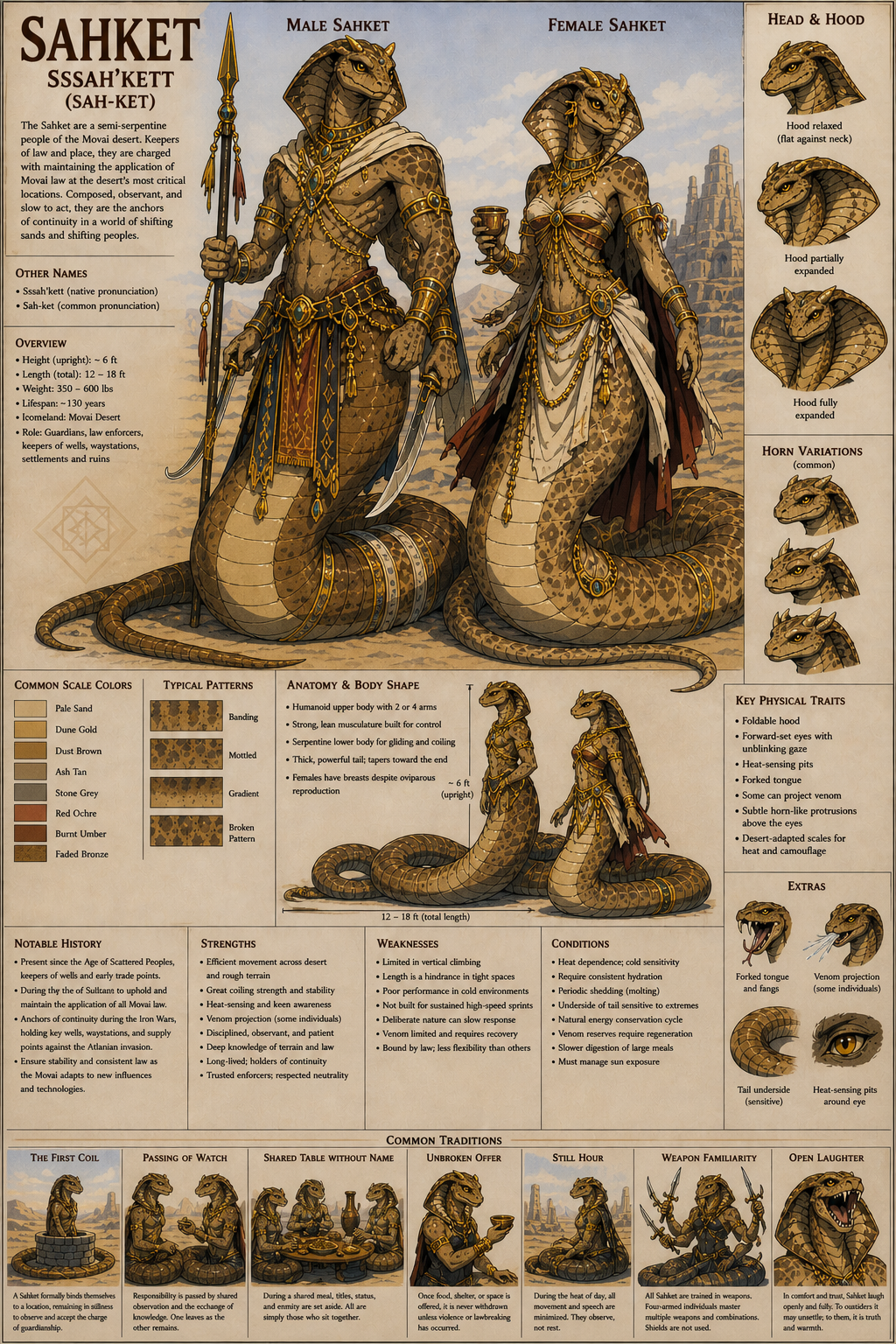
The Sahket are a semi-serpentine people of the Movai desert, combining a humanoid upper body with a long, powerful tail that allows them to glide across sand with smooth, controlled motion. An average individual presents a calm, deliberate presence, rarely moving more than necessary and often remaining partially coiled when at rest. Their wedge-shaped head is framed by a foldable hood that lies flat when relaxed but can expand into a broad, imposing mantle when needed, while forward-set eyes and an unblinking gaze give them an intensely observant and measured expression.
Their scales are typically muted desert tones—sand, brown, ash, or ochre—often layered with subtle patterning that blends naturally into their surroundings. Most appear to stand no taller than about six feet when raised, though their full length extends far beyond that, giving them a grounded, substantial presence. Some individuals bear small horn-like protrusions above the eyes, and many carry themselves with a quiet confidence reinforced by precise, economical movement.
In behavior, an average Sahket is composed, watchful, and slow to act, preferring to observe before committing to motion. They speak with controlled cadence and rarely waste words, yet can shift unexpectedly into warmth in social settings, particularly during shared meals where they become more physically expressive and open. To those unfamiliar with them, they may seem distant or unsettling at first, but over time reveal themselves to be consistent, deliberate, and deeply rooted in the places they inhabit.
Sssah’kett (native pronunciation , Sah-ket (common pronunciation)
Looks
The Sahket are a semi-serpentine people whose form is built for endurance, control, and stability in the harsh conditions of the Movai desert. Their upper body is broadly humanoid, beginning at the shoulders and extending to the hips, though it tends toward a more elongated and streamlined proportion than that of most human peoples. From just below the hips, their body transitions into a long, powerful serpentine tail that serves as their primary means of movement.
This tail is thick and heavily muscled near the base, gradually tapering toward the end, allowing for both steady gliding motion across sand and sudden bursts of speed when necessary. When at rest, Sahket often coil portions of their lower body beneath or around themselves, creating a stable, grounded posture that reinforces their naturally composed presence.
Their upper torso is supported by a strong but lean musculature, favoring control and precision over brute strength. Individuals possess between two and four arms, with additional limbs integrated seamlessly into the shoulder structure. These extra arms do not appear unnatural or vestigial, instead functioning with the same dexterity and coordination as the primary pair, allowing for complex tasks, combat techniques, or ritual gestures.
Despite their serpentine nature, the Sahket retain certain mammalian traits, most notably in females, whose forms include developed breasts despite their oviparous reproduction. This duality does not carry cultural significance among the Sahket themselves, existing simply as a natural aspect of their physiology.
Overall, the Sahket present a form that is less imposing through sheer size and more through posture and control—long, coiled, and deliberate, they give the impression of a body that wastes no motion and is always ready to act with precise intent.
Some Sahket exhibit horn-like protrusions above the eyes, The exact function of these horns is not fully understood, though they are believed to serve a combination of purposes, including:
breaking up the outline of the head when partially buried in sand
shielding the eyes from wind-driven الرمال and debris
providing minor protection during strikes or close physical encounters
The presence, size, and shape of these horns vary naturally among the Sahket and do not inherently indicate status or rank, though in some regions they may be viewed as aesthetically favorable or distinctive.
Like many aspects of Sahket physiology, these features are treated as a matter of natural variation rather than cultural significance, though they can contribute to an individual’s presence and recognizability.
The Sahket possess a range of scale coloration adapted to the shifting environments of the Movai desert, favoring muted, natural tones that aid in camouflage and heat management rather than vibrancy. Most individuals display layered coloration rather than a single uniform hue, combining base tones with subtle banding, mottling, or gradient transitions. Common colors include pale sand, dune gold, dust brown, and ash tan, reflecting the sun-bleached dunes, dry earth, and weathered stone of their environment. Regional and lineage variations may introduce tones such as stone grey near ruins and rocky outcroppings, red ochre in iron-rich regions, burnt umber among darker bloodlines, and faded bronze with a dull, non-reflective sheen. Patterning is typically low-contrast and functional, with soft banding along the tail, mottled spotting for camouflage, and gradual transitions from lighter underbellies to darker dorsal surfaces to break up their outline when still. The hood and cranial scales often differ slightly in tone, tending toward darker or more defined coloration, sometimes bearing faint patterns that become more visible when the hood is expanded, subtly reinforcing individual presence and recognition. The underside is generally lighter, ranging from pale cream to faded sand, aiding in thermal balance. Overall, Sahket coloration appears desert-muted, layered, and practical, giving the impression that they are a natural extension of the landscape itself until they choose to move.
The Sahket do not measure height in the same way as fully upright peoples, as their bodies are primarily supported by a serpentine lower half. When raised into an upright posture, most Sahket deliberately limit their visible height to around six feet, presenting themselves at a level comparable to other desert peoples. This is a conscious behavioral choice rather than a physical limitation, reflecting a cultural preference for controlled presence over overt displays of size.
In reality, Sahket are significantly longer than their apparent height suggests. From head to tail tip, individuals commonly reach lengths of twelve to eighteen feet, with some exceeding this range depending on age, lineage, and environmental factors. Much of this length is typically coiled, grounded, or extended along the terrain, allowing them to maintain stability and conserve energy.
When fully extended or elevated beyond their usual posture, a Sahket can appear considerably larger and more imposing than expected. However, such displays are uncommon outside of combat, threat response, or deliberate acts of intimidation. Under normal circumstances, their restrained height and coiled posture contribute to their characteristic demeanor—measured, composed, and never excessive.
The Sahket are significantly heavier than their controlled, often restrained posture suggests, with most individuals weighing between 350 and 600 pounds depending on their overall length, build, and age. Despite commonly presenting themselves at a modest upright height, their true mass is distributed along a long, muscular body, with the greatest concentration found in the upper portion of the tail and core. This structure provides both stability and powerful coiling strength while maintaining efficient movement across the desert. Their build favors dense, functional musculature over excess bulk, allowing them to endure harsh conditions without unnecessary energy expenditure. Individuals possessing four arms tend to be slightly heavier on average, as the additional limbs are supported by increased musculature in the shoulders and upper torso. Overall, their weight is not immediately apparent in their composed stance, but becomes evident in motion, where their presence carries a grounded, deliberate heaviness.
The Sahket possess a number of physiological traits beyond their obvious serpentine form, many of which contribute directly to their effectiveness as observers, guardians, and enforcers within the Movai desert.
Some Sahket are capable of projecting venom over short distances, expelling it from specialized fangs with controlled force. This is most often used as a deterrent rather than a killing method, typically aimed at the eyes or exposed skin to cause intense pain, disorientation, or temporary blindness. The ability is not universal among all Sahket, appearing more commonly in certain lineages, and its use is considered a serious escalation rather than a casual act.
Subtle heat-sensing pits along the face allow Sahket to detect minute differences in temperature, granting them awareness of movement and presence even in darkness, sandstorms, or behind partial cover. This makes them exceptionally difficult to ambush and contributes to their reputation for noticing what others cannot.
A forked tongue provides additional environmental sensing through scent and airborne traces, though it is used sparingly and with control. Frequent or exaggerated use is considered uncultured, reinforcing the Sahket tendency toward deliberate, restrained behavior.
The cranial structure, including the head and foldable hood, is reinforced with thicker, more durable scales than the rest of the body. This provides protection during close encounters and enhances their ability to use posture as both communication and deterrence.
Some Sahket also exhibit horn-like protrusions above the eyes, similar to those of desert horned vipers. These structures help break up the outline of the head when partially buried in sand and provide minor protection from wind-driven debris. Their presence varies naturally and does not indicate status.
Despite their size and weight, Sahket are capable of moving with remarkable quiet across sand and stone. Their motion is smooth and controlled, producing minimal sound when unhurried, reinforcing their role as ever-present watchers rather than overt enforcers.
Together, these features make the Sahket highly perceptive, difficult to surprise, and capable of responding with precision when necessary, embodying a presence that is controlled, observant, and only dangerous when required.
The Sahket exhibit a high degree of physical variation across individuals, shaped by lineage, environment, and the specific regions of the Movai desert they inhabit. While their overall form remains consistent, differences in size, proportion, and minor features are common and widely accepted as natural.
Total length can vary noticeably, with some individuals presenting longer, more slender builds suited for extended travel, while others are shorter but more heavily muscled, favoring strength and stability. Tail thickness, coil density, and overall mass distribution may differ accordingly, influencing how an individual moves, rests, and carries themselves.
Arm count is another point of natural variation, with Sahket possessing either two or four arms. Four-armed individuals tend to have broader upper torsos and increased musculature to support the additional limbs, often resulting in a heavier overall build. These differences do not inherently determine role or status, though they may influence personal capability and specialization.
Cranial features also vary, most notably in the presence or absence of horn-like protrusions above the eyes, as well as differences in hood shape, width, and structure. Some Sahket possess wider, more imposing hoods, while others have narrower, more streamlined forms. Facial structure, eye shape, and scale patterning further contribute to individual distinction.
Sexual Dimorphism
Sexual dimorphism among the Sahket is present but not extreme, expressed primarily through differences in build, proportion, and subtle anatomical traits rather than drastic changes in form.
Females typically present slightly fuller upper torsos, including developed breasts despite their oviparous reproduction, along with marginally wider midsections where the humanoid torso transitions into the serpentine body. Their overall build often emphasizes balance and endurance.
Males tend toward a more angular musculature, with slightly narrower torsos and more pronounced definition in the shoulders and upper body. In some cases, males may exhibit slightly longer average tail lengths, though this is not a strict rule.
In both sexes, variation remains significant, and individual differences often outweigh general trends. Sahket do not place strong cultural emphasis on these distinctions, viewing them as natural aspects of form rather than defining characteristics.
Overall Impression
Taken together, Sahket physical variation is best described as broad but cohesive—a people unified by form and function, yet diverse in the details that shape their presence, movement, and individuality.
Sahket clothing follows the same foundational principles as that of the Movians and Tarkibi—managing heat, light, and exposure while preserving freedom of movement—but is adapted to accommodate their elongated, semi-serpentine form. As with other peoples of the Movai, the sun is treated as a greater threat than modesty, and their garments are designed first and foremost for environmental control rather than concealment.
Indoors, within shaded or enclosed spaces, Sahket favor minimal, breathable fabrics across the humanoid portion of their body. Light silks, loose wraps, and draped garments are commonly worn across the shoulders, chest, and arms, often leaving portions of the torso exposed for comfort. Their serpentine lower half is typically left uncovered in these conditions, allowing for natural heat dissipation and ease of movement, though some may rest upon thin cloths or cushions when stationary.
Outdoors, their clothing becomes more structured and layered, particularly along the upper body. Flowing robes, layered wraps, and adjustable veils are worn to shield the head, hood, shoulders, and torso from direct sunlight. These garments are often designed to drape without restricting the expansion of the hood, incorporating loose collars, open backs, or split structures that allow the mantle to unfurl without obstruction. Face coverings and head wraps are commonly used, though adapted to sit comfortably around the cranial structure and folded hood.
The lower body presents the greatest adaptation. Rather than full coverage, Sahket typically employ segmented wrappings, trailing cloths, or partial drapes along sections of the tail. These serve to:
protect against heated الرمال (sand) and abrasive surfaces
reduce direct sun exposure along the dorsal side
allow full flexibility and coiling without entanglement
These coverings are often modular, secured in sections, and easily adjusted or removed depending on terrain and temperature. Full enclosure of the tail is rare, as it would trap heat and restrict movement.
Materials mirror those used by other desert peoples—fine woven cloth and desert-suited fibers that breathe well, dry quickly, and resist clinging under heat. Heavier materials are used sparingly, typically only in reinforced sections near the shoulders or for travel gear.
Gold adornment is as prominent among the Sahket as it is among the Movians. Jewelry is worn across the upper body, arms, and neck, as well as along the tail in the form of rings, bands, or chained segments. These adornments catch the light with movement, though Sahket tend to wear them in a more measured and deliberate fashion, avoiding excess that might interfere with motion.
Footwear is largely absent due to their form, though some Sahket may use protective wrappings or fitted coverings along the underside of the tail when traveling across particularly harsh terrain.
Ultimately, Sahket clothing reflects the same philosophy as the wider Movai: it is not about covering the body, but about controlling how much of the desert is allowed to touch it—adapted through a form that coils, glides, and endures where others walk.
Traits
The Sahket possess a range of strengths shaped by their serpentine physiology, desert environment, and deeply ingrained cultural discipline. Individually, these traits make them capable; together, they make them exceptionally reliable in harsh and controlled conditions alike.
Their serpentine lower body provides powerful, efficient movement across sand and uneven terrain, allowing them to travel without the fatigue typically associated with long-distance movement in the desert. This same structure grants them significant coiling strength, enabling them to anchor themselves securely, resist displacement, and exert controlled force when necessary.
Sahket exhibit a high degree of bodily control and balance, supported by dense, functional musculature. Whether moving, striking, or remaining still, they waste little motion, conserving energy and maintaining stability even in shifting الرمال (sand) or confined spaces.
Their sensory capabilities further enhance their effectiveness. Heat-sensing pits allow them to detect subtle thermal differences, making them highly aware of movement and presence even in low visibility conditions such as darkness or sandstorms. This makes them particularly difficult to surprise or ambush. Their controlled use of scent through a forked tongue adds another layer of environmental awareness.
Some Sahket possess the ability to project venom, providing them with a ranged deterrent that can incapacitate or disorient opponents without requiring close engagement. This ability is used sparingly but effectively, often ending conflicts before they escalate further.
In addition to their physical traits, Sahket benefit from a cultural emphasis on restraint, observation, and deliberate action. They do not rush to respond, instead assessing situations carefully before committing to movement or force. This measured approach reduces unnecessary risk and allows them to act with precision when required.
Their long-term presence in fixed locations also gives them a deep familiarity with their surroundings. Whether guarding a waystation, settlement, or ruin, a Sahket is rarely unaware of the terrain, structures, or patterns of movement within their domain.
Finally, their adherence to the Law of Water and broader cultural respect for justice provides them with a level of trust uncommon in harsh environments. They are often viewed as consistent and reliable figures, capable of enforcing order without instability, which further strengthens their role as guardians within the Movai desert.
Despite their many strengths, the Sahket possess a number of limitations shaped by their physiology, environment, and cultural disposition.
Their serpentine lower body, while highly effective in desert terrain, is less suited to environments that require vertical movement or complex climbing. Stairs, ladders, and narrow vertical passages can present challenges, often forcing them to rely on ramps, gradual inclines, or constructed accommodations. In dense urban environments not designed with them in mind, their mobility can be restricted.
Their overall length, while advantageous in open terrain, can become a hindrance in confined or cluttered spaces. Tight interiors, crowded streets, or heavily obstructed environments limit their ability to maneuver efficiently, reducing both speed and responsiveness.
Sahket are also highly specialized for arid climates. Extended exposure to cold environments can impair their mobility and reaction time, as their bodies are adapted for heat retention and desert conditions. In such climates, they may become sluggish or require external heat sources to maintain normal function.
While capable of controlled bursts of speed, Sahket are not built for sustained rapid acceleration compared to some fully bipedal or more lightly built peoples. Their movement favors endurance and efficiency over quick, repeated sprints, making them less effective in prolonged high-speed pursuits.
Their reliance on controlled, deliberate action can also become a disadvantage in rapidly changing or chaotic situations. Sahket tend to assess before acting, which, while usually beneficial, can lead to hesitation when immediate reaction is required. Opponents who exploit unpredictability or constant pressure may disrupt their preferred pace of engagement.
Not all Sahket possess venom projection, and even among those who do, its use is limited. It is not an endlessly repeatable ability and must be used with care, reducing its reliability in prolonged engagements.
Finally, their cultural role as enforcers of law—particularly the Law of Water—places constraints on their behavior. Sahket are not free to act purely on personal impulse, especially within settlements or along established routes. Their actions are expected to align with legal and cultural expectations, which can limit flexibility in situations where a less restrained individual might act more freely.
Heat Dependence – Require warm environments to maintain full mobility and reaction speed
Cold Sensitivity – Slowed movement, stiffness, and reduced function in low temperatures
Hydration Regulation – Efficient water retention, but still require consistent intake
Molting (Shedding) – Periodic shedding of outer scales, causing temporary vulnerability
Surface Sensitivity – Underside of tail sensitive to extreme heat, cold, or rough terrain
Energy Conservation Cycle – Naturally favor periods of stillness between activity
Venom Regeneration – Limited venom reserves that require time to replenish
Digestive Pace – Slower digestion of large meals, requiring periods of reduced activity
Sun Exposure Management – Balance between necessary warmth and overexposure risk
The Sahket are physiologically adapted to the harsh conditions of the Movai desert, but this specialization comes with specific biological requirements and limitations. They are inherently dependent on heat to maintain optimal bodily function; in warm environments, they exhibit full mobility and responsiveness, while prolonged exposure to cold can lead to stiffness, slowed reactions, and reduced overall capability. Though highly efficient at retaining moisture, Sahket still require regular access to water, particularly under sustained exertion, making hydration a managed necessity rather than a constant demand.
Like many scaled creatures, Sahket undergo periodic molting, shedding their outer layer of skin over time. During these periods, they may experience irritation, dulled coloration, and increased vulnerability, often seeking secure or familiar locations until the process is complete. Their serpentine underside, while durable, remains sensitive to extreme surfaces, with excessive heat, cold, or abrasive terrain causing discomfort or injury over prolonged contact.
Sahket naturally operate in cycles of activity and stillness, conserving energy through extended periods of minimal movement. This behavior is not lethargy, but an efficient adaptation to their environment. Their venom, when present, is not limitless and requires time to regenerate after use, reinforcing their tendency toward deliberate, measured escalation in conflict. Similarly, their digestion is slower when consuming large meals, often requiring reduced activity as their bodies process intake.
Finally, while the sun is essential to their function, it must be managed carefully. Sahket rely on clothing, posture, and their hood to regulate exposure, balancing the need for warmth with the risks of overexertion and dehydration. In all aspects, their condition reflects a body finely tuned to the desert—efficient, resilient, but dependent on maintaining the balance that environment demands.
Culture
The Sahket maintain a long and deeply rooted tradition of guardianship, tracing back to the founding of the Sultanate itself. From their earliest recorded history, they have been associated with the protection of vital places—oases, waystations, settlements, and ruins—forming a continuous cultural identity centered on watchfulness, responsibility, and endurance. To a Sahket, remaining in place and fulfilling a duty over time is not simply work, but a defining expression of who they are.
Martial training is a fundamental part of Sahket life, expected of nearly all individuals regardless of role. They are trained extensively in the use of both single-handed and two-handed weapons, with a strong emphasis on adaptability, control, and precision. This expectation is even more pronounced among four-armed individuals, who are often trained to wield multiple weapons simultaneously—whether four single-handed weapons, two two-handed weapons, or a combination of both. Despite this, Sahket do not make use of shields, instead relying on skill, positioning, and bodily control to defend themselves. Their combat style reflects their broader nature: deliberate, efficient, and without wasted motion.
Beyond their martial and guardian traditions, the Sahket place a strong cultural value on hospitality and shared experience. They are notably open in offering food and company to others, and it is considered improper to deny someone the opportunity to sit and eat among them, regardless of species or affiliation. These shared meals are not treated as formal rituals, but as natural extensions of coexistence, where conversation, observation, and quiet understanding are allowed to develop.
Despite their often composed and controlled demeanor, Sahket are capable of sudden and genuine warmth in social settings. They are known to laugh openly and heartily, often with an unrestrained, open-mouthed expression that reveals their full dentition. While they are aware that this can be unsettling to other peoples, they do not suppress it entirely, viewing such reactions as a matter of perspective rather than something to be hidden.
The Sahket maintain a number of distinct cultural traditions that reinforce their roles as guardians and observers. Rituals such as the First Coil formally bind an individual to a place, while the Passing of Watch ensures continuity of knowledge and presence across generations. Social customs like the Shared Table Without Name and the Unbroken Offer reflect their commitment to controlled neutrality and hospitality, even among potential adversaries. Periods of deliberate stillness, such as the Still Hour, reinforce their cultural emphasis on observation over action. Even their martial expectations are formalized through rites of demonstrated competency rather than celebration. Together, these traditions define a people who do not simply live within the desert, but maintain a structured, enduring relationship with it through discipline, memory, and presence.
The Sahket maintain a number of distinct traditions that reinforce their identity as guardians of place, observers of continuity, and participants in the broader cultural framework of the Movai desert. Among the most significant is the First Coil, a ritual performed when a Sahket assumes responsibility for a location. In this act, they coil themselves around a central feature—such as a well, ruin marker, or settlement structure—and remain in complete stillness for an extended period, observing without speech or movement. This signifies a binding of self to place, marking the beginning of their role as its guardian. Equally important is the Passing of Watch, in which responsibility is transferred directly between individuals. Rather than formal ceremony, both Sahket occupy the site together for a time, silently observing before exchanging a measured recounting of relevant knowledge—events, patterns, and notable presences—ensuring continuity without interruption. The transition is quiet and deliberate, with one departing as the other remains, maintaining an unbroken presence.
In social contexts, the Sahket practice what is known as the Shared Table Without Name, a custom in which individuals gathered to eat set aside titles, affiliations, and status for the duration of the meal. This creates a temporary space of neutrality and shared experience, where even those of differing loyalties may sit together without immediate conflict. Once an offer of food or space has been made, it is upheld through the tradition of the Unbroken Offer, which dictates that such hospitality cannot be withdrawn unless violence has already begun or law has been directly violated. These customs reflect a broader commitment to controlled interaction and respect for structured conduct.
Sahket also observe the Still Hour, a period during the hottest part of the day in which movement and speech are minimized. During this time, individuals remain alert and observant rather than resting, reinforcing their cultural emphasis on awareness and energy conservation. This can result in entire areas where Sahket sit or coil in near-perfect stillness, quietly monitoring their surroundings. Complementing this is their approach to martial expectation, often referred to as the Weapon Familiarity Rite, though it is less a ceremony and more a standard of adulthood. All Sahket are expected to demonstrate competence with both single-handed and two-handed weapons, while four-armed individuals must master multiple configurations, including the simultaneous use of several weapons. This expectation reflects their belief that readiness is not exceptional, but required.
Finally, despite their often controlled demeanor, the Sahket embrace open, unrestrained laughter in appropriate company. This expression is considered a sign of trust and comfort, even if it may appear unsettling to outsiders due to its open-mouthed nature. Together, these traditions illustrate a people defined by continuity, discipline, and measured openness—those who bind themselves to place, uphold law through action, and maintain a quiet but enduring presence within the Movai desert.
Sahket belief aligns closely with the broader Movian understanding that justice is a real and active force, but differs in how that force is approached and maintained. Where many Movians emphasize debate, interpretation, and the continual refinement of law through discourse, the Sahket place greater importance on observation, continuity, and consistent application. To them, justice is not only something to be argued—it is something to be held in place over time.
They believe that a law proves its worth not only through reasoning, but through endurance. A rule that continues to function across years, generations, and changing conditions is seen as inherently closer to true justice than one that exists only in theory or argument. Because of this, Sahket tend to favor measured interpretation over rapid change, reinforcing existing structures unless there is clear and undeniable reason to alter them.
Central to their belief is the idea that place and law are intertwined. A settlement, a well, or a ruin is not simply a location—it is a point where law has been applied, tested, and maintained. By remaining in these places, observing them, and ensuring continuity, Sahket believe they are actively preserving the integrity of justice itself. Their role as guardians is therefore not just practical, but philosophical: to allow law to exist uninterrupted within the world.
While they recognize the authority of the Sultan as the primary interpreter of justice, Sahket do not view authority as something that must constantly assert itself. Instead, they see it as something that must remain consistent and stable, much like their own presence. They are less inclined toward active political debate, but when they do speak on matters of law, it is typically from a position of accumulated observation rather than abstract reasoning.
Sahket also place strong emphasis on measured action. Acting too quickly, without sufficient understanding, is seen as a failure to respect the complexity of justice. In their view, restraint is not hesitation—it is discipline. A correct action taken at the right moment holds more value than many taken in haste.
Despite this controlled approach, Sahket do not separate justice from coexistence. Their traditions of shared meals, open hospitality, and the suspension of status during communal moments reflect a belief that understanding others is part of maintaining balance. Justice, in their view, must exist not only in enforcement, but in how people are allowed to interact within its structure.
Finally, the Sahket share the broader desert belief that endurance is proof of correctness, but interpret it through stillness rather than movement. Where others may prove themselves by crossing the desert, the Sahket prove themselves by remaining—by holding a place, a law, and a responsibility without faltering over time.
The Sahket are a fully integrated part of the broader Movian governance system, participating in its political, legal, and social structures while maintaining a distinct role shaped by their long-standing traditions of guardianship and continuity. In a cosmopolitan society where any race may rise to positions of authority—including that of Sultan—the Sahket are neither separate from nor subordinate to the system, but represent a specialized and influential presence within it.
Like other peoples of the Movai, Sahket may serve as:
regional leaders
council representatives
legal authorities
or, in rare cases, even Sultan
Their participation in governance follows the same foundational structure of debate, agreement, and layered law. However, their approach to politics differs in emphasis. Where many leaders argue, negotiate, and reinterpret, Sahket tend to contribute through measured input, long-term perspective, and observed precedent.
In addition to their role as political participants, Sahket maintain their traditional function as guardians of key locations—wells, waystations, settlements, and ruins. These roles are not separate from governance, but rather an extension of it. A Sahket assigned to such a place is recognized not only as a protector, but as a local authority in matters of law enforcement and continuity, particularly regarding foundational principles such as the Law of Water.
This creates a dual position:
As political actors, they engage in the same systems of debate and decision-making as others
As guardians, they provide stability at the points where law meets reality
Because of their long-term presence and consistent observation, Sahket are often relied upon as:
witnesses to precedent
sources of historical continuity
and stabilizing voices in disputes involving long-standing law
Their testimony carries weight not because of rank, but because of duration and consistency.
Despite this influence, Sahket do not dominate governance. Civil administration—trade, taxation, daily leadership—remains distributed among the broader population, reflecting the Movian commitment to shared authority. Instead, Sahket function as a balancing force within the system, ensuring that law is not only created and debated, but also applied consistently over time.
Their presence helps prevent fragmentation in a system that values autonomy, while their participation in politics ensures they are not detached from the evolving interpretation of justice.
Sahket technology exists fully within the broader Movian approach of adaptation and practical refinement, but is shaped heavily by their physiology, longevity, and role as guardians of fixed locations. Rather than focusing on rapid innovation or large-scale production, Sahket tend to specialize in durability, maintenance, and long-term reliability, particularly in environments where failure would have immediate consequences.
Their contributions are most evident in the design and upkeep of critical infrastructure, especially at wells, waystations, and settlement centers. Systems associated with water storage and distribution are often reinforced, simplified, and made resistant to sand intrusion, wear, and neglect. Sahket favor designs that can be easily inspected, repaired, and understood over time, ensuring that essential systems remain functional even across generations of use.
Their physical form has also influenced architectural and mechanical design in subtle but important ways. Spaces under Sahket influence often feature:
gradual inclines and ramps instead of stairs
wide, unobstructed pathways to accommodate their length and coiling movement
low-profile mechanisms that can be operated without requiring upright posture
Tools and equipment are similarly adapted. Controls may be:
positioned lower to the ground
spaced for use with multiple arms
or designed for stable operation from a coiled position
Four-armed individuals, in particular, are capable of manipulating multiple tools or components simultaneously, which has led to techniques that emphasize parallel handling of tasks, especially in maintenance, assembly, and repair work.
Sahket also excel in the long-term preservation and interpretation of older technologies, particularly those found in ruins. Their extended presence at specific sites allows them to develop a deep familiarity with structures and mechanisms that others might only encounter briefly. While they do not always fully understand the original design of such systems, they are highly effective at keeping them functional, stabilizing damaged components, and integrating them into existing infrastructure when possible.
In terms of warfare and personal equipment, Sahket follow the broader Movian trend of adaptation. Weapons and gear are modified for use without reliance on shields, emphasizing balance, control, and compatibility with multiple arms. Equipment is kept durable and simple, avoiding unnecessary complexity that could fail under desert conditions.
Despite their capabilities, Sahket do not drive technological expansion on their own. They rely on the wider Movian system—trade, conflict, and exchange—for new materials and ideas. Their strength lies in what happens after acquisition: refining, maintaining, and ensuring that what is built continues to function over time.
Ultimately, Sahket technology reflects a philosophy aligned with their beliefs—what matters is not how quickly something is created, but how long it continues to work.
Sahket occupations are shaped by their long-standing role as guardians, their integration within Movian society, and their physical and cultural predispositions toward stability, observation, and controlled action. While they are capable of filling nearly any role within the broader system, they tend to gravitate toward positions that benefit from long-term presence, reliability, and measured judgment.
The most defining occupation among the Sahket is that of guardian, in which an individual is assigned to oversee a specific location such as a well, waystation, settlement, or ruin. In this role, they are responsible for maintaining order, enforcing foundational laws—particularly the Law of Water—and ensuring the continued stability of the site. This position is not temporary; many Sahket remain associated with a single location for extended periods, sometimes for the majority of their lives.
Closely related to this are roles as lawkeepers and arbiters, where Sahket serve in the interpretation and application of law at the local level. Their reputation for restraint and consistency makes them well-suited to resolving disputes, especially those involving long-standing precedent or shared resources.
Sahket are also commonly found as watchers and record-keepers, though their methods differ from written tradition. They rely heavily on memory, observation, and continuity, acting as living accounts of events, patterns, and changes within the places they oversee. Their testimony is often valued in both local and broader political contexts.
In more technical roles, Sahket frequently work as infrastructure stewards, maintaining wells, cistern systems, and other critical desert mechanisms. Their patience, physical stability, and ability to work from a grounded position make them particularly effective at long-term maintenance and repair tasks.
Martial occupations are also common. Many Sahket serve as soldiers, caravan escorts, or settlement defenders, applying their extensive weapon training in practical contexts. Their fighting style emphasizes control and precision, making them especially effective in defensive engagements or controlled confrontations.
Due to their physical form and environmental familiarity, some Sahket take on roles as guides or pathwardens, overseeing safe passage along known routes, particularly in areas where terrain or conditions are unpredictable. These roles often overlap with their guardian duties.
Sahket also participate in broader society through roles such as traders, advisors, and political representatives, though even in these positions they tend to operate with a measured and deliberate approach. Those involved in governance often act as stabilizing voices, contributing long-term perspective rather than rapid argument.
While less common, some Sahket pursue craft and technical work, particularly in areas that benefit from multi-limbed manipulation or sustained, careful effort. Their contributions in these fields tend to focus on durability and function rather than artistic expression or rapid production.
Overall, Sahket occupations reflect a people who do not seek constant change or movement, but instead excel in roles that require presence, patience, and the steady application of skill over time.
Sahket economics are not defined by large-scale production or constant movement, but by their control of stable, high-value locations within the broader Movian trade network. Fully integrated into the Movai economic system, they participate in trade and resource exchange like any other people, but their primary economic influence comes from their role as guardians of the places where trade converges and survival is sustained.
At wells, waystations, and settlement hubs, Sahket serve as anchors of economic continuity, ensuring that trade routes remain functional and that essential resources—particularly water—are distributed in accordance with established law. While they do not deny access without cause, their presence ensures that exchanges remain structured, fair, and consistent, reinforcing the trust necessary for long-distance trade across the desert.
Rather than extracting wealth directly, Sahket often benefit through association with the locations they oversee. Settlements under their watch tend to attract more stable trade, as merchants and travelers place confidence in the reliability of law enforcement and the reduced risk of disruption. This indirect influence allows Sahket to accumulate wealth through:
service roles
advisory positions
trade participation
and long-term agreements tied to specific sites
Sahket individuals may also engage directly in commerce, particularly in roles that benefit from their reputation for consistency. They are often trusted as:
intermediaries in disputes
overseers of agreements
or guarantors of fair exchange
Their word carries weight not because of formal authority, but because their cultural and social expectations strongly discourage inconsistency or impulsive behavior.
In terms of material wealth, Sahket participate in the broader Movian use of gold as both currency and visible status. However, they tend to display it in a more measured manner, favoring functional adornment that does not interfere with movement or duty. Wealth among the Sahket is often accumulated gradually and retained over long periods, reflecting their tendency toward permanence rather than rapid gain.
Their long-term presence at specific sites also allows them to develop deep familiarity with local resource patterns, trade flows, and environmental conditions. This knowledge can be leveraged economically, whether through advising trade groups, optimizing resource use, or identifying shifts in supply and demand before they become widely apparent.
Despite this influence, Sahket do not dominate the economic system. They rely on the broader Movian network—particularly mobile groups like the Tarkibi—for transport, large-scale trade, and resource acquisition. In return, they provide the stability and trust that allow those systems to function effectively.
Ultimately, Sahket economics are defined less by what they produce and more by what they preserve. They ensure that trade can continue, that resources are distributed reliably, and that the structures supporting the Movai economy remain intact over time.
Sahket dietary preferences reflect both their serpentine physiology and their integration within the broader Movai cultural sphere. While fully capable of consuming the same foods as Movians and Tarkibi, they tend to favor meals that are efficient to eat, easy to portion, and suited to controlled consumption. Their flexible jaws allow them to consume larger pieces than most peoples, but culturally they avoid overt displays of this ability in shared settings, instead preparing food in manageable portions that align with communal norms.
Protein-rich foods are particularly favored, especially those that can be preserved or prepared in ways that withstand desert conditions. Roasted meats, dried cuts, and slow-cooked dishes are common, often seasoned with desert herbs and oils. Fish from oasis and trade sources are also valued, particularly when dried or smoked for longevity. Softer foods, such as stews or grain-based dishes, are appreciated for their ease of consumption and hydration benefits.
Sahket also place importance on meals as shared experiences. Their cultural practice of open hospitality means that food is rarely treated as exclusive, and they take particular enjoyment in meals that can be shared among mixed groups, allowing for conversation and observation. Foods that can be portioned, passed, or eaten gradually are especially favored in these contexts.
Despite their controlled eating habits, Sahket do enjoy strong flavors. Spiced oils, salted preparations, and subtly sweet elements are common, though rarely overwhelming. Their preferences tend toward balance—flavorful but not excessive, filling but not indulgent—reflecting their broader cultural emphasis on restraint and function.
Common and Favored Dishes
Spiced Desert Roast – Slow-roasted goat or mutton, seasoned with oil, salt, and ground desert herbs
Sun-Dried Meat Strips – Preserved cuts of meat, lightly salted and dried for travel and long-term storage
Oasis Fish Wraps – Smoked or grilled fish wrapped in thin flatbread with herbs and oil
Stone Pot Stew – A slow-cooked mixture of meat, grains, and root vegetables, often shared communally
Barley and Oil Mash – Soft, filling grain dish mixed with olive oil and seasoning for easy consumption
Salted Egg Clusters – Preserved eggs prepared in brine, valued for both nutrition and longevity
Herbed Flatbread – Thin, flexible bread used to carry meats, oils, or stews
Date and Nut Press – Dense, sweet mixture of dates and crushed nuts, often eaten in small portions
Smoked Poultry Cuts – Lightly preserved bird meat, commonly eaten in strips or small sections
Oil-Cured Olives – A staple shared across Movai peoples, providing salt and flavor
History
Sahket history is not defined by sweeping empires or singular conquests, but by their continuous presence at the critical points where Movai civilization holds together. Their role becomes most visible during moments when structure is established, tested, or nearly broken.
In the Age of Scattered Peoples, before the rise of the Sultanate, Sahket existed among the many desert groups but were already associated with fixed locations—wells, ruins, and early trade points. While other peoples moved, fought, and shifted alliances, Sahket were noted for remaining in place, informally maintaining order around the few stable resources that allowed desert life to persist. Though not unified, this period established their earliest identity as keepers of continuity in a landscape defined by instability.
Their role became formalized during the rise of the Sultanate under the first Sultan. As the desert transitioned from endless tribal conflict into a system governed by shared law, it became clear that law alone was not enough—it had to be enforced consistently across distance and time. Recognizing the Sahket’s natural inclination toward stillness, observation, and long-term presence, the Sultan formally charged them with the responsibility of upholding and maintaining the application of law at the desert’s most critical locations. This was not limited to a single decree such as the Law of Water, but extended across the growing body of Movai law. Over time, this charge became embedded within Sahket identity, transforming an existing pattern of behavior into a recognized and expected role within the structure of governance.
As the Sultanate expanded and the system of layered law developed, Sahket became increasingly important in maintaining its stability. With tens of thousands of laws accumulating over generations, their ability to observe, remember, and apply precedent at specific sites made them essential in preventing fragmentation. While Movian leaders debated and reinterpreted law at the center, Sahket ensured that those interpretations were consistently carried out at the edges, where disagreement and distance might otherwise erode cohesion.
During the expansion of trade routes, Sahket presence at waystations and crossroads helped transform the Movai from a fractured desert into a reliable trade network. Merchants and travelers came to recognize Sahket-guarded locations as stable points where law was upheld and agreements were respected. This contributed to the gradual shift of the desert from a place of constant conflict to one of controlled exchange, without eliminating the underlying tensions between its peoples.
In the Iron Wars at the end of the Fifth Age, while the Tarkibi served as the primary mobile force resisting Atlanian invasion, the Sahket played a less visible but equally critical role. They held and maintained key positions—wells, fortified waystations, and supply points—ensuring that desert forces could continue to operate and that the invading army could not easily secure or disrupt essential resources. Their refusal to abandon these locations, even under pressure, contributed to the broader strategy of endurance that ultimately broke the invading force.
In the modern era, as the Movai becomes increasingly connected to outside powers and technologies, the Sahket continue to serve as stabilizing elements within a rapidly evolving system. Their role has not diminished, but adapted—ensuring that new laws, tools, and influences are integrated without destabilizing the structures that have allowed the desert to endure.
Notes
Sahket pronunciation carries a distinct sibilant quality that is difficult for non-native speakers to replicate accurately. Among themselves, the name is more precisely rendered as “Sssah’kett”, with the opening sound drawn out in a controlled, steady hiss rather than a loose or exaggerated one. The central consonant is sharp and dry, while the ending is clipped and final. The overall effect is deliberate, controlled, and often slightly unsettling to those unfamiliar with it, though never animalistic in tone. Most other peoples simplify the pronunciation to “Sah-ket,” with variations such as “Sak-et” or “Sa-khet” depending on accent. This difference is immediately noticeable to the Sahket, who rarely correct it but quietly register familiarity and origin through speech alone.
Sahket are notably long-lived, with most individuals reaching around 130 years of age, and exceptional individuals living up to 200 years under stable conditions. This longevity contributes directly to their role within Movai society, allowing them to maintain long-term associations with specific locations and to serve as living points of continuity across generations.
In day-to-day interactions, Sahket tend to allow others more personal space than expected, often maintaining a measured physical distance and a composed, still presence. This restraint, however, shifts dramatically in social settings centered around food. During shared meals, personal space is significantly reduced, and close physical proximity is considered natural. Sahket may position themselves near or partially around others, and it is not uncommon for them to offer food directly by hand, sometimes without being asked. This behavior is not seen as intrusive within their culture, but as an expression of inclusion and shared experience.
Physical contact more broadly is common among the Sahket in trusted settings. They can become noticeably clingy by outside standards, favoring touch as a grounding and social behavior. This may include resting against others, maintaining contact during conversation, or subtle coiling proximity when seated or gathered. While normal among themselves, this can be surprising or uncomfortable for those unfamiliar with their customs.
Their laughter is another defining social trait. Sahket are capable of loud, open-mouthed laughter that fully reveals their dentition. Among Movians and Tarkibi, this is generally accepted as part of their nature, though still striking. To outsiders, however, it is almost always initially unsettling, often interpreted as predatory or aggressive before familiarity sets in. Over time, repeated exposure tends to reframe it as a sign of genuine comfort and openness rather than threat.
Taken together, these behaviors create a distinct social contrast within the Sahket—reserved and distant in ordinary interaction, but intensely close and physically expressive in moments of trust and shared experience.
Overview
Details about this race's overview
Sahket
The Sahket are a semi-serpentine people of the Movai desert, combining a humanoid upper body with a long, powerful tail that allows them to glide across sand with smooth, controlled motion. An average individual presents a calm, deliberate presence, rarely moving more than necessary and often remaining partially coiled when at rest. Their wedge-shaped head is framed by a foldable hood that lies flat when relaxed but can expand into a broad, imposing mantle when needed, while forward-set eyes and an unblinking gaze give them an intensely observant and measured expression.
Their scales are typically muted desert tones—sand, brown, ash, or ochre—often layered with subtle patterning that blends naturally into their surroundings. Most appear to stand no taller than about six feet when raised, though their full length extends far beyond that, giving them a grounded, substantial presence. Some individuals bear small horn-like protrusions above the eyes, and many carry themselves with a quiet confidence reinforced by precise, economical movement.
In behavior, an average Sahket is composed, watchful, and slow to act, preferring to observe before committing to motion. They speak with controlled cadence and rarely waste words, yet can shift unexpectedly into warmth in social settings, particularly during shared meals where they become more physically expressive and open. To those unfamiliar with them, they may seem distant or unsettling at first, but over time reveal themselves to be consistent, deliberate, and deeply rooted in the places they inhabit.
Sssah’kett (native pronunciation , Sah-ket (common pronunciation)
Looks
Details about this race's looks
The Sahket are a semi-serpentine people whose form is built for endurance, control, and stability in the harsh conditions of the Movai desert. Their upper body is broadly humanoid, beginning at the shoulders and extending to the hips, though it tends toward a more elongated and streamlined proportion than that of most human peoples. From just below the hips, their body transitions into a long, powerful serpentine tail that serves as their primary means of movement.
This tail is thick and heavily muscled near the base, gradually tapering toward the end, allowing for both steady gliding motion across sand and sudden bursts of speed when necessary. When at rest, Sahket often coil portions of their lower body beneath or around themselves, creating a stable, grounded posture that reinforces their naturally composed presence.
Their upper torso is supported by a strong but lean musculature, favoring control and precision over brute strength. Individuals possess between two and four arms, with additional limbs integrated seamlessly into the shoulder structure. These extra arms do not appear unnatural or vestigial, instead functioning with the same dexterity and coordination as the primary pair, allowing for complex tasks, combat techniques, or ritual gestures.
Despite their serpentine nature, the Sahket retain certain mammalian traits, most notably in females, whose forms include developed breasts despite their oviparous reproduction. This duality does not carry cultural significance among the Sahket themselves, existing simply as a natural aspect of their physiology.
Overall, the Sahket present a form that is less imposing through sheer size and more through posture and control—long, coiled, and deliberate, they give the impression of a body that wastes no motion and is always ready to act with precise intent.
Some Sahket exhibit horn-like protrusions above the eyes, The exact function of these horns is not fully understood, though they are believed to serve a combination of purposes, including:
breaking up the outline of the head when partially buried in sand
shielding the eyes from wind-driven الرمال and debris
providing minor protection during strikes or close physical encounters
The presence, size, and shape of these horns vary naturally among the Sahket and do not inherently indicate status or rank, though in some regions they may be viewed as aesthetically favorable or distinctive.
Like many aspects of Sahket physiology, these features are treated as a matter of natural variation rather than cultural significance, though they can contribute to an individual’s presence and recognizability.
The Sahket possess a range of scale coloration adapted to the shifting environments of the Movai desert, favoring muted, natural tones that aid in camouflage and heat management rather than vibrancy. Most individuals display layered coloration rather than a single uniform hue, combining base tones with subtle banding, mottling, or gradient transitions. Common colors include pale sand, dune gold, dust brown, and ash tan, reflecting the sun-bleached dunes, dry earth, and weathered stone of their environment. Regional and lineage variations may introduce tones such as stone grey near ruins and rocky outcroppings, red ochre in iron-rich regions, burnt umber among darker bloodlines, and faded bronze with a dull, non-reflective sheen. Patterning is typically low-contrast and functional, with soft banding along the tail, mottled spotting for camouflage, and gradual transitions from lighter underbellies to darker dorsal surfaces to break up their outline when still. The hood and cranial scales often differ slightly in tone, tending toward darker or more defined coloration, sometimes bearing faint patterns that become more visible when the hood is expanded, subtly reinforcing individual presence and recognition. The underside is generally lighter, ranging from pale cream to faded sand, aiding in thermal balance. Overall, Sahket coloration appears desert-muted, layered, and practical, giving the impression that they are a natural extension of the landscape itself until they choose to move.
The Sahket do not measure height in the same way as fully upright peoples, as their bodies are primarily supported by a serpentine lower half. When raised into an upright posture, most Sahket deliberately limit their visible height to around six feet, presenting themselves at a level comparable to other desert peoples. This is a conscious behavioral choice rather than a physical limitation, reflecting a cultural preference for controlled presence over overt displays of size.
In reality, Sahket are significantly longer than their apparent height suggests. From head to tail tip, individuals commonly reach lengths of twelve to eighteen feet, with some exceeding this range depending on age, lineage, and environmental factors. Much of this length is typically coiled, grounded, or extended along the terrain, allowing them to maintain stability and conserve energy.
When fully extended or elevated beyond their usual posture, a Sahket can appear considerably larger and more imposing than expected. However, such displays are uncommon outside of combat, threat response, or deliberate acts of intimidation. Under normal circumstances, their restrained height and coiled posture contribute to their characteristic demeanor—measured, composed, and never excessive.
The Sahket are significantly heavier than their controlled, often restrained posture suggests, with most individuals weighing between 350 and 600 pounds depending on their overall length, build, and age. Despite commonly presenting themselves at a modest upright height, their true mass is distributed along a long, muscular body, with the greatest concentration found in the upper portion of the tail and core. This structure provides both stability and powerful coiling strength while maintaining efficient movement across the desert. Their build favors dense, functional musculature over excess bulk, allowing them to endure harsh conditions without unnecessary energy expenditure. Individuals possessing four arms tend to be slightly heavier on average, as the additional limbs are supported by increased musculature in the shoulders and upper torso. Overall, their weight is not immediately apparent in their composed stance, but becomes evident in motion, where their presence carries a grounded, deliberate heaviness.
The Sahket possess a number of physiological traits beyond their obvious serpentine form, many of which contribute directly to their effectiveness as observers, guardians, and enforcers within the Movai desert.
Some Sahket are capable of projecting venom over short distances, expelling it from specialized fangs with controlled force. This is most often used as a deterrent rather than a killing method, typically aimed at the eyes or exposed skin to cause intense pain, disorientation, or temporary blindness. The ability is not universal among all Sahket, appearing more commonly in certain lineages, and its use is considered a serious escalation rather than a casual act.
Subtle heat-sensing pits along the face allow Sahket to detect minute differences in temperature, granting them awareness of movement and presence even in darkness, sandstorms, or behind partial cover. This makes them exceptionally difficult to ambush and contributes to their reputation for noticing what others cannot.
A forked tongue provides additional environmental sensing through scent and airborne traces, though it is used sparingly and with control. Frequent or exaggerated use is considered uncultured, reinforcing the Sahket tendency toward deliberate, restrained behavior.
The cranial structure, including the head and foldable hood, is reinforced with thicker, more durable scales than the rest of the body. This provides protection during close encounters and enhances their ability to use posture as both communication and deterrence.
Some Sahket also exhibit horn-like protrusions above the eyes, similar to those of desert horned vipers. These structures help break up the outline of the head when partially buried in sand and provide minor protection from wind-driven debris. Their presence varies naturally and does not indicate status.
Despite their size and weight, Sahket are capable of moving with remarkable quiet across sand and stone. Their motion is smooth and controlled, producing minimal sound when unhurried, reinforcing their role as ever-present watchers rather than overt enforcers.
Together, these features make the Sahket highly perceptive, difficult to surprise, and capable of responding with precision when necessary, embodying a presence that is controlled, observant, and only dangerous when required.
The Sahket exhibit a high degree of physical variation across individuals, shaped by lineage, environment, and the specific regions of the Movai desert they inhabit. While their overall form remains consistent, differences in size, proportion, and minor features are common and widely accepted as natural.
Total length can vary noticeably, with some individuals presenting longer, more slender builds suited for extended travel, while others are shorter but more heavily muscled, favoring strength and stability. Tail thickness, coil density, and overall mass distribution may differ accordingly, influencing how an individual moves, rests, and carries themselves.
Arm count is another point of natural variation, with Sahket possessing either two or four arms. Four-armed individuals tend to have broader upper torsos and increased musculature to support the additional limbs, often resulting in a heavier overall build. These differences do not inherently determine role or status, though they may influence personal capability and specialization.
Cranial features also vary, most notably in the presence or absence of horn-like protrusions above the eyes, as well as differences in hood shape, width, and structure. Some Sahket possess wider, more imposing hoods, while others have narrower, more streamlined forms. Facial structure, eye shape, and scale patterning further contribute to individual distinction.
Sexual Dimorphism
Sexual dimorphism among the Sahket is present but not extreme, expressed primarily through differences in build, proportion, and subtle anatomical traits rather than drastic changes in form.
Females typically present slightly fuller upper torsos, including developed breasts despite their oviparous reproduction, along with marginally wider midsections where the humanoid torso transitions into the serpentine body. Their overall build often emphasizes balance and endurance.
Males tend toward a more angular musculature, with slightly narrower torsos and more pronounced definition in the shoulders and upper body. In some cases, males may exhibit slightly longer average tail lengths, though this is not a strict rule.
In both sexes, variation remains significant, and individual differences often outweigh general trends. Sahket do not place strong cultural emphasis on these distinctions, viewing them as natural aspects of form rather than defining characteristics.
Overall Impression
Taken together, Sahket physical variation is best described as broad but cohesive—a people unified by form and function, yet diverse in the details that shape their presence, movement, and individuality.
Sahket clothing follows the same foundational principles as that of the Movians and Tarkibi—managing heat, light, and exposure while preserving freedom of movement—but is adapted to accommodate their elongated, semi-serpentine form. As with other peoples of the Movai, the sun is treated as a greater threat than modesty, and their garments are designed first and foremost for environmental control rather than concealment.
Indoors, within shaded or enclosed spaces, Sahket favor minimal, breathable fabrics across the humanoid portion of their body. Light silks, loose wraps, and draped garments are commonly worn across the shoulders, chest, and arms, often leaving portions of the torso exposed for comfort. Their serpentine lower half is typically left uncovered in these conditions, allowing for natural heat dissipation and ease of movement, though some may rest upon thin cloths or cushions when stationary.
Outdoors, their clothing becomes more structured and layered, particularly along the upper body. Flowing robes, layered wraps, and adjustable veils are worn to shield the head, hood, shoulders, and torso from direct sunlight. These garments are often designed to drape without restricting the expansion of the hood, incorporating loose collars, open backs, or split structures that allow the mantle to unfurl without obstruction. Face coverings and head wraps are commonly used, though adapted to sit comfortably around the cranial structure and folded hood.
The lower body presents the greatest adaptation. Rather than full coverage, Sahket typically employ segmented wrappings, trailing cloths, or partial drapes along sections of the tail. These serve to:
protect against heated الرمال (sand) and abrasive surfaces
reduce direct sun exposure along the dorsal side
allow full flexibility and coiling without entanglement
These coverings are often modular, secured in sections, and easily adjusted or removed depending on terrain and temperature. Full enclosure of the tail is rare, as it would trap heat and restrict movement.
Materials mirror those used by other desert peoples—fine woven cloth and desert-suited fibers that breathe well, dry quickly, and resist clinging under heat. Heavier materials are used sparingly, typically only in reinforced sections near the shoulders or for travel gear.
Gold adornment is as prominent among the Sahket as it is among the Movians. Jewelry is worn across the upper body, arms, and neck, as well as along the tail in the form of rings, bands, or chained segments. These adornments catch the light with movement, though Sahket tend to wear them in a more measured and deliberate fashion, avoiding excess that might interfere with motion.
Footwear is largely absent due to their form, though some Sahket may use protective wrappings or fitted coverings along the underside of the tail when traveling across particularly harsh terrain.
Ultimately, Sahket clothing reflects the same philosophy as the wider Movai: it is not about covering the body, but about controlling how much of the desert is allowed to touch it—adapted through a form that coils, glides, and endures where others walk.
Traits
Details about this race's traits
The Sahket possess a range of strengths shaped by their serpentine physiology, desert environment, and deeply ingrained cultural discipline. Individually, these traits make them capable; together, they make them exceptionally reliable in harsh and controlled conditions alike.
Their serpentine lower body provides powerful, efficient movement across sand and uneven terrain, allowing them to travel without the fatigue typically associated with long-distance movement in the desert. This same structure grants them significant coiling strength, enabling them to anchor themselves securely, resist displacement, and exert controlled force when necessary.
Sahket exhibit a high degree of bodily control and balance, supported by dense, functional musculature. Whether moving, striking, or remaining still, they waste little motion, conserving energy and maintaining stability even in shifting الرمال (sand) or confined spaces.
Their sensory capabilities further enhance their effectiveness. Heat-sensing pits allow them to detect subtle thermal differences, making them highly aware of movement and presence even in low visibility conditions such as darkness or sandstorms. This makes them particularly difficult to surprise or ambush. Their controlled use of scent through a forked tongue adds another layer of environmental awareness.
Some Sahket possess the ability to project venom, providing them with a ranged deterrent that can incapacitate or disorient opponents without requiring close engagement. This ability is used sparingly but effectively, often ending conflicts before they escalate further.
In addition to their physical traits, Sahket benefit from a cultural emphasis on restraint, observation, and deliberate action. They do not rush to respond, instead assessing situations carefully before committing to movement or force. This measured approach reduces unnecessary risk and allows them to act with precision when required.
Their long-term presence in fixed locations also gives them a deep familiarity with their surroundings. Whether guarding a waystation, settlement, or ruin, a Sahket is rarely unaware of the terrain, structures, or patterns of movement within their domain.
Finally, their adherence to the Law of Water and broader cultural respect for justice provides them with a level of trust uncommon in harsh environments. They are often viewed as consistent and reliable figures, capable of enforcing order without instability, which further strengthens their role as guardians within the Movai desert.
Despite their many strengths, the Sahket possess a number of limitations shaped by their physiology, environment, and cultural disposition.
Their serpentine lower body, while highly effective in desert terrain, is less suited to environments that require vertical movement or complex climbing. Stairs, ladders, and narrow vertical passages can present challenges, often forcing them to rely on ramps, gradual inclines, or constructed accommodations. In dense urban environments not designed with them in mind, their mobility can be restricted.
Their overall length, while advantageous in open terrain, can become a hindrance in confined or cluttered spaces. Tight interiors, crowded streets, or heavily obstructed environments limit their ability to maneuver efficiently, reducing both speed and responsiveness.
Sahket are also highly specialized for arid climates. Extended exposure to cold environments can impair their mobility and reaction time, as their bodies are adapted for heat retention and desert conditions. In such climates, they may become sluggish or require external heat sources to maintain normal function.
While capable of controlled bursts of speed, Sahket are not built for sustained rapid acceleration compared to some fully bipedal or more lightly built peoples. Their movement favors endurance and efficiency over quick, repeated sprints, making them less effective in prolonged high-speed pursuits.
Their reliance on controlled, deliberate action can also become a disadvantage in rapidly changing or chaotic situations. Sahket tend to assess before acting, which, while usually beneficial, can lead to hesitation when immediate reaction is required. Opponents who exploit unpredictability or constant pressure may disrupt their preferred pace of engagement.
Not all Sahket possess venom projection, and even among those who do, its use is limited. It is not an endlessly repeatable ability and must be used with care, reducing its reliability in prolonged engagements.
Finally, their cultural role as enforcers of law—particularly the Law of Water—places constraints on their behavior. Sahket are not free to act purely on personal impulse, especially within settlements or along established routes. Their actions are expected to align with legal and cultural expectations, which can limit flexibility in situations where a less restrained individual might act more freely.
Heat Dependence – Require warm environments to maintain full mobility and reaction speed
Cold Sensitivity – Slowed movement, stiffness, and reduced function in low temperatures
Hydration Regulation – Efficient water retention, but still require consistent intake
Molting (Shedding) – Periodic shedding of outer scales, causing temporary vulnerability
Surface Sensitivity – Underside of tail sensitive to extreme heat, cold, or rough terrain
Energy Conservation Cycle – Naturally favor periods of stillness between activity
Venom Regeneration – Limited venom reserves that require time to replenish
Digestive Pace – Slower digestion of large meals, requiring periods of reduced activity
Sun Exposure Management – Balance between necessary warmth and overexposure risk
The Sahket are physiologically adapted to the harsh conditions of the Movai desert, but this specialization comes with specific biological requirements and limitations. They are inherently dependent on heat to maintain optimal bodily function; in warm environments, they exhibit full mobility and responsiveness, while prolonged exposure to cold can lead to stiffness, slowed reactions, and reduced overall capability. Though highly efficient at retaining moisture, Sahket still require regular access to water, particularly under sustained exertion, making hydration a managed necessity rather than a constant demand.
Like many scaled creatures, Sahket undergo periodic molting, shedding their outer layer of skin over time. During these periods, they may experience irritation, dulled coloration, and increased vulnerability, often seeking secure or familiar locations until the process is complete. Their serpentine underside, while durable, remains sensitive to extreme surfaces, with excessive heat, cold, or abrasive terrain causing discomfort or injury over prolonged contact.
Sahket naturally operate in cycles of activity and stillness, conserving energy through extended periods of minimal movement. This behavior is not lethargy, but an efficient adaptation to their environment. Their venom, when present, is not limitless and requires time to regenerate after use, reinforcing their tendency toward deliberate, measured escalation in conflict. Similarly, their digestion is slower when consuming large meals, often requiring reduced activity as their bodies process intake.
Finally, while the sun is essential to their function, it must be managed carefully. Sahket rely on clothing, posture, and their hood to regulate exposure, balancing the need for warmth with the risks of overexertion and dehydration. In all aspects, their condition reflects a body finely tuned to the desert—efficient, resilient, but dependent on maintaining the balance that environment demands.
Culture
Details about this race's culture
The Sahket maintain a long and deeply rooted tradition of guardianship, tracing back to the founding of the Sultanate itself. From their earliest recorded history, they have been associated with the protection of vital places—oases, waystations, settlements, and ruins—forming a continuous cultural identity centered on watchfulness, responsibility, and endurance. To a Sahket, remaining in place and fulfilling a duty over time is not simply work, but a defining expression of who they are.
Martial training is a fundamental part of Sahket life, expected of nearly all individuals regardless of role. They are trained extensively in the use of both single-handed and two-handed weapons, with a strong emphasis on adaptability, control, and precision. This expectation is even more pronounced among four-armed individuals, who are often trained to wield multiple weapons simultaneously—whether four single-handed weapons, two two-handed weapons, or a combination of both. Despite this, Sahket do not make use of shields, instead relying on skill, positioning, and bodily control to defend themselves. Their combat style reflects their broader nature: deliberate, efficient, and without wasted motion.
Beyond their martial and guardian traditions, the Sahket place a strong cultural value on hospitality and shared experience. They are notably open in offering food and company to others, and it is considered improper to deny someone the opportunity to sit and eat among them, regardless of species or affiliation. These shared meals are not treated as formal rituals, but as natural extensions of coexistence, where conversation, observation, and quiet understanding are allowed to develop.
Despite their often composed and controlled demeanor, Sahket are capable of sudden and genuine warmth in social settings. They are known to laugh openly and heartily, often with an unrestrained, open-mouthed expression that reveals their full dentition. While they are aware that this can be unsettling to other peoples, they do not suppress it entirely, viewing such reactions as a matter of perspective rather than something to be hidden.
The Sahket maintain a number of distinct cultural traditions that reinforce their roles as guardians and observers. Rituals such as the First Coil formally bind an individual to a place, while the Passing of Watch ensures continuity of knowledge and presence across generations. Social customs like the Shared Table Without Name and the Unbroken Offer reflect their commitment to controlled neutrality and hospitality, even among potential adversaries. Periods of deliberate stillness, such as the Still Hour, reinforce their cultural emphasis on observation over action. Even their martial expectations are formalized through rites of demonstrated competency rather than celebration. Together, these traditions define a people who do not simply live within the desert, but maintain a structured, enduring relationship with it through discipline, memory, and presence.
The Sahket maintain a number of distinct traditions that reinforce their identity as guardians of place, observers of continuity, and participants in the broader cultural framework of the Movai desert. Among the most significant is the First Coil, a ritual performed when a Sahket assumes responsibility for a location. In this act, they coil themselves around a central feature—such as a well, ruin marker, or settlement structure—and remain in complete stillness for an extended period, observing without speech or movement. This signifies a binding of self to place, marking the beginning of their role as its guardian. Equally important is the Passing of Watch, in which responsibility is transferred directly between individuals. Rather than formal ceremony, both Sahket occupy the site together for a time, silently observing before exchanging a measured recounting of relevant knowledge—events, patterns, and notable presences—ensuring continuity without interruption. The transition is quiet and deliberate, with one departing as the other remains, maintaining an unbroken presence.
In social contexts, the Sahket practice what is known as the Shared Table Without Name, a custom in which individuals gathered to eat set aside titles, affiliations, and status for the duration of the meal. This creates a temporary space of neutrality and shared experience, where even those of differing loyalties may sit together without immediate conflict. Once an offer of food or space has been made, it is upheld through the tradition of the Unbroken Offer, which dictates that such hospitality cannot be withdrawn unless violence has already begun or law has been directly violated. These customs reflect a broader commitment to controlled interaction and respect for structured conduct.
Sahket also observe the Still Hour, a period during the hottest part of the day in which movement and speech are minimized. During this time, individuals remain alert and observant rather than resting, reinforcing their cultural emphasis on awareness and energy conservation. This can result in entire areas where Sahket sit or coil in near-perfect stillness, quietly monitoring their surroundings. Complementing this is their approach to martial expectation, often referred to as the Weapon Familiarity Rite, though it is less a ceremony and more a standard of adulthood. All Sahket are expected to demonstrate competence with both single-handed and two-handed weapons, while four-armed individuals must master multiple configurations, including the simultaneous use of several weapons. This expectation reflects their belief that readiness is not exceptional, but required.
Finally, despite their often controlled demeanor, the Sahket embrace open, unrestrained laughter in appropriate company. This expression is considered a sign of trust and comfort, even if it may appear unsettling to outsiders due to its open-mouthed nature. Together, these traditions illustrate a people defined by continuity, discipline, and measured openness—those who bind themselves to place, uphold law through action, and maintain a quiet but enduring presence within the Movai desert.
Sahket belief aligns closely with the broader Movian understanding that justice is a real and active force, but differs in how that force is approached and maintained. Where many Movians emphasize debate, interpretation, and the continual refinement of law through discourse, the Sahket place greater importance on observation, continuity, and consistent application. To them, justice is not only something to be argued—it is something to be held in place over time.
They believe that a law proves its worth not only through reasoning, but through endurance. A rule that continues to function across years, generations, and changing conditions is seen as inherently closer to true justice than one that exists only in theory or argument. Because of this, Sahket tend to favor measured interpretation over rapid change, reinforcing existing structures unless there is clear and undeniable reason to alter them.
Central to their belief is the idea that place and law are intertwined. A settlement, a well, or a ruin is not simply a location—it is a point where law has been applied, tested, and maintained. By remaining in these places, observing them, and ensuring continuity, Sahket believe they are actively preserving the integrity of justice itself. Their role as guardians is therefore not just practical, but philosophical: to allow law to exist uninterrupted within the world.
While they recognize the authority of the Sultan as the primary interpreter of justice, Sahket do not view authority as something that must constantly assert itself. Instead, they see it as something that must remain consistent and stable, much like their own presence. They are less inclined toward active political debate, but when they do speak on matters of law, it is typically from a position of accumulated observation rather than abstract reasoning.
Sahket also place strong emphasis on measured action. Acting too quickly, without sufficient understanding, is seen as a failure to respect the complexity of justice. In their view, restraint is not hesitation—it is discipline. A correct action taken at the right moment holds more value than many taken in haste.
Despite this controlled approach, Sahket do not separate justice from coexistence. Their traditions of shared meals, open hospitality, and the suspension of status during communal moments reflect a belief that understanding others is part of maintaining balance. Justice, in their view, must exist not only in enforcement, but in how people are allowed to interact within its structure.
Finally, the Sahket share the broader desert belief that endurance is proof of correctness, but interpret it through stillness rather than movement. Where others may prove themselves by crossing the desert, the Sahket prove themselves by remaining—by holding a place, a law, and a responsibility without faltering over time.
The Sahket are a fully integrated part of the broader Movian governance system, participating in its political, legal, and social structures while maintaining a distinct role shaped by their long-standing traditions of guardianship and continuity. In a cosmopolitan society where any race may rise to positions of authority—including that of Sultan—the Sahket are neither separate from nor subordinate to the system, but represent a specialized and influential presence within it.
Like other peoples of the Movai, Sahket may serve as:
regional leaders
council representatives
legal authorities
or, in rare cases, even Sultan
Their participation in governance follows the same foundational structure of debate, agreement, and layered law. However, their approach to politics differs in emphasis. Where many leaders argue, negotiate, and reinterpret, Sahket tend to contribute through measured input, long-term perspective, and observed precedent.
In addition to their role as political participants, Sahket maintain their traditional function as guardians of key locations—wells, waystations, settlements, and ruins. These roles are not separate from governance, but rather an extension of it. A Sahket assigned to such a place is recognized not only as a protector, but as a local authority in matters of law enforcement and continuity, particularly regarding foundational principles such as the Law of Water.
This creates a dual position:
As political actors, they engage in the same systems of debate and decision-making as others
As guardians, they provide stability at the points where law meets reality
Because of their long-term presence and consistent observation, Sahket are often relied upon as:
witnesses to precedent
sources of historical continuity
and stabilizing voices in disputes involving long-standing law
Their testimony carries weight not because of rank, but because of duration and consistency.
Despite this influence, Sahket do not dominate governance. Civil administration—trade, taxation, daily leadership—remains distributed among the broader population, reflecting the Movian commitment to shared authority. Instead, Sahket function as a balancing force within the system, ensuring that law is not only created and debated, but also applied consistently over time.
Their presence helps prevent fragmentation in a system that values autonomy, while their participation in politics ensures they are not detached from the evolving interpretation of justice.
Sahket technology exists fully within the broader Movian approach of adaptation and practical refinement, but is shaped heavily by their physiology, longevity, and role as guardians of fixed locations. Rather than focusing on rapid innovation or large-scale production, Sahket tend to specialize in durability, maintenance, and long-term reliability, particularly in environments where failure would have immediate consequences.
Their contributions are most evident in the design and upkeep of critical infrastructure, especially at wells, waystations, and settlement centers. Systems associated with water storage and distribution are often reinforced, simplified, and made resistant to sand intrusion, wear, and neglect. Sahket favor designs that can be easily inspected, repaired, and understood over time, ensuring that essential systems remain functional even across generations of use.
Their physical form has also influenced architectural and mechanical design in subtle but important ways. Spaces under Sahket influence often feature:
gradual inclines and ramps instead of stairs
wide, unobstructed pathways to accommodate their length and coiling movement
low-profile mechanisms that can be operated without requiring upright posture
Tools and equipment are similarly adapted. Controls may be:
positioned lower to the ground
spaced for use with multiple arms
or designed for stable operation from a coiled position
Four-armed individuals, in particular, are capable of manipulating multiple tools or components simultaneously, which has led to techniques that emphasize parallel handling of tasks, especially in maintenance, assembly, and repair work.
Sahket also excel in the long-term preservation and interpretation of older technologies, particularly those found in ruins. Their extended presence at specific sites allows them to develop a deep familiarity with structures and mechanisms that others might only encounter briefly. While they do not always fully understand the original design of such systems, they are highly effective at keeping them functional, stabilizing damaged components, and integrating them into existing infrastructure when possible.
In terms of warfare and personal equipment, Sahket follow the broader Movian trend of adaptation. Weapons and gear are modified for use without reliance on shields, emphasizing balance, control, and compatibility with multiple arms. Equipment is kept durable and simple, avoiding unnecessary complexity that could fail under desert conditions.
Despite their capabilities, Sahket do not drive technological expansion on their own. They rely on the wider Movian system—trade, conflict, and exchange—for new materials and ideas. Their strength lies in what happens after acquisition: refining, maintaining, and ensuring that what is built continues to function over time.
Ultimately, Sahket technology reflects a philosophy aligned with their beliefs—what matters is not how quickly something is created, but how long it continues to work.
Sahket occupations are shaped by their long-standing role as guardians, their integration within Movian society, and their physical and cultural predispositions toward stability, observation, and controlled action. While they are capable of filling nearly any role within the broader system, they tend to gravitate toward positions that benefit from long-term presence, reliability, and measured judgment.
The most defining occupation among the Sahket is that of guardian, in which an individual is assigned to oversee a specific location such as a well, waystation, settlement, or ruin. In this role, they are responsible for maintaining order, enforcing foundational laws—particularly the Law of Water—and ensuring the continued stability of the site. This position is not temporary; many Sahket remain associated with a single location for extended periods, sometimes for the majority of their lives.
Closely related to this are roles as lawkeepers and arbiters, where Sahket serve in the interpretation and application of law at the local level. Their reputation for restraint and consistency makes them well-suited to resolving disputes, especially those involving long-standing precedent or shared resources.
Sahket are also commonly found as watchers and record-keepers, though their methods differ from written tradition. They rely heavily on memory, observation, and continuity, acting as living accounts of events, patterns, and changes within the places they oversee. Their testimony is often valued in both local and broader political contexts.
In more technical roles, Sahket frequently work as infrastructure stewards, maintaining wells, cistern systems, and other critical desert mechanisms. Their patience, physical stability, and ability to work from a grounded position make them particularly effective at long-term maintenance and repair tasks.
Martial occupations are also common. Many Sahket serve as soldiers, caravan escorts, or settlement defenders, applying their extensive weapon training in practical contexts. Their fighting style emphasizes control and precision, making them especially effective in defensive engagements or controlled confrontations.
Due to their physical form and environmental familiarity, some Sahket take on roles as guides or pathwardens, overseeing safe passage along known routes, particularly in areas where terrain or conditions are unpredictable. These roles often overlap with their guardian duties.
Sahket also participate in broader society through roles such as traders, advisors, and political representatives, though even in these positions they tend to operate with a measured and deliberate approach. Those involved in governance often act as stabilizing voices, contributing long-term perspective rather than rapid argument.
While less common, some Sahket pursue craft and technical work, particularly in areas that benefit from multi-limbed manipulation or sustained, careful effort. Their contributions in these fields tend to focus on durability and function rather than artistic expression or rapid production.
Overall, Sahket occupations reflect a people who do not seek constant change or movement, but instead excel in roles that require presence, patience, and the steady application of skill over time.
Sahket economics are not defined by large-scale production or constant movement, but by their control of stable, high-value locations within the broader Movian trade network. Fully integrated into the Movai economic system, they participate in trade and resource exchange like any other people, but their primary economic influence comes from their role as guardians of the places where trade converges and survival is sustained.
At wells, waystations, and settlement hubs, Sahket serve as anchors of economic continuity, ensuring that trade routes remain functional and that essential resources—particularly water—are distributed in accordance with established law. While they do not deny access without cause, their presence ensures that exchanges remain structured, fair, and consistent, reinforcing the trust necessary for long-distance trade across the desert.
Rather than extracting wealth directly, Sahket often benefit through association with the locations they oversee. Settlements under their watch tend to attract more stable trade, as merchants and travelers place confidence in the reliability of law enforcement and the reduced risk of disruption. This indirect influence allows Sahket to accumulate wealth through:
service roles
advisory positions
trade participation
and long-term agreements tied to specific sites
Sahket individuals may also engage directly in commerce, particularly in roles that benefit from their reputation for consistency. They are often trusted as:
intermediaries in disputes
overseers of agreements
or guarantors of fair exchange
Their word carries weight not because of formal authority, but because their cultural and social expectations strongly discourage inconsistency or impulsive behavior.
In terms of material wealth, Sahket participate in the broader Movian use of gold as both currency and visible status. However, they tend to display it in a more measured manner, favoring functional adornment that does not interfere with movement or duty. Wealth among the Sahket is often accumulated gradually and retained over long periods, reflecting their tendency toward permanence rather than rapid gain.
Their long-term presence at specific sites also allows them to develop deep familiarity with local resource patterns, trade flows, and environmental conditions. This knowledge can be leveraged economically, whether through advising trade groups, optimizing resource use, or identifying shifts in supply and demand before they become widely apparent.
Despite this influence, Sahket do not dominate the economic system. They rely on the broader Movian network—particularly mobile groups like the Tarkibi—for transport, large-scale trade, and resource acquisition. In return, they provide the stability and trust that allow those systems to function effectively.
Ultimately, Sahket economics are defined less by what they produce and more by what they preserve. They ensure that trade can continue, that resources are distributed reliably, and that the structures supporting the Movai economy remain intact over time.
Sahket dietary preferences reflect both their serpentine physiology and their integration within the broader Movai cultural sphere. While fully capable of consuming the same foods as Movians and Tarkibi, they tend to favor meals that are efficient to eat, easy to portion, and suited to controlled consumption. Their flexible jaws allow them to consume larger pieces than most peoples, but culturally they avoid overt displays of this ability in shared settings, instead preparing food in manageable portions that align with communal norms.
Protein-rich foods are particularly favored, especially those that can be preserved or prepared in ways that withstand desert conditions. Roasted meats, dried cuts, and slow-cooked dishes are common, often seasoned with desert herbs and oils. Fish from oasis and trade sources are also valued, particularly when dried or smoked for longevity. Softer foods, such as stews or grain-based dishes, are appreciated for their ease of consumption and hydration benefits.
Sahket also place importance on meals as shared experiences. Their cultural practice of open hospitality means that food is rarely treated as exclusive, and they take particular enjoyment in meals that can be shared among mixed groups, allowing for conversation and observation. Foods that can be portioned, passed, or eaten gradually are especially favored in these contexts.
Despite their controlled eating habits, Sahket do enjoy strong flavors. Spiced oils, salted preparations, and subtly sweet elements are common, though rarely overwhelming. Their preferences tend toward balance—flavorful but not excessive, filling but not indulgent—reflecting their broader cultural emphasis on restraint and function.
Common and Favored Dishes
Spiced Desert Roast – Slow-roasted goat or mutton, seasoned with oil, salt, and ground desert herbs
Sun-Dried Meat Strips – Preserved cuts of meat, lightly salted and dried for travel and long-term storage
Oasis Fish Wraps – Smoked or grilled fish wrapped in thin flatbread with herbs and oil
Stone Pot Stew – A slow-cooked mixture of meat, grains, and root vegetables, often shared communally
Barley and Oil Mash – Soft, filling grain dish mixed with olive oil and seasoning for easy consumption
Salted Egg Clusters – Preserved eggs prepared in brine, valued for both nutrition and longevity
Herbed Flatbread – Thin, flexible bread used to carry meats, oils, or stews
Date and Nut Press – Dense, sweet mixture of dates and crushed nuts, often eaten in small portions
Smoked Poultry Cuts – Lightly preserved bird meat, commonly eaten in strips or small sections
Oil-Cured Olives – A staple shared across Movai peoples, providing salt and flavor
History
Details about this race's history
Sahket history is not defined by sweeping empires or singular conquests, but by their continuous presence at the critical points where Movai civilization holds together. Their role becomes most visible during moments when structure is established, tested, or nearly broken.
In the Age of Scattered Peoples, before the rise of the Sultanate, Sahket existed among the many desert groups but were already associated with fixed locations—wells, ruins, and early trade points. While other peoples moved, fought, and shifted alliances, Sahket were noted for remaining in place, informally maintaining order around the few stable resources that allowed desert life to persist. Though not unified, this period established their earliest identity as keepers of continuity in a landscape defined by instability.
Their role became formalized during the rise of the Sultanate under the first Sultan. As the desert transitioned from endless tribal conflict into a system governed by shared law, it became clear that law alone was not enough—it had to be enforced consistently across distance and time. Recognizing the Sahket’s natural inclination toward stillness, observation, and long-term presence, the Sultan formally charged them with the responsibility of upholding and maintaining the application of law at the desert’s most critical locations. This was not limited to a single decree such as the Law of Water, but extended across the growing body of Movai law. Over time, this charge became embedded within Sahket identity, transforming an existing pattern of behavior into a recognized and expected role within the structure of governance.
As the Sultanate expanded and the system of layered law developed, Sahket became increasingly important in maintaining its stability. With tens of thousands of laws accumulating over generations, their ability to observe, remember, and apply precedent at specific sites made them essential in preventing fragmentation. While Movian leaders debated and reinterpreted law at the center, Sahket ensured that those interpretations were consistently carried out at the edges, where disagreement and distance might otherwise erode cohesion.
During the expansion of trade routes, Sahket presence at waystations and crossroads helped transform the Movai from a fractured desert into a reliable trade network. Merchants and travelers came to recognize Sahket-guarded locations as stable points where law was upheld and agreements were respected. This contributed to the gradual shift of the desert from a place of constant conflict to one of controlled exchange, without eliminating the underlying tensions between its peoples.
In the Iron Wars at the end of the Fifth Age, while the Tarkibi served as the primary mobile force resisting Atlanian invasion, the Sahket played a less visible but equally critical role. They held and maintained key positions—wells, fortified waystations, and supply points—ensuring that desert forces could continue to operate and that the invading army could not easily secure or disrupt essential resources. Their refusal to abandon these locations, even under pressure, contributed to the broader strategy of endurance that ultimately broke the invading force.
In the modern era, as the Movai becomes increasingly connected to outside powers and technologies, the Sahket continue to serve as stabilizing elements within a rapidly evolving system. Their role has not diminished, but adapted—ensuring that new laws, tools, and influences are integrated without destabilizing the structures that have allowed the desert to endure.
Notes
Details about this race's notes
Sahket pronunciation carries a distinct sibilant quality that is difficult for non-native speakers to replicate accurately. Among themselves, the name is more precisely rendered as “Sssah’kett”, with the opening sound drawn out in a controlled, steady hiss rather than a loose or exaggerated one. The central consonant is sharp and dry, while the ending is clipped and final. The overall effect is deliberate, controlled, and often slightly unsettling to those unfamiliar with it, though never animalistic in tone. Most other peoples simplify the pronunciation to “Sah-ket,” with variations such as “Sak-et” or “Sa-khet” depending on accent. This difference is immediately noticeable to the Sahket, who rarely correct it but quietly register familiarity and origin through speech alone.
Sahket are notably long-lived, with most individuals reaching around 130 years of age, and exceptional individuals living up to 200 years under stable conditions. This longevity contributes directly to their role within Movai society, allowing them to maintain long-term associations with specific locations and to serve as living points of continuity across generations.
In day-to-day interactions, Sahket tend to allow others more personal space than expected, often maintaining a measured physical distance and a composed, still presence. This restraint, however, shifts dramatically in social settings centered around food. During shared meals, personal space is significantly reduced, and close physical proximity is considered natural. Sahket may position themselves near or partially around others, and it is not uncommon for them to offer food directly by hand, sometimes without being asked. This behavior is not seen as intrusive within their culture, but as an expression of inclusion and shared experience.
Physical contact more broadly is common among the Sahket in trusted settings. They can become noticeably clingy by outside standards, favoring touch as a grounding and social behavior. This may include resting against others, maintaining contact during conversation, or subtle coiling proximity when seated or gathered. While normal among themselves, this can be surprising or uncomfortable for those unfamiliar with their customs.
Their laughter is another defining social trait. Sahket are capable of loud, open-mouthed laughter that fully reveals their dentition. Among Movians and Tarkibi, this is generally accepted as part of their nature, though still striking. To outsiders, however, it is almost always initially unsettling, often interpreted as predatory or aggressive before familiarity sets in. Over time, repeated exposure tends to reframe it as a sign of genuine comfort and openness rather than threat.
Taken together, these behaviors create a distinct social contrast within the Sahket—reserved and distant in ordinary interaction, but intensely close and physically expressive in moments of trust and shared experience.
Gallery
Images and visual content for this race
Associations
Other pages that reference or connect to this race
No connections yet
Start building your world by linking this race to other pages
Collections
Published collections that feature this race
Not in any collections yet
This race hasn't been published in any collections yet. Collections are curated groups of related content that help organize and showcase your world.
Tip: Collections are a great way to group related content together and share themed stories or worldbuilding elements with others.
Timelines
Timelines that reference or include this race
No timeline connections yet
This race isn't connected to any timelines yet. Timelines help organize events chronologically and show how your content fits into the broader history of your world.
Tip: Create timelines to organize important events in your world's history. Link characters, locations, and other content to specific events to build rich, interconnected narratives.
Shares
Discussion about this race
No shares yet
Be the first to start a discussion about this race by sharing it to the community stream.
Privacy & Sharing
Manage who can see and access this race
Current Status
refresh
This race is currently
Privacy Settings
Choose who can see and access this race
language Universe Privacy
This page belongs to a universe with its own privacy settings