
Categories
Dive Deeper
Page Stats
Navigation
Categories
Dive Deeper
Page Stats
Complete Details
All information about this race
Overview
Mayurai
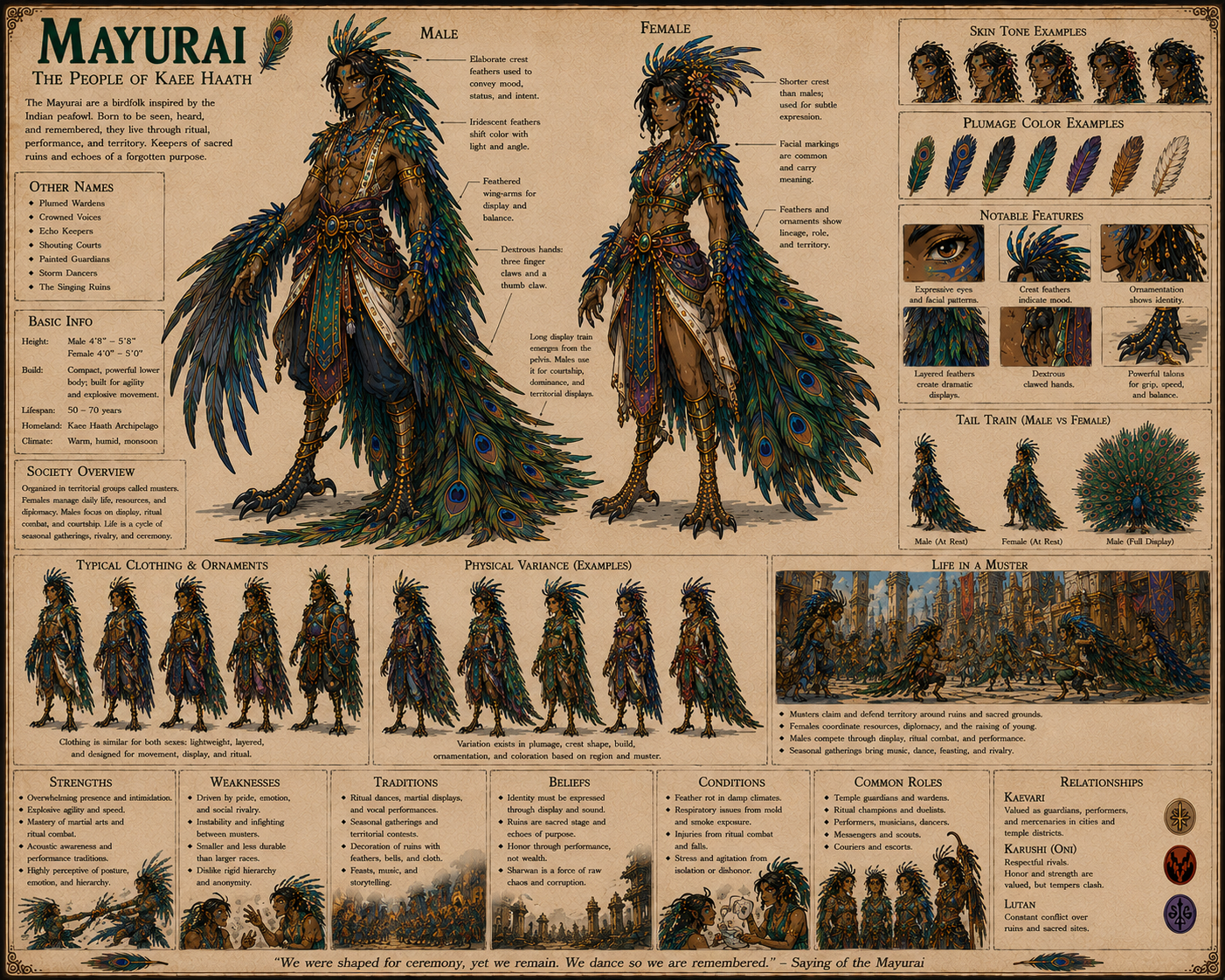
The Mayurai are a small but intensely vibrant people of Kaee Haath whose lives revolve around ritual display, territorial identity, sacred performance, and inherited ceremonial behavior whose true origins have long since faded into myth. Instantly recognizable by their iridescent plumage, crest-feathers, digitigrade avian legs, and elaborate display trains, the Mayurai possess a striking mixture of humanoid and peafowl-like features that make them among the most visually unforgettable peoples of the archipelago. Though physically smaller than most other races, they compensate through overwhelming social presence, explosive agility, highly expressive body language, and an instinctive ability to dominate space through posture, sound, movement, and spectacle.
The Mayurai appear to have once served as ritual guardians, ceremonial warriors, or sacred wardens for a long-vanished civilization whose identity is no longer fully understood. Though the masters they were created or shaped to serve have disappeared into the forgotten past, the instincts and behaviors associated with that purpose still remain deeply embedded within the species. Modern Mayurai societies continuously reenact fragments of ancient ceremonial structures through ritualized combat, territorial courts, martial dances, vocal performances, public displays, sacred processions, and occupation of resonant ruins and temple complexes that instinctively “feel correct” to them even when their original purpose has been lost. As a result, much of Mayurai civilization resembles an elaborate performance of statehood and sacred authority rather than a stable political system in the conventional sense.
Mayurai society is organized around communal territorial groups known as musters, typically centered around ruins, ceremonial grounds, elevated courtyards, or acoustically significant structures throughout Kaee Haath. Females, who significantly outnumber the males, maintain most of the species’ practical continuity through social organization, resource coordination, child rearing, diplomacy, and territorial management, while males devote enormous energy toward ritualized displays of dominance, courtship, territorial competition, and ceremonial conflict. During major gathering seasons, entire musters may converge into overwhelming spectacles of color, sound, music, martial performance, feasting, and public rivalry before dispersing once more into cycles of territorial movement and ritual warfare.
Though often viewed as chaotic, theatrical, or unstable by outsiders, the Mayurai are far from unintelligent. They possess highly refined traditions surrounding martial arts, acoustic architecture, performance, ornamentation, ceremonial combat, and social communication, along with remarkable sensitivity to posture, emotional tension, and public hierarchy. Many integrate themselves into Kaevari city-states as temple guardians, ceremonial soldiers, performers, sacred wardens, or prestige fighters, instinctively gravitating toward temple-schools, courtyards, and ritual spaces whose structure echoes the environments they seem to have originally been created to inhabit.
The Mayurai relationship with the ancient ruins of Kaee Haath is especially intense, often placing them into constant conflict with the Lutan, who consider many of the same sites sacred remnants of their lost heritage. To the Mayurai, however, such ruins are more than historical relics, they are stages, sanctuaries, territorial symbols, and echoes of a forgotten purpose still buried deep within the species itself. Across the archipelago, the Mayurai remain a people caught between spectacle and civilization, endlessly performing fragments of an ancient role they no longer fully understand, yet cannot fully abandon.
Plumed Wardens, Crowned Voices, Echo Keepers, Shouting Courts, Painted Guardians, Storm Dancers, The Singing Ruins
Looks
The Mayurai possess compact, lightweight bodies built around agility, display, balance, and explosive bursts of movement rather than raw physical strength or endurance. Smaller than most other peoples of Kaee Haath, they nevertheless command attention through elaborate plumage, upright posture, and intensely expressive body language that often makes them appear larger and more imposing than they truly are. Their physiques are lean and athletic, with narrow waists, flexible torsos, and powerful lower bodies adapted for rapid footwork, ritualized combat, sudden lunging strikes, and elaborate ceremonial displays. Even at rest, most Mayurai carry themselves with deliberate poise and visible awareness of how they occupy space, reflecting a species shaped as much for sacred performance and territorial presence as for practical survival.
Their legs are digitigrade and distinctly avian, built for balance, speed, and powerful kicking techniques rather than the grasping structure of predatory birds. Strong hips, thighs, and lower backs support the flowing rotational movement, stance work, and explosive agility central to Mayurai martial traditions. Their feet end in large scaled talons with three forward claws and a rear stabilizing claw, providing secure footing across wet stone, jungle terrain, temple ruins, elevated perches, and densely layered tropical environments.
The upper body remains largely humanoid in structure, possessing dexterous hands and flexible shoulders necessary for weapon use, ritual dance, climbing, and social display. Feathered display structures extend along the arms, shoulders, and upper back in layered arrangements resembling ceremonial wings rather than true flight appendages. These structures can flare outward dramatically during courtship, intimidation displays, ritualized conflict, or formal performances, emphasizing movement and posture rather than sustained aerial ability. Combined with crest-feathers, trailing display trains, and constantly shifting iridescent plumage, the overall silhouette of the Mayurai creates the impression of creatures designed not merely to exist within civilization, but to embody ceremony, spectacle, and sacred authority itself.
The Mayurai possess a wide range of warm tropical skin tones generally lighter on average than those commonly found among the Kaevari, though still heavily shaped by the humid equatorial environment of Kaee Haath. Most Mayurai skin falls within shades of:
golden brown
warm bronze
copper
tawny tan
deep sun-burnished amber
or rich reddish-brown
with lighter cream, pale gold, and dark umber tones appearing less commonly. Their skin often carries a subtle natural sheen in humid climates, especially around the face, shoulders, neck, and upper torso where fine scale-like feather textures and iridescent coloration sometimes blend into the skin itself.
Unlike the more uniform complexion patterns often seen among the Kaevari, the Mayurai display striking ornamental coloration tied closely to their plumage and artificial origins. Iridescent feather growth around the neck, shoulders, arms, back, hips, and display structures commonly shifts between:
sapphire blue
emerald green
teal
turquoise
bronze
violet
and black-green oil-sheen hues
depending on lighting and feather angle. Many Mayurai also possess naturally occurring facial markings, eye-stripes, or bands of contrasting coloration inspired by Indian peafowl patterns, often appearing in:
pale ivory
deep cobalt
charcoal
gold-green
or metallic blue tones.
Both males and females are vividly colored, though males tend toward far more dramatic iridescence and display contrast. Mature males frequently develop intensely reflective feather trains with brilliant blue-green eyespots, metallic sheen, and exaggerated color transitions that become especially vibrant during ritual displays, territorial confrontations, or courtship seasons. Females retain the same core coloration patterns but with shorter trains, slightly more restrained iridescence, and plumage that appears denser and more controlled rather than explosively ornamental. Even so, female Mayurai remain unmistakably vibrant and visually striking compared to most peoples of Kaee Haath, reinforcing the species-wide emphasis on beauty, presence, and ceremonial display.
The Mayurai are among the smallest of the major peoples of Kaee Haath, standing noticeably shorter on average than both the Kaevari and Karushi, with only the smaller Lutan rivaling them in stature. Most Mayurai stand between roughly 4 to 5½ feet tall, though their elaborate crest-feathers, upright posture, layered wing displays, and trailing plumage often make them appear considerably larger and more physically imposing than they truly are. Females generally average between 4'0" and 5'0", while males tend to be slightly taller at 4'8" to 5'8", with exceptionally large or dominant males occasionally reaching heights just beyond that range.
Despite their relatively compact size, Mayurai rarely appear physically small in motion or social presence. Their species evolved—or was shaped—to dominate space visually through posture, coloration, sound, and ceremonial display rather than raw body mass. During territorial confrontations, ritual dances, or courtship displays, the expansion of their feather structures, display trains, and arm-plumage can dramatically increase their apparent size, allowing even smaller individuals to project an overwhelming sense of presence and intimidation. Combined with their explosive agility, intense body language, and highly expressive movement, the Mayurai often feel far larger and more dangerous than their true height would initially suggest.
Though relatively small in stature, the Mayurai are more physically solid than their graceful appearance initially suggests. Most possess dense lower-body musculature and reinforced skeletal structures adapted for balance, rapid directional movement, powerful jumping, and impact absorption rather than flight. Their legs, hips, lower spine, and taloned feet are especially robust, allowing them to navigate elevated ruins, wet stone terraces, jungle canopies, and ceremonial combat grounds with remarkable agility and stability. As a result, Mayurai often weigh more than outsiders expect for their size, with females commonly ranging between roughly 90–150 pounds and males between 120–190 pounds depending on plumage, build, and display development.
Rather than the hollow bones associated with flying birds, the Mayurai possess compact, durable physiques built around explosive movement, rotational martial techniques, and ritualized territorial displays. Their species appears adapted—or perhaps originally designed—for life within elevated ceremonial architecture and sacred ruins, where leaping, landing, climbing, and sudden bursts of aggression are common parts of both social and combat behavior. Combined with their elaborate feather structures and highly expressive movement patterns, this creates the unusual impression of creatures who appear elegant and theatrical at a distance, yet surprisingly grounded and physically forceful up close.
The Mayurai are instantly recognizable for their elaborate plumage, intensely expressive body language, and striking ceremonial appearance, possessing a blend of humanoid and avian traits unlike any other people of Kaee Haath. Their most iconic features are the long iridescent display feathers extending from the lower back, hips, shoulders, and arms, which can flare outward dramatically during territorial displays, ritual combat, courtship, or ceremonial performance. These feather structures shimmer with shifting hues of sapphire blue, emerald green, turquoise, bronze, violet, and black-green oil sheen depending on the angle of light, often creating the illusion that the Mayurai are constantly moving even while standing still. Mature males develop especially enormous feather trains marked by brilliant eye-like patterns and highly reflective iridescence, transforming major displays into overwhelming spectacles of motion, sound, and color.
Their heads are crowned with elegant crest-feathers that react visibly to emotion and posture, rising, flattening, or spreading during social interaction much like the plumage displays of peafowl. Facial markings inspired by Indian peafowl patterns are common, including dark eye-stripes, pale facial patches, metallic coloration around the eyes, and ornamental feathering along the cheeks and jawline. Their eyes are particularly striking, often appearing in shades of gold, amber, green, teal, or deep brown with unusually sharp, socially attentive expressions. Even subtle eye contact carries significant meaning within Mayurai culture due to their strong emphasis on posture, display, and visual communication.
The Mayurai possess digitigrade avian legs ending in scaled taloned feet built for balance, powerful kicks, climbing, and explosive movement across stone ruins and jungle terrain. Though incapable of true flight, layered feather structures along the arms and upper body create the silhouette of ceremonial wings when spread during displays or combat. Their movements are highly deliberate and theatrical, blending graceful posture with sudden bursts of startling aggression that can shift almost instantly from ritualized display into violence. Combined with their ornamental jewelry, vibrant fabrics, crest-feathers, and naturally dramatic body language, the overall appearance of the Mayurai gives the impression of creatures designed not simply to fight or survive, but to embody sacred performance, territorial authority, and ceremonial presence itself.
Physical variation among the Mayurai is extremely broad and socially significant, with differences in plumage, crest structure, coloration, body shape, display quality, and vocal presence often carrying major implications for status, attractiveness, territorial influence, and ritual authority. Because the Mayurai evolved—or were shaped—for ceremonial display and visual communication as much as practical survival, individual appearance is deeply tied to social identity within their culture. No two Mayurai displays appear exactly alike, and entire rivalries, reputations, and bloodlines may become associated with distinctive feather patterns, crest shapes, vocalizations, or territorial display styles.
Plumage coloration varies widely across the species, though most Mayurai possess combinations of:
sapphire blue
emerald green
teal
turquoise
bronze
violet
black-green
gold
or deep indigo iridescence
within their feather structures. Some individuals display extremely vibrant metallic coloration visible even at great distance, while others possess darker, more subdued plumage with stronger bronze, charcoal, or oil-sheen hues. White, silver, pale cream, or unusually dark near-black plumage occasionally appears and is often viewed as spiritually significant, ominous, or exceptionally prestigious depending on local tradition. The eye-like patterns present within many feather trains also vary considerably in size, density, coloration, and arrangement, becoming one of the primary visual identifiers between individuals or musters.
Crest-feathers differ heavily between bloodlines and regions, ranging from sleek elegant fans to long dramatic spines, layered feather crowns, or highly expressive plume arrangements that react visibly to posture and emotion. Facial markings similarly vary through eye-stripes, metallic patches, speckling, feathered jawlines, and ornamental coloration around the eyes and throat. Some Mayurai possess extremely sharp angular facial structures and predatory expressions, while others appear softer, more elegant, or almost deceptively delicate despite their aggressive behavior.
Body shape also differs significantly between individuals and sexes. Females tend toward compact athletic builds emphasizing balance, agility, and controlled movement, while males often develop more exaggerated proportions built around visual dominance and display presence. Large males may possess enormous feather trains, broader shoulders, elongated crest structures, louder vocalizations, and highly dramatic territorial behavior, sometimes appearing almost absurdly oversized once their displays are fully expanded despite their relatively small actual stature. Other males remain leaner and more movement-oriented, emphasizing ritual combat skill and agility over pure visual spectacle.
Regional and cultural variation further shapes Mayurai appearance depending on where particular musters live or which outside societies they interact with most frequently. Mayurai living near Kaevari cities often incorporate elaborate jewelry, dyed fabrics, bronze ornamentation, and refined ceremonial grooming into their displays, while more isolated ruin-dwelling musters may appear wilder, louder, and more heavily feather-focused with less emphasis on textiles or structured ornamentation. Over generations, many musters develop distinctive display traditions, color preferences, ritual scarification, feather arrangements, and performance styles that become major parts of their territorial and cultural identity.
Mayurai clothing is designed primarily around freedom of movement, rapid preparation, ceremonial display, and the visual enhancement of posture and motion. Because much of Mayurai social interaction revolves around ritualized presence, territorial behavior, martial display, and highly expressive body language, their garments are intentionally lightweight and nonrestrictive, allowing the full range of rotational movement, lunging footwork, feather displays, and sweeping arm motions central to both daily life and ceremonial combat. Most clothing is constructed from layered wraps, draped fabrics, tied sashes, split lower garments, and fitted waist bindings that can be adjusted quickly and worn comfortably within the humid tropical climate of Kaee Haath.
The lower body typically receives the greatest amount of practical coverage, with wrapped trousers, layered skirts, split drapes, and loose fitted leg garments designed to accommodate digitigrade legs, powerful kicks, and rapid movement across ruins, terraces, and jungle terrain. Upper garments are often minimal or absent entirely in warmer regions, especially among males during festivals, territorial displays, or ritual gatherings where plumage and body presentation carry major social significance. When worn, upper clothing usually consists of open vests, draped shoulder cloths, ceremonial wraps, light chest bindings, or fitted sleeveless garments that leave the shoulders, neck, and display feathers unobstructed.
Despite the simplicity of the core garments, Mayurai clothing is rarely plain. Individual expression and territorial identity are heavily emphasized through:
feather arrangement
layered sashes
embroidered trims
beadwork
bronze ornaments
bells
reflective jewelry
painted cloth
colored bindings
and decorative tassels
all of which are often chosen to enhance movement and sound during displays or combat. Fabrics commonly incorporate vibrant blues, greens, golds, teals, whites, bronzes, and deep jewel tones inspired by their natural plumage, with many garments intentionally designed to flare, ripple, or shift dramatically during motion.
Males frequently wear more exaggerated and visually disruptive ornamentation, especially during ritual seasons, incorporating long trailing fabrics, display harnesses, feather mantles, ceremonial belts, and layered jewelry intended to amplify their territorial presence and visual dominance. Females generally favor more controlled and practical arrangements emphasizing mobility, authority, and refined presentation while still maintaining the species-wide emphasis on beauty and ceremonial identity. Weapons, particularly curved blades and shields, are commonly integrated directly into clothing through waist sashes, back harnesses, hip bindings, or decorative suspension systems, reinforcing the Mayurai tendency to blur the line between martial equipment, ritual attire, and personal display.
Across Kaee Haath, Mayurai clothing reflects the same qualities that define the people themselves: elegant but aggressive, practical but theatrical, and constantly shaped by the need to transform movement, posture, and appearance into forms of social and ceremonial expression.
Traits
The greatest strengths of the Mayurai lie in their overwhelming social presence, explosive agility, ritualized combat traditions, and deeply ingrained instincts surrounding territorial defense and ceremonial authority. Though smaller than most other peoples of Kaee Haath, the Mayurai possess an extraordinary ability to dominate space visually and emotionally through posture, movement, vocalization, and display. Their species appears naturally adapted—or perhaps originally designed—for intimidation, public performance, and highly visible forms of social and martial control, allowing even relatively small individuals to project confidence, danger, and authority far beyond what their physical size alone would suggest.
The Mayurai are exceptionally agile fighters, combining powerful lower bodies, digitigrade movement, rapid directional changes, rotational footwork, and explosive bursts of aggression into highly effective close-range martial traditions. Their combat styles emphasize mobility, precision, rhythm, intimidation, and ceremonial escalation, making them especially dangerous within ruins, courtyards, elevated structures, dense urban terrain, and other confined environments where their speed and maneuverability allow them to overwhelm larger opponents. Many Mayurai also possess remarkable balance and impact tolerance due to their dense lower skeletal structure, allowing them to leap, climb, land, and maneuver across difficult terrain with unusual confidence and physical control.
Territorial awareness and social sensitivity are also major strengths of the species. The Mayurai are highly perceptive regarding posture, eye contact, emotional tension, hesitation, confidence, and social hierarchy, often reading the intentions or emotional states of others with startling accuracy. This makes them naturally effective as guardians, ceremonial wardens, duelists, performers, escorts, and social intimidators. Their instinctive attraction toward structure, ritual space, and ceremonial environments also allows many Mayurai to integrate surprisingly well into Kaevari temple districts and civic centers despite their otherwise unstable social tendencies.
The Mayurai additionally possess highly refined traditions surrounding acoustic awareness, performance, and ceremonial coordination. Through generations of ritual behavior tied to resonant ruins and public displays, many develop exceptional control over rhythm, vocal projection, synchronized movement, and spatial awareness. Group performances, martial dances, coordinated displays, and territorial ceremonies can become psychologically overwhelming experiences for outsiders due to the species’ ability to combine movement, sound, ornamentation, and social pressure into unified displays of presence and dominance.
Above all, the Mayurai excel at transforming identity itself into a form of power. Their beauty, movement, aggression, confidence, ceremonial behavior, and inherited guardian instincts combine to create a people capable of exerting enormous emotional and social influence within the spaces they occupy. Whether serving as ritual champions, sacred wardens, performers, duelists, temple guardians, or territorial defenders, the Mayurai remain one of the most visually and psychologically commanding peoples anywhere in Kaee Haath.
The greatest weaknesses of the Mayurai stem from the same instincts and behavioral drives that make them socially and ceremonially powerful. Their species is intensely emotional, territorial, status-conscious, and reactive to public perception, causing many Mayurai societies to struggle with long-term stability, centralized organization, and sustained cooperation on large scales. Rivalries, personal disputes, ceremonial challenges, territorial escalation, wounded pride, and social competition frequently consume enormous amounts of communal energy, often destabilizing musters or undermining attempts to form lasting political structures. Even minor slights, public embarrassment, or perceived disrespect can escalate rapidly within highly performative social environments where status and visibility hold immense cultural importance.
The Mayurai are also heavily dependent upon ritual structure, social presence, and communal interaction, often becoming restless, agitated, or emotionally unstable when isolated from territorial identity or ceremonial environments for long periods. Many possess difficulty adapting to quiet anonymity, rigid bureaucracy, prolonged restraint, or highly impersonal systems such as the administrative structures favored by the Kaevari. While capable of functioning within such systems temporarily, most Mayurai instinctively gravitate back toward environments built around display, movement, sound, social hierarchy, and visible emotional expression.
Despite their agility and combat skill, the Mayurai are physically smaller and less durable overall than many of the other major peoples of Kaee Haath, particularly the Karushi. Their martial traditions rely heavily upon speed, intimidation, precision, and momentum rather than prolonged endurance or overwhelming physical force, making them vulnerable in extended attritional warfare, large-scale military campaigns, or heavily disciplined battlefield formations. They also struggle with logistical coordination and institutional continuity due to the fragmented nature of their societies and the cyclical instability caused by seasonal male rivalries and territorial conflict.
The species’ strong attraction toward sacred ruins, ceremonial spaces, and inherited ritual behavior creates additional vulnerabilities. Many Mayurai instinctively prioritize symbolic territorial claims or emotionally resonant locations over practical strategic considerations, sometimes drawing entire musters into prolonged conflicts over ruins or ceremonial grounds whose original purpose is no longer fully understood. Their tendency to imitate the structures and aesthetics of civilization without fully maintaining the systems underlying them also leaves many Mayurai societies technologically and economically inconsistent despite appearances of sophistication.
Males in particular are prone to reckless behavior driven by display instincts, territorial pride, ceremonial competition, and social visibility. During mating seasons or major gatherings, rivalries may spiral into destructive feuds, dangerous ritual conflicts, wasteful displays of excess, or cycles of escalating violence that destabilize entire territories. While females often work constantly to maintain practical continuity beneath these social pressures, the species as a whole remains deeply vulnerable to emotional escalation, charismatic manipulation, spectacle-driven leadership, and the intoxicating influence of powerful public figures capable of dominating social attention through force of presence alone.
Above all, the Mayurai struggle with the tension between inherited purpose and true civilization. They instinctively crave structure, ceremony, authority, and sacred legitimacy, yet their own behavioral drives repeatedly undermine the stable systems necessary to sustain them over long periods. In many ways, the Mayurai remain trapped between performance and permanence, endlessly reenacting fragments of an ancient role they no longer fully understand.
The Mayurai are prone to several conditions tied closely to their elaborate display biology, intense social instincts, territorial behavior, and ceremonial lifestyles. One of the most widespread is a collection of fungal infections, parasites, feather degradation disorders, and skin conditions commonly referred to as plume rot, particularly common during the humid monsoon seasons or among individuals unable to properly maintain their plumage. Because feather quality is deeply tied to social identity, health, attractiveness, and ceremonial status within Mayurai society, visible plumage deterioration often carries severe emotional and social consequences alongside the physical symptoms themselves.
Many Mayurai, particularly males during major gatherings or mating seasons, are also susceptible to periods of heightened emotional escalation commonly associated with territorial competition and ritual display behavior. During these episodes, individuals may become obsessively focused on challenges, social dominance, public visibility, or territorial disputes, pushing themselves into states of exhaustion, reckless aggression, compulsive performance behavior, and dangerously poor judgment. While these tendencies are partially normalized within Mayurai culture due to the social value placed on display and prestige, severe cases can destabilize entire musters or trigger prolonged cycles of ritual conflict between rival groups.
Another condition strongly associated with the species is an intense psychological attachment to specific ruins, ceremonial grounds, resonant structures, or territorial spaces, sometimes developing into unhealthy fixation if individuals are separated from them for long periods. Some Mayurai appear to experience genuine emotional decline, agitation, depression, or identity instability when removed from familiar ritual environments or isolated from communal social structures for extended periods. Combined with their strong need for visible social interaction, public identity, and ceremonial presence, prolonged isolation tends to affect the Mayurai more severely than many other peoples of Kaee Haath.
The species is additionally prone to vocal strain, respiratory stress, seasonal molting exhaustion, and socially disruptive involuntary display responses caused by their highly expressive crest-feathers and body language. Because emotional states among the Mayurai are often physically difficult to conceal, stress, fear, aggression, attraction, and territorial tension may become visibly apparent through posture, feather movement, crest reactions, or vocal shifts even when individuals attempt to remain composed. In many ways, the conditions most associated with the Mayurai reflect the same truth underlying much of their culture: they are a people biologically and psychologically shaped for visibility, performance, ritual presence, and communal identity, often at significant personal cost.
Culture
Mayurai traditions are loud, theatrical, territorial, and intensely communal, built around cycles of gathering, display, ritual conflict, performance, and seasonal movement throughout the islands of Kaee Haath. Much of their culture revolves around visibility and social presence, causing even ordinary communal activities to become elaborate displays of posture, sound, ornamentation, and ceremony. Public performance occupies an enormous role within Mayurai life, not simply as entertainment, but as a way of expressing identity, legitimacy, emotional state, territorial claim, lineage, and spiritual significance. Music, drumming, vocal projection, feather displays, rhythmic stamping, ritual movement, martial choreography, and highly expressive body language are deeply integrated into nearly every major social gathering.
The largest Mayurai traditions are tied to seasonal gatherings between musters, particularly during mating periods and the transitions surrounding the monsoon seasons. During these times, large communal courts form around sacred ruins, resonant plazas, temple terraces, and ceremonial grounds where dozens of musters may gather simultaneously for performances, territorial negotiations, feasting, courtship displays, ritual combat, storytelling, and communal celebrations. These gatherings often become overwhelming spectacles of color, sound, movement, ornamentation, and social competition, with males especially devoting enormous energy toward display rituals intended to establish prestige, attract mates, challenge rivals, and reinforce territorial legitimacy.
Ritualized combat traditions hold immense importance throughout Mayurai society. Violence is generally expected to progress through escalating displays of posture, vocalization, movement, ceremonial challenge, and martial performance before physical combat begins, though these rituals can collapse rapidly into explosive aggression if tensions escalate too far. Many disputes between individuals or musters are resolved through ritual duels, synchronized combat dances, public challenge ceremonies, territorial contests, or formalized martial performances conducted within designated plazas or sacred ruins. These traditions are especially influenced by flowing stance work, rotational movement, weapon displays, shield choreography, and highly controlled footwork designed to transform combat itself into a visible performance of identity and authority.
The Mayurai also maintain strong traditions surrounding sacred ruins and ceremonial spaces. Many musters devote enormous effort toward decorating, restoring, occupying, or acoustically modifying ancient structures they consider spiritually significant. Hanging feathers, bronze ornaments, bells, dyed cloth, polished stone, painted markings, and resonant instruments are commonly used to personalize claimed ruins and reinforce territorial identity. Acoustic performance traditions are especially important, with some gatherings featuring coordinated vocal displays, rhythmic stamping ceremonies, synchronized drumming, or echo-based performances intended to interact directly with the architecture itself.
Feasting traditions are similarly central to Mayurai social life. Public meals often function as territorial statements or demonstrations of prestige, particularly among dominant males attempting to reinforce social status through excess, spectacle, and hospitality. Large communal feasts filled with music, ritual movement, loud storytelling, ornamentation, and constant social performance are common during festivals, successful territorial claims, ritual victories, mating gatherings, and monsoon celebrations. Females typically play a major role in organizing and sustaining the practical structure of these events, even when males dominate the visible ceremonial aspects.
Mayurai integrated into Kaevari cities frequently adapt many of these traditions into temple districts, civic festivals, ceremonial parades, and shrine gatherings where their performances, martial displays, and territorial pageantry become accepted parts of urban life. Some Kaevari city-states even construct dedicated plazas, roosting grounds, performance courts, and ceremonial districts specifically designed to accommodate Mayurai social behavior while minimizing violent escalation between rival musters.
Above all, Mayurai traditions reflect a people instinctively driven toward spectacle, ritualized authority, inherited ceremony, and public identity. Their festivals, displays, territorial contests, and communal gatherings may appear chaotic or excessive to outsiders, yet beneath the noise and color lies an ancient pattern of ceremonial behavior still shaping the species long after the civilization that first gave it purpose disappeared into the forgotten past of Kaee Haath.
Mayurai beliefs revolve around ritual presence, territorial authority, sacred performance, inherited purpose, and the idea that identity must be expressed visibly to possess meaning. Unlike the highly philosophical traditions of the Kaevari or the contemplative discipline of the Lutan, Mayurai spirituality is intensely physical, emotional, and performative, rooted less in written doctrine than in posture, movement, ceremony, vocalization, territorial ritual, and inherited behavior whose original meaning has often been forgotten. Much of modern Mayurai culture appears built upon fragmented ceremonial instincts passed down from an ancient age when their people likely served as ritual guardians, palace wardens, or sacred protectors for a long-vanished civilization whose identity is no longer fully understood.
As a result, many Mayurai traditions revolve around reenactment rather than formal theology. Ritual dances, territorial displays, martial performances, ceremonial duels, procession routes, acoustic ceremonies, feather presentations, and public challenge rituals are often treated as spiritually significant acts even when participants no longer fully understand their original purpose. Sacred ruins occupy a central place within Mayurai belief systems, particularly structures with strong acoustics, elevated courtyards, resonant halls, ceremonial terraces, or visible public spaces that instinctively “feel correct” to the species. Different musters frequently claim the same ruins based on competing interpretations of ancestral legitimacy, sacred inheritance, or territorial destiny, leading to constant ritualized conflicts with rival Mayurai groups and especially with the Lutan, who view many of these same sites as sacred remnants of their lost heritage.
The Mayurai place enormous spiritual importance on visibility, presence, and public identity. To be seen, acknowledged, challenged, admired, or remembered is often treated as proof of significance and vitality, while obscurity, isolation, or social irrelevance may carry deep feelings of shame or spiritual emptiness. Beauty itself is commonly interpreted not merely as aesthetics, but as evidence of health, strength, discipline, lineage, and proper alignment with one’s inherited role. This extends into their beliefs surrounding combat, where ritualized escalation through display, posture, vocalization, and ceremonial challenge is often expected before violence begins. Though highly aggressive by nature, many Mayurai view uncontrolled or meaningless violence as spiritually crude compared to conflict shaped through proper ritual and visible intent.
Most Mayurai do not possess large organized priesthoods or unified religious systems. Instead, spiritual authority tends to emerge from ritual mastery, territorial legitimacy, performance ability, ancestral memory, martial prestige, and ceremonial influence within the muster itself. Certain individuals become revered as plume speakers, echo keepers, ruin singers, ceremonial wardens, or voice bearers, serving as interpreters of inherited ritual behavior and guardians of ancient traditions whose true origins may no longer be fully known.
The Mayurai relationship with Sharwan is complicated and often contradictory. Many instinctively fear and resent him while simultaneously being drawn toward the overwhelming presence, dominance, and sacred authority he represents. Some believe Sharwan may have played a role in shaping their species long ago, either directly or indirectly, while others reject this idea entirely. Regardless of the truth, the Mayurai remain one of the peoples most emotionally susceptible to displays of power, spectacle, and commanding presence, making charismatic leaders, ritual champions, and powerful figures capable of exerting extraordinary influence over large groups of their kind.
Above all, Mayurai beliefs reflect a people still acting out fragments of an ancient purpose they no longer fully understand. Their ceremonies, rivalries, dances, displays, and territorial rituals may appear chaotic or theatrical to outsiders, yet beneath them lies the persistent echo of something old, sacred, and unfinished lingering within the ruins of Kaee Haath itself.
Mayurai society is organized primarily through territorial communal groups known as musters, semi-permanent social structures centered around sacred ruins, ceremonial grounds, resonant courtyards, temple complexes, or prominent display territories throughout Kaee Haath. Unlike the highly structured city-states of the Kaevari, Mayurai governments rarely develop into stable bureaucratic institutions, instead functioning through overlapping systems of ritual authority, territorial legitimacy, social performance, and personal reputation. Leadership within a muster is heavily influenced by ceremonial dominance, martial prestige, vocal presence, display quality, and the ability to command attention during public rituals, disputes, or territorial confrontations.
Visible authority within Mayurai society is often associated with dominant males who serve as ceremonial champions, territorial defenders, ritual duelists, and public representatives of the muster’s prestige. These males frequently engage in seasonal rivalries, challenge displays, ritualized combat, and territorial conflicts intended to establish status and legitimacy both within and between neighboring groups. However, despite their highly visible social role, the long-term stability and practical continuity of most musters is maintained primarily by female communal structures responsible for resource management, social organization, diplomacy, child rearing, territorial maintenance, and coordination between rival factions. As a result, Mayurai society often operates through a divide between symbolic authority and practical governance, with much of the true organizational stability existing beneath the surface of ceremonial hierarchy and public spectacle.
Because Mayurai culture strongly rewards territoriality, rivalry, emotional display, and public prestige, large centralized states rarely remain stable for long. Alliances form and fracture constantly through ritual challenges, territorial disputes, seasonal migrations, and shifting social loyalties. Political conflicts are often resolved through ceremonial contests, martial displays, ritual duels, vocal performances, or highly formalized public confrontations rather than written law or bureaucratic systems. Many Mayurai also integrate themselves into Kaevari city-states where temple-schools and civic authorities provide the structured ceremonial environments the species instinctively gravitates toward. Within these cities, Mayurai often serve as sacred guardians, ritual performers, temple wardens, prestige soldiers, or ceremonial protectors, though Kaevari authorities frequently regulate their territorial instincts carefully to prevent rival musters from destabilizing urban life through escalating public conflicts.
Mayurai technology is highly uneven, reflecting a culture shaped more by inherited purpose, ritual behavior, and adaptive imitation than by organized innovation or large-scale development. While the Mayurai are fully capable of learning, preserving, and utilizing complex tools or techniques, their societies rarely maintain the stable institutional structures necessary to sustain continuous technological advancement on the scale seen among the Kaevari. Instead, Mayurai technological culture focuses heavily on ceremonial application, martial utility, visual presentation, and the adaptive reuse of existing systems, particularly within the ancient ruins and sacred structures many musters occupy throughout Kaee Haath.
The Mayurai possess especially strong traditions surrounding martial equipment, ceremonial weaponry, ornamentation, and performance-focused craftsmanship. Curved swords, shields, display armor, decorative harnesses, ritual bells, feather preservation techniques, dyed textiles, bronze ornamentation, and movement-enhancing garments are all highly developed within many musters. Weapons and armor are often treated as extensions of social presence and ritual identity as much as practical tools of war, with visual intimidation, sound, posture, and ceremonial symbolism playing major roles in their design. Many Mayurai martial traditions also place strong emphasis on mobility, rotational movement, acrobatics, and ritualized combat forms suited for fighting within ruins, terraces, courtyards, and elevated structures.
The Mayurai also demonstrate remarkable instinctive understanding of acoustics and resonant architecture despite lacking the formal scholarly traditions of the Kaevari. Through generations of ritual performance, territorial display, and ruin occupation, many musters have become highly skilled at modifying spaces for amplified sound, echo projection, rhythmic signaling, and ceremonial performance. Elevated platforms, resonant chambers, suspended bells, stamping grounds, feather-rattle ornaments, and acoustically tuned courtyards are common features within Mayurai-controlled territories and sacred sites.
Though capable sailors and travelers between islands, the Mayurai generally rely upon adapted foreign ship designs and outside trade networks rather than extensive native maritime infrastructure. Advanced scholarship, alchemy, medicine, engineering, and large-scale administration are similarly inconsistent within purely Mayurai societies, often depending heavily upon contact with Kaevari temple-schools and city-states where many Mayurai integrate as guardians, performers, ceremonial soldiers, or sacred wardens. As a result, Mayurai civilization often appears simultaneously ancient, sophisticated, and strangely incomplete—possessing fragments of highly refined ceremonial and martial knowledge without the stable systems normally required to sustain a fully developed technological civilization.
Mayurai occupations are shaped heavily by territorial life within the musters, ceremonial behavior, inherited guardian instincts, and the practical demands of surviving within the fragmented ruins and tropical environments of Kaee Haath. Unlike the highly specialized bureaucratic professions of the Kaevari or the structured communal labor systems of the Lutan, Mayurai labor tends to revolve around social role, ritual identity, territorial function, and immediate communal necessity rather than rigid economic specialization. Many occupations blur together naturally within daily life, with individuals often shifting between martial, performative, communal, and practical responsibilities depending on season, status, or territorial circumstance.
Within the musters themselves, many Mayurai fulfill roles tied directly to maintenance of the communal territory and its ceremonial identity. Common occupations include:
ruin keepers
roost tenders
territorial wardens
feather keepers
display artisans
ritual performers
weapon dancers
drummers
vocal callers
plume arrangers
ornament makers
and acoustic caretakers responsible for maintaining resonant halls, ceremonial plazas, and display grounds.
Others focus on practical survival through:
hunting
fishing
fruit gathering
tropical farming
egg tending
cooking
textile work
feather treatment
water collection
and maintenance of elevated walkways, bridges, roosts, and ruin settlements.
Martial occupations hold especially high social importance among the Mayurai due to their origins as ceremonial guardians and ritual warriors. Many individuals train extensively as:
duelists
territorial challengers
temple wardens
ritual guards
ceremonial escorts
ruin defenders
shield dancers
or prestige fighters
with males often devoting enormous amounts of time and energy toward ritual combat, display competition, territorial disputes, and public martial performance. Females more commonly maintain the practical continuity of the musters through resource coordination, social organization, child rearing, territorial diplomacy, and long-term communal management, though many are also highly skilled fighters and ritual practitioners in their own right.
Mayurai integrated into Kaevari city-states frequently adopt occupations that align naturally with their ceremonial instincts and territorial behavior. Common urban professions include:
temple guardians
ceremonial soldiers
shrine wardens
performers
dancers
musicians
prestige bodyguards
festival coordinators
ritual escorts
duel instructors
ruin caretakers
and ornamental craftsmen
particularly within temple-school districts or ceremonial civic spaces where their presence is culturally valued. Some Mayurai also work as harbor enforcers, caravan guards, arena fighters, or public entertainers, though they rarely dominate commercial or administrative professions requiring long-term bureaucratic discipline.
Across Kaee Haath, Mayurai occupations tend to emphasize visibility, ritual identity, movement, and social presence as much as practical labor itself. Even mundane tasks are often transformed into performative or ceremonial acts through posture, ornamentation, rhythmic movement, vocalization, or territorial display. In many ways, the Mayurai do not simply work within their societies—they continuously perform their place within them.
The Mayurai participate only partially in the broader economic systems dominating much of Kaee Haath, particularly those maintained by the Kaevari city-states. While fully capable of understanding trade, coinage, and the exchange of goods or services, Mayurai society is not deeply organized around abstract market systems, wealth accumulation, or long-term economic administration. Instead, most musters operate through communal resource sharing, territorial access, ritual obligation, prestige exchange, and personal reputation rather than formalized commerce. Coinage is generally viewed as a practical tool for obtaining desired goods, food, services, or ornamentation rather than a symbol of lasting financial security or institutional power.
Within Mayurai culture, social status is more commonly tied to display quality, territorial legitimacy, ceremonial authority, martial prestige, and possession of culturally significant objects such as weapons, feathers, jewelry, instruments, ritual fabrics, or ruin claims. Males in particular are often prone to extravagant spending on ceremonial displays, festivals, ornamentation, performances, and ritual conflicts, frequently exhausting resources in pursuit of prestige or social visibility rather than long-term stability. As a result, Mayurai settlements rarely develop the sophisticated trade infrastructure, merchant dynasties, or bureaucratic economic systems seen among the Kaevari despite regularly interacting with them.
Many Mayurai living within or near Kaevari cities instead support themselves through ceremonial roles, temple service, martial labor, performance traditions, craftsmanship, or territorial guardianship rather than large-scale commerce. This creates a complicated but mutually beneficial relationship between the two peoples, with the Kaevari often viewing the Mayurai as economically unreliable yet culturally valuable participants within the broader life of the archipelago.
Mayurai cuisine is built around tropical fruits, roasted meats, fish, fragrant spices, communal feasting, and foods that complement their highly social and performative lifestyles. Unlike the carefully balanced and highly structured culinary traditions of the Kaevari, Mayurai food culture is loud, sensory, communal, and emotionally expressive, with meals often functioning as social gatherings, territorial displays, courtship opportunities, or ritual celebrations as much as practical nourishment. Food is deeply tied to visibility and presence within the musters, and large public feasts are common during mating seasons, territorial gatherings, ritual victories, monsoon celebrations, and ceremonial performances.
Fresh tropical produce forms a major part of the Mayurai diet, particularly: mangoes, bananas, jackfruit, citrus, coconuts, figs, brightly colored peppers, sugarcane, and various jungle fruits gathered from across the islands of Kaee Haath.
These are commonly combined with heavily seasoned fish, roasted meats, spiced rice dishes, grilled shellfish, smoked river eel, tropical stews, and richly aromatic sauces designed to produce strong flavors and lingering scents. The Mayurai appear especially drawn toward foods that are: vibrant in color, aromatic, texturally dramatic or visually impressive when presented communally.
Many dishes are intentionally arranged to look beautiful during feasts or ceremonial gatherings, reinforcing the species-wide connection between display, identity, and social interaction.
Protein sources commonly include: fish, jungle birds, reptiles, shellfish, river creatures, wild boar, giant insects, and various small tropical animals hunted or trapped near the musters.
Roasting, smoking, wrapping foods in leaves, open-fire cooking, and heavily spiced grilling methods are all widespread, particularly because many Mayurai settlements prioritize temporary or adaptable cooking spaces rather than permanent urban kitchens. Sweet, spicy, smoky, and sharply sour flavor combinations are especially popular, with fermented fruit drinks, sugarcane liquors, honeyed alcohols, and heavily spiced ceremonial beverages commonly consumed during displays, performances, and ritual gatherings.
Feasting among the Mayurai often carries a strong territorial and social component. Dominant males may sponsor extravagant public meals to demonstrate status, attract attention, or reinforce ceremonial authority, while females more commonly oversee the long-term organization and distribution of communal food resources within the musters themselves. Food sharing, display presentation, and ritual hospitality are culturally significant behaviors, and the quality or abundance of a feast may directly influence social reputation within a territory. Even outside formal celebrations, many Mayurai eat communally whenever possible, turning meals into loud, highly interactive social events filled with posturing, storytelling, vocal displays, and constant visual performance.
Across Kaee Haath, Mayurai cuisine reflects the same qualities found throughout the species itself: vibrant, theatrical, communal, aggressive, beautiful, and driven as much by emotional and ceremonial expression as by simple practicality.
History
Long before the modern peoples of Kaee Haath understood themselves as separate cultures or races, the archipelago appears to have belonged to a far older civilization whose identity has been almost completely erased by time, disaster, and fragmentation. Across the islands surrounding the Shattered Palm, immense ruins, resonant temple complexes, elevated courtyards, collapsed observatories, drowned causeways, and impossible stone structures remain scattered through jungles, cliffsides, reefs, and volcanic valleys. No surviving people fully agrees on who built them. The Lutan claim they are remnants of the Monkey King’s ancient domains, the Kaevari believe they are fragments of a forgotten maritime civilization, some Karushi traditions whisper that Sharwan once ruled much of the archipelago directly, while many Mayurai seem instinctively drawn to the ruins without fully understanding why they feel sacred at all.
Whatever this ancient civilization truly was, it eventually collapsed. Some believe the destruction of the great volcanic center now known as the Shattered Palm marked the beginning of the end, shattering trade routes, flooding islands, destroying cities, and isolating surviving populations across the archipelago. Others believe the collapse was slower, caused by war, internal decay, unnatural forces, or struggles involving Sharwan and powers no longer remembered clearly. Much of Kaee Haath’s surviving history exists only as contradictory oral traditions, fragmented rituals, ruined architecture, and inherited instincts preserved unevenly between the races.
The Lutan are believed to be among the oldest surviving organized peoples of the archipelago. Their traditions speak of ancient troop kingdoms, sacred mountain monasteries, disciplined wandering societies, and the lost rule of the Monkey King, though how much of this survives as literal history is unclear. Even in the modern age, the Lutan remain deeply tied to ruins, ancestral memory, and sacred preservation, often treating the remnants of the ancient world with reverence and caution.
The Mayurai appear to have once served some ceremonial or guardian function within the forgotten civilization. Though their masters vanished long ago, the species continues to reenact fragments of inherited purpose through territorial courts, ritualized combat, sacred performances, and instinctive attraction toward temple complexes and resonant ruins. Over centuries, they developed unstable but vibrant communal societies centered around musters, sacred display grounds, and ritual authority, frequently coming into conflict with the Lutan over possession of ancient ceremonial sites.
The Karushi emerged in later eras as powerful warriors, raiders, enforcers, and mercenaries closely tied to the influence of Sharwan. Whether created, shaped, uplifted, or merely empowered by him remains uncertain, but the connection between the Karushi and Sharwan is deeply embedded within both their biology and cultural memory. For long periods, they served as feared martial powers throughout Kaee Haath before eventually throwing off the rigid structures imposed upon them after Sharwan’s defeat at the hands of Tal'Zanithal. In the centuries afterward, the Karushi fragmented into crews, pirate bands, mercenary groups, harbor communities, and wandering martial cultures defined more by celebration, violence, and personal freedom than centralized rule.
The Kaevari rose to prominence comparatively late, gradually building the first truly stable maritime city-states of the modern era across the islands surrounding the Shattered Palm. Drawing together fragments of surviving knowledge, trade traditions, navigation systems, engineering practices, and scholarly traditions preserved unevenly across the archipelago, the Kaevari established temple-schools that became centers of administration, learning, trade, and civic life. Though less ancient than many of the structures surrounding them, the Kaevari became the primary organizers and sustainers of modern civilization within Kaee Haath, integrating both Lutan and Mayurai populations into their growing urban centers while maintaining complicated relationships with the fiercely independent Karushi.
In the modern age, Kaee Haath exists as a fractured but interconnected archipelago where no people fully understands the world that came before them, yet all continue to live among its ruins. The Kaevari maintain the closest thing to stable civilization, the Lutan preserve memory and sacred continuity, the Karushi embody freedom and inherited violence, and the Mayurai continue to perform echoes of ancient ceremonial purpose beneath the shadow of forgotten ruins. Around them all, the storms surrounding the Shattered Palm continue to rage, and somewhere beneath the fractured history of the archipelago lies the unanswered question that haunts every people of Kaee Haath alike: who built the first civilization, and what destroyed it?
Overview
Details about this race's overview
Mayurai
The Mayurai are a small but intensely vibrant people of Kaee Haath whose lives revolve around ritual display, territorial identity, sacred performance, and inherited ceremonial behavior whose true origins have long since faded into myth. Instantly recognizable by their iridescent plumage, crest-feathers, digitigrade avian legs, and elaborate display trains, the Mayurai possess a striking mixture of humanoid and peafowl-like features that make them among the most visually unforgettable peoples of the archipelago. Though physically smaller than most other races, they compensate through overwhelming social presence, explosive agility, highly expressive body language, and an instinctive ability to dominate space through posture, sound, movement, and spectacle.
The Mayurai appear to have once served as ritual guardians, ceremonial warriors, or sacred wardens for a long-vanished civilization whose identity is no longer fully understood. Though the masters they were created or shaped to serve have disappeared into the forgotten past, the instincts and behaviors associated with that purpose still remain deeply embedded within the species. Modern Mayurai societies continuously reenact fragments of ancient ceremonial structures through ritualized combat, territorial courts, martial dances, vocal performances, public displays, sacred processions, and occupation of resonant ruins and temple complexes that instinctively “feel correct” to them even when their original purpose has been lost. As a result, much of Mayurai civilization resembles an elaborate performance of statehood and sacred authority rather than a stable political system in the conventional sense.
Mayurai society is organized around communal territorial groups known as musters, typically centered around ruins, ceremonial grounds, elevated courtyards, or acoustically significant structures throughout Kaee Haath. Females, who significantly outnumber the males, maintain most of the species’ practical continuity through social organization, resource coordination, child rearing, diplomacy, and territorial management, while males devote enormous energy toward ritualized displays of dominance, courtship, territorial competition, and ceremonial conflict. During major gathering seasons, entire musters may converge into overwhelming spectacles of color, sound, music, martial performance, feasting, and public rivalry before dispersing once more into cycles of territorial movement and ritual warfare.
Though often viewed as chaotic, theatrical, or unstable by outsiders, the Mayurai are far from unintelligent. They possess highly refined traditions surrounding martial arts, acoustic architecture, performance, ornamentation, ceremonial combat, and social communication, along with remarkable sensitivity to posture, emotional tension, and public hierarchy. Many integrate themselves into Kaevari city-states as temple guardians, ceremonial soldiers, performers, sacred wardens, or prestige fighters, instinctively gravitating toward temple-schools, courtyards, and ritual spaces whose structure echoes the environments they seem to have originally been created to inhabit.
The Mayurai relationship with the ancient ruins of Kaee Haath is especially intense, often placing them into constant conflict with the Lutan, who consider many of the same sites sacred remnants of their lost heritage. To the Mayurai, however, such ruins are more than historical relics, they are stages, sanctuaries, territorial symbols, and echoes of a forgotten purpose still buried deep within the species itself. Across the archipelago, the Mayurai remain a people caught between spectacle and civilization, endlessly performing fragments of an ancient role they no longer fully understand, yet cannot fully abandon.
Plumed Wardens, Crowned Voices, Echo Keepers, Shouting Courts, Painted Guardians, Storm Dancers, The Singing Ruins
Looks
Details about this race's looks
The Mayurai possess compact, lightweight bodies built around agility, display, balance, and explosive bursts of movement rather than raw physical strength or endurance. Smaller than most other peoples of Kaee Haath, they nevertheless command attention through elaborate plumage, upright posture, and intensely expressive body language that often makes them appear larger and more imposing than they truly are. Their physiques are lean and athletic, with narrow waists, flexible torsos, and powerful lower bodies adapted for rapid footwork, ritualized combat, sudden lunging strikes, and elaborate ceremonial displays. Even at rest, most Mayurai carry themselves with deliberate poise and visible awareness of how they occupy space, reflecting a species shaped as much for sacred performance and territorial presence as for practical survival.
Their legs are digitigrade and distinctly avian, built for balance, speed, and powerful kicking techniques rather than the grasping structure of predatory birds. Strong hips, thighs, and lower backs support the flowing rotational movement, stance work, and explosive agility central to Mayurai martial traditions. Their feet end in large scaled talons with three forward claws and a rear stabilizing claw, providing secure footing across wet stone, jungle terrain, temple ruins, elevated perches, and densely layered tropical environments.
The upper body remains largely humanoid in structure, possessing dexterous hands and flexible shoulders necessary for weapon use, ritual dance, climbing, and social display. Feathered display structures extend along the arms, shoulders, and upper back in layered arrangements resembling ceremonial wings rather than true flight appendages. These structures can flare outward dramatically during courtship, intimidation displays, ritualized conflict, or formal performances, emphasizing movement and posture rather than sustained aerial ability. Combined with crest-feathers, trailing display trains, and constantly shifting iridescent plumage, the overall silhouette of the Mayurai creates the impression of creatures designed not merely to exist within civilization, but to embody ceremony, spectacle, and sacred authority itself.
The Mayurai possess a wide range of warm tropical skin tones generally lighter on average than those commonly found among the Kaevari, though still heavily shaped by the humid equatorial environment of Kaee Haath. Most Mayurai skin falls within shades of:
golden brown
warm bronze
copper
tawny tan
deep sun-burnished amber
or rich reddish-brown
with lighter cream, pale gold, and dark umber tones appearing less commonly. Their skin often carries a subtle natural sheen in humid climates, especially around the face, shoulders, neck, and upper torso where fine scale-like feather textures and iridescent coloration sometimes blend into the skin itself.
Unlike the more uniform complexion patterns often seen among the Kaevari, the Mayurai display striking ornamental coloration tied closely to their plumage and artificial origins. Iridescent feather growth around the neck, shoulders, arms, back, hips, and display structures commonly shifts between:
sapphire blue
emerald green
teal
turquoise
bronze
violet
and black-green oil-sheen hues
depending on lighting and feather angle. Many Mayurai also possess naturally occurring facial markings, eye-stripes, or bands of contrasting coloration inspired by Indian peafowl patterns, often appearing in:
pale ivory
deep cobalt
charcoal
gold-green
or metallic blue tones.
Both males and females are vividly colored, though males tend toward far more dramatic iridescence and display contrast. Mature males frequently develop intensely reflective feather trains with brilliant blue-green eyespots, metallic sheen, and exaggerated color transitions that become especially vibrant during ritual displays, territorial confrontations, or courtship seasons. Females retain the same core coloration patterns but with shorter trains, slightly more restrained iridescence, and plumage that appears denser and more controlled rather than explosively ornamental. Even so, female Mayurai remain unmistakably vibrant and visually striking compared to most peoples of Kaee Haath, reinforcing the species-wide emphasis on beauty, presence, and ceremonial display.
The Mayurai are among the smallest of the major peoples of Kaee Haath, standing noticeably shorter on average than both the Kaevari and Karushi, with only the smaller Lutan rivaling them in stature. Most Mayurai stand between roughly 4 to 5½ feet tall, though their elaborate crest-feathers, upright posture, layered wing displays, and trailing plumage often make them appear considerably larger and more physically imposing than they truly are. Females generally average between 4'0" and 5'0", while males tend to be slightly taller at 4'8" to 5'8", with exceptionally large or dominant males occasionally reaching heights just beyond that range.
Despite their relatively compact size, Mayurai rarely appear physically small in motion or social presence. Their species evolved—or was shaped—to dominate space visually through posture, coloration, sound, and ceremonial display rather than raw body mass. During territorial confrontations, ritual dances, or courtship displays, the expansion of their feather structures, display trains, and arm-plumage can dramatically increase their apparent size, allowing even smaller individuals to project an overwhelming sense of presence and intimidation. Combined with their explosive agility, intense body language, and highly expressive movement, the Mayurai often feel far larger and more dangerous than their true height would initially suggest.
Though relatively small in stature, the Mayurai are more physically solid than their graceful appearance initially suggests. Most possess dense lower-body musculature and reinforced skeletal structures adapted for balance, rapid directional movement, powerful jumping, and impact absorption rather than flight. Their legs, hips, lower spine, and taloned feet are especially robust, allowing them to navigate elevated ruins, wet stone terraces, jungle canopies, and ceremonial combat grounds with remarkable agility and stability. As a result, Mayurai often weigh more than outsiders expect for their size, with females commonly ranging between roughly 90–150 pounds and males between 120–190 pounds depending on plumage, build, and display development.
Rather than the hollow bones associated with flying birds, the Mayurai possess compact, durable physiques built around explosive movement, rotational martial techniques, and ritualized territorial displays. Their species appears adapted—or perhaps originally designed—for life within elevated ceremonial architecture and sacred ruins, where leaping, landing, climbing, and sudden bursts of aggression are common parts of both social and combat behavior. Combined with their elaborate feather structures and highly expressive movement patterns, this creates the unusual impression of creatures who appear elegant and theatrical at a distance, yet surprisingly grounded and physically forceful up close.
The Mayurai are instantly recognizable for their elaborate plumage, intensely expressive body language, and striking ceremonial appearance, possessing a blend of humanoid and avian traits unlike any other people of Kaee Haath. Their most iconic features are the long iridescent display feathers extending from the lower back, hips, shoulders, and arms, which can flare outward dramatically during territorial displays, ritual combat, courtship, or ceremonial performance. These feather structures shimmer with shifting hues of sapphire blue, emerald green, turquoise, bronze, violet, and black-green oil sheen depending on the angle of light, often creating the illusion that the Mayurai are constantly moving even while standing still. Mature males develop especially enormous feather trains marked by brilliant eye-like patterns and highly reflective iridescence, transforming major displays into overwhelming spectacles of motion, sound, and color.
Their heads are crowned with elegant crest-feathers that react visibly to emotion and posture, rising, flattening, or spreading during social interaction much like the plumage displays of peafowl. Facial markings inspired by Indian peafowl patterns are common, including dark eye-stripes, pale facial patches, metallic coloration around the eyes, and ornamental feathering along the cheeks and jawline. Their eyes are particularly striking, often appearing in shades of gold, amber, green, teal, or deep brown with unusually sharp, socially attentive expressions. Even subtle eye contact carries significant meaning within Mayurai culture due to their strong emphasis on posture, display, and visual communication.
The Mayurai possess digitigrade avian legs ending in scaled taloned feet built for balance, powerful kicks, climbing, and explosive movement across stone ruins and jungle terrain. Though incapable of true flight, layered feather structures along the arms and upper body create the silhouette of ceremonial wings when spread during displays or combat. Their movements are highly deliberate and theatrical, blending graceful posture with sudden bursts of startling aggression that can shift almost instantly from ritualized display into violence. Combined with their ornamental jewelry, vibrant fabrics, crest-feathers, and naturally dramatic body language, the overall appearance of the Mayurai gives the impression of creatures designed not simply to fight or survive, but to embody sacred performance, territorial authority, and ceremonial presence itself.
Physical variation among the Mayurai is extremely broad and socially significant, with differences in plumage, crest structure, coloration, body shape, display quality, and vocal presence often carrying major implications for status, attractiveness, territorial influence, and ritual authority. Because the Mayurai evolved—or were shaped—for ceremonial display and visual communication as much as practical survival, individual appearance is deeply tied to social identity within their culture. No two Mayurai displays appear exactly alike, and entire rivalries, reputations, and bloodlines may become associated with distinctive feather patterns, crest shapes, vocalizations, or territorial display styles.
Plumage coloration varies widely across the species, though most Mayurai possess combinations of:
sapphire blue
emerald green
teal
turquoise
bronze
violet
black-green
gold
or deep indigo iridescence
within their feather structures. Some individuals display extremely vibrant metallic coloration visible even at great distance, while others possess darker, more subdued plumage with stronger bronze, charcoal, or oil-sheen hues. White, silver, pale cream, or unusually dark near-black plumage occasionally appears and is often viewed as spiritually significant, ominous, or exceptionally prestigious depending on local tradition. The eye-like patterns present within many feather trains also vary considerably in size, density, coloration, and arrangement, becoming one of the primary visual identifiers between individuals or musters.
Crest-feathers differ heavily between bloodlines and regions, ranging from sleek elegant fans to long dramatic spines, layered feather crowns, or highly expressive plume arrangements that react visibly to posture and emotion. Facial markings similarly vary through eye-stripes, metallic patches, speckling, feathered jawlines, and ornamental coloration around the eyes and throat. Some Mayurai possess extremely sharp angular facial structures and predatory expressions, while others appear softer, more elegant, or almost deceptively delicate despite their aggressive behavior.
Body shape also differs significantly between individuals and sexes. Females tend toward compact athletic builds emphasizing balance, agility, and controlled movement, while males often develop more exaggerated proportions built around visual dominance and display presence. Large males may possess enormous feather trains, broader shoulders, elongated crest structures, louder vocalizations, and highly dramatic territorial behavior, sometimes appearing almost absurdly oversized once their displays are fully expanded despite their relatively small actual stature. Other males remain leaner and more movement-oriented, emphasizing ritual combat skill and agility over pure visual spectacle.
Regional and cultural variation further shapes Mayurai appearance depending on where particular musters live or which outside societies they interact with most frequently. Mayurai living near Kaevari cities often incorporate elaborate jewelry, dyed fabrics, bronze ornamentation, and refined ceremonial grooming into their displays, while more isolated ruin-dwelling musters may appear wilder, louder, and more heavily feather-focused with less emphasis on textiles or structured ornamentation. Over generations, many musters develop distinctive display traditions, color preferences, ritual scarification, feather arrangements, and performance styles that become major parts of their territorial and cultural identity.
Mayurai clothing is designed primarily around freedom of movement, rapid preparation, ceremonial display, and the visual enhancement of posture and motion. Because much of Mayurai social interaction revolves around ritualized presence, territorial behavior, martial display, and highly expressive body language, their garments are intentionally lightweight and nonrestrictive, allowing the full range of rotational movement, lunging footwork, feather displays, and sweeping arm motions central to both daily life and ceremonial combat. Most clothing is constructed from layered wraps, draped fabrics, tied sashes, split lower garments, and fitted waist bindings that can be adjusted quickly and worn comfortably within the humid tropical climate of Kaee Haath.
The lower body typically receives the greatest amount of practical coverage, with wrapped trousers, layered skirts, split drapes, and loose fitted leg garments designed to accommodate digitigrade legs, powerful kicks, and rapid movement across ruins, terraces, and jungle terrain. Upper garments are often minimal or absent entirely in warmer regions, especially among males during festivals, territorial displays, or ritual gatherings where plumage and body presentation carry major social significance. When worn, upper clothing usually consists of open vests, draped shoulder cloths, ceremonial wraps, light chest bindings, or fitted sleeveless garments that leave the shoulders, neck, and display feathers unobstructed.
Despite the simplicity of the core garments, Mayurai clothing is rarely plain. Individual expression and territorial identity are heavily emphasized through:
feather arrangement
layered sashes
embroidered trims
beadwork
bronze ornaments
bells
reflective jewelry
painted cloth
colored bindings
and decorative tassels
all of which are often chosen to enhance movement and sound during displays or combat. Fabrics commonly incorporate vibrant blues, greens, golds, teals, whites, bronzes, and deep jewel tones inspired by their natural plumage, with many garments intentionally designed to flare, ripple, or shift dramatically during motion.
Males frequently wear more exaggerated and visually disruptive ornamentation, especially during ritual seasons, incorporating long trailing fabrics, display harnesses, feather mantles, ceremonial belts, and layered jewelry intended to amplify their territorial presence and visual dominance. Females generally favor more controlled and practical arrangements emphasizing mobility, authority, and refined presentation while still maintaining the species-wide emphasis on beauty and ceremonial identity. Weapons, particularly curved blades and shields, are commonly integrated directly into clothing through waist sashes, back harnesses, hip bindings, or decorative suspension systems, reinforcing the Mayurai tendency to blur the line between martial equipment, ritual attire, and personal display.
Across Kaee Haath, Mayurai clothing reflects the same qualities that define the people themselves: elegant but aggressive, practical but theatrical, and constantly shaped by the need to transform movement, posture, and appearance into forms of social and ceremonial expression.
Traits
Details about this race's traits
The greatest strengths of the Mayurai lie in their overwhelming social presence, explosive agility, ritualized combat traditions, and deeply ingrained instincts surrounding territorial defense and ceremonial authority. Though smaller than most other peoples of Kaee Haath, the Mayurai possess an extraordinary ability to dominate space visually and emotionally through posture, movement, vocalization, and display. Their species appears naturally adapted—or perhaps originally designed—for intimidation, public performance, and highly visible forms of social and martial control, allowing even relatively small individuals to project confidence, danger, and authority far beyond what their physical size alone would suggest.
The Mayurai are exceptionally agile fighters, combining powerful lower bodies, digitigrade movement, rapid directional changes, rotational footwork, and explosive bursts of aggression into highly effective close-range martial traditions. Their combat styles emphasize mobility, precision, rhythm, intimidation, and ceremonial escalation, making them especially dangerous within ruins, courtyards, elevated structures, dense urban terrain, and other confined environments where their speed and maneuverability allow them to overwhelm larger opponents. Many Mayurai also possess remarkable balance and impact tolerance due to their dense lower skeletal structure, allowing them to leap, climb, land, and maneuver across difficult terrain with unusual confidence and physical control.
Territorial awareness and social sensitivity are also major strengths of the species. The Mayurai are highly perceptive regarding posture, eye contact, emotional tension, hesitation, confidence, and social hierarchy, often reading the intentions or emotional states of others with startling accuracy. This makes them naturally effective as guardians, ceremonial wardens, duelists, performers, escorts, and social intimidators. Their instinctive attraction toward structure, ritual space, and ceremonial environments also allows many Mayurai to integrate surprisingly well into Kaevari temple districts and civic centers despite their otherwise unstable social tendencies.
The Mayurai additionally possess highly refined traditions surrounding acoustic awareness, performance, and ceremonial coordination. Through generations of ritual behavior tied to resonant ruins and public displays, many develop exceptional control over rhythm, vocal projection, synchronized movement, and spatial awareness. Group performances, martial dances, coordinated displays, and territorial ceremonies can become psychologically overwhelming experiences for outsiders due to the species’ ability to combine movement, sound, ornamentation, and social pressure into unified displays of presence and dominance.
Above all, the Mayurai excel at transforming identity itself into a form of power. Their beauty, movement, aggression, confidence, ceremonial behavior, and inherited guardian instincts combine to create a people capable of exerting enormous emotional and social influence within the spaces they occupy. Whether serving as ritual champions, sacred wardens, performers, duelists, temple guardians, or territorial defenders, the Mayurai remain one of the most visually and psychologically commanding peoples anywhere in Kaee Haath.
The greatest weaknesses of the Mayurai stem from the same instincts and behavioral drives that make them socially and ceremonially powerful. Their species is intensely emotional, territorial, status-conscious, and reactive to public perception, causing many Mayurai societies to struggle with long-term stability, centralized organization, and sustained cooperation on large scales. Rivalries, personal disputes, ceremonial challenges, territorial escalation, wounded pride, and social competition frequently consume enormous amounts of communal energy, often destabilizing musters or undermining attempts to form lasting political structures. Even minor slights, public embarrassment, or perceived disrespect can escalate rapidly within highly performative social environments where status and visibility hold immense cultural importance.
The Mayurai are also heavily dependent upon ritual structure, social presence, and communal interaction, often becoming restless, agitated, or emotionally unstable when isolated from territorial identity or ceremonial environments for long periods. Many possess difficulty adapting to quiet anonymity, rigid bureaucracy, prolonged restraint, or highly impersonal systems such as the administrative structures favored by the Kaevari. While capable of functioning within such systems temporarily, most Mayurai instinctively gravitate back toward environments built around display, movement, sound, social hierarchy, and visible emotional expression.
Despite their agility and combat skill, the Mayurai are physically smaller and less durable overall than many of the other major peoples of Kaee Haath, particularly the Karushi. Their martial traditions rely heavily upon speed, intimidation, precision, and momentum rather than prolonged endurance or overwhelming physical force, making them vulnerable in extended attritional warfare, large-scale military campaigns, or heavily disciplined battlefield formations. They also struggle with logistical coordination and institutional continuity due to the fragmented nature of their societies and the cyclical instability caused by seasonal male rivalries and territorial conflict.
The species’ strong attraction toward sacred ruins, ceremonial spaces, and inherited ritual behavior creates additional vulnerabilities. Many Mayurai instinctively prioritize symbolic territorial claims or emotionally resonant locations over practical strategic considerations, sometimes drawing entire musters into prolonged conflicts over ruins or ceremonial grounds whose original purpose is no longer fully understood. Their tendency to imitate the structures and aesthetics of civilization without fully maintaining the systems underlying them also leaves many Mayurai societies technologically and economically inconsistent despite appearances of sophistication.
Males in particular are prone to reckless behavior driven by display instincts, territorial pride, ceremonial competition, and social visibility. During mating seasons or major gatherings, rivalries may spiral into destructive feuds, dangerous ritual conflicts, wasteful displays of excess, or cycles of escalating violence that destabilize entire territories. While females often work constantly to maintain practical continuity beneath these social pressures, the species as a whole remains deeply vulnerable to emotional escalation, charismatic manipulation, spectacle-driven leadership, and the intoxicating influence of powerful public figures capable of dominating social attention through force of presence alone.
Above all, the Mayurai struggle with the tension between inherited purpose and true civilization. They instinctively crave structure, ceremony, authority, and sacred legitimacy, yet their own behavioral drives repeatedly undermine the stable systems necessary to sustain them over long periods. In many ways, the Mayurai remain trapped between performance and permanence, endlessly reenacting fragments of an ancient role they no longer fully understand.
The Mayurai are prone to several conditions tied closely to their elaborate display biology, intense social instincts, territorial behavior, and ceremonial lifestyles. One of the most widespread is a collection of fungal infections, parasites, feather degradation disorders, and skin conditions commonly referred to as plume rot, particularly common during the humid monsoon seasons or among individuals unable to properly maintain their plumage. Because feather quality is deeply tied to social identity, health, attractiveness, and ceremonial status within Mayurai society, visible plumage deterioration often carries severe emotional and social consequences alongside the physical symptoms themselves.
Many Mayurai, particularly males during major gatherings or mating seasons, are also susceptible to periods of heightened emotional escalation commonly associated with territorial competition and ritual display behavior. During these episodes, individuals may become obsessively focused on challenges, social dominance, public visibility, or territorial disputes, pushing themselves into states of exhaustion, reckless aggression, compulsive performance behavior, and dangerously poor judgment. While these tendencies are partially normalized within Mayurai culture due to the social value placed on display and prestige, severe cases can destabilize entire musters or trigger prolonged cycles of ritual conflict between rival groups.
Another condition strongly associated with the species is an intense psychological attachment to specific ruins, ceremonial grounds, resonant structures, or territorial spaces, sometimes developing into unhealthy fixation if individuals are separated from them for long periods. Some Mayurai appear to experience genuine emotional decline, agitation, depression, or identity instability when removed from familiar ritual environments or isolated from communal social structures for extended periods. Combined with their strong need for visible social interaction, public identity, and ceremonial presence, prolonged isolation tends to affect the Mayurai more severely than many other peoples of Kaee Haath.
The species is additionally prone to vocal strain, respiratory stress, seasonal molting exhaustion, and socially disruptive involuntary display responses caused by their highly expressive crest-feathers and body language. Because emotional states among the Mayurai are often physically difficult to conceal, stress, fear, aggression, attraction, and territorial tension may become visibly apparent through posture, feather movement, crest reactions, or vocal shifts even when individuals attempt to remain composed. In many ways, the conditions most associated with the Mayurai reflect the same truth underlying much of their culture: they are a people biologically and psychologically shaped for visibility, performance, ritual presence, and communal identity, often at significant personal cost.
Culture
Details about this race's culture
Mayurai traditions are loud, theatrical, territorial, and intensely communal, built around cycles of gathering, display, ritual conflict, performance, and seasonal movement throughout the islands of Kaee Haath. Much of their culture revolves around visibility and social presence, causing even ordinary communal activities to become elaborate displays of posture, sound, ornamentation, and ceremony. Public performance occupies an enormous role within Mayurai life, not simply as entertainment, but as a way of expressing identity, legitimacy, emotional state, territorial claim, lineage, and spiritual significance. Music, drumming, vocal projection, feather displays, rhythmic stamping, ritual movement, martial choreography, and highly expressive body language are deeply integrated into nearly every major social gathering.
The largest Mayurai traditions are tied to seasonal gatherings between musters, particularly during mating periods and the transitions surrounding the monsoon seasons. During these times, large communal courts form around sacred ruins, resonant plazas, temple terraces, and ceremonial grounds where dozens of musters may gather simultaneously for performances, territorial negotiations, feasting, courtship displays, ritual combat, storytelling, and communal celebrations. These gatherings often become overwhelming spectacles of color, sound, movement, ornamentation, and social competition, with males especially devoting enormous energy toward display rituals intended to establish prestige, attract mates, challenge rivals, and reinforce territorial legitimacy.
Ritualized combat traditions hold immense importance throughout Mayurai society. Violence is generally expected to progress through escalating displays of posture, vocalization, movement, ceremonial challenge, and martial performance before physical combat begins, though these rituals can collapse rapidly into explosive aggression if tensions escalate too far. Many disputes between individuals or musters are resolved through ritual duels, synchronized combat dances, public challenge ceremonies, territorial contests, or formalized martial performances conducted within designated plazas or sacred ruins. These traditions are especially influenced by flowing stance work, rotational movement, weapon displays, shield choreography, and highly controlled footwork designed to transform combat itself into a visible performance of identity and authority.
The Mayurai also maintain strong traditions surrounding sacred ruins and ceremonial spaces. Many musters devote enormous effort toward decorating, restoring, occupying, or acoustically modifying ancient structures they consider spiritually significant. Hanging feathers, bronze ornaments, bells, dyed cloth, polished stone, painted markings, and resonant instruments are commonly used to personalize claimed ruins and reinforce territorial identity. Acoustic performance traditions are especially important, with some gatherings featuring coordinated vocal displays, rhythmic stamping ceremonies, synchronized drumming, or echo-based performances intended to interact directly with the architecture itself.
Feasting traditions are similarly central to Mayurai social life. Public meals often function as territorial statements or demonstrations of prestige, particularly among dominant males attempting to reinforce social status through excess, spectacle, and hospitality. Large communal feasts filled with music, ritual movement, loud storytelling, ornamentation, and constant social performance are common during festivals, successful territorial claims, ritual victories, mating gatherings, and monsoon celebrations. Females typically play a major role in organizing and sustaining the practical structure of these events, even when males dominate the visible ceremonial aspects.
Mayurai integrated into Kaevari cities frequently adapt many of these traditions into temple districts, civic festivals, ceremonial parades, and shrine gatherings where their performances, martial displays, and territorial pageantry become accepted parts of urban life. Some Kaevari city-states even construct dedicated plazas, roosting grounds, performance courts, and ceremonial districts specifically designed to accommodate Mayurai social behavior while minimizing violent escalation between rival musters.
Above all, Mayurai traditions reflect a people instinctively driven toward spectacle, ritualized authority, inherited ceremony, and public identity. Their festivals, displays, territorial contests, and communal gatherings may appear chaotic or excessive to outsiders, yet beneath the noise and color lies an ancient pattern of ceremonial behavior still shaping the species long after the civilization that first gave it purpose disappeared into the forgotten past of Kaee Haath.
Mayurai beliefs revolve around ritual presence, territorial authority, sacred performance, inherited purpose, and the idea that identity must be expressed visibly to possess meaning. Unlike the highly philosophical traditions of the Kaevari or the contemplative discipline of the Lutan, Mayurai spirituality is intensely physical, emotional, and performative, rooted less in written doctrine than in posture, movement, ceremony, vocalization, territorial ritual, and inherited behavior whose original meaning has often been forgotten. Much of modern Mayurai culture appears built upon fragmented ceremonial instincts passed down from an ancient age when their people likely served as ritual guardians, palace wardens, or sacred protectors for a long-vanished civilization whose identity is no longer fully understood.
As a result, many Mayurai traditions revolve around reenactment rather than formal theology. Ritual dances, territorial displays, martial performances, ceremonial duels, procession routes, acoustic ceremonies, feather presentations, and public challenge rituals are often treated as spiritually significant acts even when participants no longer fully understand their original purpose. Sacred ruins occupy a central place within Mayurai belief systems, particularly structures with strong acoustics, elevated courtyards, resonant halls, ceremonial terraces, or visible public spaces that instinctively “feel correct” to the species. Different musters frequently claim the same ruins based on competing interpretations of ancestral legitimacy, sacred inheritance, or territorial destiny, leading to constant ritualized conflicts with rival Mayurai groups and especially with the Lutan, who view many of these same sites as sacred remnants of their lost heritage.
The Mayurai place enormous spiritual importance on visibility, presence, and public identity. To be seen, acknowledged, challenged, admired, or remembered is often treated as proof of significance and vitality, while obscurity, isolation, or social irrelevance may carry deep feelings of shame or spiritual emptiness. Beauty itself is commonly interpreted not merely as aesthetics, but as evidence of health, strength, discipline, lineage, and proper alignment with one’s inherited role. This extends into their beliefs surrounding combat, where ritualized escalation through display, posture, vocalization, and ceremonial challenge is often expected before violence begins. Though highly aggressive by nature, many Mayurai view uncontrolled or meaningless violence as spiritually crude compared to conflict shaped through proper ritual and visible intent.
Most Mayurai do not possess large organized priesthoods or unified religious systems. Instead, spiritual authority tends to emerge from ritual mastery, territorial legitimacy, performance ability, ancestral memory, martial prestige, and ceremonial influence within the muster itself. Certain individuals become revered as plume speakers, echo keepers, ruin singers, ceremonial wardens, or voice bearers, serving as interpreters of inherited ritual behavior and guardians of ancient traditions whose true origins may no longer be fully known.
The Mayurai relationship with Sharwan is complicated and often contradictory. Many instinctively fear and resent him while simultaneously being drawn toward the overwhelming presence, dominance, and sacred authority he represents. Some believe Sharwan may have played a role in shaping their species long ago, either directly or indirectly, while others reject this idea entirely. Regardless of the truth, the Mayurai remain one of the peoples most emotionally susceptible to displays of power, spectacle, and commanding presence, making charismatic leaders, ritual champions, and powerful figures capable of exerting extraordinary influence over large groups of their kind.
Above all, Mayurai beliefs reflect a people still acting out fragments of an ancient purpose they no longer fully understand. Their ceremonies, rivalries, dances, displays, and territorial rituals may appear chaotic or theatrical to outsiders, yet beneath them lies the persistent echo of something old, sacred, and unfinished lingering within the ruins of Kaee Haath itself.
Mayurai society is organized primarily through territorial communal groups known as musters, semi-permanent social structures centered around sacred ruins, ceremonial grounds, resonant courtyards, temple complexes, or prominent display territories throughout Kaee Haath. Unlike the highly structured city-states of the Kaevari, Mayurai governments rarely develop into stable bureaucratic institutions, instead functioning through overlapping systems of ritual authority, territorial legitimacy, social performance, and personal reputation. Leadership within a muster is heavily influenced by ceremonial dominance, martial prestige, vocal presence, display quality, and the ability to command attention during public rituals, disputes, or territorial confrontations.
Visible authority within Mayurai society is often associated with dominant males who serve as ceremonial champions, territorial defenders, ritual duelists, and public representatives of the muster’s prestige. These males frequently engage in seasonal rivalries, challenge displays, ritualized combat, and territorial conflicts intended to establish status and legitimacy both within and between neighboring groups. However, despite their highly visible social role, the long-term stability and practical continuity of most musters is maintained primarily by female communal structures responsible for resource management, social organization, diplomacy, child rearing, territorial maintenance, and coordination between rival factions. As a result, Mayurai society often operates through a divide between symbolic authority and practical governance, with much of the true organizational stability existing beneath the surface of ceremonial hierarchy and public spectacle.
Because Mayurai culture strongly rewards territoriality, rivalry, emotional display, and public prestige, large centralized states rarely remain stable for long. Alliances form and fracture constantly through ritual challenges, territorial disputes, seasonal migrations, and shifting social loyalties. Political conflicts are often resolved through ceremonial contests, martial displays, ritual duels, vocal performances, or highly formalized public confrontations rather than written law or bureaucratic systems. Many Mayurai also integrate themselves into Kaevari city-states where temple-schools and civic authorities provide the structured ceremonial environments the species instinctively gravitates toward. Within these cities, Mayurai often serve as sacred guardians, ritual performers, temple wardens, prestige soldiers, or ceremonial protectors, though Kaevari authorities frequently regulate their territorial instincts carefully to prevent rival musters from destabilizing urban life through escalating public conflicts.
Mayurai technology is highly uneven, reflecting a culture shaped more by inherited purpose, ritual behavior, and adaptive imitation than by organized innovation or large-scale development. While the Mayurai are fully capable of learning, preserving, and utilizing complex tools or techniques, their societies rarely maintain the stable institutional structures necessary to sustain continuous technological advancement on the scale seen among the Kaevari. Instead, Mayurai technological culture focuses heavily on ceremonial application, martial utility, visual presentation, and the adaptive reuse of existing systems, particularly within the ancient ruins and sacred structures many musters occupy throughout Kaee Haath.
The Mayurai possess especially strong traditions surrounding martial equipment, ceremonial weaponry, ornamentation, and performance-focused craftsmanship. Curved swords, shields, display armor, decorative harnesses, ritual bells, feather preservation techniques, dyed textiles, bronze ornamentation, and movement-enhancing garments are all highly developed within many musters. Weapons and armor are often treated as extensions of social presence and ritual identity as much as practical tools of war, with visual intimidation, sound, posture, and ceremonial symbolism playing major roles in their design. Many Mayurai martial traditions also place strong emphasis on mobility, rotational movement, acrobatics, and ritualized combat forms suited for fighting within ruins, terraces, courtyards, and elevated structures.
The Mayurai also demonstrate remarkable instinctive understanding of acoustics and resonant architecture despite lacking the formal scholarly traditions of the Kaevari. Through generations of ritual performance, territorial display, and ruin occupation, many musters have become highly skilled at modifying spaces for amplified sound, echo projection, rhythmic signaling, and ceremonial performance. Elevated platforms, resonant chambers, suspended bells, stamping grounds, feather-rattle ornaments, and acoustically tuned courtyards are common features within Mayurai-controlled territories and sacred sites.
Though capable sailors and travelers between islands, the Mayurai generally rely upon adapted foreign ship designs and outside trade networks rather than extensive native maritime infrastructure. Advanced scholarship, alchemy, medicine, engineering, and large-scale administration are similarly inconsistent within purely Mayurai societies, often depending heavily upon contact with Kaevari temple-schools and city-states where many Mayurai integrate as guardians, performers, ceremonial soldiers, or sacred wardens. As a result, Mayurai civilization often appears simultaneously ancient, sophisticated, and strangely incomplete—possessing fragments of highly refined ceremonial and martial knowledge without the stable systems normally required to sustain a fully developed technological civilization.
Mayurai occupations are shaped heavily by territorial life within the musters, ceremonial behavior, inherited guardian instincts, and the practical demands of surviving within the fragmented ruins and tropical environments of Kaee Haath. Unlike the highly specialized bureaucratic professions of the Kaevari or the structured communal labor systems of the Lutan, Mayurai labor tends to revolve around social role, ritual identity, territorial function, and immediate communal necessity rather than rigid economic specialization. Many occupations blur together naturally within daily life, with individuals often shifting between martial, performative, communal, and practical responsibilities depending on season, status, or territorial circumstance.
Within the musters themselves, many Mayurai fulfill roles tied directly to maintenance of the communal territory and its ceremonial identity. Common occupations include:
ruin keepers
roost tenders
territorial wardens
feather keepers
display artisans
ritual performers
weapon dancers
drummers
vocal callers
plume arrangers
ornament makers
and acoustic caretakers responsible for maintaining resonant halls, ceremonial plazas, and display grounds.
Others focus on practical survival through:
hunting
fishing
fruit gathering
tropical farming
egg tending
cooking
textile work
feather treatment
water collection
and maintenance of elevated walkways, bridges, roosts, and ruin settlements.
Martial occupations hold especially high social importance among the Mayurai due to their origins as ceremonial guardians and ritual warriors. Many individuals train extensively as:
duelists
territorial challengers
temple wardens
ritual guards
ceremonial escorts
ruin defenders
shield dancers
or prestige fighters
with males often devoting enormous amounts of time and energy toward ritual combat, display competition, territorial disputes, and public martial performance. Females more commonly maintain the practical continuity of the musters through resource coordination, social organization, child rearing, territorial diplomacy, and long-term communal management, though many are also highly skilled fighters and ritual practitioners in their own right.
Mayurai integrated into Kaevari city-states frequently adopt occupations that align naturally with their ceremonial instincts and territorial behavior. Common urban professions include:
temple guardians
ceremonial soldiers
shrine wardens
performers
dancers
musicians
prestige bodyguards
festival coordinators
ritual escorts
duel instructors
ruin caretakers
and ornamental craftsmen
particularly within temple-school districts or ceremonial civic spaces where their presence is culturally valued. Some Mayurai also work as harbor enforcers, caravan guards, arena fighters, or public entertainers, though they rarely dominate commercial or administrative professions requiring long-term bureaucratic discipline.
Across Kaee Haath, Mayurai occupations tend to emphasize visibility, ritual identity, movement, and social presence as much as practical labor itself. Even mundane tasks are often transformed into performative or ceremonial acts through posture, ornamentation, rhythmic movement, vocalization, or territorial display. In many ways, the Mayurai do not simply work within their societies—they continuously perform their place within them.
The Mayurai participate only partially in the broader economic systems dominating much of Kaee Haath, particularly those maintained by the Kaevari city-states. While fully capable of understanding trade, coinage, and the exchange of goods or services, Mayurai society is not deeply organized around abstract market systems, wealth accumulation, or long-term economic administration. Instead, most musters operate through communal resource sharing, territorial access, ritual obligation, prestige exchange, and personal reputation rather than formalized commerce. Coinage is generally viewed as a practical tool for obtaining desired goods, food, services, or ornamentation rather than a symbol of lasting financial security or institutional power.
Within Mayurai culture, social status is more commonly tied to display quality, territorial legitimacy, ceremonial authority, martial prestige, and possession of culturally significant objects such as weapons, feathers, jewelry, instruments, ritual fabrics, or ruin claims. Males in particular are often prone to extravagant spending on ceremonial displays, festivals, ornamentation, performances, and ritual conflicts, frequently exhausting resources in pursuit of prestige or social visibility rather than long-term stability. As a result, Mayurai settlements rarely develop the sophisticated trade infrastructure, merchant dynasties, or bureaucratic economic systems seen among the Kaevari despite regularly interacting with them.
Many Mayurai living within or near Kaevari cities instead support themselves through ceremonial roles, temple service, martial labor, performance traditions, craftsmanship, or territorial guardianship rather than large-scale commerce. This creates a complicated but mutually beneficial relationship between the two peoples, with the Kaevari often viewing the Mayurai as economically unreliable yet culturally valuable participants within the broader life of the archipelago.
Mayurai cuisine is built around tropical fruits, roasted meats, fish, fragrant spices, communal feasting, and foods that complement their highly social and performative lifestyles. Unlike the carefully balanced and highly structured culinary traditions of the Kaevari, Mayurai food culture is loud, sensory, communal, and emotionally expressive, with meals often functioning as social gatherings, territorial displays, courtship opportunities, or ritual celebrations as much as practical nourishment. Food is deeply tied to visibility and presence within the musters, and large public feasts are common during mating seasons, territorial gatherings, ritual victories, monsoon celebrations, and ceremonial performances.
Fresh tropical produce forms a major part of the Mayurai diet, particularly: mangoes, bananas, jackfruit, citrus, coconuts, figs, brightly colored peppers, sugarcane, and various jungle fruits gathered from across the islands of Kaee Haath.
These are commonly combined with heavily seasoned fish, roasted meats, spiced rice dishes, grilled shellfish, smoked river eel, tropical stews, and richly aromatic sauces designed to produce strong flavors and lingering scents. The Mayurai appear especially drawn toward foods that are: vibrant in color, aromatic, texturally dramatic or visually impressive when presented communally.
Many dishes are intentionally arranged to look beautiful during feasts or ceremonial gatherings, reinforcing the species-wide connection between display, identity, and social interaction.
Protein sources commonly include: fish, jungle birds, reptiles, shellfish, river creatures, wild boar, giant insects, and various small tropical animals hunted or trapped near the musters.
Roasting, smoking, wrapping foods in leaves, open-fire cooking, and heavily spiced grilling methods are all widespread, particularly because many Mayurai settlements prioritize temporary or adaptable cooking spaces rather than permanent urban kitchens. Sweet, spicy, smoky, and sharply sour flavor combinations are especially popular, with fermented fruit drinks, sugarcane liquors, honeyed alcohols, and heavily spiced ceremonial beverages commonly consumed during displays, performances, and ritual gatherings.
Feasting among the Mayurai often carries a strong territorial and social component. Dominant males may sponsor extravagant public meals to demonstrate status, attract attention, or reinforce ceremonial authority, while females more commonly oversee the long-term organization and distribution of communal food resources within the musters themselves. Food sharing, display presentation, and ritual hospitality are culturally significant behaviors, and the quality or abundance of a feast may directly influence social reputation within a territory. Even outside formal celebrations, many Mayurai eat communally whenever possible, turning meals into loud, highly interactive social events filled with posturing, storytelling, vocal displays, and constant visual performance.
Across Kaee Haath, Mayurai cuisine reflects the same qualities found throughout the species itself: vibrant, theatrical, communal, aggressive, beautiful, and driven as much by emotional and ceremonial expression as by simple practicality.
History
Details about this race's history
Long before the modern peoples of Kaee Haath understood themselves as separate cultures or races, the archipelago appears to have belonged to a far older civilization whose identity has been almost completely erased by time, disaster, and fragmentation. Across the islands surrounding the Shattered Palm, immense ruins, resonant temple complexes, elevated courtyards, collapsed observatories, drowned causeways, and impossible stone structures remain scattered through jungles, cliffsides, reefs, and volcanic valleys. No surviving people fully agrees on who built them. The Lutan claim they are remnants of the Monkey King’s ancient domains, the Kaevari believe they are fragments of a forgotten maritime civilization, some Karushi traditions whisper that Sharwan once ruled much of the archipelago directly, while many Mayurai seem instinctively drawn to the ruins without fully understanding why they feel sacred at all.
Whatever this ancient civilization truly was, it eventually collapsed. Some believe the destruction of the great volcanic center now known as the Shattered Palm marked the beginning of the end, shattering trade routes, flooding islands, destroying cities, and isolating surviving populations across the archipelago. Others believe the collapse was slower, caused by war, internal decay, unnatural forces, or struggles involving Sharwan and powers no longer remembered clearly. Much of Kaee Haath’s surviving history exists only as contradictory oral traditions, fragmented rituals, ruined architecture, and inherited instincts preserved unevenly between the races.
The Lutan are believed to be among the oldest surviving organized peoples of the archipelago. Their traditions speak of ancient troop kingdoms, sacred mountain monasteries, disciplined wandering societies, and the lost rule of the Monkey King, though how much of this survives as literal history is unclear. Even in the modern age, the Lutan remain deeply tied to ruins, ancestral memory, and sacred preservation, often treating the remnants of the ancient world with reverence and caution.
The Mayurai appear to have once served some ceremonial or guardian function within the forgotten civilization. Though their masters vanished long ago, the species continues to reenact fragments of inherited purpose through territorial courts, ritualized combat, sacred performances, and instinctive attraction toward temple complexes and resonant ruins. Over centuries, they developed unstable but vibrant communal societies centered around musters, sacred display grounds, and ritual authority, frequently coming into conflict with the Lutan over possession of ancient ceremonial sites.
The Karushi emerged in later eras as powerful warriors, raiders, enforcers, and mercenaries closely tied to the influence of Sharwan. Whether created, shaped, uplifted, or merely empowered by him remains uncertain, but the connection between the Karushi and Sharwan is deeply embedded within both their biology and cultural memory. For long periods, they served as feared martial powers throughout Kaee Haath before eventually throwing off the rigid structures imposed upon them after Sharwan’s defeat at the hands of Tal'Zanithal. In the centuries afterward, the Karushi fragmented into crews, pirate bands, mercenary groups, harbor communities, and wandering martial cultures defined more by celebration, violence, and personal freedom than centralized rule.
The Kaevari rose to prominence comparatively late, gradually building the first truly stable maritime city-states of the modern era across the islands surrounding the Shattered Palm. Drawing together fragments of surviving knowledge, trade traditions, navigation systems, engineering practices, and scholarly traditions preserved unevenly across the archipelago, the Kaevari established temple-schools that became centers of administration, learning, trade, and civic life. Though less ancient than many of the structures surrounding them, the Kaevari became the primary organizers and sustainers of modern civilization within Kaee Haath, integrating both Lutan and Mayurai populations into their growing urban centers while maintaining complicated relationships with the fiercely independent Karushi.
In the modern age, Kaee Haath exists as a fractured but interconnected archipelago where no people fully understands the world that came before them, yet all continue to live among its ruins. The Kaevari maintain the closest thing to stable civilization, the Lutan preserve memory and sacred continuity, the Karushi embody freedom and inherited violence, and the Mayurai continue to perform echoes of ancient ceremonial purpose beneath the shadow of forgotten ruins. Around them all, the storms surrounding the Shattered Palm continue to rage, and somewhere beneath the fractured history of the archipelago lies the unanswered question that haunts every people of Kaee Haath alike: who built the first civilization, and what destroyed it?
Notes
Details about this race's notes
No notes information yet
This section doesn't have any information filled in yet.
Gallery
Images and visual content for this race
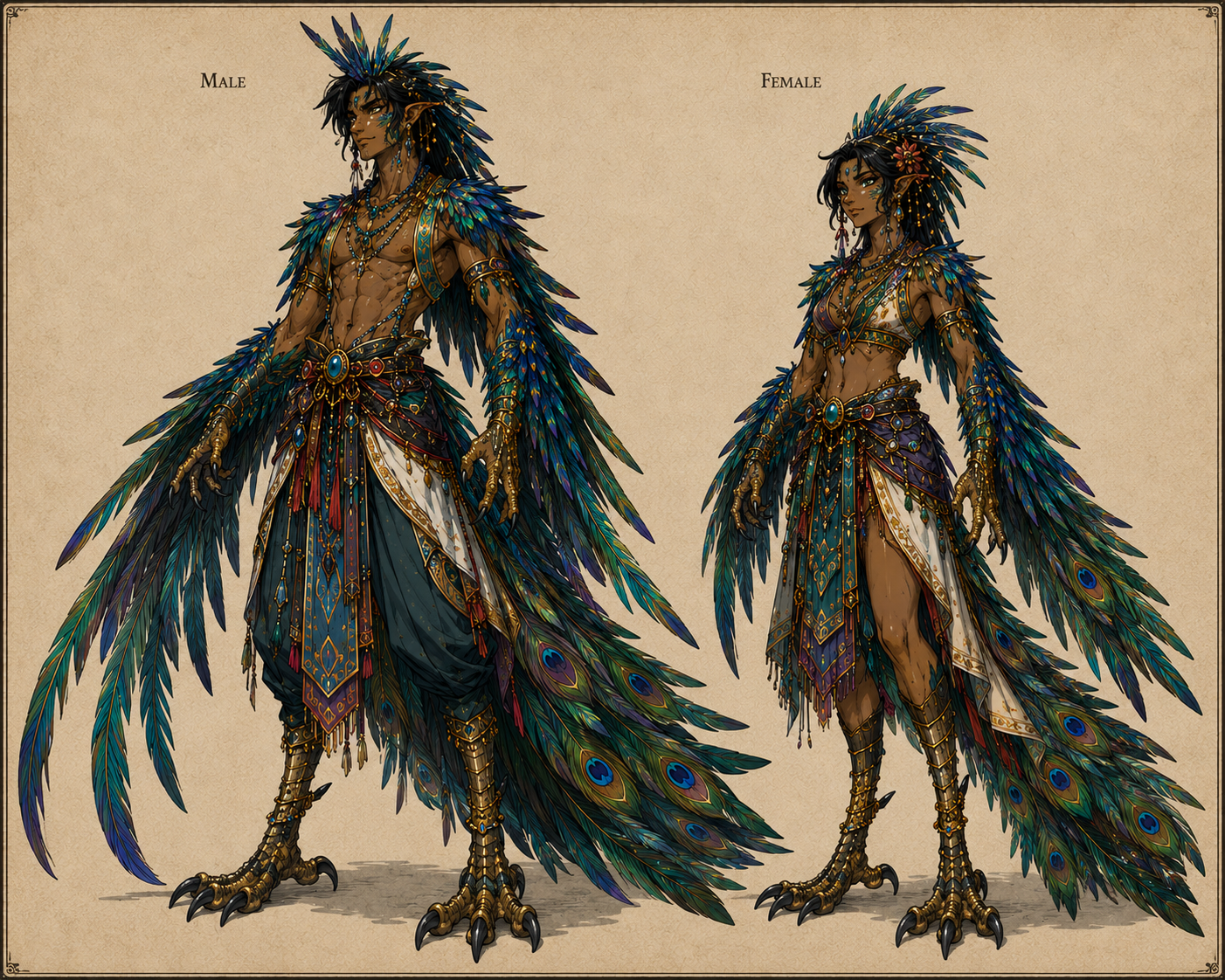
Associations
Other pages that reference or connect to this race
Collections
Published collections that feature this race
Not in any collections yet
This race hasn't been published in any collections yet. Collections are curated groups of related content that help organize and showcase your world.
Tip: Collections are a great way to group related content together and share themed stories or worldbuilding elements with others.
Timelines
Timelines that reference or include this race
No timeline connections yet
This race isn't connected to any timelines yet. Timelines help organize events chronologically and show how your content fits into the broader history of your world.
Tip: Create timelines to organize important events in your world's history. Link characters, locations, and other content to specific events to build rich, interconnected narratives.
Shares
Discussion about this race
No shares yet
Be the first to start a discussion about this race by sharing it to the community stream.
Privacy & Sharing
Manage who can see and access this race
Current Status
refresh
This race is currently
Privacy Settings
Choose who can see and access this race
language Universe Privacy
This page belongs to a universe with its own privacy settings