
Categories
Dive Deeper
Page Stats
Navigation
Categories
Dive Deeper
Page Stats
Complete Details
All information about this race
Overview
Nakka
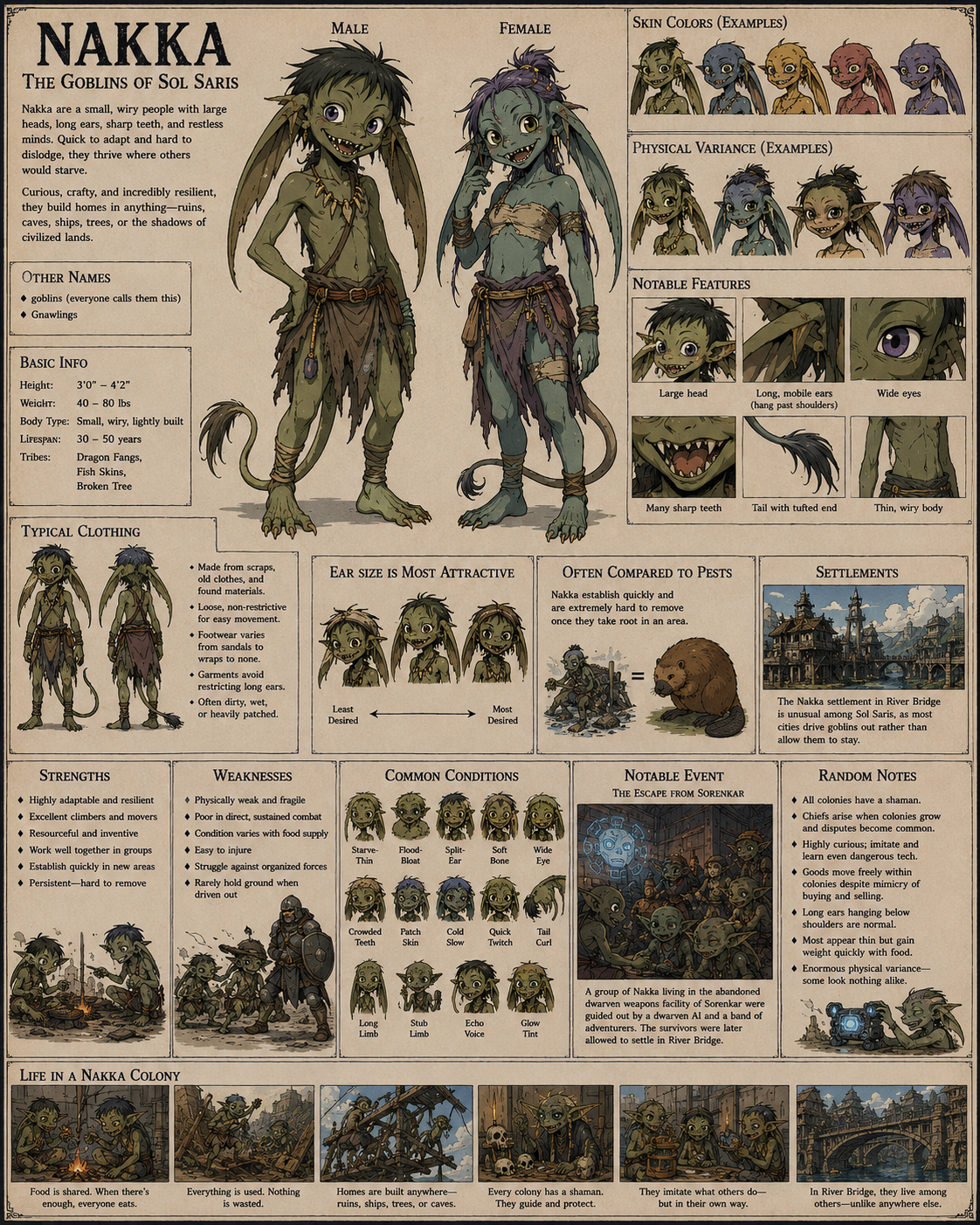
An average goblin (Nakka) is a small, wiry humanoid standing around 3 to 4 feet tall, with a disproportionately large head, wide, expressive eyes, and a mouth filled with many small, sharp teeth that give them a slightly unsettling but often oddly endearing appearance. Their long ears hang well past their shoulders, shifting and lifting subtly as they react to their surroundings, while a thin, rat-like tail with a tufted end moves with their posture. Most appear thin or lightly built, though this can change quickly with access to food. Their skin falls somewhere within muted tones of green, blue, fallow, or light red, and their hair is usually unkempt and practical. They rarely remain still, constantly adjusting, touching nearby objects or others, and moving with quick, deliberate motions, often glancing toward others around them as they act.
goblins (everyone calls them this), Gnawlings
Looks
Goblins (Nakka) have small, wiry frames with disproportionately large heads and thin limbs, their bodies built more for agility and quick movement than strength. They are most commonly seen in a skinny or even emaciated state, with visible joints and narrow torsos, though when they have consistent access to food they gain weight quickly, filling out their limbs and midsection and appearing much more rounded and solid. Their overall build is lightweight and flexible, often carrying a slight hunch at rest, and this variability in body condition is common, reflecting their environment more than any fixed physical standard.
Goblins (Nakka) display a wide range of natural and muted skin tones, most commonly including green, blue, fallow (a dusty yellow-brown), and a light, non-pink red, with occasional individuals appearing in more unusual shades such as purple. These colors are typically somewhat dulled or blended rather than vibrant, giving them a more natural, environment-worn appearance.
Goblins (Nakka) typically stand between 3'0" and 4'2" in height, with most individuals falling toward the middle of that range. Their height is consistent across tribes, though slight variation can occur depending on environment and access to food.
Goblins (Nakka) typically weigh between 40 and 80 pounds, though this can vary noticeably depending on food availability, with individuals appearing very light and thin in lean conditions and becoming significantly heavier and more filled out when well-fed.
Goblins (Nakka) are most recognizable by their large, rounded heads and wide, expressive eyes, paired with broad mouths filled with many small, sharp, uneven teeth that give them a predatory but often oddly endearing appearance. They have long, floppy ears that hang down past their shoulders along the sides of the head, though they are fully mobile and capable of lifting or perking upward when alert. A thin, rat-like tail extends from the base of the spine, ending in a small tuft of hair, often moving subtly with posture or mood. Their bodies are usually thin with narrow limbs and visible joints, though this can change quickly with access to food. They also grow hair atop their heads like other warm-blooded humanoids, typically worn in simple or unkempt styles.
Goblins (Nakka) exhibit an unusually high degree of physical variance, to the point that individuals from different tribes—or even within the same group—can appear so different that it may be difficult to tell they belong to the same species. While they share a consistent baseline of features such as large heads, wide eyes, long ears, and thin frames, nearly every other aspect of their appearance can vary widely, including proportions, facial structure, ear size and shape, tail length, coloration, and overall build. Some may appear more compact and rounded, others extremely thin and elongated; some with exaggerated features, others more subdued. This range of variation is a normal and expected trait among goblins rather than an exception.
Goblins (Nakka) wear simple, practical clothing made from whatever materials are available to them, often resulting in mismatched and heavily worn garments assembled from scraps of cloth, old garments taken from other peoples, rough stitching, and repurposed materials, giving them an uneven and patched-together appearance. Most wear loose wraps, short tunics or shirts, simple belts or ties to secure items, and minimal lower coverings or fitted leg wrappings, with clothing kept light and non-restrictive to allow for quick movement, climbing, and general mobility. Footwear is inconsistent, ranging from simple sandals or wraps to going barefoot depending on terrain. Because of their long ears, garments are either left open or shaped in a way that does not interfere with them, and their clothing is often dirty, faded, or water-worn from constant use. When additional warmth is needed, they rely on cloaks, layered cloth, or bundled materials rather than structured garments, with little uniformity in style as appearance is dictated almost entirely by availability and immediate need rather than tradition or status.
Traits
Goblins (Nakka) excel in adaptability and persistence, able to survive and function effectively in a wide range of environments with minimal resources. They are quick and agile, well-suited for climbing, squeezing through tight spaces, and navigating difficult terrain, and they work efficiently in groups, coordinating simple tasks to achieve larger results. They are highly resourceful, making use of whatever materials are available to them, and can establish themselves rapidly in new or unstable areas. Their ability to adjust to changing conditions, combined with their speed, awareness, and tendency to remain once established, makes them difficult to remove once they have taken hold in a location.
Weaknesses – What are goblins (Nakka) bad at?
Goblins (Nakka) lack individual physical strength and durability, making them poorly suited for direct, sustained combat against larger or more heavily built opponents. Their small size and light frames make them easier to injure, and they rely heavily on numbers or positioning rather than individual capability. They are also inconsistent in condition due to fluctuating access to food, often appearing thin or underfed, which can further limit their endurance and strength. While they can establish themselves quickly, they struggle to defend against organized, well-equipped forces, and once driven out of an area, they rarely hold ground against determined opposition.
Goblins (Nakka) display a wide range of physical conditions, many of which stem from their variable access to food, dense living conditions, and unusually flexible biology. Some conditions are mundane—related to malnutrition, injury, or environment—while others become more extreme, resulting in noticeable physical changes that would be considered abnormal in other species but are not entirely uncommon among the Nakka. These conditions rarely isolate individuals completely, as goblin groups tend to tolerate and adapt around them, allowing even heavily altered individuals to remain part of the group.
Common and Notable Conditions
Starve-Thin: extreme emaciation due to prolonged lack of food
Flood-Bloat: rapid weight gain and swelling after periods of plenty
Split-Ear: torn or uneven ears from injury or growth irregularities
Soft Bone: weakened or flexible bone structure leading to unusual posture or movement
Wide Eye: one or both eyes enlarged or overly prominent
Crowded Teeth: excessive or misaligned teeth causing a packed, uneven bite
Patch Skin: uneven coloration or blotched skin patterns beyond normal variation
Cold Slow: sluggish movement and reduced responsiveness in colder environments
Quick Twitch: constant small muscle movements or jittering behavior
Tail Curl: abnormal tail shape or stiffness
Long Limb: disproportionately extended arms or legs compared to body size
Stub Limb: shortened or underdeveloped limbs
Echo Voice: unusual vocal tone, such as doubled or hollow-sounding speech
Glow Tint: faint, unnatural coloration in the eyes or skin under low light
Culture
Goblins (Nakka) display a number of traditions that resemble the behavior of tightly packed colony animals, where group cohesion, constant movement, and shared awareness take priority over individuality. These behaviors are not formal rituals, but repeated patterns that the group falls into naturally, often appearing erratic, invasive, or unsettling to outsiders due to the Nakka’s comfort with proximity, touch, and synchronized action. They build dense, layered nests from scraps and debris, creating enclosed, constantly shifting living spaces where individuals cluster together, and they sleep in tight, moving piles rather than separately. Food is consumed collectively in close proximity, often with individuals taking from one another or offering food directly, while frequent touch—grabbing arms, shoulders, or faces—serves as a normal way of maintaining awareness of others. When startled, groups may scatter rapidly in all directions before quickly regrouping, or just as suddenly freeze in complete stillness, watching in silence before resuming activity. Even at rest, they are rarely still, constantly shifting, climbing, and repositioning around one another. They mark spaces and pathways through repeated contact, move in loose follow chains without direct instruction, and gather small objects into shared hoards where items are moved and reused without clear ownership. Awareness spreads quickly through proximity, with one individual’s alertness or movement often triggering the same response across the group in moments.
Goblins (Nakka) hold simple, practical beliefs shaped by direct interaction with their surroundings rather than abstract ideas or formal systems. Their understanding of the world is based on use, contact, and immediate experience, with little emphasis placed on ownership, permanence, or individual authority. They place trust in what can be touched, tested, and observed, often relying on the presence and reactions of others to guide decisions. Movement is seen as natural and necessary, while long periods of stillness are avoided. Objects and spaces are valued based on how they are used, not on who they belong to, and unfamiliar things are approached through repeated interaction until they are understood.
Common Beliefs
Things are only meaningful when they are being used
Touch confirms that something is real or important
Movement is normal; long stillness is avoided
More individuals observing or reacting leads to better decisions
Unfamiliar things must be tested through interaction
Objects do not belong to individuals, only to whoever is using them
Goblins (Nakka) organize themselves at the level of individual colonies, with each group operating independently and without any larger, centralized authority. Day-to-day activity is largely unstructured, with individuals taking on tasks based on ability and immediate need, and group direction forming naturally through shared behavior rather than formal decision-making.
As a colony grows in size, a chief is often recognized, not as a ruler in a traditional sense, but as a figure who helps settle disputes, break stalemates, and direct attention when too many individuals are competing over the same task. Their authority is practical and situational, maintained only so long as they remain effective.
Alongside this, every colony maintains a shaman, a more constant role responsible for handling unusual situations, interpreting unfamiliar events, and guiding the group when something falls outside normal behavior. While not necessarily commanding, the shaman holds a distinct position within the colony and is typically deferred to in matters that are uncertain or difficult to understand.
Leadership within a Nakka colony remains fluid, with both chief and shaman acting more as points of coordination than sources of control, and influence shifting as conditions change.
Goblins (Nakka) do not maintain a consistent or unified level of technological development, instead relying heavily on what they can acquire, repurpose, or “borrow” from nearby settlements. While they are capable of creating simple tools and solutions on their own, they are far more likely to take existing designs and adapt them to their needs, often claiming them as their own once integrated into daily use. Their real strength lies in how quickly they adopt new technologies once they have seen them in action, showing a strong curiosity and willingness to experiment—even in situations where it may be unsafe or poorly understood. Tools and devices are frequently modified, simplified, or reassembled from multiple sources, resulting in equipment that may look crude or inconsistent but remains functional. Their approach is practical and immediate, focusing on what works rather than how or why it was originally made, and once something proves useful, it spreads quickly through a colony as others observe and replicate it.
Within their colonies, goblins (Nakka) take on roles based first on what they are capable of and then on what is needed, often resulting in multiple individuals attempting the same task at once until it is sorted out through group adjustment, intervention by other goblins, or direction from a chief—a position typically recognized once a colony reaches a larger size to help resolve disputes—or the colony’s shaman, a role present in all Nakka groups. Work is not rigidly assigned, and roles can shift frequently as needs change or as individuals move between tasks. Outside of their colonies, occupations depend heavily on location and circumstance; in places like Stanzgar or in the southern country of Atlania, individual goblins may be given opportunities to prove themselves as more than pests, though this is rare and often difficult, requiring sustained effort and tolerance from those around them. When accepted, they can perform a wide range of jobs depending on what they are able to learn, though this path is typically an uphill effort rather than a common outcome.
Goblins (Nakka) operate on a loose, inconsistent economic system shaped by imitation, barter, and immediate usefulness rather than a true understanding of currency. Within their colonies, goods move freely between individuals based on need, with little concept of ownership or stored value, though they will often imitate the behavior of nearby settlements by “playing” at being shopkeepers among themselves—setting out items, exchanging goods, and offering “payment” in ways that resemble structured trade without being fully understood. When interacting with outsiders, Nakka extend this imitation further, mimicking trade practices they have observed, but frequently substituting actual currency with “shiny bits,” which may include real coinage but just as often consist of polished stones, bits of metal, nails, or other reflective objects they perceive as valuable. This mismatch can lead to confusion or conflict when dealing with more structured societies such as Stanzgar, where expectations of value and exchange differ significantly. To manage this, colonies will often send a chief to handle interactions with outsiders, as they tend to have a better grasp—though still imperfect—of how these exchanges are expected to function.
Goblins (Nakka) favor foods that are easy to obtain, easy to share, and can be eaten quickly in groups, with little concern for presentation or preparation. Their diet is highly flexible and often reflects whatever is most immediately available, including scavenged goods, small animals, fish, roots, and scraps taken from nearby settlements. They show a strong preference for foods that can be handled directly, passed between individuals, or eaten in pieces, and they are generally unbothered by texture, mixing flavors, or eating partially prepared items. Freshness is less important than availability, and they will readily consume food that other races might reject, though they are still capable of recognizing what is safe to eat through repeated exposure and group testing. When food is plentiful, they tend to eat heavily and quickly, while in lean times they stretch whatever is available across the group.
Common and Preferred Foods
Small roasted animals (rats, birds, lizards)
Fish, often eaten whole or lightly cooked
Root vegetables (dug up and eaten raw or roasted)
Scraps taken from other settlements (bread, meat, cooked leftovers)
Mixed food piles (various ingredients gathered and eaten together)
Hard or dried food that can be carried and shared
Insects and grubs
Foraged fruits and berries
Bone scraps with remaining meat or marrow
Thick stews made from whatever is available
History
While most goblin (Nakka) history is local and colony-based rather than widely recorded, one of the most notable recent events involves the group that once inhabited the abandoned dwarven weapons facility known as Sorenkar. These Nakka had taken residence within the ruin, unaware of—or unable to escape—the dangers still present inside. Over time, conditions within Sorenkar became increasingly hazardous, until a combination of a surviving dwarven artificial intelligence and a group of adventurers enabled their escape. Following this, the surviving Nakka were relocated and eventually allowed to settle within the city of River Bridge, marking a rare instance of a goblin population being accepted into a structured settlement rather than driven out.
Notable Event
The Escape from Sorenkar: A group of Nakka living within an abandoned dwarven weapons lab were guided out with the help of a dwarven AI and outside adventurers, later settling in River Bridge
Notes
The trait goblins (Nakka) find most attractive is ear size, with especially long or large ears generally being viewed favorably
Goblins are commonly compared to pests such as beavers by larger civilizations due to how quickly they establish themselves in an area
Most goblin colonies in the Stanzgar river valley belong to one of three major tribes: the Dragon Fangs, the Fish Skins, or the Broken Tree
Goblins possess an unusually high degree of physical variance, sometimes appearing so different from one another that outsiders struggle to believe they are the same species
All goblin colonies maintain a shaman, regardless of colony size
Chiefs usually emerge only once a colony becomes large enough for disputes and task conflicts to become common
Goblins are highly curious and will often attempt to learn or imitate unfamiliar technology even when doing so is dangerous
Goods move freely within colonies despite goblins frequently imitating the buying and selling behavior of larger societies
Goblin groups are extremely difficult to permanently remove once established in an area
Long ears hanging below the shoulders are considered normal among goblins, though size and shape vary heavily between individuals
Goblins often appear thin or underfed, but can gain weight very quickly when food is plentiful
The Nakka settlement in River Bridge is considered highly unusual due to goblins being permitted to remain within a structured city rather than being expelled
Overview
Details about this race's overview
Nakka
An average goblin (Nakka) is a small, wiry humanoid standing around 3 to 4 feet tall, with a disproportionately large head, wide, expressive eyes, and a mouth filled with many small, sharp teeth that give them a slightly unsettling but often oddly endearing appearance. Their long ears hang well past their shoulders, shifting and lifting subtly as they react to their surroundings, while a thin, rat-like tail with a tufted end moves with their posture. Most appear thin or lightly built, though this can change quickly with access to food. Their skin falls somewhere within muted tones of green, blue, fallow, or light red, and their hair is usually unkempt and practical. They rarely remain still, constantly adjusting, touching nearby objects or others, and moving with quick, deliberate motions, often glancing toward others around them as they act.
goblins (everyone calls them this), Gnawlings
Looks
Details about this race's looks
Goblins (Nakka) have small, wiry frames with disproportionately large heads and thin limbs, their bodies built more for agility and quick movement than strength. They are most commonly seen in a skinny or even emaciated state, with visible joints and narrow torsos, though when they have consistent access to food they gain weight quickly, filling out their limbs and midsection and appearing much more rounded and solid. Their overall build is lightweight and flexible, often carrying a slight hunch at rest, and this variability in body condition is common, reflecting their environment more than any fixed physical standard.
Goblins (Nakka) display a wide range of natural and muted skin tones, most commonly including green, blue, fallow (a dusty yellow-brown), and a light, non-pink red, with occasional individuals appearing in more unusual shades such as purple. These colors are typically somewhat dulled or blended rather than vibrant, giving them a more natural, environment-worn appearance.
Goblins (Nakka) typically stand between 3'0" and 4'2" in height, with most individuals falling toward the middle of that range. Their height is consistent across tribes, though slight variation can occur depending on environment and access to food.
Goblins (Nakka) typically weigh between 40 and 80 pounds, though this can vary noticeably depending on food availability, with individuals appearing very light and thin in lean conditions and becoming significantly heavier and more filled out when well-fed.
Goblins (Nakka) are most recognizable by their large, rounded heads and wide, expressive eyes, paired with broad mouths filled with many small, sharp, uneven teeth that give them a predatory but often oddly endearing appearance. They have long, floppy ears that hang down past their shoulders along the sides of the head, though they are fully mobile and capable of lifting or perking upward when alert. A thin, rat-like tail extends from the base of the spine, ending in a small tuft of hair, often moving subtly with posture or mood. Their bodies are usually thin with narrow limbs and visible joints, though this can change quickly with access to food. They also grow hair atop their heads like other warm-blooded humanoids, typically worn in simple or unkempt styles.
Goblins (Nakka) exhibit an unusually high degree of physical variance, to the point that individuals from different tribes—or even within the same group—can appear so different that it may be difficult to tell they belong to the same species. While they share a consistent baseline of features such as large heads, wide eyes, long ears, and thin frames, nearly every other aspect of their appearance can vary widely, including proportions, facial structure, ear size and shape, tail length, coloration, and overall build. Some may appear more compact and rounded, others extremely thin and elongated; some with exaggerated features, others more subdued. This range of variation is a normal and expected trait among goblins rather than an exception.
Goblins (Nakka) wear simple, practical clothing made from whatever materials are available to them, often resulting in mismatched and heavily worn garments assembled from scraps of cloth, old garments taken from other peoples, rough stitching, and repurposed materials, giving them an uneven and patched-together appearance. Most wear loose wraps, short tunics or shirts, simple belts or ties to secure items, and minimal lower coverings or fitted leg wrappings, with clothing kept light and non-restrictive to allow for quick movement, climbing, and general mobility. Footwear is inconsistent, ranging from simple sandals or wraps to going barefoot depending on terrain. Because of their long ears, garments are either left open or shaped in a way that does not interfere with them, and their clothing is often dirty, faded, or water-worn from constant use. When additional warmth is needed, they rely on cloaks, layered cloth, or bundled materials rather than structured garments, with little uniformity in style as appearance is dictated almost entirely by availability and immediate need rather than tradition or status.
Traits
Details about this race's traits
Goblins (Nakka) excel in adaptability and persistence, able to survive and function effectively in a wide range of environments with minimal resources. They are quick and agile, well-suited for climbing, squeezing through tight spaces, and navigating difficult terrain, and they work efficiently in groups, coordinating simple tasks to achieve larger results. They are highly resourceful, making use of whatever materials are available to them, and can establish themselves rapidly in new or unstable areas. Their ability to adjust to changing conditions, combined with their speed, awareness, and tendency to remain once established, makes them difficult to remove once they have taken hold in a location.
Weaknesses – What are goblins (Nakka) bad at?
Goblins (Nakka) lack individual physical strength and durability, making them poorly suited for direct, sustained combat against larger or more heavily built opponents. Their small size and light frames make them easier to injure, and they rely heavily on numbers or positioning rather than individual capability. They are also inconsistent in condition due to fluctuating access to food, often appearing thin or underfed, which can further limit their endurance and strength. While they can establish themselves quickly, they struggle to defend against organized, well-equipped forces, and once driven out of an area, they rarely hold ground against determined opposition.
Goblins (Nakka) display a wide range of physical conditions, many of which stem from their variable access to food, dense living conditions, and unusually flexible biology. Some conditions are mundane—related to malnutrition, injury, or environment—while others become more extreme, resulting in noticeable physical changes that would be considered abnormal in other species but are not entirely uncommon among the Nakka. These conditions rarely isolate individuals completely, as goblin groups tend to tolerate and adapt around them, allowing even heavily altered individuals to remain part of the group.
Common and Notable Conditions
Starve-Thin: extreme emaciation due to prolonged lack of food
Flood-Bloat: rapid weight gain and swelling after periods of plenty
Split-Ear: torn or uneven ears from injury or growth irregularities
Soft Bone: weakened or flexible bone structure leading to unusual posture or movement
Wide Eye: one or both eyes enlarged or overly prominent
Crowded Teeth: excessive or misaligned teeth causing a packed, uneven bite
Patch Skin: uneven coloration or blotched skin patterns beyond normal variation
Cold Slow: sluggish movement and reduced responsiveness in colder environments
Quick Twitch: constant small muscle movements or jittering behavior
Tail Curl: abnormal tail shape or stiffness
Long Limb: disproportionately extended arms or legs compared to body size
Stub Limb: shortened or underdeveloped limbs
Echo Voice: unusual vocal tone, such as doubled or hollow-sounding speech
Glow Tint: faint, unnatural coloration in the eyes or skin under low light
Culture
Details about this race's culture
Goblins (Nakka) display a number of traditions that resemble the behavior of tightly packed colony animals, where group cohesion, constant movement, and shared awareness take priority over individuality. These behaviors are not formal rituals, but repeated patterns that the group falls into naturally, often appearing erratic, invasive, or unsettling to outsiders due to the Nakka’s comfort with proximity, touch, and synchronized action. They build dense, layered nests from scraps and debris, creating enclosed, constantly shifting living spaces where individuals cluster together, and they sleep in tight, moving piles rather than separately. Food is consumed collectively in close proximity, often with individuals taking from one another or offering food directly, while frequent touch—grabbing arms, shoulders, or faces—serves as a normal way of maintaining awareness of others. When startled, groups may scatter rapidly in all directions before quickly regrouping, or just as suddenly freeze in complete stillness, watching in silence before resuming activity. Even at rest, they are rarely still, constantly shifting, climbing, and repositioning around one another. They mark spaces and pathways through repeated contact, move in loose follow chains without direct instruction, and gather small objects into shared hoards where items are moved and reused without clear ownership. Awareness spreads quickly through proximity, with one individual’s alertness or movement often triggering the same response across the group in moments.
Goblins (Nakka) hold simple, practical beliefs shaped by direct interaction with their surroundings rather than abstract ideas or formal systems. Their understanding of the world is based on use, contact, and immediate experience, with little emphasis placed on ownership, permanence, or individual authority. They place trust in what can be touched, tested, and observed, often relying on the presence and reactions of others to guide decisions. Movement is seen as natural and necessary, while long periods of stillness are avoided. Objects and spaces are valued based on how they are used, not on who they belong to, and unfamiliar things are approached through repeated interaction until they are understood.
Common Beliefs
Things are only meaningful when they are being used
Touch confirms that something is real or important
Movement is normal; long stillness is avoided
More individuals observing or reacting leads to better decisions
Unfamiliar things must be tested through interaction
Objects do not belong to individuals, only to whoever is using them
Goblins (Nakka) organize themselves at the level of individual colonies, with each group operating independently and without any larger, centralized authority. Day-to-day activity is largely unstructured, with individuals taking on tasks based on ability and immediate need, and group direction forming naturally through shared behavior rather than formal decision-making.
As a colony grows in size, a chief is often recognized, not as a ruler in a traditional sense, but as a figure who helps settle disputes, break stalemates, and direct attention when too many individuals are competing over the same task. Their authority is practical and situational, maintained only so long as they remain effective.
Alongside this, every colony maintains a shaman, a more constant role responsible for handling unusual situations, interpreting unfamiliar events, and guiding the group when something falls outside normal behavior. While not necessarily commanding, the shaman holds a distinct position within the colony and is typically deferred to in matters that are uncertain or difficult to understand.
Leadership within a Nakka colony remains fluid, with both chief and shaman acting more as points of coordination than sources of control, and influence shifting as conditions change.
Goblins (Nakka) do not maintain a consistent or unified level of technological development, instead relying heavily on what they can acquire, repurpose, or “borrow” from nearby settlements. While they are capable of creating simple tools and solutions on their own, they are far more likely to take existing designs and adapt them to their needs, often claiming them as their own once integrated into daily use. Their real strength lies in how quickly they adopt new technologies once they have seen them in action, showing a strong curiosity and willingness to experiment—even in situations where it may be unsafe or poorly understood. Tools and devices are frequently modified, simplified, or reassembled from multiple sources, resulting in equipment that may look crude or inconsistent but remains functional. Their approach is practical and immediate, focusing on what works rather than how or why it was originally made, and once something proves useful, it spreads quickly through a colony as others observe and replicate it.
Within their colonies, goblins (Nakka) take on roles based first on what they are capable of and then on what is needed, often resulting in multiple individuals attempting the same task at once until it is sorted out through group adjustment, intervention by other goblins, or direction from a chief—a position typically recognized once a colony reaches a larger size to help resolve disputes—or the colony’s shaman, a role present in all Nakka groups. Work is not rigidly assigned, and roles can shift frequently as needs change or as individuals move between tasks. Outside of their colonies, occupations depend heavily on location and circumstance; in places like Stanzgar or in the southern country of Atlania, individual goblins may be given opportunities to prove themselves as more than pests, though this is rare and often difficult, requiring sustained effort and tolerance from those around them. When accepted, they can perform a wide range of jobs depending on what they are able to learn, though this path is typically an uphill effort rather than a common outcome.
Goblins (Nakka) operate on a loose, inconsistent economic system shaped by imitation, barter, and immediate usefulness rather than a true understanding of currency. Within their colonies, goods move freely between individuals based on need, with little concept of ownership or stored value, though they will often imitate the behavior of nearby settlements by “playing” at being shopkeepers among themselves—setting out items, exchanging goods, and offering “payment” in ways that resemble structured trade without being fully understood. When interacting with outsiders, Nakka extend this imitation further, mimicking trade practices they have observed, but frequently substituting actual currency with “shiny bits,” which may include real coinage but just as often consist of polished stones, bits of metal, nails, or other reflective objects they perceive as valuable. This mismatch can lead to confusion or conflict when dealing with more structured societies such as Stanzgar, where expectations of value and exchange differ significantly. To manage this, colonies will often send a chief to handle interactions with outsiders, as they tend to have a better grasp—though still imperfect—of how these exchanges are expected to function.
Goblins (Nakka) favor foods that are easy to obtain, easy to share, and can be eaten quickly in groups, with little concern for presentation or preparation. Their diet is highly flexible and often reflects whatever is most immediately available, including scavenged goods, small animals, fish, roots, and scraps taken from nearby settlements. They show a strong preference for foods that can be handled directly, passed between individuals, or eaten in pieces, and they are generally unbothered by texture, mixing flavors, or eating partially prepared items. Freshness is less important than availability, and they will readily consume food that other races might reject, though they are still capable of recognizing what is safe to eat through repeated exposure and group testing. When food is plentiful, they tend to eat heavily and quickly, while in lean times they stretch whatever is available across the group.
Common and Preferred Foods
Small roasted animals (rats, birds, lizards)
Fish, often eaten whole or lightly cooked
Root vegetables (dug up and eaten raw or roasted)
Scraps taken from other settlements (bread, meat, cooked leftovers)
Mixed food piles (various ingredients gathered and eaten together)
Hard or dried food that can be carried and shared
Insects and grubs
Foraged fruits and berries
Bone scraps with remaining meat or marrow
Thick stews made from whatever is available
History
Details about this race's history
While most goblin (Nakka) history is local and colony-based rather than widely recorded, one of the most notable recent events involves the group that once inhabited the abandoned dwarven weapons facility known as Sorenkar. These Nakka had taken residence within the ruin, unaware of—or unable to escape—the dangers still present inside. Over time, conditions within Sorenkar became increasingly hazardous, until a combination of a surviving dwarven artificial intelligence and a group of adventurers enabled their escape. Following this, the surviving Nakka were relocated and eventually allowed to settle within the city of River Bridge, marking a rare instance of a goblin population being accepted into a structured settlement rather than driven out.
Notable Event
The Escape from Sorenkar: A group of Nakka living within an abandoned dwarven weapons lab were guided out with the help of a dwarven AI and outside adventurers, later settling in River Bridge
Notes
Details about this race's notes
The trait goblins (Nakka) find most attractive is ear size, with especially long or large ears generally being viewed favorably
Goblins are commonly compared to pests such as beavers by larger civilizations due to how quickly they establish themselves in an area
Most goblin colonies in the Stanzgar river valley belong to one of three major tribes: the Dragon Fangs, the Fish Skins, or the Broken Tree
Goblins possess an unusually high degree of physical variance, sometimes appearing so different from one another that outsiders struggle to believe they are the same species
All goblin colonies maintain a shaman, regardless of colony size
Chiefs usually emerge only once a colony becomes large enough for disputes and task conflicts to become common
Goblins are highly curious and will often attempt to learn or imitate unfamiliar technology even when doing so is dangerous
Goods move freely within colonies despite goblins frequently imitating the buying and selling behavior of larger societies
Goblin groups are extremely difficult to permanently remove once established in an area
Long ears hanging below the shoulders are considered normal among goblins, though size and shape vary heavily between individuals
Goblins often appear thin or underfed, but can gain weight very quickly when food is plentiful
The Nakka settlement in River Bridge is considered highly unusual due to goblins being permitted to remain within a structured city rather than being expelled
Gallery
Images and visual content for this race
Associations
Other pages that reference or connect to this race
No connections yet
Start building your world by linking this race to other pages
Collections
Published collections that feature this race
Not in any collections yet
This race hasn't been published in any collections yet. Collections are curated groups of related content that help organize and showcase your world.
Tip: Collections are a great way to group related content together and share themed stories or worldbuilding elements with others.
Timelines
Timelines that reference or include this race
No timeline connections yet
This race isn't connected to any timelines yet. Timelines help organize events chronologically and show how your content fits into the broader history of your world.
Tip: Create timelines to organize important events in your world's history. Link characters, locations, and other content to specific events to build rich, interconnected narratives.
Shares
Discussion about this race
No shares yet
Be the first to start a discussion about this race by sharing it to the community stream.
Privacy & Sharing
Manage who can see and access this race
Current Status
refresh
This race is currently
Privacy Settings
Choose who can see and access this race
language Universe Privacy
This page belongs to a universe with its own privacy settings