
Categories
Dive Deeper
Page Stats
Navigation
Categories
Dive Deeper
Page Stats
Complete Details
All information about this technology
Overview
Combined Operations Autonomous Resupply System (COARS)
COARS
None
Production
NaN
NaN
NaN
Average
Presence
Common
Use
The COARS is used to assist in the resupply of deployed forces.
COARS was developed early in AAF, with a change in doctrine following lessons learned in the Second Porcine War and the earlier Iapsis Annexation.
Previously, deployed resupply was mostly a strategic level mechanism. A Naval Starship fleet in orbit would create land bases to sustain ground forces.
After the successful defense of many GRU planets against Porcine invasion due to ground based strategic defenses and in-atmosphere aircraft, the GRU and later AAF reevaluated their own offensive strategy.
During the Second Porcine War, many Porcine Naval Spaceship landing attempts were thwared by stiff resistance by non naval forces. The few that did manage to land and deploy their ground forces quickly developed logistical problems. The lack of infrastructure in most landing zones meant that supply bases and routes had to be built from the ground up, an incredibly difficult task for an invading force. The inability to effectively transfer supplies from the naval force to the ground forces stalled the invasion and ultimately led to the Porcine's defeat.
The new AAF strategy involved a multistep plan encompassing joint Naval Space, Naval Air, and ground forces maneuvers. Once space superiority was achieved, NAS-H(X)-CV Battle class, a class of newly developed flying aircraft carriers, would be deployed along with conventional landing craft to begin the invasion. The NAS-H(X)-CV Battle class would ensure air superiority and cover the landing craft while they deploy.
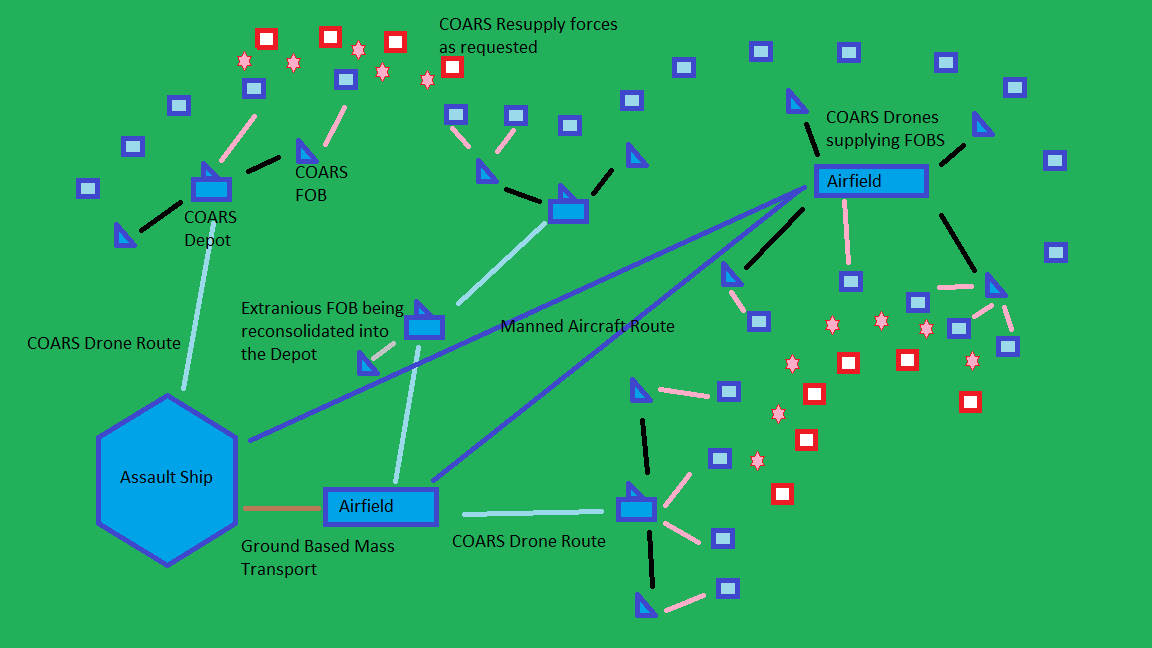
COARS is what keeps the post deployment supply advantage for the AAF. Using an intelligent automated supply request system, COARS dispatches VTOL drones to directly resupply soldiers and vehicles in the field, forgoing all ground based transportation.
Even though COARS doesn't explicitly need additional supply bases, it can be advantageous to have them. The establishment of forward supply bases allows the stockpiling of material closer to where to may be needed, allowing for shorter resupply times and more efficient use of COARS drones. In addition, since the system is aircraft based, ground supply points are not required to be road accessible. Bases can be made on islands, forest clearings, mountains, or even in wetlands. The AAF has many deployable prefabricated structures for use with COARS supply bases. As long as there is enough flat space to fit the structures they need, COARS bases can be built anywhere.
COARS uses a fleet of autonomous drones to resupply deployed forces.
None
Appearance
NaN
NaN
NaN
NaN
Notes
None
Overview
Details about this technology's overview
Combined Operations Autonomous Resupply System (COARS)
COARS
None
Production
Details about this technology's production
NaN
NaN
NaN
Average
Presence
Details about this technology's presence
Common
Use
Details about this technology's use
The COARS is used to assist in the resupply of deployed forces.
COARS was developed early in AAF, with a change in doctrine following lessons learned in the Second Porcine War and the earlier Iapsis Annexation.
Previously, deployed resupply was mostly a strategic level mechanism. A Naval Starship fleet in orbit would create land bases to sustain ground forces.
After the successful defense of many GRU planets against Porcine invasion due to ground based strategic defenses and in-atmosphere aircraft, the GRU and later AAF reevaluated their own offensive strategy.
During the Second Porcine War, many Porcine Naval Spaceship landing attempts were thwared by stiff resistance by non naval forces. The few that did manage to land and deploy their ground forces quickly developed logistical problems. The lack of infrastructure in most landing zones meant that supply bases and routes had to be built from the ground up, an incredibly difficult task for an invading force. The inability to effectively transfer supplies from the naval force to the ground forces stalled the invasion and ultimately led to the Porcine's defeat.
The new AAF strategy involved a multistep plan encompassing joint Naval Space, Naval Air, and ground forces maneuvers. Once space superiority was achieved, NAS-H(X)-CV Battle class, a class of newly developed flying aircraft carriers, would be deployed along with conventional landing craft to begin the invasion. The NAS-H(X)-CV Battle class would ensure air superiority and cover the landing craft while they deploy.
COARS is what keeps the post deployment supply advantage for the AAF. Using an intelligent automated supply request system, COARS dispatches VTOL drones to directly resupply soldiers and vehicles in the field, forgoing all ground based transportation.
Even though COARS doesn't explicitly need additional supply bases, it can be advantageous to have them. The establishment of forward supply bases allows the stockpiling of material closer to where to may be needed, allowing for shorter resupply times and more efficient use of COARS drones. In addition, since the system is aircraft based, ground supply points are not required to be road accessible. Bases can be made on islands, forest clearings, mountains, or even in wetlands. The AAF has many deployable prefabricated structures for use with COARS supply bases. As long as there is enough flat space to fit the structures they need, COARS bases can be built anywhere.
COARS uses a fleet of autonomous drones to resupply deployed forces.
None
Appearance
Details about this technology's appearance
NaN
NaN
NaN
NaN
Related technologies
Details about this technology's related technologies
Notes
Details about this technology's notes
None
Gallery
Images and visual content for this technology
Associations
Other pages that reference or connect to this technology
Referenced By
2Collections
Published collections that feature this technology
Not in any collections yet
This technology hasn't been published in any collections yet. Collections are curated groups of related content that help organize and showcase your world.
Tip: Collections are a great way to group related content together and share themed stories or worldbuilding elements with others.
Timelines
Timelines that reference or include this technology
No timeline connections yet
This technology isn't connected to any timelines yet. Timelines help organize events chronologically and show how your content fits into the broader history of your world.
Tip: Create timelines to organize important events in your world's history. Link characters, locations, and other content to specific events to build rich, interconnected narratives.
Shares
Discussion about this technology
No shares yet
Be the first to start a discussion about this technology by sharing it to the community stream.
Privacy & Sharing
Manage who can see and access this technology
Current Status
refresh
This technology is currently
Privacy Settings
Choose who can see and access this technology
language Universe Privacy
This page belongs to a universe with its own privacy settings