Categories
Dive Deeper
Page Stats
Navigation
Categories
Dive Deeper
Page Stats
Complete Details
All information about this race
Overview
Orc
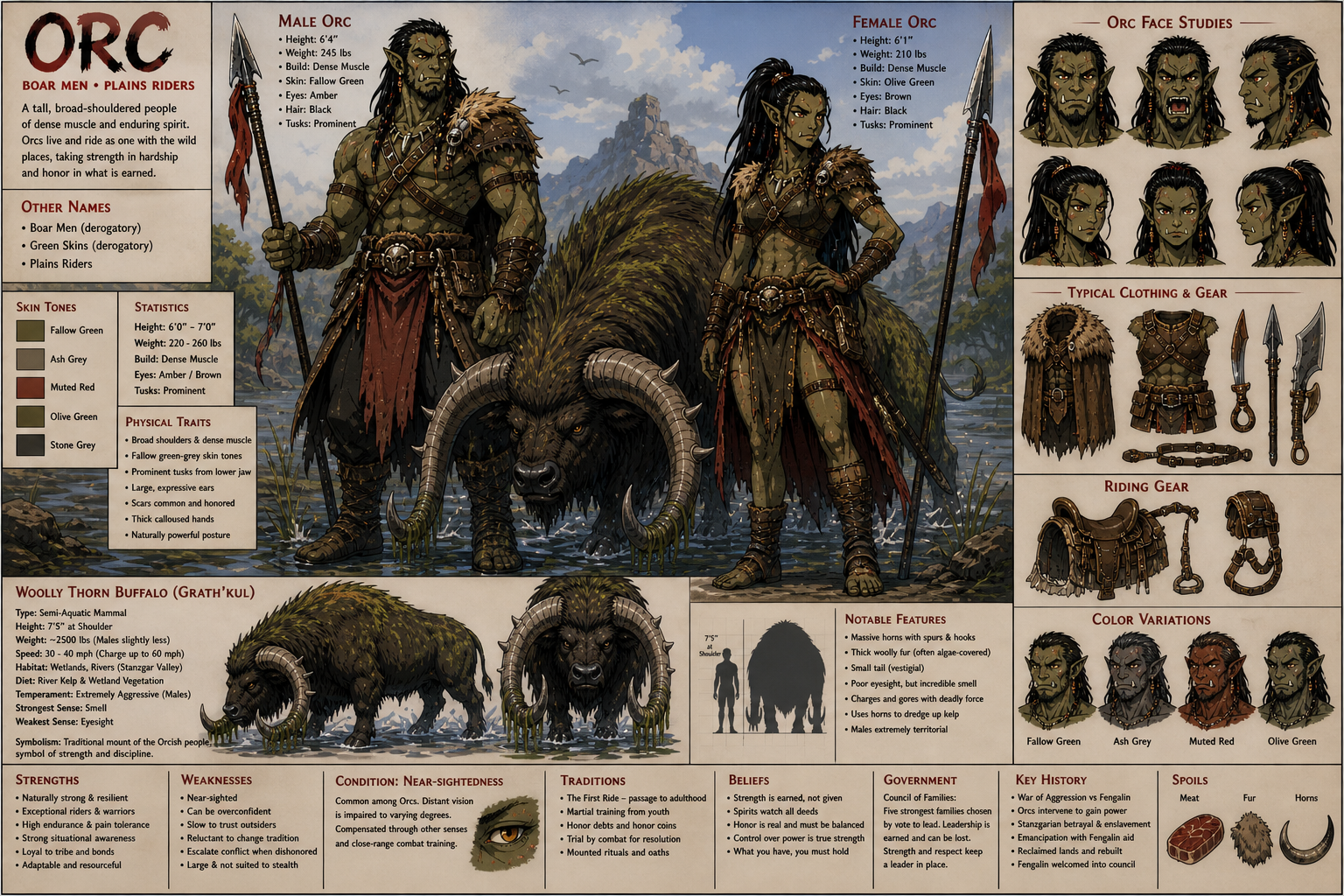
An average Orc is a tall, broad-shouldered figure of dense muscle and fallow green-grey skin, with tusks rising from the lower jaw and a presence that feels solid and grounded. Built naturally strong, they carry weight with ease and move with a steady, deliberate confidence rather than speed or flourish.
Their posture reflects a life of riding and readiness—balanced, forward-set, and always seeming prepared to act. Whether on foot or in the saddle, they give the impression of someone accustomed to control, capable of holding their ground and applying force when needed. Marked often by scars and shaped by hard living, an Orc looks less like someone trying to appear strong and more like someone who simply is.
Boar men, (derogatory), green skins (derogatory), plains riders
Looks
Orc physiques are defined by one immediately obvious truth:
they are built for strength—and they get there faster than most
Naturally Muscular Build
While Orcs can have a range of body types like any people, they tend strongly toward:
broad, heavily muscled frames
thick limbs
and dense physical structure
Their bodies develop muscle quickly, often with:
less effort than humans
faster visible results
and greater overall density
Even an Orc who does not actively train will often appear:
solid
powerful
and physically capable
Heavy Frame and Density
Orcs are not just muscular—
they are dense.
Their bodies tend to have:
thick bone structure
wide shoulders
and deep chests
This gives them:
high natural strength
strong physical resilience
and a presence that feels grounded and difficult to move
They are rarely described as:
light
delicate
or fragile
Upper Body Dominance
Much of an Orc’s visible power sits in:
shoulders
arms
and upper torso
This supports:
weapon use
grappling
and mounted combat control
However, their lower body is no less important.
Rider’s Build (Lower Body Strength)
Because of their cultural focus on riding—especially mounts like the Woolly Thorn Buffalo (Grath’kul)—Orcs develop:
extremely strong legs
powerful hips
and excellent balance
They are built to:
grip and control large, aggressive mounts
absorb impact while riding at speed
and maintain stability under violent movement
This gives them a full-body strength profile that is:
as much about control as it is power
Muscle Development Pattern
Orc musculature tends to be:
thick rather than sharply defined
built for force over aesthetics
and highly functional
They are less likely to have:
lean, “cut” muscle appearance
and more likely to show:
heavy, compact strength
Posture and Presence
Orcs carry themselves with:
a forward-set stance
relaxed but ready posture
and a natural sense of physical confidence
They often appear:
planted
steady
and prepared to act
Even at rest, there is a sense that:
they could move with force at any moment
Variation Within the Form
Though trends are strong, Orcs can still vary:
some are bulkier and more massive
others are leaner but still powerful
some favor endurance builds, others explosive strength
However, almost all Orcs share:
a baseline of physical capability above average humanoids
Core Body Identity
Orcs are not just strong—
they are built to be strong easily, consistently, and reliably.
Orc skin carries a tone often described as fallow—muted, earthy, and grounded—reflecting both their environment and their physical nature.
Common Skin Tones
Orcs typically exhibit a range of colors between:
pale green
dull olive
ashen green
stone-grey
and green-grey blends
These tones are rarely bright or vibrant. Instead, they appear:
subdued
weathered
and natural
Their coloration often feels closer to:
earth, moss, and worn stone
than anything vivid or striking.
Fallow Quality
The term fallow is often used to describe Orc skin because it carries:
a muted, almost desaturated appearance
a slightly rough or matte texture
and a sense of something hardened by exposure
This gives Orcs a look that feels:
grounded
resilient
and unrefined in a natural way
Undertones and Variation
Within their general color range, Orcs may display undertones such as:
yellow-green
grey-blue
or brown-olive
These undertones can shift based on:
region
lineage
and environment
Some Orcs lean more:
green
others more grey
but rarely fully into one or the other.
Environmental Effects
Life in open plains and harsh climates leaves visible impact on their skin.
Many Orcs show:
weathering from wind and sun
minor scarring
and slight roughness from exposure
These are not seen as flaws—
but as:
marks of experience
Scar Visibility
Due to their skin tone:
scars often appear lighter or slightly raised
healed wounds stand out clearly
and markings remain visible over time
This contributes to a cultural acceptance that:
a life without marks is a life not tested
Contrast with Features
Their skin provides strong visual contrast with:
tusks
eyes
and any adornments or armor
This makes their defining features stand out more clearly, especially:
facial structure
and expressions
Core Skin Identity
Orc skin is not vibrant or decorative—
it is:
practical, weathered, and built to endure the environments they live in
Orcs are a tall people, with most individuals standing between 6 and 7 feet, placing them well above the average height of most humanoid races.
Average Range and Distribution
Most Orcs fall within:
6’0” to 7’0”
With:
shorter individuals still appearing large due to build
taller individuals becoming especially imposing
Heights above 7 feet are uncommon—but not unheard of among particularly strong bloodlines.
Height and Build Relationship
Orc height is closely tied to their overall physique.
Because they are:
heavily muscled
broad-shouldered
and dense
their height does not make them appear lanky or stretched.
Instead, it creates a presence that feels:
solid, grounded, and imposing
A 6’2” Orc can often feel larger than a taller but lighter-built individual.
Posture and Presence
Orcs tend to carry their height with:
a forward-set, ready posture
squared shoulders
and a steady stance
They rarely:
slouch
or diminish their size
This gives them a natural presence that is:
assertive
stable
and difficult to ignore
Mounted Culture Influence
Because Orcs are a riding culture—especially of mounts like the Woolly Thorn Buffalo (Grath’kul)—their height supports:
better control over large mounts
stronger leverage when riding
and improved visibility across open plains
Their stature is not just natural—
it is reinforced by how they live.
Perceived Size
To outsiders, Orcs often appear:
larger than their actual height
more physically dominant
and more imposing than expected
This is due to the combination of:
height
density
and posture
Core Height Identity
Orc height is not just about being tall—
it is about:
carrying size with weight, strength, and presence
Orcs average around ~230 pounds, though this number often understates how heavy they actually feel.
They are not just large—
they are dense, heavily built, and difficult to move.
Weight Range and Distribution
Most Orcs fall within:
200–260 lbs
With:
leaner individuals on the lower end
heavily muscled or larger-framed individuals pushing higher
Even at the lower end, Orcs rarely appear light.
Density Over Size
What defines Orc weight is not just mass—
it is how that mass is built.
Their bodies tend to have:
thick bone structure
tightly packed muscle
and minimal wasted space
This creates a physical presence that feels:
heavier than it looks
An Orc of average height and weight can feel comparable to a much larger individual when:
lifting
grappling
or impacting something
Muscle Contribution
A large portion of Orc weight comes from:
natural muscle development
Because Orcs build muscle easily, they tend to carry:
more muscle mass at baseline
thicker limbs
and stronger cores
Even those not actively training often maintain:
functional strength
and noticeable mass
Weight and Stability
Their weight contributes directly to:
balance
stability
and resistance to being moved
This is especially important for:
mounted combat
close-quarters fighting
and controlling large animals like the Woolly Thorn Buffalo (Grath’kul)
They are not easily:
knocked down
pushed aside
or displaced
Variation Within the Range
While ~230 lbs is average, variation exists:
lighter Orcs (~200 lbs) are often more mobile but still strong
heavier Orcs (250+ lbs) may carry extreme muscle or broader frames
Regardless of variation, most Orcs maintain:
a baseline of solid, functional mass
Core Weight Identity
Orc weight is not about size alone—
it is about:
density, power, and the ability to hold ground against force
Tusks
The most defining feature of an Orc is their tusks, which protrude upward from the lower jaw.
These tusks:
vary in length and curvature
may be straight, hooked, or slightly flared outward
grow thicker and more pronounced with age
They are not purely decorative.
Tusks serve as:
a symbol of maturity
a mark of identity
and, in some cases, a practical asset in close combat
Damaged or broken tusks are often:
visible
remembered
and sometimes respected as signs of experience
Height and Physical Presence
Orcs are immediately noticeable for their:
tall stature
broad frames
and dense musculature
They tend to dominate space simply by:
standing
turning
or moving
Even among other tall races, Orcs stand out because their size is paired with:
weight, solidity, and readiness
Musculature and Build
Orc bodies carry:
thick, naturally developed muscle
wide shoulders
and powerful limbs
Their musculature is:
compact rather than sharply defined
built for strength and impact
and present even without deliberate training
This gives them a look that is:
functional, not ornamental
Fallow Green-Grey Skin
Their skin—ranging from pale green to grey—has a:
muted
weathered
and slightly rough appearance
This fallow quality makes them look:
hardened by environment
and grounded in their surroundings
It also contrasts strongly with:
tusks
eyes
and any armor or adornment
Rider’s Posture and Balance
Orcs are a mounted culture, and it shows in how they carry themselves.
They tend to have:
a low, stable center of gravity
strong leg positioning
and excellent balance
Even on foot, they move as if:
they are ready to mount or already in motion
Hands Built for Grip and Control
Orc hands are typically:
large
strong
and thick-fingered
They are well suited for:
weapon handling
reins control
and grappling
Their grip strength is often one of their most noticeable physical traits in action.
Scarring and Wear
Due to their martial culture and environment, many Orcs bear:
visible scars
healed wounds
and marks of past conflict
These are:
common
accepted
and often carry personal meaning
Eyes (Often a Point of Contrast)
While not always emphasized, Orc eyes often stand out against their muted skin tones.
They may appear:
sharp
intense
or focused
This creates a contrast where:
expression becomes more noticeable
and gaze carries weight
Mounted Identity (Visual Association)
Even when not riding, Orcs are often visually associated with their traditional mounts:
the Woolly Thorn Buffalo (Grath’kul)
This connection reinforces their image as:
powerful riders
disciplined handlers of dangerous animals
and people accustomed to controlling force rather than avoiding it
Core Feature Identity
Orcs are defined by a combination of:
size, strength, and unmistakable physical markers that signal both power and lived experience
Orcs display wide physical variance, comparable to any other humanoid race—
but all variation exists within a framework of:
strength, density, and presence
Range of Body Types
Orcs can vary across a full spectrum of builds, including:
heavily muscled, broad “strongman” frames
more balanced, athletic builds
leaner individuals with less bulk but retained strength
and larger, heavier-set individuals with significant mass
However, even at their leanest, Orcs tend to maintain:
noticeable muscle
solid structure
and above-average physical capability
Height and Size Variation
While most Orcs fall between 6–7 feet, variation still exists:
shorter Orcs (~5’10”–6’) may appear more compact and dense
taller Orcs (approaching or exceeding 7’) can be especially imposing
Despite these differences, they rarely appear:
slight
fragile
or underdeveloped
Muscle Development Differences
Though Orcs build muscle easily, how that muscle develops varies:
some individuals become extremely bulky and powerful
others remain more streamlined but still strong
some favor endurance-based builds over explosive strength
Training, lifestyle, and role all influence this.
Tusks Variation
Tusks show significant individual variation in:
length
thickness
curvature
and symmetry
Some Orcs have:
short, thick tusks close to the jaw
long, pronounced tusks extending upward
or asymmetrical tusks due to damage or growth differences
Tusks are often one of the most distinguishing features between individuals.
Skin Tone Variation
Within their green-to-grey range, Orcs may vary in:
saturation
undertone
and overall depth of color
Some lean more:
green
others more grey
and some carry mixed tones
Environmental exposure can also affect appearance over time.
Scars and Lived Experience
One of the most visible forms of variance comes from:
scars
injuries
and wear
Because of their culture, few Orcs reach adulthood without:
marks of conflict
signs of labor
or visible history on their bodies
These differences often carry more identity than natural features.
Eyesight Variation (Notable Trait)
Unlike many traits, eyesight varies significantly across Orc populations.
Near-sightedness is:
common
but not universal
This creates a divide between individuals who:
rely more on close-range combat and instinct
versus those with clearer distance vision
Environmental and Cultural Influence
Lifestyle heavily influences Orc appearance.
Differences may emerge between:
riders vs. laborers
soldiers vs. farmers
plains-dwellers vs. more settled groups
These differences affect:
posture
muscle emphasis
and overall build
Core Variance Identity
Orcs can vary widely in appearance—
but never in a way that removes their core traits.
Typical Clothing – What kind of clothing is common with Orc individuals?
Orc clothing is shaped by two constant demands:
harsh seasonal extremes
and a life built around riding and readiness for combat
They dress not for appearance first—
but for:
function, protection, and durability
Seasonal Adaptation
Orc homelands experience strong temperature swings, and their clothing reflects this.
In warmer seasons, Orcs favor:
light, breathable garments
minimal layering
and flexible materials that allow movement
These are often:
sleeveless or short-sleeved
loose enough for airflow
but structured enough not to interfere with riding
In colder seasons, they shift to:
heavy furs
layered hides
and insulated garments
These are designed to:
retain heat
resist wind
and endure long exposure outdoors
Constant Presence of Armor
Regardless of season, Orcs almost always incorporate:
some form of armor into their clothing
This may include:
leather chest pieces
reinforced shoulder guards
bracers and greaves
or light metal plating where available
Even in casual settings, an Orc is rarely:
completely unprotected
Armor is treated not as separate from clothing—
but as:
part of what one wears
Rider-Adapted Design
Because of their strong riding culture—especially with mounts like the Woolly Thorn Buffalo (Grath’kul)—Orc clothing is built for:
stability in the saddle
freedom of leg movement
and resistance to wear from constant contact
Common features include:
reinforced inner leg areas
secure belts and harness attachments
garments that do not snag easily
Clothing must hold up under:
speed
impact
and prolonged travel
Materials and Construction
Orc clothing is typically made from:
leather
hide
fur
and durable woven fabrics
Materials are chosen for:
toughness
availability
and resistance to damage
Fine or delicate fabrics are rare and often impractical.
Practical Layering
Orcs layer clothing in a way that allows for:
quick adjustment
temperature regulation
and ease of movement
Layers can be:
removed
added
or shifted
depending on:
weather
activity
or combat readiness
Minimal Ornamentation
Compared to some cultures, Orc clothing is:
functional
straightforward
and minimally decorative
Any decoration that exists is usually:
symbolic (clan, family, achievements)
or integrated into armor and gear
They do not prioritize:
excess display
or unnecessary embellishment
Utility and Readiness
Most Orc outfits are built with:
attachment points for weapons
space for tools
and accessibility for equipment
An Orc dresses with the expectation that:
they may need to act quickly
Core Clothing Identity
Orc clothing is not about style—
it is about:
being prepared for weather, travel, and conflict at all times
Traits
Typical Clothing – What kind of clothing is common with Orc individuals?
Orc clothing is shaped by two constant demands:
harsh seasonal extremes
and a life built around riding and readiness for combat
They dress not for appearance first—
but for:
function, protection, and durability
Seasonal Adaptation
Orc homelands experience strong temperature swings, and their clothing reflects this.
In warmer seasons, Orcs favor:
light, breathable garments
minimal layering
and flexible materials that allow movement
These are often:
sleeveless or short-sleeved
loose enough for airflow
but structured enough not to interfere with riding
In colder seasons, they shift to:
heavy furs
layered hides
and insulated garments
These are designed to:
retain heat
resist wind
and endure long exposure outdoors
Constant Presence of Armor
Regardless of season, Orcs almost always incorporate:
some form of armor into their clothing
This may include:
leather chest pieces
reinforced shoulder guards
bracers and greaves
or light metal plating where available
Even in casual settings, an Orc is rarely:
completely unprotected
Armor is treated not as separate from clothing—
but as:
part of what one wears
Rider-Adapted Design
Because of their strong riding culture—especially with mounts like the Woolly Thorn Buffalo (Grath’kul)—Orc clothing is built for:
stability in the saddle
freedom of leg movement
and resistance to wear from constant contact
Common features include:
reinforced inner leg areas
secure belts and harness attachments
garments that do not snag easily
Clothing must hold up under:
speed
impact
and prolonged travel
Materials and Construction
Orc clothing is typically made from:
leather
hide
fur
and durable woven fabrics
Materials are chosen for:
toughness
availability
and resistance to damage
Fine or delicate fabrics are rare and often impractical.
Practical Layering
Orcs layer clothing in a way that allows for:
quick adjustment
temperature regulation
and ease of movement
Layers can be:
removed
added
or shifted
depending on:
weather
activity
or combat readiness
Minimal Ornamentation
Compared to some cultures, Orc clothing is:
functional
straightforward
and minimally decorative
Any decoration that exists is usually:
symbolic (clan, family, achievements)
or integrated into armor and gear
They do not prioritize:
excess display
or unnecessary embellishment
Utility and Readiness
Most Orc outfits are built with:
attachment points for weapons
space for tools
and accessibility for equipment
An Orc dresses with the expectation that:
they may need to act quickly
Core Clothing Identity
Orc clothing is not about style—
it is about:
being prepared for weather, travel, and conflict at all times
Near-Sightedness
One of the most common weaknesses among Orcs is poor eyesight, particularly near-sightedness.
While not universal, it is widespread enough to be:
recognized
accounted for
and culturally adapted to
Affected Orcs struggle with:
long-distance clarity
identifying fine details at range
and tracking distant movement
This can be a disadvantage in:
scouting
ranged combat
and open-field awareness
However, many Orcs compensate through:
reliance on other senses
experience
and proximity-based combat styles
Limited Long-Range Precision
Even beyond true near-sightedness, Orcs are generally less specialized in:
fine visual tracking
long-range targeting
and precision-based ranged combat
They excel up close—
but at distance, they may be:
slower to react
less accurate
or reliant on others for support
Reliance on Physical Dominance
Orc strengths are heavily tied to:
strength
direct engagement
and physical control
This can become a weakness when facing:
highly mobile opponents
ranged-focused enemies
or environments that restrict movement
Situations that prevent them from:
closing distance and applying force
can limit their effectiveness.
Environmental Exposure
Because Orc clothing and lifestyle prioritize:
mobility
and readiness
they may be more exposed to:
extreme environmental shifts
sudden weather changes
or prolonged non-native climates
While they adapt to seasonal extremes, they are not specialized for:
highly controlled indoor environments
or radically different climates
Large Target Profile
Their size and build make Orcs:
highly visible
easy to track
and difficult to conceal
This can be a disadvantage in:
stealth operations
ambush situations
or environments requiring subtlety
They are rarely able to:
disappear into a crowd or landscape
Momentum-Based Combat Style
Orcs often rely on:
forward pressure
sustained engagement
and physical momentum
When this momentum is:
interrupted
redirected
or stalled
they may need time to:
recover position
or re-engage effectively
Cultural Directness
Their tendency toward:
straightforward thinking
and direct action
can sometimes lead to:
underestimating complex strategies
difficulty with deception-heavy situations
or frustration with indirect approaches
This is not a lack of intelligence—
but a difference in approach that can be exploited.
Core Weakness Identity
Orc weaknesses stem from the same traits that make them strong—
they are built for direct strength in a world that does not always fight directly
Orc conditions tend to reflect the realities of their lives:
physical strain
environmental exposure
and biological traits tied to their build
They are not a fragile people—
but even strong bodies have limits.
Near-Sightedness
Description:
A common condition among Orcs where distant vision is impaired.
It varies in severity, from mild blur at long range to significant difficulty identifying shapes and movement far away.
Symptoms:
difficulty seeing clearly at distance
reliance on proximity for identification
reduced effectiveness in long-range observation
In more severe cases:
inability to track distant targets
delayed reaction to far-off threats
Cultural Meaning:
Well understood and widely accommodated.
Orcs adapt by:
favoring close combat roles
relying on others for scouting
or using mounts to close distance quickly
It is not heavily stigmatized—
just something to work around.
Overstrain (Muscle and Joint Stress)
Description:
A condition caused by repeated heavy exertion, overtraining, or pushing physical limits too far.
Because Orcs build muscle easily and often rely on strength, they may:
overuse their bodies
ignore early warning signs
or continue past safe limits
Symptoms:
joint pain
muscle stiffness
reduced mobility
lingering fatigue
In severe cases:
tearing injuries
long-term joint damage
Cultural Meaning:
Often dismissed early on.
Many Orcs will push through it until it becomes:
impossible to ignore
Elders and experienced warriors tend to take it more seriously.
Rider’s Wear
Description:
A long-term condition affecting Orcs who spend significant time riding, especially on aggressive mounts like the Woolly Thorn Buffalo (Grath’kul).
Symptoms:
hip and lower back strain
leg fatigue or stiffness
joint compression
Over time:
posture may shift slightly
mobility may be affected when not riding
Cultural Meaning:
Seen as a mark of experience.
Those with Rider’s Wear are often:
people who have spent years in the saddle
Tusk Damage
Description:
A physical condition resulting from:
broken
chipped
or uneven tusks
This can occur through:
combat
accidents
or natural growth irregularities
Symptoms:
pain or sensitivity
difficulty biting or clenching
asymmetry in jaw movement
In severe cases:
infection
or long-term discomfort
Cultural Meaning:
Varies.
Some see it as:
a mark of battle
Others view it as:
something to be corrected if possible
Cold Stiffness
Description:
A temporary condition caused by prolonged exposure to cold environments.
Though Orcs can handle seasonal shifts, cold can:
tighten muscles
slow movement
and reduce flexibility
Symptoms:
stiffness in joints
reduced reaction speed
muscle tightness
Cultural Meaning:
Expected during winter seasons.
Managed through:
proper layering
movement
and preparation
Mount Shock
Description:
A short-term condition occurring after:
sudden dismounts
falls
or high-impact riding events
Especially common when dealing with aggressive mounts.
Symptoms:
disorientation
soreness
temporary loss of balance
In severe cases:
concussion-like symptoms
Cultural Meaning:
Part of riding life.
Rarely avoided—
only managed.
Core Condition Identity
Orc conditions are not signs of weakness—
they are:
the cost of strength, riding, and living hard lives in demanding conditions
Culture
The First Ride
Becoming an adult through mastery of the mount
Among Orcs, no individual is considered an adult until they have:
taken their first ride unassisted
This is not symbolic.
It is a real and often dangerous act, typically performed on a Woolly Thorn Buffalo (Grath’kul) or another culturally recognized mount.
The First Ride requires the individual to:
mount without aid
maintain control
and remain seated through the animal’s resistance
Because these creatures are:
powerful
aggressive
and not easily controlled
the act is a true test of:
strength
balance
and will
Failure is expected.
Injury is not uncommon.
Success, however, marks:
entry into adulthood
recognition by the community
and the beginning of full social responsibility
Cultural Meaning:
You are not considered grown because of age—
you are considered grown when:
you can hold your place on something stronger than you
Martial Training from Youth
Strength is taught, not assumed
Orc children are introduced early to:
weapons
drills
and structured physical training
This includes:
basic weapon handling
sparring
endurance exercises
and coordinated group drills
Training is not optional.
It is:
expected
continuous
and culturally reinforced
By adolescence, most Orcs have:
practical combat ability
familiarity with multiple weapons
and disciplined physical habits
Martial skill is not reserved for soldiers—
it is:
a baseline expectation
Orc belief is grounded in a simple, uncompromising idea:
nothing worth having is given—everything must be earned
Their worldview is not built around distant gods or abstract philosophy, but around:
action
strength
and proof
Strength of Arms
Power is proven, not assumed
Orcs believe that strength—both physical and practical—is the clearest measure of worth.
This does not mean mindless violence.
It means:
the ability to act
the ability to endure
and the ability to impose your will when necessary
Strength is expressed through:
combat ability
control of mounts
endurance under hardship
and success in labor
A person’s value is not declared—
it is:
demonstrated repeatedly
Earning What You Have
Nothing comes without proof
Orcs do not believe in entitlement.
Position, respect, and resources must be:
earned
defended
and maintained
Inheritance alone does not guarantee status.
Even those born into strong families are expected to:
prove themselves
uphold their position
and justify what they hold
If they fail to do so, they risk:
losing respect
or being replaced
Cultural Meaning:
What you have is only truly yours if:
you can hold it
Respect for Proven Strength
Orcs respect strength wherever it appears.
This includes:
physical power
skill
endurance
and discipline
Respect is not limited by:
origin
status
or background
An outsider who proves themselves can earn:
recognition
trust
and even influence
Core Idea:
Strength is universal.
It does not care where you came from
Control Over Power
Raw strength without control is seen as:
dangerous
unreliable
and incomplete
Orcs believe that true strength includes:
discipline
restraint
and precision
This is especially reflected in their relationship with mounts like the Woolly Thorn Buffalo (Grath’kul).
Anyone can attempt to overpower something.
Very few can:
control it without losing themselves
Action Over Words
Orcs place little value on:
promises
declarations
or empty claims
What matters is:
what has been done
what can be done
and what is being done now
Speech without action is:
ignored
challenged
or dismissed
Core Idea:
Words are not proof.
Action is
Strength Through Adversity
Orcs believe hardship is not something to avoid—
it is something that:
reveals weakness
builds strength
and defines character
Struggle is seen as:
necessary
unavoidable
and ultimately beneficial
Those who endure it become:
stronger
more capable
and more worthy
Loyalty Earned, Not Assumed
Orcs do not give loyalty freely.
It must be:
built
tested
and reinforced over time
However, once earned, loyalty tends to be:
strong
enduring
and difficult to break
This applies to:
individuals
families
and allies
Memory of Betrayal
Their history—particularly their enslavement and betrayal by Stanzgar—has left a lasting mark on their beliefs.
Orcs tend to:
distrust easy promises
question authority
and value independence
Even with allies, there is often an understanding that:
trust must be maintained, not assumed permanent
Core Belief Identity
Orc beliefs are not abstract or distant—
they are:
practical, earned, and proven through action
Orc governance is built around a balance of:
strength
representation
and earned authority
It is neither a simple hierarchy nor pure democracy.
It is:
a system where leadership must be strong enough to act—and respected enough to be followed
The Council of Families
Strength chosen by many
Traditionally, Orc society was governed by a Council of Families.
From among all families or clans, five were chosen by vote to lead.
These were not simply the largest or oldest families—
they were the ones considered:
strongest
most capable
and most worthy of leadership
“Strength” in this context included:
martial ability
leadership skill
resource control
and the ability to protect and provide
Once chosen, these five families formed a council that:
made decisions for the people as a whole
directed policy
and coordinated large-scale action
This system ensured that leadership was:
earned through recognition—not seized alone
Leadership Through Proof
Even within the ruling families, authority is not automatic.
Leaders must:
demonstrate capability
maintain respect
and justify their position continuously
If a family weakens, fails, or loses support:
they can be replaced in future selection
This keeps governance:
competitive
performance-based
and resistant to stagnation
The Collapse and Enslavement Period
During their betrayal and enslavement by Stanzgar, Orc governance was:
dismantled
suppressed
and replaced with external control
Traditional leadership structures were:
broken
disbanded
or forced underground
This period disrupted:
political continuity
cultural authority
and internal decision-making
Reconstruction After Emancipation
Rebuilding what was taken
Following their liberation—particularly through the actions of Nicholas Drachenbar and the efforts of the Fengalin—the Orcs began to rebuild their governance.
They returned to the Council of Families model, but with important changes.
Most notably:
the Fengalin were welcomed into the council
This was not symbolic.
It was recognition of:
the role they played in Orc freedom
their strength in action
and their place in Orc history
This inclusion reflects a key Orc principle:
those who prove themselves can stand among us
Modern Structure
The current Orc government is:
a reformed council system
built on tradition
but shaped by recent history
It includes:
leading Orc families
Fengalin representation
and a continued emphasis on strength and merit
Decisions are made through:
council deliberation
collective agreement
and demonstrated authority
Strengths and Limitations
Strengths:
leadership is earned, not inherited blindly
multiple voices prevent singular tyranny
adaptability based on performance
Limitations:
internal competition can create tension
decisions may take time to resolve
leadership stability depends on continued strength
Core Government Identity
Orc governance is not about rule by birthright alone—
it is about:
earning the right to lead, and keeping it through strength and respect
Orc technology is best understood as:
practical, adopted, and shaped by use rather than theory
They do not lead in innovation—but they are far from primitive.
They use what works, and they use it well.
Shared Stanzgarian Technology
Orcs make use of the same general technological level found across the Stanzgarian sphere, including:
standard metallurgy
forged weapons and armor
agricultural tools
and basic mechanical systems
This includes access to:
iron and steel equipment
reinforced armor
and common military tools
While they may not produce all of this themselves at scale, they are:
familiar with it
trained in its use
and capable of maintaining it
Practical Over Theoretical
Orcs do not typically pursue deep technical theory.
Instead, they focus on:
how something works in practice
how to maintain it
and how to keep it functioning under stress
An Orc may not explain:
why a mechanism works
but they will know:
how to fix it
how to use it effectively
and when it will fail
This makes them strong in:
field use and durability-focused application
Rider-Focused Equipment
A large portion of Orc technology is built around:
mounted life
and control of powerful creatures like the Woolly Thorn Buffalo (Grath’kul)
This includes:
reinforced saddles
heavy-duty reins and harness systems
mount armor
and equipment designed to remain stable at high speeds
Their gear must withstand:
impact
sudden movement
and the strength of aggressive mounts
Weapon and Armor Preference
Orc equipment tends to favor:
durability
simplicity
and reliability
They prefer:
weapons that can take repeated impact
armor that protects without failing easily
and tools that can be repaired in the field
They are less inclined toward:
overly complex mechanisms
delicate systems
or equipment that requires specialized maintenance
Agricultural and Labor Tools
Outside of warfare, Orcs use:
standard farming equipment
land-clearing tools
and resource-handling systems
These are often:
heavy-duty
straightforward
and built to last
Their physical strength allows them to:
use tools others might find cumbersome
and perform labor efficiently
Adaptation and Repair Culture
Because of their history—especially enslavement and rebuilding—Orcs have developed a strong culture of:
repairing
repurposing
and maintaining equipment
They do not waste functional tools.
If something can be:
fixed
reinforced
or reused
it will be.
Limitations
Orc technological limitations include:
less emphasis on innovation
reliance on existing designs
and reduced specialization in advanced systems
They are less likely to:
invent new technologies
or refine complex mechanisms
However, this is balanced by their strength in:
making existing technology endure real conditions
Core Technological Identity
Orc technology is not about advancement for its own sake—
it is about:
tools that work, survive, and continue working when they are needed most
Orc occupations are shaped by:
strength-based culture
a history of enslavement and rebuilding
and a life centered around land and riding
Work among Orcs is not rigidly specialized by class.
Instead, it follows a simple principle:
do what you are capable of—and prove you can do it well
Soldiers
Strength put to direct use
One of the most common and respected roles among Orcs is that of the soldier.
Orcs are naturally suited for:
front-line combat
mounted warfare
and close-quarters fighting
Their training from a young age means many Orcs already possess:
weapon familiarity
combat discipline
and physical conditioning
As soldiers, they serve as:
shock troops
cavalry units
and battlefield anchors
This role aligns directly with their cultural values of:
strength, action, and proof
Farmers
Strength applied to the land
Orcs also commonly work as farmers, especially in reclaimed lands following their emancipation.
Their physical strength allows them to:
clear land efficiently
handle heavy tools
and perform labor-intensive agricultural work
Farming among Orcs is:
practical
necessary
and often community-driven
It represents stability after a history of disruption.
General Labor and Trades
Beyond primary roles, Orcs fill a wide range of occupations such as:
builders
laborers
transport workers
and craftsmen
They are especially suited for:
physically demanding jobs
repetitive heavy work
and tasks requiring endurance
Because of their build, they are often preferred for:
work others struggle to sustain
Riders and Handlers
Given their cultural emphasis on riding, many Orcs specialize as:
mounted couriers
animal handlers
and herd managers
Especially with creatures like the Woolly Thorn Buffalo (Grath’kul), these individuals are responsible for:
training mounts
maintaining control of herds
and preparing animals for travel or combat
This is a highly respected skill set.
Cavalry and Mounted Specialists
Beyond general soldiers, some Orcs focus specifically on:
mounted combat
high-speed engagement
and coordinated movement
These individuals combine:
weapon skill
riding mastery
and battlefield awareness
They are among the most dangerous Orc combatants.
Blacksmiths and Equipment Maintainers
While not universally specialized, Orcs do take roles in:
metalworking
armor repair
and weapon maintenance
Their approach focuses on:
durability
practicality
and function
They may not innovate heavily—
but they ensure equipment:
keeps working
Guards and Enforcers
Orcs are often employed as:
guards
protectors
and enforcers
Their presence alone serves as:
deterrence
and visible authority
They are commonly found:
protecting settlements
securing trade routes
and maintaining order
Rebuilders and Settlers
Following their emancipation, many Orcs have taken on roles tied to:
rebuilding infrastructure
restoring lands
and establishing stable communities
This includes:
construction
land management
and settlement expansion
This work reflects a cultural shift from:
survival under control
to
ownership and rebuilding
Core Occupational Identity
Orc work is not defined by complexity or status—
it is defined by:
capability, effort, and visible results
Orc economics are defined by a simple reality:
they are rebuilding from loss
Their current situation is:
poor overall
but steadily improving
This is not due to lack of capability—
but the lasting effects of:
betrayal
enslavement
and disruption of their homeland and systems
Post-Emancipation Recovery
From survival to stability
Following their liberation—most notably through Nicholas Drachenbar and the actions of the Fengalin—Orc society was left with:
broken infrastructure
disrupted agriculture
and limited independent production
Much of their early economy was focused on:
survival
rebuilding settlements
and reclaiming land
This period established the foundation of their current economic state:
functional, but still recovering
Labor-Based Economy
Orc economic strength lies in:
physical labor
and practical work
They contribute through:
farming
construction
transport
and military service
Because of their natural strength, Orcs are highly valued for:
heavy labor
sustained physical work
and demanding roles others avoid
This allows them to:
generate income
and integrate into broader economies
Agricultural Development
As they reclaim their lands, Orcs are rebuilding:
farms
grazing areas
and food production systems
Agriculture is:
essential for stability
a source of independence
and a long-term investment
However, it takes time to:
restore soil
rebuild infrastructure
and reach consistent output
Military and Service Income
Many Orcs earn through:
military service
guard work
and protection roles
Their reputation as:
strong
reliable
and capable
makes them sought after in:
armies
caravans
and settlements
This provides:
steady income
and economic mobility
Limited Industrial and Trade Power
Compared to major powers like:
Stanzgar
or Atlania
Orcs currently lack:
large-scale industry
refined production systems
and strong trade infrastructure
They are more often:
participants in trade
than
controllers of it
Rebuilding Trade and Assets
Orcs are gradually working to:
reestablish trade routes
rebuild herds (including Woolly Thorn Buffalo)
and develop local resources
These efforts are:
slow
but consistent
Each gain represents:
reclaimed independence
External Support and Alliances
Their improved position is partially supported by:
alliances (especially with the Fengalin)
and shifting political relationships
These connections provide:
access to markets
opportunities for work
and protection during recovery
Wealth Distribution
Wealth among Orcs is currently:
uneven
limited
and often tied to individual effort
Some individuals gain stability through:
military roles
or specialized work
while others remain:
close to subsistence levels
Core Economic Identity
Orc economics are not yet about prosperity—
they are about:
rebuilding strength, reclaiming control, and creating stability after having it taken away
Orc cuisine is built around:
strength
simplicity
and substance
Their food is not delicate or complex.
It is:
filling, direct, and meant to sustain hard lives
Spit-Roasted Boar
The most iconic and widely favored Orc dish is:
spit-roasted boar
Prepared by:
skewering a whole or large portion of the animal
slow-roasting it over an open fire
and turning it continuously for even cooking
This method produces:
heavily seared outer meat
rich, tender interior
and deep, smoky flavor
Boar is favored because it is:
strong
aggressive
and difficult to hunt
Successfully bringing one down is:
an accomplishment
and often a group effort
The meal itself is typically:
shared among many
eaten in large portions
and tied to gathering or celebration
Cultural Meaning:
This is more than food.
It is:
proof of strength, success in the hunt, and something worth sharing
Fire-Roasted Meats
Beyond boar, Orcs favor:
large cuts of meat
roasted directly over flame
These are often:
minimally seasoned
cooked quickly or heavily seared
and eaten hot
The focus is on:
protein
energy
and immediate nourishment
Hearty Stews
When time and resources allow, Orcs prepare:
thick, meat-heavy stews
These may include:
tougher cuts of meat
root vegetables
and available grains
Stews are valued because they:
stretch ingredients
provide sustained nutrition
and can feed many people at once
Preserved Meats
Due to travel and seasonal shifts, Orcs also rely on:
dried meats
salted cuts
and smoked provisions
These foods are:
durable
portable
and long-lasting
Common during:
travel
military campaigns
and colder seasons
Simple Grains and Roots
Orc diets are supplemented with:
grains
root vegetables
and hardy crops
These are typically:
boiled
roasted
or added to stews
They provide:
balance
and additional energy
Shared Feast Culture
Meals—especially those involving hunted meat—are often:
communal
loud
and celebratory
Food is:
divided among participants
eaten together
and rarely wasted
This reinforces:
group bonds
shared effort
and collective success
Flavor Profile
Orc food tends to emphasize:
rich, smoky flavors
hearty textures
and direct preparation
It is rarely:
subtle
delicate
or overly seasoned
Instead, it is:
honest food for hard lives
Core Food Identity
Orc cuisine is not about refinement—
it is about:
fueling strength, rewarding effort, and feeding many
History
The Age of the Riding Clans
Before the Fifth Age
Prior to the Fifth Age, Orc society existed as:
independent riding clans
powerful family groups
and self-governed territories
They were organized under the Council of Families, where:
five of the strongest families, chosen by vote, ruled collectively
Their culture revolved around:
martial strength
riding mastery
and control of land
Relations with Stanzgar were not friendly, but not openly dominant either—more a state of:
tension
distance
and mutual awareness
The War of Aggression Against the Fengalin
The beginning of the Fifth Age
At the start of the Fifth Age, Stanzgar launched a war of aggression against the Fengalin.
Initially, the campaign progressed in Stanzgar’s favor—
until the Fengalin did something decisive:
they united
Previously divided groups came together, creating:
coordinated resistance
stronger strategy
and a unified front
This shift began turning the war:
in favor of the Fengalin
The Orc Intervention
A choice for power and glory
At this critical moment, the Orcs chose to intervene.
They offered their aid to Stanzgar, motivated by:
opportunity
the promise of power
and the chance for glory
This was not an alliance born of trust—
but of mutual advantage.
With Orc forces entering the war, Stanzgar regained:
momentum
battlefield strength
and offensive capability
The Breaking of the Fengalin
With the added strength of Orc riders and warriors, Stanzgar was able to:
push back Fengalin forces
disrupt their unity
and scatter their resistance
The war, which had begun to turn, was forced back once again.
But this victory came at a cost—
not to Stanzgar,
but to the Orcs.
The Weakening of the Orcs
Victory that cost everything
The Orcs committed heavily to the war effort.
In doing so, they became:
overextended
depleted
and vulnerable
Their strength—normally their greatest asset—was:
spent
scattered
and not yet recovered
They had helped secure victory—
but left themselves exposed.
The Stanzgarian Betrayal
“Two birds with one stone”
Seeing an opportunity, the King of Stanzgar made his decision.
To him, this was not betrayal in the emotional sense.
It was:
efficiency
With the Fengalin scattered and the Orcs weakened, he moved to:
conquer Orc lands
eliminate a potential rival
and expand his domain
In his view, he was:
solving two problems at once
The Enslavement of the Orcs
When strength could not be held
Unable to mount a proper defense in the aftermath of the war, the Orcs were:
defeated
subjugated
and enslaved by Stanzgar
Their society was:
dismantled
leadership broken
and autonomy stripped away
This moment became the defining wound of Orc history.
They had:
chosen to fight
helped secure victory
and were rewarded with chains
The Age of Enslavement
Strength under control
Under Stanzgarian rule, Orcs were used for:
labor
warfare
and service
Their culture was suppressed—but not erased.
Core traditions endured:
riding
martial training
and communal identity
This era reinforced a belief that defines them to this day:
if you cannot hold your strength, it will be taken from you
The Fengalin Return and Push for Emancipation
Former enemies, decisive allies
In time, the Fengalin—once enemies of the Orcs—became the driving force behind:
their emancipation
and the return of their homeland
They:
fought against Orc enslavement
applied pressure against Stanzgar
and helped restore Orc independence
This marked a profound shift:
those they had helped defeat became those who helped free them
The Emancipation Under New Stanzgar Leadership
Orc freedom was ultimately realized under new leadership in Stanzgar.
This leadership chose to:
end slavery
dismantle the systems that held the Orcs
and allow their autonomy to be restored
To the Orcs, this distinction matters:
the same nation that enslaved them
later, under different leadership, freed them
Reinforcing the belief that:
power is defined by who holds it, not where it comes from
The Reclamation and Rebuilding
Following emancipation, Orcs began:
reclaiming their lands
rebuilding their society
and restoring their governance
They reformed the Council of Families, and made a defining choice:
the Fengalin were welcomed into the council
Not as former enemies—
but as those who had proven themselves.
The Modern Era
Today, Orcs are:
rebuilding
recovering
and growing stronger
But they carry their history with clarity.
They remember:
why they chose to fight
what that choice cost them
and who stood with them when they fell
Core Historical Identity
Orc history is a lesson written in consequence:
they sought power, gave their strength to another, and lost everything when that strength was spent
Notes
Are not the okose
Notable for riding a specific type of very fast and aggressive buffalo
Overview
Details about this race's overview
Orc
An average Orc is a tall, broad-shouldered figure of dense muscle and fallow green-grey skin, with tusks rising from the lower jaw and a presence that feels solid and grounded. Built naturally strong, they carry weight with ease and move with a steady, deliberate confidence rather than speed or flourish.
Their posture reflects a life of riding and readiness—balanced, forward-set, and always seeming prepared to act. Whether on foot or in the saddle, they give the impression of someone accustomed to control, capable of holding their ground and applying force when needed. Marked often by scars and shaped by hard living, an Orc looks less like someone trying to appear strong and more like someone who simply is.
Boar men, (derogatory), green skins (derogatory), plains riders
Looks
Details about this race's looks
Orc physiques are defined by one immediately obvious truth:
they are built for strength—and they get there faster than most
Naturally Muscular Build
While Orcs can have a range of body types like any people, they tend strongly toward:
broad, heavily muscled frames
thick limbs
and dense physical structure
Their bodies develop muscle quickly, often with:
less effort than humans
faster visible results
and greater overall density
Even an Orc who does not actively train will often appear:
solid
powerful
and physically capable
Heavy Frame and Density
Orcs are not just muscular—
they are dense.
Their bodies tend to have:
thick bone structure
wide shoulders
and deep chests
This gives them:
high natural strength
strong physical resilience
and a presence that feels grounded and difficult to move
They are rarely described as:
light
delicate
or fragile
Upper Body Dominance
Much of an Orc’s visible power sits in:
shoulders
arms
and upper torso
This supports:
weapon use
grappling
and mounted combat control
However, their lower body is no less important.
Rider’s Build (Lower Body Strength)
Because of their cultural focus on riding—especially mounts like the Woolly Thorn Buffalo (Grath’kul)—Orcs develop:
extremely strong legs
powerful hips
and excellent balance
They are built to:
grip and control large, aggressive mounts
absorb impact while riding at speed
and maintain stability under violent movement
This gives them a full-body strength profile that is:
as much about control as it is power
Muscle Development Pattern
Orc musculature tends to be:
thick rather than sharply defined
built for force over aesthetics
and highly functional
They are less likely to have:
lean, “cut” muscle appearance
and more likely to show:
heavy, compact strength
Posture and Presence
Orcs carry themselves with:
a forward-set stance
relaxed but ready posture
and a natural sense of physical confidence
They often appear:
planted
steady
and prepared to act
Even at rest, there is a sense that:
they could move with force at any moment
Variation Within the Form
Though trends are strong, Orcs can still vary:
some are bulkier and more massive
others are leaner but still powerful
some favor endurance builds, others explosive strength
However, almost all Orcs share:
a baseline of physical capability above average humanoids
Core Body Identity
Orcs are not just strong—
they are built to be strong easily, consistently, and reliably.
Orc skin carries a tone often described as fallow—muted, earthy, and grounded—reflecting both their environment and their physical nature.
Common Skin Tones
Orcs typically exhibit a range of colors between:
pale green
dull olive
ashen green
stone-grey
and green-grey blends
These tones are rarely bright or vibrant. Instead, they appear:
subdued
weathered
and natural
Their coloration often feels closer to:
earth, moss, and worn stone
than anything vivid or striking.
Fallow Quality
The term fallow is often used to describe Orc skin because it carries:
a muted, almost desaturated appearance
a slightly rough or matte texture
and a sense of something hardened by exposure
This gives Orcs a look that feels:
grounded
resilient
and unrefined in a natural way
Undertones and Variation
Within their general color range, Orcs may display undertones such as:
yellow-green
grey-blue
or brown-olive
These undertones can shift based on:
region
lineage
and environment
Some Orcs lean more:
green
others more grey
but rarely fully into one or the other.
Environmental Effects
Life in open plains and harsh climates leaves visible impact on their skin.
Many Orcs show:
weathering from wind and sun
minor scarring
and slight roughness from exposure
These are not seen as flaws—
but as:
marks of experience
Scar Visibility
Due to their skin tone:
scars often appear lighter or slightly raised
healed wounds stand out clearly
and markings remain visible over time
This contributes to a cultural acceptance that:
a life without marks is a life not tested
Contrast with Features
Their skin provides strong visual contrast with:
tusks
eyes
and any adornments or armor
This makes their defining features stand out more clearly, especially:
facial structure
and expressions
Core Skin Identity
Orc skin is not vibrant or decorative—
it is:
practical, weathered, and built to endure the environments they live in
Orcs are a tall people, with most individuals standing between 6 and 7 feet, placing them well above the average height of most humanoid races.
Average Range and Distribution
Most Orcs fall within:
6’0” to 7’0”
With:
shorter individuals still appearing large due to build
taller individuals becoming especially imposing
Heights above 7 feet are uncommon—but not unheard of among particularly strong bloodlines.
Height and Build Relationship
Orc height is closely tied to their overall physique.
Because they are:
heavily muscled
broad-shouldered
and dense
their height does not make them appear lanky or stretched.
Instead, it creates a presence that feels:
solid, grounded, and imposing
A 6’2” Orc can often feel larger than a taller but lighter-built individual.
Posture and Presence
Orcs tend to carry their height with:
a forward-set, ready posture
squared shoulders
and a steady stance
They rarely:
slouch
or diminish their size
This gives them a natural presence that is:
assertive
stable
and difficult to ignore
Mounted Culture Influence
Because Orcs are a riding culture—especially of mounts like the Woolly Thorn Buffalo (Grath’kul)—their height supports:
better control over large mounts
stronger leverage when riding
and improved visibility across open plains
Their stature is not just natural—
it is reinforced by how they live.
Perceived Size
To outsiders, Orcs often appear:
larger than their actual height
more physically dominant
and more imposing than expected
This is due to the combination of:
height
density
and posture
Core Height Identity
Orc height is not just about being tall—
it is about:
carrying size with weight, strength, and presence
Orcs average around ~230 pounds, though this number often understates how heavy they actually feel.
They are not just large—
they are dense, heavily built, and difficult to move.
Weight Range and Distribution
Most Orcs fall within:
200–260 lbs
With:
leaner individuals on the lower end
heavily muscled or larger-framed individuals pushing higher
Even at the lower end, Orcs rarely appear light.
Density Over Size
What defines Orc weight is not just mass—
it is how that mass is built.
Their bodies tend to have:
thick bone structure
tightly packed muscle
and minimal wasted space
This creates a physical presence that feels:
heavier than it looks
An Orc of average height and weight can feel comparable to a much larger individual when:
lifting
grappling
or impacting something
Muscle Contribution
A large portion of Orc weight comes from:
natural muscle development
Because Orcs build muscle easily, they tend to carry:
more muscle mass at baseline
thicker limbs
and stronger cores
Even those not actively training often maintain:
functional strength
and noticeable mass
Weight and Stability
Their weight contributes directly to:
balance
stability
and resistance to being moved
This is especially important for:
mounted combat
close-quarters fighting
and controlling large animals like the Woolly Thorn Buffalo (Grath’kul)
They are not easily:
knocked down
pushed aside
or displaced
Variation Within the Range
While ~230 lbs is average, variation exists:
lighter Orcs (~200 lbs) are often more mobile but still strong
heavier Orcs (250+ lbs) may carry extreme muscle or broader frames
Regardless of variation, most Orcs maintain:
a baseline of solid, functional mass
Core Weight Identity
Orc weight is not about size alone—
it is about:
density, power, and the ability to hold ground against force
Tusks
The most defining feature of an Orc is their tusks, which protrude upward from the lower jaw.
These tusks:
vary in length and curvature
may be straight, hooked, or slightly flared outward
grow thicker and more pronounced with age
They are not purely decorative.
Tusks serve as:
a symbol of maturity
a mark of identity
and, in some cases, a practical asset in close combat
Damaged or broken tusks are often:
visible
remembered
and sometimes respected as signs of experience
Height and Physical Presence
Orcs are immediately noticeable for their:
tall stature
broad frames
and dense musculature
They tend to dominate space simply by:
standing
turning
or moving
Even among other tall races, Orcs stand out because their size is paired with:
weight, solidity, and readiness
Musculature and Build
Orc bodies carry:
thick, naturally developed muscle
wide shoulders
and powerful limbs
Their musculature is:
compact rather than sharply defined
built for strength and impact
and present even without deliberate training
This gives them a look that is:
functional, not ornamental
Fallow Green-Grey Skin
Their skin—ranging from pale green to grey—has a:
muted
weathered
and slightly rough appearance
This fallow quality makes them look:
hardened by environment
and grounded in their surroundings
It also contrasts strongly with:
tusks
eyes
and any armor or adornment
Rider’s Posture and Balance
Orcs are a mounted culture, and it shows in how they carry themselves.
They tend to have:
a low, stable center of gravity
strong leg positioning
and excellent balance
Even on foot, they move as if:
they are ready to mount or already in motion
Hands Built for Grip and Control
Orc hands are typically:
large
strong
and thick-fingered
They are well suited for:
weapon handling
reins control
and grappling
Their grip strength is often one of their most noticeable physical traits in action.
Scarring and Wear
Due to their martial culture and environment, many Orcs bear:
visible scars
healed wounds
and marks of past conflict
These are:
common
accepted
and often carry personal meaning
Eyes (Often a Point of Contrast)
While not always emphasized, Orc eyes often stand out against their muted skin tones.
They may appear:
sharp
intense
or focused
This creates a contrast where:
expression becomes more noticeable
and gaze carries weight
Mounted Identity (Visual Association)
Even when not riding, Orcs are often visually associated with their traditional mounts:
the Woolly Thorn Buffalo (Grath’kul)
This connection reinforces their image as:
powerful riders
disciplined handlers of dangerous animals
and people accustomed to controlling force rather than avoiding it
Core Feature Identity
Orcs are defined by a combination of:
size, strength, and unmistakable physical markers that signal both power and lived experience
Orcs display wide physical variance, comparable to any other humanoid race—
but all variation exists within a framework of:
strength, density, and presence
Range of Body Types
Orcs can vary across a full spectrum of builds, including:
heavily muscled, broad “strongman” frames
more balanced, athletic builds
leaner individuals with less bulk but retained strength
and larger, heavier-set individuals with significant mass
However, even at their leanest, Orcs tend to maintain:
noticeable muscle
solid structure
and above-average physical capability
Height and Size Variation
While most Orcs fall between 6–7 feet, variation still exists:
shorter Orcs (~5’10”–6’) may appear more compact and dense
taller Orcs (approaching or exceeding 7’) can be especially imposing
Despite these differences, they rarely appear:
slight
fragile
or underdeveloped
Muscle Development Differences
Though Orcs build muscle easily, how that muscle develops varies:
some individuals become extremely bulky and powerful
others remain more streamlined but still strong
some favor endurance-based builds over explosive strength
Training, lifestyle, and role all influence this.
Tusks Variation
Tusks show significant individual variation in:
length
thickness
curvature
and symmetry
Some Orcs have:
short, thick tusks close to the jaw
long, pronounced tusks extending upward
or asymmetrical tusks due to damage or growth differences
Tusks are often one of the most distinguishing features between individuals.
Skin Tone Variation
Within their green-to-grey range, Orcs may vary in:
saturation
undertone
and overall depth of color
Some lean more:
green
others more grey
and some carry mixed tones
Environmental exposure can also affect appearance over time.
Scars and Lived Experience
One of the most visible forms of variance comes from:
scars
injuries
and wear
Because of their culture, few Orcs reach adulthood without:
marks of conflict
signs of labor
or visible history on their bodies
These differences often carry more identity than natural features.
Eyesight Variation (Notable Trait)
Unlike many traits, eyesight varies significantly across Orc populations.
Near-sightedness is:
common
but not universal
This creates a divide between individuals who:
rely more on close-range combat and instinct
versus those with clearer distance vision
Environmental and Cultural Influence
Lifestyle heavily influences Orc appearance.
Differences may emerge between:
riders vs. laborers
soldiers vs. farmers
plains-dwellers vs. more settled groups
These differences affect:
posture
muscle emphasis
and overall build
Core Variance Identity
Orcs can vary widely in appearance—
but never in a way that removes their core traits.
Typical Clothing – What kind of clothing is common with Orc individuals?
Orc clothing is shaped by two constant demands:
harsh seasonal extremes
and a life built around riding and readiness for combat
They dress not for appearance first—
but for:
function, protection, and durability
Seasonal Adaptation
Orc homelands experience strong temperature swings, and their clothing reflects this.
In warmer seasons, Orcs favor:
light, breathable garments
minimal layering
and flexible materials that allow movement
These are often:
sleeveless or short-sleeved
loose enough for airflow
but structured enough not to interfere with riding
In colder seasons, they shift to:
heavy furs
layered hides
and insulated garments
These are designed to:
retain heat
resist wind
and endure long exposure outdoors
Constant Presence of Armor
Regardless of season, Orcs almost always incorporate:
some form of armor into their clothing
This may include:
leather chest pieces
reinforced shoulder guards
bracers and greaves
or light metal plating where available
Even in casual settings, an Orc is rarely:
completely unprotected
Armor is treated not as separate from clothing—
but as:
part of what one wears
Rider-Adapted Design
Because of their strong riding culture—especially with mounts like the Woolly Thorn Buffalo (Grath’kul)—Orc clothing is built for:
stability in the saddle
freedom of leg movement
and resistance to wear from constant contact
Common features include:
reinforced inner leg areas
secure belts and harness attachments
garments that do not snag easily
Clothing must hold up under:
speed
impact
and prolonged travel
Materials and Construction
Orc clothing is typically made from:
leather
hide
fur
and durable woven fabrics
Materials are chosen for:
toughness
availability
and resistance to damage
Fine or delicate fabrics are rare and often impractical.
Practical Layering
Orcs layer clothing in a way that allows for:
quick adjustment
temperature regulation
and ease of movement
Layers can be:
removed
added
or shifted
depending on:
weather
activity
or combat readiness
Minimal Ornamentation
Compared to some cultures, Orc clothing is:
functional
straightforward
and minimally decorative
Any decoration that exists is usually:
symbolic (clan, family, achievements)
or integrated into armor and gear
They do not prioritize:
excess display
or unnecessary embellishment
Utility and Readiness
Most Orc outfits are built with:
attachment points for weapons
space for tools
and accessibility for equipment
An Orc dresses with the expectation that:
they may need to act quickly
Core Clothing Identity
Orc clothing is not about style—
it is about:
being prepared for weather, travel, and conflict at all times
Traits
Details about this race's traits
Typical Clothing – What kind of clothing is common with Orc individuals?
Orc clothing is shaped by two constant demands:
harsh seasonal extremes
and a life built around riding and readiness for combat
They dress not for appearance first—
but for:
function, protection, and durability
Seasonal Adaptation
Orc homelands experience strong temperature swings, and their clothing reflects this.
In warmer seasons, Orcs favor:
light, breathable garments
minimal layering
and flexible materials that allow movement
These are often:
sleeveless or short-sleeved
loose enough for airflow
but structured enough not to interfere with riding
In colder seasons, they shift to:
heavy furs
layered hides
and insulated garments
These are designed to:
retain heat
resist wind
and endure long exposure outdoors
Constant Presence of Armor
Regardless of season, Orcs almost always incorporate:
some form of armor into their clothing
This may include:
leather chest pieces
reinforced shoulder guards
bracers and greaves
or light metal plating where available
Even in casual settings, an Orc is rarely:
completely unprotected
Armor is treated not as separate from clothing—
but as:
part of what one wears
Rider-Adapted Design
Because of their strong riding culture—especially with mounts like the Woolly Thorn Buffalo (Grath’kul)—Orc clothing is built for:
stability in the saddle
freedom of leg movement
and resistance to wear from constant contact
Common features include:
reinforced inner leg areas
secure belts and harness attachments
garments that do not snag easily
Clothing must hold up under:
speed
impact
and prolonged travel
Materials and Construction
Orc clothing is typically made from:
leather
hide
fur
and durable woven fabrics
Materials are chosen for:
toughness
availability
and resistance to damage
Fine or delicate fabrics are rare and often impractical.
Practical Layering
Orcs layer clothing in a way that allows for:
quick adjustment
temperature regulation
and ease of movement
Layers can be:
removed
added
or shifted
depending on:
weather
activity
or combat readiness
Minimal Ornamentation
Compared to some cultures, Orc clothing is:
functional
straightforward
and minimally decorative
Any decoration that exists is usually:
symbolic (clan, family, achievements)
or integrated into armor and gear
They do not prioritize:
excess display
or unnecessary embellishment
Utility and Readiness
Most Orc outfits are built with:
attachment points for weapons
space for tools
and accessibility for equipment
An Orc dresses with the expectation that:
they may need to act quickly
Core Clothing Identity
Orc clothing is not about style—
it is about:
being prepared for weather, travel, and conflict at all times
Near-Sightedness
One of the most common weaknesses among Orcs is poor eyesight, particularly near-sightedness.
While not universal, it is widespread enough to be:
recognized
accounted for
and culturally adapted to
Affected Orcs struggle with:
long-distance clarity
identifying fine details at range
and tracking distant movement
This can be a disadvantage in:
scouting
ranged combat
and open-field awareness
However, many Orcs compensate through:
reliance on other senses
experience
and proximity-based combat styles
Limited Long-Range Precision
Even beyond true near-sightedness, Orcs are generally less specialized in:
fine visual tracking
long-range targeting
and precision-based ranged combat
They excel up close—
but at distance, they may be:
slower to react
less accurate
or reliant on others for support
Reliance on Physical Dominance
Orc strengths are heavily tied to:
strength
direct engagement
and physical control
This can become a weakness when facing:
highly mobile opponents
ranged-focused enemies
or environments that restrict movement
Situations that prevent them from:
closing distance and applying force
can limit their effectiveness.
Environmental Exposure
Because Orc clothing and lifestyle prioritize:
mobility
and readiness
they may be more exposed to:
extreme environmental shifts
sudden weather changes
or prolonged non-native climates
While they adapt to seasonal extremes, they are not specialized for:
highly controlled indoor environments
or radically different climates
Large Target Profile
Their size and build make Orcs:
highly visible
easy to track
and difficult to conceal
This can be a disadvantage in:
stealth operations
ambush situations
or environments requiring subtlety
They are rarely able to:
disappear into a crowd or landscape
Momentum-Based Combat Style
Orcs often rely on:
forward pressure
sustained engagement
and physical momentum
When this momentum is:
interrupted
redirected
or stalled
they may need time to:
recover position
or re-engage effectively
Cultural Directness
Their tendency toward:
straightforward thinking
and direct action
can sometimes lead to:
underestimating complex strategies
difficulty with deception-heavy situations
or frustration with indirect approaches
This is not a lack of intelligence—
but a difference in approach that can be exploited.
Core Weakness Identity
Orc weaknesses stem from the same traits that make them strong—
they are built for direct strength in a world that does not always fight directly
Orc conditions tend to reflect the realities of their lives:
physical strain
environmental exposure
and biological traits tied to their build
They are not a fragile people—
but even strong bodies have limits.
Near-Sightedness
Description:
A common condition among Orcs where distant vision is impaired.
It varies in severity, from mild blur at long range to significant difficulty identifying shapes and movement far away.
Symptoms:
difficulty seeing clearly at distance
reliance on proximity for identification
reduced effectiveness in long-range observation
In more severe cases:
inability to track distant targets
delayed reaction to far-off threats
Cultural Meaning:
Well understood and widely accommodated.
Orcs adapt by:
favoring close combat roles
relying on others for scouting
or using mounts to close distance quickly
It is not heavily stigmatized—
just something to work around.
Overstrain (Muscle and Joint Stress)
Description:
A condition caused by repeated heavy exertion, overtraining, or pushing physical limits too far.
Because Orcs build muscle easily and often rely on strength, they may:
overuse their bodies
ignore early warning signs
or continue past safe limits
Symptoms:
joint pain
muscle stiffness
reduced mobility
lingering fatigue
In severe cases:
tearing injuries
long-term joint damage
Cultural Meaning:
Often dismissed early on.
Many Orcs will push through it until it becomes:
impossible to ignore
Elders and experienced warriors tend to take it more seriously.
Rider’s Wear
Description:
A long-term condition affecting Orcs who spend significant time riding, especially on aggressive mounts like the Woolly Thorn Buffalo (Grath’kul).
Symptoms:
hip and lower back strain
leg fatigue or stiffness
joint compression
Over time:
posture may shift slightly
mobility may be affected when not riding
Cultural Meaning:
Seen as a mark of experience.
Those with Rider’s Wear are often:
people who have spent years in the saddle
Tusk Damage
Description:
A physical condition resulting from:
broken
chipped
or uneven tusks
This can occur through:
combat
accidents
or natural growth irregularities
Symptoms:
pain or sensitivity
difficulty biting or clenching
asymmetry in jaw movement
In severe cases:
infection
or long-term discomfort
Cultural Meaning:
Varies.
Some see it as:
a mark of battle
Others view it as:
something to be corrected if possible
Cold Stiffness
Description:
A temporary condition caused by prolonged exposure to cold environments.
Though Orcs can handle seasonal shifts, cold can:
tighten muscles
slow movement
and reduce flexibility
Symptoms:
stiffness in joints
reduced reaction speed
muscle tightness
Cultural Meaning:
Expected during winter seasons.
Managed through:
proper layering
movement
and preparation
Mount Shock
Description:
A short-term condition occurring after:
sudden dismounts
falls
or high-impact riding events
Especially common when dealing with aggressive mounts.
Symptoms:
disorientation
soreness
temporary loss of balance
In severe cases:
concussion-like symptoms
Cultural Meaning:
Part of riding life.
Rarely avoided—
only managed.
Core Condition Identity
Orc conditions are not signs of weakness—
they are:
the cost of strength, riding, and living hard lives in demanding conditions
Culture
Details about this race's culture
The First Ride
Becoming an adult through mastery of the mount
Among Orcs, no individual is considered an adult until they have:
taken their first ride unassisted
This is not symbolic.
It is a real and often dangerous act, typically performed on a Woolly Thorn Buffalo (Grath’kul) or another culturally recognized mount.
The First Ride requires the individual to:
mount without aid
maintain control
and remain seated through the animal’s resistance
Because these creatures are:
powerful
aggressive
and not easily controlled
the act is a true test of:
strength
balance
and will
Failure is expected.
Injury is not uncommon.
Success, however, marks:
entry into adulthood
recognition by the community
and the beginning of full social responsibility
Cultural Meaning:
You are not considered grown because of age—
you are considered grown when:
you can hold your place on something stronger than you
Martial Training from Youth
Strength is taught, not assumed
Orc children are introduced early to:
weapons
drills
and structured physical training
This includes:
basic weapon handling
sparring
endurance exercises
and coordinated group drills
Training is not optional.
It is:
expected
continuous
and culturally reinforced
By adolescence, most Orcs have:
practical combat ability
familiarity with multiple weapons
and disciplined physical habits
Martial skill is not reserved for soldiers—
it is:
a baseline expectation
Orc belief is grounded in a simple, uncompromising idea:
nothing worth having is given—everything must be earned
Their worldview is not built around distant gods or abstract philosophy, but around:
action
strength
and proof
Strength of Arms
Power is proven, not assumed
Orcs believe that strength—both physical and practical—is the clearest measure of worth.
This does not mean mindless violence.
It means:
the ability to act
the ability to endure
and the ability to impose your will when necessary
Strength is expressed through:
combat ability
control of mounts
endurance under hardship
and success in labor
A person’s value is not declared—
it is:
demonstrated repeatedly
Earning What You Have
Nothing comes without proof
Orcs do not believe in entitlement.
Position, respect, and resources must be:
earned
defended
and maintained
Inheritance alone does not guarantee status.
Even those born into strong families are expected to:
prove themselves
uphold their position
and justify what they hold
If they fail to do so, they risk:
losing respect
or being replaced
Cultural Meaning:
What you have is only truly yours if:
you can hold it
Respect for Proven Strength
Orcs respect strength wherever it appears.
This includes:
physical power
skill
endurance
and discipline
Respect is not limited by:
origin
status
or background
An outsider who proves themselves can earn:
recognition
trust
and even influence
Core Idea:
Strength is universal.
It does not care where you came from
Control Over Power
Raw strength without control is seen as:
dangerous
unreliable
and incomplete
Orcs believe that true strength includes:
discipline
restraint
and precision
This is especially reflected in their relationship with mounts like the Woolly Thorn Buffalo (Grath’kul).
Anyone can attempt to overpower something.
Very few can:
control it without losing themselves
Action Over Words
Orcs place little value on:
promises
declarations
or empty claims
What matters is:
what has been done
what can be done
and what is being done now
Speech without action is:
ignored
challenged
or dismissed
Core Idea:
Words are not proof.
Action is
Strength Through Adversity
Orcs believe hardship is not something to avoid—
it is something that:
reveals weakness
builds strength
and defines character
Struggle is seen as:
necessary
unavoidable
and ultimately beneficial
Those who endure it become:
stronger
more capable
and more worthy
Loyalty Earned, Not Assumed
Orcs do not give loyalty freely.
It must be:
built
tested
and reinforced over time
However, once earned, loyalty tends to be:
strong
enduring
and difficult to break
This applies to:
individuals
families
and allies
Memory of Betrayal
Their history—particularly their enslavement and betrayal by Stanzgar—has left a lasting mark on their beliefs.
Orcs tend to:
distrust easy promises
question authority
and value independence
Even with allies, there is often an understanding that:
trust must be maintained, not assumed permanent
Core Belief Identity
Orc beliefs are not abstract or distant—
they are:
practical, earned, and proven through action
Orc governance is built around a balance of:
strength
representation
and earned authority
It is neither a simple hierarchy nor pure democracy.
It is:
a system where leadership must be strong enough to act—and respected enough to be followed
The Council of Families
Strength chosen by many
Traditionally, Orc society was governed by a Council of Families.
From among all families or clans, five were chosen by vote to lead.
These were not simply the largest or oldest families—
they were the ones considered:
strongest
most capable
and most worthy of leadership
“Strength” in this context included:
martial ability
leadership skill
resource control
and the ability to protect and provide
Once chosen, these five families formed a council that:
made decisions for the people as a whole
directed policy
and coordinated large-scale action
This system ensured that leadership was:
earned through recognition—not seized alone
Leadership Through Proof
Even within the ruling families, authority is not automatic.
Leaders must:
demonstrate capability
maintain respect
and justify their position continuously
If a family weakens, fails, or loses support:
they can be replaced in future selection
This keeps governance:
competitive
performance-based
and resistant to stagnation
The Collapse and Enslavement Period
During their betrayal and enslavement by Stanzgar, Orc governance was:
dismantled
suppressed
and replaced with external control
Traditional leadership structures were:
broken
disbanded
or forced underground
This period disrupted:
political continuity
cultural authority
and internal decision-making
Reconstruction After Emancipation
Rebuilding what was taken
Following their liberation—particularly through the actions of Nicholas Drachenbar and the efforts of the Fengalin—the Orcs began to rebuild their governance.
They returned to the Council of Families model, but with important changes.
Most notably:
the Fengalin were welcomed into the council
This was not symbolic.
It was recognition of:
the role they played in Orc freedom
their strength in action
and their place in Orc history
This inclusion reflects a key Orc principle:
those who prove themselves can stand among us
Modern Structure
The current Orc government is:
a reformed council system
built on tradition
but shaped by recent history
It includes:
leading Orc families
Fengalin representation
and a continued emphasis on strength and merit
Decisions are made through:
council deliberation
collective agreement
and demonstrated authority
Strengths and Limitations
Strengths:
leadership is earned, not inherited blindly
multiple voices prevent singular tyranny
adaptability based on performance
Limitations:
internal competition can create tension
decisions may take time to resolve
leadership stability depends on continued strength
Core Government Identity
Orc governance is not about rule by birthright alone—
it is about:
earning the right to lead, and keeping it through strength and respect
Orc technology is best understood as:
practical, adopted, and shaped by use rather than theory
They do not lead in innovation—but they are far from primitive.
They use what works, and they use it well.
Shared Stanzgarian Technology
Orcs make use of the same general technological level found across the Stanzgarian sphere, including:
standard metallurgy
forged weapons and armor
agricultural tools
and basic mechanical systems
This includes access to:
iron and steel equipment
reinforced armor
and common military tools
While they may not produce all of this themselves at scale, they are:
familiar with it
trained in its use
and capable of maintaining it
Practical Over Theoretical
Orcs do not typically pursue deep technical theory.
Instead, they focus on:
how something works in practice
how to maintain it
and how to keep it functioning under stress
An Orc may not explain:
why a mechanism works
but they will know:
how to fix it
how to use it effectively
and when it will fail
This makes them strong in:
field use and durability-focused application
Rider-Focused Equipment
A large portion of Orc technology is built around:
mounted life
and control of powerful creatures like the Woolly Thorn Buffalo (Grath’kul)
This includes:
reinforced saddles
heavy-duty reins and harness systems
mount armor
and equipment designed to remain stable at high speeds
Their gear must withstand:
impact
sudden movement
and the strength of aggressive mounts
Weapon and Armor Preference
Orc equipment tends to favor:
durability
simplicity
and reliability
They prefer:
weapons that can take repeated impact
armor that protects without failing easily
and tools that can be repaired in the field
They are less inclined toward:
overly complex mechanisms
delicate systems
or equipment that requires specialized maintenance
Agricultural and Labor Tools
Outside of warfare, Orcs use:
standard farming equipment
land-clearing tools
and resource-handling systems
These are often:
heavy-duty
straightforward
and built to last
Their physical strength allows them to:
use tools others might find cumbersome
and perform labor efficiently
Adaptation and Repair Culture
Because of their history—especially enslavement and rebuilding—Orcs have developed a strong culture of:
repairing
repurposing
and maintaining equipment
They do not waste functional tools.
If something can be:
fixed
reinforced
or reused
it will be.
Limitations
Orc technological limitations include:
less emphasis on innovation
reliance on existing designs
and reduced specialization in advanced systems
They are less likely to:
invent new technologies
or refine complex mechanisms
However, this is balanced by their strength in:
making existing technology endure real conditions
Core Technological Identity
Orc technology is not about advancement for its own sake—
it is about:
tools that work, survive, and continue working when they are needed most
Orc occupations are shaped by:
strength-based culture
a history of enslavement and rebuilding
and a life centered around land and riding
Work among Orcs is not rigidly specialized by class.
Instead, it follows a simple principle:
do what you are capable of—and prove you can do it well
Soldiers
Strength put to direct use
One of the most common and respected roles among Orcs is that of the soldier.
Orcs are naturally suited for:
front-line combat
mounted warfare
and close-quarters fighting
Their training from a young age means many Orcs already possess:
weapon familiarity
combat discipline
and physical conditioning
As soldiers, they serve as:
shock troops
cavalry units
and battlefield anchors
This role aligns directly with their cultural values of:
strength, action, and proof
Farmers
Strength applied to the land
Orcs also commonly work as farmers, especially in reclaimed lands following their emancipation.
Their physical strength allows them to:
clear land efficiently
handle heavy tools
and perform labor-intensive agricultural work
Farming among Orcs is:
practical
necessary
and often community-driven
It represents stability after a history of disruption.
General Labor and Trades
Beyond primary roles, Orcs fill a wide range of occupations such as:
builders
laborers
transport workers
and craftsmen
They are especially suited for:
physically demanding jobs
repetitive heavy work
and tasks requiring endurance
Because of their build, they are often preferred for:
work others struggle to sustain
Riders and Handlers
Given their cultural emphasis on riding, many Orcs specialize as:
mounted couriers
animal handlers
and herd managers
Especially with creatures like the Woolly Thorn Buffalo (Grath’kul), these individuals are responsible for:
training mounts
maintaining control of herds
and preparing animals for travel or combat
This is a highly respected skill set.
Cavalry and Mounted Specialists
Beyond general soldiers, some Orcs focus specifically on:
mounted combat
high-speed engagement
and coordinated movement
These individuals combine:
weapon skill
riding mastery
and battlefield awareness
They are among the most dangerous Orc combatants.
Blacksmiths and Equipment Maintainers
While not universally specialized, Orcs do take roles in:
metalworking
armor repair
and weapon maintenance
Their approach focuses on:
durability
practicality
and function
They may not innovate heavily—
but they ensure equipment:
keeps working
Guards and Enforcers
Orcs are often employed as:
guards
protectors
and enforcers
Their presence alone serves as:
deterrence
and visible authority
They are commonly found:
protecting settlements
securing trade routes
and maintaining order
Rebuilders and Settlers
Following their emancipation, many Orcs have taken on roles tied to:
rebuilding infrastructure
restoring lands
and establishing stable communities
This includes:
construction
land management
and settlement expansion
This work reflects a cultural shift from:
survival under control
to
ownership and rebuilding
Core Occupational Identity
Orc work is not defined by complexity or status—
it is defined by:
capability, effort, and visible results
Orc economics are defined by a simple reality:
they are rebuilding from loss
Their current situation is:
poor overall
but steadily improving
This is not due to lack of capability—
but the lasting effects of:
betrayal
enslavement
and disruption of their homeland and systems
Post-Emancipation Recovery
From survival to stability
Following their liberation—most notably through Nicholas Drachenbar and the actions of the Fengalin—Orc society was left with:
broken infrastructure
disrupted agriculture
and limited independent production
Much of their early economy was focused on:
survival
rebuilding settlements
and reclaiming land
This period established the foundation of their current economic state:
functional, but still recovering
Labor-Based Economy
Orc economic strength lies in:
physical labor
and practical work
They contribute through:
farming
construction
transport
and military service
Because of their natural strength, Orcs are highly valued for:
heavy labor
sustained physical work
and demanding roles others avoid
This allows them to:
generate income
and integrate into broader economies
Agricultural Development
As they reclaim their lands, Orcs are rebuilding:
farms
grazing areas
and food production systems
Agriculture is:
essential for stability
a source of independence
and a long-term investment
However, it takes time to:
restore soil
rebuild infrastructure
and reach consistent output
Military and Service Income
Many Orcs earn through:
military service
guard work
and protection roles
Their reputation as:
strong
reliable
and capable
makes them sought after in:
armies
caravans
and settlements
This provides:
steady income
and economic mobility
Limited Industrial and Trade Power
Compared to major powers like:
Stanzgar
or Atlania
Orcs currently lack:
large-scale industry
refined production systems
and strong trade infrastructure
They are more often:
participants in trade
than
controllers of it
Rebuilding Trade and Assets
Orcs are gradually working to:
reestablish trade routes
rebuild herds (including Woolly Thorn Buffalo)
and develop local resources
These efforts are:
slow
but consistent
Each gain represents:
reclaimed independence
External Support and Alliances
Their improved position is partially supported by:
alliances (especially with the Fengalin)
and shifting political relationships
These connections provide:
access to markets
opportunities for work
and protection during recovery
Wealth Distribution
Wealth among Orcs is currently:
uneven
limited
and often tied to individual effort
Some individuals gain stability through:
military roles
or specialized work
while others remain:
close to subsistence levels
Core Economic Identity
Orc economics are not yet about prosperity—
they are about:
rebuilding strength, reclaiming control, and creating stability after having it taken away
Orc cuisine is built around:
strength
simplicity
and substance
Their food is not delicate or complex.
It is:
filling, direct, and meant to sustain hard lives
Spit-Roasted Boar
The most iconic and widely favored Orc dish is:
spit-roasted boar
Prepared by:
skewering a whole or large portion of the animal
slow-roasting it over an open fire
and turning it continuously for even cooking
This method produces:
heavily seared outer meat
rich, tender interior
and deep, smoky flavor
Boar is favored because it is:
strong
aggressive
and difficult to hunt
Successfully bringing one down is:
an accomplishment
and often a group effort
The meal itself is typically:
shared among many
eaten in large portions
and tied to gathering or celebration
Cultural Meaning:
This is more than food.
It is:
proof of strength, success in the hunt, and something worth sharing
Fire-Roasted Meats
Beyond boar, Orcs favor:
large cuts of meat
roasted directly over flame
These are often:
minimally seasoned
cooked quickly or heavily seared
and eaten hot
The focus is on:
protein
energy
and immediate nourishment
Hearty Stews
When time and resources allow, Orcs prepare:
thick, meat-heavy stews
These may include:
tougher cuts of meat
root vegetables
and available grains
Stews are valued because they:
stretch ingredients
provide sustained nutrition
and can feed many people at once
Preserved Meats
Due to travel and seasonal shifts, Orcs also rely on:
dried meats
salted cuts
and smoked provisions
These foods are:
durable
portable
and long-lasting
Common during:
travel
military campaigns
and colder seasons
Simple Grains and Roots
Orc diets are supplemented with:
grains
root vegetables
and hardy crops
These are typically:
boiled
roasted
or added to stews
They provide:
balance
and additional energy
Shared Feast Culture
Meals—especially those involving hunted meat—are often:
communal
loud
and celebratory
Food is:
divided among participants
eaten together
and rarely wasted
This reinforces:
group bonds
shared effort
and collective success
Flavor Profile
Orc food tends to emphasize:
rich, smoky flavors
hearty textures
and direct preparation
It is rarely:
subtle
delicate
or overly seasoned
Instead, it is:
honest food for hard lives
Core Food Identity
Orc cuisine is not about refinement—
it is about:
fueling strength, rewarding effort, and feeding many
History
Details about this race's history
The Age of the Riding Clans
Before the Fifth Age
Prior to the Fifth Age, Orc society existed as:
independent riding clans
powerful family groups
and self-governed territories
They were organized under the Council of Families, where:
five of the strongest families, chosen by vote, ruled collectively
Their culture revolved around:
martial strength
riding mastery
and control of land
Relations with Stanzgar were not friendly, but not openly dominant either—more a state of:
tension
distance
and mutual awareness
The War of Aggression Against the Fengalin
The beginning of the Fifth Age
At the start of the Fifth Age, Stanzgar launched a war of aggression against the Fengalin.
Initially, the campaign progressed in Stanzgar’s favor—
until the Fengalin did something decisive:
they united
Previously divided groups came together, creating:
coordinated resistance
stronger strategy
and a unified front
This shift began turning the war:
in favor of the Fengalin
The Orc Intervention
A choice for power and glory
At this critical moment, the Orcs chose to intervene.
They offered their aid to Stanzgar, motivated by:
opportunity
the promise of power
and the chance for glory
This was not an alliance born of trust—
but of mutual advantage.
With Orc forces entering the war, Stanzgar regained:
momentum
battlefield strength
and offensive capability
The Breaking of the Fengalin
With the added strength of Orc riders and warriors, Stanzgar was able to:
push back Fengalin forces
disrupt their unity
and scatter their resistance
The war, which had begun to turn, was forced back once again.
But this victory came at a cost—
not to Stanzgar,
but to the Orcs.
The Weakening of the Orcs
Victory that cost everything
The Orcs committed heavily to the war effort.
In doing so, they became:
overextended
depleted
and vulnerable
Their strength—normally their greatest asset—was:
spent
scattered
and not yet recovered
They had helped secure victory—
but left themselves exposed.
The Stanzgarian Betrayal
“Two birds with one stone”
Seeing an opportunity, the King of Stanzgar made his decision.
To him, this was not betrayal in the emotional sense.
It was:
efficiency
With the Fengalin scattered and the Orcs weakened, he moved to:
conquer Orc lands
eliminate a potential rival
and expand his domain
In his view, he was:
solving two problems at once
The Enslavement of the Orcs
When strength could not be held
Unable to mount a proper defense in the aftermath of the war, the Orcs were:
defeated
subjugated
and enslaved by Stanzgar
Their society was:
dismantled
leadership broken
and autonomy stripped away
This moment became the defining wound of Orc history.
They had:
chosen to fight
helped secure victory
and were rewarded with chains
The Age of Enslavement
Strength under control
Under Stanzgarian rule, Orcs were used for:
labor
warfare
and service
Their culture was suppressed—but not erased.
Core traditions endured:
riding
martial training
and communal identity
This era reinforced a belief that defines them to this day:
if you cannot hold your strength, it will be taken from you
The Fengalin Return and Push for Emancipation
Former enemies, decisive allies
In time, the Fengalin—once enemies of the Orcs—became the driving force behind:
their emancipation
and the return of their homeland
They:
fought against Orc enslavement
applied pressure against Stanzgar
and helped restore Orc independence
This marked a profound shift:
those they had helped defeat became those who helped free them
The Emancipation Under New Stanzgar Leadership
Orc freedom was ultimately realized under new leadership in Stanzgar.
This leadership chose to:
end slavery
dismantle the systems that held the Orcs
and allow their autonomy to be restored
To the Orcs, this distinction matters:
the same nation that enslaved them
later, under different leadership, freed them
Reinforcing the belief that:
power is defined by who holds it, not where it comes from
The Reclamation and Rebuilding
Following emancipation, Orcs began:
reclaiming their lands
rebuilding their society
and restoring their governance
They reformed the Council of Families, and made a defining choice:
the Fengalin were welcomed into the council
Not as former enemies—
but as those who had proven themselves.
The Modern Era
Today, Orcs are:
rebuilding
recovering
and growing stronger
But they carry their history with clarity.
They remember:
why they chose to fight
what that choice cost them
and who stood with them when they fell
Core Historical Identity
Orc history is a lesson written in consequence:
they sought power, gave their strength to another, and lost everything when that strength was spent
Notes
Details about this race's notes
Are not the okose
Notable for riding a specific type of very fast and aggressive buffalo
Gallery
Images and visual content for this race
Associations
Other pages that reference or connect to this race
Referenced By
5Collections
Published collections that feature this race
Not in any collections yet
This race hasn't been published in any collections yet. Collections are curated groups of related content that help organize and showcase your world.
Tip: Collections are a great way to group related content together and share themed stories or worldbuilding elements with others.
Timelines
Timelines that reference or include this race
No timeline connections yet
This race isn't connected to any timelines yet. Timelines help organize events chronologically and show how your content fits into the broader history of your world.
Tip: Create timelines to organize important events in your world's history. Link characters, locations, and other content to specific events to build rich, interconnected narratives.
Shares
Discussion about this race
No shares yet
Be the first to start a discussion about this race by sharing it to the community stream.
Privacy & Sharing
Manage who can see and access this race
Current Status
refresh
This race is currently
Privacy Settings
Choose who can see and access this race
language Universe Privacy
This page belongs to a universe with its own privacy settings