
Categories
Dive Deeper
Page Stats
Navigation
Categories
Dive Deeper
Page Stats
Complete Details
All information about this character
Overview
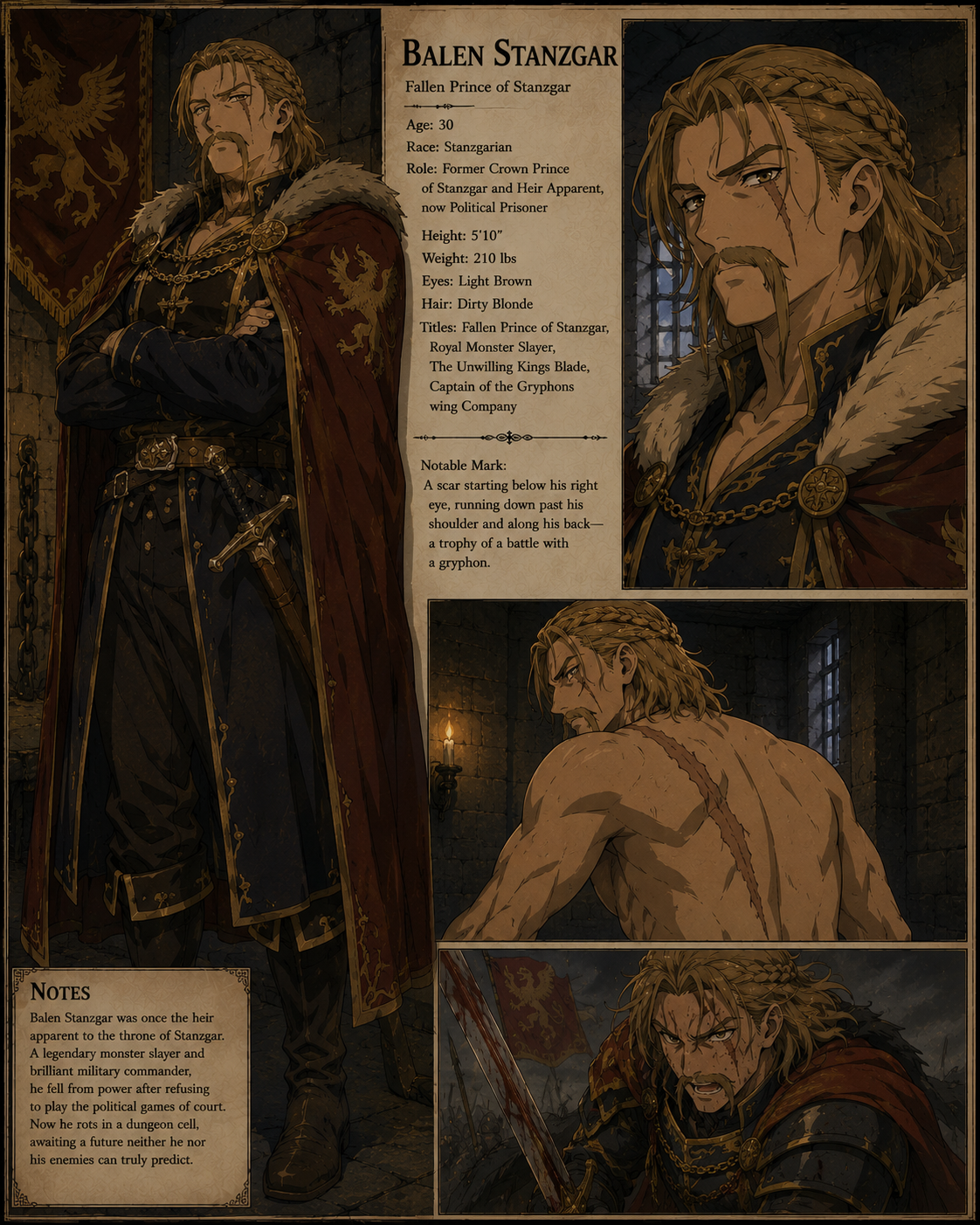
Balen Stanzgar
Fallen Prince of Stanzgar, Royal Monster Slayer, The Unwilling Kings Blade, Captain of the Gryphons wing Company
former crown prince of the Kingdom of stanzgar and heir apparent, now political prisoner
30
Male
Looks
Long Fu Manchu mustache, extending past the jawline, thick and well-kept. No beard beyond the mustache.
Mid-length hair, braided across the top of his head with loose strands framing his face. The braid is functional but also ornamental, reflecting his noble heritage and warrior practicality.
Dirty blonde – a sun‑weathered shade that hints at both his noble lineage and the years spent outdoors hunting monsters and leading troops. blonde
5'10" – average height for a Stanzgarian male, giving him a solid presence without being imposing solely by stature."
210 lbs – solid, muscular build reflecting both his years of training and his brute-force approach to combat and hunting.
A prominent scar starting below his right eye, running down past his shoulder and along his back—a trophy of a battle with a gryphon. Nothing else immediately stands out, though his weathered appearance hints at many other minor injuries from hunts and battles.
Muscular and large, built like a seasoned warrior—broad shoulders, thick arms, solid core. He looks like he could overpower most opponents physically, giving the impression of a brute, though his agility and training belie that first impression.
Light, but weathered from years of travel, hunting, and exposure to the elements—slightly tanned with a rugged, lived-in appearance.
Stanzgarian
Light brown, steady and observant, often giving him a calculating gaze beneath his boisterous exterior.
Nature
Holds deep resentment toward the Drachenbär family for their betrayal during Darius’ Rebellion, distrusts the Master of River Road and the King of Edgewood for abandoning alliances, and maintains a general wariness of historical allies who prioritized greed over loyalty.
Balen carries extensive scars across his body from old hunts, battles in the rebellion, and civil war. These serve as both physical reminders of past danger and psychological weight, contributing to his reputation as a battle-hardened warrior.
Balen often appears as a lumbering, boisterous brute, enjoying food, drink, and company, but this is interlaced with moments of cold calculation. He moves with deliberate intention in combat and politics alike, and when in conversation or negotiation, he can switch seamlessly from seemingly casual or joking demeanor to sharp, politically savvy observation. He has a habit of lingering on expressions and gestures, reading subtle cues from allies and foes, and rarely acts without weighing the potential outcomes.
Balen is driven by a combination of duty, survival, and vengeance. His foremost goal is keeping as many of his family alive as possible while navigating the dangerous political landscape of Stanzgar. He seeks to reclaim his family’s power and influence, restore their legacy, and punish those responsible for past betrayals, particularly the Drachenbär family and other allies who abandoned his line during Darius’ Rebellion. Beyond revenge and protection, he is motivated by proving his own competence and strength, both as a warrior and as a strategist, ensuring that he is never again caught off-guard or outmaneuvered.
Balen’s flaws are deeply tied to both his personality and his history. He is vengeful, holding grudges for perceived betrayals for years, which can cloud his judgment and make him act rashly. His tendency to underestimate threats outside his immediate experience—combined with a history of overconfidence in his early years—has left scars both physical and emotional. He struggles with despondence and bouts of defeatism, particularly when his plans fail or when the safety of his family is threatened. His reliance on brute force and combat prowess can make him impatient with subtle political maneuvering, despite being capable of strategic thinking. Additionally, his boisterous public persona sometimes masks his careful planning, causing others to misjudge his intentions or take advantage of his trust.
Balen is a consummate fighter and strategist. He excels in combat with multiple weapon types, particularly axes and polearms, and has a natural talent for monster hunting, combining physical prowess with sharp observation to anticipate threats. Beyond battlefield skill, he has an acute political acumen, able to read situations, allies, and enemies to manipulate outcomes to his advantage when needed. He is highly charismatic, able to rally men and inspire loyalty even in dire circumstances. Additionally, he is a skilled tracker and survivalist, honed from years of hunting dangerous creatures in varied and harsh environments.
Balen spends his free time hunting dangerous creatures, testing his skill and reflexes in controlled and wild environments alike. He enjoys celebrating victories—whether from hunts or battlefield successes—with food, drink, and socializing, often surrounding himself with companions and allies. Practicing combat techniques, studying the behaviors of beasts, and refining his strategic and survival skills also occupy him when he’s not on official duty. He occasionally indulges in games of chance and friendly duels, both as training and entertainment.
Balen projects the image of a boisterous, loud, and seemingly carefree man, giving the impression of a blunt, almost oafish figure. Beneath this exterior, however, lies a calculating mind, highly strategic and politically savvy. He combines charisma with sharp intuition, able to read situations and people with ease, and he often uses his outward joviality to mask his true intentions or plans. Despite his confidence and bravado, he carries a weight of responsibility and lingering bitterness from past betrayals, which informs his cautious and sometimes vengeful decisions.
Social
Balen favors hearty, robust meals that reflect his hunter’s instincts and his love of physical prowess. Chief among these is roast boar, preferably one he has hunted himself, served simply to highlight the natural flavor of the meat. He enjoys meals that are filling, rich in protein, and paired with strong ales or wines when available. For him, eating is both sustenance and a celebration of conquest, whether from the hunt or from battle.
Bear dogs
Balen’s weapon of choice is a double-headed axe. Its design complements his brute strength and allows him to deliver devastating, sweeping strikes. He favors weapons that feel natural in his hands, capable of both precision in a fight and raw power against monstrous foes. While skilled with many arms, the double-headed axe is the one he trusts above all for both hunting dangerous creatures and enforcing his authority in battle.
Balen’s favorite possession is the circlet his father wore when Balen was young. It is not the royal crown of Stanzgar, nor a grand symbol of kingship meant to impress a court. It is a simpler thing: a silver and gold circlet, sparsely ornamented compared to the formal regalia of the kingdom, but deeply tied to Balen’s memories of his father before politics, war, pride, and failure changed everything.
To others, the circlet might seem modest for something owned by a king. To Balen, that is part of its value. It reminds him of Charles III not as the doomed monarch of a collapsing kingdom, but as the father he knew in childhood: powerful, certain, present, and still capable of being admired without bitterness. The circlet carries a memory of the man before the fall, before the rebellion, before the choices that left Balen negotiating for his family’s survival instead of inheriting a throne.
Balen likely keeps it hidden or guarded carefully, not because it has great political value, but because it is one of the few objects that can still wound him privately. His father’s actual crown represents lost authority, failed rule, and the claim that was taken from him. This circlet represents something more painful and more human: the memory of a father Balen still wants to believe existed.
For a man who performs loudness, appetite, brutality, and confidence, the circlet is unusually quiet. It is not a hunting trophy, not a weapon, and not a prize won by force. It is memory, grief, legitimacy, and longing shaped into metal. Balen may speak of it roughly, if he speaks of it at all, but he would not forgive someone who treated it carelessly.
Balen’s favorite color is magenta, a bold and unexpected choice that suits him better than it first appears. It is not a quiet color, nor a traditionally restrained one. It is vivid, royal, almost aggressive in its richness, carrying the theatrical confidence of a man who enjoys being seen, celebrated, and remembered. For someone who often plays the part of a loud, indulgent brute, magenta gives that performance a flash of deliberate extravagance.
The color also fits his old royal identity. Magenta feels expensive, difficult to ignore, and close enough to purple to carry a sense of nobility without being the predictable color of kingship. Balen likely favors it in cloaks, sashes, hunting banners, lining, embroidery, or ceremonial accents rather than full garments. Used well, it lets him appear both princely and dangerous: a fallen heir who still dresses as though defeat has not made him small.
There is also something defiant about the choice. Balen has lost his expected crown, his political future, and much of his freedom, but magenta refuses humility. It is a color that says he has not become a ghost of the old royal family, no matter how the new order tries to contain him. On Balen, magenta is not softness. It is pride made visible.
Balen’s occupation is a strange mixture of what he was born to be, what he chose to become, and what his enemies now allow him to remain. He was once the crown prince of the Kingdom of Stanzgar, the first son of Charles III and heir apparent to the throne. His earliest life was shaped around statecraft, succession, command, and the expectation that he would one day rule. Even after his family’s fall, that upbringing never fully left him; Balen still thinks like a prince, even when he is forced to live as a hostage.
After completing much of his formal education, Balen filled his time by becoming a monster hunter, a role that suited both his appetite for danger and his desire to prove himself outside courtly halls. He hunted beasts, led armed men, won small conflicts between Stanzgarian nobles, and built a reputation as the Royal Monster Slayer and captain of the Gryphons Wing Company. This was not merely sport to him. Monster hunting gave him glory, loyalty, field experience, and a way to seem like a brute while sharpening the instincts of a commander.
After Darius’ rebellion, Balen’s occupation became far more bitter. He remained a monster hunter under the new Stanzgarian order, but also became a political prisoner whose usefulness helped keep his family alive. As long as he tows the line, performs his duties, and keeps his mother and siblings under control, he is allowed a measure of freedom and status. His work is therefore both service and leash: he hunts monsters for the empire that defeated him, while quietly preserving what remains of the royal family’s dignity.
In practice, Balen is a fallen prince, monster hunter, military captain, and political hostage all at once. He spends his days doing work that suits him physically while enduring a political arrangement that humiliates him personally. The tragedy is that he is good at all of it. He was raised to rule, trained to fight, skilled enough to hunt monsters, and clever enough to survive captivity without looking broken.
Balen has no open political views, because openly having them would be dangerous. As the former crown prince of the old Kingdom of Stanzgar and now a political hostage under the new order, he understands that every public opinion can become evidence, every alliance can become a threat, and every careless word can place his family in danger. In public, he plays the role expected of him: the loud fallen prince, the monster hunter, the useful brute who drinks too much, hunts too often, and thinks less than he does.
Privately, Balen’s politics are simple and poisonous: he would love to see the fall of the Drachenbär family. He hates them for destroying his father’s reign, taking the throne that should have been his, and reducing his family to bargaining pieces. His hatred is especially focused on Darius, Nicolas, and Richard Drachenbär, though he extends his resentment across much of the family and the Stanzgarian Confederacy that rose from their victory.
Balen also despises the former allies who abandoned his house during Darius’ Rebellion. The Master of River Road and the King of Edgewood are particular targets of his bitterness, not because he expected kindness from them, but because pacts of defense were supposed to matter. To Balen, their failure was not mere caution; it was greed and cowardice dressed as practicality. Their abandonment taught him that treaties are only as strong as the people willing to bleed for them.
Despite his desire for revenge, Balen is not reckless enough to openly rebel. His first political priority is keeping his family alive. Restoration, vengeance, and dignity all matter to him, but none of them matter more than ensuring his mother and siblings survive their captivity. This forces him into a constant balancing act: serve just enough to remain useful, conceal enough to remain safe, and remember enough that the name Stanzgar does not become harmless. His politics are not spoken from a podium. They are kept behind his teeth, carried like a knife, and sharpened slowly.
Balen worships the Stanzgarian pantheon through the Church of the One, but his personal devotion leans especially toward Korvath, the god of the hunt. This suits him well. Balen is not a gentle or contemplative worshipper by nature; his faith is tied to pursuit, blood, danger, trophies, endurance, and the proving of strength against things that can kill him. Where some nobles treat religion as ceremony, Balen feels closest to the divine when tracking something dangerous through wild country with weapons in hand.
His reverence for Korvath is not limited to simple sport. Monster hunting is one of the few parts of Balen’s life where he still feels fully himself: prince, warrior, commander, and predator all at once. Before a hunt, he may make offerings, speak a brief prayer, or observe old rites asking for clear senses, steady hands, and a worthy quarry. After a successful kill, celebration with food, drink, and companions becomes almost religious in its own way: the danger was faced, the beast was brought down, and life continues because skill overcame terror.
Balen still acknowledges the wider Stanzgarian pantheon properly, as expected of a prince of the old royal family. He understands religion as part of civilization, legitimacy, and public order, and he would not openly neglect the rites attached to his station. But Korvath is the god who feels most personally his. The hunt gives shape to Balen’s anger and grief, turning them into action rather than despair.
Since his fall, Balen’s faith has likely become harsher. He may look to Korvath not only as the patron of hunters, but as a divine witness to pursuit itself: the long tracking of enemies, the patience before a strike, and the belief that even powerful prey can eventually be brought down. Whether hunting monsters in the wild or imagining revenge against the Drachenbär family, Balen’s devotion to Korvath reflects the same truth: he is a man who has lost a kingdom, but not the instinct to chase what wounded him.
Balen’s job is monster hunter and political hostage, a pairing that captures the contradiction of his life after the fall of the old Stanzgarian royal family. Publicly, he remains useful as a hunter of dangerous beasts, a proven fighter, and captain of the Gryphons Wing Company. This work gives him a controlled outlet for his violence, keeps his reputation alive, and allows the new Stanzgarian order to present him as a loyal servant rather than a defeated prince waiting for opportunity.
Privately, the role is also a leash. Balen is allowed to hunt, command, drink, celebrate, and appear boisterously free so long as he remembers the terms of his survival. His mother and siblings remain politically vulnerable, and his own conduct helps determine how safely they are treated. Every monster he kills for the new order reinforces his usefulness, but it also reminds him that his skills now serve the people who took his future from him.
As a monster hunter, Balen is genuinely capable and even fulfilled. He knows how to track dangerous creatures, organize hunts, command armed retainers, and bring down beasts that would terrify ordinary soldiers. As a hostage, he is careful, bitter, and always aware that open defiance would endanger the very family he is trying to protect. His job is therefore not merely employment. It is survival disguised as service, revenge delayed by necessity, and captivity made useful enough to endure.
History
Balen was born in the fall, near harvest time. The season suits him well: hunting parties, heavy feasts, cold air, stored grain, slaughtered livestock, and the last great movements of men and beasts before winter closes in. It is a fitting time for a prince who became a hunter, a warrior, and a man defined by appetite, endurance, and survival.
His birthday would once have been a royal occasion, marked by feasting, formal gifts, courtly attention, and public celebration of the kingdom’s heir. After his family’s fall, the date likely became more bitter. Balen may still celebrate it loudly with food, drink, women, hunting companions, and trophies from the field, but the excess hides what the day now reminds him of: the future he was born for and the crown he never inherited.
For Balen, a proper birthday is probably less about ceremony and more about defiance. A successful hunt, roast meat, strong drink, loyal company, and enough noise to drown out regret would suit him far better than quiet reflection. He was born near harvest, but much of his life has been spent gathering the bitter remains of a kingdom someone else cut down.
Balen Stanzgar was born in the city of Stanzgar, in the Stanzgar River Valley, as the first son of Charles III, King of Stanzgar, and Jezabelle Mythrocal Stanzgar. As crown prince and heir apparent, his life was shaped from the beginning by expectation. He was raised to inherit the kingdom, trained to understand court politics, noble rivalries, military obligations, diplomacy, and the machinery of rule. Unlike the brute he would later pretend to be, Balen proved exceptionally gifted at statecraft. By his twentieth year, many of his tutors and scholars had little left to teach him.
Once his formal education ceased to challenge him, Balen turned his attention elsewhere. He filled his time hunting monsters in the north, winning petty battles between Stanzgarian nobles, gathering mercenaries, and building a reputation as the Royal Monster Slayer. This life suited him more than anyone expected. It let him indulge his appetite for danger, women, food, drink, trophies, and glory, while also sharpening the instincts of a commander. The boisterous hunter-prince became a public image people could understand, and Balen leaned into it gladly, letting others mistake appetite for stupidity.
That mistake became costly when Darius Drachenbär’s rebellion grew beyond a few dissidents. Balen recognized, too late, that the threat might be serious enough to require his personal intervention. He asked his father whether he should bring his mercenaries south to hunt the rebels down and crush their spirits before the uprising gained too much momentum. Charles III refused, insisting that Balen’s forces would not be needed. It was the last time Balen heard from his father.
By the time Balen returned to the capital, the war was already over. Darius had led his raid, Charles III was dead, and the loyalist cause had collapsed with terrifying speed. The crown Balen had been born to inherit was gone before he could even properly fight for it. With the old royal house defeated and many former allies abandoning them, Balen was left to do the one thing still within his power: negotiate for the survival of his family.
Those negotiations became the defining humiliation of his life. Balen presided over the terms that kept his mother and siblings alive, but only by accepting their new reality as political hostages under the victorious order. The former crown prince became a captive asset, preserved because he was useful, dangerous, and valuable enough not to waste. He kept some measure of status, but not freedom. He kept his name, but not his throne. He kept his family alive, but at the cost of living under the power of those who had destroyed them.
Under the new Stanzgarian order, Balen was allowed to remain a monster hunter and captain of the Gryphons Wing Company, provided he toed the line and kept his mother and siblings controlled. This arrangement suited his enemies well: it let them use his skills, contain his rage, and present him as a loyal servant rather than a dispossessed prince. For Balen, the role is both insult and necessity. Every hunt gives him purpose, reputation, and a weaponized image; every success also reminds him that his strength now serves the house that stole his future.
Since then, Balen has lived as a man divided between performance and truth. Publicly, he is loud, indulgent, oafish, and dangerous in simple ways: the fallen prince who drinks, hunts, laughs, and kills monsters. Privately, he remains politically sharp, bitter, and patient, carrying hatred for the Drachenbär family and for the allies who abandoned his house when their pacts of defense became inconvenient. His greatest motive is still keeping as many of his family alive as possible, but beneath that duty burns the old desire for restoration and revenge. Balen may look defeated, and in some ways he is, but he has not forgotten what was taken from him.
Balen’s education is extremely high, though he works hard to make sure most people forget that. As the first son of Charles III and heir apparent to the Kingdom of Stanzgar, he was educated from childhood for rule. Tutors, scholars, military instructors, priests, diplomats, and court officials all had a hand in shaping him, preparing him to inherit not only a throne, but the enormous burden of managing noble factions, military obligations, foreign rivals, trade interests, and royal authority.
He proved unusually gifted at statecraft. By his twentieth year, most of his tutors had little left to teach him, at least in the formal sense. Balen understood law, diplomacy, inheritance, court etiquette, military organization, finance, alliance management, and the social machinery of monarchy. He learned how to read a room, weigh a noble’s loyalty, recognize weakness in a treaty, and turn ceremony into leverage. His education was not ornamental; it was meant to make him king.
What makes Balen dangerous is that he hides this education behind the mask of a loud, indulgent brute. In public, he acts as though he cares more for hunting, drinking, women, food, and battle than for policy or courtly calculation. This is partly genuine—he does love those things—but it is also useful camouflage. People who think him a simple monster hunter are less careful around him, and Balen is very good at letting others underestimate the mind behind the scars and appetite.
His education is somewhat warped by experience. He was trained to rule a kingdom that fell before he could inherit it, and much of what he learned now serves survival rather than governance. Instead of using statecraft to rule openly, he uses it to keep his family alive, manage captivity, conceal his anger, and preserve what little influence remains to the fallen royal line. Balen is not undereducated. He is overeducated for the cage he now lives in, and that may be one of the quietest cruelties of his life.
Family
A number of Bear Dogs trained for hunting monsters
Notes
Age is at the signing of the treaty of unity
Overview
Details about this character's overview
Balen Stanzgar
Fallen Prince of Stanzgar, Royal Monster Slayer, The Unwilling Kings Blade, Captain of the Gryphons wing Company
former crown prince of the Kingdom of stanzgar and heir apparent, now political prisoner
30
Male
Looks
Details about this character's looks
Long Fu Manchu mustache, extending past the jawline, thick and well-kept. No beard beyond the mustache.
Mid-length hair, braided across the top of his head with loose strands framing his face. The braid is functional but also ornamental, reflecting his noble heritage and warrior practicality.
Dirty blonde – a sun‑weathered shade that hints at both his noble lineage and the years spent outdoors hunting monsters and leading troops. blonde
5'10" – average height for a Stanzgarian male, giving him a solid presence without being imposing solely by stature."
210 lbs – solid, muscular build reflecting both his years of training and his brute-force approach to combat and hunting.
A prominent scar starting below his right eye, running down past his shoulder and along his back—a trophy of a battle with a gryphon. Nothing else immediately stands out, though his weathered appearance hints at many other minor injuries from hunts and battles.
Muscular and large, built like a seasoned warrior—broad shoulders, thick arms, solid core. He looks like he could overpower most opponents physically, giving the impression of a brute, though his agility and training belie that first impression.
Light, but weathered from years of travel, hunting, and exposure to the elements—slightly tanned with a rugged, lived-in appearance.
Stanzgarian
Light brown, steady and observant, often giving him a calculating gaze beneath his boisterous exterior.
Nature
Details about this character's nature
Holds deep resentment toward the Drachenbär family for their betrayal during Darius’ Rebellion, distrusts the Master of River Road and the King of Edgewood for abandoning alliances, and maintains a general wariness of historical allies who prioritized greed over loyalty.
Balen carries extensive scars across his body from old hunts, battles in the rebellion, and civil war. These serve as both physical reminders of past danger and psychological weight, contributing to his reputation as a battle-hardened warrior.
Balen often appears as a lumbering, boisterous brute, enjoying food, drink, and company, but this is interlaced with moments of cold calculation. He moves with deliberate intention in combat and politics alike, and when in conversation or negotiation, he can switch seamlessly from seemingly casual or joking demeanor to sharp, politically savvy observation. He has a habit of lingering on expressions and gestures, reading subtle cues from allies and foes, and rarely acts without weighing the potential outcomes.
Balen is driven by a combination of duty, survival, and vengeance. His foremost goal is keeping as many of his family alive as possible while navigating the dangerous political landscape of Stanzgar. He seeks to reclaim his family’s power and influence, restore their legacy, and punish those responsible for past betrayals, particularly the Drachenbär family and other allies who abandoned his line during Darius’ Rebellion. Beyond revenge and protection, he is motivated by proving his own competence and strength, both as a warrior and as a strategist, ensuring that he is never again caught off-guard or outmaneuvered.
Balen’s flaws are deeply tied to both his personality and his history. He is vengeful, holding grudges for perceived betrayals for years, which can cloud his judgment and make him act rashly. His tendency to underestimate threats outside his immediate experience—combined with a history of overconfidence in his early years—has left scars both physical and emotional. He struggles with despondence and bouts of defeatism, particularly when his plans fail or when the safety of his family is threatened. His reliance on brute force and combat prowess can make him impatient with subtle political maneuvering, despite being capable of strategic thinking. Additionally, his boisterous public persona sometimes masks his careful planning, causing others to misjudge his intentions or take advantage of his trust.
Balen is a consummate fighter and strategist. He excels in combat with multiple weapon types, particularly axes and polearms, and has a natural talent for monster hunting, combining physical prowess with sharp observation to anticipate threats. Beyond battlefield skill, he has an acute political acumen, able to read situations, allies, and enemies to manipulate outcomes to his advantage when needed. He is highly charismatic, able to rally men and inspire loyalty even in dire circumstances. Additionally, he is a skilled tracker and survivalist, honed from years of hunting dangerous creatures in varied and harsh environments.
Balen spends his free time hunting dangerous creatures, testing his skill and reflexes in controlled and wild environments alike. He enjoys celebrating victories—whether from hunts or battlefield successes—with food, drink, and socializing, often surrounding himself with companions and allies. Practicing combat techniques, studying the behaviors of beasts, and refining his strategic and survival skills also occupy him when he’s not on official duty. He occasionally indulges in games of chance and friendly duels, both as training and entertainment.
Balen projects the image of a boisterous, loud, and seemingly carefree man, giving the impression of a blunt, almost oafish figure. Beneath this exterior, however, lies a calculating mind, highly strategic and politically savvy. He combines charisma with sharp intuition, able to read situations and people with ease, and he often uses his outward joviality to mask his true intentions or plans. Despite his confidence and bravado, he carries a weight of responsibility and lingering bitterness from past betrayals, which informs his cautious and sometimes vengeful decisions.
Social
Details about this character's social
Balen favors hearty, robust meals that reflect his hunter’s instincts and his love of physical prowess. Chief among these is roast boar, preferably one he has hunted himself, served simply to highlight the natural flavor of the meat. He enjoys meals that are filling, rich in protein, and paired with strong ales or wines when available. For him, eating is both sustenance and a celebration of conquest, whether from the hunt or from battle.
Bear dogs
Balen’s weapon of choice is a double-headed axe. Its design complements his brute strength and allows him to deliver devastating, sweeping strikes. He favors weapons that feel natural in his hands, capable of both precision in a fight and raw power against monstrous foes. While skilled with many arms, the double-headed axe is the one he trusts above all for both hunting dangerous creatures and enforcing his authority in battle.
Balen’s favorite possession is the circlet his father wore when Balen was young. It is not the royal crown of Stanzgar, nor a grand symbol of kingship meant to impress a court. It is a simpler thing: a silver and gold circlet, sparsely ornamented compared to the formal regalia of the kingdom, but deeply tied to Balen’s memories of his father before politics, war, pride, and failure changed everything.
To others, the circlet might seem modest for something owned by a king. To Balen, that is part of its value. It reminds him of Charles III not as the doomed monarch of a collapsing kingdom, but as the father he knew in childhood: powerful, certain, present, and still capable of being admired without bitterness. The circlet carries a memory of the man before the fall, before the rebellion, before the choices that left Balen negotiating for his family’s survival instead of inheriting a throne.
Balen likely keeps it hidden or guarded carefully, not because it has great political value, but because it is one of the few objects that can still wound him privately. His father’s actual crown represents lost authority, failed rule, and the claim that was taken from him. This circlet represents something more painful and more human: the memory of a father Balen still wants to believe existed.
For a man who performs loudness, appetite, brutality, and confidence, the circlet is unusually quiet. It is not a hunting trophy, not a weapon, and not a prize won by force. It is memory, grief, legitimacy, and longing shaped into metal. Balen may speak of it roughly, if he speaks of it at all, but he would not forgive someone who treated it carelessly.
Balen’s favorite color is magenta, a bold and unexpected choice that suits him better than it first appears. It is not a quiet color, nor a traditionally restrained one. It is vivid, royal, almost aggressive in its richness, carrying the theatrical confidence of a man who enjoys being seen, celebrated, and remembered. For someone who often plays the part of a loud, indulgent brute, magenta gives that performance a flash of deliberate extravagance.
The color also fits his old royal identity. Magenta feels expensive, difficult to ignore, and close enough to purple to carry a sense of nobility without being the predictable color of kingship. Balen likely favors it in cloaks, sashes, hunting banners, lining, embroidery, or ceremonial accents rather than full garments. Used well, it lets him appear both princely and dangerous: a fallen heir who still dresses as though defeat has not made him small.
There is also something defiant about the choice. Balen has lost his expected crown, his political future, and much of his freedom, but magenta refuses humility. It is a color that says he has not become a ghost of the old royal family, no matter how the new order tries to contain him. On Balen, magenta is not softness. It is pride made visible.
Balen’s occupation is a strange mixture of what he was born to be, what he chose to become, and what his enemies now allow him to remain. He was once the crown prince of the Kingdom of Stanzgar, the first son of Charles III and heir apparent to the throne. His earliest life was shaped around statecraft, succession, command, and the expectation that he would one day rule. Even after his family’s fall, that upbringing never fully left him; Balen still thinks like a prince, even when he is forced to live as a hostage.
After completing much of his formal education, Balen filled his time by becoming a monster hunter, a role that suited both his appetite for danger and his desire to prove himself outside courtly halls. He hunted beasts, led armed men, won small conflicts between Stanzgarian nobles, and built a reputation as the Royal Monster Slayer and captain of the Gryphons Wing Company. This was not merely sport to him. Monster hunting gave him glory, loyalty, field experience, and a way to seem like a brute while sharpening the instincts of a commander.
After Darius’ rebellion, Balen’s occupation became far more bitter. He remained a monster hunter under the new Stanzgarian order, but also became a political prisoner whose usefulness helped keep his family alive. As long as he tows the line, performs his duties, and keeps his mother and siblings under control, he is allowed a measure of freedom and status. His work is therefore both service and leash: he hunts monsters for the empire that defeated him, while quietly preserving what remains of the royal family’s dignity.
In practice, Balen is a fallen prince, monster hunter, military captain, and political hostage all at once. He spends his days doing work that suits him physically while enduring a political arrangement that humiliates him personally. The tragedy is that he is good at all of it. He was raised to rule, trained to fight, skilled enough to hunt monsters, and clever enough to survive captivity without looking broken.
Balen has no open political views, because openly having them would be dangerous. As the former crown prince of the old Kingdom of Stanzgar and now a political hostage under the new order, he understands that every public opinion can become evidence, every alliance can become a threat, and every careless word can place his family in danger. In public, he plays the role expected of him: the loud fallen prince, the monster hunter, the useful brute who drinks too much, hunts too often, and thinks less than he does.
Privately, Balen’s politics are simple and poisonous: he would love to see the fall of the Drachenbär family. He hates them for destroying his father’s reign, taking the throne that should have been his, and reducing his family to bargaining pieces. His hatred is especially focused on Darius, Nicolas, and Richard Drachenbär, though he extends his resentment across much of the family and the Stanzgarian Confederacy that rose from their victory.
Balen also despises the former allies who abandoned his house during Darius’ Rebellion. The Master of River Road and the King of Edgewood are particular targets of his bitterness, not because he expected kindness from them, but because pacts of defense were supposed to matter. To Balen, their failure was not mere caution; it was greed and cowardice dressed as practicality. Their abandonment taught him that treaties are only as strong as the people willing to bleed for them.
Despite his desire for revenge, Balen is not reckless enough to openly rebel. His first political priority is keeping his family alive. Restoration, vengeance, and dignity all matter to him, but none of them matter more than ensuring his mother and siblings survive their captivity. This forces him into a constant balancing act: serve just enough to remain useful, conceal enough to remain safe, and remember enough that the name Stanzgar does not become harmless. His politics are not spoken from a podium. They are kept behind his teeth, carried like a knife, and sharpened slowly.
Balen worships the Stanzgarian pantheon through the Church of the One, but his personal devotion leans especially toward Korvath, the god of the hunt. This suits him well. Balen is not a gentle or contemplative worshipper by nature; his faith is tied to pursuit, blood, danger, trophies, endurance, and the proving of strength against things that can kill him. Where some nobles treat religion as ceremony, Balen feels closest to the divine when tracking something dangerous through wild country with weapons in hand.
His reverence for Korvath is not limited to simple sport. Monster hunting is one of the few parts of Balen’s life where he still feels fully himself: prince, warrior, commander, and predator all at once. Before a hunt, he may make offerings, speak a brief prayer, or observe old rites asking for clear senses, steady hands, and a worthy quarry. After a successful kill, celebration with food, drink, and companions becomes almost religious in its own way: the danger was faced, the beast was brought down, and life continues because skill overcame terror.
Balen still acknowledges the wider Stanzgarian pantheon properly, as expected of a prince of the old royal family. He understands religion as part of civilization, legitimacy, and public order, and he would not openly neglect the rites attached to his station. But Korvath is the god who feels most personally his. The hunt gives shape to Balen’s anger and grief, turning them into action rather than despair.
Since his fall, Balen’s faith has likely become harsher. He may look to Korvath not only as the patron of hunters, but as a divine witness to pursuit itself: the long tracking of enemies, the patience before a strike, and the belief that even powerful prey can eventually be brought down. Whether hunting monsters in the wild or imagining revenge against the Drachenbär family, Balen’s devotion to Korvath reflects the same truth: he is a man who has lost a kingdom, but not the instinct to chase what wounded him.
Balen’s job is monster hunter and political hostage, a pairing that captures the contradiction of his life after the fall of the old Stanzgarian royal family. Publicly, he remains useful as a hunter of dangerous beasts, a proven fighter, and captain of the Gryphons Wing Company. This work gives him a controlled outlet for his violence, keeps his reputation alive, and allows the new Stanzgarian order to present him as a loyal servant rather than a defeated prince waiting for opportunity.
Privately, the role is also a leash. Balen is allowed to hunt, command, drink, celebrate, and appear boisterously free so long as he remembers the terms of his survival. His mother and siblings remain politically vulnerable, and his own conduct helps determine how safely they are treated. Every monster he kills for the new order reinforces his usefulness, but it also reminds him that his skills now serve the people who took his future from him.
As a monster hunter, Balen is genuinely capable and even fulfilled. He knows how to track dangerous creatures, organize hunts, command armed retainers, and bring down beasts that would terrify ordinary soldiers. As a hostage, he is careful, bitter, and always aware that open defiance would endanger the very family he is trying to protect. His job is therefore not merely employment. It is survival disguised as service, revenge delayed by necessity, and captivity made useful enough to endure.
History
Details about this character's history
Balen was born in the fall, near harvest time. The season suits him well: hunting parties, heavy feasts, cold air, stored grain, slaughtered livestock, and the last great movements of men and beasts before winter closes in. It is a fitting time for a prince who became a hunter, a warrior, and a man defined by appetite, endurance, and survival.
His birthday would once have been a royal occasion, marked by feasting, formal gifts, courtly attention, and public celebration of the kingdom’s heir. After his family’s fall, the date likely became more bitter. Balen may still celebrate it loudly with food, drink, women, hunting companions, and trophies from the field, but the excess hides what the day now reminds him of: the future he was born for and the crown he never inherited.
For Balen, a proper birthday is probably less about ceremony and more about defiance. A successful hunt, roast meat, strong drink, loyal company, and enough noise to drown out regret would suit him far better than quiet reflection. He was born near harvest, but much of his life has been spent gathering the bitter remains of a kingdom someone else cut down.
Balen Stanzgar was born in the city of Stanzgar, in the Stanzgar River Valley, as the first son of Charles III, King of Stanzgar, and Jezabelle Mythrocal Stanzgar. As crown prince and heir apparent, his life was shaped from the beginning by expectation. He was raised to inherit the kingdom, trained to understand court politics, noble rivalries, military obligations, diplomacy, and the machinery of rule. Unlike the brute he would later pretend to be, Balen proved exceptionally gifted at statecraft. By his twentieth year, many of his tutors and scholars had little left to teach him.
Once his formal education ceased to challenge him, Balen turned his attention elsewhere. He filled his time hunting monsters in the north, winning petty battles between Stanzgarian nobles, gathering mercenaries, and building a reputation as the Royal Monster Slayer. This life suited him more than anyone expected. It let him indulge his appetite for danger, women, food, drink, trophies, and glory, while also sharpening the instincts of a commander. The boisterous hunter-prince became a public image people could understand, and Balen leaned into it gladly, letting others mistake appetite for stupidity.
That mistake became costly when Darius Drachenbär’s rebellion grew beyond a few dissidents. Balen recognized, too late, that the threat might be serious enough to require his personal intervention. He asked his father whether he should bring his mercenaries south to hunt the rebels down and crush their spirits before the uprising gained too much momentum. Charles III refused, insisting that Balen’s forces would not be needed. It was the last time Balen heard from his father.
By the time Balen returned to the capital, the war was already over. Darius had led his raid, Charles III was dead, and the loyalist cause had collapsed with terrifying speed. The crown Balen had been born to inherit was gone before he could even properly fight for it. With the old royal house defeated and many former allies abandoning them, Balen was left to do the one thing still within his power: negotiate for the survival of his family.
Those negotiations became the defining humiliation of his life. Balen presided over the terms that kept his mother and siblings alive, but only by accepting their new reality as political hostages under the victorious order. The former crown prince became a captive asset, preserved because he was useful, dangerous, and valuable enough not to waste. He kept some measure of status, but not freedom. He kept his name, but not his throne. He kept his family alive, but at the cost of living under the power of those who had destroyed them.
Under the new Stanzgarian order, Balen was allowed to remain a monster hunter and captain of the Gryphons Wing Company, provided he toed the line and kept his mother and siblings controlled. This arrangement suited his enemies well: it let them use his skills, contain his rage, and present him as a loyal servant rather than a dispossessed prince. For Balen, the role is both insult and necessity. Every hunt gives him purpose, reputation, and a weaponized image; every success also reminds him that his strength now serves the house that stole his future.
Since then, Balen has lived as a man divided between performance and truth. Publicly, he is loud, indulgent, oafish, and dangerous in simple ways: the fallen prince who drinks, hunts, laughs, and kills monsters. Privately, he remains politically sharp, bitter, and patient, carrying hatred for the Drachenbär family and for the allies who abandoned his house when their pacts of defense became inconvenient. His greatest motive is still keeping as many of his family alive as possible, but beneath that duty burns the old desire for restoration and revenge. Balen may look defeated, and in some ways he is, but he has not forgotten what was taken from him.
Balen’s education is extremely high, though he works hard to make sure most people forget that. As the first son of Charles III and heir apparent to the Kingdom of Stanzgar, he was educated from childhood for rule. Tutors, scholars, military instructors, priests, diplomats, and court officials all had a hand in shaping him, preparing him to inherit not only a throne, but the enormous burden of managing noble factions, military obligations, foreign rivals, trade interests, and royal authority.
He proved unusually gifted at statecraft. By his twentieth year, most of his tutors had little left to teach him, at least in the formal sense. Balen understood law, diplomacy, inheritance, court etiquette, military organization, finance, alliance management, and the social machinery of monarchy. He learned how to read a room, weigh a noble’s loyalty, recognize weakness in a treaty, and turn ceremony into leverage. His education was not ornamental; it was meant to make him king.
What makes Balen dangerous is that he hides this education behind the mask of a loud, indulgent brute. In public, he acts as though he cares more for hunting, drinking, women, food, and battle than for policy or courtly calculation. This is partly genuine—he does love those things—but it is also useful camouflage. People who think him a simple monster hunter are less careful around him, and Balen is very good at letting others underestimate the mind behind the scars and appetite.
His education is somewhat warped by experience. He was trained to rule a kingdom that fell before he could inherit it, and much of what he learned now serves survival rather than governance. Instead of using statecraft to rule openly, he uses it to keep his family alive, manage captivity, conceal his anger, and preserve what little influence remains to the fallen royal line. Balen is not undereducated. He is overeducated for the cage he now lives in, and that may be one of the quietest cruelties of his life.
Family
Details about this character's family
A number of Bear Dogs trained for hunting monsters
Inventory
Details about this character's inventory
No inventory information yet
This section doesn't have any information filled in yet.
Changelog
Details about this character's changelog
No changelog information yet
This section doesn't have any information filled in yet.
Notes
Details about this character's notes
Age is at the signing of the treaty of unity
Gallery
Images and visual content for this character


Associations
Other pages that reference or connect to this character
Referenced By
33Annarita Stanzgar
Friends
Annarita Stanzgar
Siblings
Calia Stanzgar
Friends
Calia Stanzgar
Siblings
Jezabelle Mythrocal Stanzgar
Children
Creena Stanzgar
Best friends
Creena Stanzgar
Siblings
Horace Stanzgar
Friends
Horace Stanzgar
Siblings
Jason Stanzgar
Friends
Robert Dùghlas LeTreis
Enemies
Jason Stanzgar
Siblings
Nendara
Best friends
Nendara
Love interests
Nathaniel Stanzgar
Friends
Nathaniel Stanzgar
Siblings
Philipe Stanzgar
Siblings
Philipe Stanzgar
Arch-enemies
Blaine Talakar Mardrein
Friends
Priscilla Stanzgar
Friends
Priscilla Stanzgar
Siblings
Brìde Ceanadach
Friends
Serena Stanzgar
Friends
Serena Stanzgar
Siblings
Tobais Stanzgar
Friends
Tobais Stanzgar
Siblings
Valera Stanzgar
Friends
Valera Stanzgar
Siblings
Zera Stanzgar
Friends
Zera Stanzgar
Siblings
Charles III King of stanzgar
Friends
Charles III King of stanzgar
Children
Lucerza
Friends
Collections
Published collections that feature this character
Not in any collections yet
This character hasn't been published in any collections yet. Collections are curated groups of related content that help organize and showcase your world.
Tip: Collections are a great way to group related content together and share themed stories or worldbuilding elements with others.
Timelines
Timelines that reference or include this character
No timeline connections yet
This character isn't connected to any timelines yet. Timelines help organize events chronologically and show how your content fits into the broader history of your world.
Tip: Create timelines to organize important events in your world's history. Link characters, locations, and other content to specific events to build rich, interconnected narratives.
Shares
Discussion about this character
No shares yet
Be the first to start a discussion about this character by sharing it to the community stream.
Privacy & Sharing
Manage who can see and access this character
Current Status
refresh
This character is currently
Privacy Settings
Choose who can see and access this character
language Universe Privacy
This page belongs to a universe with its own privacy settings