
Categories
Dive Deeper
Page Stats
Navigation
Categories
Dive Deeper
Page Stats
Complete Details
All information about this race
Overview
Nmerian
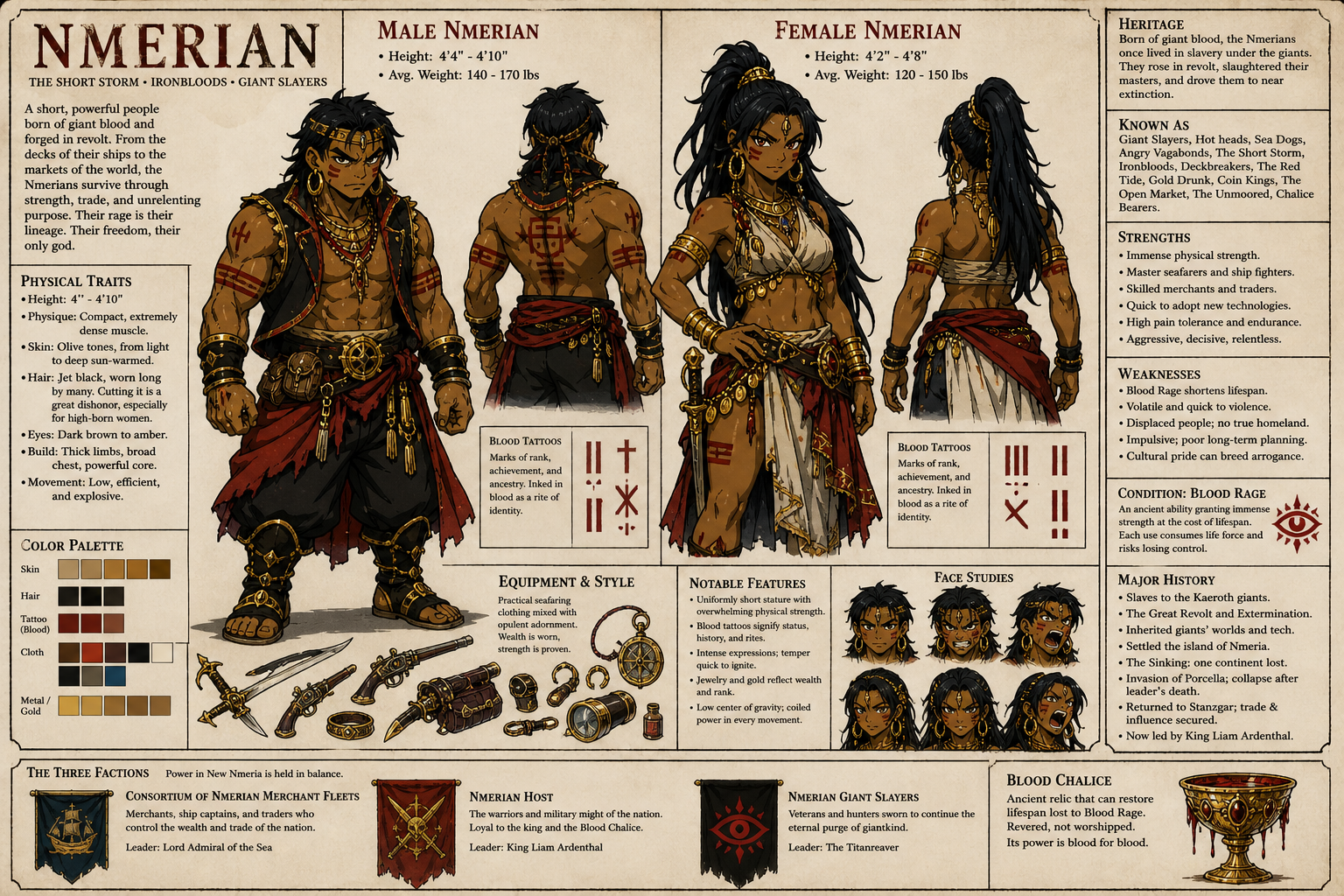
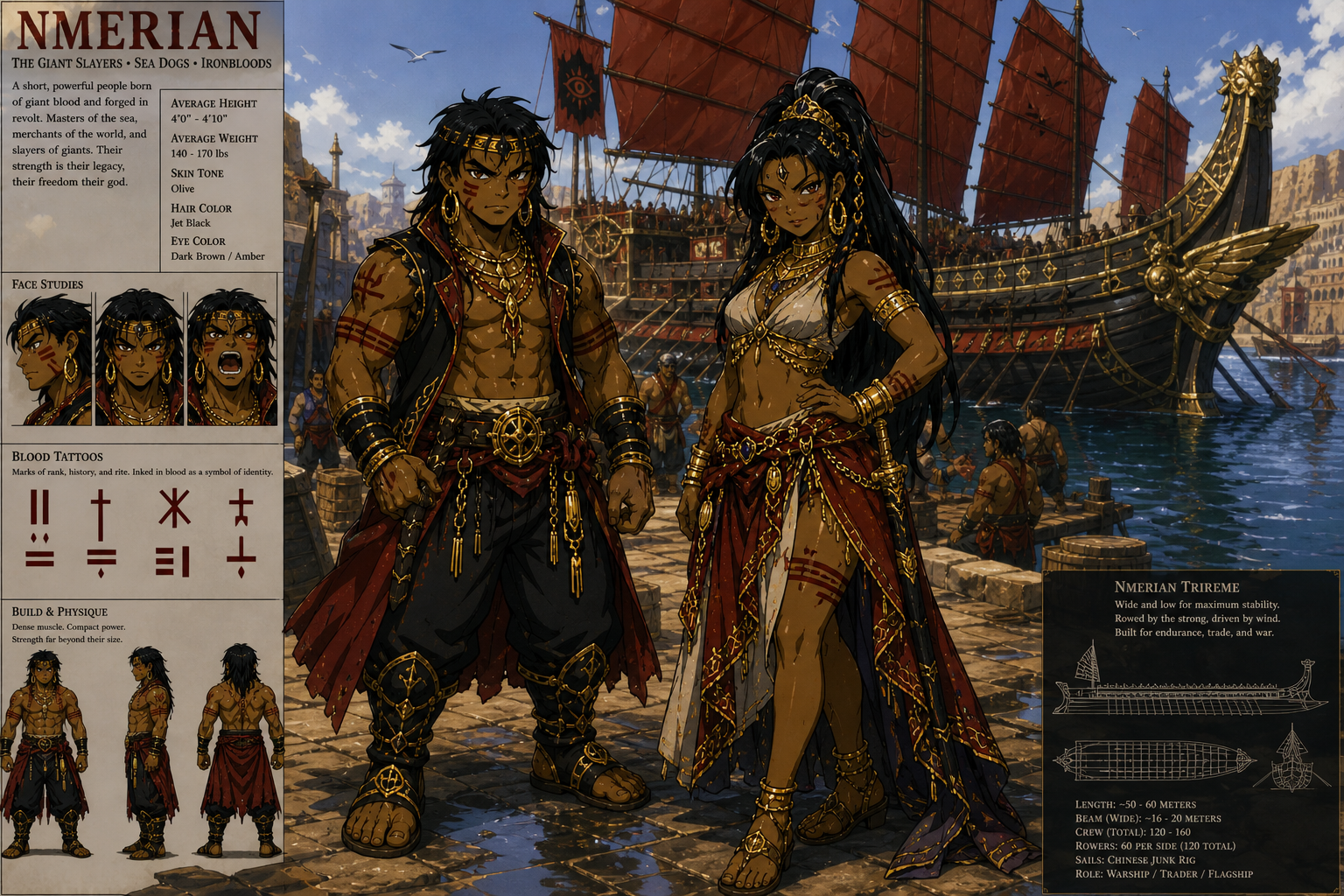
The Nmerians are a short, olive-skinned people whose physical presence belies their immense strength, their compact frames packed with dense, powerful muscle derived from the lingering influence of giant blood within their lineage. Though small in stature, they move with a controlled, efficient precision that reflects both their seafaring heritage and their deeply ingrained martial instincts, giving the impression of coiled force rather than raw bulk. Their bodies are built for endurance and sudden violence alike, with strong limbs, thick forearms, and a grounded posture that suggests stability and power beyond what their size would imply. This physical intensity is matched by their demeanor, as Nmerians tend to carry themselves with a natural confidence that often borders on aggression, their expressions quick to shift from calm to confrontational. There is a constant sense of contained energy about them, as though something just beneath the surface is waiting to be unleashed, a reflection of both their history and the volatile strength they possess. Even outside of conflict, they are rarely passive, their presence marked by a restless, driven nature that reflects a people shaped by survival, conquest, and the lingering echoes of a past defined by both servitude and domination.
Giant Slayers, Hot heads, sea dogs, Angry Vagabonds, The Short Storm, Ironbloods, Deckbreakers, The Red Tide, Gold Drunk, Coin Kings, The Open Market, The Unmoored, Chalice Bearers,
Looks
The Nmerian body is defined by its compact structure and extraordinary muscle density, giving individuals a weight and physical presence far beyond what their short stature would suggest. Rather than appearing bulky, their strength is distributed through tightly packed muscle, creating a build that is thick, grounded, and efficient rather than exaggerated. Their limbs, particularly the forearms and thighs, are notably well-developed, reflecting both their seafaring lifestyle and their capacity for sudden, explosive force. The torso tends to be broad and stable, forming a solid center of mass that supports powerful, controlled movement. Nmerians carry themselves with a naturally balanced posture, their stance low and rooted, allowing them to exert strength without overextension or loss of control. Movement among them is deliberate and economical, with little wasted effort, reinforcing the impression of contained power rather than outward display. Altogether, their physique is one built not for size or intimidation through scale, but for efficiency, endurance, and the ability to deliver overwhelming force from a deceptively small frame.
Nmerian skin tones are most commonly found within a range of olive hues, varying from deeper sun-warmed tones to lighter, more muted shades depending on environment and exposure. Those who live and work under open skies and along the sea often develop richer, darker coloration, their skin shaped by constant sunlight and salt air, while individuals removed from such conditions—whether through prolonged time indoors or in places like the astral plane—may appear noticeably paler or desaturated. Despite this range, their coloration remains consistent in character, rarely straying far from its olive foundation, giving the Nmerians a distinct and recognizable appearance as a people. Their skin reflects both their origins and their adaptability, carrying the marks of a life shaped by travel, hardship, and shifting environments without losing its core identity.
Nmerians are a notably short people, with most individuals standing between four feet and four feet ten inches in height, and very little variation outside of this range. Their stature is one of their most immediately recognizable traits, often leading outsiders to underestimate them at a glance. This perception is quickly corrected, however, as their compact frames carry a density and strength that far exceed what their size would suggest. Height holds little significance within Nmerian society, as physical power and capability are not tied to scale but to the immense strength inherent in their build. Rather than appearing diminished by their stature, Nmerians instead give the impression of being grounded and solid, their low center of mass contributing to both their stability and their ability to exert force efficiently. Their size is not a limitation, but a defining aspect of how their strength and presence manifest.
4'-4'10"
Nmerians are considerably heavier than their small stature would suggest, their compact frames composed of tightly packed muscle that gives them a surprising and often misleading physical weight. This density is not the result of bulk or excess mass, but of highly efficient musculature that maximizes strength within a limited frame. As a result, even a relatively small Nmerian can carry the weight and impact of a much larger individual, making physical interactions with them unexpectedly forceful. Their weight contributes to a low, stable center of gravity, enhancing both balance and striking power, while also allowing them to endure prolonged physical exertion without significant loss of performance. To those unfamiliar with them, this disparity between size and weight often leads to underestimation, a mistake that is rarely made twice.
The notable features of the Nmerians are defined less by unusual anatomy and more by a combination of physical intensity and culturally significant markings that set them apart as a people. Their hair is uniformly jet black, a defining trait across the race, and among high-born individuals, particularly women, it is worn long as a symbol of status and identity, with cutting it considered a significant loss or violation. Many Nmerians bear distinctive blood tattoos, most commonly rendered in deep red, which mark rank, ritual standing, or personal history; these markings often appear as clean, deliberate bars or lines placed along the face, limbs, or torso, giving them a stark and purposeful appearance. Their facial expressions tend toward intensity, with sharp, focused gazes and quick shifts from calm to aggression, reflecting the volatile nature that runs through their culture. Their eyes often seem particularly striking, whether through color, focus, or sheer presence, contributing to an impression of constant awareness and readiness. Even at rest, Nmerians carry themselves with a subtle tension, their posture and bearing suggesting contained strength and the ever-present potential for sudden action, reinforcing the sense that beneath their small stature lies something far more formidable than first impressions would suggest.
Physical variance among the Nmerians is relatively limited, with most individuals sharing a consistent range of height, build, and general structure that makes them immediately recognizable as a people. Differences do exist, but they tend to manifest in the distribution and conditioning of muscle rather than in overall size or frame, with some individuals appearing thicker and more heavily built, while others are leaner but no less dense or capable. Environmental factors can influence aspects such as skin tone or level of conditioning, particularly between those who live at sea and those in more settled environments, but these changes remain within a narrow and cohesive range. More distinct variation is often expressed culturally rather than physically, through the use of blood tattoos, hairstyle, and personal presentation, which can signify rank, experience, or background. Despite these differences, Nmerians maintain a strong visual consistency, their shared traits of compact stature, dense musculature, and intense presence ensuring that even the most distinct individuals remain clearly part of the same people.
Nmerian clothing varies significantly depending on environment and social context, reflecting both practicality and a strong inclination toward display among the wealthy. In everyday life, most Nmerians favor simple, unassuming outfits designed for comfort, mobility, and durability, particularly those who work at sea or in labor-intensive roles. In warmer climates, traditional attire tends toward light, flowing garments that allow for ease of movement and relief from the heat, often worn in layered but breathable configurations. In contrast, within major urban centers such as the capital, clothing becomes a statement of wealth and status, with the affluent favoring expensive, gaudy, and vividly colored garments that draw attention and signal prosperity. These outfits may incorporate fine fabrics, intricate patterns, and bold color combinations, creating a striking visual contrast to the otherwise practical dress of the broader population. Despite this range, clothing among the Nmerians remains an expression of circumstance and identity rather than necessity, with even the most extravagant attire serving to reinforce personal presence rather than define it.
Traits
The strengths of the Nmerians lie in a combination of physical capability, environmental mastery, and cultural temperament that makes them formidable in both conflict and commerce. Despite their small stature, they possess immense physical strength derived from the giant blood within them, allowing them to exert force far beyond what their size would suggest. This strength is paired with a natural aptitude for seafaring, as generations spent navigating open waters have made them highly skilled sailors, navigators, and shipborne fighters. In addition to their physical and nautical prowess, Nmerians are exceptionally capable merchants, able to amass and manage wealth on a large scale while rapidly expanding their influence through trade. Beyond these established strengths, they also display a high degree of adaptability, readily incorporating new technologies and practices into their society without hesitation, allowing them to remain competitive in changing environments. Their dense musculature and cultural conditioning grant them significant endurance and tolerance for pain, enabling them to continue functioning under conditions that would overwhelm others. Finally, their temperament—marked by aggression, decisiveness, and a readiness to act—makes them particularly dangerous in moments of conflict, as they are inclined to commit fully and without hesitation once a course of action is chosen.
The weaknesses of the Nmerians stem largely from the same traits that make them powerful, creating a people who are as unstable as they are formidable. Central among these is their bloodlust, an ever-present undercurrent within their culture that can quickly escalate into violence, particularly when combined with the use of their Blood Rage. While this ability grants immense strength, it comes at a severe cost, steadily shortening their lifespan with each use and placing a constant strain on those who rely on it too heavily. Beyond this, the Nmerians are a displaced people, lacking a true homeland after the loss of their original island, which has left them culturally and physically unmoored, often seeking purpose through action rather than stability. Their volatile nature makes them prone to impulsive decisions, with conflicts frequently escalating faster than intended, while a tendency toward short-term thinking can undermine long-term planning and cohesion. Additionally, their strong cultural pride and history of dominance can manifest as arrogance or a sense of superiority, creating friction in their dealings with other peoples. Altogether, these weaknesses form a pattern of intensity without restraint, where strength and success are often achieved at the cost of longevity, stability, and broader cooperation.
The primary condition affecting the Nmerians is known as the Blood Rage, an ancient and inherited ability rooted in the giant blood that runs through their lineage. When invoked, it grants the user a dramatic and immediate increase in physical strength, allowing them to perform feats far beyond their already formidable baseline. This surge of power, however, comes at a severe and irreversible cost, as each use shortens the individual’s lifespan, steadily consuming the very vitality that sustains them. While the ability can be controlled to a degree, repeated use places increasing strain on both body and mind, and those who rely on it too heavily may experience a gradual loss of restraint, becoming more prone to uncontrolled violence and reckless behavior. The Blood Rage is not merely a physical condition, but a defining aspect of Nmerian identity, shaping their approach to conflict, survival, and self-worth. To counteract its toll, ancient practices such as the use of the Blood Chalice were developed, offering a means to restore lost lifespan, though such rituals are rare and often bound by strict cultural or ceremonial limitations. As a result, the Blood Rage exists as both a powerful tool and a lingering curse, one that grants greatness in the moment while quietly eroding the future.
Culture
Nmerian beliefs are rooted in a history defined by enslavement under the giants and the violent struggle that led to their liberation, shaping a worldview that places little trust in divinity or inherited authority. Having risen against and ultimately destroyed beings once considered godlike, they hold a fundamental belief that power, not divine right, determines truth and legitimacy, and that no being is beyond challenge or destruction. This perspective fuels their deeply ingrained opposition to slavery, which they view as the greatest possible violation, one that must be opposed wherever it is found. Their continued pursuit of giants, even into the present age, is not merely an act of vengeance but a cultural obligation, a responsibility carried forward from their ancestors. While artifacts such as the Blood Chalice are treated with great reverence, this reverence is practical rather than devotional, as such objects are valued for their function and significance rather than worshipped as sacred in a traditional sense. Nmerian belief places emphasis on action, strength, and proven capability, favoring tangible results over faith or doctrine, resulting in a people who define meaning not through what they believe, but through what they do.
Nmerian beliefs are rooted in a history defined by enslavement under the giants and the violent struggle that led to their liberation, shaping a worldview that places little trust in divinity or inherited authority. Having risen against and ultimately destroyed beings once considered godlike, they hold a fundamental belief that power, not divine right, determines truth and legitimacy, and that no being is beyond challenge or destruction. This perspective fuels their deeply ingrained opposition to slavery, which they view as the greatest possible violation, one that must be opposed wherever it is found. Their continued pursuit of giants, even into the present age, is not merely an act of vengeance but a cultural obligation, a responsibility carried forward from their ancestors. While artifacts such as the Blood Chalice are treated with great reverence, this reverence is practical rather than devotional, as such objects are valued for their function and significance rather than worshipped as sacred in a traditional sense. Nmerian belief places emphasis on action, strength, and proven capability, favoring tangible results over faith or doctrine, resulting in a people who define meaning not through what they believe, but through what they do.
The government of the Nmerians in New Nmeria is not a singular unified structure, but a precarious balance between three dominant factions, each representing a core aspect of Nmerian identity: trade, war, and legacy. The Consortium of Nmerian Merchant Fleets governs the economic engine of the people, consisting of ship captains and merchant leaders who operate under the authority of the Lord Admiral of the Sea, controlling trade routes, wealth flow, and external relations. The Nmerian Host serves as the primary military force, a collective of warriors bound under the rule of King Liam Ardenthal, who commands loyalty through both personal strength and his recognition by the Blood Chalice, granting him legitimacy as a unifying figure among the Nmerians. The third faction, the Nmerian Giant Slayers, exists as a more fragmented but deeply respected order composed of hardened veterans who continue the ancient mission of hunting and destroying giants wherever they are found, following the leadership of the Titanreaver. These three factions do not operate in perfect harmony, each pursuing its own priorities—wealth, stability, or vengeance—often bringing them into tension with one another. As a result, Nmerian governance is less a system of centralized control and more a constant negotiation of power, where authority must be asserted, maintained, and balanced rather than assumed. The presence of the Blood Chalice as a sacred and legitimizing force further complicates this structure, as it serves not only as a symbol of divine right but as a tangible source of authority, reinforcing the position of the king while simultaneously tying the fate of the people to the ancient power that defines them.
Nmerian technological advancement is defined less by original invention and more by their exceptional ability to acquire, adapt, and integrate innovations from a wide range of sources. As one of the most well-traveled and economically powerful peoples in the known world, they have access to technologies far beyond those of most nations, which they rapidly incorporate into their own systems with little hesitation. Their expertise is particularly evident in maritime engineering, navigation, and logistical infrastructure, where generations of seafaring experience have allowed them to refine and optimize tools and techniques for trade, transport, and warfare. Nmerian ships, in particular, are often equipped with a blend of traditional design and advanced modifications, making them both efficient and versatile across a variety of conditions. Beyond the material plane, their historical interaction with astral environments and relics has granted them access to knowledge and artifacts that further enhance their capabilities, though these are not always fully understood. Technology among the Nmerians is valued for its utility and potential, and it is frequently repurposed to serve multiple functions, whether for profit, expansion, or conflict. This pragmatic and opportunistic approach ensures that they remain at the forefront of technological capability, even if they are not always the originators of the innovations they employ.
Nmerian occupations reflect both their seafaring heritage and their ongoing efforts to rebuild and expand their presence in the modern age. In their ancient homeland, an idyllic tropical island, their society supported a wide range of professions typical of a thriving metropolitan center, including artisans, traders, administrators, and laborers, alongside the many roles required to maintain a powerful maritime presence such as sailors, navigators, shipwrights, and merchants engaged in long-distance trade. In the present day, this foundation has shifted toward supporting the rapid development of New Nmeria, with many individuals taking on roles tied to infrastructure, logistics, and expansion as the nation establishes itself on newly acquired lands. Despite these changes, the merchant navy remains central to Nmerian identity, with a significant portion of the population still engaged in seaborne trade, transport, and exploration. There is often considerable overlap between civilian, merchant, and military roles, as individuals move fluidly between them depending on need, reflecting a society where practical skill and contribution are valued over rigid specialization. Whether on land or at sea, Nmerian occupations are driven by purpose and opportunity, reinforcing their reputation as adaptable, capable, and relentlessly forward-moving.
The Nmerian economy is exceptionally strong, built upon their position as the primary supplier of foreign and exotic goods from outside Procella, granting them significant influence over trade across the region. Their vast merchant fleets form the backbone of this system, transporting rare materials, technologies, and luxury items that other nations cannot easily access, allowing them to accumulate immense wealth in a relatively short period of time. This wealth is not typically hoarded, but actively spent and circulated, with many Nmerians—particularly among the elite—displaying a preference for excess, luxury, and visible prosperity. As a result, their economic culture is marked by constant movement of capital, with investments flowing into infrastructure, expansion, and increasingly ambitious ventures as they establish their presence in new territories. However, this rapid accumulation of wealth has also led to inefficiencies, as the pace of economic growth often outstrips the development of stable systems to manage it. Despite this, their dominance in trade and their ability to control the flow of goods ensures that their economic position remains both powerful and resilient, reinforcing their status as one of the foremost mercantile forces in the known world.
Nmerian food culture is rooted in the abundance of their ancient tropical homeland, where diets commonly featured fresh fish, game birds, and a wide variety of fruits drawn from the island’s rich natural resources. This foundation, shaped by both land and sea, emphasized freshness, variety, and the ability to sustain a people closely tied to maritime life. In modern times, however, Nmerian tastes have expanded dramatically, reflecting their immense wealth and access to global trade networks. Particularly among the elite, there is a strong tendency toward indulgence, with a wide range of imported and exotic foods being sought out and consumed with enthusiasm. Rather than being limited by geography, Nmerians now take pride in their ability to acquire and enjoy nearly anything available across the known world, often treating food as both a luxury and a symbol of status. This has resulted in a culinary culture that blends traditional island fare with an ever-growing array of foreign influences, creating a dining experience defined as much by excess and variety as it is by heritage.
History
Nmerian history is defined by a series of transformative and often violent events that have shaped them into the people they are today. In their earliest known history, the Nmerians lived in complete servitude to the Kaeroth, having no memory of a time before their enslavement. This changed during the great revolt, when they seized an opportunity for freedom and rose against their masters, choosing not only liberation but total retribution. What followed was a prolonged and relentless campaign of extermination, as Nmerian forces pursued the giants across the astral sea and into real space, systematically hunting them to near extinction. In the aftermath of this war, they inherited the abandoned worlds and technologies of their former masters, using them to travel the cosmos until they discovered and settled the island of Nmeria, an ideal homeland that would become the center of their civilization. This era of stability was shattered by the cataclysmic sinking of Nmeria, the loss of one of its five great continents, which fractured the Nmerian people and scattered them across the world. In the wake of this disaster, a large portion of their forces launched a desperate campaign into Porcella, carving a destructive path toward the heart of the Grand Empire before ultimately collapsing after the death of their leader, leaving lasting damage in their wake. In more recent times, the reemergence of Nmerian fleets and their calculated arrival in Stanzgar marked a turning point, as they leveraged their strength and resources into a powerful trade agreement that secured them land and influence in the ruins of the former empire. Today, under the leadership of King Liam Ardenthal, the Nmerians stand at a crossroads, seeking to unify their fractured factions and rebuild their nation while carrying forward the weight of a past defined by conquest, loss, and unrelenting purpose.
Overview
Details about this race's overview
Nmerian
The Nmerians are a short, olive-skinned people whose physical presence belies their immense strength, their compact frames packed with dense, powerful muscle derived from the lingering influence of giant blood within their lineage. Though small in stature, they move with a controlled, efficient precision that reflects both their seafaring heritage and their deeply ingrained martial instincts, giving the impression of coiled force rather than raw bulk. Their bodies are built for endurance and sudden violence alike, with strong limbs, thick forearms, and a grounded posture that suggests stability and power beyond what their size would imply. This physical intensity is matched by their demeanor, as Nmerians tend to carry themselves with a natural confidence that often borders on aggression, their expressions quick to shift from calm to confrontational. There is a constant sense of contained energy about them, as though something just beneath the surface is waiting to be unleashed, a reflection of both their history and the volatile strength they possess. Even outside of conflict, they are rarely passive, their presence marked by a restless, driven nature that reflects a people shaped by survival, conquest, and the lingering echoes of a past defined by both servitude and domination.
Giant Slayers, Hot heads, sea dogs, Angry Vagabonds, The Short Storm, Ironbloods, Deckbreakers, The Red Tide, Gold Drunk, Coin Kings, The Open Market, The Unmoored, Chalice Bearers,
Looks
Details about this race's looks
The Nmerian body is defined by its compact structure and extraordinary muscle density, giving individuals a weight and physical presence far beyond what their short stature would suggest. Rather than appearing bulky, their strength is distributed through tightly packed muscle, creating a build that is thick, grounded, and efficient rather than exaggerated. Their limbs, particularly the forearms and thighs, are notably well-developed, reflecting both their seafaring lifestyle and their capacity for sudden, explosive force. The torso tends to be broad and stable, forming a solid center of mass that supports powerful, controlled movement. Nmerians carry themselves with a naturally balanced posture, their stance low and rooted, allowing them to exert strength without overextension or loss of control. Movement among them is deliberate and economical, with little wasted effort, reinforcing the impression of contained power rather than outward display. Altogether, their physique is one built not for size or intimidation through scale, but for efficiency, endurance, and the ability to deliver overwhelming force from a deceptively small frame.
Nmerian skin tones are most commonly found within a range of olive hues, varying from deeper sun-warmed tones to lighter, more muted shades depending on environment and exposure. Those who live and work under open skies and along the sea often develop richer, darker coloration, their skin shaped by constant sunlight and salt air, while individuals removed from such conditions—whether through prolonged time indoors or in places like the astral plane—may appear noticeably paler or desaturated. Despite this range, their coloration remains consistent in character, rarely straying far from its olive foundation, giving the Nmerians a distinct and recognizable appearance as a people. Their skin reflects both their origins and their adaptability, carrying the marks of a life shaped by travel, hardship, and shifting environments without losing its core identity.
Nmerians are a notably short people, with most individuals standing between four feet and four feet ten inches in height, and very little variation outside of this range. Their stature is one of their most immediately recognizable traits, often leading outsiders to underestimate them at a glance. This perception is quickly corrected, however, as their compact frames carry a density and strength that far exceed what their size would suggest. Height holds little significance within Nmerian society, as physical power and capability are not tied to scale but to the immense strength inherent in their build. Rather than appearing diminished by their stature, Nmerians instead give the impression of being grounded and solid, their low center of mass contributing to both their stability and their ability to exert force efficiently. Their size is not a limitation, but a defining aspect of how their strength and presence manifest.
4'-4'10"
Nmerians are considerably heavier than their small stature would suggest, their compact frames composed of tightly packed muscle that gives them a surprising and often misleading physical weight. This density is not the result of bulk or excess mass, but of highly efficient musculature that maximizes strength within a limited frame. As a result, even a relatively small Nmerian can carry the weight and impact of a much larger individual, making physical interactions with them unexpectedly forceful. Their weight contributes to a low, stable center of gravity, enhancing both balance and striking power, while also allowing them to endure prolonged physical exertion without significant loss of performance. To those unfamiliar with them, this disparity between size and weight often leads to underestimation, a mistake that is rarely made twice.
The notable features of the Nmerians are defined less by unusual anatomy and more by a combination of physical intensity and culturally significant markings that set them apart as a people. Their hair is uniformly jet black, a defining trait across the race, and among high-born individuals, particularly women, it is worn long as a symbol of status and identity, with cutting it considered a significant loss or violation. Many Nmerians bear distinctive blood tattoos, most commonly rendered in deep red, which mark rank, ritual standing, or personal history; these markings often appear as clean, deliberate bars or lines placed along the face, limbs, or torso, giving them a stark and purposeful appearance. Their facial expressions tend toward intensity, with sharp, focused gazes and quick shifts from calm to aggression, reflecting the volatile nature that runs through their culture. Their eyes often seem particularly striking, whether through color, focus, or sheer presence, contributing to an impression of constant awareness and readiness. Even at rest, Nmerians carry themselves with a subtle tension, their posture and bearing suggesting contained strength and the ever-present potential for sudden action, reinforcing the sense that beneath their small stature lies something far more formidable than first impressions would suggest.
Physical variance among the Nmerians is relatively limited, with most individuals sharing a consistent range of height, build, and general structure that makes them immediately recognizable as a people. Differences do exist, but they tend to manifest in the distribution and conditioning of muscle rather than in overall size or frame, with some individuals appearing thicker and more heavily built, while others are leaner but no less dense or capable. Environmental factors can influence aspects such as skin tone or level of conditioning, particularly between those who live at sea and those in more settled environments, but these changes remain within a narrow and cohesive range. More distinct variation is often expressed culturally rather than physically, through the use of blood tattoos, hairstyle, and personal presentation, which can signify rank, experience, or background. Despite these differences, Nmerians maintain a strong visual consistency, their shared traits of compact stature, dense musculature, and intense presence ensuring that even the most distinct individuals remain clearly part of the same people.
Nmerian clothing varies significantly depending on environment and social context, reflecting both practicality and a strong inclination toward display among the wealthy. In everyday life, most Nmerians favor simple, unassuming outfits designed for comfort, mobility, and durability, particularly those who work at sea or in labor-intensive roles. In warmer climates, traditional attire tends toward light, flowing garments that allow for ease of movement and relief from the heat, often worn in layered but breathable configurations. In contrast, within major urban centers such as the capital, clothing becomes a statement of wealth and status, with the affluent favoring expensive, gaudy, and vividly colored garments that draw attention and signal prosperity. These outfits may incorporate fine fabrics, intricate patterns, and bold color combinations, creating a striking visual contrast to the otherwise practical dress of the broader population. Despite this range, clothing among the Nmerians remains an expression of circumstance and identity rather than necessity, with even the most extravagant attire serving to reinforce personal presence rather than define it.
Traits
Details about this race's traits
The strengths of the Nmerians lie in a combination of physical capability, environmental mastery, and cultural temperament that makes them formidable in both conflict and commerce. Despite their small stature, they possess immense physical strength derived from the giant blood within them, allowing them to exert force far beyond what their size would suggest. This strength is paired with a natural aptitude for seafaring, as generations spent navigating open waters have made them highly skilled sailors, navigators, and shipborne fighters. In addition to their physical and nautical prowess, Nmerians are exceptionally capable merchants, able to amass and manage wealth on a large scale while rapidly expanding their influence through trade. Beyond these established strengths, they also display a high degree of adaptability, readily incorporating new technologies and practices into their society without hesitation, allowing them to remain competitive in changing environments. Their dense musculature and cultural conditioning grant them significant endurance and tolerance for pain, enabling them to continue functioning under conditions that would overwhelm others. Finally, their temperament—marked by aggression, decisiveness, and a readiness to act—makes them particularly dangerous in moments of conflict, as they are inclined to commit fully and without hesitation once a course of action is chosen.
The weaknesses of the Nmerians stem largely from the same traits that make them powerful, creating a people who are as unstable as they are formidable. Central among these is their bloodlust, an ever-present undercurrent within their culture that can quickly escalate into violence, particularly when combined with the use of their Blood Rage. While this ability grants immense strength, it comes at a severe cost, steadily shortening their lifespan with each use and placing a constant strain on those who rely on it too heavily. Beyond this, the Nmerians are a displaced people, lacking a true homeland after the loss of their original island, which has left them culturally and physically unmoored, often seeking purpose through action rather than stability. Their volatile nature makes them prone to impulsive decisions, with conflicts frequently escalating faster than intended, while a tendency toward short-term thinking can undermine long-term planning and cohesion. Additionally, their strong cultural pride and history of dominance can manifest as arrogance or a sense of superiority, creating friction in their dealings with other peoples. Altogether, these weaknesses form a pattern of intensity without restraint, where strength and success are often achieved at the cost of longevity, stability, and broader cooperation.
The primary condition affecting the Nmerians is known as the Blood Rage, an ancient and inherited ability rooted in the giant blood that runs through their lineage. When invoked, it grants the user a dramatic and immediate increase in physical strength, allowing them to perform feats far beyond their already formidable baseline. This surge of power, however, comes at a severe and irreversible cost, as each use shortens the individual’s lifespan, steadily consuming the very vitality that sustains them. While the ability can be controlled to a degree, repeated use places increasing strain on both body and mind, and those who rely on it too heavily may experience a gradual loss of restraint, becoming more prone to uncontrolled violence and reckless behavior. The Blood Rage is not merely a physical condition, but a defining aspect of Nmerian identity, shaping their approach to conflict, survival, and self-worth. To counteract its toll, ancient practices such as the use of the Blood Chalice were developed, offering a means to restore lost lifespan, though such rituals are rare and often bound by strict cultural or ceremonial limitations. As a result, the Blood Rage exists as both a powerful tool and a lingering curse, one that grants greatness in the moment while quietly eroding the future.
Culture
Details about this race's culture
Nmerian beliefs are rooted in a history defined by enslavement under the giants and the violent struggle that led to their liberation, shaping a worldview that places little trust in divinity or inherited authority. Having risen against and ultimately destroyed beings once considered godlike, they hold a fundamental belief that power, not divine right, determines truth and legitimacy, and that no being is beyond challenge or destruction. This perspective fuels their deeply ingrained opposition to slavery, which they view as the greatest possible violation, one that must be opposed wherever it is found. Their continued pursuit of giants, even into the present age, is not merely an act of vengeance but a cultural obligation, a responsibility carried forward from their ancestors. While artifacts such as the Blood Chalice are treated with great reverence, this reverence is practical rather than devotional, as such objects are valued for their function and significance rather than worshipped as sacred in a traditional sense. Nmerian belief places emphasis on action, strength, and proven capability, favoring tangible results over faith or doctrine, resulting in a people who define meaning not through what they believe, but through what they do.
Nmerian beliefs are rooted in a history defined by enslavement under the giants and the violent struggle that led to their liberation, shaping a worldview that places little trust in divinity or inherited authority. Having risen against and ultimately destroyed beings once considered godlike, they hold a fundamental belief that power, not divine right, determines truth and legitimacy, and that no being is beyond challenge or destruction. This perspective fuels their deeply ingrained opposition to slavery, which they view as the greatest possible violation, one that must be opposed wherever it is found. Their continued pursuit of giants, even into the present age, is not merely an act of vengeance but a cultural obligation, a responsibility carried forward from their ancestors. While artifacts such as the Blood Chalice are treated with great reverence, this reverence is practical rather than devotional, as such objects are valued for their function and significance rather than worshipped as sacred in a traditional sense. Nmerian belief places emphasis on action, strength, and proven capability, favoring tangible results over faith or doctrine, resulting in a people who define meaning not through what they believe, but through what they do.
The government of the Nmerians in New Nmeria is not a singular unified structure, but a precarious balance between three dominant factions, each representing a core aspect of Nmerian identity: trade, war, and legacy. The Consortium of Nmerian Merchant Fleets governs the economic engine of the people, consisting of ship captains and merchant leaders who operate under the authority of the Lord Admiral of the Sea, controlling trade routes, wealth flow, and external relations. The Nmerian Host serves as the primary military force, a collective of warriors bound under the rule of King Liam Ardenthal, who commands loyalty through both personal strength and his recognition by the Blood Chalice, granting him legitimacy as a unifying figure among the Nmerians. The third faction, the Nmerian Giant Slayers, exists as a more fragmented but deeply respected order composed of hardened veterans who continue the ancient mission of hunting and destroying giants wherever they are found, following the leadership of the Titanreaver. These three factions do not operate in perfect harmony, each pursuing its own priorities—wealth, stability, or vengeance—often bringing them into tension with one another. As a result, Nmerian governance is less a system of centralized control and more a constant negotiation of power, where authority must be asserted, maintained, and balanced rather than assumed. The presence of the Blood Chalice as a sacred and legitimizing force further complicates this structure, as it serves not only as a symbol of divine right but as a tangible source of authority, reinforcing the position of the king while simultaneously tying the fate of the people to the ancient power that defines them.
Nmerian technological advancement is defined less by original invention and more by their exceptional ability to acquire, adapt, and integrate innovations from a wide range of sources. As one of the most well-traveled and economically powerful peoples in the known world, they have access to technologies far beyond those of most nations, which they rapidly incorporate into their own systems with little hesitation. Their expertise is particularly evident in maritime engineering, navigation, and logistical infrastructure, where generations of seafaring experience have allowed them to refine and optimize tools and techniques for trade, transport, and warfare. Nmerian ships, in particular, are often equipped with a blend of traditional design and advanced modifications, making them both efficient and versatile across a variety of conditions. Beyond the material plane, their historical interaction with astral environments and relics has granted them access to knowledge and artifacts that further enhance their capabilities, though these are not always fully understood. Technology among the Nmerians is valued for its utility and potential, and it is frequently repurposed to serve multiple functions, whether for profit, expansion, or conflict. This pragmatic and opportunistic approach ensures that they remain at the forefront of technological capability, even if they are not always the originators of the innovations they employ.
Nmerian occupations reflect both their seafaring heritage and their ongoing efforts to rebuild and expand their presence in the modern age. In their ancient homeland, an idyllic tropical island, their society supported a wide range of professions typical of a thriving metropolitan center, including artisans, traders, administrators, and laborers, alongside the many roles required to maintain a powerful maritime presence such as sailors, navigators, shipwrights, and merchants engaged in long-distance trade. In the present day, this foundation has shifted toward supporting the rapid development of New Nmeria, with many individuals taking on roles tied to infrastructure, logistics, and expansion as the nation establishes itself on newly acquired lands. Despite these changes, the merchant navy remains central to Nmerian identity, with a significant portion of the population still engaged in seaborne trade, transport, and exploration. There is often considerable overlap between civilian, merchant, and military roles, as individuals move fluidly between them depending on need, reflecting a society where practical skill and contribution are valued over rigid specialization. Whether on land or at sea, Nmerian occupations are driven by purpose and opportunity, reinforcing their reputation as adaptable, capable, and relentlessly forward-moving.
The Nmerian economy is exceptionally strong, built upon their position as the primary supplier of foreign and exotic goods from outside Procella, granting them significant influence over trade across the region. Their vast merchant fleets form the backbone of this system, transporting rare materials, technologies, and luxury items that other nations cannot easily access, allowing them to accumulate immense wealth in a relatively short period of time. This wealth is not typically hoarded, but actively spent and circulated, with many Nmerians—particularly among the elite—displaying a preference for excess, luxury, and visible prosperity. As a result, their economic culture is marked by constant movement of capital, with investments flowing into infrastructure, expansion, and increasingly ambitious ventures as they establish their presence in new territories. However, this rapid accumulation of wealth has also led to inefficiencies, as the pace of economic growth often outstrips the development of stable systems to manage it. Despite this, their dominance in trade and their ability to control the flow of goods ensures that their economic position remains both powerful and resilient, reinforcing their status as one of the foremost mercantile forces in the known world.
Nmerian food culture is rooted in the abundance of their ancient tropical homeland, where diets commonly featured fresh fish, game birds, and a wide variety of fruits drawn from the island’s rich natural resources. This foundation, shaped by both land and sea, emphasized freshness, variety, and the ability to sustain a people closely tied to maritime life. In modern times, however, Nmerian tastes have expanded dramatically, reflecting their immense wealth and access to global trade networks. Particularly among the elite, there is a strong tendency toward indulgence, with a wide range of imported and exotic foods being sought out and consumed with enthusiasm. Rather than being limited by geography, Nmerians now take pride in their ability to acquire and enjoy nearly anything available across the known world, often treating food as both a luxury and a symbol of status. This has resulted in a culinary culture that blends traditional island fare with an ever-growing array of foreign influences, creating a dining experience defined as much by excess and variety as it is by heritage.
History
Details about this race's history
Nmerian history is defined by a series of transformative and often violent events that have shaped them into the people they are today. In their earliest known history, the Nmerians lived in complete servitude to the Kaeroth, having no memory of a time before their enslavement. This changed during the great revolt, when they seized an opportunity for freedom and rose against their masters, choosing not only liberation but total retribution. What followed was a prolonged and relentless campaign of extermination, as Nmerian forces pursued the giants across the astral sea and into real space, systematically hunting them to near extinction. In the aftermath of this war, they inherited the abandoned worlds and technologies of their former masters, using them to travel the cosmos until they discovered and settled the island of Nmeria, an ideal homeland that would become the center of their civilization. This era of stability was shattered by the cataclysmic sinking of Nmeria, the loss of one of its five great continents, which fractured the Nmerian people and scattered them across the world. In the wake of this disaster, a large portion of their forces launched a desperate campaign into Porcella, carving a destructive path toward the heart of the Grand Empire before ultimately collapsing after the death of their leader, leaving lasting damage in their wake. In more recent times, the reemergence of Nmerian fleets and their calculated arrival in Stanzgar marked a turning point, as they leveraged their strength and resources into a powerful trade agreement that secured them land and influence in the ruins of the former empire. Today, under the leadership of King Liam Ardenthal, the Nmerians stand at a crossroads, seeking to unify their fractured factions and rebuild their nation while carrying forward the weight of a past defined by conquest, loss, and unrelenting purpose.
Notes
Details about this race's notes
No notes information yet
This section doesn't have any information filled in yet.
Gallery
Images and visual content for this race
Associations
Other pages that reference or connect to this race
Referenced By
6Andrew Hayes
Linked Races
Liam Ardenthal of House Hayes
Linked Races
Paloa
Linked Races
Sol Saris
Races
Sol Saris
Races
Philipe Stanzgar
Enemies
Collections
Published collections that feature this race
Not in any collections yet
This race hasn't been published in any collections yet. Collections are curated groups of related content that help organize and showcase your world.
Tip: Collections are a great way to group related content together and share themed stories or worldbuilding elements with others.
Timelines
Timelines that reference or include this race
No timeline connections yet
This race isn't connected to any timelines yet. Timelines help organize events chronologically and show how your content fits into the broader history of your world.
Tip: Create timelines to organize important events in your world's history. Link characters, locations, and other content to specific events to build rich, interconnected narratives.
Shares
Discussion about this race
No shares yet
Be the first to start a discussion about this race by sharing it to the community stream.
Privacy & Sharing
Manage who can see and access this race
Current Status
refresh
This race is currently
Privacy Settings
Choose who can see and access this race
language Universe Privacy
This page belongs to a universe with its own privacy settings