
Categories
Dive Deeper
Page Stats
Navigation
Categories
Dive Deeper
Page Stats
Complete Details
All information about this character
Overview
Paloa
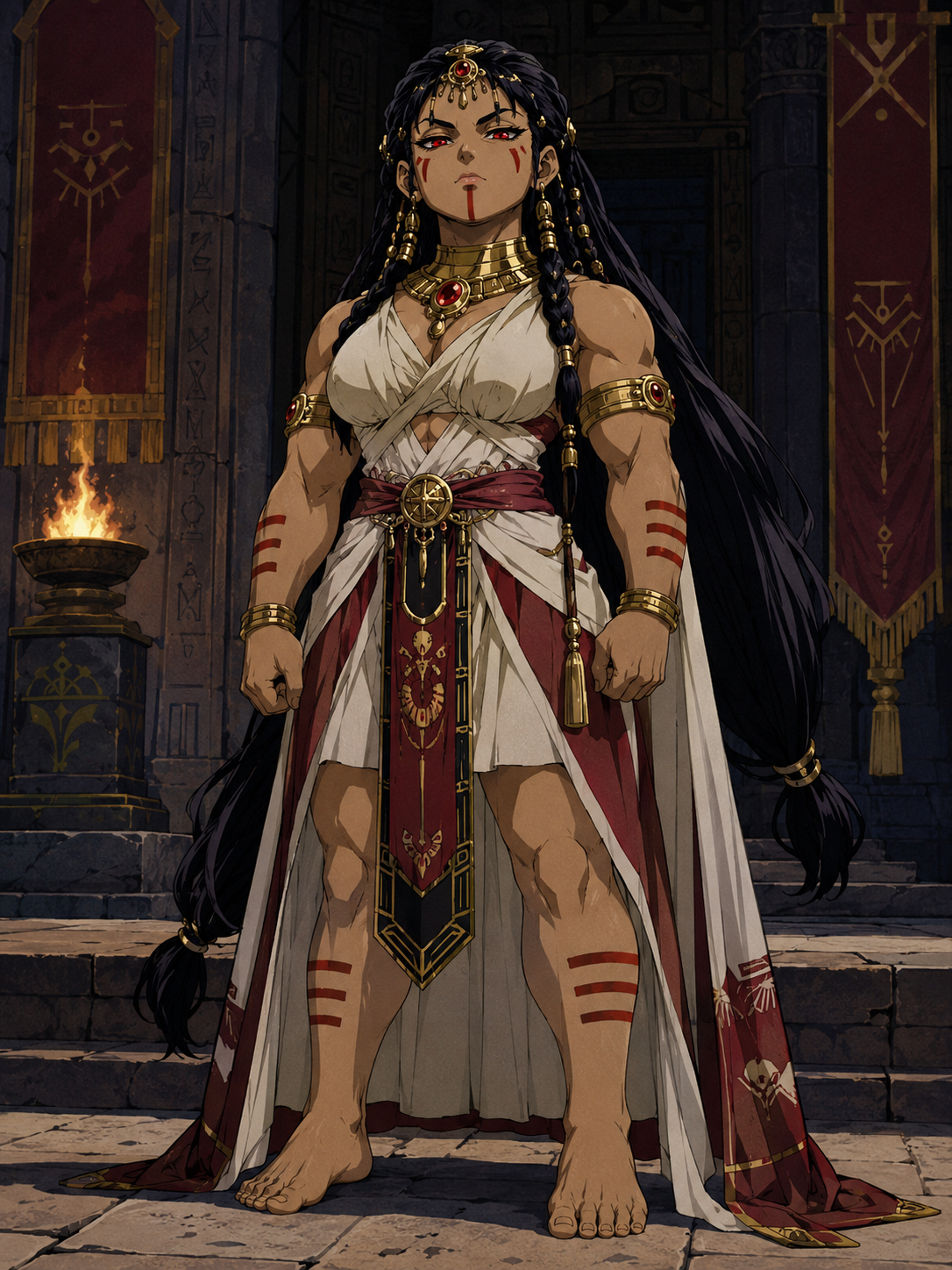
Paloa, known as the Last Bearer of the Blood Chalice, is an Old Nmerian high priestess, former Astral gladiator, and personal bodyguard-handmaiden of Lady Melidia. Though she stands only four feet five, her compact, dense body is packed with immense strength, thick forearms, powerful thighs, and the controlled posture of someone who has survived countless fights by wasting no motion. Her jet-black hair, magically regrown after being cut during her enslavement, can reach her ankles when let down, while her glowing crimson eyes, pale olive skin, and red Nmerian blood tattoos mark her as both sacred and dangerous. Once a high priestess of the Great Temple of the Giants, Paloa was abducted by Astral slavers before Nmeria sank and spent ages fighting for their amusement, burning through the giant’s blood within her through the Nmerian Rage. Rescued into Armon-Kal, she became volatile, possessive, haughty, and quick to violence, yet also deeply relieved to be pampered by Melidia after millennia of being used as a weapon. She is a living treasury of Old Nmerian ritual knowledge, the protector of the Blood Chalice, and a woman caught between sacred duty, ancient trauma, royal pride, and the terrifying fact that outside Armon-Kal’s protection, ordinary time may claim everything the Astral Sea delayed.
Last Bearer of the Blood Chalice
High Priestess of The Great Temple of the Giants
24
Female
Looks
none
Paloa usually wears her hair in ponytails, braids, or buns, keeping its immense length controlled for movement, ceremony, and guarding Melidia. When let down, her jet-black hair reaches all the way to her ankles, a mark of high-born Nmerian womanhood and sacred status. Among Nmerian women of her rank, uncut hair carries deep cultural weight, which makes the fact that Astral slavers once cut hers especially violating. Because time does not pass normally on the Astral Sea, Paloa went to great lengths to magically regrow it while trapped there, reclaiming piece by piece something that had been taken from her. Now, whether bound up in practical styles or worn loose in private, her hair is both beauty and defiance: proof that slavery did not get to keep what it stole.
Paloa’s hair is jet black, the proper and expected color for a Nmerian of her blood and status. Its darkness gives her a severe, ancient beauty, especially against her pale olive skin, glowing crimson eyes, and red blood tattoos. Because her hair was once cut by Astral slavers, its color and restored length carry more than simple appearance; they are part of her reclaimed identity as a high-born Nmerian woman, a priestess, and the Last Bearer of the Blood Chalice.
4' 5"
150lbs
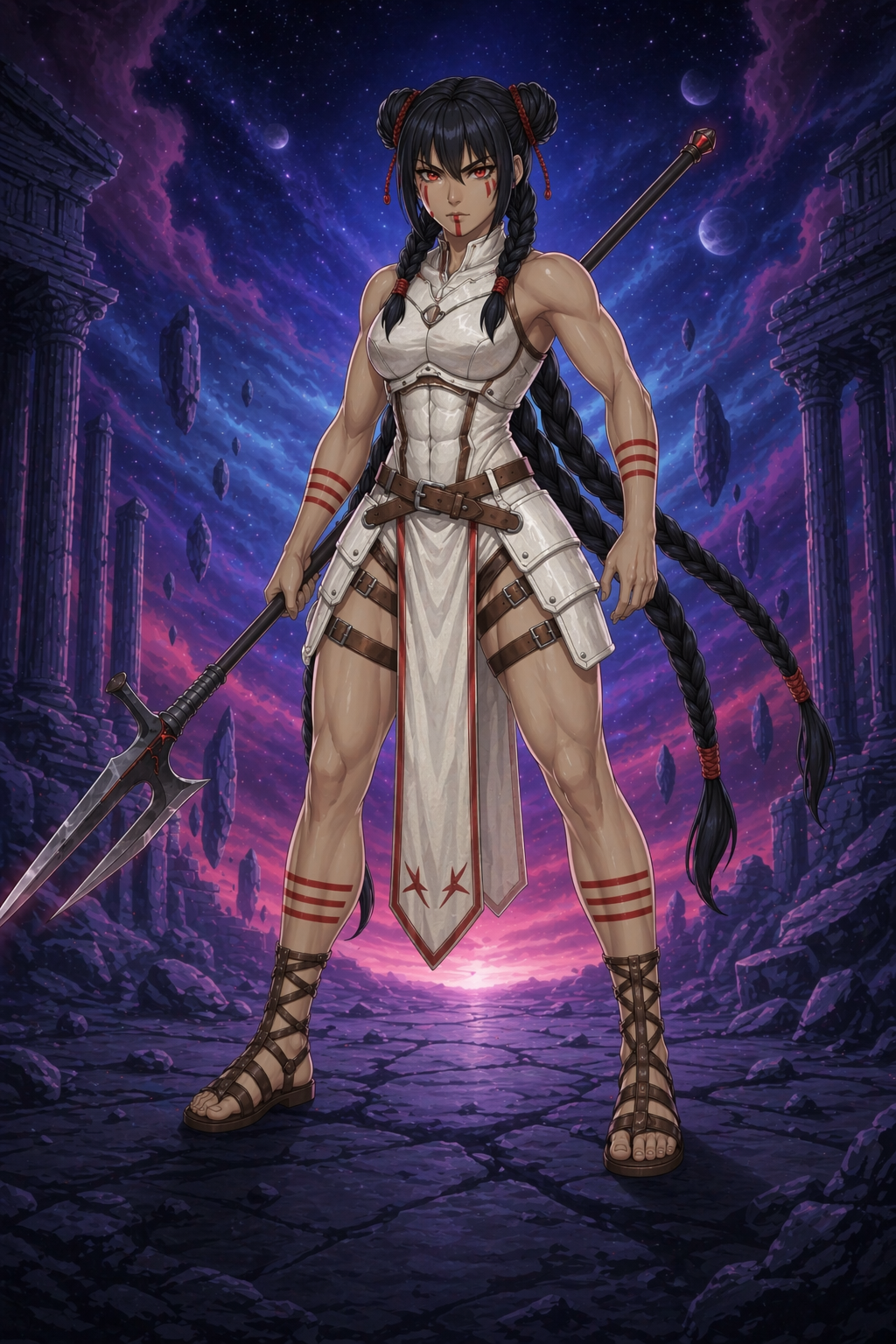
Paloa’s identifying marks are her Nmerian blood tattoos: short red bars descending diagonally from the outer corners of her eyes, another red mark running from her bottom lip down part of her chin, and three plain red bars on each forearm and calf. The lack of adornment in these markings identifies her as a neophyte among the high priestesses, a detail made tragic by everything she endured after being taken from Old Nmeria. Against her pale olive skin, jet-black hair, and glowing crimson eyes, the tattoos make her look unmistakably sacred, martial, and ancient, even before one knows she is the Last Bearer of the Blood Chalice.
Paloa has a compact, dense build, small at a glance but unmistakably powerful once seen in motion. At four feet five and around one hundred fifty pounds, she is built like a tightened pillar of muscle, with thick forearms, strong thighs, a broadened frame, and subtle curves shaped by Nmerian strength rather than softness. She does not look bulky so much as compressed, as though far more power has been packed into her body than her height should allow. Her movements are efficient and controlled, with no wasted motion, carrying the battle-hardened discipline of someone who survived millennia as an Astral gladiator and learned that every breath, step, and strike had to matter.
Paloa has pale olive skin, a complexion shaped by long ages away from ordinary sunlight on the Astral Sea and within Armon-Kal. The olive undertone marks her clearly as Nmerian, but the paleness gives her a strange, almost preserved quality, as if time, sun, and mortal weather have had less claim on her than they should. Against her jet-black hair, glowing crimson eyes, and red Nmerian blood tattoos, her skin makes her look ancient, sacred, and dangerous despite her small stature.
Nmerian
glowing crimson red
Nature
Paloa’s strongest prejudice is against Astral beings, especially slavers, pirates, and the creatures who treated her as a gladiatorial amusement for untold ages. Her hatred of them is immediate, personal, and violent, rooted in captivity rather than theory. Beyond that, she also carries the old Nmerian superiority complex, looking down on many of the peoples of Sol Saris as younger, weaker, less sacred, or less properly ordered than Old Nmeria. This arrogance is not always loud, but it is often present in the way she speaks, judges, and expects to be treated. To Paloa, she was born to a civilization that slew giants and guarded sacred blood; most other peoples have to prove they are worth taking seriously.
Paloa suffers from a unique condition caused by spending ages on the Astral Sea as a gladiator while repeatedly using the Nmerian Rage. Her inhuman strength draws on the giant’s blood within her, consuming reserves that should have been restored or regulated by ordinary time, rest, and natural bodily processes. But on the Astral Sea, time did not pass properly, leaving the damage suspended rather than resolved. By the time she was rescued, Paloa had burned through so much of that sacred blood that leaving the protective sphere of Armon-Kal would have caused her to die instantly as ordinary time caught up with what her body had endured. This fate was only resolved with the rediscovery of the Blood Chalice, which restored the possibility of survival beyond Armon-Kal and returned her sacred duty to the center of her life.
Paloa is haughty, volatile, and quick to anger, carrying herself with the sharp pride of an Old Nmerian high priestess who has survived far too much to accept being treated lightly. She is prone to violence when threatened, insulted, or cornered, and her first instinct is often to assert control before anyone can take it from her again. Around most people, she is guarded, possessive, and difficult, expecting deference and watching for betrayal. Around Melidia, however, much of that hardness can be softened through indulgence; she is surprisingly easy to coddle when pampered, praised, fed fresh fruit, and treated like the sacred little princess she believes herself to be. This makes her both dangerous and oddly endearing: a battle-hardened priestess who may threaten someone one moment and then settle comfortably into being spoiled the next.
Paloa is motivated first by the desire to never be forced into the arena again. After ages spent fighting for the amusement of Astral slavers, not fighting feels like a luxury, a victory, and a sacred right. She wants to be pampered like a princess by Melidia, not because she has become soft, but because being indulged, fed fresh fruit, dressed beautifully, and treated as precious feels like the opposite of everything the Astral Sea made her endure. Once she learns that Nmerians still live, she is also driven by the need to reconnect with her people and understand what remains of the civilization stolen from her. During the long peace, this becomes tied to her sacred duty as protector of the Blood Chalice, retrieved from the ruins of Old Nmeria. To Paloa, the Chalice is not a political instrument but a holy trust, which puts her at odds with the triumvirate government of New Nmeria, who would see it used to restore their historical control.
Paloa is deeply mistrusting, possessive, and prone to losing control of her temper. After ages of captivity in the Astral Sea, she expects others to use, betray, contain, or command her, so she often responds to uncertainty with hostility before vulnerability can show. Her pride as an Old Nmerian high priestess makes this worse, because she already believes she is owed deference and has little patience for being questioned by people she considers lesser. She can become fiercely possessive of those who pamper, protect, or belong to her inner circle, especially Melidia, and her anger can turn violent quickly when she feels threatened or disrespected. Paloa’s flaws are not simple cruelty; they are the habits of a sacred woman who survived by becoming a weapon and has not fully learned how to stop guarding herself.
Paloa is a living treasury of Old Nmerian culture, ritual, and sacred practice, especially where the Blood Chalice and the old high priestesses are concerned. She knows the rites, meanings, restrictions, and dangers surrounding the Chalice in ways no modern scholar or New Nmerian politician fully can. Before her abduction, she was trained in basic defense with polearms, but millennia in the Astral gladiator pits turned that foundation into brutal mastery through survival. She is battle-hardened beyond any ordinary warrior, with a deep instinct for violence, endurance, and reading danger. Between her priestly knowledge, Nmerian Rage, immense strength, and long experience fighting to win, Paloa is both a sacred authority and a terrifying combatant.
Paloa enjoys gardening, wine making, and lounging, all of which are luxuries after ages spent surviving as an Astral gladiator. Gardening gives her something living, quiet, and obedient to tend without violence, while wine making lets her reclaim patience, craft, and pleasure rather than endurance and rage. Lounging may look indulgent, especially when Melidia is pampering her with fresh fruit and attention, but to Paloa it is almost sacred: proof that no one is forcing her to fight, perform, or bleed for their amusement. Her hobbies are not merely pastimes; they are small acts of recovery, ownership, and deserved softness after a life stolen by the Astral Sea.
Paloa is volatile, possessive, guarded, and deeply proud, with the temperament of someone who was born sacred, enslaved as a spectacle, and survived by becoming too dangerous to break. She is quick to anger and slow to trust, often treating unfamiliar people as threats, inferiors, or potential handlers before she sees them as companions. Yet beneath that hardness is a woman exhausted by violence and desperate to be treated as precious rather than useful. Around Melidia, she can become almost comically coddled: spoiled with fruit, comfort, praise, and attention until the ancient gladiator-priestess gives way to something softer, pettier, and more princess-like. Paloa is not gentle, but she is not only rage either; she is a sacred survivor trying to reclaim dignity, pleasure, and control after millennia of being made into someone else’s weapon.
Social
Loves fresh fruit of all sorts, rarely got such luxuries in the astral sea, and is plied with them whenever possible on Armon Kal.
seagulls
Guandao like polearm
The Blood Chalice, she did not have any possessions that she cherished from her time on the astral sea, and was given everything she wanted on Armon Kal, but the Blood Chalice is her sacred duty to protect.
Light Green
Paloa is Lady Melidia’s personal bodyguard and handmaiden, as well as the High Priestess of the Blood and the Last Bearer of the Blood Chalice. In Melidia’s household, she serves as a fiercely possessive protector, attendant, companion, and occasionally pampered menace, guarding her lady with the strength and violence of someone who survived millennia in Astral arenas. In Nmerian terms, however, her true occupation is sacred rather than domestic: she is one of the last living authorities of Old Nmerian blood rites, the keeper of the Blood Chalice’s rituals, and the protector of a relic powerful enough to unsettle the politics of New Nmeria itself.
Paloa has little interest in politics until the reformation of the Nmerian kingdom and the rediscovery of the Blood Chalice give her loyalties a clear shape. Once Liam Ardenthal is recognized as King of Nmeria, she becomes fiercely loyal to him and to the Nmerian Host, seeing them as the living continuation of the people and sacred order she thought were lost. Her politics are not subtle, diplomatic, or institutional; they are devotional, possessive, and protective. As the Last Bearer of the Blood Chalice, she jealously guards it from anyone she deems unworthy of its blessing, regardless of title, office, or historical claim. This places her at odds with those who would use the Chalice as a tool of governmental control, because Paloa does not believe sacred blood exists to serve politicians.
Paloa has a dim view of religion in the ordinary sense, because Old Nmerians did not look at gods the way many younger peoples do. To her, beings worshiped as gods may be powerful, ancient, or terrifying, but they are not beyond death; Nmerian history remembers giants as rulers, enemies, sacred blood-sources, and killable things. Her own sacred role is therefore less about humble worship and more about blood, lineage, ritual, duty, and the dangerous inheritance of those who slew giants rather than bowed to them. As High Priestess of the Blood and Last Bearer of the Blood Chalice, Paloa treats the Chalice and its rites with absolute seriousness, but she does not confuse reverence for weakness. In her eyes, divinity is not something untouchable above the world; it is something powerful enough to matter, and mortal hands may still be called to guard, use, judge, or destroy it.
Paloa’s job is to serve as Lady Melidia’s personal bodyguard and handmaiden while also fulfilling her sacred role as High Priestess of the Blood. In Melidia’s household, she guards, attends, threatens, lounges, and makes herself everyone’s problem when she feels insufficiently pampered. In Nmerian matters, however, her role becomes far more serious: she is the keeper of the Blood Chalice, the living authority on its rites, and the one who decides who may or may not be worthy of its blessing. She stands between the Chalice and anyone who would reduce it to a political tool, making her both sacred guardian and dangerous obstacle to those who want control over New Nmeria’s future.
History
The years end
Paloa was born in Old Nmeria, in the age before the island kingdom sank beneath the waves, and was raised within the sacred world of the Great Temple of the Giants. As a high-born Nmerian woman and high priestess, her life was shaped by blood rites, ritual authority, giant-slaying inheritance, and the old Nmerian conviction that divinity was not something to kneel before, but something to understand, bind, use, or kill when necessary. Though still a neophyte among the high priestesses, marked by the plain red blood tattoos of her station, she was already entrusted with sacred knowledge tied to the Blood Chalice and the rituals that governed Nmerian kingship.
That life was stolen from her when Astral slavers abducted her sometime before Nmeria’s fall. Torn away from her temple, her people, and her sacred duties, Paloa was taken into the Astral Sea and forced into gladiatorial combat for the amusement of beings who saw mortals as toys, trophies, and meat. Her hair was cut, her dignity stripped from her, and her inhuman Nmerian strength was exploited again and again. To survive, she used the Nmerian Rage far beyond what any body was meant to endure. Because time and natural processes did not pass properly in the Astral Sea, the damage did not catch up with her at once; instead, it accumulated in suspension, leaving her alive only because ordinary time could not properly claim what she had spent.
For untold centuries, Paloa survived by winning. The basic polearm training she had received as a priestess became brutal gladiatorial mastery. Her pride hardened into fury, her sacred authority into possessiveness, and her mistrust into instinct. By the time House Hayes and the Grand Duke’s forces resumed their hunting of Astral slavers and found her, Paloa was no longer only a stolen priestess. She was an ancient survivor, a living weapon, and a woman who had burned through so much of the giant’s blood within herself that leaving the protective sphere of Armon-Kal would have killed her instantly.
After her rescue, Lady Melidia became fascinated with Paloa almost immediately. Compared to Melidia’s towering HaLafin frame, Paloa was tiny, fierce, beautiful, and wonderfully volatile, and Melidia treated her with the indulgent possessiveness of someone who had found a sacred little war-beast to spoil. Paloa accepted this treatment with surprising enthusiasm. After millennia of being forced to fight for the pleasure of others, being pampered, fed fresh fruit, dressed comfortably, allowed to lounge, and treated like a precious high priestess felt not degrading, but correct. She was, after all, sacred, and people should have been treating her that way all along.
Her presence in House Hayes was not always peaceful. Paloa made a menace of herself among the staff, mistrusting nearly everyone, demanding deference, and responding poorly to anything that felt like control. Yet beneath the temper and entitlement was a woman without a living people, a priestess without a temple, and a guardian without the Chalice she had once been sworn to honor. That changed when Andrew Hayes told her that he and his ward Liam Ardenthal had found the lost continent of Nmeria beneath the waves and had commissioned a diving ship to descend into the old ruins. If the Great Temple still stood, then the Blood Chalice might still be there.
The rediscovery of the Blood Chalice transformed Paloa’s life. It resolved the deadly condition left by her Astral captivity, allowing her existence beyond Armon-Kal to become possible again, but it also restored her sacred duty. Paloa was no longer merely Melidia’s pampered bodyguard or a relic of a dead world; she was the Last Bearer of the Blood Chalice, one of the only living authorities who understood its rites from Old Nmeria itself. Its recovery also threw New Nmeria into crisis, because the Lord Admiral of the Sea and the triumvirate government ruled a surviving Nmerian society whose old structures had not accounted for the return of a high priestess, the Chalice, and a king recognized by ancient blood-right.
In the end, that king was Liam Ardenthal. Paloa’s loyalty settled fiercely on him and the Nmerian Host, not because she had become a subtle political actor, but because sacred duty, old law, and living blood had finally aligned again. From then on, she guarded the Blood Chalice jealously, denying it to anyone she deemed unworthy, including those in New Nmeria who wished to use it to restore their own historical control. Paloa’s background is therefore one of violent interruption and strange restoration: a priestess stolen before the fall of her world, remade in Astral arenas, spoiled into softness by Melidia, and finally returned to purpose as the dangerous guardian of Nmeria’s most sacred blood.
Paloa is well educated
Family
none
Inventory
Notes
is thousands of years old taken by astral slavers sometime in the 2nd age
Overview
Details about this character's overview
Paloa
Paloa, known as the Last Bearer of the Blood Chalice, is an Old Nmerian high priestess, former Astral gladiator, and personal bodyguard-handmaiden of Lady Melidia. Though she stands only four feet five, her compact, dense body is packed with immense strength, thick forearms, powerful thighs, and the controlled posture of someone who has survived countless fights by wasting no motion. Her jet-black hair, magically regrown after being cut during her enslavement, can reach her ankles when let down, while her glowing crimson eyes, pale olive skin, and red Nmerian blood tattoos mark her as both sacred and dangerous. Once a high priestess of the Great Temple of the Giants, Paloa was abducted by Astral slavers before Nmeria sank and spent ages fighting for their amusement, burning through the giant’s blood within her through the Nmerian Rage. Rescued into Armon-Kal, she became volatile, possessive, haughty, and quick to violence, yet also deeply relieved to be pampered by Melidia after millennia of being used as a weapon. She is a living treasury of Old Nmerian ritual knowledge, the protector of the Blood Chalice, and a woman caught between sacred duty, ancient trauma, royal pride, and the terrifying fact that outside Armon-Kal’s protection, ordinary time may claim everything the Astral Sea delayed.
Last Bearer of the Blood Chalice
High Priestess of The Great Temple of the Giants
24
Female
Looks
Details about this character's looks
none
Paloa usually wears her hair in ponytails, braids, or buns, keeping its immense length controlled for movement, ceremony, and guarding Melidia. When let down, her jet-black hair reaches all the way to her ankles, a mark of high-born Nmerian womanhood and sacred status. Among Nmerian women of her rank, uncut hair carries deep cultural weight, which makes the fact that Astral slavers once cut hers especially violating. Because time does not pass normally on the Astral Sea, Paloa went to great lengths to magically regrow it while trapped there, reclaiming piece by piece something that had been taken from her. Now, whether bound up in practical styles or worn loose in private, her hair is both beauty and defiance: proof that slavery did not get to keep what it stole.
Paloa’s hair is jet black, the proper and expected color for a Nmerian of her blood and status. Its darkness gives her a severe, ancient beauty, especially against her pale olive skin, glowing crimson eyes, and red blood tattoos. Because her hair was once cut by Astral slavers, its color and restored length carry more than simple appearance; they are part of her reclaimed identity as a high-born Nmerian woman, a priestess, and the Last Bearer of the Blood Chalice.
4' 5"
150lbs
Paloa’s identifying marks are her Nmerian blood tattoos: short red bars descending diagonally from the outer corners of her eyes, another red mark running from her bottom lip down part of her chin, and three plain red bars on each forearm and calf. The lack of adornment in these markings identifies her as a neophyte among the high priestesses, a detail made tragic by everything she endured after being taken from Old Nmeria. Against her pale olive skin, jet-black hair, and glowing crimson eyes, the tattoos make her look unmistakably sacred, martial, and ancient, even before one knows she is the Last Bearer of the Blood Chalice.
Paloa has a compact, dense build, small at a glance but unmistakably powerful once seen in motion. At four feet five and around one hundred fifty pounds, she is built like a tightened pillar of muscle, with thick forearms, strong thighs, a broadened frame, and subtle curves shaped by Nmerian strength rather than softness. She does not look bulky so much as compressed, as though far more power has been packed into her body than her height should allow. Her movements are efficient and controlled, with no wasted motion, carrying the battle-hardened discipline of someone who survived millennia as an Astral gladiator and learned that every breath, step, and strike had to matter.
Paloa has pale olive skin, a complexion shaped by long ages away from ordinary sunlight on the Astral Sea and within Armon-Kal. The olive undertone marks her clearly as Nmerian, but the paleness gives her a strange, almost preserved quality, as if time, sun, and mortal weather have had less claim on her than they should. Against her jet-black hair, glowing crimson eyes, and red Nmerian blood tattoos, her skin makes her look ancient, sacred, and dangerous despite her small stature.
Nmerian
glowing crimson red
Nature
Details about this character's nature
Paloa’s strongest prejudice is against Astral beings, especially slavers, pirates, and the creatures who treated her as a gladiatorial amusement for untold ages. Her hatred of them is immediate, personal, and violent, rooted in captivity rather than theory. Beyond that, she also carries the old Nmerian superiority complex, looking down on many of the peoples of Sol Saris as younger, weaker, less sacred, or less properly ordered than Old Nmeria. This arrogance is not always loud, but it is often present in the way she speaks, judges, and expects to be treated. To Paloa, she was born to a civilization that slew giants and guarded sacred blood; most other peoples have to prove they are worth taking seriously.
Paloa suffers from a unique condition caused by spending ages on the Astral Sea as a gladiator while repeatedly using the Nmerian Rage. Her inhuman strength draws on the giant’s blood within her, consuming reserves that should have been restored or regulated by ordinary time, rest, and natural bodily processes. But on the Astral Sea, time did not pass properly, leaving the damage suspended rather than resolved. By the time she was rescued, Paloa had burned through so much of that sacred blood that leaving the protective sphere of Armon-Kal would have caused her to die instantly as ordinary time caught up with what her body had endured. This fate was only resolved with the rediscovery of the Blood Chalice, which restored the possibility of survival beyond Armon-Kal and returned her sacred duty to the center of her life.
Paloa is haughty, volatile, and quick to anger, carrying herself with the sharp pride of an Old Nmerian high priestess who has survived far too much to accept being treated lightly. She is prone to violence when threatened, insulted, or cornered, and her first instinct is often to assert control before anyone can take it from her again. Around most people, she is guarded, possessive, and difficult, expecting deference and watching for betrayal. Around Melidia, however, much of that hardness can be softened through indulgence; she is surprisingly easy to coddle when pampered, praised, fed fresh fruit, and treated like the sacred little princess she believes herself to be. This makes her both dangerous and oddly endearing: a battle-hardened priestess who may threaten someone one moment and then settle comfortably into being spoiled the next.
Paloa is motivated first by the desire to never be forced into the arena again. After ages spent fighting for the amusement of Astral slavers, not fighting feels like a luxury, a victory, and a sacred right. She wants to be pampered like a princess by Melidia, not because she has become soft, but because being indulged, fed fresh fruit, dressed beautifully, and treated as precious feels like the opposite of everything the Astral Sea made her endure. Once she learns that Nmerians still live, she is also driven by the need to reconnect with her people and understand what remains of the civilization stolen from her. During the long peace, this becomes tied to her sacred duty as protector of the Blood Chalice, retrieved from the ruins of Old Nmeria. To Paloa, the Chalice is not a political instrument but a holy trust, which puts her at odds with the triumvirate government of New Nmeria, who would see it used to restore their historical control.
Paloa is deeply mistrusting, possessive, and prone to losing control of her temper. After ages of captivity in the Astral Sea, she expects others to use, betray, contain, or command her, so she often responds to uncertainty with hostility before vulnerability can show. Her pride as an Old Nmerian high priestess makes this worse, because she already believes she is owed deference and has little patience for being questioned by people she considers lesser. She can become fiercely possessive of those who pamper, protect, or belong to her inner circle, especially Melidia, and her anger can turn violent quickly when she feels threatened or disrespected. Paloa’s flaws are not simple cruelty; they are the habits of a sacred woman who survived by becoming a weapon and has not fully learned how to stop guarding herself.
Paloa is a living treasury of Old Nmerian culture, ritual, and sacred practice, especially where the Blood Chalice and the old high priestesses are concerned. She knows the rites, meanings, restrictions, and dangers surrounding the Chalice in ways no modern scholar or New Nmerian politician fully can. Before her abduction, she was trained in basic defense with polearms, but millennia in the Astral gladiator pits turned that foundation into brutal mastery through survival. She is battle-hardened beyond any ordinary warrior, with a deep instinct for violence, endurance, and reading danger. Between her priestly knowledge, Nmerian Rage, immense strength, and long experience fighting to win, Paloa is both a sacred authority and a terrifying combatant.
Paloa enjoys gardening, wine making, and lounging, all of which are luxuries after ages spent surviving as an Astral gladiator. Gardening gives her something living, quiet, and obedient to tend without violence, while wine making lets her reclaim patience, craft, and pleasure rather than endurance and rage. Lounging may look indulgent, especially when Melidia is pampering her with fresh fruit and attention, but to Paloa it is almost sacred: proof that no one is forcing her to fight, perform, or bleed for their amusement. Her hobbies are not merely pastimes; they are small acts of recovery, ownership, and deserved softness after a life stolen by the Astral Sea.
Paloa is volatile, possessive, guarded, and deeply proud, with the temperament of someone who was born sacred, enslaved as a spectacle, and survived by becoming too dangerous to break. She is quick to anger and slow to trust, often treating unfamiliar people as threats, inferiors, or potential handlers before she sees them as companions. Yet beneath that hardness is a woman exhausted by violence and desperate to be treated as precious rather than useful. Around Melidia, she can become almost comically coddled: spoiled with fruit, comfort, praise, and attention until the ancient gladiator-priestess gives way to something softer, pettier, and more princess-like. Paloa is not gentle, but she is not only rage either; she is a sacred survivor trying to reclaim dignity, pleasure, and control after millennia of being made into someone else’s weapon.
Social
Details about this character's social
Loves fresh fruit of all sorts, rarely got such luxuries in the astral sea, and is plied with them whenever possible on Armon Kal.
seagulls
Guandao like polearm
The Blood Chalice, she did not have any possessions that she cherished from her time on the astral sea, and was given everything she wanted on Armon Kal, but the Blood Chalice is her sacred duty to protect.
Light Green
Paloa is Lady Melidia’s personal bodyguard and handmaiden, as well as the High Priestess of the Blood and the Last Bearer of the Blood Chalice. In Melidia’s household, she serves as a fiercely possessive protector, attendant, companion, and occasionally pampered menace, guarding her lady with the strength and violence of someone who survived millennia in Astral arenas. In Nmerian terms, however, her true occupation is sacred rather than domestic: she is one of the last living authorities of Old Nmerian blood rites, the keeper of the Blood Chalice’s rituals, and the protector of a relic powerful enough to unsettle the politics of New Nmeria itself.
Paloa has little interest in politics until the reformation of the Nmerian kingdom and the rediscovery of the Blood Chalice give her loyalties a clear shape. Once Liam Ardenthal is recognized as King of Nmeria, she becomes fiercely loyal to him and to the Nmerian Host, seeing them as the living continuation of the people and sacred order she thought were lost. Her politics are not subtle, diplomatic, or institutional; they are devotional, possessive, and protective. As the Last Bearer of the Blood Chalice, she jealously guards it from anyone she deems unworthy of its blessing, regardless of title, office, or historical claim. This places her at odds with those who would use the Chalice as a tool of governmental control, because Paloa does not believe sacred blood exists to serve politicians.
Paloa has a dim view of religion in the ordinary sense, because Old Nmerians did not look at gods the way many younger peoples do. To her, beings worshiped as gods may be powerful, ancient, or terrifying, but they are not beyond death; Nmerian history remembers giants as rulers, enemies, sacred blood-sources, and killable things. Her own sacred role is therefore less about humble worship and more about blood, lineage, ritual, duty, and the dangerous inheritance of those who slew giants rather than bowed to them. As High Priestess of the Blood and Last Bearer of the Blood Chalice, Paloa treats the Chalice and its rites with absolute seriousness, but she does not confuse reverence for weakness. In her eyes, divinity is not something untouchable above the world; it is something powerful enough to matter, and mortal hands may still be called to guard, use, judge, or destroy it.
Paloa’s job is to serve as Lady Melidia’s personal bodyguard and handmaiden while also fulfilling her sacred role as High Priestess of the Blood. In Melidia’s household, she guards, attends, threatens, lounges, and makes herself everyone’s problem when she feels insufficiently pampered. In Nmerian matters, however, her role becomes far more serious: she is the keeper of the Blood Chalice, the living authority on its rites, and the one who decides who may or may not be worthy of its blessing. She stands between the Chalice and anyone who would reduce it to a political tool, making her both sacred guardian and dangerous obstacle to those who want control over New Nmeria’s future.
History
Details about this character's history
The years end
Paloa was born in Old Nmeria, in the age before the island kingdom sank beneath the waves, and was raised within the sacred world of the Great Temple of the Giants. As a high-born Nmerian woman and high priestess, her life was shaped by blood rites, ritual authority, giant-slaying inheritance, and the old Nmerian conviction that divinity was not something to kneel before, but something to understand, bind, use, or kill when necessary. Though still a neophyte among the high priestesses, marked by the plain red blood tattoos of her station, she was already entrusted with sacred knowledge tied to the Blood Chalice and the rituals that governed Nmerian kingship.
That life was stolen from her when Astral slavers abducted her sometime before Nmeria’s fall. Torn away from her temple, her people, and her sacred duties, Paloa was taken into the Astral Sea and forced into gladiatorial combat for the amusement of beings who saw mortals as toys, trophies, and meat. Her hair was cut, her dignity stripped from her, and her inhuman Nmerian strength was exploited again and again. To survive, she used the Nmerian Rage far beyond what any body was meant to endure. Because time and natural processes did not pass properly in the Astral Sea, the damage did not catch up with her at once; instead, it accumulated in suspension, leaving her alive only because ordinary time could not properly claim what she had spent.
For untold centuries, Paloa survived by winning. The basic polearm training she had received as a priestess became brutal gladiatorial mastery. Her pride hardened into fury, her sacred authority into possessiveness, and her mistrust into instinct. By the time House Hayes and the Grand Duke’s forces resumed their hunting of Astral slavers and found her, Paloa was no longer only a stolen priestess. She was an ancient survivor, a living weapon, and a woman who had burned through so much of the giant’s blood within herself that leaving the protective sphere of Armon-Kal would have killed her instantly.
After her rescue, Lady Melidia became fascinated with Paloa almost immediately. Compared to Melidia’s towering HaLafin frame, Paloa was tiny, fierce, beautiful, and wonderfully volatile, and Melidia treated her with the indulgent possessiveness of someone who had found a sacred little war-beast to spoil. Paloa accepted this treatment with surprising enthusiasm. After millennia of being forced to fight for the pleasure of others, being pampered, fed fresh fruit, dressed comfortably, allowed to lounge, and treated like a precious high priestess felt not degrading, but correct. She was, after all, sacred, and people should have been treating her that way all along.
Her presence in House Hayes was not always peaceful. Paloa made a menace of herself among the staff, mistrusting nearly everyone, demanding deference, and responding poorly to anything that felt like control. Yet beneath the temper and entitlement was a woman without a living people, a priestess without a temple, and a guardian without the Chalice she had once been sworn to honor. That changed when Andrew Hayes told her that he and his ward Liam Ardenthal had found the lost continent of Nmeria beneath the waves and had commissioned a diving ship to descend into the old ruins. If the Great Temple still stood, then the Blood Chalice might still be there.
The rediscovery of the Blood Chalice transformed Paloa’s life. It resolved the deadly condition left by her Astral captivity, allowing her existence beyond Armon-Kal to become possible again, but it also restored her sacred duty. Paloa was no longer merely Melidia’s pampered bodyguard or a relic of a dead world; she was the Last Bearer of the Blood Chalice, one of the only living authorities who understood its rites from Old Nmeria itself. Its recovery also threw New Nmeria into crisis, because the Lord Admiral of the Sea and the triumvirate government ruled a surviving Nmerian society whose old structures had not accounted for the return of a high priestess, the Chalice, and a king recognized by ancient blood-right.
In the end, that king was Liam Ardenthal. Paloa’s loyalty settled fiercely on him and the Nmerian Host, not because she had become a subtle political actor, but because sacred duty, old law, and living blood had finally aligned again. From then on, she guarded the Blood Chalice jealously, denying it to anyone she deemed unworthy, including those in New Nmeria who wished to use it to restore their own historical control. Paloa’s background is therefore one of violent interruption and strange restoration: a priestess stolen before the fall of her world, remade in Astral arenas, spoiled into softness by Melidia, and finally returned to purpose as the dangerous guardian of Nmeria’s most sacred blood.
Paloa is well educated
Family
Details about this character's family
none
Inventory
Details about this character's inventory
Changelog
Details about this character's changelog
No changelog information yet
This section doesn't have any information filled in yet.
Notes
Details about this character's notes
is thousands of years old taken by astral slavers sometime in the 2nd age
Gallery
Images and visual content for this character


Associations
Other pages that reference or connect to this character
Referenced By
16Liam Ardenthal of House Hayes
Best friends
Melidia
Love interests
Liam Ardenthal of House Hayes
Love interests
Andrew Hayes
Friends
Aideen the Red
Enemies
Melidia
Companions
Melidia
Friends
Nmerian
Famous figures
Dendre
Enemies
Lela
Friends
Robert Dùghlas LeTreis
Friends
Nendara
Best friends
Nendara
Love interests
Milie Sugarbeach
Friends
Kusha
Enemies
Kusha
Friends
Collections
Published collections that feature this character
Not in any collections yet
This character hasn't been published in any collections yet. Collections are curated groups of related content that help organize and showcase your world.
Tip: Collections are a great way to group related content together and share themed stories or worldbuilding elements with others.
Timelines
Timelines that reference or include this character
No timeline connections yet
This character isn't connected to any timelines yet. Timelines help organize events chronologically and show how your content fits into the broader history of your world.
Tip: Create timelines to organize important events in your world's history. Link characters, locations, and other content to specific events to build rich, interconnected narratives.
Shares
Discussion about this character
No shares yet
Be the first to start a discussion about this character by sharing it to the community stream.
Privacy & Sharing
Manage who can see and access this character
Current Status
refresh
This character is currently
Privacy Settings
Choose who can see and access this character
language Universe Privacy
This page belongs to a universe with its own privacy settings