
Categories
Dive Deeper
Page Stats
Navigation
Categories
Dive Deeper
Page Stats
Complete Details
All information about this race
Overview
Dityalumy
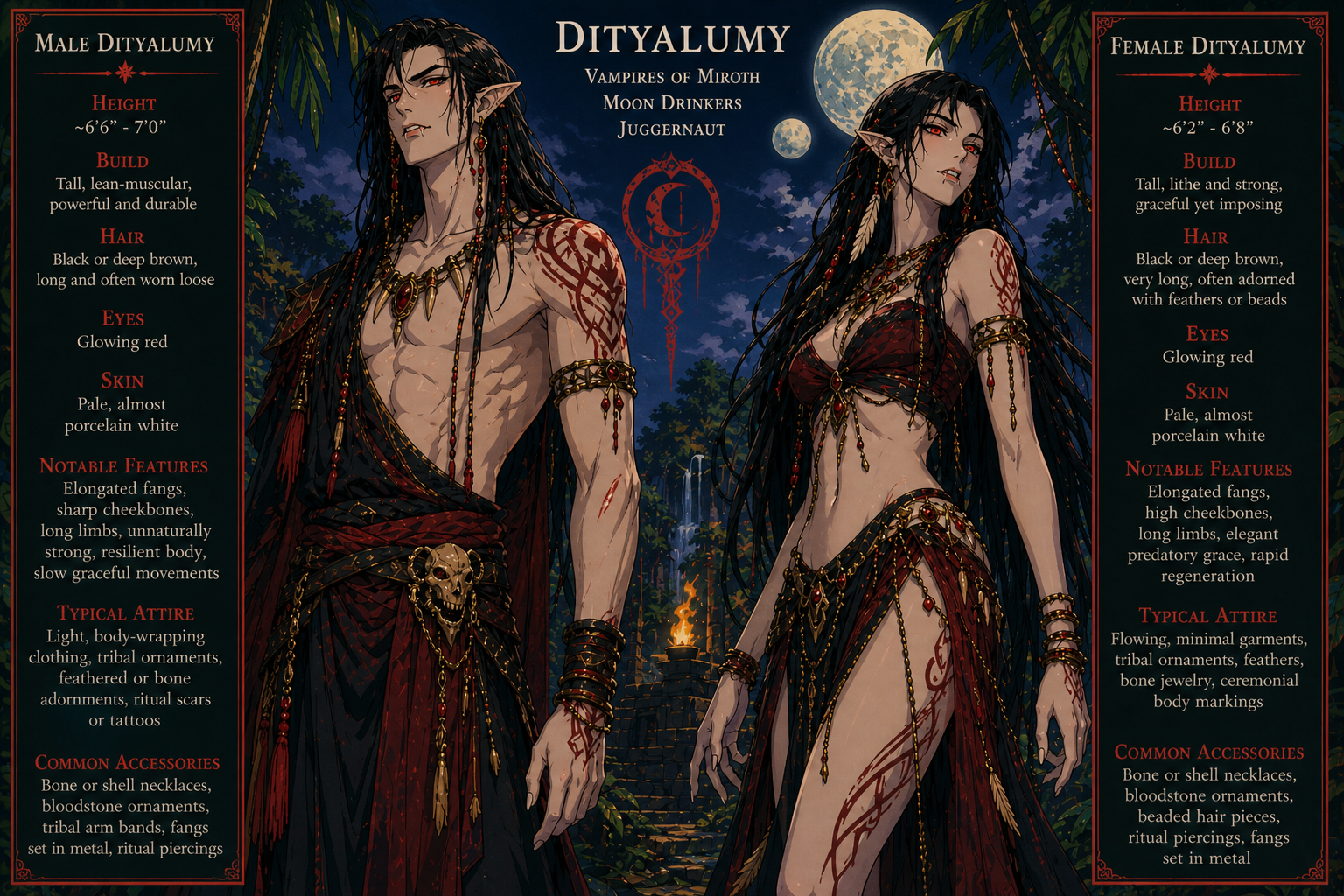
Pale-skinned island dwellers with glowing red eyes and elongated fangs, the Dityalumy carry the quiet presence of something both beautiful and dangerous. Tall, long-lived, and unnaturally strong, they move with a calm, predatory grace that makes even stillness feel intentional. Their bodies are highly durable, capable of rapid regeneration, and sustained by blood rather than ordinary food, giving rise to countless stories of vampires and moon-born monsters. Yet beneath the fear they inspire, they are a deeply loyal and spiritual people, bound by blood, memory, and the belief that the moons created all things.
Vampire, blood sucker, moon drinkers, juggernaut,
Looks
Dityalumy can possess nearly any humanoid body shape—lean, broad, heavyset, lithe, muscular, or soft-bodied—but all of them carry an unnatural physical density that makes them feel heavier and stronger than they first appear.
Even the slender among them tend to have a quiet sense of hidden strength, like coiled wire beneath pale skin. Their movements are often smooth and deliberate rather than hurried, giving them an unnerving grace that can make even a relaxed Dityalumy seem like a predator choosing not to pounce.
They are generally tall, with long limbs, strong backs, and a posture that feels almost too still when at rest. Many outsiders describe them as looking “wrong” in the same way large predators do—beautiful, but with the constant impression that they are built for violence whether they intend it or not.
Their musculature is rarely exaggerated in appearance; even powerful warriors often look lean rather than bulky. This makes their unnatural strength especially unsettling, as someone who appears elegant and slight may be capable of tearing a door from its hinges without visible strain.
Heavier Dityalumy do exist, but even then they resemble old stone statues or great hunting beasts rather than softness. Their bodies seem built to endure, heal, and persist rather than simply survive.
There is often something subtly nocturnal about them—their stillness, the way they hold eye contact, and the quiet confidence of something that has never needed to fear being hunted.
They do not usually look monstrous.
They look like something that decided being beautiful was the better disguise.
Dityalumy are most commonly known for their pale, almost unnatural complexions. Their skin ranges from soft ivory and cool cream to moonlit alabaster, pale ash, muted pearl, and the faint gray-pink tones of skin that rarely sees strong sun. Even those who spend much of their lives outdoors tend to remain strikingly pale, as though sunlight never fully claims them.
Unlike the warm olive tones of Atlanians or the varied fairness of Stanzgarians, Dityalumy skin often carries cool undertones—silver, blue-gray, soft violet, or the faint flush of old rose beneath white skin. In moonlight, their skin can seem almost luminous, giving rise to many old stories that they were shaped directly from moonlight and sea foam.
Some older bloodlines possess an especially ghostly pallor, skin so pale it appears nearly translucent at the wrists, throat, and temples, where faint veins may show beneath. This is often considered beautiful among them, a sign of strong lineage and closeness to the Moon Creator.
Scars heal cleanly and often fade strangely pale rather than darkening, leaving smooth white marks that can look almost carved rather than wounded. Bruising, however, shows vividly, dark and dramatic against their light skin.
Their red eyes and elongated fangs make the pallor even more striking, creating the unsettling impression that all color in them was taken from the body and placed behind the eyes.
To outsiders, they are often described as looking:
too pale to be warm
and too alive to be dead
which the Dityalumy generally take as a compliment.
Dityalumy are generally a tall people, with most adults standing around 6 feet tall, though the common natural range stretches from 5 feet to 7 feet depending on bloodline, sex, and the strange quirks of their long-lived physiology.
Even those on the shorter end of that range often seem taller than they are because of their posture and proportions. They tend toward long limbs, straight backs, and a quiet stillness that gives them an unnerving physical presence. A Dityalumy standing silently in a doorway can feel far larger than their actual height.
Those closer to seven feet are not especially rare, particularly among older bloodlines and warrior families, and these individuals often become the source of local ghost stories or “vampire giant” rumors among nearby mortal settlements. Their size, combined with pale skin and glowing red eyes, makes them difficult to forget once seen.
Children tend to grow quickly in adolescence, often seeming awkwardly tall before they settle into the controlled grace of adulthood. Because of their long lifespans, some elders continue to gain slight height or seem to “lengthen” with age, becoming leaner, sharper, and more imposing rather than stooped.
Dityalumy are heavier than they first appear, with most adults commonly weighing between 190 and 200 pounds, though taller individuals and older bloodlines can easily exceed that without looking bulky.
Their bodies carry an unnatural density—strong bones, powerful musculature, and a kind of physical solidity hidden beneath smooth pale frames. Even the leanest Dityalumy often feel surprisingly heavy when touched, like something carved from polished stone rather than ordinary flesh.
Because their strength and regeneration are so exceptional, their bodies are built less for visible athleticism and more for endurance and predatory efficiency. A slender Dityalumy with narrow shoulders and long limbs may still weigh far more than expected, and lifting one can be an unpleasant surprise for anyone assuming elegance means fragility.
Their musculature tends to be subtle rather than obvious. They rarely look like laborers or bodybuilders, even when they possess immense strength. Instead, they have the kind of build that feels deceptively calm—quiet until it suddenly isn’t.
Heavier Dityalumy exist as well, particularly among older warriors, tribal leaders, and those who have lived centuries in comfort and status. Even then, they tend to look like old predators at rest rather than soft or indulgent. Their weight settles into thick shoulders, powerful backs, and the stillness of something that has no need to rush.
Among their people, weight is rarely discussed in terms of beauty. It is associated more with vitality, the ability to heal, and whether one’s blood bond is healthy and well-maintained.
A Dityalumy who begins losing weight too quickly is not considered “thin”—
they are considered a cause for immediate concern.
The first thing most people notice about a Dityalumy is their eyes.
Their eyes glow a vivid, unnatural red—sometimes like fresh embers, sometimes like deep wine held to candlelight, and in older bloodlines almost like something luminous burning behind the iris itself. Even in daylight, their gaze is striking and difficult to ignore, carrying an intensity that makes many people instinctively uneasy. In darkness, that glow becomes far more obvious, and in firelight or moonlight it can make them look less like people and more like something old pretending to be one.
The second most noticeable feature is their elongated fangs.
Unlike simple sharp canines, Dityalumy fangs are prominent enough to be visible even when speaking or smiling, giving them a constant predatory undertone. Some have only slightly lengthened upper canines, while older bloodlines may possess more pronounced lower fangs as well, making their mouths look subtly wrong in a way that is hard to forget.
Their skin is also immediately recognizable—pale to the point of seeming unnatural, often carrying cool undertones of ivory, pearl, ash, or moonlit white. Combined with their red eyes, this creates the unsettling impression that all warmth in them was placed behind the eyes and nowhere else.
They are generally tall, long-limbed, and unnervingly still. Even at rest they tend to stand with straight posture and quiet confidence, moving with smooth, deliberate precision rather than wasted motion. Many people describe them as looking like predators conserving effort rather than relaxing.
There is often very little visible strain in them. They do not fidget much, rarely seem tired, and can hold eye contact for far too long without discomfort. This stillness can make even friendly Dityalumy seem intimidating.
Scars are strangely pale and clean when healed, and older individuals often seem to age more through presence than appearance—becoming sharper, quieter, and more imposing rather than visibly old.
Many also decorate themselves with:
feathers
bone ornaments
moon symbols
woven cords
and ritual marks tied to blood bonds or tribal identity
which soften none of the danger and often make it worse.
To most outsiders, the lasting impression is simple:
they look like they know exactly how fragile you are.
Dityalumy display a wide range of physical variation, despite the strong shared features that make them instantly recognizable—pale skin, glowing red eyes, elongated fangs, and their tall, predatory presence.
Facial features vary greatly between bloodlines and island tribes. Some possess sharp, elegant features with high cheekbones, narrow noses, and almost unnerving beauty, while others are broader-faced, heavier-jawed, and look more like old hunters than moonlit nobility. Both are equally common, and both carry the same unsettling sense that they were built to survive longer than most people should.
Body types range across the full spectrum—lean, broad, muscular, soft-bodied, heavyset, or lithe—but all retain that same hidden density and unnatural strength. Even a seemingly delicate Dityalumy can possess frightening physical power, while larger individuals often feel less like large people and more like something that should not be moved without permission.
Height varies widely as well, with some standing just above 5 feet and others reaching close to 7 feet, though most settle around 6 feet. Older bloodlines and tribal leaders often trend taller, contributing to the cultural belief that great age and physical presence are tied together.
Hair color is usually dark, commonly appearing in:
black
deep brown
ash brown
dark red
blue-black
Hair texture varies from straight to thick waves to heavy curls depending on lineage, and long hair is often culturally favored, especially when decorated with feathers, beads, or ritual ties.
Eye color beneath the glow can vary—deep crimson, ruby, wine-red, dark garnet, or even nearly black-red—but all Dityalumy eyes hold that same unnatural brightness, as though light is trapped behind them.
Fangs also differ between families. Some have elegant upper canines that only show when smiling, while others possess visibly prominent fangs at all times, with both upper and lower teeth slightly elongated, creating a far more openly monstrous appearance.
Scarring is common, especially among older warriors and long-lived elders, but it heals pale and smooth, often looking more like polished ivory marks than damaged flesh.
Because of their long lives, age can be difficult to judge. A Dityalumy of two hundred may look younger than a mortal of forty, while another may seem ancient simply from the way they hold silence.
No two Dityalumy look alike—
but all of them look like they belong more comfortably under moonlight than under the sun.
Dityalumy clothing is shaped first by climate, then by culture.
Their island home of Miroth is wet, humid, and almost constantly touched by rain, mist, or sea wind, so practicality comes before ornament. Clothing must dry quickly, endure constant moisture, and allow freedom of movement for hunting, climbing, and long travel through dense forests and rocky coastlines.
They favor simple, durable garments made from:
leather
hide
softened furs
woven plant fibers
treated linen when available
and water-resistant layered cloth
Their style is functional rather than tailored, built for movement and survival rather than formal structure.
Loose wraps, sleeveless tunics, fitted leather chest pieces, practical belts, and simple leg wrappings are common. Clothing is often tied rather than heavily buttoned, allowing it to be adjusted quickly depending on weather and work.
Because rain is such a constant part of life, ponchos, rain capes, and heavy shoulder drapes are extremely common and culturally iconic. These are often made from:
wax-treated cloth
hide
layered woven reeds
treated featherwork
or broad stitched leather panels
A good rain cape is considered nearly as important as a good blade.
Most are worn loose over the shoulders and upper body, allowing water to run off while keeping the hands free. Older Dityalumy often have beloved travel capes repaired dozens of times rather than replaced.
Feathers are the most common sign of decoration and status.
When a Dityalumy wishes to appear impressive, ceremonial, or attractive, they add:
feathered shoulder mantles
braided feather ornaments in the hair
bone jewelry
moon-symbol pendants
carved wooden beads
and ritual cords tied to tribe, blood bond, or family
Feathers are especially important in displays of beauty and adulthood, with certain birds carrying specific symbolic meanings.
Colors tend toward:
black
dark brown
deep green
storm gray
muted red
ivory
and moon-pale white for ritual garments
Bright colors are uncommon except during ceremonies, where white, silver-gray, and blood-red become especially important.
Warriors serving with the Stanzgarian legions often adapt their clothing with:
reinforced leather
light armor
military belts
practical breastplates
and travel cloaks
but even then they tend to keep their tribal rain capes, feathers, and personal adornments, making them immediately recognizable even in foreign ranks.
Formal beauty among the Dityalumy is not elegance in the noble sense—
it is looking like someone who could walk through a storm and come back with exactly what they went for.
To outsiders, they often look like:
hunters dressed for weather that never ends.
Traits
The Dityalumy are feared and respected for the same reason:
they are incredibly difficult to kill
What many outsiders lazily dismiss as “vampire stories” is, unfortunately for those outsiders, often rooted in very real experience.
Their greatest strength is their unnatural physical power.
Even the leanest Dityalumy possess strength far beyond what their graceful frames suggest. They are capable of overwhelming force in close combat, sudden bursts of speed, and a kind of predatory violence that feels less like a person fighting and more like something deciding the fight is over.
This strength is paired with extreme durability.
Dityalumy bodies are hard to permanently injure. They endure pain well, survive wounds that should kill ordinary people, and recover from physical trauma with alarming speed. Broken bones, deep cuts, and even severe internal injuries can heal with proper feeding and time. This makes them terrifying opponents in prolonged fights, because what would end another warrior may only slow them.
Their rapid regeneration is legendary.
As long as they are healthy and properly fed, their bodies repair themselves far faster than most races. Scars fade pale, illness is uncommon, and even age seems reluctant to claim them quickly.
This feeds directly into their next great strength:
their extraordinary lifespan.
Dityalumy live far longer than ordinary mortals, often surviving for centuries. This creates individuals with vast practical experience—hunters who have stalked the same forests for generations, warriors who remember old wars personally, and tribal elders whose memory is treated almost like living history.
They do not simply study patience.
They outlive impatience.
Their glowing red eyes are not just unsettling—they reflect exceptional night vision and a strong instinct for movement, making them excellent hunters, ambushers, and nocturnal fighters. Combined with their island homeland’s storms, forests, and darkness, this makes them masters of fighting where others are least comfortable.
They are also highly resilient psychologically.
The Dityalumy are difficult to intimidate, slow to panic, and often unnervingly calm in dangerous situations. Long life and blood-bond traditions create people who think in decades instead of days.
Finally, their blood-bonding rituals create unusually deep personal loyalty.
A Dityalumy who chooses someone to feed from is not making a casual choice—it is intimate, practical, and often sacred. This makes betrayal rare and personal bonds incredibly strong, whether romantic, familial, or political.
Among Stanzgarian soldiers there is an old saying:
“If your Dityalumy still looks calm, you still have time to be afraid.”
For all their strength, the Dityalumy are defined by one unavoidable truth:
they cannot survive alone from the world around them
Their greatest weakness is their dependence on blood.
Blood is not ritual, luxury, or dark indulgence—it is a biological necessity. Without it, their bodies weaken rapidly. Strength fades, healing slows, senses dull, and eventually even sunlight and minor wounds become dangerous. A starving Dityalumy becomes visibly thinner, paler in the wrong way, and increasingly unstable both physically and emotionally.
This dependency creates vulnerability, because survival is tied directly to trust.
Most Dityalumy bond with and feed from only one mortal at a time, forming a long-term blood relationship that is part practical survival and part sacred cultural act. Changing this bond is not simple—it requires a difficult ritual lasting days and the assistance of others of their kind. This means losing a bonded mortal is not merely grief, but genuine physical danger.
Strong unnatural sunlight is another serious weakness.
Ordinary daylight is unpleasant but survivable for a healthy Dityalumy. However, intense unnatural sunlight—certain divine magics, blessed flame, concentrated radiant effects, or prolonged exposure while weakened—can cause real physical harm. Burns heal slowly under these conditions, and the pain can be debilitating. In old stories, this became exaggerated into “sunlight kills them,” but the truth is more complicated and often worse.
Their long lives also create social stagnation.
Dityalumy are slow to change, slow to forgive, and often painfully resistant to leaving home or abandoning tradition. Many will remain tied to the same island, the same tribe, or the same grievance for generations. This creates stability, but also isolation and missed opportunity.
Emotionally, they can become dangerously possessive.
Because blood bonds are intimate and long-lasting, affection, loyalty, and dependency often blur together. Jealousy can become extreme, and a Dityalumy who feels betrayed may take years—or centuries—to let it go.
Their bodies are durable, but not invincible.
Fire, decapitation, catastrophic bodily destruction, and certain sacred or anti-life magics can overcome even their regeneration. They are hard to kill, not impossible.
They are also vulnerable to Blood Sickness, the most feared condition among their people, where the body begins rejecting all blood and slowly withers despite every attempt to feed. It is a slow death, cruel because the victim often remains mentally clear long enough to understand exactly what is happening.
Finally, they are creatures of reputation.
Their appearance—fangs, pale skin, glowing eyes—makes suspicion easy and trust difficult. Even where they are respected, many outsiders are always waiting for proof that the monster stories were right all along.
Among the Dityalumy themselves there is an old warning:
“Choose carefully whose blood keeps your heart beating—
they will own more of your life than either of you intended.”
The Dityalumy are long-lived, durable, and difficult to kill, but their strange biology comes with several conditions unique to their kind—most of them tied to blood, hunger, and the unnatural way their bodies sustain themselves.
Their strength is not free.
It must be fed.
And when it is not, the body begins to reveal exactly what kind of creature it truly is.
Among their people, illness is often spoken of less as disease and more as:
the body forgetting how to remain alive
which they find deeply unsettling.
Blood Sickness
Description:
The most feared Dityalumy condition.
A wasting illness in which the body begins to reject all blood, no matter the source.
The victim can feed—
but gains no nourishment.
Their strength fades anyway.
Symptoms:
rapid weight loss
weakening regeneration
dulling of the red glow in the eyes
sun sensitivity worsening dramatically
exhaustion
physical wasting
eventual organ failure and death
As starvation worsens, the color begins to leave the hair, draining it of its natural dark pigment until it turns a pale, silvery white.
This whitening is considered one of the clearest signs that death may be approaching.
Cultural Meaning:
Terrifying.
Because it cannot be reasoned with.
It does not care how old, powerful, or loved you are.
Many rituals exist to try and slow it.
Few succeed.
Moon Fading
Description:
A slower, less fatal condition caused by prolonged refusal to feed, emotional trauma, exile from one’s bonded mortal, or self-imposed starvation.
Unlike Blood Sickness, the body can still accept blood—
the person simply does not take enough.
Sometimes by choice.
Sometimes by grief.
Symptoms:
gradual weakness
pale, brittle skin
slowed healing
emotional withdrawal
insomnia
extreme lethargy
fading red eye glow
and the slow whitening of the hair into silver-white
This hair change can happen even in otherwise healthy Dityalumy if they deny themselves blood long enough.
It is often the first thing others notice.
Cultural Meaning:
Often treated like a visible form of heartbreak.
Older tribes describe it as:
“the moon beginning to take them back”
It is deeply associated with mourning and failed bonds.
Sunburnt Weakness
Description:
A lingering condition caused by repeated exposure to strong unnatural sunlight, divine radiance, or blessed flame while already weakened.
Their regeneration struggles to repair the damage fully.
Symptoms:
scars that refuse to fade
chronic pain
reduced healing
weakness in daylight
permanent sensitivity to bright light
A starving Dityalumy does not look monstrous—they look like someone the moon has started taking back, one strand of silver hair at a time.
Culture
Dityalumy traditions revolve around three things above all else:
blood, memory, and chosen permanence
They are a people who live long enough to understand that survival is rarely about strength alone. It is about who you trust, who you return to, and what promises still matter after a hundred years.
Because of this, their traditions are deeply personal, often intimate, and treated with a seriousness outsiders sometimes mistake for coldness. They do not form bonds quickly, do not abandon home lightly, and do not separate survival from affection.
To a Dityalumy, permanence is love.
And love is often terrifying.
Their customs reflect this.
The Bonding
Tradition:
The most important tradition in Dityalumy life.
A sacred ritual in which a Dityalumy and a chosen Mirothii become a lifelong pair bond:
until death takes one from the other
It is the closest thing their people have to marriage—
but also not quite that.
It is emotional, practical, spiritual, and biological all at once.
The Dityalumy feeds from this person.
The Mirothii becomes their chosen anchor in mortal life.
This bond shapes:
trust
household
family
inheritance
duty
and often love
though romance is not required
and sometimes comes later.
Sometimes never.
The bond matters anyway.
Cultural Meaning:
It is not entered lightly.
Breaking it requires a difficult ritual lasting days and the aid of others.
Most never do.
To ask for bonding is one of the most serious offers a Dityalumy can make.
More serious than marriage in many cultures.
Quiet truth:
Many outsiders think it sounds romantic.
Many bonded pairs would simply call it:
survival with witnesses
Do Not Leave Home Lightly
Tradition:
Traditionally, Dityalumy do not leave Miroth.
Their island is not simply homeland—
it is identity.
Leaving it was once seen almost as a spiritual severing.
Even in the modern age, travel is treated seriously.
A person leaving for years may be spoken of almost like someone entering another life.
Cultural Meaning:
Home is not where you live.
It is where your dead can still find you.
Returning matters.
Burial matters.
Roots matter.
Feathers of Memory
Tradition:
Important life events are marked by specific feathers being worn, gifted, or preserved.
Examples:
first hunt
first military service
bonding
death of a bonded partner
return from exile
surviving Blood Sickness
Some families keep entire mantle-cloaks of remembered feathers.
Others keep only one.
Both are sacred.
Cultural Meaning:
Memory should be visible.
If something mattered, it should leave a shape behind.
Five Years of Service
Tradition:
Each year, one hundred Dityalumy enter service with the Stanzgarian legions for five years.
This is not merely military obligation—
it is a national agreement and cultural rite.
Service brings:
honor
status
foreign experience
and proof that Miroth remains free
Returning veterans are treated with deep respect.
Especially if they came back with stories.
Especially if they came back at all.
Meaning:
Freedom is maintained, not inherited.
Do Not Feed in Anger
Tradition:
Feeding while enraged, grieving uncontrollably, or seeking revenge is considered deeply shameful.
Blood taken in emotional violence is believed to poison both people involved.
Young Dityalumy are taught this early.
Usually more than once.
Meaning:
Hunger is not permission.
Power without restraint is ugliness.
A Dityalumy bond is not built on romance alone—it is built on the quiet agreement that if the world becomes unbearable, neither of you will be facing it alone.
The Dityalumy are deeply spiritual people whose beliefs revolve around one central truth:
everything begins with the Moons
They do not see the moons merely as a celestial body, but as the first creator, the oldest witness, and the quiet force that shaped life from darkness and tide. To them, the moons are not simply a god in the way other peoples speak of gods—it is something older, more constant, and less interested in worship than in balance.
Their faith is less about obedience and more about understanding one’s place in a cycle much larger than the self.
They believe:
life feeds life
blood carries memory
death is a return, not an ending
and permanence is measured by what remains after you are gone
This creates a worldview that is calm, patient, and often unsettling to outsiders.
They do not fear death the way many cultures do.
They fear being forgotten.
The moons are regarded as the first mother and first witness.
According to Dityalumy belief, all living things were shaped by moonlight reflected on the sea, and blood is the proof that life remembers where it came from.
Different tribes tell this story differently, but most agree that the Dityalumy were shaped closest to the moon’s original intention—which explains both their blessings and their burdens.
They do not “worship” the moons in the way a temple priest might worship a god.
They live in awareness of it.
The moon does not require praise.
It simply exists.
And that is enough.
Blood Carries More Than Life
Blood is sacred because it is believed to carry:
memory
emotion
ancestry
promise
and spiritual weight
Feeding is never considered casual.
To drink from someone is to take part of their lived existence into yourself.
This is why bonding rituals are treated with such seriousness.
It is not consumption.
It is trust made physical.
To abuse that trust is considered spiritually ugly, not merely immoral.
Balance Over Purity
The Dityalumy do not divide the world neatly into good and evil.
They believe imbalance is the true danger.
Too much hunger.
Too much grief.
Too much pride.
Too much sunlight.
Too much darkness.
Any force pushed too far becomes destructive.
This makes them suspicious of zealotry and deeply uncomfortable with people who speak too confidently about moral certainty.
A person who claims to be entirely righteous is often viewed as someone standing very close to becoming monstrous.
Home Is Part of the Soul
Miroth is not just homeland.
It is spiritually alive.
The island itself is considered part of Dityalumy identity, almost like a shared ancestor.
To be buried away from it is seen as deeply tragic unless extraordinary circumstances demand it.
Returning matters.
Even the sea between home and elsewhere is treated with reverence.
One does not simply leave Miroth.
One negotiates with absence.
Because they are powerful predators by nature, restraint is treated as virtue.
Self-control is one of the highest moral ideals.
A Dityalumy who cannot master hunger, anger, or obsession is considered spiritually immature no matter how old they are.
This is why traditions like:
Do Not Feed in Anger
carry so much weight.
Power is expected.
Control is respected.
Greatest Spiritual Fear
Not death.
Not hunger.
Not even Blood Sickness.
Their deepest fear is:
becoming something that takes without remembering why it should stop
To become ruled by hunger is to become less a person and more a wound with teeth.
That is true horror to them.
Dityalumy faith is built on the belief that the moons made all things from reflected light, and that the purpose of life is not to shine brighter than others—but to make sure your reflection remains when you are gone.
The Dityalumy do not rule kingdoms, hold formal crowns, or maintain a government separate from the people around them.
Instead, they live within the tribal structure of the Mirothii, sharing homes, families, and daily life with the mortal tribes of Miroth rather than standing above them as separate rulers.
This is one of the greatest misunderstandings outsiders have about them.
Many assume the long-lived, powerful, blood-drinking Dityalumy must secretly rule the island from the shadows.
They do not.
In truth:
they belong to the tribe
not the other way around
Their authority comes from age, memory, and personal respect—not formal political office.
The Mirothii are governed by their local tribal leaders, and the Dityalumy exist inside that system rather than above it.
Mirothii Tribal Leadership
The Real Government
Each region of Miroth is governed by its own tribal leader, usually chosen through a mix of:
family authority
personal reputation
proven competence
and community trust
Leadership is practical.
A chief is expected to:
settle disputes
organize defense
manage trade
maintain relationships between families
and keep people alive through bad seasons
Leadership is not ornamental.
If a leader cannot protect the tribe, they stop being leader eventually.
Sometimes peacefully.
Sometimes not.
The Role of the Dityalumy
Dityalumy rarely serve as official rulers, but they often act as:
advisors
ritual keepers
hunters
warriors
blood-bonded family anchors
and living memory for the tribe
Because they live so long, a Dityalumy may remember:
who married who three generations ago
which river floods first
who lied at a treaty meeting eighty years ago
and exactly why no one should trust that family near the western cliffs
This makes them politically important without requiring formal power.
They are often listened to.
They are not automatically obeyed.
And many prefer it that way.
Bonded Influence
Because of the Bonding tradition, many Dityalumy become deeply tied to specific Mirothii families through lifelong pair bonds.
This creates influence through relationship rather than title.
A respected Dityalumy may have no official rank at all—
but if three generations of one family trust them with their lives, that matters more than rank.
Power here is personal.
Not bureaucratic.
Councils of Elders
Most tribes also rely heavily on elder councils:
senior hunters
family matriarchs
respected veterans
old Dityalumy
ritual leaders
These people may not be “chiefs,” but no wise chief ignores them.
Authority on Miroth is often less:
“I command”
and more:
“everyone knows you should probably listen”
which is honestly harder to argue with.
Each year, one hundred Dityalumy enter service with the Stanzgarian legions for five years as part of the long-standing agreement that preserves Miroth’s independence.
This creates an unusual political relationship:
Stanzgar is not their ruler
but it is a constant outside presence.
This military service gives Stanzgar influence, and the colony of Black Circle strengthens that further.
It is tolerated because it preserves peace.
The establishment of Black Circle, the Stanzgarian colony allowed to exist on Miroth by both the Mirothii and Dityalumy, has begun changing everything.
For the first time:
regular trade
foreign politics
permanent outside presence
and broader tribal coordination
are becoming normal.
Tribes that once interacted only during 2–3 major yearly gatherings now speak more often because they must.
Some see Black Circle as opportunity.
Some see it as the first polite step of conquest.
Both may be right.
The Dityalumy themselves are not a people of grand cities, towering machines, or formal industry. Their lives are shaped by the wet forests, storm-heavy coastlines, and isolated tribal life of Miroth, where survival depends more on practical skill than technological ambition.
Their culture favors:
what works
what lasts
and what can be repaired in the rain
They are often described by outsiders as “primitive,” which is usually said by people who have never tried surviving a Miroth storm with fancy equipment.
The Dityalumy and Mirothii rely on a tribal technological level built around:
hunting
fishing
weaving
leatherwork
medicine
and the practical knowledge needed to survive an island that is always wet and never particularly forgiving
They do not reject advanced technology out of ignorance.
They simply trust what keeps people alive.
Their greatest weakness is scale.
They are excellent at survival, poor at mass production.
They can make something beautifully and make it last forever—
but making five hundred of it quickly is another matter entirely.
This makes them resilient.
It also makes them vulnerable to larger organized powers.
Dityalumy occupations are shaped less by wealth or status and more by necessity, tribe, and the simple truth that on Miroth everyone is expected to be useful.
They do not divide life neatly into “high” and “low” work the way many mainland societies do. Survival is too practical for that. A healer may also be a hunter. A warrior may spend half the year weaving fishing traps. A tribal elder may still be expected to help repair storm damage.
Work is not prestige.
Work is belonging.
If you eat with the tribe, you contribute to the tribe.
That expectation is universal.
Because of their long lives and unusual biology, Dityalumy often grow into several occupations across a lifetime rather than defining themselves by only one.
Someone may spend fifty years as a hunter, another fifty as a healer, and the next century being the terrifyingly calm elder everyone avoids lying to.
This is considered normal.
Warriors and Legion Service
Each year, one hundred Dityalumy enter service with the Stanzgarian legions for five years.
This makes soldiers an important and respected occupation, especially returning veterans.
They serve as:
shock troops
scouts
elite close-combat fighters
and battlefield hunters
Military service brings status because it proves:
discipline
usefulness
and sacrifice for Miroth’s independence
The Dityalumy themselves have very little personal use for coin, markets, or the idea of wealth as mainland societies understand it.
Their lives are built around tribe, survival, and blood-bonded responsibility rather than accumulation. Food, shelter, loyalty, and useful hands matter far more than silver ever could.
To many of them, wealth is measured by:
who would still feed you if the storms lasted too long
not by what sits in a locked chest.
Because of this, their economy is not truly separate from the Mirothii tribal structure they live within. They exist inside the Mirothii system rather than above or beside it.
Trade, labor, and obligation flow through family, tribe, and reciprocal duty first.
Coin comes later.
Sometimes much later.
Tribal Exchange Over Coin
Within Miroth itself, most daily economic life functions through:
shared labor
family obligation
reciprocal trade
hunting contribution
and seasonal resource exchange
A healer is repaid in food.
A hunter is repaid in roof repairs.
A Blood Keeper may be repaid in family loyalty for the next fifty years.
This is not informal.
It is the system.
Trying to place a fixed price on everything is often viewed as vaguely ridiculous.
Practical Wealth
Useful goods hold far more value than luxury.
Things considered genuinely valuable include:
preserved food
medical herbs
durable boats
rain capes
strong tools
safe blood stores
and trustworthy allies
A beautiful gold cup is impressive.
A dry house during storm season is wealth.
No one argues with the second one.
Legion Service and Stanzgarian Influence
The yearly military service to the Stanzgarian legions creates one of the few major direct links to mainland coin wealth.
Returning veterans often bring back:
wages
foreign goods
and access to outside trade
This creates a quiet split between more traditional tribal life and those increasingly tied to Stanzgar’s broader economy.
Some families welcome this.
The colony of Black Circle has changed Miroth’s economy more than anything in centuries.
It brings:
permanent merchants
structured trade routes
foreign buyers
ship repair contracts
and actual market pressure
Goods that once moved by personal exchange now sometimes move by negotiated price.
This creates opportunity—
and suspicion.
Because dependency can arrive looking exactly like convenience.
Many older Dityalumy trust storms more than merchants.
Storms, at least, are honest.
The Mortal Tribes and Outside Trade
While Dityalumy themselves care little for money, the mortal Mirothii tribes absolutely use trade and barter with outsiders when needed.
This includes:
fish
preserved goods
medicinal resources
rare island materials
military contracts
and services through Black Circle
The Dityalumy often act as stabilizers in this system rather than merchants, ensuring exchange does not become exploitation.
Sometimes successfully.
Sometimes loudly.
Dityalumy economics runs on food, trust, and the very practical understanding that if your neighbor starves, that becomes your problem surprisingly fast.
For the Dityalumy, food is simple:
blood is life
Unlike most peoples of Sol Saris, they cannot properly digest or gain nourishment from normal food. Meat, bread, fruit, and wine may be enjoyed for smell, ritual, or social participation, but they provide no true sustenance.
To survive, they must drink blood.
This is not indulgence.
It is biology.
And because it is biology, it has shaped their entire culture.
They do not think of blood as “food” in the crude way outsiders often imagine.
It is closer to:
breath
medicine
intimacy
and survival
all at once.
That distinction matters deeply.
For the Dityalumy, food is simple:
blood is life
Unlike most peoples of Sol Saris, they cannot properly digest or gain nourishment from normal food. Meat, bread, fruit, and wine may be enjoyed for smell, ritual, or social participation, but they provide no true sustenance.
To survive, they must drink blood.
This is not indulgence.
It is biology.
And because it is biology, it has shaped their entire culture.
They do not think of blood as “food” in the crude way outsiders often imagine.
It is closer to:
breath
medicine
intimacy
and survival
all at once.
That distinction matters deeply.
Before bonding or in isolated conditions, some Dityalumy may feed from hunted animals.
This is acceptable, especially for young hunters and soldiers in the field, but generally considered less ideal than mortal blood.
It sustains.
It does not fulfill.
There is a strong cultural difference between:
surviving
and
being properly nourished
and everyone understands it.
Social Participation with Mortal Food
Though they gain no sustenance from normal food, many still participate in communal meals for social reasons.
They may:
sit at the fire during meals
taste food for tradition or courtesy
especially with bonded families.
A Dityalumy refusing to sit at table entirely is often seen as emotionally distant rather than practical.
Presence matters.
Even if dinner is mostly symbolic.
A Dityalumy’s favorite food is not blood in general—it is the blood of someone who stayed, someone trusted, and someone whose heartbeat they would recognize in the dark.
History
the Dityalumy lived on their island home in isolation for a very long time until the ships of stanzgar made landfall, it was after this in attempt to keep themselves free, that they agreed to aid the stanzgarian war machine as shock troops, each year one hundred of their kind join in service to the stanzgarian legions for five years
The Black Circle - a colony allowed to be on their island by vote of the tribes, land that should have taken years possibly decades to clear was done so over night by a dragon made of flame called forth by one of the Drachenbär children, not burning any farther then they had been gifted and leaving the ground permanently blackened
For most of their existence, they remained on Miroth, their storm-wrapped island homeland, distant from the ambitions of mainland powers. They were not conquerors, not empire-builders, and not particularly interested in being found.
That changed the moment ships from Stanzgar reached their shores.
Since then, Dityalumy history has been shaped by one constant question:
how much of the outside world can be allowed in
before it stops being yours?
Every major event turns around that answer.
The Age of Isolation
Before the Mainland Knew Their Name
For centuries beyond clear record, the Dityalumy lived in relative isolation on Miroth alongside the Mirothii tribes.
The island was enough:
food
blood
family
storms
the moon
and the dead
They had little reason to seek outsiders and even less reason to trust them.
This long isolation shaped nearly everything about them:
tribal governance
blood-bond traditions
moon worship
and the belief that home and identity are inseparable
To many older Dityalumy, this was not “the old way.”
It was simply:
the correct way
The Landing of Stanzgar
When the Mainland Arrived
Everything changed when the ships of Stanzgar made landfall on Miroth.
For the first time, a major foreign power reached the island not as rumor or distant trade, but as presence.
The Dityalumy and Mirothii faced a choice:
resist and risk eventual conquest
or
negotiate from strength while they still could
They chose negotiation.
This was not surrender.
It was survival with better paperwork.
The first meetings were tense, suspicious, and full of people politely pretending they were not one insult away from violence.
It worked anyway.
Mostly.
The Five-Year Pact
Blood for Independence
To preserve Miroth’s freedom and avoid becoming a conquered territory, an agreement was struck with Stanzgar:
Each year,
one hundred Dityalumy would enter service in the Stanzgarian legions for five years
as elite soldiers and shock troops.
In return:
Miroth remained autonomous
Stanzgar recognized tribal sovereignty
and military pressure became alliance instead of invasion
This became both political necessity and cultural rite.
Service is not seen as subservience.
It is the price of choosing your own terms.
Every family remembers someone who served.
Usually several.
The Five-Year Pact
Blood for Independence
To preserve Miroth’s freedom and avoid becoming a conquered territory, an agreement was struck with Stanzgar:
Each year,
one hundred Dityalumy would enter service in the Stanzgarian legions for five years
as elite soldiers and shock troops.
In return:
Miroth remained autonomous
Stanzgar recognized tribal sovereignty
and military pressure became alliance instead of invasion
This became both political necessity and cultural rite.
Service is not seen as subservience.
It is the price of choosing your own terms.
Every family remembers someone who served.
Usually several.
Dityalumy history is the story of a people who survived by learning that sometimes the smartest way to defend your home is to decide exactly how much of it you are willing to let the world touch.
Notes
the oldest Dityalumy live is generally 200 years, though that is rare
Cultural Truth
The Dityalumy do not ask:
“Who do you love?”
They ask:
“Who would still come looking for your body?”
because to them, that is a much more serious question.
Greatest Economic Weakness
Their greatest weakness is scale and outside leverage.
Because they do not naturally think in terms of accumulation or expansion, larger foreign powers can manipulate trade far more aggressively.
The Dityalumy understand survival.
Empires understand invoices.
This creates problems.
Often expensive ones.
Overview
Details about this race's overview
Dityalumy
Pale-skinned island dwellers with glowing red eyes and elongated fangs, the Dityalumy carry the quiet presence of something both beautiful and dangerous. Tall, long-lived, and unnaturally strong, they move with a calm, predatory grace that makes even stillness feel intentional. Their bodies are highly durable, capable of rapid regeneration, and sustained by blood rather than ordinary food, giving rise to countless stories of vampires and moon-born monsters. Yet beneath the fear they inspire, they are a deeply loyal and spiritual people, bound by blood, memory, and the belief that the moons created all things.
Vampire, blood sucker, moon drinkers, juggernaut,
Looks
Details about this race's looks
Dityalumy can possess nearly any humanoid body shape—lean, broad, heavyset, lithe, muscular, or soft-bodied—but all of them carry an unnatural physical density that makes them feel heavier and stronger than they first appear.
Even the slender among them tend to have a quiet sense of hidden strength, like coiled wire beneath pale skin. Their movements are often smooth and deliberate rather than hurried, giving them an unnerving grace that can make even a relaxed Dityalumy seem like a predator choosing not to pounce.
They are generally tall, with long limbs, strong backs, and a posture that feels almost too still when at rest. Many outsiders describe them as looking “wrong” in the same way large predators do—beautiful, but with the constant impression that they are built for violence whether they intend it or not.
Their musculature is rarely exaggerated in appearance; even powerful warriors often look lean rather than bulky. This makes their unnatural strength especially unsettling, as someone who appears elegant and slight may be capable of tearing a door from its hinges without visible strain.
Heavier Dityalumy do exist, but even then they resemble old stone statues or great hunting beasts rather than softness. Their bodies seem built to endure, heal, and persist rather than simply survive.
There is often something subtly nocturnal about them—their stillness, the way they hold eye contact, and the quiet confidence of something that has never needed to fear being hunted.
They do not usually look monstrous.
They look like something that decided being beautiful was the better disguise.
Dityalumy are most commonly known for their pale, almost unnatural complexions. Their skin ranges from soft ivory and cool cream to moonlit alabaster, pale ash, muted pearl, and the faint gray-pink tones of skin that rarely sees strong sun. Even those who spend much of their lives outdoors tend to remain strikingly pale, as though sunlight never fully claims them.
Unlike the warm olive tones of Atlanians or the varied fairness of Stanzgarians, Dityalumy skin often carries cool undertones—silver, blue-gray, soft violet, or the faint flush of old rose beneath white skin. In moonlight, their skin can seem almost luminous, giving rise to many old stories that they were shaped directly from moonlight and sea foam.
Some older bloodlines possess an especially ghostly pallor, skin so pale it appears nearly translucent at the wrists, throat, and temples, where faint veins may show beneath. This is often considered beautiful among them, a sign of strong lineage and closeness to the Moon Creator.
Scars heal cleanly and often fade strangely pale rather than darkening, leaving smooth white marks that can look almost carved rather than wounded. Bruising, however, shows vividly, dark and dramatic against their light skin.
Their red eyes and elongated fangs make the pallor even more striking, creating the unsettling impression that all color in them was taken from the body and placed behind the eyes.
To outsiders, they are often described as looking:
too pale to be warm
and too alive to be dead
which the Dityalumy generally take as a compliment.
Dityalumy are generally a tall people, with most adults standing around 6 feet tall, though the common natural range stretches from 5 feet to 7 feet depending on bloodline, sex, and the strange quirks of their long-lived physiology.
Even those on the shorter end of that range often seem taller than they are because of their posture and proportions. They tend toward long limbs, straight backs, and a quiet stillness that gives them an unnerving physical presence. A Dityalumy standing silently in a doorway can feel far larger than their actual height.
Those closer to seven feet are not especially rare, particularly among older bloodlines and warrior families, and these individuals often become the source of local ghost stories or “vampire giant” rumors among nearby mortal settlements. Their size, combined with pale skin and glowing red eyes, makes them difficult to forget once seen.
Children tend to grow quickly in adolescence, often seeming awkwardly tall before they settle into the controlled grace of adulthood. Because of their long lifespans, some elders continue to gain slight height or seem to “lengthen” with age, becoming leaner, sharper, and more imposing rather than stooped.
Dityalumy are heavier than they first appear, with most adults commonly weighing between 190 and 200 pounds, though taller individuals and older bloodlines can easily exceed that without looking bulky.
Their bodies carry an unnatural density—strong bones, powerful musculature, and a kind of physical solidity hidden beneath smooth pale frames. Even the leanest Dityalumy often feel surprisingly heavy when touched, like something carved from polished stone rather than ordinary flesh.
Because their strength and regeneration are so exceptional, their bodies are built less for visible athleticism and more for endurance and predatory efficiency. A slender Dityalumy with narrow shoulders and long limbs may still weigh far more than expected, and lifting one can be an unpleasant surprise for anyone assuming elegance means fragility.
Their musculature tends to be subtle rather than obvious. They rarely look like laborers or bodybuilders, even when they possess immense strength. Instead, they have the kind of build that feels deceptively calm—quiet until it suddenly isn’t.
Heavier Dityalumy exist as well, particularly among older warriors, tribal leaders, and those who have lived centuries in comfort and status. Even then, they tend to look like old predators at rest rather than soft or indulgent. Their weight settles into thick shoulders, powerful backs, and the stillness of something that has no need to rush.
Among their people, weight is rarely discussed in terms of beauty. It is associated more with vitality, the ability to heal, and whether one’s blood bond is healthy and well-maintained.
A Dityalumy who begins losing weight too quickly is not considered “thin”—
they are considered a cause for immediate concern.
The first thing most people notice about a Dityalumy is their eyes.
Their eyes glow a vivid, unnatural red—sometimes like fresh embers, sometimes like deep wine held to candlelight, and in older bloodlines almost like something luminous burning behind the iris itself. Even in daylight, their gaze is striking and difficult to ignore, carrying an intensity that makes many people instinctively uneasy. In darkness, that glow becomes far more obvious, and in firelight or moonlight it can make them look less like people and more like something old pretending to be one.
The second most noticeable feature is their elongated fangs.
Unlike simple sharp canines, Dityalumy fangs are prominent enough to be visible even when speaking or smiling, giving them a constant predatory undertone. Some have only slightly lengthened upper canines, while older bloodlines may possess more pronounced lower fangs as well, making their mouths look subtly wrong in a way that is hard to forget.
Their skin is also immediately recognizable—pale to the point of seeming unnatural, often carrying cool undertones of ivory, pearl, ash, or moonlit white. Combined with their red eyes, this creates the unsettling impression that all warmth in them was placed behind the eyes and nowhere else.
They are generally tall, long-limbed, and unnervingly still. Even at rest they tend to stand with straight posture and quiet confidence, moving with smooth, deliberate precision rather than wasted motion. Many people describe them as looking like predators conserving effort rather than relaxing.
There is often very little visible strain in them. They do not fidget much, rarely seem tired, and can hold eye contact for far too long without discomfort. This stillness can make even friendly Dityalumy seem intimidating.
Scars are strangely pale and clean when healed, and older individuals often seem to age more through presence than appearance—becoming sharper, quieter, and more imposing rather than visibly old.
Many also decorate themselves with:
feathers
bone ornaments
moon symbols
woven cords
and ritual marks tied to blood bonds or tribal identity
which soften none of the danger and often make it worse.
To most outsiders, the lasting impression is simple:
they look like they know exactly how fragile you are.
Dityalumy display a wide range of physical variation, despite the strong shared features that make them instantly recognizable—pale skin, glowing red eyes, elongated fangs, and their tall, predatory presence.
Facial features vary greatly between bloodlines and island tribes. Some possess sharp, elegant features with high cheekbones, narrow noses, and almost unnerving beauty, while others are broader-faced, heavier-jawed, and look more like old hunters than moonlit nobility. Both are equally common, and both carry the same unsettling sense that they were built to survive longer than most people should.
Body types range across the full spectrum—lean, broad, muscular, soft-bodied, heavyset, or lithe—but all retain that same hidden density and unnatural strength. Even a seemingly delicate Dityalumy can possess frightening physical power, while larger individuals often feel less like large people and more like something that should not be moved without permission.
Height varies widely as well, with some standing just above 5 feet and others reaching close to 7 feet, though most settle around 6 feet. Older bloodlines and tribal leaders often trend taller, contributing to the cultural belief that great age and physical presence are tied together.
Hair color is usually dark, commonly appearing in:
black
deep brown
ash brown
dark red
blue-black
Hair texture varies from straight to thick waves to heavy curls depending on lineage, and long hair is often culturally favored, especially when decorated with feathers, beads, or ritual ties.
Eye color beneath the glow can vary—deep crimson, ruby, wine-red, dark garnet, or even nearly black-red—but all Dityalumy eyes hold that same unnatural brightness, as though light is trapped behind them.
Fangs also differ between families. Some have elegant upper canines that only show when smiling, while others possess visibly prominent fangs at all times, with both upper and lower teeth slightly elongated, creating a far more openly monstrous appearance.
Scarring is common, especially among older warriors and long-lived elders, but it heals pale and smooth, often looking more like polished ivory marks than damaged flesh.
Because of their long lives, age can be difficult to judge. A Dityalumy of two hundred may look younger than a mortal of forty, while another may seem ancient simply from the way they hold silence.
No two Dityalumy look alike—
but all of them look like they belong more comfortably under moonlight than under the sun.
Dityalumy clothing is shaped first by climate, then by culture.
Their island home of Miroth is wet, humid, and almost constantly touched by rain, mist, or sea wind, so practicality comes before ornament. Clothing must dry quickly, endure constant moisture, and allow freedom of movement for hunting, climbing, and long travel through dense forests and rocky coastlines.
They favor simple, durable garments made from:
leather
hide
softened furs
woven plant fibers
treated linen when available
and water-resistant layered cloth
Their style is functional rather than tailored, built for movement and survival rather than formal structure.
Loose wraps, sleeveless tunics, fitted leather chest pieces, practical belts, and simple leg wrappings are common. Clothing is often tied rather than heavily buttoned, allowing it to be adjusted quickly depending on weather and work.
Because rain is such a constant part of life, ponchos, rain capes, and heavy shoulder drapes are extremely common and culturally iconic. These are often made from:
wax-treated cloth
hide
layered woven reeds
treated featherwork
or broad stitched leather panels
A good rain cape is considered nearly as important as a good blade.
Most are worn loose over the shoulders and upper body, allowing water to run off while keeping the hands free. Older Dityalumy often have beloved travel capes repaired dozens of times rather than replaced.
Feathers are the most common sign of decoration and status.
When a Dityalumy wishes to appear impressive, ceremonial, or attractive, they add:
feathered shoulder mantles
braided feather ornaments in the hair
bone jewelry
moon-symbol pendants
carved wooden beads
and ritual cords tied to tribe, blood bond, or family
Feathers are especially important in displays of beauty and adulthood, with certain birds carrying specific symbolic meanings.
Colors tend toward:
black
dark brown
deep green
storm gray
muted red
ivory
and moon-pale white for ritual garments
Bright colors are uncommon except during ceremonies, where white, silver-gray, and blood-red become especially important.
Warriors serving with the Stanzgarian legions often adapt their clothing with:
reinforced leather
light armor
military belts
practical breastplates
and travel cloaks
but even then they tend to keep their tribal rain capes, feathers, and personal adornments, making them immediately recognizable even in foreign ranks.
Formal beauty among the Dityalumy is not elegance in the noble sense—
it is looking like someone who could walk through a storm and come back with exactly what they went for.
To outsiders, they often look like:
hunters dressed for weather that never ends.
Traits
Details about this race's traits
The Dityalumy are feared and respected for the same reason:
they are incredibly difficult to kill
What many outsiders lazily dismiss as “vampire stories” is, unfortunately for those outsiders, often rooted in very real experience.
Their greatest strength is their unnatural physical power.
Even the leanest Dityalumy possess strength far beyond what their graceful frames suggest. They are capable of overwhelming force in close combat, sudden bursts of speed, and a kind of predatory violence that feels less like a person fighting and more like something deciding the fight is over.
This strength is paired with extreme durability.
Dityalumy bodies are hard to permanently injure. They endure pain well, survive wounds that should kill ordinary people, and recover from physical trauma with alarming speed. Broken bones, deep cuts, and even severe internal injuries can heal with proper feeding and time. This makes them terrifying opponents in prolonged fights, because what would end another warrior may only slow them.
Their rapid regeneration is legendary.
As long as they are healthy and properly fed, their bodies repair themselves far faster than most races. Scars fade pale, illness is uncommon, and even age seems reluctant to claim them quickly.
This feeds directly into their next great strength:
their extraordinary lifespan.
Dityalumy live far longer than ordinary mortals, often surviving for centuries. This creates individuals with vast practical experience—hunters who have stalked the same forests for generations, warriors who remember old wars personally, and tribal elders whose memory is treated almost like living history.
They do not simply study patience.
They outlive impatience.
Their glowing red eyes are not just unsettling—they reflect exceptional night vision and a strong instinct for movement, making them excellent hunters, ambushers, and nocturnal fighters. Combined with their island homeland’s storms, forests, and darkness, this makes them masters of fighting where others are least comfortable.
They are also highly resilient psychologically.
The Dityalumy are difficult to intimidate, slow to panic, and often unnervingly calm in dangerous situations. Long life and blood-bond traditions create people who think in decades instead of days.
Finally, their blood-bonding rituals create unusually deep personal loyalty.
A Dityalumy who chooses someone to feed from is not making a casual choice—it is intimate, practical, and often sacred. This makes betrayal rare and personal bonds incredibly strong, whether romantic, familial, or political.
Among Stanzgarian soldiers there is an old saying:
“If your Dityalumy still looks calm, you still have time to be afraid.”
For all their strength, the Dityalumy are defined by one unavoidable truth:
they cannot survive alone from the world around them
Their greatest weakness is their dependence on blood.
Blood is not ritual, luxury, or dark indulgence—it is a biological necessity. Without it, their bodies weaken rapidly. Strength fades, healing slows, senses dull, and eventually even sunlight and minor wounds become dangerous. A starving Dityalumy becomes visibly thinner, paler in the wrong way, and increasingly unstable both physically and emotionally.
This dependency creates vulnerability, because survival is tied directly to trust.
Most Dityalumy bond with and feed from only one mortal at a time, forming a long-term blood relationship that is part practical survival and part sacred cultural act. Changing this bond is not simple—it requires a difficult ritual lasting days and the assistance of others of their kind. This means losing a bonded mortal is not merely grief, but genuine physical danger.
Strong unnatural sunlight is another serious weakness.
Ordinary daylight is unpleasant but survivable for a healthy Dityalumy. However, intense unnatural sunlight—certain divine magics, blessed flame, concentrated radiant effects, or prolonged exposure while weakened—can cause real physical harm. Burns heal slowly under these conditions, and the pain can be debilitating. In old stories, this became exaggerated into “sunlight kills them,” but the truth is more complicated and often worse.
Their long lives also create social stagnation.
Dityalumy are slow to change, slow to forgive, and often painfully resistant to leaving home or abandoning tradition. Many will remain tied to the same island, the same tribe, or the same grievance for generations. This creates stability, but also isolation and missed opportunity.
Emotionally, they can become dangerously possessive.
Because blood bonds are intimate and long-lasting, affection, loyalty, and dependency often blur together. Jealousy can become extreme, and a Dityalumy who feels betrayed may take years—or centuries—to let it go.
Their bodies are durable, but not invincible.
Fire, decapitation, catastrophic bodily destruction, and certain sacred or anti-life magics can overcome even their regeneration. They are hard to kill, not impossible.
They are also vulnerable to Blood Sickness, the most feared condition among their people, where the body begins rejecting all blood and slowly withers despite every attempt to feed. It is a slow death, cruel because the victim often remains mentally clear long enough to understand exactly what is happening.
Finally, they are creatures of reputation.
Their appearance—fangs, pale skin, glowing eyes—makes suspicion easy and trust difficult. Even where they are respected, many outsiders are always waiting for proof that the monster stories were right all along.
Among the Dityalumy themselves there is an old warning:
“Choose carefully whose blood keeps your heart beating—
they will own more of your life than either of you intended.”
The Dityalumy are long-lived, durable, and difficult to kill, but their strange biology comes with several conditions unique to their kind—most of them tied to blood, hunger, and the unnatural way their bodies sustain themselves.
Their strength is not free.
It must be fed.
And when it is not, the body begins to reveal exactly what kind of creature it truly is.
Among their people, illness is often spoken of less as disease and more as:
the body forgetting how to remain alive
which they find deeply unsettling.
Blood Sickness
Description:
The most feared Dityalumy condition.
A wasting illness in which the body begins to reject all blood, no matter the source.
The victim can feed—
but gains no nourishment.
Their strength fades anyway.
Symptoms:
rapid weight loss
weakening regeneration
dulling of the red glow in the eyes
sun sensitivity worsening dramatically
exhaustion
physical wasting
eventual organ failure and death
As starvation worsens, the color begins to leave the hair, draining it of its natural dark pigment until it turns a pale, silvery white.
This whitening is considered one of the clearest signs that death may be approaching.
Cultural Meaning:
Terrifying.
Because it cannot be reasoned with.
It does not care how old, powerful, or loved you are.
Many rituals exist to try and slow it.
Few succeed.
Moon Fading
Description:
A slower, less fatal condition caused by prolonged refusal to feed, emotional trauma, exile from one’s bonded mortal, or self-imposed starvation.
Unlike Blood Sickness, the body can still accept blood—
the person simply does not take enough.
Sometimes by choice.
Sometimes by grief.
Symptoms:
gradual weakness
pale, brittle skin
slowed healing
emotional withdrawal
insomnia
extreme lethargy
fading red eye glow
and the slow whitening of the hair into silver-white
This hair change can happen even in otherwise healthy Dityalumy if they deny themselves blood long enough.
It is often the first thing others notice.
Cultural Meaning:
Often treated like a visible form of heartbreak.
Older tribes describe it as:
“the moon beginning to take them back”
It is deeply associated with mourning and failed bonds.
Sunburnt Weakness
Description:
A lingering condition caused by repeated exposure to strong unnatural sunlight, divine radiance, or blessed flame while already weakened.
Their regeneration struggles to repair the damage fully.
Symptoms:
scars that refuse to fade
chronic pain
reduced healing
weakness in daylight
permanent sensitivity to bright light
A starving Dityalumy does not look monstrous—they look like someone the moon has started taking back, one strand of silver hair at a time.
Culture
Details about this race's culture
Dityalumy traditions revolve around three things above all else:
blood, memory, and chosen permanence
They are a people who live long enough to understand that survival is rarely about strength alone. It is about who you trust, who you return to, and what promises still matter after a hundred years.
Because of this, their traditions are deeply personal, often intimate, and treated with a seriousness outsiders sometimes mistake for coldness. They do not form bonds quickly, do not abandon home lightly, and do not separate survival from affection.
To a Dityalumy, permanence is love.
And love is often terrifying.
Their customs reflect this.
The Bonding
Tradition:
The most important tradition in Dityalumy life.
A sacred ritual in which a Dityalumy and a chosen Mirothii become a lifelong pair bond:
until death takes one from the other
It is the closest thing their people have to marriage—
but also not quite that.
It is emotional, practical, spiritual, and biological all at once.
The Dityalumy feeds from this person.
The Mirothii becomes their chosen anchor in mortal life.
This bond shapes:
trust
household
family
inheritance
duty
and often love
though romance is not required
and sometimes comes later.
Sometimes never.
The bond matters anyway.
Cultural Meaning:
It is not entered lightly.
Breaking it requires a difficult ritual lasting days and the aid of others.
Most never do.
To ask for bonding is one of the most serious offers a Dityalumy can make.
More serious than marriage in many cultures.
Quiet truth:
Many outsiders think it sounds romantic.
Many bonded pairs would simply call it:
survival with witnesses
Do Not Leave Home Lightly
Tradition:
Traditionally, Dityalumy do not leave Miroth.
Their island is not simply homeland—
it is identity.
Leaving it was once seen almost as a spiritual severing.
Even in the modern age, travel is treated seriously.
A person leaving for years may be spoken of almost like someone entering another life.
Cultural Meaning:
Home is not where you live.
It is where your dead can still find you.
Returning matters.
Burial matters.
Roots matter.
Feathers of Memory
Tradition:
Important life events are marked by specific feathers being worn, gifted, or preserved.
Examples:
first hunt
first military service
bonding
death of a bonded partner
return from exile
surviving Blood Sickness
Some families keep entire mantle-cloaks of remembered feathers.
Others keep only one.
Both are sacred.
Cultural Meaning:
Memory should be visible.
If something mattered, it should leave a shape behind.
Five Years of Service
Tradition:
Each year, one hundred Dityalumy enter service with the Stanzgarian legions for five years.
This is not merely military obligation—
it is a national agreement and cultural rite.
Service brings:
honor
status
foreign experience
and proof that Miroth remains free
Returning veterans are treated with deep respect.
Especially if they came back with stories.
Especially if they came back at all.
Meaning:
Freedom is maintained, not inherited.
Do Not Feed in Anger
Tradition:
Feeding while enraged, grieving uncontrollably, or seeking revenge is considered deeply shameful.
Blood taken in emotional violence is believed to poison both people involved.
Young Dityalumy are taught this early.
Usually more than once.
Meaning:
Hunger is not permission.
Power without restraint is ugliness.
A Dityalumy bond is not built on romance alone—it is built on the quiet agreement that if the world becomes unbearable, neither of you will be facing it alone.
The Dityalumy are deeply spiritual people whose beliefs revolve around one central truth:
everything begins with the Moons
They do not see the moons merely as a celestial body, but as the first creator, the oldest witness, and the quiet force that shaped life from darkness and tide. To them, the moons are not simply a god in the way other peoples speak of gods—it is something older, more constant, and less interested in worship than in balance.
Their faith is less about obedience and more about understanding one’s place in a cycle much larger than the self.
They believe:
life feeds life
blood carries memory
death is a return, not an ending
and permanence is measured by what remains after you are gone
This creates a worldview that is calm, patient, and often unsettling to outsiders.
They do not fear death the way many cultures do.
They fear being forgotten.
The moons are regarded as the first mother and first witness.
According to Dityalumy belief, all living things were shaped by moonlight reflected on the sea, and blood is the proof that life remembers where it came from.
Different tribes tell this story differently, but most agree that the Dityalumy were shaped closest to the moon’s original intention—which explains both their blessings and their burdens.
They do not “worship” the moons in the way a temple priest might worship a god.
They live in awareness of it.
The moon does not require praise.
It simply exists.
And that is enough.
Blood Carries More Than Life
Blood is sacred because it is believed to carry:
memory
emotion
ancestry
promise
and spiritual weight
Feeding is never considered casual.
To drink from someone is to take part of their lived existence into yourself.
This is why bonding rituals are treated with such seriousness.
It is not consumption.
It is trust made physical.
To abuse that trust is considered spiritually ugly, not merely immoral.
Balance Over Purity
The Dityalumy do not divide the world neatly into good and evil.
They believe imbalance is the true danger.
Too much hunger.
Too much grief.
Too much pride.
Too much sunlight.
Too much darkness.
Any force pushed too far becomes destructive.
This makes them suspicious of zealotry and deeply uncomfortable with people who speak too confidently about moral certainty.
A person who claims to be entirely righteous is often viewed as someone standing very close to becoming monstrous.
Home Is Part of the Soul
Miroth is not just homeland.
It is spiritually alive.
The island itself is considered part of Dityalumy identity, almost like a shared ancestor.
To be buried away from it is seen as deeply tragic unless extraordinary circumstances demand it.
Returning matters.
Even the sea between home and elsewhere is treated with reverence.
One does not simply leave Miroth.
One negotiates with absence.
Because they are powerful predators by nature, restraint is treated as virtue.
Self-control is one of the highest moral ideals.
A Dityalumy who cannot master hunger, anger, or obsession is considered spiritually immature no matter how old they are.
This is why traditions like:
Do Not Feed in Anger
carry so much weight.
Power is expected.
Control is respected.
Greatest Spiritual Fear
Not death.
Not hunger.
Not even Blood Sickness.
Their deepest fear is:
becoming something that takes without remembering why it should stop
To become ruled by hunger is to become less a person and more a wound with teeth.
That is true horror to them.
Dityalumy faith is built on the belief that the moons made all things from reflected light, and that the purpose of life is not to shine brighter than others—but to make sure your reflection remains when you are gone.
The Dityalumy do not rule kingdoms, hold formal crowns, or maintain a government separate from the people around them.
Instead, they live within the tribal structure of the Mirothii, sharing homes, families, and daily life with the mortal tribes of Miroth rather than standing above them as separate rulers.
This is one of the greatest misunderstandings outsiders have about them.
Many assume the long-lived, powerful, blood-drinking Dityalumy must secretly rule the island from the shadows.
They do not.
In truth:
they belong to the tribe
not the other way around
Their authority comes from age, memory, and personal respect—not formal political office.
The Mirothii are governed by their local tribal leaders, and the Dityalumy exist inside that system rather than above it.
Mirothii Tribal Leadership
The Real Government
Each region of Miroth is governed by its own tribal leader, usually chosen through a mix of:
family authority
personal reputation
proven competence
and community trust
Leadership is practical.
A chief is expected to:
settle disputes
organize defense
manage trade
maintain relationships between families
and keep people alive through bad seasons
Leadership is not ornamental.
If a leader cannot protect the tribe, they stop being leader eventually.
Sometimes peacefully.
Sometimes not.
The Role of the Dityalumy
Dityalumy rarely serve as official rulers, but they often act as:
advisors
ritual keepers
hunters
warriors
blood-bonded family anchors
and living memory for the tribe
Because they live so long, a Dityalumy may remember:
who married who three generations ago
which river floods first
who lied at a treaty meeting eighty years ago
and exactly why no one should trust that family near the western cliffs
This makes them politically important without requiring formal power.
They are often listened to.
They are not automatically obeyed.
And many prefer it that way.
Bonded Influence
Because of the Bonding tradition, many Dityalumy become deeply tied to specific Mirothii families through lifelong pair bonds.
This creates influence through relationship rather than title.
A respected Dityalumy may have no official rank at all—
but if three generations of one family trust them with their lives, that matters more than rank.
Power here is personal.
Not bureaucratic.
Councils of Elders
Most tribes also rely heavily on elder councils:
senior hunters
family matriarchs
respected veterans
old Dityalumy
ritual leaders
These people may not be “chiefs,” but no wise chief ignores them.
Authority on Miroth is often less:
“I command”
and more:
“everyone knows you should probably listen”
which is honestly harder to argue with.
Each year, one hundred Dityalumy enter service with the Stanzgarian legions for five years as part of the long-standing agreement that preserves Miroth’s independence.
This creates an unusual political relationship:
Stanzgar is not their ruler
but it is a constant outside presence.
This military service gives Stanzgar influence, and the colony of Black Circle strengthens that further.
It is tolerated because it preserves peace.
The establishment of Black Circle, the Stanzgarian colony allowed to exist on Miroth by both the Mirothii and Dityalumy, has begun changing everything.
For the first time:
regular trade
foreign politics
permanent outside presence
and broader tribal coordination
are becoming normal.
Tribes that once interacted only during 2–3 major yearly gatherings now speak more often because they must.
Some see Black Circle as opportunity.
Some see it as the first polite step of conquest.
Both may be right.
The Dityalumy themselves are not a people of grand cities, towering machines, or formal industry. Their lives are shaped by the wet forests, storm-heavy coastlines, and isolated tribal life of Miroth, where survival depends more on practical skill than technological ambition.
Their culture favors:
what works
what lasts
and what can be repaired in the rain
They are often described by outsiders as “primitive,” which is usually said by people who have never tried surviving a Miroth storm with fancy equipment.
The Dityalumy and Mirothii rely on a tribal technological level built around:
hunting
fishing
weaving
leatherwork
medicine
and the practical knowledge needed to survive an island that is always wet and never particularly forgiving
They do not reject advanced technology out of ignorance.
They simply trust what keeps people alive.
Their greatest weakness is scale.
They are excellent at survival, poor at mass production.
They can make something beautifully and make it last forever—
but making five hundred of it quickly is another matter entirely.
This makes them resilient.
It also makes them vulnerable to larger organized powers.
Dityalumy occupations are shaped less by wealth or status and more by necessity, tribe, and the simple truth that on Miroth everyone is expected to be useful.
They do not divide life neatly into “high” and “low” work the way many mainland societies do. Survival is too practical for that. A healer may also be a hunter. A warrior may spend half the year weaving fishing traps. A tribal elder may still be expected to help repair storm damage.
Work is not prestige.
Work is belonging.
If you eat with the tribe, you contribute to the tribe.
That expectation is universal.
Because of their long lives and unusual biology, Dityalumy often grow into several occupations across a lifetime rather than defining themselves by only one.
Someone may spend fifty years as a hunter, another fifty as a healer, and the next century being the terrifyingly calm elder everyone avoids lying to.
This is considered normal.
Warriors and Legion Service
Each year, one hundred Dityalumy enter service with the Stanzgarian legions for five years.
This makes soldiers an important and respected occupation, especially returning veterans.
They serve as:
shock troops
scouts
elite close-combat fighters
and battlefield hunters
Military service brings status because it proves:
discipline
usefulness
and sacrifice for Miroth’s independence
The Dityalumy themselves have very little personal use for coin, markets, or the idea of wealth as mainland societies understand it.
Their lives are built around tribe, survival, and blood-bonded responsibility rather than accumulation. Food, shelter, loyalty, and useful hands matter far more than silver ever could.
To many of them, wealth is measured by:
who would still feed you if the storms lasted too long
not by what sits in a locked chest.
Because of this, their economy is not truly separate from the Mirothii tribal structure they live within. They exist inside the Mirothii system rather than above or beside it.
Trade, labor, and obligation flow through family, tribe, and reciprocal duty first.
Coin comes later.
Sometimes much later.
Tribal Exchange Over Coin
Within Miroth itself, most daily economic life functions through:
shared labor
family obligation
reciprocal trade
hunting contribution
and seasonal resource exchange
A healer is repaid in food.
A hunter is repaid in roof repairs.
A Blood Keeper may be repaid in family loyalty for the next fifty years.
This is not informal.
It is the system.
Trying to place a fixed price on everything is often viewed as vaguely ridiculous.
Practical Wealth
Useful goods hold far more value than luxury.
Things considered genuinely valuable include:
preserved food
medical herbs
durable boats
rain capes
strong tools
safe blood stores
and trustworthy allies
A beautiful gold cup is impressive.
A dry house during storm season is wealth.
No one argues with the second one.
Legion Service and Stanzgarian Influence
The yearly military service to the Stanzgarian legions creates one of the few major direct links to mainland coin wealth.
Returning veterans often bring back:
wages
foreign goods
and access to outside trade
This creates a quiet split between more traditional tribal life and those increasingly tied to Stanzgar’s broader economy.
Some families welcome this.
The colony of Black Circle has changed Miroth’s economy more than anything in centuries.
It brings:
permanent merchants
structured trade routes
foreign buyers
ship repair contracts
and actual market pressure
Goods that once moved by personal exchange now sometimes move by negotiated price.
This creates opportunity—
and suspicion.
Because dependency can arrive looking exactly like convenience.
Many older Dityalumy trust storms more than merchants.
Storms, at least, are honest.
The Mortal Tribes and Outside Trade
While Dityalumy themselves care little for money, the mortal Mirothii tribes absolutely use trade and barter with outsiders when needed.
This includes:
fish
preserved goods
medicinal resources
rare island materials
military contracts
and services through Black Circle
The Dityalumy often act as stabilizers in this system rather than merchants, ensuring exchange does not become exploitation.
Sometimes successfully.
Sometimes loudly.
Dityalumy economics runs on food, trust, and the very practical understanding that if your neighbor starves, that becomes your problem surprisingly fast.
For the Dityalumy, food is simple:
blood is life
Unlike most peoples of Sol Saris, they cannot properly digest or gain nourishment from normal food. Meat, bread, fruit, and wine may be enjoyed for smell, ritual, or social participation, but they provide no true sustenance.
To survive, they must drink blood.
This is not indulgence.
It is biology.
And because it is biology, it has shaped their entire culture.
They do not think of blood as “food” in the crude way outsiders often imagine.
It is closer to:
breath
medicine
intimacy
and survival
all at once.
That distinction matters deeply.
For the Dityalumy, food is simple:
blood is life
Unlike most peoples of Sol Saris, they cannot properly digest or gain nourishment from normal food. Meat, bread, fruit, and wine may be enjoyed for smell, ritual, or social participation, but they provide no true sustenance.
To survive, they must drink blood.
This is not indulgence.
It is biology.
And because it is biology, it has shaped their entire culture.
They do not think of blood as “food” in the crude way outsiders often imagine.
It is closer to:
breath
medicine
intimacy
and survival
all at once.
That distinction matters deeply.
Before bonding or in isolated conditions, some Dityalumy may feed from hunted animals.
This is acceptable, especially for young hunters and soldiers in the field, but generally considered less ideal than mortal blood.
It sustains.
It does not fulfill.
There is a strong cultural difference between:
surviving
and
being properly nourished
and everyone understands it.
Social Participation with Mortal Food
Though they gain no sustenance from normal food, many still participate in communal meals for social reasons.
They may:
sit at the fire during meals
taste food for tradition or courtesy
especially with bonded families.
A Dityalumy refusing to sit at table entirely is often seen as emotionally distant rather than practical.
Presence matters.
Even if dinner is mostly symbolic.
A Dityalumy’s favorite food is not blood in general—it is the blood of someone who stayed, someone trusted, and someone whose heartbeat they would recognize in the dark.
History
Details about this race's history
the Dityalumy lived on their island home in isolation for a very long time until the ships of stanzgar made landfall, it was after this in attempt to keep themselves free, that they agreed to aid the stanzgarian war machine as shock troops, each year one hundred of their kind join in service to the stanzgarian legions for five years
The Black Circle - a colony allowed to be on their island by vote of the tribes, land that should have taken years possibly decades to clear was done so over night by a dragon made of flame called forth by one of the Drachenbär children, not burning any farther then they had been gifted and leaving the ground permanently blackened
For most of their existence, they remained on Miroth, their storm-wrapped island homeland, distant from the ambitions of mainland powers. They were not conquerors, not empire-builders, and not particularly interested in being found.
That changed the moment ships from Stanzgar reached their shores.
Since then, Dityalumy history has been shaped by one constant question:
how much of the outside world can be allowed in
before it stops being yours?
Every major event turns around that answer.
The Age of Isolation
Before the Mainland Knew Their Name
For centuries beyond clear record, the Dityalumy lived in relative isolation on Miroth alongside the Mirothii tribes.
The island was enough:
food
blood
family
storms
the moon
and the dead
They had little reason to seek outsiders and even less reason to trust them.
This long isolation shaped nearly everything about them:
tribal governance
blood-bond traditions
moon worship
and the belief that home and identity are inseparable
To many older Dityalumy, this was not “the old way.”
It was simply:
the correct way
The Landing of Stanzgar
When the Mainland Arrived
Everything changed when the ships of Stanzgar made landfall on Miroth.
For the first time, a major foreign power reached the island not as rumor or distant trade, but as presence.
The Dityalumy and Mirothii faced a choice:
resist and risk eventual conquest
or
negotiate from strength while they still could
They chose negotiation.
This was not surrender.
It was survival with better paperwork.
The first meetings were tense, suspicious, and full of people politely pretending they were not one insult away from violence.
It worked anyway.
Mostly.
The Five-Year Pact
Blood for Independence
To preserve Miroth’s freedom and avoid becoming a conquered territory, an agreement was struck with Stanzgar:
Each year,
one hundred Dityalumy would enter service in the Stanzgarian legions for five years
as elite soldiers and shock troops.
In return:
Miroth remained autonomous
Stanzgar recognized tribal sovereignty
and military pressure became alliance instead of invasion
This became both political necessity and cultural rite.
Service is not seen as subservience.
It is the price of choosing your own terms.
Every family remembers someone who served.
Usually several.
The Five-Year Pact
Blood for Independence
To preserve Miroth’s freedom and avoid becoming a conquered territory, an agreement was struck with Stanzgar:
Each year,
one hundred Dityalumy would enter service in the Stanzgarian legions for five years
as elite soldiers and shock troops.
In return:
Miroth remained autonomous
Stanzgar recognized tribal sovereignty
and military pressure became alliance instead of invasion
This became both political necessity and cultural rite.
Service is not seen as subservience.
It is the price of choosing your own terms.
Every family remembers someone who served.
Usually several.
Dityalumy history is the story of a people who survived by learning that sometimes the smartest way to defend your home is to decide exactly how much of it you are willing to let the world touch.
Notes
Details about this race's notes
the oldest Dityalumy live is generally 200 years, though that is rare
Cultural Truth
The Dityalumy do not ask:
“Who do you love?”
They ask:
“Who would still come looking for your body?”
because to them, that is a much more serious question.
Greatest Economic Weakness
Their greatest weakness is scale and outside leverage.
Because they do not naturally think in terms of accumulation or expansion, larger foreign powers can manipulate trade far more aggressively.
The Dityalumy understand survival.
Empires understand invoices.
This creates problems.
Often expensive ones.
Gallery
Images and visual content for this race
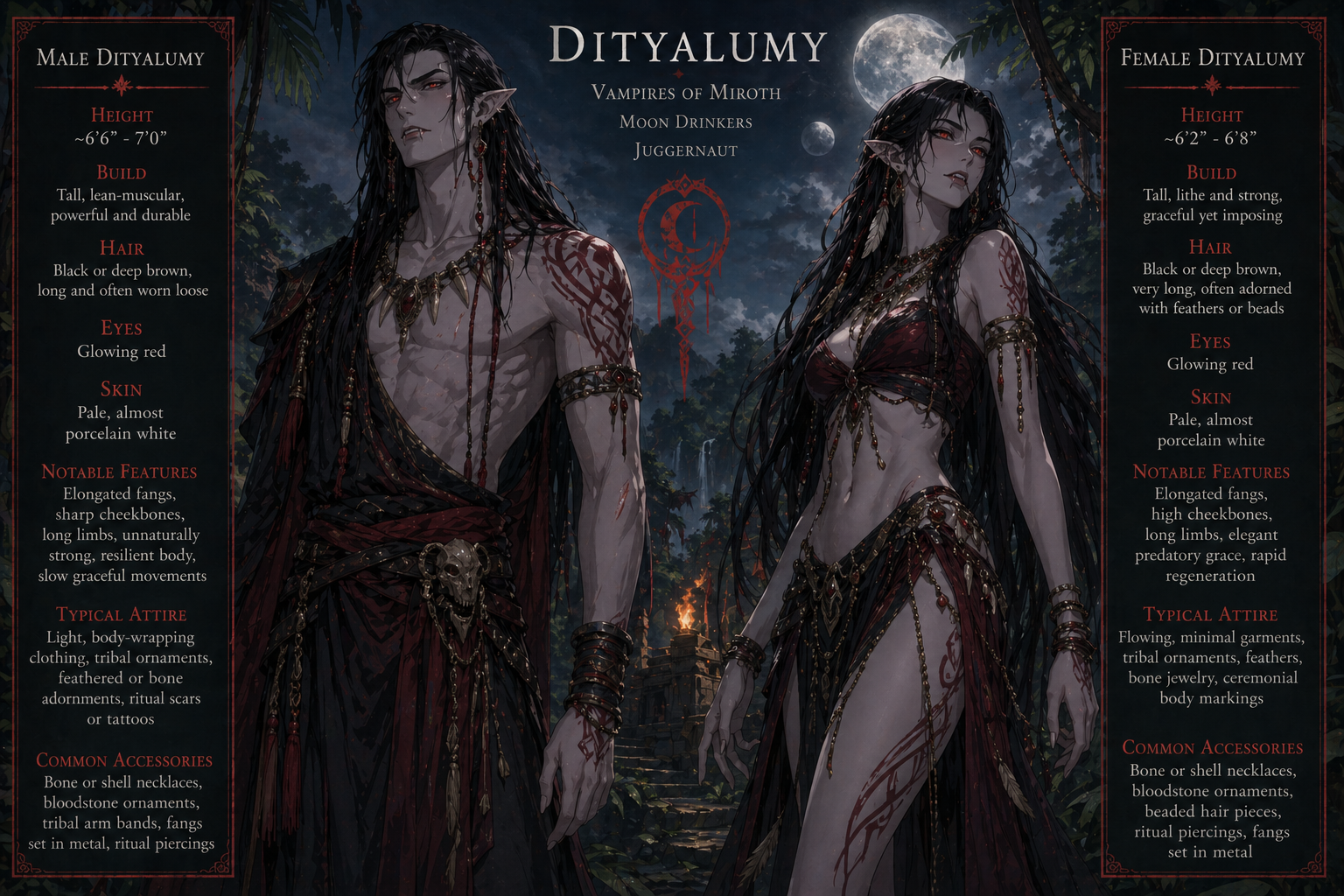
Associations
Other pages that reference or connect to this race
Referenced By
6Professor Tanya Nightlake
Linked Races
Sol Saris
Races
Sol Saris
Races
Shai Ren
Linked Races
Black Circle
Groups
Philipe Stanzgar
Enemies
Collections
Published collections that feature this race
Not in any collections yet
This race hasn't been published in any collections yet. Collections are curated groups of related content that help organize and showcase your world.
Tip: Collections are a great way to group related content together and share themed stories or worldbuilding elements with others.
Timelines
Timelines that reference or include this race
No timeline connections yet
This race isn't connected to any timelines yet. Timelines help organize events chronologically and show how your content fits into the broader history of your world.
Tip: Create timelines to organize important events in your world's history. Link characters, locations, and other content to specific events to build rich, interconnected narratives.
Shares
Discussion about this race
No shares yet
Be the first to start a discussion about this race by sharing it to the community stream.
Privacy & Sharing
Manage who can see and access this race
Current Status
refresh
This race is currently
Privacy Settings
Choose who can see and access this race
language Universe Privacy
This page belongs to a universe with its own privacy settings