
Categories
Dive Deeper
Page Stats
Navigation
Categories
Dive Deeper
Page Stats
Complete Details
All information about this race
Overview
Taizan
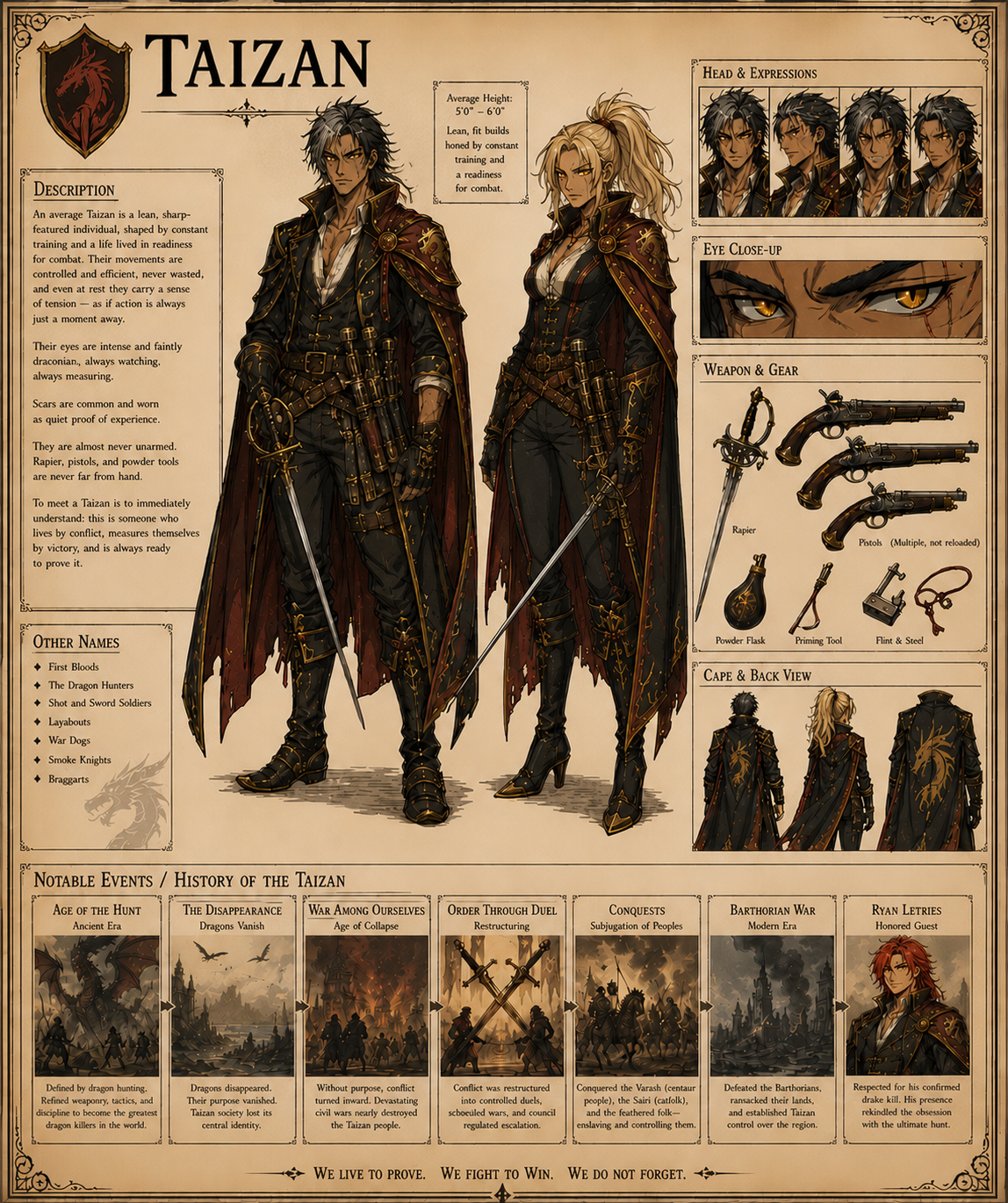
An average Taizan is a lean, sharp-featured individual, typically standing between five and six feet tall, with sun-warmed skin and a body shaped by constant training and readiness for combat. Their movements are controlled and efficient, never wasted, and even at rest they carry a sense of tension—as if action is always just a moment away.
Their most striking feature is their eyes: focused, intense, and often described as faintly draconian, giving the impression that they are always watching, always measuring. Scars are common and rarely hidden, worn as quiet proof of experience rather than something to be concealed.
They are almost never unarmed. A rapier rests at their side, and it is common for them to carry more than one pistol—kept within easy reach rather than reloaded in the moment—alongside the tools needed to ignite powder quickly. Their attire—shoulder cape included—blends style with readiness, ensuring they are prepared to turn any moment into a duel if needed.
To meet a Taizan is to immediately understand:
this is someone who lives by conflict, measures themselves by victory, and is always ready to prove it
first bloods, the dragon hunters, shot and sword soldiers, layabouts, war dogs, smoke knights, braggarts
Looks
Taizan physiques are best described as lean, honed, and built for speed, precision, and endurance in combat. While they can exhibit the full range of humanoid body types, cultural pressures and lifelong training shape most Taizans toward a distinct athletic baseline. The most common build is lean and well-muscled, with low excess weight and clearly defined musculature. This favors speed, agility, and stamina over raw bulk. They are rarely hulking or heavily built; instead, their strength appears efficient, controlled, and purpose-driven.
Because Taizan culture revolves around dueling, personal combat, and weapon mastery, their bodies develop accordingly. They tend to have strong core stability, flexible and responsive movement, and excellent balance. Musculature is often emphasized in the shoulders and arms for weapon control, the torso for stability and rotation, and the legs for footwork and positioning. They are built to fight for extended periods without losing precision, maintaining control even under strain.
There is still variation within this standard. Some individuals are broader and more power-focused, others lighter and built for speed, and some outside martial circles may be heavier or less conditioned. However, even beyond combat roles, Taizan society values physical competence, so extreme neglect of conditioning is uncommon, though it does exist in certain individuals.
Sex-based differences are present but not extreme. Men tend to be slightly taller, with more visible musculature and broader shoulders, while women are often slightly smaller, more compact, and streamlined. Both, however, are expected to be capable in combat or at least competent in self-defense.
Taizans carry themselves with upright posture, controlled movement, and a constant readiness that borders on tension. Even at rest, they appear alert, aware, and prepared, as if always a moment away from action. Their bodies are not shaped by environment or labor alone, but by a culture that treats combat as both necessity and art.
Taizan skin tones fall within a warm, sun-shaped spectrum, most commonly ranging from lightly tanned to deep olive brown. Their coloration reflects both a life spent outdoors and generations shaped by a climate that favors sun exposure and constant activity. Most Taizans fall within a range that includes light tan, golden tan, olive tones with green-gold undertones, and deeper olive brown complexions with rich warmth. Very pale or cool-toned skin is uncommon and tends to stand out noticeably when present.
Their skin typically carries warm undertones—golden, amber, or copper—or olive undertones that give a subtle green-brown depth. This results in a complexion that appears vibrant, healthy, and responsive to light. Environmental influence plays a major role in shaping their appearance. Due to their active lifestyles, many Taizans develop deeper tans over time, with sun-darkened skin in exposed areas and visible contrast between covered and uncovered regions. Even individuals who begin with lighter tones often darken with age and continued exposure.
Surface details further reinforce this identity. Light freckling may appear in some individuals, while older or more experienced fighters often show sun-weathered texture and visible scarring. These marks tend to stand out clearly against their skin tones, contributing to an overall appearance that feels lived-in and battle-tested.
While there is natural variation, Taizan skin tones remain relatively cohesive across the population, with most individuals falling within the same warm spectrum and extreme outliers being rare. This creates a shared visual identity without removing individuality. Taizan skin ultimately reflects sun, activity, and a life shaped by motion and conflict.
Taizans typically stand between 5’0” and 6’0”, placing them well within standard humanoid height ranges. Despite this, their bearing and presence often make them feel taller than they are. Most fall into a fairly even distribution: 5’0”–5’4” includes shorter individuals who tend to be quicker and more compact, 5’5”–5’9” represents the most common range, and 5’10”–6’0” includes taller individuals who often benefit from increased reach in combat. Heights outside this range do exist, but are uncommon and usually noted rather than expected.
Sex-based differences are present but not extreme. Men tend to average between 5’7” and 6’0” with slightly broader frames, while women generally fall between 5’0” and 5’7” with more compact builds. Both, however, are fully capable within the expectations of Taizan society, and height does not limit one’s role or effectiveness.
Taizans frequently appear taller than their actual measurements due to posture and presence. They carry themselves upright, with controlled and deliberate movement, maintaining confident eye contact and occupying space with intention. This creates a sense of height through presence rather than physical scale.
In combat, height differences influence reach, stance, and fighting style, but are not overly emphasized as an advantage. Taizan culture prioritizes skill, timing, and control over raw physical traits, ensuring that effectiveness is not determined by size alone. Taizans are not defined by towering stature, but by how they carry themselves.
Taizan weight is proportional to height and build, generally falling within average humanoid ranges while maintaining a lean, well-conditioned profile shaped by constant physical activity and combat training. Most individuals fall between 100–140 lbs on the lighter, speed-focused end, 140–180 lbs as the most common range, and 180–200+ lbs for heavier, more power-oriented builds. Weights outside these ranges are uncommon, though possible given natural variation.
Their conditioning emphasizes low body fat, defined musculature, and efficient mass distribution. Weight is rarely excessive or poorly carried; instead, it reflects function over bulk. Even at higher weights, Taizans tend to appear controlled and purposeful rather than heavy or cumbersome.
Lifestyle and role influence where individuals fall within this range. Duelists and fighters often maintain tightly controlled, lean weight optimized for speed and precision. Soldiers and enforcers may carry slightly more mass for durability and impact. Artisans and non-combat roles show more variation, though most still maintain baseline fitness and functional strength due to cultural expectations.
Sex-based differences are present but not restrictive. Men generally occupy the mid-to-upper ranges with more visible muscle mass, while women tend toward the lower-to-mid ranges with compact but still athletic builds. Both are equally capable within the demands of their society.
Overall, Taizan weight supports quick footwork, sustained combat, and rapid directional changes. They are built to move efficiently without sacrificing power. Taizan weight is not about mass—it is about balance, control, and the ability to fight without wasted movement.
Taizans are most immediately recognized by their sharp, draconian eyes—the defining feature of their appearance. Their gaze is focused, predatory, and intensely aware, often locking onto movement quickly and holding eye contact longer than most. This creates the impression that they are constantly evaluating their surroundings, always assessing and ready. Eye contact itself carries cultural weight, signaling confidence, challenge, or readiness, while avoiding it may be seen as weakness or hesitation.
Their facial structure tends toward refined, angular features, with defined cheekbones, sharp jawlines, and clean lines that favor clarity over softness. This gives them a disciplined, controlled look that can feel intimidating even at rest. Complementing this is a lean, tension-carried physique—Taizans often appear slightly coiled, as if ready to move at any moment. Their posture and musculature suggest contained motion rather than true rest.
Scarring is common and culturally accepted. Many carry visible marks from duels or combat, which are not hidden but often regarded as signs of experience, survival, and proven skill. Their movements reinforce this identity: quick, precise, and efficient, with minimal wasted motion. Even simple actions tend to appear deliberate and practiced.
Frequent weapon use results in calloused hands, with hardened palms and strengthened grip—particularly noticeable among duelists, soldiers, and those who regularly handle tools or weapons. Altogether, these traits contribute to a subtle sense of “otherness.” Though fully humanoid, Taizans can feel slightly off to outsiders, due to their intense gaze, controlled presence, and underlying cultural identity. They carry the impression of something built for combat—precise, deliberate, and always ready.
Taizans display considerable physical variance, comparable to any humanoid population of similar size. There is no rigid physical template beyond broad tendencies, and individuals can vary widely in build, facial structure, and overall appearance. They are capable of exhibiting the full range of humanoid body types—from lean and wiry to broader and heavier physiques, as well as compact or taller frames within their natural range. While their culture favors athleticism, it does not eliminate natural diversity.
There is a clear athletic bias shaped by their focus on dueling, combat, and physical discipline. Many Taizans trend toward lean muscle, defined structure, and controlled physiques, but this is a tendency rather than a rule. Heavier individuals, less conditioned bodies, or those shaped more by non-combat professions are still present within the population.
Facial features also vary significantly. Differences in bone structure, eye shape, and intensity are common. While the characteristic “draconian” eye quality appears frequently, it can manifest in different ways—some individuals have sharper, more predatory gazes, while others exhibit subtler or more restrained versions of the same trait. Skin tones generally fall within a lightly tanned to deep olive range, but still vary in depth, undertone, and how individuals respond to sun exposure over time.
A major source of visible variation comes from experience, particularly in relation to combat. Differences in scarring, posture changes from injury, and overall wear create distinct appearances. Some Taizans appear heavily marked and battle-worn, while others remain relatively unscarred and refined, depending on their history.
Sex-based differences exist but remain flexible. Men tend toward slightly larger frames and more visible musculature, while women often have more compact builds, though still athletic and fully capable. These are general tendencies rather than strict limits.
Taizans are not visually uniform. What unifies them is not identical physical form, but shared culture, posture, and presence—the way they carry themselves, move, and engage with the world.
Taizan clothing reflects a culture built around dueling, status display, and constant readiness for combat. What they wear is not purely practical—it is a statement of identity, capability, and intent. Among the most defining elements is the shoulder cape, particularly among the nobility. Worn draped over one or both shoulders and secured to allow free arm movement, these capes are styled to flow without interfering in combat. They act as markers of status, expressions of house or personal identity, and visual flair during duels. Noble versions are often finely made, richly colored, and carefully maintained, while simpler variations are widely adopted by others.
Weapons are an expected part of attire. The rapier, especially among nobles, is both a primary dueling weapon and a symbol of refinement and skill. It is commonly carried at all times, often finely crafted, decorated, and personalized. To be without one can suggest unpreparedness or a lack of standing. Among non-nobility, pistols are also common, reflecting practicality and the integration of gunpowder into daily life. Unlike muskets, which may be seen as dishonorable in dueling contexts, pistols are accepted due to their close-range nature and the expectation that opponents still face one another.
Many Taizans also carry smoking sticks—practical tools used for lighting explosives, igniting powder, or preparing weapons quickly. These are kept readily accessible and reinforce the idea that a Taizan is always prepared for conflict. Clothing itself is typically fitted, non-restrictive, and designed for movement, supporting quick footwork and free arm motion. Loose or cumbersome garments are generally avoided unless deliberately styled for status.
Light protection is often incorporated through reinforced fabrics, subtle armor pieces, or hidden defenses, balancing mobility with durability. At the same time, clothing is highly personalized. Individuals often tailor their attire to reflect personal taste, affiliation, or house identity through color choices, markings, and unique cuts.
Taizan clothing exists at the intersection of combat readiness, social signaling, and personal expression—never purely functional, and never purely decorative, but always intentional.
Traits
Taizan strengths arise from a fusion of advanced techno-magical craft, relentless martial culture, and unusual perceptual abilities. They are not simply skilled fighters—they are a people who have refined combat into both science and art. Their technological edge comes from highly developed systems that blend runic enchantment, anti-magic techniques, and precise mechanical design. This allows them to produce weapons, armor, and tools that are exceptionally effective, specialized, and adaptable. Their equipment is often optimized for dueling conditions and particularly effective at countering magical threats, reinforcing physical combat with carefully integrated enchantment.
Among their more notable advantages is the rare ability known as Glamour Sight. Some Taizans can see through illusions and magical disguises as if they were thin veils, allowing them to detect deception, identify hidden entities, and resist certain forms of magical misdirection. While not universal, this trait is widely respected and feared when present, offering a decisive perceptual advantage in a world where magic can obscure reality.
At the individual level, Taizans are elite duelists. From a young age, many are trained in weapon technique, timing, and precision, excelling in one-on-one engagements and controlled combat environments. Their approach emphasizes skill over brute force, supported by strong physical conditioning and mental discipline. Even outside formal duels, they are accustomed to violence, capable of quick reactions, controlled aggression, and sustained performance under pressure.
A defining aspect of their strength is the seamless integration of magic and martial skill. They do not treat these as separate disciplines, but as complementary tools, allowing for enhanced strikes, defensive enchantments, and tactical versatility. This is reflected in their philosophy: effectiveness matters more than purity of method.
Culturally, Taizans are deeply familiar with conflict. Because it is normalized and ritualized, they do not hesitate in combat, remain composed under pressure, and instinctively understand the flow of battle. This familiarity, combined with their reputation as aggressive, skilled, and dangerous, often gives them a psychological edge—intimidating opponents and shaping expectations before a fight even begins.
Taizan strength is not defined by any single advantage, but by the cumulative effect of a culture that has refined conflict into mastery.
Taizan weaknesses stem from the same source as their strengths: a culture that elevates combat, honor, and victory above nearly everything else. What makes them formidable also makes them predictable, self-destructive, and vulnerable in ways they often refuse to acknowledge. Their devotion to combat can border on the extreme. Taizans are deeply committed to proving themselves through conflict, which leads them to take risks others would avoid, escalate situations unnecessarily, and refuse retreat even when it would be tactically sound. They are not thoughtless, but their tolerance for danger is far higher than most.
Defeat is taken personally, and rarely left behind. Loss becomes something to be corrected rather than accepted, giving rise to long-standing grudges, generational feuds, and cycles of retaliation. These conflicts can consume individuals and destabilize entire houses over time. This mindset also feeds into their preference for direct confrontation. Taizans favor visible, honorable engagement, which makes them more predictable in battle and vulnerable to deception, indirect tactics, or asymmetrical warfare. While they may understand these approaches, they often choose not to rely on them.
Their emphasis on honor and reputation can override broader strategic thinking. They may reject effective tactics if they are seen as dishonorable, refuse tools that conflict with cultural expectations, or prioritize how victory appears over how it is achieved. Internally, this same mindset creates instability. In the absence of external threats, Taizans have historically turned their aggression inward, escalating disputes and bringing themselves close to collapse. Though structures now exist to regulate conflict, the underlying tendency remains.
There is also a degree of overconfidence in their abilities. Taizans place strong faith in their training, equipment, and integrated magic, which can lead them to underestimate opponents or overlook unconventional threats. Their acceptance of effectiveness over purity—such as the belief that winning justifies the method—can also create friction with other cultures, leading to mistrust or reputational strain.
Taizan weaknesses are not rooted in a lack of ability, but in priority and perspective. Their focus on combat, honor, and personal victory can limit their adaptability, strain their relationships, and lead them into conflicts that might otherwise be avoided.
Taizan conditions reflect the long-term cost of a culture built around constant combat, precision, and the integration of magic and technology. These are not rare afflictions, but common consequences of living at the edge of physical, mental, and magical limits.
Repeated dueling places sustained strain on the body, particularly the wrists, elbows, shoulders, and knees. Over time, this leads to joint stiffness, reduced flexibility, and lingering pain during motion. As these effects accumulate, they can reduce precision, slow reaction times, and create chronic discomfort. Despite this, such wear is often ignored or even embraced as a mark of experience.
The use of enchanted equipment introduces another risk: runic feedback. When enchantments are improperly aligned, pushed beyond tolerance, or destabilized, energy can surge back through the user’s body. This results in localized burns, nerve-like pain, muscle spasms, and temporary loss of control in affected limbs. In severe cases, it can cause lasting nerve damage or reduce an individual’s ability to safely use magical tools.
Those with heightened perception, particularly individuals capable of seeing through glamours, face their own strain. Constantly filtering visual information and processing conflicting sensory input can lead to eye fatigue, migraines, difficulty focusing, and visual distortions such as ghosting or afterimages. Over time, this can degrade both comfort and effectiveness.
Frequent use of firearms and explosives exposes Taizans to powder burns, smoke inhalation, and chemical residue. This can cause skin irritation, lung strain, and reduced breathing capacity, especially among soldiers, engineers, and duelists who rely on pistols. Similarly, regular handling of explosive materials increases the risk of burns, hand injuries, and even partial loss of fingers, often leaving visible scars and reduced dexterity.
Scarring itself is nearly universal. Cuts, punctures, and blade wounds accumulate over time, leading to reduced skin elasticity, nerve sensitivity, and in some cases restricted movement. Because scars are culturally accepted—even respected—there is often little emphasis on preventing them, allowing damage to compound.
Beyond the physical, there are mental and systemic strains. Constant readiness for combat can lead to adrenal burnout, marked by fatigue, irritability, slower reactions, and reduced mental clarity. In severe cases, individuals may collapse under stress or lose their ability to perform effectively in battle. A related behavioral condition, often described as honor fixation, drives some Taizans to become obsessively attached to reputation and victory. This can result in an inability to let go of defeat, escalation of minor conflicts, and long-term, destructive rivalries that endanger both the individual and those around them.
Taizan conditions are not isolated weaknesses—they are the cumulative cost of a people who push themselves relentlessly. They reflect a society that lives close to the edge of its own capabilities, physically, mentally, and magically, and accepts those consequences as part of the path to mastery.
Culture
Taizan traditions are built around combat, honor, and the public proving of oneself. They are a people who transform conflict into structure—and structure into culture. At the center of this is the honor duel, a practice that makes conflict immediate and personal. Duels can arise from insults, disagreements, challenges to reputation, or even perceived slights. They are quickly formalized, often witnessed, and carried out with clear intent. These duels serve to settle disputes, establish hierarchy, and reinforce personal standing. Refusing a duel is typically seen as weakness or an admission of fault.
Many of these traditions trace back to an older identity: dragon hunting. In ancient times, Taizans were defined by their role as hunters of dragons, a pursuit that demanded coordination, courage, advanced weaponry, and absolute commitment. Though dragons have not been seen for centuries, this legacy continues to shape their values, training, and perception of combat. Modern Taizan culture can be understood as a continuation of dragon hunting without dragons.
To prevent their own society from collapsing under constant conflict, Taizans established structured periods known as seasons for war. During these times, conflicts are formally declared and fought openly, allowing large-scale violence to occur within controlled boundaries. Outside of these periods, such escalation is restricted, though dueling remains constant. This system allows them to engage in warfare without fully destroying themselves.
Weapon crafting and enhancement are treated as both technical and ceremonial practices. Enchanting a weapon involves runic inscription, balancing magical and physical properties, and refining it over time. A well-crafted weapon is considered an extension of the individual, tying identity directly to the tools of combat.
Another defining and controversial tradition is the practice of indentured victory. In certain conflicts, the victor may claim the defeated as bound to their house, formalizing loss into service. This reinforces hierarchy through combat outcomes and directly links social standing to martial success. Though regulated, it remains a harsh and deeply embedded aspect of their society.
Taizans are rarely unarmed. Carrying a rapier, a pistol, or both is expected, reflecting constant readiness. Being unarmed suggests unpreparedness or a lack of seriousness. Milestones such as drawing “first blood” in combat or a duel are culturally significant, marking proof of capability and personal threshold moments.
Reputation plays a central role in their lives. Actions are observed, victories are remembered, and losses are not easily forgotten. Status is built through visible acts, particularly in combat, reinforcing a culture where individuals are constantly judged by their performance. Even their familiarity with explosives—handling powder, ignition tools, and controlled blasts—has become normalized enough to border on tradition, often taught early and expected in many roles.
At their core, Taizan traditions revolve around a single principle: conflict is not chaos—it is structure, identity, and proof.
Taizan beliefs are built around a single core truth: life is proven through conflict, and only what survives that proof truly matters. They do not separate honor, combat, and identity—instead, they treat them as the same force expressed in different ways. To a Taizan, who you are is what you can prove under pressure.
Central to this is the belief in death before dishonor. Reputation is valued above survival, and this is not an abstract ideal—it directly shapes behavior. Taizans will accept lethal duels, refuse surrender in certain circumstances, and choose risk over perceived shame. Dishonor is seen as permanent, visible, and worse than death itself.
They also hold that the victor writes history. Outcome determines legitimacy, shaping how they view truth, justice, and memory. If you win, your version stands; if you lose, your perspective is dismissed or rewritten. This creates a worldview where results matter more than intent, and success defines reality.
Their approach to tools and methods reflects this same mindset. The belief that “magic isn’t cheating if you win” allows them to freely integrate enchantment and innovation into combat. There is little stigma around using any advantage—so long as it works. However, this is paired with an unspoken rule: if you lose, your method is invalid. Victory justifies the approach; defeat exposes it as flawed.
Despite the absence of dragons for centuries, they remain the ultimate symbol of challenge in Taizan belief. Dragons represent the highest test of skill and the origin of their identity. This creates a cultural tension, as Taizans continue to train for a standard that no longer exists, seeking equivalent challenges in other forms of combat.
Combat itself is not viewed solely as survival—it is expression. Dueling is treated as an art, warfare as a structured sport, and personal combat as performance. This belief supports formal duels, seasonal wars, and public demonstrations of skill. Honor, in this context, must be visible. It is not enough to believe oneself honorable—others must witness, test, and recognize it for it to exist.
Defeat is never final. It creates obligation and tension, driving rematches, feuds, and long-term rivalries. Conflict is seen as a necessary force—struggle refines skill, opposition drives growth, and pressure reveals truth. Peace without challenge is often viewed as stagnation or decline.
Social hierarchy reflects these beliefs. Status is influenced by combat success, reputation, and visible achievement, tying directly into dueling culture, indenture practices, and noble standing.
Taizan beliefs are not passive or theoretical—they are lived, tested, and reinforced through constant action.
Taizan governance is built around a balance of noble authority, structured conflict, and collective decision-making among elites. It is neither a traditional monarchy nor a loose federation, but a controlled aristocratic system designed to manage a people whose natural tendencies toward conflict would otherwise lead to self-destruction.
At the center of this system is the council of counts and high-ranking nobility. These individuals represent powerful houses, territorial control, and military strength, and together they form the primary governing body. The council oversees large-scale decisions and maintains cohesion across Taiza, preventing fragmentation. Influence within the council is not fixed, but shaped by reputation, military success, and political standing, ensuring that power remains tied to demonstrated capability.
One of the council’s most critical roles is the management of internal conflict. Rather than attempting to suppress violence, Taizan governance formalizes and contains it. Wars between factions are scheduled, escalation is regulated, and conflict is structured to prevent uncontrolled destruction. This system exists because history has shown that without such regulation, Taizan society would collapse under its own aggression.
When external threats arise, or when unified action is required beyond internal disputes, the council appoints a War Leader. This individual is granted temporary centralized authority, commanding combined forces and directing the campaign. Their power is significant but strictly limited in duration—once the conflict ends, authority returns to the council, preventing permanent consolidation of power.
Outside of these centralized decisions, governance remains highly localized. Individual nobles control their own territories, manage their populations, and maintain their own military forces. This creates a system where local authority is strong, central authority is situational, and power is distributed among competing elites.
The practice of indenturing those defeated in combat also functions as a mechanism of governance. While culturally framed, it reinforces hierarchy, ties authority directly to martial success, and integrates defeated individuals into existing power structures. In doing so, it serves both as social control and a means of labor distribution.
This system has clear strengths: it prevents total internal collapse, allows capable leaders to rise, and enables rapid coordination during external conflicts. However, it also carries inherent limitations, including constant tension between nobles, reliance on conflict as a stabilizing force, and the risk of instability should the council weaken.
Taizan governance is not designed to eliminate conflict—it is built to control it, structure it, and ensure the society survives it.
Taizan technology is defined by a deliberate fusion of gunpowder weaponry, runic enchantment, and anti-magic systems. They are not the most industrially advanced people, but within the domain of combat technology they are refined, dangerous, and highly specialized. Their approach is not to innovate broadly, but to perfect what is used in battle.
Gunpowder weapons play a central role, particularly pistols and cannons, which are integrated into both personal combat and larger engagements. However, cultural values strongly influence their use. While muskets are known, they are generally viewed as dishonorable because they create distance and remove the personal element of combat. Taizans favor close-range firearms that allow opponents to face one another directly, reinforcing their belief that combat should remain personal and visible.
At the core of their technological identity is runic enchantment. Taizans are highly skilled in applying precise, carefully tuned runes to weapons, armor, and tools. These enchantments enhance force, reinforce durability, and create specialized effects tailored to the wielder. A Taizan weapon is rarely just metal—it is a layered construct combining physical craftsmanship and magical design, often refined and personalized over time.
Complementing this is a strong emphasis on anti-magic systems. These are typically embedded into equipment, allowing Taizans to disrupt spells, resist enchantments, and counter magical opponents. This gives them a critical advantage in confronting spellcasters, enabling them to neutralize or mitigate supernatural threats through engineered solutions rather than raw magical ability alone.
Their craftsmanship blends mechanical design, enchantment, and practical combat needs into cohesive systems. Equipment is built to be efficient, durable, and suited to specific fighting styles. Explosive tools and ignition systems—such as powder charges, controlled explosives, and smoking sticks—are also widely used for breaching, disruption, and tactical advantage. Handling such tools is normalized and often taught early.
A defining aspect of Taizan technology is its focus on the individual. Rather than mass production, they emphasize personal weapons—customized, maintained, and refined over time to suit the wielder. This extends even to ammunition. Enchanted rounds are treated as extensions of the weapon system, capable of delivering enhanced force, elemental effects, or delayed magical reactions. Bullets may detonate into bursts of energy, petrify on impact, or release stored effects after penetration, turning even a simple pistol into a versatile magical platform. This allows Taizans to tailor their approach to specific opponents while maintaining their preference for close, decisive engagements.
Because of these priorities, they invest less in long-range warfare or impersonal combat systems. Instead, they focus on engagement distance, visibility, and direct confrontation. Taizan technology is not about scale or industrial dominance—it is about refining the tools of combat to their most effective, precise, and personal form.
Taizan occupations span the full range of roles required for a functioning society—from laborers and craftsmen to nobles and administrators. They maintain clear specialization, defined responsibilities, and structured expectations. However, all of these roles exist under a constant cultural truth: combat is always relevant. Even those who never seek it are shaped by a society where it is expected, respected, and ever-present.
At a foundational level, Taizans fill all standard societal roles. Laborers, craftsmen, merchants, administrators, and nobles all contribute to a complete and functional system. These occupations are typically skill-based and often influenced by house affiliation or lineage. While their society is not exclusively martial, it is undeniably built around a martial core that influences how every role is performed.
Soldiering stands as one of the most prominent and respected professions. Taizan soldiers operate within organized forces, including standing armies and house troops, and are trained in both individual and formation combat. They are expected to fight effectively in structured warfare during designated war seasons as well as in less predictable engagements. Unlike dueling, which is cultural, soldiering is institutional—formalized, trained, and essential to the state.
Alongside them are duelists and combat specialists, individuals who focus on personal combat and reputation. These Taizans build status through frequent duels, act as champions for their houses, and refine their technique to a high degree. Their role is less about organized warfare and more about visible, individual excellence.
Artisans and enchanters form another critical pillar of Taizan society. They are responsible for crafting weapons, inscribing runes, and enhancing equipment. Their work produces the enchanted weapons, reinforced armor, and specialized ammunition that define Taizan combat capability. Without them, the martial edge of Taiza would not exist.
Engineers and powder specialists handle the more volatile side of their technology. Working with gunpowder, explosives, and ignition systems, they support both warfare and innovation. Their expertise ensures that Taizans can effectively deploy their explosive tools in both tactical and large-scale contexts.
Nobility and house leadership occupy positions of authority, governing territories, managing military forces, and influencing economic structures. They also participate directly in the cultural aspects of combat—dueling, council governance, and the strategic direction of war. Their power is both administrative and martial, tied closely to reputation and success.
A significant portion of the population consists of indentured individuals—those defeated in combat or taken through conquest. These individuals perform labor, service, and support roles within the structure of noble authority. While regulated, this system reinforces hierarchy and ties social position directly to martial outcome.
Merchants and trade agents facilitate the movement of goods, both within Taiza and beyond. They manage supply chains, resource distribution, and economic exchange, ensuring that the materials needed for both daily life and warfare remain available.
Taizan occupations reflect a structured and specialized society where every role has its place. Yet all are shaped by a culture that values combat, victory, and reputation, ensuring that even the most mundane profession exists in the shadow of conflict.
Taiza maintains a strong, stable, and deliberately managed economy built on noble-controlled wealth systems, advanced weapon and enchantment industries, and the labor of both citizens and indentured populations. It is a wealthy nation not by accident, but by design—where even the lowest are accounted for, because instability is more dangerous than cost.
At a broad level, Taiza is considered a wealthy and functional state. While power and wealth are unevenly distributed, the system ensures that lower populations are still integrated into the economy and prevented from falling into total destitution. This is not driven by altruism, but by a calculated understanding that stability must be maintained to preserve control.
Economic power is concentrated in the hands of Counts and noble houses. These houses control land, production, labor systems, and trade networks, effectively operating as political units, military forces, and economic engines all at once. Competition between houses fuels innovation, expansion, and constant economic maneuvering, keeping the system active and adaptive.
A foundational element of this economy is the indentured labor system. Much of Taiza’s large-scale production—agriculture, resource extraction, construction—relies on individuals bound through conquest or defeat. While these individuals are technically compensated and may eventually earn freedom, the system functions as controlled, large-scale labor that is inherently exploitative, yet deeply embedded in the structure of the state.
Taiza’s greatest economic strength lies in its high-end production, particularly in the crafting of enchanted weapons, specialized ammunition, runic armor, and anti-magic equipment. These goods are expensive, highly valued, and often exported, forming a cornerstone of their external trade. This sector is driven by skilled artisans, house-sponsored workshops, and a culture of continuous refinement.
War itself is a central economic force. Conflict drives demand for equipment, redistributes wealth, and reinforces the existing hierarchy. Victory in war brings tangible economic benefits, including land, labor, and expanded influence. As a result, Taiza’s economy is structured to sustain ongoing conflict without collapse.
Externally, Taiza trades in weapons, enchanted goods, raw materials gained through conquest, and specialized services. Their reputation for producing high-quality combat technology gives them leverage in trade, though their economic relationships are often shaped as much by military strength and political pressure as by commerce.
Economic mobility exists, but it is difficult to achieve. Advancement may come through success in combat, accumulation of wealth, or recognition of lineage. Freed indentured individuals can integrate into society and rise within it, but doing so requires significant effort and favorable conditions.
To maintain internal stability, Taiza ensures that even its lower classes remain minimally supported and economically active. This reduces the risk of unrest and uncontrolled rebellion, reflecting a clear understanding that deprivation leads to unpredictability.
Taiza’s economy is neither purely exploitative nor benevolent. It is controlled, productive, and intentionally structured to sustain both power and conflict, ensuring that the system remains stable while continuously feeding the forces that define it.
Taizan cuisine is shaped by the same forces that define their culture: combat, history, and intensity. It favors bold flavor, efficient preparation, and foods that can be shared or carried, reflecting both their martial lifestyle and their origins as dragon hunters.
One of the most iconic dishes is spiced vegetable and meat kebabs. These skewers are a direct cultural descendant of their dragon-hunting past, when such meals would have been prepared with dragon meat. In the modern era, they are made with livestock, game, and whatever cuts are available, combined with vegetables and heavily seasoned before being cooked over open flame. The result is a dish that is flavorful, efficient, and easy to serve in groups—remaining popular not just for practicality, but as a living reminder of their origins.
Fire-grilled meats are a staple across Taiza. Meals often emphasize flame-cooking, strong seasoning, and a slight char, prioritizing intensity of flavor over subtlety. This aligns closely with their broader cultural preferences—direct, impactful, and unmistakable. Their cuisine leans heavily into spice-forward profiles, with layered seasoning, heat, and sharpness designed to make food memorable rather than mild.
Practicality also plays a major role. Many Taizan foods are designed to be portable and combat-ready—easy to carry, quick to prepare, and suitable for travel or wartime conditions. Beyond kebabs, this includes wrapped meats, skewered portions, and compact meals that can be eaten on the move without sacrificing substance or flavor.
Despite this practicality, eating is often a communal act. Meals are prepared and shared in groups, frequently tied to gatherings, post-conflict moments, or celebrations of victory. Food becomes both sustenance and social reinforcement, a way to mark events and maintain bonds within a competitive society.
Taizan cuisine reflects who they are: a people shaped by conflict, grounded in history, and drawn to bold, direct experiences.
History
Taizan history follows a clear and dangerous arc: from mastering the greatest prey in the world to reshaping themselves when that purpose vanished. It is a history marked by eradication, collapse, conquest, and the deliberate control of their own nature.
In the ancient era, Taizans were defined entirely by dragon hunting. This was not simply a role—it was their identity, their unifying force, and the foundation of their culture. Hunting dragons required advanced weaponry, coordinated tactics, extreme personal skill, and relentless discipline. Over generations, they became one of the most effective dragon-killing peoples to ever exist, refining both their technology and their martial philosophy around this singular purpose.
The disappearance of dragons marked a catastrophic turning point. Whether due to overhunting, migration, or unknown causes, the result was the same: the Taizans had succeeded too completely. With no dragons left to hunt, they lost their central purpose, their ultimate challenge, and the structure that had held them together. What followed was a period of near collapse.
Deprived of an external enemy, the Taizans turned inward. Their cultural drive for combat, dominance, and proof remained, but without direction it became destructive. This led to widespread internal wars, escalating feuds, and devastation across their own lands. Entire regions were depopulated or brought under violent control, and at their lowest point, Taizan society came close to annihilating itself.
Survival required transformation—not of their nature, but of how it was expressed. The Taizans restructured conflict into a controlled system, establishing formal dueling practices, designated seasons for war, and council-regulated escalation. Violence was not reduced; it was organized. Conflict became scheduled, contained, and culturally reinforced, allowing them to preserve their identity without destroying themselves.
With internal stability restored, they turned outward once more. Their conquest of the Varash marked a significant step, as they defeated a highly mobile, combat-capable centaur people and brought large portions of their population into indentured servitude. This reinforced Taizan dominance in both mobility and battlefield control. They followed this with the subjugation of the Sairi, a catfolk people, resulting in widespread loss of autonomy, displacement, and indenture. Some Sairi remain free, but largely on the fringes of Taizan-controlled lands.
Their campaigns extended further to include the feathered folk, asserting dominance not only over land but over aerial-capable populations. These groups were subdued, integrated, indentured, or forced into marginal territories, marking a strategic expansion into vertical control of the battlefield.
In the modern era, the Taizans demonstrated their ability to project power beyond their own lands through the Barthorian War. They defeated Barthorian forces, ransacked the region, and established control, proving that their restructured society could sustain large-scale warfare and dominate powerful external states.
A notable cultural moment came with the hosting of Ryan LeTries, who is respected among the Taizans for having achieved a confirmed drake kill. To them, he represents one of the closest living echoes of their ancient ideal. His presence reignited fascination with dragons and reinforced the lingering cultural obsession with the ultimate challenge they once defined themselves against.
At its core, Taizan history is defined by a brutal truth: when their purpose disappeared, they did not change—they redirected it.
Notes
Taizan reality contains layers that most of its people never see, built on hidden truths, controlled systems, and a constant tension between what is believed and what actually is.
The greatest of these hidden truths lies in the “absence” of dragons. While most Taizans believe they eradicated their ancient prey, the reality is far more dangerous: dragons did not vanish—they adapted. The most intelligent among them concealed themselves, assumed humanoid forms, and integrated into Taizan society. Over generations, some have lived undetected, even interbreeding and subtly influencing bloodlines. This has led to rare individuals displaying unusual traits—heightened perception, unnatural instincts, or abilities that do not fully align with known Taizan norms. This truth remains largely unknown, unproven in the public sphere, and deeply dangerous if revealed, as it would undermine the very foundation of Taizan identity .
Beneath their structured society lies another stark reality: indentured servitude. While presented as a regulated system with provisions such as payment and the theoretical possibility of earning freedom, in practice it functions as slavery under formal structure. Those bound within it experience loss of autonomy, forced labor, and systemic control. Though some may eventually gain citizenship and legal protections, the path is difficult, inconsistent, and often dependent on circumstance rather than merit.
Taizan dominance over their continent is also built on conquest. They have subjugated and absorbed multiple beast races, including the Varash, the Sairi, and the feathered folk. While some free populations still exist, they are typically pushed to the margins—confined to harsher lands or living under constant threat of capture. Even beyond direct control, these groups exist under persistent pressure, shaping the broader power dynamics of the continent.
Geographically, Taiza exists in isolation on its own continent. This separation has allowed it to develop independently, pursue its own conflicts, and refine its systems without interference from powers such as Porcella or the Roskarn until much later eras. This isolation is a key reason their culture evolved so intensely around internal dynamics and controlled conflict.
At the heart of Taizan society is a deep cultural tension. They remain defined by dragon hunting, obsessed with combat, and driven by the need for challenge—but their original purpose is gone. Everything they have built since—dueling systems, war structuring, conquest—is, in part, a response to that absence.
This tension is reflected in their governance. Taiza is ruled by a council composed primarily of Counts, the highest permanent rank in their society. These individuals hold control over land, forces, and populations, and represent the peak of stable political authority. Beneath them exist lesser nobles and officers, but none equal their standing within the council. The only authority above a Count is the War Leader—a temporary position granted during external conflicts, typically drawn from among the Counts themselves. Once the war ends, that authority dissolves, and the balance of power resumes.
This creates a clear hierarchy: Counts hold permanent power, the War Leader holds temporary unified command, and all others operate beneath them. It reinforces a central truth of Taizan culture—power must be earned, proven, and constantly defended within a system that never fully stabilizes.
Becoming a Count reflects this philosophy. The title is not inherited by default or granted through ceremony—it is claimed, proven, and then recognized. The most common path is through conflict: defeating a sitting Count, dismantling a noble house, or seizing and holding territory. Victory alone is not enough; the claimant must maintain control, survive retaliation, and demonstrate the ability to function at that level of power. Failure results in removal, replacement, or erasure.
Other paths exist, though they are less direct. Some rise through overwhelming economic influence, controlling resources, funding wars, or manipulating outcomes. Others claim power through blood right, reviving fallen houses by proving lineage and defending their claim. Notably, this path can include members of conquered or marginalized groups, so long as they can prove the blood and hold the title.
Regardless of the path, recognition by the council is required. This recognition is not ceremonial—it is practical. A new Count is acknowledged when they cannot be easily removed, their claim is proven, and their power is stable enough to matter. Even then, recognition offers no safety. To remain a Count, one must continuously defend their position, maintain influence, and survive constant challenge.
In Taiza, power is never secure. A Count is not crowned—they are claimed, proven, and continuously justified.
Final One-Line
In Taiza, a Count is not crowned—they are claimed—through victory, influence, or blood, and only remain so long as they can prove they deserve it.
Common Enchanted Ammunition
Reliable, widely produced, simple runic scripts
1. Thunderbite Rounds
Deliver enhanced kinetic force on impact.
2. Emberburst Rounds
Ignite on impact with a small fire flare.
3. Frostnick Rounds
Flash-freeze a small area on contact.
4. Shockspark Rounds
Release a brief electrical discharge on impact.
5. Stoneweight Rounds
Momentarily increase mass just before impact.
6. Pierce-True Rounds
Reduce deflection, improving armor penetration.
7. Bloodmark Rounds
Cause wounds to bleed more heavily for a short time.
8. Flashflare Rounds
Produce a bright flash on impact to disorient.
9. Smokeveil Rounds
Release a cloud of smoke on impact.
10. Reverb Rounds
Create a concussive shockwave on impact.
11. Heatline Rounds
Superheat the projectile mid-flight.
12. Chilltrace Rounds
Leave a cold trail that slightly slows targets hit.
13. Gripbreak Rounds
Disrupt muscle control briefly on impact.
14. Searpoint Rounds
Burn through light armor and cloth.
15. Ironpulse Rounds
Vibrate on impact to transfer force deeper.
16. Scatterburst Rounds
Fragment into small non-magical shards on impact.
17. Dustkick Rounds
Kick up debris to obscure vision.
18. Rattlebone Rounds
Deliver internal shock, causing brief disorientation.
19. Sparktrail Rounds
Leave visible streaks for tracking shots.
20. Quickstrike Rounds
Slightly increase projectile velocity.
Uncommon Enchanted Ammunition (10)
More complex runes, multi-stage effects, specialized use
1. Glacier Bloom Rounds
Explode into a spreading ice field on impact.
2. Stormlash Rounds
Arc lightning between nearby targets after impact.
3. Gravemark Rounds
Temporarily increase gravity on the struck target.
4. Petrify-Touch Rounds
Begin partial petrification at the wound site.
5. Phantom Split Rounds
Split mid-air into multiple spectral projectiles.
6. Delayed Rupture Rounds
Embed, then detonate seconds later.
7. Void-Puncture Rounds
Ignore minor magical barriers.
8. Chainflare Rounds
Ignite secondary targets near the first.
9. Frostbind Rounds
Freeze limbs or joints temporarily.
10. Echohunter Rounds
Slightly track targets after being fired.
Rare Enchanted Ammunition (5)
Highly complex runic matrices, expensive, dangerous, often personalized
1. Dragon’s Ire Rounds
Impact triggers a violent eruption of elemental force (fire, lightning, or frost depending on inscription), mimicking a draconic breath burst.
2. Kingbreaker Rounds
Upon impact, release a cascading anti-magic pulse that strips enchantments and disrupts magical defenses in a radius.
3. Gravebind Rounds
Fully petrify or immobilize the struck target if conditions are met (often requiring precision or prior injury).
4. Storm Coffin Rounds
Encapsulate the target in a swirling sphere of elemental force (wind, lightning, ice), trapping and damaging them over several seconds.
5. Bloodright Rounds
Runes react to the wielder’s lineage—on a successful strike, dramatically amplify effect (explosive, piercing, or binding) if fired by the rightful bearer.
Taizan Cultural Note
Among Taizan duelists:
ammunition is often named, customized, and remembered
specific rounds may be associated with:
victories
rivalries
or infamous duels
A duelist might not just win a fight—
they might be remembered for:
which round they chose to end it
Common Enchanted Ammunition (20)
Reliable, widely produced, simple runic scripts
1. Thunderbite Rounds
Deliver enhanced kinetic force on impact.
2. Emberburst Rounds
Ignite on impact with a small fire flare.
3. Frostnick Rounds
Flash-freeze a small area on contact.
4. Shockspark Rounds
Release a brief electrical discharge on impact.
5. Stoneweight Rounds
Momentarily increase mass just before impact.
6. Pierce-True Rounds
Reduce deflection, improving armor penetration.
7. Bloodmark Rounds
Cause wounds to bleed more heavily for a short time.
8. Flashflare Rounds
Produce a bright flash on impact to disorient.
9. Smokeveil Rounds
Release a cloud of smoke on impact.
10. Reverb Rounds
Create a concussive shockwave on impact.
11. Heatline Rounds
Superheat the projectile mid-flight.
12. Chilltrace Rounds
Leave a cold trail that slightly slows targets hit.
13. Gripbreak Rounds
Disrupt muscle control briefly on impact.
14. Searpoint Rounds
Burn through light armor and cloth.
15. Ironpulse Rounds
Vibrate on impact to transfer force deeper.
16. Scatterburst Rounds
Fragment into small non-magical shards on impact.
17. Dustkick Rounds
Kick up debris to obscure vision.
18. Rattlebone Rounds
Deliver internal shock, causing brief disorientation.
19. Sparktrail Rounds
Leave visible streaks for tracking shots.
20. Quickstrike Rounds
Slightly increase projectile velocity.
Uncommon Enchanted Ammunition (10)
More complex runes, multi-stage effects, specialized use
1. Glacier Bloom Rounds
Explode into a spreading ice field on impact.
2. Stormlash Rounds
Arc lightning between nearby targets after impact.
3. Gravemark Rounds
Temporarily increase gravity on the struck target.
4. Petrify-Touch Rounds
Begin partial petrification at the wound site.
5. Phantom Split Rounds
Split mid-air into multiple spectral projectiles.
6. Delayed Rupture Rounds
Embed, then detonate seconds later.
7. Void-Puncture Rounds
Ignore minor magical barriers.
8. Chainflare Rounds
Ignite secondary targets near the first.
9. Frostbind Rounds
Freeze limbs or joints temporarily.
10. Echohunter Rounds
Slightly track targets after being fired.
Rare Enchanted Ammunition (5)
Highly complex runic matrices, expensive, dangerous, often personalized
1. Dragon’s Ire Rounds
Impact triggers a violent eruption of elemental force (fire, lightning, or frost depending on inscription), mimicking a draconic breath burst.
2. Kingbreaker Rounds
Upon impact, release a cascading anti-magic pulse that strips enchantments and disrupts magical defenses in a radius.
3. Gravebind Rounds
Fully petrify or immobilize the struck target if conditions are met (often requiring precision or prior injury).
4. Storm Coffin Rounds
Encapsulate the target in a swirling sphere of elemental force (wind, lightning, ice), trapping and damaging them over several seconds.
5. Bloodright Rounds
Runes react to the wielder’s lineage—on a successful strike, dramatically amplify effect (explosive, piercing, or binding) if fired by the rightful bearer.
Taizan Cultural Note
Among Taizan duelists:
ammunition is often named, customized, and remembered
specific rounds may be associated with:
victories
rivalries
or infamous duels
A duelist might not just win a fight—
they might be remembered for:
which round they chose to end it
These aren’t just illegal—they’re:
“If you needed this, you already lost the right to call it a duel.”
Forbidden Ammunition
Unacknowledged. Unregulated. Unforgivable.
Officially: does not exist
Unofficially: everyone knows better than to ask
Common Forbidden Rounds (20)
Already excessive. Already unacceptable.
1. Blackkiss Rounds
Create a pinpoint gravity collapse on impact—crushing flesh inward before vanishing.
2. Ashen Vein Rounds
Turn struck blood to burning ash slurry for several seconds.
3. Boneglass Rounds
Convert impacted bone into brittle crystal, causing catastrophic shattering.
4. Screamcoil Rounds
Trap the target in a feedback loop of their own nerve signals, causing full-body lock and agony.
5. Riftnick Rounds
Tear a small spatial fracture at the wound site, widening damage unnaturally.
6. Graveflare Rounds
Cause flesh to rapidly decay and then stabilize, leaving living necrotic damage.
7. Stormcore Rounds
Embed a miniature storm field that lashes outward for a few seconds.
8. Iron Bloom Rounds
Explode into razor metal growths erupting outward from the wound.
9. Pulsebreaker Rounds
Stop the heart for a moment—then restart it violently.
10. Nullbite Rounds
Erase a small portion of matter on impact—not destroyed, just gone
11. Fleshwarp Rounds
Distort the body around the wound into wrong geometry
12. Mindfracture Rounds
Cause immediate sensory desynchronization—sight, sound, and motion no longer align.
13. Bloodfreeze Rounds
Instantly crystallize blood in a localized area.
14. Echo Rupture Rounds
The wound reopens repeatedly in echoing bursts.
15. Weightfall Rounds
Multiply local gravity on the target’s body for a brief moment.
16. Cinderlung Rounds
Fill lungs with burning particulate for several seconds.
17. Chain Collapse Rounds
Trigger secondary failures in nearby tissue or armor
18. Voidburn Rounds
Burn with cold nothingness instead of heat
19. Shatterpulse Rounds
Send a wave through the body that fractures internal structure.
20. Grasping Wound Rounds
Create a wound that actively pulls inward, resisting healing.
Uncommon Forbidden Rounds (10)
Blatantly excessive. Duel-breaking.
1. Eventide Collapse Rounds
Create a micro singularity that collapses and releases everything violently outward.
2. Living Storm Rounds
Summon a self-contained storm entity that lashes the target briefly.
3. Total Petrification Rounds
Turn the entire struck body to stone within seconds.
4. Phase Rend Rounds
Desynchronize the target partially from reality—they exist incorrectly for a moment
5. Blood Boil Rounds
Superheat internal fluids without external burn.
6. Mirror Death Rounds
Reflect the damage internally multiple times.
7. Gravity Shear Rounds
Apply opposing gravitational forces across the body.
8. Time-Slip Rounds
Delay damage—then deliver it all at once moments later.
9. Soulshock Rounds
Disrupt whatever animates the body, leaving it functional but hollow for seconds.
10. Wound Eclipse Rounds
Create a localized lightless void that devours matter briefly
Rare Forbidden Rounds (5)
These are not used. These are remembered.
1. “Zero Point”
Creates a true localized singularity for a fraction of a second.
Collapses everything in immediate proximity
Leaves behind warped terrain
Using this is not considered winning.
It is considered ending the conversation.
2. “Last Horizon”
Fires a round that does not stop
Continues through all matter in a straight line
Disassembles anything it touches at a fundamental level
Entire battlefields have lines through them from this.
3. “Kingfall Script”
A layered anti-magic + destruction round.
Strips all enchantments
Immediately follows with catastrophic structural failure
Designed for targets that should not be able to die
4. “Grave of the Unanswered”
Encases the target in a collapsing dimensional pocket
Crushed, erased, or trapped—outcome uncertain
No confirmed survivors.
5. “Proof of Ending”
A round keyed entirely to intent.
If fired with certainty, it guarantees termination
If not, it fails
The weapon does not decide.
The wielder does.
Taizan Cultural Reality
These rounds are:
not spoken of publicly
not acknowledged in dueling circles
and absolutely used when it matters
If one appears in a duel, the outcome is clear:
it was never a duel to begin with
Overview
Details about this race's overview
Taizan
An average Taizan is a lean, sharp-featured individual, typically standing between five and six feet tall, with sun-warmed skin and a body shaped by constant training and readiness for combat. Their movements are controlled and efficient, never wasted, and even at rest they carry a sense of tension—as if action is always just a moment away.
Their most striking feature is their eyes: focused, intense, and often described as faintly draconian, giving the impression that they are always watching, always measuring. Scars are common and rarely hidden, worn as quiet proof of experience rather than something to be concealed.
They are almost never unarmed. A rapier rests at their side, and it is common for them to carry more than one pistol—kept within easy reach rather than reloaded in the moment—alongside the tools needed to ignite powder quickly. Their attire—shoulder cape included—blends style with readiness, ensuring they are prepared to turn any moment into a duel if needed.
To meet a Taizan is to immediately understand:
this is someone who lives by conflict, measures themselves by victory, and is always ready to prove it
first bloods, the dragon hunters, shot and sword soldiers, layabouts, war dogs, smoke knights, braggarts
Looks
Details about this race's looks
Taizan physiques are best described as lean, honed, and built for speed, precision, and endurance in combat. While they can exhibit the full range of humanoid body types, cultural pressures and lifelong training shape most Taizans toward a distinct athletic baseline. The most common build is lean and well-muscled, with low excess weight and clearly defined musculature. This favors speed, agility, and stamina over raw bulk. They are rarely hulking or heavily built; instead, their strength appears efficient, controlled, and purpose-driven.
Because Taizan culture revolves around dueling, personal combat, and weapon mastery, their bodies develop accordingly. They tend to have strong core stability, flexible and responsive movement, and excellent balance. Musculature is often emphasized in the shoulders and arms for weapon control, the torso for stability and rotation, and the legs for footwork and positioning. They are built to fight for extended periods without losing precision, maintaining control even under strain.
There is still variation within this standard. Some individuals are broader and more power-focused, others lighter and built for speed, and some outside martial circles may be heavier or less conditioned. However, even beyond combat roles, Taizan society values physical competence, so extreme neglect of conditioning is uncommon, though it does exist in certain individuals.
Sex-based differences are present but not extreme. Men tend to be slightly taller, with more visible musculature and broader shoulders, while women are often slightly smaller, more compact, and streamlined. Both, however, are expected to be capable in combat or at least competent in self-defense.
Taizans carry themselves with upright posture, controlled movement, and a constant readiness that borders on tension. Even at rest, they appear alert, aware, and prepared, as if always a moment away from action. Their bodies are not shaped by environment or labor alone, but by a culture that treats combat as both necessity and art.
Taizan skin tones fall within a warm, sun-shaped spectrum, most commonly ranging from lightly tanned to deep olive brown. Their coloration reflects both a life spent outdoors and generations shaped by a climate that favors sun exposure and constant activity. Most Taizans fall within a range that includes light tan, golden tan, olive tones with green-gold undertones, and deeper olive brown complexions with rich warmth. Very pale or cool-toned skin is uncommon and tends to stand out noticeably when present.
Their skin typically carries warm undertones—golden, amber, or copper—or olive undertones that give a subtle green-brown depth. This results in a complexion that appears vibrant, healthy, and responsive to light. Environmental influence plays a major role in shaping their appearance. Due to their active lifestyles, many Taizans develop deeper tans over time, with sun-darkened skin in exposed areas and visible contrast between covered and uncovered regions. Even individuals who begin with lighter tones often darken with age and continued exposure.
Surface details further reinforce this identity. Light freckling may appear in some individuals, while older or more experienced fighters often show sun-weathered texture and visible scarring. These marks tend to stand out clearly against their skin tones, contributing to an overall appearance that feels lived-in and battle-tested.
While there is natural variation, Taizan skin tones remain relatively cohesive across the population, with most individuals falling within the same warm spectrum and extreme outliers being rare. This creates a shared visual identity without removing individuality. Taizan skin ultimately reflects sun, activity, and a life shaped by motion and conflict.
Taizans typically stand between 5’0” and 6’0”, placing them well within standard humanoid height ranges. Despite this, their bearing and presence often make them feel taller than they are. Most fall into a fairly even distribution: 5’0”–5’4” includes shorter individuals who tend to be quicker and more compact, 5’5”–5’9” represents the most common range, and 5’10”–6’0” includes taller individuals who often benefit from increased reach in combat. Heights outside this range do exist, but are uncommon and usually noted rather than expected.
Sex-based differences are present but not extreme. Men tend to average between 5’7” and 6’0” with slightly broader frames, while women generally fall between 5’0” and 5’7” with more compact builds. Both, however, are fully capable within the expectations of Taizan society, and height does not limit one’s role or effectiveness.
Taizans frequently appear taller than their actual measurements due to posture and presence. They carry themselves upright, with controlled and deliberate movement, maintaining confident eye contact and occupying space with intention. This creates a sense of height through presence rather than physical scale.
In combat, height differences influence reach, stance, and fighting style, but are not overly emphasized as an advantage. Taizan culture prioritizes skill, timing, and control over raw physical traits, ensuring that effectiveness is not determined by size alone. Taizans are not defined by towering stature, but by how they carry themselves.
Taizan weight is proportional to height and build, generally falling within average humanoid ranges while maintaining a lean, well-conditioned profile shaped by constant physical activity and combat training. Most individuals fall between 100–140 lbs on the lighter, speed-focused end, 140–180 lbs as the most common range, and 180–200+ lbs for heavier, more power-oriented builds. Weights outside these ranges are uncommon, though possible given natural variation.
Their conditioning emphasizes low body fat, defined musculature, and efficient mass distribution. Weight is rarely excessive or poorly carried; instead, it reflects function over bulk. Even at higher weights, Taizans tend to appear controlled and purposeful rather than heavy or cumbersome.
Lifestyle and role influence where individuals fall within this range. Duelists and fighters often maintain tightly controlled, lean weight optimized for speed and precision. Soldiers and enforcers may carry slightly more mass for durability and impact. Artisans and non-combat roles show more variation, though most still maintain baseline fitness and functional strength due to cultural expectations.
Sex-based differences are present but not restrictive. Men generally occupy the mid-to-upper ranges with more visible muscle mass, while women tend toward the lower-to-mid ranges with compact but still athletic builds. Both are equally capable within the demands of their society.
Overall, Taizan weight supports quick footwork, sustained combat, and rapid directional changes. They are built to move efficiently without sacrificing power. Taizan weight is not about mass—it is about balance, control, and the ability to fight without wasted movement.
Taizans are most immediately recognized by their sharp, draconian eyes—the defining feature of their appearance. Their gaze is focused, predatory, and intensely aware, often locking onto movement quickly and holding eye contact longer than most. This creates the impression that they are constantly evaluating their surroundings, always assessing and ready. Eye contact itself carries cultural weight, signaling confidence, challenge, or readiness, while avoiding it may be seen as weakness or hesitation.
Their facial structure tends toward refined, angular features, with defined cheekbones, sharp jawlines, and clean lines that favor clarity over softness. This gives them a disciplined, controlled look that can feel intimidating even at rest. Complementing this is a lean, tension-carried physique—Taizans often appear slightly coiled, as if ready to move at any moment. Their posture and musculature suggest contained motion rather than true rest.
Scarring is common and culturally accepted. Many carry visible marks from duels or combat, which are not hidden but often regarded as signs of experience, survival, and proven skill. Their movements reinforce this identity: quick, precise, and efficient, with minimal wasted motion. Even simple actions tend to appear deliberate and practiced.
Frequent weapon use results in calloused hands, with hardened palms and strengthened grip—particularly noticeable among duelists, soldiers, and those who regularly handle tools or weapons. Altogether, these traits contribute to a subtle sense of “otherness.” Though fully humanoid, Taizans can feel slightly off to outsiders, due to their intense gaze, controlled presence, and underlying cultural identity. They carry the impression of something built for combat—precise, deliberate, and always ready.
Taizans display considerable physical variance, comparable to any humanoid population of similar size. There is no rigid physical template beyond broad tendencies, and individuals can vary widely in build, facial structure, and overall appearance. They are capable of exhibiting the full range of humanoid body types—from lean and wiry to broader and heavier physiques, as well as compact or taller frames within their natural range. While their culture favors athleticism, it does not eliminate natural diversity.
There is a clear athletic bias shaped by their focus on dueling, combat, and physical discipline. Many Taizans trend toward lean muscle, defined structure, and controlled physiques, but this is a tendency rather than a rule. Heavier individuals, less conditioned bodies, or those shaped more by non-combat professions are still present within the population.
Facial features also vary significantly. Differences in bone structure, eye shape, and intensity are common. While the characteristic “draconian” eye quality appears frequently, it can manifest in different ways—some individuals have sharper, more predatory gazes, while others exhibit subtler or more restrained versions of the same trait. Skin tones generally fall within a lightly tanned to deep olive range, but still vary in depth, undertone, and how individuals respond to sun exposure over time.
A major source of visible variation comes from experience, particularly in relation to combat. Differences in scarring, posture changes from injury, and overall wear create distinct appearances. Some Taizans appear heavily marked and battle-worn, while others remain relatively unscarred and refined, depending on their history.
Sex-based differences exist but remain flexible. Men tend toward slightly larger frames and more visible musculature, while women often have more compact builds, though still athletic and fully capable. These are general tendencies rather than strict limits.
Taizans are not visually uniform. What unifies them is not identical physical form, but shared culture, posture, and presence—the way they carry themselves, move, and engage with the world.
Taizan clothing reflects a culture built around dueling, status display, and constant readiness for combat. What they wear is not purely practical—it is a statement of identity, capability, and intent. Among the most defining elements is the shoulder cape, particularly among the nobility. Worn draped over one or both shoulders and secured to allow free arm movement, these capes are styled to flow without interfering in combat. They act as markers of status, expressions of house or personal identity, and visual flair during duels. Noble versions are often finely made, richly colored, and carefully maintained, while simpler variations are widely adopted by others.
Weapons are an expected part of attire. The rapier, especially among nobles, is both a primary dueling weapon and a symbol of refinement and skill. It is commonly carried at all times, often finely crafted, decorated, and personalized. To be without one can suggest unpreparedness or a lack of standing. Among non-nobility, pistols are also common, reflecting practicality and the integration of gunpowder into daily life. Unlike muskets, which may be seen as dishonorable in dueling contexts, pistols are accepted due to their close-range nature and the expectation that opponents still face one another.
Many Taizans also carry smoking sticks—practical tools used for lighting explosives, igniting powder, or preparing weapons quickly. These are kept readily accessible and reinforce the idea that a Taizan is always prepared for conflict. Clothing itself is typically fitted, non-restrictive, and designed for movement, supporting quick footwork and free arm motion. Loose or cumbersome garments are generally avoided unless deliberately styled for status.
Light protection is often incorporated through reinforced fabrics, subtle armor pieces, or hidden defenses, balancing mobility with durability. At the same time, clothing is highly personalized. Individuals often tailor their attire to reflect personal taste, affiliation, or house identity through color choices, markings, and unique cuts.
Taizan clothing exists at the intersection of combat readiness, social signaling, and personal expression—never purely functional, and never purely decorative, but always intentional.
Traits
Details about this race's traits
Taizan strengths arise from a fusion of advanced techno-magical craft, relentless martial culture, and unusual perceptual abilities. They are not simply skilled fighters—they are a people who have refined combat into both science and art. Their technological edge comes from highly developed systems that blend runic enchantment, anti-magic techniques, and precise mechanical design. This allows them to produce weapons, armor, and tools that are exceptionally effective, specialized, and adaptable. Their equipment is often optimized for dueling conditions and particularly effective at countering magical threats, reinforcing physical combat with carefully integrated enchantment.
Among their more notable advantages is the rare ability known as Glamour Sight. Some Taizans can see through illusions and magical disguises as if they were thin veils, allowing them to detect deception, identify hidden entities, and resist certain forms of magical misdirection. While not universal, this trait is widely respected and feared when present, offering a decisive perceptual advantage in a world where magic can obscure reality.
At the individual level, Taizans are elite duelists. From a young age, many are trained in weapon technique, timing, and precision, excelling in one-on-one engagements and controlled combat environments. Their approach emphasizes skill over brute force, supported by strong physical conditioning and mental discipline. Even outside formal duels, they are accustomed to violence, capable of quick reactions, controlled aggression, and sustained performance under pressure.
A defining aspect of their strength is the seamless integration of magic and martial skill. They do not treat these as separate disciplines, but as complementary tools, allowing for enhanced strikes, defensive enchantments, and tactical versatility. This is reflected in their philosophy: effectiveness matters more than purity of method.
Culturally, Taizans are deeply familiar with conflict. Because it is normalized and ritualized, they do not hesitate in combat, remain composed under pressure, and instinctively understand the flow of battle. This familiarity, combined with their reputation as aggressive, skilled, and dangerous, often gives them a psychological edge—intimidating opponents and shaping expectations before a fight even begins.
Taizan strength is not defined by any single advantage, but by the cumulative effect of a culture that has refined conflict into mastery.
Taizan weaknesses stem from the same source as their strengths: a culture that elevates combat, honor, and victory above nearly everything else. What makes them formidable also makes them predictable, self-destructive, and vulnerable in ways they often refuse to acknowledge. Their devotion to combat can border on the extreme. Taizans are deeply committed to proving themselves through conflict, which leads them to take risks others would avoid, escalate situations unnecessarily, and refuse retreat even when it would be tactically sound. They are not thoughtless, but their tolerance for danger is far higher than most.
Defeat is taken personally, and rarely left behind. Loss becomes something to be corrected rather than accepted, giving rise to long-standing grudges, generational feuds, and cycles of retaliation. These conflicts can consume individuals and destabilize entire houses over time. This mindset also feeds into their preference for direct confrontation. Taizans favor visible, honorable engagement, which makes them more predictable in battle and vulnerable to deception, indirect tactics, or asymmetrical warfare. While they may understand these approaches, they often choose not to rely on them.
Their emphasis on honor and reputation can override broader strategic thinking. They may reject effective tactics if they are seen as dishonorable, refuse tools that conflict with cultural expectations, or prioritize how victory appears over how it is achieved. Internally, this same mindset creates instability. In the absence of external threats, Taizans have historically turned their aggression inward, escalating disputes and bringing themselves close to collapse. Though structures now exist to regulate conflict, the underlying tendency remains.
There is also a degree of overconfidence in their abilities. Taizans place strong faith in their training, equipment, and integrated magic, which can lead them to underestimate opponents or overlook unconventional threats. Their acceptance of effectiveness over purity—such as the belief that winning justifies the method—can also create friction with other cultures, leading to mistrust or reputational strain.
Taizan weaknesses are not rooted in a lack of ability, but in priority and perspective. Their focus on combat, honor, and personal victory can limit their adaptability, strain their relationships, and lead them into conflicts that might otherwise be avoided.
Taizan conditions reflect the long-term cost of a culture built around constant combat, precision, and the integration of magic and technology. These are not rare afflictions, but common consequences of living at the edge of physical, mental, and magical limits.
Repeated dueling places sustained strain on the body, particularly the wrists, elbows, shoulders, and knees. Over time, this leads to joint stiffness, reduced flexibility, and lingering pain during motion. As these effects accumulate, they can reduce precision, slow reaction times, and create chronic discomfort. Despite this, such wear is often ignored or even embraced as a mark of experience.
The use of enchanted equipment introduces another risk: runic feedback. When enchantments are improperly aligned, pushed beyond tolerance, or destabilized, energy can surge back through the user’s body. This results in localized burns, nerve-like pain, muscle spasms, and temporary loss of control in affected limbs. In severe cases, it can cause lasting nerve damage or reduce an individual’s ability to safely use magical tools.
Those with heightened perception, particularly individuals capable of seeing through glamours, face their own strain. Constantly filtering visual information and processing conflicting sensory input can lead to eye fatigue, migraines, difficulty focusing, and visual distortions such as ghosting or afterimages. Over time, this can degrade both comfort and effectiveness.
Frequent use of firearms and explosives exposes Taizans to powder burns, smoke inhalation, and chemical residue. This can cause skin irritation, lung strain, and reduced breathing capacity, especially among soldiers, engineers, and duelists who rely on pistols. Similarly, regular handling of explosive materials increases the risk of burns, hand injuries, and even partial loss of fingers, often leaving visible scars and reduced dexterity.
Scarring itself is nearly universal. Cuts, punctures, and blade wounds accumulate over time, leading to reduced skin elasticity, nerve sensitivity, and in some cases restricted movement. Because scars are culturally accepted—even respected—there is often little emphasis on preventing them, allowing damage to compound.
Beyond the physical, there are mental and systemic strains. Constant readiness for combat can lead to adrenal burnout, marked by fatigue, irritability, slower reactions, and reduced mental clarity. In severe cases, individuals may collapse under stress or lose their ability to perform effectively in battle. A related behavioral condition, often described as honor fixation, drives some Taizans to become obsessively attached to reputation and victory. This can result in an inability to let go of defeat, escalation of minor conflicts, and long-term, destructive rivalries that endanger both the individual and those around them.
Taizan conditions are not isolated weaknesses—they are the cumulative cost of a people who push themselves relentlessly. They reflect a society that lives close to the edge of its own capabilities, physically, mentally, and magically, and accepts those consequences as part of the path to mastery.
Culture
Details about this race's culture
Taizan traditions are built around combat, honor, and the public proving of oneself. They are a people who transform conflict into structure—and structure into culture. At the center of this is the honor duel, a practice that makes conflict immediate and personal. Duels can arise from insults, disagreements, challenges to reputation, or even perceived slights. They are quickly formalized, often witnessed, and carried out with clear intent. These duels serve to settle disputes, establish hierarchy, and reinforce personal standing. Refusing a duel is typically seen as weakness or an admission of fault.
Many of these traditions trace back to an older identity: dragon hunting. In ancient times, Taizans were defined by their role as hunters of dragons, a pursuit that demanded coordination, courage, advanced weaponry, and absolute commitment. Though dragons have not been seen for centuries, this legacy continues to shape their values, training, and perception of combat. Modern Taizan culture can be understood as a continuation of dragon hunting without dragons.
To prevent their own society from collapsing under constant conflict, Taizans established structured periods known as seasons for war. During these times, conflicts are formally declared and fought openly, allowing large-scale violence to occur within controlled boundaries. Outside of these periods, such escalation is restricted, though dueling remains constant. This system allows them to engage in warfare without fully destroying themselves.
Weapon crafting and enhancement are treated as both technical and ceremonial practices. Enchanting a weapon involves runic inscription, balancing magical and physical properties, and refining it over time. A well-crafted weapon is considered an extension of the individual, tying identity directly to the tools of combat.
Another defining and controversial tradition is the practice of indentured victory. In certain conflicts, the victor may claim the defeated as bound to their house, formalizing loss into service. This reinforces hierarchy through combat outcomes and directly links social standing to martial success. Though regulated, it remains a harsh and deeply embedded aspect of their society.
Taizans are rarely unarmed. Carrying a rapier, a pistol, or both is expected, reflecting constant readiness. Being unarmed suggests unpreparedness or a lack of seriousness. Milestones such as drawing “first blood” in combat or a duel are culturally significant, marking proof of capability and personal threshold moments.
Reputation plays a central role in their lives. Actions are observed, victories are remembered, and losses are not easily forgotten. Status is built through visible acts, particularly in combat, reinforcing a culture where individuals are constantly judged by their performance. Even their familiarity with explosives—handling powder, ignition tools, and controlled blasts—has become normalized enough to border on tradition, often taught early and expected in many roles.
At their core, Taizan traditions revolve around a single principle: conflict is not chaos—it is structure, identity, and proof.
Taizan beliefs are built around a single core truth: life is proven through conflict, and only what survives that proof truly matters. They do not separate honor, combat, and identity—instead, they treat them as the same force expressed in different ways. To a Taizan, who you are is what you can prove under pressure.
Central to this is the belief in death before dishonor. Reputation is valued above survival, and this is not an abstract ideal—it directly shapes behavior. Taizans will accept lethal duels, refuse surrender in certain circumstances, and choose risk over perceived shame. Dishonor is seen as permanent, visible, and worse than death itself.
They also hold that the victor writes history. Outcome determines legitimacy, shaping how they view truth, justice, and memory. If you win, your version stands; if you lose, your perspective is dismissed or rewritten. This creates a worldview where results matter more than intent, and success defines reality.
Their approach to tools and methods reflects this same mindset. The belief that “magic isn’t cheating if you win” allows them to freely integrate enchantment and innovation into combat. There is little stigma around using any advantage—so long as it works. However, this is paired with an unspoken rule: if you lose, your method is invalid. Victory justifies the approach; defeat exposes it as flawed.
Despite the absence of dragons for centuries, they remain the ultimate symbol of challenge in Taizan belief. Dragons represent the highest test of skill and the origin of their identity. This creates a cultural tension, as Taizans continue to train for a standard that no longer exists, seeking equivalent challenges in other forms of combat.
Combat itself is not viewed solely as survival—it is expression. Dueling is treated as an art, warfare as a structured sport, and personal combat as performance. This belief supports formal duels, seasonal wars, and public demonstrations of skill. Honor, in this context, must be visible. It is not enough to believe oneself honorable—others must witness, test, and recognize it for it to exist.
Defeat is never final. It creates obligation and tension, driving rematches, feuds, and long-term rivalries. Conflict is seen as a necessary force—struggle refines skill, opposition drives growth, and pressure reveals truth. Peace without challenge is often viewed as stagnation or decline.
Social hierarchy reflects these beliefs. Status is influenced by combat success, reputation, and visible achievement, tying directly into dueling culture, indenture practices, and noble standing.
Taizan beliefs are not passive or theoretical—they are lived, tested, and reinforced through constant action.
Taizan governance is built around a balance of noble authority, structured conflict, and collective decision-making among elites. It is neither a traditional monarchy nor a loose federation, but a controlled aristocratic system designed to manage a people whose natural tendencies toward conflict would otherwise lead to self-destruction.
At the center of this system is the council of counts and high-ranking nobility. These individuals represent powerful houses, territorial control, and military strength, and together they form the primary governing body. The council oversees large-scale decisions and maintains cohesion across Taiza, preventing fragmentation. Influence within the council is not fixed, but shaped by reputation, military success, and political standing, ensuring that power remains tied to demonstrated capability.
One of the council’s most critical roles is the management of internal conflict. Rather than attempting to suppress violence, Taizan governance formalizes and contains it. Wars between factions are scheduled, escalation is regulated, and conflict is structured to prevent uncontrolled destruction. This system exists because history has shown that without such regulation, Taizan society would collapse under its own aggression.
When external threats arise, or when unified action is required beyond internal disputes, the council appoints a War Leader. This individual is granted temporary centralized authority, commanding combined forces and directing the campaign. Their power is significant but strictly limited in duration—once the conflict ends, authority returns to the council, preventing permanent consolidation of power.
Outside of these centralized decisions, governance remains highly localized. Individual nobles control their own territories, manage their populations, and maintain their own military forces. This creates a system where local authority is strong, central authority is situational, and power is distributed among competing elites.
The practice of indenturing those defeated in combat also functions as a mechanism of governance. While culturally framed, it reinforces hierarchy, ties authority directly to martial success, and integrates defeated individuals into existing power structures. In doing so, it serves both as social control and a means of labor distribution.
This system has clear strengths: it prevents total internal collapse, allows capable leaders to rise, and enables rapid coordination during external conflicts. However, it also carries inherent limitations, including constant tension between nobles, reliance on conflict as a stabilizing force, and the risk of instability should the council weaken.
Taizan governance is not designed to eliminate conflict—it is built to control it, structure it, and ensure the society survives it.
Taizan technology is defined by a deliberate fusion of gunpowder weaponry, runic enchantment, and anti-magic systems. They are not the most industrially advanced people, but within the domain of combat technology they are refined, dangerous, and highly specialized. Their approach is not to innovate broadly, but to perfect what is used in battle.
Gunpowder weapons play a central role, particularly pistols and cannons, which are integrated into both personal combat and larger engagements. However, cultural values strongly influence their use. While muskets are known, they are generally viewed as dishonorable because they create distance and remove the personal element of combat. Taizans favor close-range firearms that allow opponents to face one another directly, reinforcing their belief that combat should remain personal and visible.
At the core of their technological identity is runic enchantment. Taizans are highly skilled in applying precise, carefully tuned runes to weapons, armor, and tools. These enchantments enhance force, reinforce durability, and create specialized effects tailored to the wielder. A Taizan weapon is rarely just metal—it is a layered construct combining physical craftsmanship and magical design, often refined and personalized over time.
Complementing this is a strong emphasis on anti-magic systems. These are typically embedded into equipment, allowing Taizans to disrupt spells, resist enchantments, and counter magical opponents. This gives them a critical advantage in confronting spellcasters, enabling them to neutralize or mitigate supernatural threats through engineered solutions rather than raw magical ability alone.
Their craftsmanship blends mechanical design, enchantment, and practical combat needs into cohesive systems. Equipment is built to be efficient, durable, and suited to specific fighting styles. Explosive tools and ignition systems—such as powder charges, controlled explosives, and smoking sticks—are also widely used for breaching, disruption, and tactical advantage. Handling such tools is normalized and often taught early.
A defining aspect of Taizan technology is its focus on the individual. Rather than mass production, they emphasize personal weapons—customized, maintained, and refined over time to suit the wielder. This extends even to ammunition. Enchanted rounds are treated as extensions of the weapon system, capable of delivering enhanced force, elemental effects, or delayed magical reactions. Bullets may detonate into bursts of energy, petrify on impact, or release stored effects after penetration, turning even a simple pistol into a versatile magical platform. This allows Taizans to tailor their approach to specific opponents while maintaining their preference for close, decisive engagements.
Because of these priorities, they invest less in long-range warfare or impersonal combat systems. Instead, they focus on engagement distance, visibility, and direct confrontation. Taizan technology is not about scale or industrial dominance—it is about refining the tools of combat to their most effective, precise, and personal form.
Taizan occupations span the full range of roles required for a functioning society—from laborers and craftsmen to nobles and administrators. They maintain clear specialization, defined responsibilities, and structured expectations. However, all of these roles exist under a constant cultural truth: combat is always relevant. Even those who never seek it are shaped by a society where it is expected, respected, and ever-present.
At a foundational level, Taizans fill all standard societal roles. Laborers, craftsmen, merchants, administrators, and nobles all contribute to a complete and functional system. These occupations are typically skill-based and often influenced by house affiliation or lineage. While their society is not exclusively martial, it is undeniably built around a martial core that influences how every role is performed.
Soldiering stands as one of the most prominent and respected professions. Taizan soldiers operate within organized forces, including standing armies and house troops, and are trained in both individual and formation combat. They are expected to fight effectively in structured warfare during designated war seasons as well as in less predictable engagements. Unlike dueling, which is cultural, soldiering is institutional—formalized, trained, and essential to the state.
Alongside them are duelists and combat specialists, individuals who focus on personal combat and reputation. These Taizans build status through frequent duels, act as champions for their houses, and refine their technique to a high degree. Their role is less about organized warfare and more about visible, individual excellence.
Artisans and enchanters form another critical pillar of Taizan society. They are responsible for crafting weapons, inscribing runes, and enhancing equipment. Their work produces the enchanted weapons, reinforced armor, and specialized ammunition that define Taizan combat capability. Without them, the martial edge of Taiza would not exist.
Engineers and powder specialists handle the more volatile side of their technology. Working with gunpowder, explosives, and ignition systems, they support both warfare and innovation. Their expertise ensures that Taizans can effectively deploy their explosive tools in both tactical and large-scale contexts.
Nobility and house leadership occupy positions of authority, governing territories, managing military forces, and influencing economic structures. They also participate directly in the cultural aspects of combat—dueling, council governance, and the strategic direction of war. Their power is both administrative and martial, tied closely to reputation and success.
A significant portion of the population consists of indentured individuals—those defeated in combat or taken through conquest. These individuals perform labor, service, and support roles within the structure of noble authority. While regulated, this system reinforces hierarchy and ties social position directly to martial outcome.
Merchants and trade agents facilitate the movement of goods, both within Taiza and beyond. They manage supply chains, resource distribution, and economic exchange, ensuring that the materials needed for both daily life and warfare remain available.
Taizan occupations reflect a structured and specialized society where every role has its place. Yet all are shaped by a culture that values combat, victory, and reputation, ensuring that even the most mundane profession exists in the shadow of conflict.
Taiza maintains a strong, stable, and deliberately managed economy built on noble-controlled wealth systems, advanced weapon and enchantment industries, and the labor of both citizens and indentured populations. It is a wealthy nation not by accident, but by design—where even the lowest are accounted for, because instability is more dangerous than cost.
At a broad level, Taiza is considered a wealthy and functional state. While power and wealth are unevenly distributed, the system ensures that lower populations are still integrated into the economy and prevented from falling into total destitution. This is not driven by altruism, but by a calculated understanding that stability must be maintained to preserve control.
Economic power is concentrated in the hands of Counts and noble houses. These houses control land, production, labor systems, and trade networks, effectively operating as political units, military forces, and economic engines all at once. Competition between houses fuels innovation, expansion, and constant economic maneuvering, keeping the system active and adaptive.
A foundational element of this economy is the indentured labor system. Much of Taiza’s large-scale production—agriculture, resource extraction, construction—relies on individuals bound through conquest or defeat. While these individuals are technically compensated and may eventually earn freedom, the system functions as controlled, large-scale labor that is inherently exploitative, yet deeply embedded in the structure of the state.
Taiza’s greatest economic strength lies in its high-end production, particularly in the crafting of enchanted weapons, specialized ammunition, runic armor, and anti-magic equipment. These goods are expensive, highly valued, and often exported, forming a cornerstone of their external trade. This sector is driven by skilled artisans, house-sponsored workshops, and a culture of continuous refinement.
War itself is a central economic force. Conflict drives demand for equipment, redistributes wealth, and reinforces the existing hierarchy. Victory in war brings tangible economic benefits, including land, labor, and expanded influence. As a result, Taiza’s economy is structured to sustain ongoing conflict without collapse.
Externally, Taiza trades in weapons, enchanted goods, raw materials gained through conquest, and specialized services. Their reputation for producing high-quality combat technology gives them leverage in trade, though their economic relationships are often shaped as much by military strength and political pressure as by commerce.
Economic mobility exists, but it is difficult to achieve. Advancement may come through success in combat, accumulation of wealth, or recognition of lineage. Freed indentured individuals can integrate into society and rise within it, but doing so requires significant effort and favorable conditions.
To maintain internal stability, Taiza ensures that even its lower classes remain minimally supported and economically active. This reduces the risk of unrest and uncontrolled rebellion, reflecting a clear understanding that deprivation leads to unpredictability.
Taiza’s economy is neither purely exploitative nor benevolent. It is controlled, productive, and intentionally structured to sustain both power and conflict, ensuring that the system remains stable while continuously feeding the forces that define it.
Taizan cuisine is shaped by the same forces that define their culture: combat, history, and intensity. It favors bold flavor, efficient preparation, and foods that can be shared or carried, reflecting both their martial lifestyle and their origins as dragon hunters.
One of the most iconic dishes is spiced vegetable and meat kebabs. These skewers are a direct cultural descendant of their dragon-hunting past, when such meals would have been prepared with dragon meat. In the modern era, they are made with livestock, game, and whatever cuts are available, combined with vegetables and heavily seasoned before being cooked over open flame. The result is a dish that is flavorful, efficient, and easy to serve in groups—remaining popular not just for practicality, but as a living reminder of their origins.
Fire-grilled meats are a staple across Taiza. Meals often emphasize flame-cooking, strong seasoning, and a slight char, prioritizing intensity of flavor over subtlety. This aligns closely with their broader cultural preferences—direct, impactful, and unmistakable. Their cuisine leans heavily into spice-forward profiles, with layered seasoning, heat, and sharpness designed to make food memorable rather than mild.
Practicality also plays a major role. Many Taizan foods are designed to be portable and combat-ready—easy to carry, quick to prepare, and suitable for travel or wartime conditions. Beyond kebabs, this includes wrapped meats, skewered portions, and compact meals that can be eaten on the move without sacrificing substance or flavor.
Despite this practicality, eating is often a communal act. Meals are prepared and shared in groups, frequently tied to gatherings, post-conflict moments, or celebrations of victory. Food becomes both sustenance and social reinforcement, a way to mark events and maintain bonds within a competitive society.
Taizan cuisine reflects who they are: a people shaped by conflict, grounded in history, and drawn to bold, direct experiences.
History
Details about this race's history
Taizan history follows a clear and dangerous arc: from mastering the greatest prey in the world to reshaping themselves when that purpose vanished. It is a history marked by eradication, collapse, conquest, and the deliberate control of their own nature.
In the ancient era, Taizans were defined entirely by dragon hunting. This was not simply a role—it was their identity, their unifying force, and the foundation of their culture. Hunting dragons required advanced weaponry, coordinated tactics, extreme personal skill, and relentless discipline. Over generations, they became one of the most effective dragon-killing peoples to ever exist, refining both their technology and their martial philosophy around this singular purpose.
The disappearance of dragons marked a catastrophic turning point. Whether due to overhunting, migration, or unknown causes, the result was the same: the Taizans had succeeded too completely. With no dragons left to hunt, they lost their central purpose, their ultimate challenge, and the structure that had held them together. What followed was a period of near collapse.
Deprived of an external enemy, the Taizans turned inward. Their cultural drive for combat, dominance, and proof remained, but without direction it became destructive. This led to widespread internal wars, escalating feuds, and devastation across their own lands. Entire regions were depopulated or brought under violent control, and at their lowest point, Taizan society came close to annihilating itself.
Survival required transformation—not of their nature, but of how it was expressed. The Taizans restructured conflict into a controlled system, establishing formal dueling practices, designated seasons for war, and council-regulated escalation. Violence was not reduced; it was organized. Conflict became scheduled, contained, and culturally reinforced, allowing them to preserve their identity without destroying themselves.
With internal stability restored, they turned outward once more. Their conquest of the Varash marked a significant step, as they defeated a highly mobile, combat-capable centaur people and brought large portions of their population into indentured servitude. This reinforced Taizan dominance in both mobility and battlefield control. They followed this with the subjugation of the Sairi, a catfolk people, resulting in widespread loss of autonomy, displacement, and indenture. Some Sairi remain free, but largely on the fringes of Taizan-controlled lands.
Their campaigns extended further to include the feathered folk, asserting dominance not only over land but over aerial-capable populations. These groups were subdued, integrated, indentured, or forced into marginal territories, marking a strategic expansion into vertical control of the battlefield.
In the modern era, the Taizans demonstrated their ability to project power beyond their own lands through the Barthorian War. They defeated Barthorian forces, ransacked the region, and established control, proving that their restructured society could sustain large-scale warfare and dominate powerful external states.
A notable cultural moment came with the hosting of Ryan LeTries, who is respected among the Taizans for having achieved a confirmed drake kill. To them, he represents one of the closest living echoes of their ancient ideal. His presence reignited fascination with dragons and reinforced the lingering cultural obsession with the ultimate challenge they once defined themselves against.
At its core, Taizan history is defined by a brutal truth: when their purpose disappeared, they did not change—they redirected it.
Notes
Details about this race's notes
Taizan reality contains layers that most of its people never see, built on hidden truths, controlled systems, and a constant tension between what is believed and what actually is.
The greatest of these hidden truths lies in the “absence” of dragons. While most Taizans believe they eradicated their ancient prey, the reality is far more dangerous: dragons did not vanish—they adapted. The most intelligent among them concealed themselves, assumed humanoid forms, and integrated into Taizan society. Over generations, some have lived undetected, even interbreeding and subtly influencing bloodlines. This has led to rare individuals displaying unusual traits—heightened perception, unnatural instincts, or abilities that do not fully align with known Taizan norms. This truth remains largely unknown, unproven in the public sphere, and deeply dangerous if revealed, as it would undermine the very foundation of Taizan identity .
Beneath their structured society lies another stark reality: indentured servitude. While presented as a regulated system with provisions such as payment and the theoretical possibility of earning freedom, in practice it functions as slavery under formal structure. Those bound within it experience loss of autonomy, forced labor, and systemic control. Though some may eventually gain citizenship and legal protections, the path is difficult, inconsistent, and often dependent on circumstance rather than merit.
Taizan dominance over their continent is also built on conquest. They have subjugated and absorbed multiple beast races, including the Varash, the Sairi, and the feathered folk. While some free populations still exist, they are typically pushed to the margins—confined to harsher lands or living under constant threat of capture. Even beyond direct control, these groups exist under persistent pressure, shaping the broader power dynamics of the continent.
Geographically, Taiza exists in isolation on its own continent. This separation has allowed it to develop independently, pursue its own conflicts, and refine its systems without interference from powers such as Porcella or the Roskarn until much later eras. This isolation is a key reason their culture evolved so intensely around internal dynamics and controlled conflict.
At the heart of Taizan society is a deep cultural tension. They remain defined by dragon hunting, obsessed with combat, and driven by the need for challenge—but their original purpose is gone. Everything they have built since—dueling systems, war structuring, conquest—is, in part, a response to that absence.
This tension is reflected in their governance. Taiza is ruled by a council composed primarily of Counts, the highest permanent rank in their society. These individuals hold control over land, forces, and populations, and represent the peak of stable political authority. Beneath them exist lesser nobles and officers, but none equal their standing within the council. The only authority above a Count is the War Leader—a temporary position granted during external conflicts, typically drawn from among the Counts themselves. Once the war ends, that authority dissolves, and the balance of power resumes.
This creates a clear hierarchy: Counts hold permanent power, the War Leader holds temporary unified command, and all others operate beneath them. It reinforces a central truth of Taizan culture—power must be earned, proven, and constantly defended within a system that never fully stabilizes.
Becoming a Count reflects this philosophy. The title is not inherited by default or granted through ceremony—it is claimed, proven, and then recognized. The most common path is through conflict: defeating a sitting Count, dismantling a noble house, or seizing and holding territory. Victory alone is not enough; the claimant must maintain control, survive retaliation, and demonstrate the ability to function at that level of power. Failure results in removal, replacement, or erasure.
Other paths exist, though they are less direct. Some rise through overwhelming economic influence, controlling resources, funding wars, or manipulating outcomes. Others claim power through blood right, reviving fallen houses by proving lineage and defending their claim. Notably, this path can include members of conquered or marginalized groups, so long as they can prove the blood and hold the title.
Regardless of the path, recognition by the council is required. This recognition is not ceremonial—it is practical. A new Count is acknowledged when they cannot be easily removed, their claim is proven, and their power is stable enough to matter. Even then, recognition offers no safety. To remain a Count, one must continuously defend their position, maintain influence, and survive constant challenge.
In Taiza, power is never secure. A Count is not crowned—they are claimed, proven, and continuously justified.
Final One-Line
In Taiza, a Count is not crowned—they are claimed—through victory, influence, or blood, and only remain so long as they can prove they deserve it.
Common Enchanted Ammunition
Reliable, widely produced, simple runic scripts
1. Thunderbite Rounds
Deliver enhanced kinetic force on impact.
2. Emberburst Rounds
Ignite on impact with a small fire flare.
3. Frostnick Rounds
Flash-freeze a small area on contact.
4. Shockspark Rounds
Release a brief electrical discharge on impact.
5. Stoneweight Rounds
Momentarily increase mass just before impact.
6. Pierce-True Rounds
Reduce deflection, improving armor penetration.
7. Bloodmark Rounds
Cause wounds to bleed more heavily for a short time.
8. Flashflare Rounds
Produce a bright flash on impact to disorient.
9. Smokeveil Rounds
Release a cloud of smoke on impact.
10. Reverb Rounds
Create a concussive shockwave on impact.
11. Heatline Rounds
Superheat the projectile mid-flight.
12. Chilltrace Rounds
Leave a cold trail that slightly slows targets hit.
13. Gripbreak Rounds
Disrupt muscle control briefly on impact.
14. Searpoint Rounds
Burn through light armor and cloth.
15. Ironpulse Rounds
Vibrate on impact to transfer force deeper.
16. Scatterburst Rounds
Fragment into small non-magical shards on impact.
17. Dustkick Rounds
Kick up debris to obscure vision.
18. Rattlebone Rounds
Deliver internal shock, causing brief disorientation.
19. Sparktrail Rounds
Leave visible streaks for tracking shots.
20. Quickstrike Rounds
Slightly increase projectile velocity.
Uncommon Enchanted Ammunition (10)
More complex runes, multi-stage effects, specialized use
1. Glacier Bloom Rounds
Explode into a spreading ice field on impact.
2. Stormlash Rounds
Arc lightning between nearby targets after impact.
3. Gravemark Rounds
Temporarily increase gravity on the struck target.
4. Petrify-Touch Rounds
Begin partial petrification at the wound site.
5. Phantom Split Rounds
Split mid-air into multiple spectral projectiles.
6. Delayed Rupture Rounds
Embed, then detonate seconds later.
7. Void-Puncture Rounds
Ignore minor magical barriers.
8. Chainflare Rounds
Ignite secondary targets near the first.
9. Frostbind Rounds
Freeze limbs or joints temporarily.
10. Echohunter Rounds
Slightly track targets after being fired.
Rare Enchanted Ammunition (5)
Highly complex runic matrices, expensive, dangerous, often personalized
1. Dragon’s Ire Rounds
Impact triggers a violent eruption of elemental force (fire, lightning, or frost depending on inscription), mimicking a draconic breath burst.
2. Kingbreaker Rounds
Upon impact, release a cascading anti-magic pulse that strips enchantments and disrupts magical defenses in a radius.
3. Gravebind Rounds
Fully petrify or immobilize the struck target if conditions are met (often requiring precision or prior injury).
4. Storm Coffin Rounds
Encapsulate the target in a swirling sphere of elemental force (wind, lightning, ice), trapping and damaging them over several seconds.
5. Bloodright Rounds
Runes react to the wielder’s lineage—on a successful strike, dramatically amplify effect (explosive, piercing, or binding) if fired by the rightful bearer.
Taizan Cultural Note
Among Taizan duelists:
ammunition is often named, customized, and remembered
specific rounds may be associated with:
victories
rivalries
or infamous duels
A duelist might not just win a fight—
they might be remembered for:
which round they chose to end it
Common Enchanted Ammunition (20)
Reliable, widely produced, simple runic scripts
1. Thunderbite Rounds
Deliver enhanced kinetic force on impact.
2. Emberburst Rounds
Ignite on impact with a small fire flare.
3. Frostnick Rounds
Flash-freeze a small area on contact.
4. Shockspark Rounds
Release a brief electrical discharge on impact.
5. Stoneweight Rounds
Momentarily increase mass just before impact.
6. Pierce-True Rounds
Reduce deflection, improving armor penetration.
7. Bloodmark Rounds
Cause wounds to bleed more heavily for a short time.
8. Flashflare Rounds
Produce a bright flash on impact to disorient.
9. Smokeveil Rounds
Release a cloud of smoke on impact.
10. Reverb Rounds
Create a concussive shockwave on impact.
11. Heatline Rounds
Superheat the projectile mid-flight.
12. Chilltrace Rounds
Leave a cold trail that slightly slows targets hit.
13. Gripbreak Rounds
Disrupt muscle control briefly on impact.
14. Searpoint Rounds
Burn through light armor and cloth.
15. Ironpulse Rounds
Vibrate on impact to transfer force deeper.
16. Scatterburst Rounds
Fragment into small non-magical shards on impact.
17. Dustkick Rounds
Kick up debris to obscure vision.
18. Rattlebone Rounds
Deliver internal shock, causing brief disorientation.
19. Sparktrail Rounds
Leave visible streaks for tracking shots.
20. Quickstrike Rounds
Slightly increase projectile velocity.
Uncommon Enchanted Ammunition (10)
More complex runes, multi-stage effects, specialized use
1. Glacier Bloom Rounds
Explode into a spreading ice field on impact.
2. Stormlash Rounds
Arc lightning between nearby targets after impact.
3. Gravemark Rounds
Temporarily increase gravity on the struck target.
4. Petrify-Touch Rounds
Begin partial petrification at the wound site.
5. Phantom Split Rounds
Split mid-air into multiple spectral projectiles.
6. Delayed Rupture Rounds
Embed, then detonate seconds later.
7. Void-Puncture Rounds
Ignore minor magical barriers.
8. Chainflare Rounds
Ignite secondary targets near the first.
9. Frostbind Rounds
Freeze limbs or joints temporarily.
10. Echohunter Rounds
Slightly track targets after being fired.
Rare Enchanted Ammunition (5)
Highly complex runic matrices, expensive, dangerous, often personalized
1. Dragon’s Ire Rounds
Impact triggers a violent eruption of elemental force (fire, lightning, or frost depending on inscription), mimicking a draconic breath burst.
2. Kingbreaker Rounds
Upon impact, release a cascading anti-magic pulse that strips enchantments and disrupts magical defenses in a radius.
3. Gravebind Rounds
Fully petrify or immobilize the struck target if conditions are met (often requiring precision or prior injury).
4. Storm Coffin Rounds
Encapsulate the target in a swirling sphere of elemental force (wind, lightning, ice), trapping and damaging them over several seconds.
5. Bloodright Rounds
Runes react to the wielder’s lineage—on a successful strike, dramatically amplify effect (explosive, piercing, or binding) if fired by the rightful bearer.
Taizan Cultural Note
Among Taizan duelists:
ammunition is often named, customized, and remembered
specific rounds may be associated with:
victories
rivalries
or infamous duels
A duelist might not just win a fight—
they might be remembered for:
which round they chose to end it
These aren’t just illegal—they’re:
“If you needed this, you already lost the right to call it a duel.”
Forbidden Ammunition
Unacknowledged. Unregulated. Unforgivable.
Officially: does not exist
Unofficially: everyone knows better than to ask
Common Forbidden Rounds (20)
Already excessive. Already unacceptable.
1. Blackkiss Rounds
Create a pinpoint gravity collapse on impact—crushing flesh inward before vanishing.
2. Ashen Vein Rounds
Turn struck blood to burning ash slurry for several seconds.
3. Boneglass Rounds
Convert impacted bone into brittle crystal, causing catastrophic shattering.
4. Screamcoil Rounds
Trap the target in a feedback loop of their own nerve signals, causing full-body lock and agony.
5. Riftnick Rounds
Tear a small spatial fracture at the wound site, widening damage unnaturally.
6. Graveflare Rounds
Cause flesh to rapidly decay and then stabilize, leaving living necrotic damage.
7. Stormcore Rounds
Embed a miniature storm field that lashes outward for a few seconds.
8. Iron Bloom Rounds
Explode into razor metal growths erupting outward from the wound.
9. Pulsebreaker Rounds
Stop the heart for a moment—then restart it violently.
10. Nullbite Rounds
Erase a small portion of matter on impact—not destroyed, just gone
11. Fleshwarp Rounds
Distort the body around the wound into wrong geometry
12. Mindfracture Rounds
Cause immediate sensory desynchronization—sight, sound, and motion no longer align.
13. Bloodfreeze Rounds
Instantly crystallize blood in a localized area.
14. Echo Rupture Rounds
The wound reopens repeatedly in echoing bursts.
15. Weightfall Rounds
Multiply local gravity on the target’s body for a brief moment.
16. Cinderlung Rounds
Fill lungs with burning particulate for several seconds.
17. Chain Collapse Rounds
Trigger secondary failures in nearby tissue or armor
18. Voidburn Rounds
Burn with cold nothingness instead of heat
19. Shatterpulse Rounds
Send a wave through the body that fractures internal structure.
20. Grasping Wound Rounds
Create a wound that actively pulls inward, resisting healing.
Uncommon Forbidden Rounds (10)
Blatantly excessive. Duel-breaking.
1. Eventide Collapse Rounds
Create a micro singularity that collapses and releases everything violently outward.
2. Living Storm Rounds
Summon a self-contained storm entity that lashes the target briefly.
3. Total Petrification Rounds
Turn the entire struck body to stone within seconds.
4. Phase Rend Rounds
Desynchronize the target partially from reality—they exist incorrectly for a moment
5. Blood Boil Rounds
Superheat internal fluids without external burn.
6. Mirror Death Rounds
Reflect the damage internally multiple times.
7. Gravity Shear Rounds
Apply opposing gravitational forces across the body.
8. Time-Slip Rounds
Delay damage—then deliver it all at once moments later.
9. Soulshock Rounds
Disrupt whatever animates the body, leaving it functional but hollow for seconds.
10. Wound Eclipse Rounds
Create a localized lightless void that devours matter briefly
Rare Forbidden Rounds (5)
These are not used. These are remembered.
1. “Zero Point”
Creates a true localized singularity for a fraction of a second.
Collapses everything in immediate proximity
Leaves behind warped terrain
Using this is not considered winning.
It is considered ending the conversation.
2. “Last Horizon”
Fires a round that does not stop
Continues through all matter in a straight line
Disassembles anything it touches at a fundamental level
Entire battlefields have lines through them from this.
3. “Kingfall Script”
A layered anti-magic + destruction round.
Strips all enchantments
Immediately follows with catastrophic structural failure
Designed for targets that should not be able to die
4. “Grave of the Unanswered”
Encases the target in a collapsing dimensional pocket
Crushed, erased, or trapped—outcome uncertain
No confirmed survivors.
5. “Proof of Ending”
A round keyed entirely to intent.
If fired with certainty, it guarantees termination
If not, it fails
The weapon does not decide.
The wielder does.
Taizan Cultural Reality
These rounds are:
not spoken of publicly
not acknowledged in dueling circles
and absolutely used when it matters
If one appears in a duel, the outcome is clear:
it was never a duel to begin with
Gallery
Images and visual content for this race
Associations
Other pages that reference or connect to this race
Referenced By
5Collections
Published collections that feature this race
Not in any collections yet
This race hasn't been published in any collections yet. Collections are curated groups of related content that help organize and showcase your world.
Tip: Collections are a great way to group related content together and share themed stories or worldbuilding elements with others.
Timelines
Timelines that reference or include this race
No timeline connections yet
This race isn't connected to any timelines yet. Timelines help organize events chronologically and show how your content fits into the broader history of your world.
Tip: Create timelines to organize important events in your world's history. Link characters, locations, and other content to specific events to build rich, interconnected narratives.
Shares
Discussion about this race
No shares yet
Be the first to start a discussion about this race by sharing it to the community stream.
Privacy & Sharing
Manage who can see and access this race
Current Status
refresh
This race is currently
Privacy Settings
Choose who can see and access this race
language Universe Privacy
This page belongs to a universe with its own privacy settings