
Categories
Dive Deeper
Page Stats
Navigation
Categories
Dive Deeper
Page Stats
Complete Details
All information about this race
Overview
Goltari - Bear Clan
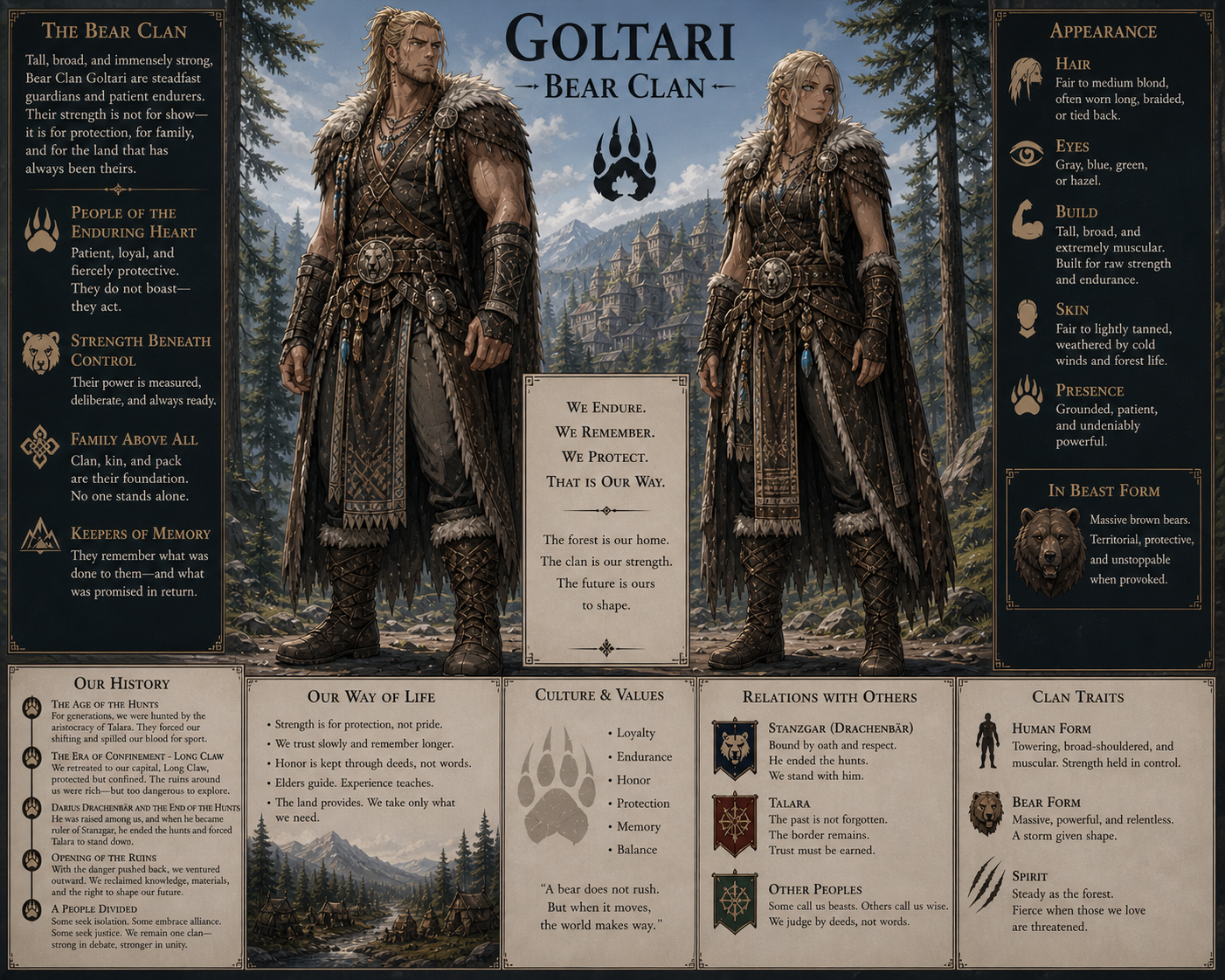
A typical Bear Clan Goltari is a tall, broad, and heavily built individual, carrying the kind of dense strength that makes them feel larger than they are. They move with a grounded, deliberate weight, rarely rushing, rarely wasting motion, and always seeming aware of the space they occupy.
In their human form, they appear as powerful, strongman-like figures with thick shoulders, heavy frames, and calm, watchful expressions. There is often something slightly off to those who know what to look for—a hint of the bear beneath the surface in their posture, their stillness, or the way they look at the world.
They are not loud by default, nor needlessly aggressive, but there is a constant sense of contained force, as if everything they are is being held just short of release.
And when they choose to stop holding back, they become something else entirely.
To those who meet them, the impression is simple:
solid, steady, and far stronger than they have any need to prove
the people, fuzzies, skin shifters, animals, bears, Bearzerkers
Looks
Bear Clan Goltari exhibit two distinct physical expressions, but both are unified by overwhelming mass, strength, and grounded presence. In their human form, they are large, heavy-set individuals built like strongmen rather than soldiers—broad through the shoulders, thick through the chest, and carrying dense, functional weight across their entire frame. Their bodies are defined by thick necks and wide collars, heavy shoulders and backs, large hands with powerful grips, and limbs that carry natural thickness, especially in the forearms and thighs. Even those considered “lean” among them still appear solid and rooted, lacking the narrowness or lightness seen in other peoples. Their musculature is immense but not always sharply defined, built for lifting, grappling, hauling, and enduring prolonged strain rather than display. They often carry themselves with a relaxed posture, yet there is always a sense of contained force, as if their bodies are never fully at rest. Subtle traits of their other form frequently show through, including slightly longer arms, heavier brow lines, thicker body hair, and an overall impression that they are larger than their height alone would suggest. When transformed, Bear Clan Goltari become massive upright werebears, their strength no longer contained but fully expressed. Their bodies expand dramatically into towering, extremely broad forms, heavily muscled beneath dense layers of fur, with immense shoulders and forelimbs that dominate their silhouette. Though upright like a humanoid, their proportions shift toward that of a bear—long, powerful arms ending in heavy claws, a thick reinforced torso built to absorb impact, and massive legs capable of both stability and sudden bursts of motion. Their weight increases significantly, yet they maintain full control over it, wielding it as a weapon rather than a burden. Their fur grows thickest around the shoulders, upper back, and neck, forming a natural mantle that enhances their already imposing size. Despite their scale, they are not slow; their movement is deliberate when calm but capable of explosive, terrifying speed over short distances. In combat or anger, they become overwhelming forces of crushing strength, relentless momentum, and sheer physical dominance—where their human form suggests power, their werebear form is that power unrestrained.
Bear Clan Goltari display a cohesive physical identity across both forms, with their human appearance shaped by northern, forested environments and their transformed state fully embodying bear-like traits. In their human form, they tend toward fair to lightly tanned skin tones, influenced more by cold and exposure than by strong sunlight. Common complexions include pale ivory, soft beige, light tan, muted peach, and faintly ruddy tones caused by cold climates. Undertones often lean cool—pink or pale red—in harsher regions, while those who travel more widely may develop slightly warmer, golden or earthy undertones. Many exhibit naturally ruddy cheeks, noses, and ears, giving them a wind-worn, weathered look even at rest. Their skin is typically thicker than average, resistant to minor injury, and shaped by rough living conditions. It often bears visible signs of their environment, including light scarring, calloused hands and forearms, and general weathering from cold, wind, and labor. These marks carry no stigma—they are simply part of life. Their overall appearance is further defined by notably thicker body hair than most humanoids, particularly along the arms, chest, shoulders, and back, with some bloodlines showing more pronounced growth patterns. Hair colors tend to mirror natural bear tones, including deep brown, black, warm chestnut, ash brown, and occasionally lighter tawny or blonde shades, reinforcing an impression of heaviness, warmth, and physical presence even before transformation. In their werebear form, visible skin is almost entirely replaced by dense fur, with coloration following similar natural tones such as dark brown, black, reddish-brown, tawny, or mixed, mottled patterns. Some individuals display lighter underbellies, darker shoulders and backs, or subtle patterning across the limbs—variations often tied to lineage and recognized within the clan. Across both forms, their eyes remain a constant identifying feature, commonly appearing in shades of brown, amber, dark hazel, or near-black. In their werebear form, these eyes become more intense—deeper set, more reflective, and distinctly predatory in focus, reinforcing the sense that beneath both forms lies the same enduring, powerful presence.
In their human form, Bear Clan Goltari are considered tall by most standards, typically standing between 5’10” and 6 feet, though their true presence comes less from height and more from their mass and build. Broad shoulders, thick torsos, and heavy frames give them a sense of scale that often makes them feel larger than they actually are, drawing attention not through towering stature but through sheer physical presence. They tend to stand upright, grounded, and stable, rarely slouching or diminishing themselves, even in unfamiliar environments. Among their own people, height is largely unremarkable unless it falls outside the norm, as greater importance is placed on strength and mass rather than vertical reach. In their werebear form, however, their size increases dramatically, transforming them into massive, imposing figures that stand well above most humanoids. When upright, they typically reach heights of 8 to 10 feet, with some larger or older individuals exceeding this range, though such cases are uncommon. This height is matched by extreme breadth, immense limb size, and a body that expands outward as much as it rises, creating a presence far greater than height alone would suggest. Despite this scale, they remain balanced, controlled, and capable of sudden, explosive movement. The transformation is not only physical but perceptual—where their human form feels solid and imposing, their werebear form becomes overwhelming.
In their human form, Bear Clan Goltari are significantly heavier than they appear, with most individuals falling between 200 and 300 pounds, though larger or particularly powerful individuals may exceed this without standing out. Their weight is defined less by size and more by density, carried through thick bone structure, heavy musculature, and a naturally broad frame. Even those who do not look especially massive feel unexpectedly heavy when lifted or resisted, as their mass distributes evenly across the body rather than concentrating in one area, giving them a solid, grounded presence rather than a top-heavy build. Heavier individuals tend to broaden further through the shoulders, upper back, and torso, maintaining a strongman-like structure rather than becoming soft or unbalanced. This density contributes directly to their stability, resistance to being moved or knocked down, and their ability to exert sustained force over time. To outsiders, the realization is often immediate and consistent—they weigh more than they should, and it is not fat. In their werebear form, this weight increases dramatically, typically ranging between 800 and 1,500 pounds depending on the individual’s size, age, and build. This is not simply added bulk, but functional mass tied to immense muscle density, reinforced skeletal structure, and the addition of thick fur and tissue. Their bodies become capable of delivering crushing force, absorbing significant impact, and maintaining stability under extreme stress. When they move, their weight is felt as much as seen—each step carries impact, momentum becomes a weapon, and their presence alone can shift the space around them. Despite this, they are not sluggish; their bodies are built to control that mass, allowing for sudden bursts of speed, powerful lunges, and overwhelming physical engagement. Where their human form feels heavy, their werebear form feels like something that should not be moved at all.
In their human form, the first thing most people notice about a Bear Clan Goltari is not any single feature, but the sense of weight and presence they carry. Even standing still, they appear broad, grounded, and difficult to move, their build alone suggesting strength before any action confirms it. Their hands are especially notable—large, thick-fingered, and visibly calloused, built for gripping, lifting, and holding rather than delicate tasks, with a handshake that often feels like a quiet test. Their shoulders and neck are unusually thick, blending into a heavy upper frame that gives them a slightly top-loaded appearance, like something built to push or carry rather than reach. Their facial structure often carries subtle hints of their other form, including broader jaws, heavier brows, slightly widened or flattened noses in some bloodlines, and deep-set eyes that remain calm and watchful. These eyes, typically brown, amber, dark hazel, or near-black, tend to be steady and unhurried, rarely darting, and when focused can feel intensely present, as though weighing whether something matters. Body hair is often more prominent than in other peoples, particularly along the arms, chest, shoulders, and back, reinforcing their impression of ruggedness and warmth. Their movement is perhaps the most defining feature—even casually, they plant their weight fully, shift with purpose, and avoid unnecessary motion, giving the sense that nothing about them is rushed and everything is intentional. In their werebear form, Bear Clan Goltari become immediately and unmistakably overwhelming, their sheer scale and mass dominating any space they occupy. Their forelimbs are massive, ending in thick claws and heavy paws capable of tearing, crushing, and holding with immense force, while their shoulders and upper body rise into a dense, fur-covered mass that forms a natural mantle of power. Their head is distinctly bear-like—broad, heavy-jawed, and built for a powerful bite, with small, focused eyes set deep within the skull. These eyes remain one of their most striking features, still intelligent and aware but far more intense, shifting from quiet observation to something closer to judgment. Their fur is dense and heavy, thickest around the neck and back, providing both protection and an even greater visual presence. Despite their size, their movement is not sluggish; they are capable of sudden bursts of speed, powerful lunges, and momentum-driven force that feels unstoppable once set in motion. When calm, they may appear slow and deliberate, but when engaged, they become overwhelming. Across both forms, the defining trait of the Bear Clan Goltari remains the same: they always feel like they are holding back, as if their size, strength, and stillness are only a fraction of what they truly are.
Bear Clan Goltari display a moderate to wide range of physical variation, but always within a clear and recognizable framework: they are consistently tall, broad, and built for strength, and none are ever mistaken for slight or delicate. In their human form, variation appears primarily in build, proportions, and facial structure rather than overall body type. Some individuals are extremely broad and heavy-set, resembling strongmen or laborers, while others are slightly leaner—though even the leanest still carry dense muscle and weight. Musculature may be visibly pronounced in some, while others appear softer in shape despite equal underlying strength. Facial features vary in jaw width, brow weight, and nose shape, with some individuals appearing more distinctly “bear-like” than others. Body hair ranges from moderate to very heavy, especially across the chest, arms, and shoulders, with certain bloodlines being notably more furred. Most stand between 5’10” and 6’, though some fall just outside that range. Despite these differences, all share a grounded posture, a sense of physical density, and an unmistakable impression of restrained power. In their werebear form, variation becomes more pronounced, particularly in size, fur coloration, and overall bulk. Some individuals transform into larger, more towering werebears, while others are slightly smaller but often faster or more controlled in movement. Build types may favor sheer mass or slightly leaner mobility, though all remain heavily muscled. Fur coloration varies across dark brown, black, reddish-brown, tawny, or mixed and mottled coats, sometimes with lighter underbellies or darker shoulders and backs. Subtle differences in muzzle length, jaw width, and eye placement give individuals distinct appearances, while claw and paw size can vary, with some displaying especially heavy forelimbs tied to lineage or lifestyle. These traits are often influenced by family lines, environment, and clan tendencies, with those living deeper in forested ruins appearing heavier, more weathered, and more fur-dense, while those interacting more with outsiders may show slightly more variation in human presentation. Within Bear Clan culture, physical differences are not judged by beauty but by capability, endurance, and presence—size alone does not determine worth, but the ability to hold ground, carry weight, and endure hardship earns respect. Variation exists, but it never removes the defining truth: every Bear Clan Goltari is built around mass, strength, and the sense that they are capable of withstanding more than they should have to.
Goltari clothing is built around a single, unavoidable truth: their bodies may not remain the same shape for long. Because of this, Bear Clan Goltari favor garments that are adaptable, durable, and forgiving, designed to accommodate sudden changes in size without tearing, binding, or interfering with movement. Most clothing is loose-fitting, layered, and easy to remove or loosen quickly, commonly consisting of wide-cut tunics, open-front coats or wraps, layered shirts tied rather than buttoned, and reinforced trousers with flexible seams. Fastenings favor ties, wraps, toggles, or simple clasps rather than rigid buttons or tight closures, and anything that cannot be removed in seconds is generally avoided. A defining feature of their clothing is its ability to survive—or at least not hinder—transformation, leading to practical design choices such as breakaway seams that split cleanly, expandable panels along the back and sides, open-backed or cloak-based layering that allows for growth, and garments meant to be shed quickly and retrieved later. Some accept that certain pieces will be damaged or lost during transformation, while others invest in clothing built to withstand repeated change. Cloaks and outer wraps are especially common, serving for warmth, concealment of body shape, ease of removal, and cultural identity; these are typically heavy, weather-resistant, and large enough to drape over their broad frames, and many are rarely seen without one. Materials prioritize durability over appearance, with thick woven cloth, leather, treated hides, and sometimes fur-lined elements forming the foundation of most garments. Clothing must endure rough terrain, heavy use, and the strain of transformation, and well-made pieces are repaired repeatedly rather than replaced. Tight or restrictive clothing is uncommon, as Goltari prefer garments that allow full range of motion, avoid binding at the shoulders or hips, and can be worn comfortably for long periods, even in more formal contexts. Belts, harnesses, and carrying straps are widely used for tools, personal items, trade goods, or weapons, but are typically designed to be removed quickly or left behind during transformation, leading many to carry fewer items overall. Decoration exists but remains subtle, often appearing as stitched patterns, small charms, carved fasteners, or markings tied to personal or clan identity, with function and reliability valued above display. Due to their connection with Stanzgar, some incorporate military-style coats, structured outerwear, or standardized gear, though these are often modified to remain transformation-friendly by loosening rigid elements or adapting them for flexibility. Ultimately, Goltari do not dress to present a certain image—they dress so that when their bodies change, their clothing does not become a problem.
Traits
Bear Clan Goltari are defined by one core truth: they are built for strength, and they possess more of it than most things around them. Their power is not subtle, but neither is it simple—what makes them formidable is not just raw force, but how naturally and effectively they apply it. Even in human form, they exhibit above-average strength, with bodies designed for lifting, grappling, hauling, and sustained physical effort, their dense musculature and heavy frames allowing them to exert force that feels effortless to them yet overwhelming to others. In their werebear form, this strength becomes truly immense, capable of crushing force, tearing through barriers, and overpowering most opponents in direct physical conflict. Their ability to shift between forms grants them exceptional adaptability, allowing them to function within society using tools, coordination, and planning in human form, while transforming into beings of overwhelming physical dominance capable of breaking obstacles and enduring extreme conditions. This duality makes them effective across both structured and hostile environments. They are also highly resilient, able to absorb significant punishment, continue under strain, and endure harsh conditions, with their werebear form further enhancing this durability through thick fur, reinforced musculature, and bodies built to withstand impact, making them difficult to wear down. Once they commit to action, particularly in their transformed state, they become forces of momentum and presence—their mass, strength, and forward drive combining into something that pushes through resistance, disrupts formations, and overwhelms opposition, while their sheer presence can intimidate, disrupt focus, and shift the tone of any confrontation. Their build makes them especially effective grapplers and close-combat fighters, excelling in confined spaces where distance is removed and strength determines the outcome; once they have hold of something, releasing it is rarely their instinct. Adapted to life in forested ruins and rugged terrain, they move confidently across uneven ground and dense environments that hinder others. Culturally, they are equally resilient, shaped by a history of being hunted, forced into transformation, and surviving under constant threat, resulting in a people who are adaptable, community-oriented, and mentally difficult to break—they are accustomed to hardship, do not expect ease, and do not rely on it. Ultimately, Bear Clan Goltari do not depend on finesse or precision; they rely on strength applied at the right moment, in the right way, with enough force that it does not need to be repeated.
For all their strength, resilience, and adaptability, Bear Clan Goltari carry several critical weaknesses, many of which stem directly from the same traits that make them formidable. The most well-known is their vulnerability to silver, which interferes with their shapechanging nature—contact can weaken their strength, disrupt or slow transformation, cause intense pain or burning sensations, and with prolonged exposure, prevent shifting entirely. Weapons made of or coated in silver are especially dangerous, piercing more effectively, hindering regeneration, and limiting access to their full power, making prepared enemies far more threatening than unprepared ones. They are also susceptible to forced transformation through certain herbs, incense, and alchemical compounds, which can strip them of control over when they shift, force them into environments where their size becomes a liability, expose them to traps or prepared defenses, and push them toward a more instinct-driven state—a weakness historically exploited during Talaran hunts. Under extreme stress, injury, or chemical influence, some may experience loss of control, resulting in partial or uncontrolled transformations, heightened aggression, and reduced tactical awareness; in these moments, they may rely on instinct over judgment, struggle to distinguish ally from threat, or commit to overwhelming force when restraint would be more effective. Their immense size, particularly in werebear form, can also become a limitation, making them too large for confined spaces, highly visible, and restricted in environments that limit movement, where their mass becomes a constraint rather than an advantage. Additionally, their reliance on direct, force-driven solutions can make them predictable in combat, leaving them vulnerable to more agile, strategic, or deception-based opponents, as they do not always adapt quickly to indirect approaches. Their strong sense of community and shared identity, while a strength, can also be exploited, as they are deeply protective of their own, reactive to threats, and often unwilling to abandon allies—even when it would be tactically advantageous. Finally, the lingering trauma of being hunted and forcibly transformed has left lasting effects on some individuals, including distrust of outsiders, heightened aggression under threat, or strong reactions to specific stimuli associated with past hunts. In the end, Bear Clan Goltari are undeniably powerful, but that power is tied to a nature that can be disrupted, provoked, or turned against them by those who understand it well enough.
Among Bear Clan Goltari, conditions are rarely viewed as simple illness but as imbalances between their two forms—the human and the bear falling out of harmony with one another. Many of their ailments reflect this tension. One of the most feared is Silver Sickness, a lingering condition caused by prolonged exposure to silver through wounds, restraints, or repeated contact; silver does not merely harm the body, it interferes with their nature, leading to burning pain around old wounds, difficulty or failure to transform, weakened strength even in human form, fatigue, instability, and a persistent sense of being “out of place” in one’s own body, with severe cases leaving individuals locked in a single form. Splitform Strain arises from overuse of transformation, where the body struggles to maintain clean transitions, causing partial shifts such as claws or fur appearing unintentionally, joint pain, instability, exhaustion, and in extreme cases failure mid-transformation. Herb-Burn results from exposure to compounds historically used to force transformation, producing involuntary shifting, agitation, nausea, and increasing long-term sensitivity, tying it closely to cultural trauma. Anchor Loss is a psychological imbalance where the individual loses a stable sense of identity between forms, resulting in memory gaps, emotional inconsistency, disconnection, and in severe cases an inability to maintain balance between selves. Bone-Weight affects older Goltari, where years of strain lead to stiffness, slower transformations, pain, and reduced mobility, yet it is respected as a sign of endurance rather than pitied. Scent Memory reflects their heightened instincts, where certain smells tied to trauma or conflict can trigger aggression, fear, or involuntary readiness to shift, often managed by removing the trigger rather than confronting the individual. Rarely, individuals are Wild Marked, existing in a constant partial state between forms, displaying traits such as bear-like ears, permanent fangs or claws, patches of fur, altered posture, or reflective eyes; they often gain increased baseline strength and faster transformations but struggle to fully pass as human and live with constant instinctual pressure, viewed culturally as either a sign of strong lineage or a dangerous imbalance. Another uncommon but widely understood condition is Transformation Weakness, where shifting drains the body, leaving the individual temporarily vulnerable with reduced strength, slowed reactions, fatigue, disorientation, and instability, making transformation a tactical risk that must be managed carefully. Across all of these, the core truth remains the same: Bear Clan Goltari conditions are not simply weaknesses, but manifestations of imbalance—moments when the strength of being two things stops working together, and power comes at a cost that must be respected.
Culture
Bear Clan Goltari traditions are rooted in shared experience, memory, and the understanding that survival is rarely done alone. Storytelling around campfires is not passive entertainment but exchange—stories are traded rather than simply told, carrying weight through personal experience, clan history, encounters with spirits, and lessons learned through hardship. Others may respond with their own stories, corrections, or challenges, not as disrespect but as a way of strengthening what is remembered, with the presence of a shared flame considered essential; refusing to share when asked is seen as withholding more than words. Humor is equally important, often appearing in moments outsiders might find inappropriate, used to defuse tension, build trust, test character, and remind others not to take themselves too seriously. Their humor is dry, blunt, sometimes dark, and often physical or situational, with the ability to take and return a joke seen as a sign of trustworthiness—someone who cannot laugh, especially at themselves, is viewed with suspicion. Community gatherings reinforce cohesion, bringing individuals together for shared meals, discussion, decision-making, celebration, or simple presence; attendance is not enforced but absence is noticed, and these gatherings allow disputes to surface, plans to form, and roles to shift, reinforcing the belief that no one should carry weight alone if it can be shared. Communal herbal baths serve both practical and cultural roles, used for cleaning after labor or transformation, soothing strain, treating injuries, and calming the mind; shared among trusted individuals, they create quiet spaces where tension eases and vulnerability is accepted, with silence considered natural rather than uncomfortable. Memory is often carried through tattoo rather than writing, with markings recording major life events, achievements, family ties, journeys, and survival; these are not merely decorative but serve as visible records, their placement and patterns holding meaning within the clan, and the act of tattooing is done with care, witnesses, and acknowledgment. Individuals also take solitary watches at the edges of their territory, often at night or dawn, not strictly as guards but as a reminder that the land—and whatever inhabits it—is always observing in return. Among close groups, shared silence is a recognized tradition, particularly after conflict or hardship, where presence alone communicates support and leaving too early suggests avoidance. Milestones such as surviving a near-fatal injury are marked through story or tattoo in what is known as First Blood, First Mark—not as glorification, but as acknowledgment that the individual has been tested. Across all of these practices, the core cultural thread remains constant: Bear Clan Goltari value shared experience, remembered truth, and the understanding that strength is not meant to stand alone.
Bear Clan Goltari beliefs are grounded in pragmatism, balance, and lived experience, centered on the idea that truth is proven through function rather than theory. They value what works—discarding ideals without application, traditions without purpose, and beliefs that cannot withstand reality—judging truth by whether it endures, functions, and holds when things go wrong. This extends to tools, leadership, people, and even spiritual understanding, where philosophy is respected only if it survives hardship. They believe the world operates within a natural order that is not fragile but can be disrupted, and they see themselves as part of that order rather than above it. This shapes how they hunt, settle, and act, discouraging excess or careless disruption while accepting that violence may be necessary, so long as it is understood that actions carry consequences beyond the immediate moment. They recognize that spirits inhabit the world itself—within animals, land, objects, and places touched by memory—and while they do not worship these spirits, they acknowledge and respect them through restraint and awareness, treating certain places and actions with care because the world is never truly empty. They also hold a belief similar to karma, where actions carry weight that lingers and eventually returns, influencing how they treat others and interpret outcomes; justice may not be immediate, but it is considered inevitable, leading to a mindset of acceptance rather than denial. Strength, to them, is not inherently good but a dangerous potential that must be controlled, as strength without purpose is waste and strength without restraint is a threat, especially given their transformative nature, where loss of control endangers not just the individual but everyone nearby. Central to their identity is the belief that the self is both human and bear, and must remain unified—neither form is more true than the other, and imbalance between them leads to weakness, a principle that shapes their understanding of conditions such as Wild Marked or Anchor Loss. Endurance is one of their highest measures of worth, not just in physical resilience but in the ability to carry hardship, survive loss, and continue forward when others would stop, as true strength is proven over time rather than in a single moment. Finally, they believe memory carries responsibility—what is remembered must be preserved, with stories, tattoos, and shared knowledge acting as obligations rather than traditions, and forgetting something important is seen as dangerous or disrespectful. Together, these beliefs form a worldview where survival, balance, and accountability define both individual and community identity.
Bear Clan Goltari governance is best understood as a tribal democracy shaped into a republic, where authority is shared, contested, and constantly shifting rather than held by a single ruler. They do not trust power that cannot be challenged, nor leadership that cannot be replaced. At the center of this system is a council composed of representatives from clans, settlements, and notable groups, responsible for major decisions affecting the Bear Clan, foreign relations, responses to threats, and long-term direction. Representation is based not purely on population, but on respect, experience, and the ability to speak for others, and council members are expected to argue openly, defend their positions, and accept being outvoted—silence is seen as weakness. While many voices exist, their politics tend to organize around three dominant factions: the Isolationists, who favor self-sufficiency and minimal outside contact, believing that entanglement brings risk; the Stanzgarian Supporters, who advocate for cooperation and alliances, seeing engagement as a source of stability and strength; and the Crusaders, the most volatile faction, driven by the belief that past persecution—particularly the Talaran hunts—has never been properly answered, and that justice demands action or retribution. These factions are not rigid parties, but widely recognized alignments that shape nearly every major decision. The system functions not through agreement, but through balance, as no faction can fully dominate the others, forcing negotiation, compromise, and shifting alliances; at times factions unite to outvote another, while at others stalemates occur, creating a government that can be slow, volatile, but rarely stagnant. On the local level, governance is handled through tribal leadership, community gatherings, and consensus, with leaders expected to mediate disputes, organize labor, and maintain order based on trust, reputation, and proven capability rather than formal authority. Leadership carries clear expectations: a Goltari leader must be physically capable, mentally steady, able to argue and defend their position under pressure, and accept loss without losing standing, as those who cannot endure opposition do not remain leaders for long. Their political structure is deeply shaped by history, with each faction reflecting a response to past suffering—the Crusaders seeking justice, the Isolationists seeking safety through distance, and the Supporters seeking strength through connection. Ultimately, Bear Clan Goltari governance does not aim for unity through agreement, but maintains it through argument, balance, and the shared understanding that no single path should ever go unchallenged.
Goltari technology is not unified or cleanly developed, but instead exists as a patchwork of inherited, adopted, scavenged, and adapted systems shaped primarily by two sources: what they have been given and what they have found. Through their connection to Stanzgar, they have access to advanced dwarven-influenced technologies—refined metallurgy, advanced tools and weaponry, early industrial machinery, magitech-integrated systems, and structured engineering practices—allowing them to utilize firearms (particularly rifles in coordinated roles), reinforced armor, mechanical infrastructure, and dwarven-designed systems adapted for daily use. However, their relationship with this technology is distinct; unlike dwarves, they do not preserve it with strict reverence, but instead modify, repurpose, and integrate it according to practical need, viewing technology not as something to maintain perfectly but as something to make work effectively. While they lack the deep theoretical focus of dwarven engineers, they excel in practical application, field repair, improvisation, and modification—often not knowing why something works, but understanding how to use it, fix it, and keep it functioning under strain. Alongside this adopted technology, the Goltari also draw from ancient ruins scattered across their homeland, recovering rare and often unstable relics that are poorly understood, difficult to replicate, and used with caution. These may include unusual devices, durable unknown materials, inconsistent mechanisms, or artifacts that interact unpredictably with magic or environment, and they are typically rare, closely guarded, and unevenly distributed, leading to disparities where some individuals possess relic-grade tools while others rely on more conventional equipment; such items often carry status, but also caution or suspicion. All Goltari technological use is shaped by the constant reality of transformation, requiring equipment that can be quickly discarded, adapted, or survived through physical change—armor is often lighter or modular, weapons must be usable or expendable, tools are carried for rapid release, and overly complex gear is avoided when possible. In many cases, their greatest and most reliable tool remains their own body in werebear form, with technology serving as support rather than replacement. Despite not pursuing innovation in a traditional sense, the Goltari demonstrate strong practical ingenuity, combining dwarven systems, Stanzgarian military structure, and lived experience to create solutions that are flexible, durable, and capable of functioning outside intended conditions or continuing after partial failure. Culturally, they do not idolize technology; they respect it only insofar as it proves useful, judging any tool by performance, durability, and reliability in real conditions rather than origin or sophistication. Ultimately, their approach reflects a simple, defining principle: they do not ask where something comes from—they ask whether it will work when they need it to.
Goltari society is built on a balance between two core truths: not everyone can do everything, but everyone is expected to do something. Their system allows specialization and daily labor to coexist rather than replace one another, ensuring both immediate needs and long-term survival are met. Each day begins with the Morning Assignment System, where general labor tasks—such as gathering, construction, patrols, cooking, maintenance, and transport—are distributed among the community. Those who rise early gain the advantage of choosing preferred tasks or positioning themselves where they are most effective, while those who arrive later take on whatever remains, ensuring that all work is completed, effort is visible, and idleness is difficult to conceal. Alongside this shared labor structure, the Goltari maintain recognized specialists whose roles are essential, including blacksmiths, engineers, healers, hunters, builders, and traders. These individuals are trained over time, acknowledged by the community, and often shielded from unnecessary general labor when their expertise is needed, as their contributions are considered irreplaceable in critical moments. However, specialization does not remove responsibility—specialists are still expected to contribute to communal needs when appropriate, reinforcing a culture where identity is not defined solely by profession but by reliability, presence, and willingness to carry weight beyond one’s role. The Morning Assignment System primarily governs general and non-specialized labor, while specialists may be exempted, redirected, or allowed to align their work with their expertise, maintaining a balance between shared obligation and skilled necessity. Through their ties to Stanzgar, many Goltari also take on structured external roles such as soldiers, scouts, industrial laborers, or handlers of advanced technology, while others work as mercenaries, caravan guards, or guides, yet upon returning home they reintegrate into the same communal system of shared work. Transformation further shapes their labor practices, as their werebear form can be used for heavy lifting, clearing land, or combat, but is not universally relied upon; some individuals use it freely as a tool, while others must exercise caution due to personal limitations, and communities account for these differences rather than enforcing uniform expectations. Ultimately, the system functions because it recognizes that while some roles are critical and irreplaceable, no individual is exempt from contributing, creating a society where responsibility is shared, effort is expected, and both skill and participation define one’s place within the community.
Goltari economics functions as a hybrid system built on internal barter and shared labor, supported by external trade and selective use of coin, shaped by necessity, memory, and practicality rather than formal structure. Within their communities, exchange is driven primarily by barter, service, and mutual contribution, with goods and labor moving based on need, availability, and established relationships—food shared for future work, tools traded for repairs, and hunting yields distributed across households. This system is largely unwritten, sustained through memory, reputation, and expectation, where economic standing is measured not by accumulated wealth but by reliability, usefulness, and consistency; those who contribute are valued, while those who take without giving are remembered and quietly held accountable. Specialists such as blacksmiths, engineers, herbalists, and builders operate within a supported structure, receiving priority access to materials, compensation through goods or labor, or relief from general duties during critical work, while remaining obligated to provide their skills when needed, maintain quality, and stay integrated within the community—recognized as essential, but not above others. Through their connection to Stanzgar, the Goltari also engage in external trade, adopting coin and structured exchange primarily for dealings beyond their own society, acquiring specialized goods and participating in broader markets, though coin remains secondary internally and has not replaced their barter-based system. A significant source of trade value comes from ruin-derived resources recovered from ancient, dangerous sites scattered across their homeland, including rare metals, unusual alloys, and materials not commonly found elsewhere; these resources are difficult to obtain, limited in quantity, and often hazardous to retrieve, making them highly valuable but inconsistent and unreliable as a stable foundation. As a result, extraction is controlled and deliberate, requiring preparation and knowledge, with some ruins only partially explored or left untouched entirely, reflecting an understanding that not everything is worth the cost of recovery. These materials grant the Goltari strong leverage in trade, access to advanced goods, and influence beyond their population size, but their economy does not depend solely on them. Instead, it prioritizes labor over accumulation, valuing resources for their use rather than their storage—unused wealth is seen as wasteful, while goods are meant to be used, shared, or traded as needed. Ultimately, Goltari economics is not built on steady production or accumulation, but on a pragmatic cycle of contribution, recovery, and readiness, grounded in the principle of what can be done today, what can be found, and what can be relied upon tomorrow.
Goltari food reflects their nature—simple, filling, and built to sustain strength—favoring meals that provide high energy, long-lasting fullness, and minimal waste. Food is not treated as delicate or ornamental, but as fuel for work, recovery, and survival. Meat forms the core of their diet, sourced from large game, smaller hunted animals, or livestock where available, and prepared through roasting over open flame, slow-cooking in stews, smoking for preservation, or quick fire-searing; they favor rich, fatty cuts and organ meats, ensuring nothing usable is wasted. Fish serves as a major secondary staple, especially near rivers and lakes, prepared as smoked stores, grilled whole over coals, thick herb-laden stews, or dried for travel, with additional river foods like shellfish or eel-like creatures supplementing their intake, valued for their reliability as much as their flavor. Stews hold particular cultural importance, allowing the combination of meats, roots, herbs, and whatever else is available into meals that can feed large groups efficiently and stretch limited resources, often shared during gatherings, after labor, or around campfires, judged not by refinement but by how well they fill, how long they last, and whether anyone remains hungry. While not plant-focused, they regularly incorporate foraged roots, greens, berries, and fungi, typically as supporting elements rather than central components, added to stews or eaten alongside meat. Preservation is essential to their lifestyle, with dried meats, smoked fish, rendered fat cakes, and compact travel rations designed to be durable, reliable, and long-lasting, where function outweighs taste. Their knowledge of herbs also produces broths, infusions, and recovery foods used to heal, calm the body after transformation, and restore strength after strain, often respected for their effects more than their flavor. Food is rarely eaten alone; meals are shared, passed around, and experienced collectively, reinforcing community bonds and mutual support, where eating together holds as much importance as the food itself. Ultimately, Goltari food is guided by a simple principle: it is not judged by refinement, but by whether it keeps them going.
History
Goltari history is defined not by conquest or expansion, but by a prolonged and brutal reality: they were hunted, and they survived long enough for that to end. During the Age of the Hunts, spanning the late Fourth Age and earlier, both Bear Clan and Wolf Clan Goltari were subjected to organized, ritualized hunts carried out by the aristocracy of Talara, who treated the act as sport and a display of status. Talaran nobles would invade Goltari lands, deploy specialized herbs and incense that forced transformation, and pursue them in their bestial forms, leaving little room for defense once exposed. This era deeply shaped Goltari identity, embedding constant vigilance, ingrained distrust of outsiders, and a reliance on community for survival; it is not remembered as distant history, but as a time when being seen meant being hunted. At the height of this persecution, the Goltari were driven inward, relying heavily on their capital, Long Claw—an immense ancient arcology that offered structural protection and defensive advantage against large-scale hunts. Yet this refuge came with limitations, as the surrounding ruins, rich with unknown technologies, remained largely inaccessible due to the risks of exposure, reinforcing a culture focused on survival, minimal expansion, and careful movement. The defining turning point came with Darius Drachenbär of Stanzgar, a ruler who had lived among the Goltari in his youth and was given the name “Dragon Bear” by them. Upon rising to power, he decisively ended the hunts through force rather than diplomacy, pushing Talara back, enforcing consequences for further aggression, and granting the Goltari their first sustained relief in generations—the ability to live without constant predation and begin envisioning a future beyond survival. This shift led to the establishment of a heavily fortified border between Goltari lands and Talara, maintained by the Drachenbär legions as both a physical barrier and a lasting symbol of protection, ensuring the past would not repeat. With external pressure reduced, the Goltari turned toward the ruins that had long surrounded them, finally able to explore deeper, recover rare materials and relic technologies, and transition from survival to growth, though these ruins remained dangerous and unpredictable. Increased interaction with Stanzgar and the wider world brought internal change and division, giving rise to factions such as the Isolationists, who seek self-reliance; the Stanzgarian Supporters, who favor cooperation; and the Crusaders, who believe Talara has yet to answer for its actions. These divisions now shape policy, alliances, and the direction of their people. Ultimately, Goltari history is not a story of rising dominance, but of endurance—of surviving long enough for the hunts to end, and then facing the question of what to do with the freedom that followed.
Overview
Details about this race's overview
Goltari - Bear Clan
A typical Bear Clan Goltari is a tall, broad, and heavily built individual, carrying the kind of dense strength that makes them feel larger than they are. They move with a grounded, deliberate weight, rarely rushing, rarely wasting motion, and always seeming aware of the space they occupy.
In their human form, they appear as powerful, strongman-like figures with thick shoulders, heavy frames, and calm, watchful expressions. There is often something slightly off to those who know what to look for—a hint of the bear beneath the surface in their posture, their stillness, or the way they look at the world.
They are not loud by default, nor needlessly aggressive, but there is a constant sense of contained force, as if everything they are is being held just short of release.
And when they choose to stop holding back, they become something else entirely.
To those who meet them, the impression is simple:
solid, steady, and far stronger than they have any need to prove
the people, fuzzies, skin shifters, animals, bears, Bearzerkers
Looks
Details about this race's looks
Bear Clan Goltari exhibit two distinct physical expressions, but both are unified by overwhelming mass, strength, and grounded presence. In their human form, they are large, heavy-set individuals built like strongmen rather than soldiers—broad through the shoulders, thick through the chest, and carrying dense, functional weight across their entire frame. Their bodies are defined by thick necks and wide collars, heavy shoulders and backs, large hands with powerful grips, and limbs that carry natural thickness, especially in the forearms and thighs. Even those considered “lean” among them still appear solid and rooted, lacking the narrowness or lightness seen in other peoples. Their musculature is immense but not always sharply defined, built for lifting, grappling, hauling, and enduring prolonged strain rather than display. They often carry themselves with a relaxed posture, yet there is always a sense of contained force, as if their bodies are never fully at rest. Subtle traits of their other form frequently show through, including slightly longer arms, heavier brow lines, thicker body hair, and an overall impression that they are larger than their height alone would suggest. When transformed, Bear Clan Goltari become massive upright werebears, their strength no longer contained but fully expressed. Their bodies expand dramatically into towering, extremely broad forms, heavily muscled beneath dense layers of fur, with immense shoulders and forelimbs that dominate their silhouette. Though upright like a humanoid, their proportions shift toward that of a bear—long, powerful arms ending in heavy claws, a thick reinforced torso built to absorb impact, and massive legs capable of both stability and sudden bursts of motion. Their weight increases significantly, yet they maintain full control over it, wielding it as a weapon rather than a burden. Their fur grows thickest around the shoulders, upper back, and neck, forming a natural mantle that enhances their already imposing size. Despite their scale, they are not slow; their movement is deliberate when calm but capable of explosive, terrifying speed over short distances. In combat or anger, they become overwhelming forces of crushing strength, relentless momentum, and sheer physical dominance—where their human form suggests power, their werebear form is that power unrestrained.
Bear Clan Goltari display a cohesive physical identity across both forms, with their human appearance shaped by northern, forested environments and their transformed state fully embodying bear-like traits. In their human form, they tend toward fair to lightly tanned skin tones, influenced more by cold and exposure than by strong sunlight. Common complexions include pale ivory, soft beige, light tan, muted peach, and faintly ruddy tones caused by cold climates. Undertones often lean cool—pink or pale red—in harsher regions, while those who travel more widely may develop slightly warmer, golden or earthy undertones. Many exhibit naturally ruddy cheeks, noses, and ears, giving them a wind-worn, weathered look even at rest. Their skin is typically thicker than average, resistant to minor injury, and shaped by rough living conditions. It often bears visible signs of their environment, including light scarring, calloused hands and forearms, and general weathering from cold, wind, and labor. These marks carry no stigma—they are simply part of life. Their overall appearance is further defined by notably thicker body hair than most humanoids, particularly along the arms, chest, shoulders, and back, with some bloodlines showing more pronounced growth patterns. Hair colors tend to mirror natural bear tones, including deep brown, black, warm chestnut, ash brown, and occasionally lighter tawny or blonde shades, reinforcing an impression of heaviness, warmth, and physical presence even before transformation. In their werebear form, visible skin is almost entirely replaced by dense fur, with coloration following similar natural tones such as dark brown, black, reddish-brown, tawny, or mixed, mottled patterns. Some individuals display lighter underbellies, darker shoulders and backs, or subtle patterning across the limbs—variations often tied to lineage and recognized within the clan. Across both forms, their eyes remain a constant identifying feature, commonly appearing in shades of brown, amber, dark hazel, or near-black. In their werebear form, these eyes become more intense—deeper set, more reflective, and distinctly predatory in focus, reinforcing the sense that beneath both forms lies the same enduring, powerful presence.
In their human form, Bear Clan Goltari are considered tall by most standards, typically standing between 5’10” and 6 feet, though their true presence comes less from height and more from their mass and build. Broad shoulders, thick torsos, and heavy frames give them a sense of scale that often makes them feel larger than they actually are, drawing attention not through towering stature but through sheer physical presence. They tend to stand upright, grounded, and stable, rarely slouching or diminishing themselves, even in unfamiliar environments. Among their own people, height is largely unremarkable unless it falls outside the norm, as greater importance is placed on strength and mass rather than vertical reach. In their werebear form, however, their size increases dramatically, transforming them into massive, imposing figures that stand well above most humanoids. When upright, they typically reach heights of 8 to 10 feet, with some larger or older individuals exceeding this range, though such cases are uncommon. This height is matched by extreme breadth, immense limb size, and a body that expands outward as much as it rises, creating a presence far greater than height alone would suggest. Despite this scale, they remain balanced, controlled, and capable of sudden, explosive movement. The transformation is not only physical but perceptual—where their human form feels solid and imposing, their werebear form becomes overwhelming.
In their human form, Bear Clan Goltari are significantly heavier than they appear, with most individuals falling between 200 and 300 pounds, though larger or particularly powerful individuals may exceed this without standing out. Their weight is defined less by size and more by density, carried through thick bone structure, heavy musculature, and a naturally broad frame. Even those who do not look especially massive feel unexpectedly heavy when lifted or resisted, as their mass distributes evenly across the body rather than concentrating in one area, giving them a solid, grounded presence rather than a top-heavy build. Heavier individuals tend to broaden further through the shoulders, upper back, and torso, maintaining a strongman-like structure rather than becoming soft or unbalanced. This density contributes directly to their stability, resistance to being moved or knocked down, and their ability to exert sustained force over time. To outsiders, the realization is often immediate and consistent—they weigh more than they should, and it is not fat. In their werebear form, this weight increases dramatically, typically ranging between 800 and 1,500 pounds depending on the individual’s size, age, and build. This is not simply added bulk, but functional mass tied to immense muscle density, reinforced skeletal structure, and the addition of thick fur and tissue. Their bodies become capable of delivering crushing force, absorbing significant impact, and maintaining stability under extreme stress. When they move, their weight is felt as much as seen—each step carries impact, momentum becomes a weapon, and their presence alone can shift the space around them. Despite this, they are not sluggish; their bodies are built to control that mass, allowing for sudden bursts of speed, powerful lunges, and overwhelming physical engagement. Where their human form feels heavy, their werebear form feels like something that should not be moved at all.
In their human form, the first thing most people notice about a Bear Clan Goltari is not any single feature, but the sense of weight and presence they carry. Even standing still, they appear broad, grounded, and difficult to move, their build alone suggesting strength before any action confirms it. Their hands are especially notable—large, thick-fingered, and visibly calloused, built for gripping, lifting, and holding rather than delicate tasks, with a handshake that often feels like a quiet test. Their shoulders and neck are unusually thick, blending into a heavy upper frame that gives them a slightly top-loaded appearance, like something built to push or carry rather than reach. Their facial structure often carries subtle hints of their other form, including broader jaws, heavier brows, slightly widened or flattened noses in some bloodlines, and deep-set eyes that remain calm and watchful. These eyes, typically brown, amber, dark hazel, or near-black, tend to be steady and unhurried, rarely darting, and when focused can feel intensely present, as though weighing whether something matters. Body hair is often more prominent than in other peoples, particularly along the arms, chest, shoulders, and back, reinforcing their impression of ruggedness and warmth. Their movement is perhaps the most defining feature—even casually, they plant their weight fully, shift with purpose, and avoid unnecessary motion, giving the sense that nothing about them is rushed and everything is intentional. In their werebear form, Bear Clan Goltari become immediately and unmistakably overwhelming, their sheer scale and mass dominating any space they occupy. Their forelimbs are massive, ending in thick claws and heavy paws capable of tearing, crushing, and holding with immense force, while their shoulders and upper body rise into a dense, fur-covered mass that forms a natural mantle of power. Their head is distinctly bear-like—broad, heavy-jawed, and built for a powerful bite, with small, focused eyes set deep within the skull. These eyes remain one of their most striking features, still intelligent and aware but far more intense, shifting from quiet observation to something closer to judgment. Their fur is dense and heavy, thickest around the neck and back, providing both protection and an even greater visual presence. Despite their size, their movement is not sluggish; they are capable of sudden bursts of speed, powerful lunges, and momentum-driven force that feels unstoppable once set in motion. When calm, they may appear slow and deliberate, but when engaged, they become overwhelming. Across both forms, the defining trait of the Bear Clan Goltari remains the same: they always feel like they are holding back, as if their size, strength, and stillness are only a fraction of what they truly are.
Bear Clan Goltari display a moderate to wide range of physical variation, but always within a clear and recognizable framework: they are consistently tall, broad, and built for strength, and none are ever mistaken for slight or delicate. In their human form, variation appears primarily in build, proportions, and facial structure rather than overall body type. Some individuals are extremely broad and heavy-set, resembling strongmen or laborers, while others are slightly leaner—though even the leanest still carry dense muscle and weight. Musculature may be visibly pronounced in some, while others appear softer in shape despite equal underlying strength. Facial features vary in jaw width, brow weight, and nose shape, with some individuals appearing more distinctly “bear-like” than others. Body hair ranges from moderate to very heavy, especially across the chest, arms, and shoulders, with certain bloodlines being notably more furred. Most stand between 5’10” and 6’, though some fall just outside that range. Despite these differences, all share a grounded posture, a sense of physical density, and an unmistakable impression of restrained power. In their werebear form, variation becomes more pronounced, particularly in size, fur coloration, and overall bulk. Some individuals transform into larger, more towering werebears, while others are slightly smaller but often faster or more controlled in movement. Build types may favor sheer mass or slightly leaner mobility, though all remain heavily muscled. Fur coloration varies across dark brown, black, reddish-brown, tawny, or mixed and mottled coats, sometimes with lighter underbellies or darker shoulders and backs. Subtle differences in muzzle length, jaw width, and eye placement give individuals distinct appearances, while claw and paw size can vary, with some displaying especially heavy forelimbs tied to lineage or lifestyle. These traits are often influenced by family lines, environment, and clan tendencies, with those living deeper in forested ruins appearing heavier, more weathered, and more fur-dense, while those interacting more with outsiders may show slightly more variation in human presentation. Within Bear Clan culture, physical differences are not judged by beauty but by capability, endurance, and presence—size alone does not determine worth, but the ability to hold ground, carry weight, and endure hardship earns respect. Variation exists, but it never removes the defining truth: every Bear Clan Goltari is built around mass, strength, and the sense that they are capable of withstanding more than they should have to.
Goltari clothing is built around a single, unavoidable truth: their bodies may not remain the same shape for long. Because of this, Bear Clan Goltari favor garments that are adaptable, durable, and forgiving, designed to accommodate sudden changes in size without tearing, binding, or interfering with movement. Most clothing is loose-fitting, layered, and easy to remove or loosen quickly, commonly consisting of wide-cut tunics, open-front coats or wraps, layered shirts tied rather than buttoned, and reinforced trousers with flexible seams. Fastenings favor ties, wraps, toggles, or simple clasps rather than rigid buttons or tight closures, and anything that cannot be removed in seconds is generally avoided. A defining feature of their clothing is its ability to survive—or at least not hinder—transformation, leading to practical design choices such as breakaway seams that split cleanly, expandable panels along the back and sides, open-backed or cloak-based layering that allows for growth, and garments meant to be shed quickly and retrieved later. Some accept that certain pieces will be damaged or lost during transformation, while others invest in clothing built to withstand repeated change. Cloaks and outer wraps are especially common, serving for warmth, concealment of body shape, ease of removal, and cultural identity; these are typically heavy, weather-resistant, and large enough to drape over their broad frames, and many are rarely seen without one. Materials prioritize durability over appearance, with thick woven cloth, leather, treated hides, and sometimes fur-lined elements forming the foundation of most garments. Clothing must endure rough terrain, heavy use, and the strain of transformation, and well-made pieces are repaired repeatedly rather than replaced. Tight or restrictive clothing is uncommon, as Goltari prefer garments that allow full range of motion, avoid binding at the shoulders or hips, and can be worn comfortably for long periods, even in more formal contexts. Belts, harnesses, and carrying straps are widely used for tools, personal items, trade goods, or weapons, but are typically designed to be removed quickly or left behind during transformation, leading many to carry fewer items overall. Decoration exists but remains subtle, often appearing as stitched patterns, small charms, carved fasteners, or markings tied to personal or clan identity, with function and reliability valued above display. Due to their connection with Stanzgar, some incorporate military-style coats, structured outerwear, or standardized gear, though these are often modified to remain transformation-friendly by loosening rigid elements or adapting them for flexibility. Ultimately, Goltari do not dress to present a certain image—they dress so that when their bodies change, their clothing does not become a problem.
Traits
Details about this race's traits
Bear Clan Goltari are defined by one core truth: they are built for strength, and they possess more of it than most things around them. Their power is not subtle, but neither is it simple—what makes them formidable is not just raw force, but how naturally and effectively they apply it. Even in human form, they exhibit above-average strength, with bodies designed for lifting, grappling, hauling, and sustained physical effort, their dense musculature and heavy frames allowing them to exert force that feels effortless to them yet overwhelming to others. In their werebear form, this strength becomes truly immense, capable of crushing force, tearing through barriers, and overpowering most opponents in direct physical conflict. Their ability to shift between forms grants them exceptional adaptability, allowing them to function within society using tools, coordination, and planning in human form, while transforming into beings of overwhelming physical dominance capable of breaking obstacles and enduring extreme conditions. This duality makes them effective across both structured and hostile environments. They are also highly resilient, able to absorb significant punishment, continue under strain, and endure harsh conditions, with their werebear form further enhancing this durability through thick fur, reinforced musculature, and bodies built to withstand impact, making them difficult to wear down. Once they commit to action, particularly in their transformed state, they become forces of momentum and presence—their mass, strength, and forward drive combining into something that pushes through resistance, disrupts formations, and overwhelms opposition, while their sheer presence can intimidate, disrupt focus, and shift the tone of any confrontation. Their build makes them especially effective grapplers and close-combat fighters, excelling in confined spaces where distance is removed and strength determines the outcome; once they have hold of something, releasing it is rarely their instinct. Adapted to life in forested ruins and rugged terrain, they move confidently across uneven ground and dense environments that hinder others. Culturally, they are equally resilient, shaped by a history of being hunted, forced into transformation, and surviving under constant threat, resulting in a people who are adaptable, community-oriented, and mentally difficult to break—they are accustomed to hardship, do not expect ease, and do not rely on it. Ultimately, Bear Clan Goltari do not depend on finesse or precision; they rely on strength applied at the right moment, in the right way, with enough force that it does not need to be repeated.
For all their strength, resilience, and adaptability, Bear Clan Goltari carry several critical weaknesses, many of which stem directly from the same traits that make them formidable. The most well-known is their vulnerability to silver, which interferes with their shapechanging nature—contact can weaken their strength, disrupt or slow transformation, cause intense pain or burning sensations, and with prolonged exposure, prevent shifting entirely. Weapons made of or coated in silver are especially dangerous, piercing more effectively, hindering regeneration, and limiting access to their full power, making prepared enemies far more threatening than unprepared ones. They are also susceptible to forced transformation through certain herbs, incense, and alchemical compounds, which can strip them of control over when they shift, force them into environments where their size becomes a liability, expose them to traps or prepared defenses, and push them toward a more instinct-driven state—a weakness historically exploited during Talaran hunts. Under extreme stress, injury, or chemical influence, some may experience loss of control, resulting in partial or uncontrolled transformations, heightened aggression, and reduced tactical awareness; in these moments, they may rely on instinct over judgment, struggle to distinguish ally from threat, or commit to overwhelming force when restraint would be more effective. Their immense size, particularly in werebear form, can also become a limitation, making them too large for confined spaces, highly visible, and restricted in environments that limit movement, where their mass becomes a constraint rather than an advantage. Additionally, their reliance on direct, force-driven solutions can make them predictable in combat, leaving them vulnerable to more agile, strategic, or deception-based opponents, as they do not always adapt quickly to indirect approaches. Their strong sense of community and shared identity, while a strength, can also be exploited, as they are deeply protective of their own, reactive to threats, and often unwilling to abandon allies—even when it would be tactically advantageous. Finally, the lingering trauma of being hunted and forcibly transformed has left lasting effects on some individuals, including distrust of outsiders, heightened aggression under threat, or strong reactions to specific stimuli associated with past hunts. In the end, Bear Clan Goltari are undeniably powerful, but that power is tied to a nature that can be disrupted, provoked, or turned against them by those who understand it well enough.
Among Bear Clan Goltari, conditions are rarely viewed as simple illness but as imbalances between their two forms—the human and the bear falling out of harmony with one another. Many of their ailments reflect this tension. One of the most feared is Silver Sickness, a lingering condition caused by prolonged exposure to silver through wounds, restraints, or repeated contact; silver does not merely harm the body, it interferes with their nature, leading to burning pain around old wounds, difficulty or failure to transform, weakened strength even in human form, fatigue, instability, and a persistent sense of being “out of place” in one’s own body, with severe cases leaving individuals locked in a single form. Splitform Strain arises from overuse of transformation, where the body struggles to maintain clean transitions, causing partial shifts such as claws or fur appearing unintentionally, joint pain, instability, exhaustion, and in extreme cases failure mid-transformation. Herb-Burn results from exposure to compounds historically used to force transformation, producing involuntary shifting, agitation, nausea, and increasing long-term sensitivity, tying it closely to cultural trauma. Anchor Loss is a psychological imbalance where the individual loses a stable sense of identity between forms, resulting in memory gaps, emotional inconsistency, disconnection, and in severe cases an inability to maintain balance between selves. Bone-Weight affects older Goltari, where years of strain lead to stiffness, slower transformations, pain, and reduced mobility, yet it is respected as a sign of endurance rather than pitied. Scent Memory reflects their heightened instincts, where certain smells tied to trauma or conflict can trigger aggression, fear, or involuntary readiness to shift, often managed by removing the trigger rather than confronting the individual. Rarely, individuals are Wild Marked, existing in a constant partial state between forms, displaying traits such as bear-like ears, permanent fangs or claws, patches of fur, altered posture, or reflective eyes; they often gain increased baseline strength and faster transformations but struggle to fully pass as human and live with constant instinctual pressure, viewed culturally as either a sign of strong lineage or a dangerous imbalance. Another uncommon but widely understood condition is Transformation Weakness, where shifting drains the body, leaving the individual temporarily vulnerable with reduced strength, slowed reactions, fatigue, disorientation, and instability, making transformation a tactical risk that must be managed carefully. Across all of these, the core truth remains the same: Bear Clan Goltari conditions are not simply weaknesses, but manifestations of imbalance—moments when the strength of being two things stops working together, and power comes at a cost that must be respected.
Culture
Details about this race's culture
Bear Clan Goltari traditions are rooted in shared experience, memory, and the understanding that survival is rarely done alone. Storytelling around campfires is not passive entertainment but exchange—stories are traded rather than simply told, carrying weight through personal experience, clan history, encounters with spirits, and lessons learned through hardship. Others may respond with their own stories, corrections, or challenges, not as disrespect but as a way of strengthening what is remembered, with the presence of a shared flame considered essential; refusing to share when asked is seen as withholding more than words. Humor is equally important, often appearing in moments outsiders might find inappropriate, used to defuse tension, build trust, test character, and remind others not to take themselves too seriously. Their humor is dry, blunt, sometimes dark, and often physical or situational, with the ability to take and return a joke seen as a sign of trustworthiness—someone who cannot laugh, especially at themselves, is viewed with suspicion. Community gatherings reinforce cohesion, bringing individuals together for shared meals, discussion, decision-making, celebration, or simple presence; attendance is not enforced but absence is noticed, and these gatherings allow disputes to surface, plans to form, and roles to shift, reinforcing the belief that no one should carry weight alone if it can be shared. Communal herbal baths serve both practical and cultural roles, used for cleaning after labor or transformation, soothing strain, treating injuries, and calming the mind; shared among trusted individuals, they create quiet spaces where tension eases and vulnerability is accepted, with silence considered natural rather than uncomfortable. Memory is often carried through tattoo rather than writing, with markings recording major life events, achievements, family ties, journeys, and survival; these are not merely decorative but serve as visible records, their placement and patterns holding meaning within the clan, and the act of tattooing is done with care, witnesses, and acknowledgment. Individuals also take solitary watches at the edges of their territory, often at night or dawn, not strictly as guards but as a reminder that the land—and whatever inhabits it—is always observing in return. Among close groups, shared silence is a recognized tradition, particularly after conflict or hardship, where presence alone communicates support and leaving too early suggests avoidance. Milestones such as surviving a near-fatal injury are marked through story or tattoo in what is known as First Blood, First Mark—not as glorification, but as acknowledgment that the individual has been tested. Across all of these practices, the core cultural thread remains constant: Bear Clan Goltari value shared experience, remembered truth, and the understanding that strength is not meant to stand alone.
Bear Clan Goltari beliefs are grounded in pragmatism, balance, and lived experience, centered on the idea that truth is proven through function rather than theory. They value what works—discarding ideals without application, traditions without purpose, and beliefs that cannot withstand reality—judging truth by whether it endures, functions, and holds when things go wrong. This extends to tools, leadership, people, and even spiritual understanding, where philosophy is respected only if it survives hardship. They believe the world operates within a natural order that is not fragile but can be disrupted, and they see themselves as part of that order rather than above it. This shapes how they hunt, settle, and act, discouraging excess or careless disruption while accepting that violence may be necessary, so long as it is understood that actions carry consequences beyond the immediate moment. They recognize that spirits inhabit the world itself—within animals, land, objects, and places touched by memory—and while they do not worship these spirits, they acknowledge and respect them through restraint and awareness, treating certain places and actions with care because the world is never truly empty. They also hold a belief similar to karma, where actions carry weight that lingers and eventually returns, influencing how they treat others and interpret outcomes; justice may not be immediate, but it is considered inevitable, leading to a mindset of acceptance rather than denial. Strength, to them, is not inherently good but a dangerous potential that must be controlled, as strength without purpose is waste and strength without restraint is a threat, especially given their transformative nature, where loss of control endangers not just the individual but everyone nearby. Central to their identity is the belief that the self is both human and bear, and must remain unified—neither form is more true than the other, and imbalance between them leads to weakness, a principle that shapes their understanding of conditions such as Wild Marked or Anchor Loss. Endurance is one of their highest measures of worth, not just in physical resilience but in the ability to carry hardship, survive loss, and continue forward when others would stop, as true strength is proven over time rather than in a single moment. Finally, they believe memory carries responsibility—what is remembered must be preserved, with stories, tattoos, and shared knowledge acting as obligations rather than traditions, and forgetting something important is seen as dangerous or disrespectful. Together, these beliefs form a worldview where survival, balance, and accountability define both individual and community identity.
Bear Clan Goltari governance is best understood as a tribal democracy shaped into a republic, where authority is shared, contested, and constantly shifting rather than held by a single ruler. They do not trust power that cannot be challenged, nor leadership that cannot be replaced. At the center of this system is a council composed of representatives from clans, settlements, and notable groups, responsible for major decisions affecting the Bear Clan, foreign relations, responses to threats, and long-term direction. Representation is based not purely on population, but on respect, experience, and the ability to speak for others, and council members are expected to argue openly, defend their positions, and accept being outvoted—silence is seen as weakness. While many voices exist, their politics tend to organize around three dominant factions: the Isolationists, who favor self-sufficiency and minimal outside contact, believing that entanglement brings risk; the Stanzgarian Supporters, who advocate for cooperation and alliances, seeing engagement as a source of stability and strength; and the Crusaders, the most volatile faction, driven by the belief that past persecution—particularly the Talaran hunts—has never been properly answered, and that justice demands action or retribution. These factions are not rigid parties, but widely recognized alignments that shape nearly every major decision. The system functions not through agreement, but through balance, as no faction can fully dominate the others, forcing negotiation, compromise, and shifting alliances; at times factions unite to outvote another, while at others stalemates occur, creating a government that can be slow, volatile, but rarely stagnant. On the local level, governance is handled through tribal leadership, community gatherings, and consensus, with leaders expected to mediate disputes, organize labor, and maintain order based on trust, reputation, and proven capability rather than formal authority. Leadership carries clear expectations: a Goltari leader must be physically capable, mentally steady, able to argue and defend their position under pressure, and accept loss without losing standing, as those who cannot endure opposition do not remain leaders for long. Their political structure is deeply shaped by history, with each faction reflecting a response to past suffering—the Crusaders seeking justice, the Isolationists seeking safety through distance, and the Supporters seeking strength through connection. Ultimately, Bear Clan Goltari governance does not aim for unity through agreement, but maintains it through argument, balance, and the shared understanding that no single path should ever go unchallenged.
Goltari technology is not unified or cleanly developed, but instead exists as a patchwork of inherited, adopted, scavenged, and adapted systems shaped primarily by two sources: what they have been given and what they have found. Through their connection to Stanzgar, they have access to advanced dwarven-influenced technologies—refined metallurgy, advanced tools and weaponry, early industrial machinery, magitech-integrated systems, and structured engineering practices—allowing them to utilize firearms (particularly rifles in coordinated roles), reinforced armor, mechanical infrastructure, and dwarven-designed systems adapted for daily use. However, their relationship with this technology is distinct; unlike dwarves, they do not preserve it with strict reverence, but instead modify, repurpose, and integrate it according to practical need, viewing technology not as something to maintain perfectly but as something to make work effectively. While they lack the deep theoretical focus of dwarven engineers, they excel in practical application, field repair, improvisation, and modification—often not knowing why something works, but understanding how to use it, fix it, and keep it functioning under strain. Alongside this adopted technology, the Goltari also draw from ancient ruins scattered across their homeland, recovering rare and often unstable relics that are poorly understood, difficult to replicate, and used with caution. These may include unusual devices, durable unknown materials, inconsistent mechanisms, or artifacts that interact unpredictably with magic or environment, and they are typically rare, closely guarded, and unevenly distributed, leading to disparities where some individuals possess relic-grade tools while others rely on more conventional equipment; such items often carry status, but also caution or suspicion. All Goltari technological use is shaped by the constant reality of transformation, requiring equipment that can be quickly discarded, adapted, or survived through physical change—armor is often lighter or modular, weapons must be usable or expendable, tools are carried for rapid release, and overly complex gear is avoided when possible. In many cases, their greatest and most reliable tool remains their own body in werebear form, with technology serving as support rather than replacement. Despite not pursuing innovation in a traditional sense, the Goltari demonstrate strong practical ingenuity, combining dwarven systems, Stanzgarian military structure, and lived experience to create solutions that are flexible, durable, and capable of functioning outside intended conditions or continuing after partial failure. Culturally, they do not idolize technology; they respect it only insofar as it proves useful, judging any tool by performance, durability, and reliability in real conditions rather than origin or sophistication. Ultimately, their approach reflects a simple, defining principle: they do not ask where something comes from—they ask whether it will work when they need it to.
Goltari society is built on a balance between two core truths: not everyone can do everything, but everyone is expected to do something. Their system allows specialization and daily labor to coexist rather than replace one another, ensuring both immediate needs and long-term survival are met. Each day begins with the Morning Assignment System, where general labor tasks—such as gathering, construction, patrols, cooking, maintenance, and transport—are distributed among the community. Those who rise early gain the advantage of choosing preferred tasks or positioning themselves where they are most effective, while those who arrive later take on whatever remains, ensuring that all work is completed, effort is visible, and idleness is difficult to conceal. Alongside this shared labor structure, the Goltari maintain recognized specialists whose roles are essential, including blacksmiths, engineers, healers, hunters, builders, and traders. These individuals are trained over time, acknowledged by the community, and often shielded from unnecessary general labor when their expertise is needed, as their contributions are considered irreplaceable in critical moments. However, specialization does not remove responsibility—specialists are still expected to contribute to communal needs when appropriate, reinforcing a culture where identity is not defined solely by profession but by reliability, presence, and willingness to carry weight beyond one’s role. The Morning Assignment System primarily governs general and non-specialized labor, while specialists may be exempted, redirected, or allowed to align their work with their expertise, maintaining a balance between shared obligation and skilled necessity. Through their ties to Stanzgar, many Goltari also take on structured external roles such as soldiers, scouts, industrial laborers, or handlers of advanced technology, while others work as mercenaries, caravan guards, or guides, yet upon returning home they reintegrate into the same communal system of shared work. Transformation further shapes their labor practices, as their werebear form can be used for heavy lifting, clearing land, or combat, but is not universally relied upon; some individuals use it freely as a tool, while others must exercise caution due to personal limitations, and communities account for these differences rather than enforcing uniform expectations. Ultimately, the system functions because it recognizes that while some roles are critical and irreplaceable, no individual is exempt from contributing, creating a society where responsibility is shared, effort is expected, and both skill and participation define one’s place within the community.
Goltari economics functions as a hybrid system built on internal barter and shared labor, supported by external trade and selective use of coin, shaped by necessity, memory, and practicality rather than formal structure. Within their communities, exchange is driven primarily by barter, service, and mutual contribution, with goods and labor moving based on need, availability, and established relationships—food shared for future work, tools traded for repairs, and hunting yields distributed across households. This system is largely unwritten, sustained through memory, reputation, and expectation, where economic standing is measured not by accumulated wealth but by reliability, usefulness, and consistency; those who contribute are valued, while those who take without giving are remembered and quietly held accountable. Specialists such as blacksmiths, engineers, herbalists, and builders operate within a supported structure, receiving priority access to materials, compensation through goods or labor, or relief from general duties during critical work, while remaining obligated to provide their skills when needed, maintain quality, and stay integrated within the community—recognized as essential, but not above others. Through their connection to Stanzgar, the Goltari also engage in external trade, adopting coin and structured exchange primarily for dealings beyond their own society, acquiring specialized goods and participating in broader markets, though coin remains secondary internally and has not replaced their barter-based system. A significant source of trade value comes from ruin-derived resources recovered from ancient, dangerous sites scattered across their homeland, including rare metals, unusual alloys, and materials not commonly found elsewhere; these resources are difficult to obtain, limited in quantity, and often hazardous to retrieve, making them highly valuable but inconsistent and unreliable as a stable foundation. As a result, extraction is controlled and deliberate, requiring preparation and knowledge, with some ruins only partially explored or left untouched entirely, reflecting an understanding that not everything is worth the cost of recovery. These materials grant the Goltari strong leverage in trade, access to advanced goods, and influence beyond their population size, but their economy does not depend solely on them. Instead, it prioritizes labor over accumulation, valuing resources for their use rather than their storage—unused wealth is seen as wasteful, while goods are meant to be used, shared, or traded as needed. Ultimately, Goltari economics is not built on steady production or accumulation, but on a pragmatic cycle of contribution, recovery, and readiness, grounded in the principle of what can be done today, what can be found, and what can be relied upon tomorrow.
Goltari food reflects their nature—simple, filling, and built to sustain strength—favoring meals that provide high energy, long-lasting fullness, and minimal waste. Food is not treated as delicate or ornamental, but as fuel for work, recovery, and survival. Meat forms the core of their diet, sourced from large game, smaller hunted animals, or livestock where available, and prepared through roasting over open flame, slow-cooking in stews, smoking for preservation, or quick fire-searing; they favor rich, fatty cuts and organ meats, ensuring nothing usable is wasted. Fish serves as a major secondary staple, especially near rivers and lakes, prepared as smoked stores, grilled whole over coals, thick herb-laden stews, or dried for travel, with additional river foods like shellfish or eel-like creatures supplementing their intake, valued for their reliability as much as their flavor. Stews hold particular cultural importance, allowing the combination of meats, roots, herbs, and whatever else is available into meals that can feed large groups efficiently and stretch limited resources, often shared during gatherings, after labor, or around campfires, judged not by refinement but by how well they fill, how long they last, and whether anyone remains hungry. While not plant-focused, they regularly incorporate foraged roots, greens, berries, and fungi, typically as supporting elements rather than central components, added to stews or eaten alongside meat. Preservation is essential to their lifestyle, with dried meats, smoked fish, rendered fat cakes, and compact travel rations designed to be durable, reliable, and long-lasting, where function outweighs taste. Their knowledge of herbs also produces broths, infusions, and recovery foods used to heal, calm the body after transformation, and restore strength after strain, often respected for their effects more than their flavor. Food is rarely eaten alone; meals are shared, passed around, and experienced collectively, reinforcing community bonds and mutual support, where eating together holds as much importance as the food itself. Ultimately, Goltari food is guided by a simple principle: it is not judged by refinement, but by whether it keeps them going.
History
Details about this race's history
Goltari history is defined not by conquest or expansion, but by a prolonged and brutal reality: they were hunted, and they survived long enough for that to end. During the Age of the Hunts, spanning the late Fourth Age and earlier, both Bear Clan and Wolf Clan Goltari were subjected to organized, ritualized hunts carried out by the aristocracy of Talara, who treated the act as sport and a display of status. Talaran nobles would invade Goltari lands, deploy specialized herbs and incense that forced transformation, and pursue them in their bestial forms, leaving little room for defense once exposed. This era deeply shaped Goltari identity, embedding constant vigilance, ingrained distrust of outsiders, and a reliance on community for survival; it is not remembered as distant history, but as a time when being seen meant being hunted. At the height of this persecution, the Goltari were driven inward, relying heavily on their capital, Long Claw—an immense ancient arcology that offered structural protection and defensive advantage against large-scale hunts. Yet this refuge came with limitations, as the surrounding ruins, rich with unknown technologies, remained largely inaccessible due to the risks of exposure, reinforcing a culture focused on survival, minimal expansion, and careful movement. The defining turning point came with Darius Drachenbär of Stanzgar, a ruler who had lived among the Goltari in his youth and was given the name “Dragon Bear” by them. Upon rising to power, he decisively ended the hunts through force rather than diplomacy, pushing Talara back, enforcing consequences for further aggression, and granting the Goltari their first sustained relief in generations—the ability to live without constant predation and begin envisioning a future beyond survival. This shift led to the establishment of a heavily fortified border between Goltari lands and Talara, maintained by the Drachenbär legions as both a physical barrier and a lasting symbol of protection, ensuring the past would not repeat. With external pressure reduced, the Goltari turned toward the ruins that had long surrounded them, finally able to explore deeper, recover rare materials and relic technologies, and transition from survival to growth, though these ruins remained dangerous and unpredictable. Increased interaction with Stanzgar and the wider world brought internal change and division, giving rise to factions such as the Isolationists, who seek self-reliance; the Stanzgarian Supporters, who favor cooperation; and the Crusaders, who believe Talara has yet to answer for its actions. These divisions now shape policy, alliances, and the direction of their people. Ultimately, Goltari history is not a story of rising dominance, but of endurance—of surviving long enough for the hunts to end, and then facing the question of what to do with the freedom that followed.
Notes
Details about this race's notes
No notes information yet
This section doesn't have any information filled in yet.
Gallery
Images and visual content for this race
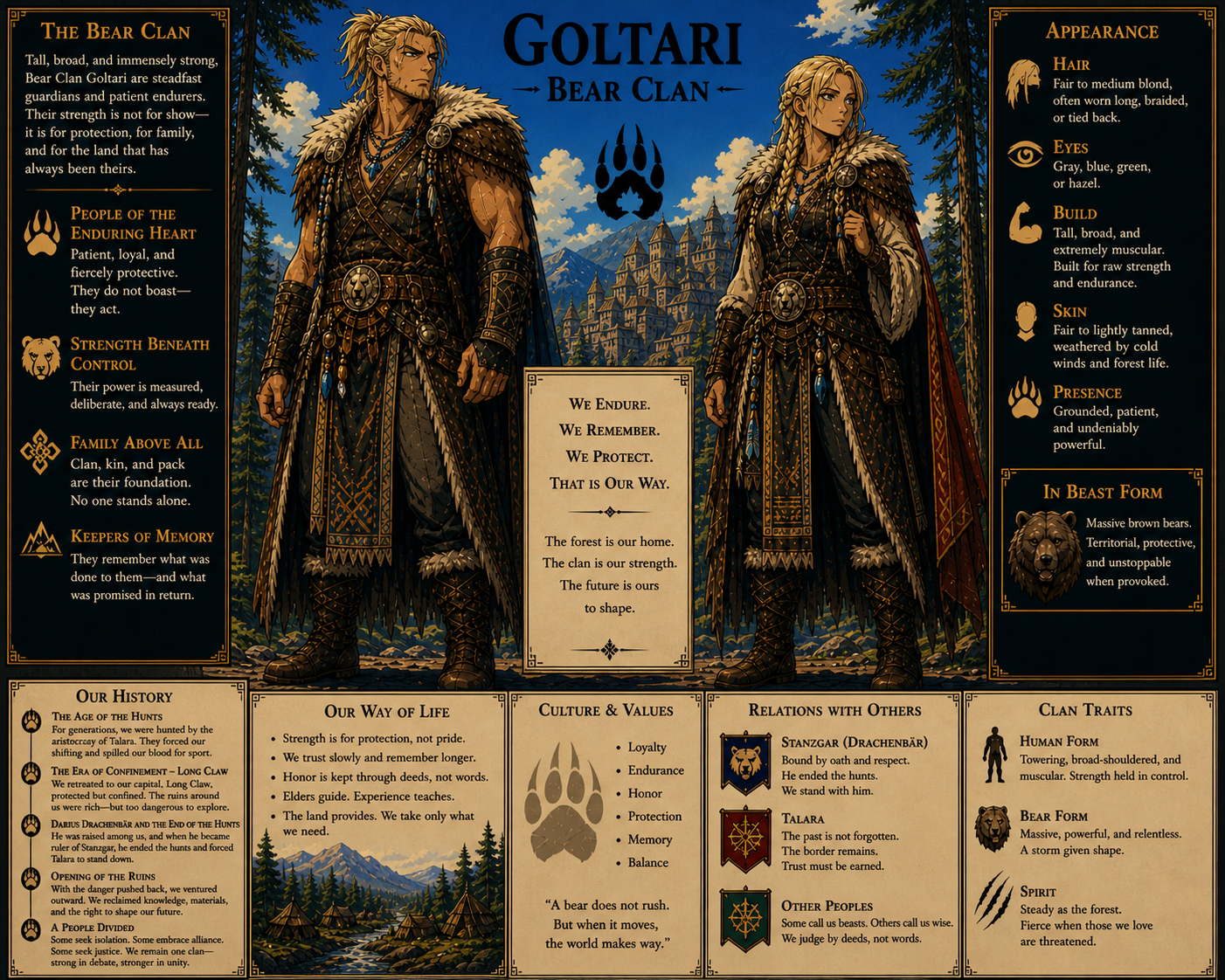
Associations
Other pages that reference or connect to this race
Referenced By
2Collections
Published collections that feature this race
Not in any collections yet
This race hasn't been published in any collections yet. Collections are curated groups of related content that help organize and showcase your world.
Tip: Collections are a great way to group related content together and share themed stories or worldbuilding elements with others.
Timelines
Timelines that reference or include this race
No timeline connections yet
This race isn't connected to any timelines yet. Timelines help organize events chronologically and show how your content fits into the broader history of your world.
Tip: Create timelines to organize important events in your world's history. Link characters, locations, and other content to specific events to build rich, interconnected narratives.
Shares
Discussion about this race
No shares yet
Be the first to start a discussion about this race by sharing it to the community stream.
Privacy & Sharing
Manage who can see and access this race
Current Status
refresh
This race is currently
Privacy Settings
Choose who can see and access this race
language Universe Privacy
This page belongs to a universe with its own privacy settings