
Categories
Dive Deeper
Page Stats
Navigation
Categories
Dive Deeper
Page Stats
Complete Details
All information about this character
Overview
Amita Blackclaw
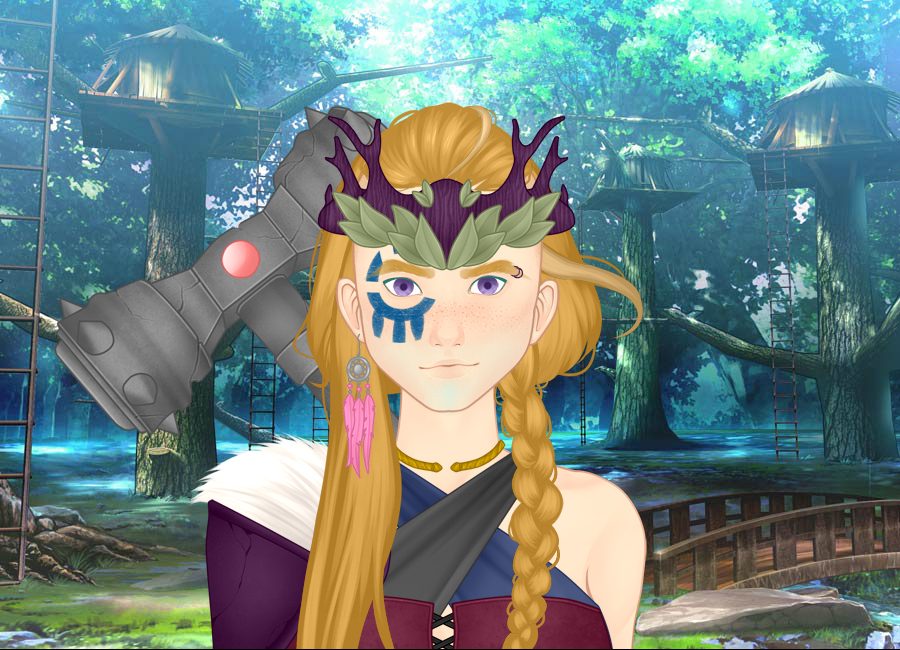
Amita Blackclaw is a tall, broad, and powerfully built Bear Clan Goltari from Vaelrún, a were-bear woman whose calm presence carries the dense, grounded strength of her people. With fair, weathered skin, dirty-blonde braids, violet eyes, and a blue tattoo curling around her right eye, she is difficult to mistake for anyone else, especially when dressed in her practical forge clothes, fur-lined travel gear, or transformation-conscious armor. Stern, punctual, and deeply motherly, Amita moves with controlled weight rather than haste, giving the impression of someone who is always holding back more force than she needs to show.
Born in Long Claw and later settled in Edgewood, Amita built a life as a blacksmith, wife, and mother before losing her husband in a tragic mining accident. That grief, combined with the inherited memory of Goltari persecution by Talara, left her guarded, distrustful of mining towns, hostile toward Tallarens, and slow to accept unfamiliar people or new ideas. Her life regained direction after meeting Arthur Greykeep during an adventure involving dark spirits in the same mine where her husband died, leading her to become one of the founding members of the Order of the Greykeep. Though she is a capable fighter and adventurer, Amita’s deepest motivation remains simple: to make a safe home, provide for her children, and ensure the people she loves have something solid to return to.
mom, but only by her children
Mother, founding member of the Order of the Greykeep
35
Female
Looks
N/A
Amita usually wears her dirty-blonde hair in thick, practical braids, keeping it controlled and out of the way while she works the forge, travels, or fights. Her hair is long and heavy, more rugged than decorative, and she tends to braid it tightly enough that it will not catch in tools, armor straps, or an opponent’s grip. Loose strands often escape around her face after a long day, softening her otherwise stern expression and giving her a slightly worn, lived-in appearance.
When she has time, especially among friends or family, Amita may take better care with the braids, tying them with simple bands, leather cords, or small keepsakes rather than ornamental jewelry. She is not vain about her hair, but she does maintain it carefully, partly out of practicality and partly because the routine is familiar and grounding. Her braids suit her well: strong, orderly, unpretentious, and quietly maternal without losing the sense that she is still very much a warrior.
Amita’s hair is a heavy dirty blonde, closer to weathered wheat, ash-gold, and pale brown than bright yellow. In strong sunlight it can catch warmer golden tones, but most of the time it appears muted and practical, with darker lowlights running through the braids and giving it a rough, natural texture. The color suits her well, feeling earthy rather than delicate, like something shaped by smoke, cold air, forge heat, and years of hard travel.
Amita is exceptionally tall, standing at 6'5", which makes her imposing even before her were-bear strength and build are taken into account. Among most humans she towers outright, and even among many Goltari she has the kind of height that makes people notice her the moment she enters a room. She does not carry herself dramatically, but her size gives her a natural authority: broad shoulders, long reach, and the steady presence of someone difficult to move once she has planted herself.
Her height is especially noticeable in the forge, where she seems built for the heavy labor of smithing, able to work large pieces of metal, lift tools, and endure long hours of physical strain without looking out of place. In battle, it gives her reach and leverage, making her well-suited to heavy weapons and close, punishing combat. Around her children and friends, however, that same height becomes protective rather than intimidating; she has the look of someone who can block a doorway simply by standing in it.
Amita weighs around 210 pounds, though that number reads differently on her frame than it would on a smaller person. At 6'5", her weight is spread across a tall, powerful body shaped by smithing, travel, fighting, and her Goltari were-bear heritage. She is not bulky in a soft or ornamental way; her build is dense, practical, and work-hardened, with the kind of muscle that comes from years of lifting iron, swinging hammers, carrying supplies, and enduring rough conditions.
Her weight gives her a grounded physical presence. She moves with calm certainty rather than speed or flourish, and when she plants her feet, she gives the impression that shifting her would take real effort. In combat, that weight supports her strength and balance, letting her absorb force, hold her ground, and put real power behind a blow. Outside of battle, it adds to her maternal protectiveness, making her feel sturdy, reliable, and difficult to break.
Amita’s most noticeable identifying mark is the blue tattoo curling around her right eye, a bold facial marking that makes her instantly recognizable even at a distance. Its shape draws attention to her violet eyes and gives her already stern expression a sharper, more watchful quality. Beyond the tattoo, Amita’s body carries the quieter marks of her life: heavy calluses across her palms and fingers from years of forge work, old burn marks along her hands and forearms, and small scars earned from travel, fighting, and handling hot metal. None of these are decorative, and she makes little effort to hide them.
She is also physically distinctive in less formal ways. Her height, broad were-bear build, thick braids, and fur-lined armor make her difficult to mistake for anyone else, especially when she is carrying herself with that calm, immovable posture. Her wedding band is another subtle but important identifying feature, not a wound or tattoo but something deeply tied to who she is. Even when armed and armored, it remains one of the clearest signs that Amita is not only a warrior and smith, but a widow, a mother, and someone who still carries her old life with her.
Amita has a tall, toned, work-hardened body shaped more by labor than vanity. Her strength comes from years at the forge, long travel, weapon practice, and the inherited power of a Goltari were-bear, giving her broad shoulders, strong arms, a sturdy back, and a grounded stance. She is not delicate or lightly athletic; even when still, she gives the impression of compressed force, like someone who can lift, carry, strike, and endure without complaint.
Her build is muscular but practical, with the dense strength of a smith rather than the sculpted look of someone training for display. Her hands, forearms, and shoulders are especially powerful from hammer work, while her height and weight give her a naturally imposing silhouette. There is still a maternal softness to her presence, especially around her children and close friends, but it rests over a frame that is undeniably durable, dangerous, and difficult to move once she has set herself in place.
Amita has fair skin with a hardy northern cast, the kind of complexion that fits a Goltari from the cool forests and old ruins of Vaelrún. Her skin is not delicate or porcelain-like; it is weathered by forge heat, cold air, travel, and hard outdoor living. Around the forge, her face and arms often take on a faint warmth from firelight and heat, while ash, soot, and old burns make her look more rugged than refined.
Her fair skin also makes her other features stand out sharply, especially her violet eyes, dirty-blonde braids, and the blue tattoo around her right eye. Small scars, burn marks, and calluses show more clearly against her complexion, giving her appearance a lived-in, practical quality. She does not look sheltered or ornamental; she looks like someone whose skin has been marked by work, weather, grief, and survival.
Goltari, were-bear
Amita’s eyes are a striking violet, unusual enough to stand out even against her height, build, and facial tattoo. The color gives her stare a memorable intensity, especially because she is not an overly expressive woman. When she is calm or withdrawn, her eyes can seem cold and assessing, as if she is weighing a person’s usefulness, honesty, and threat all at once. When she is with her children or close friends, however, the same violet softens noticeably, making her stern expression feel warmer and more protective.
Nature
Amita’s prejudices are rooted less in abstract hatred and more in memory, grief, and hard-earned suspicion. As a Bear Clan Goltari, she was raised with the long shadow of the Talaran hunts, and she hates Talarans on principle because, to her, Talara represents generations of fear, forced transformation, cruelty, and nobles who treated her people as animals to be chased. Even if she knows not every Talaran personally took part in those crimes, she has little patience for being asked to separate individuals from a history that still shaped the lives of her people. A Talaran has to earn neutrality from her, let alone trust.
Her distrust of mining towns is more personal. After losing her husband in a mining accident, Amita associates such places with negligence, greed, death, and the kind of underground darkness that takes people away from their families and gives nothing back. The later events involving dark spirits in that same mine only deepened the association, making mining settlements feel cursed, unsafe, and dishonest to her. She tends to assume that anyone profiting from a mine is hiding something, cutting corners, or ignoring danger until proven otherwise. This does not mean she cannot work with miners or mining communities, but she approaches them with a guarded eye, a short temper for excuses, and very little tolerance for people who treat cave-ins, disappearances, or workplace deaths as the cost of business.
This also extends into a broader suspicion of outsiders who arrive with tools, contracts, magic, or promises of improvement. Amita distrusts anything that asks for faith before it proves its worth, and she is especially wary of people who speak smoothly about progress while expecting others to bear the risk. Her prejudice is not loud or theatrical; it appears as silence, refusal, sharp questions, and a stubborn unwillingness to relax around people she has already decided are dangerous. She can change her mind, but slowly, and only when someone proves through action that they are reliable, respectful, and not another predator wearing civilized clothes.
Amita suffers from a mild form of Scent Memory, tied specifically to mines, cave-ins, and the dark spirit incident that followed her husband’s death. Certain smells can pull her sharply back into that trauma: damp stone, coal dust, old timber supports, stale underground air, blood on rock, cold iron, or the unnatural residue left by hostile spirits. These scents do not make her helpless, but they do put her on edge almost instantly, sharpening her temper and making her more guarded, suspicious, and physically ready to act.
When triggered, Amita becomes quieter rather than louder. She plants her feet, watches exits, keeps her hands free, and begins treating the space around her as if something is about to go wrong. Around her children or close companions, the reaction becomes even stronger, shifting quickly into protective vigilance. In severe moments, her were-bear instincts press closer to the surface, making her more likely to bare her teeth, growl under her breath, partially shift, or prepare for violence before she has fully reasoned through the danger.
Amita manages this condition through discipline, routine, and avoidance when possible. She can enter mines or underground spaces if she has to, but she does not do so casually, and she has little patience for anyone who dismisses the danger. To her, the reaction is not weakness; it is memory doing its job. Mines took her husband, nearly swallowed her life, and taught her that some places are never as empty as people claim.
Amita’s mannerisms are calm, deliberate, and heavily controlled, reflecting both her Bear Clan upbringing and her years as a mother, smith, and adventurer. She rarely rushes unless there is true danger, and even then her movements remain purposeful rather than frantic. When standing still, she plants her feet firmly and keeps her weight low, giving the impression that she could not easily be moved unless she allowed it. She tends to occupy space without apology, not by looming over people intentionally, but by simply being too solid and present to ignore.
She is punctual almost to the point of severity, arriving early, preparing tools before they are needed, and quietly judging those who waste time. Around people she trusts, her motherly side shows through in practical gestures rather than softness: adjusting a cloak, checking a weapon strap, handing someone food without asking, or silently placing herself between danger and whoever she considers under her care. She does not fuss loudly, but she notices discomfort, injury, hunger, and fear faster than most.
When suspicious, Amita becomes quieter. She watches hands, exits, tools, and shadows, asking short questions and giving little away in return. Her expression often settles into a stern, measuring stare, made more intense by her violet eyes and the tattoo around her right eye. In mines, underground spaces, or places that smell of damp stone and old timber, these habits sharpen into protective vigilance; she keeps her hands free, listens more than she speaks, and reacts poorly to anyone treating the danger lightly.
Amita’s motivations are rooted in home, family, and the need to make something solid after loss. More than glory, wealth, or politics, she wants to provide for her children and give them a life that cannot be easily taken from them. Her smithy, her work, her friendships, and her place among the Greykeep all tie back to the same desire: to build a home strong enough to survive grief, danger, and whatever darkness comes looking.
She is also driven by responsibility. As a Bear Clan Goltari, Amita was raised to believe that strength is not meant to stand alone, and she carries that belief into nearly everything she does. If people depend on her, she shows up. If something needs repaired, guarded, carried, or fought, she puts her hands to it. She does not need to be praised for this; usefulness matters more to her than recognition.
The death of her husband left her with a quiet fear of losing everything again, and much of her motivation comes from resisting that fear through action. She cannot undo what happened in the mine, but she can protect her children, keep her forge burning, stand beside her companions, and make sure others are not abandoned when danger closes in. Adventuring with the Greykeep gave her life direction again, but her deepest reason for continuing is simple: she wants the people she loves to have somewhere safe to return to, and she intends to be strong enough to hold that place open.
Amita’s flaws grow out of the same traits that make her dependable. She is steady, protective, and difficult to break, but she can also be deeply distrustful of anyone she has not personally accepted. She does not give strangers much benefit of the doubt, especially if they come from places or professions she already associates with danger. Once she decides someone is unreliable, careless, or predatory, changing her mind takes time and repeated proof, not words.
She is also stubbornly resistant to new things. Amita trusts what has endured, what has been tested, and what she can understand with her own hands. New tools, new customs, new plans, and especially new magic tend to irritate her until they prove useful and safe. This makes her practical, but it can also make her slow to adapt, dismissive of unfamiliar solutions, and frustrating to work with when a problem requires experimentation rather than proven habit.
Her dislike of magic is another weakness, despite having magical ability herself. She respects magic that behaves like a tool with clear limits, but she distrusts anything unstable, abstract, or too dependent on theory. This can cause her to underestimate magical allies, misread arcane threats, or reject help that would genuinely benefit her. At her worst, she treats magic as something dangerous until proven otherwise, which is not always fair.
Amita’s protectiveness can also become controlling. She wants to keep her children and companions safe, but she may do so by deciding what risks they are allowed to take, what truths they need to hear, or when they should be removed from danger. She does not mean to smother people, but fear of loss makes her heavy-handed. When her Scent Memory is triggered, this flaw becomes sharper: she grows quiet, severe, and ready for violence, sometimes responding to old danger before fully judging the danger in front of her.
Amita is a talented blacksmith with the practical instincts of someone who learned by doing rather than by formal theory. She has a strong eye for balance, durability, and usefulness, and she judges her work by whether it will survive real strain. Weapons are her favorite projects, but she is capable of making tools, fittings, repairs, armor pieces, and everyday metalwork when needed. Her forge work is not delicate or ornamental by default; it is sturdy, reliable, and made to last.
She is also a competent fighter, especially in close quarters where her size, strength, and grounded stance matter most. Amita is not flashy in combat and does not waste motion trying to impress anyone. She favors direct, forceful engagement, using her reach, weight, and discipline to hold ground, protect others, and end fights efficiently. Her warhammer suits this approach well, serving as a battlefield weapon rather than a smithing tool.
Her Bear Clan Goltari nature gives her additional talents beyond ordinary training. She is physically powerful, difficult to move, and highly enduring, with strong instincts for guarding space and reading danger through posture, scent, and sound. Her were-bear form makes her a terrifying force when unleashed, but one of her real talents is restraint: she does not transform carelessly, and she understands that strength must be controlled to be useful.
Amita also has quieter talents that matter just as much. She is good at preparation, maintenance, and practical problem-solving, often noticing what needs repaired, carried, reinforced, or replaced before others do. As a mother and long-time survivor, she has a sharp sense for when people are tired, hungry, injured, frightened, or lying badly. She may not be formally educated, but she is highly capable in the ways that keep people alive.
Amita’s hobbies are not sharply separated from her work, because she finds comfort in making things with her hands. Forging is her favorite way to spend quiet time, especially when she is not working under commission or pressure. Weapons are her preferred projects, not because she is bloodthirsty, but because she appreciates the discipline of making something that must be balanced, durable, and honest in its purpose. A badly made weapon lies to the person carrying it, and Amita has little patience for that.
When she is not making weapons, she still tends toward practical craft. She may repair tools, reinforce hinges, mend cookware, reshape damaged fittings, or improve equipment for friends without making much noise about it. These small acts are often how her affection shows; someone may wake to find a strap replaced, a knife sharpened, a cooking hook repaired, or a broken buckle quietly fixed because Amita noticed it before they did.
She also enjoys the calmer traditions of her people, especially shared meals, fireside stories, and quiet company where no one is expected to perform. She is not much for idle novelty, but she appreciates rituals that have proven their worth: maintaining her tools, tending the forge, braiding her hair, checking over her children’s belongings, or sitting in silence with people she trusts. To Amita, rest is best when it still leaves something steadier than it was before.
Amita’s personality is stern, practical, and deeply motherly, with a calmness that feels less gentle than immovable. She is not cold, but she is guarded, and most people have to earn their way past the first layer of suspicion before they see how much warmth she actually carries. Like many Bear Clan Goltari, she values usefulness, endurance, honesty, and proven action over charm or fine words. She does not care much for speeches, excuses, or cleverness that cannot survive contact with real trouble.
At her best, Amita is dependable in the most literal sense. She shows up when needed, works until the job is done, and quietly takes responsibility for people who have become hers. Her affection is usually practical rather than sentimental: food placed in someone’s hand, a repaired tool left where they will find it, a warning given before danger, or a stern correction meant to keep someone alive. She can seem severe, especially to younger or more reckless companions, but the severity almost always comes from care.
Her Bear Clan nature gives her personality a sense of restrained force. Amita is patient until she is not, slow to anger until a line is crossed, and difficult to intimidate because she has already survived grief, danger, and loss. She prefers routine, familiar methods, and things she can trust with her hands, which makes her steady but also resistant to change. Magic, unfamiliar customs, and untested people all make her wary. Once someone earns her trust, however, she becomes fiercely loyal, protective, and surprisingly gentle in quiet moments.
Underneath her discipline is a woman still shaped by mourning. The loss of her husband, her distrust of mines, and her Scent Memory have left her with a constant awareness that safety can vanish quickly. Because of that, she tries to build stability wherever she goes: a home, a forge, a family, a company of trusted friends. Amita is not driven by ambition or glory. She is driven by the need to keep the fire lit, the doors strong, the tools ready, and the people she loves close enough to protect.
Social
Amita’s favorite food is chocolate, especially dark, bitter chocolate with just enough sweetness to soften the edge. It is not a common everyday food for her, but a small luxury she values precisely because it is unnecessary. Most of her meals are practical, filling, and built around work, travel, and survival, so chocolate occupies a different place in her life: it is comfort, indulgence, and quiet reward rather than fuel. She tends to favor chocolate mixed with nuts, dried berries, coffee, smoked salt, or warming spices, preferring rich, strong flavors over delicate sweetness.
Because of this, chocolate is one of the easier ways to see Amita’s softer side. She may keep a small wrapped piece hidden in her belongings, save it for evenings after a hard day, or break it into careful portions to share with her children or closest friends. She is not openly sentimental about it, but accepting chocolate from someone is one of the few gestures that can noticeably soften her mood. For a woman who spends so much of her life making useful things and preparing for danger, chocolate is one of the rare pleasures she allows herself simply because it makes the world feel a little kinder.
Bear dogs of Woodgate
Amita’s favorite weapon is her warhammer, Bärentatze, a weapon she made with her husband not long after moving to Edgewood with him. The hammer is not simply a tool she carries into battle, nor just a well-made piece of metalwork; it is one of the last great things they created together during the happy beginning of their life there. Because of that, Bärentatze is tied to her marriage, her home, her grief, and the version of herself that existed before the mining accident took him from her.
The name Bärentatze, meaning something like “bear paw,” suits both the weapon and Amita herself. It is a heavy, punishing warhammer built for force, control, and finality rather than flourish. In her hands, it becomes an extension of her Bear Clan strength: direct, grounded, and difficult to stop once committed. She does not swing it wildly or theatrically. She uses it with the steady brutality of someone who understands weight, leverage, balance, and impact from years at the forge.
What makes Bärentatze especially significant is that Amita enchanted it with old magic, something she does not do lightly. Despite having magical ability, she dislikes magic and distrusts anything too unstable, abstract, or clever for its own sake. For her to place old magic into the hammer means the weapon had to matter deeply. The enchantment is not a casual improvement or decorative flourish; it is a binding of purpose, memory, and protection into something she already trusted with her hands.
Because of this, Bärentatze is one of the few magical things Amita fully accepts. She knows who made it. She knows why it was made. She knows what was put into it, and what it cost her emotionally to do so. To anyone else, it may be a dangerous enchanted warhammer. To Amita, it is proof that magic can be tolerable when it is anchored to craft, love, and necessity rather than arrogance or experimentation. She maintains it carefully, carries it seriously, and does not allow others to handle it casually. It is not only her favorite weapon; it is a surviving piece of her marriage.
Amita’s favorite possession is her wedding band, a small and deeply personal reminder of the life she built with her husband after leaving Vaelrún for Edgewood. Unlike Bärentatze, it is not useful in a fight, not valuable as a tool, and not something she keeps because it proves her strength. Its importance is quieter than that. It is the clearest surviving symbol of the home, marriage, and ordinary happiness she had before the mining accident took him from her.
She wears it with a seriousness that makes it feel almost sacred, though she would likely never describe it that way aloud. To Amita, the ring is not just a marker of widowhood; it is proof that her husband existed, that their life together mattered, and that the family they made did not end with his death. When she touches it, turns it, or checks that it is still there, the gesture is often unconscious, especially when she is anxious, grieving, or standing somewhere that reminds her of the mine.
Because Bear Clan Goltari place great importance on memory, the wedding band carries a weight beyond sentiment. It is a piece of remembered truth, something she can hold when stories, grief, and time begin to blur. She may own stronger things, rarer things, and more impressive things, but none of them matter in quite the same way. Her wedding band is small enough to fit in her palm, but to Amita, it carries the weight of a whole life she refuses to forget.
Amita’s favorite color is blue, especially deep, sturdy shades rather than pale or delicate ones. She favors blues that feel like cold twilight, old steel, storm clouds, deep water, or the dark cloth of a well-worn cloak. It is a color that suits her temperament: calm without being soft, somber without being hopeless, and steady without demanding attention.
Amita Blackclaw works as both a blacksmith and an adventurer, though she tends to understand the two roles as connected rather than separate. Smithing is her trade, her comfort, and the foundation of the life she built in Edgewood. She makes and repairs weapons, tools, fittings, armor pieces, and whatever practical metalwork her community needs, judging every piece by whether it will endure real use. Her work is sturdy rather than showy, shaped by Bear Clan pragmatism and the belief that a tool should never fail the person depending on it.
As a blacksmith, Amita is most drawn to weapons, not because she loves violence, but because weapons demand honesty. A blade, hammer, axe, or spear must be balanced, durable, and suited to its purpose, or it becomes a danger to the one carrying it. She respects that clarity. Her best work carries the same qualities she values in people: reliability, weight, purpose, and the ability to hold under pressure. She is also skilled enough to repair damaged gear in difficult conditions, making her especially useful to traveling companions and adventuring parties.
Her life as an adventurer began after meeting Arthur Greykeep during the events surrounding the dark spirits in the mine where her husband died. What started as a painful return to old grief became the beginning of a new purpose, drawing her into the company that would become the Order of the Greykeep. As an adventurer, Amita serves as a front-line fighter, protector, field smith, and steadying presence among more reckless or fragile companions. She is not driven by treasure or fame; she goes where she is needed, carries what others cannot, fixes what breaks, and stands between danger and the people she has chosen as her own.
Even when traveling, Amita remains a smith at heart. She notices weak hinges, poor weapon maintenance, cracked straps, damaged armor, and tools on the edge of failure. Around the Greykeep, her occupation often expands into a quiet form of caretaking: sharpening blades, repairing buckles, reinforcing shields, checking supplies, and making sure everyone’s equipment is ready before trouble arrives. To Amita, work is not only how she earns a living. It is how she protects, remembers, and keeps the world from falling apart one broken thing at a time.
Amita has little patience for politics in the formal sense, and generally cares only about who has authority over her home, who collects taxes, and whether those people interfere with her family or forge. She is not interested in speeches, factions, courtly maneuvering, or grand ideological arguments. To her, government proves its worth the same way a tool does: by whether it holds, whether it protects what it claims to protect, and whether ordinary people can live under it without being crushed.
Her Bear Clan Goltari background gives her a strong distrust of unchecked power. She was raised among a people whose history was shaped by the Talaran hunts, so nobles who treat others as property, sport, or disposable labor earn her immediate contempt. She does not care what titles such people hold or how old their bloodlines are. If authority cannot be challenged, replaced, or forced to answer for harm, Amita sees it as dangerous.
In Goltari terms, Amita likely leans toward the practical side of the Stanzgarian Supporters, though without being especially political about it. She understands why some Goltari prefer isolation, and she shares the old distrust that feeds the Crusaders, but her own life in Edgewood taught her that outside connections can become home, trade, friendship, and protection. She is willing to work with Stanzgarian structures when they function, especially when they keep Talaran aggression in check or provide stability for people like her children.
That said, Amita is not blindly loyal to any crown, council, or order. She judges rulers by their conduct, not their banners. A good ruler keeps roads safe, mines honest, workers alive, families fed, and monsters away from doorsteps. A bad ruler makes excuses while others bleed. In most political disputes, Amita’s position is simple: leave her home in peace, do not endanger her children, do not exploit working people, and do not expect her to respect authority that has not earned it.
Amita follows the Stanzgarian religion through the Church of the One, not because she was raised with it, but because it belonged to her husband. The Stanzgarian pantheon contains hundreds of gods, too many for her to feel drawn toward any single patron, and she has little interest in complicated theology or choosing one divine figure above the rest. Instead, the Church of the One suits her because it honors the entire pantheon as a unified whole, allowing her to respect the faith without needing to divide her devotion among individual gods.
Her practice is quiet, personal, and deeply tied to memory. Amita does not worship loudly, argue doctrine, or present herself as especially pious. She attends rites, keeps certain observances, and gives respect to the Church because doing so helps her remain connected to the man she loved. In that sense, her faith is less about mystical certainty and more about loyalty, grief, and continuity. It is another way of keeping part of her husband’s life alive within her own.
This also makes her religion slightly unusual for a Bear Clan Goltari. Her native worldview already respects spirits, memory, consequence, and the unseen weight carried by places and things, so she does not find the idea of many gods difficult to accept. What she appreciates about the Church of the One is its practicality: rather than asking her to understand or favor all 250 gods separately, it gathers them into one focus of reverence. That structure gives her something solid to hold onto, a single shape for a vast and complicated faith.
Amita’s relationship with religion is therefore sincere, but not soft. She may pray before dangerous journeys, observe rites for the dead, or make offerings in her husband’s memory, but she is unlikely to ask the gods to solve what she believes must be handled by mortal hands. To her, faith is not an excuse to stop working. It is a way to remember, endure, and keep walking beneath a sky watched by more powers than anyone can properly name.
Amita’s primary job is blacksmithing. Her forge in Edgewood is the center of her practical life, where she makes and repairs weapons, tools, fittings, armor pieces, and everyday metalwork for those who need reliable work. Though she also travels and fights as an adventurer with the Order of the Greykeep, smithing remains the trade that supports her household, expresses her skill, and gives her a steady place in the community.
History
Amita was born sometime in the fall. The season suits her well, carrying associations of cold mornings, harvest smoke, turning leaves, stored food, and preparation for harder days ahead. She is not the sort to make much ceremony of her birthday, though she would quietly appreciate being remembered by her children or closest friends. Practical gifts mean the most to her: good chocolate, quality metal, a useful tool, warm cloth, or something made by hand.
Amita Blackclaw was born in Long Claw, the great Goltari city of Vaelrún, and was raised among the Bear Clan with the values of her people: endurance, usefulness, memory, and controlled strength. She received no formal education in the scholarly sense, but she grew up learning the practical skills expected of her community, including labor, basic survival, clan traditions, and the early foundations of smithing. From a young age, she proved better with her hands than with speeches, drawn to metalwork because it rewarded patience, force, and honesty. A tool either held or it failed; a weapon was either balanced or it lied to the hand that carried it. Amita understood that kind of truth.
Eventually, Amita left Vaelrún and settled in Edgewood, where she met the Stanzgarian man who would become her husband. Their life together gave her something solid outside the homeland of her birth: a forge, a household, and a future she could build with her own hands. Not long after she moved there with him, the two forged her warhammer Bärentatze together, a weapon she later enchanted with old magic despite her distrust of magic in most forms. That act marked the hammer as something far more personal than a weapon. It became a surviving piece of their early marriage, crafted in the brief bright stretch before grief entered her life.
For a time, Amita’s life in Edgewood was happy. She established herself as a blacksmith, built a home with her husband, and eventually became the mother of Miri Blackclaw and Noct Blackclaw. Though stern and guarded by nature, she settled into the role of wife, mother, and craftswoman with a quiet devotion. Her husband’s Stanzgarian faith also became part of her life, leading her to follow the Church of the One in his memory rather than worship any single god of the vast Stanzgarian pantheon.
Amita Blackclaw was born in Long Claw, the great Goltari city of Vaelrún, and was raised among the Bear Clan with the values of her people: endurance, usefulness, memory, and controlled strength. She received no formal education in the scholarly sense, but she grew up learning the practical skills expected of her community, including labor, basic survival, clan traditions, and the early foundations of smithing. From a young age, she proved better with her hands than with speeches, drawn to metalwork because it rewarded patience, force, and honesty. A tool either held or it failed; a weapon was either balanced or it lied to the hand that carried it. Amita understood that kind of truth.
Eventually, Amita left Vaelrún and settled in Edgewood, where she met the Stanzgarian man who would become her husband. Their life together gave her something solid outside the homeland of her birth: a forge, a household, and a future she could build with her own hands. Not long after she moved there with him, the two forged her warhammer Bärentatze together, a weapon she later enchanted with old magic despite her distrust of magic in most forms. That act marked the hammer as something far more personal than a weapon. It became a surviving piece of their early marriage, crafted in the brief bright stretch before grief entered her life.
For a time, Amita’s life in Edgewood was happy. She established herself as a blacksmith, built a home with her husband, and eventually became the mother of Miri Blackclaw and Noct Blackclaw. Though stern and guarded by nature, she settled into the role of wife, mother, and craftswoman with a quiet devotion. Her husband’s Stanzgarian faith also became part of her life, leading her to follow the Church of the One in his memory rather than worship any single god of the vast Stanzgarian pantheon.
Though she would spend much of the rest of her life adventuring with the Greykeep, Amita never stopped being rooted in the things that first defined her: her children, her forge, her husband’s memory, and the stubborn need to make a home that could endure. She is not an adventurer out of restlessness or a hunger for glory. She adventures because danger found her home once, and she learned that sometimes the only way to keep the dark from returning is to meet it with hammer in hand.
Though she would spend much of the rest of her life adventuring with the Greykeep, Amita never stopped being rooted in the things that first defined her: her children, her forge, her husband’s memory, and the stubborn need to make a home that could endure. She is not an adventurer out of restlessness or a hunger for glory. She adventures because danger found her home once, and she learned that sometimes the only way to keep the dark from returning is to meet it with hammer in hand.
Family
none
Inventory
Overview
Details about this character's overview
Amita Blackclaw
Amita Blackclaw is a tall, broad, and powerfully built Bear Clan Goltari from Vaelrún, a were-bear woman whose calm presence carries the dense, grounded strength of her people. With fair, weathered skin, dirty-blonde braids, violet eyes, and a blue tattoo curling around her right eye, she is difficult to mistake for anyone else, especially when dressed in her practical forge clothes, fur-lined travel gear, or transformation-conscious armor. Stern, punctual, and deeply motherly, Amita moves with controlled weight rather than haste, giving the impression of someone who is always holding back more force than she needs to show.
Born in Long Claw and later settled in Edgewood, Amita built a life as a blacksmith, wife, and mother before losing her husband in a tragic mining accident. That grief, combined with the inherited memory of Goltari persecution by Talara, left her guarded, distrustful of mining towns, hostile toward Tallarens, and slow to accept unfamiliar people or new ideas. Her life regained direction after meeting Arthur Greykeep during an adventure involving dark spirits in the same mine where her husband died, leading her to become one of the founding members of the Order of the Greykeep. Though she is a capable fighter and adventurer, Amita’s deepest motivation remains simple: to make a safe home, provide for her children, and ensure the people she loves have something solid to return to.
mom, but only by her children
Mother, founding member of the Order of the Greykeep
35
Female
Looks
Details about this character's looks
N/A
Amita usually wears her dirty-blonde hair in thick, practical braids, keeping it controlled and out of the way while she works the forge, travels, or fights. Her hair is long and heavy, more rugged than decorative, and she tends to braid it tightly enough that it will not catch in tools, armor straps, or an opponent’s grip. Loose strands often escape around her face after a long day, softening her otherwise stern expression and giving her a slightly worn, lived-in appearance.
When she has time, especially among friends or family, Amita may take better care with the braids, tying them with simple bands, leather cords, or small keepsakes rather than ornamental jewelry. She is not vain about her hair, but she does maintain it carefully, partly out of practicality and partly because the routine is familiar and grounding. Her braids suit her well: strong, orderly, unpretentious, and quietly maternal without losing the sense that she is still very much a warrior.
Amita’s hair is a heavy dirty blonde, closer to weathered wheat, ash-gold, and pale brown than bright yellow. In strong sunlight it can catch warmer golden tones, but most of the time it appears muted and practical, with darker lowlights running through the braids and giving it a rough, natural texture. The color suits her well, feeling earthy rather than delicate, like something shaped by smoke, cold air, forge heat, and years of hard travel.
Amita is exceptionally tall, standing at 6'5", which makes her imposing even before her were-bear strength and build are taken into account. Among most humans she towers outright, and even among many Goltari she has the kind of height that makes people notice her the moment she enters a room. She does not carry herself dramatically, but her size gives her a natural authority: broad shoulders, long reach, and the steady presence of someone difficult to move once she has planted herself.
Her height is especially noticeable in the forge, where she seems built for the heavy labor of smithing, able to work large pieces of metal, lift tools, and endure long hours of physical strain without looking out of place. In battle, it gives her reach and leverage, making her well-suited to heavy weapons and close, punishing combat. Around her children and friends, however, that same height becomes protective rather than intimidating; she has the look of someone who can block a doorway simply by standing in it.
Amita weighs around 210 pounds, though that number reads differently on her frame than it would on a smaller person. At 6'5", her weight is spread across a tall, powerful body shaped by smithing, travel, fighting, and her Goltari were-bear heritage. She is not bulky in a soft or ornamental way; her build is dense, practical, and work-hardened, with the kind of muscle that comes from years of lifting iron, swinging hammers, carrying supplies, and enduring rough conditions.
Her weight gives her a grounded physical presence. She moves with calm certainty rather than speed or flourish, and when she plants her feet, she gives the impression that shifting her would take real effort. In combat, that weight supports her strength and balance, letting her absorb force, hold her ground, and put real power behind a blow. Outside of battle, it adds to her maternal protectiveness, making her feel sturdy, reliable, and difficult to break.
Amita’s most noticeable identifying mark is the blue tattoo curling around her right eye, a bold facial marking that makes her instantly recognizable even at a distance. Its shape draws attention to her violet eyes and gives her already stern expression a sharper, more watchful quality. Beyond the tattoo, Amita’s body carries the quieter marks of her life: heavy calluses across her palms and fingers from years of forge work, old burn marks along her hands and forearms, and small scars earned from travel, fighting, and handling hot metal. None of these are decorative, and she makes little effort to hide them.
She is also physically distinctive in less formal ways. Her height, broad were-bear build, thick braids, and fur-lined armor make her difficult to mistake for anyone else, especially when she is carrying herself with that calm, immovable posture. Her wedding band is another subtle but important identifying feature, not a wound or tattoo but something deeply tied to who she is. Even when armed and armored, it remains one of the clearest signs that Amita is not only a warrior and smith, but a widow, a mother, and someone who still carries her old life with her.
Amita has a tall, toned, work-hardened body shaped more by labor than vanity. Her strength comes from years at the forge, long travel, weapon practice, and the inherited power of a Goltari were-bear, giving her broad shoulders, strong arms, a sturdy back, and a grounded stance. She is not delicate or lightly athletic; even when still, she gives the impression of compressed force, like someone who can lift, carry, strike, and endure without complaint.
Her build is muscular but practical, with the dense strength of a smith rather than the sculpted look of someone training for display. Her hands, forearms, and shoulders are especially powerful from hammer work, while her height and weight give her a naturally imposing silhouette. There is still a maternal softness to her presence, especially around her children and close friends, but it rests over a frame that is undeniably durable, dangerous, and difficult to move once she has set herself in place.
Amita has fair skin with a hardy northern cast, the kind of complexion that fits a Goltari from the cool forests and old ruins of Vaelrún. Her skin is not delicate or porcelain-like; it is weathered by forge heat, cold air, travel, and hard outdoor living. Around the forge, her face and arms often take on a faint warmth from firelight and heat, while ash, soot, and old burns make her look more rugged than refined.
Her fair skin also makes her other features stand out sharply, especially her violet eyes, dirty-blonde braids, and the blue tattoo around her right eye. Small scars, burn marks, and calluses show more clearly against her complexion, giving her appearance a lived-in, practical quality. She does not look sheltered or ornamental; she looks like someone whose skin has been marked by work, weather, grief, and survival.
Goltari, were-bear
Amita’s eyes are a striking violet, unusual enough to stand out even against her height, build, and facial tattoo. The color gives her stare a memorable intensity, especially because she is not an overly expressive woman. When she is calm or withdrawn, her eyes can seem cold and assessing, as if she is weighing a person’s usefulness, honesty, and threat all at once. When she is with her children or close friends, however, the same violet softens noticeably, making her stern expression feel warmer and more protective.
Nature
Details about this character's nature
Amita’s prejudices are rooted less in abstract hatred and more in memory, grief, and hard-earned suspicion. As a Bear Clan Goltari, she was raised with the long shadow of the Talaran hunts, and she hates Talarans on principle because, to her, Talara represents generations of fear, forced transformation, cruelty, and nobles who treated her people as animals to be chased. Even if she knows not every Talaran personally took part in those crimes, she has little patience for being asked to separate individuals from a history that still shaped the lives of her people. A Talaran has to earn neutrality from her, let alone trust.
Her distrust of mining towns is more personal. After losing her husband in a mining accident, Amita associates such places with negligence, greed, death, and the kind of underground darkness that takes people away from their families and gives nothing back. The later events involving dark spirits in that same mine only deepened the association, making mining settlements feel cursed, unsafe, and dishonest to her. She tends to assume that anyone profiting from a mine is hiding something, cutting corners, or ignoring danger until proven otherwise. This does not mean she cannot work with miners or mining communities, but she approaches them with a guarded eye, a short temper for excuses, and very little tolerance for people who treat cave-ins, disappearances, or workplace deaths as the cost of business.
This also extends into a broader suspicion of outsiders who arrive with tools, contracts, magic, or promises of improvement. Amita distrusts anything that asks for faith before it proves its worth, and she is especially wary of people who speak smoothly about progress while expecting others to bear the risk. Her prejudice is not loud or theatrical; it appears as silence, refusal, sharp questions, and a stubborn unwillingness to relax around people she has already decided are dangerous. She can change her mind, but slowly, and only when someone proves through action that they are reliable, respectful, and not another predator wearing civilized clothes.
Amita suffers from a mild form of Scent Memory, tied specifically to mines, cave-ins, and the dark spirit incident that followed her husband’s death. Certain smells can pull her sharply back into that trauma: damp stone, coal dust, old timber supports, stale underground air, blood on rock, cold iron, or the unnatural residue left by hostile spirits. These scents do not make her helpless, but they do put her on edge almost instantly, sharpening her temper and making her more guarded, suspicious, and physically ready to act.
When triggered, Amita becomes quieter rather than louder. She plants her feet, watches exits, keeps her hands free, and begins treating the space around her as if something is about to go wrong. Around her children or close companions, the reaction becomes even stronger, shifting quickly into protective vigilance. In severe moments, her were-bear instincts press closer to the surface, making her more likely to bare her teeth, growl under her breath, partially shift, or prepare for violence before she has fully reasoned through the danger.
Amita manages this condition through discipline, routine, and avoidance when possible. She can enter mines or underground spaces if she has to, but she does not do so casually, and she has little patience for anyone who dismisses the danger. To her, the reaction is not weakness; it is memory doing its job. Mines took her husband, nearly swallowed her life, and taught her that some places are never as empty as people claim.
Amita’s mannerisms are calm, deliberate, and heavily controlled, reflecting both her Bear Clan upbringing and her years as a mother, smith, and adventurer. She rarely rushes unless there is true danger, and even then her movements remain purposeful rather than frantic. When standing still, she plants her feet firmly and keeps her weight low, giving the impression that she could not easily be moved unless she allowed it. She tends to occupy space without apology, not by looming over people intentionally, but by simply being too solid and present to ignore.
She is punctual almost to the point of severity, arriving early, preparing tools before they are needed, and quietly judging those who waste time. Around people she trusts, her motherly side shows through in practical gestures rather than softness: adjusting a cloak, checking a weapon strap, handing someone food without asking, or silently placing herself between danger and whoever she considers under her care. She does not fuss loudly, but she notices discomfort, injury, hunger, and fear faster than most.
When suspicious, Amita becomes quieter. She watches hands, exits, tools, and shadows, asking short questions and giving little away in return. Her expression often settles into a stern, measuring stare, made more intense by her violet eyes and the tattoo around her right eye. In mines, underground spaces, or places that smell of damp stone and old timber, these habits sharpen into protective vigilance; she keeps her hands free, listens more than she speaks, and reacts poorly to anyone treating the danger lightly.
Amita’s motivations are rooted in home, family, and the need to make something solid after loss. More than glory, wealth, or politics, she wants to provide for her children and give them a life that cannot be easily taken from them. Her smithy, her work, her friendships, and her place among the Greykeep all tie back to the same desire: to build a home strong enough to survive grief, danger, and whatever darkness comes looking.
She is also driven by responsibility. As a Bear Clan Goltari, Amita was raised to believe that strength is not meant to stand alone, and she carries that belief into nearly everything she does. If people depend on her, she shows up. If something needs repaired, guarded, carried, or fought, she puts her hands to it. She does not need to be praised for this; usefulness matters more to her than recognition.
The death of her husband left her with a quiet fear of losing everything again, and much of her motivation comes from resisting that fear through action. She cannot undo what happened in the mine, but she can protect her children, keep her forge burning, stand beside her companions, and make sure others are not abandoned when danger closes in. Adventuring with the Greykeep gave her life direction again, but her deepest reason for continuing is simple: she wants the people she loves to have somewhere safe to return to, and she intends to be strong enough to hold that place open.
Amita’s flaws grow out of the same traits that make her dependable. She is steady, protective, and difficult to break, but she can also be deeply distrustful of anyone she has not personally accepted. She does not give strangers much benefit of the doubt, especially if they come from places or professions she already associates with danger. Once she decides someone is unreliable, careless, or predatory, changing her mind takes time and repeated proof, not words.
She is also stubbornly resistant to new things. Amita trusts what has endured, what has been tested, and what she can understand with her own hands. New tools, new customs, new plans, and especially new magic tend to irritate her until they prove useful and safe. This makes her practical, but it can also make her slow to adapt, dismissive of unfamiliar solutions, and frustrating to work with when a problem requires experimentation rather than proven habit.
Her dislike of magic is another weakness, despite having magical ability herself. She respects magic that behaves like a tool with clear limits, but she distrusts anything unstable, abstract, or too dependent on theory. This can cause her to underestimate magical allies, misread arcane threats, or reject help that would genuinely benefit her. At her worst, she treats magic as something dangerous until proven otherwise, which is not always fair.
Amita’s protectiveness can also become controlling. She wants to keep her children and companions safe, but she may do so by deciding what risks they are allowed to take, what truths they need to hear, or when they should be removed from danger. She does not mean to smother people, but fear of loss makes her heavy-handed. When her Scent Memory is triggered, this flaw becomes sharper: she grows quiet, severe, and ready for violence, sometimes responding to old danger before fully judging the danger in front of her.
Amita is a talented blacksmith with the practical instincts of someone who learned by doing rather than by formal theory. She has a strong eye for balance, durability, and usefulness, and she judges her work by whether it will survive real strain. Weapons are her favorite projects, but she is capable of making tools, fittings, repairs, armor pieces, and everyday metalwork when needed. Her forge work is not delicate or ornamental by default; it is sturdy, reliable, and made to last.
She is also a competent fighter, especially in close quarters where her size, strength, and grounded stance matter most. Amita is not flashy in combat and does not waste motion trying to impress anyone. She favors direct, forceful engagement, using her reach, weight, and discipline to hold ground, protect others, and end fights efficiently. Her warhammer suits this approach well, serving as a battlefield weapon rather than a smithing tool.
Her Bear Clan Goltari nature gives her additional talents beyond ordinary training. She is physically powerful, difficult to move, and highly enduring, with strong instincts for guarding space and reading danger through posture, scent, and sound. Her were-bear form makes her a terrifying force when unleashed, but one of her real talents is restraint: she does not transform carelessly, and she understands that strength must be controlled to be useful.
Amita also has quieter talents that matter just as much. She is good at preparation, maintenance, and practical problem-solving, often noticing what needs repaired, carried, reinforced, or replaced before others do. As a mother and long-time survivor, she has a sharp sense for when people are tired, hungry, injured, frightened, or lying badly. She may not be formally educated, but she is highly capable in the ways that keep people alive.
Amita’s hobbies are not sharply separated from her work, because she finds comfort in making things with her hands. Forging is her favorite way to spend quiet time, especially when she is not working under commission or pressure. Weapons are her preferred projects, not because she is bloodthirsty, but because she appreciates the discipline of making something that must be balanced, durable, and honest in its purpose. A badly made weapon lies to the person carrying it, and Amita has little patience for that.
When she is not making weapons, she still tends toward practical craft. She may repair tools, reinforce hinges, mend cookware, reshape damaged fittings, or improve equipment for friends without making much noise about it. These small acts are often how her affection shows; someone may wake to find a strap replaced, a knife sharpened, a cooking hook repaired, or a broken buckle quietly fixed because Amita noticed it before they did.
She also enjoys the calmer traditions of her people, especially shared meals, fireside stories, and quiet company where no one is expected to perform. She is not much for idle novelty, but she appreciates rituals that have proven their worth: maintaining her tools, tending the forge, braiding her hair, checking over her children’s belongings, or sitting in silence with people she trusts. To Amita, rest is best when it still leaves something steadier than it was before.
Amita’s personality is stern, practical, and deeply motherly, with a calmness that feels less gentle than immovable. She is not cold, but she is guarded, and most people have to earn their way past the first layer of suspicion before they see how much warmth she actually carries. Like many Bear Clan Goltari, she values usefulness, endurance, honesty, and proven action over charm or fine words. She does not care much for speeches, excuses, or cleverness that cannot survive contact with real trouble.
At her best, Amita is dependable in the most literal sense. She shows up when needed, works until the job is done, and quietly takes responsibility for people who have become hers. Her affection is usually practical rather than sentimental: food placed in someone’s hand, a repaired tool left where they will find it, a warning given before danger, or a stern correction meant to keep someone alive. She can seem severe, especially to younger or more reckless companions, but the severity almost always comes from care.
Her Bear Clan nature gives her personality a sense of restrained force. Amita is patient until she is not, slow to anger until a line is crossed, and difficult to intimidate because she has already survived grief, danger, and loss. She prefers routine, familiar methods, and things she can trust with her hands, which makes her steady but also resistant to change. Magic, unfamiliar customs, and untested people all make her wary. Once someone earns her trust, however, she becomes fiercely loyal, protective, and surprisingly gentle in quiet moments.
Underneath her discipline is a woman still shaped by mourning. The loss of her husband, her distrust of mines, and her Scent Memory have left her with a constant awareness that safety can vanish quickly. Because of that, she tries to build stability wherever she goes: a home, a forge, a family, a company of trusted friends. Amita is not driven by ambition or glory. She is driven by the need to keep the fire lit, the doors strong, the tools ready, and the people she loves close enough to protect.
Social
Details about this character's social
Amita’s favorite food is chocolate, especially dark, bitter chocolate with just enough sweetness to soften the edge. It is not a common everyday food for her, but a small luxury she values precisely because it is unnecessary. Most of her meals are practical, filling, and built around work, travel, and survival, so chocolate occupies a different place in her life: it is comfort, indulgence, and quiet reward rather than fuel. She tends to favor chocolate mixed with nuts, dried berries, coffee, smoked salt, or warming spices, preferring rich, strong flavors over delicate sweetness.
Because of this, chocolate is one of the easier ways to see Amita’s softer side. She may keep a small wrapped piece hidden in her belongings, save it for evenings after a hard day, or break it into careful portions to share with her children or closest friends. She is not openly sentimental about it, but accepting chocolate from someone is one of the few gestures that can noticeably soften her mood. For a woman who spends so much of her life making useful things and preparing for danger, chocolate is one of the rare pleasures she allows herself simply because it makes the world feel a little kinder.
Bear dogs of Woodgate
Amita’s favorite weapon is her warhammer, Bärentatze, a weapon she made with her husband not long after moving to Edgewood with him. The hammer is not simply a tool she carries into battle, nor just a well-made piece of metalwork; it is one of the last great things they created together during the happy beginning of their life there. Because of that, Bärentatze is tied to her marriage, her home, her grief, and the version of herself that existed before the mining accident took him from her.
The name Bärentatze, meaning something like “bear paw,” suits both the weapon and Amita herself. It is a heavy, punishing warhammer built for force, control, and finality rather than flourish. In her hands, it becomes an extension of her Bear Clan strength: direct, grounded, and difficult to stop once committed. She does not swing it wildly or theatrically. She uses it with the steady brutality of someone who understands weight, leverage, balance, and impact from years at the forge.
What makes Bärentatze especially significant is that Amita enchanted it with old magic, something she does not do lightly. Despite having magical ability, she dislikes magic and distrusts anything too unstable, abstract, or clever for its own sake. For her to place old magic into the hammer means the weapon had to matter deeply. The enchantment is not a casual improvement or decorative flourish; it is a binding of purpose, memory, and protection into something she already trusted with her hands.
Because of this, Bärentatze is one of the few magical things Amita fully accepts. She knows who made it. She knows why it was made. She knows what was put into it, and what it cost her emotionally to do so. To anyone else, it may be a dangerous enchanted warhammer. To Amita, it is proof that magic can be tolerable when it is anchored to craft, love, and necessity rather than arrogance or experimentation. She maintains it carefully, carries it seriously, and does not allow others to handle it casually. It is not only her favorite weapon; it is a surviving piece of her marriage.
Amita’s favorite possession is her wedding band, a small and deeply personal reminder of the life she built with her husband after leaving Vaelrún for Edgewood. Unlike Bärentatze, it is not useful in a fight, not valuable as a tool, and not something she keeps because it proves her strength. Its importance is quieter than that. It is the clearest surviving symbol of the home, marriage, and ordinary happiness she had before the mining accident took him from her.
She wears it with a seriousness that makes it feel almost sacred, though she would likely never describe it that way aloud. To Amita, the ring is not just a marker of widowhood; it is proof that her husband existed, that their life together mattered, and that the family they made did not end with his death. When she touches it, turns it, or checks that it is still there, the gesture is often unconscious, especially when she is anxious, grieving, or standing somewhere that reminds her of the mine.
Because Bear Clan Goltari place great importance on memory, the wedding band carries a weight beyond sentiment. It is a piece of remembered truth, something she can hold when stories, grief, and time begin to blur. She may own stronger things, rarer things, and more impressive things, but none of them matter in quite the same way. Her wedding band is small enough to fit in her palm, but to Amita, it carries the weight of a whole life she refuses to forget.
Amita’s favorite color is blue, especially deep, sturdy shades rather than pale or delicate ones. She favors blues that feel like cold twilight, old steel, storm clouds, deep water, or the dark cloth of a well-worn cloak. It is a color that suits her temperament: calm without being soft, somber without being hopeless, and steady without demanding attention.
Amita Blackclaw works as both a blacksmith and an adventurer, though she tends to understand the two roles as connected rather than separate. Smithing is her trade, her comfort, and the foundation of the life she built in Edgewood. She makes and repairs weapons, tools, fittings, armor pieces, and whatever practical metalwork her community needs, judging every piece by whether it will endure real use. Her work is sturdy rather than showy, shaped by Bear Clan pragmatism and the belief that a tool should never fail the person depending on it.
As a blacksmith, Amita is most drawn to weapons, not because she loves violence, but because weapons demand honesty. A blade, hammer, axe, or spear must be balanced, durable, and suited to its purpose, or it becomes a danger to the one carrying it. She respects that clarity. Her best work carries the same qualities she values in people: reliability, weight, purpose, and the ability to hold under pressure. She is also skilled enough to repair damaged gear in difficult conditions, making her especially useful to traveling companions and adventuring parties.
Her life as an adventurer began after meeting Arthur Greykeep during the events surrounding the dark spirits in the mine where her husband died. What started as a painful return to old grief became the beginning of a new purpose, drawing her into the company that would become the Order of the Greykeep. As an adventurer, Amita serves as a front-line fighter, protector, field smith, and steadying presence among more reckless or fragile companions. She is not driven by treasure or fame; she goes where she is needed, carries what others cannot, fixes what breaks, and stands between danger and the people she has chosen as her own.
Even when traveling, Amita remains a smith at heart. She notices weak hinges, poor weapon maintenance, cracked straps, damaged armor, and tools on the edge of failure. Around the Greykeep, her occupation often expands into a quiet form of caretaking: sharpening blades, repairing buckles, reinforcing shields, checking supplies, and making sure everyone’s equipment is ready before trouble arrives. To Amita, work is not only how she earns a living. It is how she protects, remembers, and keeps the world from falling apart one broken thing at a time.
Amita has little patience for politics in the formal sense, and generally cares only about who has authority over her home, who collects taxes, and whether those people interfere with her family or forge. She is not interested in speeches, factions, courtly maneuvering, or grand ideological arguments. To her, government proves its worth the same way a tool does: by whether it holds, whether it protects what it claims to protect, and whether ordinary people can live under it without being crushed.
Her Bear Clan Goltari background gives her a strong distrust of unchecked power. She was raised among a people whose history was shaped by the Talaran hunts, so nobles who treat others as property, sport, or disposable labor earn her immediate contempt. She does not care what titles such people hold or how old their bloodlines are. If authority cannot be challenged, replaced, or forced to answer for harm, Amita sees it as dangerous.
In Goltari terms, Amita likely leans toward the practical side of the Stanzgarian Supporters, though without being especially political about it. She understands why some Goltari prefer isolation, and she shares the old distrust that feeds the Crusaders, but her own life in Edgewood taught her that outside connections can become home, trade, friendship, and protection. She is willing to work with Stanzgarian structures when they function, especially when they keep Talaran aggression in check or provide stability for people like her children.
That said, Amita is not blindly loyal to any crown, council, or order. She judges rulers by their conduct, not their banners. A good ruler keeps roads safe, mines honest, workers alive, families fed, and monsters away from doorsteps. A bad ruler makes excuses while others bleed. In most political disputes, Amita’s position is simple: leave her home in peace, do not endanger her children, do not exploit working people, and do not expect her to respect authority that has not earned it.
Amita follows the Stanzgarian religion through the Church of the One, not because she was raised with it, but because it belonged to her husband. The Stanzgarian pantheon contains hundreds of gods, too many for her to feel drawn toward any single patron, and she has little interest in complicated theology or choosing one divine figure above the rest. Instead, the Church of the One suits her because it honors the entire pantheon as a unified whole, allowing her to respect the faith without needing to divide her devotion among individual gods.
Her practice is quiet, personal, and deeply tied to memory. Amita does not worship loudly, argue doctrine, or present herself as especially pious. She attends rites, keeps certain observances, and gives respect to the Church because doing so helps her remain connected to the man she loved. In that sense, her faith is less about mystical certainty and more about loyalty, grief, and continuity. It is another way of keeping part of her husband’s life alive within her own.
This also makes her religion slightly unusual for a Bear Clan Goltari. Her native worldview already respects spirits, memory, consequence, and the unseen weight carried by places and things, so she does not find the idea of many gods difficult to accept. What she appreciates about the Church of the One is its practicality: rather than asking her to understand or favor all 250 gods separately, it gathers them into one focus of reverence. That structure gives her something solid to hold onto, a single shape for a vast and complicated faith.
Amita’s relationship with religion is therefore sincere, but not soft. She may pray before dangerous journeys, observe rites for the dead, or make offerings in her husband’s memory, but she is unlikely to ask the gods to solve what she believes must be handled by mortal hands. To her, faith is not an excuse to stop working. It is a way to remember, endure, and keep walking beneath a sky watched by more powers than anyone can properly name.
Amita’s primary job is blacksmithing. Her forge in Edgewood is the center of her practical life, where she makes and repairs weapons, tools, fittings, armor pieces, and everyday metalwork for those who need reliable work. Though she also travels and fights as an adventurer with the Order of the Greykeep, smithing remains the trade that supports her household, expresses her skill, and gives her a steady place in the community.
History
Details about this character's history
Amita was born sometime in the fall. The season suits her well, carrying associations of cold mornings, harvest smoke, turning leaves, stored food, and preparation for harder days ahead. She is not the sort to make much ceremony of her birthday, though she would quietly appreciate being remembered by her children or closest friends. Practical gifts mean the most to her: good chocolate, quality metal, a useful tool, warm cloth, or something made by hand.
Amita Blackclaw was born in Long Claw, the great Goltari city of Vaelrún, and was raised among the Bear Clan with the values of her people: endurance, usefulness, memory, and controlled strength. She received no formal education in the scholarly sense, but she grew up learning the practical skills expected of her community, including labor, basic survival, clan traditions, and the early foundations of smithing. From a young age, she proved better with her hands than with speeches, drawn to metalwork because it rewarded patience, force, and honesty. A tool either held or it failed; a weapon was either balanced or it lied to the hand that carried it. Amita understood that kind of truth.
Eventually, Amita left Vaelrún and settled in Edgewood, where she met the Stanzgarian man who would become her husband. Their life together gave her something solid outside the homeland of her birth: a forge, a household, and a future she could build with her own hands. Not long after she moved there with him, the two forged her warhammer Bärentatze together, a weapon she later enchanted with old magic despite her distrust of magic in most forms. That act marked the hammer as something far more personal than a weapon. It became a surviving piece of their early marriage, crafted in the brief bright stretch before grief entered her life.
For a time, Amita’s life in Edgewood was happy. She established herself as a blacksmith, built a home with her husband, and eventually became the mother of Miri Blackclaw and Noct Blackclaw. Though stern and guarded by nature, she settled into the role of wife, mother, and craftswoman with a quiet devotion. Her husband’s Stanzgarian faith also became part of her life, leading her to follow the Church of the One in his memory rather than worship any single god of the vast Stanzgarian pantheon.
Amita Blackclaw was born in Long Claw, the great Goltari city of Vaelrún, and was raised among the Bear Clan with the values of her people: endurance, usefulness, memory, and controlled strength. She received no formal education in the scholarly sense, but she grew up learning the practical skills expected of her community, including labor, basic survival, clan traditions, and the early foundations of smithing. From a young age, she proved better with her hands than with speeches, drawn to metalwork because it rewarded patience, force, and honesty. A tool either held or it failed; a weapon was either balanced or it lied to the hand that carried it. Amita understood that kind of truth.
Eventually, Amita left Vaelrún and settled in Edgewood, where she met the Stanzgarian man who would become her husband. Their life together gave her something solid outside the homeland of her birth: a forge, a household, and a future she could build with her own hands. Not long after she moved there with him, the two forged her warhammer Bärentatze together, a weapon she later enchanted with old magic despite her distrust of magic in most forms. That act marked the hammer as something far more personal than a weapon. It became a surviving piece of their early marriage, crafted in the brief bright stretch before grief entered her life.
For a time, Amita’s life in Edgewood was happy. She established herself as a blacksmith, built a home with her husband, and eventually became the mother of Miri Blackclaw and Noct Blackclaw. Though stern and guarded by nature, she settled into the role of wife, mother, and craftswoman with a quiet devotion. Her husband’s Stanzgarian faith also became part of her life, leading her to follow the Church of the One in his memory rather than worship any single god of the vast Stanzgarian pantheon.
Though she would spend much of the rest of her life adventuring with the Greykeep, Amita never stopped being rooted in the things that first defined her: her children, her forge, her husband’s memory, and the stubborn need to make a home that could endure. She is not an adventurer out of restlessness or a hunger for glory. She adventures because danger found her home once, and she learned that sometimes the only way to keep the dark from returning is to meet it with hammer in hand.
Though she would spend much of the rest of her life adventuring with the Greykeep, Amita never stopped being rooted in the things that first defined her: her children, her forge, her husband’s memory, and the stubborn need to make a home that could endure. She is not an adventurer out of restlessness or a hunger for glory. She adventures because danger found her home once, and she learned that sometimes the only way to keep the dark from returning is to meet it with hammer in hand.
Family
Details about this character's family
none
Inventory
Details about this character's inventory
Changelog
Details about this character's changelog
No changelog information yet
This section doesn't have any information filled in yet.
Notes
Details about this character's notes
No notes information yet
This section doesn't have any information filled in yet.
Gallery
Images and visual content for this character
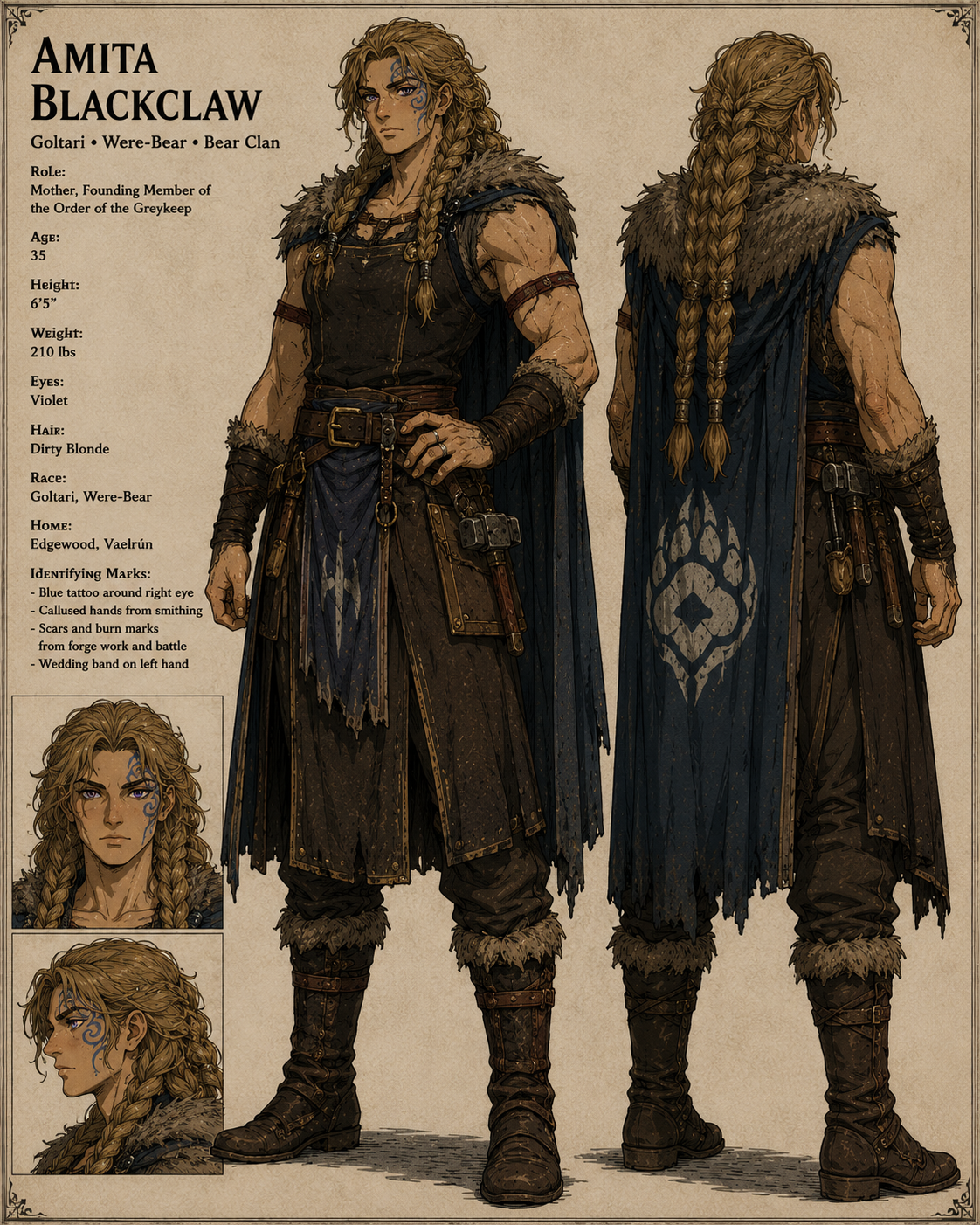


Associations
Other pages that reference or connect to this character
Referenced By
28Miri Blackclaw
Mothers
Noct Blackclaw
Mothers
Arthur Greykeep
Best friends
Andrew Hayes
Friends
Bärentatze
Original Owners
Arthur Greykeep
Companions
Goltari
Famous figures
Nicolas Drachenbär
Friends
Mariana Donnerhirsch
Friends
Lunara Greykeep
Friends
Anabala Weyrauch
Friends
Inara Matikar
Friends
Saren Morep
Friends
Ser'naia
Friends
Ser'naia
Love interests
Zor Matikar
Best friends
Calia Stanzgar
Enemies
Calia Stanzgar
Love interests
Goltari - Bear Clan
Famous figures
Creena Stanzgar
Best friends
Nendara
Best friends
Nendara
Love interests
Philipe Stanzgar
Love interests
Priscilla Stanzgar
Friends
Brìde Ceanadach
Best friends
Tobais Stanzgar
Friends
Kusha
Friends
Lucerza
Friends
Collections
Published collections that feature this character
Not in any collections yet
This character hasn't been published in any collections yet. Collections are curated groups of related content that help organize and showcase your world.
Tip: Collections are a great way to group related content together and share themed stories or worldbuilding elements with others.
Timelines
Timelines that reference or include this character
No timeline connections yet
This character isn't connected to any timelines yet. Timelines help organize events chronologically and show how your content fits into the broader history of your world.
Tip: Create timelines to organize important events in your world's history. Link characters, locations, and other content to specific events to build rich, interconnected narratives.
Shares
Discussion about this character
No shares yet
Be the first to start a discussion about this character by sharing it to the community stream.
Privacy & Sharing
Manage who can see and access this character
Current Status
refresh
This character is currently
Privacy Settings
Choose who can see and access this character
language Universe Privacy
This page belongs to a universe with its own privacy settings