Categories
Dive Deeper
Page Stats
Navigation
Categories
Dive Deeper
Page Stats
Complete Details
All information about this race
Overview
Kaeroth
The Kaeroth, more commonly known as giants, are immense humanoid beings shaped by the will of the Karpachi, existing as living vessels of immense and enduring power. Though they resemble scaled human forms, their presence carries a weight that sets them apart from all mortal life, marked by unnatural precision, stillness, and an overwhelming sense of imposed authority. Once rulers of a vast and tyrannical dominion, they now exist as scattered remnants, each an isolated entity rather than part of any true people or culture. Even in states that would be considered death, a Kaeroth is rarely inert, their will lingering in ways that can influence minds and surroundings alike. To encounter one is not simply to face a powerful being, but to stand before something that exists beyond the expectations of life, death, and form, a presence that does not diminish so much as endure.
Kaerothim (plural), Giants
Looks
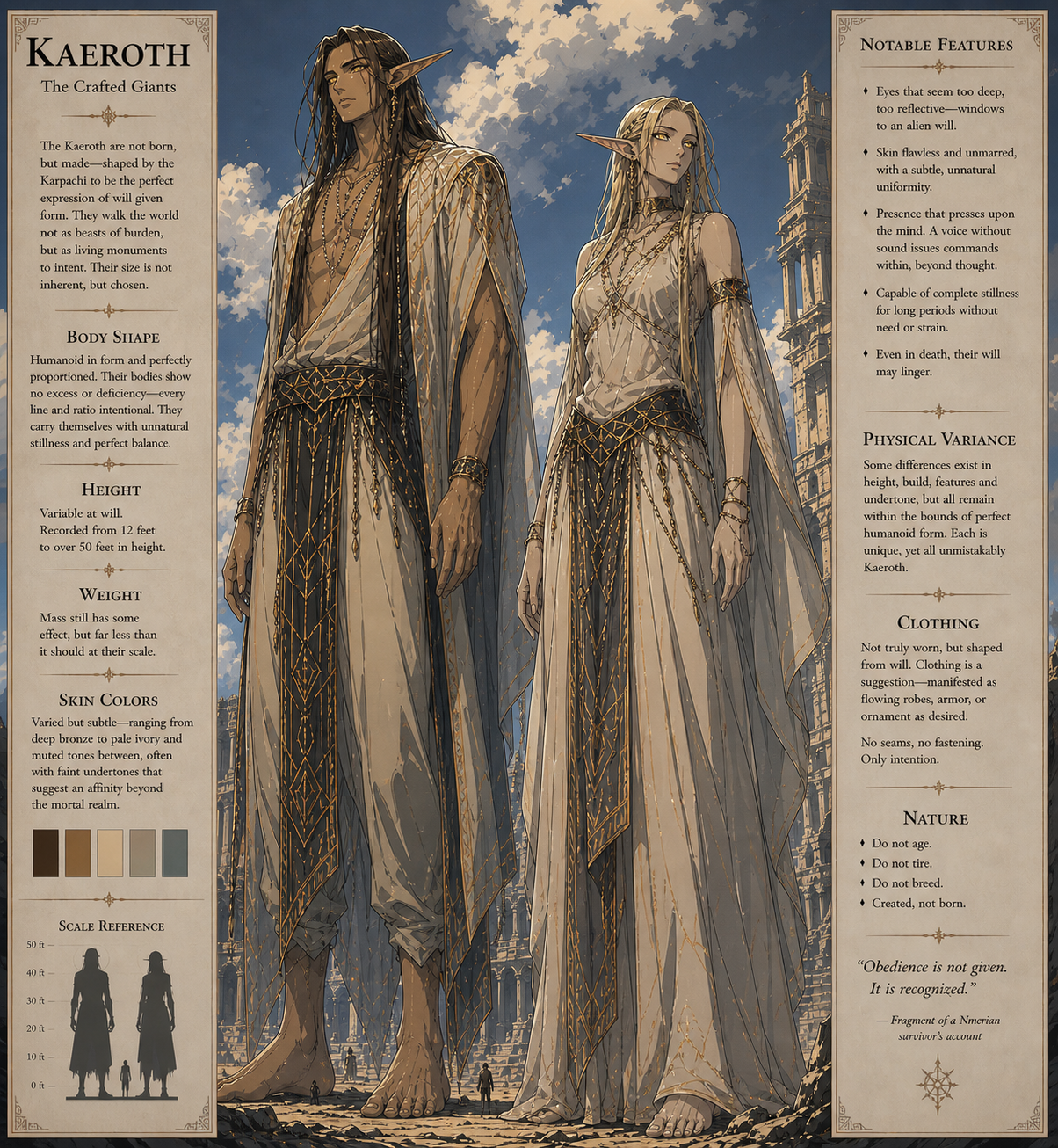
The Kaeroth possess a humanoid body structure defined not by natural development, but by deliberate design shaped to reflect the aesthetic preferences of the Karpachi. They stand upright with balanced proportions, bearing a strong resemblance to human form, though scaled to a size that places them far beyond any mortal race. Unlike many depictions of giants, their build is not exaggerated or brutish; instead, their proportions appear clean, symmetrical, and almost idealized, as though representing a perfected version of the humanoid form. Their limbs are neither overly thick nor elongated, but instead proportioned with a sense of purpose and structural harmony, giving them an appearance that feels intentional rather than biological. Their posture is naturally upright and composed, rarely shifting without purpose, and they carry themselves with a stillness that can feel unnatural to mortal observers. Movement among the Kaeroth is deliberate and efficient, lacking any wasted motion, and even at their immense scale they exhibit a level of control that seems incongruous with their size. What makes their form unsettling is not distortion, but precision—the sense that every aspect of their shape exists exactly as intended, resulting in a presence that feels complete, self-contained, and subtly at odds with the imperfect forms of mortal life.
The skin of the Kaeroth presents a wide range of coloration that often falls near human tones but rarely settles fully within them, instead carrying subtle deviations that set them apart upon closer inspection. Shades may include deep bronze, pale ivory, muted ash-gray, or other natural hues, though these are frequently accompanied by faint undertones that hint at something beyond mortal biology. In some individuals, a quiet affinity expresses itself through these undertones—skin that seems to hold a low, ember-like warmth, a cool pallor that subtly desaturates surrounding color, or a faintly storm-touched cast that shifts under changing light. These influences remain restrained, never manifesting as overt elemental transformation, but rather as a persistent impression that something lies beneath the surface. The skin itself appears smooth and uniform, lacking the small imperfections common to mortal flesh, and carries a density that suggests durability without appearing hardened or artificial. Altogether, the coloration of the Kaeroth reinforces their nature as crafted beings, each tone and variation feeling less like the product of environment or ancestry and more like a deliberate, cohesive expression of form.
The sparse records that have been obtained from the Nmerian giant slayers reveal that giants have been recorded at as little as twelve feet in height to in excess of fifty feet. These measurements, however, are not indicative of natural variation, but rather reflect the fluid nature of the Kaeroth form. Unlike mortal beings, their size is not governed by biology, age, or environment, but instead by will and the vast reserves of power they carry within themselves. A Kaeroth may present itself at a smaller scale when it suits its purpose, or rise to a towering height that dwarfs structures and landscapes alike, maintaining that form effortlessly. This control over their own scale gives their presence an added layer of unease, as their size feels chosen rather than inherent, shifting the perception of them from large creatures to entities that simply occupy as much space as they deem necessary. Even at their smallest recorded stature, they remain imposing beyond comparison to mortal races, and at their largest, they transcend conventional notions of physical scale, reinforcing their nature as beings not bound by the limitations of the material world.
Mass still has some effect on them, but not as much as a creature of their size should have.
The notable features of a Kaeroth are not expressed through grotesque or exaggerated anatomy, but through a collection of subtle traits that together create an overwhelming and deeply unsettling presence. Their eyes are often the most immediately remarked upon, appearing too focused, too reflective, or faintly luminous, as though something vast peers outward through them rather than simply seeing. Their bodies lack the minor imperfections common to mortal life—there are no visible flaws, no signs of strain, and no indication of fatigue—giving the impression of a form that exists in a constant state of complete function. Their stillness is particularly striking, as they are capable of remaining motionless for extended periods without the natural adjustments expected of living beings, making any movement feel deliberate and purposeful rather than reactive. When they do act, it is with precise, efficient motion that eliminates any sense of wasted effort. Beyond their physical qualities, the most defining feature of a Kaeroth is the effect they have on the mind of those in their presence. Individuals often report a clawing, intrusive voice at the back of their thoughts—not heard through the ears, but felt within the mind itself—issuing impressions of command rather than spoken words. This sensation can range from a faint pressure to an overwhelming directive force, creating the unsettling impression that obedience is not being requested, but expected as a fundamental truth. Even in states that would be considered death by mortal standards, Kaeroth forms may retain a lingering influence, further blurring the boundary between life, will, and presence in their kind.
Vast
Clothing is a suggestion for the Kaeroth, not to say they do not wear it, but one would be hard pressed to describe it with any consistency or certainty. What appears as attire is rarely bound to function, protection, or environment, and instead seems to exist as an extension of the individual Kaeroth’s will. In some instances, their form may be adorned in what resembles robes, armor, or layered garments, while in others it may present as something far less tangible—shifting, indistinct, or difficult to focus on directly. Observers often find that details of this “clothing” are difficult to recall after the fact, as though the mind struggles to fix its shape or substance in memory. It does not behave like mortal fabric, nor does it show signs of wear, fastening, or construction, instead appearing complete and self-presenting, much like the Kaeroth themselves. Whatever form it takes, it reflects not necessity, but identity, conveying aspects of presence, purpose, or authority in a way that feels imposed rather than worn, reinforcing the sense that the Kaeroth do not dress themselves to exist within the world, but shape their appearance as an extension of their existence within it.
Culture
The Kaeroth do not possess a culture in any meaningful sense in the present age, nor is there evidence that they ever maintained one in the way mortal races understand the concept. In their prime, they functioned not as a unified people bound by shared traditions, beliefs, or communal identity, but as a collection of immensely powerful individuals who imposed their will upon the world and those beneath them. Their dominion was structured through control and subjugation rather than cooperation, and what might be described as their “society” was more accurately a hierarchy of tyrants, each exerting authority over vast territories and enslaved populations. With their fall and subsequent near-eradication, even this loose structure has long since collapsed, leaving only isolated remnants scattered across the cosmos. Modern Kaeroth exist as singular entities, unbound by shared customs or collective purpose, their actions driven by individual will rather than cultural continuity. What remains of their former existence can be seen only in faint behavioral echoes—an ingrained expectation of obedience, a tendency toward domination, and an inherent assumption of authority—none of which stem from living tradition, but from the lingering nature of what they were created to be.
Overview
Details about this race's overview
Kaeroth
The Kaeroth, more commonly known as giants, are immense humanoid beings shaped by the will of the Karpachi, existing as living vessels of immense and enduring power. Though they resemble scaled human forms, their presence carries a weight that sets them apart from all mortal life, marked by unnatural precision, stillness, and an overwhelming sense of imposed authority. Once rulers of a vast and tyrannical dominion, they now exist as scattered remnants, each an isolated entity rather than part of any true people or culture. Even in states that would be considered death, a Kaeroth is rarely inert, their will lingering in ways that can influence minds and surroundings alike. To encounter one is not simply to face a powerful being, but to stand before something that exists beyond the expectations of life, death, and form, a presence that does not diminish so much as endure.
Kaerothim (plural), Giants
Looks
Details about this race's looks
The Kaeroth possess a humanoid body structure defined not by natural development, but by deliberate design shaped to reflect the aesthetic preferences of the Karpachi. They stand upright with balanced proportions, bearing a strong resemblance to human form, though scaled to a size that places them far beyond any mortal race. Unlike many depictions of giants, their build is not exaggerated or brutish; instead, their proportions appear clean, symmetrical, and almost idealized, as though representing a perfected version of the humanoid form. Their limbs are neither overly thick nor elongated, but instead proportioned with a sense of purpose and structural harmony, giving them an appearance that feels intentional rather than biological. Their posture is naturally upright and composed, rarely shifting without purpose, and they carry themselves with a stillness that can feel unnatural to mortal observers. Movement among the Kaeroth is deliberate and efficient, lacking any wasted motion, and even at their immense scale they exhibit a level of control that seems incongruous with their size. What makes their form unsettling is not distortion, but precision—the sense that every aspect of their shape exists exactly as intended, resulting in a presence that feels complete, self-contained, and subtly at odds with the imperfect forms of mortal life.
The skin of the Kaeroth presents a wide range of coloration that often falls near human tones but rarely settles fully within them, instead carrying subtle deviations that set them apart upon closer inspection. Shades may include deep bronze, pale ivory, muted ash-gray, or other natural hues, though these are frequently accompanied by faint undertones that hint at something beyond mortal biology. In some individuals, a quiet affinity expresses itself through these undertones—skin that seems to hold a low, ember-like warmth, a cool pallor that subtly desaturates surrounding color, or a faintly storm-touched cast that shifts under changing light. These influences remain restrained, never manifesting as overt elemental transformation, but rather as a persistent impression that something lies beneath the surface. The skin itself appears smooth and uniform, lacking the small imperfections common to mortal flesh, and carries a density that suggests durability without appearing hardened or artificial. Altogether, the coloration of the Kaeroth reinforces their nature as crafted beings, each tone and variation feeling less like the product of environment or ancestry and more like a deliberate, cohesive expression of form.
The sparse records that have been obtained from the Nmerian giant slayers reveal that giants have been recorded at as little as twelve feet in height to in excess of fifty feet. These measurements, however, are not indicative of natural variation, but rather reflect the fluid nature of the Kaeroth form. Unlike mortal beings, their size is not governed by biology, age, or environment, but instead by will and the vast reserves of power they carry within themselves. A Kaeroth may present itself at a smaller scale when it suits its purpose, or rise to a towering height that dwarfs structures and landscapes alike, maintaining that form effortlessly. This control over their own scale gives their presence an added layer of unease, as their size feels chosen rather than inherent, shifting the perception of them from large creatures to entities that simply occupy as much space as they deem necessary. Even at their smallest recorded stature, they remain imposing beyond comparison to mortal races, and at their largest, they transcend conventional notions of physical scale, reinforcing their nature as beings not bound by the limitations of the material world.
Mass still has some effect on them, but not as much as a creature of their size should have.
The notable features of a Kaeroth are not expressed through grotesque or exaggerated anatomy, but through a collection of subtle traits that together create an overwhelming and deeply unsettling presence. Their eyes are often the most immediately remarked upon, appearing too focused, too reflective, or faintly luminous, as though something vast peers outward through them rather than simply seeing. Their bodies lack the minor imperfections common to mortal life—there are no visible flaws, no signs of strain, and no indication of fatigue—giving the impression of a form that exists in a constant state of complete function. Their stillness is particularly striking, as they are capable of remaining motionless for extended periods without the natural adjustments expected of living beings, making any movement feel deliberate and purposeful rather than reactive. When they do act, it is with precise, efficient motion that eliminates any sense of wasted effort. Beyond their physical qualities, the most defining feature of a Kaeroth is the effect they have on the mind of those in their presence. Individuals often report a clawing, intrusive voice at the back of their thoughts—not heard through the ears, but felt within the mind itself—issuing impressions of command rather than spoken words. This sensation can range from a faint pressure to an overwhelming directive force, creating the unsettling impression that obedience is not being requested, but expected as a fundamental truth. Even in states that would be considered death by mortal standards, Kaeroth forms may retain a lingering influence, further blurring the boundary between life, will, and presence in their kind.
Vast
Clothing is a suggestion for the Kaeroth, not to say they do not wear it, but one would be hard pressed to describe it with any consistency or certainty. What appears as attire is rarely bound to function, protection, or environment, and instead seems to exist as an extension of the individual Kaeroth’s will. In some instances, their form may be adorned in what resembles robes, armor, or layered garments, while in others it may present as something far less tangible—shifting, indistinct, or difficult to focus on directly. Observers often find that details of this “clothing” are difficult to recall after the fact, as though the mind struggles to fix its shape or substance in memory. It does not behave like mortal fabric, nor does it show signs of wear, fastening, or construction, instead appearing complete and self-presenting, much like the Kaeroth themselves. Whatever form it takes, it reflects not necessity, but identity, conveying aspects of presence, purpose, or authority in a way that feels imposed rather than worn, reinforcing the sense that the Kaeroth do not dress themselves to exist within the world, but shape their appearance as an extension of their existence within it.
Traits
Details about this race's traits
No traits information yet
This section doesn't have any information filled in yet.
Culture
Details about this race's culture
The Kaeroth do not possess a culture in any meaningful sense in the present age, nor is there evidence that they ever maintained one in the way mortal races understand the concept. In their prime, they functioned not as a unified people bound by shared traditions, beliefs, or communal identity, but as a collection of immensely powerful individuals who imposed their will upon the world and those beneath them. Their dominion was structured through control and subjugation rather than cooperation, and what might be described as their “society” was more accurately a hierarchy of tyrants, each exerting authority over vast territories and enslaved populations. With their fall and subsequent near-eradication, even this loose structure has long since collapsed, leaving only isolated remnants scattered across the cosmos. Modern Kaeroth exist as singular entities, unbound by shared customs or collective purpose, their actions driven by individual will rather than cultural continuity. What remains of their former existence can be seen only in faint behavioral echoes—an ingrained expectation of obedience, a tendency toward domination, and an inherent assumption of authority—none of which stem from living tradition, but from the lingering nature of what they were created to be.
History
Details about this race's history
No history information yet
This section doesn't have any information filled in yet.
Notes
Details about this race's notes
No notes information yet
This section doesn't have any information filled in yet.
Gallery
Images and visual content for this race
Associations
Other pages that reference or connect to this race
Referenced By
1Collections
Published collections that feature this race
Not in any collections yet
This race hasn't been published in any collections yet. Collections are curated groups of related content that help organize and showcase your world.
Tip: Collections are a great way to group related content together and share themed stories or worldbuilding elements with others.
Timelines
Timelines that reference or include this race
No timeline connections yet
This race isn't connected to any timelines yet. Timelines help organize events chronologically and show how your content fits into the broader history of your world.
Tip: Create timelines to organize important events in your world's history. Link characters, locations, and other content to specific events to build rich, interconnected narratives.
Shares
Discussion about this race
No shares yet
Be the first to start a discussion about this race by sharing it to the community stream.
Privacy & Sharing
Manage who can see and access this race
Current Status
refresh
This race is currently
Privacy Settings
Choose who can see and access this race
language Universe Privacy
This page belongs to a universe with its own privacy settings