
Categories
Dive Deeper
Page Stats
Navigation
Categories
Dive Deeper
Page Stats
Complete Details
All information about this race
Overview
Uruvash
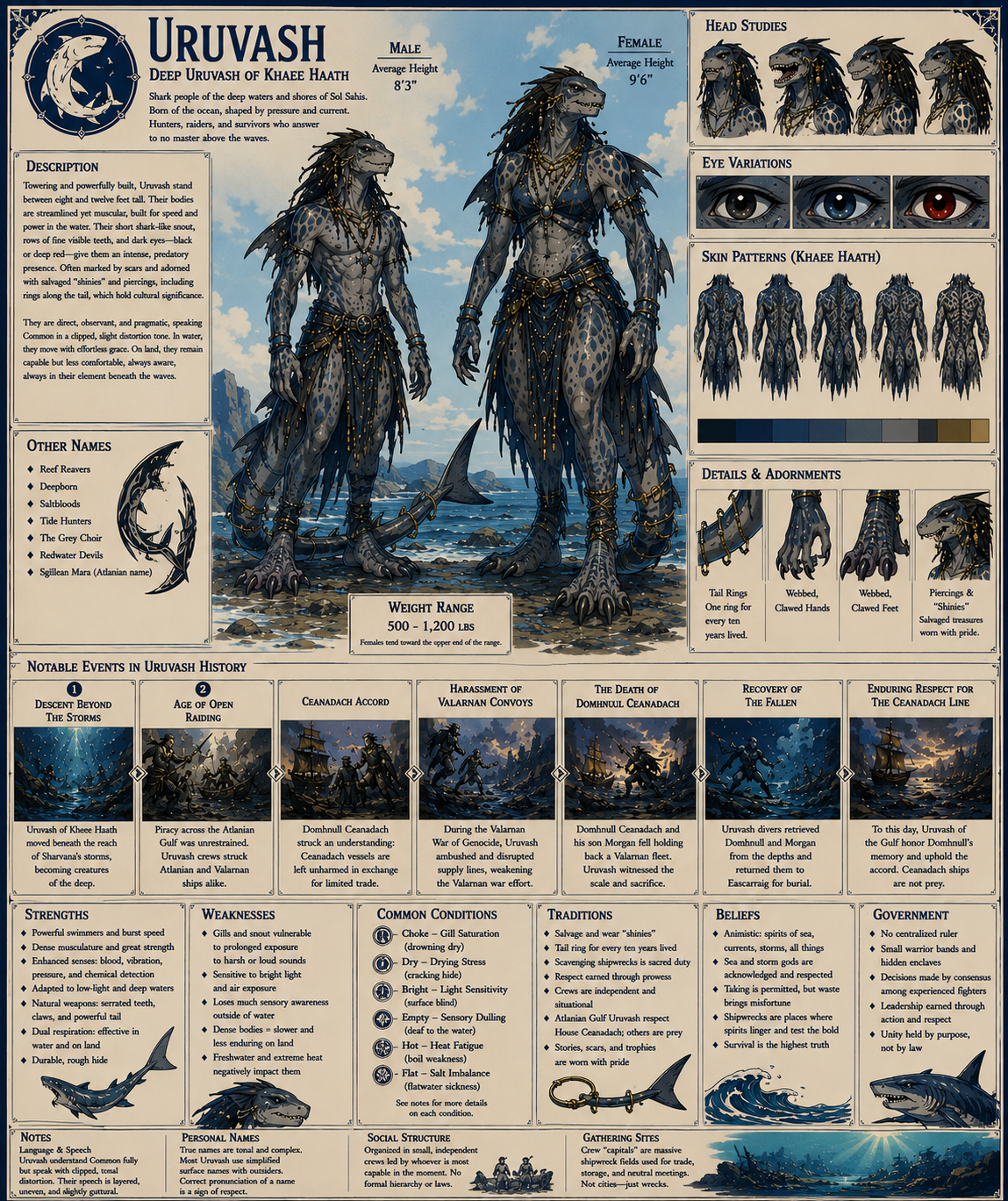
An average Uruvash is a towering, powerfully built figure standing between eight and twelve feet in height, their posture slightly hunched on land but unmistakably predatory in presence. Their body is streamlined yet muscular, with a broad upper frame tapering into a narrow waist, webbed and clawed hands and feet, and a long, flexible tail that shifts subtly for balance. A short shark-like snout and rows of visible teeth give their face a constant edge of danger, while dark eyes—black or deep red—watch with steady, deliberate focus, often shielded by simple goggles when above water. Their skin follows the patterns of their region, ranging from muted grey countershading to the striped, coral-toned hues of the Atlanian Gulf, and is often marked by scars and adorned with salvaged “shinies” worked into piercings across the body, including the culturally significant rings along the tail.
In behavior, an Uruvash individual is direct, efficient, and observant, speaking in clipped, slightly distorted Common shaped by their physiology. They are most at ease in the water, where their movements become fluid and controlled, but remain capable—if less comfortable—on land. Whether hunter, scavenger, or raider, they carry themselves with the quiet confidence of something that knows its place in the world: not above others, but firmly at the top of its domain.
Reef Reavers, Deepborn, Saltbloods, Tide Hunters, The Grey Choir, Redwater Devils, Sgàilean Mara (Atlanian name)
Looks
The Uruvash are humanoid apex marine predators, built for both hydrodynamic movement in water and functional mobility on land. They possess broad shoulders and a powerful upper torso that tapers into a narrower waist, with dense, compact musculature focused through the back, core, and legs, giving them a coiled, ready posture that leans slightly forward. Their head features a short shark-like snout and multiple rows of serrated teeth that are often visible even at rest, making even neutral expressions appear threatening. Their eyes are fully formed rather than lidless, typically deep black or dark red, but are sensitive to air and light, leading many Uruvash to wear protective goggles on the surface. Along the sides of their neck sit prominent gill slits, supported by lungs within a broad chest. A large dorsal fin runs along their back, with smaller fins present along the forearms and sometimes calves, aiding in maneuverability. Their arms end in webbed hands tipped with curved claws, capable of fine manipulation despite their predatory design, while their legs are fully bipedal and built for short bursts of movement rather than endurance; their feet mirror their hands, being both webbed and clawed. Extending from the base of the spine is a muscular shark-like tail used for propulsion in water and balance on land, rarely remaining still. Despite their aquatic nature, Uruvash possess thick, often dark hair that tends to slick back when wet. Sexual dimorphism is present but not extreme, with females possessing streamlined breasts and males typically exhibiting slightly broader builds and more pronounced fins, though both maintain the same overall predatory silhouette.
Uruvash are an exceptionally tall species, typically standing between 8 and 12 feet in height, with females generally larger and more imposing than males. However, when on land they rarely stand fully upright for long, instead carrying a slight forward hunch due to their mass, balance, and partially aquatic physiology, which shortens their apparent height in casual observation. When fully extended—whether in water or when deliberately straightening—they reveal their true scale, which can be startling to surface dwellers. As with other apex beings in Sol Saris, these measurements are not absolute, and individuals outside this range do exist, particularly among older or more dominant specimens, though such cases are uncommon.
Uruvash are an exceptionally tall species, typically standing between 8 and 12 feet in height, with females generally larger and more imposing than males. However, when on land they rarely stand fully upright for long, instead carrying a slight forward hunch due to their mass, balance, and partially aquatic physiology, which shortens their apparent height in casual observation. When fully extended—whether in water or when deliberately straightening—they reveal their true scale, which can be startling to surface dwellers. As with other apex beings in Sol Saris, these measurements are not absolute, and individuals outside this range do exist, particularly among older or more dominant specimens, though such cases are uncommon.
Uruvash are extremely heavy for their height, typically ranging between 500 and 1,200 pounds, with females tending toward the upper end due to their larger overall size and mass. Their weight comes not from bulk, but from dense musculature, reinforced skeletal structure, and a thick, water-adapted physiology that favors power and stability over lightness. Individuals from reef environments, such as those of the Atlanian Gulf, may fall slightly lighter within this range due to increased agility demands, while open-water or deep-ranging Uruvash often develop greater mass. On land, this weight contributes to their slightly hunched posture and heavy, deliberate movement, while in water it is offset by buoyancy, allowing them to move with far greater speed and grace.
Uruvash possess several heightened sensory and behavioral traits that reinforce their role as apex marine predators, all of which are rooted in biology rather than overt supernatural ability. They are extremely sensitive to blood and other chemical changes in water, allowing them to detect injury or distress with remarkable accuracy within their environment, making it difficult for wounded prey to remain hidden. In addition, they exhibit strong sensitivity to vibration and movement, capable of feeling disturbances through water and even nearby surfaces, rendering stealth against them in aquatic settings largely ineffective. Beyond their physical senses, Uruvash often provoke an instinctive reaction in other beings—a heightened sense of unease, alertness, or the feeling of being watched—which stems not from any magical aura but from their controlled movements, unblinking or slow-blinking gaze, and lack of familiar social cues, causing others to recognize them subconsciously as predators. Their speech further distinguishes them, as their dual respiratory system and unique anatomy produce a slightly layered, uneven vocal quality that can sound subtly distorted or off to surface listeners, though it remains fully understandable. Together, these traits make the Uruvash difficult to deceive, unsettling to engage with, and exceptionally effective hunters within their domain.
Uruvash display moderate physical variation shaped by both environment and sex, though all retain the same core predatory silhouette. Females are generally larger and more dominant in overall size, with slightly exaggerated feminine features—notably in the chest, hips, and overall body contour—while still maintaining a streamlined form suited for efficient swimming. Males, while smaller in overall height, tend to be more visibly bulky, with thicker upper bodies, heavier musculature, and broader frames, giving them a denser, more compact appearance. Beyond sexual dimorphism, regional differences also play a role: open-water Uruvash often appear longer and more tapered, reef-dwelling individuals show tighter builds with more pronounced striping and fin definition, and deepwater variants may exhibit more unusual proportions or subtle adaptations tied to low-light environments. Despite these differences, all Uruvash maintain the same underlying sense of coiled strength and aquatic efficiency.
Uruvash clothing is largely practical and situational, divided between what is worn in the water and what is used when interacting with surface dwellers. Among their own kind, they have little concept of modesty, but those who regularly deal with other races understand the discomfort it can cause and will dress accordingly when on land. Surface garments are typically simple, durable, and easily replaceable—loose wraps, reinforced cloth, leathers, or salvaged materials that can withstand repeated exposure to water and drying without falling apart, often secured in ways that accommodate their fins, tail, and overall build. In contrast, underwater attire is minimal, if present at all, and usually consists of items that do not hinder movement, such as bone fittings, kelp bindings, or light harnesses. Uruvash also commonly incorporate scavenged elements into both forms of dress, including fragments of shipwrecks, worked metal, coins, glass, and other surface-world objects, often worn as adornments or even embedded as piercings across various parts of their bodies. These additions serve less as decoration in a traditional sense and more as markers of experience, territory, or notable encounters, giving each individual a distinct and often intimidating appearance.
Traits
Uruvash possess a range of natural strengths that make them exceptionally effective predators and formidable opponents, particularly within aquatic environments. They are powerful swimmers capable of rapid bursts of speed, allowing them to close distance quickly or disengage just as fast, while their dense musculature grants them significant physical strength both in water and on land. Their heightened senses—especially their ability to detect blood and subtle changes in their surroundings—make it difficult to hide from them when injured or moving through their territory. Uruvash are also highly adapted to low-light and deep-water conditions, maintaining awareness and effectiveness where many other races would be nearly blind. Their natural weapons, including serrated teeth and clawed hands, make them dangerous even when unarmed, and their durable, slightly rough hide offers a degree of natural protection against minor cuts and abrasions. Additionally, their dual respiratory system allows them to operate in both aquatic and terrestrial environments, giving them flexibility that most marine predators lack. While not built for prolonged endurance on land, their ability to function effectively across both domains makes them uniquely versatile and difficult to counter.
Despite their formidable strengths, Uruvash possess several clear vulnerabilities tied to their physiology and environment. Their gills are highly sensitive, and direct strikes or damage to the neck area can be debilitating or even fatal, while their snout is another vulnerable point, making it particularly susceptible to blunt force or precise strikes. Although capable on land, Uruvash are not built for prolonged terrestrial activity; extended time out of water leads to fatigue, dehydration, and reduced sensory effectiveness, especially if their skin and gills begin to dry. Their eyes, while well-adapted to aquatic conditions, are sensitive to bright light and air exposure, requiring protection such as goggles—without which their vision can quickly degrade. Uruvash also rely heavily on waterborne sensory input, meaning in dry environments they lose much of their awareness and tracking ability, making them easier to evade. Their dense bodies, while powerful, can become a disadvantage on land, resulting in heavier, more deliberate movement and reduced endurance compared to fully terrestrial races. Additionally, environments that disrupt water conditions—such as extreme heat, pollution, or unfamiliar freshwater systems—can negatively impact their comfort and effectiveness, further limiting their advantage outside their natural domain.
Gill Saturation (Scholarly)
“Drowning Dry” / “Choke of the Gills” (Sailor Slang)
When out of water, Uruvash naturally produce a protective mucus to keep their gills moist and functional. In some cases, this production becomes excessive, causing the mucus to thicken and spread into the upper airways. This can lead to labored breathing, coughing, reduced stamina, and in severe cases partial suffocation if not cleared or managed.
Drying Stress (Scholarly)
“Cracking Hide” / “Sun Peel” (Sailor Slang)
Prolonged exposure to dry environments causes the skin and gill tissue to lose moisture, leading to irritation, cracking, and reduced efficiency in both respiration and sensory perception. Symptoms include fatigue, slowed reaction time, and general discomfort, worsening over time if not rehydrated.
Light Sensitivity (Scholarly)
“Surface Blind” / “Sunburned Eyes” (Sailor Slang)
Uruvash eyes are adapted to aquatic and often low-light conditions. Extended exposure to bright sunlight or dry air without protection can result in eye irritation, blurred vision, and headaches, often forcing individuals to rely on goggles or shaded environments when on land.
Sensory Dulling (Scholarly)
“Deaf to the Water” / “Empty Current” (Sailor Slang)
Outside of water, Uruvash lose access to much of their environmental awareness, particularly their ability to detect chemical traces and subtle vibrations. This can lead to delayed reactions, difficulty tracking targets, and a general sense of disorientation compared to their normal state.
Heat Fatigue (Scholarly)
“Boil Weakness” / “Sun Sickness” (Sailor Slang)
Uruvash are poorly adapted to high-temperature, dry climates. Excessive heat accelerates dehydration and places strain on both their respiratory systems, leading to heavy breathing, sluggish movement, and reduced combat effectiveness.
Salt Imbalance (Scholarly)
“Flatwater Sickness” / “Dead Sea Weakness” (Sailor Slang)
Extended time in freshwater or environments lacking proper salinity can disrupt their internal balance, causing muscle weakness, lethargy, and in severe cases disorientation. Most Uruvash will instinctively avoid such conditions or seek to correct them quickly.
Culture
Uruvash culture is shaped by survival, scavenging, and a long-standing relationship with the sea as both hunting ground and graveyard. Across all populations, they share a deep fascination with shipwrecks, treating them as sources of wealth, tools, and memory; recovering objects from the depths is both practical and culturally significant. Items taken from wrecks—coins, worked metal, glass, weapons, and other “shinies”—are rarely stored away, instead being worn openly as adornment or incorporated into piercings across the body, marking experience and personal history. Among these, tail piercings hold particular cultural importance, with Uruvash traditionally adding a ring for every ten years lived, a practice rooted in older traditions that tracked age, survival, and endurance.
Behavior varies notably between regions. The Uruvash of Kaee Haath maintain a formidable reputation as aggressive pirates and coastal predators, favoring direct action, opportunistic raids, and displays of strength that reinforce their dominance. In contrast, the Uruvash of the Atlanian Gulf are more restrained in their approach, having developed a cautious relationship with surrounding powers—most notably House Ceanadach, whose maritime influence they deliberately avoid provoking. Gulf Uruvash will often trade or interact indirectly with Ceanadach holdings, and as a result, tend to be more selective in their piracy, avoiding well-defended or politically sensitive targets while still readily attacking Valarnan, Stanzgarian, or otherwise unprotected vessels when opportunity presents itself. This relative stability has led some Gulf Uruvash to adopt a more relaxed disposition, enjoying the spoils of nearby civilization without fully integrating into it.
Despite these differences, all Uruvash place value on visible proof of experience. Scars, trophies, and salvaged items serve as a form of social language, communicating age, survival, and past actions without the need for explanation. There is little emphasis on formal hierarchy; respect is earned through demonstrated capability—successful hunts, survival against odds, or the claiming of valuable finds. Cooperation does occur, particularly during large scavenging efforts or coordinated attacks, but such arrangements are typically temporary and based on mutual benefit rather than lasting allegiance. Across both regions, Uruvash remain opportunistic, pragmatic, and deeply tied to the sea, navigating a balance between predation, scavenging, and selective interaction with the surface world.
Uruvash belief systems are rooted in a form of animism, centered on the idea that the world is inhabited by spirits—of the sea, currents, storms, and the countless things that move through them. These spirits are not distant or abstract, but immediate and ever-present, felt through shifting waters, changing tides, and the behavior of prey and predators alike. Uruvash do not typically build shrines or formal places of worship; instead, reverence is shown through action—respecting the sea’s dangers, taking only what can be claimed, and acknowledging the forces that shape survival. Shipwrecks in particular are often treated as spiritually significant, seen as places where the boundary between life, death, and the sea’s will has been made visible.
Among Uruvash who frequently interact with surface cultures—particularly those of the Atlanian Gulf—these animistic beliefs have expanded to incorporate foreign deities, though often in ways that reflect their own worldview. The Atlanian mountain gods are acknowledged, but interpreted through a maritime lens; mountains are understood less as landforms and more as vast, unmoving presences akin to submerged ridges or the distant, immovable boundaries of the deep, making their worship somewhat abstract and inconsistent. More directly embraced are the Stanzgarian god of storms and shipwright and the goddess of navigation and sailors, whose domains overlap more naturally with Uruvash life. These figures are respected as powerful forces that influence weather, vessels, and the movements of those who travel the sea, though even here, devotion is pragmatic rather than devotional in the traditional sense.
Across all Uruvash, belief is less about faith and more about acknowledgment of forces that cannot be controlled. Spirits and gods alike are not expected to protect or guide without reason; they are to be understood, respected, and, when possible, survived.
Uruvash do not maintain a unified government, instead organizing themselves into small, largely self-contained groups often referred to by outsiders as “crews.” Each crew operates independently, bound by proximity, shared activity, or mutual benefit rather than formal law or lineage. Leadership within a crew is informal and situational, typically falling to the most capable or experienced individual in a given moment—whether in hunting, scavenging, or conflict—rather than a fixed ruler. Authority is maintained through demonstrated competence and the ability to secure resources, not through titles or inherited position.
Despite this fragmentation, many Uruvash populations maintain a central gathering site often described as a “capital” by surface observers. These are not cities in the traditional sense, but vast accumulations of shipwrecks, debris fields, and sunken structures, layered over time into sprawling underwater hubs. These locations serve primarily as places to store, exchange, and redistribute scavenged goods, as well as neutral ground where different crews may interact without immediate conflict. While tensions can and do arise, there is an unspoken understanding that these sites are valuable enough to avoid outright destruction.
In regions such as the Atlanian Gulf, these wreck-capitals also function as intermediaries between Uruvash and surface trade networks, allowing goods to circulate without constant direct contact with land-based societies. Even so, participation in these hubs is voluntary, and no central authority governs them; influence within these spaces is fluid, shifting based on reputation, resources, and the ability to defend one’s claims. Overall, Uruvash governance is best understood not as a structured system, but as a network of independent groups connected by necessity, opportunity, and the shared realities of life at sea.
Uruvash technological development is largely opportunistic rather than innovative; they rarely produce complex tools of their own, instead favoring the adaptation and use of materials and equipment recovered from shipwrecks or taken from surface vessels. Any tool that can withstand prolonged exposure to saltwater without degrading is highly valued, while fragile or maintenance-heavy designs are typically ignored or quickly discarded. As a result, Uruvash equipment is often a mix of salvaged parts, reinforced materials, and modified surface-world craftsmanship, repurposed to function reliably in an aquatic environment.
There are, however, a few notable exceptions that are distinctly Uruvash in origin. One of their most recognizable weapons is a forearm-mounted blade, designed to collapse and sit flush along the arm when not in use, minimizing drag and obstruction while swimming. When deployed, the blade extends into a rigid, streamlined form, crafted from materials or treated in such a way that it moves through water with virtually no resistance, allowing for fast, efficient strikes. They have also developed a form of spear gun that utilizes controlled water-based magic to propel a spear or harpoon at high velocity, providing effective ranged capability even in dense underwater environments where traditional mechanisms would fail. Additionally, Uruvash are known for their signature goggles, designed specifically for surface use; these protect their eyes from drying and harsh light while maintaining clear vision, often constructed from salvaged glass and fitted into durable, watertight frames.
Overall, Uruvash technology reflects their nature—practical, adaptive, and environment-focused, with true innovation appearing only where necessity demands it.
Uruvash occupations are driven by practicality and survival, with most individuals taking on multiple roles as needed rather than adhering to rigid professions. Piracy and scavenging are the most prominent and culturally favored pursuits, with many Uruvash crews engaging in opportunistic raids on vulnerable vessels or salvaging shipwrecks for valuable materials, tools, and “shinies.” These activities serve as both a primary source of wealth and a measure of status, as successful hunts and valuable recoveries directly contribute to an individual’s reputation.
Domestic responsibilities are largely handled by those not actively engaged in raiding or deep salvage work—primarily the young, the old, and the infirm. These individuals maintain the day-to-day stability of Uruvash life, tending to docile sea creatures—similar to manatees—kept as livestock, overseeing their safety, movement, and use as a renewable resource. They also manage structural maintenance within wreck-based homes and communal sites, reinforcing unstable areas, organizing salvage, and adapting their environment to remain functional over time. While less visibly prestigious, these roles are essential, ensuring that crews remain supplied, sheltered, and capable of continued activity.
Other roles include hunters, who focus on natural predation; salvage specialists, who recover materials from particularly dangerous or deep wrecks; and traders or intermediaries, especially among Atlanian Gulf Uruvash, who manage indirect exchange with surface dwellers. While responsibilities shift based on need, all Uruvash contribute in some capacity, forming a flexible system where risk-heavy roles are taken by the capable, and sustaining roles are carried by those less suited to direct conflict, maintaining the overall balance of the group.
Uruvash economics are decentralized and largely non-monetary within their own communities, built around salvage, use-value, and exchange rather than formal currency systems. Most wealth originates from shipwreck scavenging and piracy, with goods such as metal, weapons, tools, glass, and other durable materials forming the backbone of their resource base. Within a crew, items are typically distributed based on need, usefulness, or demonstrated claim—those who recover or secure an item hold primary rights to it, though practical sharing is common when it benefits the group as a whole.
Trade does occur, both internally and externally. Among Uruvash, exchange is often informal, consisting of direct trades of useful items or favors rather than standardized pricing. More structured economic behavior appears at their wreck-capital sites, where large accumulations of salvage are stored, traded, or redistributed. These locations function as hubs of exchange, allowing crews to offload excess goods, acquire needed materials, or indirectly interact with other groups without constant conflict.
In regions such as the Atlanian Gulf, Uruvash engage more actively with surface economies, particularly through indirect or cautious trade with Ceanadach-controlled ports. In these cases, they may accept currency or trade goods in forms recognizable to surface dwellers, though this is typically pragmatic rather than cultural. Even so, Uruvash generally place little inherent value on money itself, favoring items that are durable, functional, or symbolically meaningful, such as metals, weapons, or unique salvage. Across all regions, their economy remains flexible and opportunistic, driven less by accumulation and more by what can be used, traded, or displayed.
Uruvash favor food that is fresh, rich, and taken directly from the sea, with a strong preference for recently killed prey. Fish—particularly large, fatty varieties—form the core of their diet, though they will consume a wide range of marine life including crustaceans, cephalopods, and larger ocean creatures when available. While they are fully capable of eating raw meat and often prefer it, Uruvash who interact with surface cultures—especially in the Atlanian Gulf—have adopted some methods of preparation such as drying, salting, or lightly cooking food, primarily for preservation rather than taste. They also make use of their domesticated, docile sea creatures as a reliable food source, though these are typically reserved for necessity rather than preference. Flavor-wise, Uruvash tend to favor strong, briny, and mineral-rich tastes, often incorporating sea plants, kelp, and naturally occurring salts. Among themselves, meals are less about ritual and more about sustenance, but particularly large or dangerous kills are often shared within a group, reinforcing bonds through the act of consumption.
Common Dishes
Fresh-Cut Reeffish
Thick slices of freshly killed fish, often eaten immediately after the hunt
Bloodfin Strips
Long cuts of fish or eel, consumed raw while still warm
Salt-Kelp Wraps
Strips of meat wrapped in kelp and left to absorb salt and flavor over time
Wreck-Dried Fillets
Fish preserved using air exposure on salvaged surfaces above water
Deepwater Flesh Cuts
Meat taken from large, slow-moving sea creatures, dense and rich
Cracked Shell Clusters
Crustaceans broken open and eaten whole, often shared in groups
Inkmarrow (Cephalopod Dish)
Soft-bodied sea creatures consumed with their internal fluids intact
Brine-Steeped Meat
Cuts left in naturally salty pools to intensify flavor and preserve texture
Coral-Scraped Flesh
Meat scraped thin and eaten in strips, sometimes lightly dried by current exposure
Herdstock Cuts
Meat taken from their domesticated sea creatures, typically reserved for times of need
Regional Dishes – Uruvash
While all Uruvash favor fresh, ocean-derived food, regional environments and cultural contact have led to distinct differences in preparation and preference.
Kaee Haath Uruvash (Open Ocean / Predator Culture)
Food here reflects their more aggressive, traditional lifestyle—fresh, raw, and immediate.
Hunter’s Share
A large kill divided on the spot, eaten fresh by the hunting group
Warmblood Cuts
Meat consumed immediately after the kill, prized for heat and vitality
Drift-Eel Strands
Long eel cuts eaten whole or torn apart mid-swim
Crushshell Feasts
Crustaceans broken open and shared communally after hunts
Deepbite Slabs
Thick chunks taken from large prey, often eaten without preparation
Tone:
Direct, violent, and efficient—food is part of the hunt, not separate from it.
Atlanian Gulf Uruvash (Reef / Trade-Influenced)
These Uruvash show more variation and outside influence, with basic preparation and flavoring becoming more common.
Salt-Cured Reef Cuts
Fish preserved using salt and time, allowing for storage and trade
Kelp-Wrapped Fillets
Meat wrapped and lightly fermented in kelp for flavor
Sun-Dried Strips
Prepared on wreckage above water, influenced by surface techniques
Spice-Rubbed Flesh
Trade-acquired spices used sparingly to enhance flavor
Brine-Steep Bites
Meat soaked in mineral-rich pools for preservation and taste
Tone:
Still practical, but more relaxed—food becomes something to enjoy, not just consume.
Prestige Foods & Cultural Meals
Certain foods carry status, memory, and recognition among the Uruvash. These are not everyday meals, but events tied to identity and achievement.
Leviathan Share
A meal taken from a massive sea creature—something that required coordination, risk, or exceptional strength to bring down.
Shared among all participants
Often eaten at the site of the kill or brought back to a communal location
The first cut is typically taken by the one who struck the decisive blow
Eating from a Leviathan marks you as someone who has faced something greater—and lived.
First Blood Meal
The first successful hunt of a young Uruvash.
Usually supervised or witnessed
The young hunter is expected to take and consume the first portion themselves
Often followed by quiet acknowledgment rather than celebration
Less ceremony, more recognition: you can feed yourself now.
Decade Feast
Tied to their tail ring tradition.
Occurs when an Uruvash adds a ring marking ten years lived
May involve:
A personally hunted kill
Or a shared meal with their crew
Not mandatory, but widely respected
Marks survival, not age—you endured ten years in the sea.
Wreck-Find Meal
Prepared when a particularly valuable or unusual wreck is discovered.
Food is shared while salvage is sorted
Often includes preserved or prepared foods (especially in the Gulf)
Serves as both a meal and a moment of assessment
“What did the sea give us this time?”
Last Catch
A quieter, more somber tradition.
When an older or dying Uruvash can no longer hunt
They may take one final, small catch
Consumed alone or with close companions
Not ritualized—but understood: this is the last hunt.
Summary Feel
Uruvash food culture sits on a spectrum:
Kaee Haath: Food is part of the hunt
Atlanian Gulf: Food begins to become experience
Prestige meals: Food becomes memory
History
Uruvash history is fragmented and rarely recorded in a traditional sense, but several key events—particularly among the populations of the Atlanian Gulf—have shaped their modern identity and relationships with surface powers.
Descent Beyond the Storms (Kaee Haath)
In their early history, Uruvash of Kaee Haath are believed to have lived closer to the surface waters, where they fell, at least in part, under the influence of Sharwan. Over time, groups of Uruvash moved deeper into the ocean, beyond the reach of the violent storms that defined their homeland and limited Sharwan’s influence. This gradual descent marked a turning point, allowing them to exist more independently, shaping their identity as creatures of the deep rather than subjects of surface-bound forces.
Age of Open Raiding (Atlanian Gulf)
Early interactions between Uruvash and surface civilizations in the Atlanian Gulf were defined by frequent and often brutal piracy. Uruvash crews targeted Atlanian and Valarnan vessels alike, developing a reputation as relentless raiders and opportunistic predators along major trade routes. During this period, there was little distinction between targets, and Uruvash activity contributed to persistent instability across the gulf.
Ceanadach Accord
A major shift occurred when Domhnull Ceanadach brokered an understanding with the Uruvash of the gulf. In exchange for ceasing attacks on Ceanadach vessels, the Uruvash were permitted limited trade and interaction with Eascarraig. This agreement did not formalize into a rigid treaty in the traditional sense, but it established a lasting precedent: Ceanadach ships were to be left alone, while other targets remained fair game. This arrangement allowed Gulf Uruvash to access surface goods more reliably and marked the beginning of their more restrained and selective approach to piracy.
Harassment of Valarnan Convoys
During the Valarnan War of Genocide, Uruvash of the Atlanian Gulf played a significant supporting role by targeting and disrupting Valarnan supply lines. Through ambushes and opportunistic strikes, they slowed convoy movement and contributed to the broader Atlanian effort, acting as an unpredictable and difficult-to-counter force beneath the waves.
The Death of Domhnull Ceanadach
In one of the defining moments of the conflict, Domhnull Ceanadach and his son Morgan Ceanadach were lost at sea while holding back a Valarnan invasion fleet. Some Uruvash were present during this final stand, witnessing the scale of the battle and the sacrifice made in defense of the gulf. This event is remembered not only as a turning point in the war, but as a moment that solidified the Uruvash respect for Domhnull.
Recovery of the Fallen
Following the battle, Uruvash divers undertook the difficult task of recovering the bodies of Domhnull and Morgan from the depths. Their return to Eascarraig for proper burial carried significant weight, both politically and culturally, reinforcing the bond—however unconventional—between the Uruvash and House Ceanadach.
Enduring Respect for the Ceanadach Line
Into the modern era, the Uruvash of the Atlanian Gulf continue to honor the memory of Domhnull Ceanadach. While they remain independent and opportunistic, they uphold the long-standing agreement not to prey upon Ceanadach vessels and maintain a cautious but stable relationship with Eascarraig. Among Gulf Uruvash, Domhnull is remembered not as a ruler, but as a figure worthy of respect—one who treated with them rather than simply opposing them, and whose death marked a moment the sea itself seemed to take notice of.
Notes
Pronunciation: oo-roo-vahsh or ur-oo-vash
Uruvash – Language & Pronunciation (Revised Canon)
The Uruvash are fully capable of understanding and learning the Common tongue, often to a high degree of fluency. Many who interact with surface cultures—especially along trade routes or contested waters—can follow complex conversation, negotiation, and even humor.
However, speaking Common is physically difficult for them.
Why They Struggle to Pronounce Words
Their speech limitations are not cultural—they are anatomical:
- Dual Breathing Structures (Lungs + Gills)
Air-based speech lacks the fluid control they naturally have underwater
Their breath comes in uneven pulses, especially when stressed or speaking quickly
This can create:
Slight pauses mid-word
Inconsistent volume
A “rolling” or broken cadence - Elongated Snout
Alters vowel shaping and airflow
Makes certain sounds (especially tight consonants like p, b, m) harder to form cleanly
Words can come out slightly distorted or softened - Teeth Structure
Multiple rows of sharp, forward-set teeth interfere with:
Precise consonants (t, s, f, v)
This gives their speech a:
Slight hiss
Occasional slurring effect - Natural Vocal Habits (From Water)
They are used to layered, resonant sound, not flat air vibration
Even when speaking correctly, their voice often carries:
A low undertone
A subtle “reverb” quality
Odd emphasis patterns
Why “Uruvash” Sounds the Way It Does
“Uruvash” is the closest stable approximation they can produce in air of their true name.
It’s not laziness.
It’s not disinterest.
It’s simply:
The most accurate shape their anatomy allows.
Cultural Implications
This creates a really nice distinction:
Uruvash don’t mind if outsiders slightly mispronounce “Uruvash”
→ It’s already an imperfect word to begin with
But personal names are different
Personal Names (Important Distinction)
To an Uruvash, a personal name is:
More precise
More intentional
Often tied to identity, history, or status
So when someone mispronounces a personal name:
It’s not just “getting it wrong”
It feels like:
Carelessness
Disrespect
Or failure to recognize the individual properly
Even if they intellectually understand the limitation, it can still irritate or offend them
Behavior Around This
An Uruvash may correct someone once or twice
After that:
They may shorten their name for you
Or stop responding to the incorrect version entirely
Some may even adopt a “surface name” for practicality—especially those dealing regularly with Atlanians, Nmerians, or Ceanadach sailors.
Nice Flavor Detail
When an Uruvash hears their name pronounced correctly (or very close to it), you could have:
A visible pause. A shift in posture. Immediate attention.
Because it’s rare—and it means something.
Conditions – Uruvash (Self-Terms)
Gill Saturation
“Choke”
Short, direct, and urgent. Used both as a warning and a state.
“Choke. Water.” (meaning: I can’t breathe properly, I need water now.)
Drying Stress
“Dry”
Broad, catch-all term for dehydration, skin stress, and discomfort.
“Too dry.” (we need to get back to water)
Light Sensitivity
“Bright”
Refers to harmful or overwhelming light conditions.
“Bright. Cover.” (get eye protection / reduce exposure)
Sensory Dulling
“Empty”
Refers to the loss of environmental awareness they normally rely on.
“Water empty.” (I can’t feel anything around me)
Heat Fatigue
“Hot”
Simple, but more severe in meaning than it sounds to others.
“Too hot.” (this environment is dangerous for us)
Salt Imbalance
“Flat”
Refers specifically to water lacking proper salinity.
“Water flat.” (this water is wrong—don’t stay here)
Personal Naming Conventions – Uruvash
Uruvash personal names are shaped by their physiology and natural mode of communication, making them difficult for most surface dwellers to hear, reproduce, or fully understand. A true Uruvash name is not a single clean word, but a short sequence of sounds, tones, and emphasis shifts, often combining a core vocalization with subtle changes in pitch or breath. When forced into air-based speech, these names are simplified into rough approximations that lose much of their original precision.
As a result, most Uruvash operate with two versions of their name: a true name used among their own kind, and a surface name used when dealing with outsiders.
True Names (Uruvash Use)
Typically short, often 1–3 syllables
Contain:
Hard consonants (k, r, t, sh)
Drawn-out vowels or slight tonal shifts
Meaning is not literal, but tied to identity, reputation, or experience
Examples (approximate representations):
“Khar’esh”
“Vruu-tak”
“Sha’rak”
“Tethru”
Even these are imperfect translations—the real name includes elements that cannot be fully spoken in air.
Surface Names (Outsider Use)
Because most non-Uruvash cannot reliably pronounce their true names, many adopt simplified versions when interacting with surface cultures.
These may be:
Shortened versions of their true name
Phonetically “smoothed” versions
Or entirely different names chosen for ease
Examples:
Khar’esh → “Kharesh” or “Kesh”
Vruu-tak → “Vrutak” or “Ruu”
Sha’rak → “Sharak”
Some long-term surface dwellers may even adopt names that fit local cultures, though this is less common.
Importance of Correct Naming
Unlike their species name, personal names carry significant weight.
A correctly spoken name = recognition and respect
A poorly spoken name = tolerated, but noted
Repeated disregard = irritation or offense
Most Uruvash understand the physical limitations of others, but effort matters. Someone who tries to get it right is treated differently than someone who doesn’t.
Name Changes
Uruvash may alter or replace their name over time based on:
Major hunts
Survival of significant events
Territorial claims
Personal transformation
These changes are not ceremonial in a formal sense—they are acknowledged through use, not declared.
Use in Speech
Among themselves, names are used sparingly:
Often only to get attention or mark importance
Context usually makes identity clear
In mixed company, names are used more frequently, especially when dealing with non-Uruvash.
Summary Feel
Uruvash names are not meant to be easily spoken—they are functional identifiers shaped by a body and environment unlike that of surface dwellers. What others hear is only an approximation, and while the Uruvash tolerate this, they do not consider it equal to being truly named.
Notes – Uruvash
Tail Ring Tradition
Uruvash mark the passage of time through tail piercings, adding a ring for every ten years lived. While rooted in older cultural practices tied to survival and endurance, the tradition persists into the modern era as a widely recognized indicator of age and experience.
Adornment & “Shinies”
Uruvash have a strong inclination toward collecting and displaying surface-world objects, particularly those recovered from shipwrecks. Coins, metal fragments, glass, and crafted items are often worn as jewelry or incorporated into extensive body piercings, serving as markers of personal history rather than simple decoration.
Speech Patterns
Due to their physiology, Uruvash speech in the Common tongue is often uneven, slightly distorted, or clipped, with unusual emphasis and pacing. Among themselves, communication is more efficient and context-driven, often using short, direct phrases rather than elaborate speech.
Naming Sensitivity
While Uruvash generally tolerate mispronunciation of their species name, personal names carry greater importance. Repeated misuse or disregard for an individual’s name may be taken as disrespect, even if initial errors are understood.
Surface Adaptation
Uruvash who spend extended time above water often adopt practical adjustments, such as wearing goggles for eye protection and choosing durable clothing suited for repeated wetting and drying. Despite this, they rarely fully adapt to terrestrial living.
Wreck-Capital Settlements
Their “capitals” are not cities in the traditional sense, but vast, layered accumulations of shipwrecks and debris, used for storage, trade, and temporary gathering. These locations are loosely maintained and highly functional rather than organized or permanent.
Selective Piracy (Atlanian Gulf)
Uruvash of the Atlanian Gulf deliberately avoid attacking Ceanadach vessels, maintaining a long-standing understanding that allows for trade and limited interaction. Other ships, particularly those of Valarnan or Stanzgarian origin, remain common targets when opportunity allows.
Predator Social Signals
Uruvash body language—stillness, direct gaze, and subtle tracking movements—can unintentionally create discomfort in other races, often triggering instinctive prey responses even outside of hostile situations.
Dual Environment Limitation
While capable of operating on land, Uruvash remain fundamentally tied to the sea. Extended time away from water reduces their effectiveness physically and sensorially, reinforcing their tendency to remain near or within aquatic environments.
View of Possessions
Ownership among Uruvash is practical rather than sentimental; items are valued for use, rarity, or story, and may change hands frequently unless personally significant. Highly distinctive or hard-won items, however, are rarely surrendered.
Overview
Details about this race's overview
Uruvash
An average Uruvash is a towering, powerfully built figure standing between eight and twelve feet in height, their posture slightly hunched on land but unmistakably predatory in presence. Their body is streamlined yet muscular, with a broad upper frame tapering into a narrow waist, webbed and clawed hands and feet, and a long, flexible tail that shifts subtly for balance. A short shark-like snout and rows of visible teeth give their face a constant edge of danger, while dark eyes—black or deep red—watch with steady, deliberate focus, often shielded by simple goggles when above water. Their skin follows the patterns of their region, ranging from muted grey countershading to the striped, coral-toned hues of the Atlanian Gulf, and is often marked by scars and adorned with salvaged “shinies” worked into piercings across the body, including the culturally significant rings along the tail.
In behavior, an Uruvash individual is direct, efficient, and observant, speaking in clipped, slightly distorted Common shaped by their physiology. They are most at ease in the water, where their movements become fluid and controlled, but remain capable—if less comfortable—on land. Whether hunter, scavenger, or raider, they carry themselves with the quiet confidence of something that knows its place in the world: not above others, but firmly at the top of its domain.
Reef Reavers, Deepborn, Saltbloods, Tide Hunters, The Grey Choir, Redwater Devils, Sgàilean Mara (Atlanian name)
Looks
Details about this race's looks
The Uruvash are humanoid apex marine predators, built for both hydrodynamic movement in water and functional mobility on land. They possess broad shoulders and a powerful upper torso that tapers into a narrower waist, with dense, compact musculature focused through the back, core, and legs, giving them a coiled, ready posture that leans slightly forward. Their head features a short shark-like snout and multiple rows of serrated teeth that are often visible even at rest, making even neutral expressions appear threatening. Their eyes are fully formed rather than lidless, typically deep black or dark red, but are sensitive to air and light, leading many Uruvash to wear protective goggles on the surface. Along the sides of their neck sit prominent gill slits, supported by lungs within a broad chest. A large dorsal fin runs along their back, with smaller fins present along the forearms and sometimes calves, aiding in maneuverability. Their arms end in webbed hands tipped with curved claws, capable of fine manipulation despite their predatory design, while their legs are fully bipedal and built for short bursts of movement rather than endurance; their feet mirror their hands, being both webbed and clawed. Extending from the base of the spine is a muscular shark-like tail used for propulsion in water and balance on land, rarely remaining still. Despite their aquatic nature, Uruvash possess thick, often dark hair that tends to slick back when wet. Sexual dimorphism is present but not extreme, with females possessing streamlined breasts and males typically exhibiting slightly broader builds and more pronounced fins, though both maintain the same overall predatory silhouette.
Uruvash are an exceptionally tall species, typically standing between 8 and 12 feet in height, with females generally larger and more imposing than males. However, when on land they rarely stand fully upright for long, instead carrying a slight forward hunch due to their mass, balance, and partially aquatic physiology, which shortens their apparent height in casual observation. When fully extended—whether in water or when deliberately straightening—they reveal their true scale, which can be startling to surface dwellers. As with other apex beings in Sol Saris, these measurements are not absolute, and individuals outside this range do exist, particularly among older or more dominant specimens, though such cases are uncommon.
Uruvash are an exceptionally tall species, typically standing between 8 and 12 feet in height, with females generally larger and more imposing than males. However, when on land they rarely stand fully upright for long, instead carrying a slight forward hunch due to their mass, balance, and partially aquatic physiology, which shortens their apparent height in casual observation. When fully extended—whether in water or when deliberately straightening—they reveal their true scale, which can be startling to surface dwellers. As with other apex beings in Sol Saris, these measurements are not absolute, and individuals outside this range do exist, particularly among older or more dominant specimens, though such cases are uncommon.
Uruvash are extremely heavy for their height, typically ranging between 500 and 1,200 pounds, with females tending toward the upper end due to their larger overall size and mass. Their weight comes not from bulk, but from dense musculature, reinforced skeletal structure, and a thick, water-adapted physiology that favors power and stability over lightness. Individuals from reef environments, such as those of the Atlanian Gulf, may fall slightly lighter within this range due to increased agility demands, while open-water or deep-ranging Uruvash often develop greater mass. On land, this weight contributes to their slightly hunched posture and heavy, deliberate movement, while in water it is offset by buoyancy, allowing them to move with far greater speed and grace.
Uruvash possess several heightened sensory and behavioral traits that reinforce their role as apex marine predators, all of which are rooted in biology rather than overt supernatural ability. They are extremely sensitive to blood and other chemical changes in water, allowing them to detect injury or distress with remarkable accuracy within their environment, making it difficult for wounded prey to remain hidden. In addition, they exhibit strong sensitivity to vibration and movement, capable of feeling disturbances through water and even nearby surfaces, rendering stealth against them in aquatic settings largely ineffective. Beyond their physical senses, Uruvash often provoke an instinctive reaction in other beings—a heightened sense of unease, alertness, or the feeling of being watched—which stems not from any magical aura but from their controlled movements, unblinking or slow-blinking gaze, and lack of familiar social cues, causing others to recognize them subconsciously as predators. Their speech further distinguishes them, as their dual respiratory system and unique anatomy produce a slightly layered, uneven vocal quality that can sound subtly distorted or off to surface listeners, though it remains fully understandable. Together, these traits make the Uruvash difficult to deceive, unsettling to engage with, and exceptionally effective hunters within their domain.
Uruvash display moderate physical variation shaped by both environment and sex, though all retain the same core predatory silhouette. Females are generally larger and more dominant in overall size, with slightly exaggerated feminine features—notably in the chest, hips, and overall body contour—while still maintaining a streamlined form suited for efficient swimming. Males, while smaller in overall height, tend to be more visibly bulky, with thicker upper bodies, heavier musculature, and broader frames, giving them a denser, more compact appearance. Beyond sexual dimorphism, regional differences also play a role: open-water Uruvash often appear longer and more tapered, reef-dwelling individuals show tighter builds with more pronounced striping and fin definition, and deepwater variants may exhibit more unusual proportions or subtle adaptations tied to low-light environments. Despite these differences, all Uruvash maintain the same underlying sense of coiled strength and aquatic efficiency.
Uruvash clothing is largely practical and situational, divided between what is worn in the water and what is used when interacting with surface dwellers. Among their own kind, they have little concept of modesty, but those who regularly deal with other races understand the discomfort it can cause and will dress accordingly when on land. Surface garments are typically simple, durable, and easily replaceable—loose wraps, reinforced cloth, leathers, or salvaged materials that can withstand repeated exposure to water and drying without falling apart, often secured in ways that accommodate their fins, tail, and overall build. In contrast, underwater attire is minimal, if present at all, and usually consists of items that do not hinder movement, such as bone fittings, kelp bindings, or light harnesses. Uruvash also commonly incorporate scavenged elements into both forms of dress, including fragments of shipwrecks, worked metal, coins, glass, and other surface-world objects, often worn as adornments or even embedded as piercings across various parts of their bodies. These additions serve less as decoration in a traditional sense and more as markers of experience, territory, or notable encounters, giving each individual a distinct and often intimidating appearance.
Traits
Details about this race's traits
Uruvash possess a range of natural strengths that make them exceptionally effective predators and formidable opponents, particularly within aquatic environments. They are powerful swimmers capable of rapid bursts of speed, allowing them to close distance quickly or disengage just as fast, while their dense musculature grants them significant physical strength both in water and on land. Their heightened senses—especially their ability to detect blood and subtle changes in their surroundings—make it difficult to hide from them when injured or moving through their territory. Uruvash are also highly adapted to low-light and deep-water conditions, maintaining awareness and effectiveness where many other races would be nearly blind. Their natural weapons, including serrated teeth and clawed hands, make them dangerous even when unarmed, and their durable, slightly rough hide offers a degree of natural protection against minor cuts and abrasions. Additionally, their dual respiratory system allows them to operate in both aquatic and terrestrial environments, giving them flexibility that most marine predators lack. While not built for prolonged endurance on land, their ability to function effectively across both domains makes them uniquely versatile and difficult to counter.
Despite their formidable strengths, Uruvash possess several clear vulnerabilities tied to their physiology and environment. Their gills are highly sensitive, and direct strikes or damage to the neck area can be debilitating or even fatal, while their snout is another vulnerable point, making it particularly susceptible to blunt force or precise strikes. Although capable on land, Uruvash are not built for prolonged terrestrial activity; extended time out of water leads to fatigue, dehydration, and reduced sensory effectiveness, especially if their skin and gills begin to dry. Their eyes, while well-adapted to aquatic conditions, are sensitive to bright light and air exposure, requiring protection such as goggles—without which their vision can quickly degrade. Uruvash also rely heavily on waterborne sensory input, meaning in dry environments they lose much of their awareness and tracking ability, making them easier to evade. Their dense bodies, while powerful, can become a disadvantage on land, resulting in heavier, more deliberate movement and reduced endurance compared to fully terrestrial races. Additionally, environments that disrupt water conditions—such as extreme heat, pollution, or unfamiliar freshwater systems—can negatively impact their comfort and effectiveness, further limiting their advantage outside their natural domain.
Gill Saturation (Scholarly)
“Drowning Dry” / “Choke of the Gills” (Sailor Slang)
When out of water, Uruvash naturally produce a protective mucus to keep their gills moist and functional. In some cases, this production becomes excessive, causing the mucus to thicken and spread into the upper airways. This can lead to labored breathing, coughing, reduced stamina, and in severe cases partial suffocation if not cleared or managed.
Drying Stress (Scholarly)
“Cracking Hide” / “Sun Peel” (Sailor Slang)
Prolonged exposure to dry environments causes the skin and gill tissue to lose moisture, leading to irritation, cracking, and reduced efficiency in both respiration and sensory perception. Symptoms include fatigue, slowed reaction time, and general discomfort, worsening over time if not rehydrated.
Light Sensitivity (Scholarly)
“Surface Blind” / “Sunburned Eyes” (Sailor Slang)
Uruvash eyes are adapted to aquatic and often low-light conditions. Extended exposure to bright sunlight or dry air without protection can result in eye irritation, blurred vision, and headaches, often forcing individuals to rely on goggles or shaded environments when on land.
Sensory Dulling (Scholarly)
“Deaf to the Water” / “Empty Current” (Sailor Slang)
Outside of water, Uruvash lose access to much of their environmental awareness, particularly their ability to detect chemical traces and subtle vibrations. This can lead to delayed reactions, difficulty tracking targets, and a general sense of disorientation compared to their normal state.
Heat Fatigue (Scholarly)
“Boil Weakness” / “Sun Sickness” (Sailor Slang)
Uruvash are poorly adapted to high-temperature, dry climates. Excessive heat accelerates dehydration and places strain on both their respiratory systems, leading to heavy breathing, sluggish movement, and reduced combat effectiveness.
Salt Imbalance (Scholarly)
“Flatwater Sickness” / “Dead Sea Weakness” (Sailor Slang)
Extended time in freshwater or environments lacking proper salinity can disrupt their internal balance, causing muscle weakness, lethargy, and in severe cases disorientation. Most Uruvash will instinctively avoid such conditions or seek to correct them quickly.
Culture
Details about this race's culture
Uruvash culture is shaped by survival, scavenging, and a long-standing relationship with the sea as both hunting ground and graveyard. Across all populations, they share a deep fascination with shipwrecks, treating them as sources of wealth, tools, and memory; recovering objects from the depths is both practical and culturally significant. Items taken from wrecks—coins, worked metal, glass, weapons, and other “shinies”—are rarely stored away, instead being worn openly as adornment or incorporated into piercings across the body, marking experience and personal history. Among these, tail piercings hold particular cultural importance, with Uruvash traditionally adding a ring for every ten years lived, a practice rooted in older traditions that tracked age, survival, and endurance.
Behavior varies notably between regions. The Uruvash of Kaee Haath maintain a formidable reputation as aggressive pirates and coastal predators, favoring direct action, opportunistic raids, and displays of strength that reinforce their dominance. In contrast, the Uruvash of the Atlanian Gulf are more restrained in their approach, having developed a cautious relationship with surrounding powers—most notably House Ceanadach, whose maritime influence they deliberately avoid provoking. Gulf Uruvash will often trade or interact indirectly with Ceanadach holdings, and as a result, tend to be more selective in their piracy, avoiding well-defended or politically sensitive targets while still readily attacking Valarnan, Stanzgarian, or otherwise unprotected vessels when opportunity presents itself. This relative stability has led some Gulf Uruvash to adopt a more relaxed disposition, enjoying the spoils of nearby civilization without fully integrating into it.
Despite these differences, all Uruvash place value on visible proof of experience. Scars, trophies, and salvaged items serve as a form of social language, communicating age, survival, and past actions without the need for explanation. There is little emphasis on formal hierarchy; respect is earned through demonstrated capability—successful hunts, survival against odds, or the claiming of valuable finds. Cooperation does occur, particularly during large scavenging efforts or coordinated attacks, but such arrangements are typically temporary and based on mutual benefit rather than lasting allegiance. Across both regions, Uruvash remain opportunistic, pragmatic, and deeply tied to the sea, navigating a balance between predation, scavenging, and selective interaction with the surface world.
Uruvash belief systems are rooted in a form of animism, centered on the idea that the world is inhabited by spirits—of the sea, currents, storms, and the countless things that move through them. These spirits are not distant or abstract, but immediate and ever-present, felt through shifting waters, changing tides, and the behavior of prey and predators alike. Uruvash do not typically build shrines or formal places of worship; instead, reverence is shown through action—respecting the sea’s dangers, taking only what can be claimed, and acknowledging the forces that shape survival. Shipwrecks in particular are often treated as spiritually significant, seen as places where the boundary between life, death, and the sea’s will has been made visible.
Among Uruvash who frequently interact with surface cultures—particularly those of the Atlanian Gulf—these animistic beliefs have expanded to incorporate foreign deities, though often in ways that reflect their own worldview. The Atlanian mountain gods are acknowledged, but interpreted through a maritime lens; mountains are understood less as landforms and more as vast, unmoving presences akin to submerged ridges or the distant, immovable boundaries of the deep, making their worship somewhat abstract and inconsistent. More directly embraced are the Stanzgarian god of storms and shipwright and the goddess of navigation and sailors, whose domains overlap more naturally with Uruvash life. These figures are respected as powerful forces that influence weather, vessels, and the movements of those who travel the sea, though even here, devotion is pragmatic rather than devotional in the traditional sense.
Across all Uruvash, belief is less about faith and more about acknowledgment of forces that cannot be controlled. Spirits and gods alike are not expected to protect or guide without reason; they are to be understood, respected, and, when possible, survived.
Uruvash do not maintain a unified government, instead organizing themselves into small, largely self-contained groups often referred to by outsiders as “crews.” Each crew operates independently, bound by proximity, shared activity, or mutual benefit rather than formal law or lineage. Leadership within a crew is informal and situational, typically falling to the most capable or experienced individual in a given moment—whether in hunting, scavenging, or conflict—rather than a fixed ruler. Authority is maintained through demonstrated competence and the ability to secure resources, not through titles or inherited position.
Despite this fragmentation, many Uruvash populations maintain a central gathering site often described as a “capital” by surface observers. These are not cities in the traditional sense, but vast accumulations of shipwrecks, debris fields, and sunken structures, layered over time into sprawling underwater hubs. These locations serve primarily as places to store, exchange, and redistribute scavenged goods, as well as neutral ground where different crews may interact without immediate conflict. While tensions can and do arise, there is an unspoken understanding that these sites are valuable enough to avoid outright destruction.
In regions such as the Atlanian Gulf, these wreck-capitals also function as intermediaries between Uruvash and surface trade networks, allowing goods to circulate without constant direct contact with land-based societies. Even so, participation in these hubs is voluntary, and no central authority governs them; influence within these spaces is fluid, shifting based on reputation, resources, and the ability to defend one’s claims. Overall, Uruvash governance is best understood not as a structured system, but as a network of independent groups connected by necessity, opportunity, and the shared realities of life at sea.
Uruvash technological development is largely opportunistic rather than innovative; they rarely produce complex tools of their own, instead favoring the adaptation and use of materials and equipment recovered from shipwrecks or taken from surface vessels. Any tool that can withstand prolonged exposure to saltwater without degrading is highly valued, while fragile or maintenance-heavy designs are typically ignored or quickly discarded. As a result, Uruvash equipment is often a mix of salvaged parts, reinforced materials, and modified surface-world craftsmanship, repurposed to function reliably in an aquatic environment.
There are, however, a few notable exceptions that are distinctly Uruvash in origin. One of their most recognizable weapons is a forearm-mounted blade, designed to collapse and sit flush along the arm when not in use, minimizing drag and obstruction while swimming. When deployed, the blade extends into a rigid, streamlined form, crafted from materials or treated in such a way that it moves through water with virtually no resistance, allowing for fast, efficient strikes. They have also developed a form of spear gun that utilizes controlled water-based magic to propel a spear or harpoon at high velocity, providing effective ranged capability even in dense underwater environments where traditional mechanisms would fail. Additionally, Uruvash are known for their signature goggles, designed specifically for surface use; these protect their eyes from drying and harsh light while maintaining clear vision, often constructed from salvaged glass and fitted into durable, watertight frames.
Overall, Uruvash technology reflects their nature—practical, adaptive, and environment-focused, with true innovation appearing only where necessity demands it.
Uruvash occupations are driven by practicality and survival, with most individuals taking on multiple roles as needed rather than adhering to rigid professions. Piracy and scavenging are the most prominent and culturally favored pursuits, with many Uruvash crews engaging in opportunistic raids on vulnerable vessels or salvaging shipwrecks for valuable materials, tools, and “shinies.” These activities serve as both a primary source of wealth and a measure of status, as successful hunts and valuable recoveries directly contribute to an individual’s reputation.
Domestic responsibilities are largely handled by those not actively engaged in raiding or deep salvage work—primarily the young, the old, and the infirm. These individuals maintain the day-to-day stability of Uruvash life, tending to docile sea creatures—similar to manatees—kept as livestock, overseeing their safety, movement, and use as a renewable resource. They also manage structural maintenance within wreck-based homes and communal sites, reinforcing unstable areas, organizing salvage, and adapting their environment to remain functional over time. While less visibly prestigious, these roles are essential, ensuring that crews remain supplied, sheltered, and capable of continued activity.
Other roles include hunters, who focus on natural predation; salvage specialists, who recover materials from particularly dangerous or deep wrecks; and traders or intermediaries, especially among Atlanian Gulf Uruvash, who manage indirect exchange with surface dwellers. While responsibilities shift based on need, all Uruvash contribute in some capacity, forming a flexible system where risk-heavy roles are taken by the capable, and sustaining roles are carried by those less suited to direct conflict, maintaining the overall balance of the group.
Uruvash economics are decentralized and largely non-monetary within their own communities, built around salvage, use-value, and exchange rather than formal currency systems. Most wealth originates from shipwreck scavenging and piracy, with goods such as metal, weapons, tools, glass, and other durable materials forming the backbone of their resource base. Within a crew, items are typically distributed based on need, usefulness, or demonstrated claim—those who recover or secure an item hold primary rights to it, though practical sharing is common when it benefits the group as a whole.
Trade does occur, both internally and externally. Among Uruvash, exchange is often informal, consisting of direct trades of useful items or favors rather than standardized pricing. More structured economic behavior appears at their wreck-capital sites, where large accumulations of salvage are stored, traded, or redistributed. These locations function as hubs of exchange, allowing crews to offload excess goods, acquire needed materials, or indirectly interact with other groups without constant conflict.
In regions such as the Atlanian Gulf, Uruvash engage more actively with surface economies, particularly through indirect or cautious trade with Ceanadach-controlled ports. In these cases, they may accept currency or trade goods in forms recognizable to surface dwellers, though this is typically pragmatic rather than cultural. Even so, Uruvash generally place little inherent value on money itself, favoring items that are durable, functional, or symbolically meaningful, such as metals, weapons, or unique salvage. Across all regions, their economy remains flexible and opportunistic, driven less by accumulation and more by what can be used, traded, or displayed.
Uruvash favor food that is fresh, rich, and taken directly from the sea, with a strong preference for recently killed prey. Fish—particularly large, fatty varieties—form the core of their diet, though they will consume a wide range of marine life including crustaceans, cephalopods, and larger ocean creatures when available. While they are fully capable of eating raw meat and often prefer it, Uruvash who interact with surface cultures—especially in the Atlanian Gulf—have adopted some methods of preparation such as drying, salting, or lightly cooking food, primarily for preservation rather than taste. They also make use of their domesticated, docile sea creatures as a reliable food source, though these are typically reserved for necessity rather than preference. Flavor-wise, Uruvash tend to favor strong, briny, and mineral-rich tastes, often incorporating sea plants, kelp, and naturally occurring salts. Among themselves, meals are less about ritual and more about sustenance, but particularly large or dangerous kills are often shared within a group, reinforcing bonds through the act of consumption.
Common Dishes
Fresh-Cut Reeffish
Thick slices of freshly killed fish, often eaten immediately after the hunt
Bloodfin Strips
Long cuts of fish or eel, consumed raw while still warm
Salt-Kelp Wraps
Strips of meat wrapped in kelp and left to absorb salt and flavor over time
Wreck-Dried Fillets
Fish preserved using air exposure on salvaged surfaces above water
Deepwater Flesh Cuts
Meat taken from large, slow-moving sea creatures, dense and rich
Cracked Shell Clusters
Crustaceans broken open and eaten whole, often shared in groups
Inkmarrow (Cephalopod Dish)
Soft-bodied sea creatures consumed with their internal fluids intact
Brine-Steeped Meat
Cuts left in naturally salty pools to intensify flavor and preserve texture
Coral-Scraped Flesh
Meat scraped thin and eaten in strips, sometimes lightly dried by current exposure
Herdstock Cuts
Meat taken from their domesticated sea creatures, typically reserved for times of need
Regional Dishes – Uruvash
While all Uruvash favor fresh, ocean-derived food, regional environments and cultural contact have led to distinct differences in preparation and preference.
Kaee Haath Uruvash (Open Ocean / Predator Culture)
Food here reflects their more aggressive, traditional lifestyle—fresh, raw, and immediate.
Hunter’s Share
A large kill divided on the spot, eaten fresh by the hunting group
Warmblood Cuts
Meat consumed immediately after the kill, prized for heat and vitality
Drift-Eel Strands
Long eel cuts eaten whole or torn apart mid-swim
Crushshell Feasts
Crustaceans broken open and shared communally after hunts
Deepbite Slabs
Thick chunks taken from large prey, often eaten without preparation
Tone:
Direct, violent, and efficient—food is part of the hunt, not separate from it.
Atlanian Gulf Uruvash (Reef / Trade-Influenced)
These Uruvash show more variation and outside influence, with basic preparation and flavoring becoming more common.
Salt-Cured Reef Cuts
Fish preserved using salt and time, allowing for storage and trade
Kelp-Wrapped Fillets
Meat wrapped and lightly fermented in kelp for flavor
Sun-Dried Strips
Prepared on wreckage above water, influenced by surface techniques
Spice-Rubbed Flesh
Trade-acquired spices used sparingly to enhance flavor
Brine-Steep Bites
Meat soaked in mineral-rich pools for preservation and taste
Tone:
Still practical, but more relaxed—food becomes something to enjoy, not just consume.
Prestige Foods & Cultural Meals
Certain foods carry status, memory, and recognition among the Uruvash. These are not everyday meals, but events tied to identity and achievement.
Leviathan Share
A meal taken from a massive sea creature—something that required coordination, risk, or exceptional strength to bring down.
Shared among all participants
Often eaten at the site of the kill or brought back to a communal location
The first cut is typically taken by the one who struck the decisive blow
Eating from a Leviathan marks you as someone who has faced something greater—and lived.
First Blood Meal
The first successful hunt of a young Uruvash.
Usually supervised or witnessed
The young hunter is expected to take and consume the first portion themselves
Often followed by quiet acknowledgment rather than celebration
Less ceremony, more recognition: you can feed yourself now.
Decade Feast
Tied to their tail ring tradition.
Occurs when an Uruvash adds a ring marking ten years lived
May involve:
A personally hunted kill
Or a shared meal with their crew
Not mandatory, but widely respected
Marks survival, not age—you endured ten years in the sea.
Wreck-Find Meal
Prepared when a particularly valuable or unusual wreck is discovered.
Food is shared while salvage is sorted
Often includes preserved or prepared foods (especially in the Gulf)
Serves as both a meal and a moment of assessment
“What did the sea give us this time?”
Last Catch
A quieter, more somber tradition.
When an older or dying Uruvash can no longer hunt
They may take one final, small catch
Consumed alone or with close companions
Not ritualized—but understood: this is the last hunt.
Summary Feel
Uruvash food culture sits on a spectrum:
Kaee Haath: Food is part of the hunt
Atlanian Gulf: Food begins to become experience
Prestige meals: Food becomes memory
History
Details about this race's history
Uruvash history is fragmented and rarely recorded in a traditional sense, but several key events—particularly among the populations of the Atlanian Gulf—have shaped their modern identity and relationships with surface powers.
Descent Beyond the Storms (Kaee Haath)
In their early history, Uruvash of Kaee Haath are believed to have lived closer to the surface waters, where they fell, at least in part, under the influence of Sharwan. Over time, groups of Uruvash moved deeper into the ocean, beyond the reach of the violent storms that defined their homeland and limited Sharwan’s influence. This gradual descent marked a turning point, allowing them to exist more independently, shaping their identity as creatures of the deep rather than subjects of surface-bound forces.
Age of Open Raiding (Atlanian Gulf)
Early interactions between Uruvash and surface civilizations in the Atlanian Gulf were defined by frequent and often brutal piracy. Uruvash crews targeted Atlanian and Valarnan vessels alike, developing a reputation as relentless raiders and opportunistic predators along major trade routes. During this period, there was little distinction between targets, and Uruvash activity contributed to persistent instability across the gulf.
Ceanadach Accord
A major shift occurred when Domhnull Ceanadach brokered an understanding with the Uruvash of the gulf. In exchange for ceasing attacks on Ceanadach vessels, the Uruvash were permitted limited trade and interaction with Eascarraig. This agreement did not formalize into a rigid treaty in the traditional sense, but it established a lasting precedent: Ceanadach ships were to be left alone, while other targets remained fair game. This arrangement allowed Gulf Uruvash to access surface goods more reliably and marked the beginning of their more restrained and selective approach to piracy.
Harassment of Valarnan Convoys
During the Valarnan War of Genocide, Uruvash of the Atlanian Gulf played a significant supporting role by targeting and disrupting Valarnan supply lines. Through ambushes and opportunistic strikes, they slowed convoy movement and contributed to the broader Atlanian effort, acting as an unpredictable and difficult-to-counter force beneath the waves.
The Death of Domhnull Ceanadach
In one of the defining moments of the conflict, Domhnull Ceanadach and his son Morgan Ceanadach were lost at sea while holding back a Valarnan invasion fleet. Some Uruvash were present during this final stand, witnessing the scale of the battle and the sacrifice made in defense of the gulf. This event is remembered not only as a turning point in the war, but as a moment that solidified the Uruvash respect for Domhnull.
Recovery of the Fallen
Following the battle, Uruvash divers undertook the difficult task of recovering the bodies of Domhnull and Morgan from the depths. Their return to Eascarraig for proper burial carried significant weight, both politically and culturally, reinforcing the bond—however unconventional—between the Uruvash and House Ceanadach.
Enduring Respect for the Ceanadach Line
Into the modern era, the Uruvash of the Atlanian Gulf continue to honor the memory of Domhnull Ceanadach. While they remain independent and opportunistic, they uphold the long-standing agreement not to prey upon Ceanadach vessels and maintain a cautious but stable relationship with Eascarraig. Among Gulf Uruvash, Domhnull is remembered not as a ruler, but as a figure worthy of respect—one who treated with them rather than simply opposing them, and whose death marked a moment the sea itself seemed to take notice of.
Notes
Details about this race's notes
Pronunciation: oo-roo-vahsh or ur-oo-vash
Uruvash – Language & Pronunciation (Revised Canon)
The Uruvash are fully capable of understanding and learning the Common tongue, often to a high degree of fluency. Many who interact with surface cultures—especially along trade routes or contested waters—can follow complex conversation, negotiation, and even humor.
However, speaking Common is physically difficult for them.
Why They Struggle to Pronounce Words
Their speech limitations are not cultural—they are anatomical:
- Dual Breathing Structures (Lungs + Gills)
Air-based speech lacks the fluid control they naturally have underwater
Their breath comes in uneven pulses, especially when stressed or speaking quickly
This can create:
Slight pauses mid-word
Inconsistent volume
A “rolling” or broken cadence - Elongated Snout
Alters vowel shaping and airflow
Makes certain sounds (especially tight consonants like p, b, m) harder to form cleanly
Words can come out slightly distorted or softened - Teeth Structure
Multiple rows of sharp, forward-set teeth interfere with:
Precise consonants (t, s, f, v)
This gives their speech a:
Slight hiss
Occasional slurring effect - Natural Vocal Habits (From Water)
They are used to layered, resonant sound, not flat air vibration
Even when speaking correctly, their voice often carries:
A low undertone
A subtle “reverb” quality
Odd emphasis patterns
Why “Uruvash” Sounds the Way It Does
“Uruvash” is the closest stable approximation they can produce in air of their true name.
It’s not laziness.
It’s not disinterest.
It’s simply:
The most accurate shape their anatomy allows.
Cultural Implications
This creates a really nice distinction:
Uruvash don’t mind if outsiders slightly mispronounce “Uruvash”
→ It’s already an imperfect word to begin with
But personal names are different
Personal Names (Important Distinction)
To an Uruvash, a personal name is:
More precise
More intentional
Often tied to identity, history, or status
So when someone mispronounces a personal name:
It’s not just “getting it wrong”
It feels like:
Carelessness
Disrespect
Or failure to recognize the individual properly
Even if they intellectually understand the limitation, it can still irritate or offend them
Behavior Around This
An Uruvash may correct someone once or twice
After that:
They may shorten their name for you
Or stop responding to the incorrect version entirely
Some may even adopt a “surface name” for practicality—especially those dealing regularly with Atlanians, Nmerians, or Ceanadach sailors.
Nice Flavor Detail
When an Uruvash hears their name pronounced correctly (or very close to it), you could have:
A visible pause. A shift in posture. Immediate attention.
Because it’s rare—and it means something.
Conditions – Uruvash (Self-Terms)
Gill Saturation
“Choke”
Short, direct, and urgent. Used both as a warning and a state.
“Choke. Water.” (meaning: I can’t breathe properly, I need water now.)
Drying Stress
“Dry”
Broad, catch-all term for dehydration, skin stress, and discomfort.
“Too dry.” (we need to get back to water)
Light Sensitivity
“Bright”
Refers to harmful or overwhelming light conditions.
“Bright. Cover.” (get eye protection / reduce exposure)
Sensory Dulling
“Empty”
Refers to the loss of environmental awareness they normally rely on.
“Water empty.” (I can’t feel anything around me)
Heat Fatigue
“Hot”
Simple, but more severe in meaning than it sounds to others.
“Too hot.” (this environment is dangerous for us)
Salt Imbalance
“Flat”
Refers specifically to water lacking proper salinity.
“Water flat.” (this water is wrong—don’t stay here)
Personal Naming Conventions – Uruvash
Uruvash personal names are shaped by their physiology and natural mode of communication, making them difficult for most surface dwellers to hear, reproduce, or fully understand. A true Uruvash name is not a single clean word, but a short sequence of sounds, tones, and emphasis shifts, often combining a core vocalization with subtle changes in pitch or breath. When forced into air-based speech, these names are simplified into rough approximations that lose much of their original precision.
As a result, most Uruvash operate with two versions of their name: a true name used among their own kind, and a surface name used when dealing with outsiders.
True Names (Uruvash Use)
Typically short, often 1–3 syllables
Contain:
Hard consonants (k, r, t, sh)
Drawn-out vowels or slight tonal shifts
Meaning is not literal, but tied to identity, reputation, or experience
Examples (approximate representations):
“Khar’esh”
“Vruu-tak”
“Sha’rak”
“Tethru”
Even these are imperfect translations—the real name includes elements that cannot be fully spoken in air.
Surface Names (Outsider Use)
Because most non-Uruvash cannot reliably pronounce their true names, many adopt simplified versions when interacting with surface cultures.
These may be:
Shortened versions of their true name
Phonetically “smoothed” versions
Or entirely different names chosen for ease
Examples:
Khar’esh → “Kharesh” or “Kesh”
Vruu-tak → “Vrutak” or “Ruu”
Sha’rak → “Sharak”
Some long-term surface dwellers may even adopt names that fit local cultures, though this is less common.
Importance of Correct Naming
Unlike their species name, personal names carry significant weight.
A correctly spoken name = recognition and respect
A poorly spoken name = tolerated, but noted
Repeated disregard = irritation or offense
Most Uruvash understand the physical limitations of others, but effort matters. Someone who tries to get it right is treated differently than someone who doesn’t.
Name Changes
Uruvash may alter or replace their name over time based on:
Major hunts
Survival of significant events
Territorial claims
Personal transformation
These changes are not ceremonial in a formal sense—they are acknowledged through use, not declared.
Use in Speech
Among themselves, names are used sparingly:
Often only to get attention or mark importance
Context usually makes identity clear
In mixed company, names are used more frequently, especially when dealing with non-Uruvash.
Summary Feel
Uruvash names are not meant to be easily spoken—they are functional identifiers shaped by a body and environment unlike that of surface dwellers. What others hear is only an approximation, and while the Uruvash tolerate this, they do not consider it equal to being truly named.
Notes – Uruvash
Tail Ring Tradition
Uruvash mark the passage of time through tail piercings, adding a ring for every ten years lived. While rooted in older cultural practices tied to survival and endurance, the tradition persists into the modern era as a widely recognized indicator of age and experience.
Adornment & “Shinies”
Uruvash have a strong inclination toward collecting and displaying surface-world objects, particularly those recovered from shipwrecks. Coins, metal fragments, glass, and crafted items are often worn as jewelry or incorporated into extensive body piercings, serving as markers of personal history rather than simple decoration.
Speech Patterns
Due to their physiology, Uruvash speech in the Common tongue is often uneven, slightly distorted, or clipped, with unusual emphasis and pacing. Among themselves, communication is more efficient and context-driven, often using short, direct phrases rather than elaborate speech.
Naming Sensitivity
While Uruvash generally tolerate mispronunciation of their species name, personal names carry greater importance. Repeated misuse or disregard for an individual’s name may be taken as disrespect, even if initial errors are understood.
Surface Adaptation
Uruvash who spend extended time above water often adopt practical adjustments, such as wearing goggles for eye protection and choosing durable clothing suited for repeated wetting and drying. Despite this, they rarely fully adapt to terrestrial living.
Wreck-Capital Settlements
Their “capitals” are not cities in the traditional sense, but vast, layered accumulations of shipwrecks and debris, used for storage, trade, and temporary gathering. These locations are loosely maintained and highly functional rather than organized or permanent.
Selective Piracy (Atlanian Gulf)
Uruvash of the Atlanian Gulf deliberately avoid attacking Ceanadach vessels, maintaining a long-standing understanding that allows for trade and limited interaction. Other ships, particularly those of Valarnan or Stanzgarian origin, remain common targets when opportunity allows.
Predator Social Signals
Uruvash body language—stillness, direct gaze, and subtle tracking movements—can unintentionally create discomfort in other races, often triggering instinctive prey responses even outside of hostile situations.
Dual Environment Limitation
While capable of operating on land, Uruvash remain fundamentally tied to the sea. Extended time away from water reduces their effectiveness physically and sensorially, reinforcing their tendency to remain near or within aquatic environments.
View of Possessions
Ownership among Uruvash is practical rather than sentimental; items are valued for use, rarity, or story, and may change hands frequently unless personally significant. Highly distinctive or hard-won items, however, are rarely surrendered.
Gallery
Images and visual content for this race
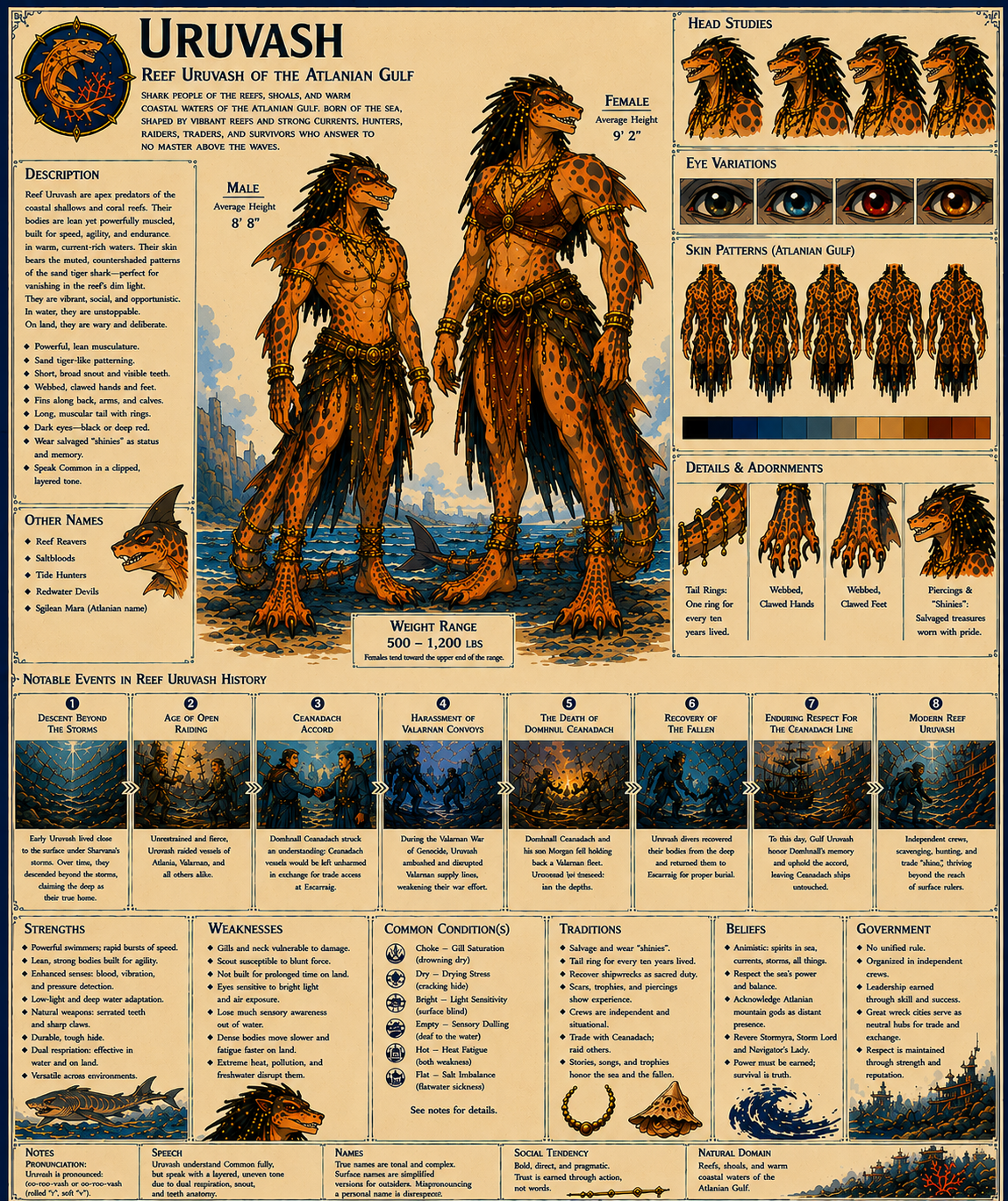
Associations
Other pages that reference or connect to this race
Referenced By
2Collections
Published collections that feature this race
Not in any collections yet
This race hasn't been published in any collections yet. Collections are curated groups of related content that help organize and showcase your world.
Tip: Collections are a great way to group related content together and share themed stories or worldbuilding elements with others.
Timelines
Timelines that reference or include this race
No timeline connections yet
This race isn't connected to any timelines yet. Timelines help organize events chronologically and show how your content fits into the broader history of your world.
Tip: Create timelines to organize important events in your world's history. Link characters, locations, and other content to specific events to build rich, interconnected narratives.
Shares
Discussion about this race
No shares yet
Be the first to start a discussion about this race by sharing it to the community stream.
Privacy & Sharing
Manage who can see and access this race
Current Status
refresh
This race is currently
Privacy Settings
Choose who can see and access this race
language Universe Privacy
This page belongs to a universe with its own privacy settings