
Categories
Dive Deeper
Page Stats
Navigation
Categories
Dive Deeper
Page Stats
Complete Details
All information about this character
Overview
Albert Dùghlas Mardrein Prince of Atlania and Heir Apparent
Albert Dùghlas Mardrein was the Crown Prince of Atlania and heir apparent of House Dùghlas during the first half of the Fourth Age, remembered as one of the monarchy’s most promising but tragic figures. Groomed from youth to become king, Albert was educated in leadership, history, religion, law, and philosophy, but he never took naturally to the glory of war. During the Okose border wars, he rose to command armies and earned the loyalty of his men through kindness, charisma, and a sincere desire to protect them, yet he remained deeply uneasy with the conflict itself. More than any other Atlanian noble of his time, Albert pushed toward peace and reconciliation with the Okose, making him a rare forward-thinking voice in an age still dominated by pride, border violence, and martial expectation. Had he lived, he may have become one of the key figures leading Atlania toward an early enlightenment, but his death left him instead as a symbol of unrealized reform: the prince who might have been a philosopher-king, had the age allowed him to survive it.
Crown Prince
Prince of Atlania
Probably in is late twenties
Male
Looks
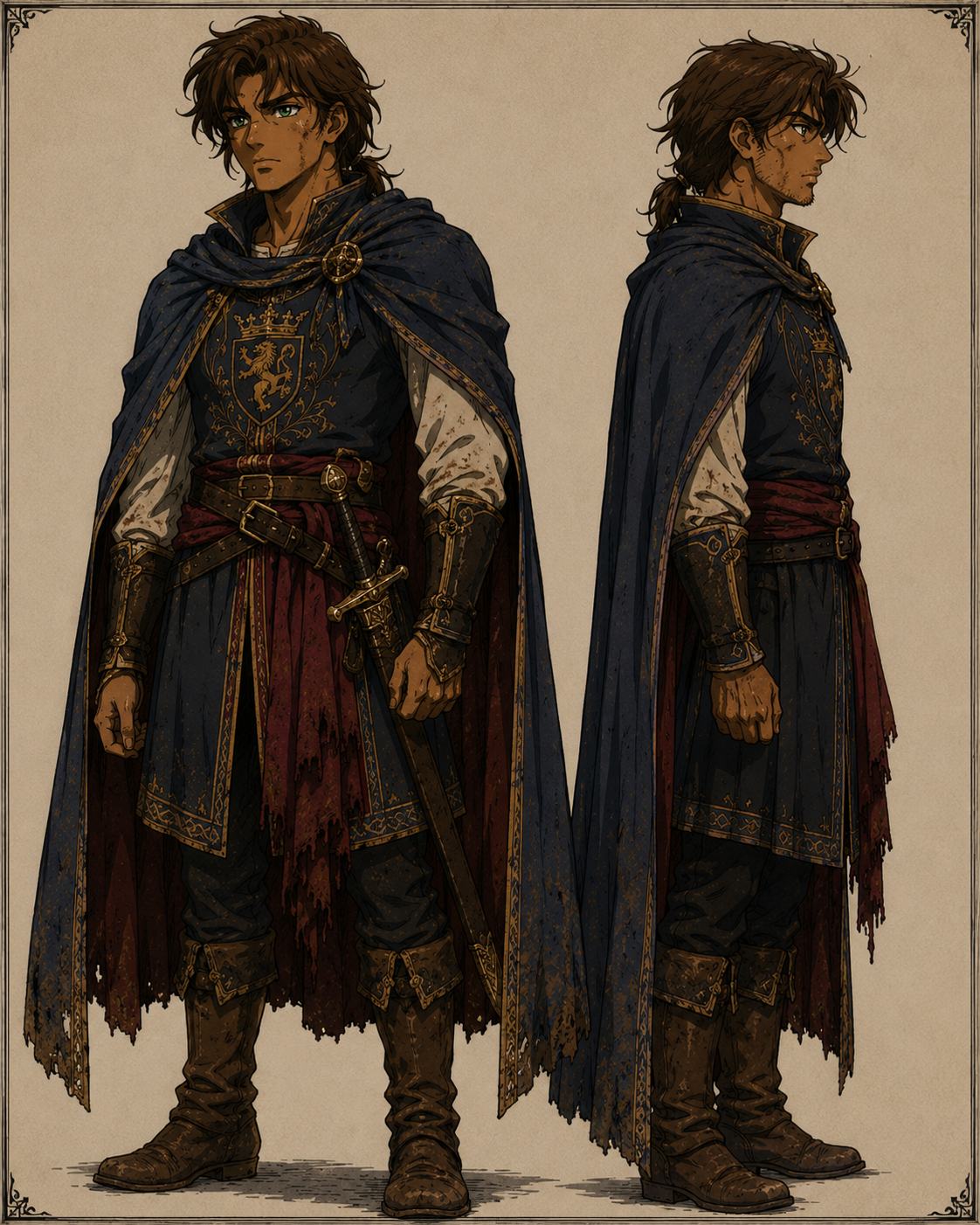
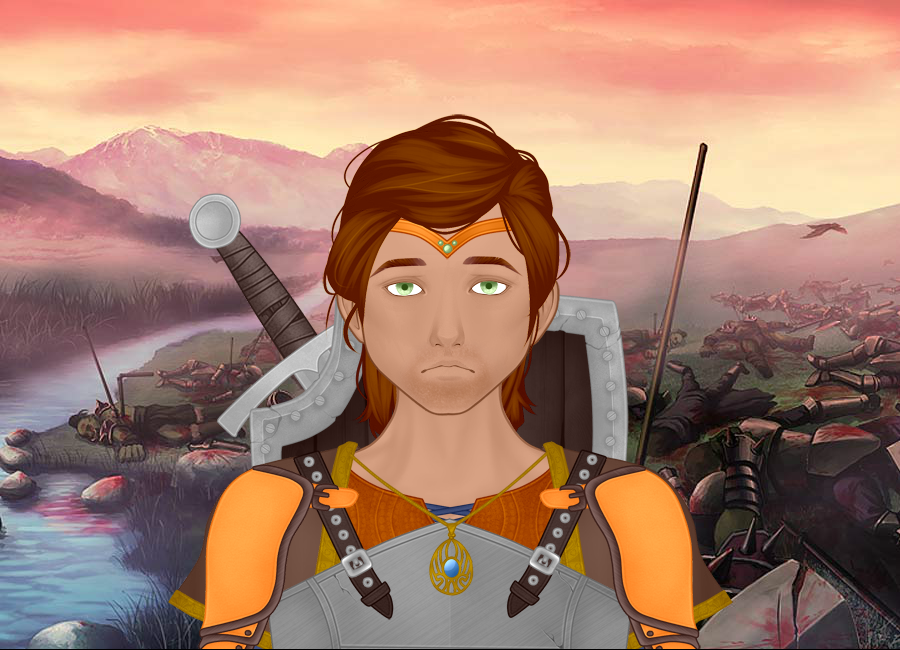
Albert prefers to be clean-shaven, reflecting both his royal upbringing and his desire to present himself with dignity and discipline. On campaign, however, this is often difficult to maintain. The Okose border wars are defined by constant movement, raids, ambushes, and hit-and-run pressure, leaving little time for proper grooming. As a result, Albert is often seen with light stubble or an uneven campaign beard, not because he favors the look, but because the war has worn down even the small rituals of princely order. This detail suits him well: he is a man raised for courts and kingship, slowly being weathered by a conflict he never truly wanted.
Albert’s hair is normally kept neat enough for a prince, but during the Okose border wars it has grown increasingly unkempt from long months on campaign. It is medium-length, practical rather than fashionable, and often pushed back or loosely tied when he has time, though stray locks frequently fall loose during travel, battle, or sleepless councils. The style reflects the strain of his circumstances: Albert was raised for courtly discipline and royal presentation, but the constant raids, marches, and lack of rest have worn that polish away. His hair should look less like deliberate ruggedness and more like the visible erosion of a thoughtful young prince trapped in a war he does not believe can be won by violence alone.
Albert has brown hair, a common enough Atlanian shade but one that suits his grounded, unflashy nature. In youth or at court it may have appeared warmer and better kept, but during the Okose border wars it is often dulled by dust, sweat, weather, and long days on campaign. His hair should not feel especially dramatic or legendary; unlike brighter or more visually striking figures, Albert’s appearance is defined less by spectacle and more by weariness, sincerity, and quiet nobility. The brown of his hair helps give him a human, approachable quality, making him look less like an untouchable royal icon and more like a prince who still sits among his men, listens to them, and carries the same mud and exhaustion they do.
6'
150lbs
Albert’s most noticeable identifying trait is that he appears slightly frail for a southern Atlanian prince, especially beside the broader, harder warriors who often surround him. He is still tall and capable, with the training expected of a royal heir, but his build is leaner and less naturally imposing than the idealized image of an Atlanian battlefield commander. On campaign this becomes more visible through tired eyes, weather-darkened skin, uneven grooming, and the general strain of long service in a war he never truly wanted. Rather than marking him as weak, this slight frailty reinforces the central tension of his character: Albert is a thoughtful, diplomatic, and philosophical heir forced to lead armies in an age that expects its princes to be warriors first and reformers second.
Albert has the tall, trained build expected of an Atlanian royal heir, but he is leaner and less physically forceful than many southern Atlanian warriors. At six feet and around one hundred fifty pounds, he has the frame of someone taught to ride, march, drill, and command, but not someone who lives for battle or glories in physical dominance. His body is capable rather than imposing: long-limbed, disciplined, and shaped by military necessity more than personal passion. On campaign, exhaustion and war-weariness make him look even slighter, reinforcing the sense that Albert’s true strength lies in his mind, voice, and conscience rather than brute force.
Albert has dark tanned skin, fitting his southern Atlanian heritage and made even deeper by long months spent outdoors on campaign. His complexion carries the warmth of the Atlanian peninsula’s sun, but during the Okose border wars it is also marked by exposure, dust, sleeplessness, and hard travel. This gives him a weathered quality that contrasts with his royal upbringing: he was born to courts, learning, and eventual kingship, but much of his young adulthood has been spent under open sky, riding between camps, border forts, and battlefields. His skin tone helps ground him visually as both a southern prince and a campaign-worn heir shaped by a war he never truly wanted.
Atlanian
Green
Nature
Albert’s strongest prejudice is against court politics, especially the kind of pride, factional maneuvering, and inherited hostility that keeps wars alive long after they have stopped serving the people. He has little patience for nobles who treat the Okose border wars as a matter of honor, glory, or family reputation while common soldiers and border communities pay the cost. Unlike many Atlanians of his age, Albert does not seem to hold a deep hatred for the Okose themselves; if anything, he is unusually willing to see them as a people with their own fears, grievances, and dignity. His bias runs in the opposite direction: he distrusts entrenched tradition when it prevents peace, and he is probably the closest figure of his era to bringing about something like an Atlanian enlightenment.
Dead
Albert is kind, charismatic, and visibly war-weary, carrying himself with the careful restraint of someone who knows every word he says may affect the morale of tired men. He listens more than many princes, often pausing before answering and trying to understand the person in front of him rather than simply command them. In council he tends toward calm persuasion instead of forceful dominance, using reason, sympathy, and well-chosen words to win support. On campaign, his exhaustion shows in small ways: tired eyes, a lowered voice, long silences, and a habit of turning small pieces of wood in his hands or whittling when thinking. Even when surrounded by war, Albert behaves like a man trying to preserve gentleness without allowing it to become weakness.
Albert is motivated by peace, the protection of his men, and the desire to become a good king. He does not seek victory for glory’s sake, and he has little interest in being remembered as a conqueror. What drives him is the belief that Atlania cannot build a better future by endlessly bleeding itself against the Okose border, especially when much of that suffering is carried by soldiers, scouts, and frontier communities rather than the nobles arguing from safety. Albert wants to end the war if he can, preserve the lives entrusted to him, and prove that a prince can be strong through mercy, wisdom, and restraint rather than through brutality alone.
Albert’s greatest flaw is his indecision on the battlefield, especially when quick violence is required. He is thoughtful, compassionate, and reluctant to waste lives, but those same virtues can become dangerous in the chaos of war. He may hesitate when a harsher commander would strike, delay an attack while searching for another option, or struggle to commit fully to a plan that will cost too many men. His desire for peace also makes him vulnerable to criticism from more militant nobles, who see his restraint as weakness. Albert is not a coward, but he is a prince whose conscience often moves faster than his sword, and in battle that hesitation can have consequences.
Albert’s greatest talents are oration, diplomacy, and thoughtful leadership. He has a natural gift for speaking to people in a way that makes them feel seen rather than commanded, allowing him to inspire tired soldiers, calm tense councils, and argue for peace without sounding naïve. He is also skilled at reading philosophy, history, and political thought, drawing lessons from old Atlanian texts that many warriors of his age would dismiss as impractical. On a more personal level, Albert is talented at wood carving and whittling, small quiet crafts that steady his mind during long campaigns and reveal the patient, careful nature beneath his royal duties.
Albert’s hobbies are reading ancient texts and whittling, both of which reflect his thoughtful and inward-looking nature. He is especially drawn to old Atlanian philosophy scrolls, searching them for ideas about kingship, duty, justice, peace, and the responsibilities of power. During campaign life, he often turns to whittling as a quiet way to steady himself, shaping small pieces of wood while thinking through difficult decisions or trying to calm his mind after battle. These habits make him stand apart from more glory-seeking warriors of his age: Albert relaxes not through boasting, hunting, or revelry, but through study, reflection, and careful work with his hands.
Albert is kind, philosophical, diplomatic, and forward-thinking, a prince more suited to reform and reconciliation than conquest. He has the bearing of a royal heir, but not the hunger for glory that many expect from an Atlanian battlefield leader. He is thoughtful, patient, and deeply concerned with the moral weight of command, often seeing people where others see enemies, soldiers, or political obstacles. This makes him charismatic and beloved by those who trust his sincerity, but also frustrating to harder warriors who mistake his restraint for weakness. At his core, Albert is a would-be philosopher-king trapped in a border war, trying to imagine a better Atlania before the age is ready to accept one.
Social
Albert’s favorite food is warm barley bread with mountain honey, usually eaten with a little goat cheese, olive oil, or dried fruit when available. It is a simple meal, but one he associates with home, study, and moments of peace between duties. The bread ties him to common Atlanian staples, while the honey gives it a gentle sweetness without making it decadent. On campaign, this favorite becomes even more meaningful: a piece of rough bread sweetened with honey is one of the few comforts that can still remind him of court gardens, old philosophy scrolls, and the kind of peaceful kingdom he hopes to build.
condors
None
Atlanian philosophy scrolls
Blue
Heir apparent of House Dùghlas
Albert is the loudest and most sincere Atlanian voice of his generation pushing for peace with the Okose. Unlike many nobles involved in the border wars, he does not see the conflict as a matter of pride, glory, or ancient insult, but as a wound that continues to bleed both peoples for the benefit of stubborn lords and old hatreds. His politics are reform-minded, diplomatic, and unusually humane for his age, built around the belief that a king’s duty is not merely to win wars, but to preserve life, reduce suffering, and build a realm where future generations are not trapped by the grudges of their ancestors. This makes him popular among soldiers and common people who are tired of fighting, but deeply inconvenient to more militant nobles who view reconciliation with the Okose as weakness, betrayal, or dangerous idealism.
Atlanian mysticism
Leader
History
Mid Dry Season
Albert Dùghlas Mardrein was the favored son of the Atlanian monarch during the Okose border wars and was groomed from youth to inherit the throne. He received the education, expectations, and military responsibilities of a crown prince, eventually working his way from command in smaller skirmishes to the leadership of entire armies. Yet Albert’s heart was never truly in the war. Though brave and dutiful, he saw the conflict with the Okose as a tragedy sustained by pride, fear, and old hatreds, and with greater support he likely would have pushed openly for peace and reconciliation.
His defining moment came when he and his army were trapped and surrounded by Okose forces. Rather than allow his men to be slaughtered, Albert took the dangerous risk of challenging the Okose chieftain in command to single combat. He defeated the chieftain honorably, earning safe passage for himself and his soldiers back to friendly lines. However, not all Okose were present for this agreement, and another chieftain, unaware of the terms, ambushed Albert during the retreat. Though this act unknowingly dishonored the Okose, the damage was done. Albert was eventually killed at Akas, and one of his retainers returned his body to Atlanian lines two weeks later.
Albert’s death changed the course of the war. In life, he had been one of the few major Atlanian voices arguing that peace with the Okose was possible. In death, he became proof of how costly the war had become, not only to soldiers and border villages, but to the royal house itself. His loss devastated his father and helped push the Atlanian monarchy toward seeking peace with the Okose. Albert is therefore remembered not as a conquering prince, but as a tragic heir whose mercy, courage, and unrealized vision helped end a war he had never truly believed in.
Albert was given the full education expected of an Atlanian crown prince and future king, with training in history, law, religion, diplomacy, military command, estate governance, rhetoric, and the duties of royal leadership. Unlike some heirs who treated these lessons as ceremony, Albert took them seriously, especially the study of ancient Atlanian philosophy scrolls and older writings on kingship, justice, and duty. He is not merely well-tutored, but genuinely thoughtful, using his education to question whether inherited wars and noble pride truly serve the realm. His learning makes him an unusually forward-thinking prince for his age, though it can also separate him from harder battlefield commanders who see too much study as hesitation or softness.
Family
Overview
Details about this character's overview
Albert Dùghlas Mardrein Prince of Atlania and Heir Apparent
Albert Dùghlas Mardrein was the Crown Prince of Atlania and heir apparent of House Dùghlas during the first half of the Fourth Age, remembered as one of the monarchy’s most promising but tragic figures. Groomed from youth to become king, Albert was educated in leadership, history, religion, law, and philosophy, but he never took naturally to the glory of war. During the Okose border wars, he rose to command armies and earned the loyalty of his men through kindness, charisma, and a sincere desire to protect them, yet he remained deeply uneasy with the conflict itself. More than any other Atlanian noble of his time, Albert pushed toward peace and reconciliation with the Okose, making him a rare forward-thinking voice in an age still dominated by pride, border violence, and martial expectation. Had he lived, he may have become one of the key figures leading Atlania toward an early enlightenment, but his death left him instead as a symbol of unrealized reform: the prince who might have been a philosopher-king, had the age allowed him to survive it.
Crown Prince
Prince of Atlania
Probably in is late twenties
Male
Looks
Details about this character's looks
Albert prefers to be clean-shaven, reflecting both his royal upbringing and his desire to present himself with dignity and discipline. On campaign, however, this is often difficult to maintain. The Okose border wars are defined by constant movement, raids, ambushes, and hit-and-run pressure, leaving little time for proper grooming. As a result, Albert is often seen with light stubble or an uneven campaign beard, not because he favors the look, but because the war has worn down even the small rituals of princely order. This detail suits him well: he is a man raised for courts and kingship, slowly being weathered by a conflict he never truly wanted.
Albert’s hair is normally kept neat enough for a prince, but during the Okose border wars it has grown increasingly unkempt from long months on campaign. It is medium-length, practical rather than fashionable, and often pushed back or loosely tied when he has time, though stray locks frequently fall loose during travel, battle, or sleepless councils. The style reflects the strain of his circumstances: Albert was raised for courtly discipline and royal presentation, but the constant raids, marches, and lack of rest have worn that polish away. His hair should look less like deliberate ruggedness and more like the visible erosion of a thoughtful young prince trapped in a war he does not believe can be won by violence alone.
Albert has brown hair, a common enough Atlanian shade but one that suits his grounded, unflashy nature. In youth or at court it may have appeared warmer and better kept, but during the Okose border wars it is often dulled by dust, sweat, weather, and long days on campaign. His hair should not feel especially dramatic or legendary; unlike brighter or more visually striking figures, Albert’s appearance is defined less by spectacle and more by weariness, sincerity, and quiet nobility. The brown of his hair helps give him a human, approachable quality, making him look less like an untouchable royal icon and more like a prince who still sits among his men, listens to them, and carries the same mud and exhaustion they do.
6'
150lbs
Albert’s most noticeable identifying trait is that he appears slightly frail for a southern Atlanian prince, especially beside the broader, harder warriors who often surround him. He is still tall and capable, with the training expected of a royal heir, but his build is leaner and less naturally imposing than the idealized image of an Atlanian battlefield commander. On campaign this becomes more visible through tired eyes, weather-darkened skin, uneven grooming, and the general strain of long service in a war he never truly wanted. Rather than marking him as weak, this slight frailty reinforces the central tension of his character: Albert is a thoughtful, diplomatic, and philosophical heir forced to lead armies in an age that expects its princes to be warriors first and reformers second.
Albert has the tall, trained build expected of an Atlanian royal heir, but he is leaner and less physically forceful than many southern Atlanian warriors. At six feet and around one hundred fifty pounds, he has the frame of someone taught to ride, march, drill, and command, but not someone who lives for battle or glories in physical dominance. His body is capable rather than imposing: long-limbed, disciplined, and shaped by military necessity more than personal passion. On campaign, exhaustion and war-weariness make him look even slighter, reinforcing the sense that Albert’s true strength lies in his mind, voice, and conscience rather than brute force.
Albert has dark tanned skin, fitting his southern Atlanian heritage and made even deeper by long months spent outdoors on campaign. His complexion carries the warmth of the Atlanian peninsula’s sun, but during the Okose border wars it is also marked by exposure, dust, sleeplessness, and hard travel. This gives him a weathered quality that contrasts with his royal upbringing: he was born to courts, learning, and eventual kingship, but much of his young adulthood has been spent under open sky, riding between camps, border forts, and battlefields. His skin tone helps ground him visually as both a southern prince and a campaign-worn heir shaped by a war he never truly wanted.
Atlanian
Green
Nature
Details about this character's nature
Albert’s strongest prejudice is against court politics, especially the kind of pride, factional maneuvering, and inherited hostility that keeps wars alive long after they have stopped serving the people. He has little patience for nobles who treat the Okose border wars as a matter of honor, glory, or family reputation while common soldiers and border communities pay the cost. Unlike many Atlanians of his age, Albert does not seem to hold a deep hatred for the Okose themselves; if anything, he is unusually willing to see them as a people with their own fears, grievances, and dignity. His bias runs in the opposite direction: he distrusts entrenched tradition when it prevents peace, and he is probably the closest figure of his era to bringing about something like an Atlanian enlightenment.
Dead
Albert is kind, charismatic, and visibly war-weary, carrying himself with the careful restraint of someone who knows every word he says may affect the morale of tired men. He listens more than many princes, often pausing before answering and trying to understand the person in front of him rather than simply command them. In council he tends toward calm persuasion instead of forceful dominance, using reason, sympathy, and well-chosen words to win support. On campaign, his exhaustion shows in small ways: tired eyes, a lowered voice, long silences, and a habit of turning small pieces of wood in his hands or whittling when thinking. Even when surrounded by war, Albert behaves like a man trying to preserve gentleness without allowing it to become weakness.
Albert is motivated by peace, the protection of his men, and the desire to become a good king. He does not seek victory for glory’s sake, and he has little interest in being remembered as a conqueror. What drives him is the belief that Atlania cannot build a better future by endlessly bleeding itself against the Okose border, especially when much of that suffering is carried by soldiers, scouts, and frontier communities rather than the nobles arguing from safety. Albert wants to end the war if he can, preserve the lives entrusted to him, and prove that a prince can be strong through mercy, wisdom, and restraint rather than through brutality alone.
Albert’s greatest flaw is his indecision on the battlefield, especially when quick violence is required. He is thoughtful, compassionate, and reluctant to waste lives, but those same virtues can become dangerous in the chaos of war. He may hesitate when a harsher commander would strike, delay an attack while searching for another option, or struggle to commit fully to a plan that will cost too many men. His desire for peace also makes him vulnerable to criticism from more militant nobles, who see his restraint as weakness. Albert is not a coward, but he is a prince whose conscience often moves faster than his sword, and in battle that hesitation can have consequences.
Albert’s greatest talents are oration, diplomacy, and thoughtful leadership. He has a natural gift for speaking to people in a way that makes them feel seen rather than commanded, allowing him to inspire tired soldiers, calm tense councils, and argue for peace without sounding naïve. He is also skilled at reading philosophy, history, and political thought, drawing lessons from old Atlanian texts that many warriors of his age would dismiss as impractical. On a more personal level, Albert is talented at wood carving and whittling, small quiet crafts that steady his mind during long campaigns and reveal the patient, careful nature beneath his royal duties.
Albert’s hobbies are reading ancient texts and whittling, both of which reflect his thoughtful and inward-looking nature. He is especially drawn to old Atlanian philosophy scrolls, searching them for ideas about kingship, duty, justice, peace, and the responsibilities of power. During campaign life, he often turns to whittling as a quiet way to steady himself, shaping small pieces of wood while thinking through difficult decisions or trying to calm his mind after battle. These habits make him stand apart from more glory-seeking warriors of his age: Albert relaxes not through boasting, hunting, or revelry, but through study, reflection, and careful work with his hands.
Albert is kind, philosophical, diplomatic, and forward-thinking, a prince more suited to reform and reconciliation than conquest. He has the bearing of a royal heir, but not the hunger for glory that many expect from an Atlanian battlefield leader. He is thoughtful, patient, and deeply concerned with the moral weight of command, often seeing people where others see enemies, soldiers, or political obstacles. This makes him charismatic and beloved by those who trust his sincerity, but also frustrating to harder warriors who mistake his restraint for weakness. At his core, Albert is a would-be philosopher-king trapped in a border war, trying to imagine a better Atlania before the age is ready to accept one.
Social
Details about this character's social
Albert’s favorite food is warm barley bread with mountain honey, usually eaten with a little goat cheese, olive oil, or dried fruit when available. It is a simple meal, but one he associates with home, study, and moments of peace between duties. The bread ties him to common Atlanian staples, while the honey gives it a gentle sweetness without making it decadent. On campaign, this favorite becomes even more meaningful: a piece of rough bread sweetened with honey is one of the few comforts that can still remind him of court gardens, old philosophy scrolls, and the kind of peaceful kingdom he hopes to build.
condors
None
Atlanian philosophy scrolls
Blue
Heir apparent of House Dùghlas
Albert is the loudest and most sincere Atlanian voice of his generation pushing for peace with the Okose. Unlike many nobles involved in the border wars, he does not see the conflict as a matter of pride, glory, or ancient insult, but as a wound that continues to bleed both peoples for the benefit of stubborn lords and old hatreds. His politics are reform-minded, diplomatic, and unusually humane for his age, built around the belief that a king’s duty is not merely to win wars, but to preserve life, reduce suffering, and build a realm where future generations are not trapped by the grudges of their ancestors. This makes him popular among soldiers and common people who are tired of fighting, but deeply inconvenient to more militant nobles who view reconciliation with the Okose as weakness, betrayal, or dangerous idealism.
Atlanian mysticism
Leader
History
Details about this character's history
Mid Dry Season
Albert Dùghlas Mardrein was the favored son of the Atlanian monarch during the Okose border wars and was groomed from youth to inherit the throne. He received the education, expectations, and military responsibilities of a crown prince, eventually working his way from command in smaller skirmishes to the leadership of entire armies. Yet Albert’s heart was never truly in the war. Though brave and dutiful, he saw the conflict with the Okose as a tragedy sustained by pride, fear, and old hatreds, and with greater support he likely would have pushed openly for peace and reconciliation.
His defining moment came when he and his army were trapped and surrounded by Okose forces. Rather than allow his men to be slaughtered, Albert took the dangerous risk of challenging the Okose chieftain in command to single combat. He defeated the chieftain honorably, earning safe passage for himself and his soldiers back to friendly lines. However, not all Okose were present for this agreement, and another chieftain, unaware of the terms, ambushed Albert during the retreat. Though this act unknowingly dishonored the Okose, the damage was done. Albert was eventually killed at Akas, and one of his retainers returned his body to Atlanian lines two weeks later.
Albert’s death changed the course of the war. In life, he had been one of the few major Atlanian voices arguing that peace with the Okose was possible. In death, he became proof of how costly the war had become, not only to soldiers and border villages, but to the royal house itself. His loss devastated his father and helped push the Atlanian monarchy toward seeking peace with the Okose. Albert is therefore remembered not as a conquering prince, but as a tragic heir whose mercy, courage, and unrealized vision helped end a war he had never truly believed in.
Albert was given the full education expected of an Atlanian crown prince and future king, with training in history, law, religion, diplomacy, military command, estate governance, rhetoric, and the duties of royal leadership. Unlike some heirs who treated these lessons as ceremony, Albert took them seriously, especially the study of ancient Atlanian philosophy scrolls and older writings on kingship, justice, and duty. He is not merely well-tutored, but genuinely thoughtful, using his education to question whether inherited wars and noble pride truly serve the realm. His learning makes him an unusually forward-thinking prince for his age, though it can also separate him from harder battlefield commanders who see too much study as hesitation or softness.
Family
Details about this character's family
Inventory
Details about this character's inventory
No inventory information yet
This section doesn't have any information filled in yet.
Changelog
Details about this character's changelog
No changelog information yet
This section doesn't have any information filled in yet.
Notes
Details about this character's notes
No notes information yet
This section doesn't have any information filled in yet.
Gallery
Images and visual content for this character
Associations
Other pages that reference or connect to this character
Referenced By
7Duncan Crùnbeinn Mardrein
Siblings
Andrew Hayes
Best friends
Atlanian Peninsula
Leaders
The Blade of the Drakes Wrath
Past Owners
Royal Crown of Atlania
Past Owners
Atlanian
Famous figures
Kingdom of Atlania
Political figures
Collections
Published collections that feature this character
Not in any collections yet
This character hasn't been published in any collections yet. Collections are curated groups of related content that help organize and showcase your world.
Tip: Collections are a great way to group related content together and share themed stories or worldbuilding elements with others.
Timelines
Timelines that reference or include this character
No timeline connections yet
This character isn't connected to any timelines yet. Timelines help organize events chronologically and show how your content fits into the broader history of your world.
Tip: Create timelines to organize important events in your world's history. Link characters, locations, and other content to specific events to build rich, interconnected narratives.
Shares
Discussion about this character
No shares yet
Be the first to start a discussion about this character by sharing it to the community stream.
Privacy & Sharing
Manage who can see and access this character
Current Status
refresh
This character is currently
Privacy Settings
Choose who can see and access this character
language Universe Privacy
This page belongs to a universe with its own privacy settings