
Categories
Dive Deeper
Page Stats
Navigation
Categories
Dive Deeper
Page Stats
Complete Details
All information about this race
Overview
Atlanian
A tall swarthy people known for heartiness and stubborn dispositions.
Backwater poets, gullible rubes, Children of the Gates, Stone-Souls, The Southern Giants, Salt-Bound, The Last Loyal Traitors, Southward Steel, Gold-Fed Wolves, Iron Shepherds
Looks
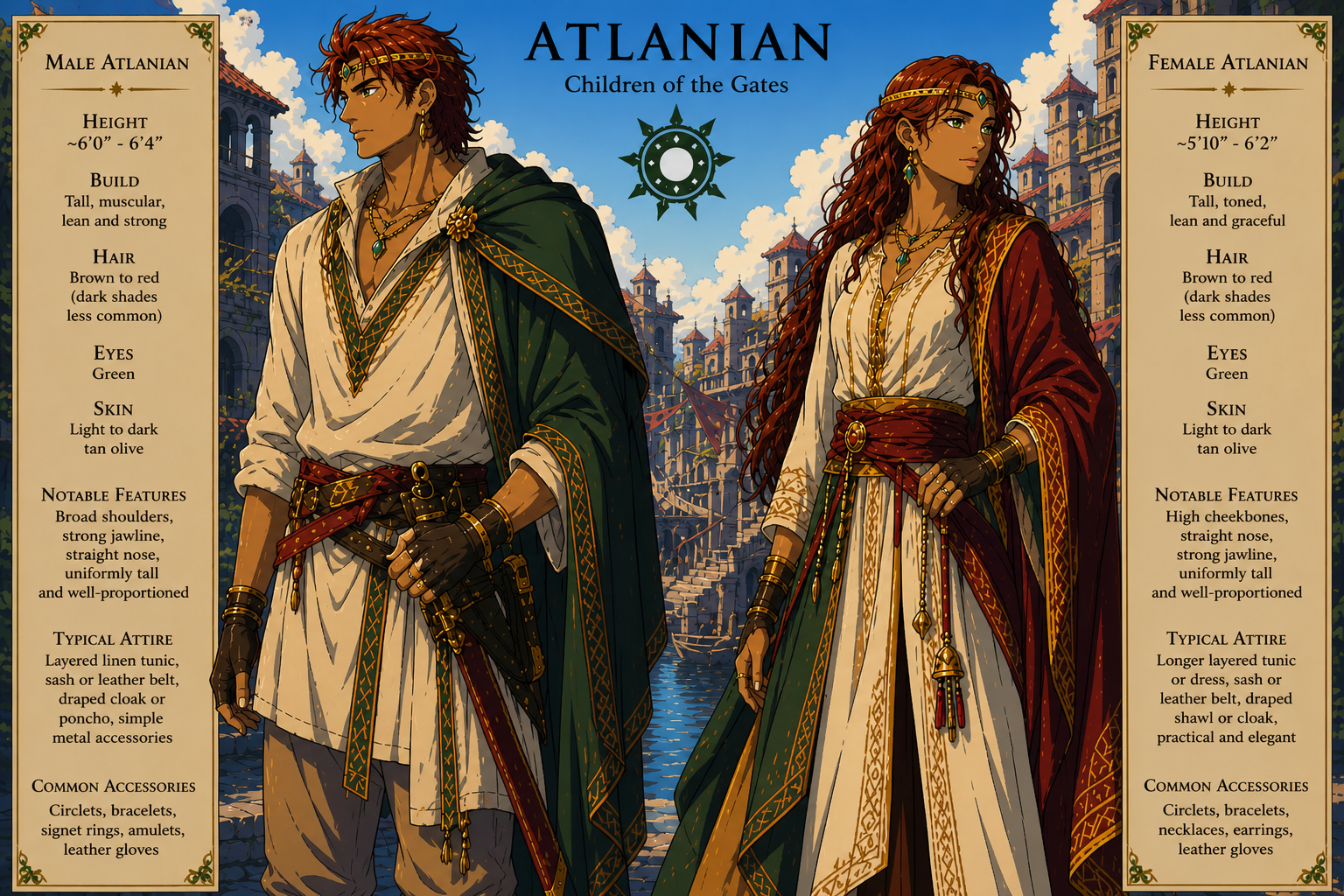
Average to slim, but usually muscular and always tall
light to dark tan olive skin
almost universally 6'
~100-200lbs
Brown to red hair is most common among Atlanians, though darker colors have started to show up with other races mixing into the gene pool. Atlanians from the peninsula have universally green eyes from the abundant arcane energies that permeate the area. If they aren't in the peninsula long enough or are born outside it's influence more colors are present.
Atlanians possess remarkably little physical variation compared to most peoples of Sol Saris. Men and women alike tend toward the same height range, similar bone structure, and the same broad-shouldered, labor-capable build. Hair and eye color vary, but body shape changes very little outside of ordinary age, sex, and lifestyle differences.
This uniformity is not viewed as strange by Atlanians—it is considered proof of proper creation. Many believe mankind was shaped from sacred clay, and that Atlanians remain physically “closer to the original hand” than other peoples.
Foreigners often find this unsettling, describing Atlanian families as looking like generations of the same person carved from the same stone.
Simple loose fitting tunics with ponchos, cloaks, scarves and simple circlets, bracelets, and necklaces being the most common accessories. Women trend for longer tunics than men, but both genders wear either pants or hosiery. The Near constant warm wet weather sees very little in seasonal clothing variety, but foreign clothes get imported and worn often.
layered linen is preferred over heavy tailoring due to humidity
practical leather belts and broad sashes are often more socially significant than jewelry
noble houses display allegiance subtly through embroidery patterns rather than loud heraldic colors
stepwell cities favor draped shade-cloths and practical cloaks designed for sun and sudden rain
gloves are culturally associated with oath-taking, inheritance ceremonies, and military commission
Traits
Known for being strong and capable, innate magical aptitude, highly resistant to disease
unusually strong memory for oral history and family lineage
high tolerance for physical pain and hardship
cultural preference for delayed gratification and long planning
exceptional engineers in waterworks, canals, wells, and fortified infrastructure
disciplined military doctrine rather than battlefield improvisation
Atlanians struggle to abandon old systems, even when practicality demands it. They are culturally resistant to changing the land itself—large alterations to rivers, hills, or sacred places are often seen as spiritually dangerous, as the dead must still recognize home.
They trust written and spoken oaths too easily, often failing to account for cultures where promises are flexible or deceit is normalized.
Many outsiders consider them gullible for this reason.
Their stubbornness often manifests as endurance beyond reason, preferring ruin to dishonorable compromise.
Arcanium poisoning,
Gravesickness
A cultural and sometimes physical decline seen in Atlanians long separated from ancestral land, marked by fatigue, sleeplessness, melancholy, and obsession with returning home.
salt-fever (common among sailors)
black lung variants in old firearms foundries
Culture
Burial of the dead in communal/familial crypts, balance with nature
Oath Witnessing
Words are treated as spiritually binding. Formal promises are often made before family witnesses, household shrines, or ancestral crypts. Breaking one’s sworn word is considered not merely dishonorable, but cosmologically dangerous.
First Stone Tradition
When a new home is built, a stone from older family land is placed into the foundation so the land will recognize its people.
Salt at the Threshold
Lines of salt, especially at doors and windows, are common protections against spirits, demons, and the Pale Ones.
Black Mourning
Black cloth, black ribbons, and veiled mirrors are associated with death rites. Silence, not weeping, is often considered the higher form of mourning.
Crown and Blade Rituals
Royal succession tied to regalia preservation
Stepwell Offerings
Coins, flowers, oil, and written prayers dropped into sacred wells
Atlanians are intensely superstitious and deeply fearful of demons, ghosts, and things that die incorrectly.
They believe the dead must be recognized by both blood and land. Burial in ancestral crypts is considered spiritually necessary, as the soul must be claimed by the Gatekeeper and returned to proper rest. Improper burial, foreign burial, or destruction of ancestral land risks unrest among the dead.
Thresholds, mirrors at night, open doors at moonlight, and untended wells are all considered spiritually dangerous places.
The Pale Ones (HaLafin) are feared not as enemies, but as violations of proper natural order.
Salt, iron, spoken names, and household rites are common protections.
Monarchy restrained by the Four Breithan Houses
Many magical technologies, at the forefront of firearms technology and gunpowder.
advanced stepwell engineering
canal systems (especially Giobson influence)
fortress architecture built for overlapping cannon fire
refined black powder (starshot powder and variants)
strong naval artillery traditions
aquifer tapping and subterranean cistern engineering
Runs the gambit, Atlanians have a robust apprenticeship system for training.
Atlanians historically used a fiat currency system backed by grain harvests and agricultural yield rather than precious metals, as gold is so abundant in the gulf that it carries relatively little practical prestige. Useful metals such as high-quality steel, orichalcum, and worked iron are considered far more valuable than raw gold.
Private noble fleets—particularly those of House Ceanadach—function as semi-state economic engines, controlling trade routes, escort contracts, and maritime taxation.
Following political and financial unification with Stanzgar, Blaine Talakar rapidly adopted northern banking practices, greatly expanding Atlania’s wealth and allowing large noble houses to convert old land wealth into modern financial power.
Coffee has been cultivated throughout the gulf for centuries and is considered a normal staple rather than an exotic luxury, though noble households still pride themselves on particular regional roasts and serving traditions.
HaLafin Ambrosia, the most potent and prestigious intoxicant known to mortals, arrives not through commerce but through diplomatic obligation—the Grand Duke of the HaLafin periodically grants immense peace tithes to the royal family, of which Ambrosia is the most symbolically significant gift.
Dwarven distilled spirits remain one of the most prized true imports, valued for both rarity and the reputation of dwarven craft.
grain-backed fiat predates modern banking
gold abundance made precious metals culturally unserious
orichalcum and steel carry greater prestige than gold
private house fleets function as semi-state economic engines
Ceanadach wealth is naval and logistical, not territorial
Halafin ambrosia and coffee act as elite prestige exports
Fish—both fresh and heavily salted—form the core of most Atlanian diets, along with fish roe, flatbreads, and a pancake-like breakfast dish commonly served with fresh or dried fruits.
Olives, grapes, barley, and wine dominate the mainland diet, while coffee has long been a familiar and culturally important staple rather than a foreign novelty. Rice and rice wine are more common in the gulf islands and archipelago regions.
Fine cheeses are especially prized; cattle were originally imported largely for dairy rather than meat production. Goat, poultry, lizard, and fish remain the most common meat staples.
Preserved citrus, herb oils, and festival breads are common in noble households and city markets, particularly around stepwell plazas and harvest celebrations.
Dwarven spirits and HaLafin Ambrosia are reserved almost entirely for major political occasions, funerary rites among the highest nobility, and royal diplomacy.
olives, grapes, barley, and wine as mainland staples
coffee long familiar but still socially “exotic”
rice and rice wine in archipelago regions
preserved lemons and herb oils
communal breads at festivals
harvest feast centered around wells and open-air markets
(why is there a second traditions?)
Overview
Details about this race's overview
Atlanian
A tall swarthy people known for heartiness and stubborn dispositions.
Backwater poets, gullible rubes, Children of the Gates, Stone-Souls, The Southern Giants, Salt-Bound, The Last Loyal Traitors, Southward Steel, Gold-Fed Wolves, Iron Shepherds
Looks
Details about this race's looks
Average to slim, but usually muscular and always tall
light to dark tan olive skin
almost universally 6'
~100-200lbs
Brown to red hair is most common among Atlanians, though darker colors have started to show up with other races mixing into the gene pool. Atlanians from the peninsula have universally green eyes from the abundant arcane energies that permeate the area. If they aren't in the peninsula long enough or are born outside it's influence more colors are present.
Atlanians possess remarkably little physical variation compared to most peoples of Sol Saris. Men and women alike tend toward the same height range, similar bone structure, and the same broad-shouldered, labor-capable build. Hair and eye color vary, but body shape changes very little outside of ordinary age, sex, and lifestyle differences.
This uniformity is not viewed as strange by Atlanians—it is considered proof of proper creation. Many believe mankind was shaped from sacred clay, and that Atlanians remain physically “closer to the original hand” than other peoples.
Foreigners often find this unsettling, describing Atlanian families as looking like generations of the same person carved from the same stone.
Simple loose fitting tunics with ponchos, cloaks, scarves and simple circlets, bracelets, and necklaces being the most common accessories. Women trend for longer tunics than men, but both genders wear either pants or hosiery. The Near constant warm wet weather sees very little in seasonal clothing variety, but foreign clothes get imported and worn often.
layered linen is preferred over heavy tailoring due to humidity
practical leather belts and broad sashes are often more socially significant than jewelry
noble houses display allegiance subtly through embroidery patterns rather than loud heraldic colors
stepwell cities favor draped shade-cloths and practical cloaks designed for sun and sudden rain
gloves are culturally associated with oath-taking, inheritance ceremonies, and military commission
Traits
Details about this race's traits
Known for being strong and capable, innate magical aptitude, highly resistant to disease
unusually strong memory for oral history and family lineage
high tolerance for physical pain and hardship
cultural preference for delayed gratification and long planning
exceptional engineers in waterworks, canals, wells, and fortified infrastructure
disciplined military doctrine rather than battlefield improvisation
Atlanians struggle to abandon old systems, even when practicality demands it. They are culturally resistant to changing the land itself—large alterations to rivers, hills, or sacred places are often seen as spiritually dangerous, as the dead must still recognize home.
They trust written and spoken oaths too easily, often failing to account for cultures where promises are flexible or deceit is normalized.
Many outsiders consider them gullible for this reason.
Their stubbornness often manifests as endurance beyond reason, preferring ruin to dishonorable compromise.
Arcanium poisoning,
Gravesickness
A cultural and sometimes physical decline seen in Atlanians long separated from ancestral land, marked by fatigue, sleeplessness, melancholy, and obsession with returning home.
salt-fever (common among sailors)
black lung variants in old firearms foundries
Culture
Details about this race's culture
Burial of the dead in communal/familial crypts, balance with nature
Oath Witnessing
Words are treated as spiritually binding. Formal promises are often made before family witnesses, household shrines, or ancestral crypts. Breaking one’s sworn word is considered not merely dishonorable, but cosmologically dangerous.
First Stone Tradition
When a new home is built, a stone from older family land is placed into the foundation so the land will recognize its people.
Salt at the Threshold
Lines of salt, especially at doors and windows, are common protections against spirits, demons, and the Pale Ones.
Black Mourning
Black cloth, black ribbons, and veiled mirrors are associated with death rites. Silence, not weeping, is often considered the higher form of mourning.
Crown and Blade Rituals
Royal succession tied to regalia preservation
Stepwell Offerings
Coins, flowers, oil, and written prayers dropped into sacred wells
Atlanians are intensely superstitious and deeply fearful of demons, ghosts, and things that die incorrectly.
They believe the dead must be recognized by both blood and land. Burial in ancestral crypts is considered spiritually necessary, as the soul must be claimed by the Gatekeeper and returned to proper rest. Improper burial, foreign burial, or destruction of ancestral land risks unrest among the dead.
Thresholds, mirrors at night, open doors at moonlight, and untended wells are all considered spiritually dangerous places.
The Pale Ones (HaLafin) are feared not as enemies, but as violations of proper natural order.
Salt, iron, spoken names, and household rites are common protections.
Monarchy restrained by the Four Breithan Houses
Many magical technologies, at the forefront of firearms technology and gunpowder.
advanced stepwell engineering
canal systems (especially Giobson influence)
fortress architecture built for overlapping cannon fire
refined black powder (starshot powder and variants)
strong naval artillery traditions
aquifer tapping and subterranean cistern engineering
Runs the gambit, Atlanians have a robust apprenticeship system for training.
Atlanians historically used a fiat currency system backed by grain harvests and agricultural yield rather than precious metals, as gold is so abundant in the gulf that it carries relatively little practical prestige. Useful metals such as high-quality steel, orichalcum, and worked iron are considered far more valuable than raw gold.
Private noble fleets—particularly those of House Ceanadach—function as semi-state economic engines, controlling trade routes, escort contracts, and maritime taxation.
Following political and financial unification with Stanzgar, Blaine Talakar rapidly adopted northern banking practices, greatly expanding Atlania’s wealth and allowing large noble houses to convert old land wealth into modern financial power.
Coffee has been cultivated throughout the gulf for centuries and is considered a normal staple rather than an exotic luxury, though noble households still pride themselves on particular regional roasts and serving traditions.
HaLafin Ambrosia, the most potent and prestigious intoxicant known to mortals, arrives not through commerce but through diplomatic obligation—the Grand Duke of the HaLafin periodically grants immense peace tithes to the royal family, of which Ambrosia is the most symbolically significant gift.
Dwarven distilled spirits remain one of the most prized true imports, valued for both rarity and the reputation of dwarven craft.
grain-backed fiat predates modern banking
gold abundance made precious metals culturally unserious
orichalcum and steel carry greater prestige than gold
private house fleets function as semi-state economic engines
Ceanadach wealth is naval and logistical, not territorial
Halafin ambrosia and coffee act as elite prestige exports
Fish—both fresh and heavily salted—form the core of most Atlanian diets, along with fish roe, flatbreads, and a pancake-like breakfast dish commonly served with fresh or dried fruits.
Olives, grapes, barley, and wine dominate the mainland diet, while coffee has long been a familiar and culturally important staple rather than a foreign novelty. Rice and rice wine are more common in the gulf islands and archipelago regions.
Fine cheeses are especially prized; cattle were originally imported largely for dairy rather than meat production. Goat, poultry, lizard, and fish remain the most common meat staples.
Preserved citrus, herb oils, and festival breads are common in noble households and city markets, particularly around stepwell plazas and harvest celebrations.
Dwarven spirits and HaLafin Ambrosia are reserved almost entirely for major political occasions, funerary rites among the highest nobility, and royal diplomacy.
olives, grapes, barley, and wine as mainland staples
coffee long familiar but still socially “exotic”
rice and rice wine in archipelago regions
preserved lemons and herb oils
communal breads at festivals
harvest feast centered around wells and open-air markets
(why is there a second traditions?)
History
Details about this race's history
No history information yet
This section doesn't have any information filled in yet.
Notes
Details about this race's notes
No notes information yet
This section doesn't have any information filled in yet.
Gallery
Images and visual content for this race
Associations
Other pages that reference or connect to this race
Referenced By
42Ryan Dùghlas LeTreis
Linked Races
Aideen the Red
Linked Races
Andrew Hayes
Linked Races
Liam Ardenthal of House Hayes
Linked Races
Lisbith Duron Lord of Gurdacrest Commander of the Third Army
Linked Races
Gnoche Richdane
Linked Races
Blaine Talakar Mardrein
Linked Races
Joshua Dùghlas LeTreis
Linked Races
Michael Talakar Mardrein
Linked Races
Kusha
Linked Races
Lela
Linked Races
Albert Dùghlas Mardrein Prince of Atlania and Heir Apparent
Linked Races
Duncan Crùnbeinn Mardrein
Linked Races
James Talakar Mardrein
Linked Races
Luke Talakar Mardrein
Linked Races
Dana Talakar Mardrein
Linked Races
Eve Talakar Mardrein
Linked Races
Hanna Aileanach Talakar Mardrein
Linked Races
Robert Dùghlas LeTreis
Linked Races
Anna Ròs
Linked Races
Samuel Talakar Mardrein III
Linked Races
Sol Saris
Races
Sol Saris
Races
Broken Wing
Makers
Si'akar
Enemies
Luksdane Aldrich
Linked Races
Mariod Ceanadach-Drachenbär
Linked Races
Domhnull Ceanadach
Linked Races
Brìde Ceanadach
Linked Races
Morgan Ceanadach
Linked Races
Caitlin Ceanadach
Linked Races
Marsaili Ceanadach
Linked Races
Philipe Stanzgar
Enemies
Zamanar
Linked Races
Zamanar
Linked Races
Cùra The Guardian
Related races
Kroloss
Related races
Dùrchan na Geata, The Gatekeeper
Related races
Na Daoine Fàgte
Related races
Na Dubhraich
Related races
Na Fiadhaich
Related races
Na Gealaich
Related races
Collections
Published collections that feature this race
Not in any collections yet
This race hasn't been published in any collections yet. Collections are curated groups of related content that help organize and showcase your world.
Tip: Collections are a great way to group related content together and share themed stories or worldbuilding elements with others.
Timelines
Timelines that reference or include this race
No timeline connections yet
This race isn't connected to any timelines yet. Timelines help organize events chronologically and show how your content fits into the broader history of your world.
Tip: Create timelines to organize important events in your world's history. Link characters, locations, and other content to specific events to build rich, interconnected narratives.
Shares
Discussion about this race
No shares yet
Be the first to start a discussion about this race by sharing it to the community stream.
Privacy & Sharing
Manage who can see and access this race
Current Status
refresh
This race is currently
Privacy Settings
Choose who can see and access this race
language Universe Privacy
This page belongs to a universe with its own privacy settings