
Categories
Dive Deeper
Page Stats
Navigation
Categories
Dive Deeper
Page Stats
Complete Details
All information about this character
Overview
Duncan Crùnbeinn Mardrein
Duncan Crùnbeinn Mardrein, known as the Spear of the Mountains and later remembered as the Tyrant Peace Maker, was an Atlanian prince, general, and eventual king whose life was defined by violence, discipline, and the impossible shadow of his younger brother Albert. Though Duncan was the elder brother and might normally have been expected to become crown prince, both he and his father understood that he was poorly suited to peaceful rule. Duncan was brilliant in war, feared in combat, and useful as a royal cudgel against rival houses, but he was volatile, wrathful, and deeply undiplomatic. Where Albert was meant to become the voice of a better Atlania, Duncan was the spear held behind that voice.
During the Okose border wars, Duncan did not conceal his enthusiasm for the conflict. He may not have been openly hostile to the Okose in every political sense, but war gave him permission to vent the violence that had always lived close beneath his skin. He became known as a terrifying battlefield commander, skilled with tri-point spears and feared by both Okose warriors and Atlanians who understood what kind of prince he was. Yet his relationship with Albert complicates him. Duncan was not merely jealous of his brother’s favor; he knew Albert was the better hope for the kingdom. After Albert’s death, Duncan’s violence took on a new direction: seeing his brother’s wishes completed, stabilizing Atlania, and forcing the realm into the peace Albert had wanted but could not live to secure.
When his father’s health began to fail, Duncan was forced into the position he had never been meant to hold. He became crown prince, fought several of his siblings for legitimacy, and eventually ruled with an iron fist. His reign was harsh, authoritarian, and effective in the short term. He consolidated Atlanian power, crushed possible rebellions, and held the kingdom together through fear, military discipline, and royal will. This earned him the name Tyrant Peace Maker: a man who helped secure peace, but did so through intimidation, violence, and relentless control.
Duncan’s greatest failure came not in war, but in succession. Though he had seven sons, he never named a specific heir and never showed clear favor to any one of them. Whether this came from distrust, pride, emotional distance, or the belief that strength should prove itself, the result was disastrous. After his death, the stability he had forced upon Atlania shattered, and his sons’ competing claims helped ignite the Crown Wars. Duncan saved his brother’s peace for a time, but by refusing to settle the future, he left behind the very kind of internal conflict his iron rule had spent a lifetime suppressing.
Spear of the Mountains, Tyrant Peace Maker
Prince of Atlania
Early thirties
Male
Looks
None
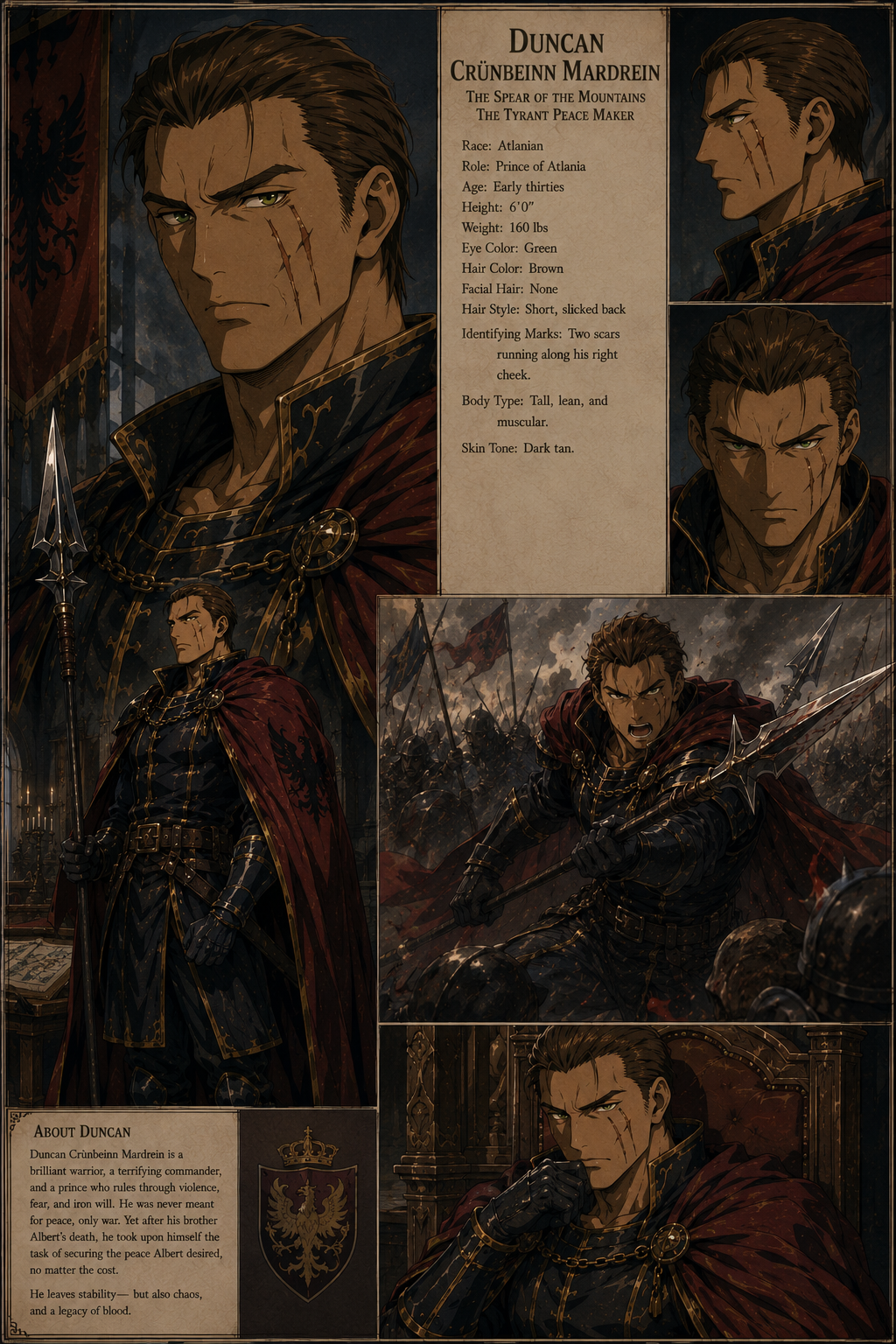
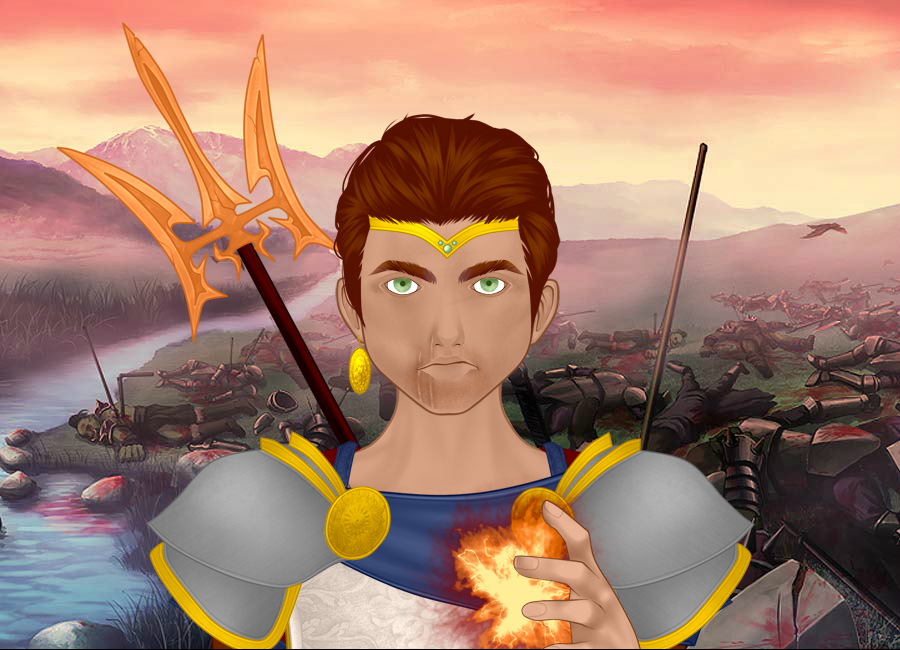
Duncan wears his hair short and slicked back, kept controlled in a severe military style rather than a fashionable courtly one. The look suits him well: sharp, disciplined, and aggressive, with no softness or ornament to distract from his presence as a commander. Even outside battle, his hair gives the impression of a man who treats his own appearance like part of his armor, ordered tightly because anything loose or careless would feel like weakness. Combined with his scars and hard expression, the style makes him look less like a romantic prince and more like a weapon kept polished for use.
Brown
6'
160lbs
Duncan’s most recognizable identifying marks are the two scars running along his right cheek. They sharpen his already severe appearance, giving his face a hard, dangerous quality that suits his reputation as the Spear of the Mountains. The scars are not decorative or romanticized; they look like marks earned in real violence, the kind carried by a prince who spent more time fighting, hunting, and commanding soldiers than softening himself for court. Combined with his slicked-back hair, dark tan, and hard green eyes, they make Duncan immediately read as a man built for war rather than diplomacy.
Duncan is tall, lean, and muscular, with the hard, dangerous build of a lifelong fighter rather than the broader solidity of a heavy commander. At six feet and around one hundred sixty pounds, he is not massive, but he carries himself with sharp physical intensity, all corded strength, controlled movement, and barely restrained violence. His body looks built for speed, reach, and impact, especially with tri-point spears and other polearms. Where Albert appears thoughtful and war-worn, Duncan appears weaponized: a prince shaped by training, anger, hunting, wrestling, and battlefield command until even his stillness feels threatening.
Duncan has a dark tan, fitting his Atlanian heritage and his life spent training, campaigning, hunting, and commanding outdoors. His complexion gives him the weathered look of a battlefield prince rather than a sheltered royal, especially when paired with his slicked-back brown hair, green eyes, and scars along his right cheek. The dark tan helps reinforce his physical presence: Duncan looks sun-hardened, active, and severe, like a man more comfortable under open sky, on rough ground, or at the head of soldiers than seated in court.
Atlanian
Green
Nature
Duncan dislikes most people on principle and is slow to trust anyone outside the narrow circle of those who have proven useful, loyal, or strong. His mistrust of the Okose is especially pronounced, shaped by the border wars and his own enjoyment of the violence those wars allowed him to unleash. Unlike Albert, Duncan does not easily imagine reconciliation through shared dignity or mutual understanding; he sees the Okose first as a military threat that must be contained, intimidated, or beaten into respecting Atlanian power. His prejudice is not limited to them, however. Duncan also has little patience for weak nobles, indecisive courtiers, ambitious siblings, or anyone he believes mistakes mercy for strength.
none
Duncan is volatile, warlike, and fiery, with a presence that makes even ordinary conversations feel like they could become confrontations. He speaks sharply, moves with controlled aggression, and often seems to be holding back anger rather than lacking it. In councils he is blunt and impatient, preferring decisions, threats, and action over long debate. Around soldiers he is more natural, especially when drilling, hunting, wrestling, or preparing for battle, but even then his approval feels hard-earned. Duncan rarely relaxes fully; he watches people like possible opponents, reacts quickly to insult or weakness, and carries himself like a spear already leveled at the next problem.
Duncan is motivated by fighting, consolidating Atlanian power, stabilizing the kingdom, and fulfilling the wishes Albert left behind. Violence comes naturally to him, and part of him is always looking for a worthy enemy, but after Albert’s death that aggression becomes tied to a larger purpose. He wants to secure the peace his brother dreamed of, even if he must do it through fear, force, and royal authority rather than diplomacy. Duncan does not believe stability happens by kindness alone; he believes a kingdom must be made too strong to break, its enemies too frightened to test it, and its nobles too disciplined to tear it apart. His tragedy is that he truly does want to protect Albert’s legacy, but the only tools he trusts are the very ones Albert hoped Atlania could someday move beyond.
Duncan’s greatest flaws are his aggression, lack of diplomacy, and quick descent into wrathful anger. He is brilliant in war, but he often treats political problems, family disputes, and noble resistance as if they are battlefields to be conquered rather than situations to be resolved. His temper makes him dangerous to challenge and difficult to advise, especially for those who cannot match his force of will. Duncan also struggles to separate strength from domination; when he believes something must be done, he is more likely to impose order through fear and violence than persuasion. This makes him effective in crisis, but disastrous as a long-term ruler, especially when his refusal to name a favored heir leaves the kingdom vulnerable to the very chaos he spent his reign suppressing.
Duncan is a brilliant strategist, tactician, and battlefield commander, with a gift for reading terrain, pressure, morale, and weakness in enemy lines. He is also a feared personal combatant, especially with tri-point spears and similar polearms, to the point that both Okose warriors and rival Atlanians know his reputation across the peninsula. Unlike Albert, Duncan does not inspire through warmth or vision; he inspires through certainty, aggression, and the frightening sense that he will break whatever stands in his way. His talents make him an exceptional general and royal enforcer, though they also reinforce his worst instincts as a ruler.
Duncan’s hobbies are wrestling, hunting, and fishing, though even his leisure tends to carry a competitive or martial edge. Wrestling gives him a direct outlet for strength, aggression, and dominance without needing a battlefield, while hunting satisfies his need for pursuit, patience, and decisive violence. Fishing is likely the closest he comes to quiet reflection, though even there he probably treats the weather, water, and catch as something to be challenged rather than merely enjoyed. Duncan does not relax gently; he prefers pastimes that test his body, sharpen his instincts, and keep him close to the rougher rhythms of the land.
Duncan is a powder keg of anger: disciplined enough to be useful, brilliant enough to be dangerous, and volatile enough that everyone around him knows to tread carefully. He is warlike, forceful, aggressive, and deeply authoritarian, a man who understands command far better than persuasion. Yet he is not mindlessly cruel or stupidly violent; his anger has direction, especially after Albert’s death, when he turns much of his fury toward securing his brother’s peace and stabilizing Atlania. Duncan is the kind of prince who can save a kingdom in crisis and poison its future in peace: a terrifying general, a necessary cudgel, and a ruler whose strength becomes dangerous when there is no enemy left to strike.
Social
Roast goat
Atlanian Drake dogs
Tri point spears
His trident
Yellow
Duncan is a military leader, prince, and eventually king of Atlania, though he is most naturally understood as a general before anything else. His true occupation is war: commanding armies, enforcing royal authority, suppressing rival houses, and turning Atlanian military strength into a tool of stability. Before Albert’s death, Duncan served as the hard edge of royal power, the prince his father could aim at enemies, rebels, and troublesome nobles when diplomacy failed. After becoming heir and later ruler, that role expanded into governance, but he never stopped thinking like a commander. Duncan’s occupation is not merely to lead soldiers, but to impose order through force when the kingdom threatens to fracture.
Duncan’s politics are authoritarian and monarchist, centered on the belief that Atlania survives only when royal power is strong enough to overawe rival houses, border enemies, and ambitious claimants. He has little patience for debate, factional bargaining, or noble independence when he believes the kingdom’s stability is at risk. After Albert’s death, Duncan becomes committed to completing his brother’s wishes, including peace with the Okose, but he pursues that peace through force, intimidation, and consolidation rather than reconciliation. To Duncan, a peaceful kingdom is not one where everyone agrees; it is one where no one dares break the order he has imposed. This makes him an effective crisis ruler, but his refusal to build a gentler or more sustainable political structure helps set the stage for the Crown Wars after his death.
Atlanian Mysticism
Duncan’s job is to serve as a general and royal enforcer, using military force to defend Atlania, discipline rival houses, and stabilize the kingdom when softer methods fail. During his father’s reign, he functions as the crown’s cudgel: the prince sent where intimidation, strategy, and violence are more useful than diplomacy. After Albert’s death, his job expands into that of heir and eventually king, but he remains a general at heart. Whether commanding armies, crushing rebellion, or forcing peace through fear, Duncan’s role is to make Atlania obey long enough to survive.
History
Start of the rainy season
Duncan Crùnbeinn Mardrein was the elder brother of Albert Dùghlas Mardrein and one of ten children born to the Atlanian royal house. By ordinary succession expectations, Duncan might have been the natural choice for crown prince, but both he and his father understood that he was a poor fit for the throne Albert was being prepared to inherit. Duncan was brilliant, dangerous, and useful, but not gentle enough for the kind of kingship his father hoped would follow. Rather than resent this openly, Duncan became the weapon his father could wield against rival houses and difficult nobles, a royal cudgel whose presence made others far more willing to negotiate with Albert.
During the Okose border wars, Duncan became one of Atlania’s most feared commanders. He was not openly hostile to every Okose tribe, but he did not hide the fact that war gave him an outlet for violence he already carried. Where Albert saw tragedy and the possibility of reconciliation, Duncan saw enemies, pressure points, and opportunities to break opposition before it could threaten Atlania. His reputation as the Spear of the Mountains grew from this period, as both Okose warriors and Atlanians learned to fear his skill in battle.
Albert’s death changed Duncan’s life completely. With his father’s health failing and the intended heir gone, Duncan was forced into the role he had never been meant to hold. He became crown prince, fought several of his siblings for legitimacy, and eventually took the throne. As king, he ruled with an iron fist, crushing possible rebellions, consolidating royal authority, and forcing Atlania into stability after the shock of war and succession crisis. In his own harsh way, he tried to complete Albert’s wishes, including maintaining the peace his brother had wanted, but he did so through intimidation and control rather than mercy or diplomacy.
Duncan’s reign succeeded in the short term but failed the future. Though he held the kingdom together through strength, he never named a specific heir and showed no clear favor among his seven sons. Whether out of distrust, pride, or the belief that only the strongest should rise, this decision left Atlania vulnerable after his death. The order he had imposed collapsed into rivalry, helping ignite the Crown Wars that would haunt the kingdom for centuries. Duncan is therefore remembered as the Tyrant Peace Maker: the prince who preserved Albert’s peace by force, then left behind the seeds of the next great fracture.
Well educated
Family
A drake dog
Notes
DUN-kan KROON-ben MAR-drain
Overview
Details about this character's overview
Duncan Crùnbeinn Mardrein
Duncan Crùnbeinn Mardrein, known as the Spear of the Mountains and later remembered as the Tyrant Peace Maker, was an Atlanian prince, general, and eventual king whose life was defined by violence, discipline, and the impossible shadow of his younger brother Albert. Though Duncan was the elder brother and might normally have been expected to become crown prince, both he and his father understood that he was poorly suited to peaceful rule. Duncan was brilliant in war, feared in combat, and useful as a royal cudgel against rival houses, but he was volatile, wrathful, and deeply undiplomatic. Where Albert was meant to become the voice of a better Atlania, Duncan was the spear held behind that voice.
During the Okose border wars, Duncan did not conceal his enthusiasm for the conflict. He may not have been openly hostile to the Okose in every political sense, but war gave him permission to vent the violence that had always lived close beneath his skin. He became known as a terrifying battlefield commander, skilled with tri-point spears and feared by both Okose warriors and Atlanians who understood what kind of prince he was. Yet his relationship with Albert complicates him. Duncan was not merely jealous of his brother’s favor; he knew Albert was the better hope for the kingdom. After Albert’s death, Duncan’s violence took on a new direction: seeing his brother’s wishes completed, stabilizing Atlania, and forcing the realm into the peace Albert had wanted but could not live to secure.
When his father’s health began to fail, Duncan was forced into the position he had never been meant to hold. He became crown prince, fought several of his siblings for legitimacy, and eventually ruled with an iron fist. His reign was harsh, authoritarian, and effective in the short term. He consolidated Atlanian power, crushed possible rebellions, and held the kingdom together through fear, military discipline, and royal will. This earned him the name Tyrant Peace Maker: a man who helped secure peace, but did so through intimidation, violence, and relentless control.
Duncan’s greatest failure came not in war, but in succession. Though he had seven sons, he never named a specific heir and never showed clear favor to any one of them. Whether this came from distrust, pride, emotional distance, or the belief that strength should prove itself, the result was disastrous. After his death, the stability he had forced upon Atlania shattered, and his sons’ competing claims helped ignite the Crown Wars. Duncan saved his brother’s peace for a time, but by refusing to settle the future, he left behind the very kind of internal conflict his iron rule had spent a lifetime suppressing.
Spear of the Mountains, Tyrant Peace Maker
Prince of Atlania
Early thirties
Male
Looks
Details about this character's looks
None
Duncan wears his hair short and slicked back, kept controlled in a severe military style rather than a fashionable courtly one. The look suits him well: sharp, disciplined, and aggressive, with no softness or ornament to distract from his presence as a commander. Even outside battle, his hair gives the impression of a man who treats his own appearance like part of his armor, ordered tightly because anything loose or careless would feel like weakness. Combined with his scars and hard expression, the style makes him look less like a romantic prince and more like a weapon kept polished for use.
Brown
6'
160lbs
Duncan’s most recognizable identifying marks are the two scars running along his right cheek. They sharpen his already severe appearance, giving his face a hard, dangerous quality that suits his reputation as the Spear of the Mountains. The scars are not decorative or romanticized; they look like marks earned in real violence, the kind carried by a prince who spent more time fighting, hunting, and commanding soldiers than softening himself for court. Combined with his slicked-back hair, dark tan, and hard green eyes, they make Duncan immediately read as a man built for war rather than diplomacy.
Duncan is tall, lean, and muscular, with the hard, dangerous build of a lifelong fighter rather than the broader solidity of a heavy commander. At six feet and around one hundred sixty pounds, he is not massive, but he carries himself with sharp physical intensity, all corded strength, controlled movement, and barely restrained violence. His body looks built for speed, reach, and impact, especially with tri-point spears and other polearms. Where Albert appears thoughtful and war-worn, Duncan appears weaponized: a prince shaped by training, anger, hunting, wrestling, and battlefield command until even his stillness feels threatening.
Duncan has a dark tan, fitting his Atlanian heritage and his life spent training, campaigning, hunting, and commanding outdoors. His complexion gives him the weathered look of a battlefield prince rather than a sheltered royal, especially when paired with his slicked-back brown hair, green eyes, and scars along his right cheek. The dark tan helps reinforce his physical presence: Duncan looks sun-hardened, active, and severe, like a man more comfortable under open sky, on rough ground, or at the head of soldiers than seated in court.
Atlanian
Green
Nature
Details about this character's nature
Duncan dislikes most people on principle and is slow to trust anyone outside the narrow circle of those who have proven useful, loyal, or strong. His mistrust of the Okose is especially pronounced, shaped by the border wars and his own enjoyment of the violence those wars allowed him to unleash. Unlike Albert, Duncan does not easily imagine reconciliation through shared dignity or mutual understanding; he sees the Okose first as a military threat that must be contained, intimidated, or beaten into respecting Atlanian power. His prejudice is not limited to them, however. Duncan also has little patience for weak nobles, indecisive courtiers, ambitious siblings, or anyone he believes mistakes mercy for strength.
none
Duncan is volatile, warlike, and fiery, with a presence that makes even ordinary conversations feel like they could become confrontations. He speaks sharply, moves with controlled aggression, and often seems to be holding back anger rather than lacking it. In councils he is blunt and impatient, preferring decisions, threats, and action over long debate. Around soldiers he is more natural, especially when drilling, hunting, wrestling, or preparing for battle, but even then his approval feels hard-earned. Duncan rarely relaxes fully; he watches people like possible opponents, reacts quickly to insult or weakness, and carries himself like a spear already leveled at the next problem.
Duncan is motivated by fighting, consolidating Atlanian power, stabilizing the kingdom, and fulfilling the wishes Albert left behind. Violence comes naturally to him, and part of him is always looking for a worthy enemy, but after Albert’s death that aggression becomes tied to a larger purpose. He wants to secure the peace his brother dreamed of, even if he must do it through fear, force, and royal authority rather than diplomacy. Duncan does not believe stability happens by kindness alone; he believes a kingdom must be made too strong to break, its enemies too frightened to test it, and its nobles too disciplined to tear it apart. His tragedy is that he truly does want to protect Albert’s legacy, but the only tools he trusts are the very ones Albert hoped Atlania could someday move beyond.
Duncan’s greatest flaws are his aggression, lack of diplomacy, and quick descent into wrathful anger. He is brilliant in war, but he often treats political problems, family disputes, and noble resistance as if they are battlefields to be conquered rather than situations to be resolved. His temper makes him dangerous to challenge and difficult to advise, especially for those who cannot match his force of will. Duncan also struggles to separate strength from domination; when he believes something must be done, he is more likely to impose order through fear and violence than persuasion. This makes him effective in crisis, but disastrous as a long-term ruler, especially when his refusal to name a favored heir leaves the kingdom vulnerable to the very chaos he spent his reign suppressing.
Duncan is a brilliant strategist, tactician, and battlefield commander, with a gift for reading terrain, pressure, morale, and weakness in enemy lines. He is also a feared personal combatant, especially with tri-point spears and similar polearms, to the point that both Okose warriors and rival Atlanians know his reputation across the peninsula. Unlike Albert, Duncan does not inspire through warmth or vision; he inspires through certainty, aggression, and the frightening sense that he will break whatever stands in his way. His talents make him an exceptional general and royal enforcer, though they also reinforce his worst instincts as a ruler.
Duncan’s hobbies are wrestling, hunting, and fishing, though even his leisure tends to carry a competitive or martial edge. Wrestling gives him a direct outlet for strength, aggression, and dominance without needing a battlefield, while hunting satisfies his need for pursuit, patience, and decisive violence. Fishing is likely the closest he comes to quiet reflection, though even there he probably treats the weather, water, and catch as something to be challenged rather than merely enjoyed. Duncan does not relax gently; he prefers pastimes that test his body, sharpen his instincts, and keep him close to the rougher rhythms of the land.
Duncan is a powder keg of anger: disciplined enough to be useful, brilliant enough to be dangerous, and volatile enough that everyone around him knows to tread carefully. He is warlike, forceful, aggressive, and deeply authoritarian, a man who understands command far better than persuasion. Yet he is not mindlessly cruel or stupidly violent; his anger has direction, especially after Albert’s death, when he turns much of his fury toward securing his brother’s peace and stabilizing Atlania. Duncan is the kind of prince who can save a kingdom in crisis and poison its future in peace: a terrifying general, a necessary cudgel, and a ruler whose strength becomes dangerous when there is no enemy left to strike.
Social
Details about this character's social
Roast goat
Atlanian Drake dogs
Tri point spears
His trident
Yellow
Duncan is a military leader, prince, and eventually king of Atlania, though he is most naturally understood as a general before anything else. His true occupation is war: commanding armies, enforcing royal authority, suppressing rival houses, and turning Atlanian military strength into a tool of stability. Before Albert’s death, Duncan served as the hard edge of royal power, the prince his father could aim at enemies, rebels, and troublesome nobles when diplomacy failed. After becoming heir and later ruler, that role expanded into governance, but he never stopped thinking like a commander. Duncan’s occupation is not merely to lead soldiers, but to impose order through force when the kingdom threatens to fracture.
Duncan’s politics are authoritarian and monarchist, centered on the belief that Atlania survives only when royal power is strong enough to overawe rival houses, border enemies, and ambitious claimants. He has little patience for debate, factional bargaining, or noble independence when he believes the kingdom’s stability is at risk. After Albert’s death, Duncan becomes committed to completing his brother’s wishes, including peace with the Okose, but he pursues that peace through force, intimidation, and consolidation rather than reconciliation. To Duncan, a peaceful kingdom is not one where everyone agrees; it is one where no one dares break the order he has imposed. This makes him an effective crisis ruler, but his refusal to build a gentler or more sustainable political structure helps set the stage for the Crown Wars after his death.
Atlanian Mysticism
Duncan’s job is to serve as a general and royal enforcer, using military force to defend Atlania, discipline rival houses, and stabilize the kingdom when softer methods fail. During his father’s reign, he functions as the crown’s cudgel: the prince sent where intimidation, strategy, and violence are more useful than diplomacy. After Albert’s death, his job expands into that of heir and eventually king, but he remains a general at heart. Whether commanding armies, crushing rebellion, or forcing peace through fear, Duncan’s role is to make Atlania obey long enough to survive.
History
Details about this character's history
Start of the rainy season
Duncan Crùnbeinn Mardrein was the elder brother of Albert Dùghlas Mardrein and one of ten children born to the Atlanian royal house. By ordinary succession expectations, Duncan might have been the natural choice for crown prince, but both he and his father understood that he was a poor fit for the throne Albert was being prepared to inherit. Duncan was brilliant, dangerous, and useful, but not gentle enough for the kind of kingship his father hoped would follow. Rather than resent this openly, Duncan became the weapon his father could wield against rival houses and difficult nobles, a royal cudgel whose presence made others far more willing to negotiate with Albert.
During the Okose border wars, Duncan became one of Atlania’s most feared commanders. He was not openly hostile to every Okose tribe, but he did not hide the fact that war gave him an outlet for violence he already carried. Where Albert saw tragedy and the possibility of reconciliation, Duncan saw enemies, pressure points, and opportunities to break opposition before it could threaten Atlania. His reputation as the Spear of the Mountains grew from this period, as both Okose warriors and Atlanians learned to fear his skill in battle.
Albert’s death changed Duncan’s life completely. With his father’s health failing and the intended heir gone, Duncan was forced into the role he had never been meant to hold. He became crown prince, fought several of his siblings for legitimacy, and eventually took the throne. As king, he ruled with an iron fist, crushing possible rebellions, consolidating royal authority, and forcing Atlania into stability after the shock of war and succession crisis. In his own harsh way, he tried to complete Albert’s wishes, including maintaining the peace his brother had wanted, but he did so through intimidation and control rather than mercy or diplomacy.
Duncan’s reign succeeded in the short term but failed the future. Though he held the kingdom together through strength, he never named a specific heir and showed no clear favor among his seven sons. Whether out of distrust, pride, or the belief that only the strongest should rise, this decision left Atlania vulnerable after his death. The order he had imposed collapsed into rivalry, helping ignite the Crown Wars that would haunt the kingdom for centuries. Duncan is therefore remembered as the Tyrant Peace Maker: the prince who preserved Albert’s peace by force, then left behind the seeds of the next great fracture.
Well educated
Family
Details about this character's family
A drake dog
Inventory
Details about this character's inventory
No inventory information yet
This section doesn't have any information filled in yet.
Changelog
Details about this character's changelog
No changelog information yet
This section doesn't have any information filled in yet.
Notes
Details about this character's notes
DUN-kan KROON-ben MAR-drain
Gallery
Images and visual content for this character


Associations
Other pages that reference or connect to this character
Referenced By
7Albert Dùghlas Mardrein Prince of Atlania and Heir Apparent
Siblings
Andrew Hayes
Friends
Atlanian Peninsula
Leaders
The Blade of the Drakes Wrath
Past Owners
Royal Crown of Atlania
Past Owners
Atlanian
Famous figures
Kingdom of Atlania
Political figures
Collections
Published collections that feature this character
Not in any collections yet
This character hasn't been published in any collections yet. Collections are curated groups of related content that help organize and showcase your world.
Tip: Collections are a great way to group related content together and share themed stories or worldbuilding elements with others.
Timelines
Timelines that reference or include this character
No timeline connections yet
This character isn't connected to any timelines yet. Timelines help organize events chronologically and show how your content fits into the broader history of your world.
Tip: Create timelines to organize important events in your world's history. Link characters, locations, and other content to specific events to build rich, interconnected narratives.
Shares
Discussion about this character
No shares yet
Be the first to start a discussion about this character by sharing it to the community stream.
Privacy & Sharing
Manage who can see and access this character
Current Status
refresh
This character is currently
Privacy Settings
Choose who can see and access this character
language Universe Privacy
This page belongs to a universe with its own privacy settings