
Categories
Dive Deeper
Page Stats
Navigation
Categories
Dive Deeper
Page Stats
Complete Details
All information about this race
Overview
Lafin
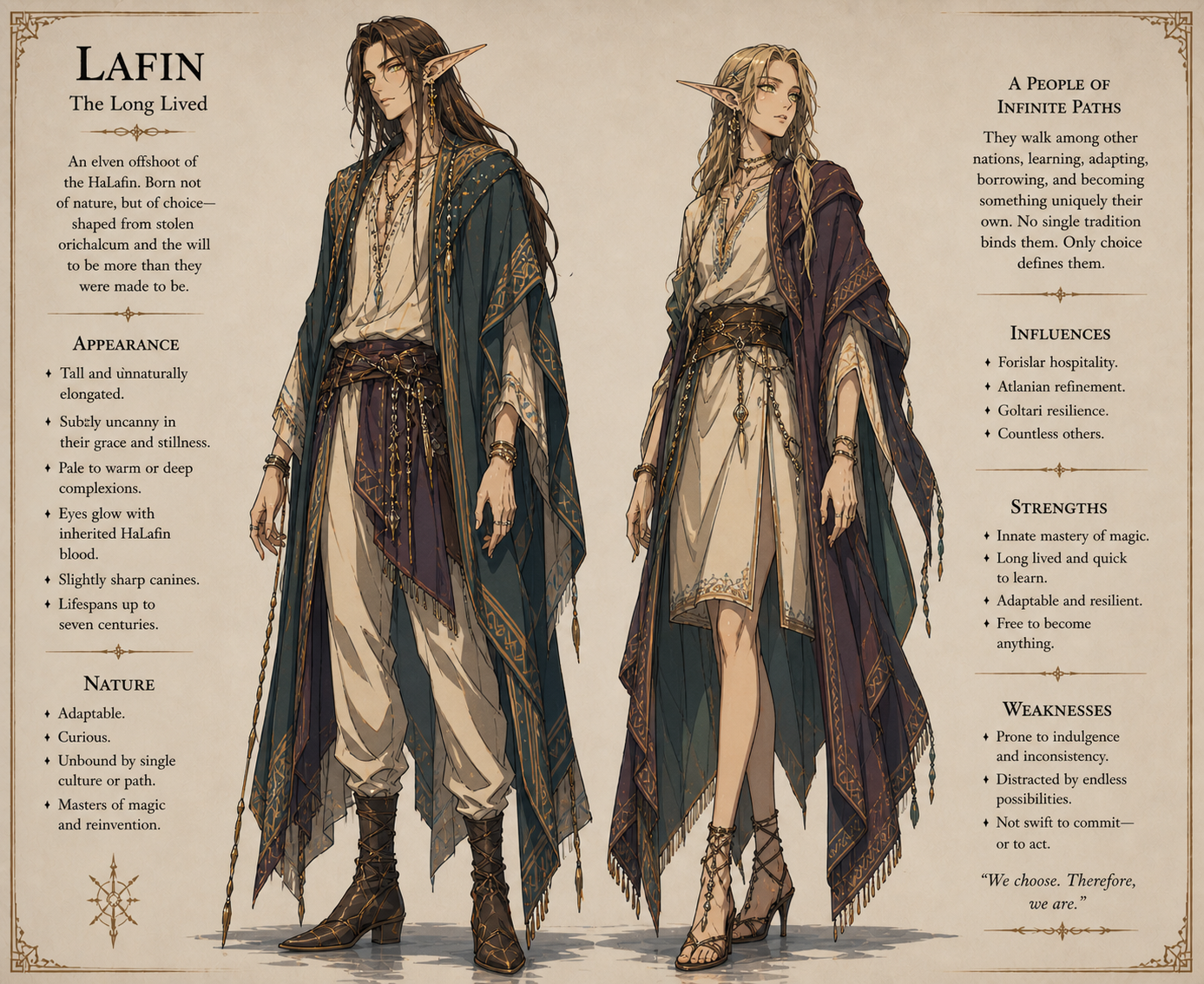
The Lafin are a tall, pale, and subtly uncanny people, bearing the unmistakable marks of their HaLafin origin while existing firmly within the limits of mortal life. At a glance, they resemble elongated, elfin figures—graceful, composed, and often striking in appearance—but closer observation reveals something slightly off in their proportions and presence. Their limbs are a little too long, their frames too light for their height, and their movements carry a fluidity that feels practiced rather than natural. They are not unnatural in the way of their progenitors, but neither are they entirely at ease within the physical world they chose to inhabit.
They are a people born not through natural lineage, but through choice and theft—former servants of the HaLafin court who seized orichalcum and reshaped themselves into living beings. In doing so, they exchanged certainty for possibility, permanence for change, and power for freedom. Unlike the rigid hierarchy of the HaLafin, the Lafin possess no fixed place in the world. They are not bound to roles, castes, or predetermined outcomes. They may become anything—but this freedom comes with the burden of sustaining themselves, something their origins did not prepare them for.
For much of their history, the Lafin have lived as cultural adopters, embedding themselves within the societies of others—most notably among the Forislar, Atlanians, and Goltari. Over the course of nearly three thousand years, they have absorbed customs, beliefs, and practices from these peoples, often blending them together in ways that are uniquely their own. They are quick to learn, quick to adapt, and quick to move on, rarely forming a unified identity beyond their shared origin. To outsiders, this makes them seem inconsistent or unreliable—not because they lack capability, but because they rarely anchor themselves to a single way of living for long.
This has led to a reputation for being unburdened by urgency. The Lafin are not inherently lazy, but they are often inconsistent in effort, prone to indulgence, distraction, and the assumption that time—of which they have much—will allow them to recover from poor decisions. Their long lives encourage cycles of excess and recovery, wealth and loss, engagement and withdrawal. They are capable of great discipline, particularly in matters of magic, but rarely maintain it unless given reason to do so.
That reason came with the onset of the demon plague.
Unlike earlier conflicts, the plague was not something the Lafin could drift through or avoid by relocation. It was universal, persistent, and indifferent to their adaptability. For many Lafin, it was the first time their long lives did not guarantee survival. Entire enclaves were lost, and those who endured did so not through chance alone, but through cooperation, preparation, and sustained effort—traits they had historically neglected.
In the centuries following the plague, a subtle shift has taken place. The Lafin have not abandoned their fluid nature, but they have become more selectively grounded. They are more likely to maintain long-term relationships, to invest in communities, and to take threats seriously when warned. Older Lafin often retain their more indulgent tendencies, while those shaped by the plague—or born after it—tend to carry a quieter awareness of consequence.
Even so, they remain a people defined by choice rather than structure. They do not build civilizations in the traditional sense, nor do they enforce a singular identity upon themselves. Instead, they exist between cultures, between expectations, and between ways of life—never fully belonging, but never entirely without place.
They are not feared like the HaLafin, nor respected like the Atlanians, nor trusted like the Forislar.
But they endure.
And they choose what that endurance means.
Knife Ears, Long Ears, Sharp teeth, the Long lived, Metal born, Lesser born
Looks
Body shape - What does the average Lafin body shape look like? (Expanded, Paragraph Form)
The Lafin possess a tall, lithe build that carries a subtle but persistent sense of imbalance when compared to fully mortal peoples. Their frames are elongated, with limbs that extend just beyond what would be considered natural proportion, giving them a height that is impressive but never imposing in a conventional, physical sense. Their shoulders are narrow, their torsos drawn thin, and their waists often appear unnaturally slight—especially when accentuated by their typical manner of dress. Even at rest, their bodies seem stretched, as though shaped to a form that was never entirely meant to hold weight.
Despite this, they are not weak. Their musculature is present, but fine and tightly distributed, favoring flexibility and control over strength or mass. Movements tend to be smooth and deliberate, often carrying a lingering trace of the fluidity associated with their HaLafin origin. They do not move like those born fully into flesh, but like those who have learned to inhabit it over time—precise, careful, and occasionally just slightly out of rhythm with the expectations of the eye.
Their physical form reflects the nature of their creation. Forged into true bodies through the use of orichalcum, Lafin exist in a state of stabilized imperfection. Their bodies are real, living, and bound by mortal limitations, but they retain subtle inconsistencies that reveal their origin—proportions that do not quite align, weight that seems lighter than it should be, and a general impression that they are held together by design rather than by nature.
There is noticeable variation among individuals, influenced by the many cultures they have lived among and intermingled with over thousands of years. However, regardless of skin tone, facial features, or other inherited traits, the underlying structure remains consistent. A Lafin can be recognized not by what they look like at first glance, but by the quiet sense that something about their form does not fully settle into the world around them.
Taken together, their bodies are not monstrous, nor are they wholly natural. They are something in between—a form chosen, rather than given, and one that never fully forgets what it used to be.
The Lafin display one of the widest ranges of skin coloration found among any people on the continent, encompassing nearly every tone seen across Sol Saris—from extremely pale to deep brown, olive, golden, and rarer hues that carry faint red or yellow undertones. This diversity is the result of both their origin and their long history of intermingling with other peoples over the course of nearly three thousand years. Unlike the HaLafin, whose appearance is tightly constrained by cultural expectation and fashion, the Lafin carry no such limitation, and their physical forms reflect the many environments and communities they have lived within.
Despite this range, there is often a subtle quality that distinguishes Lafin skin from that of fully mortal peoples. Regardless of tone, it can appear slightly too even, or faintly unnatural in its consistency, as though shaped rather than grown. In certain light, particularly among older individuals or those with stronger magical affinity, their complexion may carry a barely perceptible sheen or depth that suggests something beneath the surface is not entirely ordinary. This effect is rarely dramatic, but it contributes to the quiet sense that their bodies, while real, are not entirely the product of natural processes.
Skin tone itself is not a marker of status or identity within Lafin communities, as variation is expected and unremarkable. Instead, it is simply another reflection of their lived history—of where they have been, who they have lived among, and how their chosen forms have adapted over time. In this way, their appearance serves as a record not of origin, but of experience, with no single coloration considered more proper than another.
Lafin are a notably tall people, with most individuals standing between 6 feet and 6 feet 6 inches in height, and some exceptional cases exceeding this range slightly. Their height is one of the most immediately recognizable aspects of their appearance, though it rarely conveys physical dominance in the way it might among other races. Instead, it contributes to their elongated, almost delicate presence, as their height is paired with a narrow frame and low body mass.
There is relatively little variation between male- and female-presenting individuals in overall height, further reinforcing the subtle uniformity inherited from their HaLafin origins. While intermingling with other peoples over thousands of years has introduced some degree of variation, the underlying tendency toward tall stature remains consistent across nearly all Lafin populations.
Their height, combined with their extended limb proportions, often gives the impression that they occupy slightly more space than expected, even when standing still. In motion, this can create a sense of fluid reach and range, as though their bodies are built to move through space efficiently rather than to anchor themselves within it. Among shorter races, this can make their presence feel quietly imposing, though rarely intentionally so.
6'-6'6"
Lafin are remarkably light for their size, with most individuals averaging between 100 and 110 pounds despite their considerable height. This low body mass contributes significantly to their uncanny presence, as their tall, elongated frames appear as though they should carry more weight than they do. Their bodies seem built with minimal excess—fine bone structure, tightly distributed musculature, and very little visible density—giving the impression that they occupy space without fully pressing into it.
This lightness is not indicative of weakness, but of construction. Their bodies, shaped through the use of orichalcum and stabilized into mortal form, do not always follow the same physical expectations as those born entirely of flesh. They move with a kind of effortless economy, rarely appearing burdened by their own mass, and can seem almost weightless in motion. At times, this can be subtly disorienting to observe, particularly when a Lafin moves quickly or changes direction with unexpected ease.
There is some variation influenced by diet, lifestyle, and the cultures they live among, but even the heaviest Lafin rarely approach the mass one would expect for their height. This consistency reinforces the underlying sense that, while they are now fully living beings, their bodies remain an approximation of natural form rather than a perfect match to it.
very light for there size, averaging about 100-110 lbs.
The Lafin are immediately recognizable by a collection of features that clearly mark their origin, even as their bodies have taken on fully mortal form. Most prominent among these are their long, pointed ears, which extend slightly further and taper more sharply than those of most elfin peoples, often angling subtly backward rather than outward. Their eyes are another defining trait, typically carrying a faint green luminescence, more noticeable in low light or moments of heightened emotion or magical exertion. Unlike their HaLafin progenitors, this glow is restrained and inconsistent, flickering rather than dominating, though in some individuals it can intensify, particularly with age or magical focus.
Their teeth often reveal more of their origin than they intend. Most Lafin possess two to three slightly elongated canine teeth, sharper than those of other mortals but not grotesque. When they smile—or more often, when they forget to conceal it—these teeth can give their expressions an edge that is difficult to ignore, hinting at something more predatory beneath an otherwise controlled demeanor.
Hair among the Lafin shows far greater variation than in the HaLafin, with all natural colors present across the population, often reflecting the peoples they have lived among. However, regardless of color, their hair tends to share a similar texture—fine, smooth, and easy to maintain, often worn long or loosely tied. This, combined with their typically pale or evenly toned skin, contributes to a consistently refined, if slightly artificial, appearance.
There is also a more subtle quality to the Lafin that is harder to define. Their features often appear just slightly too precise, their symmetry a bit too consistent, their proportions a touch too deliberate. Even when heavily influenced by mortal ancestry, there remains a lingering sense that their form was chosen rather than grown. In motion or in stillness, this can create a quiet dissonance—nothing overtly wrong, but nothing entirely natural either.
Taken together, these features do not make the Lafin monstrous, nor do they fully align them with any single mortal race. Instead, they exist in a space between—recognizably living, unmistakably altered, and always carrying a faint echo of what they once were.
Long pointy ears, 2-3 canine teeth, glowing green eyes. Unlike their immortal progenitor's, all hair colors are possible
The Lafin exhibit a broad range of surface-level variation, reflecting nearly three thousand years of intermingling with the peoples of the continent. Differences in skin tone, hair color, facial structure, and minor features are common and often mirror the cultures in which they have lived. In this sense, no two Lafin need look alike at first glance, and many can pass among other races with only subtle distinction.
However, beneath this variation lies a remarkably consistent underlying form. Regardless of outward differences, Lafin bodies tend toward the same elongated proportions—tall, narrow frames, low body mass, and limbs that extend just beyond natural expectation. This shared structure creates a unifying presence that becomes more apparent the longer one observes them. Even when influenced by mortal ancestry, their posture, movement, and overall silhouette retain a familiar pattern that distinguishes them from fully natural-born peoples.
Their HaLafin origin continues to assert itself in small, persistent ways. Features such as faintly luminous eyes, slightly sharpened teeth, and the characteristic length of their ears appear with varying intensity from individual to individual. In some, these traits are subtle enough to go unnoticed at a distance; in others, they are more pronounced, especially in those with stronger magical affinity or those who lean more heavily into their heritage.
Unlike their progenitors, the Lafin cannot fully reshape themselves at will, and their physical forms are largely stable. However, their bodies are still the result of a chosen and constructed state of being, rather than purely natural development. Because of this, minor inconsistencies can occur—proportions that feel slightly off, movements that are almost too fluid, or expressions that do not quite align with expectation.
Taken together, Lafin variance exists primarily at the surface, while their deeper structure remains consistent. They are a people who can appear as many things, but who, upon closer inspection, are always recognizably the same.
Lafin clothing is defined less by a singular cultural style and more by adaptation and preference, reflecting the many societies they have lived among over the past three thousand years. There is no unified Lafin fashion, but there are clear tendencies—garments are typically loose-fitting, layered, and designed to accommodate their tall, narrow frames, often emphasizing their length rather than concealing it. Long tunics, flowing robes, ponchos, and open-layered wraps are especially common, usually secured with belts that draw attention to their unusually thin waists. Fabrics tend to favor comfort and movement over structure, allowing for ease whether traveling, performing, or practicing magic.
Among Lafin communities embedded within Atlanian societies, clothing often reflects the warmer, maritime climate and practical sensibilities of the region. Here, Lafin adopt breathable tunics, draped fabrics, and layered cloth similar to Atlanian styles, though they tend to wear them slightly longer and looser, allowing their proportions to show more clearly. Accessories such as scarves, cloaks, and simple jewelry are common, though Lafin often favor subtler ornamentation or pieces that carry personal significance rather than overt displays of status.
Those living among the Forislar tend toward highly practical, travel-ready attire. Durable cloaks, layered garments, reinforced stitching, and clothing designed for repair and reuse are common. Lafin in these communities often blend multiple regional styles together, creating outfits that reflect a patchwork of influences—functional above all else, but rarely uniform. Hidden pockets, adjustable fastenings, and garments suited for long travel are typical, though Lafin may still incorporate softer, more flowing elements than their Forislar counterparts.
Within Goltari territories, particularly among the Wolf Clan, Lafin clothing often shifts toward more fitted and movement-oriented designs. Shorter tunics, flexible wraps, and layered pieces that allow for quick motion are favored, sometimes incorporating natural materials or subtle clan influences. Even here, however, Lafin tend to maintain a slightly more refined or deliberate presentation, avoiding the heavier, more rugged builds of Goltari attire while still respecting its functional purpose.
Across all regions, Lafin clothing often carries a faint sense of intentional presentation, even when practical. They rarely dress purely for necessity; there is almost always an element of self-curation, whether conscious or not. This can manifest in the way fabrics are layered, how garments fall along their elongated frames, or how small details—belts, clasps, or stitching—are chosen and maintained.
Unlike the HaLafin, whose fashion is rigidly tied to courtly imitation, Lafin treat clothing as something fluid. They adopt, adjust, and reinterpret the styles around them, often blending multiple influences into a single form. Over time, this has created a quiet but recognizable pattern: while no two Lafin may dress the same, their clothing almost always reflects a balance between comfort, adaptability, and subtle self-expression, shaped by both the cultures they inhabit and the freedom they chose to claim.
loose fitting robes and ponchos are common, knee length tunics, a belt accentuating their inhumanly thin waists.
Traits
The greatest strength of the Lafin lies in their innate connection to magic, a remnant of their HaLafin origin that persists even within their mortal forms. Unlike most mortal peoples, who must study, train, or ritualize their use of magic, the Lafin engage with it almost instinctively. Their understanding is not always structured, but it is deeply intuitive, allowing them to manipulate magical forces with a level of ease that can rival trained scholars or seasoned practitioners. This makes them particularly adept as sorcerers, enchanters, and performers of arcane arts, often achieving complex results without the rigid methodologies employed by more disciplined cultures.
Their longevity is another defining advantage. With lifespans that can extend up to seven centuries, the Lafin possess the rare ability to accumulate knowledge, skill, and experience across vast stretches of time. A single Lafin may master multiple disciplines, live through several cultural shifts, and adapt to changing environments in ways that shorter-lived peoples cannot. While they do not always make efficient use of this time, those who do can become exceptionally capable individuals, carrying centuries of lived understanding.
The Lafin are also highly adaptable on a social and cultural level. Having spent nearly three thousand years living among other peoples, they have developed an ability to integrate into foreign societies with relative ease. They learn languages quickly, adopt customs fluidly, and navigate social structures without rigid attachment. This makes them effective intermediaries, travelers, and participants in mixed communities, able to move between cultures in ways few others can manage.
Another strength lies in their resilience to disease and environmental stress, a trait likely tied to the stability granted by their orichalcum-forged bodies. While not immune to illness, they tend to recover more readily than most mortals, and their bodies are less susceptible to common ailments. This durability, combined with their long lifespan, allows them to endure conditions that might weaken or shorten the lives of others.
Finally, the Lafin possess a unique advantage in their freedom of identity. Unlike the HaLafin, who are bound to rigid roles, or societies such as the Valarnans, who assign purpose through structure, the Lafin are not confined to predetermined paths. They are capable of becoming nearly anything—scholars, performers, merchants, wanderers, or something entirely their own. This lack of constraint allows for a breadth of experience and perspective that is rare among more structured peoples.
Taken together, the Lafin are not defined by discipline or consistency, but by potential. When they choose to apply themselves, they are capable of remarkable skill, deep knowledge, and powerful influence. Their strength lies not in what they are required to be, but in what they are able to become.
The greatest weakness of the Lafin is not a lack of capability, but a persistent lack of sustained discipline. While they possess immense potential—particularly in magic and long-term learning—they often fail to apply themselves consistently. Their long lifespans foster a tendency toward delay, indulgence, and the assumption that there will always be more time to correct mistakes. As a result, many Lafin drift through periods of inaction or distraction, allowing opportunities to pass or problems to compound before addressing them. When they do commit themselves, they can achieve remarkable results, but maintaining that commitment is often the greater challenge.
Their relationship with mortality is another fundamental weakness. Unlike other mortal peoples, the Lafin chose their condition rather than being born into it, and many never fully internalize its limitations. They understand death intellectually, but often fail to treat it with the urgency it demands. This disconnect can lead to poor long-term planning, neglect of personal safety, and an overreliance on adaptability in situations that require preparation. While the demon plague forced many Lafin to confront this reality, the lesson was unevenly absorbed, and its impact varies widely between individuals.
The Lafin are also structurally rootless. While their ability to integrate into other cultures is a strength, it comes at the cost of lacking a strong, unified identity of their own. They rarely build stable institutions, maintain long-term governance structures, or preserve consistent traditions across generations. This makes them dependent, to varying degrees, on the societies they inhabit. When those societies are stable, the Lafin thrive. When they are not, the Lafin often struggle to maintain cohesion on their own.
Their reputation for inconsistency further compounds this issue. Other peoples often view Lafin as unreliable—not because they are incapable, but because they are unpredictable in effort and follow-through. This can limit the roles they are trusted with, particularly in positions that require long-term commitment or responsibility. Even when an individual Lafin proves dependable, they may still carry the weight of this broader perception.
Physically, while resilient in many respects, Lafin are still fully mortal. They are susceptible to injury, fatigue, and the same environmental dangers as other races. Their unusually low body mass can also work against them in physically demanding or high-impact situations, making them less suited for sustained heavy labor or direct confrontation compared to more robust peoples.
Finally, their long lifespan carries its own cost. Many Lafin experience cognitive decline in advanced age, with forms of dementia becoming increasingly common beyond five centuries of life. This decline can erode memory, judgment, and identity, particularly in individuals who have lived highly unstructured lives. For a people who rely heavily on lived experience rather than preserved tradition, this represents not just a personal loss, but the gradual disappearance of knowledge that was never formally recorded.
Taken together, the Lafin are limited not by what they can do, but by how often they choose to do it—and by how long they take to recognize when they must.
The Lafin, though long-lived and resilient, are fully mortal and therefore subject to a range of conditions shaped both by their constructed nature and their prolonged lifespans. The most well-known of these is cognitive decline in advanced age, with forms of dementia becoming increasingly common beyond five centuries of life. This decline can manifest as memory fragmentation, personality drift, or loss of continuity across the many lives a single Lafin may have lived, often eroding not just knowledge, but identity itself.
They are also susceptible to Arcanium poisoning, though their tolerance is significantly higher than that of most mortal races. Prolonged or intense exposure can still destabilize their bodies, leading to symptoms such as fatigue, disorientation, and, in severe cases, partial breakdown of the magical structures that maintain their physical form. Because Lafin rely more heavily on ambient and internalized magic than most mortals, such exposure can be particularly disruptive, even if it occurs less readily.
Another condition observed among the Lafin is sometimes referred to as form strain, a gradual misalignment between their physical body and the magical framework that sustains it. This can present as subtle physical inconsistencies—joints that do not move quite as expected, shifts in posture or proportion over time, or a general sense that the body is no longer sitting correctly within itself. While rarely immediately debilitating, prolonged form strain can lead to discomfort, reduced coordination, or increased susceptibility to injury.
Lafin also exhibit a tendency toward arcane dependency, in which individuals become overly reliant on magic to compensate for physical or practical limitations. This can result in a decline in non-magical skills, reduced physical conditioning, and difficulty functioning effectively in environments where magic is limited or disrupted. In extreme cases, individuals may struggle to perform even basic tasks without magical assistance.
A more subtle but widespread condition is temporal disassociation, a byproduct of their long lifespans. Many Lafin experience difficulty maintaining a consistent sense of time, with years or even decades passing without clear distinction. This can lead to lapses in long-term planning, forgotten obligations, or a tendency to treat distant consequences as abstract rather than immediate concerns. While not considered an illness within Lafin communities, it contributes significantly to their reputation for inconsistency.
Finally, in the centuries following the demon plague, some Lafin have shown signs of what might be described as survivor fixation—a lingering behavioral shift in individuals who lived through the event. These Lafin tend to exhibit more caution, stronger attachment to communities, and a greater awareness of risk, sometimes bordering on anxiety or over-preparation. While not universal, this condition marks one of the few widespread behavioral changes to emerge across Lafin populations in recent history.
Taken together, Lafin conditions reflect the tension between what they were and what they chose to become—long-lived, magically inclined beings now bound to bodies that require care, discipline, and acceptance of limits they were never meant to have.
Culture
The Lafin possess few traditions that are wholly their own, a consequence of their origin as escapees rather than a naturally formed people. Instead, their cultural identity has developed through adoption, adaptation, and quiet synthesis of the societies they have lived among for nearly three thousand years. They are quick to take on the customs of those around them, but rarely preserve them in a rigid or formalized way. Over time, this has produced a loose collection of shared habits rather than a unified tradition—patterns of behavior that recur across Lafin communities without ever becoming codified.
One of the most consistent of these is a strong emphasis on hospitality to strangers, a value inherited largely from their long association with the Forislar. The Lafin remember that, when they first took on mortal form, they were not welcomed by all peoples, and it was the Forislar who most often gave them shelter. As a result, offering food, drink, and temporary refuge to travelers has become one of the few widely shared cultural practices among them. This is not always performed with ceremony, but it is rarely ignored.
Another common thread is the informal exchange of knowledge and skill. Lafin communities tend to share what they know freely, particularly in matters of magic, craft, and survival. This exchange is rarely structured as formal teaching; instead, it takes the form of demonstration, imitation, and gradual absorption. A Lafin may learn a skill over decades simply by being around those who practice it, without ever undergoing direct instruction.
The Lafin also maintain a subtle but meaningful tradition surrounding self-presentation and reinvention. It is not uncommon for individuals to change aspects of their appearance, clothing, or mannerisms over the course of their lives, particularly when moving between cultures. These changes are not ritualized, but they are often intentional, marking shifts in identity, purpose, or circumstance. A Lafin may adopt the dress and habits of one people for a century, then leave them behind without ceremony, carrying only what remains useful.
Before the Sixth Age, Lafin culture was marked by a general lack of urgency in preserving continuity. Communities formed and dissolved with relative ease, and few efforts were made to maintain shared identity across time. However, the demon plague introduced a subtle shift. In its aftermath, some Lafin populations began to hold more tightly to relationships, locations, and recurring practices. While still fluid compared to other races, there is now a greater tendency to return to familiar places, maintain long-standing connections, and remember who offered aid in times of crisis.
Even so, Lafin traditions remain intentionally light. They do not bind themselves to strict systems, nor do they enforce cultural conformity. Their shared identity is not built on what must be done, but on what is commonly chosen. Over time, this has resulted in a people whose traditions are less about preservation and more about continuity through experience—a culture that exists not in fixed practices, but in the patterns that emerge as they live among others and carry those influences forward.
Lafin belief is not inherited from a single origin, but formed gradually through observation, experience, and long exposure to the mortal world. Unlike the HaLafin, who reject the legitimacy of gods, the Lafin have come to accept that gods are real, present, and capable of direct influence, even if their nature is not fully understood. Their belief is not rooted in doctrine, but in accumulation—what has been seen, what has been survived, and what has proven itself to have consequence. Among these, the mountain gods are held in particularly high regard, likely influenced by their long association with peoples who revere them, as well as the visible and enduring nature of mountains themselves. To the Lafin, such beings are not abstract—they are part of the structure of the world and must be treated with appropriate respect.
They also maintain a strong awareness of spirits and unseen presences, a belief shaped both by their HaLafin origins and their time among mortal cultures. Spirits are not dismissed or categorized cleanly; they are acknowledged as real, varied, and potentially dangerous or beneficial depending on circumstance. The Lafin tend to approach them with a mixture of caution and courtesy, often extending small acts of respect—quiet words, offerings, or simple acknowledgment—rather than formal worship.
Hospitality holds a central place in Lafin belief, though it is not framed as a moral law so much as a learned necessity. The early Lafin survived in part because they were received by others, particularly the Forislar, and this memory has shaped their outlook. To offer shelter or aid to a stranger is not simply kindness—it is recognition of a shared vulnerability. While not all Lafin practice this equally, it is one of the few values that appears consistently across their communities.
Their understanding of morality is situational rather than absolute. The Lafin do not tend toward rigid ethical systems; instead, they evaluate actions based on outcome, relationship, and consequence. They are capable of compassion and cruelty alike, but neither is elevated into doctrine. This flexibility allows them to adapt to the cultures they live within, but it can also make their behavior difficult to predict or judge by external standards.
One of the most significant underlying beliefs among the Lafin is the idea that life is something chosen and therefore must be maintained. Unlike other mortals, they are acutely aware that their existence in flesh was not inevitable—it was taken. This creates a quiet but persistent understanding that survival requires effort, even if that effort is not always consistently applied. The demon plague reinforced this belief for many, turning what was once an abstract understanding into lived experience. Those who endured it often carry a deeper respect for preparation, community, and the limits of their own resilience.
Despite these shared threads, Lafin belief remains fluid. It shifts with environment, experience, and time. There are common patterns, but no central authority, no unified doctrine, and no expectation of conformity. Each Lafin builds their understanding of the world gradually, drawing from what they have seen, what they have been taught, and what they have chosen to believe.
The Lafin possess no unified system of government of their own, nor any enduring political structure that spans their people as a whole. This absence is not accidental, but a direct result of their origin. Having fled a rigid and absolute hierarchy under the HaLafin, the Lafin are deeply resistant to systems that impose fixed roles, permanent authority, or inherited obligation. As a result, they rarely establish lasting governance among themselves, and when they do, such structures tend to be temporary, situational, and limited in scope.
In practice, most Lafin live under the governments of the societies they inhabit—Atlanian, Forislar, Goltari, or otherwise—adapting to local laws and expectations with varying degrees of willingness. While they are often capable of navigating these systems effectively, they are rarely enthusiastic participants. Authority is tolerated when necessary, avoided when possible, and resisted when it becomes restrictive. Even when fully integrated into a society, Lafin individuals tend to maintain a degree of personal independence, rarely binding themselves completely to the structures around them.
Within Lafin communities, leadership—when it exists—is informal and fluid. Influence is typically held by individuals with experience, magical skill, or strong social connections rather than by formal appointment. Decisions are often made through discussion, consensus, or simple deference to those best suited to a particular situation. These arrangements can function effectively in small groups, but they rarely scale into stable, long-term institutions.
Before the Sixth Age, this lack of structure often resulted in fragmented and short-lived communities, with Lafin groups forming, dissolving, and reforming as circumstances changed. However, the demon plague introduced a subtle shift. In its aftermath, some Lafin populations have shown a greater willingness to accept limited forms of coordination and shared responsibility, particularly in matters of survival and mutual defense. This has led to the emergence of slightly more stable enclaves, where leadership may persist for longer periods, though still without becoming rigid or hereditary.
Even so, the Lafin remain fundamentally disinclined toward governance as an institution. They do not seek to rule, and they rarely attempt to organize themselves into a cohesive political entity. Their approach to authority is shaped by their defining choice—to escape a system that allowed no deviation. As a result, they continue to exist largely outside of formal power structures, moving within them when necessary, but never fully becoming part of them.
The Lafin do not maintain a unified technological tradition of their own, instead drawing from the societies they live among and supplementing those tools with their innate magical aptitude. They are pragmatic in their approach—if something is useful, they will use it, whether it originates from Atlanian engineering, Stanzgarian industry, dwarven craft, or local adaptation. Unlike the Valarnans, they do not require extensive verification before adoption, and unlike the HaLafin, they do not rely exclusively on magic to replicate all functions. Instead, they exist in a flexible middle ground, combining borrowed technology with personal arcane ability in whatever way best suits their immediate needs.
Magic, however, remains their preferred tool. Lafin are natural sorcerers, and many rely on spellwork to simplify or replace tasks that would otherwise require specialized equipment. Simple conveniences—lighting, heating, minor repairs, and personal transport—are often handled through magic rather than constructed devices. In more advanced cases, they may weave enchantments into everyday objects, creating tools that blur the line between crafted technology and personal spellwork. These solutions are often elegant but rarely standardized, as individual Lafin tend to develop their own methods rather than adhere to a shared system.
Because of this, Lafin technology is often inconsistent but effective. One individual may rely heavily on Atlanian firearms or Stanzgarian tools, while another may substitute nearly everything with magic. This lack of standardization makes it difficult for Lafin communities to develop large-scale technological infrastructure of their own, as solutions are often personal rather than communal.
They are also capable of learning and adapting more structured technologies when necessary. Lafin who spend extended time within Atlanian or Stanzgarian societies may become proficient with firearms, mechanical systems, or industrial tools, while those living near dwarven influence may gain an appreciation for precision-crafted instruments. However, they rarely push these technologies forward themselves, preferring to adopt rather than innovate.
Since the Sixth Age, and particularly following the demon plague, there has been a slight shift toward greater practical adoption of reliable tools and systems. Lafin communities that endured the crisis have shown increased willingness to maintain equipment, store resources, and preserve functional knowledge rather than relying solely on improvisation or magic. Even so, this shift remains uneven, and many Lafin continue to favor flexible, personal solutions over structured technological advancement.
In the end, Lafin technology is best understood not as a system, but as an approach—one that values utility, adaptability, and personal capability over consistency or large-scale development.
Lafin occupations are shaped less by obligation and more by inclination, opportunity, and circumstance, resulting in a wide and often inconsistent distribution of roles across their populations. While they are capable of excelling in many fields, they tend to gravitate toward occupations that allow for flexibility, autonomy, and intermittent effort rather than those requiring strict routine or long-term structural commitment.
Among the most common and recognizable Lafin roles are sorcerers and magical practitioners, where their innate connection to arcane forces gives them a natural advantage. Many serve as enchanters, hedge-mages, or independent spellcasters, offering their skills where needed rather than binding themselves to institutions. Their approach to magic is often intuitive and personalized, making them effective but sometimes unconventional in practice.
They are also frequently found in performative and social professions, including entertainers, musicians, storytellers, and actors. Their presence, appearance, and fluid adaptability lend themselves well to roles that involve presentation and interaction. In these fields, Lafin often thrive, as the work allows for variation, creativity, and periods of intensity followed by rest.
The service industry is another common space for Lafin, particularly in roles that benefit from charm, adaptability, and social awareness—innkeeping, bartending, guiding, or hospitality work. These positions align well with their cultural tendencies toward movement and interaction without requiring long-term attachment to a single place or structure.
Despite these common roles, Lafin are not limited in capability. Some do take on more structured professions—craftsmen, scholars, traders, or even soldiers—but these individuals tend to be exceptions rather than the norm, often shaped by the cultures they have embedded themselves within. Those who remain in such roles for extended periods are typically individuals who have adopted a more grounded approach to life, particularly in the aftermath of the demon plague.
Their long lifespan introduces another unique aspect to Lafin occupation: cyclical engagement. A Lafin may pursue one profession for decades or even centuries, abandon it entirely, and later return to it with renewed interest. Wealth, skill, and reputation can all be gained and lost multiple times over the course of a single life. This makes them difficult to categorize, as any given Lafin may have lived several distinct occupational “lives” within their lifespan.
While some outsiders interpret this as laziness, it is more accurately described as inconsistent investment. Lafin are capable of effort, even great effort, but they rarely sustain it without personal motivation or external pressure. Since the Sixth Age, there has been a gradual increase in individuals maintaining longer-term roles, particularly in communities that endured the demon plague, but this shift remains uneven.
Ultimately, Lafin occupations reflect their defining trait: they do what they choose, when they choose to do it—and they may choose differently tomorrow.
Lafin economics are defined by movement rather than structure, with individuals and small groups operating across the economic systems of the societies they inhabit rather than maintaining one of their own. They do not possess a centralized economy, nor do they produce or distribute goods at scale within a unified framework. Instead, they exist along the edges and intersections of larger economic powers, often moving between Atlanian, Stanzgarian, and regional markets, adapting to each as needed.
As a result, Lafin individuals run the full spectrum from destitution to extreme wealth, often experiencing multiple points along that range over the course of their lives. Their long lifespans allow them to accumulate wealth, lose it, rebuild, and repeat this cycle several times, sometimes by choice and sometimes through neglect or changing circumstance. Unlike more structured societies, where wealth is often tied to lineage or sustained position, Lafin wealth is typically fluid and temporary, tied to current engagement rather than long-term stability.
Their close association with the Forislar has played a significant role in shaping this pattern. Many Lafin travel alongside or within Forislar enclaves, relying on their networks for access to trade routes, safe passage, and economic opportunity. In return, Lafin often contribute through magical skill, performance, or specialized services, integrating into these mobile economies without fully anchoring themselves to them. This relationship allows Lafin to participate in trade without the need to maintain independent infrastructure.
Because they rarely form large, self-sustaining communities, Lafin economic activity tends to be individualized or small-scale. They may act as independent contractors, specialists, entertainers, or merchants, offering services rather than producing goods in volume. Even when wealth is accumulated, it is often spent, redistributed, or lost over time, as few Lafin prioritize long-term preservation without a specific reason to do so.
Since the Sixth Age, there has been a gradual shift toward slightly greater economic stability among some Lafin populations, particularly those who experienced the disruptions of the demon plague. These individuals are more likely to maintain savings, invest in long-term relationships, or remain within a single economic system for extended periods. However, this change is inconsistent, and many Lafin continue to follow older patterns of cyclical gain and loss.
In the end, Lafin economics are not defined by scarcity or abundance, but by impermanence. Wealth comes and goes, often more than once within a single lifetime, and few Lafin see this as unusual. It is simply another aspect of a life lived without fixed structure—something to be gained, lost, and gained again.
Lafin food preferences are shaped by indulgence, accessibility, and cultural borrowing, rather than tradition or necessity. Unlike more structured societies, they do not maintain a consistent culinary identity of their own, instead adopting and favoring foods that provide immediate satisfaction—rich flavors, easy preparation, and a sense of comfort or novelty. Across most Lafin populations, there is a clear preference for meats, sweets, and soft breads, particularly those that require little effort to prepare or can be acquired readily within the societies they inhabit.
Meat is especially favored, often prepared in ways that emphasize flavor over efficiency—roasted, stewed, or heavily seasoned depending on local influence. Lafin rarely concern themselves with strict dietary balance, instead choosing foods that are enjoyable and sustaining in the moment. Sweets are another common preference, particularly baked goods, candied fruits, and honeyed dishes, which align well with their tendency toward indulgence when circumstances allow.
White breads and other soft, easily consumed staples are widely favored, both for their availability and their versatility. These foods often form the base of Lafin meals, paired with meats, cheeses, or sweet spreads depending on region and personal taste. Their preference for such foods reflects both practicality and a desire for comfort—simple, reliable options that require little thought or preparation.
One of the more distinctive developments in Lafin culture over the past few centuries is their strong affinity for alcoholic ciders. Unlike heavier spirits or formal wines, ciders offer a balance of flavor, accessibility, and mild intoxication that suits Lafin habits well. They are commonly consumed in social settings, during travel, or simply as a daily indulgence, and have become one of the few consistent culinary preferences shared across Lafin communities.
Because Lafin often live among other peoples, their diets vary widely by region. A Lafin living in Atlania may favor seafood and fresh breads, while one among the Forislar might rely on preserved meats and travel-ready foods. Despite this variation, their overall approach remains consistent: they favor foods that are enjoyable, accessible, and require minimal long-term commitment.
Since the Sixth Age, there has been a slight shift among some Lafin toward maintaining more reliable food habits, particularly in communities that endured the demon plague. These individuals are more likely to store food, prepare meals in advance, or consider nutritional balance. Even so, indulgence remains a defining trait. Given the choice, most Lafin will still favor what is immediately satisfying over what is carefully planned.
In the end, Lafin cuisine is less about tradition and more about experience—a reflection of a people who eat not to preserve a culture, but to enjoy the moment they are in.
History
The history of the Lafin begins not with a natural origin, but with an act of defiance and desperation within the rigid hierarchy of the HaLafin court. Among the lesser ranks—servants, attendants, laborers, and those bound to roles with no possibility of change—there existed a quiet but growing awareness of their condition. In HaLafin society, position is absolute. One does not rise, does not fall, and does not choose. For those at the bottom, this meant an existence without variation or escape, stretching indefinitely into eternity.
When the Grand Duke began the great working that would draw his power inward and seal the court of Armon Kal between the layers of the universe, attention shifted toward the ritual. In that moment of distraction, a number of these lesser HaLafin acted. They breached the Grand Duke’s private treasury and stole a significant quantity of orichalcum, a material of immense importance to HaLafin kind—one capable of stabilizing their forms into true, living flesh rather than the shifting arcane constructs they naturally inhabit.
What followed was not transformation in the traditional sense, but self-imposition. Using the stolen orichalcum, these beings reshaped themselves into mortal forms, binding their existence to physical bodies governed by time, decay, and consequence. In doing so, they severed themselves from the certainty of HaLafin existence. They became something new—neither HaLafin nor fully natural-born mortal. They became the Lafin.
This act did not go unnoticed, but it could not be undone. The Grand Duke completed his ritual, sealing Armon Kal away, and the newly formed Lafin found themselves cast into a world they had not prepared for. They had gained freedom, but lost structure, protection, and the stability of their former existence. For the first time, they were required to survive.
Their early history is marked by scattering and uncertainty. Without a shared culture or system of survival, the Lafin spread across the continent, seeking refuge where they could. Many were turned away or treated with suspicion, their unnatural features and unclear origins making them difficult to trust. It was among the Forislar that they most often found acceptance, as these wandering peoples were more willing than most to offer shelter to outsiders. This early relationship would shape Lafin behavior for millennia to come.
Over time, the Lafin embedded themselves within multiple societies, most notably among the Forislar, Atlanians, and Goltari. Rather than forming a unified culture, they adapted to the environments they entered, adopting local customs, languages, and ways of life. Across nearly three thousand years, this pattern repeated, resulting in a people defined less by shared tradition and more by shared origin and scattered experience.
For much of this time, Lafin existence was characterized by cycles of engagement and withdrawal. Their long lifespans allowed them to accumulate knowledge, wealth, and skill, only to abandon or lose them and begin again. Without a strong internal structure, their communities remained small, fluid, and often temporary. They did not build nations, nor did they attempt to reclaim what they had left behind. Freedom remained their defining principle, even when it came at the cost of stability.
The most significant turning point in Lafin history came with the demon plague of the Sixth Age, an event that affected all peoples across the continent. Unlike earlier conflicts, the plague could not be avoided through movement or adaptation alone. It spread widely and without regard for culture, forcing the Lafin to confront the limitations of their lifestyle. Many perished, particularly those who had relied on drift, chance, or the assumption that time would allow for recovery.
For those who survived, the plague introduced a lasting change. While the Lafin did not abandon their fluid nature, they began to develop a greater awareness of consequence and continuity. Some communities became more stable, relationships more enduring, and individual behavior more measured. This shift was not universal, but it marked the first time in their history that a shared external event produced a recognizable, widespread change in Lafin behavior.
In the present age, the Lafin remain a people without a homeland, without a unified culture, and without a central authority. They exist across the continent, woven into the societies of others, carrying with them the memory of their origin and the consequences of their choice. They are neither remnants of the HaLafin nor fully integrated mortals, but something that continues to evolve—slowly, unevenly, and always on their own terms.
Their history is not one of rise and fall, but of escape, survival, and gradual understanding.
Lafin history is short in the grand scheme of the cosmos. HaLafin society is extremely rigid. An elf born into a particular position will remain in that position for all time. For the lesser born HaLafin this is a miserable existence, binding them as laborers, footmen, and ladies in waiting. When the Grand Duke began the ritual to draw in all his power and seal the court of Armon Kal between the layers of the universe, many of his lesser servants saw an opportunity to take their lives into their own hands. While he was distracted with the ritual they broke into his private treasury and stole a great sum of orichalcum, the most precious of materials to the HaLafin as it can help them form their bodies into actual living flesh, and not just chaotic arcane energies given visage. With this act they doomed themselves to hard mortal lives where they would have to fight every moment for their existence, but they would also be free to choose the outcomes.
Overview
Details about this race's overview
Lafin
The Lafin are a tall, pale, and subtly uncanny people, bearing the unmistakable marks of their HaLafin origin while existing firmly within the limits of mortal life. At a glance, they resemble elongated, elfin figures—graceful, composed, and often striking in appearance—but closer observation reveals something slightly off in their proportions and presence. Their limbs are a little too long, their frames too light for their height, and their movements carry a fluidity that feels practiced rather than natural. They are not unnatural in the way of their progenitors, but neither are they entirely at ease within the physical world they chose to inhabit.
They are a people born not through natural lineage, but through choice and theft—former servants of the HaLafin court who seized orichalcum and reshaped themselves into living beings. In doing so, they exchanged certainty for possibility, permanence for change, and power for freedom. Unlike the rigid hierarchy of the HaLafin, the Lafin possess no fixed place in the world. They are not bound to roles, castes, or predetermined outcomes. They may become anything—but this freedom comes with the burden of sustaining themselves, something their origins did not prepare them for.
For much of their history, the Lafin have lived as cultural adopters, embedding themselves within the societies of others—most notably among the Forislar, Atlanians, and Goltari. Over the course of nearly three thousand years, they have absorbed customs, beliefs, and practices from these peoples, often blending them together in ways that are uniquely their own. They are quick to learn, quick to adapt, and quick to move on, rarely forming a unified identity beyond their shared origin. To outsiders, this makes them seem inconsistent or unreliable—not because they lack capability, but because they rarely anchor themselves to a single way of living for long.
This has led to a reputation for being unburdened by urgency. The Lafin are not inherently lazy, but they are often inconsistent in effort, prone to indulgence, distraction, and the assumption that time—of which they have much—will allow them to recover from poor decisions. Their long lives encourage cycles of excess and recovery, wealth and loss, engagement and withdrawal. They are capable of great discipline, particularly in matters of magic, but rarely maintain it unless given reason to do so.
That reason came with the onset of the demon plague.
Unlike earlier conflicts, the plague was not something the Lafin could drift through or avoid by relocation. It was universal, persistent, and indifferent to their adaptability. For many Lafin, it was the first time their long lives did not guarantee survival. Entire enclaves were lost, and those who endured did so not through chance alone, but through cooperation, preparation, and sustained effort—traits they had historically neglected.
In the centuries following the plague, a subtle shift has taken place. The Lafin have not abandoned their fluid nature, but they have become more selectively grounded. They are more likely to maintain long-term relationships, to invest in communities, and to take threats seriously when warned. Older Lafin often retain their more indulgent tendencies, while those shaped by the plague—or born after it—tend to carry a quieter awareness of consequence.
Even so, they remain a people defined by choice rather than structure. They do not build civilizations in the traditional sense, nor do they enforce a singular identity upon themselves. Instead, they exist between cultures, between expectations, and between ways of life—never fully belonging, but never entirely without place.
They are not feared like the HaLafin, nor respected like the Atlanians, nor trusted like the Forislar.
But they endure.
And they choose what that endurance means.
Knife Ears, Long Ears, Sharp teeth, the Long lived, Metal born, Lesser born
Looks
Details about this race's looks
Body shape - What does the average Lafin body shape look like? (Expanded, Paragraph Form)
The Lafin possess a tall, lithe build that carries a subtle but persistent sense of imbalance when compared to fully mortal peoples. Their frames are elongated, with limbs that extend just beyond what would be considered natural proportion, giving them a height that is impressive but never imposing in a conventional, physical sense. Their shoulders are narrow, their torsos drawn thin, and their waists often appear unnaturally slight—especially when accentuated by their typical manner of dress. Even at rest, their bodies seem stretched, as though shaped to a form that was never entirely meant to hold weight.
Despite this, they are not weak. Their musculature is present, but fine and tightly distributed, favoring flexibility and control over strength or mass. Movements tend to be smooth and deliberate, often carrying a lingering trace of the fluidity associated with their HaLafin origin. They do not move like those born fully into flesh, but like those who have learned to inhabit it over time—precise, careful, and occasionally just slightly out of rhythm with the expectations of the eye.
Their physical form reflects the nature of their creation. Forged into true bodies through the use of orichalcum, Lafin exist in a state of stabilized imperfection. Their bodies are real, living, and bound by mortal limitations, but they retain subtle inconsistencies that reveal their origin—proportions that do not quite align, weight that seems lighter than it should be, and a general impression that they are held together by design rather than by nature.
There is noticeable variation among individuals, influenced by the many cultures they have lived among and intermingled with over thousands of years. However, regardless of skin tone, facial features, or other inherited traits, the underlying structure remains consistent. A Lafin can be recognized not by what they look like at first glance, but by the quiet sense that something about their form does not fully settle into the world around them.
Taken together, their bodies are not monstrous, nor are they wholly natural. They are something in between—a form chosen, rather than given, and one that never fully forgets what it used to be.
The Lafin display one of the widest ranges of skin coloration found among any people on the continent, encompassing nearly every tone seen across Sol Saris—from extremely pale to deep brown, olive, golden, and rarer hues that carry faint red or yellow undertones. This diversity is the result of both their origin and their long history of intermingling with other peoples over the course of nearly three thousand years. Unlike the HaLafin, whose appearance is tightly constrained by cultural expectation and fashion, the Lafin carry no such limitation, and their physical forms reflect the many environments and communities they have lived within.
Despite this range, there is often a subtle quality that distinguishes Lafin skin from that of fully mortal peoples. Regardless of tone, it can appear slightly too even, or faintly unnatural in its consistency, as though shaped rather than grown. In certain light, particularly among older individuals or those with stronger magical affinity, their complexion may carry a barely perceptible sheen or depth that suggests something beneath the surface is not entirely ordinary. This effect is rarely dramatic, but it contributes to the quiet sense that their bodies, while real, are not entirely the product of natural processes.
Skin tone itself is not a marker of status or identity within Lafin communities, as variation is expected and unremarkable. Instead, it is simply another reflection of their lived history—of where they have been, who they have lived among, and how their chosen forms have adapted over time. In this way, their appearance serves as a record not of origin, but of experience, with no single coloration considered more proper than another.
Lafin are a notably tall people, with most individuals standing between 6 feet and 6 feet 6 inches in height, and some exceptional cases exceeding this range slightly. Their height is one of the most immediately recognizable aspects of their appearance, though it rarely conveys physical dominance in the way it might among other races. Instead, it contributes to their elongated, almost delicate presence, as their height is paired with a narrow frame and low body mass.
There is relatively little variation between male- and female-presenting individuals in overall height, further reinforcing the subtle uniformity inherited from their HaLafin origins. While intermingling with other peoples over thousands of years has introduced some degree of variation, the underlying tendency toward tall stature remains consistent across nearly all Lafin populations.
Their height, combined with their extended limb proportions, often gives the impression that they occupy slightly more space than expected, even when standing still. In motion, this can create a sense of fluid reach and range, as though their bodies are built to move through space efficiently rather than to anchor themselves within it. Among shorter races, this can make their presence feel quietly imposing, though rarely intentionally so.
6'-6'6"
Lafin are remarkably light for their size, with most individuals averaging between 100 and 110 pounds despite their considerable height. This low body mass contributes significantly to their uncanny presence, as their tall, elongated frames appear as though they should carry more weight than they do. Their bodies seem built with minimal excess—fine bone structure, tightly distributed musculature, and very little visible density—giving the impression that they occupy space without fully pressing into it.
This lightness is not indicative of weakness, but of construction. Their bodies, shaped through the use of orichalcum and stabilized into mortal form, do not always follow the same physical expectations as those born entirely of flesh. They move with a kind of effortless economy, rarely appearing burdened by their own mass, and can seem almost weightless in motion. At times, this can be subtly disorienting to observe, particularly when a Lafin moves quickly or changes direction with unexpected ease.
There is some variation influenced by diet, lifestyle, and the cultures they live among, but even the heaviest Lafin rarely approach the mass one would expect for their height. This consistency reinforces the underlying sense that, while they are now fully living beings, their bodies remain an approximation of natural form rather than a perfect match to it.
very light for there size, averaging about 100-110 lbs.
The Lafin are immediately recognizable by a collection of features that clearly mark their origin, even as their bodies have taken on fully mortal form. Most prominent among these are their long, pointed ears, which extend slightly further and taper more sharply than those of most elfin peoples, often angling subtly backward rather than outward. Their eyes are another defining trait, typically carrying a faint green luminescence, more noticeable in low light or moments of heightened emotion or magical exertion. Unlike their HaLafin progenitors, this glow is restrained and inconsistent, flickering rather than dominating, though in some individuals it can intensify, particularly with age or magical focus.
Their teeth often reveal more of their origin than they intend. Most Lafin possess two to three slightly elongated canine teeth, sharper than those of other mortals but not grotesque. When they smile—or more often, when they forget to conceal it—these teeth can give their expressions an edge that is difficult to ignore, hinting at something more predatory beneath an otherwise controlled demeanor.
Hair among the Lafin shows far greater variation than in the HaLafin, with all natural colors present across the population, often reflecting the peoples they have lived among. However, regardless of color, their hair tends to share a similar texture—fine, smooth, and easy to maintain, often worn long or loosely tied. This, combined with their typically pale or evenly toned skin, contributes to a consistently refined, if slightly artificial, appearance.
There is also a more subtle quality to the Lafin that is harder to define. Their features often appear just slightly too precise, their symmetry a bit too consistent, their proportions a touch too deliberate. Even when heavily influenced by mortal ancestry, there remains a lingering sense that their form was chosen rather than grown. In motion or in stillness, this can create a quiet dissonance—nothing overtly wrong, but nothing entirely natural either.
Taken together, these features do not make the Lafin monstrous, nor do they fully align them with any single mortal race. Instead, they exist in a space between—recognizably living, unmistakably altered, and always carrying a faint echo of what they once were.
Long pointy ears, 2-3 canine teeth, glowing green eyes. Unlike their immortal progenitor's, all hair colors are possible
The Lafin exhibit a broad range of surface-level variation, reflecting nearly three thousand years of intermingling with the peoples of the continent. Differences in skin tone, hair color, facial structure, and minor features are common and often mirror the cultures in which they have lived. In this sense, no two Lafin need look alike at first glance, and many can pass among other races with only subtle distinction.
However, beneath this variation lies a remarkably consistent underlying form. Regardless of outward differences, Lafin bodies tend toward the same elongated proportions—tall, narrow frames, low body mass, and limbs that extend just beyond natural expectation. This shared structure creates a unifying presence that becomes more apparent the longer one observes them. Even when influenced by mortal ancestry, their posture, movement, and overall silhouette retain a familiar pattern that distinguishes them from fully natural-born peoples.
Their HaLafin origin continues to assert itself in small, persistent ways. Features such as faintly luminous eyes, slightly sharpened teeth, and the characteristic length of their ears appear with varying intensity from individual to individual. In some, these traits are subtle enough to go unnoticed at a distance; in others, they are more pronounced, especially in those with stronger magical affinity or those who lean more heavily into their heritage.
Unlike their progenitors, the Lafin cannot fully reshape themselves at will, and their physical forms are largely stable. However, their bodies are still the result of a chosen and constructed state of being, rather than purely natural development. Because of this, minor inconsistencies can occur—proportions that feel slightly off, movements that are almost too fluid, or expressions that do not quite align with expectation.
Taken together, Lafin variance exists primarily at the surface, while their deeper structure remains consistent. They are a people who can appear as many things, but who, upon closer inspection, are always recognizably the same.
Lafin clothing is defined less by a singular cultural style and more by adaptation and preference, reflecting the many societies they have lived among over the past three thousand years. There is no unified Lafin fashion, but there are clear tendencies—garments are typically loose-fitting, layered, and designed to accommodate their tall, narrow frames, often emphasizing their length rather than concealing it. Long tunics, flowing robes, ponchos, and open-layered wraps are especially common, usually secured with belts that draw attention to their unusually thin waists. Fabrics tend to favor comfort and movement over structure, allowing for ease whether traveling, performing, or practicing magic.
Among Lafin communities embedded within Atlanian societies, clothing often reflects the warmer, maritime climate and practical sensibilities of the region. Here, Lafin adopt breathable tunics, draped fabrics, and layered cloth similar to Atlanian styles, though they tend to wear them slightly longer and looser, allowing their proportions to show more clearly. Accessories such as scarves, cloaks, and simple jewelry are common, though Lafin often favor subtler ornamentation or pieces that carry personal significance rather than overt displays of status.
Those living among the Forislar tend toward highly practical, travel-ready attire. Durable cloaks, layered garments, reinforced stitching, and clothing designed for repair and reuse are common. Lafin in these communities often blend multiple regional styles together, creating outfits that reflect a patchwork of influences—functional above all else, but rarely uniform. Hidden pockets, adjustable fastenings, and garments suited for long travel are typical, though Lafin may still incorporate softer, more flowing elements than their Forislar counterparts.
Within Goltari territories, particularly among the Wolf Clan, Lafin clothing often shifts toward more fitted and movement-oriented designs. Shorter tunics, flexible wraps, and layered pieces that allow for quick motion are favored, sometimes incorporating natural materials or subtle clan influences. Even here, however, Lafin tend to maintain a slightly more refined or deliberate presentation, avoiding the heavier, more rugged builds of Goltari attire while still respecting its functional purpose.
Across all regions, Lafin clothing often carries a faint sense of intentional presentation, even when practical. They rarely dress purely for necessity; there is almost always an element of self-curation, whether conscious or not. This can manifest in the way fabrics are layered, how garments fall along their elongated frames, or how small details—belts, clasps, or stitching—are chosen and maintained.
Unlike the HaLafin, whose fashion is rigidly tied to courtly imitation, Lafin treat clothing as something fluid. They adopt, adjust, and reinterpret the styles around them, often blending multiple influences into a single form. Over time, this has created a quiet but recognizable pattern: while no two Lafin may dress the same, their clothing almost always reflects a balance between comfort, adaptability, and subtle self-expression, shaped by both the cultures they inhabit and the freedom they chose to claim.
loose fitting robes and ponchos are common, knee length tunics, a belt accentuating their inhumanly thin waists.
Traits
Details about this race's traits
The greatest strength of the Lafin lies in their innate connection to magic, a remnant of their HaLafin origin that persists even within their mortal forms. Unlike most mortal peoples, who must study, train, or ritualize their use of magic, the Lafin engage with it almost instinctively. Their understanding is not always structured, but it is deeply intuitive, allowing them to manipulate magical forces with a level of ease that can rival trained scholars or seasoned practitioners. This makes them particularly adept as sorcerers, enchanters, and performers of arcane arts, often achieving complex results without the rigid methodologies employed by more disciplined cultures.
Their longevity is another defining advantage. With lifespans that can extend up to seven centuries, the Lafin possess the rare ability to accumulate knowledge, skill, and experience across vast stretches of time. A single Lafin may master multiple disciplines, live through several cultural shifts, and adapt to changing environments in ways that shorter-lived peoples cannot. While they do not always make efficient use of this time, those who do can become exceptionally capable individuals, carrying centuries of lived understanding.
The Lafin are also highly adaptable on a social and cultural level. Having spent nearly three thousand years living among other peoples, they have developed an ability to integrate into foreign societies with relative ease. They learn languages quickly, adopt customs fluidly, and navigate social structures without rigid attachment. This makes them effective intermediaries, travelers, and participants in mixed communities, able to move between cultures in ways few others can manage.
Another strength lies in their resilience to disease and environmental stress, a trait likely tied to the stability granted by their orichalcum-forged bodies. While not immune to illness, they tend to recover more readily than most mortals, and their bodies are less susceptible to common ailments. This durability, combined with their long lifespan, allows them to endure conditions that might weaken or shorten the lives of others.
Finally, the Lafin possess a unique advantage in their freedom of identity. Unlike the HaLafin, who are bound to rigid roles, or societies such as the Valarnans, who assign purpose through structure, the Lafin are not confined to predetermined paths. They are capable of becoming nearly anything—scholars, performers, merchants, wanderers, or something entirely their own. This lack of constraint allows for a breadth of experience and perspective that is rare among more structured peoples.
Taken together, the Lafin are not defined by discipline or consistency, but by potential. When they choose to apply themselves, they are capable of remarkable skill, deep knowledge, and powerful influence. Their strength lies not in what they are required to be, but in what they are able to become.
The greatest weakness of the Lafin is not a lack of capability, but a persistent lack of sustained discipline. While they possess immense potential—particularly in magic and long-term learning—they often fail to apply themselves consistently. Their long lifespans foster a tendency toward delay, indulgence, and the assumption that there will always be more time to correct mistakes. As a result, many Lafin drift through periods of inaction or distraction, allowing opportunities to pass or problems to compound before addressing them. When they do commit themselves, they can achieve remarkable results, but maintaining that commitment is often the greater challenge.
Their relationship with mortality is another fundamental weakness. Unlike other mortal peoples, the Lafin chose their condition rather than being born into it, and many never fully internalize its limitations. They understand death intellectually, but often fail to treat it with the urgency it demands. This disconnect can lead to poor long-term planning, neglect of personal safety, and an overreliance on adaptability in situations that require preparation. While the demon plague forced many Lafin to confront this reality, the lesson was unevenly absorbed, and its impact varies widely between individuals.
The Lafin are also structurally rootless. While their ability to integrate into other cultures is a strength, it comes at the cost of lacking a strong, unified identity of their own. They rarely build stable institutions, maintain long-term governance structures, or preserve consistent traditions across generations. This makes them dependent, to varying degrees, on the societies they inhabit. When those societies are stable, the Lafin thrive. When they are not, the Lafin often struggle to maintain cohesion on their own.
Their reputation for inconsistency further compounds this issue. Other peoples often view Lafin as unreliable—not because they are incapable, but because they are unpredictable in effort and follow-through. This can limit the roles they are trusted with, particularly in positions that require long-term commitment or responsibility. Even when an individual Lafin proves dependable, they may still carry the weight of this broader perception.
Physically, while resilient in many respects, Lafin are still fully mortal. They are susceptible to injury, fatigue, and the same environmental dangers as other races. Their unusually low body mass can also work against them in physically demanding or high-impact situations, making them less suited for sustained heavy labor or direct confrontation compared to more robust peoples.
Finally, their long lifespan carries its own cost. Many Lafin experience cognitive decline in advanced age, with forms of dementia becoming increasingly common beyond five centuries of life. This decline can erode memory, judgment, and identity, particularly in individuals who have lived highly unstructured lives. For a people who rely heavily on lived experience rather than preserved tradition, this represents not just a personal loss, but the gradual disappearance of knowledge that was never formally recorded.
Taken together, the Lafin are limited not by what they can do, but by how often they choose to do it—and by how long they take to recognize when they must.
The Lafin, though long-lived and resilient, are fully mortal and therefore subject to a range of conditions shaped both by their constructed nature and their prolonged lifespans. The most well-known of these is cognitive decline in advanced age, with forms of dementia becoming increasingly common beyond five centuries of life. This decline can manifest as memory fragmentation, personality drift, or loss of continuity across the many lives a single Lafin may have lived, often eroding not just knowledge, but identity itself.
They are also susceptible to Arcanium poisoning, though their tolerance is significantly higher than that of most mortal races. Prolonged or intense exposure can still destabilize their bodies, leading to symptoms such as fatigue, disorientation, and, in severe cases, partial breakdown of the magical structures that maintain their physical form. Because Lafin rely more heavily on ambient and internalized magic than most mortals, such exposure can be particularly disruptive, even if it occurs less readily.
Another condition observed among the Lafin is sometimes referred to as form strain, a gradual misalignment between their physical body and the magical framework that sustains it. This can present as subtle physical inconsistencies—joints that do not move quite as expected, shifts in posture or proportion over time, or a general sense that the body is no longer sitting correctly within itself. While rarely immediately debilitating, prolonged form strain can lead to discomfort, reduced coordination, or increased susceptibility to injury.
Lafin also exhibit a tendency toward arcane dependency, in which individuals become overly reliant on magic to compensate for physical or practical limitations. This can result in a decline in non-magical skills, reduced physical conditioning, and difficulty functioning effectively in environments where magic is limited or disrupted. In extreme cases, individuals may struggle to perform even basic tasks without magical assistance.
A more subtle but widespread condition is temporal disassociation, a byproduct of their long lifespans. Many Lafin experience difficulty maintaining a consistent sense of time, with years or even decades passing without clear distinction. This can lead to lapses in long-term planning, forgotten obligations, or a tendency to treat distant consequences as abstract rather than immediate concerns. While not considered an illness within Lafin communities, it contributes significantly to their reputation for inconsistency.
Finally, in the centuries following the demon plague, some Lafin have shown signs of what might be described as survivor fixation—a lingering behavioral shift in individuals who lived through the event. These Lafin tend to exhibit more caution, stronger attachment to communities, and a greater awareness of risk, sometimes bordering on anxiety or over-preparation. While not universal, this condition marks one of the few widespread behavioral changes to emerge across Lafin populations in recent history.
Taken together, Lafin conditions reflect the tension between what they were and what they chose to become—long-lived, magically inclined beings now bound to bodies that require care, discipline, and acceptance of limits they were never meant to have.
Culture
Details about this race's culture
The Lafin possess few traditions that are wholly their own, a consequence of their origin as escapees rather than a naturally formed people. Instead, their cultural identity has developed through adoption, adaptation, and quiet synthesis of the societies they have lived among for nearly three thousand years. They are quick to take on the customs of those around them, but rarely preserve them in a rigid or formalized way. Over time, this has produced a loose collection of shared habits rather than a unified tradition—patterns of behavior that recur across Lafin communities without ever becoming codified.
One of the most consistent of these is a strong emphasis on hospitality to strangers, a value inherited largely from their long association with the Forislar. The Lafin remember that, when they first took on mortal form, they were not welcomed by all peoples, and it was the Forislar who most often gave them shelter. As a result, offering food, drink, and temporary refuge to travelers has become one of the few widely shared cultural practices among them. This is not always performed with ceremony, but it is rarely ignored.
Another common thread is the informal exchange of knowledge and skill. Lafin communities tend to share what they know freely, particularly in matters of magic, craft, and survival. This exchange is rarely structured as formal teaching; instead, it takes the form of demonstration, imitation, and gradual absorption. A Lafin may learn a skill over decades simply by being around those who practice it, without ever undergoing direct instruction.
The Lafin also maintain a subtle but meaningful tradition surrounding self-presentation and reinvention. It is not uncommon for individuals to change aspects of their appearance, clothing, or mannerisms over the course of their lives, particularly when moving between cultures. These changes are not ritualized, but they are often intentional, marking shifts in identity, purpose, or circumstance. A Lafin may adopt the dress and habits of one people for a century, then leave them behind without ceremony, carrying only what remains useful.
Before the Sixth Age, Lafin culture was marked by a general lack of urgency in preserving continuity. Communities formed and dissolved with relative ease, and few efforts were made to maintain shared identity across time. However, the demon plague introduced a subtle shift. In its aftermath, some Lafin populations began to hold more tightly to relationships, locations, and recurring practices. While still fluid compared to other races, there is now a greater tendency to return to familiar places, maintain long-standing connections, and remember who offered aid in times of crisis.
Even so, Lafin traditions remain intentionally light. They do not bind themselves to strict systems, nor do they enforce cultural conformity. Their shared identity is not built on what must be done, but on what is commonly chosen. Over time, this has resulted in a people whose traditions are less about preservation and more about continuity through experience—a culture that exists not in fixed practices, but in the patterns that emerge as they live among others and carry those influences forward.
Lafin belief is not inherited from a single origin, but formed gradually through observation, experience, and long exposure to the mortal world. Unlike the HaLafin, who reject the legitimacy of gods, the Lafin have come to accept that gods are real, present, and capable of direct influence, even if their nature is not fully understood. Their belief is not rooted in doctrine, but in accumulation—what has been seen, what has been survived, and what has proven itself to have consequence. Among these, the mountain gods are held in particularly high regard, likely influenced by their long association with peoples who revere them, as well as the visible and enduring nature of mountains themselves. To the Lafin, such beings are not abstract—they are part of the structure of the world and must be treated with appropriate respect.
They also maintain a strong awareness of spirits and unseen presences, a belief shaped both by their HaLafin origins and their time among mortal cultures. Spirits are not dismissed or categorized cleanly; they are acknowledged as real, varied, and potentially dangerous or beneficial depending on circumstance. The Lafin tend to approach them with a mixture of caution and courtesy, often extending small acts of respect—quiet words, offerings, or simple acknowledgment—rather than formal worship.
Hospitality holds a central place in Lafin belief, though it is not framed as a moral law so much as a learned necessity. The early Lafin survived in part because they were received by others, particularly the Forislar, and this memory has shaped their outlook. To offer shelter or aid to a stranger is not simply kindness—it is recognition of a shared vulnerability. While not all Lafin practice this equally, it is one of the few values that appears consistently across their communities.
Their understanding of morality is situational rather than absolute. The Lafin do not tend toward rigid ethical systems; instead, they evaluate actions based on outcome, relationship, and consequence. They are capable of compassion and cruelty alike, but neither is elevated into doctrine. This flexibility allows them to adapt to the cultures they live within, but it can also make their behavior difficult to predict or judge by external standards.
One of the most significant underlying beliefs among the Lafin is the idea that life is something chosen and therefore must be maintained. Unlike other mortals, they are acutely aware that their existence in flesh was not inevitable—it was taken. This creates a quiet but persistent understanding that survival requires effort, even if that effort is not always consistently applied. The demon plague reinforced this belief for many, turning what was once an abstract understanding into lived experience. Those who endured it often carry a deeper respect for preparation, community, and the limits of their own resilience.
Despite these shared threads, Lafin belief remains fluid. It shifts with environment, experience, and time. There are common patterns, but no central authority, no unified doctrine, and no expectation of conformity. Each Lafin builds their understanding of the world gradually, drawing from what they have seen, what they have been taught, and what they have chosen to believe.
The Lafin possess no unified system of government of their own, nor any enduring political structure that spans their people as a whole. This absence is not accidental, but a direct result of their origin. Having fled a rigid and absolute hierarchy under the HaLafin, the Lafin are deeply resistant to systems that impose fixed roles, permanent authority, or inherited obligation. As a result, they rarely establish lasting governance among themselves, and when they do, such structures tend to be temporary, situational, and limited in scope.
In practice, most Lafin live under the governments of the societies they inhabit—Atlanian, Forislar, Goltari, or otherwise—adapting to local laws and expectations with varying degrees of willingness. While they are often capable of navigating these systems effectively, they are rarely enthusiastic participants. Authority is tolerated when necessary, avoided when possible, and resisted when it becomes restrictive. Even when fully integrated into a society, Lafin individuals tend to maintain a degree of personal independence, rarely binding themselves completely to the structures around them.
Within Lafin communities, leadership—when it exists—is informal and fluid. Influence is typically held by individuals with experience, magical skill, or strong social connections rather than by formal appointment. Decisions are often made through discussion, consensus, or simple deference to those best suited to a particular situation. These arrangements can function effectively in small groups, but they rarely scale into stable, long-term institutions.
Before the Sixth Age, this lack of structure often resulted in fragmented and short-lived communities, with Lafin groups forming, dissolving, and reforming as circumstances changed. However, the demon plague introduced a subtle shift. In its aftermath, some Lafin populations have shown a greater willingness to accept limited forms of coordination and shared responsibility, particularly in matters of survival and mutual defense. This has led to the emergence of slightly more stable enclaves, where leadership may persist for longer periods, though still without becoming rigid or hereditary.
Even so, the Lafin remain fundamentally disinclined toward governance as an institution. They do not seek to rule, and they rarely attempt to organize themselves into a cohesive political entity. Their approach to authority is shaped by their defining choice—to escape a system that allowed no deviation. As a result, they continue to exist largely outside of formal power structures, moving within them when necessary, but never fully becoming part of them.
The Lafin do not maintain a unified technological tradition of their own, instead drawing from the societies they live among and supplementing those tools with their innate magical aptitude. They are pragmatic in their approach—if something is useful, they will use it, whether it originates from Atlanian engineering, Stanzgarian industry, dwarven craft, or local adaptation. Unlike the Valarnans, they do not require extensive verification before adoption, and unlike the HaLafin, they do not rely exclusively on magic to replicate all functions. Instead, they exist in a flexible middle ground, combining borrowed technology with personal arcane ability in whatever way best suits their immediate needs.
Magic, however, remains their preferred tool. Lafin are natural sorcerers, and many rely on spellwork to simplify or replace tasks that would otherwise require specialized equipment. Simple conveniences—lighting, heating, minor repairs, and personal transport—are often handled through magic rather than constructed devices. In more advanced cases, they may weave enchantments into everyday objects, creating tools that blur the line between crafted technology and personal spellwork. These solutions are often elegant but rarely standardized, as individual Lafin tend to develop their own methods rather than adhere to a shared system.
Because of this, Lafin technology is often inconsistent but effective. One individual may rely heavily on Atlanian firearms or Stanzgarian tools, while another may substitute nearly everything with magic. This lack of standardization makes it difficult for Lafin communities to develop large-scale technological infrastructure of their own, as solutions are often personal rather than communal.
They are also capable of learning and adapting more structured technologies when necessary. Lafin who spend extended time within Atlanian or Stanzgarian societies may become proficient with firearms, mechanical systems, or industrial tools, while those living near dwarven influence may gain an appreciation for precision-crafted instruments. However, they rarely push these technologies forward themselves, preferring to adopt rather than innovate.
Since the Sixth Age, and particularly following the demon plague, there has been a slight shift toward greater practical adoption of reliable tools and systems. Lafin communities that endured the crisis have shown increased willingness to maintain equipment, store resources, and preserve functional knowledge rather than relying solely on improvisation or magic. Even so, this shift remains uneven, and many Lafin continue to favor flexible, personal solutions over structured technological advancement.
In the end, Lafin technology is best understood not as a system, but as an approach—one that values utility, adaptability, and personal capability over consistency or large-scale development.
Lafin occupations are shaped less by obligation and more by inclination, opportunity, and circumstance, resulting in a wide and often inconsistent distribution of roles across their populations. While they are capable of excelling in many fields, they tend to gravitate toward occupations that allow for flexibility, autonomy, and intermittent effort rather than those requiring strict routine or long-term structural commitment.
Among the most common and recognizable Lafin roles are sorcerers and magical practitioners, where their innate connection to arcane forces gives them a natural advantage. Many serve as enchanters, hedge-mages, or independent spellcasters, offering their skills where needed rather than binding themselves to institutions. Their approach to magic is often intuitive and personalized, making them effective but sometimes unconventional in practice.
They are also frequently found in performative and social professions, including entertainers, musicians, storytellers, and actors. Their presence, appearance, and fluid adaptability lend themselves well to roles that involve presentation and interaction. In these fields, Lafin often thrive, as the work allows for variation, creativity, and periods of intensity followed by rest.
The service industry is another common space for Lafin, particularly in roles that benefit from charm, adaptability, and social awareness—innkeeping, bartending, guiding, or hospitality work. These positions align well with their cultural tendencies toward movement and interaction without requiring long-term attachment to a single place or structure.
Despite these common roles, Lafin are not limited in capability. Some do take on more structured professions—craftsmen, scholars, traders, or even soldiers—but these individuals tend to be exceptions rather than the norm, often shaped by the cultures they have embedded themselves within. Those who remain in such roles for extended periods are typically individuals who have adopted a more grounded approach to life, particularly in the aftermath of the demon plague.
Their long lifespan introduces another unique aspect to Lafin occupation: cyclical engagement. A Lafin may pursue one profession for decades or even centuries, abandon it entirely, and later return to it with renewed interest. Wealth, skill, and reputation can all be gained and lost multiple times over the course of a single life. This makes them difficult to categorize, as any given Lafin may have lived several distinct occupational “lives” within their lifespan.
While some outsiders interpret this as laziness, it is more accurately described as inconsistent investment. Lafin are capable of effort, even great effort, but they rarely sustain it without personal motivation or external pressure. Since the Sixth Age, there has been a gradual increase in individuals maintaining longer-term roles, particularly in communities that endured the demon plague, but this shift remains uneven.
Ultimately, Lafin occupations reflect their defining trait: they do what they choose, when they choose to do it—and they may choose differently tomorrow.
Lafin economics are defined by movement rather than structure, with individuals and small groups operating across the economic systems of the societies they inhabit rather than maintaining one of their own. They do not possess a centralized economy, nor do they produce or distribute goods at scale within a unified framework. Instead, they exist along the edges and intersections of larger economic powers, often moving between Atlanian, Stanzgarian, and regional markets, adapting to each as needed.
As a result, Lafin individuals run the full spectrum from destitution to extreme wealth, often experiencing multiple points along that range over the course of their lives. Their long lifespans allow them to accumulate wealth, lose it, rebuild, and repeat this cycle several times, sometimes by choice and sometimes through neglect or changing circumstance. Unlike more structured societies, where wealth is often tied to lineage or sustained position, Lafin wealth is typically fluid and temporary, tied to current engagement rather than long-term stability.
Their close association with the Forislar has played a significant role in shaping this pattern. Many Lafin travel alongside or within Forislar enclaves, relying on their networks for access to trade routes, safe passage, and economic opportunity. In return, Lafin often contribute through magical skill, performance, or specialized services, integrating into these mobile economies without fully anchoring themselves to them. This relationship allows Lafin to participate in trade without the need to maintain independent infrastructure.
Because they rarely form large, self-sustaining communities, Lafin economic activity tends to be individualized or small-scale. They may act as independent contractors, specialists, entertainers, or merchants, offering services rather than producing goods in volume. Even when wealth is accumulated, it is often spent, redistributed, or lost over time, as few Lafin prioritize long-term preservation without a specific reason to do so.
Since the Sixth Age, there has been a gradual shift toward slightly greater economic stability among some Lafin populations, particularly those who experienced the disruptions of the demon plague. These individuals are more likely to maintain savings, invest in long-term relationships, or remain within a single economic system for extended periods. However, this change is inconsistent, and many Lafin continue to follow older patterns of cyclical gain and loss.
In the end, Lafin economics are not defined by scarcity or abundance, but by impermanence. Wealth comes and goes, often more than once within a single lifetime, and few Lafin see this as unusual. It is simply another aspect of a life lived without fixed structure—something to be gained, lost, and gained again.
Lafin food preferences are shaped by indulgence, accessibility, and cultural borrowing, rather than tradition or necessity. Unlike more structured societies, they do not maintain a consistent culinary identity of their own, instead adopting and favoring foods that provide immediate satisfaction—rich flavors, easy preparation, and a sense of comfort or novelty. Across most Lafin populations, there is a clear preference for meats, sweets, and soft breads, particularly those that require little effort to prepare or can be acquired readily within the societies they inhabit.
Meat is especially favored, often prepared in ways that emphasize flavor over efficiency—roasted, stewed, or heavily seasoned depending on local influence. Lafin rarely concern themselves with strict dietary balance, instead choosing foods that are enjoyable and sustaining in the moment. Sweets are another common preference, particularly baked goods, candied fruits, and honeyed dishes, which align well with their tendency toward indulgence when circumstances allow.
White breads and other soft, easily consumed staples are widely favored, both for their availability and their versatility. These foods often form the base of Lafin meals, paired with meats, cheeses, or sweet spreads depending on region and personal taste. Their preference for such foods reflects both practicality and a desire for comfort—simple, reliable options that require little thought or preparation.
One of the more distinctive developments in Lafin culture over the past few centuries is their strong affinity for alcoholic ciders. Unlike heavier spirits or formal wines, ciders offer a balance of flavor, accessibility, and mild intoxication that suits Lafin habits well. They are commonly consumed in social settings, during travel, or simply as a daily indulgence, and have become one of the few consistent culinary preferences shared across Lafin communities.
Because Lafin often live among other peoples, their diets vary widely by region. A Lafin living in Atlania may favor seafood and fresh breads, while one among the Forislar might rely on preserved meats and travel-ready foods. Despite this variation, their overall approach remains consistent: they favor foods that are enjoyable, accessible, and require minimal long-term commitment.
Since the Sixth Age, there has been a slight shift among some Lafin toward maintaining more reliable food habits, particularly in communities that endured the demon plague. These individuals are more likely to store food, prepare meals in advance, or consider nutritional balance. Even so, indulgence remains a defining trait. Given the choice, most Lafin will still favor what is immediately satisfying over what is carefully planned.
In the end, Lafin cuisine is less about tradition and more about experience—a reflection of a people who eat not to preserve a culture, but to enjoy the moment they are in.
History
Details about this race's history
The history of the Lafin begins not with a natural origin, but with an act of defiance and desperation within the rigid hierarchy of the HaLafin court. Among the lesser ranks—servants, attendants, laborers, and those bound to roles with no possibility of change—there existed a quiet but growing awareness of their condition. In HaLafin society, position is absolute. One does not rise, does not fall, and does not choose. For those at the bottom, this meant an existence without variation or escape, stretching indefinitely into eternity.
When the Grand Duke began the great working that would draw his power inward and seal the court of Armon Kal between the layers of the universe, attention shifted toward the ritual. In that moment of distraction, a number of these lesser HaLafin acted. They breached the Grand Duke’s private treasury and stole a significant quantity of orichalcum, a material of immense importance to HaLafin kind—one capable of stabilizing their forms into true, living flesh rather than the shifting arcane constructs they naturally inhabit.
What followed was not transformation in the traditional sense, but self-imposition. Using the stolen orichalcum, these beings reshaped themselves into mortal forms, binding their existence to physical bodies governed by time, decay, and consequence. In doing so, they severed themselves from the certainty of HaLafin existence. They became something new—neither HaLafin nor fully natural-born mortal. They became the Lafin.
This act did not go unnoticed, but it could not be undone. The Grand Duke completed his ritual, sealing Armon Kal away, and the newly formed Lafin found themselves cast into a world they had not prepared for. They had gained freedom, but lost structure, protection, and the stability of their former existence. For the first time, they were required to survive.
Their early history is marked by scattering and uncertainty. Without a shared culture or system of survival, the Lafin spread across the continent, seeking refuge where they could. Many were turned away or treated with suspicion, their unnatural features and unclear origins making them difficult to trust. It was among the Forislar that they most often found acceptance, as these wandering peoples were more willing than most to offer shelter to outsiders. This early relationship would shape Lafin behavior for millennia to come.
Over time, the Lafin embedded themselves within multiple societies, most notably among the Forislar, Atlanians, and Goltari. Rather than forming a unified culture, they adapted to the environments they entered, adopting local customs, languages, and ways of life. Across nearly three thousand years, this pattern repeated, resulting in a people defined less by shared tradition and more by shared origin and scattered experience.
For much of this time, Lafin existence was characterized by cycles of engagement and withdrawal. Their long lifespans allowed them to accumulate knowledge, wealth, and skill, only to abandon or lose them and begin again. Without a strong internal structure, their communities remained small, fluid, and often temporary. They did not build nations, nor did they attempt to reclaim what they had left behind. Freedom remained their defining principle, even when it came at the cost of stability.
The most significant turning point in Lafin history came with the demon plague of the Sixth Age, an event that affected all peoples across the continent. Unlike earlier conflicts, the plague could not be avoided through movement or adaptation alone. It spread widely and without regard for culture, forcing the Lafin to confront the limitations of their lifestyle. Many perished, particularly those who had relied on drift, chance, or the assumption that time would allow for recovery.
For those who survived, the plague introduced a lasting change. While the Lafin did not abandon their fluid nature, they began to develop a greater awareness of consequence and continuity. Some communities became more stable, relationships more enduring, and individual behavior more measured. This shift was not universal, but it marked the first time in their history that a shared external event produced a recognizable, widespread change in Lafin behavior.
In the present age, the Lafin remain a people without a homeland, without a unified culture, and without a central authority. They exist across the continent, woven into the societies of others, carrying with them the memory of their origin and the consequences of their choice. They are neither remnants of the HaLafin nor fully integrated mortals, but something that continues to evolve—slowly, unevenly, and always on their own terms.
Their history is not one of rise and fall, but of escape, survival, and gradual understanding.
Lafin history is short in the grand scheme of the cosmos. HaLafin society is extremely rigid. An elf born into a particular position will remain in that position for all time. For the lesser born HaLafin this is a miserable existence, binding them as laborers, footmen, and ladies in waiting. When the Grand Duke began the ritual to draw in all his power and seal the court of Armon Kal between the layers of the universe, many of his lesser servants saw an opportunity to take their lives into their own hands. While he was distracted with the ritual they broke into his private treasury and stole a great sum of orichalcum, the most precious of materials to the HaLafin as it can help them form their bodies into actual living flesh, and not just chaotic arcane energies given visage. With this act they doomed themselves to hard mortal lives where they would have to fight every moment for their existence, but they would also be free to choose the outcomes.
Notes
Details about this race's notes
No notes information yet
This section doesn't have any information filled in yet.
Gallery
Images and visual content for this race
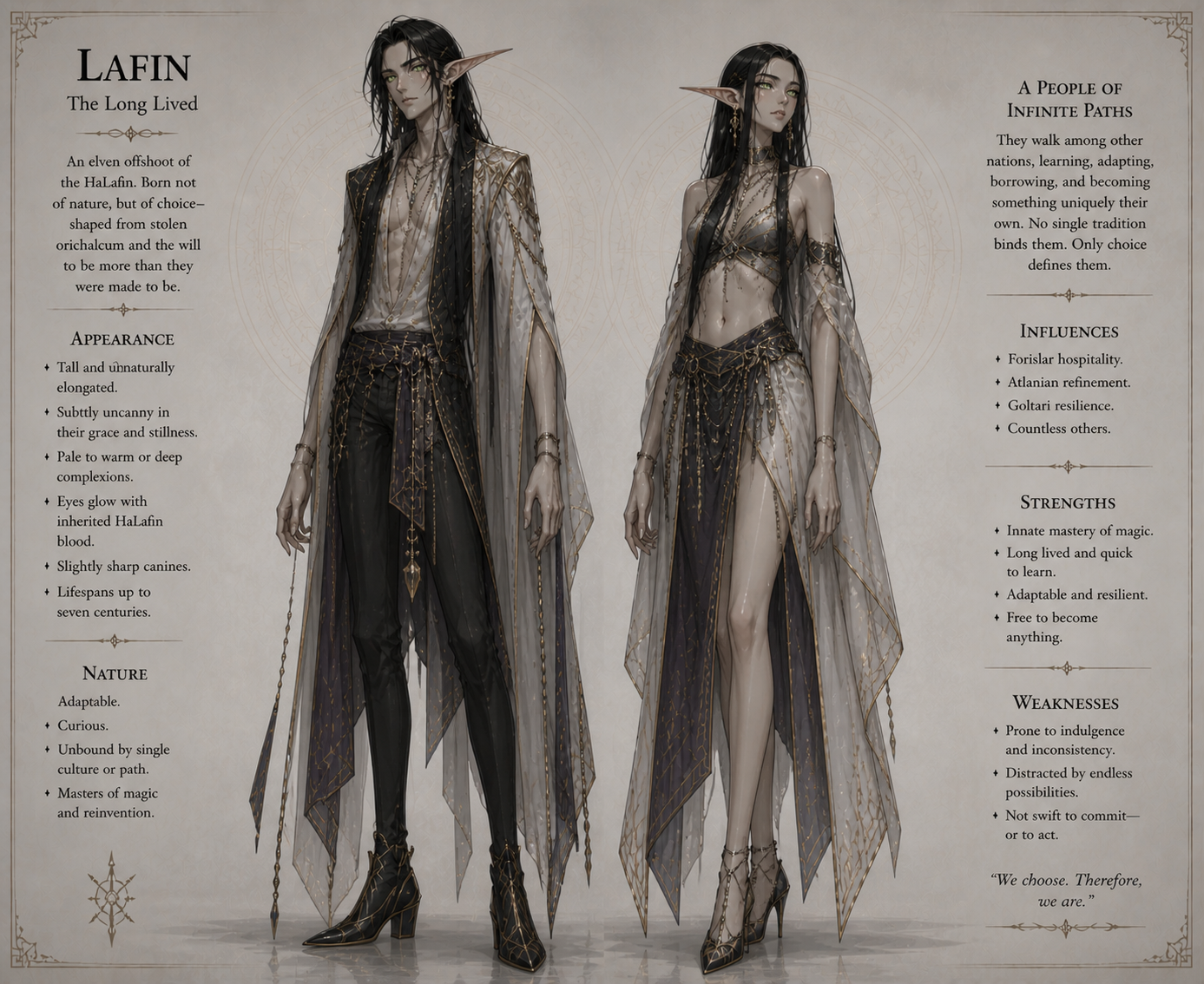
Associations
Other pages that reference or connect to this race
Referenced By
10Kusha
Linked Races
Lela
Linked Races
Sol Saris
Races
Sol Saris
Races
Nendara
Linked Races
Ser'naia
Linked Races
Philipe Stanzgar
Enemies
Gouldram
Related races
Mirelle Duskveil
Linked Races
Serovel of the Silver Tongue
Related races
Collections
Published collections that feature this race
Not in any collections yet
This race hasn't been published in any collections yet. Collections are curated groups of related content that help organize and showcase your world.
Tip: Collections are a great way to group related content together and share themed stories or worldbuilding elements with others.
Timelines
Timelines that reference or include this race
No timeline connections yet
This race isn't connected to any timelines yet. Timelines help organize events chronologically and show how your content fits into the broader history of your world.
Tip: Create timelines to organize important events in your world's history. Link characters, locations, and other content to specific events to build rich, interconnected narratives.
Shares
Discussion about this race
No shares yet
Be the first to start a discussion about this race by sharing it to the community stream.
Privacy & Sharing
Manage who can see and access this race
Current Status
refresh
This race is currently
Privacy Settings
Choose who can see and access this race
language Universe Privacy
This page belongs to a universe with its own privacy settings