
Categories
Dive Deeper
Page Stats
Navigation
Categories
Dive Deeper
Page Stats
Complete Details
All information about this race
Overview
Forislar
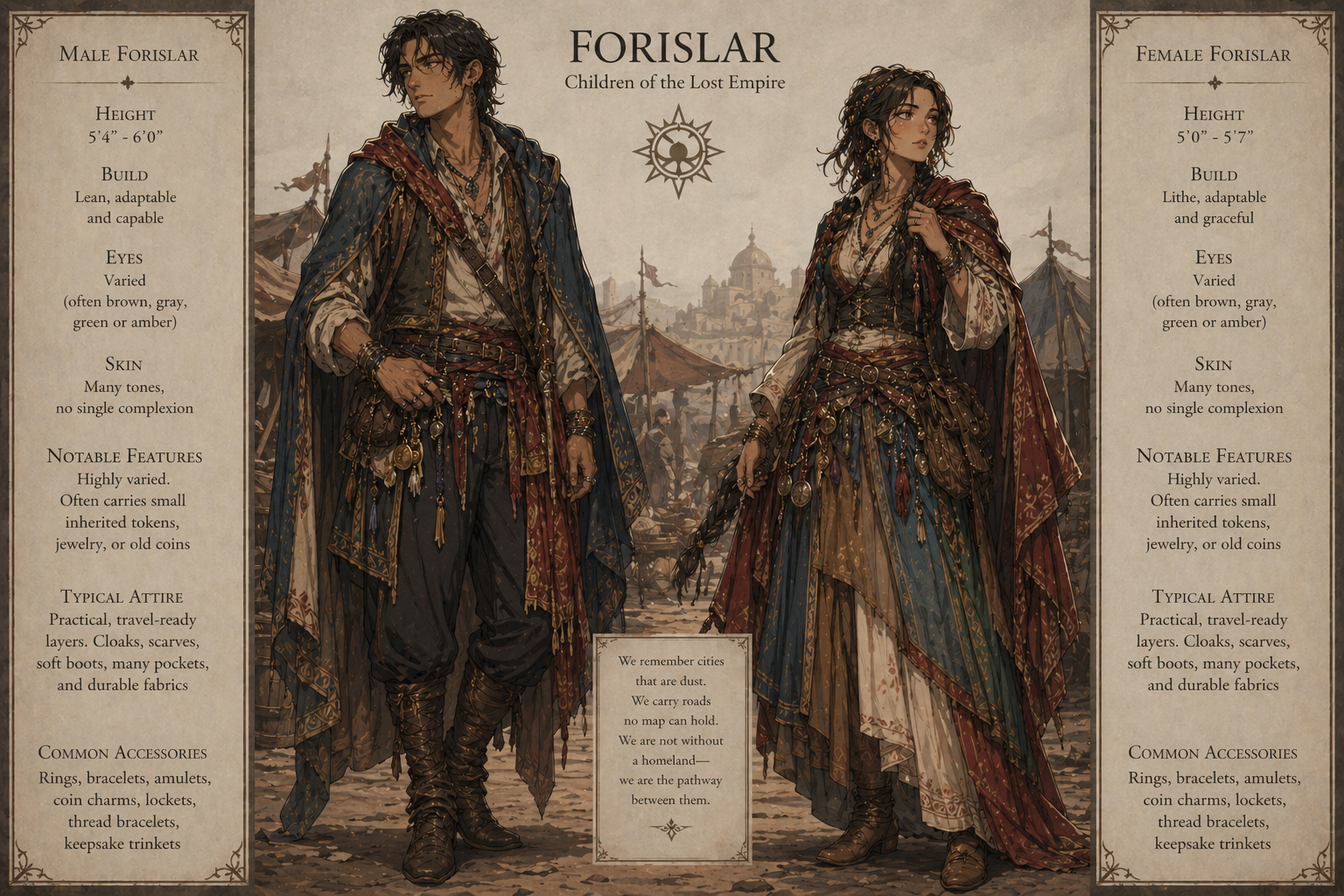
Travelers, vagabonds, thieves, merchants, scholars, and ghosts of an empire—these are all names that have been given to the Forislar since the fall of the Grand Empire.
The Forislar are a people without a singular homeland, not because they never had one, but because they lost it. Once the builders and inheritors of the Grand Empire, they now exist scattered across the continent in enclaves, caravan communities, old quarter districts, and wandering family bands that move between kingdoms without ever fully belonging to any of them.
They are rarely fully integrated into the societies around them. Instead, they form their own quiet communities within foreign cities—close enough to trade, but never so close as to be absorbed. In rural lands they are often found in long-standing roadside settlements, old trade stops, and merchant camps that have become semi-permanent over generations.
To outsiders, the Forislar often appear rootless. To themselves, they are not homeless—they are carrying what remains of home with them.
Their identity is not tied to borders, but to memory, bloodline, language fragments, inherited customs, and the stubborn refusal to disappear.
Wanderers, Travelers, Roadborn, Empire’s Children, Ash Walkers, Last Citizens, Dust Folk, The Unlanded, Caravan Blood, The Remembering People
Looks
There is no singular “Forislar build.” Their people show as much physical variation as can be found anywhere on the continent.
They are generally somewhat leaner than neighboring peoples due to generations of travel, uncertain settlement, and labor-based survival. Even wealthier Forislar often carry themselves like people used to leaving quickly.
Nearly every skin tone found across the continent can be found among the Forislar.
Their long history of migration, trade, intermarriage, and survival among other peoples has made physical appearance highly varied. No single complexion defines them.
Most Forislar fall between 5 and 6 feet tall, though considerable variance exists depending on family lineage and region.
There is wide natural variance, though most tend toward leaner builds due to frequent travel, physical labor, and less stable access to wealth than many settled peoples.
Even prosperous families often retain older habits of restraint and preparedness.
The most noticeable feature of the Forislar is not physical appearance, but how difficult they are to physically define.
They are a people shaped by intermingling with nearly every other race and nation around them. Hair, eyes, build, and complexion vary so widely that no singular “look” exists.
Instead, outsiders often recognize them through mannerisms—careful speech, inherited posture, the habit of watching exits, strong family clustering, and an unusual talent for making temporary places feel permanent.
Older families often preserve small inherited markers of old imperial identity—jewelry, names, tattoos, prayer habits, or old coin fragments worn as charms.
Extensive.
The Forislar may possess the greatest physical variance of any human people on the continent. Unlike peoples such as the Atlanians, whose divine shaping left them physically uniform, the Forislar were shaped by movement, intermarriage, and survival.
They are often described less as a race and more as a people held together by memory.
Because the Forislar live across nearly every nation on the continent, there is no universal style of dress. Clothing is usually determined by local climate, available materials, and the customs of the surrounding culture.
However, practicality is always favored.
Articles that travel well—layered cloaks, durable boots, weatherproof wraps, sturdy belts, hidden pockets, and garments that can be repaired repeatedly—are preferred across nearly all communities.
Jewelry tends to be small, inherited, and personally meaningful rather than extravagant. Rings, old coins, lockets, and family-thread bracelets are common.
Even wealthy Forislar often dress more like prepared travelers than settled nobles.
Traits
The Forislar are known for adaptability, persistence, and an almost unnatural ability to survive change.
They learn quickly, travel easily, and rarely build their identity around institutions that can be taken from them. They are excellent negotiators, merchants, interpreters, craftsmen, and survivors.
Their greatest strength is continuity—when kingdoms fall, roads remain, and so do they.
They are also known for preserving stories, names, debts, and grudges far longer than most settled peoples.
Pride.
The Forislar remember what they were, and many never fully forgive the world for what they became.
This pride can make them slow to trust, reluctant to ask for help, and unwilling to accept humiliation even when practicality would demand it.
Many struggle with belonging—too foreign to be fully accepted elsewhere, too changed to return to what was lost.
Some communities become so protective of memory that they resist change entirely, preserving wounds as carefully as traditions.
The same illnesses and conditions common among Stanzgarians are often found among the Forislar, particularly those living in colder northern regions.
In addition, many speak of a condition sometimes called Road Hunger—a restless unease felt after remaining too long in one place. Whether cultural habit or genuine spiritual inheritance, many Forislar become anxious, irritable, or melancholic when they feel “stuck.”
Culture
Though traditions vary heavily by region, one principle is nearly universal:
A stranger is fed before they are questioned.
Hospitality is sacred among the Forislar. A people who survived by finding shelter in foreign places rarely deny shelter to others.
Family stories are treated as inheritance. Oral history is preserved carefully, and children are often expected to know the names of ancestors they will never meet and places they have never seen.
Portable shrines, inherited cookware, and old trade-route customs remain surprisingly consistent across distant communities.
Departure rituals are often more formal than arrivals.
Leaving safely matters more than arriving proudly.
Broadly, the Forislar share the same religious and spiritual framework as the Stanzgarians, though often with stronger emphasis on memory, inheritance, and the moral weight of hospitality.
They believe roads remember.
Homes may be lost, but paths endure.
Ancestors are often honored less through burial places and more through continuation—names passed down, recipes preserved, stories retold correctly.
Many Forislar place spiritual importance on thresholds, crossroads, old roads, and inns.
To offer warmth to the lost is considered a sacred act.
The Forislar rarely rule territory of their own and usually live under whatever government controls the land around them.
Internally, however, many communities are governed by family elders, trade councils, respected speakers, or old bloodline agreements that outsiders rarely notice.
A kingdom may claim the city.
But everyone knows which grandmother actually runs the neighborhood.
Whatever is available where they live.
The Forislar are practical adopters rather than cultural inventors. They learn quickly and adapt easily, often becoming highly skilled in local crafts without claiming ownership of them.
Portable technologies, repairable tools, durable cookware, trade knowledge, and survival skills are often valued more than grand inventions.
They trust what can be carried.
Anything and everything.
The Forislar can be found as merchants, caravan masters, smiths, cooks, scholars, translators, sailors, tailors, innkeepers, scribes, musicians, laborers, and thieves.
They are especially common in professions built on movement, trust, and information.
They often become the people who know everyone.
The Forislar adapt to the economy of whatever society they live within.
They are rarely the highest nobility, but they also rarely sink to the absolute bottom. Their strength lies in networks—family ties across borders, old trade relationships, shared favors, and information that travels faster than official law.
A poor Forislar family may have little coin but three cities willing to shelter them.
That is often wealth enough.
This depends heavily on region, but foods that travel well, preserve easily, or can be prepared on small hearths and portable stoves are strongly preferred.
Stews, flatbreads, smoked meats, dried fruits, preserved roots, hard cheeses, and heavily spiced caravan dishes are common.
Meals are often built around what can be shared quickly and carried forward tomorrow.
Food that reminds someone of another place is often valued more than expensive food.
History
The Foundation of the Grand Empire
The Height of Imperial Expansion
The Collapse and Destruction of the Grand Empire
The Great Scattering of the Forislar People
The Attempted Eradication of the Forislar by the Icesea Area Dwarves
The Survival of the Road Enclaves
The Quiet Return of Forislar influence through trade, scholarship, and bloodline survival
Overview
Details about this race's overview
Forislar
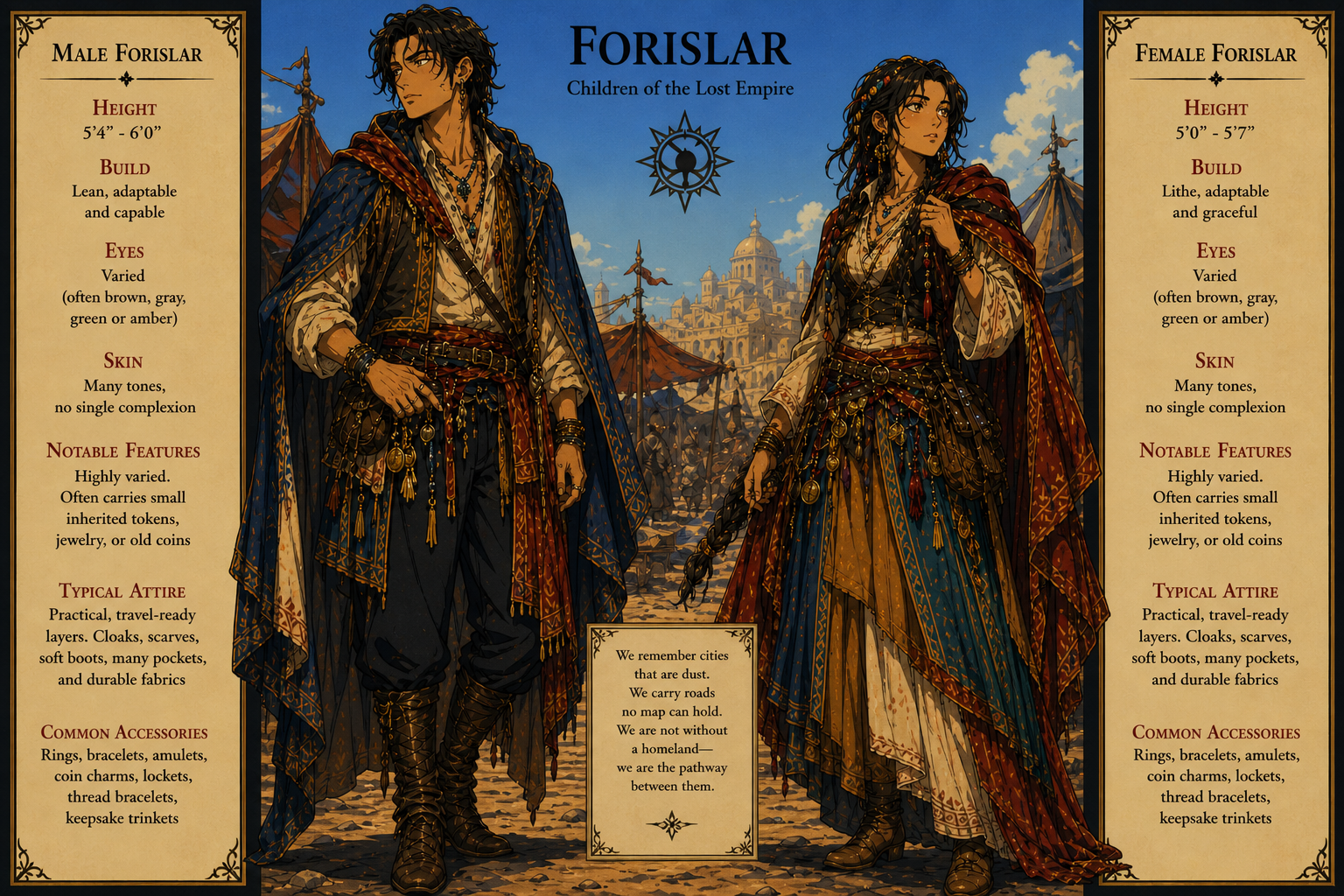
Travelers, vagabonds, thieves, merchants, scholars, and ghosts of an empire—these are all names that have been given to the Forislar since the fall of the Grand Empire.
The Forislar are a people without a singular homeland, not because they never had one, but because they lost it. Once the builders and inheritors of the Grand Empire, they now exist scattered across the continent in enclaves, caravan communities, old quarter districts, and wandering family bands that move between kingdoms without ever fully belonging to any of them.
They are rarely fully integrated into the societies around them. Instead, they form their own quiet communities within foreign cities—close enough to trade, but never so close as to be absorbed. In rural lands they are often found in long-standing roadside settlements, old trade stops, and merchant camps that have become semi-permanent over generations.
To outsiders, the Forislar often appear rootless. To themselves, they are not homeless—they are carrying what remains of home with them.
Their identity is not tied to borders, but to memory, bloodline, language fragments, inherited customs, and the stubborn refusal to disappear.
Wanderers, Travelers, Roadborn, Empire’s Children, Ash Walkers, Last Citizens, Dust Folk, The Unlanded, Caravan Blood, The Remembering People
Looks
Details about this race's looks
There is no singular “Forislar build.” Their people show as much physical variation as can be found anywhere on the continent.
They are generally somewhat leaner than neighboring peoples due to generations of travel, uncertain settlement, and labor-based survival. Even wealthier Forislar often carry themselves like people used to leaving quickly.
Nearly every skin tone found across the continent can be found among the Forislar.
Their long history of migration, trade, intermarriage, and survival among other peoples has made physical appearance highly varied. No single complexion defines them.
Most Forislar fall between 5 and 6 feet tall, though considerable variance exists depending on family lineage and region.
There is wide natural variance, though most tend toward leaner builds due to frequent travel, physical labor, and less stable access to wealth than many settled peoples.
Even prosperous families often retain older habits of restraint and preparedness.
The most noticeable feature of the Forislar is not physical appearance, but how difficult they are to physically define.
They are a people shaped by intermingling with nearly every other race and nation around them. Hair, eyes, build, and complexion vary so widely that no singular “look” exists.
Instead, outsiders often recognize them through mannerisms—careful speech, inherited posture, the habit of watching exits, strong family clustering, and an unusual talent for making temporary places feel permanent.
Older families often preserve small inherited markers of old imperial identity—jewelry, names, tattoos, prayer habits, or old coin fragments worn as charms.
Extensive.
The Forislar may possess the greatest physical variance of any human people on the continent. Unlike peoples such as the Atlanians, whose divine shaping left them physically uniform, the Forislar were shaped by movement, intermarriage, and survival.
They are often described less as a race and more as a people held together by memory.
Because the Forislar live across nearly every nation on the continent, there is no universal style of dress. Clothing is usually determined by local climate, available materials, and the customs of the surrounding culture.
However, practicality is always favored.
Articles that travel well—layered cloaks, durable boots, weatherproof wraps, sturdy belts, hidden pockets, and garments that can be repaired repeatedly—are preferred across nearly all communities.
Jewelry tends to be small, inherited, and personally meaningful rather than extravagant. Rings, old coins, lockets, and family-thread bracelets are common.
Even wealthy Forislar often dress more like prepared travelers than settled nobles.
Traits
Details about this race's traits
The Forislar are known for adaptability, persistence, and an almost unnatural ability to survive change.
They learn quickly, travel easily, and rarely build their identity around institutions that can be taken from them. They are excellent negotiators, merchants, interpreters, craftsmen, and survivors.
Their greatest strength is continuity—when kingdoms fall, roads remain, and so do they.
They are also known for preserving stories, names, debts, and grudges far longer than most settled peoples.
Pride.
The Forislar remember what they were, and many never fully forgive the world for what they became.
This pride can make them slow to trust, reluctant to ask for help, and unwilling to accept humiliation even when practicality would demand it.
Many struggle with belonging—too foreign to be fully accepted elsewhere, too changed to return to what was lost.
Some communities become so protective of memory that they resist change entirely, preserving wounds as carefully as traditions.
The same illnesses and conditions common among Stanzgarians are often found among the Forislar, particularly those living in colder northern regions.
In addition, many speak of a condition sometimes called Road Hunger—a restless unease felt after remaining too long in one place. Whether cultural habit or genuine spiritual inheritance, many Forislar become anxious, irritable, or melancholic when they feel “stuck.”
Culture
Details about this race's culture
Though traditions vary heavily by region, one principle is nearly universal:
A stranger is fed before they are questioned.
Hospitality is sacred among the Forislar. A people who survived by finding shelter in foreign places rarely deny shelter to others.
Family stories are treated as inheritance. Oral history is preserved carefully, and children are often expected to know the names of ancestors they will never meet and places they have never seen.
Portable shrines, inherited cookware, and old trade-route customs remain surprisingly consistent across distant communities.
Departure rituals are often more formal than arrivals.
Leaving safely matters more than arriving proudly.
Broadly, the Forislar share the same religious and spiritual framework as the Stanzgarians, though often with stronger emphasis on memory, inheritance, and the moral weight of hospitality.
They believe roads remember.
Homes may be lost, but paths endure.
Ancestors are often honored less through burial places and more through continuation—names passed down, recipes preserved, stories retold correctly.
Many Forislar place spiritual importance on thresholds, crossroads, old roads, and inns.
To offer warmth to the lost is considered a sacred act.
The Forislar rarely rule territory of their own and usually live under whatever government controls the land around them.
Internally, however, many communities are governed by family elders, trade councils, respected speakers, or old bloodline agreements that outsiders rarely notice.
A kingdom may claim the city.
But everyone knows which grandmother actually runs the neighborhood.
Whatever is available where they live.
The Forislar are practical adopters rather than cultural inventors. They learn quickly and adapt easily, often becoming highly skilled in local crafts without claiming ownership of them.
Portable technologies, repairable tools, durable cookware, trade knowledge, and survival skills are often valued more than grand inventions.
They trust what can be carried.
Anything and everything.
The Forislar can be found as merchants, caravan masters, smiths, cooks, scholars, translators, sailors, tailors, innkeepers, scribes, musicians, laborers, and thieves.
They are especially common in professions built on movement, trust, and information.
They often become the people who know everyone.
The Forislar adapt to the economy of whatever society they live within.
They are rarely the highest nobility, but they also rarely sink to the absolute bottom. Their strength lies in networks—family ties across borders, old trade relationships, shared favors, and information that travels faster than official law.
A poor Forislar family may have little coin but three cities willing to shelter them.
That is often wealth enough.
This depends heavily on region, but foods that travel well, preserve easily, or can be prepared on small hearths and portable stoves are strongly preferred.
Stews, flatbreads, smoked meats, dried fruits, preserved roots, hard cheeses, and heavily spiced caravan dishes are common.
Meals are often built around what can be shared quickly and carried forward tomorrow.
Food that reminds someone of another place is often valued more than expensive food.
History
Details about this race's history
The Foundation of the Grand Empire
The Height of Imperial Expansion
The Collapse and Destruction of the Grand Empire
The Great Scattering of the Forislar People
The Attempted Eradication of the Forislar by the Icesea Area Dwarves
The Survival of the Road Enclaves
The Quiet Return of Forislar influence through trade, scholarship, and bloodline survival
Notes
Details about this race's notes
No notes information yet
This section doesn't have any information filled in yet.
Gallery
Images and visual content for this race
Associations
Other pages that reference or connect to this race
Referenced By
7Lisbith Duron Lord of Gurdacrest Commander of the Third Army
Linked Races
Anabala Weyrauch
Linked Races
Sol Saris
Races
Sol Saris
Races
Jezabelle Mythrocal Stanzgar
Linked Races
Philipe Stanzgar
Enemies
Rhisiart Powell
Linked Races
Collections
Published collections that feature this race
Not in any collections yet
This race hasn't been published in any collections yet. Collections are curated groups of related content that help organize and showcase your world.
Tip: Collections are a great way to group related content together and share themed stories or worldbuilding elements with others.
Timelines
Timelines that reference or include this race
No timeline connections yet
This race isn't connected to any timelines yet. Timelines help organize events chronologically and show how your content fits into the broader history of your world.
Tip: Create timelines to organize important events in your world's history. Link characters, locations, and other content to specific events to build rich, interconnected narratives.
Shares
Discussion about this race
No shares yet
Be the first to start a discussion about this race by sharing it to the community stream.
Privacy & Sharing
Manage who can see and access this race
Current Status
refresh
This race is currently
Privacy Settings
Choose who can see and access this race
language Universe Privacy
This page belongs to a universe with its own privacy settings