
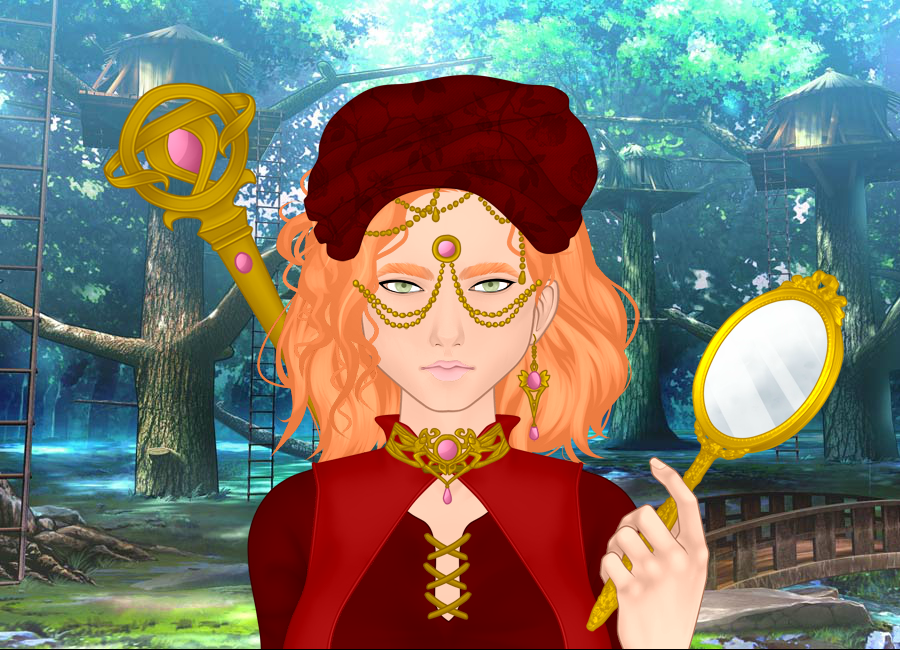
Categories
Dive Deeper
Page Stats
Navigation
Categories
Dive Deeper
Page Stats
Complete Details
All information about this character
Overview
Anabala Weyrauch
Anabala Weyrauch is a lean young Forislar woman with slightly tanned skin, light green eyes, and long light-red hair usually worn swept back in a loose, unkempt style beneath a broad hat. She has the look of someone born to the road: lightly built, quick-moving, and always dressed in layers practical enough for travel but theatrical enough to sell a story. Belts, pouches, charms, cards, and small trinkets tend to hang from her clothing, while her crystal ball and fortune-teller’s tools complete the image she presents to the world. At a glance she looks playful, clever, and a little untrustworthy—exactly the impression she usually intends to give.
the grey witch
Founding member of the Order of the Greykeep
24
Female
Looks
None
Anabala wears her light red hair long, loose, and swept back in a way that looks careless until one realizes how much of it is intentional. It is usually a little unkempt, with stray strands, uneven waves, and wind-tossed sections that make her look like someone who has been on the road too long to bother with perfect grooming. Rather than tying it neatly, she lets it fall around her shoulders or down her back, keeping it controlled just enough that it does not interfere with her hands, cards, crystal ball, or pockets.
Her hat is the most important part of the style. Broad-brimmed, worn-in, and unmistakably hers, it helps turn her messy hair into part of her fortune-teller persona. With the hat on, the loose red hair becomes theatrical rather than simply untidy, giving her the look of a wandering witch, street performer, or charming fraud who has stepped out of a dozen different stories and borrowed pieces from all of them.
The style also suits her Forislar background. It is practical enough for travel, easy to fix without a mirror, and expressive enough to make her memorable in a crowd. Anabala does not need her hair to look refined; she needs it to look like part of the act. Whether she is reading fortunes, talking her way out of trouble, or pretending she saw someone’s destiny coming all along, the swept-back mess of red hair beneath her hat helps sell the image of the Grey Witch before she ever says a word.
Anabala’s hair is light red, closer to copper, faded flame, or sunlit autumn leaves than deep crimson. It has enough warmth to catch attention, especially when loose beneath her hat, but it is not a polished or noble-looking red. The color feels road-worn and natural, made more striking by how casually she wears it.
In bright light, her hair can look almost orange-gold, especially around loose strands and flyaways. In shadow, it settles into a softer reddish copper that pairs well with her slightly tanned skin and pale green eyes. The contrast gives her face a sharp, memorable quality, which she uses to her advantage when performing as the Grey Witch.
Her hair color also helps her stand out in a crowd without needing much effort. For a con artist and fortune teller, that can be useful or dangerous depending on the situation. Anabala likely treats it as part of the act when attention helps her, but curses it when she would rather vanish unnoticed. Like much about her, it is both a gift and a complication.
Anabala stands at 5'8", placing her comfortably within the common range for a Forislar, though her lean build and restless way of moving can make her seem a little taller than she is. She does not have an imposing presence in the way a warrior or noble might, but she knows how to use posture, gesture, and presentation to make herself noticeable when she wants attention.
Her height suits her life well. She is tall enough to be seen over a small market crowd when performing, but not so tall that she becomes difficult to overlook when she wants to slip away. Combined with her long red hair, broad hat, and theatrical clothing, her height helps her cut a memorable figure as the Grey Witch without making her seem physically threatening.
Anabala carries herself like someone used to moving through crowded roads, markets, inns, and caravan stops. She shifts easily between taking up space and disappearing into it, depending on what the situation demands. When selling a fortune, she can seem larger, brighter, and impossible to ignore; when trouble starts, she becomes just another traveler moving with the crowd.
Anabala weighs around 130 pounds, giving her a lean, lightly built frame suited to travel, quick movement, and slipping through crowded places without drawing too much physical attention. She is not frail, but she is narrow and wiry rather than strong-looking, with the sort of body shaped by walking roads, living out of packs, sleeping lightly, and rarely staying comfortable for long.
Her weight fits her Forislar background well. She looks like someone accustomed to movement, uncertainty, and making do with what she has rather than someone raised in settled ease. Even when dressed theatrically as the Grey Witch, with layered clothing, belts, pouches, cards, charms, and her hat, there is still a lightness to her. She seems ready to pack up, vanish, or run before anyone realizes she has decided to leave.
Physically, Anabala does not rely on force. Her build favors speed, balance, nervous energy, and sleight of hand over strength. She is quick with her fingers, quick with her words, and quick to put distance between herself and danger when charm fails. Her slightness also supports her con artist persona: she can appear harmless, fragile, mysterious, or pitiable when it benefits her, then turn around and rob someone blind before they realize they underestimated her.
Anabala has no major scars, tattoos, birthmarks, or permanent physical marks that she is known for. This is useful to her, since a woman who lives by travel, deception, fortune telling, and fast exits benefits from being able to change how memorable she appears. Without her hat, props, and performance, she is easier to mistake for just another lean Forislar traveler with red hair and clever eyes.
That said, Anabala is still recognizable to anyone who has spent time around her. Her light red hair, pale green eyes, broad hat, restless posture, and half-mocking expression all tend to give her away. She also has a habit of surrounding herself with portable signs of her trade: cards, charms, pouches, trinkets, and her crystal ball. None of these are true identifying marks, but together they create the image people remember as the Grey Witch.
Anabala has a skinny, lean body shaped by travel rather than comfort. She is narrow through the shoulders and waist, lightly built, and quick on her feet, with the wiry look of someone used to walking long roads, slipping through crowds, sleeping in uncertain places, and leaving quickly when a situation turns bad. She does not look fragile exactly, but she certainly does not look like someone who wins fights by strength.
Her build suits both her Forislar background and her profession. Anabala relies on speed, performance, sleight of hand, and misdirection far more than physical power. Her hands are quick, her posture is restless, and her body language often shifts depending on what role she is playing. When she wants to seem mystical, she can make herself appear graceful and strange; when she wants sympathy, she can seem smaller and more harmless than she really is; and when danger appears, she moves like someone already halfway to the exit.
She lacks the solid presence of a warrior, but that is part of what makes her effective. People often underestimate her because she appears too thin, too flighty, or too theatrical to be truly dangerous. Anabala uses that assumption whenever she can. Her body is not built to overpower people, but to survive them: to dodge, distract, steal, flee, and talk her way out before anyone gets a firm grip on her.
Skin Tone – What is Anabala Weyrauch’s skin tone?
Anabala has skin that is only slightly tanned, with just enough warmth to suggest a life spent traveling under open skies rather than living comfortably indoors. Her complexion is not deeply sun-darkened, but it carries the faint weathering of roads, markets, caravan stops, and long days spent moving from place to place. It fits her Forislar background well: not tied to one homeland or climate, but shaped by exposure, travel, and whatever road she happened to be walking last.
Her slight tan pairs well with her light red hair and pale green eyes, giving her a lively, sharp-featured look without making her seem polished or noble. She does not have the sheltered complexion of someone protected by wealth, nor the heavily weathered look of a hardened laborer. Instead, she looks like someone who lives between places: part performer, part wanderer, part opportunist, always spending enough time outside to be marked by the road.
When dressed as the Grey Witch, her skin tone helps ground the performance. The hat, layered clothes, charms, cards, and crystal ball may make her look theatrical, but her complexion keeps her from seeming too ornamental. She looks like a real traveler playing at mysticism, which is exactly the balance she prefers.
Forislar
Anabala’s eyes are light green, bright enough to be memorable without seeming unnatural. The color pairs sharply with her light red hair and slightly tanned skin, giving her face a lively, foxlike quality that suits both her charm and her dishonesty. Her eyes are often one of the first things people notice when she is performing as the Grey Witch, especially because she knows how to use them: widening them for drama, narrowing them in mock suspicion, or holding someone’s gaze just long enough to make them wonder if she really has seen something.
Their light green color also reinforces her slightly uncanny reputation. When Anabala is lying, joking, or selling a false fortune, her eyes make her look clever and playful. When she has a real vision, however, that same brightness can turn distant and unfocused, as if she is looking through the person in front of her rather than at them. In those moments, the act briefly falls away, and her eyes become one of the clearest signs that the Grey Witch is not entirely a fraud.
Because she is naturally sarcastic and guarded, Anabala rarely lets her expression become fully open. Her eyes tend to carry motion even when the rest of her face is still, constantly watching hands, exits, purses, reactions, and opportunities. They suit a Forislar roadborn fortune teller perfectly: pretty enough to sell mystery, sharp enough to sell lies, and restless enough to show that she is always ready to leave.
Nature
Anabala’s prejudice against the Talaran theocracy is rooted in experience rather than inherited hatred. She did not grow up with the same cultural wound that Bear Clan Goltari carry toward Talara, but after the Order of the Greykeep became tied to the new royal family of the Stanzgarian Confederacy, their titles came with obligations. When Talaran dissidents launched a surprise attack on Stanzgarian positions within Talara, those obligations pulled Anabala and her companions into the short, ugly Talaran War. The conflict lasted only a few months, but Anabala hated every moment of it.
For Anabala, Talara became associated with forced duty, bloodshed, religious authority, noble cruelty, and the terrifying feeling of fate tightening around her life. She had spent much of her youth running from people who wanted to control her gift and make decisions for her, only to find herself dragged into a war because names, titles, and politics suddenly mattered more than whether she wanted to be there. The fact that many of the Talaran nobles involved were put to the sword afterward did not make the experience feel clean or satisfying to her. It only confirmed her belief that the powerful create disasters and then expect people like her to survive the consequences.
Her dislike of Stanzgarian nobility is related but more complicated. She is not hostile to Stanzgarians as a people, and she has friends, allies, and even deep personal ties within Stanzgarian society. What she distrusts is nobility as a system: titles, obligations, inherited authority, and the way a court can turn friendship into service and service into a battlefield. She resents being useful to nobles, especially when usefulness comes with chains dressed up as honors.
Anabala’s prejudice is not usually loud or ideological. She expresses it through sarcasm, evasiveness, mockery, and refusal to be impressed by sacred titles or noble blood. Priests, theocrats, and nobles who expect deference quickly find that she has very little to give them. She can work with such people when necessary, lie to them when useful, and flatter them when profitable, but trust is another matter entirely. To Anabala, Talara and noble politics both represent the same danger: powerful people deciding that someone else’s life belongs to the story they want to tell.
Anabala has no major known condition, though her uncontrolled foresight can leave her unsettled at times. Her visions come in flashes of possible futures rather than clear prophecies, and she often receives no explanation of how likely they are, what causes them, or whether they can be avoided. Because of this, she sometimes struggles with restlessness, poor sleep, sudden distraction, or the unnerving feeling that something terrible is about to happen without knowing what to do about it.
These effects do not keep her from functioning, and she usually hides them behind sarcasm, fast talk, and theatrical confidence. To most people, she simply seems flighty or detached. Those who know her better understand that part of her mind is often watching for something no one else has seen yet. Her condition is not severe enough to define her life, but it does make her foresight feel less like a clean gift and more like a troublesome, unreliable sense she has never fully learned to control.
Anabala’s mannerisms are quick, theatrical, and difficult to trust. She talks with her hands, shifts her weight often, and rarely seems fully settled in one place, as if some part of her is always ready to leave before the conversation turns dangerous. Her expressions change easily: a sly smile, a look of wounded innocence, exaggerated offense, mock sympathy, or sudden wide-eyed mystery, all deployed as naturally as breathing. Even when she is being sincere, she often sounds like she is performing.
She is deeply sarcastic, especially when frightened, cornered, or dealing with authority. Anabala deflects discomfort with jokes, evasions, and fast explanations that may or may not be true. She has a habit of answering serious questions sideways, pretending not to care when she does, and acting more detached than she really is. If pressed too hard, she becomes slippery rather than openly hostile, changing the subject, making a joke, pointing out someone else’s hypocrisy, or finding a reason to step away.
Her Forislar upbringing shows in the way she watches people and spaces. She notices exits, purses, weapons, loose pockets, nervous hands, and anyone paying too much attention. In inns or markets, she tends to sit where she can see the door. When performing as the Grey Witch, these habits become part of the act: she leans over cards, lowers her voice, studies faces dramatically, and lets pauses stretch just long enough to make people uncomfortable.
When a real vision strikes, however, the performance breaks. Her eyes may lose focus, her speech may cut off mid-sentence, or her sarcasm may vanish so abruptly that anyone who knows her realizes something is wrong. Afterward, she usually tries to recover quickly, making some joke or lie to cover how shaken she is. Anabala’s mannerisms are built around motion, misdirection, and escape, but the rare moments when she goes still are often the ones that reveal the most.
Anabala is motivated by three things that do not always agree with each other: keeping her friends alive, getting rich, and changing fate. On the surface, she often pretends the money matters most. Coin means food, shelter, freedom, distance from people who want to control her, and the ability to leave before anyone can trap her. For a roadborn Forislar con artist, wealth is not just greed; it is security that can be carried, hidden, spent, or used to buy a clean escape.
Beneath that, however, Anabala is far more loyal than she likes to admit. After meeting Arthur Greykeep and becoming part of the group that would become the Order of the Greykeep, she found herself caring about people in a way that made her deeply uncomfortable. She may joke, lie, complain, and act like she is only there for the reward, but when danger comes she is often trying to keep someone from dying before they even know they are at risk. Her foresight makes this worse, because she sometimes sees flashes of possible futures where her friends are hurt, lost, or killed, and she cannot always tell how to stop it.
Her deepest motivation is the desire to change fate. Anabala hates the idea that anyone’s life is already written, especially her own. Her family once tried to turn her gift into a tool and make decisions about her future, and that left her with a fierce need to prove that visions are not commands. Every con, escape, warning, and desperate intervention is part of the same argument with destiny: she wants to believe that seeing what might happen gives her the chance to choose something else.
This makes Anabala restless and contradictory. She wants comfort, but fears being trapped. She wants money, but spends it to save people. She claims not to care, then risks herself because a vision showed her what would happen if she walked away. At her core, the Grey Witch is not trying to become a hero. She is trying to stay free, stay ahead, and prove that even fate can be cheated if someone lies well enough, runs fast enough, and cares at exactly the wrong time.
Anabala’s greatest flaw is that she is difficult to trust, and she knows it. She lies too easily, talks too quickly, and often treats honesty as something to be used only when deception would take too much effort. Even when she is trying to help, she may hide the full truth, exaggerate what she knows, or twist her words so that she has room to escape later. This makes her useful in dangerous situations, but it also means people often have to wonder whether Anabala is warning them, manipulating them, or doing both at once.
She is also deeply untrusting herself. Anabala expects people to want something from her, especially those with authority, titles, religious power, or family claims over her. Her own relatives tried to take control of her life after her foresight appeared, and that taught her to see affection and usefulness as dangerously close together. Because of this, she may pull away from people who genuinely care about her, test friendships unnecessarily, or assume betrayal before it happens.
Her fast-talking nature can become a problem even when she means well. Anabala has a talent for improvising, but she can talk herself into corners, make promises she cannot keep, or escalate a situation by being too clever at the wrong time. She is especially bad at staying quiet when mocked, threatened, or ordered around. Sarcasm is her armor, but it also makes enemies out of people who might otherwise have been harmless.
Her foresight adds another layer to these flaws. Because her visions are uncontrolled and uncertain, she sometimes acts on incomplete information, trying to prevent a possible future without knowing whether her actions are helping or causing it. At times, she withholds what she saw because she fears being blamed, used, or disbelieved. At other times, she meddles too much, convinced that if she just lies, cheats, warns, steals, or runs at the right moment, she can outwit fate itself.
For all her charm, Anabala is emotionally avoidant. She pretends to be detached because caring makes her vulnerable, and vulnerability is something she learned to treat as dangerous. She wants friends, safety, and belonging, but she also fears the obligations that come with them. This leaves her caught between loyalty and escape: always ready to run, yet increasingly unable to abandon the people who have become hers.
Anabala’s greatest talent is her foresight, though it is as troublesome as it is useful. She can see flashes of possible futures, usually without warning and rarely with enough context to make them simple to understand. These visions may show danger, opportunity, death, betrayal, or some small detail that only becomes important later. Because they are uncontrolled and uncertain, Anabala has had to learn how to interpret them through instinct rather than certainty. She is not a clean prophet delivering perfect answers; she is someone catching glimpses through fog and trying to decide whether to run toward them or away from them.
She is also an excellent fortune teller, partly because of her real gift and partly because she understands performance. Anabala knows how to read faces, posture, clothing, hands, hesitation, and the little details people reveal without meaning to. Even when no true vision comes, she can often make a convincing prediction by combining observation, guesswork, and theatrical confidence. Her clients may walk away believing she saw their destiny, when in truth she saw their muddy boots, worn wedding ring, nervous glance, and poorly hidden purse.
Her skill as a pickpocket comes from the same quickness. Anabala has light hands, careful timing, and a strong sense for when attention is pointed elsewhere. She knows how to brush past someone, bump into them at the right angle, hide a movement beneath a gesture, or make a joke just as her fingers find what they are looking for. She is not a brute-force thief; she steals through rhythm, distraction, and confidence.
Acting may be her most reliable talent of all. Anabala can become wounded, mysterious, charming, offended, helpless, prophetic, foolish, or frightening depending on what the moment requires. She changes her voice, posture, expression, and story with practiced ease, often quickly enough that people have trouble deciding which version is real. This makes her a skilled con artist, but also a useful adventurer. She can bluff past guards, calm frightened villagers, misdirect enemies, gather information, and lie convincingly when the truth would get someone killed.
Taken together, Anabala’s talents make her dangerous in indirect ways. She is not a warrior and does not pretend to be one, but she can see trouble coming, talk her way into places she should not be, steal what she needs, and make people believe the version of reality she wants them to accept. Her greatest strength is not any single gift, but the way she combines magic, observation, deception, and nerve into one fast-moving act.
Anabala’s hobbies are difficult to separate from her work, because most of the things she enjoys are also things she can turn into coin, favors, or leverage. Fortune telling is the closest thing she has to a proper pastime. Even when she is not actively selling readings, she enjoys laying out cards, polishing her crystal ball, inventing dramatic interpretations, and watching how people react when they think their future is being revealed. Sometimes the reading is genuine, sometimes it is pure performance, and sometimes even Anabala is not entirely sure which it is until the words are already out of her mouth.
She also enjoys “pulling fast ones,” partly for profit and partly for the thrill of proving she can. Small cons, harmless tricks, rigged guesses, false omens, sleight-of-hand games, and theatrical little scams all amuse her, especially when the target is arrogant, wealthy, self-important, or too sure they are smarter than everyone else. Anabala likes winning without force. A clean trick, a well-timed lie, or a mark who thanks her while being cheated can make her grin for hours.
Her more innocent hobbies still tend to have an edge of performance. She likes people-watching in markets and inns, collecting rumors, practicing voices, shuffling cards, inventing fake backstories, and seeing how long she can keep a stranger believing something ridiculous. She also has a fondness for small portable comforts: fresh bread, warm hearths, street music, cheap charms, pretty trinkets, and anything that can be carried away when it is time to leave.
Around trusted friends, her hobbies become a little softer. She may read fortunes just to entertain them, cheat at cards badly enough to make them laugh, or pretend to predict obvious events with great seriousness. Even then, Anabala rarely drops the act completely. For her, play, survival, and deception have always lived close together, and the hobbies she enjoys most are the ones that let her stay clever, restless, and just a little impossible to pin down.
Anabala is a fast-talking con artist who actually tries to help people, though she would rather no one make a sentimental speech about it. She is sarcastic, slippery, clever, and almost allergic to being pinned down, with a personality built around motion, misdirection, and escape. At first glance, she seems selfish and unreliable, the sort of woman who would sell a false fortune, steal a purse, and vanish before breakfast. The irritating part is that this impression is not entirely wrong.
What makes Anabala more complicated is that she does care. She just hates admitting it. Her first instinct is usually to protect herself, make a joke, find the angle, and keep enough distance that no one can hurt or control her. But when someone becomes one of “hers,” she starts watching their future almost as closely as her own. She may lie, cheat, steal, and complain the entire time, but more often than not, she is trying to keep people alive.
She is charming in a difficult way. Anabala can be funny, warm, dramatic, and strangely comforting when she wants to be, but there is always a question of how much is genuine and how much is performance. She has spent so long surviving through roles that even she may not always know where the act ends. The Grey Witch persona lets her turn fear, uncertainty, and real magic into something she can control, or at least sell convincingly.
At her core, Anabala is a woman who wants freedom more than safety, but keeps finding people she is unwilling to abandon. She distrusts fate, authority, religion, nobility, and anyone who thinks her gift gives them a claim over her life. Yet despite all her evasions, she repeatedly chooses to help. She is not honest enough to be saintly, not cruel enough to be heartless, and not detached enough to stay uninvolved. That contradiction is the heart of her personality: a fraud with real visions, a coward who runs toward danger when it matters, and a liar who sometimes tells the most important truth in the room.
Social
Anabala’s favorite food is fresh-baked bread, especially when it is still warm enough to steam when torn open. For someone born into a wandering Forislar life, bread has a very particular comfort to it. It is simple, familiar, cheap when luck is good, and easy to share on the road, but fresh bread also means something more settled than travel rations or whatever can be bought cold from a market stall. It means a hearth, an oven, a home, or at least a place willing to pretend to be one for an evening.
She likes the smell almost as much as the taste. Warm bread has a way of cutting through the noise of inns, markets, and roadside camps, making even a strange place feel briefly safe. Anabala may joke that she likes it because it is easy to steal, easy to carry, and good with almost anything, but the truth is softer than she would admit. Fresh bread reminds her of hospitality, temporary shelter, and the Forislar belief that a stranger should be fed before they are questioned.
Her favorite kind is probably whatever is hot, crusty, and close at hand: round hearth loaves, flatbreads pulled from a small oven, market rolls brushed with fat, or dense travel bread made better by being fresh for once. She is especially fond of tearing off pieces by hand and eating them with butter, cheese, honey, stew, or whatever else she has managed to acquire honestly or otherwise. For Anabala, fresh bread is not fancy food. It is comfort she can hold in both hands, eat quickly, and remember after she has moved on.
Anabala’s favorite animals are cats, which suits her almost too well. She likes their independence, their suspicion of strangers, their talent for appearing harmless while stealing food, and the way they can move through a room as if every person in it exists for their convenience. Cats do not beg for approval, do not explain themselves, and rarely stay where they are not wanted unless they have decided the place belongs to them anyway. Anabala respects that.
She is especially fond of street cats, inn cats, caravan cats, and half-feral mousers that live around markets and roadside settlements. They remind her of Forislar travelers in a small way: adaptable, watchful, difficult to own, and capable of making almost any temporary shelter feel lived in. A cat curled near a hearth can make a strange inn feel safer, while a cat slipping through an alley is a reminder that survival often belongs to the quick, quiet, and shameless.
Anabala also appreciates that cats are excellent judges of comfort. If a cat trusts a place enough to sleep there, she tends to take that as a good sign, even if she would never admit to using a cat as a moral authority. She has a habit of feeding strays, pretending she is only bribing them for luck or information. In truth, she simply likes them. Cats match her temperament: clever, slippery, affectionate on their own terms, and always ready to vanish the moment someone reaches too confidently.
Anabala does not have a favorite weapon in the traditional sense. She may carry a small blade or other practical defense when travel demands it, but she does not think of herself as a warrior and has little interest in solving problems through direct violence. Her preferred weapon is her wit: a fast tongue, a convincing lie, a well-timed distraction, and the ability to make someone look the wrong way at exactly the right moment.
This suits her far better than any blade. Anabala survives by reading people, twisting expectations, and turning danger into confusion before it can close around her. She would rather talk past a guard, cheat a noble, frighten a priest with a false omen, or steal the key than win a fair fight. Fair fights are for people with armor, muscles, and poor survival instincts.
When cornered, her wits become sharper rather than cleaner. She may lie, bargain, flatter, threaten, improvise a prophecy, or pretend to know far more than she does. Sometimes this makes things worse, but often enough it keeps her alive. To Anabala, the best weapon is the one no one can confiscate: her ability to think quickly, speak faster, and make the truth optional until she finds an exit.
Anabala’s favorite possession is her crystal ball, though whether it is truly magical, theatrically useful, or simply important to her depends on when one asks and how much she feels like lying. To most people, it is the centerpiece of her fortune-teller persona: the object she sets before a client, polishes with exaggerated care, gazes into with pale green eyes, and uses to make silence feel meaningful. It helps sell the idea of the Grey Witch before she ever speaks a prophecy.
Its real value, however, is more personal than professional. The crystal ball gives shape to a gift she cannot fully control. Anabala’s foresight comes in flashes of possible futures, often without warning or clear meaning, and the ball lets her pretend there is a method to it. It gives her hands something to hold, her eyes somewhere to look, and her clients something to believe in. Even when the vision is real, the performance around it helps her feel less exposed.
She also uses the crystal ball as a shield. When people stare at the ball, they are not staring quite as hard at her. When they believe the object is the source of her power, they are less likely to understand how much of her work comes from observation, instinct, acting, and fear. In that way, the ball is both tool and misdirection: part stage prop, part comfort object, part symbol of the life she built after running from the people who wanted to control her gift.
Anabala is careless with many things, but not with the crystal ball. She may joke about replacing it, pawning it, or using it to hit someone over the head, but she keeps it wrapped carefully when traveling and rarely lets anyone handle it without complaint. It is one of the few objects that feels truly hers: portable, mysterious, useful, and just dishonest enough to suit her.
Anabala’s favorite color is blue, especially rich, noticeable shades that can look mystical under candlelight or theatrical beneath a fortune-teller’s hat. She favors blues that suggest twilight, painted glass, old caravan cloth, polished beads, deep sky, and the strange dark color of the road just after sunset. It is a color that suits the Grey Witch persona well: mysterious without being too severe, pretty without being innocent, and easy to turn into part of the act.
Blue also works well with her appearance. Against her light red hair, pale green eyes, and slightly tanned skin, blue stands out sharply, making her look more memorable when she wants to be noticed. She may wear it as a scarf, sash, hat ribbon, lining, beadwork, or charm cord, using just enough of the color to catch the eye without making her clothing too impractical for travel.
For Anabala, blue probably also carries a sense of freedom. It belongs to open skies, distant roads, cold winter mornings, and the spaces between towns where no one owns her. She would never describe it that sentimentally unless she was mocking someone else, but the color follows her all the same. It fits both sides of her life: the wandering Forislar woman who wants room to run, and the Grey Witch who knows how to make mystery look profitable.
Anabala works as a con artist and fortune teller, though the line between those two occupations is not always clear, even to her. In most towns, she presents herself as the Grey Witch, a wandering seer who reads fortunes, interprets omens, lays cards, studies palms, and gazes into her crystal ball with just enough mystery to make people pay before asking too many questions. Some of her readings are clever performances built from observation, guesswork, and practiced theatrics. Others are shaped by real flashes of foresight that arrive without warning and leave her just as unsettled as the person receiving the prophecy.
Her work depends on reading people quickly. Anabala watches clothing, posture, speech, jewelry, nervous habits, old wounds, and the direction someone’s eyes move when they lie. From there, she builds a story convincing enough to sound like fate. She can sell comfort, fear, warning, romance, doom, or hope depending on what the customer seems ready to believe. Sometimes this makes her a fraud. Sometimes it makes her useful. Often, it makes her both at once.
As a con artist, Anabala favors small, mobile schemes over elaborate criminal enterprises. She is a fast talker, pickpocket, actress, and opportunist who survives by knowing when to press a lie and when to disappear. Her Forislar background suits this life well: she travels easily, adapts quickly, keeps her valuables portable, and rarely builds a plan that requires staying in one place longer than necessary. She is not interested in building a criminal empire. She wants coin, freedom, and enough distance between herself and angry marks.
After joining the company that would become the Order of the Greykeep, Anabala’s occupation expanded into adventuring, though she still approaches danger like a fortune teller and trickster rather than a soldier. She scouts social situations, gathers rumors, lies to the right people, warns her companions of possible futures, and talks her way through doors that force would only close. In the Order, she is not the strongest fighter or the most reliable moral compass, but she is often the one who sees trouble coming, whether through genuine vision or the simple fact that she knows what trouble looks like before it introduces itself.
Anabala is surprisingly uncaring about politics, at least in the formal sense. She has no loyalty to parties, courts, banners, noble houses, or grand ideological causes, and she tends to view political arguments as expensive games played by people who expect someone else to bleed when they lose. To her, rulers and governments are mostly obstacles to be avoided, fooled, bribed, flattered, or escaped depending on the situation.
This does not mean she has no opinions. Anabala distrusts the Talaran theocracy, resents Stanzgarian nobility, and has very little patience for anyone who thinks titles or divine authority give them a claim over other people’s lives. Her problem is not usually with ordinary citizens, soldiers, or believers, but with systems that turn people into tools. She has been controlled by family, dragged into war by obligation, and made useful by powers larger than herself, so any political structure that demands obedience immediately earns her suspicion.
As a Forislar, Anabala is also used to living beneath governments that are not truly hers. Kingdoms rise, borders change, lords argue, taxes shift, and travelers learn which gates to avoid. Her instinct is not to reform the system, but to survive it. She cares less about who claims authority and more about whether roads are open, inns are safe, guards can be talked around, and people like her can keep moving without being trapped.
If forced to define her politics, Anabala would probably say she believes in herself, her friends, and a full purse. Beneath the joke, there is some truth to that. She supports whatever keeps her people alive, her companions free, and powerful fools too confused to ruin everything. She may not call that politics, but it is the closest thing she has to a position.
Anabala does not practice any religion, though her lack of worship is not based on disbelief. In Sol Saris, the gods are real, active beings, and Anabala knows this better than most because she has personally encountered several Stanzgarian gods during her adventures with Arthur Greykeep and the others. She does not deny their existence, their power, or their importance. She simply refuses to worship them.
To Anabala, the existence of a god is not the same as proof that they deserve devotion. She has seen enough of fate, war, nobility, prophecy, and divine influence to be deeply suspicious of any power that expects reverence simply because it is greater than mortal life. Her foresight already makes her feel as though unseen forces are reaching into her choices, and the idea of bowing willingly to beings who may shape destiny sits poorly with her. She does not want another force, mortal or divine, deciding what her life is supposed to mean.
This does not make her openly hostile to gods in every circumstance. Anabala can speak to them, bargain with them, fear them, mock them unwisely, or treat them with cautious respect when survival demands it. What she will not do is kneel easily. Priests, theocrats, and especially religious authorities who expect obedience from her tend to bring out her worst sarcasm. She has particular contempt for people who hide control, cruelty, or ambition behind holy language.
Her stance is less atheism than defiance. The gods are real; she knows that. Some may even be worth listening to. But Anabala’s life has been shaped by people trying to use her gift, claim her future, and pull her into stories she never agreed to join. Worship feels too much like surrender, and surrender is something the Grey Witch has spent her whole life avoiding.
Anabala’s job is best described as adventurer and fortune teller, though neither title fully captures how she actually makes her way through the world. As a fortune teller, she travels under the name the Grey Witch, offering card readings, crystal ball readings, ominous warnings, and carefully staged glimpses of destiny to anyone willing to pay. Sometimes the performance is pure theater, built from observation and fast talk. Sometimes her uncontrolled foresight makes the reading far more real than even she expected.
As an adventurer, Anabala serves the Order of the Greykeep through information, misdirection, social trickery, and warning. She is not a front-line fighter and has little interest in becoming one, but she is useful in ways a blade cannot be: reading suspicious strangers, talking past guards, spotting lies, stealing keys, interpreting omens, and occasionally seeing a future that gives the group just enough time to avoid disaster.
Even after becoming part of the Order, Anabala still treats work like a Forislar traveler would. A job should be portable, profitable, flexible, and easy to abandon if it turns sour. Fortune telling gives her coin and cover; adventuring gives her danger, purpose, and people she has somehow failed to stop caring about.
History
Anabala was born in midwinter, a fitting season for someone who came into the world on the road rather than in settled comfort. Her birth carries the feeling of cold nights, hard travel, thin fires, frozen roads, and families huddled close against the dark. It suits her Forislar background well: born into motion, uncertainty, and survival, but also into a people who know how to keep warmth alive even when the world offers very little of it.
She is not especially sentimental about her birthday, and she would likely deflect attention with jokes, lies, or complaints if someone made too much of it. Still, she would notice if her friends remembered. A good birthday for Anabala would not need to be grand: fresh-baked bread, warm drink, a safe room, a little coin in her pocket, and people she trusts enough to sit with her without asking too many questions. Midwinter makes the date feel less like celebration for its own sake and more like endurance: another year survived, another cold season outwitted, another proof that fate has not caught her yet.
Anabala Weyrauch was born in the Northern Expanse to wandering Forislar parents, entering a life of roads, temporary shelters, trade stops, borrowed hearths, and constant movement. She took naturally to that life. From a young age, she learned how to read strangers, listen without seeming to listen, and survive in places where hospitality could vanish as quickly as it appeared. Her education was not formal, but it was effective: she learned the value of a quick smile, a faster lie, and knowing where the exits were before anyone else thought to look.
As she grew older, Anabala developed a gift for talk. She could flatter, cajole, distract, invent, and bargain with a confidence well beyond her years. What began as childish cleverness eventually became a way of living. She learned to trick people into giving her what she wanted, to sell stories just convincing enough to be believed, and to make herself seem harmless, mystical, pitiful, or amusing depending on what the moment required. By the time she was old enough to be left on her own, she already understood that people often saw what they expected to see, and that a clever girl could make a living inside those expectations.
On her sixteenth birthday, Anabala discovered that her fortune telling was not always a lie. She began seeing flashes of possible futures: sudden, uncontrolled visions of things that might happen, often without context, certainty, or instruction. The gift frightened her as much as it fascinated her. It could warn her away from danger, lead her toward opportunity, or show her something terrible with no clear way to prevent it. Worse, once her family realized what she could do, they began making decisions about her life, expecting her to use the gift for their benefit and gradually treating her future as something they had a right to manage.
Anabala eventually decided she had endured enough and ran away. Alone, she returned to the wandering life, but this time on her own terms. She used her foresight when it came, ignored it when she could, and wrapped the whole thing in the persona of the Grey Witch, a fortune teller whose act was half fraud, half genuine magic, and half panic hidden behind a smile. She conned people out of coin, told fortunes in markets and inns, followed visions when they seemed useful, and avoided them when they smelled too much like trouble. For a time, that was enough. She was free, fed, and no one owned her future but herself.
That changed when one of her visions led her to a dejected young man bleeding beside the road after being stabbed by goblins during a failed robbery. That man was Arthur Greykeep. Finding him should have been just another strange turn of fate, but it became the beginning of the most important connection of her life. Through Arthur and the companions who gathered around him, Anabala became part of the group that would eventually be known as the Order of the Greykeep. She remained sarcastic, slippery, and difficult to trust, but she also began using her lies, visions, and quick hands to keep people alive rather than only to keep herself moving.
As a founding member of the Order, Anabala’s life became entangled with forces she would rather have avoided: war, nobility, divine beings, prophecy, and the dangerous consequences of being useful to powerful people. She fought in the short and ugly Talaran War after the Greykeep’s ties to the Stanzgarian Confederacy pulled them into obligation, an experience that cemented her hatred of the Talaran theocracy and deepened her distrust of noble titles. Though she still insists she is not a hero, Anabala has repeatedly chosen to stay when running would have been easier. Her life remains a constant argument with fate: she sees what might happen, lies about how much she knows, and keeps trying to steal a better ending before destiny notices.
Anabala is self-taught, though not uneducated. She was never trained in an academy, temple school, noble household, or formal magical institution, and she would probably have been a poor fit for any of them. Her education came from the road: caravan camps, market squares, inns, back rooms, roadside settlements, and the constant need to learn quickly from whoever happened to know something useful.
As a Forislar, Anabala grew up in a culture where stories, routes, names, debts, customs, and practical knowledge matter more than polished scholarship. She learned by listening to older travelers, watching negotiations, memorizing useful phrases, and paying attention to what people revealed when they thought no one was studying them. She likely has enough reading, counting, and language skill to handle travel, trade, coin, basic records, and written signs, but her real education is social rather than academic.
Much of what Anabala knows comes from survival. She taught herself how to read faces, copy accents, invent believable stories, spot gullible marks, recognize dangerous authority, and leave before trouble settled fully around her. Her skills as a fortune teller, pickpocket, and con artist were built through practice, failure, observation, and nerve. She learned what people fear, what they want to hear, and how much truth a lie needs before someone will pay for it.
Her magical education is even less formal. When her foresight appeared, she had no teacher capable of properly explaining or controlling it, so she learned to manage the gift through instinct and improvisation. Her understanding of arcane and summoning magic is similarly uneven: practical, opportunistic, and shaped by use rather than theory. Anabala may not know the correct scholarly terms for everything she does, but she knows what works, what scares people, and what is likely to get her killed if handled carelessly.
Family
A cat
Notes
Anabala eventually marries Tobias Stanzgar, a former prince of the previous Stanzgarian royal family. Their relationship begins later in her life, after the short Talaran conflict and during the long period of uneasy peace that follows. Because Tobias belongs to the displaced old royal line, his presence in Anabala’s life ties her once again to nobility, history, and political consequence, despite her general distrust of noble titles and her repeated attempts to stay free of powerful people’s stories.
This marriage is notable because it complicates Anabala’s usual attitude toward Stanzgarian nobility. She distrusts noble systems, inherited authority, and the obligations that titles create, yet Tobias becomes someone she chooses personally rather than someone imposed on her by politics or fate. For Anabala, that distinction matters. She may never become comfortable with the weight of his lineage, but her relationship with him proves that her prejudice is aimed more at systems of power than at every individual born within them.
Their marriage also belongs to a different era of her life. By the time Tobias becomes important to her, Anabala has already survived the road, her uncontrolled foresight, the founding of the Order of the Greykeep, the Talaran War, and the beginning of a 500-year uneasy peace. He is not part of the moment when she becomes the Grey Witch, but part of what comes after: the strange, difficult question of what a woman who spent her life running does when history finally slows down long enough for her to stay.
age is at the signing of the treaty of unity
Overview
Details about this character's overview
Anabala Weyrauch
Anabala Weyrauch is a lean young Forislar woman with slightly tanned skin, light green eyes, and long light-red hair usually worn swept back in a loose, unkempt style beneath a broad hat. She has the look of someone born to the road: lightly built, quick-moving, and always dressed in layers practical enough for travel but theatrical enough to sell a story. Belts, pouches, charms, cards, and small trinkets tend to hang from her clothing, while her crystal ball and fortune-teller’s tools complete the image she presents to the world. At a glance she looks playful, clever, and a little untrustworthy—exactly the impression she usually intends to give.
the grey witch
Founding member of the Order of the Greykeep
24
Female
Looks
Details about this character's looks
None
Anabala wears her light red hair long, loose, and swept back in a way that looks careless until one realizes how much of it is intentional. It is usually a little unkempt, with stray strands, uneven waves, and wind-tossed sections that make her look like someone who has been on the road too long to bother with perfect grooming. Rather than tying it neatly, she lets it fall around her shoulders or down her back, keeping it controlled just enough that it does not interfere with her hands, cards, crystal ball, or pockets.
Her hat is the most important part of the style. Broad-brimmed, worn-in, and unmistakably hers, it helps turn her messy hair into part of her fortune-teller persona. With the hat on, the loose red hair becomes theatrical rather than simply untidy, giving her the look of a wandering witch, street performer, or charming fraud who has stepped out of a dozen different stories and borrowed pieces from all of them.
The style also suits her Forislar background. It is practical enough for travel, easy to fix without a mirror, and expressive enough to make her memorable in a crowd. Anabala does not need her hair to look refined; she needs it to look like part of the act. Whether she is reading fortunes, talking her way out of trouble, or pretending she saw someone’s destiny coming all along, the swept-back mess of red hair beneath her hat helps sell the image of the Grey Witch before she ever says a word.
Anabala’s hair is light red, closer to copper, faded flame, or sunlit autumn leaves than deep crimson. It has enough warmth to catch attention, especially when loose beneath her hat, but it is not a polished or noble-looking red. The color feels road-worn and natural, made more striking by how casually she wears it.
In bright light, her hair can look almost orange-gold, especially around loose strands and flyaways. In shadow, it settles into a softer reddish copper that pairs well with her slightly tanned skin and pale green eyes. The contrast gives her face a sharp, memorable quality, which she uses to her advantage when performing as the Grey Witch.
Her hair color also helps her stand out in a crowd without needing much effort. For a con artist and fortune teller, that can be useful or dangerous depending on the situation. Anabala likely treats it as part of the act when attention helps her, but curses it when she would rather vanish unnoticed. Like much about her, it is both a gift and a complication.
Anabala stands at 5'8", placing her comfortably within the common range for a Forislar, though her lean build and restless way of moving can make her seem a little taller than she is. She does not have an imposing presence in the way a warrior or noble might, but she knows how to use posture, gesture, and presentation to make herself noticeable when she wants attention.
Her height suits her life well. She is tall enough to be seen over a small market crowd when performing, but not so tall that she becomes difficult to overlook when she wants to slip away. Combined with her long red hair, broad hat, and theatrical clothing, her height helps her cut a memorable figure as the Grey Witch without making her seem physically threatening.
Anabala carries herself like someone used to moving through crowded roads, markets, inns, and caravan stops. She shifts easily between taking up space and disappearing into it, depending on what the situation demands. When selling a fortune, she can seem larger, brighter, and impossible to ignore; when trouble starts, she becomes just another traveler moving with the crowd.
Anabala weighs around 130 pounds, giving her a lean, lightly built frame suited to travel, quick movement, and slipping through crowded places without drawing too much physical attention. She is not frail, but she is narrow and wiry rather than strong-looking, with the sort of body shaped by walking roads, living out of packs, sleeping lightly, and rarely staying comfortable for long.
Her weight fits her Forislar background well. She looks like someone accustomed to movement, uncertainty, and making do with what she has rather than someone raised in settled ease. Even when dressed theatrically as the Grey Witch, with layered clothing, belts, pouches, cards, charms, and her hat, there is still a lightness to her. She seems ready to pack up, vanish, or run before anyone realizes she has decided to leave.
Physically, Anabala does not rely on force. Her build favors speed, balance, nervous energy, and sleight of hand over strength. She is quick with her fingers, quick with her words, and quick to put distance between herself and danger when charm fails. Her slightness also supports her con artist persona: she can appear harmless, fragile, mysterious, or pitiable when it benefits her, then turn around and rob someone blind before they realize they underestimated her.
Anabala has no major scars, tattoos, birthmarks, or permanent physical marks that she is known for. This is useful to her, since a woman who lives by travel, deception, fortune telling, and fast exits benefits from being able to change how memorable she appears. Without her hat, props, and performance, she is easier to mistake for just another lean Forislar traveler with red hair and clever eyes.
That said, Anabala is still recognizable to anyone who has spent time around her. Her light red hair, pale green eyes, broad hat, restless posture, and half-mocking expression all tend to give her away. She also has a habit of surrounding herself with portable signs of her trade: cards, charms, pouches, trinkets, and her crystal ball. None of these are true identifying marks, but together they create the image people remember as the Grey Witch.
Anabala has a skinny, lean body shaped by travel rather than comfort. She is narrow through the shoulders and waist, lightly built, and quick on her feet, with the wiry look of someone used to walking long roads, slipping through crowds, sleeping in uncertain places, and leaving quickly when a situation turns bad. She does not look fragile exactly, but she certainly does not look like someone who wins fights by strength.
Her build suits both her Forislar background and her profession. Anabala relies on speed, performance, sleight of hand, and misdirection far more than physical power. Her hands are quick, her posture is restless, and her body language often shifts depending on what role she is playing. When she wants to seem mystical, she can make herself appear graceful and strange; when she wants sympathy, she can seem smaller and more harmless than she really is; and when danger appears, she moves like someone already halfway to the exit.
She lacks the solid presence of a warrior, but that is part of what makes her effective. People often underestimate her because she appears too thin, too flighty, or too theatrical to be truly dangerous. Anabala uses that assumption whenever she can. Her body is not built to overpower people, but to survive them: to dodge, distract, steal, flee, and talk her way out before anyone gets a firm grip on her.
Skin Tone – What is Anabala Weyrauch’s skin tone?
Anabala has skin that is only slightly tanned, with just enough warmth to suggest a life spent traveling under open skies rather than living comfortably indoors. Her complexion is not deeply sun-darkened, but it carries the faint weathering of roads, markets, caravan stops, and long days spent moving from place to place. It fits her Forislar background well: not tied to one homeland or climate, but shaped by exposure, travel, and whatever road she happened to be walking last.
Her slight tan pairs well with her light red hair and pale green eyes, giving her a lively, sharp-featured look without making her seem polished or noble. She does not have the sheltered complexion of someone protected by wealth, nor the heavily weathered look of a hardened laborer. Instead, she looks like someone who lives between places: part performer, part wanderer, part opportunist, always spending enough time outside to be marked by the road.
When dressed as the Grey Witch, her skin tone helps ground the performance. The hat, layered clothes, charms, cards, and crystal ball may make her look theatrical, but her complexion keeps her from seeming too ornamental. She looks like a real traveler playing at mysticism, which is exactly the balance she prefers.
Forislar
Anabala’s eyes are light green, bright enough to be memorable without seeming unnatural. The color pairs sharply with her light red hair and slightly tanned skin, giving her face a lively, foxlike quality that suits both her charm and her dishonesty. Her eyes are often one of the first things people notice when she is performing as the Grey Witch, especially because she knows how to use them: widening them for drama, narrowing them in mock suspicion, or holding someone’s gaze just long enough to make them wonder if she really has seen something.
Their light green color also reinforces her slightly uncanny reputation. When Anabala is lying, joking, or selling a false fortune, her eyes make her look clever and playful. When she has a real vision, however, that same brightness can turn distant and unfocused, as if she is looking through the person in front of her rather than at them. In those moments, the act briefly falls away, and her eyes become one of the clearest signs that the Grey Witch is not entirely a fraud.
Because she is naturally sarcastic and guarded, Anabala rarely lets her expression become fully open. Her eyes tend to carry motion even when the rest of her face is still, constantly watching hands, exits, purses, reactions, and opportunities. They suit a Forislar roadborn fortune teller perfectly: pretty enough to sell mystery, sharp enough to sell lies, and restless enough to show that she is always ready to leave.
Nature
Details about this character's nature
Anabala’s prejudice against the Talaran theocracy is rooted in experience rather than inherited hatred. She did not grow up with the same cultural wound that Bear Clan Goltari carry toward Talara, but after the Order of the Greykeep became tied to the new royal family of the Stanzgarian Confederacy, their titles came with obligations. When Talaran dissidents launched a surprise attack on Stanzgarian positions within Talara, those obligations pulled Anabala and her companions into the short, ugly Talaran War. The conflict lasted only a few months, but Anabala hated every moment of it.
For Anabala, Talara became associated with forced duty, bloodshed, religious authority, noble cruelty, and the terrifying feeling of fate tightening around her life. She had spent much of her youth running from people who wanted to control her gift and make decisions for her, only to find herself dragged into a war because names, titles, and politics suddenly mattered more than whether she wanted to be there. The fact that many of the Talaran nobles involved were put to the sword afterward did not make the experience feel clean or satisfying to her. It only confirmed her belief that the powerful create disasters and then expect people like her to survive the consequences.
Her dislike of Stanzgarian nobility is related but more complicated. She is not hostile to Stanzgarians as a people, and she has friends, allies, and even deep personal ties within Stanzgarian society. What she distrusts is nobility as a system: titles, obligations, inherited authority, and the way a court can turn friendship into service and service into a battlefield. She resents being useful to nobles, especially when usefulness comes with chains dressed up as honors.
Anabala’s prejudice is not usually loud or ideological. She expresses it through sarcasm, evasiveness, mockery, and refusal to be impressed by sacred titles or noble blood. Priests, theocrats, and nobles who expect deference quickly find that she has very little to give them. She can work with such people when necessary, lie to them when useful, and flatter them when profitable, but trust is another matter entirely. To Anabala, Talara and noble politics both represent the same danger: powerful people deciding that someone else’s life belongs to the story they want to tell.
Anabala has no major known condition, though her uncontrolled foresight can leave her unsettled at times. Her visions come in flashes of possible futures rather than clear prophecies, and she often receives no explanation of how likely they are, what causes them, or whether they can be avoided. Because of this, she sometimes struggles with restlessness, poor sleep, sudden distraction, or the unnerving feeling that something terrible is about to happen without knowing what to do about it.
These effects do not keep her from functioning, and she usually hides them behind sarcasm, fast talk, and theatrical confidence. To most people, she simply seems flighty or detached. Those who know her better understand that part of her mind is often watching for something no one else has seen yet. Her condition is not severe enough to define her life, but it does make her foresight feel less like a clean gift and more like a troublesome, unreliable sense she has never fully learned to control.
Anabala’s mannerisms are quick, theatrical, and difficult to trust. She talks with her hands, shifts her weight often, and rarely seems fully settled in one place, as if some part of her is always ready to leave before the conversation turns dangerous. Her expressions change easily: a sly smile, a look of wounded innocence, exaggerated offense, mock sympathy, or sudden wide-eyed mystery, all deployed as naturally as breathing. Even when she is being sincere, she often sounds like she is performing.
She is deeply sarcastic, especially when frightened, cornered, or dealing with authority. Anabala deflects discomfort with jokes, evasions, and fast explanations that may or may not be true. She has a habit of answering serious questions sideways, pretending not to care when she does, and acting more detached than she really is. If pressed too hard, she becomes slippery rather than openly hostile, changing the subject, making a joke, pointing out someone else’s hypocrisy, or finding a reason to step away.
Her Forislar upbringing shows in the way she watches people and spaces. She notices exits, purses, weapons, loose pockets, nervous hands, and anyone paying too much attention. In inns or markets, she tends to sit where she can see the door. When performing as the Grey Witch, these habits become part of the act: she leans over cards, lowers her voice, studies faces dramatically, and lets pauses stretch just long enough to make people uncomfortable.
When a real vision strikes, however, the performance breaks. Her eyes may lose focus, her speech may cut off mid-sentence, or her sarcasm may vanish so abruptly that anyone who knows her realizes something is wrong. Afterward, she usually tries to recover quickly, making some joke or lie to cover how shaken she is. Anabala’s mannerisms are built around motion, misdirection, and escape, but the rare moments when she goes still are often the ones that reveal the most.
Anabala is motivated by three things that do not always agree with each other: keeping her friends alive, getting rich, and changing fate. On the surface, she often pretends the money matters most. Coin means food, shelter, freedom, distance from people who want to control her, and the ability to leave before anyone can trap her. For a roadborn Forislar con artist, wealth is not just greed; it is security that can be carried, hidden, spent, or used to buy a clean escape.
Beneath that, however, Anabala is far more loyal than she likes to admit. After meeting Arthur Greykeep and becoming part of the group that would become the Order of the Greykeep, she found herself caring about people in a way that made her deeply uncomfortable. She may joke, lie, complain, and act like she is only there for the reward, but when danger comes she is often trying to keep someone from dying before they even know they are at risk. Her foresight makes this worse, because she sometimes sees flashes of possible futures where her friends are hurt, lost, or killed, and she cannot always tell how to stop it.
Her deepest motivation is the desire to change fate. Anabala hates the idea that anyone’s life is already written, especially her own. Her family once tried to turn her gift into a tool and make decisions about her future, and that left her with a fierce need to prove that visions are not commands. Every con, escape, warning, and desperate intervention is part of the same argument with destiny: she wants to believe that seeing what might happen gives her the chance to choose something else.
This makes Anabala restless and contradictory. She wants comfort, but fears being trapped. She wants money, but spends it to save people. She claims not to care, then risks herself because a vision showed her what would happen if she walked away. At her core, the Grey Witch is not trying to become a hero. She is trying to stay free, stay ahead, and prove that even fate can be cheated if someone lies well enough, runs fast enough, and cares at exactly the wrong time.
Anabala’s greatest flaw is that she is difficult to trust, and she knows it. She lies too easily, talks too quickly, and often treats honesty as something to be used only when deception would take too much effort. Even when she is trying to help, she may hide the full truth, exaggerate what she knows, or twist her words so that she has room to escape later. This makes her useful in dangerous situations, but it also means people often have to wonder whether Anabala is warning them, manipulating them, or doing both at once.
She is also deeply untrusting herself. Anabala expects people to want something from her, especially those with authority, titles, religious power, or family claims over her. Her own relatives tried to take control of her life after her foresight appeared, and that taught her to see affection and usefulness as dangerously close together. Because of this, she may pull away from people who genuinely care about her, test friendships unnecessarily, or assume betrayal before it happens.
Her fast-talking nature can become a problem even when she means well. Anabala has a talent for improvising, but she can talk herself into corners, make promises she cannot keep, or escalate a situation by being too clever at the wrong time. She is especially bad at staying quiet when mocked, threatened, or ordered around. Sarcasm is her armor, but it also makes enemies out of people who might otherwise have been harmless.
Her foresight adds another layer to these flaws. Because her visions are uncontrolled and uncertain, she sometimes acts on incomplete information, trying to prevent a possible future without knowing whether her actions are helping or causing it. At times, she withholds what she saw because she fears being blamed, used, or disbelieved. At other times, she meddles too much, convinced that if she just lies, cheats, warns, steals, or runs at the right moment, she can outwit fate itself.
For all her charm, Anabala is emotionally avoidant. She pretends to be detached because caring makes her vulnerable, and vulnerability is something she learned to treat as dangerous. She wants friends, safety, and belonging, but she also fears the obligations that come with them. This leaves her caught between loyalty and escape: always ready to run, yet increasingly unable to abandon the people who have become hers.
Anabala’s greatest talent is her foresight, though it is as troublesome as it is useful. She can see flashes of possible futures, usually without warning and rarely with enough context to make them simple to understand. These visions may show danger, opportunity, death, betrayal, or some small detail that only becomes important later. Because they are uncontrolled and uncertain, Anabala has had to learn how to interpret them through instinct rather than certainty. She is not a clean prophet delivering perfect answers; she is someone catching glimpses through fog and trying to decide whether to run toward them or away from them.
She is also an excellent fortune teller, partly because of her real gift and partly because she understands performance. Anabala knows how to read faces, posture, clothing, hands, hesitation, and the little details people reveal without meaning to. Even when no true vision comes, she can often make a convincing prediction by combining observation, guesswork, and theatrical confidence. Her clients may walk away believing she saw their destiny, when in truth she saw their muddy boots, worn wedding ring, nervous glance, and poorly hidden purse.
Her skill as a pickpocket comes from the same quickness. Anabala has light hands, careful timing, and a strong sense for when attention is pointed elsewhere. She knows how to brush past someone, bump into them at the right angle, hide a movement beneath a gesture, or make a joke just as her fingers find what they are looking for. She is not a brute-force thief; she steals through rhythm, distraction, and confidence.
Acting may be her most reliable talent of all. Anabala can become wounded, mysterious, charming, offended, helpless, prophetic, foolish, or frightening depending on what the moment requires. She changes her voice, posture, expression, and story with practiced ease, often quickly enough that people have trouble deciding which version is real. This makes her a skilled con artist, but also a useful adventurer. She can bluff past guards, calm frightened villagers, misdirect enemies, gather information, and lie convincingly when the truth would get someone killed.
Taken together, Anabala’s talents make her dangerous in indirect ways. She is not a warrior and does not pretend to be one, but she can see trouble coming, talk her way into places she should not be, steal what she needs, and make people believe the version of reality she wants them to accept. Her greatest strength is not any single gift, but the way she combines magic, observation, deception, and nerve into one fast-moving act.
Anabala’s hobbies are difficult to separate from her work, because most of the things she enjoys are also things she can turn into coin, favors, or leverage. Fortune telling is the closest thing she has to a proper pastime. Even when she is not actively selling readings, she enjoys laying out cards, polishing her crystal ball, inventing dramatic interpretations, and watching how people react when they think their future is being revealed. Sometimes the reading is genuine, sometimes it is pure performance, and sometimes even Anabala is not entirely sure which it is until the words are already out of her mouth.
She also enjoys “pulling fast ones,” partly for profit and partly for the thrill of proving she can. Small cons, harmless tricks, rigged guesses, false omens, sleight-of-hand games, and theatrical little scams all amuse her, especially when the target is arrogant, wealthy, self-important, or too sure they are smarter than everyone else. Anabala likes winning without force. A clean trick, a well-timed lie, or a mark who thanks her while being cheated can make her grin for hours.
Her more innocent hobbies still tend to have an edge of performance. She likes people-watching in markets and inns, collecting rumors, practicing voices, shuffling cards, inventing fake backstories, and seeing how long she can keep a stranger believing something ridiculous. She also has a fondness for small portable comforts: fresh bread, warm hearths, street music, cheap charms, pretty trinkets, and anything that can be carried away when it is time to leave.
Around trusted friends, her hobbies become a little softer. She may read fortunes just to entertain them, cheat at cards badly enough to make them laugh, or pretend to predict obvious events with great seriousness. Even then, Anabala rarely drops the act completely. For her, play, survival, and deception have always lived close together, and the hobbies she enjoys most are the ones that let her stay clever, restless, and just a little impossible to pin down.
Anabala is a fast-talking con artist who actually tries to help people, though she would rather no one make a sentimental speech about it. She is sarcastic, slippery, clever, and almost allergic to being pinned down, with a personality built around motion, misdirection, and escape. At first glance, she seems selfish and unreliable, the sort of woman who would sell a false fortune, steal a purse, and vanish before breakfast. The irritating part is that this impression is not entirely wrong.
What makes Anabala more complicated is that she does care. She just hates admitting it. Her first instinct is usually to protect herself, make a joke, find the angle, and keep enough distance that no one can hurt or control her. But when someone becomes one of “hers,” she starts watching their future almost as closely as her own. She may lie, cheat, steal, and complain the entire time, but more often than not, she is trying to keep people alive.
She is charming in a difficult way. Anabala can be funny, warm, dramatic, and strangely comforting when she wants to be, but there is always a question of how much is genuine and how much is performance. She has spent so long surviving through roles that even she may not always know where the act ends. The Grey Witch persona lets her turn fear, uncertainty, and real magic into something she can control, or at least sell convincingly.
At her core, Anabala is a woman who wants freedom more than safety, but keeps finding people she is unwilling to abandon. She distrusts fate, authority, religion, nobility, and anyone who thinks her gift gives them a claim over her life. Yet despite all her evasions, she repeatedly chooses to help. She is not honest enough to be saintly, not cruel enough to be heartless, and not detached enough to stay uninvolved. That contradiction is the heart of her personality: a fraud with real visions, a coward who runs toward danger when it matters, and a liar who sometimes tells the most important truth in the room.
Social
Details about this character's social
Anabala’s favorite food is fresh-baked bread, especially when it is still warm enough to steam when torn open. For someone born into a wandering Forislar life, bread has a very particular comfort to it. It is simple, familiar, cheap when luck is good, and easy to share on the road, but fresh bread also means something more settled than travel rations or whatever can be bought cold from a market stall. It means a hearth, an oven, a home, or at least a place willing to pretend to be one for an evening.
She likes the smell almost as much as the taste. Warm bread has a way of cutting through the noise of inns, markets, and roadside camps, making even a strange place feel briefly safe. Anabala may joke that she likes it because it is easy to steal, easy to carry, and good with almost anything, but the truth is softer than she would admit. Fresh bread reminds her of hospitality, temporary shelter, and the Forislar belief that a stranger should be fed before they are questioned.
Her favorite kind is probably whatever is hot, crusty, and close at hand: round hearth loaves, flatbreads pulled from a small oven, market rolls brushed with fat, or dense travel bread made better by being fresh for once. She is especially fond of tearing off pieces by hand and eating them with butter, cheese, honey, stew, or whatever else she has managed to acquire honestly or otherwise. For Anabala, fresh bread is not fancy food. It is comfort she can hold in both hands, eat quickly, and remember after she has moved on.
Anabala’s favorite animals are cats, which suits her almost too well. She likes their independence, their suspicion of strangers, their talent for appearing harmless while stealing food, and the way they can move through a room as if every person in it exists for their convenience. Cats do not beg for approval, do not explain themselves, and rarely stay where they are not wanted unless they have decided the place belongs to them anyway. Anabala respects that.
She is especially fond of street cats, inn cats, caravan cats, and half-feral mousers that live around markets and roadside settlements. They remind her of Forislar travelers in a small way: adaptable, watchful, difficult to own, and capable of making almost any temporary shelter feel lived in. A cat curled near a hearth can make a strange inn feel safer, while a cat slipping through an alley is a reminder that survival often belongs to the quick, quiet, and shameless.
Anabala also appreciates that cats are excellent judges of comfort. If a cat trusts a place enough to sleep there, she tends to take that as a good sign, even if she would never admit to using a cat as a moral authority. She has a habit of feeding strays, pretending she is only bribing them for luck or information. In truth, she simply likes them. Cats match her temperament: clever, slippery, affectionate on their own terms, and always ready to vanish the moment someone reaches too confidently.
Anabala does not have a favorite weapon in the traditional sense. She may carry a small blade or other practical defense when travel demands it, but she does not think of herself as a warrior and has little interest in solving problems through direct violence. Her preferred weapon is her wit: a fast tongue, a convincing lie, a well-timed distraction, and the ability to make someone look the wrong way at exactly the right moment.
This suits her far better than any blade. Anabala survives by reading people, twisting expectations, and turning danger into confusion before it can close around her. She would rather talk past a guard, cheat a noble, frighten a priest with a false omen, or steal the key than win a fair fight. Fair fights are for people with armor, muscles, and poor survival instincts.
When cornered, her wits become sharper rather than cleaner. She may lie, bargain, flatter, threaten, improvise a prophecy, or pretend to know far more than she does. Sometimes this makes things worse, but often enough it keeps her alive. To Anabala, the best weapon is the one no one can confiscate: her ability to think quickly, speak faster, and make the truth optional until she finds an exit.
Anabala’s favorite possession is her crystal ball, though whether it is truly magical, theatrically useful, or simply important to her depends on when one asks and how much she feels like lying. To most people, it is the centerpiece of her fortune-teller persona: the object she sets before a client, polishes with exaggerated care, gazes into with pale green eyes, and uses to make silence feel meaningful. It helps sell the idea of the Grey Witch before she ever speaks a prophecy.
Its real value, however, is more personal than professional. The crystal ball gives shape to a gift she cannot fully control. Anabala’s foresight comes in flashes of possible futures, often without warning or clear meaning, and the ball lets her pretend there is a method to it. It gives her hands something to hold, her eyes somewhere to look, and her clients something to believe in. Even when the vision is real, the performance around it helps her feel less exposed.
She also uses the crystal ball as a shield. When people stare at the ball, they are not staring quite as hard at her. When they believe the object is the source of her power, they are less likely to understand how much of her work comes from observation, instinct, acting, and fear. In that way, the ball is both tool and misdirection: part stage prop, part comfort object, part symbol of the life she built after running from the people who wanted to control her gift.
Anabala is careless with many things, but not with the crystal ball. She may joke about replacing it, pawning it, or using it to hit someone over the head, but she keeps it wrapped carefully when traveling and rarely lets anyone handle it without complaint. It is one of the few objects that feels truly hers: portable, mysterious, useful, and just dishonest enough to suit her.
Anabala’s favorite color is blue, especially rich, noticeable shades that can look mystical under candlelight or theatrical beneath a fortune-teller’s hat. She favors blues that suggest twilight, painted glass, old caravan cloth, polished beads, deep sky, and the strange dark color of the road just after sunset. It is a color that suits the Grey Witch persona well: mysterious without being too severe, pretty without being innocent, and easy to turn into part of the act.
Blue also works well with her appearance. Against her light red hair, pale green eyes, and slightly tanned skin, blue stands out sharply, making her look more memorable when she wants to be noticed. She may wear it as a scarf, sash, hat ribbon, lining, beadwork, or charm cord, using just enough of the color to catch the eye without making her clothing too impractical for travel.
For Anabala, blue probably also carries a sense of freedom. It belongs to open skies, distant roads, cold winter mornings, and the spaces between towns where no one owns her. She would never describe it that sentimentally unless she was mocking someone else, but the color follows her all the same. It fits both sides of her life: the wandering Forislar woman who wants room to run, and the Grey Witch who knows how to make mystery look profitable.
Anabala works as a con artist and fortune teller, though the line between those two occupations is not always clear, even to her. In most towns, she presents herself as the Grey Witch, a wandering seer who reads fortunes, interprets omens, lays cards, studies palms, and gazes into her crystal ball with just enough mystery to make people pay before asking too many questions. Some of her readings are clever performances built from observation, guesswork, and practiced theatrics. Others are shaped by real flashes of foresight that arrive without warning and leave her just as unsettled as the person receiving the prophecy.
Her work depends on reading people quickly. Anabala watches clothing, posture, speech, jewelry, nervous habits, old wounds, and the direction someone’s eyes move when they lie. From there, she builds a story convincing enough to sound like fate. She can sell comfort, fear, warning, romance, doom, or hope depending on what the customer seems ready to believe. Sometimes this makes her a fraud. Sometimes it makes her useful. Often, it makes her both at once.
As a con artist, Anabala favors small, mobile schemes over elaborate criminal enterprises. She is a fast talker, pickpocket, actress, and opportunist who survives by knowing when to press a lie and when to disappear. Her Forislar background suits this life well: she travels easily, adapts quickly, keeps her valuables portable, and rarely builds a plan that requires staying in one place longer than necessary. She is not interested in building a criminal empire. She wants coin, freedom, and enough distance between herself and angry marks.
After joining the company that would become the Order of the Greykeep, Anabala’s occupation expanded into adventuring, though she still approaches danger like a fortune teller and trickster rather than a soldier. She scouts social situations, gathers rumors, lies to the right people, warns her companions of possible futures, and talks her way through doors that force would only close. In the Order, she is not the strongest fighter or the most reliable moral compass, but she is often the one who sees trouble coming, whether through genuine vision or the simple fact that she knows what trouble looks like before it introduces itself.
Anabala is surprisingly uncaring about politics, at least in the formal sense. She has no loyalty to parties, courts, banners, noble houses, or grand ideological causes, and she tends to view political arguments as expensive games played by people who expect someone else to bleed when they lose. To her, rulers and governments are mostly obstacles to be avoided, fooled, bribed, flattered, or escaped depending on the situation.
This does not mean she has no opinions. Anabala distrusts the Talaran theocracy, resents Stanzgarian nobility, and has very little patience for anyone who thinks titles or divine authority give them a claim over other people’s lives. Her problem is not usually with ordinary citizens, soldiers, or believers, but with systems that turn people into tools. She has been controlled by family, dragged into war by obligation, and made useful by powers larger than herself, so any political structure that demands obedience immediately earns her suspicion.
As a Forislar, Anabala is also used to living beneath governments that are not truly hers. Kingdoms rise, borders change, lords argue, taxes shift, and travelers learn which gates to avoid. Her instinct is not to reform the system, but to survive it. She cares less about who claims authority and more about whether roads are open, inns are safe, guards can be talked around, and people like her can keep moving without being trapped.
If forced to define her politics, Anabala would probably say she believes in herself, her friends, and a full purse. Beneath the joke, there is some truth to that. She supports whatever keeps her people alive, her companions free, and powerful fools too confused to ruin everything. She may not call that politics, but it is the closest thing she has to a position.
Anabala does not practice any religion, though her lack of worship is not based on disbelief. In Sol Saris, the gods are real, active beings, and Anabala knows this better than most because she has personally encountered several Stanzgarian gods during her adventures with Arthur Greykeep and the others. She does not deny their existence, their power, or their importance. She simply refuses to worship them.
To Anabala, the existence of a god is not the same as proof that they deserve devotion. She has seen enough of fate, war, nobility, prophecy, and divine influence to be deeply suspicious of any power that expects reverence simply because it is greater than mortal life. Her foresight already makes her feel as though unseen forces are reaching into her choices, and the idea of bowing willingly to beings who may shape destiny sits poorly with her. She does not want another force, mortal or divine, deciding what her life is supposed to mean.
This does not make her openly hostile to gods in every circumstance. Anabala can speak to them, bargain with them, fear them, mock them unwisely, or treat them with cautious respect when survival demands it. What she will not do is kneel easily. Priests, theocrats, and especially religious authorities who expect obedience from her tend to bring out her worst sarcasm. She has particular contempt for people who hide control, cruelty, or ambition behind holy language.
Her stance is less atheism than defiance. The gods are real; she knows that. Some may even be worth listening to. But Anabala’s life has been shaped by people trying to use her gift, claim her future, and pull her into stories she never agreed to join. Worship feels too much like surrender, and surrender is something the Grey Witch has spent her whole life avoiding.
Anabala’s job is best described as adventurer and fortune teller, though neither title fully captures how she actually makes her way through the world. As a fortune teller, she travels under the name the Grey Witch, offering card readings, crystal ball readings, ominous warnings, and carefully staged glimpses of destiny to anyone willing to pay. Sometimes the performance is pure theater, built from observation and fast talk. Sometimes her uncontrolled foresight makes the reading far more real than even she expected.
As an adventurer, Anabala serves the Order of the Greykeep through information, misdirection, social trickery, and warning. She is not a front-line fighter and has little interest in becoming one, but she is useful in ways a blade cannot be: reading suspicious strangers, talking past guards, spotting lies, stealing keys, interpreting omens, and occasionally seeing a future that gives the group just enough time to avoid disaster.
Even after becoming part of the Order, Anabala still treats work like a Forislar traveler would. A job should be portable, profitable, flexible, and easy to abandon if it turns sour. Fortune telling gives her coin and cover; adventuring gives her danger, purpose, and people she has somehow failed to stop caring about.
History
Details about this character's history
Anabala was born in midwinter, a fitting season for someone who came into the world on the road rather than in settled comfort. Her birth carries the feeling of cold nights, hard travel, thin fires, frozen roads, and families huddled close against the dark. It suits her Forislar background well: born into motion, uncertainty, and survival, but also into a people who know how to keep warmth alive even when the world offers very little of it.
She is not especially sentimental about her birthday, and she would likely deflect attention with jokes, lies, or complaints if someone made too much of it. Still, she would notice if her friends remembered. A good birthday for Anabala would not need to be grand: fresh-baked bread, warm drink, a safe room, a little coin in her pocket, and people she trusts enough to sit with her without asking too many questions. Midwinter makes the date feel less like celebration for its own sake and more like endurance: another year survived, another cold season outwitted, another proof that fate has not caught her yet.
Anabala Weyrauch was born in the Northern Expanse to wandering Forislar parents, entering a life of roads, temporary shelters, trade stops, borrowed hearths, and constant movement. She took naturally to that life. From a young age, she learned how to read strangers, listen without seeming to listen, and survive in places where hospitality could vanish as quickly as it appeared. Her education was not formal, but it was effective: she learned the value of a quick smile, a faster lie, and knowing where the exits were before anyone else thought to look.
As she grew older, Anabala developed a gift for talk. She could flatter, cajole, distract, invent, and bargain with a confidence well beyond her years. What began as childish cleverness eventually became a way of living. She learned to trick people into giving her what she wanted, to sell stories just convincing enough to be believed, and to make herself seem harmless, mystical, pitiful, or amusing depending on what the moment required. By the time she was old enough to be left on her own, she already understood that people often saw what they expected to see, and that a clever girl could make a living inside those expectations.
On her sixteenth birthday, Anabala discovered that her fortune telling was not always a lie. She began seeing flashes of possible futures: sudden, uncontrolled visions of things that might happen, often without context, certainty, or instruction. The gift frightened her as much as it fascinated her. It could warn her away from danger, lead her toward opportunity, or show her something terrible with no clear way to prevent it. Worse, once her family realized what she could do, they began making decisions about her life, expecting her to use the gift for their benefit and gradually treating her future as something they had a right to manage.
Anabala eventually decided she had endured enough and ran away. Alone, she returned to the wandering life, but this time on her own terms. She used her foresight when it came, ignored it when she could, and wrapped the whole thing in the persona of the Grey Witch, a fortune teller whose act was half fraud, half genuine magic, and half panic hidden behind a smile. She conned people out of coin, told fortunes in markets and inns, followed visions when they seemed useful, and avoided them when they smelled too much like trouble. For a time, that was enough. She was free, fed, and no one owned her future but herself.
That changed when one of her visions led her to a dejected young man bleeding beside the road after being stabbed by goblins during a failed robbery. That man was Arthur Greykeep. Finding him should have been just another strange turn of fate, but it became the beginning of the most important connection of her life. Through Arthur and the companions who gathered around him, Anabala became part of the group that would eventually be known as the Order of the Greykeep. She remained sarcastic, slippery, and difficult to trust, but she also began using her lies, visions, and quick hands to keep people alive rather than only to keep herself moving.
As a founding member of the Order, Anabala’s life became entangled with forces she would rather have avoided: war, nobility, divine beings, prophecy, and the dangerous consequences of being useful to powerful people. She fought in the short and ugly Talaran War after the Greykeep’s ties to the Stanzgarian Confederacy pulled them into obligation, an experience that cemented her hatred of the Talaran theocracy and deepened her distrust of noble titles. Though she still insists she is not a hero, Anabala has repeatedly chosen to stay when running would have been easier. Her life remains a constant argument with fate: she sees what might happen, lies about how much she knows, and keeps trying to steal a better ending before destiny notices.
Anabala is self-taught, though not uneducated. She was never trained in an academy, temple school, noble household, or formal magical institution, and she would probably have been a poor fit for any of them. Her education came from the road: caravan camps, market squares, inns, back rooms, roadside settlements, and the constant need to learn quickly from whoever happened to know something useful.
As a Forislar, Anabala grew up in a culture where stories, routes, names, debts, customs, and practical knowledge matter more than polished scholarship. She learned by listening to older travelers, watching negotiations, memorizing useful phrases, and paying attention to what people revealed when they thought no one was studying them. She likely has enough reading, counting, and language skill to handle travel, trade, coin, basic records, and written signs, but her real education is social rather than academic.
Much of what Anabala knows comes from survival. She taught herself how to read faces, copy accents, invent believable stories, spot gullible marks, recognize dangerous authority, and leave before trouble settled fully around her. Her skills as a fortune teller, pickpocket, and con artist were built through practice, failure, observation, and nerve. She learned what people fear, what they want to hear, and how much truth a lie needs before someone will pay for it.
Her magical education is even less formal. When her foresight appeared, she had no teacher capable of properly explaining or controlling it, so she learned to manage the gift through instinct and improvisation. Her understanding of arcane and summoning magic is similarly uneven: practical, opportunistic, and shaped by use rather than theory. Anabala may not know the correct scholarly terms for everything she does, but she knows what works, what scares people, and what is likely to get her killed if handled carelessly.
Family
Details about this character's family
A cat
Inventory
Details about this character's inventory
No inventory information yet
This section doesn't have any information filled in yet.
Changelog
Details about this character's changelog
No changelog information yet
This section doesn't have any information filled in yet.
Notes
Details about this character's notes
Anabala eventually marries Tobias Stanzgar, a former prince of the previous Stanzgarian royal family. Their relationship begins later in her life, after the short Talaran conflict and during the long period of uneasy peace that follows. Because Tobias belongs to the displaced old royal line, his presence in Anabala’s life ties her once again to nobility, history, and political consequence, despite her general distrust of noble titles and her repeated attempts to stay free of powerful people’s stories.
This marriage is notable because it complicates Anabala’s usual attitude toward Stanzgarian nobility. She distrusts noble systems, inherited authority, and the obligations that titles create, yet Tobias becomes someone she chooses personally rather than someone imposed on her by politics or fate. For Anabala, that distinction matters. She may never become comfortable with the weight of his lineage, but her relationship with him proves that her prejudice is aimed more at systems of power than at every individual born within them.
Their marriage also belongs to a different era of her life. By the time Tobias becomes important to her, Anabala has already survived the road, her uncontrolled foresight, the founding of the Order of the Greykeep, the Talaran War, and the beginning of a 500-year uneasy peace. He is not part of the moment when she becomes the Grey Witch, but part of what comes after: the strange, difficult question of what a woman who spent her life running does when history finally slows down long enough for her to stay.
age is at the signing of the treaty of unity
Gallery
Images and visual content for this character
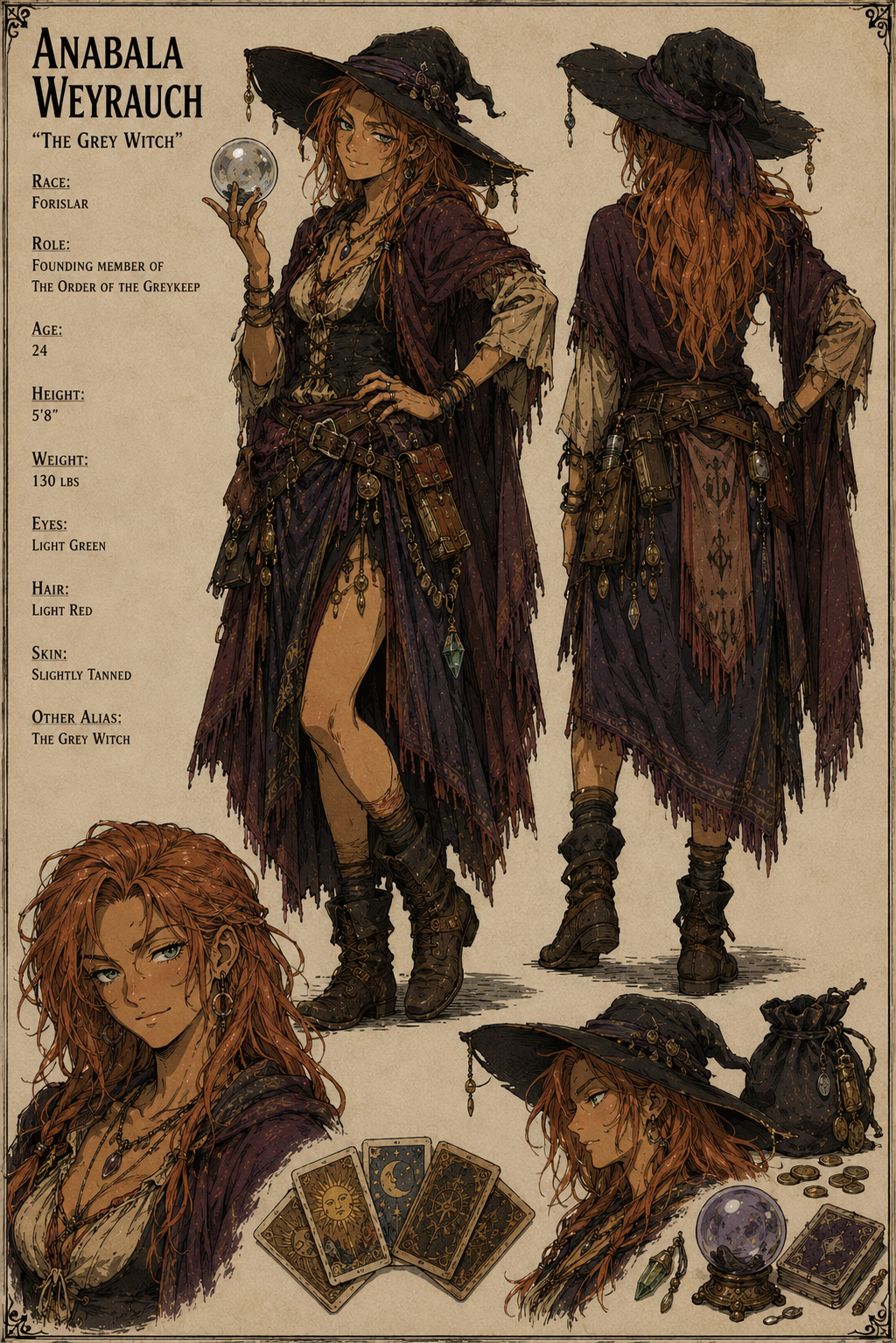


Associations
Other pages that reference or connect to this character
Referenced By
23Arthur Greykeep
Best friends
Andrew Hayes
Friends
Arthur Greykeep
Companions
Nicolas Drachenbär
Friends
Mariana Donnerhirsch
Friends
Lunara Greykeep
Friends
Inara Matikar
Friends
Saren Morep
Friends
Ser'naia
Friends
Ser'naia
Love interests
Zor Matikar
Friends
Creena Stanzgar
Friends
Creena Stanzgar
Best friends
Miri Blackclaw
Friends
Nendara
Best friends
Nendara
Love interests
Noct Blackclaw
Friends
Noct Blackclaw
Love interests
Tobais Stanzgar
Spouses
Priscilla Stanzgar
Friends
Tobais Stanzgar
Best friends
Tobais Stanzgar
Love interests
Kusha
Best friends
Collections
Published collections that feature this character
Not in any collections yet
This character hasn't been published in any collections yet. Collections are curated groups of related content that help organize and showcase your world.
Tip: Collections are a great way to group related content together and share themed stories or worldbuilding elements with others.
Timelines
Timelines that reference or include this character
No timeline connections yet
This character isn't connected to any timelines yet. Timelines help organize events chronologically and show how your content fits into the broader history of your world.
Tip: Create timelines to organize important events in your world's history. Link characters, locations, and other content to specific events to build rich, interconnected narratives.
Shares
Discussion about this character
No shares yet
Be the first to start a discussion about this character by sharing it to the community stream.
Privacy & Sharing
Manage who can see and access this character
Current Status
refresh
This character is currently
Privacy Settings
Choose who can see and access this character
language Universe Privacy
This page belongs to a universe with its own privacy settings