
Categories
Dive Deeper
Page Stats
Navigation
Categories
Dive Deeper
Page Stats
Complete Details
All information about this character
Overview
Lisbith Duron Lord of Gurdacrest Commander of the Third Army
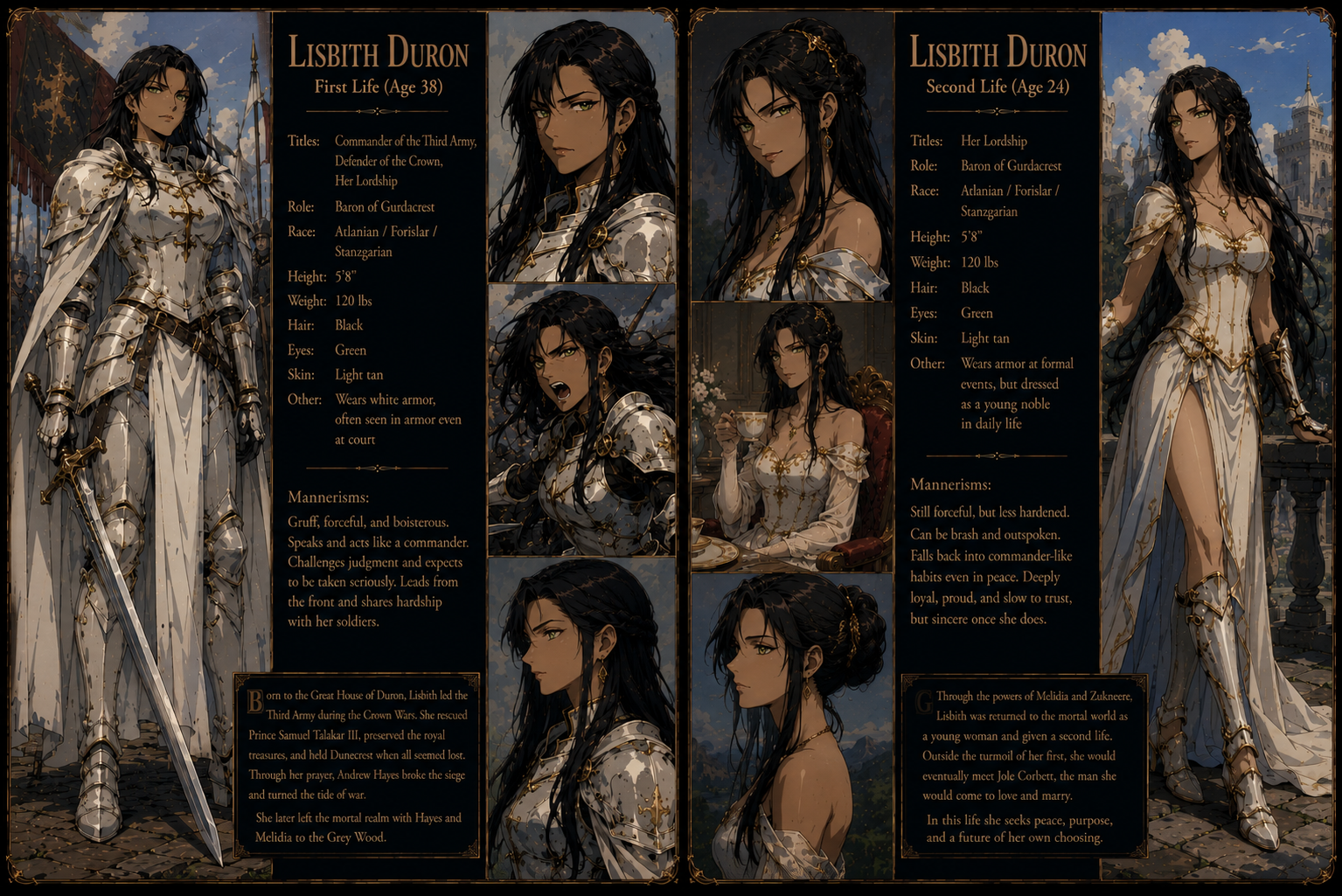
Lord Lisbith Duron, known as the Commander of the Third Army and Defender of the Crown, was the Baron of Gurdacrest and one of the most important figures in the restoration of the Talakar line. Born to the Great House of Duron, whose lineage reaches back to the founding of Atlania, Lisbith inherited both immense authority and immense pressure. Her father’s marriage to a non-noble Forislarian woman left Lisbith feeling judged by the other great houses, especially because her black hair and mixed heritage made her visibly different from the more expected image of an Atlanian great lord’s heir. Though her father did not treat her as lesser, Lisbith grew up feeling that she had to prove herself equal to every noble who might question her blood, birth, or right to rule.
Raised as a stateswoman, warrior, and proper lady whenever her mother could force her into that role, Lisbith became gruff, battle-hardened, boisterous, and deeply conscious of her lineage. She came of age during a period of unstable royal politics, as the great families vied for influence over the crown and the recognition of the Blade of Drakes Wrath. While the other great houses tried to remain distant from the conflict when possible, Lisbith thrust herself into the center of events, muscling her way into command of the Third Army and refusing to let House Duron remain passive while Atlania fractured.
Her defining act came during the Crown Wars, when rebels slaughtered much of the royal family and threatened to extinguish the legitimate line. Lisbith led her forces into the capital, rescued Prince Samuel Talakar III, and preserved the royal treasures before retreating to Dunecrest, the most fortified bastion in her holdings. Besieged, outmatched, and running dangerously low on supplies, she prayed at a small household shrine, unknowingly reaching one of the few direct connections to the Grey Wood and Andrew Hayes, a long-forgotten Duron vassal thought to be little more than history. Bound by oath to House Duron and loyal to the Talakars as the most legitimate bloodline, Hayes answered, broke the siege, and helped turn the war back in the loyalists’ favor.
After Samuel III was crowned, Lisbith served with distinction for a time before eventually withdrawing to the Grey Wood with Hayes and Melidia. There, her story became stranger still. Through the powers of Melidia and Zukneere, Lisbith was returned to the mortal world as a young woman, given a second life outside the turmoil, politics, and war that had defined her first. In that second life, she would meet Jole Corbett, the man she would eventually love and marry. Lisbith therefore exists in two forms within Atlanian memory: the white-armored Defender of the Crown, and the woman granted a second chance to live beyond the legend she created.
Commander of the Third Army, Defender of the Crown, Her Lordship
Baron of Gurdacrest
38 and then 24
Female
Looks
N/A
Lisbith usually wears her long black hair in practical braids or buns while on campaign, keeping it controlled beneath armor, helmets, cloaks, and the rough demands of command. When she is not in the field, she is more willing to wear it down, especially at formal events where she often appears with her hair loose and at least a partial set of armor, creating the striking image of a noblewoman who refuses to separate courtly presence from martial authority. The contrast suits her well: her hair can be beautiful and dramatic when worn down, but the armor reminds everyone that Lord Duron is not merely ornamental. Even in peace, Lisbith presents herself as someone ready to lead, fight, and defend the crown if called.
Black
5'8
120
Lord Lisbith Duron has no well documented identifying marks
Lisbith has a lithe, muscular warrior’s build, shaped more by command, weapons training, and campaign life than by courtly ideals of softness. At 5'8", she is not especially tall for an Atlanian noble, but she carries herself with enough force and confidence that she often seems larger in a room than she physically is. Her strength is lean and practical, suited to longsword, glaive, armor, and long days in the field rather than brute power alone. She looks fast, disciplined, and hard to pin down, which fits her reputation for strategy, leadership, and unpredictability: a compact battlefield lord whose body reflects endurance, technique, and the constant need to prove she belongs among Atlania’s great houses.
Lisbith has a light tan complexion, reflecting her mixed Atlanian, Forislar, and Stanzgarian heritage. She is not as deeply tanned as many southern or coastal Atlanians, but her skin still carries enough warmth to mark her as someone raised in Gurdacrest and trained outdoors rather than sheltered entirely within castle walls. The lighter tone also helps her black hair and green eyes stand out more sharply, contributing to the striking, almost severe image that later stories associate with the Defender of the Crown. Combined with her white armor and preference for the color white, Lisbith’s complexion gives her a distinct visual contrast: pale steel, dark hair, green eyes, and the sun-touched warmth of an Atlanian noble raised for war.
Atlanian/ Forislar/ Stanzgarian
Green
Nature
Lisbith is deeply distrustful of the other nobility, especially the great houses and royal factions that treated the crown as something to be fought over rather than protected. Her prejudice is not simple class hatred; she is a noble herself and fully understands the weight of lineage, law, and inherited authority. What she resents is the arrogance, hesitation, and self-interest of nobles who stood aside, maneuvered for advantage, or questioned her legitimacy while Atlania tore itself apart. Because of her mixed heritage and her father’s controversial marriage to a non-noble Forislarian woman, Lisbith is quick to assume that other nobles are judging her blood, her sex, her manners, or her right to command. This gives her a permanent chip on her shoulder and makes her far more comfortable proving herself through action than trusting noble courtesy.
none known
Lisbith is gruff, battle-hardened, and forceful in the way she carries herself, often speaking like a commander even when she is not on campaign. She has a habit of meeting noble judgment with loud confidence, sharp words, and visible defiance, because part of her always feels she must prove she belongs among the great houses despite her mixed heritage and her father’s controversial marriage. Around soldiers, she is more natural: direct, practical, and willing to share hardship rather than posture above them. In court, however, she can become overly boisterous, using armor, volume, and blunt certainty as shields against insecurity. Even in her second life, she sometimes falls into older patterns of speech and command, making her seem like someone from another Atlania trying to force herself into the present.
Lisbith is motivated above all by duty to the crown, especially the belief that House Duron’s strength exists to defend Atlania when the royal line and the realm itself are in danger. Her loyalty is not passive or ceremonial; when she believes the crown is threatened, she acts, even if that means forcing her way into command, defying other nobles, or carrying the burden herself. Beneath that duty is a powerful need to prove that she is worthy of House Duron’s legacy despite her insecurity, mixed heritage, and the judgment she expects from other nobles. Lisbith does not merely want to serve Atlania; she wants to prove, through action, sacrifice, and victory, that no one had the right to doubt her place among its great houses.
Lisbith’s greatest flaws are her insecurity and the heavy chip she carries on her shoulder. Though she is capable, brave, and born to one of Atlania’s great houses, she often feels as if she must constantly prove her right to stand beside the other nobles. Her father’s marriage outside traditional Atlanian nobility and her own mixed heritage leave her quick to hear judgment even when none is spoken. This makes her overly defensive, boisterous, and sometimes reckless in asserting her authority. Lisbith’s pride is not empty arrogance; it is armor over the fear that if she ever stops proving herself, the world will decide she never belonged in the first place.
Lisbith’s greatest talents are strategy, leadership, and unpredictability. She has a sharp battlefield mind, able to read pressure, exploit confusion, and act before slower or more traditional commanders understand what she is doing. Her leadership is forceful rather than polished; she wins loyalty by standing in danger herself, sharing hardship, and making soldiers believe that retreat or despair is not the only option. Her unpredictability is especially dangerous in war and politics, because Lisbith is willing to take risks other nobles would consider improper, reckless, or beneath their dignity. This is what allowed her to force her way into command of the Third Army, storm the capital, save Prince Samuel, and keep the loyalist cause alive when more cautious houses hesitated.
Lisbith secretly enjoys baking, though she would be mortified if most people knew how much pleasure she takes in it. For someone whose public life is defined by armor, command, lineage, and proving herself among the great houses, baking gives her a rare private space where effort produces something warm, ordinary, and comforting rather than political or violent. She favors practical, rustic baked goods over delicate court pastries: breads, savory pies, fruit tarts, spiced cakes, and small things she can pretend were made for “the household” rather than because she wanted to make them. The hobby reveals a softer side she works hard to hide, especially because she fears other nobles would treat it as proof that she is less of a warrior or lord.
Lisbith is boisterous, gruff, insecure, and fiercely duty-bound, a battlefield lord who hides self-doubt beneath armor, volume, and relentless action. As the only child of the Duron line, she grew up under the weight of one of Atlania’s great houses and often felt as though she had to become the son, heir, commander, and symbol everyone expected her father to have. Her father never treated her as lesser, but the pressure of lineage, mixed heritage, and noble judgment made her feel constantly watched and measured. She can be loud, blunt, and overly forceful because softness feels dangerous to her in public. Beneath that hard exterior, however, Lisbith is deeply loyal, protective, and more vulnerable than she wants anyone to know: a woman who became the Defender of the Crown partly because duty demanded it, and partly because she needed to prove she was worthy of the name Duron.
Social
Game hens
Has a love of cats
Longsword, glaive
Lisbith’s favorite possession is a formal dress her mother made for her, though she almost never wears it and would be mortified to be seen in it at a major event. The dress matters because it represents the softer life her mother tried to keep alive for her: not command, lineage, armor, or the burden of House Duron, but daughterhood, care, beauty, and being allowed to exist as something other than a battlefield lord. Lisbith hides her attachment to it because it feels too vulnerable, especially for someone who has spent so much of her life proving she is strong enough to stand among Atlania’s great houses. To anyone else it may look like an unused garment; to Lisbith, it is one of the few pieces of her life that belongs to love rather than duty.
White
Lisbith is the Marshal of the Northern Reach, Breithan of Gurdacrest, and one of the great military leaders of her age. Her occupation combines noble rulership, frontier defense, army command, and the protection of Atlania’s northern territories. As lord of House Duron, she is responsible for one of the kingdom’s oldest and most strategically important holdings, but she is not content to rule from a hall while others act in her name. Lisbith leads directly, commands soldiers personally, and treats her authority as something that must be proven through service. During the Crown Wars, her role expands from regional marshal to defender of the royal line, making her occupation not merely governance or command, but the preservation of the crown itself.
Lisbith is highly aware of the power her position carries, especially after the Crown Wars prove how quickly noble hesitation can become national disaster. While the other three Breithans tried to avoid the conflict as much as possible, Lisbith forced herself into court politics and muscled her way into command of the Third Army during a period of relative peace under the Talakars. She does not see politics as polite debate or social maneuvering, but as the place where duty either acts or fails. When rebellion threatened the royal family, Lisbith stormed the capital, rescued Prince Samuel, and preserved the crown’s future through decisive action. Her politics are therefore loyalist, interventionist, and deeply tied to House Duron’s role as a defender of Atlania: if the crown is in danger, she believes power is meant to be used, not carefully preserved for appearance’s sake.
Atlanian Mysticism
Lisbith’s job is to lead, command, and defend, whether as Baron of Gurdacrest, Marshal of the Northern Reach, Commander of the Third Army, or Defender of the Crown. She is responsible for protecting Duron territory, maintaining military readiness along the northern reach, and acting decisively when Atlania’s royal line or national stability is threatened. During the Crown Wars, her job became larger than ordinary noble duty: she rescued Prince Samuel, preserved the royal treasures, held Dunecrest under siege, and helped restore the legitimate crown. Lisbith is not merely a landholding noble; she is a battlefield leader whose role is to turn House Duron’s ancient strength into action when the kingdom can no longer afford hesitation.
History
Some time during the dry season
Lisbith was born to the Great House of Duron, tracing it's lineage all the way back to the founding of Atlania. Her father broke with tradition and married a Forislarian woman who was not a noble. She grew up being involved with the turmoltous politics of the peninsula as the Royal famlies vied for the Crown and the acknowledgement of the sword of Drakes Wrath. She was trained to be a stateman, warrior, and proper Lady when her mother could manage to force her into the castle. The other three Barron's tried to stay out of the conflicts as best they could, but Lisbith thrust herself into the court politics muscling her way into leadership of the third army during a relative peace under the Talakars. She stormed the capitol to rescue the royal family managing to save Prince Samuel and the royal tresures. They beat a hasty retreat to Dunecrest the most fortifed bastion in her holdings, where they were besieged for months. In a moment of weakness and running extremely low on supplies she made a prayer to her household gods at the small shrine in Dunecrest and unbenownst to her this was one of the few direct connections to the Gray Woods and Andrew Hayes who had been thought long dead and nothing but a historical vasal to her family. Being alerted to her peril and honor bound to the Talakars as the most legitimate bloodline to the throne and still being a Knight of House Duron he marshalled his forces and armory from the Gray Woods to help break the siege. The Third Army then marshalled and began to fight back against the other houses and rebels until they were able to bring a cesaion to hostilities and crown Samuel Talakar king of Atlania. Lisbith would serve with distinction for sometime, eventually deciding to take up residence in the Gray Woods with Hayes and Melidia. Eventually, through the powers of Melidia and the Grand Duke, Lisbith returned to the mortal world, as a young woman. a second life given to her, outside the turmoil she grew up in, in her second life she met the man she would eventually fall in love with and marry Jole Corbett.
As a noble she had the best education in the realm
Family
Notes
was 38 when Samuel Talakar the 3rd was crowned king of Atlania, eventually retiring to the Grey Woods with Andrew Hayes, returned to the mortal world as a preteen and was 24 when the Treaty of Unity was signed.
tends to fall into outdated terms of speaking, her understanding of Atlanian and Forislar being several centuries out of date.
Overview
Details about this character's overview
Lisbith Duron Lord of Gurdacrest Commander of the Third Army
Lord Lisbith Duron, known as the Commander of the Third Army and Defender of the Crown, was the Baron of Gurdacrest and one of the most important figures in the restoration of the Talakar line. Born to the Great House of Duron, whose lineage reaches back to the founding of Atlania, Lisbith inherited both immense authority and immense pressure. Her father’s marriage to a non-noble Forislarian woman left Lisbith feeling judged by the other great houses, especially because her black hair and mixed heritage made her visibly different from the more expected image of an Atlanian great lord’s heir. Though her father did not treat her as lesser, Lisbith grew up feeling that she had to prove herself equal to every noble who might question her blood, birth, or right to rule.
Raised as a stateswoman, warrior, and proper lady whenever her mother could force her into that role, Lisbith became gruff, battle-hardened, boisterous, and deeply conscious of her lineage. She came of age during a period of unstable royal politics, as the great families vied for influence over the crown and the recognition of the Blade of Drakes Wrath. While the other great houses tried to remain distant from the conflict when possible, Lisbith thrust herself into the center of events, muscling her way into command of the Third Army and refusing to let House Duron remain passive while Atlania fractured.
Her defining act came during the Crown Wars, when rebels slaughtered much of the royal family and threatened to extinguish the legitimate line. Lisbith led her forces into the capital, rescued Prince Samuel Talakar III, and preserved the royal treasures before retreating to Dunecrest, the most fortified bastion in her holdings. Besieged, outmatched, and running dangerously low on supplies, she prayed at a small household shrine, unknowingly reaching one of the few direct connections to the Grey Wood and Andrew Hayes, a long-forgotten Duron vassal thought to be little more than history. Bound by oath to House Duron and loyal to the Talakars as the most legitimate bloodline, Hayes answered, broke the siege, and helped turn the war back in the loyalists’ favor.
After Samuel III was crowned, Lisbith served with distinction for a time before eventually withdrawing to the Grey Wood with Hayes and Melidia. There, her story became stranger still. Through the powers of Melidia and Zukneere, Lisbith was returned to the mortal world as a young woman, given a second life outside the turmoil, politics, and war that had defined her first. In that second life, she would meet Jole Corbett, the man she would eventually love and marry. Lisbith therefore exists in two forms within Atlanian memory: the white-armored Defender of the Crown, and the woman granted a second chance to live beyond the legend she created.
Commander of the Third Army, Defender of the Crown, Her Lordship
Baron of Gurdacrest
38 and then 24
Female
Looks
Details about this character's looks
N/A
Lisbith usually wears her long black hair in practical braids or buns while on campaign, keeping it controlled beneath armor, helmets, cloaks, and the rough demands of command. When she is not in the field, she is more willing to wear it down, especially at formal events where she often appears with her hair loose and at least a partial set of armor, creating the striking image of a noblewoman who refuses to separate courtly presence from martial authority. The contrast suits her well: her hair can be beautiful and dramatic when worn down, but the armor reminds everyone that Lord Duron is not merely ornamental. Even in peace, Lisbith presents herself as someone ready to lead, fight, and defend the crown if called.
Black
5'8
120
Lord Lisbith Duron has no well documented identifying marks
Lisbith has a lithe, muscular warrior’s build, shaped more by command, weapons training, and campaign life than by courtly ideals of softness. At 5'8", she is not especially tall for an Atlanian noble, but she carries herself with enough force and confidence that she often seems larger in a room than she physically is. Her strength is lean and practical, suited to longsword, glaive, armor, and long days in the field rather than brute power alone. She looks fast, disciplined, and hard to pin down, which fits her reputation for strategy, leadership, and unpredictability: a compact battlefield lord whose body reflects endurance, technique, and the constant need to prove she belongs among Atlania’s great houses.
Lisbith has a light tan complexion, reflecting her mixed Atlanian, Forislar, and Stanzgarian heritage. She is not as deeply tanned as many southern or coastal Atlanians, but her skin still carries enough warmth to mark her as someone raised in Gurdacrest and trained outdoors rather than sheltered entirely within castle walls. The lighter tone also helps her black hair and green eyes stand out more sharply, contributing to the striking, almost severe image that later stories associate with the Defender of the Crown. Combined with her white armor and preference for the color white, Lisbith’s complexion gives her a distinct visual contrast: pale steel, dark hair, green eyes, and the sun-touched warmth of an Atlanian noble raised for war.
Atlanian/ Forislar/ Stanzgarian
Green
Nature
Details about this character's nature
Lisbith is deeply distrustful of the other nobility, especially the great houses and royal factions that treated the crown as something to be fought over rather than protected. Her prejudice is not simple class hatred; she is a noble herself and fully understands the weight of lineage, law, and inherited authority. What she resents is the arrogance, hesitation, and self-interest of nobles who stood aside, maneuvered for advantage, or questioned her legitimacy while Atlania tore itself apart. Because of her mixed heritage and her father’s controversial marriage to a non-noble Forislarian woman, Lisbith is quick to assume that other nobles are judging her blood, her sex, her manners, or her right to command. This gives her a permanent chip on her shoulder and makes her far more comfortable proving herself through action than trusting noble courtesy.
none known
Lisbith is gruff, battle-hardened, and forceful in the way she carries herself, often speaking like a commander even when she is not on campaign. She has a habit of meeting noble judgment with loud confidence, sharp words, and visible defiance, because part of her always feels she must prove she belongs among the great houses despite her mixed heritage and her father’s controversial marriage. Around soldiers, she is more natural: direct, practical, and willing to share hardship rather than posture above them. In court, however, she can become overly boisterous, using armor, volume, and blunt certainty as shields against insecurity. Even in her second life, she sometimes falls into older patterns of speech and command, making her seem like someone from another Atlania trying to force herself into the present.
Lisbith is motivated above all by duty to the crown, especially the belief that House Duron’s strength exists to defend Atlania when the royal line and the realm itself are in danger. Her loyalty is not passive or ceremonial; when she believes the crown is threatened, she acts, even if that means forcing her way into command, defying other nobles, or carrying the burden herself. Beneath that duty is a powerful need to prove that she is worthy of House Duron’s legacy despite her insecurity, mixed heritage, and the judgment she expects from other nobles. Lisbith does not merely want to serve Atlania; she wants to prove, through action, sacrifice, and victory, that no one had the right to doubt her place among its great houses.
Lisbith’s greatest flaws are her insecurity and the heavy chip she carries on her shoulder. Though she is capable, brave, and born to one of Atlania’s great houses, she often feels as if she must constantly prove her right to stand beside the other nobles. Her father’s marriage outside traditional Atlanian nobility and her own mixed heritage leave her quick to hear judgment even when none is spoken. This makes her overly defensive, boisterous, and sometimes reckless in asserting her authority. Lisbith’s pride is not empty arrogance; it is armor over the fear that if she ever stops proving herself, the world will decide she never belonged in the first place.
Lisbith’s greatest talents are strategy, leadership, and unpredictability. She has a sharp battlefield mind, able to read pressure, exploit confusion, and act before slower or more traditional commanders understand what she is doing. Her leadership is forceful rather than polished; she wins loyalty by standing in danger herself, sharing hardship, and making soldiers believe that retreat or despair is not the only option. Her unpredictability is especially dangerous in war and politics, because Lisbith is willing to take risks other nobles would consider improper, reckless, or beneath their dignity. This is what allowed her to force her way into command of the Third Army, storm the capital, save Prince Samuel, and keep the loyalist cause alive when more cautious houses hesitated.
Lisbith secretly enjoys baking, though she would be mortified if most people knew how much pleasure she takes in it. For someone whose public life is defined by armor, command, lineage, and proving herself among the great houses, baking gives her a rare private space where effort produces something warm, ordinary, and comforting rather than political or violent. She favors practical, rustic baked goods over delicate court pastries: breads, savory pies, fruit tarts, spiced cakes, and small things she can pretend were made for “the household” rather than because she wanted to make them. The hobby reveals a softer side she works hard to hide, especially because she fears other nobles would treat it as proof that she is less of a warrior or lord.
Lisbith is boisterous, gruff, insecure, and fiercely duty-bound, a battlefield lord who hides self-doubt beneath armor, volume, and relentless action. As the only child of the Duron line, she grew up under the weight of one of Atlania’s great houses and often felt as though she had to become the son, heir, commander, and symbol everyone expected her father to have. Her father never treated her as lesser, but the pressure of lineage, mixed heritage, and noble judgment made her feel constantly watched and measured. She can be loud, blunt, and overly forceful because softness feels dangerous to her in public. Beneath that hard exterior, however, Lisbith is deeply loyal, protective, and more vulnerable than she wants anyone to know: a woman who became the Defender of the Crown partly because duty demanded it, and partly because she needed to prove she was worthy of the name Duron.
Social
Details about this character's social
Game hens
Has a love of cats
Longsword, glaive
Lisbith’s favorite possession is a formal dress her mother made for her, though she almost never wears it and would be mortified to be seen in it at a major event. The dress matters because it represents the softer life her mother tried to keep alive for her: not command, lineage, armor, or the burden of House Duron, but daughterhood, care, beauty, and being allowed to exist as something other than a battlefield lord. Lisbith hides her attachment to it because it feels too vulnerable, especially for someone who has spent so much of her life proving she is strong enough to stand among Atlania’s great houses. To anyone else it may look like an unused garment; to Lisbith, it is one of the few pieces of her life that belongs to love rather than duty.
White
Lisbith is the Marshal of the Northern Reach, Breithan of Gurdacrest, and one of the great military leaders of her age. Her occupation combines noble rulership, frontier defense, army command, and the protection of Atlania’s northern territories. As lord of House Duron, she is responsible for one of the kingdom’s oldest and most strategically important holdings, but she is not content to rule from a hall while others act in her name. Lisbith leads directly, commands soldiers personally, and treats her authority as something that must be proven through service. During the Crown Wars, her role expands from regional marshal to defender of the royal line, making her occupation not merely governance or command, but the preservation of the crown itself.
Lisbith is highly aware of the power her position carries, especially after the Crown Wars prove how quickly noble hesitation can become national disaster. While the other three Breithans tried to avoid the conflict as much as possible, Lisbith forced herself into court politics and muscled her way into command of the Third Army during a period of relative peace under the Talakars. She does not see politics as polite debate or social maneuvering, but as the place where duty either acts or fails. When rebellion threatened the royal family, Lisbith stormed the capital, rescued Prince Samuel, and preserved the crown’s future through decisive action. Her politics are therefore loyalist, interventionist, and deeply tied to House Duron’s role as a defender of Atlania: if the crown is in danger, she believes power is meant to be used, not carefully preserved for appearance’s sake.
Atlanian Mysticism
Lisbith’s job is to lead, command, and defend, whether as Baron of Gurdacrest, Marshal of the Northern Reach, Commander of the Third Army, or Defender of the Crown. She is responsible for protecting Duron territory, maintaining military readiness along the northern reach, and acting decisively when Atlania’s royal line or national stability is threatened. During the Crown Wars, her job became larger than ordinary noble duty: she rescued Prince Samuel, preserved the royal treasures, held Dunecrest under siege, and helped restore the legitimate crown. Lisbith is not merely a landholding noble; she is a battlefield leader whose role is to turn House Duron’s ancient strength into action when the kingdom can no longer afford hesitation.
History
Details about this character's history
Some time during the dry season
Lisbith was born to the Great House of Duron, tracing it's lineage all the way back to the founding of Atlania. Her father broke with tradition and married a Forislarian woman who was not a noble. She grew up being involved with the turmoltous politics of the peninsula as the Royal famlies vied for the Crown and the acknowledgement of the sword of Drakes Wrath. She was trained to be a stateman, warrior, and proper Lady when her mother could manage to force her into the castle. The other three Barron's tried to stay out of the conflicts as best they could, but Lisbith thrust herself into the court politics muscling her way into leadership of the third army during a relative peace under the Talakars. She stormed the capitol to rescue the royal family managing to save Prince Samuel and the royal tresures. They beat a hasty retreat to Dunecrest the most fortifed bastion in her holdings, where they were besieged for months. In a moment of weakness and running extremely low on supplies she made a prayer to her household gods at the small shrine in Dunecrest and unbenownst to her this was one of the few direct connections to the Gray Woods and Andrew Hayes who had been thought long dead and nothing but a historical vasal to her family. Being alerted to her peril and honor bound to the Talakars as the most legitimate bloodline to the throne and still being a Knight of House Duron he marshalled his forces and armory from the Gray Woods to help break the siege. The Third Army then marshalled and began to fight back against the other houses and rebels until they were able to bring a cesaion to hostilities and crown Samuel Talakar king of Atlania. Lisbith would serve with distinction for sometime, eventually deciding to take up residence in the Gray Woods with Hayes and Melidia. Eventually, through the powers of Melidia and the Grand Duke, Lisbith returned to the mortal world, as a young woman. a second life given to her, outside the turmoil she grew up in, in her second life she met the man she would eventually fall in love with and marry Jole Corbett.
As a noble she had the best education in the realm
Family
Details about this character's family
Inventory
Details about this character's inventory
No inventory information yet
This section doesn't have any information filled in yet.
Changelog
Details about this character's changelog
No changelog information yet
This section doesn't have any information filled in yet.
Notes
Details about this character's notes
was 38 when Samuel Talakar the 3rd was crowned king of Atlania, eventually retiring to the Grey Woods with Andrew Hayes, returned to the mortal world as a preteen and was 24 when the Treaty of Unity was signed.
tends to fall into outdated terms of speaking, her understanding of Atlanian and Forislar being several centuries out of date.
Gallery
Images and visual content for this character



Associations
Other pages that reference or connect to this character
Referenced By
22Andrew Hayes
Best friends
Aideen the Red
Best friends
Gnoche Richdane
Friends
Atlanian Peninsula
Leaders
Melidia
Companions
Atlanian
Famous figures
Forislar
Famous figures
Dendre
Enemies
Nicolas Drachenbär
Friends
Eve Talakar Mardrein
Friends
Si'akar
Friends
Robert Dùghlas LeTreis
Friends
Nendara
Best friends
Nendara
Love interests
Philipe Stanzgar
Love interests
Blaine Talakar Mardrein
Friends
Brìde Ceanadach
Friends
Kusha
Best friends
Paloa
Companions
Samuel Talakar Mardrein III
Best friends
Samuel Talakar Mardrein III
Love interests
Kingdom of Atlania
Political figures
Collections
Published collections that feature this character
Not in any collections yet
This character hasn't been published in any collections yet. Collections are curated groups of related content that help organize and showcase your world.
Tip: Collections are a great way to group related content together and share themed stories or worldbuilding elements with others.
Timelines
Timelines that reference or include this character
No timeline connections yet
This character isn't connected to any timelines yet. Timelines help organize events chronologically and show how your content fits into the broader history of your world.
Tip: Create timelines to organize important events in your world's history. Link characters, locations, and other content to specific events to build rich, interconnected narratives.
Shares
Discussion about this character
No shares yet
Be the first to start a discussion about this character by sharing it to the community stream.
Privacy & Sharing
Manage who can see and access this character
Current Status
refresh
This character is currently
Privacy Settings
Choose who can see and access this character
language Universe Privacy
This page belongs to a universe with its own privacy settings