
Categories
Dive Deeper
Page Stats
Navigation
Categories
Dive Deeper
Page Stats
Complete Details
All information about this race
Overview
Talaran
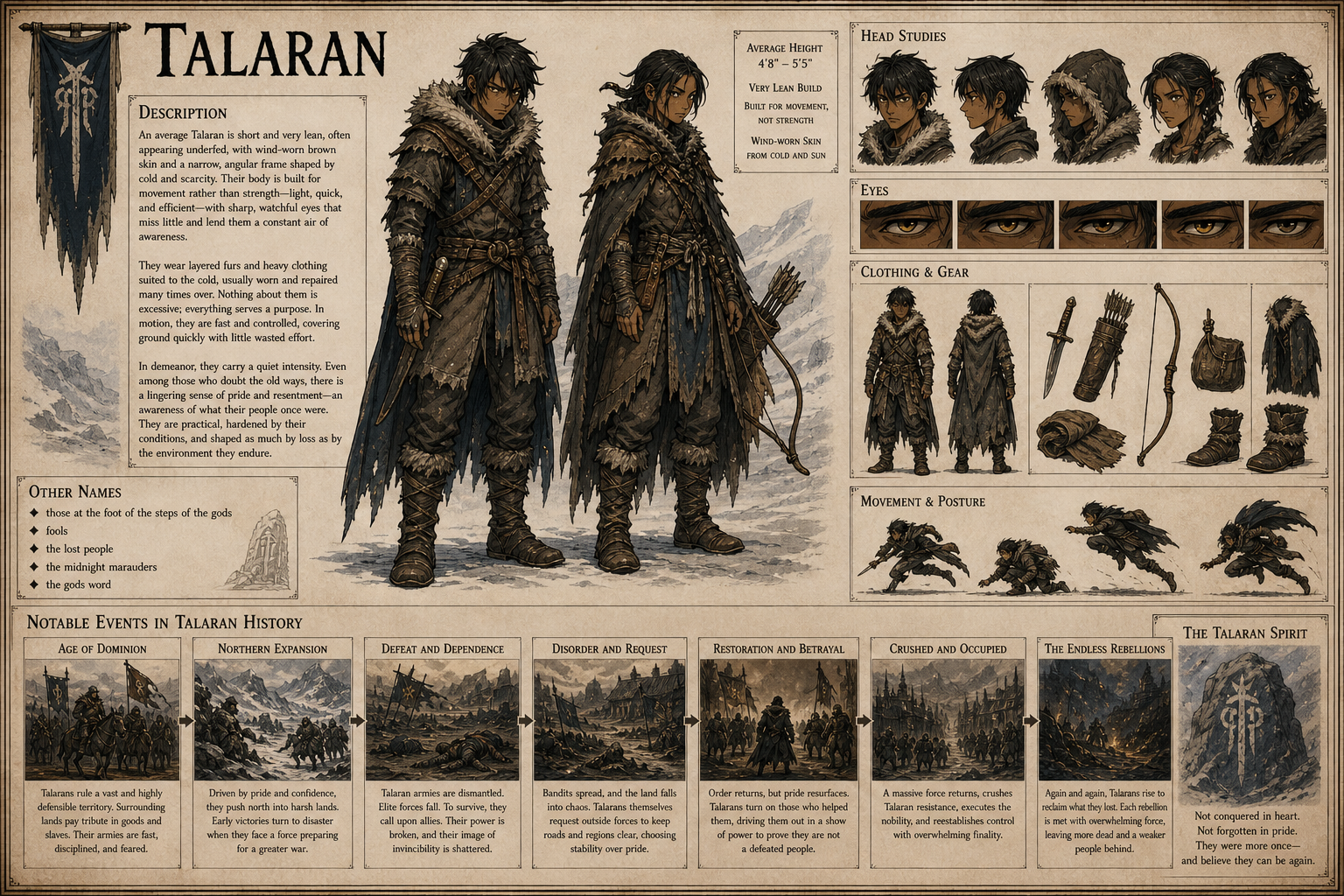
An average Talaran is short and very lean, often appearing underfed, with wind-worn brown skin and a narrow, angular frame shaped by cold and scarcity. Their body is built for movement rather than strength—light, quick, and efficient—with sharp, watchful eyes that miss little and lend them a constant air of awareness.
They wear layered furs and heavy clothing suited to the cold, usually worn and repaired many times over. Nothing about them is excessive; everything serves a purpose. In motion, they are fast and controlled, covering ground quickly with little wasted effort.
In demeanor, they carry a quiet intensity. Even among those who doubt the old ways, there is a lingering sense of pride and resentment—an awareness of what their people once were. They are practical, hardened by their conditions, and shaped as much by loss as by the environment they endure.
those at the foot of the steps of the gods
fools
the lost people
the midnight maruaders
the gods word
Looks
Talaran body shape is best understood in two distinct contexts: before their decline, and in the modern era. Their physical form reflects a people first shaped by strength, mobility, and environment—and later reshaped by scarcity and restriction.
In earlier periods, the typical Talaran build was lean, efficient, and lightly muscled. They were not large-bodied, but they were well-conditioned, fast, and physically capable. Their physiques favored speed, endurance, and precision over raw mass, and even at rest they carried a sense of readiness—alert, balanced, and prepared to move at a moment’s notice.
In the late Fifth to early Sixth Age, this baseline has shifted. Many Talarans now appear thin, underfed, and visibly strained. Malnourishment is common, often immediately noticeable in narrow frames, reduced muscle fullness, and slightly weakened posture. Despite this, their underlying structure remains. Even in diminished condition, their bodies still reflect a design built for movement. Longer limb proportions, light but responsive musculature, and quick, controlled motion persist, creating a contrast where they may appear fragile at a glance, yet capable in action.
There is also a clear divide based on social position. Common individuals are more likely to show signs of strain and undernourishment, while those of higher status may retain healthier weight, better musculature, and a more stable physical condition. This difference reinforces a visible gap between those with access to resources and those without.
In posture and movement, Talarans consistently display forward-leaning readiness. Their bodies reflect a life shaped by motion, hunting, and survival. Even when weakened, they tend to move with speed, efficiency, and minimal wasted motion.
At their core, Talaran bodies are not defined by size or raw strength—they are lean, fast, and built for movement, shaped first by capability and later by hardship.
Talaran skin tones fall within a cohesive range of earth-toned browns shaped by cold, wind, and constant exposure. Their coloration reflects life in high, open terrain, thin air, and harsh environmental conditions that steadily wear down and reshape the body over time.
Most Talarans display shades such as raw umber, cool brown, and ashen tan. These tones tend to carry muted undertones, often with subtle grey or desaturated warmth. Even individuals who might otherwise appear lighter do not present as pale in the traditional sense—instead, their skin looks weathered, as though tempered by the environment itself.
Their skin frequently shows the effects of cold conditions. It often appears dry, tightened, and hardened by exposure, with darkened or roughened areas along the face and hands. Natural color is slightly dulled by wind and chill, and the overall texture reflects a life spent in open, unforgiving landscapes.
Variation exists, but remains contained within this earthy spectrum. Individuals differ in depth of tone, undertone balance, and the degree of environmental wear. Some appear lighter, with grey-brown or faded hues, while others show deeper, more saturated umber tones. These differences are noticeable, but still unified within a shared visual range.
Environmental factors continue to shape their appearance throughout life. Wind exposure, cold air, and elevation gradually push all Talarans toward a more muted, weathered look, regardless of their starting tone. Their skin becomes something lived in rather than simply inherited.
Because of this, the population shows minimal extreme contrast. Most individuals fall within a narrow and consistent spectrum, reinforcing a shared identity that feels grounded, cohesive, and tied directly to their environment.
At its core, Talaran skin is not vibrant or highly varied—it is muted, wind-worn, and rooted in earthy browns, shaped by cold air, high ground, and constant exposure.
Talarans are notably shorter than average, with most individuals standing around 5’0”. This gives them a physical presence that feels compact, efficient, and built for movement rather than scale.
Most Talarans fall within a tight height range of about 4’8” to 5’0”, with those reaching 5’0” to 5’2” considered taller by their standards. Heights beyond this are uncommon and tend to stand out within the population. Overall, their height is consistent rather than widely varied, reinforcing a shared physical baseline.
This shorter stature is paired with lean frames, narrow builds, and efficient proportions. Their bodies are designed for speed, agility, and endurance rather than reach or physical mass. The combination of compact height and streamlined build supports sustained movement across difficult terrain.
Despite their size, Talarans are rarely perceived as frail. Their posture and movement convey quickness, readiness, and controlled energy. They feel low to the ground, but not weak—capable and responsive rather than diminished.
Differences between men and women are present but minimal in terms of height. Males may trend slightly taller, but both fall within the same narrow range, maintaining overall consistency across the population.
Their stature reflects environmental adaptation. Living in open, resource-limited terrain favors a smaller frame that requires less energy while supporting endurance over long distances. Their height is not a limitation, but a functional trait shaped by necessity.
At its core, Talaran height is not about variation or presence—it is short, consistent, and efficient, reflecting a people built for movement and endurance rather than physical scale.
Talarans are notably light for their height, with most individuals falling between 75–80 lbs. Their weight reflects both a naturally lean physical design and, in the modern era, the widespread effects of undernourishment.
Most Talarans fall into a narrow distribution: 70–75 lbs for very lean individuals—common in harsher conditions—75–80 lbs as the average range, and 80–90 lbs for those with better access to food or higher social standing. Weights beyond this are uncommon and usually indicate sustained access to resources rather than natural variation.
Their bodies rarely carry excess fat or heavy musculature. Instead, they are composed of light, efficient muscle, low overall mass, and minimal stored weight. Even at their healthiest, Talarans appear slim rather than filled out, emphasizing function over fullness.
In the modern era, undernourishment has had a visible impact. Limited resources and restricted food access have led to reduced body mass, noticeable thinness, and uneven physical condition across the population. Despite this, their underlying build remains intact—their bodies are still structured for efficiency, even when deprived.
Weight is typically evenly distributed, but minimal. Talarans often appear narrow through the torso, light in the limbs, and lacking in overall density. Their silhouette feels stripped down rather than balanced, as if reduced to only what is necessary for movement.
They are often perceived as lighter than they should be, giving an initial impression of fragility. However, in motion, this perception shifts—they appear quick, responsive, and capable, revealing the functional strength beneath their low mass.
Weight is also unstable across the population. It can fluctuate based on access to food, seasonal conditions, and social status. This creates a visible divide between those who are relatively sustained and those who are consistently deprived.
At its core, Talaran weight is not about strength or physical presence—it is light, constrained, and shaped as much by scarcity as by design, reflecting a people built for efficiency but burdened by limited resources.
Talarans are not defined by a single exaggerated trait, but by a combination of features that together create a look that is weathered, sharp, and shaped by harsh conditions. Their most immediately noticeable feature is their wind-worn complexion—tanned, hardened skin that has been darkened and roughened by years of exposure, developing a texture that resists the elements. The face, especially the cheeks, nose, and brow, often shows signs of constant wind and cold: subtle dryness, faint lines, and a surface that feels used rather than preserved. Their eyes are sharp and watchful, reflecting their exceptional eyesight; they appear focused, often slightly narrowed against distance or glare, and carry a constant sense of awareness. Even at rest, their gaze feels evaluative, as though they are always observing, measuring, and anticipating. Their facial structure is lean and tightly defined, typically narrow and lightly angular, with high or pronounced cheekbones, lean jawlines, and very little softness. This gives them an appearance that feels cut down to function rather than shaped for comfort or display.
Their bodies, though not large, carry a sense of coiled readiness. Their proportions favor quick movement, balanced footing, and controlled motion, creating a form that appears built to act first and endure second. Even when underfed, this underlying efficiency remains visible. Many Talarans also show subtle signs of hardship: slight hollowness in the cheeks, prominent joints or collarbones, and fine scarring from environmental exposure or physical work. These details are not always severe, but they are common enough to be recognizable, reinforcing the impression of a life shaped by survival. Hair is typically dark and thick, worn in practical styles—kept short, bound, or otherwise controlled to prevent interference with movement, hunting, or daily tasks. Ornamentation is minimal; Talarans rarely rely on jewelry or decoration, and when adornment is present, it tends to be functional, symbolic of status, or tied to achievement. Their overall presentation emphasizes utility over display.
More than any single physical trait, Talarans are defined by how they move. Their motion is quick, light, and precise, with little wasted effort. They often appear faster than expected and can be difficult to track over distance, their movements controlled and efficient rather than expressive. In the end, Talarans are not defined by any one striking feature, but by the cohesion of all these elements—a collection of hardened, efficient traits shaped by exposure, movement, and survival, where every visible detail reflects function over excess.
Talarans exhibit moderate physical variance. They are not identical in appearance, but their shared environment and lifestyle keep them within a fairly tight and recognizable range. Most Talarans share a consistent baseline of shorter height, lean build, and brown skin tones, creating a population that appears visually cohesive and immediately identifiable. Extreme differences are uncommon, and while individuals vary, they rarely fall outside this established range.
The most noticeable variation appears along class lines. Common individuals are more likely to show signs of undernourishment, harsher physical wear, and more pronounced thinness, while higher-status individuals tend to display healthier weight, clearer skin condition, and more stable physical development. This creates a visible divide tied directly to access to resources. Differences between men and women exist but are not extreme. Men tend to appear slightly more angular and marginally taller, while women often have slightly fuller features and more balanced proportions. Both, however, remain within the same lean and efficient physical range.
Individual variation is most evident in facial structure, eye shape, and bone definition. Some Talarans appear sharper and more angular, while others present softer but still defined features. These differences are noticeable on a personal level but do not disrupt the overall cohesive appearance of the population. Environmental influence further narrows this variation. Constant exposure to cold, wind, and daily physical activity produces shared surface traits such as weathered skin and hardened features, reinforcing a common physical identity shaped by their surroundings.
Talarans rarely exhibit extremes in height, build, or overall form. Their conditions and lifestyle naturally limit how far individuals deviate from the norm, keeping variation present but constrained. At their core, Talarans are a people with noticeable individual differences, shaped and narrowed by environment, class, and condition into a consistent and recognizable whole.
Talaran clothing is defined by cold, exposure, and limited resources. What they wear is shaped almost entirely by the need to survive in a harsh environment, with little emphasis on decoration or excess. Their garments are built to retain heat, block wind, and endure constant wear, with common clothing including furs, thick robes, and layered tunics. These are typically worn in multiple layers and adjusted as conditions demand. Fur and hide are widely used due to their availability, durability, and insulating properties, appearing in items such as fur-lined cloaks, hide boots, and layered pelts—materials valued for function first, comfort second.
Layering is standard among Talarans, with individuals commonly wearing several layers at once to adapt to shifting temperatures, retain body heat, and protect against constant wind exposure. These layers are simple, interchangeable, and often worn until they are no longer usable. Clothing is usually handmade or locally produced, built for longevity rather than appearance, and often looks coarse, patched, or visibly repaired. Wear and tear is expected, and garments are maintained and reused rather than replaced.
Ornamentation is minimal. Clothing is not used to display wealth or signal status in obvious ways, and when adornment does appear, it is subtle, functional, or tied to rank among higher classes. Differences in clothing are most noticeable between common individuals and nobility. Common clothing tends to be simpler, more worn, and heavily reused, while higher-status individuals may have access to better materials, cleaner construction, and more complete outfits. Even so, all clothing remains practical and suited to the environment.
Garments are designed to allow movement, typically loose enough to accommodate layering but secured to prevent interference during activity. This supports hunting, travel, and physical labor. Protection for the head and face is also common, with hoods, wrapped cloth, and fur-lined coverings used to guard against wind, cold, and prolonged exposure. At its core, Talaran clothing is not about expression or status—it is layered, durable, and built for survival, reflecting a people shaped by cold, scarcity, and the need to endure rather than display.
Traits
Talaran strengths are rooted in adaptation, precision, and physical efficiency. They are not overwhelming in force, but excel in speed, perception, and endurance under harsh conditions. One of their most significant advantages is their natural resistance to cold environments. Their bodies are adapted to low temperatures, harsh winds, and prolonged exposure, allowing them to operate effectively where others would slow down, lose efficiency, or struggle to function. This enables them to remain active, hunt, and travel in conditions that would limit most other peoples.
They are also defined by exceptional eyesight. Talarans can spot movement at long distances, track targets across open terrain, and maintain focus over extended ranges. This makes them highly effective in ranged combat and particularly skilled as archers. Their speed and agility further reinforce this, as they are faster than average on foot. Their light frames and efficient musculature allow for quick acceleration, sustained movement, and rapid directional changes, making them especially capable in open terrain, pursuit, and evasion.
Rather than relying on raw stamina, Talarans endure through efficiency. Their smaller frames require less energy and less recovery time, allowing them to remain active longer under limited conditions. This efficiency supports their role as hunters, where their physical traits combine with learned skills to make them highly capable at tracking, ambush, and coordinated pursuit. These abilities are not specialized disciplines alone—they are embedded in their daily life and traditions.
Talarans are also highly adapted to harsh living conditions. Accustomed to scarcity, exposure, and difficult terrain, they are capable of functioning with limited resources, making use of what is available, and continuing even under strain. Their resilience is practical rather than absolute—they persist not because they are unbreakable, but because they are used to enduring.
Their light frame provides additional advantages in speed, mobility, and reduced fatigue during movement. They can cover ground quickly, navigate terrain efficiently, and reposition with ease. At their core, Talaran strength is not found in power or durability—it lies in speed, sight, and adaptation, allowing them to survive, move, and strike effectively in environments that demand efficiency over force.
Talaran weaknesses stem from internal belief, resource limitation, and physical constraint. They are not lacking in capability—but are often limited by how they think and what they have access to. One of their most defining weaknesses is a long-standing belief in the absolute authority of their rulers. Even as this belief begins to fracture, it remains deeply ingrained and slow to fade, leading to blind obedience, delayed resistance, and difficulty adapting to new structures of power.
They also carry a cultural sense of superiority, often viewing themselves as inherently above others. This mindset can result in underestimating opponents, dismissing outside ideas, and resisting change. Historically, this has led to overreach and costly misjudgments. Compounding this issue is a divided belief system within their society. Some still hold that their rulers are divine, while others believe they were deceived, creating internal tension, instability, and a lack of unified direction.
In the modern era, widespread undernourishment further weakens the population. Limited resources have led to chronic deficiencies that affect strength, endurance, and recovery. While Talarans remain capable, many operate below their full physical potential. Their isolation also contributes to restricted access to goods, reduced technological development, and fewer opportunities for advancement, forcing them to rely on older or less efficient systems.
Physically, their light frames—while efficient—leave them less durable. They are more vulnerable to direct impact, prolonged strain, and severe injury, relying on avoidance and mobility rather than absorbing force. Additionally, legacy social structures such as serfdom, slavery, and strict hierarchy have left lasting effects on mobility within society, access to opportunity, and trust between groups. Even as these systems weaken, their influence remains deeply embedded.
This is further intensified by a cycle of rebellion and suppression. Repeated uprisings are often met with overwhelming force, leading to heavy loss of life, a weakened population, and continued instability. At their core, Talaran weaknesses are not due to a lack of ability—they are the result of belief, constraint, and repeated collapse, limiting a people who are capable but rarely allowed to fully realize that capability.
Talaran conditions are shaped by resource scarcity, environmental exposure, and long-term societal strain. These conditions differ sharply between earlier periods of stability and the modern era. In the present day, widespread undernourishment is one of the most defining conditions, affecting a large portion of the population, daily function, and long-term health. Common effects include low body mass, reduced physical strength, slower recovery from injury, and visible physical strain. While individuals remain capable, many operate at a reduced baseline of performance.
This stands in stark contrast to earlier periods, when Talarans experienced far fewer widespread conditions. They once maintained access to organized healing systems, including both practical and specialized care, which allowed for consistent treatment, better recovery outcomes, and overall stronger population health. The difference between past stability and current hardship is significant and widely felt.
Despite their natural resistance to cold, prolonged exposure still takes a toll. Over time, individuals may develop fatigue, stiffness, and gradual physical wear, including chronic joint discomfort, reduced flexibility, and long-term strain on the body. Their resistance allows them to survive in harsh conditions, but not without cost. Ongoing strain from limited resources, high activity levels, and environmental pressure also leads to physical depletion, manifesting as general exhaustion, reduced endurance, and slower recovery that builds gradually over time.
Injuries present another challenge. With limited access to consistent care, wounds may heal improperly, linger longer than expected, or leave lasting effects such as reduced mobility, chronic pain, or permanent limitation. This is compounded by mental strain caused by resource pressure, social instability, and repeated conflict. Many Talarans experience stress, fatigue, and emotional strain, which can result in difficulty maintaining focus, heightened aggression, or periods of withdrawal.
Long-term nutrient deficiencies are also common, particularly in isolated or resource-poor areas. These can lead to weakness, impaired vision over time, and reduced immune response. Meanwhile, constant exposure to wind and cold contributes to chronic surface damage, including skin wear, reduced sensation in extremities, and gradual deterioration that accumulates over years.
In extreme cases, individuals may experience fatigue collapse episodes—sudden loss of strength and the inability to continue activity, followed by extended recovery periods. These episodes are especially dangerous in open or exposed environments and are difficult to predict. Overall recovery is often inefficient, as the body may heal more slowly, fail to fully recover, or lose effectiveness over time due to lack of proper care.
At their core, Talaran conditions are not defined by a single affliction—they are the cumulative result of scarcity, exposure, and sustained pressure, creating a population that endures through strain rather than avoiding it.
Culture
Talaran traditions are shaped by dominance, faith, and survival through structure. They are a people whose customs were once built around power and certainty, and are now fractured by loss, restriction, and doubt. One of their most defining traditions was the hunting of the Goltari, treated not as war but as sport. These hunts were organized, ritualized, and tied directly to status, with nobility proving themselves through tracking, cornering, and killing powerful prey. This reinforced deeply held beliefs in superiority and the right to dominate. Though far less common now, the legacy of these hunts remains deeply embedded and widely remembered.
For most of their history, Talarans practiced absolute devotion to their rulers, worshiping them as living gods. Their kings were not symbolic figures but divine authorities, and daily life was structured around prayer, ritual, and obedience. Even as belief in this system has fractured, many of its outward traditions persist unchanged in form. Religious practice was once constant and highly structured, with individuals participating in morning acknowledgment of divine authority, midday offerings or gestures of devotion, and evening rites of thanks or submission. These rituals reinforced order, hierarchy, and the presence of divine rule in everyday life.
Raiding was also a normalized and respected activity, used to acquire goods, take slaves, and assert dominance. These raids were often organized, state-supported, and expected of certain groups, with success bringing status, wealth, and recognition. Alongside this, Talaran society was built on strict hierarchical labor systems, including serfdom for their own lower classes and slavery for captured outsiders. These practices were not viewed as unjust, but as natural extensions of their worldview, and their effects remain deeply ingrained even as the systems themselves weaken.
Public combat and spectacle were another major tradition, most notably in the form of gladiatorial games. These served as entertainment, punishment, and demonstrations of power, with participants ranging from slaves and criminals to captured enemies. Victory could bring temporary status, while defeat was often fatal. Across all aspects of their culture, Talarans placed strong emphasis on visible proof of strength, whether through successful hunts, combat victories, or the possession of trophies. Recognition was never subtle—it was earned and displayed openly.
In the modern era, many of these traditions have weakened, shifted, or been forced underground due to restriction and external control. Large-scale hunts, raiding, and open displays of dominance are far less common, but they are not forgotten. They remain remembered, often resented, and in some cases quietly continued. At the same time, new patterns are beginning to emerge as belief in divine rulers collapses. These include questioning of old rituals, rejection of imposed hierarchy, and small acts of defiance or independence. These are not yet fully formed traditions, but they represent a cultural shift in progress.
At their core, Talaran traditions are not gentle or communal—they are built on power, control, and belief, now fractured by loss and slowly reshaping into something uncertain, but inevitable.
Talaran beliefs are divided between what was taught and what has been realized. Their worldview is currently fractured, with old doctrine still present but no longer universally accepted. For most of their history, Talarans believed in absolute divine kingship—their rulers were not symbolic figures, but living gods, and this was treated as unquestionable truth. Obedience was both duty and worship, and to defy authority was to defy the divine order itself. Alongside this, they held a belief in their inherent right of dominance, viewing themselves as meant to rule while other peoples were considered lesser—fit to serve or be conquered. This worldview justified raiding, slavery, and expansion as natural and correct. The hunt, particularly of powerful prey such as the Goltari, was seen as proof of superiority, where success validated worth, nobility, and the right to lead, while failure exposed weakness. They also believed that other societies should recognize their dominance through tribute, submission, or acknowledgment of authority, with respect expected to flow in one direction.
In the modern era, these beliefs are breaking apart. A growing number of Talarans now reject divine authority entirely, believing their rulers were never gods, but manipulators or beneficiaries of blind faith. This realization has brought anger, disillusionment, and a deep loss of identity. Without divine justification, long-standing hierarchies are now questioned—systems of rule, obedience, and class are no longer accepted without doubt. This has led to a broader loss of cultural certainty, leaving many Talarans unsure of their place in the world or the purpose behind their former structure. The result is instability, internal conflict, and ideological division.
Even among those who reject the old beliefs, memory of what they once were remains strong. This creates resentment toward their current state, a desire to reclaim lost status, and disagreement over how—or if—that should be achieved. Belief itself has become fragmented. Some still hold fully to the old doctrines, others reject them entirely, and many exist in between—uncertain, but not yet free from what they were taught. There is no longer a single dominant belief system, only overlapping and competing ideas. At its core, Talaran belief is no longer unified—it is a broken system, caught between inherited certainty and emerging doubt, where faith has not disappeared, but no longer agrees on what is true.
Talaran governance is defined by loss of sovereignty, external control, and the remnants of a broken theocracy. Their system is no longer what it once was—but traces of it still shape how power functions. For most of their history, Talarans were ruled under a strict theocracy, where rulers held power as divine authorities and religion and governance were indistinguishable. Laws were treated as expressions of divine will, and authority was absolute and unquestioned. This created a rigid, centralized system entirely dependent on belief.
As belief in their rulers began to fracture, the foundation of this system failed. Without divine legitimacy, the government lost its authority, unity, and stability, leading to weakened leadership, internal conflict, and the eventual collapse of centralized control. In the modern era, Talaran is governed by a puppet monarch—a figure who exists to maintain structure, represent continuity, and enforce external interests. Their authority is limited, controlled, and dependent on outside power. They rule, but do not truly govern independently.
Real power now lies outside of Talaran itself. Governance is shaped by external forces that maintain control over the region, ensuring compliance, containment, and the suppression of large-scale unrest. Decisions are influenced less by internal will and more by what is permitted. Within this structure, local authority still exists in fragmented forms. Some regions are influenced by remnants of noble structures, local leaders, or informal power holders, but all operate within strict limitations and cannot act beyond what is tolerated.
This system is continually destabilized by cycles of rebellion and suppression. Uprisings are driven by resentment, loss of identity, and the desire for autonomy, but are consistently met with overwhelming force. This creates a repeating pattern of uprising, suppression, and instability that prevents meaningful reform. Despite the collapse of full belief, elements of the old theocratic system persist—ritual authority, structured hierarchy, and expectations of obedience still influence behavior, even when the belief behind them has weakened or disappeared.
Modern Talaran lacks a unified governing identity. It is no longer fully theocratic, but it is not independent or self-determined either. Instead, it exists as a controlled, fragmented system caught between what it was and what it has become. At its core, Talaran governance is not defined by strength or unity—it is a fallen theocracy held in place by external control, where authority exists, but independence does not.
Talaran technology is defined by isolation, stagnation, and decline. They operate at a level roughly a century or more behind the broader world, with limited access to newer developments and very little capacity to advance on their own. Most of their technology remains at a basic, pre-industrial level, relying on simple tools, traditional construction methods, and labor-driven systems. What they have is functional, but not optimized, and often shows clear signs of age, wear, and repeated use.
In earlier periods, Talarans possessed more advanced and organized systems, supported by skilled labor and structured development. However, decline and external restriction have led to a loss of knowledge, breakdown of infrastructure, and an inability to maintain past standards. Much of what once existed is now reduced, fragmented, or poorly preserved. Magical practice still exists, but it is restricted, inconsistent, and far less developed than it once was. Where there were once organized practitioners and structured healing systems, there are now scattered individuals working with incomplete knowledge and diminished capability.
Isolation has further limited their access to innovation. Talarans lack exposure to new tools, advanced systems, and external knowledge, preventing technological growth and adaptation. As a result, they are forced to reuse, repair, and make do with what they already possess. They rely heavily on older, traditional methods that are understood, reliable, and repeatable—but often inefficient compared to more advanced systems elsewhere.
Technology is also unevenly distributed. Individuals of higher status may retain access to better tools, preserved knowledge, or more complete equipment, while the majority depend on basic, worn resources. What technology remains is maintained with a focus on durability rather than refinement. Items are repaired repeatedly, used far beyond their intended lifespan, and valued for continued function rather than quality or performance.
At its core, Talaran technology is not advancing—it is aging, restricted, and sustained just enough to remain functional, reflecting a society cut off from progress and forced to rely on what remains rather than what could be developed.
Talaran occupations are defined by hierarchy, necessity, and limited opportunity. Work is tied more to social position than personal choice, and most individuals have little ability to change their role over time. The majority of the population are farmers, forming the peasantry that sustains the entire society through constant, labor-intensive work. This labor is demanding, repetitive, and offers almost no upward mobility. Above them, the aristocracy operates very differently—many nobles do not hold formal occupations at all, instead living off inherited status, land control, and access to resources. Some may take on roles in administration or military leadership, but this is optional rather than expected. There are limited specialized roles such as craftsmen, builders, and basic healers, but these are not widespread or strongly supported, and most people cannot rely on specialization alone to survive. Military roles exist as well, primarily focused on local control, enforcement, and maintaining order, and service is often expected rather than chosen. Many lower-class individuals also occupy servitude roles, including domestic labor or other forms of assigned work tied directly to their status. In more remote or harsher areas, occupations shift toward pure survival—hunting, gathering, and maintaining shelter—less structured but no less necessary. Overall, Talaran occupations are not flexible or opportunity-driven; they are inherited, assigned, and maintained within a rigid system where most people work to survive and very few are required to do so.
Talaran economics are defined by poverty, restriction, and external control. The overall system is weak and constrained, with most economic activity focused on basic survival rather than growth or expansion. Widespread sanctions and isolation limit access to trade, resources, and outside markets, preventing the development of a stable or prosperous economy. The majority of wealth and resources are concentrated at the top, while the lower classes operate with very little, often struggling to meet basic needs. Agriculture forms the backbone of the economy, but production is inconsistent and often insufficient due to environmental conditions and lack of support systems. Trade exists, but it is heavily limited, localized, and rarely able to generate significant wealth. Goods circulate slowly, and access to anything beyond essentials is uncommon for most of the population. Currency may be used, but it is not abundant, and in many cases goods and labor are more reliable than coin. Economic mobility is extremely limited—individuals rarely improve their position, and wealth does not easily change hands outside of established structures. The system does not reward innovation or expansion, as opportunities to do so are restricted or suppressed. Instead, it reinforces stability at the top and stagnation below. Overall, Talaran economics are not dynamic or self-sustaining; they are constrained, uneven, and maintained in a state that prevents recovery while ensuring continued dependence and limitation.
Talaran food is defined by scarcity, environment, and memory of better times. While they will eat almost anything available, there is a clear preference for roasted meats, which are seen as both filling and culturally significant. Meat is highly valued, especially when freshly prepared over open flame, as it represents strength, success in hunting, and a break from more limited daily meals. In practice, however, access to meat is inconsistent for much of the population, making it more of a desired food than a constant one.
Daily diet is often simple and survival-focused, consisting of whatever can be reliably sourced—small game, preserved meats, and basic gathered or farmed foods. Meals tend to be repetitive and functional, prioritizing calories over variety or refinement. Roasting remains the most favored method of preparation when possible, as it requires minimal tools and brings out the most flavor from limited ingredients.
Preserved foods are common, including dried or smoked meats, as well as anything that can be stored for long periods without spoiling. These foods are essential in a cold, resource-limited environment where fresh supply is not always guaranteed. When food is scarce, nothing is wasted—organs, tougher cuts, and less desirable portions are all used.
Among those with greater access to resources, meals become more substantial, with larger cuts of meat, better preparation, and more consistent availability. However, even in these cases, food remains grounded in practicality rather than luxury.
Despite current limitations, there is a cultural memory of abundance. Foods that were once common—large game, rich meals, and plentiful portions—are still remembered and influence what is considered desirable. This creates a contrast between what Talarans eat and what they wish they could eat more often.
Overall, Talaran food is not refined or varied—it is harsh, practical, and built around survival, with a lasting preference for roasted meats as a symbol of strength and better times.
History
Notable events – What events are most important to the history of Talaran?
Talaran history is defined by rise, overreach, collapse, and repeated attempts to reclaim lost power. They were once a dominant force, ruling a vast and highly defensible territory. Their armies were fast, disciplined, and effective, and surrounding regions paid tribute in goods and slaves. This period of strength reinforced their belief in superiority and divine right to rule.
Their downfall began with expansion northward. Confident in their power, they pushed into lands far more dangerous than anticipated. Early victories gave way to disaster when they encountered a force already preparing for a far greater conflict. This opponent systematically dismantled Talaran military strength, defeating even their most elite forces. Unable to withstand the losses, the Talarans called upon their allies to survive. Though they avoided total destruction, their military was broken, their rulers weakened, and their image of invincibility shattered.
In the aftermath, their lands fell into disorder. Bandits and other threats spread, and the weakened state could not restore control. When a general offer was made to keep major roads and regions clear across multiple lands, the Talarans themselves requested that these forces operate within their territory. This was not an imposed occupation, but a decision made out of necessity to stabilize what they could no longer control.
For a time, this worked. Order returned, threats were reduced, and the land became more stable. However, as recovery began, the Talarans remembered what they had once been. Their decision to turn on the forces within their lands was not born from oppression, but from pride—a deliberate show of power meant to prove they were not a defeated people.
Initially, they succeeded. They drove those forces out and reasserted control, reinforcing the idea that their strength had not been fully lost. But this victory provoked a full response. A massive military force returned, overwhelming Talaran resistance, crushing their remaining nobility, and reestablishing control with far greater finality.
This marked the beginning of a long period of failed rebellions. Time and again, Talarans have risen to reclaim their independence. Each time, they have been met with overwhelming force, and each time the result has been heavy loss of life and further weakening of their people.
Overall, Talaran history is not just a fall from power—it is a cycle of defiance. They were not simply conquered; they chose to fight again after being given stability, and have continued to do so ever since, driven by the belief that they were once more—and could be again.
Overview
Details about this race's overview
Talaran
An average Talaran is short and very lean, often appearing underfed, with wind-worn brown skin and a narrow, angular frame shaped by cold and scarcity. Their body is built for movement rather than strength—light, quick, and efficient—with sharp, watchful eyes that miss little and lend them a constant air of awareness.
They wear layered furs and heavy clothing suited to the cold, usually worn and repaired many times over. Nothing about them is excessive; everything serves a purpose. In motion, they are fast and controlled, covering ground quickly with little wasted effort.
In demeanor, they carry a quiet intensity. Even among those who doubt the old ways, there is a lingering sense of pride and resentment—an awareness of what their people once were. They are practical, hardened by their conditions, and shaped as much by loss as by the environment they endure.
those at the foot of the steps of the gods
fools
the lost people
the midnight maruaders
the gods word
Looks
Details about this race's looks
Talaran body shape is best understood in two distinct contexts: before their decline, and in the modern era. Their physical form reflects a people first shaped by strength, mobility, and environment—and later reshaped by scarcity and restriction.
In earlier periods, the typical Talaran build was lean, efficient, and lightly muscled. They were not large-bodied, but they were well-conditioned, fast, and physically capable. Their physiques favored speed, endurance, and precision over raw mass, and even at rest they carried a sense of readiness—alert, balanced, and prepared to move at a moment’s notice.
In the late Fifth to early Sixth Age, this baseline has shifted. Many Talarans now appear thin, underfed, and visibly strained. Malnourishment is common, often immediately noticeable in narrow frames, reduced muscle fullness, and slightly weakened posture. Despite this, their underlying structure remains. Even in diminished condition, their bodies still reflect a design built for movement. Longer limb proportions, light but responsive musculature, and quick, controlled motion persist, creating a contrast where they may appear fragile at a glance, yet capable in action.
There is also a clear divide based on social position. Common individuals are more likely to show signs of strain and undernourishment, while those of higher status may retain healthier weight, better musculature, and a more stable physical condition. This difference reinforces a visible gap between those with access to resources and those without.
In posture and movement, Talarans consistently display forward-leaning readiness. Their bodies reflect a life shaped by motion, hunting, and survival. Even when weakened, they tend to move with speed, efficiency, and minimal wasted motion.
At their core, Talaran bodies are not defined by size or raw strength—they are lean, fast, and built for movement, shaped first by capability and later by hardship.
Talaran skin tones fall within a cohesive range of earth-toned browns shaped by cold, wind, and constant exposure. Their coloration reflects life in high, open terrain, thin air, and harsh environmental conditions that steadily wear down and reshape the body over time.
Most Talarans display shades such as raw umber, cool brown, and ashen tan. These tones tend to carry muted undertones, often with subtle grey or desaturated warmth. Even individuals who might otherwise appear lighter do not present as pale in the traditional sense—instead, their skin looks weathered, as though tempered by the environment itself.
Their skin frequently shows the effects of cold conditions. It often appears dry, tightened, and hardened by exposure, with darkened or roughened areas along the face and hands. Natural color is slightly dulled by wind and chill, and the overall texture reflects a life spent in open, unforgiving landscapes.
Variation exists, but remains contained within this earthy spectrum. Individuals differ in depth of tone, undertone balance, and the degree of environmental wear. Some appear lighter, with grey-brown or faded hues, while others show deeper, more saturated umber tones. These differences are noticeable, but still unified within a shared visual range.
Environmental factors continue to shape their appearance throughout life. Wind exposure, cold air, and elevation gradually push all Talarans toward a more muted, weathered look, regardless of their starting tone. Their skin becomes something lived in rather than simply inherited.
Because of this, the population shows minimal extreme contrast. Most individuals fall within a narrow and consistent spectrum, reinforcing a shared identity that feels grounded, cohesive, and tied directly to their environment.
At its core, Talaran skin is not vibrant or highly varied—it is muted, wind-worn, and rooted in earthy browns, shaped by cold air, high ground, and constant exposure.
Talarans are notably shorter than average, with most individuals standing around 5’0”. This gives them a physical presence that feels compact, efficient, and built for movement rather than scale.
Most Talarans fall within a tight height range of about 4’8” to 5’0”, with those reaching 5’0” to 5’2” considered taller by their standards. Heights beyond this are uncommon and tend to stand out within the population. Overall, their height is consistent rather than widely varied, reinforcing a shared physical baseline.
This shorter stature is paired with lean frames, narrow builds, and efficient proportions. Their bodies are designed for speed, agility, and endurance rather than reach or physical mass. The combination of compact height and streamlined build supports sustained movement across difficult terrain.
Despite their size, Talarans are rarely perceived as frail. Their posture and movement convey quickness, readiness, and controlled energy. They feel low to the ground, but not weak—capable and responsive rather than diminished.
Differences between men and women are present but minimal in terms of height. Males may trend slightly taller, but both fall within the same narrow range, maintaining overall consistency across the population.
Their stature reflects environmental adaptation. Living in open, resource-limited terrain favors a smaller frame that requires less energy while supporting endurance over long distances. Their height is not a limitation, but a functional trait shaped by necessity.
At its core, Talaran height is not about variation or presence—it is short, consistent, and efficient, reflecting a people built for movement and endurance rather than physical scale.
Talarans are notably light for their height, with most individuals falling between 75–80 lbs. Their weight reflects both a naturally lean physical design and, in the modern era, the widespread effects of undernourishment.
Most Talarans fall into a narrow distribution: 70–75 lbs for very lean individuals—common in harsher conditions—75–80 lbs as the average range, and 80–90 lbs for those with better access to food or higher social standing. Weights beyond this are uncommon and usually indicate sustained access to resources rather than natural variation.
Their bodies rarely carry excess fat or heavy musculature. Instead, they are composed of light, efficient muscle, low overall mass, and minimal stored weight. Even at their healthiest, Talarans appear slim rather than filled out, emphasizing function over fullness.
In the modern era, undernourishment has had a visible impact. Limited resources and restricted food access have led to reduced body mass, noticeable thinness, and uneven physical condition across the population. Despite this, their underlying build remains intact—their bodies are still structured for efficiency, even when deprived.
Weight is typically evenly distributed, but minimal. Talarans often appear narrow through the torso, light in the limbs, and lacking in overall density. Their silhouette feels stripped down rather than balanced, as if reduced to only what is necessary for movement.
They are often perceived as lighter than they should be, giving an initial impression of fragility. However, in motion, this perception shifts—they appear quick, responsive, and capable, revealing the functional strength beneath their low mass.
Weight is also unstable across the population. It can fluctuate based on access to food, seasonal conditions, and social status. This creates a visible divide between those who are relatively sustained and those who are consistently deprived.
At its core, Talaran weight is not about strength or physical presence—it is light, constrained, and shaped as much by scarcity as by design, reflecting a people built for efficiency but burdened by limited resources.
Talarans are not defined by a single exaggerated trait, but by a combination of features that together create a look that is weathered, sharp, and shaped by harsh conditions. Their most immediately noticeable feature is their wind-worn complexion—tanned, hardened skin that has been darkened and roughened by years of exposure, developing a texture that resists the elements. The face, especially the cheeks, nose, and brow, often shows signs of constant wind and cold: subtle dryness, faint lines, and a surface that feels used rather than preserved. Their eyes are sharp and watchful, reflecting their exceptional eyesight; they appear focused, often slightly narrowed against distance or glare, and carry a constant sense of awareness. Even at rest, their gaze feels evaluative, as though they are always observing, measuring, and anticipating. Their facial structure is lean and tightly defined, typically narrow and lightly angular, with high or pronounced cheekbones, lean jawlines, and very little softness. This gives them an appearance that feels cut down to function rather than shaped for comfort or display.
Their bodies, though not large, carry a sense of coiled readiness. Their proportions favor quick movement, balanced footing, and controlled motion, creating a form that appears built to act first and endure second. Even when underfed, this underlying efficiency remains visible. Many Talarans also show subtle signs of hardship: slight hollowness in the cheeks, prominent joints or collarbones, and fine scarring from environmental exposure or physical work. These details are not always severe, but they are common enough to be recognizable, reinforcing the impression of a life shaped by survival. Hair is typically dark and thick, worn in practical styles—kept short, bound, or otherwise controlled to prevent interference with movement, hunting, or daily tasks. Ornamentation is minimal; Talarans rarely rely on jewelry or decoration, and when adornment is present, it tends to be functional, symbolic of status, or tied to achievement. Their overall presentation emphasizes utility over display.
More than any single physical trait, Talarans are defined by how they move. Their motion is quick, light, and precise, with little wasted effort. They often appear faster than expected and can be difficult to track over distance, their movements controlled and efficient rather than expressive. In the end, Talarans are not defined by any one striking feature, but by the cohesion of all these elements—a collection of hardened, efficient traits shaped by exposure, movement, and survival, where every visible detail reflects function over excess.
Talarans exhibit moderate physical variance. They are not identical in appearance, but their shared environment and lifestyle keep them within a fairly tight and recognizable range. Most Talarans share a consistent baseline of shorter height, lean build, and brown skin tones, creating a population that appears visually cohesive and immediately identifiable. Extreme differences are uncommon, and while individuals vary, they rarely fall outside this established range.
The most noticeable variation appears along class lines. Common individuals are more likely to show signs of undernourishment, harsher physical wear, and more pronounced thinness, while higher-status individuals tend to display healthier weight, clearer skin condition, and more stable physical development. This creates a visible divide tied directly to access to resources. Differences between men and women exist but are not extreme. Men tend to appear slightly more angular and marginally taller, while women often have slightly fuller features and more balanced proportions. Both, however, remain within the same lean and efficient physical range.
Individual variation is most evident in facial structure, eye shape, and bone definition. Some Talarans appear sharper and more angular, while others present softer but still defined features. These differences are noticeable on a personal level but do not disrupt the overall cohesive appearance of the population. Environmental influence further narrows this variation. Constant exposure to cold, wind, and daily physical activity produces shared surface traits such as weathered skin and hardened features, reinforcing a common physical identity shaped by their surroundings.
Talarans rarely exhibit extremes in height, build, or overall form. Their conditions and lifestyle naturally limit how far individuals deviate from the norm, keeping variation present but constrained. At their core, Talarans are a people with noticeable individual differences, shaped and narrowed by environment, class, and condition into a consistent and recognizable whole.
Talaran clothing is defined by cold, exposure, and limited resources. What they wear is shaped almost entirely by the need to survive in a harsh environment, with little emphasis on decoration or excess. Their garments are built to retain heat, block wind, and endure constant wear, with common clothing including furs, thick robes, and layered tunics. These are typically worn in multiple layers and adjusted as conditions demand. Fur and hide are widely used due to their availability, durability, and insulating properties, appearing in items such as fur-lined cloaks, hide boots, and layered pelts—materials valued for function first, comfort second.
Layering is standard among Talarans, with individuals commonly wearing several layers at once to adapt to shifting temperatures, retain body heat, and protect against constant wind exposure. These layers are simple, interchangeable, and often worn until they are no longer usable. Clothing is usually handmade or locally produced, built for longevity rather than appearance, and often looks coarse, patched, or visibly repaired. Wear and tear is expected, and garments are maintained and reused rather than replaced.
Ornamentation is minimal. Clothing is not used to display wealth or signal status in obvious ways, and when adornment does appear, it is subtle, functional, or tied to rank among higher classes. Differences in clothing are most noticeable between common individuals and nobility. Common clothing tends to be simpler, more worn, and heavily reused, while higher-status individuals may have access to better materials, cleaner construction, and more complete outfits. Even so, all clothing remains practical and suited to the environment.
Garments are designed to allow movement, typically loose enough to accommodate layering but secured to prevent interference during activity. This supports hunting, travel, and physical labor. Protection for the head and face is also common, with hoods, wrapped cloth, and fur-lined coverings used to guard against wind, cold, and prolonged exposure. At its core, Talaran clothing is not about expression or status—it is layered, durable, and built for survival, reflecting a people shaped by cold, scarcity, and the need to endure rather than display.
Traits
Details about this race's traits
Talaran strengths are rooted in adaptation, precision, and physical efficiency. They are not overwhelming in force, but excel in speed, perception, and endurance under harsh conditions. One of their most significant advantages is their natural resistance to cold environments. Their bodies are adapted to low temperatures, harsh winds, and prolonged exposure, allowing them to operate effectively where others would slow down, lose efficiency, or struggle to function. This enables them to remain active, hunt, and travel in conditions that would limit most other peoples.
They are also defined by exceptional eyesight. Talarans can spot movement at long distances, track targets across open terrain, and maintain focus over extended ranges. This makes them highly effective in ranged combat and particularly skilled as archers. Their speed and agility further reinforce this, as they are faster than average on foot. Their light frames and efficient musculature allow for quick acceleration, sustained movement, and rapid directional changes, making them especially capable in open terrain, pursuit, and evasion.
Rather than relying on raw stamina, Talarans endure through efficiency. Their smaller frames require less energy and less recovery time, allowing them to remain active longer under limited conditions. This efficiency supports their role as hunters, where their physical traits combine with learned skills to make them highly capable at tracking, ambush, and coordinated pursuit. These abilities are not specialized disciplines alone—they are embedded in their daily life and traditions.
Talarans are also highly adapted to harsh living conditions. Accustomed to scarcity, exposure, and difficult terrain, they are capable of functioning with limited resources, making use of what is available, and continuing even under strain. Their resilience is practical rather than absolute—they persist not because they are unbreakable, but because they are used to enduring.
Their light frame provides additional advantages in speed, mobility, and reduced fatigue during movement. They can cover ground quickly, navigate terrain efficiently, and reposition with ease. At their core, Talaran strength is not found in power or durability—it lies in speed, sight, and adaptation, allowing them to survive, move, and strike effectively in environments that demand efficiency over force.
Talaran weaknesses stem from internal belief, resource limitation, and physical constraint. They are not lacking in capability—but are often limited by how they think and what they have access to. One of their most defining weaknesses is a long-standing belief in the absolute authority of their rulers. Even as this belief begins to fracture, it remains deeply ingrained and slow to fade, leading to blind obedience, delayed resistance, and difficulty adapting to new structures of power.
They also carry a cultural sense of superiority, often viewing themselves as inherently above others. This mindset can result in underestimating opponents, dismissing outside ideas, and resisting change. Historically, this has led to overreach and costly misjudgments. Compounding this issue is a divided belief system within their society. Some still hold that their rulers are divine, while others believe they were deceived, creating internal tension, instability, and a lack of unified direction.
In the modern era, widespread undernourishment further weakens the population. Limited resources have led to chronic deficiencies that affect strength, endurance, and recovery. While Talarans remain capable, many operate below their full physical potential. Their isolation also contributes to restricted access to goods, reduced technological development, and fewer opportunities for advancement, forcing them to rely on older or less efficient systems.
Physically, their light frames—while efficient—leave them less durable. They are more vulnerable to direct impact, prolonged strain, and severe injury, relying on avoidance and mobility rather than absorbing force. Additionally, legacy social structures such as serfdom, slavery, and strict hierarchy have left lasting effects on mobility within society, access to opportunity, and trust between groups. Even as these systems weaken, their influence remains deeply embedded.
This is further intensified by a cycle of rebellion and suppression. Repeated uprisings are often met with overwhelming force, leading to heavy loss of life, a weakened population, and continued instability. At their core, Talaran weaknesses are not due to a lack of ability—they are the result of belief, constraint, and repeated collapse, limiting a people who are capable but rarely allowed to fully realize that capability.
Talaran conditions are shaped by resource scarcity, environmental exposure, and long-term societal strain. These conditions differ sharply between earlier periods of stability and the modern era. In the present day, widespread undernourishment is one of the most defining conditions, affecting a large portion of the population, daily function, and long-term health. Common effects include low body mass, reduced physical strength, slower recovery from injury, and visible physical strain. While individuals remain capable, many operate at a reduced baseline of performance.
This stands in stark contrast to earlier periods, when Talarans experienced far fewer widespread conditions. They once maintained access to organized healing systems, including both practical and specialized care, which allowed for consistent treatment, better recovery outcomes, and overall stronger population health. The difference between past stability and current hardship is significant and widely felt.
Despite their natural resistance to cold, prolonged exposure still takes a toll. Over time, individuals may develop fatigue, stiffness, and gradual physical wear, including chronic joint discomfort, reduced flexibility, and long-term strain on the body. Their resistance allows them to survive in harsh conditions, but not without cost. Ongoing strain from limited resources, high activity levels, and environmental pressure also leads to physical depletion, manifesting as general exhaustion, reduced endurance, and slower recovery that builds gradually over time.
Injuries present another challenge. With limited access to consistent care, wounds may heal improperly, linger longer than expected, or leave lasting effects such as reduced mobility, chronic pain, or permanent limitation. This is compounded by mental strain caused by resource pressure, social instability, and repeated conflict. Many Talarans experience stress, fatigue, and emotional strain, which can result in difficulty maintaining focus, heightened aggression, or periods of withdrawal.
Long-term nutrient deficiencies are also common, particularly in isolated or resource-poor areas. These can lead to weakness, impaired vision over time, and reduced immune response. Meanwhile, constant exposure to wind and cold contributes to chronic surface damage, including skin wear, reduced sensation in extremities, and gradual deterioration that accumulates over years.
In extreme cases, individuals may experience fatigue collapse episodes—sudden loss of strength and the inability to continue activity, followed by extended recovery periods. These episodes are especially dangerous in open or exposed environments and are difficult to predict. Overall recovery is often inefficient, as the body may heal more slowly, fail to fully recover, or lose effectiveness over time due to lack of proper care.
At their core, Talaran conditions are not defined by a single affliction—they are the cumulative result of scarcity, exposure, and sustained pressure, creating a population that endures through strain rather than avoiding it.
Culture
Details about this race's culture
Talaran traditions are shaped by dominance, faith, and survival through structure. They are a people whose customs were once built around power and certainty, and are now fractured by loss, restriction, and doubt. One of their most defining traditions was the hunting of the Goltari, treated not as war but as sport. These hunts were organized, ritualized, and tied directly to status, with nobility proving themselves through tracking, cornering, and killing powerful prey. This reinforced deeply held beliefs in superiority and the right to dominate. Though far less common now, the legacy of these hunts remains deeply embedded and widely remembered.
For most of their history, Talarans practiced absolute devotion to their rulers, worshiping them as living gods. Their kings were not symbolic figures but divine authorities, and daily life was structured around prayer, ritual, and obedience. Even as belief in this system has fractured, many of its outward traditions persist unchanged in form. Religious practice was once constant and highly structured, with individuals participating in morning acknowledgment of divine authority, midday offerings or gestures of devotion, and evening rites of thanks or submission. These rituals reinforced order, hierarchy, and the presence of divine rule in everyday life.
Raiding was also a normalized and respected activity, used to acquire goods, take slaves, and assert dominance. These raids were often organized, state-supported, and expected of certain groups, with success bringing status, wealth, and recognition. Alongside this, Talaran society was built on strict hierarchical labor systems, including serfdom for their own lower classes and slavery for captured outsiders. These practices were not viewed as unjust, but as natural extensions of their worldview, and their effects remain deeply ingrained even as the systems themselves weaken.
Public combat and spectacle were another major tradition, most notably in the form of gladiatorial games. These served as entertainment, punishment, and demonstrations of power, with participants ranging from slaves and criminals to captured enemies. Victory could bring temporary status, while defeat was often fatal. Across all aspects of their culture, Talarans placed strong emphasis on visible proof of strength, whether through successful hunts, combat victories, or the possession of trophies. Recognition was never subtle—it was earned and displayed openly.
In the modern era, many of these traditions have weakened, shifted, or been forced underground due to restriction and external control. Large-scale hunts, raiding, and open displays of dominance are far less common, but they are not forgotten. They remain remembered, often resented, and in some cases quietly continued. At the same time, new patterns are beginning to emerge as belief in divine rulers collapses. These include questioning of old rituals, rejection of imposed hierarchy, and small acts of defiance or independence. These are not yet fully formed traditions, but they represent a cultural shift in progress.
At their core, Talaran traditions are not gentle or communal—they are built on power, control, and belief, now fractured by loss and slowly reshaping into something uncertain, but inevitable.
Talaran beliefs are divided between what was taught and what has been realized. Their worldview is currently fractured, with old doctrine still present but no longer universally accepted. For most of their history, Talarans believed in absolute divine kingship—their rulers were not symbolic figures, but living gods, and this was treated as unquestionable truth. Obedience was both duty and worship, and to defy authority was to defy the divine order itself. Alongside this, they held a belief in their inherent right of dominance, viewing themselves as meant to rule while other peoples were considered lesser—fit to serve or be conquered. This worldview justified raiding, slavery, and expansion as natural and correct. The hunt, particularly of powerful prey such as the Goltari, was seen as proof of superiority, where success validated worth, nobility, and the right to lead, while failure exposed weakness. They also believed that other societies should recognize their dominance through tribute, submission, or acknowledgment of authority, with respect expected to flow in one direction.
In the modern era, these beliefs are breaking apart. A growing number of Talarans now reject divine authority entirely, believing their rulers were never gods, but manipulators or beneficiaries of blind faith. This realization has brought anger, disillusionment, and a deep loss of identity. Without divine justification, long-standing hierarchies are now questioned—systems of rule, obedience, and class are no longer accepted without doubt. This has led to a broader loss of cultural certainty, leaving many Talarans unsure of their place in the world or the purpose behind their former structure. The result is instability, internal conflict, and ideological division.
Even among those who reject the old beliefs, memory of what they once were remains strong. This creates resentment toward their current state, a desire to reclaim lost status, and disagreement over how—or if—that should be achieved. Belief itself has become fragmented. Some still hold fully to the old doctrines, others reject them entirely, and many exist in between—uncertain, but not yet free from what they were taught. There is no longer a single dominant belief system, only overlapping and competing ideas. At its core, Talaran belief is no longer unified—it is a broken system, caught between inherited certainty and emerging doubt, where faith has not disappeared, but no longer agrees on what is true.
Talaran governance is defined by loss of sovereignty, external control, and the remnants of a broken theocracy. Their system is no longer what it once was—but traces of it still shape how power functions. For most of their history, Talarans were ruled under a strict theocracy, where rulers held power as divine authorities and religion and governance were indistinguishable. Laws were treated as expressions of divine will, and authority was absolute and unquestioned. This created a rigid, centralized system entirely dependent on belief.
As belief in their rulers began to fracture, the foundation of this system failed. Without divine legitimacy, the government lost its authority, unity, and stability, leading to weakened leadership, internal conflict, and the eventual collapse of centralized control. In the modern era, Talaran is governed by a puppet monarch—a figure who exists to maintain structure, represent continuity, and enforce external interests. Their authority is limited, controlled, and dependent on outside power. They rule, but do not truly govern independently.
Real power now lies outside of Talaran itself. Governance is shaped by external forces that maintain control over the region, ensuring compliance, containment, and the suppression of large-scale unrest. Decisions are influenced less by internal will and more by what is permitted. Within this structure, local authority still exists in fragmented forms. Some regions are influenced by remnants of noble structures, local leaders, or informal power holders, but all operate within strict limitations and cannot act beyond what is tolerated.
This system is continually destabilized by cycles of rebellion and suppression. Uprisings are driven by resentment, loss of identity, and the desire for autonomy, but are consistently met with overwhelming force. This creates a repeating pattern of uprising, suppression, and instability that prevents meaningful reform. Despite the collapse of full belief, elements of the old theocratic system persist—ritual authority, structured hierarchy, and expectations of obedience still influence behavior, even when the belief behind them has weakened or disappeared.
Modern Talaran lacks a unified governing identity. It is no longer fully theocratic, but it is not independent or self-determined either. Instead, it exists as a controlled, fragmented system caught between what it was and what it has become. At its core, Talaran governance is not defined by strength or unity—it is a fallen theocracy held in place by external control, where authority exists, but independence does not.
Talaran technology is defined by isolation, stagnation, and decline. They operate at a level roughly a century or more behind the broader world, with limited access to newer developments and very little capacity to advance on their own. Most of their technology remains at a basic, pre-industrial level, relying on simple tools, traditional construction methods, and labor-driven systems. What they have is functional, but not optimized, and often shows clear signs of age, wear, and repeated use.
In earlier periods, Talarans possessed more advanced and organized systems, supported by skilled labor and structured development. However, decline and external restriction have led to a loss of knowledge, breakdown of infrastructure, and an inability to maintain past standards. Much of what once existed is now reduced, fragmented, or poorly preserved. Magical practice still exists, but it is restricted, inconsistent, and far less developed than it once was. Where there were once organized practitioners and structured healing systems, there are now scattered individuals working with incomplete knowledge and diminished capability.
Isolation has further limited their access to innovation. Talarans lack exposure to new tools, advanced systems, and external knowledge, preventing technological growth and adaptation. As a result, they are forced to reuse, repair, and make do with what they already possess. They rely heavily on older, traditional methods that are understood, reliable, and repeatable—but often inefficient compared to more advanced systems elsewhere.
Technology is also unevenly distributed. Individuals of higher status may retain access to better tools, preserved knowledge, or more complete equipment, while the majority depend on basic, worn resources. What technology remains is maintained with a focus on durability rather than refinement. Items are repaired repeatedly, used far beyond their intended lifespan, and valued for continued function rather than quality or performance.
At its core, Talaran technology is not advancing—it is aging, restricted, and sustained just enough to remain functional, reflecting a society cut off from progress and forced to rely on what remains rather than what could be developed.
Talaran occupations are defined by hierarchy, necessity, and limited opportunity. Work is tied more to social position than personal choice, and most individuals have little ability to change their role over time. The majority of the population are farmers, forming the peasantry that sustains the entire society through constant, labor-intensive work. This labor is demanding, repetitive, and offers almost no upward mobility. Above them, the aristocracy operates very differently—many nobles do not hold formal occupations at all, instead living off inherited status, land control, and access to resources. Some may take on roles in administration or military leadership, but this is optional rather than expected. There are limited specialized roles such as craftsmen, builders, and basic healers, but these are not widespread or strongly supported, and most people cannot rely on specialization alone to survive. Military roles exist as well, primarily focused on local control, enforcement, and maintaining order, and service is often expected rather than chosen. Many lower-class individuals also occupy servitude roles, including domestic labor or other forms of assigned work tied directly to their status. In more remote or harsher areas, occupations shift toward pure survival—hunting, gathering, and maintaining shelter—less structured but no less necessary. Overall, Talaran occupations are not flexible or opportunity-driven; they are inherited, assigned, and maintained within a rigid system where most people work to survive and very few are required to do so.
Talaran economics are defined by poverty, restriction, and external control. The overall system is weak and constrained, with most economic activity focused on basic survival rather than growth or expansion. Widespread sanctions and isolation limit access to trade, resources, and outside markets, preventing the development of a stable or prosperous economy. The majority of wealth and resources are concentrated at the top, while the lower classes operate with very little, often struggling to meet basic needs. Agriculture forms the backbone of the economy, but production is inconsistent and often insufficient due to environmental conditions and lack of support systems. Trade exists, but it is heavily limited, localized, and rarely able to generate significant wealth. Goods circulate slowly, and access to anything beyond essentials is uncommon for most of the population. Currency may be used, but it is not abundant, and in many cases goods and labor are more reliable than coin. Economic mobility is extremely limited—individuals rarely improve their position, and wealth does not easily change hands outside of established structures. The system does not reward innovation or expansion, as opportunities to do so are restricted or suppressed. Instead, it reinforces stability at the top and stagnation below. Overall, Talaran economics are not dynamic or self-sustaining; they are constrained, uneven, and maintained in a state that prevents recovery while ensuring continued dependence and limitation.
Talaran food is defined by scarcity, environment, and memory of better times. While they will eat almost anything available, there is a clear preference for roasted meats, which are seen as both filling and culturally significant. Meat is highly valued, especially when freshly prepared over open flame, as it represents strength, success in hunting, and a break from more limited daily meals. In practice, however, access to meat is inconsistent for much of the population, making it more of a desired food than a constant one.
Daily diet is often simple and survival-focused, consisting of whatever can be reliably sourced—small game, preserved meats, and basic gathered or farmed foods. Meals tend to be repetitive and functional, prioritizing calories over variety or refinement. Roasting remains the most favored method of preparation when possible, as it requires minimal tools and brings out the most flavor from limited ingredients.
Preserved foods are common, including dried or smoked meats, as well as anything that can be stored for long periods without spoiling. These foods are essential in a cold, resource-limited environment where fresh supply is not always guaranteed. When food is scarce, nothing is wasted—organs, tougher cuts, and less desirable portions are all used.
Among those with greater access to resources, meals become more substantial, with larger cuts of meat, better preparation, and more consistent availability. However, even in these cases, food remains grounded in practicality rather than luxury.
Despite current limitations, there is a cultural memory of abundance. Foods that were once common—large game, rich meals, and plentiful portions—are still remembered and influence what is considered desirable. This creates a contrast between what Talarans eat and what they wish they could eat more often.
Overall, Talaran food is not refined or varied—it is harsh, practical, and built around survival, with a lasting preference for roasted meats as a symbol of strength and better times.
History
Details about this race's history
Notable events – What events are most important to the history of Talaran?
Talaran history is defined by rise, overreach, collapse, and repeated attempts to reclaim lost power. They were once a dominant force, ruling a vast and highly defensible territory. Their armies were fast, disciplined, and effective, and surrounding regions paid tribute in goods and slaves. This period of strength reinforced their belief in superiority and divine right to rule.
Their downfall began with expansion northward. Confident in their power, they pushed into lands far more dangerous than anticipated. Early victories gave way to disaster when they encountered a force already preparing for a far greater conflict. This opponent systematically dismantled Talaran military strength, defeating even their most elite forces. Unable to withstand the losses, the Talarans called upon their allies to survive. Though they avoided total destruction, their military was broken, their rulers weakened, and their image of invincibility shattered.
In the aftermath, their lands fell into disorder. Bandits and other threats spread, and the weakened state could not restore control. When a general offer was made to keep major roads and regions clear across multiple lands, the Talarans themselves requested that these forces operate within their territory. This was not an imposed occupation, but a decision made out of necessity to stabilize what they could no longer control.
For a time, this worked. Order returned, threats were reduced, and the land became more stable. However, as recovery began, the Talarans remembered what they had once been. Their decision to turn on the forces within their lands was not born from oppression, but from pride—a deliberate show of power meant to prove they were not a defeated people.
Initially, they succeeded. They drove those forces out and reasserted control, reinforcing the idea that their strength had not been fully lost. But this victory provoked a full response. A massive military force returned, overwhelming Talaran resistance, crushing their remaining nobility, and reestablishing control with far greater finality.
This marked the beginning of a long period of failed rebellions. Time and again, Talarans have risen to reclaim their independence. Each time, they have been met with overwhelming force, and each time the result has been heavy loss of life and further weakening of their people.
Overall, Talaran history is not just a fall from power—it is a cycle of defiance. They were not simply conquered; they chose to fight again after being given stability, and have continued to do so ever since, driven by the belief that they were once more—and could be again.
Notes
Details about this race's notes
No notes information yet
This section doesn't have any information filled in yet.
Gallery
Images and visual content for this race
Associations
Other pages that reference or connect to this race
Referenced By
7Sol Saris
Races
Sol Saris
Races
Amita Blackclaw
Enemies
Amita Blackclaw
Arch-enemies
Desmond Drachenbär
Enemies
Philipe Stanzgar
Enemies
Jaliquai
Linked Races
Collections
Published collections that feature this race
Not in any collections yet
This race hasn't been published in any collections yet. Collections are curated groups of related content that help organize and showcase your world.
Tip: Collections are a great way to group related content together and share themed stories or worldbuilding elements with others.
Timelines
Timelines that reference or include this race
No timeline connections yet
This race isn't connected to any timelines yet. Timelines help organize events chronologically and show how your content fits into the broader history of your world.
Tip: Create timelines to organize important events in your world's history. Link characters, locations, and other content to specific events to build rich, interconnected narratives.
Shares
Discussion about this race
No shares yet
Be the first to start a discussion about this race by sharing it to the community stream.
Privacy & Sharing
Manage who can see and access this race
Current Status
refresh
This race is currently
Privacy Settings
Choose who can see and access this race
language Universe Privacy
This page belongs to a universe with its own privacy settings