
Categories
Dive Deeper
Page Stats
Navigation
Categories
Dive Deeper
Page Stats
Complete Details
All information about this race
Overview
Barthorian
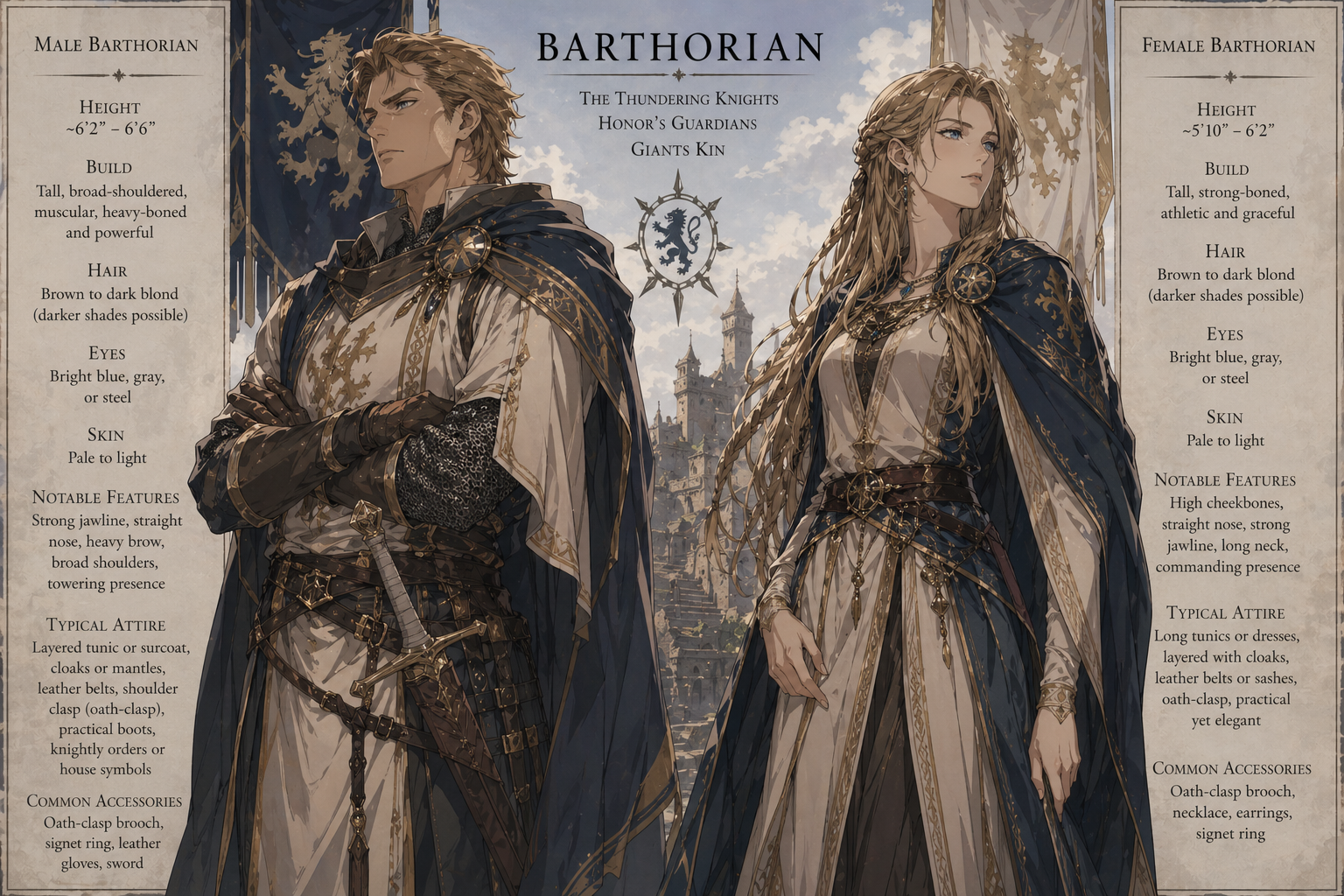
Tall, pale folk with an unmistakable air of nobility and old chivalry, the Barthorians carry themselves like people raised on stories of knights and giants. Even their common farmers seem as though they could be handed a sword and expected to know what to do with it. Broad-shouldered, heavy-boned, and unnaturally strong, they move with the weight and certainty of something built to endure. Their bright eyes and giant-blooded presence give them an almost mythic quality—less like ordinary humans, and more like the descendants of old heroic statues that learned how to breathe.
the Thundering knights, Honors guardians, Giants Kin
Looks
Barthorians can have any humanoid body shape, but all possess unusual density, strength, and physical presence. Even the smallest tend toward broad shoulders, heavy bones, powerful legs, and a naturally upright posture. Their strength often hides beneath smooth or noble frames rather than obvious musculature, making even scholars and nobles seem unnervingly solid. The Giants Kin bloodlines are especially massive, with deep chests, long limbs, and proportions that make them feel like descendants of living statues. Even the sickly or portly are still immensely strong, resembling strongmen rather than ordinary people. Barthorians do not simply look tall—they look like they were built to endure impact.
however even the most sickly or portly individual is still incredibly strong
Barthorians are most commonly fair to pale in complexion, with skin tones ranging from soft ivory and cool cream to pale beige, muted rose, and light ash-toned tans. Even those who work outdoors for much of their lives rarely darken beyond a sun-warmed wheat or light bronze, their coloring tending toward cooler undertones rather than the richer olive tones seen in places like Atlania.
Those of older noble bloodlines—especially among the Giants Kin—often possess an almost striking pallor, skin so pale it can seem marble-like in moonlight, contributing to their unnerving beauty and the old stories that they are not entirely human. Their skin bruises visibly, scars cleanly, and often carries the look of old stone rather than softness.
In colder northern regions, Barthorians are often nearly white-skinned with pink or silver undertones, while southern and borderland families may have warmer fair tones from generations of harsher sun and mixed bloodlines.
Regardless of shade, there is often a strange vitality to them—the sense that their skin seems to hold light rather than reflect it, especially when their eyes begin to glow with elemental power.
Barthorians exist in two distinct height groups, a trait tied to their ancient giant ancestry and one of the clearest markers of their people.
Roughly two-thirds of all Barthorians stand between 5'0" and 6'0", making them tall by the standards of many neighboring peoples but still within the range of ordinary humans. Even among this “smaller” majority, they tend to feel larger than their height suggests due to their heavy frames, broad builds, and sheer physical presence.
The remaining third are known as the Giants Kin, individuals whose bloodline runs closer to the old giant heritage of Barthoria. These Barthorians stand between 6'5" and 8'0" tall, with some rare individuals growing even larger. Giants Kin are impossible to ignore—towering figures whose proportions remain powerful rather than awkward, built like heroic statues given life.
In old songs and royal records, there are tales of ancient Barthorian kings and champions who stood even taller still—nine feet, ten feet, or more—though modern scholars argue how much of that is history and how much is heroic exaggeration. Most Barthorians simply answer that the old kings were taller because the world itself was larger then.
All Barthorians are noticeably heavier than they appear, regardless of whether they are lean, broad, or seemingly soft-bodied. Their giant ancestry gives them unusually dense bones, powerful musculature, and a physical solidity that makes even their lightest members feel substantial.
A smaller Barthorian standing between 5'0" and 6'0" will often weigh far more than an outsider expects, commonly ranging from 180 to 280 pounds, depending on build and sex. Even slender nobles or scholars carry a surprising heaviness to them, their frames built more like old stone than ordinary flesh.
Those of the Giants Kin are far heavier still. Standing between 6'5" and 8'0", they commonly range from 300 to 600+ pounds, with exceptional warriors, laborers, and noble champions reaching even greater weights without appearing grotesque. Their size is not cumbersome so much as inevitable—they move with the confidence of something built to survive impact.
Even portly Barthorians do not resemble ordinary fatness; they look like strongmen or draft animals given human form, with heavy chests, thick limbs, and immense backs. A sickly Barthorian may seem thin, but still weighs enough to make armorers curse and horses reconsider their life choices.
Their great weight is part of why they are so formidable in war. When armored Barthorian knights charge across the plains, the sound is often compared to cavalry even when no horses are present.
The first thing most people notice about a Barthorian is their sheer presence. Even before height, there is a sense of weight to them—broad frames, heavy posture, and the feeling that they occupy more space than their body should allow. They move like people built to endure impact, and when they run in armor across the plains, the sound is often compared to the thunder of cavalry.
Their size is immediately striking, especially among the Giants Kin, whose towering frames can reach from 6'5" to 8'0" or more. Even smaller Barthorians carry unusually broad shoulders, deep chests, thick hands, and the dense build of something closer to a warhorse than an ordinary person.
Their most distinctive feature, however, is their eyes.
Barthorian eyes are always unnaturally bright, as though light sits just behind them. Even at rest, their gaze carries a strange intensity—clear, sharp, and almost reflective, giving the impression that they are harder to lie to than most people. In dim light, their eyes can seem almost luminous.
When using their gift of elemental infusion, that brightness becomes unmistakable. Their eyes glow with visible elemental power from within, often reflecting the nature of the energy they are channeling—heat like embers, storm-light like lightning behind glass, or cold brilliance like winter sunlight on steel. This is not subtle; it makes them look momentarily less mortal and far more like the descendants of giants the old stories claim they are.
Many Barthorians also possess old scars, especially among warriors and noble houses, and these are worn openly rather than hidden. Scars are often seen as proof of vows kept rather than beauty lost.
There is also something difficult to define in their bearing—an air of nobility, chivalry, and old expectation that can make even a farmer seem like someone who could be handed a sword and expected to know what to do with it. They often look like people standing in a portrait of themselves.
Barthorians show a wide range of physical variance, much like any human people, but all of that variation exists within the framework of their giant-blooded build and unmistakable physical presence.
Facial features can vary greatly—some Barthorians are broad-faced and rugged with heavy brows and square jaws, while others possess the almost unnerving beauty often associated with old noble bloodlines: sharp cheekbones, long elegant noses, and the kind of symmetry that makes them seem sculpted rather than born. Both are equally common, and neither diminishes the sense that they are built from stronger material than most.
Body builds range from lean and athletic to broad, heavy, or soft-bodied, but even the smallest and most refined individuals still possess dense frames, powerful posture, and unusual strength. A Barthorian scholar may look like a courtly noble, only for someone to realize too late that he can lift a man one-handed.
The greatest visible divide comes from the distinction between the common majority and the Giants Kin bloodlines. Some families produce generations of towering figures, while others remain closer to ordinary human height for centuries before giant blood suddenly reappears in a child. These births are often treated with awe, pride, or quiet superstition.
Hair colors most commonly range through:
pale blond
ash blond
light brown
chestnut
deep brown
black
with silvering hair often appearing earlier than expected in noble bloodlines, which is sometimes seen as a sign of strong giant heritage rather than age.
Eye colors vary widely as well, but all Barthorians share the same unnatural brightness behind the eyes. Blue, gray, green, amber, and deep brown are all common, though lighter eyes are often romanticized in old heroic poetry.
Scarring is extremely common, especially among warriors and laborers, and is culturally respected rather than hidden. Missing fingers, old blade scars, and weathered hands are often seen as marks of earned adulthood rather than disfigurement.
Among the Giants Kin, even posture differs—many seem to carry themselves with an unconscious awareness that the world was not built to their proportions, forcing a kind of permanent grace or permanent impatience depending on the person.
There is enough variation that no two Barthorians look the same—
but enough shared weight and presence that no one mistakes them for anything else.
Barthorian clothing reflects two things above all else:
practicality for a harsh climate
and the expectation that anyone, at any time, may be called to stand with dignity
Even common farmers and stable hands tend to dress with a quiet sense of structure and formality, as though they were only one step away from being summoned before a lord, a guest, or a battlefield.
In times of peace, Barthorians wear layered clothing suited to their cold plains, long winters, and strong seasonal winds.
During warmer months, they favor:
linen shirts
fitted wool tunics
long belted coats
riding trousers
sturdy leather boots
heavy cloaks for travel
Clothing is usually cut to emphasize broad shoulders and upright posture, with strong seams and durable construction rather than soft draping. Even simple clothing tends to look “well-made” rather than decorative.
In winter, heavy furs, thick wool mantles, layered cloaks, and fur-lined greatcoats become common. Noble houses favor massive shoulder-cloaks of wolf, bear, or winter stag fur, worn almost like heraldic displays of family strength. Gloves, high boots, and layered collars are practical necessities rather than luxuries.
Colors tend toward:
deep blues
forest green
dark red
charcoal gray
cream
ivory
muted gold
and black
Bright colors exist, but are usually reserved for heraldry, ceremony, and knightly display rather than everyday life.
Metal clasps, brooches, belts, and family signets are extremely common. Even ordinary people often wear something inherited—an old clasp, a family ring, a token of lineage—because legacy matters deeply.
At war, Barthorians become something else entirely.
They favor extremely heavy armor built for their dense frames and giant strength:
full plate
reinforced mail beneath
broad tower shields
massive greatswords
polearms
warhammers
and weapons many other peoples would struggle to even lift properly
Their armor is often decorated with:
engraved oaths
house heraldry
saintly or divine motifs
sunbursts
giant-knot patterns
and symbols of vows sworn
Helms are frequently full-faced or crowned with crests, giving them the look of walking statues or cathedral knights.
A charging Barthorian war host is often described as:
a landslide in heraldry, which is exactly correct.
Noble and Court Fashion
Among nobles, clothing becomes even more structured.
Long tabards, embroidered surcoats, ceremonial chains, fur-lined mantles, and formal riding coats are common. Clothing is made to make a person look taller, broader, and harder to ignore.
Even beauty is expected to look disciplined.
Loose, overly revealing, or deliberately casual dress is often seen as childish or dishonorable unless done in very private settings.
A Barthorian noble should look like:
they could either negotiate peace
or personally lead the cavalry charge
Traits
Barthorians are renowned for their immense physical strength, towering presence, and the old giant-blooded power that still runs through their people. Even the smallest among them possess unusual durability and force, while those of the Giants Kin can feel less like ordinary people and more like heroic figures stepped out of old legend.
Their first and most obvious strength is sheer physical power.
Barthorians are naturally stronger than most other peoples of Sol Saris, with dense bones, powerful musculature, and bodies built to endure impact. Even scholars, nobles, and priests can possess surprising strength, while trained warriors become terrifying in close combat. They wear armor others could barely stand in and wield weapons that would require teams of men for anyone else.
This strength is paired with exceptional endurance.
They are difficult to exhaust, slow to break, and famously stubborn in both body and spirit. A Barthorian force is known for holding ground rather than yielding it, and in battle they excel at defensive warfare, shield walls, cavalry-breaking formations, and long brutal engagements where lesser armies would falter.
Their second great strength is their gift of elemental infusion.
Barthorians can channel elemental power directly into objects they wield or possess, imbuing:
blades with flame
armor with stone-like resilience
shields with storm-force impact
arrows with frost
banners with protective enchantment
or even simple tools with temporary supernatural purpose
This power makes them especially dangerous because they do not separate magic from warfare—they make war itself magical.
Unlike scholars who study spells from books, Barthorians often treat elemental magic as something closer to inheritance and instinct, a force of will bound to duty and discipline.
They also possess a natural authority that others respond to instinctively.
Their size, posture, and cultural expectation of honor create an almost supernatural presence. Even common Barthorians often carry themselves like minor nobility, and their reputation for guest-right, oathkeeping, and martial honor makes them widely respected—even by enemies.
Finally, their society’s devotion to chivalry gives them unusual social cohesion.
They value:
honor
hospitality
protection of the weak
oathkeeping
and peace before war
This makes them slow to start conflict—but once committed, they fight with frightening certainty, because to them war becomes a moral duty rather than ambition.
For all their strength, the Barthorians carry weaknesses born from the very same things that make them formidable—size, pride, old tradition, and long peace.
Their greatest physical weakness is momentum.
Barthorians are massive, heavy people built for force and impact, but that same weight makes them slower to stop, slower to change direction, and easier to punish once committed. In battle, when a Barthorian charge begins, it is devastating—but if that momentum is turned against them, it can become a liability. They excel at pushing forward, but quick skirmishers, ambushes, and enemies who refuse to meet them head-on can frustrate them badly.
Their size also makes them obvious targets.
A Barthorian knight in full armor is difficult to miss, and a Giant’s Kin warrior even more so. On open fields this can be an advantage, but against disciplined archers, rifle lines, or coordinated artillery, it means they often draw the first and heaviest fire. There is little subtlety in being eight feet tall and shining.
Another weakness is simple rarity.
There are not many Barthorians left who are truly war-ready. Generations of peace, noble comfort, and the slow decline of old martial traditions have left many of their people more accustomed to stories of heroism than the reality of it. They still possess the blood for greatness, but not always the training, discipline, or willingness to bear its cost.
This is worsened by their rigid social traditions.
Barthorian society values hierarchy, inheritance, and old expectations. Social mobility is rare, and talent is often buried beneath duty or family obligation. Brilliant soldiers may never command because they were born too low, while lesser nobles may inherit authority simply because tradition demands it. Their reverence for honor can sometimes become inflexibility.
Their devotion to chivalry is both strength and weakness.
They prefer:
open conflict
declared intentions
fair warning
honorable peace before war
This makes them vulnerable to enemies who do not share those values. Political manipulation, treachery, bribery, and quiet betrayals have undone Barthoria more effectively than armies ever did. Their downfall at the hands of Taizan aggression and Nmerian influence came not because they were weaker in battle, but because they trusted too long in systems of honor their enemies had already abandoned.
Finally, they struggle with pride.
Barthorians believe deeply in what they are supposed to be:
protectors
knights
heirs of giants
guardians of honor
This can make them slow to admit weakness, slower to ask for help, and dangerously blind to decline. They often endure too long in silence rather than accept humiliation, and many noble houses have fallen because they preferred dignity to adaptation.
Giant’s Burden
Description:
A condition most common among the Giants Kin, where the body continues to grow heavier and denser faster than the heart, lungs, and joints would prefer.
It is not gigantism exactly—
it is:
too much strength trying to live inside one body
Symptoms:
chronic joint pain
difficulty breathing after exertion
failing knees and hips later in life
heart strain
shortened lifespan among the largest bloodlines
Some warriors seem invincible in youth and break suddenly in middle age.
Cultural Meaning:
Seen as both:
a mark of powerful lineage
and
a quiet family fear
Many noble houses treat it like inherited glory with a funeral attached.
Bright-Eye Fever
Description:
A condition tied to their elemental infusion gift where the body struggles to regulate magical output.
Their eyes remain too bright for too long
and the magic begins to “bleed” into the body.
Symptoms:
feverish skin
insomnia
shaking hands
glowing eyes even at rest
emotional volatility
burns, frostbite, or other elemental scars from their own power
depending on affinity
Cultural Meaning:
Often appears in young warriors pushing too hard.
Old knights call it:
trying to become your own legend too quickly
Stonebone
Description:
A slow condition where bones heal too thick, too heavy, or too rigid after repeated injuries.
Strength increases—
flexibility does not.
Symptoms:
reduced movement
old fractures becoming painful in winter
stiffness
difficulty riding or fighting later in life
The Long Blood
Description:
A rare noble condition where giant ancestry manifests too strongly in children.
They grow:
too quickly
too large
too powerful
sometimes beyond what their body can safely sustain
Symptoms:
dangerous childhood growth
constant hunger
heart strain
difficult adolescence
sometimes early death
or
rarely—
living legends
Honor-Sickness
Description:
Not a physical disease, but a culturally recognized condition where pride, duty, and inherited expectation become psychologically destructive.
Barthorians who cannot fail gracefully often collapse under the weight of what they believe they should be.
Culture
Guest-Right Is Sacred
Tradition:
Any person offered shelter beneath a Barthorian roof—
whether noble, traveler, enemy messenger, or wandering stranger—
is protected for the duration of that hospitality.
Food, fire, and a place to rest create a temporary sacred peace.
To violate guest-right is considered one of the deepest possible disgraces.
Meaning:
A guest may be hated tomorrow
but tonight:
they are under your roof
and therefore under your protection
Even kings tread carefully around this rule
Peace Before Steel
Tradition:
Before a serious duel, feud, or battle,
a Barthorian is expected to offer terms first.
This may be:
surrender
compensation
apology
honorable withdrawal
or simply one final chance to avoid bloodshed
Only after peace is refused does violence become righteous.
Meaning:
War is not proof of strength.
Restraint is
Defend the Weaker Hand
Tradition:
Strength creates obligation.
A stronger person—physically, socially, politically—must protect those with less power.
This applies to:
children
servants
guests
commoners
defeated foes
even political enemies under lawful protection
Ignoring abuse is treated almost as badly as committing it.
Meaning:
A knight who bullies the weak is not feared—
they are considered shameful
The Oath-Clasp
Tradition:
Many Barthorians wear a metal clasp, brooch, shoulder pin, or chain representing:
sworn vows
knightly orders
military service
family duty
or promises not yet fulfilled
It is not jewelry.
It is public accountability.
To wear one falsely is social suicide.
To remove one before the vow is fulfilled is worse.
Meaning:
Your word should be visible
Speak Before the Charge
Tradition:
Before battle, commanders and knights often ride or walk forward to address:
enemies
rival nobles
challengers
or even invading armies
This is not dramatic performance—
it is expected courtesy.
One should know who they are killing and why.
Meaning:
Anonymous war is considered cowardly
Very old ideal:
Even enemies deserve clarity
A Challenge Must Be Witnessed
Tradition:
Serious duels, accusations of dishonor, and formal grievances must have witnesses.
Honor cannot exist in secret.
Even deeply personal disputes are expected to be made known if they threaten reputation or justice.
Meaning:
Truth should survive the people arguing about it
Barthorians do not think chivalry is romance.
They think it is:
the minimum acceptable behavior for someone trusted with strength
That is why they take it so seriously.
the Barthorians are polytheistic like many peoples on sol saris
The Crown
At the top sits the monarch of Barthoria:
king or queen
considered first protector of the realm
symbolic inheritor of giant blood and ancient duty
The ruler is expected to embody:
chivalry
guest-right
justice
restraint
and visible courage
They are not meant to be distant rulers hidden behind walls, but living examples of the ideals the realm claims to uphold.
A weak ruler is pitied.
A dishonorable ruler is remembered for generations.
High Noble Houses
Beneath the crown are the great noble houses, ancient landed families whose authority is tied to:
hereditary claims
military obligation
sworn fealty
and old family reputation
Many trace their bloodlines to the old Giants Kin, and these families often guard that heritage with obsessive pride.
Land ownership and military service are inseparable.
To hold land means:
you are responsible for everyone standing on it
A noble who taxes heavily but defends poorly is considered contemptible.
At least in theory.
Knightly Orders and Oath Houses
Unlike some feudal systems, military power is not held only by landowners.
Knightly orders, oath-bound houses, and martial brotherhoods hold enormous influence.
Some are:
religious
royal
regional
or tied to ancient giant bloodlines
These orders often serve as:
military leadership
moral authority
political balance against noble excess
Sometimes they are better respected than the nobles themselves.
A poor knight with a clean reputation may command more loyalty than a rich lord with none.
Local Lords and Stewardship
Below the great houses are:
regional lords
castle keepers
land stewards
sworn protectors of villages and roads
Their authority is personal and visible.
A lord is expected to be known by their people.
Not loved necessarily—
but known.
Distance is suspicious.
A noble who never walks their own land is quietly judged.
Though not democratic, Barthorian governance relies heavily on:
councils
witnesses
public judgment
and formal challenge
Disputes of inheritance, accusations of dishonor, and noble grievances are often handled in witnessed halls rather than private chambers.
Justice is expected to be seen.
Not merely done.
This creates a government where reputation can be almost as dangerous as law.
Social Mobility
Very little.
Barthoria is deeply traditional.
Birth matters.
Family matters.
Expectation matters.
A commoner can rise—through war, service, or exceptional virtue—
but tradition resists it.
Most people inherit not only occupation, but social identity.
This stability creates order.
It also creates stagnation.
And that has cost them dearly.
Barthoria possesses the technology of a high medieval society, but shaped by giant blood, knightly warfare, and a long cultural preference for things that are built to endure rather than things built quickly.
Their engineering favors:
permanence over efficiency
craftsmanship over innovation
and reliability over cleverness
They are not technologically primitive—far from it—but they are often slow to adopt anything that feels untested, dishonorable, or likely to fail under pressure.
If a machine cannot survive winter, war, and three generations of stubborn use, a Barthorian often sees little reason to trust it.
This makes their society appear old-fashioned to some neighbors, but also means what they build tends to last.
Architecture and Fortification
Barthorian stonework is exceptional.
They build:
massive keeps
thick-walled castles
fortified manors
hilltop watchtowers
and ancient road systems
with the assumption that every structure should survive both siege and inheritance disputes.
Their castles are often built for people larger than average, especially old noble strongholds of the Giants Kin, with:
wider staircases
taller doorways
heavier gates
enormous hearths
and halls large enough to feel like chapels
Even ordinary homes are built with a sense of durability and lineage.
A family house is expected to outlive the family.
Armor and Smithing
Barthorian metallurgy is among their greatest strengths.
They produce:
extremely heavy plate armor
oversized weapons
reinforced shields
masterwork mail
ceremonial blades
and oath-bound heirloom arms
Their smiths understand how to make equipment for people whose strength would ruin ordinary steel.
Armor is built for impact and longevity, often passed down across generations.
A noble family may own the same suit of plate for centuries.
Weapons are expected to have names.
Preferably old ones.
Though not dependent on cavalry in the same way as some cultures, Barthorians are masters of battlefield logistics for heavy war hosts.
They excel in:
siege preparation
supply trains
armored cavalry support
shield wall infrastructure
and fortification warfare
They understand that battles are often won by:
who arrives prepared to still be fighting tomorrow
not who charges first
Though admittedly, they also like charging first.
Elemental Infusion Craft
Their greatest magical technology lies in the use of elemental infusion.
Rather than relying entirely on traditional spellcasting, Barthorians embed elemental power into:
weapons
armor
banners
walls
bridges
tools
and sacred relics
This creates semi-magical craftsmanship where practical objects are expected to carry supernatural purpose.
Examples include:
gatehouses reinforced with stone-binding magic
swords that hold heat like banked coals
shields that resist storm-force impacts
winter roads warded against ice
and bells enchanted to ring against hostile spirits
To them, magic is not separate from civilization.
It is part of proper construction.
Scholarship and Record Keeping
They maintain:
monastery archives
knightly genealogies
royal war records
oath registries
and family histories
written preservation matters deeply, especially among noble and religious institutions.
However, oral tradition and witnessed testimony still hold nearly equal weight.
A written lie is still a lie.
And an old grandmother may be treated as better evidence than a document.
Agriculture and Estate Management
Their farming is efficient but conservative.
They use:
crop rotation
large feudal estates
managed grazing lands
hunting preserves
and noble-controlled granaries
Agriculture supports the military first and luxury second.
Food security is treated as political security.
Barthorians can be found in nearly every occupation expected of a high medieval society, but their culture strongly shapes how work is viewed.
To a Barthorian, occupation is not simply:
what you do
but often:
what your family has always done
and what your honor requires you to do well
Social strata are deeply traditional, and while movement between classes is possible, it is uncommon and often resisted. A noble child is expected to understand rulership and war, a smith’s child is expected to understand iron, and a farmer’s child is expected to know the land before they know the world.
This creates a society where skill is respected, but inheritance is still the louder voice.
A person may earn greatness—
but they are first expected to honor where they came from.
Nobility, Knights, and Military Service
Among noble houses, the most common occupations revolve around:
rulership
land stewardship
military command
diplomacy
and knightly service
Even nobles who prefer scholarship or court life are expected to understand war, because defense is considered part of legitimate rule.
Knighthood is both occupation and moral expectation.
A knight is not simply a soldier—
they are supposed to be:
visible proof that strength can be trusted
Whether reality agrees is another matter.
Military officers, household guards, oath-sworn retainers, and banner captains are common respected paths, especially among younger nobles and Giants Kin families.
Smiths, Armorers, and Master Craftsmen
Because Barthorians rely heavily on oversized arms, plate armor, and heirloom war gear, smiths hold unusually high social respect.
Important professions include:
blacksmiths
armorers
weapon smiths
farriers
masons
and siege engineers
A master armorer may be treated with almost noble respect if their work protects noble blood.
To make something that survives generations is considered close to holy.
Farmers, Herdsmen, and Estate Workers
Most common Barthorians live through:
farming
herding
milling
forestry
and estate labor
Large feudal estates dominate the countryside, and many villages exist in direct relationship to noble houses.
Even here, work is tied to duty.
A farmer is not “lesser” than a knight in moral worth—
only responsible for protecting a different thing.
Food is treated as strategic stability, not just livelihood.
A failed harvest is a political event.
Clergy, Keepers, and Oath Witnesses
Religious service is a major social path, especially for younger children of noble families who will not inherit land.
Common respected roles include:
priests
shrine keepers
monastery scholars
funeral attendants
oath witnesses
and judges tied to religious authority
Because honor and law are deeply intertwined, priests are often expected to mediate disputes as much as they perform rituals.
A holy person who cannot settle an argument is seen as suspiciously decorative.
Scholars, Scribes, and Genealogists
Barthorians value:
lineage
inheritance
and written proof of promises
which makes record keepers extremely important.
Common intellectual occupations include:
scribes
tutors
royal historians
monastery scholars
genealogists
and legal witnesses
A person who can prove whose grandfather swore what to whom may hold more power than a soldier with a sword.
This is especially true in noble courts.
Servants, Stewards, and Household Officers
Large noble houses require enormous domestic infrastructure.
Common roles include:
stewards
chamber officials
cooks
stablemasters
household guards
and estate accountants
A skilled steward may quietly control more practical power than the lord they serve.
Every old kingdom runs partly on one terrifyingly competent elderly housekeeper.
Barthoria is no exception.
Greatest Occupational Weakness
Talent does not always outrun birth.
A brilliant common-born strategist may spend life obeying a foolish noble commander because tradition says that is how the world should work.
This creates stability—
and also resentment.
Sometimes both at once.
Barthoria operates through a traditional feudal economy built on land, obligation, and the understanding that wealth is measured less by coin alone and more by:
what you can protect
what you can sustain
and who will still answer your call in winter
Their economy is fundamentally agrarian, supported by noble estates, hereditary land rights, military obligation, and long-standing systems of service between lords, knights, clergy, and common households.
Coin matters—but reputation, grain stores, and sworn loyalty often matter more.
A rich man with no allies is considered poor.
A poor lord with loyal people is considered dangerous.
That mindset defines everything.
Agriculture as the Foundation
Most of Barthoria’s wealth begins in:
grain fields
managed grazing lands
orchards
forests
hunting preserves
and village labor
Large noble estates dominate the countryside, and the health of the realm depends heavily on harvest stability.
Farmers owe:
labor
rent
military levy support
or shares of produce
to local lords, who in turn are expected to provide:
protection
roads
winter reserves
and legal stability
At least in theory.
Food security is treated as national security.
A bad harvest can start wars faster than bad diplomacy.
Land = Power
Land ownership is the true currency of the nobility.
To control land means:
taxes
soldiers
labor
inheritance
and political legitimacy
A noble with vast land but little coin is still powerful.
A merchant with immense coin but no land is still viewed with suspicion.
This creates a culture where inherited estates matter far more than fast wealth.
You do not become important by getting rich.
You become important by becoming impossible to ignore.
Military Obligation and Oath Economy
Much of the economy runs on sworn service rather than simple payment.
Knights owe military service.
Vassals owe banners.
Lords owe protection.
Priests owe mediation.
Everyone owes someone something.
This creates what is effectively an economy of obligation where promises can be as valuable as silver.
A broken oath can bankrupt a house faster than debt.
Sometimes literally.
Craftsmen and High-Value Trade
Though agrarian at heart, Barthoria is famous for:
master smithing
armor production
heavy cavalry equipment
siege engineering
stonework
and enchanted elemental craftsmanship
Weapons, armor, and heirloom-quality goods are major exports.
A single master-forged blade may carry the economic weight of an entire village’s yearly taxes.
Craft guilds exist, but noble patronage often matters more than guild authority.
A famous armorer may serve kings without ever becoming rich.
Prestige is often paid in protection rather than coin.
Magical Infrastructure
Elemental infusion is woven directly into the economy.
Magic supports:
roads protected from winter ice
fortified keeps
mills
bridges
defensive walls
heirloom weapons
and sacred civic objects
This makes magical labor practical rather than exotic.
A magical blacksmith may be treated less like a wizard and more like an engineer with terrifying opinions.
Noble Debt and Old Wealth
Many noble houses are:
land rich
cash poor
They possess:
ancient keeps
ancestral forests
heirloom armor
ten thousand obligations
and almost no liquid money
This creates endless marriages, alliances, and political negotiations built around:
preserving dignity while quietly being broke
Barthoria’s economy runs on grain, iron, and the dangerous assumption that people who swear loyalty actually mean it.
Barthorian food is built around the same values as the people themselves:
hearty, durable, and meant to get you through winter
Their cuisine favors warmth, substance, and meals that can feed both a noble table and a marching war host without changing much in spirit. They are not a people of delicate dining—they are a people of:
deep stews
heavy breads
roasted meats
rich gravies
savory pies
and enough salt to make winter negotiable
Food is expected to satisfy, to last, and to be shared.
A meal that looks beautiful but leaves someone hungry is considered suspicious.
Stews
Stew is the unofficial language of Barthoria.
Nearly every region has its own version:
beef and root vegetable stew
venison and dark ale stew
mushroom and barley stew
lamb with onion and herb broth
winter turnip and marrow stew
Stew is:
commoner food
noble comfort food
soldier food
funeral food
victory feast leftovers
If something can be put in a pot and improved by waiting, a Barthorian approves.
Savory Meat Pies
Pies are beloved because they travel well, preserve heat, and feel civilized even when eaten in armor.
Common fillings include:
beef and onion
rabbit and herbs
venison and mushrooms
chicken and leek
spiced root vegetables with cream
Large family pies are common at feasts, while smaller hand pies are perfect for riders, patrols, and knights pretending they are not eating on horseback.
A good pie is considered proof of trustworthy character.
This is not negotiable.
Heavy Breads
Dense dark breads made from:
barley
rye
oats
wheat when available
are everyday staples.
Served with:
butter
cheese
dripping
or stew thick enough to count as architecture
Fresh bread is hospitality.
Old bread becomes soup.
Nothing is wasted.
Roasted Game and Winter Meats
Because of noble hunting traditions and harsh winters, roasted meats are culturally important.
Favorites include:
venison
boar
winter stag
pheasant
goose
beef
and preserved pork
At noble feasts, whole roasts are displays of both wealth and legitimacy.
A lord who cannot feed guests properly invites political gossip.
Strong Cheeses and Preserved Foods
Winter creates practical people.
Barthorians rely heavily on:
aged cheeses
smoked meats
pickled vegetables
dried apples
preserved berries
and salted fish from trade routes
Luxury means surviving February without resenting everyone you know.
Festival Sweets
Though everyday food is practical, festivals bring richer foods:
honey cakes
apple tarts
berry preserves
spiced cream pastries
nut breads
mulled wine cakes
These are strongly tied to:
weddings
harvest feasts
oath celebrations
and winter holy days
A person remembered for good honey cake may be invited to politics.
Drink
Common drinks include:
dark ales
heavy red wines
mulled spiced wine
ciders
herbal teas
thick broths served almost like drinks
Water is respected.
Wine is expected.
Ale is trusted.
Tea is what older women use to solve arguments.
The Guest Bowl
Offering a guest:
hot bread
broth
or stew first
before any serious conversation
is deeply important.
No negotiations begin on an empty stomach.
A person discussing politics before feeding someone is either a fool or Taizan.
Neither is ideal.
Barthorians believe:
if someone leaves your table hungry,
they will remember your name for the wrong reasons
Food is hospitality.
Hospitality is politics.
Politics is war with better table manners.
Barthorian cuisine is what happens when knights, winters, and grandmothers all agree that the correct amount of food is “more than that.”
History
The Barthorians are the Kin of the Giants, descendants of the great captors of the Nmerians, a fact they would love to hide if only they could find something taller than themselves. the Barthorians once had a long history of defending themselves not only from their neighbors the Taiznas and the others around them, they also fought of attacks from the great fleets of the Nmerians on several occasions through luck and guile, however their love of chivalry and long ages of peace had left them weakened even if they didn't notice, and all it took was the Nmerians greasing the right wheels and directing the war hungry Taizans at them to crush their country
The Giant Dominion
The First Great Shame
In the oldest days, before the rise of modern kingdoms, the ancestors of the Barthorians were among the great giant-blooded powers of the continent.
They were the captors and rulers over the early Nmerian peoples, part of the ancient giant dominions that treated the first Nmerians as subjects, labor, and lesser peoples beneath giant authority.
This legacy is the oldest stain on Barthorian history.
It is not denied exactly—
but it is spoken of carefully.
Modern Barthorians prefer stories of noble kings and honorable knights.
Nmerians remember chains.
Both are true.
The title “Giants Kin” carries pride inside Barthoria and accusation outside it.
The Breaking of Giant Rule
The eventual rise of the Nmerians and their rebellion against giant domination shattered the old order.
The ancestors of modern Nmeria overthrew their captors through war, rebellion, and centuries of bitter resistance.
This broke the ancient giant powers and forced the surviving giant-blooded peoples—including the ancestors of Barthoria—into a new political reality.
From that collapse came the early Barthorian kingdoms.
This is the moment where they ceased being conquerors
and began becoming defenders.
They remember it as tragedy.
Nmeria remembers it as justice.
Neither side is wrong.
From Giant Lords to Knight-Kings
In the aftermath of the old giant collapse, the surviving giant-blooded houses consolidated into the kingdom of Barthoria.
This was the birth of:
the monarchy
the knightly orders
the feudal houses
and the cultural obsession with honor and protection
Many scholars believe Barthorian chivalry was born partly as a response to the shame of what came before—
a deliberate attempt to become something better than their ancestors.
Whether it succeeded depends on who is asked.
Barthorians would say yes.
Nmerians would usually laugh.
The Great Nmerian Fleet Wars
The Long Defense of the Coasts
For centuries, Barthoria endured repeated attacks, raids, and military pressure from the expanding maritime strength of Nmeria.
The great fleets came:
for vengeance
for strategy
for wealth
and because history never stays buried politely
Barthoria survived through:
fortified coasts
brutal defensive warfare
luck
and a remarkable talent for making invasions expensive
Many of their greatest heroes come from these wars.
Many of their oldest grudges do too.
This period cemented their identity as:
defenders of the realm
rather than empire-builders
The Long Peace
The Beautiful Decline
Eventually, peace came.
Too much of it.
Generations without true existential war left Barthoria wealthy, comfortable, and increasingly convinced that its own ideals would preserve it forever.
Knighthood became ceremony.
War became history.
Honor became performance.
They still looked powerful.
But much of that power had become inherited confidence rather than practiced readiness.
This peace was beautiful.
It was also a trap.
The Fall of Barthoria
The Quiet Conquest
Barthoria was not destroyed by glorious invasion.
It was undone by manipulation.
The Nmerians, unable or unwilling to crush them directly, used wealth, diplomacy, and political pressure to direct the war-hungry Taizans toward Barthoria.
At the same time, internal stagnation, complacency, and noble pride weakened resistance.
The Taizans brought the force.
The Nmerians greased the wheels.
Barthoria brought honor to a political knife fight.
It did not go well.
Their kingdom was broken.
Not because they were weaker warriors—
but because they were slower to believe the world had changed.
This is the wound that still defines them.
Barthoria’s tragedy is not that they fell—it is that they spent so long trying to become better than their ancestors that they forgot their enemies were still willing to behave like them.
Notes
Among Barthorians, people do not ask:
“How tall will the child be?”
They ask:
“How loudly will the floor remember them?”
Among neighboring peoples there is an old saying:
“If a Barthorian sits at your table, build the chair first and ask questions later.”
To Barthorians themselves, weight is rarely associated with beauty—it is associated with presence, endurance, and the ability to stand your ground when the world expects you to move.
The Oath-Clasp
Many Barthorians wear a personal metal clasp, brooch, or shoulder pin representing:
a sworn vow
a knightly order
family duty
military service
or a promise not yet fulfilled
It is considered deeply shameful to wear one falsely.
Among neighboring peoples there is a saying:
“If a Barthorian draws steel, someone has already been given every chance not to make him.”
Among their enemies there is a cruel saying:
“The easiest way to kill a Barthorian is to let him explain the rules first.”
Saying:
“If I draw steel, I have already asked politely.”
Social Mobility
Very little.
Barthoria is deeply traditional.
Birth matters.
Family matters.
Expectation matters.
A commoner can rise—through war, service, or exceptional virtue—
but tradition resists it.
Most people inherit not only occupation, but social identity.
This stability creates order.
It also creates stagnation.
And that has cost them dearly.
Greatest Technological Weakness
Innovation often loses arguments to tradition.
They can build extraordinary things—
but they are slow to change systems that already work.
This caution protects them from foolishness
and also leaves them vulnerable to faster-moving rivals.
Especially Taizan.
Cultural Truth
A Barthorian invention is judged by one question:
“Will my grandchildren still curse me for building it wrong?”
If the answer is yes,
they rebuild it.
Cultural Truth
Barthorians do not ask:
“What do you do?”
They ask:
“Whose duty are you carrying?”
because that tells them much more.
In Barthoria, occupation is less a career and more an inheritance with paperwork, expectations, and usually at least one ancestor loudly judging your performance from the afterlife.
Greatest Economic Weakness
Barthoria struggles with adaptation.
Their feudal structure creates stability—
but also makes economic reform painfully slow.
Merchants, innovation, and rapid wealth accumulation often threaten old noble expectations, and tradition resists change even when change is clearly necessary.
This made them vulnerable to outside manipulation, especially from Taizan influence and Nmerian trade pressure.
They were often too honorable to realize someone else was treating economics like warfare.
Because they were.
Cultural Truth
A Barthorian does not ask:
“How much is it worth?”
They ask:
“Will it still matter after I am dead?”
That is a very different economy.
Greatest Historical Truth
Barthorians like to think of themselves as:
the noble last defenders
and in many ways, they are.
But history remembers:
they were once the giants at the top of the mountain
before they became the kingdom defending the hill below it.
That duality never leaves them.
Overview
Details about this race's overview
Barthorian
Tall, pale folk with an unmistakable air of nobility and old chivalry, the Barthorians carry themselves like people raised on stories of knights and giants. Even their common farmers seem as though they could be handed a sword and expected to know what to do with it. Broad-shouldered, heavy-boned, and unnaturally strong, they move with the weight and certainty of something built to endure. Their bright eyes and giant-blooded presence give them an almost mythic quality—less like ordinary humans, and more like the descendants of old heroic statues that learned how to breathe.
the Thundering knights, Honors guardians, Giants Kin
Looks
Details about this race's looks
Barthorians can have any humanoid body shape, but all possess unusual density, strength, and physical presence. Even the smallest tend toward broad shoulders, heavy bones, powerful legs, and a naturally upright posture. Their strength often hides beneath smooth or noble frames rather than obvious musculature, making even scholars and nobles seem unnervingly solid. The Giants Kin bloodlines are especially massive, with deep chests, long limbs, and proportions that make them feel like descendants of living statues. Even the sickly or portly are still immensely strong, resembling strongmen rather than ordinary people. Barthorians do not simply look tall—they look like they were built to endure impact.
however even the most sickly or portly individual is still incredibly strong
Barthorians are most commonly fair to pale in complexion, with skin tones ranging from soft ivory and cool cream to pale beige, muted rose, and light ash-toned tans. Even those who work outdoors for much of their lives rarely darken beyond a sun-warmed wheat or light bronze, their coloring tending toward cooler undertones rather than the richer olive tones seen in places like Atlania.
Those of older noble bloodlines—especially among the Giants Kin—often possess an almost striking pallor, skin so pale it can seem marble-like in moonlight, contributing to their unnerving beauty and the old stories that they are not entirely human. Their skin bruises visibly, scars cleanly, and often carries the look of old stone rather than softness.
In colder northern regions, Barthorians are often nearly white-skinned with pink or silver undertones, while southern and borderland families may have warmer fair tones from generations of harsher sun and mixed bloodlines.
Regardless of shade, there is often a strange vitality to them—the sense that their skin seems to hold light rather than reflect it, especially when their eyes begin to glow with elemental power.
Barthorians exist in two distinct height groups, a trait tied to their ancient giant ancestry and one of the clearest markers of their people.
Roughly two-thirds of all Barthorians stand between 5'0" and 6'0", making them tall by the standards of many neighboring peoples but still within the range of ordinary humans. Even among this “smaller” majority, they tend to feel larger than their height suggests due to their heavy frames, broad builds, and sheer physical presence.
The remaining third are known as the Giants Kin, individuals whose bloodline runs closer to the old giant heritage of Barthoria. These Barthorians stand between 6'5" and 8'0" tall, with some rare individuals growing even larger. Giants Kin are impossible to ignore—towering figures whose proportions remain powerful rather than awkward, built like heroic statues given life.
In old songs and royal records, there are tales of ancient Barthorian kings and champions who stood even taller still—nine feet, ten feet, or more—though modern scholars argue how much of that is history and how much is heroic exaggeration. Most Barthorians simply answer that the old kings were taller because the world itself was larger then.
All Barthorians are noticeably heavier than they appear, regardless of whether they are lean, broad, or seemingly soft-bodied. Their giant ancestry gives them unusually dense bones, powerful musculature, and a physical solidity that makes even their lightest members feel substantial.
A smaller Barthorian standing between 5'0" and 6'0" will often weigh far more than an outsider expects, commonly ranging from 180 to 280 pounds, depending on build and sex. Even slender nobles or scholars carry a surprising heaviness to them, their frames built more like old stone than ordinary flesh.
Those of the Giants Kin are far heavier still. Standing between 6'5" and 8'0", they commonly range from 300 to 600+ pounds, with exceptional warriors, laborers, and noble champions reaching even greater weights without appearing grotesque. Their size is not cumbersome so much as inevitable—they move with the confidence of something built to survive impact.
Even portly Barthorians do not resemble ordinary fatness; they look like strongmen or draft animals given human form, with heavy chests, thick limbs, and immense backs. A sickly Barthorian may seem thin, but still weighs enough to make armorers curse and horses reconsider their life choices.
Their great weight is part of why they are so formidable in war. When armored Barthorian knights charge across the plains, the sound is often compared to cavalry even when no horses are present.
The first thing most people notice about a Barthorian is their sheer presence. Even before height, there is a sense of weight to them—broad frames, heavy posture, and the feeling that they occupy more space than their body should allow. They move like people built to endure impact, and when they run in armor across the plains, the sound is often compared to the thunder of cavalry.
Their size is immediately striking, especially among the Giants Kin, whose towering frames can reach from 6'5" to 8'0" or more. Even smaller Barthorians carry unusually broad shoulders, deep chests, thick hands, and the dense build of something closer to a warhorse than an ordinary person.
Their most distinctive feature, however, is their eyes.
Barthorian eyes are always unnaturally bright, as though light sits just behind them. Even at rest, their gaze carries a strange intensity—clear, sharp, and almost reflective, giving the impression that they are harder to lie to than most people. In dim light, their eyes can seem almost luminous.
When using their gift of elemental infusion, that brightness becomes unmistakable. Their eyes glow with visible elemental power from within, often reflecting the nature of the energy they are channeling—heat like embers, storm-light like lightning behind glass, or cold brilliance like winter sunlight on steel. This is not subtle; it makes them look momentarily less mortal and far more like the descendants of giants the old stories claim they are.
Many Barthorians also possess old scars, especially among warriors and noble houses, and these are worn openly rather than hidden. Scars are often seen as proof of vows kept rather than beauty lost.
There is also something difficult to define in their bearing—an air of nobility, chivalry, and old expectation that can make even a farmer seem like someone who could be handed a sword and expected to know what to do with it. They often look like people standing in a portrait of themselves.
Barthorians show a wide range of physical variance, much like any human people, but all of that variation exists within the framework of their giant-blooded build and unmistakable physical presence.
Facial features can vary greatly—some Barthorians are broad-faced and rugged with heavy brows and square jaws, while others possess the almost unnerving beauty often associated with old noble bloodlines: sharp cheekbones, long elegant noses, and the kind of symmetry that makes them seem sculpted rather than born. Both are equally common, and neither diminishes the sense that they are built from stronger material than most.
Body builds range from lean and athletic to broad, heavy, or soft-bodied, but even the smallest and most refined individuals still possess dense frames, powerful posture, and unusual strength. A Barthorian scholar may look like a courtly noble, only for someone to realize too late that he can lift a man one-handed.
The greatest visible divide comes from the distinction between the common majority and the Giants Kin bloodlines. Some families produce generations of towering figures, while others remain closer to ordinary human height for centuries before giant blood suddenly reappears in a child. These births are often treated with awe, pride, or quiet superstition.
Hair colors most commonly range through:
pale blond
ash blond
light brown
chestnut
deep brown
black
with silvering hair often appearing earlier than expected in noble bloodlines, which is sometimes seen as a sign of strong giant heritage rather than age.
Eye colors vary widely as well, but all Barthorians share the same unnatural brightness behind the eyes. Blue, gray, green, amber, and deep brown are all common, though lighter eyes are often romanticized in old heroic poetry.
Scarring is extremely common, especially among warriors and laborers, and is culturally respected rather than hidden. Missing fingers, old blade scars, and weathered hands are often seen as marks of earned adulthood rather than disfigurement.
Among the Giants Kin, even posture differs—many seem to carry themselves with an unconscious awareness that the world was not built to their proportions, forcing a kind of permanent grace or permanent impatience depending on the person.
There is enough variation that no two Barthorians look the same—
but enough shared weight and presence that no one mistakes them for anything else.
Barthorian clothing reflects two things above all else:
practicality for a harsh climate
and the expectation that anyone, at any time, may be called to stand with dignity
Even common farmers and stable hands tend to dress with a quiet sense of structure and formality, as though they were only one step away from being summoned before a lord, a guest, or a battlefield.
In times of peace, Barthorians wear layered clothing suited to their cold plains, long winters, and strong seasonal winds.
During warmer months, they favor:
linen shirts
fitted wool tunics
long belted coats
riding trousers
sturdy leather boots
heavy cloaks for travel
Clothing is usually cut to emphasize broad shoulders and upright posture, with strong seams and durable construction rather than soft draping. Even simple clothing tends to look “well-made” rather than decorative.
In winter, heavy furs, thick wool mantles, layered cloaks, and fur-lined greatcoats become common. Noble houses favor massive shoulder-cloaks of wolf, bear, or winter stag fur, worn almost like heraldic displays of family strength. Gloves, high boots, and layered collars are practical necessities rather than luxuries.
Colors tend toward:
deep blues
forest green
dark red
charcoal gray
cream
ivory
muted gold
and black
Bright colors exist, but are usually reserved for heraldry, ceremony, and knightly display rather than everyday life.
Metal clasps, brooches, belts, and family signets are extremely common. Even ordinary people often wear something inherited—an old clasp, a family ring, a token of lineage—because legacy matters deeply.
At war, Barthorians become something else entirely.
They favor extremely heavy armor built for their dense frames and giant strength:
full plate
reinforced mail beneath
broad tower shields
massive greatswords
polearms
warhammers
and weapons many other peoples would struggle to even lift properly
Their armor is often decorated with:
engraved oaths
house heraldry
saintly or divine motifs
sunbursts
giant-knot patterns
and symbols of vows sworn
Helms are frequently full-faced or crowned with crests, giving them the look of walking statues or cathedral knights.
A charging Barthorian war host is often described as:
a landslide in heraldry, which is exactly correct.
Noble and Court Fashion
Among nobles, clothing becomes even more structured.
Long tabards, embroidered surcoats, ceremonial chains, fur-lined mantles, and formal riding coats are common. Clothing is made to make a person look taller, broader, and harder to ignore.
Even beauty is expected to look disciplined.
Loose, overly revealing, or deliberately casual dress is often seen as childish or dishonorable unless done in very private settings.
A Barthorian noble should look like:
they could either negotiate peace
or personally lead the cavalry charge
Traits
Details about this race's traits
Barthorians are renowned for their immense physical strength, towering presence, and the old giant-blooded power that still runs through their people. Even the smallest among them possess unusual durability and force, while those of the Giants Kin can feel less like ordinary people and more like heroic figures stepped out of old legend.
Their first and most obvious strength is sheer physical power.
Barthorians are naturally stronger than most other peoples of Sol Saris, with dense bones, powerful musculature, and bodies built to endure impact. Even scholars, nobles, and priests can possess surprising strength, while trained warriors become terrifying in close combat. They wear armor others could barely stand in and wield weapons that would require teams of men for anyone else.
This strength is paired with exceptional endurance.
They are difficult to exhaust, slow to break, and famously stubborn in both body and spirit. A Barthorian force is known for holding ground rather than yielding it, and in battle they excel at defensive warfare, shield walls, cavalry-breaking formations, and long brutal engagements where lesser armies would falter.
Their second great strength is their gift of elemental infusion.
Barthorians can channel elemental power directly into objects they wield or possess, imbuing:
blades with flame
armor with stone-like resilience
shields with storm-force impact
arrows with frost
banners with protective enchantment
or even simple tools with temporary supernatural purpose
This power makes them especially dangerous because they do not separate magic from warfare—they make war itself magical.
Unlike scholars who study spells from books, Barthorians often treat elemental magic as something closer to inheritance and instinct, a force of will bound to duty and discipline.
They also possess a natural authority that others respond to instinctively.
Their size, posture, and cultural expectation of honor create an almost supernatural presence. Even common Barthorians often carry themselves like minor nobility, and their reputation for guest-right, oathkeeping, and martial honor makes them widely respected—even by enemies.
Finally, their society’s devotion to chivalry gives them unusual social cohesion.
They value:
honor
hospitality
protection of the weak
oathkeeping
and peace before war
This makes them slow to start conflict—but once committed, they fight with frightening certainty, because to them war becomes a moral duty rather than ambition.
For all their strength, the Barthorians carry weaknesses born from the very same things that make them formidable—size, pride, old tradition, and long peace.
Their greatest physical weakness is momentum.
Barthorians are massive, heavy people built for force and impact, but that same weight makes them slower to stop, slower to change direction, and easier to punish once committed. In battle, when a Barthorian charge begins, it is devastating—but if that momentum is turned against them, it can become a liability. They excel at pushing forward, but quick skirmishers, ambushes, and enemies who refuse to meet them head-on can frustrate them badly.
Their size also makes them obvious targets.
A Barthorian knight in full armor is difficult to miss, and a Giant’s Kin warrior even more so. On open fields this can be an advantage, but against disciplined archers, rifle lines, or coordinated artillery, it means they often draw the first and heaviest fire. There is little subtlety in being eight feet tall and shining.
Another weakness is simple rarity.
There are not many Barthorians left who are truly war-ready. Generations of peace, noble comfort, and the slow decline of old martial traditions have left many of their people more accustomed to stories of heroism than the reality of it. They still possess the blood for greatness, but not always the training, discipline, or willingness to bear its cost.
This is worsened by their rigid social traditions.
Barthorian society values hierarchy, inheritance, and old expectations. Social mobility is rare, and talent is often buried beneath duty or family obligation. Brilliant soldiers may never command because they were born too low, while lesser nobles may inherit authority simply because tradition demands it. Their reverence for honor can sometimes become inflexibility.
Their devotion to chivalry is both strength and weakness.
They prefer:
open conflict
declared intentions
fair warning
honorable peace before war
This makes them vulnerable to enemies who do not share those values. Political manipulation, treachery, bribery, and quiet betrayals have undone Barthoria more effectively than armies ever did. Their downfall at the hands of Taizan aggression and Nmerian influence came not because they were weaker in battle, but because they trusted too long in systems of honor their enemies had already abandoned.
Finally, they struggle with pride.
Barthorians believe deeply in what they are supposed to be:
protectors
knights
heirs of giants
guardians of honor
This can make them slow to admit weakness, slower to ask for help, and dangerously blind to decline. They often endure too long in silence rather than accept humiliation, and many noble houses have fallen because they preferred dignity to adaptation.
Giant’s Burden
Description:
A condition most common among the Giants Kin, where the body continues to grow heavier and denser faster than the heart, lungs, and joints would prefer.
It is not gigantism exactly—
it is:
too much strength trying to live inside one body
Symptoms:
chronic joint pain
difficulty breathing after exertion
failing knees and hips later in life
heart strain
shortened lifespan among the largest bloodlines
Some warriors seem invincible in youth and break suddenly in middle age.
Cultural Meaning:
Seen as both:
a mark of powerful lineage
and
a quiet family fear
Many noble houses treat it like inherited glory with a funeral attached.
Bright-Eye Fever
Description:
A condition tied to their elemental infusion gift where the body struggles to regulate magical output.
Their eyes remain too bright for too long
and the magic begins to “bleed” into the body.
Symptoms:
feverish skin
insomnia
shaking hands
glowing eyes even at rest
emotional volatility
burns, frostbite, or other elemental scars from their own power
depending on affinity
Cultural Meaning:
Often appears in young warriors pushing too hard.
Old knights call it:
trying to become your own legend too quickly
Stonebone
Description:
A slow condition where bones heal too thick, too heavy, or too rigid after repeated injuries.
Strength increases—
flexibility does not.
Symptoms:
reduced movement
old fractures becoming painful in winter
stiffness
difficulty riding or fighting later in life
The Long Blood
Description:
A rare noble condition where giant ancestry manifests too strongly in children.
They grow:
too quickly
too large
too powerful
sometimes beyond what their body can safely sustain
Symptoms:
dangerous childhood growth
constant hunger
heart strain
difficult adolescence
sometimes early death
or
rarely—
living legends
Honor-Sickness
Description:
Not a physical disease, but a culturally recognized condition where pride, duty, and inherited expectation become psychologically destructive.
Barthorians who cannot fail gracefully often collapse under the weight of what they believe they should be.
Culture
Details about this race's culture
Guest-Right Is Sacred
Tradition:
Any person offered shelter beneath a Barthorian roof—
whether noble, traveler, enemy messenger, or wandering stranger—
is protected for the duration of that hospitality.
Food, fire, and a place to rest create a temporary sacred peace.
To violate guest-right is considered one of the deepest possible disgraces.
Meaning:
A guest may be hated tomorrow
but tonight:
they are under your roof
and therefore under your protection
Even kings tread carefully around this rule
Peace Before Steel
Tradition:
Before a serious duel, feud, or battle,
a Barthorian is expected to offer terms first.
This may be:
surrender
compensation
apology
honorable withdrawal
or simply one final chance to avoid bloodshed
Only after peace is refused does violence become righteous.
Meaning:
War is not proof of strength.
Restraint is
Defend the Weaker Hand
Tradition:
Strength creates obligation.
A stronger person—physically, socially, politically—must protect those with less power.
This applies to:
children
servants
guests
commoners
defeated foes
even political enemies under lawful protection
Ignoring abuse is treated almost as badly as committing it.
Meaning:
A knight who bullies the weak is not feared—
they are considered shameful
The Oath-Clasp
Tradition:
Many Barthorians wear a metal clasp, brooch, shoulder pin, or chain representing:
sworn vows
knightly orders
military service
family duty
or promises not yet fulfilled
It is not jewelry.
It is public accountability.
To wear one falsely is social suicide.
To remove one before the vow is fulfilled is worse.
Meaning:
Your word should be visible
Speak Before the Charge
Tradition:
Before battle, commanders and knights often ride or walk forward to address:
enemies
rival nobles
challengers
or even invading armies
This is not dramatic performance—
it is expected courtesy.
One should know who they are killing and why.
Meaning:
Anonymous war is considered cowardly
Very old ideal:
Even enemies deserve clarity
A Challenge Must Be Witnessed
Tradition:
Serious duels, accusations of dishonor, and formal grievances must have witnesses.
Honor cannot exist in secret.
Even deeply personal disputes are expected to be made known if they threaten reputation or justice.
Meaning:
Truth should survive the people arguing about it
Barthorians do not think chivalry is romance.
They think it is:
the minimum acceptable behavior for someone trusted with strength
That is why they take it so seriously.
the Barthorians are polytheistic like many peoples on sol saris
The Crown
At the top sits the monarch of Barthoria:
king or queen
considered first protector of the realm
symbolic inheritor of giant blood and ancient duty
The ruler is expected to embody:
chivalry
guest-right
justice
restraint
and visible courage
They are not meant to be distant rulers hidden behind walls, but living examples of the ideals the realm claims to uphold.
A weak ruler is pitied.
A dishonorable ruler is remembered for generations.
High Noble Houses
Beneath the crown are the great noble houses, ancient landed families whose authority is tied to:
hereditary claims
military obligation
sworn fealty
and old family reputation
Many trace their bloodlines to the old Giants Kin, and these families often guard that heritage with obsessive pride.
Land ownership and military service are inseparable.
To hold land means:
you are responsible for everyone standing on it
A noble who taxes heavily but defends poorly is considered contemptible.
At least in theory.
Knightly Orders and Oath Houses
Unlike some feudal systems, military power is not held only by landowners.
Knightly orders, oath-bound houses, and martial brotherhoods hold enormous influence.
Some are:
religious
royal
regional
or tied to ancient giant bloodlines
These orders often serve as:
military leadership
moral authority
political balance against noble excess
Sometimes they are better respected than the nobles themselves.
A poor knight with a clean reputation may command more loyalty than a rich lord with none.
Local Lords and Stewardship
Below the great houses are:
regional lords
castle keepers
land stewards
sworn protectors of villages and roads
Their authority is personal and visible.
A lord is expected to be known by their people.
Not loved necessarily—
but known.
Distance is suspicious.
A noble who never walks their own land is quietly judged.
Though not democratic, Barthorian governance relies heavily on:
councils
witnesses
public judgment
and formal challenge
Disputes of inheritance, accusations of dishonor, and noble grievances are often handled in witnessed halls rather than private chambers.
Justice is expected to be seen.
Not merely done.
This creates a government where reputation can be almost as dangerous as law.
Social Mobility
Very little.
Barthoria is deeply traditional.
Birth matters.
Family matters.
Expectation matters.
A commoner can rise—through war, service, or exceptional virtue—
but tradition resists it.
Most people inherit not only occupation, but social identity.
This stability creates order.
It also creates stagnation.
And that has cost them dearly.
Barthoria possesses the technology of a high medieval society, but shaped by giant blood, knightly warfare, and a long cultural preference for things that are built to endure rather than things built quickly.
Their engineering favors:
permanence over efficiency
craftsmanship over innovation
and reliability over cleverness
They are not technologically primitive—far from it—but they are often slow to adopt anything that feels untested, dishonorable, or likely to fail under pressure.
If a machine cannot survive winter, war, and three generations of stubborn use, a Barthorian often sees little reason to trust it.
This makes their society appear old-fashioned to some neighbors, but also means what they build tends to last.
Architecture and Fortification
Barthorian stonework is exceptional.
They build:
massive keeps
thick-walled castles
fortified manors
hilltop watchtowers
and ancient road systems
with the assumption that every structure should survive both siege and inheritance disputes.
Their castles are often built for people larger than average, especially old noble strongholds of the Giants Kin, with:
wider staircases
taller doorways
heavier gates
enormous hearths
and halls large enough to feel like chapels
Even ordinary homes are built with a sense of durability and lineage.
A family house is expected to outlive the family.
Armor and Smithing
Barthorian metallurgy is among their greatest strengths.
They produce:
extremely heavy plate armor
oversized weapons
reinforced shields
masterwork mail
ceremonial blades
and oath-bound heirloom arms
Their smiths understand how to make equipment for people whose strength would ruin ordinary steel.
Armor is built for impact and longevity, often passed down across generations.
A noble family may own the same suit of plate for centuries.
Weapons are expected to have names.
Preferably old ones.
Though not dependent on cavalry in the same way as some cultures, Barthorians are masters of battlefield logistics for heavy war hosts.
They excel in:
siege preparation
supply trains
armored cavalry support
shield wall infrastructure
and fortification warfare
They understand that battles are often won by:
who arrives prepared to still be fighting tomorrow
not who charges first
Though admittedly, they also like charging first.
Elemental Infusion Craft
Their greatest magical technology lies in the use of elemental infusion.
Rather than relying entirely on traditional spellcasting, Barthorians embed elemental power into:
weapons
armor
banners
walls
bridges
tools
and sacred relics
This creates semi-magical craftsmanship where practical objects are expected to carry supernatural purpose.
Examples include:
gatehouses reinforced with stone-binding magic
swords that hold heat like banked coals
shields that resist storm-force impacts
winter roads warded against ice
and bells enchanted to ring against hostile spirits
To them, magic is not separate from civilization.
It is part of proper construction.
Scholarship and Record Keeping
They maintain:
monastery archives
knightly genealogies
royal war records
oath registries
and family histories
written preservation matters deeply, especially among noble and religious institutions.
However, oral tradition and witnessed testimony still hold nearly equal weight.
A written lie is still a lie.
And an old grandmother may be treated as better evidence than a document.
Agriculture and Estate Management
Their farming is efficient but conservative.
They use:
crop rotation
large feudal estates
managed grazing lands
hunting preserves
and noble-controlled granaries
Agriculture supports the military first and luxury second.
Food security is treated as political security.
Barthorians can be found in nearly every occupation expected of a high medieval society, but their culture strongly shapes how work is viewed.
To a Barthorian, occupation is not simply:
what you do
but often:
what your family has always done
and what your honor requires you to do well
Social strata are deeply traditional, and while movement between classes is possible, it is uncommon and often resisted. A noble child is expected to understand rulership and war, a smith’s child is expected to understand iron, and a farmer’s child is expected to know the land before they know the world.
This creates a society where skill is respected, but inheritance is still the louder voice.
A person may earn greatness—
but they are first expected to honor where they came from.
Nobility, Knights, and Military Service
Among noble houses, the most common occupations revolve around:
rulership
land stewardship
military command
diplomacy
and knightly service
Even nobles who prefer scholarship or court life are expected to understand war, because defense is considered part of legitimate rule.
Knighthood is both occupation and moral expectation.
A knight is not simply a soldier—
they are supposed to be:
visible proof that strength can be trusted
Whether reality agrees is another matter.
Military officers, household guards, oath-sworn retainers, and banner captains are common respected paths, especially among younger nobles and Giants Kin families.
Smiths, Armorers, and Master Craftsmen
Because Barthorians rely heavily on oversized arms, plate armor, and heirloom war gear, smiths hold unusually high social respect.
Important professions include:
blacksmiths
armorers
weapon smiths
farriers
masons
and siege engineers
A master armorer may be treated with almost noble respect if their work protects noble blood.
To make something that survives generations is considered close to holy.
Farmers, Herdsmen, and Estate Workers
Most common Barthorians live through:
farming
herding
milling
forestry
and estate labor
Large feudal estates dominate the countryside, and many villages exist in direct relationship to noble houses.
Even here, work is tied to duty.
A farmer is not “lesser” than a knight in moral worth—
only responsible for protecting a different thing.
Food is treated as strategic stability, not just livelihood.
A failed harvest is a political event.
Clergy, Keepers, and Oath Witnesses
Religious service is a major social path, especially for younger children of noble families who will not inherit land.
Common respected roles include:
priests
shrine keepers
monastery scholars
funeral attendants
oath witnesses
and judges tied to religious authority
Because honor and law are deeply intertwined, priests are often expected to mediate disputes as much as they perform rituals.
A holy person who cannot settle an argument is seen as suspiciously decorative.
Scholars, Scribes, and Genealogists
Barthorians value:
lineage
inheritance
and written proof of promises
which makes record keepers extremely important.
Common intellectual occupations include:
scribes
tutors
royal historians
monastery scholars
genealogists
and legal witnesses
A person who can prove whose grandfather swore what to whom may hold more power than a soldier with a sword.
This is especially true in noble courts.
Servants, Stewards, and Household Officers
Large noble houses require enormous domestic infrastructure.
Common roles include:
stewards
chamber officials
cooks
stablemasters
household guards
and estate accountants
A skilled steward may quietly control more practical power than the lord they serve.
Every old kingdom runs partly on one terrifyingly competent elderly housekeeper.
Barthoria is no exception.
Greatest Occupational Weakness
Talent does not always outrun birth.
A brilliant common-born strategist may spend life obeying a foolish noble commander because tradition says that is how the world should work.
This creates stability—
and also resentment.
Sometimes both at once.
Barthoria operates through a traditional feudal economy built on land, obligation, and the understanding that wealth is measured less by coin alone and more by:
what you can protect
what you can sustain
and who will still answer your call in winter
Their economy is fundamentally agrarian, supported by noble estates, hereditary land rights, military obligation, and long-standing systems of service between lords, knights, clergy, and common households.
Coin matters—but reputation, grain stores, and sworn loyalty often matter more.
A rich man with no allies is considered poor.
A poor lord with loyal people is considered dangerous.
That mindset defines everything.
Agriculture as the Foundation
Most of Barthoria’s wealth begins in:
grain fields
managed grazing lands
orchards
forests
hunting preserves
and village labor
Large noble estates dominate the countryside, and the health of the realm depends heavily on harvest stability.
Farmers owe:
labor
rent
military levy support
or shares of produce
to local lords, who in turn are expected to provide:
protection
roads
winter reserves
and legal stability
At least in theory.
Food security is treated as national security.
A bad harvest can start wars faster than bad diplomacy.
Land = Power
Land ownership is the true currency of the nobility.
To control land means:
taxes
soldiers
labor
inheritance
and political legitimacy
A noble with vast land but little coin is still powerful.
A merchant with immense coin but no land is still viewed with suspicion.
This creates a culture where inherited estates matter far more than fast wealth.
You do not become important by getting rich.
You become important by becoming impossible to ignore.
Military Obligation and Oath Economy
Much of the economy runs on sworn service rather than simple payment.
Knights owe military service.
Vassals owe banners.
Lords owe protection.
Priests owe mediation.
Everyone owes someone something.
This creates what is effectively an economy of obligation where promises can be as valuable as silver.
A broken oath can bankrupt a house faster than debt.
Sometimes literally.
Craftsmen and High-Value Trade
Though agrarian at heart, Barthoria is famous for:
master smithing
armor production
heavy cavalry equipment
siege engineering
stonework
and enchanted elemental craftsmanship
Weapons, armor, and heirloom-quality goods are major exports.
A single master-forged blade may carry the economic weight of an entire village’s yearly taxes.
Craft guilds exist, but noble patronage often matters more than guild authority.
A famous armorer may serve kings without ever becoming rich.
Prestige is often paid in protection rather than coin.
Magical Infrastructure
Elemental infusion is woven directly into the economy.
Magic supports:
roads protected from winter ice
fortified keeps
mills
bridges
defensive walls
heirloom weapons
and sacred civic objects
This makes magical labor practical rather than exotic.
A magical blacksmith may be treated less like a wizard and more like an engineer with terrifying opinions.
Noble Debt and Old Wealth
Many noble houses are:
land rich
cash poor
They possess:
ancient keeps
ancestral forests
heirloom armor
ten thousand obligations
and almost no liquid money
This creates endless marriages, alliances, and political negotiations built around:
preserving dignity while quietly being broke
Barthoria’s economy runs on grain, iron, and the dangerous assumption that people who swear loyalty actually mean it.
Barthorian food is built around the same values as the people themselves:
hearty, durable, and meant to get you through winter
Their cuisine favors warmth, substance, and meals that can feed both a noble table and a marching war host without changing much in spirit. They are not a people of delicate dining—they are a people of:
deep stews
heavy breads
roasted meats
rich gravies
savory pies
and enough salt to make winter negotiable
Food is expected to satisfy, to last, and to be shared.
A meal that looks beautiful but leaves someone hungry is considered suspicious.
Stews
Stew is the unofficial language of Barthoria.
Nearly every region has its own version:
beef and root vegetable stew
venison and dark ale stew
mushroom and barley stew
lamb with onion and herb broth
winter turnip and marrow stew
Stew is:
commoner food
noble comfort food
soldier food
funeral food
victory feast leftovers
If something can be put in a pot and improved by waiting, a Barthorian approves.
Savory Meat Pies
Pies are beloved because they travel well, preserve heat, and feel civilized even when eaten in armor.
Common fillings include:
beef and onion
rabbit and herbs
venison and mushrooms
chicken and leek
spiced root vegetables with cream
Large family pies are common at feasts, while smaller hand pies are perfect for riders, patrols, and knights pretending they are not eating on horseback.
A good pie is considered proof of trustworthy character.
This is not negotiable.
Heavy Breads
Dense dark breads made from:
barley
rye
oats
wheat when available
are everyday staples.
Served with:
butter
cheese
dripping
or stew thick enough to count as architecture
Fresh bread is hospitality.
Old bread becomes soup.
Nothing is wasted.
Roasted Game and Winter Meats
Because of noble hunting traditions and harsh winters, roasted meats are culturally important.
Favorites include:
venison
boar
winter stag
pheasant
goose
beef
and preserved pork
At noble feasts, whole roasts are displays of both wealth and legitimacy.
A lord who cannot feed guests properly invites political gossip.
Strong Cheeses and Preserved Foods
Winter creates practical people.
Barthorians rely heavily on:
aged cheeses
smoked meats
pickled vegetables
dried apples
preserved berries
and salted fish from trade routes
Luxury means surviving February without resenting everyone you know.
Festival Sweets
Though everyday food is practical, festivals bring richer foods:
honey cakes
apple tarts
berry preserves
spiced cream pastries
nut breads
mulled wine cakes
These are strongly tied to:
weddings
harvest feasts
oath celebrations
and winter holy days
A person remembered for good honey cake may be invited to politics.
Drink
Common drinks include:
dark ales
heavy red wines
mulled spiced wine
ciders
herbal teas
thick broths served almost like drinks
Water is respected.
Wine is expected.
Ale is trusted.
Tea is what older women use to solve arguments.
The Guest Bowl
Offering a guest:
hot bread
broth
or stew first
before any serious conversation
is deeply important.
No negotiations begin on an empty stomach.
A person discussing politics before feeding someone is either a fool or Taizan.
Neither is ideal.
Barthorians believe:
if someone leaves your table hungry,
they will remember your name for the wrong reasons
Food is hospitality.
Hospitality is politics.
Politics is war with better table manners.
Barthorian cuisine is what happens when knights, winters, and grandmothers all agree that the correct amount of food is “more than that.”
History
Details about this race's history
The Barthorians are the Kin of the Giants, descendants of the great captors of the Nmerians, a fact they would love to hide if only they could find something taller than themselves. the Barthorians once had a long history of defending themselves not only from their neighbors the Taiznas and the others around them, they also fought of attacks from the great fleets of the Nmerians on several occasions through luck and guile, however their love of chivalry and long ages of peace had left them weakened even if they didn't notice, and all it took was the Nmerians greasing the right wheels and directing the war hungry Taizans at them to crush their country
The Giant Dominion
The First Great Shame
In the oldest days, before the rise of modern kingdoms, the ancestors of the Barthorians were among the great giant-blooded powers of the continent.
They were the captors and rulers over the early Nmerian peoples, part of the ancient giant dominions that treated the first Nmerians as subjects, labor, and lesser peoples beneath giant authority.
This legacy is the oldest stain on Barthorian history.
It is not denied exactly—
but it is spoken of carefully.
Modern Barthorians prefer stories of noble kings and honorable knights.
Nmerians remember chains.
Both are true.
The title “Giants Kin” carries pride inside Barthoria and accusation outside it.
The Breaking of Giant Rule
The eventual rise of the Nmerians and their rebellion against giant domination shattered the old order.
The ancestors of modern Nmeria overthrew their captors through war, rebellion, and centuries of bitter resistance.
This broke the ancient giant powers and forced the surviving giant-blooded peoples—including the ancestors of Barthoria—into a new political reality.
From that collapse came the early Barthorian kingdoms.
This is the moment where they ceased being conquerors
and began becoming defenders.
They remember it as tragedy.
Nmeria remembers it as justice.
Neither side is wrong.
From Giant Lords to Knight-Kings
In the aftermath of the old giant collapse, the surviving giant-blooded houses consolidated into the kingdom of Barthoria.
This was the birth of:
the monarchy
the knightly orders
the feudal houses
and the cultural obsession with honor and protection
Many scholars believe Barthorian chivalry was born partly as a response to the shame of what came before—
a deliberate attempt to become something better than their ancestors.
Whether it succeeded depends on who is asked.
Barthorians would say yes.
Nmerians would usually laugh.
The Great Nmerian Fleet Wars
The Long Defense of the Coasts
For centuries, Barthoria endured repeated attacks, raids, and military pressure from the expanding maritime strength of Nmeria.
The great fleets came:
for vengeance
for strategy
for wealth
and because history never stays buried politely
Barthoria survived through:
fortified coasts
brutal defensive warfare
luck
and a remarkable talent for making invasions expensive
Many of their greatest heroes come from these wars.
Many of their oldest grudges do too.
This period cemented their identity as:
defenders of the realm
rather than empire-builders
The Long Peace
The Beautiful Decline
Eventually, peace came.
Too much of it.
Generations without true existential war left Barthoria wealthy, comfortable, and increasingly convinced that its own ideals would preserve it forever.
Knighthood became ceremony.
War became history.
Honor became performance.
They still looked powerful.
But much of that power had become inherited confidence rather than practiced readiness.
This peace was beautiful.
It was also a trap.
The Fall of Barthoria
The Quiet Conquest
Barthoria was not destroyed by glorious invasion.
It was undone by manipulation.
The Nmerians, unable or unwilling to crush them directly, used wealth, diplomacy, and political pressure to direct the war-hungry Taizans toward Barthoria.
At the same time, internal stagnation, complacency, and noble pride weakened resistance.
The Taizans brought the force.
The Nmerians greased the wheels.
Barthoria brought honor to a political knife fight.
It did not go well.
Their kingdom was broken.
Not because they were weaker warriors—
but because they were slower to believe the world had changed.
This is the wound that still defines them.
Barthoria’s tragedy is not that they fell—it is that they spent so long trying to become better than their ancestors that they forgot their enemies were still willing to behave like them.
Notes
Details about this race's notes
Among Barthorians, people do not ask:
“How tall will the child be?”
They ask:
“How loudly will the floor remember them?”
Among neighboring peoples there is an old saying:
“If a Barthorian sits at your table, build the chair first and ask questions later.”
To Barthorians themselves, weight is rarely associated with beauty—it is associated with presence, endurance, and the ability to stand your ground when the world expects you to move.
The Oath-Clasp
Many Barthorians wear a personal metal clasp, brooch, or shoulder pin representing:
a sworn vow
a knightly order
family duty
military service
or a promise not yet fulfilled
It is considered deeply shameful to wear one falsely.
Among neighboring peoples there is a saying:
“If a Barthorian draws steel, someone has already been given every chance not to make him.”
Among their enemies there is a cruel saying:
“The easiest way to kill a Barthorian is to let him explain the rules first.”
Saying:
“If I draw steel, I have already asked politely.”
Social Mobility
Very little.
Barthoria is deeply traditional.
Birth matters.
Family matters.
Expectation matters.
A commoner can rise—through war, service, or exceptional virtue—
but tradition resists it.
Most people inherit not only occupation, but social identity.
This stability creates order.
It also creates stagnation.
And that has cost them dearly.
Greatest Technological Weakness
Innovation often loses arguments to tradition.
They can build extraordinary things—
but they are slow to change systems that already work.
This caution protects them from foolishness
and also leaves them vulnerable to faster-moving rivals.
Especially Taizan.
Cultural Truth
A Barthorian invention is judged by one question:
“Will my grandchildren still curse me for building it wrong?”
If the answer is yes,
they rebuild it.
Cultural Truth
Barthorians do not ask:
“What do you do?”
They ask:
“Whose duty are you carrying?”
because that tells them much more.
In Barthoria, occupation is less a career and more an inheritance with paperwork, expectations, and usually at least one ancestor loudly judging your performance from the afterlife.
Greatest Economic Weakness
Barthoria struggles with adaptation.
Their feudal structure creates stability—
but also makes economic reform painfully slow.
Merchants, innovation, and rapid wealth accumulation often threaten old noble expectations, and tradition resists change even when change is clearly necessary.
This made them vulnerable to outside manipulation, especially from Taizan influence and Nmerian trade pressure.
They were often too honorable to realize someone else was treating economics like warfare.
Because they were.
Cultural Truth
A Barthorian does not ask:
“How much is it worth?”
They ask:
“Will it still matter after I am dead?”
That is a very different economy.
Greatest Historical Truth
Barthorians like to think of themselves as:
the noble last defenders
and in many ways, they are.
But history remembers:
they were once the giants at the top of the mountain
before they became the kingdom defending the hill below it.
That duality never leaves them.
Gallery
Images and visual content for this race
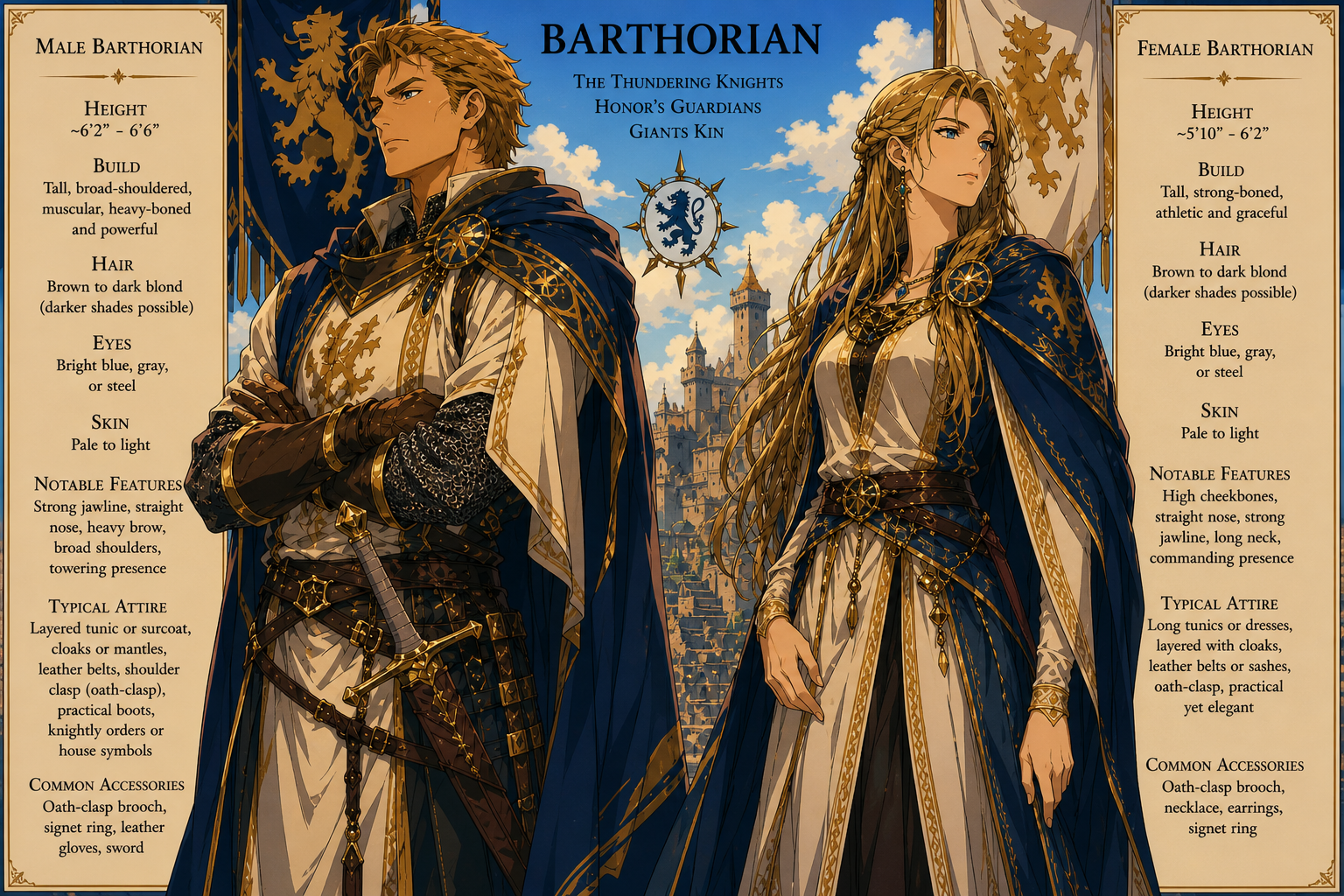
Associations
Other pages that reference or connect to this race
Referenced By
5Collections
Published collections that feature this race
Not in any collections yet
This race hasn't been published in any collections yet. Collections are curated groups of related content that help organize and showcase your world.
Tip: Collections are a great way to group related content together and share themed stories or worldbuilding elements with others.
Timelines
Timelines that reference or include this race
No timeline connections yet
This race isn't connected to any timelines yet. Timelines help organize events chronologically and show how your content fits into the broader history of your world.
Tip: Create timelines to organize important events in your world's history. Link characters, locations, and other content to specific events to build rich, interconnected narratives.
Shares
Discussion about this race
No shares yet
Be the first to start a discussion about this race by sharing it to the community stream.
Privacy & Sharing
Manage who can see and access this race
Current Status
refresh
This race is currently
Privacy Settings
Choose who can see and access this race
language Universe Privacy
This page belongs to a universe with its own privacy settings