
Categories
Dive Deeper
Page Stats
Navigation
Categories
Dive Deeper
Page Stats
Complete Details
All information about this character
Overview
Aideen the Red
Aideen the Red is one of the oldest living Atlanians known to still walk the world, though most who remember her name know her only through broken heroic songs, mountain legends, and demon-slaying tales from before the formal beginning of the First Age. Born among the early tribes of the Guardian Mountain region in a time before Atlanian mysticism, formal houses, royal lineages, or settled noble law, Aideen belonged to a harsher and more immediate world, one where the mountain gods still spoke directly to their people and demon armies made the lowlands nearly unlivable. To later generations she became the Red Chieftain, the Demon Slayer, and the warrior who united the scattered Guardian Mountain tribes long enough to drive back the demon hosts and slay the Demon Lord Ostralan.
The legend claims that Aideen died after her final battle, mortally wounded by Ostralan and carried into myth by the glory of her victory. The truth is stranger and crueler. Rather than dying on the battlefield, Aideen was taken by astral beings and enslaved upon the Astral Sea, vanishing from the material world for thousands of years while her deeds hardened into sacred memory. By the time she was rescued by House Hayes, the Atlania she had known was gone. Tribes had become houses, war-chiefs had become lords, old mountain compacts had become half-forgotten myth, and the people she once fought to protect had built an entire civilization upon the bones of ages she never lived through.
In the modern age, Aideen serves as a warrior and bodyguard in the retinue of House Hayes. Her loyalty is sincere, especially toward Andrew Hayes and those she recognizes as worthy guardians of Atlania, but she remains deeply out of place among contemporary nobles, courts, academies, and polished social customs. She is curt, brash, rough-spoken, and openly contemptuous of weakness when lives are at stake. Yet beneath her temper and bloodlust is a dependable protector, a brilliant battlefield commander, and a woman who still measures honor by whether one stands between their people and the monsters that come for them.
Aideen is most comfortable away from modern society, often preferring the Gray Forest of Armon-Kal to the cities and halls of Atlania. There, among stranger beings and older magics, her own strangeness feels less exposed. She is not pious in the modern Atlanian sense, because the religion of later Atlania did not exist when she was born. To her, gods are not abstract symbols or distant judges, but powers of mountain, storm, stone, and blood that once spoke plainly to those who lived beneath their shadows. Her closest divine bond is with Cùra the Guardian, whom she regards less as an object of worship and more as a terrible, beloved presence from the world she lost.
Aideen’s hatred of demons is not ideological, inherited, or ceremonial. It is personal memory. She saw the world when demons ruled the open lands, lost people to them, built an army to destroy them, and suffered millennia of enslavement after the battle that supposedly ended her life. This hatred extends, sometimes unfairly and dangerously, toward demon-blooded individuals, making her one of the more difficult ancient heroes for later generations to comfortably revere. She is a defender of Atlania, a relic of its pre-history, a living contradiction to its own legends, and a reminder that the heroic age was not cleaner, nobler, or kinder than the present. It was simply older, bloodier, and closer to the gods.
Red Chieftain, Demon Slayer,
Defender of Atlania and the Guardian Mountain
appears to be in her twenties, but is serveral thousand years old. She spent a considerable amount of time on the astral plane before joining the retinue of house Hayes
Female
Looks
N/A
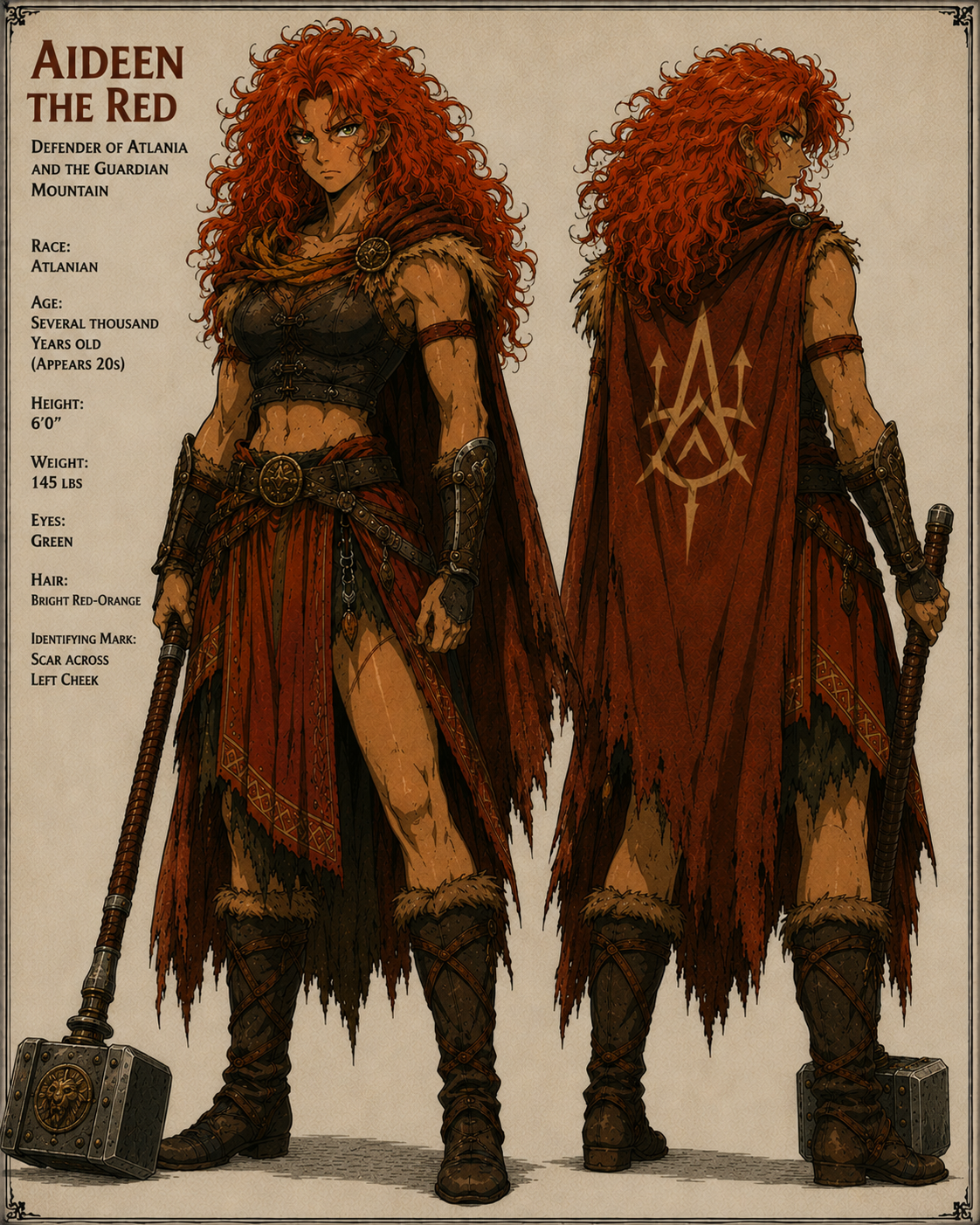
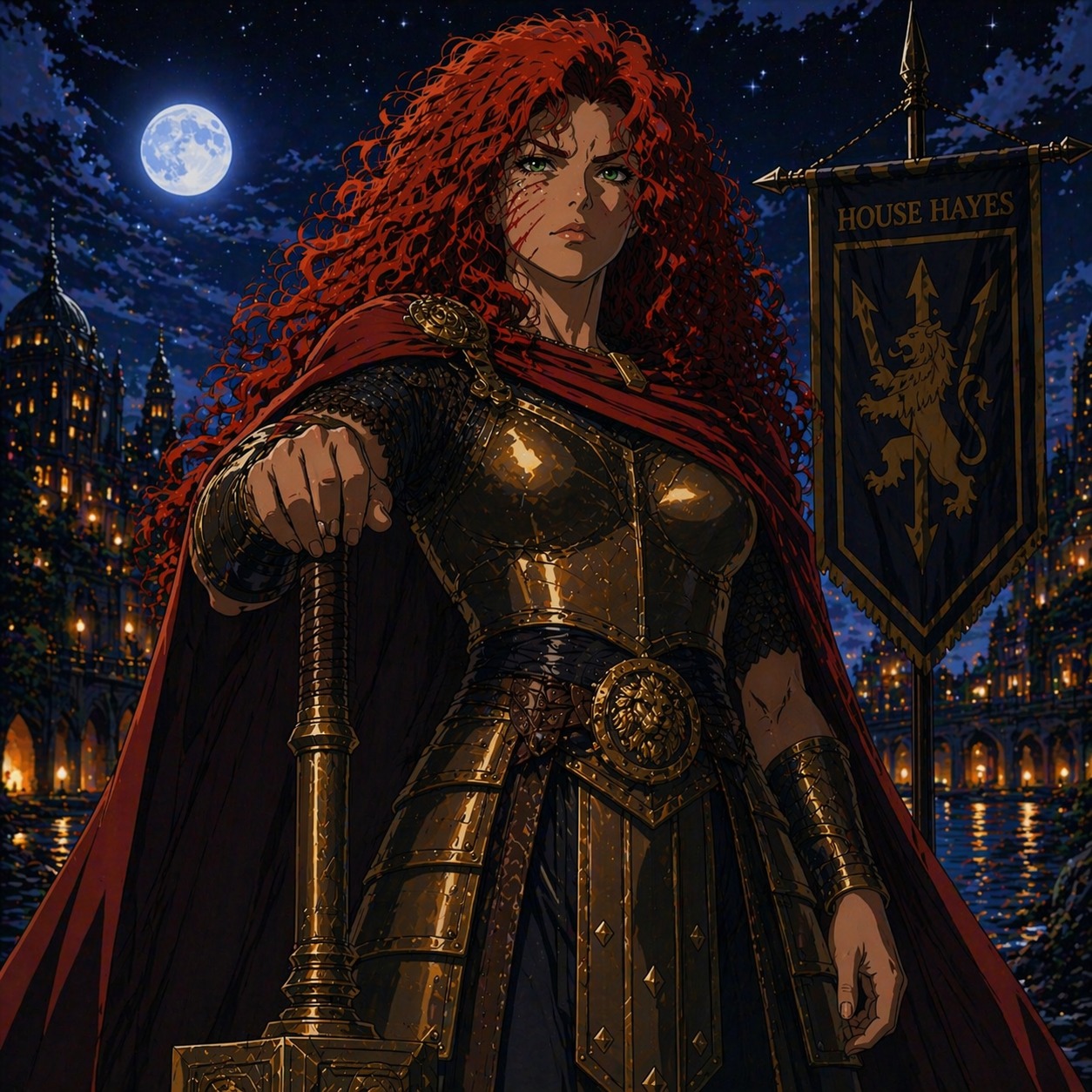
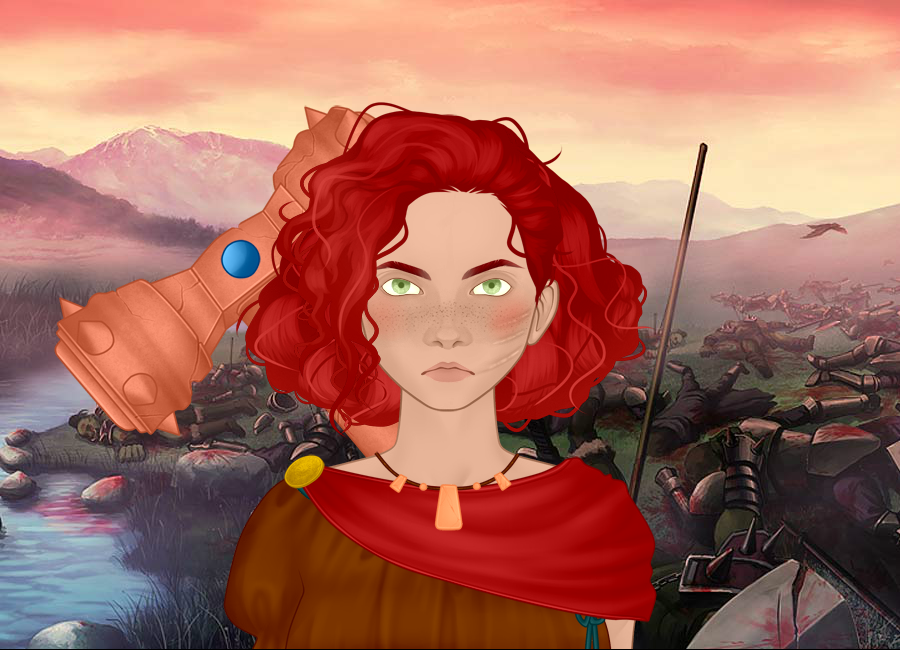
Shoulder length, usually worn loose or only roughly controlled. Her hair is naturally thick and unruly, with enough wave and curl that it often appears larger and wilder than its actual length. In battle or travel she may bind parts of it back for practicality, but she rarely wears it in polished courtly styles. Later legends often exaggerate her hair into a flowing mane of fire, but in life it is best understood as shoulder-length, vivid, and difficult to tame.
Aideen’s hair is a vivid bright red-orange, closer to flame, fresh copper, or storm-lit autumn leaves than to ordinary auburn. It is the feature most responsible for her title, “the Red,” and is striking enough that even people unfamiliar with her legend tend to notice it immediately. In older stories, her hair is often exaggerated into something almost supernatural, described as burning like fire around her head or trailing behind her like a war-banner. In truth, its color is natural by Atlanian standards, but unusually intense, making her instantly recognizable among both ancient mountain tribes and later House Hayes retainers. The shade also suits her preferred colors, especially brick orange, rust red, and other warm earth-and-fire tones.
Aideen stands at roughly six feet tall, placing her within the taller range for an Atlanian woman and giving her a naturally commanding presence. Her height suits both her old role as a tribal war-chieftain of the Guardian Mountain region and her later position as a bodyguard in the service of House Hayes. She does not carry herself delicately or try to soften her size; instead, she stands squarely, moves with confidence, and tends to occupy space like someone accustomed to being obeyed on a battlefield. Her height also reinforces the strange contrast between her youthful appearance and ancient presence, making her look like a warrior in her prime even though she is thousands of years older than she appears.
145lbs
Aideen’s clearest identifying mark is the scar across her left cheek, a visible reminder of the violent age she came from and the kind of battles that shaped her reputation. The scar does not disfigure her so much as harden her appearance, cutting through the youthful features she still possesses and making it harder to mistake her for an ordinary young warrior. Among those who know her legends, the mark is often treated as part of her image: red hair, green eyes, a warrior’s build, and the cheek scar of the Demon Slayer. It also gives her face a more severe, battle-worn quality, reinforcing the sense that Aideen is not a polished noblewoman or courtly retainer, but an ancient battlefield chieftain who survived horrors most modern Atlanians only know through myth.
Aideen is tall, strong, and well-muscled, with the practical build of a lifelong warrior rather than the sculpted refinement of a court-trained fighter. Her strength shows most clearly in her shoulders, arms, back, and stance, giving her the look of someone used to carrying a shield, swinging heavy weapons, and holding a battle line under pressure. She is not massive or heavy-bodied, but she is solid, athletic, and difficult to move, with dense muscle built through war, travel, and survival in harsh mountain country. Her body type reflects the older Guardian Mountain warrior culture she came from: direct, physical, enduring, and shaped by real violence rather than ceremony.
Aideen has lightly tanned skin, fitting her Atlanian heritage and her origin among the Guardian Mountain tribes. Her complexion suggests a life spent outdoors in highland sun, storm wind, and open campaigning rather than inside court halls or noble estates. It is not deeply dark, but it carries enough warmth to contrast clearly with her bright red-orange hair and green eyes. Like much of her appearance, her skin tone helps place her between the harsh physical world of ancient Atlania and her current role among later noble houses: she looks like someone shaped by mountain paths, battlefield camps, and exposed weather, not by sheltered luxury.
Atlanian
Aideen’s eyes are green, but not a soft or ordinary green. They have a sharp, flickering quality to them, like green fire seen through smoke or flame catching on polished emerald. In calm moments they may appear simply bright and watchful, but when she is angry, battle-ready, or deeply focused, they seem to kindle with an inner heat. Most people assume this is merely the intensity of her expression or another embellishment added to the legend of Aideen the Red. In truth, the strange living quality in her eyes is tied to the Primordial Fire of Life, a power she carries without most people understanding its nature. Only Cùra the Guardian truly knows what burns within her, and Aideen herself may not fully grasp how much of that ancient flame shows through when her temper, will, or life-force rises close to the surface.
Nature
That makes Aideen’s distrust much stronger and more reasonable. It should not be framed as paranoia so much as hard-earned survival instinct. In Sol Saris, the Astral Sea is not a wondrous neutral plane; it is a predatory expanse where most native powers see mortals as prey, property, curiosities, or food. So Aideen’s hatred of astral beings fits both her personal trauma and the broader reality of the setting.
Here is a tightened version for the field:
Prejudices - What prejudices does Aideen the Red have?
Aideen holds a deep and often violent hatred for demons, demonkind, and anything she recognizes as infernal in origin. This hatred is not symbolic or inherited from later Atlanian beliefs; it comes from direct experience. She was born into an age when demon armies roamed the lands, when the mountains were among the only safe refuges left, and when survival required meeting infernal horror with force. To Aideen, demons are not distant mythic enemies. They are butchers, invaders, and the monsters that defined the bloodiest years of her life.
This prejudice extends, more dangerously, toward demon-blooded individuals and peoples touched by the Infernal Plane, including the Sarathi. Aideen can recognize that the Sarathi are not simply demons, and that many were changed by infernal forces rather than willingly born from them, but that distinction does not make her comfortable. She struggles to separate infernal influence from infernal guilt, especially when she sees demonic traits, infernal magic, or customs that remind her of the enemies she once fought. Her treatment of demon-blooded people can therefore be harsh, suspicious, and unfair, even when they have done nothing to earn her hostility.
Aideen also has an absolute distrust of beings from the Astral Sea. This is partly personal, as she was taken by astral slavers after her battle with Ostralan and spent uncounted ages in captivity, but it is also rooted in the nature of the Astral Sea itself. To Aideen, astral beings are not mysterious travelers or strange foreign powers. They are predators from a cruel and unkind realm, beings who often view mortals from ordinary space as prey, property, toys, or meals. She does not believe they can be safely trusted, negotiated with, or treated as harmless.
Even the Halafin, whom she grudgingly accepts through House Hayes and Armon-Kal, do not fully escape this suspicion. Aideen understands that the Halafin are among the least monstrous powers connected to that broader otherworldly sphere, and she knows they once fought the horrors of the Astral Sea, but she still keeps them at a distance. Their inhuman nature, old empire, and fae-like detachment make them difficult for her to trust completely. She may live among them and cooperate with them, but she does so with the guarded instincts of someone who knows that in the Astral Sea, trust is often the first step toward being chained, eaten, or owned.
Because of this, Aideen often struggles with modern customs, noble etiquette, political subtlety, and peaceful civilian life. She can learn, and she has learned a great deal since her rescue, but she does not naturally think like a modern Atlanian. She still understands the world through older patterns: tribe, war-band, oath, territory, divine presence, enemy, protector, and captive. This makes her dependable in crisis but difficult in ordinary life. She is far more comfortable preparing for battle than attending court, far more at ease guarding a mountain pass than navigating noble conversation.
Aideen often withdraws to the Gray Forest of Armon-Kal because it offers a kind of relief from the burden of belonging nowhere. Among the Halafin, House Hayes, and the strange half-astral nature of Armon-Kal, she is still uncomfortable, but not quite as visibly out of place. The forest’s danger, age, and otherworldly atmosphere suit her better than cities, academies, or courtly halls. She does not fit easily among modern Atlanians, but in the Gray Forest, surrounded by strangeness and old powers, her own strangeness feels less exposed.
Aideen is curt, rough-spoken, and direct in nearly everything she does. She does not soften her words for politeness, and she has little patience for the layered courtesy, implication, and verbal fencing common among modern nobles. When she speaks, she tends to say exactly what she means, often in the tone of someone giving battlefield instructions rather than making conversation. This can make her seem rude, even when she is not trying to be cruel. To Aideen, clarity is a virtue, and wasted words can get people killed.
She carries herself like a war-leader even when she is technically serving as a retainer or bodyguard. She stands squarely, watches entrances, studies people’s hands, and keeps herself positioned where she can intercept danger quickly. In unfamiliar places, she often seems restless, not because she is afraid, but because she is constantly measuring threats, exits, terrain, and lines of attack. She is at her calmest when a situation is dangerous enough to make sense to her.
Aideen is dependable in a very physical, practical way. She may complain, snap, or insult someone’s judgment, but once she has accepted a duty, she follows through with absolute seriousness. If she says she will guard a door, hold a line, or escort someone through hostile ground, she treats that promise as binding. Her loyalty is not sentimental in its expression; she shows care by standing watch, giving blunt warnings, checking weapons, placing herself between danger and those under her protection, and remembering who has earned her trust.
Aideen is driven by a mixture of personal glory, protective duty, and vengeance. She was born in an age where glory was not vanity, but proof that a warrior had done something worthy of remembrance, and she still wants her deeds to matter in that older, harsher sense. At the same time, she remains fiercely committed to the safety of Atlania, especially the Guardian Mountain region and those she has accepted under her protection through House Hayes. Beneath both motives is a colder, more personal hunger: the desire to see her former astral captors destroyed, punished, or at least denied the power to take anyone else as they once took her.
Aideen’s greatest flaws are her short temper, bloodlust, and difficulty adapting to a world no longer shaped by the brutal survival rules of her youth. She is quick to anger, especially when faced with hesitation, cowardice, demonic influence, or anything that reminds her of captivity, and once violence begins she can be difficult to pull back from. Her hatred of demons often spills unfairly onto demon-blooded peoples such as the Sarathi, making her suspicious even of those who have done nothing to earn it. She also struggles with modern customs, diplomacy, and restraint, often treating peaceful compromise as weakness when it may actually be wisdom.
Aideen is a brilliant strategist, battlefield leader, and front-line warrior, with an instinctive understanding of terrain, morale, timing, and the breaking point of an enemy force. Her talents were proven in the Guardian Mountain region, where she united scattered tribes into an army capable of driving back demons and eventually defeating the Demon Lord Ostralan. She is especially skilled at leading desperate battles, holding defensive lines, and turning harsh ground to her advantage. Though rough in ordinary conversation, she becomes sharply focused in war, able to read a battlefield quickly and command warriors through fear, pressure, and chaos.
Aideen’s hobbies are writing poetry, dancing, and war-making, though she approaches all three in an older and rougher style than modern Atlanians might expect. Her poetry is likely spare, forceful, and shaped by mountains, storms, grief, glory, captivity, and battle rather than delicate courtly romance. Her dancing is similarly physical, rooted more in tribal celebration, firelight, victory, mourning, and war-camp rhythm than polished noble forms. War-making, for Aideen, is not merely an occupation but a craft she continues to study, practice, and refine, whether through weapon drills, tactical planning, or judging how best to break an enemy before they can threaten what she protects.
Aideen is brash, blunt, proud, and fiercely martial, with little patience for delicate manners or the expectations placed on noblewomen in later Atlanian society. She is not “unladylike” because she is careless or crude for its own sake, but because she comes from an older world where survival, command, courage, and strength mattered far more than courtly refinement. She is quick to speak, quick to anger, and often intimidating in ordinary company, yet she is also deeply dependable once her loyalty is earned. At her core, Aideen is a war-chieftain displaced into a softer age: rough, glory-hungry, protective, vengeful, and far more comfortable facing monsters than pretending to enjoy polite society.
Social
Roasted turkey
Monitor Lizards
Hammers
Her shield medallion
brick orange
Warrior and bodyguard to house Hayes
Aideen’s politics are tribal, oath-bound, and deeply tied to House Hayes rather than to modern ideology. She was born before Atlania’s later noble structures fully existed, so she does not naturally think in terms of courts, parties, bureaucracy, or legal theory. To her, legitimate authority comes from strength, proven courage, the ability to protect one’s people, and the keeping of oaths. She understands chiefs, war-leaders, sworn companions, bloodlines, sacred territory, and personal loyalty far more easily than she understands modern statecraft. Her loyalty to House Hayes is therefore not abstract patriotism, but a warrior’s allegiance to a household she believes has earned her service and trust.
Aideen does not practice modern Atlanian mysticism in the formal sense, because she was born before that religious structure truly existed. In her youth, the mountain gods were not distant figures approached through inherited rites and later doctrine; they were immediate, local powers who could speak, act, bargain, protect, punish, and be encountered by those who lived near their mountains. Because of this, Aideen’s beliefs are older, rougher, and more personal than modern religion. She does not “worship” the gods as abstractions so much as acknowledge them as powerful beings she has known, feared, honored, and sometimes relied upon. Her bond with Cùra the Guardian is especially important, though she treats Cùra less like an untouchable deity and more like a terrible, beloved presence from the world she lost.
Bodyguard
History
Early in the storm season
Aideen was born to a small Atlanian tribe in the Guardian Mountain region before the First Age, in a time before noble houses, formal Atlanian mysticism, or settled royal law. When she was still a young woman, demon armies roamed the lands and the mountains were among the only places where mortals could survive. Rather than allow the scattered tribes of the region to be destroyed one by one, Aideen conquered, bound, or rallied them beneath her command, creating an army strong enough to drive the demons back. Her campaigns made her a legendary war-chieftain, and her greatest victory came when she slew the Demon Lord Ostralan. Later tradition claims she was mortally wounded in that battle and died after saving her people, but the truth is crueler: Aideen was taken by astral beings and enslaved upon the Astral Sea, vanishing from the world for uncounted ages while her deeds became myth. She was eventually rescued by House Hayes and entered their service as a warrior and bodyguard, though she returned to an Atlania that no longer resembled the world she had saved. During the later demon plague, Aideen once again joined the defense of Atlania, proving that the ancient Demon Slayer was not merely a legend, but a living weapon still willing to stand against the horrors of her youth.
Aideen was born before formal schooling existed in Atlania, so her early education was practical, oral, and survival-based rather than academic. She learned through elders, warriors, priests or god-touched figures, lived experience, and the brutal necessities of life in the Guardian Mountain region during the demon wars. Her original knowledge centered on warfare, leadership, terrain, weather, tribal custom, oath-keeping, hunting, weapon use, and the old relationships between mortals and the mountain gods. Since being rescued from the Astral Sea, she has learned a considerable amount about the modern world, but unevenly. She can understand strategy, history, magic, and politics when they are tied to action or survival, but struggles more with formal scholarship, courtly etiquette, bureaucracy, and social customs that seem unnecessary or artificial to her.
Family
Inventory
Notes
Hanna Aileanach Talakar Mardrein as a child but they are distantly related, being from the same bloodline just thousands of years apart.
Overview
Details about this character's overview
Aideen the Red
Aideen the Red is one of the oldest living Atlanians known to still walk the world, though most who remember her name know her only through broken heroic songs, mountain legends, and demon-slaying tales from before the formal beginning of the First Age. Born among the early tribes of the Guardian Mountain region in a time before Atlanian mysticism, formal houses, royal lineages, or settled noble law, Aideen belonged to a harsher and more immediate world, one where the mountain gods still spoke directly to their people and demon armies made the lowlands nearly unlivable. To later generations she became the Red Chieftain, the Demon Slayer, and the warrior who united the scattered Guardian Mountain tribes long enough to drive back the demon hosts and slay the Demon Lord Ostralan.
The legend claims that Aideen died after her final battle, mortally wounded by Ostralan and carried into myth by the glory of her victory. The truth is stranger and crueler. Rather than dying on the battlefield, Aideen was taken by astral beings and enslaved upon the Astral Sea, vanishing from the material world for thousands of years while her deeds hardened into sacred memory. By the time she was rescued by House Hayes, the Atlania she had known was gone. Tribes had become houses, war-chiefs had become lords, old mountain compacts had become half-forgotten myth, and the people she once fought to protect had built an entire civilization upon the bones of ages she never lived through.
In the modern age, Aideen serves as a warrior and bodyguard in the retinue of House Hayes. Her loyalty is sincere, especially toward Andrew Hayes and those she recognizes as worthy guardians of Atlania, but she remains deeply out of place among contemporary nobles, courts, academies, and polished social customs. She is curt, brash, rough-spoken, and openly contemptuous of weakness when lives are at stake. Yet beneath her temper and bloodlust is a dependable protector, a brilliant battlefield commander, and a woman who still measures honor by whether one stands between their people and the monsters that come for them.
Aideen is most comfortable away from modern society, often preferring the Gray Forest of Armon-Kal to the cities and halls of Atlania. There, among stranger beings and older magics, her own strangeness feels less exposed. She is not pious in the modern Atlanian sense, because the religion of later Atlania did not exist when she was born. To her, gods are not abstract symbols or distant judges, but powers of mountain, storm, stone, and blood that once spoke plainly to those who lived beneath their shadows. Her closest divine bond is with Cùra the Guardian, whom she regards less as an object of worship and more as a terrible, beloved presence from the world she lost.
Aideen’s hatred of demons is not ideological, inherited, or ceremonial. It is personal memory. She saw the world when demons ruled the open lands, lost people to them, built an army to destroy them, and suffered millennia of enslavement after the battle that supposedly ended her life. This hatred extends, sometimes unfairly and dangerously, toward demon-blooded individuals, making her one of the more difficult ancient heroes for later generations to comfortably revere. She is a defender of Atlania, a relic of its pre-history, a living contradiction to its own legends, and a reminder that the heroic age was not cleaner, nobler, or kinder than the present. It was simply older, bloodier, and closer to the gods.
Red Chieftain, Demon Slayer,
Defender of Atlania and the Guardian Mountain
appears to be in her twenties, but is serveral thousand years old. She spent a considerable amount of time on the astral plane before joining the retinue of house Hayes
Female
Looks
Details about this character's looks
N/A
Shoulder length, usually worn loose or only roughly controlled. Her hair is naturally thick and unruly, with enough wave and curl that it often appears larger and wilder than its actual length. In battle or travel she may bind parts of it back for practicality, but she rarely wears it in polished courtly styles. Later legends often exaggerate her hair into a flowing mane of fire, but in life it is best understood as shoulder-length, vivid, and difficult to tame.
Aideen’s hair is a vivid bright red-orange, closer to flame, fresh copper, or storm-lit autumn leaves than to ordinary auburn. It is the feature most responsible for her title, “the Red,” and is striking enough that even people unfamiliar with her legend tend to notice it immediately. In older stories, her hair is often exaggerated into something almost supernatural, described as burning like fire around her head or trailing behind her like a war-banner. In truth, its color is natural by Atlanian standards, but unusually intense, making her instantly recognizable among both ancient mountain tribes and later House Hayes retainers. The shade also suits her preferred colors, especially brick orange, rust red, and other warm earth-and-fire tones.
Aideen stands at roughly six feet tall, placing her within the taller range for an Atlanian woman and giving her a naturally commanding presence. Her height suits both her old role as a tribal war-chieftain of the Guardian Mountain region and her later position as a bodyguard in the service of House Hayes. She does not carry herself delicately or try to soften her size; instead, she stands squarely, moves with confidence, and tends to occupy space like someone accustomed to being obeyed on a battlefield. Her height also reinforces the strange contrast between her youthful appearance and ancient presence, making her look like a warrior in her prime even though she is thousands of years older than she appears.
145lbs
Aideen’s clearest identifying mark is the scar across her left cheek, a visible reminder of the violent age she came from and the kind of battles that shaped her reputation. The scar does not disfigure her so much as harden her appearance, cutting through the youthful features she still possesses and making it harder to mistake her for an ordinary young warrior. Among those who know her legends, the mark is often treated as part of her image: red hair, green eyes, a warrior’s build, and the cheek scar of the Demon Slayer. It also gives her face a more severe, battle-worn quality, reinforcing the sense that Aideen is not a polished noblewoman or courtly retainer, but an ancient battlefield chieftain who survived horrors most modern Atlanians only know through myth.
Aideen is tall, strong, and well-muscled, with the practical build of a lifelong warrior rather than the sculpted refinement of a court-trained fighter. Her strength shows most clearly in her shoulders, arms, back, and stance, giving her the look of someone used to carrying a shield, swinging heavy weapons, and holding a battle line under pressure. She is not massive or heavy-bodied, but she is solid, athletic, and difficult to move, with dense muscle built through war, travel, and survival in harsh mountain country. Her body type reflects the older Guardian Mountain warrior culture she came from: direct, physical, enduring, and shaped by real violence rather than ceremony.
Aideen has lightly tanned skin, fitting her Atlanian heritage and her origin among the Guardian Mountain tribes. Her complexion suggests a life spent outdoors in highland sun, storm wind, and open campaigning rather than inside court halls or noble estates. It is not deeply dark, but it carries enough warmth to contrast clearly with her bright red-orange hair and green eyes. Like much of her appearance, her skin tone helps place her between the harsh physical world of ancient Atlania and her current role among later noble houses: she looks like someone shaped by mountain paths, battlefield camps, and exposed weather, not by sheltered luxury.
Atlanian
Aideen’s eyes are green, but not a soft or ordinary green. They have a sharp, flickering quality to them, like green fire seen through smoke or flame catching on polished emerald. In calm moments they may appear simply bright and watchful, but when she is angry, battle-ready, or deeply focused, they seem to kindle with an inner heat. Most people assume this is merely the intensity of her expression or another embellishment added to the legend of Aideen the Red. In truth, the strange living quality in her eyes is tied to the Primordial Fire of Life, a power she carries without most people understanding its nature. Only Cùra the Guardian truly knows what burns within her, and Aideen herself may not fully grasp how much of that ancient flame shows through when her temper, will, or life-force rises close to the surface.
Nature
Details about this character's nature
That makes Aideen’s distrust much stronger and more reasonable. It should not be framed as paranoia so much as hard-earned survival instinct. In Sol Saris, the Astral Sea is not a wondrous neutral plane; it is a predatory expanse where most native powers see mortals as prey, property, curiosities, or food. So Aideen’s hatred of astral beings fits both her personal trauma and the broader reality of the setting.
Here is a tightened version for the field:
Prejudices - What prejudices does Aideen the Red have?
Aideen holds a deep and often violent hatred for demons, demonkind, and anything she recognizes as infernal in origin. This hatred is not symbolic or inherited from later Atlanian beliefs; it comes from direct experience. She was born into an age when demon armies roamed the lands, when the mountains were among the only safe refuges left, and when survival required meeting infernal horror with force. To Aideen, demons are not distant mythic enemies. They are butchers, invaders, and the monsters that defined the bloodiest years of her life.
This prejudice extends, more dangerously, toward demon-blooded individuals and peoples touched by the Infernal Plane, including the Sarathi. Aideen can recognize that the Sarathi are not simply demons, and that many were changed by infernal forces rather than willingly born from them, but that distinction does not make her comfortable. She struggles to separate infernal influence from infernal guilt, especially when she sees demonic traits, infernal magic, or customs that remind her of the enemies she once fought. Her treatment of demon-blooded people can therefore be harsh, suspicious, and unfair, even when they have done nothing to earn her hostility.
Aideen also has an absolute distrust of beings from the Astral Sea. This is partly personal, as she was taken by astral slavers after her battle with Ostralan and spent uncounted ages in captivity, but it is also rooted in the nature of the Astral Sea itself. To Aideen, astral beings are not mysterious travelers or strange foreign powers. They are predators from a cruel and unkind realm, beings who often view mortals from ordinary space as prey, property, toys, or meals. She does not believe they can be safely trusted, negotiated with, or treated as harmless.
Even the Halafin, whom she grudgingly accepts through House Hayes and Armon-Kal, do not fully escape this suspicion. Aideen understands that the Halafin are among the least monstrous powers connected to that broader otherworldly sphere, and she knows they once fought the horrors of the Astral Sea, but she still keeps them at a distance. Their inhuman nature, old empire, and fae-like detachment make them difficult for her to trust completely. She may live among them and cooperate with them, but she does so with the guarded instincts of someone who knows that in the Astral Sea, trust is often the first step toward being chained, eaten, or owned.
Because of this, Aideen often struggles with modern customs, noble etiquette, political subtlety, and peaceful civilian life. She can learn, and she has learned a great deal since her rescue, but she does not naturally think like a modern Atlanian. She still understands the world through older patterns: tribe, war-band, oath, territory, divine presence, enemy, protector, and captive. This makes her dependable in crisis but difficult in ordinary life. She is far more comfortable preparing for battle than attending court, far more at ease guarding a mountain pass than navigating noble conversation.
Aideen often withdraws to the Gray Forest of Armon-Kal because it offers a kind of relief from the burden of belonging nowhere. Among the Halafin, House Hayes, and the strange half-astral nature of Armon-Kal, she is still uncomfortable, but not quite as visibly out of place. The forest’s danger, age, and otherworldly atmosphere suit her better than cities, academies, or courtly halls. She does not fit easily among modern Atlanians, but in the Gray Forest, surrounded by strangeness and old powers, her own strangeness feels less exposed.
Aideen is curt, rough-spoken, and direct in nearly everything she does. She does not soften her words for politeness, and she has little patience for the layered courtesy, implication, and verbal fencing common among modern nobles. When she speaks, she tends to say exactly what she means, often in the tone of someone giving battlefield instructions rather than making conversation. This can make her seem rude, even when she is not trying to be cruel. To Aideen, clarity is a virtue, and wasted words can get people killed.
She carries herself like a war-leader even when she is technically serving as a retainer or bodyguard. She stands squarely, watches entrances, studies people’s hands, and keeps herself positioned where she can intercept danger quickly. In unfamiliar places, she often seems restless, not because she is afraid, but because she is constantly measuring threats, exits, terrain, and lines of attack. She is at her calmest when a situation is dangerous enough to make sense to her.
Aideen is dependable in a very physical, practical way. She may complain, snap, or insult someone’s judgment, but once she has accepted a duty, she follows through with absolute seriousness. If she says she will guard a door, hold a line, or escort someone through hostile ground, she treats that promise as binding. Her loyalty is not sentimental in its expression; she shows care by standing watch, giving blunt warnings, checking weapons, placing herself between danger and those under her protection, and remembering who has earned her trust.
Aideen is driven by a mixture of personal glory, protective duty, and vengeance. She was born in an age where glory was not vanity, but proof that a warrior had done something worthy of remembrance, and she still wants her deeds to matter in that older, harsher sense. At the same time, she remains fiercely committed to the safety of Atlania, especially the Guardian Mountain region and those she has accepted under her protection through House Hayes. Beneath both motives is a colder, more personal hunger: the desire to see her former astral captors destroyed, punished, or at least denied the power to take anyone else as they once took her.
Aideen’s greatest flaws are her short temper, bloodlust, and difficulty adapting to a world no longer shaped by the brutal survival rules of her youth. She is quick to anger, especially when faced with hesitation, cowardice, demonic influence, or anything that reminds her of captivity, and once violence begins she can be difficult to pull back from. Her hatred of demons often spills unfairly onto demon-blooded peoples such as the Sarathi, making her suspicious even of those who have done nothing to earn it. She also struggles with modern customs, diplomacy, and restraint, often treating peaceful compromise as weakness when it may actually be wisdom.
Aideen is a brilliant strategist, battlefield leader, and front-line warrior, with an instinctive understanding of terrain, morale, timing, and the breaking point of an enemy force. Her talents were proven in the Guardian Mountain region, where she united scattered tribes into an army capable of driving back demons and eventually defeating the Demon Lord Ostralan. She is especially skilled at leading desperate battles, holding defensive lines, and turning harsh ground to her advantage. Though rough in ordinary conversation, she becomes sharply focused in war, able to read a battlefield quickly and command warriors through fear, pressure, and chaos.
Aideen’s hobbies are writing poetry, dancing, and war-making, though she approaches all three in an older and rougher style than modern Atlanians might expect. Her poetry is likely spare, forceful, and shaped by mountains, storms, grief, glory, captivity, and battle rather than delicate courtly romance. Her dancing is similarly physical, rooted more in tribal celebration, firelight, victory, mourning, and war-camp rhythm than polished noble forms. War-making, for Aideen, is not merely an occupation but a craft she continues to study, practice, and refine, whether through weapon drills, tactical planning, or judging how best to break an enemy before they can threaten what she protects.
Aideen is brash, blunt, proud, and fiercely martial, with little patience for delicate manners or the expectations placed on noblewomen in later Atlanian society. She is not “unladylike” because she is careless or crude for its own sake, but because she comes from an older world where survival, command, courage, and strength mattered far more than courtly refinement. She is quick to speak, quick to anger, and often intimidating in ordinary company, yet she is also deeply dependable once her loyalty is earned. At her core, Aideen is a war-chieftain displaced into a softer age: rough, glory-hungry, protective, vengeful, and far more comfortable facing monsters than pretending to enjoy polite society.
Social
Details about this character's social
Roasted turkey
Monitor Lizards
Hammers
Her shield medallion
brick orange
Warrior and bodyguard to house Hayes
Aideen’s politics are tribal, oath-bound, and deeply tied to House Hayes rather than to modern ideology. She was born before Atlania’s later noble structures fully existed, so she does not naturally think in terms of courts, parties, bureaucracy, or legal theory. To her, legitimate authority comes from strength, proven courage, the ability to protect one’s people, and the keeping of oaths. She understands chiefs, war-leaders, sworn companions, bloodlines, sacred territory, and personal loyalty far more easily than she understands modern statecraft. Her loyalty to House Hayes is therefore not abstract patriotism, but a warrior’s allegiance to a household she believes has earned her service and trust.
Aideen does not practice modern Atlanian mysticism in the formal sense, because she was born before that religious structure truly existed. In her youth, the mountain gods were not distant figures approached through inherited rites and later doctrine; they were immediate, local powers who could speak, act, bargain, protect, punish, and be encountered by those who lived near their mountains. Because of this, Aideen’s beliefs are older, rougher, and more personal than modern religion. She does not “worship” the gods as abstractions so much as acknowledge them as powerful beings she has known, feared, honored, and sometimes relied upon. Her bond with Cùra the Guardian is especially important, though she treats Cùra less like an untouchable deity and more like a terrible, beloved presence from the world she lost.
Bodyguard
History
Details about this character's history
Early in the storm season
Aideen was born to a small Atlanian tribe in the Guardian Mountain region before the First Age, in a time before noble houses, formal Atlanian mysticism, or settled royal law. When she was still a young woman, demon armies roamed the lands and the mountains were among the only places where mortals could survive. Rather than allow the scattered tribes of the region to be destroyed one by one, Aideen conquered, bound, or rallied them beneath her command, creating an army strong enough to drive the demons back. Her campaigns made her a legendary war-chieftain, and her greatest victory came when she slew the Demon Lord Ostralan. Later tradition claims she was mortally wounded in that battle and died after saving her people, but the truth is crueler: Aideen was taken by astral beings and enslaved upon the Astral Sea, vanishing from the world for uncounted ages while her deeds became myth. She was eventually rescued by House Hayes and entered their service as a warrior and bodyguard, though she returned to an Atlania that no longer resembled the world she had saved. During the later demon plague, Aideen once again joined the defense of Atlania, proving that the ancient Demon Slayer was not merely a legend, but a living weapon still willing to stand against the horrors of her youth.
Aideen was born before formal schooling existed in Atlania, so her early education was practical, oral, and survival-based rather than academic. She learned through elders, warriors, priests or god-touched figures, lived experience, and the brutal necessities of life in the Guardian Mountain region during the demon wars. Her original knowledge centered on warfare, leadership, terrain, weather, tribal custom, oath-keeping, hunting, weapon use, and the old relationships between mortals and the mountain gods. Since being rescued from the Astral Sea, she has learned a considerable amount about the modern world, but unevenly. She can understand strategy, history, magic, and politics when they are tied to action or survival, but struggles more with formal scholarship, courtly etiquette, bureaucracy, and social customs that seem unnecessary or artificial to her.
Family
Details about this character's family
Inventory
Details about this character's inventory
Changelog
Details about this character's changelog
No changelog information yet
This section doesn't have any information filled in yet.
Notes
Details about this character's notes
Hanna Aileanach Talakar Mardrein as a child but they are distantly related, being from the same bloodline just thousands of years apart.
Gallery
Images and visual content for this character

Associations
Other pages that reference or connect to this character
Referenced By
13Andrew Hayes
Best friends
Atlanian Peninsula
Leaders
Melidia
Companions
Lisbith Duron Lord of Gurdacrest Commander of the Third Army
Best friends
Atlanian
Famous figures
Dendre
Enemies
Kusha
Friends
Liam Ardenthal of House Hayes
Friends
Robert Dùghlas LeTreis
Friends
Nendara
Best friends
Nendara
Love interests
Brìde Ceanadach
Friends
Paloa
Companions
Collections
Published collections that feature this character
Not in any collections yet
This character hasn't been published in any collections yet. Collections are curated groups of related content that help organize and showcase your world.
Tip: Collections are a great way to group related content together and share themed stories or worldbuilding elements with others.
Timelines
Timelines that reference or include this character
No timeline connections yet
This character isn't connected to any timelines yet. Timelines help organize events chronologically and show how your content fits into the broader history of your world.
Tip: Create timelines to organize important events in your world's history. Link characters, locations, and other content to specific events to build rich, interconnected narratives.
Shares
Discussion about this character
No shares yet
Be the first to start a discussion about this character by sharing it to the community stream.
Privacy & Sharing
Manage who can see and access this character
Current Status
refresh
This character is currently
Privacy Settings
Choose who can see and access this character
language Universe Privacy
This page belongs to a universe with its own privacy settings